



Abstract
The current study proposes a heuristic model for classification of female offenders into groups based on key variables relevant to women’s backgrounds and programming needs. We utilize a mixed-methods approach with a sample of 60 women incarcerated in a maximum-security prison. We develop qualitative, person-centered groupings of female offenders, and then use quantitative analyses to provide more detailed data on each group. Findings demonstrate five distinct groupings: aggressive career offenders, women who killed or assaulted persons in retaliation or self-defense, women who maltreated children, substance-dependent women experiencing intimate partner violence (IPV), and social capital offenders. These findings lend support to prior research on pathways and typologies of women’s offending, and decision rules effectively “triage” cases according to most pressing needs. The model offers unique utility for researchers, practitioners, and policy makers working with women in the criminal legal system.
Introduction
Researchers have attempted to examine women’s pathways to crime using both qualitative and quantitative methodologies, sampling women involved in the criminal legal system in diverse settings, and yielding findings on pathways to criminal offending, mechanisms associated with these, and resulting taxonomies of offenders. Yet, there still exists no definitive articulation of women’s pathways to offending, and extant findings are somewhat difficult to navigate for practical purposes. In the present study, we utilize a sample of 60 incarcerated women to develop a model proposed as a heuristic to guide future research and practice, specifying a typology of female offenders developed with consideration of both qualitative case dynamics and life experiences germane to women’s programming needs. The model has potential for unique utility for researchers, practitioners, and policy makers working with women in the criminal legal system. Here, we describe key studies that set the foundation for the present study, rationale for our work, and implications of the resulting model for research, practice, and policy.
Prior Studies of Women’s Pathways
The feminist pathways perspective on crime emphasizes unique risks that girls and women face as contributors to their entry into or escalation of delinquent and criminal offending. As Salisbury and Van Voorhis (2009) note, this approach is based on the idea that girls and women are differentially exposed to or differentially respond to risks for criminal behavior than do boys and men. Thus, while there may be gender-neutral factors such as education, criminal history, and criminal networks that are associated with both women’s and men’s crime and recidivism, there also exist gender-responsive factors such as victimization and mental health that play a more prominent role in the criminal offending of women than that of men (Brennan, Breitenbach, Dieterich, Salisbury, & Van Voorhis, 2012). This perspective recognizes differences in delinquent/criminal development not only between men and women but also within groups of women (Wattanporn & Holtfreter, 2014). The pathways perspective has explanatory value in addressing the etiology and progression of crime, as well as pragmatic applicability in addressing risks for offending, resource and programming needs, and responsivity to justice and service interventions (Andrews & Bonta, 1994).
The pathways perspective built on research published in the late 1980s and early 1990s, when Chesney-Lind (1989) noted the inadequacy of major delinquency theories in explaining female behavior and pointed to societal criminalization of survival strategies (e.g., running away from abuse, self-medicating with substances) as a key factor in girls’ involvement in the justice system. Using qualitative analysis of the life histories of 20 incarcerated women, Gilfus (1992) expounded upon themes of violence, neglect, and loss in the backgrounds of female offenders, demonstrating how marginalization from the mainstream pushed girls and women into delinquent and criminal subcultures. Gilfus also provided stark illustrations of the gendered nature of women’s options within these subcultures, pointing toward differential pathways to crime for males and females.
Daly (1992) utilized court reports and transcripts to identify subsets of cases based on characteristics such as female offenders’ past victimization, their substance use, and their criminal histories. Her qualitative analyses of 40 cases yielded a typology of women offenders based on their pathways to felony court. Daly termed the most frequent pathway to court (over one third of the sample) “harmed and harming women.” These women experienced chaotic childhoods characterized by physical and/or emotional abuse. Their histories of victimization were linked to addiction, inability to cope, and behavioral acting out. “Street women” comprised one fourth of the sample. They ran away or were forced out of abusive households and typically survived through making a living on the street through prostitution, theft, and drug dealing. The next most frequent group was termed “battered women.” Although other women in the sample may have experienced intimate partner violence (IPV), Daly believed that these women were unlikely to have ended up in felony court had they not been involved with abusive men. The remainder were “drug-connected women” (about 15% of the sample) who were involved with drugs via their relationships with partners or family members, and “others” (10% of sample) who committed crimes in response to immediate economic circumstances or greed.
Richie (1995) provided an in-depth, mixed-methods examination of the role of racial and gendered marginalization in women’s pathways to crime. Her study of 37 incarcerated women included both Black and White women, some who had experienced IPV and some who had not. Richie identified six pathways by which battered Black women were compelled to crime. “Women held hostage” were in severely abusive relationships and were too isolated and afraid to reach out for help. Within this group, Ritchie identified several women who were arrested for the death of one of their children. The second path, “projection and association,” described women who directed violence at men other than the batterer in a symbolic/projected retaliation for past abuse. “Sexual exploitation” was a pathway associated with women’s illegal sex work, the only source of commerce perceived by the women following early or repeated histories of child sexual victimization. “Fighting back” described the pathway of women who committed arson, property damage, or assaults toward their batterers. “Poverty,” quite simply, described economically motivated crimes. Ritchie underscored that life histories of these women often indicated that their partners portrayed themselves as more vulnerable to law enforcement, and thereby coerced the women into committing crimes. The final path, “addiction,” described women arrested for drug crimes—many of whom experienced IPV and described drug use as a means of connecting with their partners. In describing elements of gender entrapment of African American battered women, Richie cited (a) criminal activities as a response to violence or a threat thereof, (b) crimes as extensions of internalized gender roles and racial identity, (c) women’s role as protective of African American men who were vulnerable to institutionalized racism, and (d) some women turning themselves in as a strategy to avoid abuse.
In more recent years, research on female pathways to offending has included rigorous quantitative approaches. Simpson, Yahner, and Dugan (2008) attempted to test for factors represented in Daly’s (1992) classifications, instead of using quantitative factor analyses of variables assessed using computerized life event calendars with 351 jailed women awaiting trial or disposition. These researchers found two factors representing distinct groups of “street women,” including a factor representing high number of lifetime arrests, incarceration, and felony convictions, as well as a factor representing criminal networks. Another factor represented “harmed and harming” qualities including serious childhood abuse, violent victimization, and offensive violence in adulthood, including both partner and nonpartner violent incidents. A factor for “drug-connected” women was associated with unemployment, drug use, dealing, and drug-involvement of partners, as well as use of defensive violence against partners. The “battered women” factor was associated with violent victimization but not with defensive violence, but these women did sometimes co-offend with partners on property crimes unrelated to substance use. A final factor (“other women”) included older women from two-parent homes with later ages of criminal onset and sexual activity.
Salisbury and Van Voorhis (2009) conducted path analyses using risk/needs assessment data from 313 female probationers to predict recidivism. Three models accounted for repeat offending in this sample: (a) a childhood-victimization model through which trauma impacted depression, anxiety, and substance abuse; (b) a relational model by which dysfunctional adult relationships contributed to adult victimization, low self-efficacy, depression, anxiety, and substance abuse; and (c) a social capital model, by which deficits in self-efficacy, support, and education contributed to low employment, financial difficulties, and imprisonment.
Brennan and associates (Brennan, 2007; Brennan, Breitenbach, & Dieterich, 2010; Brennan et al., 2012) used a person-centered quantitative approach to identify latent subgroups of girls and women with similar profiles based on risk/needs assessment findings. These studies demonstrated the complexity of grouping female offenders along dimensions including victimization, mental health, relationships, housing, and family background. Brennan et al. (2012) nicely summarized consistent themes in prior pathways research, and identified four overarching groups (with eight total subgroups—often distinguished by age and parenting status) of women in a sample of 718 soon-to-be-released incarcerated women. These researchers described normal-functioning drug-dependent women with low levels of victimization, less marginalization, and low criminal history. There were also victimized/battered women with high levels of child and adult victimization, depression or other mental health issues, drug use, and use of retaliatory violence. Socialized subcultural women came from less stable housing but not as much childhood abuse, they had fewer mental health issues, and their crimes often involved drugs or trafficking. Finally, aggressive antisocial women were from high-crime abusive families, experienced IPV and mental health issues, and committed violent crimes.
The Current Study
The aforementioned studies have demonstrated threads of consistency over time, populations, and methodologies. For instance, the Brennan et al. (2012) victimized/battered group may overlap with Daly’s (1992) and Simpson et al.’s (2008) battered women or drug-connected women, Richie’s (1995) hostage or fighting back, or Salisbury and Van Voorhis’s (2009) childhood-victimization or relational paths. Similarly, Brennan et al.’s (2012) aggressive antisocial group could represent aspects of Daly’s (1992) and Simpson et al.’s (2008) harmed-and-harming, Richie’s (1995) projection, and so on. Yet, there is substantial variability across studies in methods and findings.
Collectively, these studies indicate somewhere between three and eight pathways to crime for women, with important themes of trauma, adversity, and substance abuse across studies. Yet, there are few rules of thumb by which to determine what types of offenders might characterize particular groups or pathways, and the group boundaries are amorphous enough that identifying group membership is subjective and often difficult. Although mathematical models of group assignment are evolving and can be implemented with special software in corrections settings (e.g., Brennan et al., 2012; Kilawee-Corsini, Pelletier, Zachary, & Brennan, 2016), these may be less feasible to adopt in some settings. Additional research is also needed to address a number of stated limitations of prior studies, including the prior focus on serious offenders (Brennan et al., 2012; Daly, 1992), focus on official data or administrative assessments (Brennan et al., 2012; Daly, 1992; Salisbury & Van Voorhis, 2009), inability of these methods to examine microlevel experiences such as cyclical life events or flare-ups of problem behavior (Brennan et al., 2012), differentiation of first offense versus repeated offending (Salisbury & Van Voorhis, 2009), and so on. For these reasons, there exists a need for a typology of female offenders that can be applied and refined to advance research, practice, and policy.
The current study is directed toward establishing a heuristic model for classification of female offenders into a cognitively coherent set of groups based on several key variables relevant to women’s backgrounds and programming needs. Our mixed-methods approach will synthesize qualitative and quantitative data to expand understanding of female offenders for pragmatic purposes (Creswell, 2003). First, we utilize a sample of 60 incarcerated women to develop qualitative, person-centered groupings of female offenders. Then, we identify and refine decision rules that best characterize membership in these groupings. This is done through an inductive, iterative process (Kekeya, 2016) in which we move back and forth between the case-level data, common themes that characterize the groups, and decision rules to define groups. Finally, we conduct descriptive and statistical analyses of quantifiable data to provide more detailed interpretation of resulting groups. We hope that this study will serve as a model, providing heuristic guidelines for a typology of female offenders and potentially leading to further multimethod examinations of women’s pathways to offending. This will allow future researchers to utilize decision rules on their own qualitative and quantitative data to systematically build knowledge on several specific pathways to female offending.
Method
Sampling
Participants were 60 women randomly sampled from a maximum-security state correctional facility in a Southeastern state in 2001-2002 (90% participation rate). All women were sampled in a broader study of incarcerated women (DeHart, 2008), and methods are described in great detail in the corresponding technical report to the funding agency (DeHart, 2004).
Measures
Open-ended interview prompts were originally developed to examine life course experiences in relation to victim-offender overlap, with topics addressed including both gender-responsive (e.g., family and relationship history, physical and psychological victimization) and gender-neutral factors (e.g., substance use, lifetime delinquency and crime, systemic involvement; for example, Brennan et al., 2012). Interview prompts and the original study rationale are described in full in DeHart (2004). It is important to note that constructs utilized in the current study were those that were systematically probed in the original interviews, including household composition, conditions of home and neighborhood, family substance use, physical/verbal/sexual abuse in the family of origin, other physical and sexual abuse, fighting in childhood, IPV, use of defensive violence, substance use, and involvement with the justice system.
Shorthand-style interview notes were transcribed by the interviewer immediately after each interview (Emerson, Fretz, & Shaw, 1995). The correctional institution also provided administrative records including women’s demographic characteristics, educational level, reading/math testing scores from the Wide Range Achievement Test (version unspecified in records), Beta intelligence scores (version unspecified), current offense and criminal history, and whether women had been identified at the facility as having a mental health problem.
Analyses
Sorting Cases
Data utilized for the current analyses had already been heavily coded in several prior studies (Bowles, DeHart, & Webb, 2012; Clone & DeHart, 2014; DeHart, 2008; DeHart & Altshuler, 2009; Wright, DeHart, Koons-Witt, & Crittenden, 2013), and abbreviated timelines of each woman’s narrative account were constructed using both the women’s accounts and their prison administrative records to delineate ages at which key events occurred in their lives. For the present study, our initial analyses consisted of reviewing each woman’s timeline and sorting cases into “piles” using the graphic interface (“network view”) of Atlas.ti qualitative analytic program (Version 8; Scientific Software, 2018). This sorting drew upon those gender-responsive and gender-neutral factors that were systematically probed in interviews, but sorting was not in itself driven by a particular theory or hypothesis. Rather, these piles were based on holistic perceptions of which offenders seemed most “alike” to develop subjectively cohesive groups, a common method for probing similarity in development of taxonomies (e.g., Boster & Johnson, 1989; DeHart et al., 2017; Weller & Romney, 1988). We did this for approximately one third of the total sample until cohesive groups seemed well established. The remainder of cases were not yet sorted as we wished to leave latitude within the sample to verify groupings once decision rules were established. This initial pile sort resulted in five preliminary groupings of female offenders: (a) generally violent women who experienced child victimization, IPV, and substance use and who demonstrated co-offending and more antisocial tendencies; (b) family-only violent women who experienced child victimization, either severe IPV or mental health problems, and were isolated/destabilized and lashed out in defensive/retaliatory violence or child abuse; (c) drug-using nonviolent women who experienced child victimization, IPV, and substance use and who often co-offend with partners; (d) drug-using women who experienced child victimization but no IPV; and (e) poor/low-capital women who experienced little victimization or substance use but substantial loss (e.g., of loved ones).
Establishing Decision Rules and Verifying Groups
We then examined cases within each cohesive group more thoroughly and attempted to identify specific decision rules that may help to define boundaries to differentiate each group from the others. We mapped out several decision rules that could be used in conjunction with one another to roughly determine which of the five piles cases might fall into (e.g., child physical or sexual victimization yes/no; intimate partner victimization yes/no; enacted harm to a person yes/no; enacted physical harm to a partner/ex or family/household member yes/no; enacted physical harm to someone other than a partner/ex or family/household member yes/no). We assigned two research assistants to review each woman’s full, uncoded narratives and assign the case a value based for each decision rule (e.g., 1 = present, 0 = absent). Given our detailed coding scheme and binary coding, this resulted in a very high rate of agreement among the two coders (97%). The author reconciled differences among the two raters using the prior heavy coding to identify specific instances of victimization, harm to a person, and so on. Using these data, we applied decision rules to all cases, classifying women into one of the groups. However, only four of the groups were well populated using this technique (i.e., there was only a single case to satisfy conditions of Group 4 above). The author examined cohesiveness and characteristics of each group and refined the decision model for the most straightforward decision model that maintained cohesiveness of groups.
Figure 1 shows a flowchart of final decision structure. If women committed any harm toward persons who were neither partners/ex-partners, nor family/household members, they were classified into a group that was later termed “aggressive career.” Next, any remaining women who committed harm specifically against partners/ex-partners and/or family/household members were classified as “family-only” offenders, with two groups of women: (a) those who committed harm that was defensive, retaliatory, or preemptive toward those who had been violent to the women or their loved ones (“retaliatory/defensive violence”), and (b) those who maltreated a child, either through physical abuse or through neglect (“child maltreatment”). For women who committed both retaliatory/defensive violence and child maltreatment, the woman’s most serious offense (as admitted by the woman or as charged) was used to determine which group she fell into. Then, any additional women who experienced IPV were classified into a group termed “substance dependence with IPV.” Finally, all remaining women were classified into a group termed “social capital.”

Decision Model for Classifying Female Offenders
It is helpful to explicitly address a number of difficult decision points in determining the decision-rule structure. First, in a few cases, women provided accounts of innocence, yet the courts found the women guilty of particular offenses. This was more likely in cases for which the women served in roles such as accessories or conspirators. For cases in which women served such secondary roles, we examined case codes and determined that for most codes, intent to commit the crime was established in the courts. Furthermore, for many such cases, the woman had also committed additional offenses that would have established her membership in the selected category. Thus, as a rule, we determined that—for purposes of classification—a woman committed an act (e.g., harm against a person) if she admitted to it OR if she were convicted of it. Second, some crimes resulting in charges of violence stemmed from acts of negligence (e.g., driving under the influence (DUI)–felony resulting in death, homicide by child abuse for drugs in baby’s system). Again, we examined cases and determined that sticking with strict decision rules in which these were considered violent offenses (as a function of foreseeable consequences) did not substantially attenuate cohesiveness of groups. Thus, for classification purposes, we maintained the law’s characterization of these crimes as inflicting harm against persons. For some offenses such as arson, if the woman set fire to property with no persons inside, the law deemed the crimes nonviolent, and we characterized decisions accordingly. For burglary, which was often admitted by women, but not evident in official charges, the crime can be charged as a violent offense and as nonviolent. For our sample, only a few women were charged using a code that can denote a violent burglary (second degree). Within these few cases, other acts of violence had also been committed and the women were thereby already classified as “aggressive career.” For other cases with charged or admitted burglary and no indication of violence, we deferred to the literature that the vast majority of burglary offenses are nonviolent (Kopp, 2016) and classified women accordingly. For classification purposes, drug crimes (e.g., trafficking/manufacturing) that are sometimes charged as violent were not characterized as harm against a person, in that closer examination of these cases demonstrated no indication of direct harm to a person and no victim/witness indicator in the record. Finally, violence in youth (i.e., fights under age 18) was not utilized for classification of women into groups but was noted for descriptive purposes. Finally, we examined cases as classified into each of the groups to examine group fit on a case-by-case basis, to assess extent to which groups were cohesive, and to identify salient themes for characterizing groups.
Descriptive and Inferential Analyses of Quantitative Data
Statistical analyses were conducted using SPSS (Version 24). Descriptive statistics were run on demographic and crime variables for the overall sample. To provide greater insight into dimensions upon which groups were similar and different, we compared the groups using ANOVA with Tukey post hoc tests for multiple comparisons and
Findings
Participants
Participants included 52% African Americans and 48% Whites, ranging in age from 18 to 70, with a median age of 31. The women were incarcerated for current offenses including murder (12%); voluntary manslaughter (12%); armed, strong-arm, or common-law robbery (12%); cocaine or crack manufacture, distribution, or trafficking (12%); homicide by child abuse (10%); forgery (8%); burglary (7%); arson (5%); shoplifting (5%); kidnapping (3%); assault and battery (3%); felony DUI (3%); child neglect (3%); lewd act on a child (2%); grand larceny (2%); and financial transaction card theft (2%). Sixty percent of the women had prior convictions.
Qualitative Typology
The decision model resulted in five groups of women, including aggressive career offenders, family-only offenders including those who used retaliatory/defensive violence and those who used child maltreatment, substance-dependent offenders experiencing IPV, and social capital offenders. Based on women’s qualitative accounts, each group is described in more detail below.
Aggressive Career Offenders
Women in the first group (n = 27) were termed “aggressive career” offenders due to their use of generalized violence (not just against partner or family/household members) and their multicrime backgrounds. Their crimes often included robbery, assault, and other violent offenses as well as burglary, larceny, fraud, prostitution, and shoplifting. Some of the women in this group offended primarily with co-offenders, but some women committed crimes on their own. Most of the women were heavily engaged in drug use or drinking, and most experienced IPV, often severe. Most had mental health problems, and a majority had prior experience in rehabilitation for substance use.
In their homes of origin, these women came from a mix of backgrounds, but about half were from poor households. In childhood, these women usually experienced verbal abuse, and a majority experienced sexual abuse, physical abuse, and neglect. Many witnessed violence in their homes or communities, sometimes involving extreme events such as death. Many engaged in fighting in childhood, and some were involved in gangs. A few of these women committed violence against partners or family members as well as against others.
Only a few women in this group did not use alcohol or drugs: two of these women otherwise fit the multicrime backgrounds, and the third woman had no prior history of crime other than her current conviction for the serial murderer of children in her care. There did exist a subset of women in this group who tended toward lesser criminal backgrounds. This included two women charged with felony DUI (i.e., harm of nonpartner by our decision rules) and whose other use of violence had been primarily directed at abusive partners in self-defense. Another woman had primarily used defensive violence against IPV, but was incarcerated for stabbing a man who was attacking her son. One woman had only a history of prostitution, but had once put a knife to the neck of man who propositioned her and was currently serving time for performing a lewd act on her child with her husband. Finally, there were four women who were implicated in murders of nonfamily members that involved a third party other than the victim (e.g., two involving romantic partners, one involving a romantic interest, and one involving a hitman). Again, it is important to note that we used strict adherence to decision rules that maximized overall cohesiveness within groups. However, it is important to note those cases that represent the poorest fit within each group to inform future research efforts.
Family Only Offenders—Retaliatory/Defensive Violence and Child Maltreatment
Those women who committed violence only toward partners, ex-partners, or family/household members included two types of offenders: those who aggressed in retaliation or defense of themselves or loved ones, and those who committed child abuse or neglect. Women in these two groups of offenders tended to have otherwise petty criminal histories, with offenses such as shoplifting, fraud, and prostitution. Their offending typically culminated in extreme crimes of murder, manslaughter, or homicide by child abuse. Most of the women were heavy users of drugs or alcohol, but the women were not as engaged in other types of drug offending (e.g., distribution) as women in other groups.
In their homes of origin, these women came from a mix of economic backgrounds. Most family-only offenders experienced IPV, which was often severe. In childhood, most of these women experienced sexual abuse, physical abuse, and verbal abuse. Of women in the retaliatory/defensive violence group, many of the women had also witnessed violence in their homes of origin and also demonstrated substantial mental health problems.
Of the women in the retaliatory/defensive violence group (n = 15), over a third were those that one typically might think of as battered women who kill their abusers. These women often experienced severe IPV, sometimes with additional sexual violence and stalking. They were most often convicted of voluntary manslaughter after events that involved direct attacks from the batterer. Several additional women had committed violent acts (sometimes severe) as a direct response to IPV, but these women were currently doing time for other offenses such as forgery, shoplifting, or larceny. The remaining third of women were involved in murders with a third party other than the victim. This included a woman who said her son killed the batterer, but she confessed; three women involved in “love triangle” murders with partners (all of which involved violence and/or coercion from one or both partners); and one young woman whose male friends murdered her nonoffending parent after severe sexual abuse (the woman was implicated in armed robbery during the event).
Of the women who maltreated children (n = 8), one attempted deliberate murder of both of her children after repeated, failed attempts to seek social and psychological support. Another lashed out in anger killing a child. Three were implicated in homicide by child abuse in cases involving a third party (two cases involving husbands and one involving roommates). Two women smoked crack while pregnant—one being convicted of homicide by child abuse when the baby died, and the other losing custody of children and serving time for other crimes. The final woman was charged with neglect for allegedly prostituting her daughter.
Substance Dependent Offenders Experiencing IPV
The women in this group of offenders (n = 6) were distinguished from more serious offenders in that their offending was nonviolent and largely related to the women’s dependence on alcohol and/or drugs. These women experienced IPV, and their drug use and offending were often linked to violent relationships in which they used drugs with their partners. Most of the women had multicrime careers with petty crimes like shoplifting, prostitution, and forgery to get drug money. Some also had drug-related offending such as distribution. One woman who had been primarily a drug user without prior offenses was convicted of arson after burning down a house—she had been behind in her mortgage and bills and also had been raped in the house a few days prior. Only one woman in the group was not a heavy user of drugs, and she described her crimes as coerced by her abusive partner.
In their households of origin, a majority of these women described middle class or wealthy families, and they often grew up with parents who were absentee—either because the parent(s) had died or through parental addiction to alcohol and/or drugs. All of these women experienced childhood verbal abuse, and many experienced physical or sexual abuse in childhood.
Social Capital Offenders
Women in the final group (n = 4) all grew up in rural settings in poor households. Their victimization histories were not as extreme as those of women from other groups, with no IPV victimization. Child victimization was limited to witnessed violence and/or isolated attempted assaults. Drug and alcohol use was variable in this group, ranging from little use to heavy use. All of the women in this group were serving time in relation to drug offending (e.g., distribution, manufacturing, trafficking), some of which was in relation to family or household members (e.g., delivering a package for a son). All of the women described these charges in relation to police “sting” operations or patterns of harassment by law enforcement. Most of the women were not engaged in other types of crime, although one of the women regularly engaged in prostitution for drug money and had charges for shoplifting and larceny. Table 1 displays key qualitative themes for each of the five groups of offenders.
Offender Group by Life Experiences
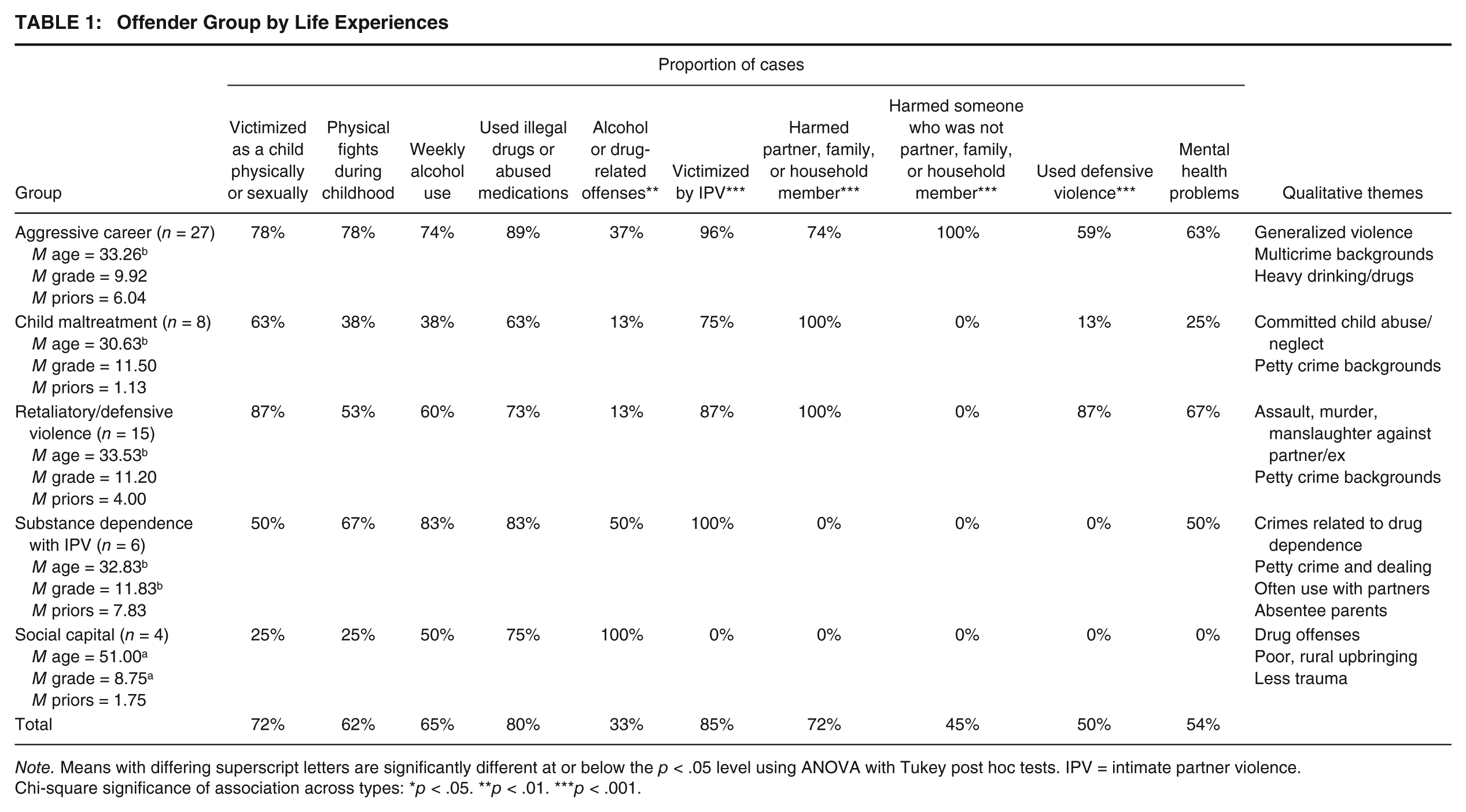
Note. Means with differing superscript letters are significantly different at or below the p < .05 level using ANOVA with Tukey post hoc tests. IPV = intimate partner violence.
Chi-square significance of association across types: *p < .05. **p < .01. ***p < .001.
Quantitative Analyses
Table 1 also displays within-group means for age, education level, and number of prior convictions, as well as proportions of each group who experienced prior victimization, engaged in fights in childhood, used drugs or alcohol, engaged in drug or violent offending, and experienced mental health problems. Explanation of specific between group comparisons (ANOVA and chi-square) are detailed below.
Age and Race
ANOVA indicated significant differences in mean age across offender groups, F(4, 55) = 3.86, p = .008,
Marital Status and Children
A Pearson chi-square statistic indicated an association between offender group and marital status, χ2(20, N = 60) = 33.37, p = .031. The value of Cramer’s V (.373, interpreted similarly to a correlation coefficient) indicates that this is a moderate to strong association (Cohen, 1988). Table 2 presents the distribution of marital statuses across groups. Although the complexity of this distribution limits our ability to draw definitive conclusions, some of the patterns in the table are as one might expect (e.g., women who use retaliatory/defensive violence having higher proportions of being widowed or single). A Pearson chi-square statistic indicated no association between offender group and whether the women had children, χ2(4, N = 60) = 2.62, p = .623, Cramer’s V = .209, ns.
Count and Percentage of Each Offender Group by Marital Status
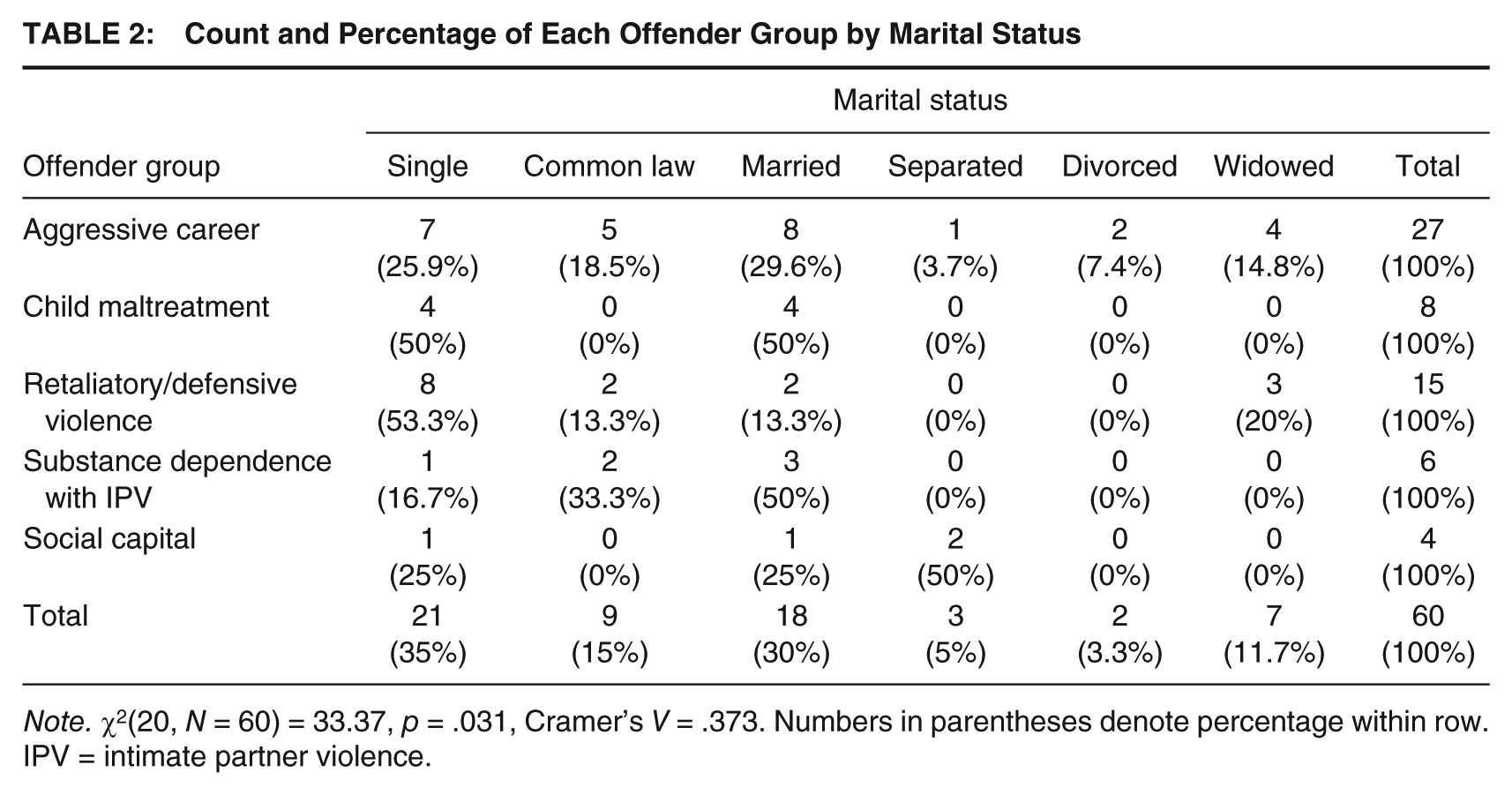
Note. χ2(20, N = 60) = 33.37, p = .031, Cramer’s V = .373. Numbers in parentheses denote percentage within row. IPV = intimate partner violence.
Education Level and Testing Scores
ANOVA indicated significant differences in mean education level across offender groups, F(4, 55) = 3.04, p = .024,
Mental Health Problems
A Pearson chi-square statistic indicated a marginal association between offender group and whether the women had been noted in correctional records to have mental health problems, χ2(4, N = 60) = 9.26, p = .055, ns. Because our decision model is largely exploratory, we elected to explore trends to inform future researchers who might identify areas for further testing and refinement of the model. The value of Cramer’s V (.393) indicates that this is a moderate to strong association (Cohen, 1988). It is notable that, although correctional records did not specify type of mental health “problem” in women’s records, findings of these analyses are very similar to findings using exploratory analyses of our own flag for mental health problems as noted in women’s qualitative interviews (e.g., the women mentioned mental health diagnoses, treatment, or self-injurious/suicidal behavior).
Prior Victimization
A Pearson chi-square statistic indicated a marginal but nonsignificant association between offender group and whether the women reported having been physically or sexually abused in childhood, χ2(4, N = 60) = 8.17, p = .086, ns. The value of Cramer’s V (.369) indicates a moderate to strong association (Cohen, 1988) that may merit inquiry in future research. As one would expect given our decision rules, a Pearson chi-square statistic indicated a significant association between offender group and whether the women reported having been victimized by IPV, χ2(4, N = 60) = 27.09, p < .001. The value of Cramer’s V (.672) indicates a strong association (Cohen, 1988).
Fights in Childhood
A Pearson chi-square statistic indicated no association between offender group and whether the women reported having engaged in physical fights in childhood, χ2(4, N = 60) = 7.72, p = .102, Cramer’s V = .359, ns.
Alcohol and Drug Use and Offending
A Pearson chi-square statistic indicated no association between offender group and whether the women reported weekly alcohol use, χ2(4, N = 60) = 5.08, p = .279, Cramer’s V = .291, or illicit drug use (i.e., use of illegal drugs or abuse of prescription drugs), χ2(4, N = 60) = 3.39, p = .496, Cramer’s V = .238, ns. A Pearson chi-square statistic indicated a significant association between offender group and whether the women engaged in other drug offenses (e.g., admitted or charged with possession, distribution, manufacturing, trafficking), χ2(4, N = 60) = 13.18, p = .010. The value of Cramer’s V (.469) indicates a strong association (Cohen, 1988).
Use of Violence in Adulthood
As would be expected given our decision rules, a Pearson chi-square statistic indicated a significant association between offender group and whether the women reported engaging in violence/harm toward a partner, ex-partner, or family/household member (e.g., assaults, murder, manslaughter, homicide by child abuse, charges of physical neglect), χ2(4, N = 60) = 34.46, p < .001. Accordingly, the value of Cramer’s V (.758) indicates a very strong association (Cohen, 1988). Also, as would be expected, a Pearson chi-square statistic indicated a significant association between offender group and whether the women reported engaging in violence/harm toward others who were not partners, exes, or family/household members (e.g., assaults, murder, manslaughter, DUI-felony causing death), χ2(4, N = 60) = 60.00, p < .001. The value of Cramer’s V (1.00) indicates a perfect association (Cohen, 1988). A Pearson chi-square statistic indicated a significant association between offender group and whether the women reported engaging in defensive violence (i.e., when being physically attacked), χ2(4, N = 60) = 23.49, p < .001. The value of Cramer’s V (.626) indicates a strong association (Cohen, 1988).
Prior Convictions
ANOVA indicated no significant differences across groups for number of prior convictions, F(4, 55) = 1.43, p = .238,
Discussion
Summary
Our findings demonstrate five distinct groupings of women based on decision rules pertaining to the women’s use of violence and their experience of IPV. The largest group was aggressive career offenders. These women use generalized violence, have multicrime careers, are heavy users of alcohol and/or drugs, and often have mental health problems. The next largest group consisted of women who killed or assaulted persons in retaliation or self-defense. These women also experienced substantial mental health problems and tended toward heavy alcohol/drug use, but their criminal pasts were less ingrained than those women in the aggressive group. The third largest group, women who maltreated children, included those who committed overt acts of violence as well as neglectful acts that resulted in death or injury to children. These women also had less extensive criminal pasts. The fourth group, substance-dependent women experiencing IPV, included nonviolent women whose crimes often related to drug dependence, and the women often used drugs with abusive partners. The final group, social capital offenders, consisted of older, less educated women from poor, rural upbringings who engaged primarily in drug-related crimes such as trafficking or manufacture of drugs. It is important to note that this distribution may in part stem from our sample of women from a maximum-security facility (i.e., more serious, violent offenders).
While this typology highlights areas of divergence across groups (e.g., violence directed toward children, engagement in drug offending), there are also striking commonalties. A majority of women in our sample experienced substantial victimization both in childhood and adulthood, and over half had mental health problems. These noncriminal life experiences play pivotal roles in women’s pathways to incarceration, giving rise to crime both directly (e.g., fighting back against violence, disruptive/disinhibiting behaviors associated with mental illness) and indirectly (e.g., engaging in criminalized survival strategies such as substance use or commercial sex work; DeHart, 2008; DeHart, Lynch, Belknap, Dass-Brailsford, & Green, 2014; DeHart & Moran, 2015). As typologies of female offending develop, emphasis on trauma, adversity, and survival must be on the forefront to address crime not just as individual behaviors but also as problematic social practices and policies that transform women from victims to offenders.
Here, we put forth the anagram SCARS as a mnemonic that represents the five groups of offenders: Substance dependence with IPV, Child maltreatment, Aggressive career, Retaliatory/defensive violence, and Social capital. This is intended to underscore the reality that women’s pathways to crime often rise from remnants of victimization and adversity in their lives. As is evinced in our sample, the challenges these women face over the life span ranges from poverty and adversity to severe, chronic violent victimization. Many of the women’s criminalized behaviors (e.g., substance use, aggression) are women’s attempts to manage such challenges in the broader context of their lives. These behaviors and experiences are differentially distributed across our five offender groups and have important implications for research, prevention, risk reduction, and intervention, as well as for systemic advocacy.
Implications for Research, Practice, and Policy
These findings lend support to prior research on pathways/typologies of women’s offending by demonstrating substantial overlap with some previously identified pathways/types of offenders. In particular, in holistically considering categories here relative to those in the literature, the “aggressive career” group is similar to Brennan et al.’s (2012) aggressive antisocial group, Daly’s (1992) harmed-and-harming group, and Simpson et al.’s (2008) harmed-and-harming and felony-involved (Factor 1) street women. This group’s chronicity of offending might represent what Moffitt (1993) termed life-course-persistent offending. The “retaliatory/defensive violence” group is similar to Daly’s (1992) battered women, Richie’s (1995) fighting-back pathway, and Brennan et al.’s (2012) victimized/battered group. The “child maltreatment” group is similar to Richie’s (1995) hostage pathway in being implicated in death of a child. The “substance dependence with IPV” group shares qualities with Brennan et al.’s normal drug-dependent group, Richie’s (1995) addiction pathway (including codependence), and Daly’s (1992) street women. Finally, the “social capital” group with low levels of victimization, low education and resources, and fewer mental health problems shares commonalties with the pathway of the same name identified by Salisbury and Van Voorhis (2009), as well as with Richie’s (1995) poverty pathway, Daly’s (1992) drug-connected pathway, and Brennan et al.’s (2012) socialized subcultural group.
Thus, going forward, we might expect that future studies can begin to solidify understanding of the more common and identifiable groups—aggressive career, retaliatory/defensive, and social capital—as well as clarify parameters of the more fluid groups such as substance dependence with IPV. Although the child maltreatment group is less pronounced in the literature, it also seems sufficiently distinct to merit additional exploration in research. Furthermore, our decision model supported the differentiation between family-only violent offenders (retaliatory/defensive and child maltreatment groups) versus more generally violent offenders (aggressive career group). This differentiation mirrors the distinction made by Holtzworth-Munroe and Stuart (1994) in their typology of male perpetrators of domestic violence, and it is consistent with Babcock, Miller, and Siard’s (2003) differentiation between partner-only and generally violent female perpetrators of domestic violence. In accord with Babcock et al.’s findings that generally violent women reported more trauma symptoms and were more likely to use violence instrumentally to control or to resolve conflicts, additional research might examine this distinction with particular attention to perceived threats and motivations for use of violence.
For researchers, the utility of the decision-rule strategy is enhanced by its easy application to determine groups by researchers who are not experts in advanced quantitative methods (e.g., cluster analysis, latent growth curve analysis). The rules can be applied using simple coding syntax on basic quantitative data for the variables generalized violence, family violence, and IPV victimization (e.g., “IF
An important practical benefit of the groupings described herein are that the resulting groups differ not only on criteria for classification (i.e., committing violence, whether the violence is family-only or generalized, whether the women experienced IPV) but also on other meaningful dimensions (e.g., drug-related offenses, use of defensive violence). Most importantly, these decision rules effectively “triage” cases according to what are likely pressing needs: use of violence, substance abuse/dependence, and poverty. While some of these needs may span across the groups, the decision rules and group names identify what may be the most pressing among a constellation of needs. Our quantitative data provide useful information about likelihood of specific challenges within each group, such as experiences of childhood trauma and lifetime experiences of mental health issues. In this way, the decision rules—if their utility is supported by further research—might serve as heuristics for determining programming needs for particular groups of women. For example, the impoverished, rural, and limited educational backgrounds of women in the social capital group might make these women good candidates for economic services, education, and jobs training. Women in the substance dependence with IPV group might benefit from trauma-informed services, IPV resources, and substance abuse treatment. Similarly, women in the retaliatory/defensive violence group might require trauma services, IPV resources, and services that address preemptive/retaliatory use of violence in the broader context of IPV victimization. Women who maltreated children may require some of the aforementioned services as well as education on parenting, access to more comprehensive prenatal education and care, and other resources to promote healthy caregiving. Finally, the aggressive career women may require many of these services in addition to anger management or cognitive-behavioral therapy as well as more intensive mental health and support services (Green, Miranda, Daroowalla, & Siddique, 2005; Lynch, Fritch, & Heath, 2012).
Thinking more broadly across the groups in this typology, the overwhelming contexts of victimization and adversity in these women’s backgrounds provide a compelling rationale for trauma-informed programming (e.g., see National Center on Domestic Violence, Trauma & Mental Health [NCDVTMH], 2017; Substance Abuse and Mental Health Services Administration [SAMHSA], 2017). Furthermore, with over half of the women experiencing mental health problems and the vast majority abusing drugs, it is crucial to integrate behavioral health services at the front end of justice interventions—through prearrest diversion programs that forge collaborative links between behavioral health providers, emergency services, and law enforcement, as well as through holistic defense practices and postarrest diversion with behavioral health cooperatively working with the courts (Munetz & Griffin, 2006; National Legal Aid Defenders Association [NLADA], 2008; SAMHSA, 2013). Similarly, to reduce recidivism and promote successful reentry into communities, discharge planning and enhanced supervision should connect women with community providers of mental and behavioral health services (Columbia University Justice Lab [CUJL], 2018; Munetz & Griffin, 2006; SAMHSA, 2013).
While risk reduction and intervention may divert some women from the justice system in lieu of individualized services to address trauma and adversity, these strategies do not address the overarching social problems made evident in our research. Specifically, women’s pathways through the justice system often stem from criminalization of survival strategies. Many of the women in our sample had been primarily involved in petty or drug-related crime, and some of the women who enacted violence did so primarily in self-defense. Their placement in a maximum-security facility raises questions as to alignment of the crime and punishment. In thinking about policy implications of our findings, it is important to consider gendered contexts that constrain women’s opportunities and render women—particularly women who are ethnic minorities or marginalized in other ways—vulnerable to offending. This includes racial and economic marginalization, greater likelihood of financial dependence on partners, having lower power in interpersonal relationships, having increased child care responsibilities, and facing increased risk of sexual and IPV (Arnold, 1992; Javdani, Sadeh, & Verona, 2011a; Richie, 1995). These forms of subjugation have potential to contribute to individual risks including substance dependence and mental health problems, and they are not easily addressed by solutions that are solely reliant on criminal justice or human service responses. For example, proarrest policies to address IPV resulted in a net-widening effect whereby arrest of women increased as a function of “equal” treatment under the law (DeLeon-Granados, Wells, & Binsbacher, 2006; Javdani, Sadeh, & Verona, 2011b). Yet, equating violent resistance—enacted out of defense, preemption, or retaliation—to battering decontextualizes force in ways that penalize the intended beneficiaries of the policy (DeLeon-Granados et al., 2006; Johnson & Ferraro, 2000; Osthoff, 2002). Future research might examine the role of system-level forces in exacerbating individual risks, structurally dislocating girls and women, and criminalizing survival. Such an “expanded lens” (Javdani et al., 2011b, p. 1324) can help clarify how pathways to offending are shaped at multiple ecological levels. Systemic advocacy and policy change are needed to address criminalization of survival strategies, and we are beginning to see promising innovations in a number of areas. Examples include advocacy around bail reform (i.e., to address criminalization of poverty; Color of Change, The Movement for Black Lives Law for Black Lives Brookland Community Bail Fund Project, NIA, & Southerners on New Ground, 2018), implementation of supervised injection sites and decriminalization of minor offenses (i.e., criminalization of addiction; Newman & LaSalle, 2017), and review of family violence arrest and sentencing policies (i.e., criminalization of defensive violence; Coalition for Women Prisoners [CWP], 2017; Connecticut Coalition Against Domestic Violence [CCADV], 2018).
Limitations
While the typology proposed here has advantages for research, practice, and policy, it also has limitations. These women who participated in our research were all from a women’s maximum-security facility that included special-needs inmates in a Southeastern state, so findings may not generalize to other security levels or to other types of correctional facilities such as jails or juvenile facilities. In particular, the 60 women in this maximum-security sample represent a range of criminal backgrounds that is more severe than one might expect from females in other correctional settings (e.g., jails, juvenile facilities; see DeHart et al., 2014; DeHart & Moran, 2015), with a majority of the women having prior offenses. Thus, this model may be applicable only to serious and/or violent offenders. Researchers may wish to examine whether these decision rules can produce similar groupings of women in jails, on probation, or in other settings where the women may be less enmeshed in serious criminal activity. Furthermore, we utilized a mixed-methods technique that established preliminary groups based on holistic impressions of similarity, but then defined decision rules based on identifiable behaviors/experiences that differentiated between the groups. This tension between cohesion of groups and clearly defined group boundaries results in somewhat “fuzzy” groups. It is likely that applying strict decision rules will result in a few outliers or misclassified cases that are less representative than other cases within each group. This was particularly notable for the aggressive career group in that some of the cases might have seemed a better fit for the retaliatory/defensive group were it not for the use of strict decision rules. Also, different states in the United States vary in defining events as crimes or as violent, so examining impact of refinements to decision rules may improve classification in the longer term. It may be useful for researchers to use an inductive, iterative approach to examining the decision rules with other populations, trying different approaches to determining group membership to identify refinements that might result in the most meaningful, cohesive groups for informing research, practice, and policy. Particular attention might be directed toward refinements around crimes involving third parties as well as those involving negligent acts that harm others. Establishing greater group homogeneity is critical if the model is to be used as the basis for intervention strategies, and there is currently no guarantee of group homogeneity except on those factors that are used to define pathways through the decision tree.
Beyond use for research, we must emphasize that the decision rules put forth here are tentative and warrant further examination before being used in practice settings. Additional research is important given our limited sample size and, in particular, small cell sizes for several of the groups in our ANOVA. This may contribute to tenuous stability of group means and variances on certain constructs and may result in analyses being underpowered. Accordingly, using larger samples to examine group similarities and differences is essential to demonstrating replicability and generalizability of findings beyond the current sample of serious and/or violent offenders.
It is also important to study discontinuities in these findings relative to prior research. For instance, Simpson et al. (2008) identified a group of battered women who did not use violence and engaged in crimes mostly unconnected to drug use—at odds with our findings. Simpson et al.’s use of factor analyses also highlights potential overlap among groups. Their “drug-connected” factor represented drug-using, drug-dealing women who sometimes used defensive violence—a factor that could straddle several of the current groups (retaliatory/defensive, substance using with IPV, and social capital). There also may be groups not represented in the current analyses, which again may stem in part from different sampling sources across studies (i.e., probation, jails, courts, prisons). These areas of ambiguity underscore the need for further research to examine defining characteristics of pathways groupings.
Finally, our study examined data from women’s narrative accounts as well as from their official prison records, but the broader study was not designed specifically for purposes of identifying different types of offenders. Rather, our original focus in data collection was to explore more generally links between victimization and offending. It is possible that more direct inquiry into life experiences, case characteristics, and offender needs may enhance research in this area. Also, because presence of a crime was based on whether a woman admitted to an offense or if they were convicted of an offense, it is important to consider the fallibility of both data sources. Specifically, women’s admissions may be subject to intentional or unintentional misrepresentations, and there is a substantial body of research documenting disparities in criminal justice processing for women. The later includes differential use of prosecutorial discretion for reducing charge of first-time offenders, selective charge reduction that may be extended primarily to White women, and differentially penalizing women versus men who are dually arrested in domestic abuse cases (Farnworth & Teske, 1995; Javdani et al., 2011b). Thus, future research would benefit from triangulation of data as well as from greater examination of institutional practices that may disproportionately affect women or certain groups of women in arresting, processing, and convicting them of offenses (for review, see Javdani et al., 2011b).
Footnotes
Author’s Note:
Special thanks to Shannon Lynch and anonymous reviewers for insights that helped to strengthen this manuscript. This project was supported by Grant 2000-WT-VX-0010 awarded by the National Institute of Justice, Office of Justice Programs, U.S. Department of Justice. Points of view in this document are those of the authors and do not necessarily represent the official position or policies of the U.S. Department of Justice.