




Abstract
Proponents of restrictive housing argue that its use is an effective deterrent of antisocial behavior, while its critics maintain that the setting causes serious psychological damage and increases noncompliance with institutional rules and expectations. Unfortunately, few studies exist that examine the influence of restrictive housing on behavioral outcomes. This investigation adds to this gap in knowledge by assessing the impact of time spent in restrictive housing confinement on subsequent measures of institutional adjustment among men in prison. Logistic regression analyses reveal no statistically significant relationships between the number of days spent in restrictive housing and subsequent measures of institutional misconduct, and uncover a small, but significant, negative relationship with subsequent placement in restrictive housing. The research and policy implications of these results are discussed.
Introduction
Correctional administrators are responsible for ensuring safety and order in prison. These authorities, therefore, seek to enact policies and practices that can reduce inmate engagement in violence and other forms of antisocial behavior. One strategy that prison officials employ to achieve this goal is to isolate dangerous and disruptive inmates in restrictive housing (Frost & Monteiro, 2016; Labrecque, 2016). In general, this type of confinement involves placement in a single cell for the majority of the day with increases in cell restrictions and security procedures (Cochran, Toman, Mears, & Bales, 2018; Mears, 2016). Authorities often justify the use of this practice on the presumption that it improves institutional safety; however, its critics maintain that the setting actually causes serious psychological damage and further increases noncompliance with institutional rules and expectations (see Labrecque & Mears, 2019).
Despite this ongoing debate regarding the utility of this correctional policy, there is a notable lack of research on the impact of restrictive housing on behavioral outcomes in prison (Labrecque & Smith, 2013; Morgan et al., 2016). It is possible that placement in this type of environment leads to improvements in one’s actions, but it is also possible that this experience increases noncompliance or has no effect on one’s institutional behavior as well (Mears, 2013; Morris, 2016). The current study addresses this gap in knowledge by evaluating the influence of time spent in restrictive housing on subsequent measures of institutional adjustment among men in prison. This investigation also helps advance the theoretical understanding of the behavioral effects of restrictive housing and provides recommendations for improving offender outcomes and making prisons safer and more orderly environments.
The Impact of Restrictive Housing on Inmate Behavior
Restrictive housing—what correctional officials and scholars also refer to as solitary confinement, administrative segregation, and supermax confinement—involves the isolation of an inmate in a single cell for 20 or more hours per day with little to no opportunity for meaningful contact with staff or other inmates (Cochran et al., 2018; Mears, 2016). Prison authorities can place inmates in restrictive housing for many reasons, including responding to institutional rule violations (i.e., disciplinary segregation), ensuring the well order of the facility (i.e., administrative segregation), protecting one from harm (i.e., protective custody), and meeting other institutional needs (i.e., temporary housing) (Butler, Griffin, & Johnson, 2013; Frost & Monteiro, 2016). In this way, restrictive housing represents the correctional systems’ solution for dealing with violent and disruptive inmates in prison, just as incarceration is society’s answer for dealing with dangerous and troublesome criminals in the community (Browne, Cambier, & Agha, 2011).
There are three competing perspectives on the behavioral impact of restrictive housing found in the literature (see also Gendreau & Goggin, 2018; Labrecque & Smith, 2018; Steiner & Cain, 2016). The first holds that the judicious use of restrictive housing is responsible for increasing safety, order, and control in prison. This position aligns with the philosophy of deterrence and rests on the assumption that the unpleasant nature of restrictive housing is the antidote for unwanted behavior in prison (see generally Nagin, 2013; Paternoster, 2010; Zimring & Hawkins, 1973). From this view, the negative experience in this type of housing teaches inmates that noncompliance with institutional rules and expectations will result in placement into this aversive environment (see also Lucas & Jones, 2017; Morris, 2016). Accordingly, inmates returning to lower security units from restrictive housing settings will be less likely to engage in antisocial behavior out of a fear for returning to the undesirable restrictive housing setting. This position also suggests that the more time one spends in restrictive housing, the more likely he will be to comply with the institutional demands in the general inmate population.
In contrast, a second school of thought argues that restrictive housing not only causes serious mental health problems but also increases one’s criminogenic risk. This view aligns with several criminological theories, including deprivation (Clemmer, 1940), social bonds (Hirschi, 1969), labeling (Braithwaite, 1989), strain (Agnew, 1992), social learning (Akers, 1973), and defiance (Sherman, 1993). According to this perspective, the harsh conditions and idleness in restrictive housing serve to intensify the pains of imprisonment, weaken social bonds, bestow a negative label, reduce the availability of coping resources, worsen perceptions of fairness and respect, isolate individuals from social networks that might promote prosocial behavior, and provide few, if any, opportunities for rehabilitation. From this viewpoint, inmates who experience a stay in restrictive housing will be more likely to violate institutional rules and expectations when returned to the general inmate population. This position also maintains that this effect will be more pronounced among inmates serving longer durations in this setting.
Finally, a third perspective contends that restrictive housing has no appreciable effect on inmate behavior. This position aligns with the importation and behavioral deep freeze theories, which describe institutional adjustment as an extension of one’s previously held values and motivations (see Irwin & Cressey, 1962; Thomas & Foster, 1973; Zamble & Porporino, 1990). From this view, one’s behavior in prison is largely determined by preexisting socialization factors, such as attitudes, relationships, and expectations, and is not influenced by the experience of restrictive housing. As such, this perspective suggests that placement in restrictive housing, regardless of time served, will have a null effect on one’s institutional behavior upon return to the general inmate population.
Research on Restrictive Housing
Restrictive housing scholarship largely focuses on psychological outcomes. Despite the popular contention that this setting causes serious psychological damage (Haney, 2003; Kupers, 2008; Lovell, 2008), the empirical literature suggests that restrictive housing produces a null to weak detrimental effect on many measures of mental health functioning (see Gendreau & Labrecque, 2018; Kapoor & Trestman, 2016; Morgan et al., 2016). There are, however, far fewer investigations on the impact of restrictive housing on institutional behavior outcomes. From this limited empirical research base, there is inconclusive support for the three perspectives described above (see also Gendreau & Goggin, 2018; Labrecque & Smith, 2018; Steiner & Cain, 2016).
Some aggregate-level studies indicate that locking down gang inmates in restrictive housing units reduces violence and other disobedience outcomes within state prison systems (e.g., assaults, stabbings, and homicides; Austin, Repko, Harris, McGinnis, & Plant, 1998; Bidna, 1975; Crouch & Marquart, 1989; Fischer, 2002; Ralph & Marquart, 1991). Other investigations report mixed findings on system-wide measures of institutional violence and disorder (e.g., inmate assaults, staff assaults, collective violence, and nonviolent misconduct; Briggs, Sundt, & Castellano, 2003; Huebner, 2003; Steiner, 2009; Sundt, Castellano, & Briggs, 2008; Wooldredge & Steiner, 2015). While informative, this type of research only provides information on the macro-level impact of restrictive housing. And regardless of whether restrictive housing is or is not an effective deterrent of misbehavior at the prison level (i.e., a general deterrent effect), it does not mean that this setting necessarily produces the same effect on the individual behavior of its inhabitants (i.e., a specific deterrent effect).
The individual-level research examining in-prison outcomes indicates that restrictive housing has a null to slight negative effect on measures of violent and nonviolent institutional misconduct (Labrecque, 2015; Lucas & Jones, 2017; Morris, 2016). Although these findings seemingly support the behavioral deep freeze position, it is important to keep in mind that these evaluations involve only one type of restrictive housing—short-term disciplinary segregation. It is possible that a stay in restrictive housing of 15 or fewer days may not be enough to meaningfully influence one’s long-term behavioral trajectory. According to the tenets of the deterrence and criminogenic positions, longer durations in this setting may be necessary to achieve improvements or detriments in one’s behavior, respectively.
Given the status of this research base, there remain many more questions than answers regarding the impact of restrictive housing on inmate behavior. Similarly, there have been many calls for more empirical evaluations of restrictive housing using criminal behavior outcomes (see Garcia, 2016).What effect the length of time spent in restrictive housing has on the institutional adjustment of inmates in prison remains an open and important empirical question. Without the availability of such research, corrections administrators and policy makers must rely on their personal judgment to determine if and how long to place inmates in restrictive housing. It remains possible that restrictive housing improves inmate behavior, but it is also possible that this setting is detrimental to prosocial conduct or has no influence on one’s actions. It is also possible that the effects of restrictive housing are more nuanced and that more than one of these perspectives are correct. For instance, some inmates may experience an improvement in behavior as a result of a stay in restrictive housing, others may suffer an increase in criminal behavior, and others still may be unaffected by the experience. Scholarship must explore these possibilities to advance knowledge in this neglected research area and provide corrections authorities with scientific evidence necessary for implementing more effective policies and practices related to the management of inmates in prison.
Current Study
The current study examines what impact the length of time spent in restrictive housing has on subsequent measures of institutional adjustment among a sample of men in prison. According to the theoretical perspectives articulated above, if the deterrent position is correct, longer durations in restrictive housing should improve behavior upon return to the general prison population. If the criminogenic position is correct, longer durations in restrictive housing should worsen behavior, and if the behavioral deep freeze position is correct, the length of time spent in restrictive housing should have no meaningful effect on behavior.
Method
Participants
The participants for this study come from an admission cohort of inmates entering a large adult state prison system between July 1, 2007, and December 31, 2010. From this population, the sample is restricted to only men who spent at least 1 day in restrictive housing confinement during their first year of incarceration and who also remained in prison for at least 1 year after being returned to a lower security setting (N = 9,016). Women were excluded in this investigation because there were only 26 identified who spent 90 or more days in restrictive housing during their first year in custody.
Data and Measures
The data for this study were acquired from a Department of Corrections in a Midwestern state. According to the departmental policy in this jurisdiction, correctional authorities can place inmates in restrictive housing for several reasons, including for violating institutional rules, failing to adjust in the general prison population, or believing that one’s presence in the general population will be disruptive to the orderly operation of the facility. For practical and theoretical reasons, this study analyzed all forms as one construct. One may argue from an academic standpoint the need for evaluating these subtypes separately; however, in many real-world settings, inmates can experience multiple types of this housing during a single placement. For example, an inmate initially placed in restrictive housing for a punitive purpose may remain in this setting even after serving his discipline time for an administrative reason, and vice versa. This makes it difficult to disentangle the impact that any one type of restrictive housing may have on behavior. The conditions and preclusions within these subtypes are also similar, which support the use of a broad measure of restrictive housing.
All of the measures included in the analyses are presented in Table 1. The independent variable of focus in this investigation is the number of days spent in restrictive housing during one’s first placement. To ensure an adequate follow-up time period following a return to the general prison population, this study examined only placements that occurred within one’s first year of incarceration. The analyses in this study also contained several theoretically relevant demographic, criminal history, and institutional behavior variables, including age at intake (measured in years), race (1 = black, 0 = other), mental illness (any recorded Axis I or Axis II diagnosis: 1 = yes, 0 = no), gang affiliation (any known association with a gang from a security threat group list: 1 = yes, 0 = no), incarceration history (number of prior incarcerations in the state prison system), sentence type (any violent conviction: 1 = yes, 0 = no), initial custody level (dummy variables for minimum, medium, close, and maximum), recidivism risk score (static risk scale ranging from −1 [lowest risk] to 8 [highest risk] of engaging in postrelease recidivism), prior misconduct history (measured as the number of guilty rule violations prior to one’s first placement in restrictive housing), and prior misconduct type (any documented violent rule violation prior to one’s first placement in restrictive housing: 1 = yes, 0 = no).
Descriptive Statistics of the RH Sample (N = 9,016)
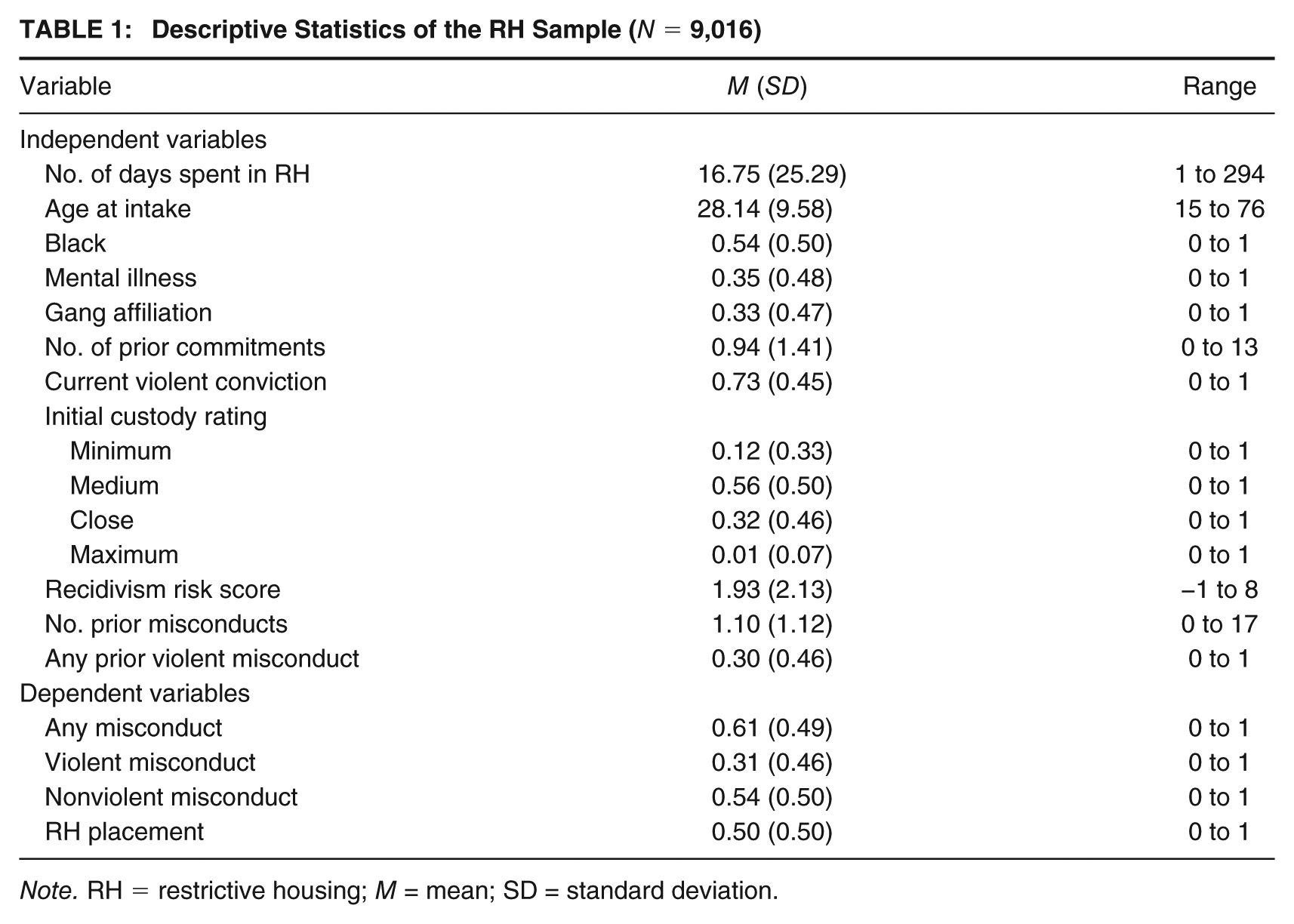
Note. RH = restrictive housing; M = mean; SD = standard deviation.
Institutional adjustment is the outcome of interest in this investigation, which included measures of inmate misbehavior and housing assignment following a return to the general inmate population from a stay in restrictive housing. More specifically, institutional misconduct is defined as any documented rule violation during a year in custody follow-up period (1 = had a rule violation, 0 = had no rule violation). This outcome is further separated into two separate dichotomous subcategories: violent (e.g., assault, 1 = yes, 0 = no) and nonviolent offenses (e.g., damage to property, theft, drug use; 1 = yes, 0 = no). Return to restrictive housing is also operationalized as any subsequent placement during the 1-year follow-up period (1 = had a restrictive housing placement, 0 = had no restrictive housing placement).
Analyses
To assess the influence of time spent in restrictive housing on measures of institutional adjustment, multivariate logistic regression analyses were performed. The use of logistic regression was advantageous for the present purposes because it provided the opportunity to assess the influence of the number of days spent in restrictive housing on the odds of each of the four dichotomous institutional adjustment outcomes (i.e., any subsequent institutional misconduct, violent misconduct, nonviolent misconduct, and restrictive housing placement) while controlling for the other theoretically relevant covariates of inmate misbehavior. Prior to estimating the final regression models, variance inflation factors were examined for each independent variable. None of the values exceeded 3, indicating that multicollinearity does not appear to be a problem here.
Results
Table 1 reports the descriptive statistics of the sample. The inmates in this study served between 1 and 294 days in restrictive housing, with a mean of 16.8 days (SD = 25.3 days) spent in this environment during their first placement. The mean age of the sample at intake was 28.1 (SD = 9.6), with a range of 15 to 76 years old. More than half of the inmates were Black and 35% had a mental health diagnosis for an Axis I or Axis II disorder. Approximately one third of the sample had a known affiliation with a gang and 73% were sentenced for a violent offense. These inmates had between 0 and 13 prior state commitments, and the largest proportion was classified as medium custody, followed by close, minimum, and maximum custody, respectively. The mean score on the state’s 10-point static recidivism risk scale was 1.9 (SD = 2.1), which identified 7% as necessitating intensive supervision upon release from custody. The mean number of documented rule infractions prior to placement in restrictive housing was 1.1 (SD = 1.1), with 30% of the sample written up for institutional misconduct that was violent in nature. During the 1-year postrestrictive housing follow-up period, 61% of the sample received a formal write-up for a disciplinary infraction. The majority of inmates (54%) participated in a subsequent nonviolent rule violation and 31% engaged in subsequent violent misconduct. In addition, half of the sample was returned to restrictive housing during the follow-up period.
Table 2 presents the final multivariate logistic regression models predicting the institutional adjustment outcomes with the inclusion of the other 13 independent variables. All four models were found to be significantly predictive of the outcome measures (p < .001). The main findings in this table are listed in the first row, which provides an estimate of the impact of time spent in restrictive housing on the dependent measures while accounting for the influence of the other explanatory variables. The results indicate that the number of days spent in restrictive housing is not statistically related at the .05 level to the three institutional misconduct measures and is a significant predictor of subsequent restrictive housing placement (p < .001). In terms of magnitude, for every additional day spent in restrictive housing on one’s first stay, there is a 0.6% decrease in the odds of being returned to restrictive housing in the following year.
Logistic Regression Predicting Institutional Adjustment Outcomes
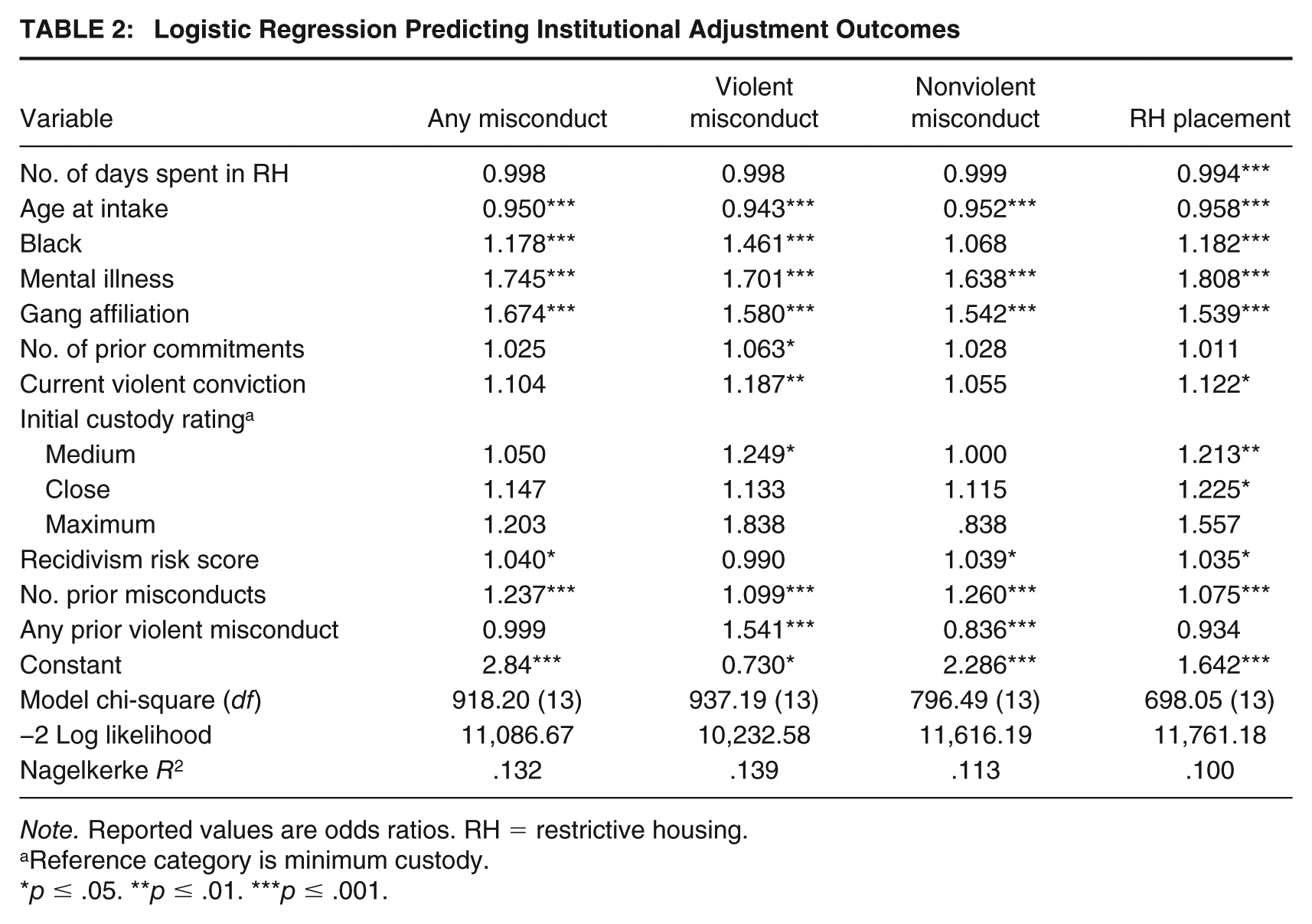
Note. Reported values are odds ratios. RH = restrictive housing.
Reference category is minimum custody.
p ≤ .05. **p ≤ .01. ***p ≤ .001.
These models also support prior penological scholarship in finding that inmate age was inversely related to the institutional adjustment measures, and that being mentally ill, gang affiliated, and engaging in prior institutional rule violations were all positively associated with these outcomes. In addition, race and recidivism risk score were found to be significant predictors in three of the four models examined. More specifically, Black inmates and those with a higher risk score were more likely to experience these adverse outcomes than non-Black inmates and those with a lower risk score. The two indicators of violence—sentenced for a violent criminal offense and having an institutional record of violence—were also positively related to subsequent violent misconduct. The number of prior commitments and initial custody rating generally did not fare well as predictors across these four outcomes.
Discussion
There is an implicit assumption made through the use of restrictive housing that this setting is an effective strategy for deterring antisocial behavior in prison; however, those critical of the practice argue it causes serious psychological damage and increases criminality (see Labrecque & Mears, 2019). Given the unsettled nature of this contentious debate, there have been many calls for more empirical research to evaluate what impact restrictive housing has on criminal behavior (see Garcia, 2016). This study responded to those calls by examining what impact time spent in restrictive housing has on subsequent measures of institutional adjustment among men in prison.
The results of this investigation indicate that time spent in restrictive housing had no statistically significant or sizably meaningful influence on one’s subsequent engagement in violent or nonviolent institutional misconduct and also that this duration had a statistically significant, but marginal, negative effect on subsequent placements in restrictive housing. These findings fail to support the deterrent or criminogenic perspectives on restrictive housing and provide tentative support for the behavioral deep freeze position. These results mirror those on the psychological impact of restrictive housing, where empirical research suggests this setting has little appreciable impact on one’s psychological functioning (see, for example, Chadick, Batastini, Levulis, & Morgan, 2018; O’Keefe, Klebe, Metzner, Dvoskin, Fellner, & Stucker, 2013; Morgan et al., 2016). These results also align with those on the behavioral effects of short-term disciplinary segregation (Labrecque, 2015; Lucas & Jones, 2017; Morris, 2016) and extend the conclusion that restrictive housing, regardless of length of time confined, has a minimal effect on subsequent institutional behavior.
Although this study helps advance the understanding of the behavioral impact of restrictive housing, caution should be exercised in interpreting and generalizing these results. First, and foremost, this investigation pragmatically analyzed all forms of restrictive housing together. It remains possible that subtypes of restrictive housing, such as disciplinary and administrative segregation, may produce differential effects on inmate behavior. Researchers are encouraged to employ other methodological designs and statistical techniques to evaluate the merits of this potential. Second, and relatedly, this study operationalized duration in restrictive housing as the number of days spent in restrictive housing during one’s first stay in the first year of incarceration. It could be that a one-time exposure to restrictive housing is not as influential as multiple stays or the cumulative number of days in this setting over a given period of time. Again, researchers are encouraged to undertake empirical evaluations that explore these possibilities.
Third, this evaluation focused on the individual-level effects of restrictive housing. It is well acknowledged that this type of housing may be employed by corrections officials for other institutional purposes, such as controlling inmates. It is possible, therefore, that even if restrictive housing has no impact on individual inmate behavior, it may still produce an incapacitation effect at the prison system level. Research is encouraged that can to assess the influence of restrictive housing on both individual and aggregate levels of institutional safety and order. Finally, this study relied on administrative data collected by the agency for other internal purposes. As such, this investigation was unable to break down the different types of mental illness by category; rather, it included all Axis I and Axis II types together. Future research should investigate whether the effects of restrictive housing vary by type of mental illness. In addition, this data set contained no information about potentially relevant situational variables, such as how staff treat inmates or the conditions in restrictive housing, which may influence these measures of institutional adjustment (Gendreau & Labrecque, 2018). Researchers are encouraged, wherever possible, to undertake observational investigations in prison settings that can account for this type of situational and environmental information. This line of inquiry holds the potential for helping to advance theoretical development in this area and for producing more informed policy recommendations.
Despite these limitations, the results of this study have several policy and practical implications. First, and foremost, these findings suggest that placing men in restrictive housing confinement for longer durations does not lead to great improvements in their institutional adjustment. If the purpose of this practice is to improve one’s institutional behavior, this study calls into question the tactic of simply increasing the time spent in restrictive housing as a mechanism for achieving this result. At the same time, these findings do not support the popular contention that restrictive housing units are serious incubators of crime, whereby inhabitants return to the general population at a greater risk for breaking the institution’s rules. Nevertheless, these null findings call into question the long-term viability of restrictive housing. Not only does increasing the time spent in this type of housing have no meaningful effect on inmate behavior, it is more expensive to house inmates in restrictive housing units than in the general prison population, the use of this practice raises serious ethical and legal concerns, and placement in this setting reduces opportunities to participate in correctional interventions that may help improve behavior (e.g., educational, vocational, mental health, and other treatment services; Labrecque, 2018a; Smith, 2016).
The convergence of these factors highlights the urgency for correctional administrators to explore alternatives to restrictive housing that may better improve inmate outcomes and make prisons safer and more orderly. Although it is well acknowledged that correctional authorities tend to place inmates with more extensive criminal histories and records of institutional misbehavior in restrictive housing confinement (Labrecque, 2018b), it is important that new policies and practices do more than just restrict the allowable types of offenders, reasons for placement, and durations spent in this type of housing. If policy reformations simply move to reduce the use of restrictive housing without also taking steps to address the underlying causes of antisocial behavior (e.g., antisocial attitude, cognition, personality; see Bonta & Andrews, 2017; Gendreau, 1996; Smith, 2013), inmates are likely to continue violating the institutional rules and authorities are likely to continue responding to such transgressions with placements in restrictive housing. It is, therefore, incumbent upon correctional administrators and scholars to work together in developing and implementing interventions and strategies that can reduce both the incidence of institutional misconduct and the requisite need for restrictive housing. One potential strategy is to offer higher risk inmates’ (e.g., younger, mentally ill, gang affiliates) access to preventive rehabilitative programs before they are placed in restrictive housing and to provide inmates in restrictive housing units with more access to treatment services (Butler, Solomon, & Spohn, 2018; Labrecque & Smith, 2019; Smith, 2016).
Footnotes
Authors’ Note:
This project was supported by a grant from the National Institute of Justice (Award No. 2014-IJ-CX-0003). The opinions, findings, and conclusions expressed in this article are those of the authors and do not necessarily reflect those of the Department of Justice.
