



Abstract
This pilot study compared the recidivism risks of older, high-risk juvenile probationers exposed or unexposed to an experimental case-management intervention to further the development of a supportive community intervention. The experimental intervention targeted unmet basic needs before and after the exposed group aged out of the juvenile justice system to prevent transition to adult crime. A prospective-cohort design compared the recidivism risks of the intervention group (n = 29) with a randomly selected comparison group (n = 114) stratified by gender, race, and risks/needs. We followed both groups for 3 years after members turned 18. The results of this pilot study showed no effects on recidivism risks, but statistically significant effects on the timing to recidivism for the group exposed to an innovative intervention. The study also revealed that the intervention was able to recruit and maintain the probationers and members of their family for the duration of the intervention.
Keywords
Studies of accountability-oriented intensive-supervision programs (ISPs) have shown mixed results in reducing recidivism for both juvenile and adult offenders (Barton & Butts, 1990; Krisberg, Rodriguez, Baake, Neuenfeldt, & Steele, 1989; Petersilia, 1999). Nonetheless, researchers have found some promising results when interventions devote attention to issues of service provision (Davidson, Redner, Blakely, Mitchell, & Emshoff, 1987; Latessa & Lowenkamp, 2006; Paparozzi & Gendreau, 2005; Pearson, McDougal, Kanaan, Bowels, & Torgerson, 2010). However, questions remain about the nature and intensity of contacts that are likely to reduce recidivism for serious juvenile offenders exposed to intensive and other forms of probation supervision (Altschuler, 1998; Gill, Hyatt, & Sherman, 2010; Taxman, 2002). Austin, Joe, Krisberg, and Steele (1990) found, for instance, that juvenile probationers “randomly assigned to either no contact probation, routine supervision, or intensive supervision in Salt Lake, Utah were not significantly different in terms of incidence, frequency, nature, or timing of results” (Lane, Turner, Fain, & Sehgal, 2005, p. 28). Other studies of intensive supervision have found similar results, in that these intensive probation interventions had minimal impact on recidivism when compared with other relevant correctional interventions (e.g., Elrod & Minor, 1992; J. Fagan & Reinarman, 1991; Weibush, 1993).
The mixed evidence for ISP programs begs the question as to whether probation officers implement the current assumptions about the nature and intensity of supervisory contacts in a manner that is consistent with principles of effective offender interventions (National Institute of Corrections, 2005). A number of criminal justice researchers (Andrews, 2006; Lowenkamp, Latessa, & Smith, 2006) and policy organizations (Crime & Justice Institute at Community Resources for Justice, 2009; National Institute of Corrections, 2005) promote principles of effective intervention for reducing criminal recidivism. Yet, there is limited research on how practitioners are implementing these principles in the process of probation supervision (Bonta, Rugge, Scott, Bourgon, & Yessine, 2008; Lowenkamp et al., 2006).
Bonta and his colleagues (2008) have attempted to shed some light on the supervisory process by audio-taping at least three interviews of 154 offenders supervised by 62 out of 108 probation officers in a Canadian province. They found that officers showed poor levels of adherence to principles of effective intervention. Inasmuch as the probation officers in their study identified the offenders’ criminogenic needs during their initial assessments, their case plans rarely focused on meeting these needs (Bonta et al., 2008). Moreover, the number of contacts that officers had with offenders failed to adhere to prescribed contacts per level of assessed risk. In addition, the findings by Bonta and his colleagues showed that officers were neither implementing their responsibilities effectively as brokers of services nor as change agents in the supervisory process.
The added demand on probation officers for acting as change agents is gaining traction in the probation literature. Bourgon, Guiterrez, and Ashton (2011) contended, for instance, that probation officers now have the added responsibility of acting as change agents and not acting simply as brokers of services. Indeed, proactive forms of supervision (Taxman, 2008) are replacing broker of service models of probation supervision in many jurisdictions, but probation officers do not appear to know how to implement this type of case management without proper training (Gill et al., 2010). In response to this problem, there are some promising training programs affecting how officers design and implement their case plans (Bourgon et al., 2011). However, many probation departments still believe that it is better to rely on human service professionals with specialized expertise in implementing assertive approaches to case management than to rely on probation officers in balancing their control and change agent functions.
The Citizenship Project in England for adult offenders provided some preliminary empirical support for the value of relying on multiagency collaborations for providing assertive strategies of service delivery (Pearson et al., 2010). What differentiated this program from others in community corrections was the emphasis that it placed on engaging with socially supportive community agencies. Pearson and colleagues found in their evaluation of the Citizenship Project that promoting contact with community support agencies resulted in statistically significant reductions in rates of recidivism when compared with a relevant historical comparison group. The South Oxnard Challenge Program (SOCP) in Ventura County California also relied on supportive community agencies in the delivery of services, but the results of this comprehensive community-based intervention did not have the desired impact on recidivism outcomes. Lane and colleagues wrote, “although SOCP youths received a more intense program in terms of amount and length of contacts and types of services given, there were few significant differences between them and the comparison group on recidivism or other outcomes” (Lane et al., 2005, p. 42).
Lane and colleagues (2005) offered some potential explanations of why they found no differences on outcomes in the SOCP evaluation. One potential explanation was that the study was not able to control for the levels of services received by youth who were included in the comparison group sample. If the comparison youth received similar community-based services, then this could explain why they observed no differences. In addition, they found a lack of correspondence between the theory of corrections in place that guided how the intervention was conceptualized and how the program was implemented. For instance, the intervention continued to focus on the probationer and minimal attention was given to targeting the family and “the multiple problems that led youths to commit crime” (Lane et al., 2005, p. 44).
The assumption that family relationships and family resources need to change to create a context of support for probationers is widely acknowledged in the current literature on probation supervision (Farrall, 2004; Shapiro & DiZerega, 2010; Trotter, 2010). This trend toward taking into account an offender’s social and familial context is in Australia (Australian Institute of Criminology, 2005) and the United States (Karp & Clear, 2002) known as the new corrections of place. Older models of community corrections only focused on changing the offender and neglected addressing the natural supports and the social context of the offender (National Institute of Corrections, 2005). Many older models of community supervision also left the intervention to a single agency that focused on the risks and needs of offenders (i.e., probation departments) without giving due regard to the need for collaboration with other agencies with expertise in supporting families and other individuals in the offenders’ social context (Farrall, 2004; Shapiro & DiZerega, 2010; Trotter, 2010).
The present study examined a cohort of older, high-risk juvenile offenders placed on the highest level of nonintensive probation supervision in Maricopa County, Arizona, with and without exposure to an assertive case-management intervention that targeted high-risk juveniles not connected to school, employment, or training. The probation officers identified a group of youth on their caseloads experiencing adjustment difficulties associated with unmet housing, employment, life skills, inadequate family resources, emotional supports, and other needs that could affect their transition to adulthood. Unlike other youth on their caseloads, the referred youth lacked connections to work, training, or school and needed interventions to connect them to these domains of functioning associated with the development of self-sufficiency. Indeed, there is limited attention in the current criminological literature to determining whether addressing unmet needs associated with making a prosocial transition to adulthood can diminish an older, high-risk juvenile’s transition to adult crime. Much more attention has been devoted to examining the effects of criminogenic risks/needs and not on addressing basic needs such as employment, housing and financial resources during this important transitional period in the development of youthful offenders.
During the transition period to adulthood, most youth depend on their families for financial and emotional support, and this support is often lacking for high-risk juveniles (Institute of Medicine and National Research Council, 2014; Settersten, Furstenberg, & Rumbut, 2008; Zajac, Sheidow, & Davis, 2015). For this reason, this study examined a cohort of older, high-risk juveniles referred or not referred to an experimental treatment intervention to describe their recidivism risks and types of recidivism. The study also examined timing differences to recidivism for youth exposed or unexposed to an intervention that provided supports to the juveniles and members of their family after they turned 18 and aged-out of the juvenile justice system.
Although we explored narrower research questions about risk for and timing to recidivism, the primary aims of this pilot study were as follows: (a) to determine whether it is feasible to engage and maintain older, high-risk juveniles in an intensive case-management intervention after they aged out of probation supervision; and (b) identify ways of improving on study designs for the type of intervention employed in this study. This is consistent with the role of pilot studies generally in that they place greater emphasis on informing subsequent research than on having sufficient power to identify statistically significant outcomes (Connelly, 2008; Leon, Davis, & Kraemer, 2011).
Why Target High-Risk and Older Juvenile Probationers?
The initial intent behind the development of standardized risks and needs assessment instruments in community corrections was to limit probation and parole officer discretion in assigning juvenile and adult offenders to differential levels of community supervision (Altschuler, 1998; Ashford & LeCroy, 1988; Baird, 1981; Clear & Gallagher, 1983; Van Voorhis & Brown, 1996). Youth with high scores on risks and needs assessments were assigned to high levels of supervision and youth with low scores were assigned to low levels of supervision (Andrews, Bonta, & Hoge, 1990). Actuarial risks and needs assessments represented, therefore, important management tools for aiding administrators in the allocation of limited resources (O’Leary & Clear, 1995). In addition, they enabled researchers eventually to assess the effectiveness of correctional interventions for specific risk classifications (Andrews & Bonta, 1998; Dowden & Andrews, 1999; Lowenkamp & Latessa, 2004).
Andrews and Bonta (1998) reanalyzed data from an earlier meta-analysis (Andrews et al., 1990) and the results of their reanalysis showed that correctional programs that included mostly higher-risk offenders had improved reductions in recidivism. Lowenkamp and Latessa (2004) concluded from their examination of Andrews and Bonta’s (1998) reanalysis that mixing higher-risk offenders with lower-risk offenders can aggravate the rates of recidivism for lower-risk offenders. The rates of recidivism that Andrews and Bonta (1998) found were an 11% improvement for correctional programs that treated mostly high-risk offenders and a 2% improvement for programs that included low and high-risk offenders. Lowenkamp and Latessa (2004) observed similar results in other examinations of different types of interventions and concluded that there are harms for lower-risk offenders when mixed with high-risk offenders. For this reason, they recommended that because of the potential harmful effects associated with the treatment of low-risk offenders that administrators should consider diverting scarce resources primarily to the treatment of high-risk offenders. Andrews, Kiessling, Robinson, and Mickus (1986) took a similar position in their study of the Youth Level Service/Case Management Inventory where they found that the mixing of low- and high-risk juveniles exacerbated the recidivism of the low-risk group.
Inasmuch as there are a number of validated risks and needs assessment instruments for juveniles, Loeber, Hoeve, Slot, and van der Laan (2012) observed that none provide predictions on how many juveniles would transition to adult crime. Instead, they had the goal of predicting recidivism, while juveniles were under the jurisdiction of the juvenile justice system. Furthermore, Loeber and colleagues (2012) have contended that the validation of most of the instruments used in the assessment of risks for juveniles were primarily on follow-ups limited to 1 year in duration, which did not include the period when juveniles transition to young adulthood. This transition period has been included mostly in studies attempting to explain the aggregate increase in crime rates during late adolescence and early adulthood. Far less attention in the transition period to young adulthood has been devoted to examining the effectiveness of standard probation in preventing the transition to adult crime strictly for high-risk juvenile offenders.
In the transitional period to young adulthood, criminal involvements peaks between 15 years and 19 years of age and begins to decline in the 20s (Loeber, Farrington, & Petechuk, 2013; Loeber et al., 2012). This well-established phenomenon in criminology is the age–crime curve (Farrington, 1986; Nagin & Tremblay, 2005). It has been documented in the United States and other developed countries, but there are a number of debates about how to interpret this peak in rates of crime across the life course (A. A. Fagan & Western, 2005; Farrington, 1986). Does this peak reflect an increase in the incidence, prevalence, or some combination of both? Another concern raised in the literature about this phenomenon is that, while the aggregate rates of recidivism peak during this period, there are some variations in when specific types of crime tend to decrease (Blokland & Palmen, 2012; Rosenfeld, White, & Esbensen, 2012; Sampson & Laub, 2003; Steffensmeir, Allan, Harer, & Streifel, 1989). The results of the Pittsburg longitudinal study found, for instance, that violent crimes tend to peak later than property crimes (Loeber et al., 2012). Rosenfeld and colleagues (2012) found that marijuana had a longer duration than theft and violent offenses (Rosenfeld et al., 2012). In addition, Rosenfeld and colleagues (2012) found that minor offenses such as vandalism and shoplifting tended to cease prior to the age of 18 years.
European scholars also found variations in when crime peaks for specific types of crime in studies. Soothill, Ackerley, and Francis (2004) found that the peak age of conviction for crimes such as burglary was around 16 years of age, but motor vehicle and drug offenses peaked between 21 years and 25 years and remained high until around 30 years of age (Loeber et al., 2012). These variations within crime classifications has prompted researchers to try to unpack the aggregate rates by offense types to obtain a better understanding of what crimes persist into adulthood.
Thus far, most of the extant research on the persistence of offending into young adulthood by type or category of crime has not focused on evaluating the extent to which older, high-risk youth placed on a specific level of probation supervision prevented the transition and the timing of transitions to adult crime. Most studies mixed the subjects exposed to standard and intensive probation supervision, which is not the case in this study.
Method
Participants
The present study limits its investigation to two groups of older, high-risk juveniles placed on the same form of standard probation supervision during the same period of time and from the same area of a large, urban county. This cohort of older, high-risk juveniles represents the youth placed on probation and not sentenced to a secure facility because of the seriousness of their offense(s). The individuals referred to the program and who met all eligibility requirements were the study’s intent-to-treat group. 1 Probation officers referred 29 individuals to the intervention between October 1, 2011 and November 2013. We examined this group as the intent-to-treat group because the treatment literature has strongly recommended that “attrition problems are best handled by analyses in which all individuals initially assigned to each group are examined” (Ashford, Sales, & Reid, 2001, p. 19). Besides, when researchers only examine the completed treatment group, there is a risk of overestimating the effectiveness of the group exposed to the enhanced treatment group (Ashford et al., 2001; Chambless & Hollon, 1998; Flick, 1988; Foa & Emmelkamp, 1983).
The average age for the intent-to-treat group was 16.7 years of age. The intent-to-treat group was 93.1% male and 6.9% female, and the racial makeup of this group was 39.3% White, non-Hispanic and 60.7% non-White. All participants in this group were on Level 1 probation supervision and assigned to a high-risk-need classification. A 10-item instrument developed by the National Council on Crime and Delinquency (NCCD) for Maricopa County, Arizona, generates three risk/need levels, and this study only included individuals assigned to the high-risk classification. This actuarial instrument considers familial, social, behavioral health, and criminal justice factors in the assignment of juveniles to a high-risk/need classification. Schwalbe (2009) provided a detailed description of NCCD’s instrument and its revalidation.
The comparison group consisted of a sample of 114 older, high-risk juveniles. The average age of the comparison group was 16.9 years of age. The comparison group was 91.2% male and 8.8% female. The racial breakdown for this group of participants is 45.6% White, non-Hispanic and 54.4% non-White participants.
The sizes of both the treatment and comparison groups are consistent with the recommendation of experts that the sample in a pilot study be at least 10% of the number projected to be necessary for the full study (Connelly, 2008). Based on a sample size analysis conducted, and described later in the article, the samples of 29 and 114 in the present pilot study are both 23% of the projected samples necessary to conduct a full study.
Interventions
All individuals in the study received Level I supervision. This is the highest level of nonintensive supervision in the jurisdiction and calls for the probation officers to have two face-to-face contacts with the juvenile and one face-to-face or telephonic contact with the parent or guardian each month. They also should visit the probationer within 45 calendar days after the youth is on supervision and have one contact every 3 months with schools to review the juvenile’s attendance. Lastly, officers need to verify employment by speaking with the juvenile’s employer, seeing the juvenile’s pay stub, and if appropriate, observing the juvenile at their place of employment.
In addition to the standard probation services described above, the exposed group received an experimental intervention that employed a team approach to case management in which two support specialists offered support to one probationer and the probationer’s family, but one of the two specialists was the primary person responsible for the case. Each specialist had primary responsibility for 15 cases and an adjunctive level of responsibility for another 15 cases. The program’s supervisor and the other specialists operated as a team in developing self-sufficiency plans. The specialists assertively supported and connected the probationers and their families with other services in the community. This approach differs from traditional approaches in probation supervision that only focus on the offender. This active support included accompanying youth on referrals to other community-based services and agencies. It also included taking proactive steps in promoting opportunities for change in the lives of the probationers and the lives of members of their families. There were no penalties for the juveniles, and their parents not volunteering to participate. Both the parents and the juveniles were actively encouraged to collaborate in setting relevant service goals.
The specialists were located at a Workforce Connections Center that serves the zip codes of the study’s target population. Within this agency setting, the specialists focused on connecting the youth to training, education, and work opportunities. The support specialists also developed strategies to address other support needs geared to promoting the offenders’ self-sufficiency. The program assumed that if youth lack the capacity for self-sufficiency, then they will not make a positive transition to adulthood. The instrument the specialists employed in identifying youth needs (Parker, 2006) focused on identifying barriers to self-sufficiency for homeless individuals (e.g., income, housing, food, health care, community involvement, life skills, and employment) and unaddressed criminogenic needs (e.g., substance abuse, mental health treatment, or family dysfunctions). For instance, many of the youth were without stable housing and the specialists helped the family obtain appropriate housing. They also helped the juveniles with transportation issues that previously prevented them from obtaining employment or participating in relevant training programs. If skill levels were a barrier, then they would connect them with opportunities for skill development at workforce connections or at other relevant opportunities in the community. They also counseled or referred the families to other services, targeting issues that were affecting the youth’s adjustment to probation supervision or their completion of their case plans for achieving self-sufficiency.
The developers of this experimental program wanted the study’s case-management intervention to serve as a bridge between older juvenile probationers who were unlikely to have their needs met while on standard probation supervision and service providers located in the probationer’s natural environment. The study’s target group was selected because the chief of probation at that time assumed that many juveniles in the system who were 16.5 years of age or older would not be on probation long enough to properly address many of their needs before turning 18.
Procedures and Design
The study employed a prospective-cohort design. This longitudinal approach allowed for an examination of an older cohort of juvenile probationers exposed or unexposed to an enhanced intervention that we followed forward in time to determine their relative risks for recidivating and their types of recidivism. In addition, the study compared the timing to recidivism for the two groups.
We completed a stratified random sample of older, high-risk juveniles assigned to Level 1 probation supervision in the same geographic area to construct the comparison group. We followed the participants in both of our study groups for 3 years beginning when each participant turned 18 to determine absolute risk differences, relative risks, types of risks, and timing to recidivism. Although stratified to resemble the intent-to-treat group, we conducted tests of difference between the intent-to-treat and the comparison group on key demographic variables. The results of these analyses in Table 1 show that the groups did not differ on these demographic variables. We did not need to do so for risks and needs because the study only included participants classified as high risks based on their risk-need scores.
Background Characteristics by Group
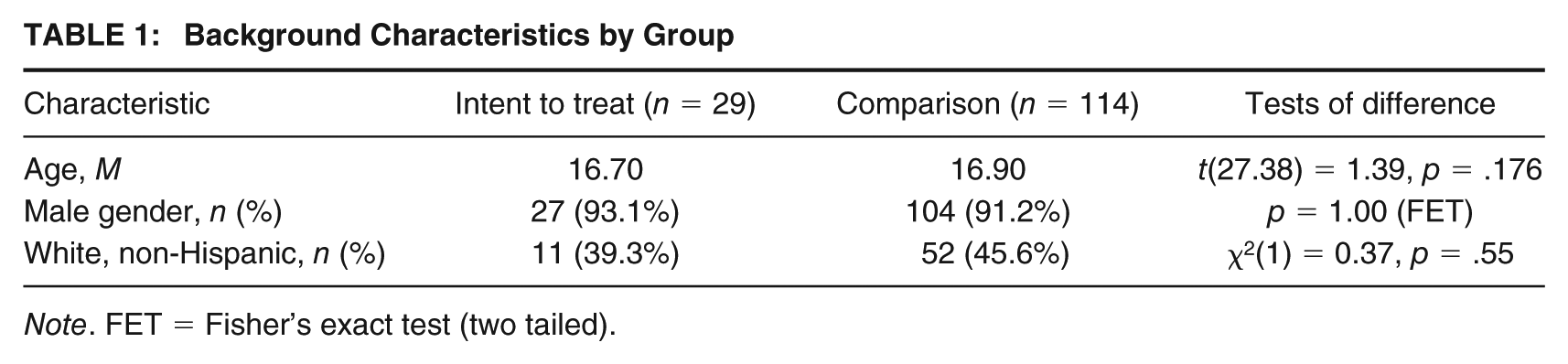
Note. FET = Fisher’s exact test (two tailed).
To evaluate the possibility that the seven individuals who were eligible, but did not enter differed from those who enrolled, we took two steps. First, we conducted an independent t test and Fisher’s exact test (FET) on the same background characteristics. These analyses show that the groups did not differ based on age (p = .200), gender (p = .431), or minority status (p = .174). The seven eligible individuals also had equivalent risk needs as the subjects who entered the program. Second, while the core of the analyses focuses on differences between the intent-to-treat group and the comparison group, we also conducted parallel tests between the 22 individuals who entered and remained in the program and the comparison group. These parallel tests of the completed treatment group do not alter the findings and we describe them briefly in the “Results” section.
Measures
The juvenile probation department provided the demographic and risk-level data. We dichotomized race and ethnicity into a binary variable contrasting White, non-Hispanic individuals with all others. Older, high-risk juveniles was defined for the purposes of this study as any youth 16.5+ years of age on Level 1 supervision with a high-risk score on the probation department’s risk/needs assessment instrument developed by NCCD (Schwalbe, 2009).
We operationalized recidivism as the filing of a charge in a felony-level court during a period of 3 years that began on the 18th birthday of each individual. The study focused on the filing of a new charge for two reasons. Conceptually, it represents a midpoint between the less stringent arrest and more stringent conviction/guilty plea thresholds. Methodologically, we utilized a data system maintained on the Internet by the state’s superior court system. Although the system readily identifies filing dates, arrest data are unavailable and final disposition dates are only available through a complicated review of minute entries. In addition, we did not include data from misdemeanor-level courts because a modest number of them did not participate in the superior court’s data management system and a pilot test we conducted identified some inconsistencies in reporting practices among those that did. Thus, focusing on charges filed in felony-level courts maximized validity from the data source employed in this study.
In addition to the any-felony category, we used the filing charges listed from the superior court’s system to create three dichotomous variables to identify individuals charged with the following types of felonies during the same 3 years: substance-related, person, and property. Our coding of offense types generally followed categorizations used by the Federal Bureau of Investigation in the National Incident-Based Reporting System (U.S. Department of Justice, Federal Bureau of Investigation, 2017). In this system, person offenses refer to crimes such as murder, rape, assault, and any other offense involving an individual. Property crimes, on the contrary, are crimes in which the object of the crime is property, for example, bribery, robbery, burglary, and so on. The one exception to the National Incident-Based Reporting System is that we focused only on a subset of crimes against society: those tied to drug or alcohol use.
Finally, we created a time-to-recidivism variable. This variable focused on the number of days that elapsed between the individual’s 18th birthday and the earliest filing date for any-felony offense.
Analysis Plan
We completed the study’s research questions in two steps. In the first, we computed absolute risk difference and relative risks as measures of the effects of the exposed group on rates of felony recidivism after each participant turned 18. We employed these same measures of effect to assess different types of felony recidivism (substance-related, person, and property) and at varying time points (1, 2, and 3 years).
Absolute risk reduction refers to the proportion of at-risk individuals who will not experience the negative outcome (here, recidivism) following exposure to the treatment intervention (Ranganathan, Pramesh, & Aggarwal, 2016). The absolute risk in the control group minus the absolute risk in the treatment group equals the absolute risk reduction. Relative risk is another descriptive measure of effects that is widely employed in cohort studies that provides “an estimate of the baseline risk that is removed as a result of the new therapy” (Ranganathan et al., 2016, p. 52). In this study, we examined the extent to which we removed the baseline risks by exposing the older, high-risk offenders with unmet needs to an intensive case-management intervention. This measure represents a relative risk ratio, which measures the ratio of the probability of recidivism occurring in the exposed group to the probability of recidivism in the unexposed group. Values below 1 are associated with a decreased risk for the intervention group, whereas values above 1 indicate an increased risk of recidivism for the intervention group.
In the second step, we conducted Kaplan–Meier survival analysis to evaluate if the intent-to-treat and comparison groups differed on time to recidivism for any felony followed for 3 years. We treated nonrecidivists in the survival analysis as right-censored cases, used median days-to-recidivism to compare the groups, and used the Tarone–Ware test to evaluate if the survival curves differed significantly. We also performed a life-table analysis to partition the observation periods into smaller time intervals of 6 months to enhance the policy implications of the Kaplan–Meier results.
Results
To examine the effect of the intervention, the study compared recidivism rates, absolute risk reduction and relative risk between the intent-to-treat (n = 29) and comparison groups (n = 114). To allow examination of how the rates and risks varied (a) by offense types and (b) over time, we presented the results for any felony, substance-related, person and property offenses at 1, 2, and 3 years. As can be seen in Figure 1, for any felony and substance-related felony offenses, the trend 2 was toward a reductive effect in risks during Year 1 that was decreased or no longer present at Year 2. By Year 3, individuals in the treatment group trended to an increased risk of any recidivism, but not for drug felonies. The only type of felony for which the intervention lacked a consistent reductive effect overall was for the property felonies. Individuals in the intent-to-treat group had a tendency toward an increased risk for property offenses, while that risk was smallest during the first year. The small base rates of person felonies make meaningful interpretation—even at a descriptive level—challenging, but suggest no meaningful difference between the groups.

Rates and Risk of Recidivism by Group, Recidivism Type, and Time
As was discussed in the “Methods” section, it is customary to conduct parallel tests using the intent-to-treat group and the treated group to guard against overestimating the effectiveness of the intervention. Thus, after conducting the core analyses with the 29-person intent-to-treat group reported above, the analyses of rates/risk, absolute risk reduction and relative risk were repeated, comparing the 22 individuals who were retained in the program with the same 114 individuals in the comparison group. Apart from a small change in the direction of the risk ratio of person offenses in Year 1, the results did not alter the trends 3 .
We examined the time to any-felony recidivism within the 3-year follow-up by performing Kaplan–Meier survival analysis between the intent-to-treat (n = 29) and comparison (n = 114) groups. We observed a significant delay in time to recidivism for the intent-to-treat group. Although the median time to recidivism was 252 days for the comparison group, it was 578 days for the intent-to-treat group. This difference was statistically significant,χ2(1) = 5.63, p = .018. To better illustrate the protective value of the intervention in delaying recidivism, we present the results of the survival curves in Figure 2 and the proportion of recidivists surviving at each 6-month interval during the 3-year review in Table 2. The precipitous drop in the comparison group’s survival curve provides graphical evidence that this group had much higher rates of recidivism during the initial phases of the transition to adulthood than did the intent-to-treat group.

Survival Curves for Any Felony Recidivism
Cumulative Proportion Surviving With Standard Error, Any Felony Charge

We again conducted parallel analysis, comparing the 22 individuals who entered the intervention with the same 114 individuals in the comparison group to ensure that the results are not confounded by differential outcomes among those who were eligible but did not enter. There were no changes in the results: The median days to recidivism were unchanged, and the curves still differed at a statistically significant level.
Discussion
We witnessed mixed results in this study like other studies involving the provision of intensive case-management services. Indeed, as in other studies, no significant differences in the types, incidence, and relative risks of recidivism existed between the exposed and unexposed groups to the study’s experimental intervention. Nonetheless, the exposed group experienced a significant delay in timing to recidivism for any felonies. The individuals identified for inclusion in the exposed group required increased supports not available in their families to facilitate self-sufficiency and a positive transition to adulthood. Although these supports did not reduce the absolute, relative types of recidivism risks, the supports did insulate them from early rates of recidivism during their transition period to adulthood.
Timing to recidivism is a measure to help understand processes underlying the effects of interventions on propensities for committing crime (National Institute of Justice, 2008). To this end, the results of the life-table analysis clarified how ineffective standard probation was in preventing the transition to this specific measure of recidivism when comparing its results with those of the exposed group. The results showed that by the end of Year 1 of the study’s criminal follow-up that 71% of the exposed group had not recidivated compared with 33% of the comparison group. The significant drop in the probability of surviving for the exposed group occurs between 18 months and 2 years; whereas rates of survival for the comparison group witnessed a substantial drop between 6 months and 1 year. Thus, the timing measure employed in this study demonstrated that an underlying process was potentially influencing the transition to recidivism for the exposed group.
However, it was unclear how specific elements in the intervention influenced the timing to recidivism for the exposed group. Was the delay in the timing to recidivism due to some change in the quality of the service provision or to levels of engagement in the intervention process by either the offender or members of their family? These questions require further scrutiny in future studies that we were unable to address in this study because the only data available on dosage and other intermediate outcomes were for study participants while on probation supervision. In addition, this quasi-experiment only provided support services for about 1 year after the participants turned 18. This might explain why we saw the absolute risk reduction percentages for property felonies double and not decline for the treatment group for Year 2. The study’s results must be weighed with a recognition that the sample size used in this pilot study resulted in a lack of statistical power for proper evaluation of the questions of relative risk and types of recidivism. A lack of reduction in risks for property felonies might have been statistically significant with larger samples. Namely, we could not rule out that the findings about no significant differences in overall recidivism risks were correct because of a lack of statistical power for most of this series of analyses. In addition, we could not eliminate the possibility that the positive statistical effect observed for the timing variable was not a false positive because of the study’s sample size 4 .
Implications for Future Research
This pilot study did identify, however, some potential improvements for future studies, which is the primary objective of a pilot study. Preventing the transition to adult crime is an important public safety issue, and this study provides some preliminary evidence that it is feasible to design a study for measuring the effects of supportive interventions for high-risk juveniles after they age out of the juvenile justice system. Indeed, this study showed that it is feasible to recruit and maintain youth and members of their family in a voluntary intervention that extends beyond the period when older, high-risk juveniles were no longer under the jurisdiction of the juvenile justice system. It retained 22 (76%) of the probationers referred to this intervention, which is consistent with overall offender attrition rates in psychological interventions, but better than what Olver, Stockdale, and Worthmith (2011) found for high-risk offenders in their meta-analysis of offender treatment attrition.
This study also identified the need for selective modifications in the duration of the intervention after the youth turned 18. Indeed, future studies need to extend the duration of the intervention given the potential effects this intervention had on timing to recidivism. Clearly, this modification is needed when creating an ideal efficacy study because older juveniles are in a stage of development “when adjustments and passages in the life-course are at their most challenging and when those already involved in offending are at risk of becoming more prolific” (Burnett & Hanley Santos, 2010, p. 4). This issue is especially true of probationers who live in communities with inadequate prosocial support networks and institutions.
Future studies should consider, therefore, randomly assigning larger numbers of high-risk juveniles with basic unmet needs to regular forms of probation supervision and others to an enhanced supportive intervention that provides a service bridge for a designated period of time after youth age out of probation supervision to identify appropriate dosages for this kind of intervention. However, the randomization of subjects to an intervention that denies additional services to a group not assigned to the experimental intervention might encounter push back from correctional administrators for ethical and cost-related concerns. Under such circumstances, a randomized control trial would not be feasible. However, the protocol employed in this study—drawing a random sample of probationers from the same jurisdiction stratified to resemble the exposed group on key variables—proved feasible and with the larger sample recommended above will allow for a rigorous testing of the intervention described in this pilot study. Utilizing propensity score matching in the development of the comparison group would also help control for potential group differences as an alternative strategy.
Although this study showed a possible effect on the question of timing to recidivism, it could not answer a number of questions about dosage issues. For instance, what is an appropriate duration for continuing to support high-risk juveniles after aging-out of probation supervision? In addition, how long is it reasonable to assume that supportive case managers can effectively engage the offender and members of the offender’s family in an intervention that bridges services before and after the juvenile ages out of the juvenile justice system? Each of the prior questions are also relevant for other interventions that are attempting to provide a supportive bridge to the offender and the offender’s family during the transition from juvenile delinquency to adulthood. In essence, this pilot study identified a number of important improvements for future efficacy studies of the type of intervention examined in this study.
Implications for Policy
Unlike other studies examining the effects of collaborative community supports to juvenile probationers, the results of this study demonstrate that a support program that continued the services after juveniles completed probation had a potential effect on a specific measure of recidivism—timing to recidivism. This finding suggests that policy makers and program planners should not rule out trying to increase the timing to recidivism for high-risk juveniles after aging out of probation supervision. We base this recommendation not solely on the findings for the participants in the exposed group, but also on the fact that large numbers of participants in the comparison group recidivated at 6 and 12 months after aging out of probation supervision. That is, a small group of youth without support after probation supervision are recidivating. For this reason, future studies need to focus on obtaining a better understanding of this small group of youth who had comparable criminogenic needs when they were originally placed on probation supervision, but recidivated very shortly after terminating regular probation supervision.
Other countries and some states allow juveniles to remain in the juvenile justice system through the age of 21 years and even up to 25 years; this is one-policy solution to addressing risk during the transition period. Oregon, for instance, allows for probation beyond 18 years of age, but a probationer’s length of supervision cannot extend beyond 23 years. Moreover, the juvenile court in Oregon can maintain its jurisdiction for up until the juvenile is 25 years of age. However, the findings of this pilot study suggest that the expansion of the juvenile system’s jurisdiction alone is not necessarily the best solution for delaying the timing to recidivism. That is, the enhanced intervention potentially affected recidivism risks from 18 to 24 months after probation ended, but dramatically increased after 24 months. The exposed group did not receive services for more than 1 year after they turned 18 years of age. Therefore, the intervention could have continued to reduce rates of recidivism if it continued for a longer period of time. Thus, future partnerships between justice systems and researchers should not only increase the number of enrolled individuals, but also consider increasing the duration of the supportive intervention.
In the area of parole supervision, interventions already exist that bridge the transition period prior to an inmate’s release and after an inmate enters the community. However, there is a major gap in current literature about the efficacy of such an approach for older, high-risk juveniles after aging out of probation supervision. For this reason, the results of this pilot study are significant because they provide some preliminary evidence that we need further research and experimentation concerning the adoption of interventions that can bridge gaps in services during the transition from probation supervision to the stage of development known as emerging adulthood.
Footnotes
Authors’ Note:
The authors would like to thank Elizabeth Ells, PhD, Jacqueline Picone, and other employees of the Maricopa County Juvenile Probation Department for their assistance with this research project. They would also like to thank social work students Rachel Williams (Arizona State University) and Elise Warner (University of Arkansas) for their assistance with collecting recidivism data. The opinions expressed are those of the authors. The authors contributed equally to this work. The authors evaluated the Maricopa County Justice Support Services through a grant from the Maricopa County, AZ Human Services Department.
