




Abstract
This study examines how combinations of situational factors are associated with patterns of terrorist success and failure. We apply Sacco and Kennedy’s criminal event perspective and Clarke and Newman’s situational crime prevention approach to the study of terrorist opportunity structures. Using data from the American Terrorism Study (ATS), we employ conjunctive analysis to investigate how opportunities for terrorist attacks and prevention are situationally positioned. We ask, “What combinations of terrorists’ ideological and situational factors are associated with terrorist outcomes in the United States?” While our findings generally show that the simplest forms of terrorism, including combinations of lone actors using unsophisticated weapons against nonhuman targets after little preparation, are associated with successful outcomes, there is heterogeneity in situated opportunities for preparing for and committing terrorism across terrorism movements. Our findings add insights into terrorism prevention strategies and help build a foundation for future comparative research on terrorism outcomes.
Introduction
Directly following the coordinated terrorist attacks in New York City, at the Pentagon (Arlington, Virginia), and in Shanksville, Pennsylvania, on September 11, 2001, preventing the next “9/11” became the top priority of the Federal Bureau of Investigation (FBI; Mueller, 2003). A number of deadly terrorist attacks have occurred since in the United States, but the FBI along with state and local law enforcement agencies have also successfully thwarted numerous planned acts of terrorism (Crenshaw & LaFree, 2017; Dahl, 2011; Gruenewald, Klein, Freilich, & Chermak, 2016; Klein, Gruenewald, & Smith, 2017). Scholars have investigated the relative frequency of planning and preparatory activities that preclude terrorist events across both American (Smith, Damphousse, & Roberts, 2006) and European settings (Schuurman, Bakker, Gill, & Bouhana, 2017). To date, however, only a few empirical studies have sought to advance our understanding of the most relevant antecedents to failed and foiled terrorist plots, and how they might compare with those of attacks that are successfully executed by terrorists.
One recent exception to the scarcity of research in this area is a study by Klein et al. (2017). Drawing from situational crime prevention (SCP) theory (Clarke & Newman, 2006), they discovered that far-right terrorists who acted alone, participated in few preparatory behaviors, and relied on conventional weapons to target attractive and vulnerable targets were relatively more likely to successfully commit ideologically motivated crimes. Questions remain nonetheless about how antecedents to terrorist events may be associated with particular outcomes across different forms of terrorism. Prior research on terrorist outcomes has been variable-focused, so we know less about the extent to which certain combinations of background and transactional factors might increase the likelihood of particular terrorist outcomes. As is true for all complex social phenomena, there is rarely a “silver bullet” explanation for why some terrorist plots are ultimately successful or foiled by law enforcement.
The purpose of the current study is to empirically identify how certain conjunctions of contextual factors are more or less associated with the success and failure of terrorists. To explain why some situational contexts lend themselves to one outcome or another, we rely on Sacco and Kennedy’s (2002; see also Meier, Kennedy, & Sacco, 2001) criminal event perspective and related criminal opportunity theories to conceptualize acts of terrorism as multidimensional criminal events that occur across successive stages and within specific time and space parameters. We recognize there has been significant progress in our understanding of political (Abrahms, 2012; Crenshaw, 1981; Schmid & Jongman, 1988) and psychological (e.g., Horgan, 2005; Kruglanski et al., 2014) explanations for how and why individuals and groups become gradually radicalized and, in some instances, eventually choose to engage in terrorism. Our focus in this study, however, is to understand the situational factors shaping terrorist decision-making during more immediate preincident and incident stages of terrorist acts.
The question that guides the remainder of our research is as follows: What combinations of terrorists’ ideological and situational factors are most commonly associated with successful and unsuccessful terrorist outcomes in the United States? Using data from the American Terrorism Study (ATS), we employ the conjunctive analysis of case configurations (CACC) approach to explore how offender-level and target-level attributes combine in discernible ways that are more or less likely to lead to particular outcomes. Doing so will allow us to better understand how opportunities for planning and executing terrorist attacks are structured, and where openings for terrorism prevention and interdiction by law enforcement are situationally positioned.
Theoretical Orientation and Prior Research
There was scant criminological attention to terrorism prior to the 9/11 attacks (e.g., for exceptions, see Hamm, 1993; Smith, 1994), due in part to terrorism being viewed as fundamentally different from crime and the scientific challenges to studying such rare and illicit behavior. While all terrorist events by definition involve criminal activity, terrorist crimes remain unique from other more routine crimes based on their social and political motives. Since 9/11, several scholars have also made important observations about the similarities between crime and terrorism (LaFree & Dugan, 2004; Rosenfeld, 2004). One key conceptual commonality is that terrorism encompasses most all other forms of crime (Clarke & Newman, 2006), and seemingly routine crimes may be committed as precursor activities to terrorism (Smith, 1994). As such, modus operandi and motivations for routine crime and terrorists’ preparatory crimes often overlap, such as the desire to belong to a peer group or thrill-seeking (Hamm, 1993). Whether for ideological or more routine motives, offenders must make choices regarding how to prepare for and commit crimes across a series of situated environments (Clarke & Newman, 2006; Hamm, 2007). Law enforcement must anticipate how criminals and terrorists interact with their social and physical environments so that modifications can be made to prevent future crime and terrorism.
Terrorism as Situated Criminal Events
In this study, we draw from the criminal event perspective (Block, 1981; Sacco & Kennedy, 2002) to conceptualize terrorist acts as multidimensional criminal events constituted by interactions between actors and their environments. These criminal events evolve over a series of junctures, including precursor, transaction, and aftermath stages occurring situationally within time and space contexts (Meier et al., 2001). As such, crimes cannot be separated from the social and physical settings in which they occur (Miethe & Meier, 1990), as features from the environment generate and attract criminal activity, creating unique settings and opportunities for crime (Brantingham & Brantingham, 1990). In this same vein, Cohen and Felson’s (1979) routine activities theory argues criminal opportunities exist and are at times more conducive within certain temporal and geographical contexts when there is a convergence of motivated offenders, suitable targets, and a lack of guardianship. For instance, Onat (2016) found bakeries in Turkey were riskiest for terrorist incidents in specific social environments. That is, fresh bread is a staple of Turkey, and “. . . the high risk around bakeries might be related to their potential to attract residents to move around for nutrition, creating an awareness among terrorists of the flow of large numbers of people” (pp. 14-15). Under certain circumstances, environmental features, such as targets that are accessible, exposed, and close in proximity to terrorists, structure opportunities and choices when planning and executing crimes and acts of terrorism in ways that are patterned and observable (Clarke & Newman, 2006).
It is assumed in this study that just as criminals are generally rational in how they define the situations in which they find themselves (Becker, 1968; Cornish & Clarke, 1986), so too are terrorists who analyze the costs and benefits of planning, preparing for, and executing ideologically motivated crimes (Clarke & Newman, 2006; Hamm, 2007). The rational choice perspective has been applied to various forms of terrorism in the past, for instance, by political scientists explaining why groups turn to terrorism (Crenshaw, 1981) and civil insurgency (Collier & Hoeffler, 2004; Fearon & Laitin, 2003) to achieve social and political change when more legitimate opportunities are limited. In addition, psychologists have provided several processual models of terrorist decision-making based on in-depth case studies tracking the trajectories of individuals as they gradually develop radical beliefs and opinions (Horgan, 2005; Kruglanski et al., 2014; Schuurman & Taylor, 2018). As has been suggested by others (Borum, 2011; Gill, Marchment, Corner, & Bouhana, 2018), however, the social psychological processes involved in the adoption of radical beliefs must be considered as separate from decision-making involved in the active preparatory and attack execution stages. Not all who develop radical beliefs become active terrorists (Horgan, 2005). Criminals and terrorists also make choices in the immediate period leading up to attacks and during the attacks that are shaped by situational crime event mechanisms (Birkbeck & LaFree, 1993; Cornish & Clarke, 1986). In this way, our consideration of terrorist rationality in this study centers on an event-level choice model that is bound to the achievement of short-term goals and shaped by immediate operational conditions. While broader psychological conditions cannot be discounted for bringing terrorists to a mental state where terrorism becomes a possibility, and recognizing that social and cultural factors provide a broader context for terrorism to occur, our conceptualization of rationality is confined temporally and geospatially to the opportunity structures situationally shaping the planning, preparing, and execution of terrorist events. Drawing from SCP (Clarke, 1997), we seek to understand how terrorists think directly prior to and during terrorist events, and how to reduce opportunities for terrorism by increasing the effort it takes to commit terrorism, increase the risks of terrorism, reduce the rewards of terrorism, reduce provocations to commit terrorism, and remove the excuses or justifications for terrorism (Clarke & Newman, 2006; see also Cornish & Clarke, 2003). As with crime more generally, physical and social environments can be observed, analyzed, and effectively altered in ways that are less conducive to terrorism, such as by protecting vulnerable targets, making targets less attractive, and monitoring and prohibiting access to facilitating tools and weapons.
Since the publication of Clarke and Newman’s (2006) Outsmarting the Terrorists, there have been an increasing number of studies relying on SCP to investigate opportunity structures of terrorism in the United States (Klein et al., 2017), Turkey (Ekici, Ozkan, Celik, & Maxfield, 2008), Israel (Perry, Apel, Newman, & Clarke, 2017), and other settings. One key component of terrorist opportunity is weapon use. From the perspective of the terrorist, different weapons provide unique advantages and risks. Weapons that are evaluated as “multipurpose, undetectable, removable, destructive, enjoyable, reliable, obtainable, uncomplicated, and safe” are theorized to provide the most opportunities for reasoning terrorists (Clarke & Newman, 2006, p. 108). Prior research on weapon use by American far-right terrorists supports these claims, as Legault and Hendrickson (2009) discovered that far-rightists preferred the use of conventional weapons, including firearms, primarily because they are considered to be safe, lethal, uncomplicated, and widely available.
The familiarity and security that comes with simple-to-use weapons such as guns may be an important consideration by terrorists given that prior research has shown they may become increasingly anxious and even paranoid leading up to planned attacks (Gill et al., 2018). Choice of weapon, however, appears to be influenced by a terrorist’s ideological background. Research by Gruenewald et al. (2016), for instance, revealed that jihadi terrorists in the United States used or planned to use bombs in their attack, as their goal is usually to create a terrorist spectacular by inflicting mass casualties. In contrast, environmental terrorists wish to avoid inflicting human casualties. While arson and explosives are the most common types of weapons used by environmental terrorists, a study by Gruenewald, Allison-Gruenewald, and Klein (2015) concluded that 44% of their attacks in the United States involved vandalism and less destructive modes of attack.
Another key component of the terrorist opportunity structure is the selection of targets (Clarke & Newman, 2006). While it is true that there are numerous targets for terrorists to choose from, the attributes of each potential target make them more or less likely to be selected. Prior research has found that terrorists often keep multiple targets in mind when planning and preparing for an attack (Gill et al., 2018). To anticipate target selection, it is necessary to evaluate their attractiveness and vulnerability through the eyes of a terrorist. In this way, the ideological backgrounds of terrorists shape their decisions about which symbolic targets to select (Drake, 1998; Onat & Gul, 2018). Santifort, Sandler, and Brandt (2012) established that domestic and international terrorist target selection and weapon choices have become less diverse over time with terrorists more commonly relying on bombings to target small parties (e.g., market squares, public transit, and shopping malls). These findings align with other research on religious terrorism that finds those who wish to rid the world of “others” viewed as not belonging or threatening to their religion are more likely to target “soft’ civilian populations (Asal et al., 2009; Brandt & Sandler, 2010).
Other researchers have concluded that some terrorists are more selective of targets than others are in ways that reflect the goals and motives of their respective ideological movements to which they adhere (e.g., left-wing, environmental, extreme far-right, radical Islamic; Onat & Gul, 2018). For example, members of antigovernment militia and patriot groups tend to target federal law enforcement and other local officials (Smith, 1994), whereas racist and anti-Semitic White nationalists tend to target Jews and racial minorities (Hamm, 1993). Radical environmentalists, on the contrary, believe in the equality of plants, animals, and humans and avoid taking human life in the name of their ideology (Gruenewald et al., 2015). In the past, radical environmentalists have chosen to target businesses and other government entities viewed as harmful to the environment (Joosse, 2007; Varriale-Carson, LaFree, & Dugan, 2012). Collectively, these disparate findings demonstrate how factors such as averseness to risk and perceptions of security measures intersect with terrorists’ ideologies (Gill et al., 2018).
Although co-offending is not one of the pillars of Clarke and Newman’s (2006) terrorist opportunity structure, criminologists have long held that committing crimes with others presents varying opportunities and advantages for criminals (Warr, 2001). In the context of terrorism, for example, it may be possible to learn from one another and become skilled at constructing or using new types of weapons. Contrastingly, there are also risks to planning and preparing terrorism with other individuals and groups that may shape opportunities for intervention by law enforcement, such as through human intelligence operations (Damphousse & Smith, 2004). Over the last 25 years, terrorists in the United States have increasingly adopted an uncoordinated violence model of offending, which recommends a reliance on small cells or acting alone to commit unstructured violence as exemplified by environmental terrorists and the extreme right’s use of “leaderless resistance” (Damphousse & Smith, 2004). Acting outside the direction of a formal command and control structure, terrorists reduce the risks of intervention by law enforcement.
Terrorism by lone actors has increasingly become a top worry of homeland security officials since the 9/11 attacks because lone actor attacks are viewed as more challenging to prevent. Although terrorists generally remain relatively close to home or their safe house (Griffiths, Johnson, & Chetty, 2017), Smith, Roberts, Gruenewald, and Klein (2014) found that lone-acting terrorists in the United States tend to live farther away from their target and more effectively avoid law enforcement detections because they engage in fewer precursor crimes. Other recent research encompassing attacks has shown that lone actor terrorists tended to travel farther to commit their crimes when they operate in the United States (rather than Europe), have known links to extremist networks, are motivated by a single ideological issue, use bombs, and select iconic and symbolic targets (Marchment, Bouhana, & Gill, 2018). Generally less skilled and resourced, prior research also reveals that lone actors may be more likely to utilize pragmatic forms of low-skill weaponry that are easy to acquire and use successfully (Schuurman et al., 2017) and to select soft targets among the public (Spaaij, 2012).
The growing research on opportunities for terrorism has generally focused on ideologically motivated crimes that are successfully executed, though some studies have also investigated terrorist plots that failed or are foiled by law enforcement. Dahl (2011), for example, found that law enforcement agencies play an integral role in intervening and thwarting terrorist plots and suggests that conventional investigative tactics are usually responsible for preventing terrorists from being successful. Other research comparatively analyzes successful and unsuccessful terrorist events. These studies have revealed that type of incident, number of offenders, and lethality are significant predictors of success (Sandler & Scott, 1987), whereas other studies have shown that factors such as target selection, training, and operational proficiency are associated with success (Jackson & Frelinger, 2009; McCleskey, McCord, Leetz, & Markey, 2007). In another more recent study of terrorist outcomes, Klein et al. (2017) used ATS data to investigate how opportunity features predict the successfulness of far-right terrorists. Their study showed that co-offending patterns, number of preparatory behaviors, weapons, and target selection were significantly associated with terrorist success.
Gaps in Existing Research
Despite the growing number of studies examining terrorism as criminal events, there are still several gaps remaining in this research. First, as discussed previously, few studies have yet to comparatively examine failed and foiled terrorist plots. Consequently, there is more to learn about how opportunity structures may differ for plots that never come to fruition for terrorists. Second, prior research on terrorist outcomes has generally focused on jihadi terrorism (Dahl, 2011; Difo, 2010; Sandler & Scott, 1987) and, to a lesser extent, far-right terrorism (Klein et al., 2017). Yet, studies have not simultaneously compared situations of terrorism across ideological movements, including left-wing terrorism. As suggested by Clarke and Newman (2006), it is critical to recognize how different ideologies shape terrorist thinking and decision-making, including decisions about weapon use and target selection. Third, prior terrorism research utilizing opportunity perspectives has either been based on case studies (e.g., Jackson & Frelinger, 2009; McCleskey et al., 2007) or variable-driven descriptive and multivariate statistical approaches. In effect, findings have either been not generalizable or focused on single features of terrorist events. Less is known about how event-level combinations of factors shape opportunity structures within the context of varying ideological movements, and which situational profiles are most associated with successful and unsuccessful outcomes for terrorists.
The Current Study
The current study is conceptually grounded in the criminal event perspective and criminal opportunity theories, while utilizing the CACC approach to comparatively examine amalgamations of terrorist opportunity structures. We seek to contribute to a growing body of research on how opportunities shape terrorist outcomes and ask “What combinations of terrorists’ ideological and situational factors are most commonly associated with successful and unsuccessful terrorist outcomes in the United States?”
Recent research has demonstrated the value of CACC for studying terrorism-related events (DeLeeuw & Pridemore, 2018). DeLeeuw and Pridemore (2018) utilized CACC to examine similarities in terrorism incidents across three sites, including the United States, United Kingdom, and Ireland from data gathered in the Global Terrorism Database (GTD). Broader criminal justice research has also employed CACC to examine a variety of topics, such as victimization (Rennison, Dragiewicz, & DeKeseredy, 2013) and other criminal justice–related topics. To the best of our knowledge, however, this is one of the first studies to apply the CACC approach to the study of far-right, environmental, far-left, and radical Islamic terrorism.
Data and Method
While a majority of extant prior research has utilized case study approaches, the data for the current study were obtained from the ATS. Beginning in 1988, with support from the FBI’s Terrorism Research and Analytical Center, the ATS has emerged as a unique source of information about terrorism based primarily on federal court case records and later supplemented by open-source documents. Although other useful terrorism databases now exist (e.g., U.S. Extremist Crime Database, GTD), the ATS has for several decades been the only database to our knowledge that has used federal court records to systematically collect detailed information on the planning and preparatory behaviors of American terrorists.
ATS data sources include court documents from official terrorism federal court cases as designated by the FBI and/or the Executive Office for United States Attorneys, U.S. Attorney websites, and relevant open-source media documents.
1
From these sources, information on terrorist participants, groups, targets, situations, and criminal justice responses is systematically collected and coded by a team of research assistants.
2
The unit of analysis for the current study is “events,” or incidents emerging from terrorism investigations by the FBI and involving persons indicted for terrorism-related charges over the past three decades.
3
The ATS is unique from other terrorism databases because it relies on the FBI’s definition of domestic terrorism, or the use, or threatened use, of force or violence by a group or individual based and operating entirely within the United States or Puerto Rico without foreign direction committed against persons or property to intimidate or coerce a government, the civilian population, or any segment thereof in furtherance of political or social objectives. (FBI, 2005, p. V)
Measures
The dependent variable of interest is the terrorist event outcome (1 = successful, 0 = unsuccessful). A successful terrorist incident outcome is one in which weapons were delivered to intended targets and observable amounts of harm or damage were caused. In contrast, unsuccessful incidents include those in which one or more overt steps (e.g., collecting weapons, reconnoitering the target) were taken toward carrying out a terrorist plot, but in which law enforcement intervened or the plot otherwise failed to cause observable damage or harm to intended targets.
In addition, five independent measures are selected for inclusion in this study because they are thought to be key elements of the terrorist opportunity structure. Although some variables were initially measured continuously, each of the variables has been dichotomized per requirement of the CACC approach. First, we measure ideological movement, including (a) extreme far-right antigovernment extremists and White supremacists, (b) extreme left-wing anticapitalist and/or Marxist revolutionaries, (c) radical environmentalists, including militant environmental and animal rights activists, and (d) radical Islamic terrorists or global jihadists operating wholly or in part in the United States. Second, to measure group size and structure, we coded the number of offenders involved in one or more stages of the terrorist incident based on four categories, including (a) lone actor, (b) two to three offenders, and (c) four or more offenders. Our third independent measure is the total number of preparatory activities associated with a terrorist incident. Preparatory activities are recorded antecedent behaviors occurring within the initial plot formation and include subsequent events committed to further the terrorist attack. This variable is categorized as (a) zero activities, (b) one to two activities, (c) three to five activities, and (d) six or more activities. Fourth, we measure the level of weapon sophistication based on ease of access and technical skills required for use: (a) least sophisticated (e.g., spray paint, sabotage of equipment, bodily weapons, knives, and blunt objects), (b) moderately sophisticated (e.g., firearms), and (c) most sophisticated (e.g., explosives, chemical, biological, radiological, and nuclear weapons). Fifth, and finally, target selection is captured as (a) human only, (b) structural and human, and (c) structural only.
Sample
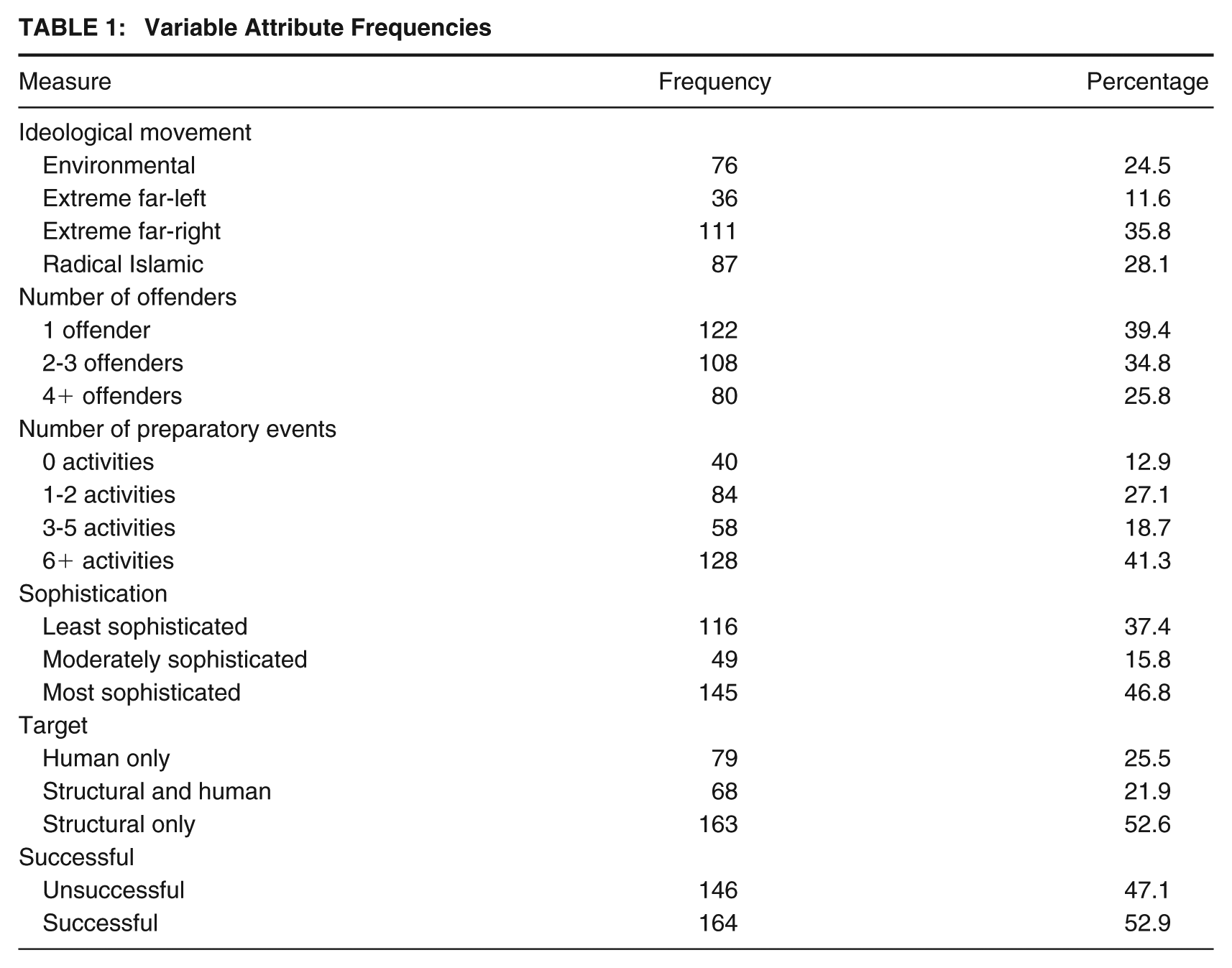
Our final sample of incidents includes 310 domestic terrorist incidents that occurred in the United States since 1975. As shown in Table 1, just more than half (52.9%) of all terrorist incidents were successfully executed by terrorists. The most common ideological movement represented is extreme far-right (35.8%), with the least represented movement being extreme far-left (11.6%). Terrorists most frequently operated alone (39.4%), whereas approximately a quarter of incidents involved four or more offenders. Most terrorist incidents (46.8%) in our study relied on sophisticated weaponry, including bombs or other explosives. The least sophisticated weapons, such as those used to deface property, were the next most commonly used by terrorists (37.4%), whereas moderately sophisticated weapons (i.e., firearms) were utilized the least frequently (18.7%). Just more than half (52.6%) of terrorist incidents targeted structures only. Less than 22% of incidents targeted both structures and human victims. As for the frequency of preparatory activities, a small percentage (12.9%) of terrorists had no known preparatory activities, whereas a larger percentage (41.3%) had six or more activities.
Variable Attribute Frequencies
Analytical Approach
The current study employs an exploratory methodology known as CACC (Miethe, Hart, & Regoeczi, 2008), which stems from similar case-oriented approaches, such as qualitative comparative analysis (see Ragin, 1987). CACC is used to explore the probability of successful terrorist incidents in the United States across situated opportunity structures or contexts. Recognizing that there may be numerous causes to the same outcome (Hart & Miethe, 2009), conjunctive analysis is an analytical technique for identifying whether certain variables are causally related to an outcome while simultaneously accounting for other measures of interest. CACC has recently grown in use by researchers for various criminological outcomes (e.g., Caplan, Kennedy, Barnum, & Piza, 2017; Rennison & DeKeseredy, 2017). Below, we provide a brief overview of the approach. 4
Conjunctive analysis begins by developing a data matrix, referred to as a truth table, consisting of all possible combinations, or interactions, of the variable attributes. For example, a matrix could be developed by level of terrorist achievement (successful or unsuccessful) and type of terrorism (domestic and international). These two variables create four unique contexts: successful domestic, successful international, unsuccessful domestic, and unsuccessful international. In the current study, there are a total of potential 864 configurations (4 × 3 × 4 × 3 × 3 × 2) in our truth table. If strong contextual relationships exist among the possible amalgamations, the number of configurations identified should cluster among a smaller number of observed configurations versus the total number possible (Hart, Rennison, & Miethe, 2017).
Each configuration of terrorist attributes identified contains a column indicating the number of cases within the data set consisting of that specific configuration, or the n per configuration. To be considered a dominant case configuration, Hart (2014) stated the minimum number of cases per configuration is five when there is a sample size smaller than 1,000, as is the case in the current study. Configurations with less than five cases are excluded from the working data matrix, resulting in a matrix comprising dominant case configurations. In addition, along with the number of cases per configuration, CACC indicates the probability of a certain outcome attribute, which in the current study is the probability of a successful terrorist event. 5 We also identify deviant situational contexts when the probability of successful terrorist events is found to be outside the norm (±1 SD from the mean). This assists us in understanding case configurations more likely or less likely to be successful than average, a practice that has been utilized in other conjunctive analysis research (Hart & Miethe, 2009).
A main difference between CACC and traditional analytical techniques is that traditional techniques tend to be variable-oriented while conjunctive analysis is case-oriented. Traditional approaches more commonly utilize main-effect models, assuming a level of stability over various contexts. This leads to a gap in understanding the stability of measures, often analyzed through interaction effects. By utilizing CACC, we examine fully saturated models consisting of all possible interactions and can detect stability or contextual differences based on specific attribute configurations. In a replication and extension of Drawve, Thomas, and Walker (2014), Drawve, Thomas, and Hart (2017) utilized conjunctive analysis to compare previous findings of a main-effect model (binary logistic regression) on the likelihood of arrest to results found through CACC. Although the general nature of the findings was similar to CACC results, there were substantial contextual effects uncovered, indicating the original findings varied based on the contextual configuration (i.e., combination of measures). This showed certain measures were not stable across all contexts, as would be assumed through main-effect models.
Results
Based on the total number of measures and their associated attributes included in our study, there were 864 possible configurations. We provide the resulting data matrix from our conjunctive analysis in Table 2. Our analysis of terrorist incidents uncovered only 96 configurations represented in the data, of which 20 could be categorized as dominant configurations (n ≥ 5). This indicates that there is contextual patterning within our data set resulting in only about 11% of all possible observed configurations. The 20 dominant case configurations (2.3% of total possible) accounted for 50.3% of the terrorism events (156/310). In other words, just more than 2% of the potential case configurations accounted for more than half of the terrorist incidents analyzed in the current study.
Successful Terrorist Incident Data Matrix
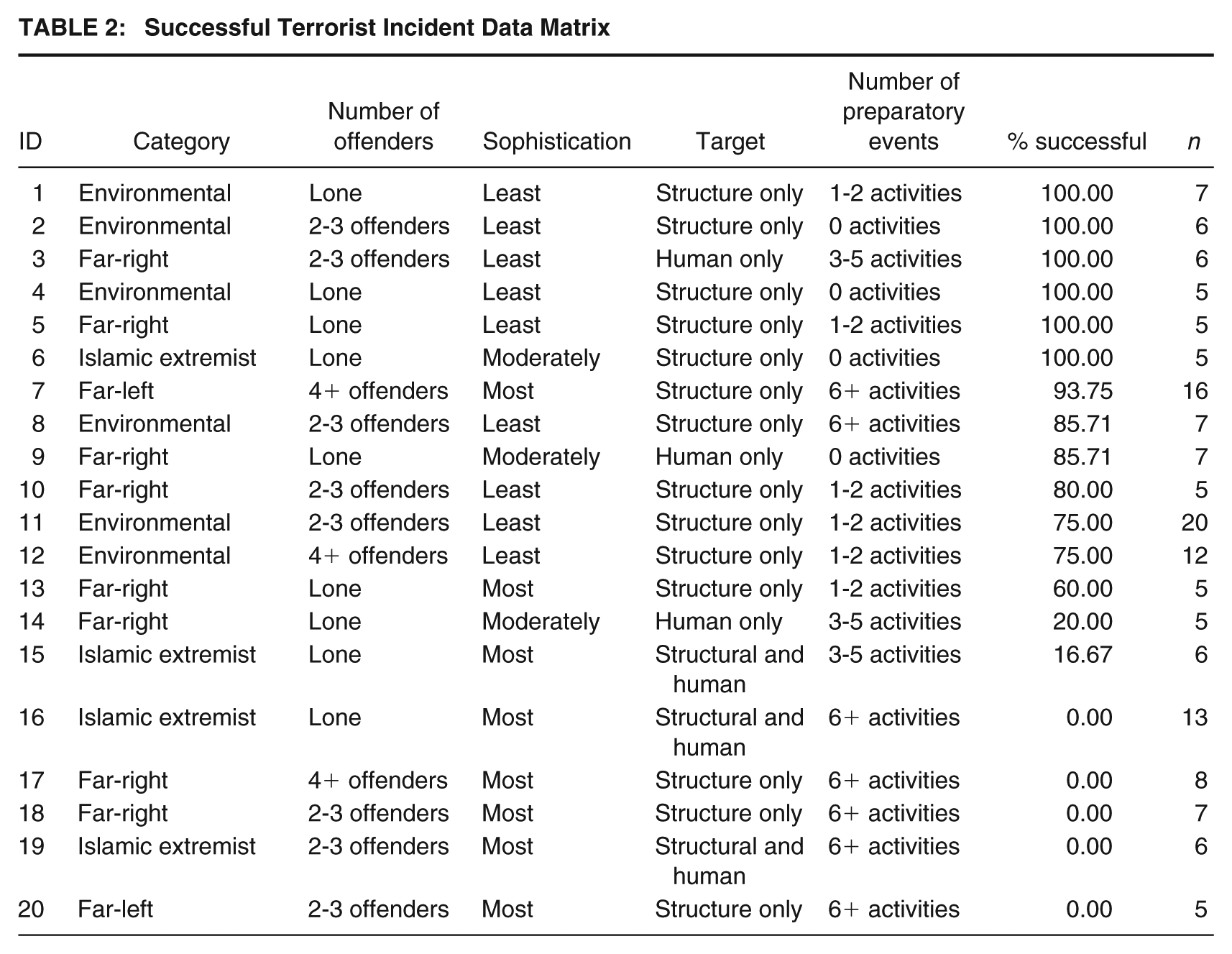
We also list in Table 2 conjunctions of terrorist opportunity structures based on the likelihood of successfulness. There were six configurations that were successful 100% of the time (IDs 1-6). In contrast, five configurations never resulted in terrorist success (IDs 16-20). Numerous comparisons are possible based on the findings presented in Table 2, but one rather simple way to think about the data matrix is similar to the effect of a light switch being turned on and off. That is, the differences between configurations can be viewed similar to turning on or off one of the attributes of a measure. For instance, Configurations 1 and 5 differ only on ideological movement type. Substituting environmental terrorism with far-right terrorism did not affect the likelihood of success, while the number of offenders, level of sophistication, target type, and number of preparatory events were held constant. Of the six configurations resulting in 100% success, patterns emerged involving lone actors, less sophisticated weapons, structural only targets, and fewer than six preparatory activities.
Focusing on environmental terrorism, the measures changing from configuration to configuration are either the number of offenders or number of preparatory events. Of the configurations involving environmental terrorists (IDs 1 and 4), incidents involving no preparatory activities for lone actors were successful 100% of the time. In addition, if the number of offenders increased to two to three offenders with zero preparatory activities, the likelihood of success remained the same. Now, examining Configurations 8, 11, and 12, there was a general decline in the success of terrorism incidents as the number of offenders and activities increased. For environmental terrorism, when there were two to three offenders, it was more beneficial for terrorists to have six or more preparatory activities than one or two, as the percent for success increased from 75% to about 86%.
It is possible to make additional comparisons when multiple measures differ between configurations, describing unique situational contexts of terrorist events. For example, Configuration IDs 3 and 5 only have two similar attributes, being committed by members of the extreme far-right and involving the least sophisticated weapons. Although the number of offenders, target type, and number of preparatory events were all different, the likelihood for a successful attack remained 100%. Again, if the level of sophistication is changed from least to most, when comparing IDs 5 and 13, the likelihood of success reduced by 40%. Furthermore, when comparing Configurations 3 and 14, reducing the number of offenders from two to three offenders to lone actor and increasing the level of sophistication from least to moderate, far-right terrorism incidents targeting only humans precipitated by three to five preparatory activities saw a reduction in the likelihood of success from 100% to 20%. In addition, lowering the number of preparatory activities to anything other than six or more activities resulted in an increase of success by 20% to 100% for certain configurations.
Stepping back from direct comparisons of particular configurations, the normative range of dominant case configurations (±1 SD from the mean) consists of Configurations 1 through 14 and the mean success rate is 59.89% with an SD of 42.54. This results in a greater than value being higher than one, leaving the deviant cases uninterpretable (i.e., greater than 100% successful). On the other end of the spectrum of success are foiled incidents (IDs 15-20). Of the configurations that are 1 SD below the mean (17.35), consistencies exist among the measures. In five configurations that always failed or were foiled, there were six or more preparatory activities, and of the six deviant configurations, the level of sophistication was consistently the highest level.
Discussion
SCP emphasizes the need to focus on the criminal elements of terrorism (Clarke & Newman, 2006), and it is in this way that findings from conjunctive analysis can aid law enforcement, intelligence analysts, and private entities to “think like terrorists” and refine existing antiterrorism strategies. We offer a couple of insights and recommendations related to terrorism prevention based on our findings. First, findings on the heterogeneous nature of opportunity structures across ideological movements should inform more nuanced terrorism prevention efforts. By comparing how opportunities for terrorism compare across ideological movements, we can gain additional insights into how, when, and where certain types of attacks have been more likely to be successfully executed. For example, our findings revealed that some of the most successful terrorists are radical environmentalists who commit crimes to further their ideologies. While bombings intended to cause mass casualties are most likely to be sensationalized by media (Chermak & Gruenewald, 2006), preventing terrorism is not only about detecting the presence of explosives in crowded venues. In fact, preventing the types of terrorist event profiles shown to be most successful requires the hardening of targets in which the loss of life is not necessarily an aim of terrorists, including environmental terrorists (e.g., excavation equipment, automobile dealerships). These terrorists remain especially difficult for law enforcement to apprehend in part because they often choose to operate alone or in small cells and rely on the least sophisticated forms of weapons. We also know that environmental terrorists wish to remain anonymous by avoiding bystanders, attacking targets at night, and usually target unmonitored structures (Gruenewald et al., 2015)—an opportunity structure that is very unique from shaping radical Islamic terrorism. Therefore, preventing future environmental terrorism will require increasing efforts for terrorists to be successful through hardening targets (e.g., locks, security card access) and law enforcement working with private entities to control access to the types of unsophisticated weapons and tools used in attacks (e.g., spray paint, bolt cutters). Increasing fear of detection through improved lighting and adding surveillance measures, including human-based (e.g., security guards) and technological security (i.e., cameras), could also change the cost–benefit calculations of would-be terrorists who must choose among potential targets. Although environmental terrorists want to remain under the radar, they still may want their crimes to be publicized. Therefore, limiting the details of their attacks and their effects on victims in media accounts may reduce the rewards of terrorism as well as the likelihood of imitation crimes.
Second, law enforcement concerns about the challenges of preventing lone actors carrying out simple attacks in the United States are supported by our findings. Four of the six profiles always resulting in terrorist success were perpetrated by lone actors who engaged in less than three preparatory activities, whereas four of the five configurations always resulting in failure involved multiple offenders engaged in six or more preparatory activities. Traditional investigative techniques, such as the introduction of human intelligence sources into terrorist groups, may be less effective against lone actors due to their social isolation; however, community-oriented policing efforts aimed at developing police–community partnerships may make residents more trusting and less fearful of contacting law enforcement with potentially valuable information. As noted by Pelfrey (2014), “[a]lthough those federal agencies have international intelligence networks, vast data mining efforts, and substantial budgets, local police have local knowledge, possess the opportunity to build local alliances, and are heavily vested in local success” (p. 486). In addition, lone actors often engage with others online (e.g., Simon, 2013) and maintain social ties (Schuurman et al., 2017). Therefore, monitoring online extremist activity (Neumann, 2013) and facilitating local partnerships between law enforcement and community groups must remain a priority for law enforcement and intelligence officials. Given the relatively lax operational security of lone actors and their proneness to providing details of planned attacks to others (Schuurman et al., 2017), local police and members of the public should be made aware of how to report potentially suspicious activities through training and continued public information campaigns (e.g., the Department of Homeland Security’s “If You See Something, Say Something” campaign).
The current study is not without its limitations. Conjunctive analysis was utilized in the current study, limiting opportunities for statistical inference. This analytical approach instead allows for the contextual value of configurations to be observed, differing from more traditional variable-focused statistical approaches. In addition, ATS data are consistently being updated, limiting our analyses to data available at the time of the data extraction. Although this process limits the amount of data we have access to, and the overall sample size, the data collection process itself offers the opportunity to replicate the analytical approach in the future. Because the ATS relies on the FBI definition of terrorism, it represents a more conservative population of terrorism cases than provided by other open-source databases, such as the GTD. Nonetheless, the ATS continues to offer a consistently reliable method of measuring and analyzing terrorism data over the past 35 years. Future terrorism research would be well served to expand the scope of terrorist events examined, as the current study was limited by its focus on situational attributes of terrorism committed in the United States. The pairing of criminal opportunity theories and CACC could be a useful approach in the future for comparatively examining additional variables about terrorism participants, precursor behaviors, and criminal justice responses to terrorism across communities, states, and cross-nationally as well (DeLeeuw & Pridemore, 2018). Considering the commonalities of terrorism and routine crimes, future research should also integrate other crime comparison groups to CACC research designs. Doing so would increase our ability to identity unique features of terrorist opportunity structures.
Building on this, the current study focused on group and situation-specific characteristics, but community-level factors may also shape opportunities for terrorists in observable ways. Also utilizing ATS data, Fitzpatrick, Gruenewald, Smith, and Roberts (2017) found that preparatory activities for Al Qaeda and associated movements were more likely to occur in United States Census tracts with a lower percentage of high school graduates, but this was not the case for far-right terrorism. In addition, research by LaFree and Bersani (2014) suggested that terrorism attacks in the United States between 1990 and 2011 were more common in counties with greater language diversity, larger populations of foreign-born residents, higher levels of residential instability, and a larger percentage of urban residents. The measures utilized by LaFree and Bersani (2014) reflect traditional social disorganization measures, and as the authors state, “[i]n general, our research suggests that county-level indicators of social disorganization have considerable utility in explaining attacks” (p. 472). These nuanced findings suggest that context matters, even at the community level when examining terrorism-related activities. Including community-level measures would assist in connecting the current analytical framework to other existing research focusing on community-level influencers. Future research should consider the role of not only individual persons but also group and broader social environments. This process would simultaneously examine situational and incident level characteristics while accounting for the larger physical social environment where the events are transpiring.
Finally, while it is known that law enforcement plays a large role in the foiling of terrorist plots (Dahl, 2011; Gruenewald et al., 2016), one limitation to the current study is the unknown extent to which terrorists’ specific planning and preparatory behaviors preceding foiled plots are shaped by FBI undercover agents and informants. Retrospectively ascertaining how official intervention situationally shaped opportunities for terrorism, such as by presenting opportunities for terrorists to choose a particular weapon or target, remains challenging based on existing data sources. Some information on undercover operations are provided in court transcripts, but we expect that other specific operational details on terrorist decision-making will be omitted from official records. Future research utilizing firsthand accounts of foiled terrorists could shed light on these important questions.
Conclusion
Our research extends what is known about terrorist outcomes by comparatively examining situational antecedents to success and failure across multiple types of terrorism in the United States. Recall that the goal of this study was not to isolate one or more key factors responsible for the foiling or successful execution of terrorist acts, but instead to identify how certain features of terrorist opportunity structures are more or less likely to culminate in particular outcomes. Conceptualizing terrorism as criminal events, we drew largely from the SCP perspective to examine how combinations of opportunity structures were associated with successful and unsuccessful terrorist outcomes. The approach of CACC was applied to terrorism data from the ATS, revealing 20 dominant configurations of situational characteristics viewed as elements of opportunity. Overall, we identified how situational context matters for terrorism events in the United States. More specifically, the least complex terrorist event profiles, including lone actors using unsophisticated weapons to target structures after little preparation, tended to be most associated with successful outcomes, presumably because they present the fewest opportunities for intervention by law enforcement. Also important, this study empirically demonstrates the heterogeneity in terrorist opportunity structures across ideological movements. These findings can be used to add nuance to terrorism prevention strategies and our alternative analytical framework provides scholars a means to examine terrorism events without relying solely on traditional statistical approaches.
Footnotes
Authors’ Note:
Funding for data collection was provided by the National Institute of Justice (NIJ), Department of Homeland Security (DHS), and the National Memorial Institute for the Prevention of Terrorism (MIPT). Points of view in this document are those of the authors and do not necessarily represent the official position of the NIJ, DHS, or MIPT.
