




Abstract
Obtaining employment has been shown to reduce recidivism among formerly incarcerated individuals, but many face discrimination when applying for jobs. The current research examined how the length of incarceration and the time since an applicant was released from prison affected the likelihood of the applicant being hired. Community members (N = 688) nationwide were randomly assigned to read one of 10 different resume and job application pairings in which the length of incarceration (15 months, 5 years, or 10 years) and time since release from prison (2 weeks, 3 months, or 1 year) were varied. Participants then decided whether to hire the applicant and answered questions regarding his morality. Results indicated that perceived morality of the applicant mediated the relationship between hiring decisions and felon status. Applicants with a felony were perceived to be less moral, which then made them less likely to be hired. Implications are discussed.
Research indicates a formerly incarcerated individual’s ability to comply with community supervision requirements is related to the ability to successfully reintegrate into society (Decker, Ortiz, Spohn, & Hedberg, 2015; Jones Young & Powell, 2015; Pavis, 2002; Tripodi, 2010), but this research has typically focused on only the offender and not how the rest of society restricts people with a criminal record. One example of societal restriction is limiting employment opportunities. Employment has been shown to reduce recidivism among those with a criminal history, and, therefore, it is not surprising that most jurisdictions require community-supervised individuals to be employed within a short time after release from prison (Pavis, 2002; Tripodi, 2010). Not meeting this requirement of employment can be considered a technical violation of community supervision; hence, it is important to understand why the unemployment rate for people with a criminal record is so high and what can be done to alleviate the issue. This article seeks to address these questions by first reviewing the literature related to the employment obstacles faced by this group of individuals.
Employment Discrimination
Research has shown that a criminal history leads society to think differently of (McCahon, 2016; Miller & Spillane, 2012) and discriminate against the individual (Furst & Evans, 2017; Pager, 2003; Pager, Western, & Bonikowski, 2009). Unfortunately, people with a criminal record fall victim to discrimination in many realms. Although the U.S. Equal Employment Opportunity Commission (EEOC) protects vulnerable populations from employment discrimination, those convicted of a criminal offense are not included as a vulnerable population and, therefore, are not protected from employer discrimination (U.S. EEOC, 2012; Furst & Evans, 2017). This exacerbates the already existing difficulty of finding employment after incarceration (Decker et al., 2015; Pager, 2003; Pager et al., 2009).
A growing body of literature has found that the general lack of protections for individuals with a criminal record during hiring can, and often do, negatively affect their ability to obtain employment. Over the last half century, researchers have asked the basic question of how willing employers are/would be to hire formerly incarcerated individuals, and the results vary. For example, Atkinson, Fenster, and Blumberg (1976) reported 69% of potential employers would hire an applicant with a criminal history. Twenty years later, Albright and Denq (1996) found 42% of employers in the Dallas and Houston areas were not willing to hire a formerly incarcerated individual. Less than 10 years later, Giguere and Dundes (2002) found 3% of employers in the Baltimore area would “probably not” hire a formerly incarcerated individual, zero would “definitely not” hire, and 53% of employers would hire a formerly incarcerated individual. Around the same time, Holzer, Raphael, and Stoll (2002) found 60% of employers across more than 3,000 businesses in four major metropolitan areas would “probably not” or “definitely not” be willing to hire an applicant who had a criminal record. In their most recent study, Holzer, Raphael, and Stoll (2007) found 40% of employers in the Los Angeles area reported not being likely to hire an applicant with a criminal history.
Atkin and Armstrong (2013) expanded on the basic question of hiring an individual with a criminal record by also considering how an employer’s willingness to hire may vary based on the specific offense committed. A survey of 97 people in charge of hiring decisions in three urban areas (Dallas, Houston, and Fort Worth) indicated type of offense did affect hiring decisions. For violent crimes, 79% (aggravated assault) to 94% (sexual assault of a child) of employers were unwilling to hire, compared with 53% (burglary) to 78% (arson) unwilling to hire for property crimes, and 10% (marijuana) to 46% (other drug) unwilling to hire for drug crimes (Atkin & Armstrong, 2013). These findings generally replicate earlier work (e.g., Giguere & Dundes, 2002; Holzer et al., 2007) in showing that type of offense affects hiring decisions. However, research has not explored how the same type of offense, but a different sentence, may affect hiring decisions. The current research sought to fill this gap in the literature.
There are obvious methodological and sample differences across these studies that can explain the disparate findings, but they all show that criminal history affects hiring decisions. Accordingly, researchers have attempted to understand what specifically affects hiring decisions when the applicant has a criminal history and have explored factors such as race of the applicant (e.g., Pager, 2003), type/severity of the crime committed (e.g., Holzer, Raphael, & Stoll, 2004), qualifications of the applicant (e.g., Varghese, Hardin, Bauer, & Morgan, 2010), employer characteristics (e.g., Lukies, Graffam, & Shinkfield, 2011), organization characteristics (e.g., Lukies et al., 2011), and others.
Across this research, criminal history has been shown to be a strong predictor of employability, even stronger than both employer and organization characteristics (Lukies et al., 2011). Lukies and colleagues (2011) surveyed around 600 employers in Australia regarding whether they would hire a candidate with a criminal history. In line with other research, Lukies and colleagues (2011) found that criminal history explained a substantial portion of the variance (27.2%) in employers’ perceptions of the employability of the applicant. Employers’ personal characteristics (i.e., age, gender, education, experience with hiring formerly incarcerated individuals, and perceptions of that experience) and organization variables (i.e., industry type, number of employees, and location of organization) were also measured, but results indicated that criminal history mattered more in determining the hireability of the applicant than both employer and organization characteristics (combined variance accounted for was 9.4%; Lukies et al., 2011).
Furthermore, research has indicated that the stigma associated with criminal history may be as detrimental or more on employment applications than the stigma associated with mental illness (Batastini, Bolaños, & Morgan, 2014; Batastini, Bolaños, Morgan, & Mitchell, 2017). Using a college student sample, Batastini and colleagues (2014) compared hiring decisions for applicants that identified as having a criminal record, a mental illness, both, or neither, and found a criminal record negatively affected the likelihood of an applicant being hired more so than any other condition. Specifically, the applicant who identified as having a criminal record was significantly less likely to be hired than the applicant who identified as having a mental illness. However, a replication of Batastini and colleagues’ (2014) study indicated that these findings may not directly apply to those with hiring experience. Using a sample of people who have a role in hiring decisions either currently, in the past, or in the future, Batastini and colleagues (2017) found that the applicant who identified as having a criminal record and history of mental illness was the least likely of the applicants to be hired, though the applicant who had only a criminal record and no history of mental illness was not hired at significantly higher rates. These findings indicate that employers have more bias toward someone with a criminal record than someone without a criminal record, and this bias may be heightened when the applicant also has a history of mental illness.
Nevertheless, employment discrimination may lessen the longer a formerly incarcerated individual is out of prison (Visher, Debus-Sherrill, & Yahner, 2011). Visher and colleagues (2011) found as time since release increased, formerly incarcerated individuals were more likely to be employed or have had employment at some point since release. Eight months since release, 65% of interviewees said they had been employed at some point, and 45% said they were currently employed compared with 43% and 31%, respectively, 2 months postrelease (Visher et al., 2011). These findings are supported by other research as well. Holzer and colleagues (2007) surveyed 619 businesses in Los Angeles and found 40% of employers would “definitely not” or “probably not” hire an applicant with a criminal record. However, findings indicated that the initial period right after release is when employers were most opposed to hiring individuals with a criminal record (Holzer et al., 2007). Thus, as formerly incarcerated individuals spend more time in society after incarceration, they are more likely to be considered for, and have attained, employment.
These findings make sense when considering the U.S. EEOC (2012) enforcement guidelines, which state “the time that has passed since the offense, conduct and/or completion of the sentence” should be considered when making hiring decisions. Jones Young and Powell (2015) argue that employers do consider the time passed since the offense and use it as a marker of potential recidivism, with the thought being the longer the applicant has not reoffended, the less likely the applicant is to reoffend in the future. In an empirical study, Griffith and Jones Young (2017) found support for this argument. They surveyed human resource professionals in five states and found that the length of time the individual with a criminal history had gone without reoffending was a factor, with some professionals stating that they would hire an individual with a criminal history if more time had passed because that would show the behavior was an isolated incident and not a pattern (Griffith and Jones Young, 2017). However, to our knowledge, no research has experimentally manipulated the time that has passed from the offense to determine whether hiring managers make different hiring decisions based on how long the applicant has gone without reoffending. The current study seeks to address this limitation.
Explaining Employment Discrimination of Formerly Incarcerated Individuals
The literature reviewed above showcases how difficult it can be for formerly incarcerated individuals to obtain employment, but the explanations for why they face difficulties obtaining employment are numerous and varied. Recently, Jones Young and Powell (2015) proposed a model to explain why formerly incarcerated individuals experience employment discrimination. First, they argue that characteristics of the offense and the formerly incarcerated individual influence employer’s perceptions of the individual’s warmth and competence. Next, those perceptions of warmth and competence are moderated by factors related to the hiring manager (e.g., the demographic similarity of the employer and formerly incarcerated individual, or the perceived likelihood coworkers will accept the formerly incarcerated individual), the culture of the organization, the availability and awareness of government incentives, and the overall fit of the formerly incarcerated individual and the job he or she is applying for. They posit the combination of these concepts then should predict a hiring manager’s decision (Jones Young & Powell, 2015). However, this theory has not yet been empirically tested.
Other research suggests that individuals with a criminal history may experience employment discrimination due simply to generally unfavorable attitudes employers have toward this population. Holzer and colleagues (2007) found that compared with applicants with a criminal history, employers were more likely to hire former welfare recipients, applicants with a general educational development (GED; instead of a high-school [HS] diploma), applicants who have been unemployed for a year or more, and applicants with spotty employment history. These negative attitudes can be caused by things such as the type of offense (with violent crimes being perceived as the worst), lack of qualifications (including education), and poor communication skills. Researchers have also theorized that the lack of exposure people have to formerly incarcerated individuals can lead to these generally unfavorable attitudes toward them (Hirschfield & Piquero, 2010; Rade, Desmarais, & Burnette, 2018; Rade, Desmarais, & Mitchell, 2016).
Negative attitudes held by employers may be explained, in part, by research that shows people tend to view criminal offenders as immoral and no longer worthy of civil liberties (McCahon, 2016). The literature on the role of morality in impression formation and perceptions of others consistently finds that morality-related traits (e.g., trustworthiness or honesty) are more important than social and competency-related traits (e.g., Brambilla & Leach, 2014; Brambilla, Sacchi, Pagliaro, & Ellemers, 2013; Goodwin, Piazza, & Rozin, 2014). For example, trustworthiness, a component of morality, has been found to be perceived quicker in others than competence (Willis & Todorov, 2006). Furthermore, van der Lee, Ellemers, Scheepers, and Rutjens (2017) found that perceived morality predicts whether a person is accepted into a new group, with those low in perceived morality even less likely to be accepted than those low in competence. Consequently, even though formerly incarcerated individuals may have the qualifications for the job, it is possible they are less likely to be hired because they are perceived as less moral.
Researchers have also argued that trustworthiness is the most desired trait an individual has (Cottrell, Neuberg, & Li, 2007), and research on morality has consistently illustrated that morality is an important characteristic of trustworthiness, arguably because it helps us identify threats (Brambilla & Leach, 2014). As Prati, Moscatelli, Van Lange, Van Doesum, and Rubini (2018) put it, “perceived morality may not just predict evaluations of others but may also enhance the overall impression of them as human beings” (p. 2). Therefore, it is possible that one reason why formerly incarcerated individuals have difficulties obtaining employment after being released from prison is that hiring managers perceive them to have low levels of morality. The current research sought to test this possibility.
The Current Study
The goal of the current study was to fill gaps in and expand on the existing literature related to the discrimination of formerly incarcerated individuals in hiring decisions. Specifically, we sought to explore how the length of incarceration may affect hiring decisions. Existing research has found that the severity of the crime affects hiring decisions (e.g., Atkin & Armstrong, 2013), but to our knowledge, no research has explored how different sentences for the same crime may alter hiring decisions. We also sought to empirically test the impact of time since release from prison on hiring decisions. When utilizing real-world data, researchers (e.g., Visher et al., 2011) have found formerly incarcerated individuals who have been out of prison longer are more likely to have employment, but this does not directly address how varying lengths of time since release from prison may affect hiring decisions. The current study experimentally manipulated the time since release to determine the impact on hiring managers’ decisions. Finally, literature on morality indicates that the overall negative perceived morality associated with formerly incarcerated individuals may explain why they experience discrimination at higher rates than other disenfranchised groups. In the current study, we sought to determine whether hiring managers’ perceptions of morality may explain why formerly incarcerated individuals experience discrimination in hiring decisions. Thus, the current study sought to expand on the existing literature by exploring how different levels of length of incarceration, time since release from prison, and perceived morality of a job applicant affects the hiring of formerly incarcerated individuals. To do this, participants were shown a job application and resume of an applicant without a felony conviction 1 (in the control condition) or with a felony conviction in which the length of incarceration and how long it had been since the applicant was released from prison was altered. We hypothesized the following:
Method
Participants and Design
An a priori power analysis estimating a small effect with sufficient power (0.80) indicated that 393 participants would be needed. We chose to oversample to account for participant attrition and removal. Participants (N = 1,202) were recruited through the online survey tool Mechanical Turk (MTurk), which recruits participants from around the United States with varying demographic profiles, and were compensated for their participation. MTurk has gained popularity in social science research due to its large participant pool and relative ease of use. In addition, samples from MTurk have been found to be more diverse (e.g., race/ethnicity) compared with other online and college student samples (Buhrmester, Kwang, & Gosling, 2011; Casler, Bickel, & Hackett, 2013; Gosling, Vazire, Srivastava, & John, 2004). All MTurk “workers” were eligible to complete our study. Workers who fully completed the study were compensated US$0.50, with the study taking workers an average of 9 min to complete.
Participants were excluded if they failed to answer attention-check questions (e.g., Select option three for this question; What job was the applicant applying for? Was the applicant convicted of a felony?) correctly. The final sample of participants (n = 688) was 47.09% female, 72.09% Caucasian, on average 36.12 years old (range = 18-76), 52.61% had hiring experience, and 4.94% identified as having a prior felony conviction.
The design of the present study was a 3 (length of incarceration: 15 months, 5 years, or 10 years) × 3 (time since release: 2 weeks, 3 months, or 1 year) plus 1 (no criminal record) between-subjects cross-sectional design. The levels of incarceration length were based off of federal sentencing guidelines for aggravated assault (U.S. Sentencing Commission, 2016), and the levels of time since release were based on previous literature (Austin, 2001; Pavis, 2002; Rocque, Bierie, & MacKenzie, 2011; Tripodi, 2010).
Materials and Procedure
Participants were asked to read an informed consent before starting the survey. Participants who consented to participate in the present study were randomly assigned to look at an applicant’s resume and job application. The resume and job application were altered to reflect the applicant’s criminal history of either no criminal record or a prior felony conviction. In the prior felony conviction conditions, length of incarceration and time since release were varied. Afterward, participants were asked to determine whether or not they would hire the applicant based upon the information provided on the resume and application. Participants were then asked to complete the Moralization of Everyday Life Scale (MELS; Lovett, Jordan, & Wiltermuth, 2012) to determine how moral they perceived the applicant to be, which included three attention-check questions (e.g., “Select option five for this question.”). Next, participants were asked what race they thought the applicant was. This was followed by more attention-check questions. Specifically, all participants except those in the control group answered the following five attention-check questions: (a) “What job did the applicant apply for?” (b) “Was the applicant incarcerated (spent time in jail/prison)?” (c) “What crime did the applicant commit?” (d) “How long was the applicant incarcerated?” and (e) “How long has the applicant been released from prison?” Participants in the control group only answered the first two questions, as the last three were not applicable. Finally, participants were asked to complete a series of demographic questions (including whether they had any hiring experience, and, if so, how long), given a code to receive compensation, and thanked for their time.
Resume and Application
The resume and application represented a male individual convicted of aggravated assault (in all but the control condition) who had been released from prison and was applying for a welding apprentice position. In the felony conditions, the resume stated the applicant received a welding certification from the correctional facility he was incarcerated at, and in the control condition, the applicant received a welding certification from a technical school. The applicant’s education and job history were kept consistent across all conditions, and the job history presented a record of a strong work ethic at lower level jobs. The applicant’s age and race were not provided, and sex was implied through the name. For the conditions in which the applicant had a prior felony conviction, the resume was altered in two ways. First, the length of incarceration was manipulated to be 15 months, 5 years, or 10 years, and second, the time since the applicant was released from prison was manipulated to be 2 weeks, 3 months, or 1 year.
MELS
Participants also answered questions about how they perceived the applicant’s morality based upon the six subscales of the MELS (Lovett et al., 2012): Deception, Body Violations, Failure to Take Opportunities to Do Good, Social Norm Violations, Laziness, and Disgust. Participants responded to the 31 questions using a 7-point Likert-type scale (1 = strongly disagree, 7 = strongly agree). The Deception subscale (n = 5; α = .88) measures perceptions of lying through items such as “the applicant is likely to keep extra money accidentally dispensed from an ATM.” The Body Violations subscale (n = 6; α = .78) measures views related to how a person violates and alters the body through items such as “the applicant is likely to get a large tattoo covering the face and neck.” The Failure to Take Opportunities to Do Good subscale (n = 5; α = .87) measures whether people would not go out of their way to help someone else because of a moral obligation through items such as “the applicant is likely to ignore a driver whose car is stuck in the snow.” The Social Norm Violations subscale (n = 5; α = .85) measures how a person perceives acts which do not align with societal beliefs such as “the applicant is likely to smoke a cigarette in a non-smoking section of a restaurant.” The Laziness subscale (n = 5; α = .80) measures a person’s perception on laziness through statements such as “the applicant chooses to wake up late, despite having a busy day ahead.” Finally, the Disgust subscale (n = 5; α = .86) measures the level of disapproval a person has with revolting behaviors through items such as “the applicant fails to shower for four days due to a lack of time.” A total MELS score was created by summing the averaged subscale scores for each of the six subscales, with higher MELS scores indicating lower perceived morality. The scale as a whole had excellent reliability (α = .93). Similar to Lovett et al. (2012), we also found good reliability for the scale as a whole (α = .97) and for each of the subscales (.88, .87, .89, .87, .82, and .85, respectively). Furthermore, to verify the use of the scale as unidimensional, we conducted a confirmatory factor analysis and found generally good fit when modeling the overall scale score (comparative fit index [CFI] = 0.86, Tucker–Lewis index [TLI] = 0.85, root mean square error of approximation [RMSEA] = 0.08).
Results
Logistic regression analyses in the statistical package R were used to analyze the first five hypotheses (see Table 1 for descriptive statistics). To analyze the first hypothesis, that applicants with a felony conviction would be less likely to be hired than applicants without a felony conviction, the data were recoded into two groups. The felony group was created by collapsing across length of incarceration and time since release and, therefore, combining all of the conditions where the applicant was convicted of a felony into one group. The nonfelony group was the control group. 2 Results indicated support for this hypothesis, χ2(1) = 64.54, p < .001, r2 = .12. The applicant who reported a previous felony conviction was significantly less likely to be hired than the applicant who did not report a felony conviction (see Figure 1).
Descriptive Statistics
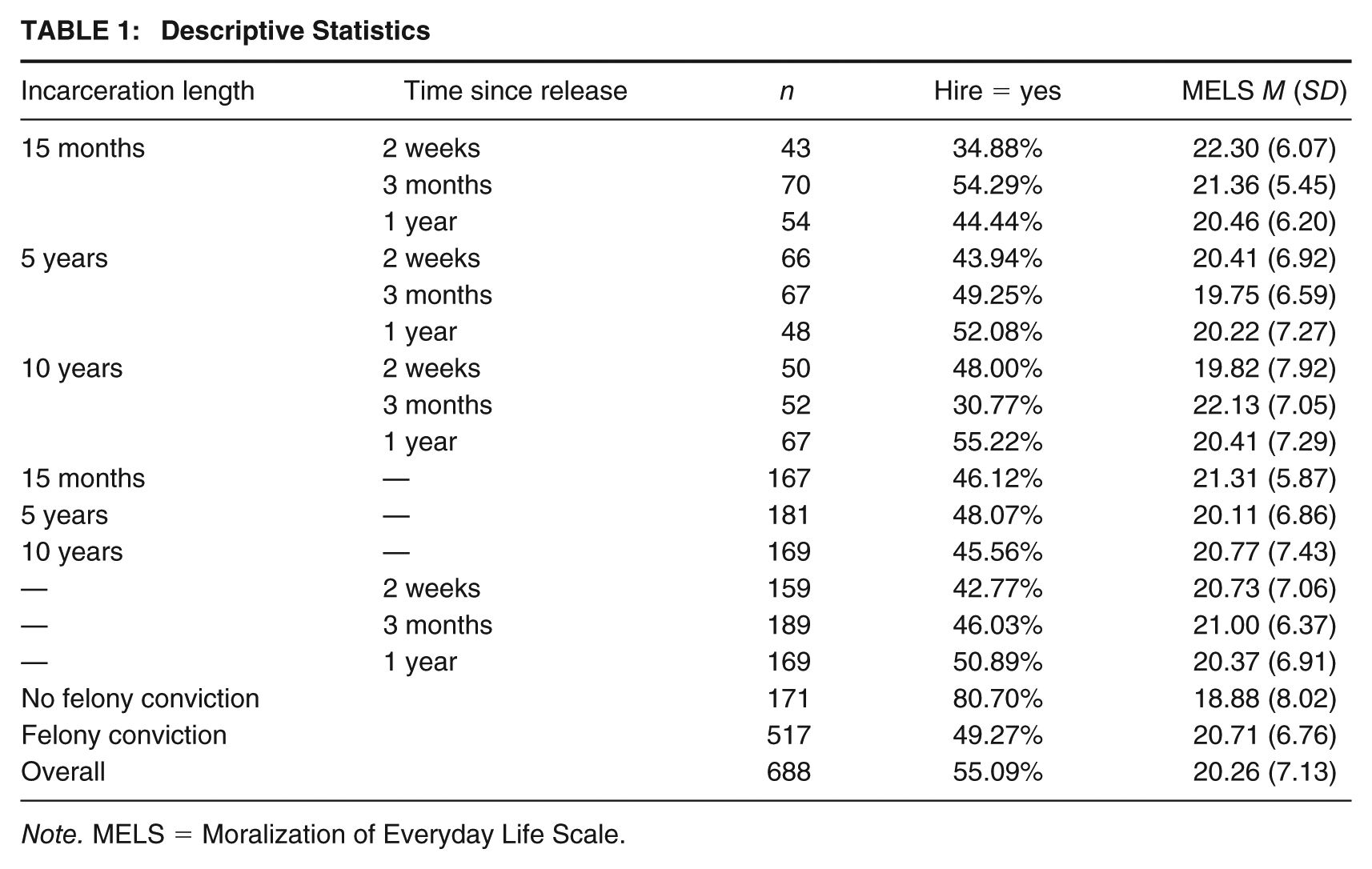
Note. MELS = Moralization of Everyday Life Scale.
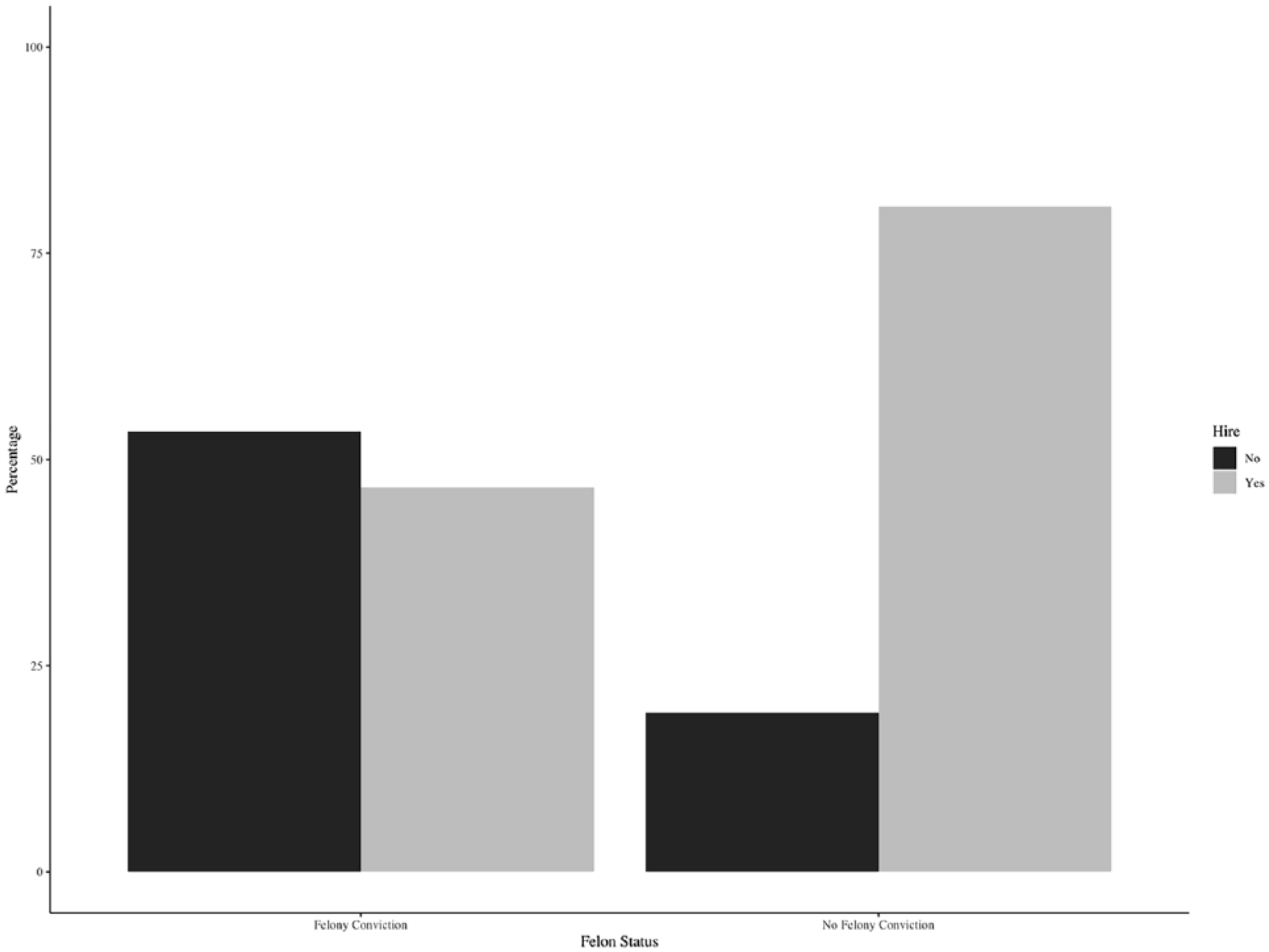
Hiring Decisions by Felon Status of the Applicant
To analyze Hypotheses 2, 3, and 4, the data were subsetted to remove the control group (n = 171). This was done to allow us to examine variability within incarceration length and release time for only those applicants who had been convicted of a felony. 3 The second hypothesis, that as incarceration length increased, participants would be less likely to hire the applicant, was not supported, χ2(2) = 0.25, p = .88, r2 = .001. Participants were no less likely to hire the applicant when he had been incarcerated 5 or 10 years compared with 15 months (see Figure 2). The third hypothesis, that as the time since release from prison increased, participants would be more likely to hire the applicant, was also not supported, χ2(2) = 2.21, p = .33, r2 = .006. Participants were no more likely to hire the applicant when he had been released from prison for 3 months or 1 year compared with 2 weeks (see Figure 3).
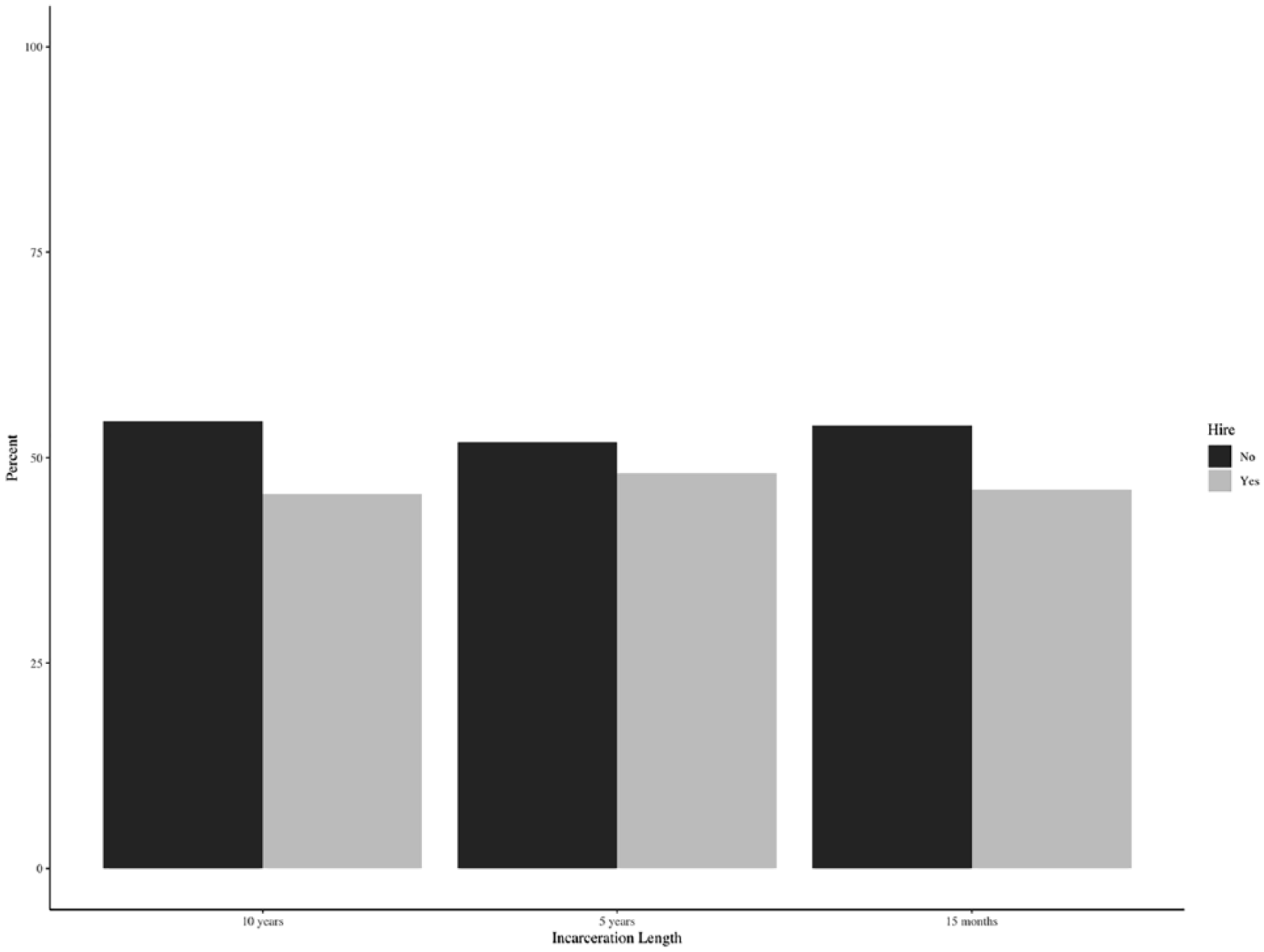
Hiring Decisions by Incarceration Length
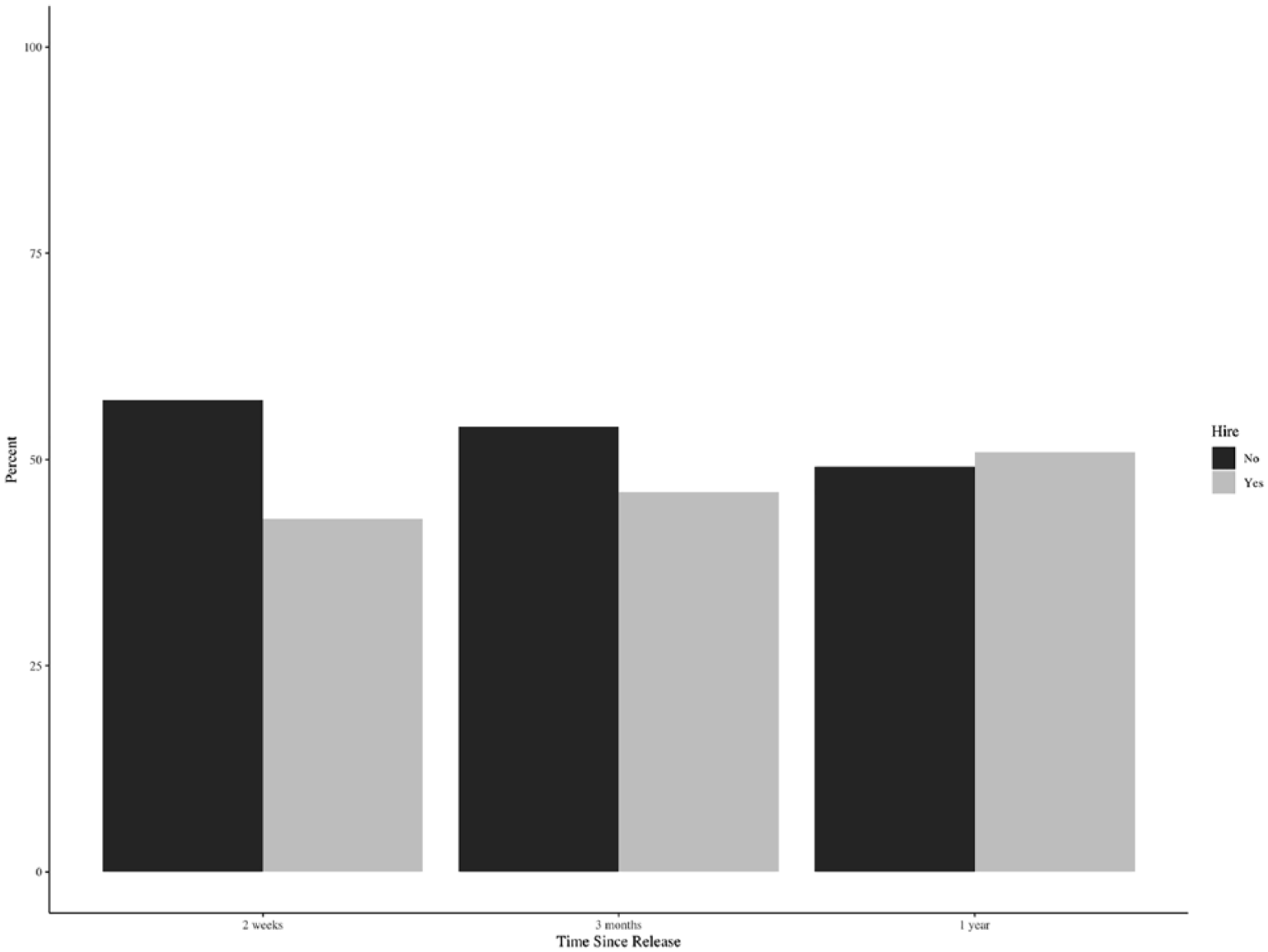
Hiring Decisions by Time Since Release
The fourth hypothesis, that there would be an interaction between incarceration length and time since release, was generally not supported, and the overall model only approached significance, χ2(8) = 12.58, p = .13, r2 = .03. The applicant who had been incarcerated for 10 years and released for 2 weeks was less likely to be hired than the applicant who had been incarcerated for 15 months and released for 3 months (β = 1.53, SE = 0.57, p = .008), as well as, marginally, the applicant who had been incarcerated for 5 years and released for 3 months (β = 0.94, SE = 0.54, p = .08). There were no other significant differences between the applicant incarcerated 10 years and released 2 weeks and the other applicants who identified as having a felony conviction (see Figure 4).
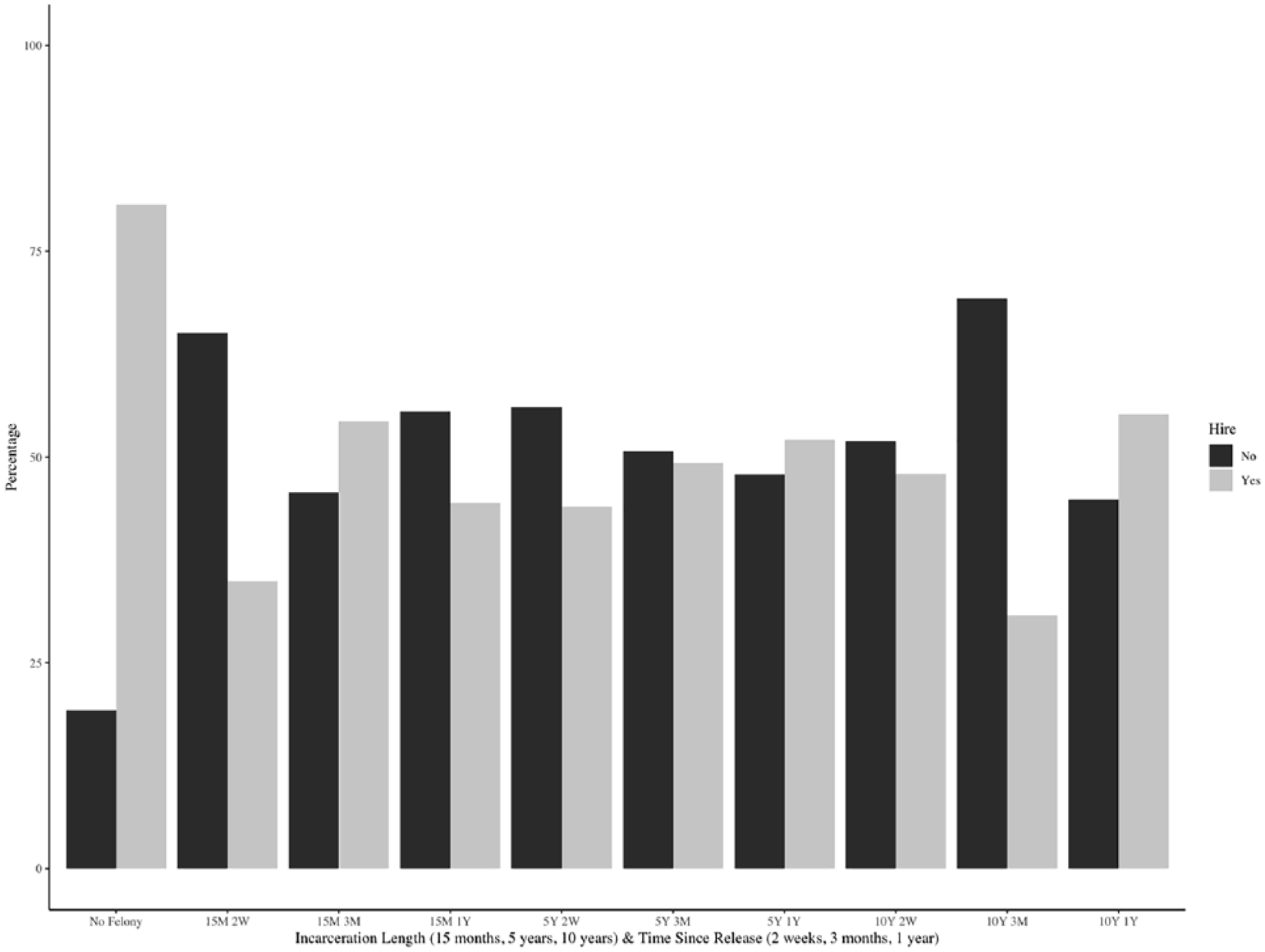
Hiring Decisions by Incarceration Length and Time Since Release
For Hypotheses 5 and 6, the data were no longer subsetted, and the control group was included. The fifth hypothesis, that as morality of the applicant decreased, participants would be less likely to hire the applicant, was supported, χ2(1) = 73.04, p < .001, r2 = .14. Finally, our sixth hypothesis was that the perceived morality of the applicant would mediate the relationship between both incarceration length and time since release and hiring decisions. Because results of Hypotheses 2 and 3 indicated no main effect of incarceration length or time since release on hiring decisions, it did not make sense to test this. However, we did observe a main effect of felon status, and, thus, ran a mediation analysis with perceived morality of the applicant mediating the relationship between felon status and hiring decisions. Using the lavaan package in R, the significance of the indirect effect was tested using 500 bootstrapped samples. Results indicated a significant indirect effect of applicant felon status on participants’ hiring decisions through perceived morality of the applicant (β = −0.34, SE = 0.04, 95% confidence interval [CI] = [−0.42, −0.27], r2 = .17). Applicants who identified as having a felony conviction were seen to be less moral than those who did not identify as having a felony conviction, and the less moral the applicant was perceived to be, the less likely he was to be hired. The direct effect of felon status on hiring decisions remained significant (β = −0.04, SE = 0.02, 95% CI = [−0.07, −0.01], r2 = .09).
Discussion
The results of the present study show that hiring decisions were not influenced by the time the applicant spent in prison nor the amount of time the applicant had been out of prison and not recidivated. These results are contrary to our hypotheses and to previous literature regarding time since release (e.g., Visher et al., 2011) and temporal immediacy (the time between the crime and the present moment). Jones Young and Powell (2015) argued that hiring managers “rely on factors such as temporal immediacy to determine the likelihood of reoffending” (p. 302) but did not test this empirically. Our findings indicated that the applicant who was released from prison 1 year ago was not hired significantly more than the applicant who was released from prison 2 weeks ago, even though the applicant who had been released 1 year had inherently gone through a longer time period of not reoffending. Thus, although existing research and theory suggest time since release should affect hiring decisions, our experimental study did not find significant differences in hiring decisions based on time since release. It is important to note, however, that although results were not statistically significant, findings were in the expected direction; participants were more likely to hire the applicant the longer he had been out of prison. Results did indicate, though, that applicants with a felony record were less likely to be hired than applicants who did not have a felony record. Specifically, when collapsing across time spent in prison and time since release from prison, results showed that when the applicant identified as having been convicted of a felony, he was significantly less likely to be hired than when he did not identify as having a felony conviction. Furthermore, this relationship was mediated by the perceived morality of the applicant. When the applicant identified as having a felony conviction, he was perceived to be less moral and was then less likely to be hired compared with the applicant who identified as having no felony conviction.
It may be the case that time since release does not affect perceptions of morality beyond what simply having a criminal conviction does. In line with the morality research reviewed, formerly incarcerated individuals are perceived unfavorably (e.g., Hirschfield & Piquero, 2010; Rade et al., 2018, 2016). Thus, it is not surprising that when slightly altering nuances of the criminal history, like the amount of time since being released from incarceration, the nuances are less likely to change the already negative impression of the formerly incarcerated individual. Results of a one-way analysis of variance (ANOVA) indicate support for this explanation. Time since release did not significantly predict MELS scores, F(2, 514) = 1.37, p = .26, η2 = .005. This could also explain our lack of evidence for length of incarceration affecting hiring decisions. Again, results indicated the specific time spent incarcerated did not change perceptions of morality beyond the fact that the applicant was incarcerated, F(2, 514) = 0.39, p = .68, η2 = .002. These findings advance the existing literature on discrimination of formerly incarcerated individuals in hiring decisions, as we are the first to show using an empirical methodology that length of incarceration and time since release do not significantly predict differences in hiring decisions or in perceived morality of the applicant for those convicted of a felony.
These findings imply that people making hiring decisions may not be specifically concerned with how long someone has been in prison or how long that person has been out of prison, but, instead, are concerned with the fact that a person has gone through the criminal justice system and was sentenced to some length of time in prison. Because of this criminal history, perceptions of that person’s morality were negative, which, in turn, made that person less likely to be hired. It seems the label of ex-felon is enough to make a potential employer have a negative perception of the applicant, even if the applicant was only in prison for 15 months and has been out for 1 year. This finding is perhaps explained by morality research that finds morality-related traits are more important than social and competency-related traits (e.g., Brambilla & Leach, 2014; Brambilla et al., 2013; Goodwin et al., 2014). Although there may be differences in social and job skills between an offender incarcerated for 10 years and an offender incarcerated for 15 months, and existing research finds those characteristics can matter in hiring decisions, social and job skill differences are not perceived to be as important to the overall impression of a person as the perception of morality of an individual with a criminal history. This finding is further supported by research showing that people low in perceived morality are even less likely to be accepted into a new group than those low in competence (van der Lee et al., 2017) and is in line with work showing that individuals with a criminal history are the least likely of all disadvantaged groups (e.g., applicants with a GED or spotty work history) to be hired (Holzer et al., 2007).
Our findings, that identifying as having a felony conviction on a job application makes the applicant less likely to be hired, provide further support for legislation known as “ban the box.” Ban the box refers to the idea that as a society, we should remove the question, and corresponding checkbox, that asks applicants whether or not they have ever been convicted of a crime. As of 2018, 33 states have adopted policies related to ban the box or “fair chance” (Avery & Herenandez, 2018). In addition, 11 states have applied a version of these policies to private companies as well (Avery & Herenandez, 2018). It is important to note that removing the requirement of individuals with a criminal history identifying their criminal history on job applications does not eliminate potential employers from ever finding out if the applicant has a criminal history. Instead, the time point at which employers learn of this information is delayed until later in the hiring process, typically after the applicant has made it far enough to submit to a background check. This can allow for the hiring manager to form a first impression of the applicant that is not tainted by the applicant’s criminal history. However, ban the box and fair chance legislation are not without drawbacks. Specifically, many policies do not state how employers should consider applicants with a criminal history and do not prevent employers from still deciding to not hire an applicant as soon as they learn of the applicant’s criminal history. Therefore, it remains important to address what may be causing hiring managers to have negative perceptions of individuals with a criminal history.
Some researchers have argued that employers are not exposed to many felons, and, therefore, do not have the opportunity to change ingrained negative stereotypes of formerly incarcerated individuals. This lack of exposure could be the driving reason for the discrimination (Jones Young & Powell, 2015). Our results indicated a decrease in perceived morality based on criminal history, which negatively affected hiring decisions. To decrease the stigma surrounding formerly incarcerated individuals, it may be useful to not only increase exposure of these individuals to hiring managers but also to do so in subtle ways that can increase perceptions of formerly incarcerated individuals’ levels of morality. For example, research has found that priming people with positive stereotypes of African Americans can increase people’s automatic perceptions of African Americans (Dasgupta & Greenwald, 2001) and make people more likely to attribute negative events to external sources, as opposed to internal (Power, Murphy, & Coover, 1996). As such, to decrease bias in hiring decisions, hiring managers may not have to have positive physical contact with formerly incarcerated individuals, and may, instead, be able to have increased positive impressions through a brief priming exercise prior to examining job applications. For example, research has shown that training people using the Situational Attribution Training Technique can reduce automatic stereotyping (Stewart, Latu, Kawakami, & Myers, 2010). Although done using negative racial stereotypes, it is possible this training may also help reduce negative stereotypes of formerly incarcerated individuals.
It is important to note, however, that the issue of individuals with a criminal history obtaining employment is not solely due to the hiring managers. Formerly incarcerated individuals themselves have to be qualified for the jobs they are applying for. A prolonged period of incarceration typically leads to a lack of recent job experience and diminished job-related skills, and individuals with a criminal history tend to be less educated and have more transportation difficulties, which provide more personal barriers to obtaining gainful employment postrelease (Visher et al., 2011; Visher, Winterfield, & Coggeshall, 2005). A 2005 meta-analysis of existing programs meant to help formerly incarcerated individuals upon release found no decrease in recidivism (Visher et al., 2005), though more recent programs have shown promise (e.g., Clifasefi, Lonczak, & Collins, 2017).
We suggest a multifaceted approach to helping reduce discrimination of formerly incarcerated individuals in the hiring process. First, individuals with a criminal history should ensure they are doing what they can while in prison to maintain or improve their education, job skills, and job experience. Second, hiring managers should be educated on stereotypes surrounding formerly incarcerated individuals and what can be done to combat the negative stereotypes and the undue influence on decision-making. Last, policy reforms such as ban the box and fair chance statutes should be implemented on a larger scale, in both the public and private sectors, and with more details for how exactly employers should consider criminal history in their decision-making process. Taken together, these suggestions can hopefully help lead to a more fair hiring process for formerly incarcerated individuals.
Limitations and Future Directions
Although the present study advanced the literature in many ways, it is not without limitations. One limitation of the current study is the use of a violent crime as the crime the applicant was convicted of. Although the crime could have been more severe, participants were not given any specific details related to the crime. According to the federal sentencing guidelines, the minimum recommended sentence for aggravated assault is 15 months, but different factors, such as use of a weapon, can make this sentence as long as 10 years. Participants were not given any of this information, nor were they given any information about what actually happened when the crime was committed. Future research should look at different crimes, such as property or drug crimes, to see whether perceptions of the applicant’s morality still affect hiring decisions.
A second limitation of the present research was that participants were only given basic facts about an applicant, derived from two documents, from which to make their hiring decisions. When the applicant indicated he had been convicted of a felony on the application, the applicant then used the three lines to briefly state the crime, the amount of time he spent incarcerated, and how long he had been released. The applicant did not provide any additional details, and we do not know if these three details are commonly provided by job applicants with a felony record (though some applications do ask for the date the crime was committed). However, for experimental purposes, we kept the details simple and straightforward. Future research should explore how varying the information about the felony conviction on a job application affects hiring decisions. It would also be interesting to explore the differences in a three-line explanation of the conviction compared with an in-person explanation, which can inherently be longer. Decker and colleagues (2015) compared online applications with in-person applications and hypothesized the online applications faired better because the employers were unable to make assumptions based off of physical characteristics. It is possible that the potential benefits that come with the ability to explain the conviction in more detail may outweigh the potential costs of revealing physical characteristics. Future research should explore this possibility.
Furthermore, although the brevity of the felony conviction description is in line with typical paper application procedures, participants in our study were only viewing one application and deciding whether or not to hire that one person. However, it is often the case that people making hiring decisions do so with multiple applications, and, therefore, make comparative judgments when choosing who to hire. Future research should explore how information from other applications can influence applications of formerly incarcerated individuals, as well as how information obtained during an in-person interview can alter hiring decisions beyond information obtained from an online application. For example, aside from physical characteristics, in-person interviews allow for the interviewer to ask the applicant questions regarding the conviction, which may change the employer’s perception of the applicant.
In addition, our use of an online community sample is potentially problematic. First, researchers have recognized the limitations of using MTurk for social science research (e.g., younger, more liberal, and more educated than the general U.S. population; Paolacci & Chandler, 2014) and have suggested best practices to follow (for a recent review, see Buhrmester, Talaifar, & Gosling, 2018), which we incorporated in our data collection. Although not without flaws, we feel the benefits of our MTurk sample outweigh the potential costs. Furthermore, we explored whether any characteristics of our participants that may differ from the general population (i.e., age, gender, race, education, and income) affected hiring decisions and found none did. Second, although our research was on hiring decisions, our use of a general community sample from MTurk instead of a sample comprised only those with hiring experience could limit the generalizability of our findings. When asked whether they had any hiring experience, 52.61% of our sample said they had, with the average reported time of experience being 5.18 years (range = 2 months-35 years). Furthermore, we tested whether existence of hiring experience changed participants’ hiring decisions and found the answer to be no, χ2(1) = 1.74, p = .19, r2 = .003; participants without hiring experience hired the applicant in our study at similar rates as participants with hiring experience. We also ran analyses including hiring experience as a covariate in each of our models and found results remained the same, and hiring experience did not significantly predict hiring decisions.
Finally, much of the previous literature has explored the negative impact race can have on hiring decisions. Although not part of the scope of the present study, we chose a name (Brian Gibson) that previous research found to be perceived by approximately half of the sample as White and half as Black. We asked participants, after they made their hiring decisions, what race they thought the applicant was. The majority of our sample (78.78%) thought the applicant was White, 13.08% thought he was Black, 3.34% thought he was Hispanic, 2.18% thought he was Native American, 1.16% thought he was Asian, and 1.45% thought he was “Other” or said there was not enough information. To ensure perceived applicant race did not affect hiring decisions, a logistic regression model was run with race predicting hiring decisions and was found to be nonsignificant. We also subsetted the data to include only those who thought the applicant was White and found that results were consistent with all participants being included. Although not the focus of the present work, future research should test whether incarceration length and time since release potentially interact with applicant race.
Conclusion
Although we found length of incarceration and time since release did not significantly affect hiring decisions, felon status did negatively affect perceptions of morality and, in turn, hiring decisions. More research into what can be done to decrease discrimination in hiring decisions is necessary to help people with a felony record obtain employment after incarceration. As people continue to be released from prison, there is growing demand for formerly incarcerated individuals to return to the workforce, but employer apprehension could be a deterrent for those seeking employment. Previous research shows that employment is a necessary component of successful reentry for those convicted of a felony; however, our research illustrates that there is still a hurdle to overcome: perceived morality.
