



Abstract
Due to the heterogeneity of homicide, certain subtypes of homicide might have remained stable or even increased over time in the overall context of decline. Adding to the research attempting to identify a standardized classification system of homicide, this study used a novel, sophisticated statistical approach (multilevel latent class analysis [MLCA]) and an inductive theoretical stance to identify subtypes of homicide in Scotland and to examine how these types have changed over time. Using variables relating to the victim, offender, and the incident of homicide, four between-level types with three within-level classes of offenders in each type were identified. The findings showed that while all homicide types demonstrated an absolute decrease, domestic homicides had demonstrated a relative increase over time. Implications for policy, theory, and practice are discussed.
Introduction
Studies have demonstrated that subtypes of homicide vary across covariates and other variables and have pointed to the necessity of disaggregating this crime to understand these relationships (Blumstein, 2000; Kubrin, 2003; Lehti, 2014; Messner & Savolainen, 2001; Thompson, 2015). While other studies have examined the spatial (McCall, Land, & Parker, 2011), as well as racial (Parker, Stansfield, & McCall, 2016) heterogeneity of homicide, no previous study has examined the changing trends of subtypes of homicide over time in the context of the overall homicide decline, resulting in a lack in knowledge of both homicide and crime trends in this regard. For instance, when Lehti (2014) disaggregated homicide in Finland, hidden countertrends were found within the greater homicide drop. While the drop in homicide seemed to be driven by a decrease in alcohol-related homicides committed by working-age men, lethal violence committed by young females had increased (Lehti, 2014). Similarly, Blumstein (2000) also argued that the change in the aggregate homicide rate in the United States was a product of several distinct trends that needed to be separated to explain the decline.
Changes in aggregate crime rates may reflect different and potentially opposite trends for different heterogeneous subgroups in the population (Hox, 2002; Lindley & Novick, 1981). Combining these subgroups and treating them as if they are the same can lead to erroneous conclusions, known as “Simpson’s Paradox” (Hox, 2002, p. 3; Lindley & Novick, 1981). In other words, decreases in homicide at the aggregate level, evident both in Europe and the United States (Aebi & Linde, 2010; Farrell, Tilley, Tseloni, & Mailley, 2010), do not mean that all subtypes of these crimes are falling equally. In fact, while some subtypes of lethal violence are decreasing in line with the general trend, other subtypes may remain stable, or even increase over time. This study therefore argues, in line with previous research, that unidimensional examinations of homicide trends are inadequate to understand the change in this heterogeneous crime over time, and will add to the knowledge of homicide as well as crime trends research by examining how different subtypes of homicide in Scotland have changed over time.
Research Context
Taking aside the general gap in knowledge of disaggregated homicide trends, the scarcity in homicide research is particularly evident in Scotland. This lack of knowledge is remarkably paradoxical considering Scotland was previously known as “the most violent country in the Western World” (“Scotland Has Second Highest Murder Rate in Europe,” 2005; “Scotland Worst for Violence—UN,” 2005). The violence problem in Scotland is deep-rooted, dating back decades, and has been particularly centered on knives and gangs, especially in the west part of Scotland (Carnochan, 2015; Damer, 1989). Yet, over the past decade, Scotland has seen an unprecedented decline in homicide with 2015-2016 demonstrating the lowest numbers since 1976 (Scottish Government, 2016). This change coincided with a shift in the violence policy focus in Scotland, moving from a “crack-down on crime,” “gloves off” approach in the mid-1990s (Orr, 1998, p. 106), to framing violence as a public health problem, advocating multiagency collaborations to tackle violence (Violence Reduction Unit [VRU], 2017).
Having gone from one of the most violent Western countries to having one of the lowest homicide rates in Europe (Eurostat, 2017), Scotland is a particularly suitable case-country for examining disaggregated homicide trends over time. In addition, due to the historical prevalence of knife violence in Scotland (Carnochan, 2015; Damer, 1989), related to violent constructions of masculinities evident, for instance, through the notion of “the hardman” or “the fighting man” (Fraser, 2015, p. 68), the characteristics of homicide are different compared with other countries such as the United States. Rather than firearms (Pizarro, 2008), the majority of homicides in Scotland involve knives or sharp objects, making Scottish homicides more similar to Scandinavian homicides, including Swedish (Granath et al., 2011) and Finnish homicides (Lehti, 2014). This, along with the fact that very little research about homicide has been conducted in this country, highlights the need for this examination in Scotland.
Various theories attempting to explain the decrease in homicide have been proposed, such as changed criminal justice policies and legislation, increased securitization, and economical and societal change (Aebi & Linde, 2010; Tonry, 2014). The empirical support for these theories has, however, been quite varied. There is, furthermore, the issue of explaining changes in international crime trends using national variables such as increases in incarceration or legislative changes (Farrell et al., 2010). Drawing on routine activities theories (Cohen & Felson, 1979), Aebi and Linde (2010) argued that the decrease in homicide and violence might be related to decreasing interactions in public places. Young people are increasingly spending more time indoors by computers rather than in public places such as the streets, which leads to fewer opportunities to engage in violence (Aebi & Linde, 2010). Whether or not crime occurs in a domestic rather than public setting has also been linked to socioeconomic status and marginalization, particularly when it comes to youth crime (Aebi & Linde, 2010).
Similarly, it has also been argued that a privatization of violence has taken place, meaning that violence has become more private and less public in nature (Cooney, 2003). Drawing on ideas of Elias (1939) and Black (1976), Cooney argued that violence in modern societies is considerably more individualized, occurring more often between fewer individuals, as well as more intimate; a higher degree of violent acts occur between people who know each other well in modern societies compared to earlier societies. This privatization of violence, related to the modernization of society, has not only increased individualization and intimacy of violence, but also reinforced the link between marginalization and violence (Cooney, 2003), an idea supported by other theorists (Aebi & Linde, 2010; Young, 2007).
Homicide Typologies
There are many different typologies of homicide that overall appear to be more diverse than similar (Polk, 1994). Wolfgang (1958), whose work remain influential to this day (i.e., Brookman, 2005), was among the first scholars to examine variables relating to the victim, the offender, and the homicide incident simultaneously. Many of the earliest developed homicide typologies were based almost exclusively on classification variables concerning the incident, such as the organized/disorganized typology developed by Hazelwood and Douglas (1980), or the offender, such as the instrumental/expressive typology (Block & Block, 1992; Salfati, 2000). More recent typologies tend to disaggregate homicide based on victim–offender relationship and variables measuring the circumstances surrounding the homicide (Flewelling & Williams, 1999).
There have been calls for a common, standardized classification system of homicide, which would not only increase the comparability of studies, but also enhance our understanding of causes and correlates of homicide, and how they vary across subtypes (Flewelling & Williams, 1999; Salfati & Dupont, 2006). For instance, Kubrin (2003) found that while economic disadvantage predicted altercation homicide, felony homicide was more strongly predicted by residential instability. Similarly, Avakame (1998) found that the predictors of stranger homicide varied strongly to predictors of intimate-partner homicide. The development of a common classification system is however hampered by a number of theoretical and methodological issues (Flewelling & Williams, 1999). Theoretically, homicide typology research is divided into a deductive, a priori approach where types of homicide are identified based on previously known subtypes (i.e., Lehti, 2014; Pridemore & Eckhardt, 2008; Pizarro, 2008), and an inductive, explorative approach which allows for the identification of new, previously unknown subtypes (i.e., Bijleveld & Smit, 2006). Although the deductive approach might eventually help create a common classification system of homicide, it essentially only identifies already known subtypes and does not allow the examination of different combinations of important variables to subtypes of homicide. Cultural differences in homicide types therefore need to be fully examined using an inductive approach before any conclusions on such a system may be drawn. Although previous research has indicated that homicidal behavior transcends national borders (Salfati & Dupont, 2006), it is nevertheless important to explore the characteristics of this crime fully in countries where subtypes have not previously been identified, such as in Scotland.
There is furthermore no consensus on how to methodologically identify homicide subtypes, resulting in a wide array of statistical methods used. These methods range from defining the types based on one single variable before using regression analysis to compare these types on other variables (Pizarro, 2008; Pridemore & Eckhardt, 2008), to using different forms of distance-based clustering techniques, such as multiple correspondence analysis (Bijleveld & Smit, 2006), smallest space analysis (Salfati, 2000; Salfati & Canter, 1999), or two-step cluster analysis (Liem & Reichelmann, 2014). Although useful, these methods are designed to identify similarities between cases based on their proximity using measures of distance, such as Euclidian distance (Romesburg, 1984). Distance-based measures are quite sensitive to the scale of the variables and although variables could be standardized, this reduces variability and the distance between clusters, risking biased results (Romesburg, 1984).
Distance-based techniques do not make any assumptions about the underlying distribution of the data or any underlying relationships between the variables. As many datasets containing information on homicide are based on categorical variables, often nested in hierarchical structures, more sophisticated statistical techniques are necessary to take these factors into account. The use of such techniques, such as multilevel latent class analysis (MLCA), has been absent from previous typology research. This constitutes another problem, because failing to take these data complexities into account can lead to statistical and interpretational error. This study therefore looks to complement previous research attempting to identify a common classification system of homicide by using a novel, sophisticated statistical technique to identify types of homicide in Scotland.
Overall, the gaps in current knowledge regarding the change in homicide subtypes are problematic for a number of reasons and have important implications for both policy and theory. Homicide has profound implications regarding stress placed on emergency systems, as well as the health of the family and community (Harries, 1989; Harvey, Williams, & Donnelly, 2012). This violent crime also has unparalleled impact on the public perception of crime and fear of crime in society (Perkins & Taylor, 1996; Warr, 2000). From a harm-reduction perspective, it is important to have a full understanding of the characteristics of homicide as well as how this crime has changed over time. If subtypes of homicide are changing differently, this might suggest that bespoke policies and prevention strategies would be required. The aim of this exploratory study is twofold: (a) to identify subtypes of homicide in Scotland based on variables relating to the victim, offender, and the incident using a novel statistical approach (MLCA) and (b) to examine how these subtypes have changed over time. This will not only help prevent a Simpson’s paradox in relation to the study of crime trends (Hox, 2002; Lindley & Novick, 1981), but also add to the literature trying to identify a standardized classification system of homicide (Flewelling & Williams, 1999; Salfati & Dupont, 2006) by using a novel statistical method and inductive approach.
Data and Method
Sample
The data were gathered from the Scottish Homicide Database (SHD), which is a population dataset held and populated by Police Scotland. A homicide in the current study is defined as an incident where at least one dead body (or parts of a dead body) was found within the context of the same crime scene. The homicide case may involve multiple offenders and/or multiple victims, but if another victim was found outside the borders of the first crime scene, this would be regarded as another homicide case. All cases identified as “murders” by the police committed between 2000 and 2015 were collected, resulting in a dataset of 1,978 offenders over 1,344 cases. In 13 cases (0.7%) the offender was unknown, and their characteristics were treated as missing. Culpable homicides, defined as homicides through wrongful conduct of the offender without the intention to kill or “wicked recklessness” (Scottish Government, 2004), and/or where diminished responsibility can be found, were excluded from the sample because some of these cases were nonviolent acts (such as the self-administration of drugs). Ethical approval was sought and approved by Police Scotland before any data collection commenced.
Statistical Analysis
To theoretically inform any future standardized classification system of homicide (Flewelling & Williams, 1999; Salfati & Dupont, 2006), and to ensure that such a system is sensitive to cultural or contextual differences of subtypes, the current study aimed to explore what subtypes could be identified in Scotland, taking an inductive, data-driven approach to capture any possible cultural nuances of this crime. As previous research has demonstrated the importance of including aspects relating to the victim, offender, and incident when examining homicide to achieve a comprehensive picture of the crime’s context (Beauregard & Proulx, 2002; Meier, Kennedy, & Sacco, 2001), classifying variables relating to all three of these aspects were included in the analysis. The homicide data mostly consisted of categorical or nominal variables and were hierarchical in structure. To take these data complexities into account, as well as examining variables relating to the victim, offender, and the incident simultaneously, MLCA was conducted. MLCA is a probabilistic clustering technique designed to identify latent subgroups in the data, based on the respondents’ response pattern on categorical classifying variables (McCutcheon, 2002). The technique assumes that the observed heterogeneity in the data can be explained by an unobserved latent variable with a finite number of classes and considers the hierarchical structures in the data by allowing latent class intercepts to vary across between-level groups, thereby examining if and how these between-level groups influence the latent classes on the within level (Henry & Muthén, 2010). This technique was chosen in favor of other techniques such as factor analysis because LCA is concerned with the structure of cases, while factor analysis is concerned with the structure of variables. Although MLCA is a very robust technique that has been found superior to distance-based multilevel modeling (Serban & Jiang, 2012), no previous study has used MLCA to identity subtypes of homicide. All MLCA modeling was conducted in Mplus. Two model parameters were estimated: (a) individual probability (which is an estimate of every offender’s probability of appearing in each class) and (b) class probability (which is an estimate for each class’s average score on each of the observed classifying variables). Both of these parameters were used to describe the characteristics of the classes. Three statistical criteria for model fit were used alongside the substantive interpretation of the classes: the Akaike information criteria (AIC), the Bayesian information criteria (BIC), and the sample size–Adjusted Bayesian Information Criteria (ABIC; McCutcheon, 2002; Nylund, Asparouhov, & Muthén, 2007).
Two latent constructs were estimated in the MLCA: a within-level multinomial latent variable (classes of offenders) and a between-level multinomial latent variable (classes of incidents and summarized victim variables). The variables included in the model were chosen based on previously identified homicide typologies which examined the victim, offender, and incident of homicide. As such, the variables were chosen because they are theoretically assumed to disaggregate homicide etiologically. Only five such typologies were identified in the current study (Bijleveld & Smit, 2006; Morton, Runyan, Moracco, & Butts, 1998; Pizarro, 2008; Pridemore & Eckhardt, 2008; Wood Harper & Voigt, 2007). While different in their methodology and outset, the 23 variables used to identify homicide subtypes in these five studies were strikingly similar, demonstrating their theoretical value and relevance when disaggregating homicide. Using these 23 variables as a starting point, single-level MLCA models were run on each group of variables, eliminating any redundant or superfluous variables. Taking into account data availability, this resulted in six classifying variables relating to the offender, which were introduced on the within level of the model; six classifying variables relating to the victim; and six variables relating to the incident, which were introduced in the between-part of the model. Time was divided into four dummy variables (2000-2003; 2004-2007; 2008-2011; 2012-2015), which were added as covariates in the between model, using the first year-group as the reference category. Four-year groups were chosen to avoid small n for certain years while still maintaining as much variance as possible.
The level of missing data in the classifying variables ranged from 0% to 72.9%, meaning that some variables had very high levels of missing data. Great efforts were made to decrease missing data, including extensive discussions with Police Scotland, recoding of the variables, and manual searches through the synopses of cases. Due to a significant relationship between missing data and time, the missing data were considered to be missing at random (MAR) and therefore considered ignorable nonresponse. A cutoff point of 60% missing data (which constituted the majority) was decided, which meant that certain variables had to be excluded from the model. While this cutoff point is to be considered high, additional analyses of the missing data of the victim, offender, and incident-related variables respectively indicated that missing data had a limited effect on the classes identified. This is an important caveat to consider when interpreting the results of the current study.
Two measures were used to examine the absolute and relative change over time in the homicide subtypes: the average probability for each between class per year group and an estimated number of offenders per year group. The mean probabilities per year group were calculated by saving the individual probabilities for each offender. That means that every offender had a probability score for each of the different possible homicide subtypes (combination of within and between classes) that were identified in the model. The probabilities of each between class were then summed for each individual, leaving each person with a summed probability for each between class. These summed probabilities for the between classes were then averaged per each year-group by calculating the mean of this summed probability over each year-group. By doing this, it was possible to estimate how likely each between class was in any year group compared with any other year group, and whether there had been a relative change over time. The average probability of belonging to each class per year group was then plotted over time. Mann–Whitney U tests were subsequently conducted to compare the average probability of the classes in any given year group to the average probability of the same class in any other given year group to determine if the change in average probability was statistically significant.
The estimated number of offenders per year group was calculated by multiplying the average probability of each year-group by the total number of offenders in each year. This resulted in an estimate of the number of offenders per homicide subtype per year group. By doing this, the absolute change in the homicide subtypes could be examined over time. As this was a summary measure (estimating the number of offenders by summing the individual class probabilities of each class per year group), no significance tests were conducted to examine the difference between year groups.
Results
Deciding on the Model
MLCA models were run with up to four subtypes on the between level and four classes on the within level. As Table 1 indicates, the 4-3 model had the best BIC and ABIC, and when comparing this to the model with the best AIC (4-4 model), the 4-3 model was more substantively relevant and was therefore chosen as the best fitting model of the data. For the sake of clarity, the between-level subtypes will be called subtypes and the within-level classes will be called classes. The names of the classes were decided based on the most common, or in some cases, most unique traits of the subtypes or classes.
Class Selection Statistics of Two-Level LCA Homicide Model
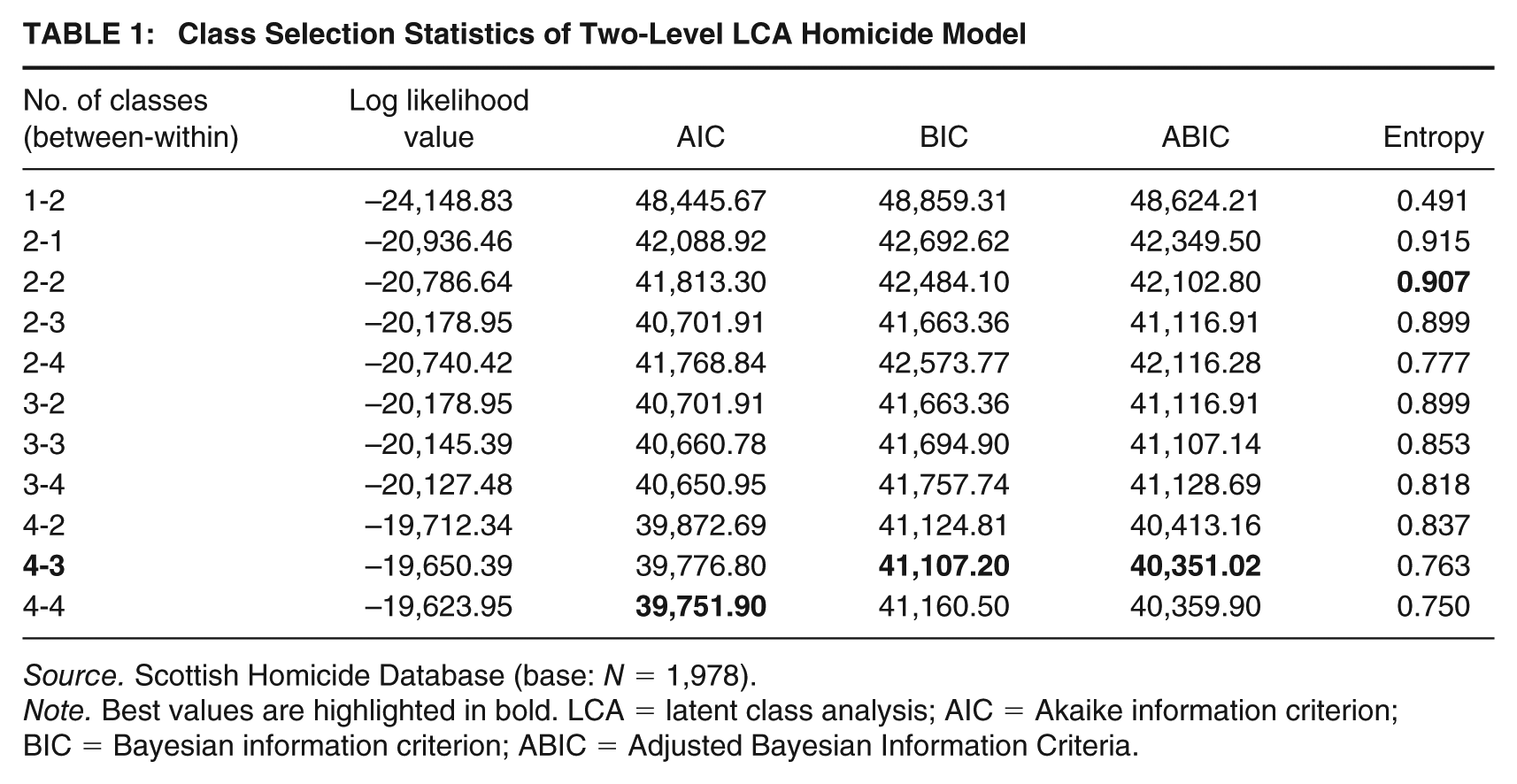
Source. Scottish Homicide Database (base: N = 1,978).
Note. Best values are highlighted in bold. LCA = latent class analysis; AIC = Akaike information criterion; BIC = Bayesian information criterion; ABIC = Adjusted Bayesian Information Criteria.
Between-Level Subtypes
In the 4-3 model, there were four subtypes of homicide based on a combination of the characteristics of the incident and the victim and, within these subtypes, there were three classes of offenders (see Table 2).
Between Subtypes With Within-Classes

Source. Scottish Homicide Database (base: N = 1,978).
Stabbing subtype
The first and largest subtype, labeled the Stabbing subtype (31.9%, n = 630), consisted only of homicides committed with the use of a sharp weapon (see Table 3). The Stabbing homicides were committed against relatively young men inside a private location (see Tables 3 and 4). The victims tended to be under the influence of alcohol or drugs, and the homicide occurred in the context of some sort of fight or argument between the offender and victim, who most commonly were friends or associates. In addition, most of the victims were male and unemployed, which could indicate a higher level of deprivation among the victims of this subtype. The victims were most commonly White, between 31 and 45 years old, and had a recorded home address. The fact that the weapon was not commonly brought to the scene, but improvised, could also indicate that the Stabbing homicides were mostly unplanned and spur-of-the-moment in nature.
Class Probabilities for Incident Variables

Source. Scottish Homicide Database (base: N = 1,978).
Class Probabilities for Victim Variables
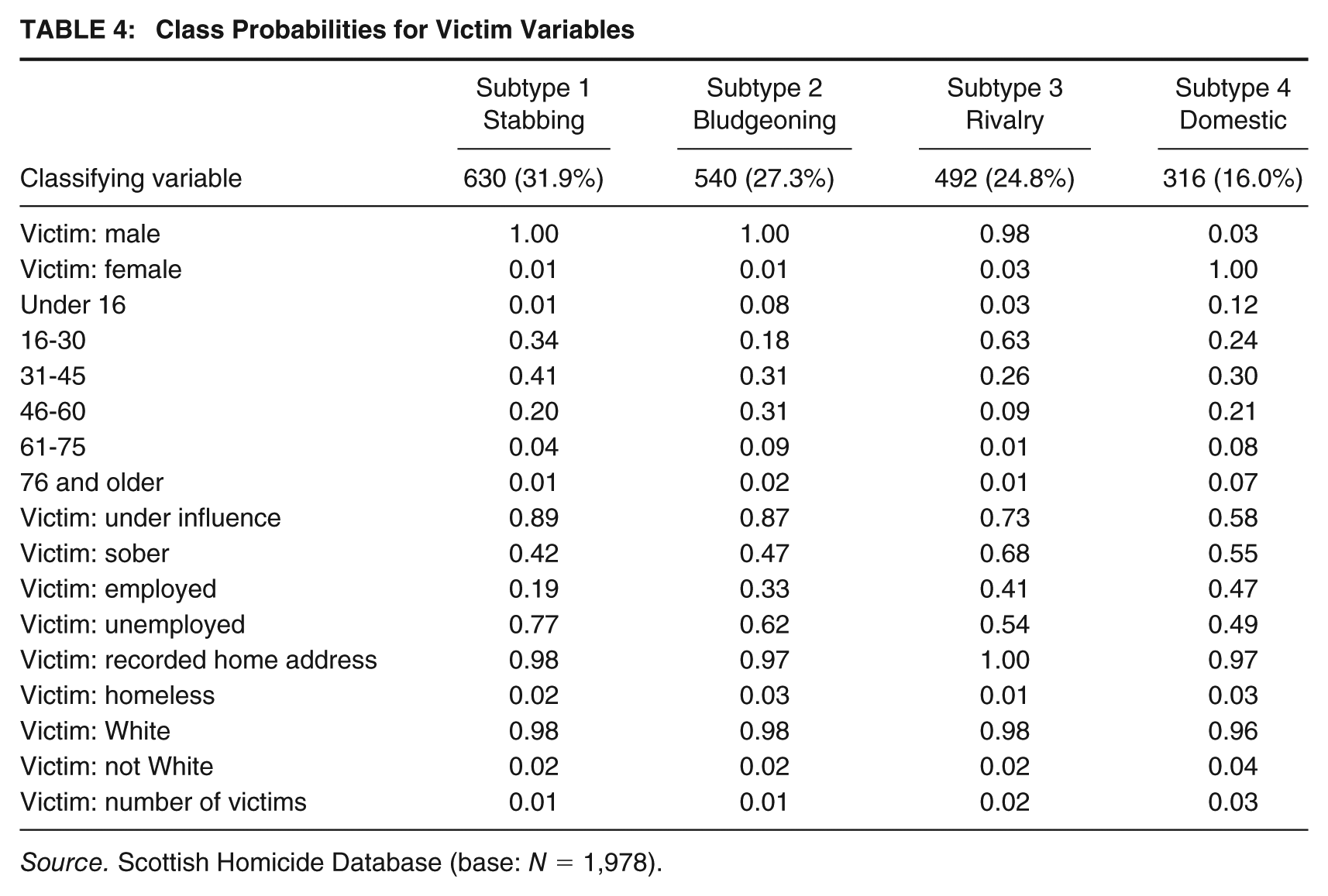
Source. Scottish Homicide Database (base: N = 1,978).
Bludgeoning subtype
The second between-level subtype was labeled the Bludgeoning subtype (27.3%, n = 540) because the most common method of killing was by physical assault, and in three fifths of the cases, no weapon was used at all (see Tables 3 and 4). The Bludgeoning subtype was largely very similar to the Stabbing subtype except for the method of killing. The Bludgeoning homicides took place in private settings, indoors, and when a weapon was used, this was commonly improvised at the scene. The victims were most commonly male, of White ethnicity, and had a recorded home address. The victims were often unemployed and under the influence of drugs or alcohol and tended to be slightly older than the victims in the Stabbing subtype, with a most common age of 46 to 60 years old. The offender and victim most commonly knew each other, and in a quarter of the cases they were related. The motive behind this subtype of homicide was typically some sort of conflict or fight.
Rivalry subtype
The third between-level subtype was named the Rivalry subtype (24.8%, n = 492) because the most common relationship between the offender and victim was rival (see Tables 3 and 4) and the most common motive was feud or faction rivalry. The Rivalry homicides were committed outdoors in public areas between young male victims and offenders. The victims were most commonly White and unemployed, and although most victims were under the influence of drugs or alcohol at the time of murder, a high proportion of the victims were not (see Table 4). The most common method of killing was stabbing, but almost a fifth of the cases included shooting by a firearm. Most of the offenders had brought the weapon to the scene, which indicates some level of premeditation. The majority of the victims were aged 16 to 30 years old, making the Rivalry homicide the subtype with the youngest victims overall.
Domestic subtype
The fourth and smallest of the between-level subtypes was labeled the Domestic subtype (16.0%, n = 316) because the victim and offender were most commonly intimate partners (41.4%), with another fifth being other relatives, including children of the offender (see Tables 3 and 4). Overall, the Domestic homicides would indicate a subtype of homicide involving the death of female victims by an intimate partner, taking place in a private setting indoors. Although the most common motive was some sort of fight or conflict, a substantial number of the homicides in this subtype was regarded as being motivated by a domestic dispute. The most common method of killing was stabbing, but strangulation and murder without the use of a weapon was also quite common. This subtype included the highest number of non-White victims, although it was still more common for the victims to be White. About as many of the Domestic victims were under the influence of drugs or alcohol as were sober, and about half of the victims were employed. This would suggest a more stable victim profile compared with the other three subtypes, which showed higher levels of unemployment and use of drugs or alcohol. The age distribution was quite evenly spread for the Domestic victims, with the most common age being 31 to 45 years old.
Within-Level Classes
As mentioned, there were three within classes of offenders in the 4-3 model (see Table 2). When the within classes were examined in greater detail, names for the classes were given, primarily based on the distinguishing variables age and employment status. The vast majority of the offenders in every class was White and had a recorded home address.
The first offender class was labeled the Unemployed Offender class (45.6%, n = 902) because it consisted of mostly unemployed men who had a most common age of 16 to 30 years old (see Table 5). This was overall the largest offender class with more than two fifths of the sample belonging to this class. The second class was labeled Mixed Offender class (43.2%, n = 854). This class was quite similar to the Unemployed Offender class because the majority of the offenders were unemployed; however, unlike the Unemployed Offender class, this class had a more evenly distributed age (see Table 5), with a higher proportion of the offenders being middle-aged. In addition, although all of the offender classes were mostly male, the Mixed Offender class had the highest average of female offenders with one fifth of the offenders being female. Due to the similarities to the Unemployed Offender class, this class may be considered something of a statistical artifact (Skardhamar, 2009) with limited practical implications. The third and final class was the smallest of offenders (11.2%, n = 222). Unlike the two other classes, the majority of the offenders in this class were employed (see Table 5). In addition, the Employed Offender class was the only class where the offender committed suicide after the homicide, with approximately one in 10 of the offenders in this class taking their own lives. This class tended to be slightly older than the two previous classes with a most common age of 31 to 45 years old, and approximately another third of the offenders being older than 45 years old.
Class Probabilities for Offender Variables
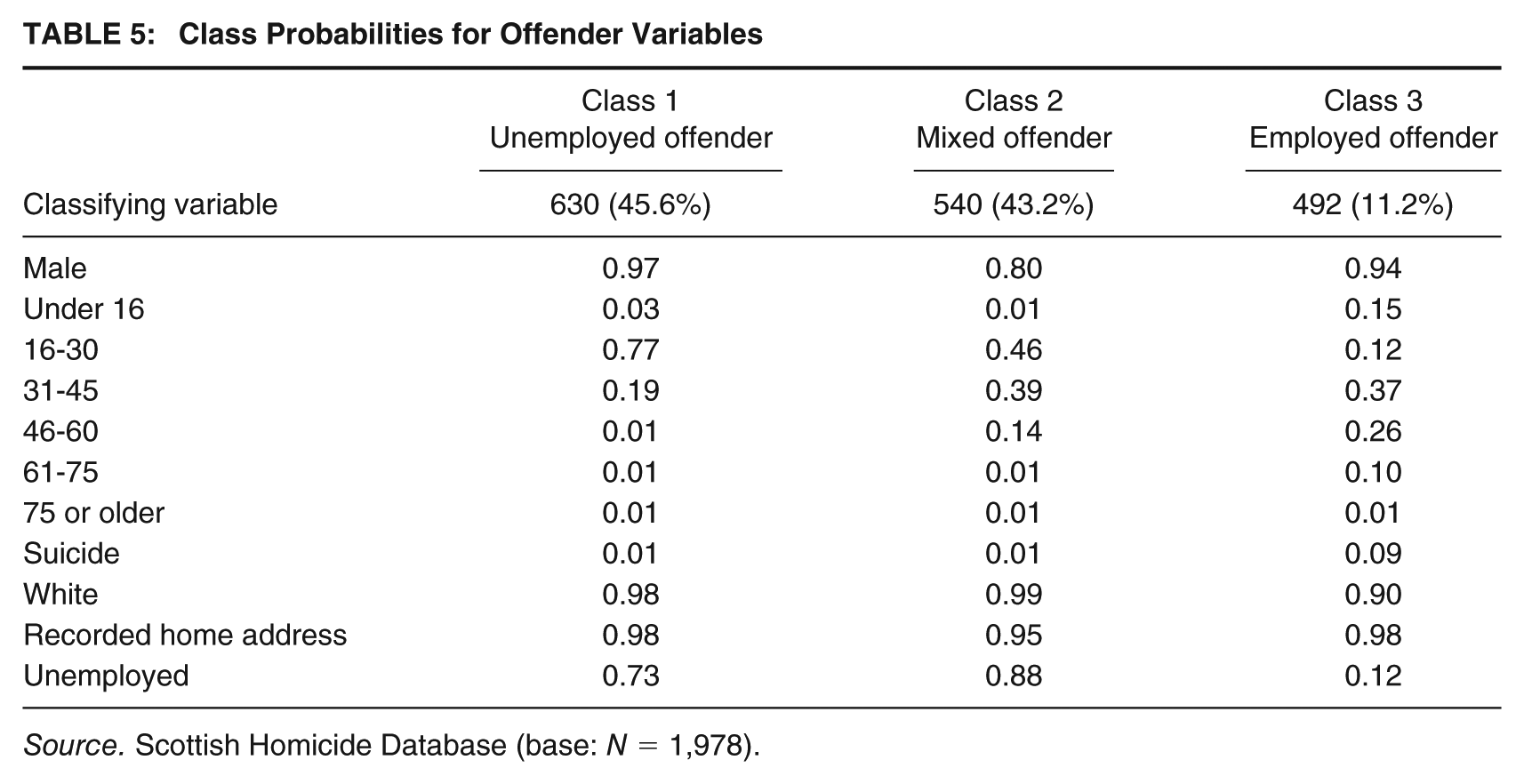
Source. Scottish Homicide Database (base: N = 1,978).
Absolute Change Over Time
Figure 1 illustrates the estimated number of offenders in each subtype in each year-group, indexed at the first year-group (2000-2003). As can be seen from Figure 1, all subtypes of homicide demonstrated an absolute decrease over time. The Stabbing homicides decreased by approximately 36% in 2012-2015 compared with 2000-2003, and the Bludgeoning subtype had almost halved over the same time period. The Rivalry homicides increased sharply (142%) between 2000-2003 and 2004-2007, but this was followed by an equally marked decrease from 2004-2007 onward, leading to an overall decrease of 54% in 2012-2015 compared with 2000-2003. The Rivalry homicides consequently demonstrated the largest absolute decrease over time. After an initial increase in the Domestic homicides, this subtype also decreased by 29% in 2012-2015 compared with 2000-2003. Of all the homicide subtypes, the Domestic subtype had the smallest absolute decrease over time.
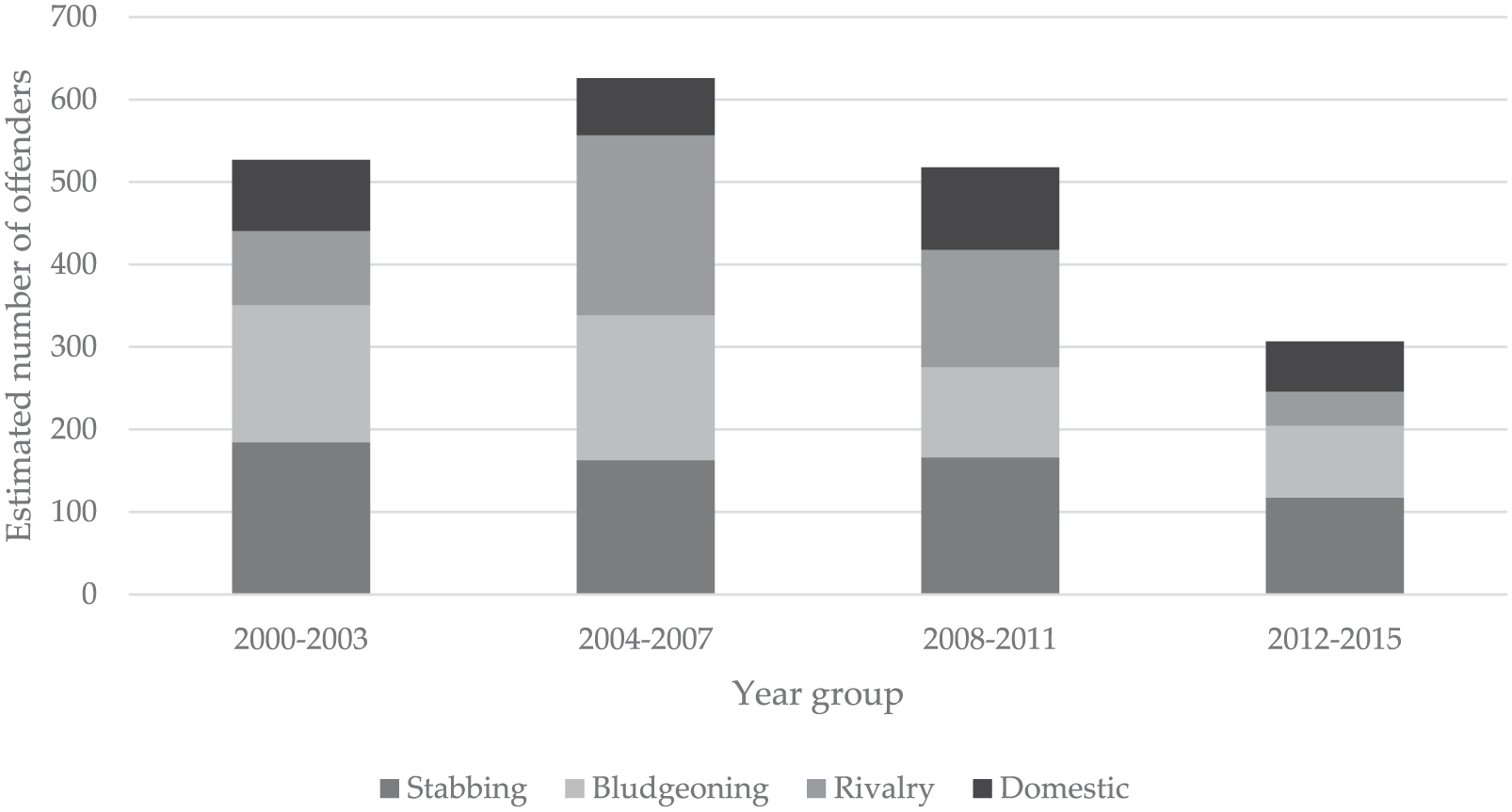
Absolute Change in Homicide Types Over Time
Relative Change Over Time
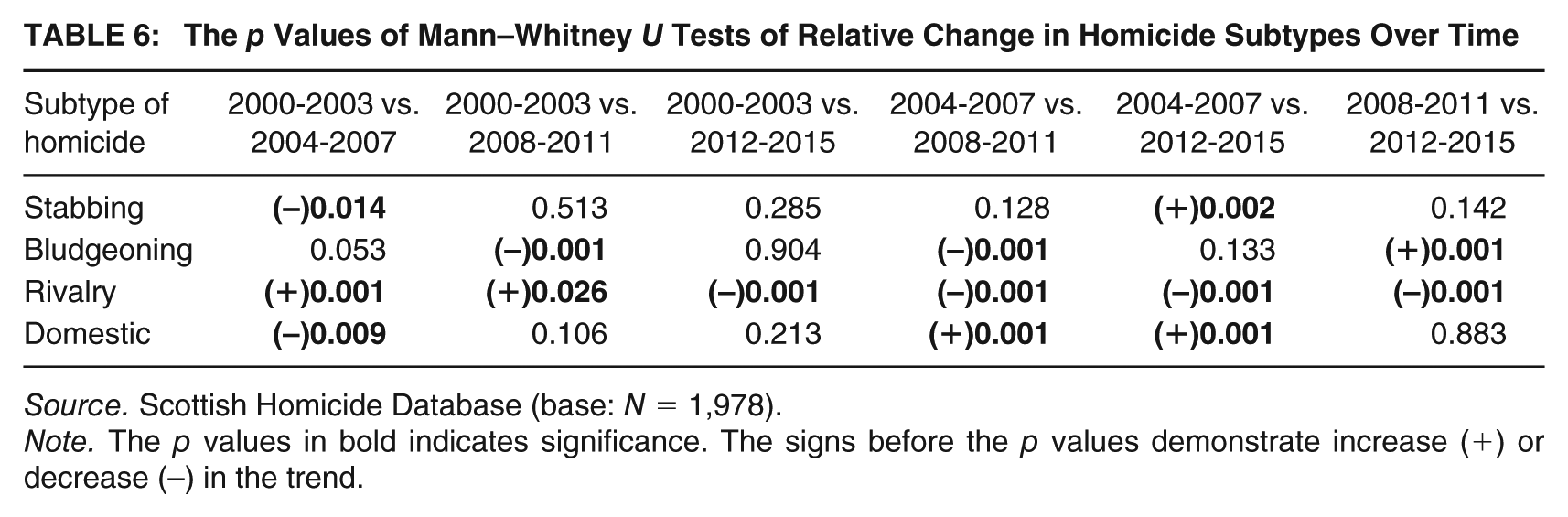
When the relative change in homicide subtypes was examined over time, it was revealed that the subtypes had not changed similarly (see Figure 2). Two of the subtypes (Stabbing and Bludgeoning) remained relatively stable over time. While both these subtypes had a few statistically significant changes over time (see Figure 2 and Table 6), both subtypes returned to levels similar to their original level in 2000-2003, and can therefore be said to demonstrate a relatively stable trend over time. In addition, these two subtypes remained the most common subtypes of homicide. Taken together, despite absolute decreases in these two subtypes, the Stabbing homicides and the Bludgeoning homicides remained relatively quite stable over time.
The p Values of Mann–Whitney U Tests of Relative Change in Homicide Subtypes Over Time
Source. Scottish Homicide Database (base: N = 1,978).
Note. The p values in bold indicates significance. The signs before the p values demonstrate increase (+) or decrease (–) in the trend.

Relative Change in Homicide Types Over Time
The Rivalry homicides demonstrated a marked, significant increase between 2000-2003 and 2004-2007 relative to the other subtypes of homicide (see Figure 2). As can be seen from Figure 2, the mean probability of belonging to this subtype increased by 104% between 2000-2003 and 2004-2007. The Rivalry homicides, however, subsequently decreased equally sharply relative to the other subtypes. In 2012-2015, this subtype of homicide had decreased by 21.3% compared with 2000-2003, making it the least common subtype of homicide in this year group compare with the other subtypes. This decrease also proved to be statistically significant (see Table 6).
The relative change of the Domestic homicides demonstrates a slightly more complex trend, however. Similarly to the Stabbing subtype, the Domestic homicides decreased significantly by 32.3% between 2000-2003 and 2004-2007 relative to the other subtypes. This decrease was followed by a significant relative increase between 2004-2007 and 2008-2012, as well as a significant relative increase between 2004-2007 and 2012-2015 (see Figure 2 and Table 6). In 2012-2015, this subtype had increased by 21.3% compared with 2000-2003, becoming more common in 2012-2015 than the Rivalry homicides. Overall, the Domestic homicides demonstrated a relative increase over time.
Discussion
This study sought to add to the body of research exploring possibilities for a standardized classification system of homicide, methodologically as well as theoretically, by identifying data-driven subtypes using a novel, more sophisticated statistical approach than has previously been attempted. Taking the complex, hierarchical structure of homicide cases into account, exploring variables relating to the victim, the offender, and the incident itself, and maintaining cultural sensitivity, this study demonstrated that there are indeed different subtypes of homicide based on these variables in Scotland, and that these subtypes have changed differently over time. Overall, four major subtypes of homicide were identified based on victim, offender, and incident characteristics (Stabbing, Bludgeoning, Rivalry, and Domestic), representing latent patterns in the homicide data, with three separate classes of offenders in each subtype (Unemployed Offenders, Mixed Offenders, and Employed Offenders).
Three of these subtypes (Stabbing, Bludgeoning, and Domestic) bear resemblance to several subtypes identified in previous research. The Stabbing and Bludgeoning subtypes are, for instance, similar to the Interpersonal Dispute identified by Pizarro (2008), the Victim Drinking subtype identified by Pridemore and Eckhardt (2008), and the Confrontational homicides and the Conflict Resolution homicides identified by Polk (1994). The Domestic subtype of homicide is also very similar to many of the homicide subtypes identified in previous studies labeled as “Domestic.” For instance, the Domestic homicide subtype found by Pizarro (2008), the “Homicides in the context of sexual intimacy” by Polk (1994), and the Spousal Revenge subtype identified by Liem and Reichelmann (2014). There are also similarities between the Domestic subtype and Morton et al.’s (1998) typology of homicide-suicides, the Extended Parricide subtype identified by Liem and Reichelmann (2014), and the Intimate-Partner Domestic Lethal Violence-Suicide subtype identified by Wood Harper and Voigt (2007). As mentioned, about one in 10 of the Employed Offender class included an offender who killed themselves after the homicide was committed. As previous research shows that it is not uncommon for certain men to kill themselves after they have killed their partner (i.e., Wood Harper & Voigt, 2007; Liem & Reichelmann, 2014), it is possible that the Domestic homicide subtype includes a smaller subset of homicide-suicides.
Although the Rivalry subtype was not found replicated in previous subtypes research, homicide as a result of rivalry has been mentioned in previous research (i.e., Daly & Wilson, 1988). The Rivalry subtype does appear to typify the knife-related youth violence previously discussed in Scottish literature (Carnochan, 2015; Damer, 1989). After a massive increase in knife carrying among young people between 1981 and 2003 in Scotland (Leyland, 2006), initiatives such as the VRU in 2006 (2005 in Glasgow; VRU, 2017) and the No Knives Better Lives in 2009 (NKBL, 2014) were introduced to work toward reducing knife crime on a local level. The Rivalry homicides could be considered the extreme end of this violence, where young men kill each other using sharp instruments in public places, motivated by some sort of feud. As the data show, these victims and offenders were quite vulnerable, with many being unemployed and under the influence of drugs or alcohol. A subset of the Rivalry homicides were also committed by an older man against a younger man (the Employed Offender Rivalry subtype), which could indicate homicides committed in feuds including several generations. The fact that this subtype has not been commonly identified in previous typology research furthermore highlights the relevance and importance of taking an inductive, data-driven theoretical stance when disaggregating homicide in new contexts. For instance, while the use of the current methodology identified the Stabbing, Bludgeoning, and Domestic homicides as distinct subtypes, varying across a range of different variables and demonstrating different patterns over time, these subtypes would have been merged if homicide had been disaggregated purely on motive.
Similarly, if the subtypes had been constructed purely based on previously identified subtypes, neither the Rivalry nor the Bludgeoning subtype would have been identified. Although certain homicidal behavior indeed appear to be universal (Flewelling & Williams, 1999; Salfati & Dupont, 2006), cultural or contextual sensitivity must be considered if a standardized classification system for homicide is to be reached. The inductive, data-driven approach, which allows for the identification of previously undetected subtypes, is therefore important to theoretically inform any potential standardized classification system of homicide. The four main subtypes of homicides identified in this research further demonstrate the importance of identifying distinct patterns in regard to the victim, offender, and incident-level variables to properly understand the dynamics of homicide.
The use of MLCA to disaggregate homicide furthermore breaks important ground in the field, not only because this technique allows for the identification of new, data-driven subtypes in the data, but also because, unlike distance-based clustering techniques, MLCA models the structures of the underlying data and has been found superior to distance-based multilevel modeling on almost all accounts, including clustering accuracy on both levels (Serban & Jiang, 2012). This allows for a more robust disaggregation compared with other techniques, taking complex and imperfect data into account, and minimizes the risk of computational or interpretational error. While computationally heavy, the obvious advantage of this technique in disaggregating homicide is one of the main contributions of the current study, and future typology research should consider this as an alternative approach.
When examining the change in subtypes over time, the results suggest that although there has been an absolute decrease in homicide, some homicide subtypes have reduced more than others. While the proportion of all cases representative of Stabbing homicides and Bludgeoning homicides has remained relatively stable over time, the proportion of Rivalry homicides has decreased significantly over time. This would suggest that the overall contribution of the Rivalry homicides has been the greatest in respect to the overall drop in homicide in Scotland. In addition, the Domestic homicides, which had the smallest absolute decrease over time, have demonstrated a relative increase in share over time, which was significant between 2004-2007 and 2012-2015. Although increases in domestic violence may be explained by increases in reporting of this crime (Tonry, 2014), it is unlikely in this case as these findings relate to domestic homicides, which already has a very low dark figure (Brookman, 2005). It is likely that the relative increase observed here has been caused by a greater reduction in other forms of homicide compared with domestic cases. Thus, the overall decrease in homicide evident over the past decade has mainly been driven by a decrease in public, feud-motivated homicides involving young men and sharp instruments, whereas domestic homicides have not decreased by nearly as much.
This has important implications for all theories attempting to explain the crime drop (i.e., Aebi & Linde, 2010; Farrell et al., 2010; Tonry, 2014). As subtypes of homicide demonstrate different patterns over time, the change in homicide cannot be explained nor understood if this crime is not disaggregated and the heterogeneous nature of this crime is taken into account. The change in lethal violence over time might, however, be explained by an overall change in the way we live our lives—our routine activities (Cohen & Felson, 1979). While different from a displacement effect of violence, a change in our routine activities is more universal and does not assume a shift in crime from one context to the other due to interventions (Clark, 1983; 1995). As argued by Aebi and Linde (2010), more time is generally spent inside private settings and less time is spent in public places, such as the streets. Even though this might be related to socioeconomic status (Aebi & Linde, 2010), there has been an overall shift toward interactions in indoor, private settings, leading to fewer opportunities to engage in violence. This hypothesized shift in general routine behavior is consistent with the change in homicide subtypes in Scotland. Not only that, but as Cooney (2003) argued, violence has become privatized, meaning that violence has become less public, and more intimate. This increased privatization and intimacy of violence is demonstrated in Scotland by the decrease in Rivalry homicides, the lack of decrease in the Stabbing and Bludgeoning homicides, and the relative increase in Domestic homicides. While interventions such as the reduction of the drink-drive limit (Scottish Parliament, 2017) and the implementation of the Smoking Ban in 2006, prohibiting smoking in public places such as nightclubs and pubs (Scottish Parliament, 2005) might have contributed to a privatization of time, the overall change in the pattern of violence would suggest a shift of general behavior in society—a general privatization of lifestyles as well as violence. Such a privatization might consequently be explained by changes in routine activities in the shorter term (Aebi & Linde, 2010; Cohen & Felson, 1979), while it might be related to the weakening of social ties and the expansion of the state in the longer term (Cooney, 2003).
Although this study did not aim to evaluate any policy initiatives implemented in Scotland over the time examined, the Scottish Government has implemented numerous strategies to combat knife-related, public violence among young people over the past 10 to 15 years, with initiatives such as the NKBL (2014) program and the VRU (2017). Although this study cannot demonstrate a direct effect of these initiatives, it is possible, given the timing of the decline in homicide and the nature of the focus of these initiatives, that they did have an impact on the homicide decline. However, the unequal decrease of homicide subtypes identified in the current study would suggest that the interventions put in place have had the greatest effect on the Rivalry homicides while being less effective on Domestic homicides and homicides occurring mainly indoors in private settings. This finding highlights both the necessity of disaggregating homicide to identify and implement relevant and successful intervention strategies for all subtypes of homicides, and the need to revise and possibly improve the current policies aimed to decrease domestic homicide. As the change in homicide in Scotland over time might be related to shifts in our general lifestyles, which are also related to issues of marginalization and identity (Aebi & Linde, 2010; Young, 2007), any revisions of such policies need to take such notions into account. As domestic lethal violence is related to deep-rooted issues of inequality in society, attempts to change these issues will take time as well as resources. It is, however, important to prevent and reduce this form of violence if all types of violence, and not just the most visible types, are to be reduced equally.
This study also holds important practical implications for police practice and procedure. While the fact that homicide has been decreasing in Scotland is widely known, no previous study has examined the relative change of different types of lethal violence. The fact that more homicides are occurring indoors, in private settings, and more often between intimate partners can help the police to direct resources more efficiently when carrying out investigations and preventing crime. Because the current study utilized variables available to the police at the time of investigation, the typology identified may hold more practical value compared to other clinical typologies. The distinct profiles of the four main subtypes identified in the current study may therefore prove helpful for the police to prioritize investigative actions. For instance, a homicide occurring in a public place involving a sharp instrument may suggest the prioritization of young, male suspects who are known rivals to the victim, while a homicide of a male victim occurring inside without the use of a weapon may suggest prioritizing suspects who are known friends of the victim. A female victim found inside in a private setting, regardless of method of killing, may prioritize any current or previous intimate partner of the victim as suspects.
No study is, however, without its limitations. As mentioned, there were high levels of missing data which proved very problematic for the current study. Despite the many measures that were taken to reduce this, including recoding of certain variables and a deeper examination of case files, this is something to bear in mind when interpreting these findings. Although the MLCA technique uses the full information maximum likelihood (FIML) method, meaning that the missing values are estimated using the observed values and parameter estimations, some variables include a high level of missing data. As mentioned, however, this is the first time that homicide is explored in this way in Scotland, and although the data are far from perfect, one of the main contributions of this study is an exploratory examination of different types of homicide in Scotland. The fact that the SHD is a population dataset also helps to increase the generalizability of the results. This study consequently has important implications for all police forces, including Police Scotland, regarding the coding of homicide data. Stricter rules about coding, such as introducing a code book, might be necessary to improve this database. Future research should also work toward minimizing the missing data and explore whether the current subtypes can be identified when this is done.
It is also important to note that subtypes of homicide in the current study are assumed to be “heuristic devices” (Sampson & Laub, 2005; Skardhamar, 2009), and not representative of distinctive groups of people or cases in the population. There has been a debate in previous research regarding the problematic theoretical implications of classifying individuals into specific subtypes or groups, specifically when these subtypes imply causal differences (i.e., Nagin & Tremblay, 2005; Sampson & Laub, 2005; Skardhamar, 2009). For this reason, it is important to clarify that the subtypes of homicide identified in the current article represent one description of a number of potential descriptions possible when complex modeling is utilized on imperfect data. No causal inferences are drawn about the subtypes in this study.
Conclusion
Overall, this study contributed to the field of homicide disaggregation research by using a novel, robust statistical technique that has never previously been used to identify subtypes of homicide. The findings suggest that there are distinct subtypes of homicide in Scotland and that these homicides have changed at different rates over time. Although some homicides, namely the Rivalry homicides, have decreased significantly over the examined time period, domestic subtypes of homicide have demonstrated a relative increase. Using an inductive, data-driven approach to homicide disaggregation, this study sought to improve the theoretical understanding of homicide as well as methodologically improve the current statistical techniques used for disaggregation.
Footnotes
Author’s Note:
The author would like to thank Susan McVie and Paul Norris for helpful comments on earlier versions of the paper. This research was supported by a grant from the Economic and Social Research Council.
