




Abstract
Research on intimate partner violence (IPV) among same-sex couples remains relatively rare. Moreover, few studies examine risk and the likelihood of reoffending among such couples. The present study utilized a large sample of people (N = 6,711) arrested for IPV to explore the risk, likelihood, and timing of reoffending, including 332 perpetrators in same-sex relationships. Analyses revealed that male perpetrators in same-sex relationships had lower assessed risk than males in heterosexual relationships, and a smaller percentage were rearrested for a new violent offense. Although female perpetrators in same-sex relationships were no more likely to have higher assessed risk compared with perpetrators of female to male violence, female perpetrators in same-sex relationships had a higher likelihood and rate of reoffending, more closely resembling male-to-female violence. Female perpetrators with male victims were identified as the lowest risk to reoffend and indeed were the least likely to reoffend.
Intimate partner violence (IPV) is usually studied within the context of heterosexual relationships. In recent years, community support programs and advocates raised awareness of IPV within the LGBTQ (lesbian, gay, bisexual, transgender, queer) community, although the provision of services for gay and lesbian survivors remains impoverished (Buzawa, Buzawa, & Stark, 2017; Renzetti, 2014). Nonetheless, the problem of IPV within the LGBTQ community is not without legislative and legal responses (Potoczniak, Murot, Crosbie-Burnett, & Potoczniak, 2003). For example, in the United States, the 2013 reauthorization of the Violence Against Women Act increased efforts at previously underserved populations, including same-sex couples (Buzawa et al., 2017). Despite positive steps, the assumption of heterosexuality continues to hamper data collection, official reporting, and ultimately research into same-sex IPV (Murray & Mobley, 2009). As revealed by the Centers for Disease Control and Prevention (CDC, 2013), “little is known about the national prevalence of intimate partner violence, sexual violence, and stalking among lesbian, gay, and bisexual women and men in the United States” (p. 1).
Despite this assertion, the past three decades witnessed numerous efforts to establish prevalence rates of IPV among sexual minority women and men. Many early studies were based on small and unrepresentative samples, leading to variation in estimates of IPV occurrence from as little as 17% of same-sex relationships to as high as 74% of those relationships (Buzawa et al., 2017). In more recent representative surveys of lesbian women, using purposive sampling, lifetime prevalence rates range from 25% to 46% (Messinger, 2011; Turell, 2000; Walters et al., 2013). Data reported by the CDC’s National Intimate Partner and Sexual Violence Survey (CDC, 2013) estimated that 46% of lesbian women (and 43% of straight women) were with a violent partner. Studies using representative sampling to examine the lifetime prevalence of IPV among gay men also found that at least one quarter of gay men experienced IPV (Blosnich & Bossarte, 2009; Walters et al., 2013). Using a sample of 581 gay men and lesbians recruited through gay and lesbian festivals, bookstores, and other organizations, as part of a larger study on the attitudes and beliefs of gay men and lesbian women, Carvalho, Lewis, Derlega, Winstead, and Viggiano (2011) found that 24.2% of the sample indicated being a victim of IPV at any point in their life, and 9.4% reported that they had been perpetrators. This study found a slightly higher percentage of reported victimization (25% compared with 23%) and perpetration (9.3% compared with 8.3%) for lesbian compared with gay men.
Much like sexual violence in general, these prevalence rates may be severely underrepresented because of fear of reporting to the police among the LGBTQ community or law enforcement not taking such reports seriously (Alexander, 2002). According to a 2012 report by the National Coalition of Anti-Violence Programs (NCAVP), less than 17% of survivors reported interacting with the police. Hassouneh and Glass (2008) conducted individual and semi-structured group interviews of 52 women exploring risk and protective factors for female same-sex IPV, finding that gender stereotypes (e.g., girls don’t hit girls, catfights) can severely bias the handling of same-sex IPV cases. This concern was also raised by Messing, Thomas, Ward-Lasher, and Brewer (2018) in the exploration of nonfatal strangulation and injury in same-sex couples, noting that police may be identifying coercive and controlling behaviors less often in same-sex couples, or that survivors are reporting less often.
Mindful of the potential for underreporting, we draw substantive and methodological summary conclusions from existing studies of same-sex IPV: (a) IPV in same-sex relationships occurs at a similar rate to IPV in heterosexual relationships, and (b) violence and the use of controlling behaviors tend to work against the partner with less power and sexual decision making (Eaton et al., 2008; Glass et al., 2008). Although a recent review of research into same-sex IPV concluded that appropriate and rigorous methods are often used, many studies are purely descriptive in nature, and few studies explore a sample of same-sex IPV offenders over a prolonged period (Murray & Mobley, 2009). To date, most studies are cross-sectional, focusing on establishing prevalence rates of same-sex IPV, in addition to studies examining the barriers to seeking help among sexual minority victims of IPV (Brown & Herman, 2015; Murray & Mobley, 2009).
Although research on same-sex IPV has predominantly focused on establishing rates and interventions for survivors of same-sex IPV, a large portion of mainstream (read: heterosexual) IPV research has focused on risk assessment or the determination of the likelihood that a case will lead to IPV recidivism. By systematically determining which relationships are likely to lead to future danger, increased criminal justice interventions may curb the effects of violence. Commonly used risk assessment tools such as the Spousal Assault Risk Assessment (SARA), the Propensity for Abusiveness Scale (PAS), the Ontario Domestic Assault Risk Assessment (ODARA), and the Revised Domestic Violence Screening Instrument (DVSI-R) were created to predict IPV recidivism. The SARA includes 20 risk factors for violence, including items such as past assaults of family or strangers, violence in family of origin, perpetrator personality disorders, and use of weapons (Kropp & Hart, 2000). Prior research found that those who were deemed “high risk” by this scale were more likely to recidivate than those rated “low risk,” although it is worth mentioning that all perpetrators in the study were male (Kropp & Hart, 2000). The PAS consists of 29 items including information about the perpetrators’ personality, childhood experiences, and disorders in adulthood (Dutton et al., 2001). High risk on this scale was correlated with abusiveness and persistence in IPV for men and women college students. The ODARA consists of 13 items, including perpetrator demographics, domestic violence history, criminal history, relationships characteristics, victim characteristics, and offense details such as substance use (Hilton et al., 2004). The predictive validity of this assessment was established in studies including male perpetrators and female victims (Hilton & Harris, 2009; Hilton et al., 2004) and recent studies including female perpetrators (Hilton, Popham, Lang, & Harris, 2014; Olver & Jung, 2017). The DVSI-R includes 11 items, focusing on the previous behavior of the perpetrator, perpetrator characteristics, and situational characteristics. Predictive validation studies found that those scoring higher on the DVSI-R were significantly more likely to recidivate within an 18-month period than those who scored lower (see Stansfield & Williams, 2014; Williams, 2012; Williams & Grant, 2006, for detailed validation studies). Although these studies validated the instrument for male and female perpetrators, no studies to date examined the predictive validity of the DVSI-R specifically for same-sex couples.
The Present Study
The goal of the present study is to determine whether same-sex relationships are similar or different to heterosexual relationships in terms of risk, rearrest, timing of rearrest, and risk prediction. To achieve these aims, this research follows a significant number of same-sex IPV perpetrators over an 18-month period. Many existing studies of same-sex IPV were conducted via cross-sectional surveys of individuals who self-identified as a sexual minority (Balsam & Szymanski, 2005; Carvalho et al., 2011; Edwards & Sylaska, 2013; Lewis, Milletich, Kelley, & Woody, 2012) or cross-sectional studies of violent incidents recorded by the police (Messing et al., 2018). Although uncovering important information about the prevalence of IPV, the cross-sectional design prevents a greater understanding of the reoffending behavior of same-sex IPV perpetrators.
A notable contribution of this study is to compare the likelihood and timing of rearrest for same-sex and heterosexual couples. Although a body of scholarship explores the motivations and methods of IPV in same-sex relationships (Bartholomew, Regan, White, & Oram, 2008; Mize & Shackelford, 2008), predictors of same-sex IPV (Lewis, Mason, Winstead, & Kelley, 2017; Lewis et al., 2012), and theories of same-sex IPV initiation (Island & Letellier, 1991; Merrill & Wolfe, 2000), cases involving perpetrators and victims in same-sex relationships are often removed from the sample prior to analysis in existing studies of IPV recidivism (e.g., Cho & Wilke, 2010; Renauer & Henning, 2005), limiting the generalizability of findings.
We also measure risk and assess whether risk predicts future IPV for perpetrators in same-sex relationships. Researchers recently explored developing IPV screening tools intended for use with same-sex perpetrators (Stephenson, Hall, Williams, Sato, & Finneran, 2013). To date, however, the predictive validity of most existing IPV risk assessment tools is limited to perpetrators in heterosexual relationships (e.g., Hilton & Harris, 2009; Hilton et al., 2004; Stansfield & Williams, 2014). We utilize the DVSI-R to compare perpetrator risk in same-sex and heterosexual couples and assess whether relationship type moderates the association between assessed risk and rearrest. That is, does the DVSI-R predict rearrest equally well across relationship types?
Method
Data
The present research included 6,711 perpetrators arrested for an incident of IPV in Connecticut, with an initial IPV incident arrest between July 1 and December 31, 2014. Although we use the term “perpetrators” throughout to maintain the conventional distinction between perpetrators and victim-survivors, we acknowledge that risk assessments in Connecticut are conducted preadjudication, and thus, the “perpetrators” are legally/technically “defendants.” Follow-up data were collected for a period of 18 months (ending June 30, 2016). In Connecticut, domestic violence has a broad definition, including various nonromantic relationships involving relatives and roommates. For the purposes of this study, the sample was restricted to those indicated to be intimate partners on arrest records, including current or former married partners, unmarried couples currently or previously living together, couples currently or previously involved in a dating relationship, and couples who have a child in common. Importantly, unlike previous studies of same-sex IPV that utilized self-reported sexual orientation (e.g., Balsam & Szymanski, 2005; Carvalho et al., 2011), an individual was considered to be in a same-sex relationship if the incident arrest involved a victim of the same gender. Importantly, we do not assume sexual orientation based on the sex of a perpetrator’s partner because it is possible that a person’s orientation is not properly captured by the gender of his or her partner at the time of arrest. As an example, someone in a same-sex relationship at the time of arrest could self-identify as bi- or pan-sexual.
In the current sample, male-to-female violence accounted for 4,689 (69.9%) of these cases. Female-to-male violence made up 1,690 (25.2%) of these cases. Cases of IPV in same-sex relationships were much less numerous, with male-to-male violence accounting for 146 (2.2%) of cases, and female-to-female violence accounting for 186 (2.8%) of cases. See the description of additional covariates below for more demographic details of the sample.
Measures
Rearrest
Two dependent variables were used in the current analysis: rearrest for a new IPV incident (not rearrested = 0, rearrested = 1), and the time to rearrest, measured as the number of days between arrest for an initial incident and the first arrest thereafter. These data were collected for each individual when rearrested for a new family violence incident and for violations of protective and restraining orders during the follow-up period. Each time a perpetrator was rearrested, a new entry was made in the database. Beyond examining the likelihood and timing of rearrest, this study also explored the impact of assessed risk, case factors, and perpetrator characteristics on the likelihood and timing of rearrest.
Risk
Whenever an arrest is made for domestic violence in the State of Connecticut, a risk assessment is conducted by trained Family Relations Counselors (FRCs) to determine the likelihood that the perpetrator will be rearrested. This risk assessment is conducted using the DVSI-R. The DVSI-R items are scored from 0 (no evidence of risk) to 2 or 0 to 3, depending on the item. The scores on each item are summed, creating a range of risk scores from 0 to 28.
The DVSI-R consists of 11 items, including prior nonfamily assaults, arrests, or convictions; prior family violence assaults, threats, or arrests; prior family violence intervention or treatment; a history of violation of orders of protection or other court supervision; substance abuse; use of an object as a weapon; presence of children during violent incidents; prior verbal or emotional abuse; frequency of family violence in the last 6 months; and escalation of family violence in the past 6 months. Employment status of the perpetrator, typically included in previous versions of the DVSI-R, was excluded for the current study. However, it was included in the analyses as a separate covariate pertaining to socioeconomic characteristics of perpetrators (see below for the covariates used). Employment provides at least one dimension of socioeconomic status. As in prior studies, we utilized a categorical measure of assessed risk based on the distribution of the data, whereby (a) scores ranging from 1 to 4 were considered lower risk, (b) scores of 5 to 8 were considered moderate risk, (c) scores of 9 to 12 were considered moderately high risk, and (d) scores of 13 or higher were considered high risk.
The mean DVSI-R risk score before excluding employment status (i.e., using the full 11 items) was 9.54 (SD = 5.36), and the mean excluding employment status (i.e., using 10 items) was 8.64 (SD = 5.12),; both of which reflect a moderate to moderately high level of risk, consistent with samples reported previously from this state (Stansfield & Williams, 2014; Williams & Stansfield, 2017). Cronbach’s alpha was .71 with and without employment status included in the measurement of risk via the DVSI-R. This finding is consistent with prior research on the DVSI-R (see Stansfield & Williams, 2014; Williams & Stansfield, 2017) and with other nondomestic violence risk assessments such as the Post Conviction Risk Assessment (PCRA) Instrument used to predict the risk of recidivism among federal offenders (Skeem & Lowenkamp, 2016). Furthermore, a high degree of overlap among items (i.e., internal consistency) is not necessarily a critical measurement property of a risk assessment instrument. As noted by Kropp and Hart (2000), “assuming all items in a risk scale are predictive of future behavior, the optimal situation would be to have. . . maximal predictive validity with minimal redundancy” (p. 109).
Other Covariates
In addition to relationship type (i.e., gender composition of intimate partners) and assessed risk, we included several perpetrator characteristics as covariates. This included a perpetrator’s age, which ranged from a minimum of 16 to a high of 86. Based on the distribution of the data, we created a categorical measure of age grouped into quartiles (16-24 = 1; 25-34 = 2; 35-44 = 3; 45 or higher = 4). We also included a categorical measure of race and ethnicity including dummy variables for non-Latinx Black (31%) and Latinx (25%), with non-Latinx White (44%) as the reference category. Finally, to control for the economic circumstances of a perpetrator, we include a dummy variable indicating a perpetrator was employed full time (32%) as opposed to part-time or unemployed (68%).
Analysis
The study proceeds in several steps. To explore differences between assessed risk factors and reoffending behavior of IPV perpetrators by gender, a descriptive analysis is conducted comparing mean scores by relationship type (i.e., between persons in same-sex and heterosexual relationships). This includes conducting t test and chi-square tests, as appropriate, to determine significant differences between persons in same-sex and opposite-sex relationships. We then proceed to determine the estimated effects of gender and relationship type on assessed risk as well as rearrest for new IPV incidents. Three separate models estimated the effects by gender and relationship type on (a) the total DVSI-R score, (b) the likelihood of IPV rearrest, and (c) the rate of rearrest. Ordinary least squares (OLS) regression was used in models predicting risk. 1 Logistic regression was used to model the likelihood of rearrest as a function of relationship type, risk, and perpetrator characteristics. The analysis of rearrest also included the interaction of relationship type and assessed risk to assess whether relationship type moderates the association of risk and rearrest.
Finally, to ensure our findings of the relationship between gender, relationship type, and recidivism were robust, we also utilized a Cox proportional hazards model to examine the rate of recidivism. Using both logistic and Cox regression analyses together allowed us to estimate both the odds of rearrest and the rate of rearrest. We included a logistic regression analysis so that results are comparable with the majority of existing risk assessment studies linking assessed scores and rearrest. Being able to predict rearrest is important for testing the predictive validity of the DVSI-R. As others have argued (Stansfield & Williams, 2014; Yoshihama & Horrocks, 2003), combining these results with survival analyses also allowed us to examine the proportion of each subgroup that survives (avoids rearrest) until a particular time. Comparing survival statistics across subgroups provided additional information regarding key time periods for intervention.
In each of these analyses, female-to-male violence serves as our reference category, given that according to prior research, violence perpetrated by females against their male partners is less common and less serious violence (Gerstenberger & Williams, 2013). Therefore, a finding of significant difference for any other relationship type could indicate more serious violence.
Results
Table 1 displays the descriptive statistics for all measures utilized in this study, organized by gender and relationship type, in addition to t-test and chi-square test values. Data revealed that almost one third of heterosexual men and 30% of men in same-sex relationships were rearrested for a new incident. Although there are little data with which to compare the prevalence of reoffending among men in same-sex couples, the percentage of heterosexual males who reoffended was consistent with existing studies of IPV recidivism within similar time frames (e.g., Hilton et al., 2004; Stansfield & Williams, 2014). Interestingly, there was a slightly higher prevalence of rearrest among females in same-sex couples (35%), which was significantly different than the likelihood of rearrest among heterosexual females (22%, χ2 = 14.54, p < .001).
Descriptive Statistics for All Variables Organized by Relationship Type

Note. DVSI-R = Revised Domestic Violence Screening Instrument; AUC = area under the curve.
Significance.
There was no difference in assessed risk between male and female relationship types. This finding was revealed by the lack of statistically significant differences between the DVSI-R total scores and the derived risk categories, comparing male-to-female and male-to-male as well as female-to-male and female-to-female relationship types. However, male perpetrators had significantly higher risk scores (DVSI-R = 9.474, t = 17.995, p < .001; risk categories = 2.646, t = 17.363, p < .001) than female perpetrators (DVSI-R = 7.032, risk categories = 2.134), regardless of whether they were in heterosexual or same-sex relationships.
Other differences by gender emerged. As an example, heterosexual male perpetrators were significantly more likely to be employed compared with males in same-sex couples arrested for an initial IPV incident (χ2 = 5.72, p = .017). There was no difference in employment between female relationship types. A higher percentage of female perpetrators in heterosexual relationships were non-Latinx White (52%) compared with female perpetrators in same-sex relationships (39%). Female perpetrators in same-sex relationships were more likely to be Black and younger on average.
Table 1 also shows area under the curve (AUC) coefficients for each subgroup, where the total sample AUC = 0.62, 95% confidence interval (CI) = [0.61, 0.64]. The lowest AUC is for female-to-female couples (AUC = 0.56, 95% CI = [0.47, 0.65]), and the highest is for male-to-male (AUC = 0.63, 95% CI = [0.53, 0.72]) and female-to-male couples (AUC = 0.63, 95% CI = [0.60, 0.66]). The AUC for male-to-female couples is 0.61 (95% CI = [0.59, 0.63]). The differences between these coefficients were not statistically significant, as demonstrated by the overlapping CIs.
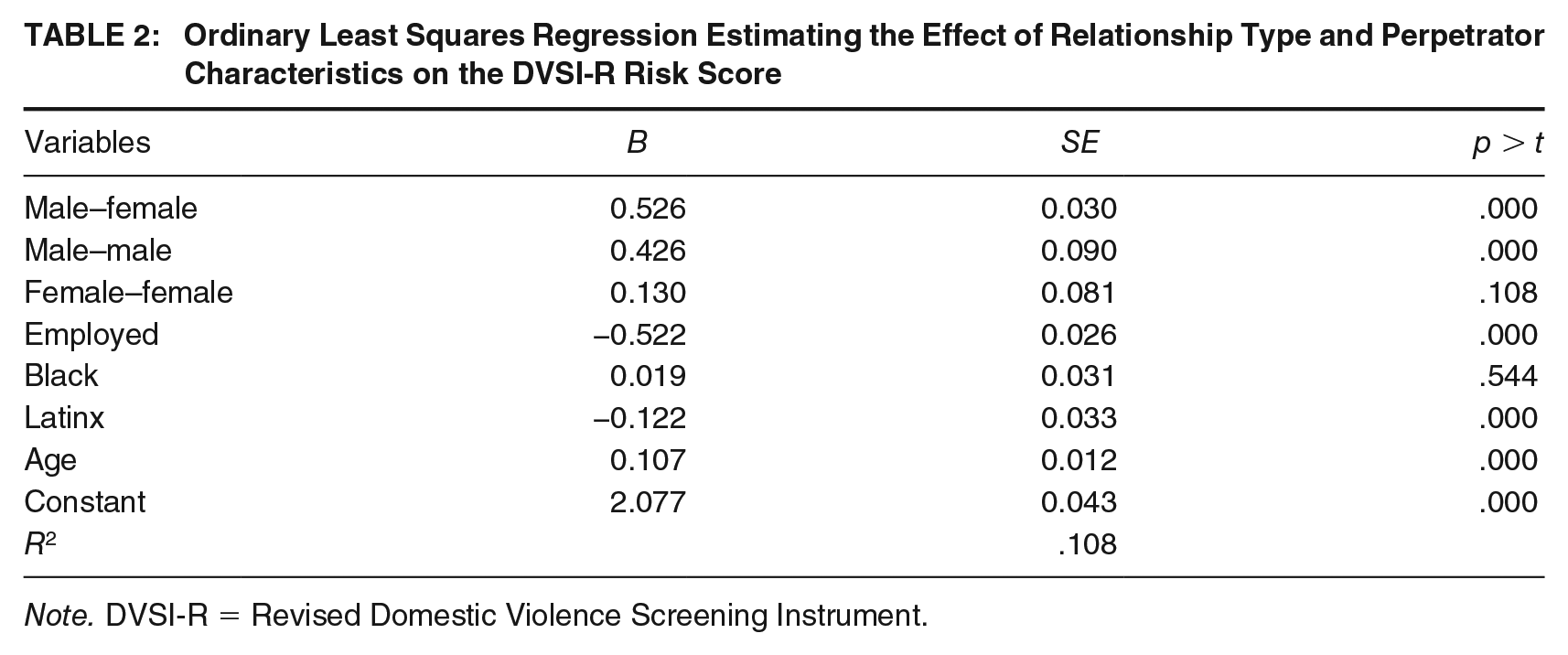
Table 2 displays the results of an OLS regression estimating the associations between relationship type, perpetrator characteristics, and the total DVSI-R risk score. As predicted, holding perpetrator ethnicity, age, and employment constant, the total DVSI-R risk score was 0.53 higher for a male perpetrator with a female victim, compared with a female perpetrator with a male victim (p < .001). The estimated effect for a perpetrator of male-to-male violence was 0.43 higher, compared with a heterosexual female perpetrator. Female–female relationships were not significantly different on the total DVSI-R risk score compared with female–male relationships. Perpetrators who were employed and Latinx relative to non-Latinx Whites were less likely to be assessed as higher risk.
Ordinary Least Squares Regression Estimating the Effect of Relationship Type and Perpetrator Characteristics on the DVSI-R Risk Score
Note. DVSI-R = Revised Domestic Violence Screening Instrument.
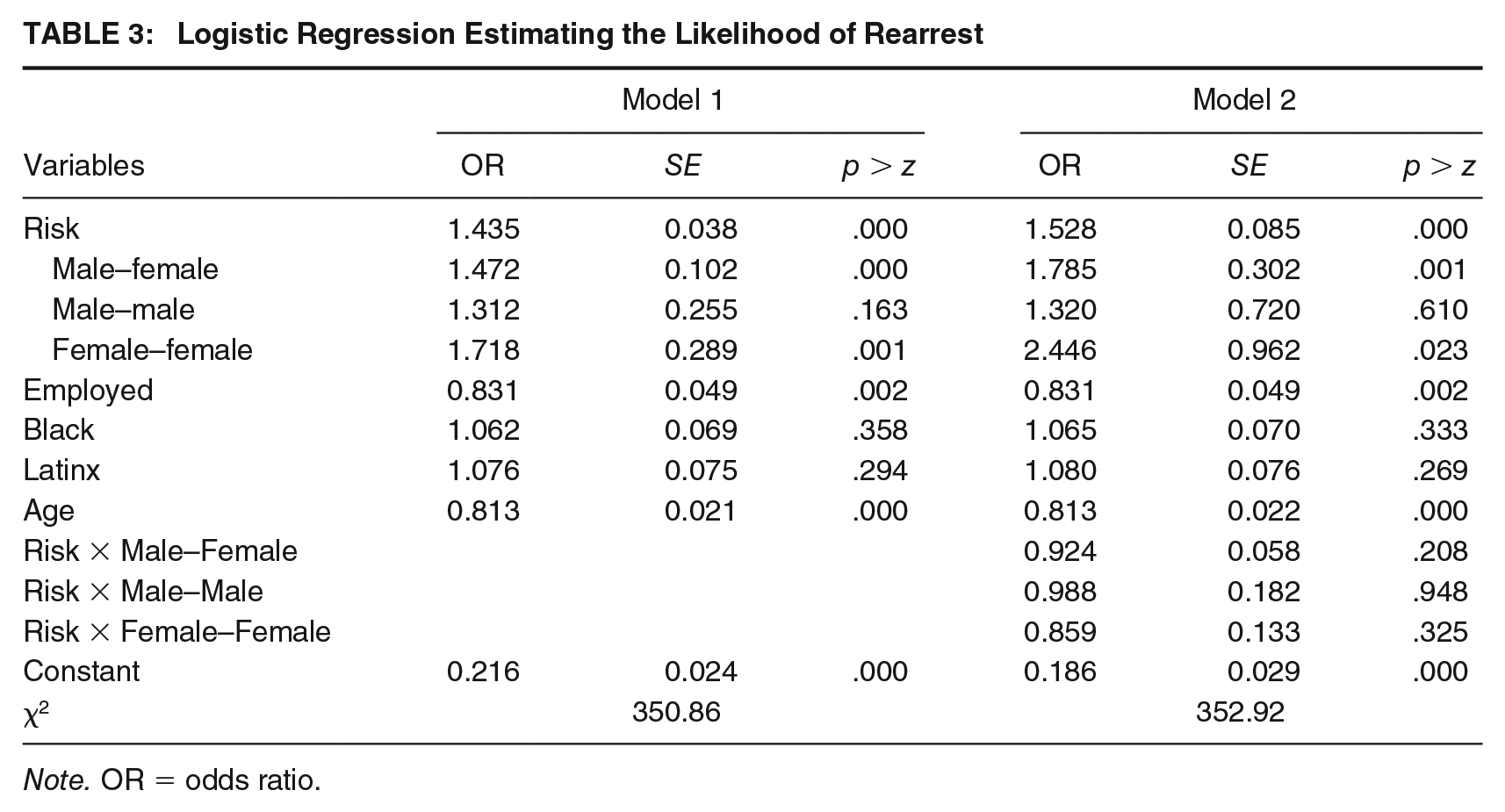
The results of the analysis estimating rearrest are reported in Table 3. As displayed in Model 1, two of the three relationship types were significantly related to rearrest during the 18-month follow-up period, even after accounting for assessed risk of recidivism. Male perpetrators with female victims were 47% more likely to be rearrested than female perpetrators with male victims (odds ratio [OR] = 1.472, p < .001). Being a female perpetrator with a female victim resulted in a 72% increased risk of rearrest during the 18-month follow-up period, when compared with female perpetrators with male victims (OR = 1.718,p < .001). Age and assessed risk were both associated with statistically significant positive estimated effects on rearrest. In addition, being employed was associated with 17% lower odds of rearrest than part-time or unemployed perpetrators. Black and Latinx perpetrators were no more likely to be rearrested than White perpetrators, after controlling for risk, relationship type, and demographic characteristics.
Logistic Regression Estimating the Likelihood of Rearrest
Note. OR = odds ratio.
The results pertaining to the interaction of relationship type and assessed risk are reported in Table 3, Model 2. The addition of these variables allows an examination of whether relationship type moderates the association of risk and rearrest. None of the interaction terms are statistically significant in this analysis, suggesting that the association of risk with rearrest is similar across these groups.
Moving beyond a binary examination of rearrest, survival analyses were also estimated. Given their ability to provide information on the timing of rearrest, survival analyses provide important information for intervention strategies. Cox regression models were estimated to explore risk factors associated with the rate of rearrest for new IPV incidents. The results of the estimation are presented in Table 4. As before, assessed risk was positively associated with the rate of rearrest, whereas older perpetrators and persons employed at the time of the initial incident had a lower rate of rearrest. Heterosexual male perpetrators and same-sex female perpetrators were rearrested faster and more often than heterosexual female perpetrators. To ease interpretation of these findings, Figure 1 displays the Kaplan–Meier survival curves of perpetrators in our sample by relationship type.
Cox Proportional Hazards Estimating the Rate of Rearrest

Note. HR = hazard ratio.
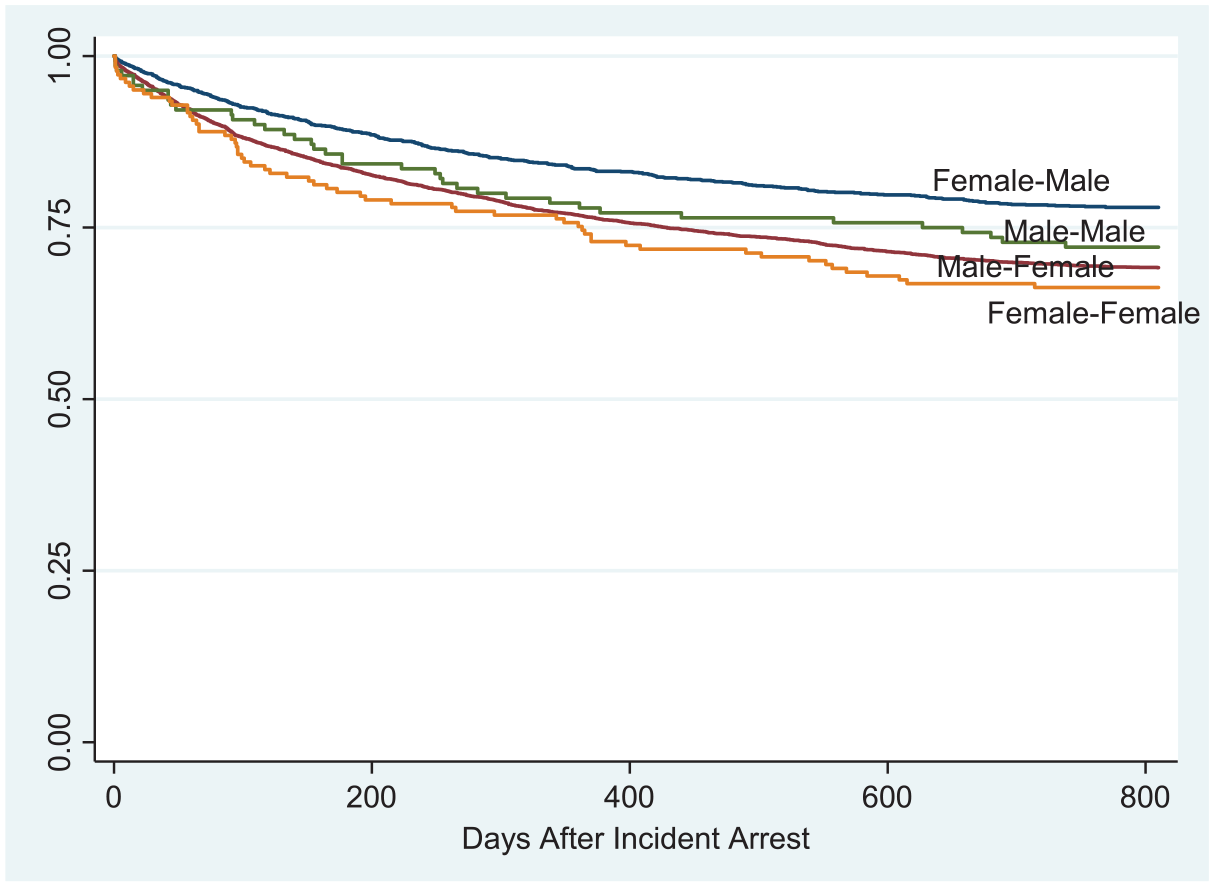
Kaplan–Meier Survival Estimates for Each Intimate Partner Offender–Victim Gender Relationship
When assessing the speed at which perpetrators are rearrested, Figure 1 reveals that female perpetrators in same-sex relationships are statistically no different than male perpetrators with female victims (χ2 = 0.92, p = .337), although same-sex female perpetrators had the lowest survival rate of any group. Female perpetrators in same-sex relationships were rearrested quicker and more often than female perpetrators in heterosexual relationships (χ2 = 15.06, p < .001). There was no statistically significant difference in survival between male relationship types (χ2 = 0.58, p = .445). This comparison provides important time windows for intervention. Half of all perpetrators who were rearrested were so within 140 days of their initial incident arrest. The speed of reoffending was higher among female perpetrators in same-sex relationships and heterosexual male perpetrators. Half of all heterosexual males who were rearrested were so within 129 days of an initial incident arrest, while half of all same-sex females who were rearrested were so within just 118 days.
Discussion
This study adds to the growing literature about IPV in same-sex couples, offering some new findings regarding the risk, likelihood, and timing of rearrest among perpetrators in same-sex relationships. The current study also contributed to the understanding of the assessment of risk of IPV recidivism. Analyses reinforced the validity of DVSI-R in predicting rearrest for all gender relationship types. Descriptive analyses revealed that rearrest for IPV is almost as common among female perpetrators in same-sex relationships as it is among male perpetrators in heterosexual relationships. Although analyses showed that female-to-female violence was not associated with an increase in risk according to the DVSI-R, being a female perpetrator with a female victim was associated with a large and significant increase in the likelihood and rate of rearrest compared with female perpetrators with male victims.
This finding may speak to the largely untested assertions that same-sex violence is not limited to bidirectional, mutual abuse or common couple violence (Island & Letellier, 1991; Merrill & Wolfe, 2000; Renzetti, 2014). Given the persisting pattern of IPV revealed, sexuality may not be as important a predictor of rearrest as previously conceived; rather, the power dynamic within a relationship is likely a greater risk factor for future offending. This finding is supported by prior research confirming that violence among intimate partners tends to work against the partner with less power and sexual decision making (Eaton et al., 2008; Glass et al., 2008). Accordingly, we urge greater attention to ensuring adequate support for female victims of IPV regardless of sexual orientation, in addition to urging more research into effective interventions for lesbian female perpetrators of IPV. In addition, these findings indicate that police must be effectively trained to identify primary aggressors in all IPV situations, including same-sex couples.
It should also be noted that because the dependent variable in this analysis was rearrest, police perceptions and bias regarding IPV may have influenced the findings. However, the finding that a female perpetrator with a female victim was associated with an increased risk of rearrest runs in sharp contrast to prior research indicates that police are often less likely to make arrests for same-sex couples than for heterosexual couples (Franklin, Goodson & Garza, 2019). In fact, prior research has shown that officers generally assume greater responsibility on the part of victims of female perpetrators regardless of their gender (Russell, 2018). However, for lesbian perpetrators and victims in particular, assumptions about guilt or innocence are often influenced by perceptions of masculine versus feminine presentation, with feminine-looking victims and perpetrators being assessed as less blameworthy (Little & Terrance, 2010). Although appearance and demeanor of both victim and perpetrator were outside the scope of the current study, future research should explore these issues.
This study has several strengths compared with prior studies of same-sex IPV, including a longer follow-up period and the use of multiple analytic techniques. However, we should note a few limitations. The first concerns the well-known limitation of official arrest data, as opposed to alternate sources, such as victim reports or life history data to measure recidivism. Official arrest data may underestimate the true level of reoffending; yet, all methods of measuring recidivism have their own sources of error, including problems of recalling the timing and interpretation of events in victimization surveys and life history interviews. Second, the generalizability of findings is questionable as the data were obtained from a single state in the United States. The problems of domestic violence in rural towns across the United States have come to light in recent years, with scholars noting the difficulties of responding to incidents in these contexts. More work is needed to determine the prevalence, continuation, and management of same-sex IPV, especially within rural settings.
Finally, the study is also limited in its underlying focus on risk factors. To provide greater information for the management of same-sex IPV, a greater understanding of protective factors, and specifically programs that may help reduce the recidivism of same-sex IPV is an important step in future research. As an example, previous studies of same-sex IPV have highlighted the importance of social and community support to reduce the likelihood of IPV (Lehavot, Balsam, & Ibrahim-Wells, 2009), but the absence of longitudinal studies tracing individuals through the community and criminal justice system has limited our understanding of how these supports may prevent recidivism and future harm. In addition, given the development of programs such as perpetrator counseling and violence education in the context of heterosexual IPV, these programs may have differential effects across gender and sexual orientation. Ultimately, high-quality research into the prevention, management, and reduction in occurrence of same-sex IPV is needed, ensuring that legal and criminal justice changes toward same-sex IPV dovetail with an evidence base of how to prevent future violent incidents. This includes validating all risk assessment tools for persons in all relationship types.
Limitations notwithstanding, this study highlights important time windows for intervention, especially to prevent future reoffending among heterosexual males and females in same-sex relationships. This study found that both heterosexual male perpetrators and same-sex female perpetrators of IPV reoffend quicker than other groups. Specifically, the first 100 to 120 days after an initial incident arrest is a particularly dangerous period for lesbian female perpetrators, within which supervision and intervention may be most critical.
Footnotes
This research was conducted with assistance from the Judicial Branch, Court Support Services Division of the State of Connecticut.
