



Abstract
Stalking is dynamic, influenced by targets’ reactions and stalkers’ circumstances. Consequently, the risk of violence in stalking cases is likely dynamic. Despite this, dynamic contextual factors have been neglected in stalking violence research. Guided by Thompson’s integrated theoretical model, we investigated key established stalking violence risk factors alongside new dynamic contextual factors in a content analysis of 43 stalking court transcripts from Queensland, Australia. Findings suggest that relying on individual factors in isolation leads to moderate rates of error. Combining risk factors provides a more sophisticated understanding of stalking violence, with dynamic contextual factors playing a pivotal role in understanding changes in risk, including when stalkers with historical and/or static contextual factors pose a higher risk of violence. Findings emphasize the need to look beyond traditional dispositional, historical, and static factors toward new dynamic contextual factors and highlight the importance of contextual factors for violence assessment and prevention strategies.
Stalking is dynamic, whereby progression is influenced by targets’ reactions, life events, and other contextual factors (Logan & Walker, 2017; McEwan, Pathe, & Ogloff, 2011). Consequently, the risk of violence in stalking cases is also likely dynamic. Despite this, stalking violence research largely focuses on the influence of dispositional, historical, and static contextual factors (e.g., ex-intimate relationship). However, dynamic contextual factors can be powerful predictors of changes in risk over time. Consideration of dynamic contextual factors may foster a better understanding of when individuals with dispositional, historical, and static contextual risk factors pose a higher risk of violence. To improve understanding of the etiology and escalation of stalking violence, the current study utilizes court transcripts of stalking cases to examine a range of predisposing and dynamic contextual risk factors and explore how these factors combine to influence the risk of violence. Guided by the integrated theoretical model of stalking violence (Thompson, 2009), we combine risk factors across multiple levels of analysis to explore changes in risk and advance practical strategies to prevent stalking violence.
Risk Factors for Stalking Violence
The empirical literature provides some support for more than a dozen risk factors for stalking violence. The most researched risk factors include threats of violence, ex-intimate relationship, history of substance abuse, history of violence, criminal history, absence of psychosis, history of domestic violence, personality disorders, rejected typology, revenge motives, and approach behaviors (Churcher & Nesca, 2013; McEwan, Daffern, MacKenzie, & Ogloff, 2017; McEwan, MacKenzie, Mullen, & James, 2012; McEwan, Mullen, MacKenzie, & Ogloff, 2009; Rosenfeld, 2004; Spitzberg & Cupach, 2014; Thompson, Dennison, & Stewart, 2013). However, with the exception of threats, ex-intimate relationship, and approach behaviors, support for these risk factors is inconsistent across studies. Even among the strongest risk factors, the rates of false positives and false negatives are high (Spitzberg & Cupach, 2014; Thompson et al., 2013).
Most of these risk factors are also dispositional, historical, and/or static, with less research investigating dynamic contextual risk factors (Groenen & Vervaeke, 2009; McEwan et al., 2011). This is problematic for three reasons. First, stalking occurs in the context of dyadic relationships, whereby stalkers often engage in behaviors to elicit some sort of reaction from the target or to have some kind of impact on the target (Logan & Walker, 2017), for example, to reunite with the target, frighten the target, or get his or her attention. How the target responds, and the outcomes of stalking behaviors, are likely to influence the stalking trajectory and may trigger escalation (Sheridan & Roberts, 2011). Second, stalking is dynamic whereby stalking behaviors and motives can change over time in response to environmental conditions, circumstances in the stalker’s personal/professional life or target variables (e.g., a target entering a new relationship; Logan & Walker, 2017; McEwan et al., 2018). These factors may also escalate the situation. As the risk of violence in stalking cases can change incrementally or rapidly, there is a need to explore dynamic contextual factors to start to understand which conditions contribute to these changes, as well as how. Third, it is possible that interactions between dynamic contextual factors and dispositional, historical, and static factors account for some inconsistencies in research examining the latter factors in isolation.
Despite a focus on dispositional, historical, and static factors, research supports the utility of risk factors that have the potential to be both contextual and dynamic, such as anger (Morrison, 2008; Thompson et al., 2013), substance use (Kienlen, Birmingham, Solberg, O’Regan, & Meloy, 1997; Thompson et al., 2013), approach behaviors (McEwan et al., 2009; McEwan et al., 2017; Strand & McEwan, 2012; Thomas, Purcell, Pathe, & Mullen, 2008), motives (McEwan et al., 2009; Rosenfeld & Harmon, 2002), and triggering events (Groenen & Vervaeke, 2009; Thompson et al., 2013). However, these variables are rarely measured dynamically and the temporal sequencing of events/behaviors/psychological states is seldom dissected (see McEwan et al., 2009; Morrison, 2008; Strand & McEwan, 2012; cf. Kienlen et al., 1997; McEwan et al., 2017). Although approaches were known to precede violence in half of McEwan et al.’s (2017) cases, their analyses did not restrict approaches to those that occurred prior to violence. In other cases, risk factors were too infrequent in already small samples to draw generalizable conclusions (e.g., Kienlen et al., 1997). Therefore, empirical support for the role of dynamic contextual factors is still lacking. Even so, the importance of dynamic contextual factors is recognized in stalking risk assessments (the Guidelines for Stalking Assessment and Management [SAM] and Stalking Risk Profile [SRP]; Kropp, Hart, & Lyon, 2008; McEwan et al., 2018), and the potential effects of dynamic contextual factors are theorized in the integrated theoretical model of stalking violence (ITMSV; Thompson et al., 2013).
The ITMSV
The ITMSV (Thompson, 2009; Thompson et al., 2013) integrates multiple theories of interpersonal violence to explain how risk factors, both unique to the circumstances of stalking as well as those derived from the broader violence field, may combine to differentially influence the risk of moderate or severe stalking violence. The model builds on existing (largely atheoretical) stalking violence research, utilizing established theoretical frameworks across the violence field. While space prohibits a comprehensive review of the ITMSV, dynamic contextual factors are considered pivotal and interact with predisposing factors to influence violence risk (see Figure 1). According to this model, humans are biologically predisposed to violence in certain circumstances, including those that often contextualize stalking, such as romantic rejection, conflict, anger, and frustration (Fisher, 2004). An individual’s ability to inhibit this propensity is dependent on a range of predisposing factors, including (a) biological abnormalities that inhibit an individual’s ability to control his or her violence (Pihl & Benkelfat, 2005), (b) a sociocultural environment supportive of violence (Thompson, Dennison, & Stewart, 2012), (c) psychological vulnerabilities that hinder emotional regulation or behavioral restraint (Follingstad, Bradley, Helff, & Laughlin, 2002), and (d) historical factors (e.g., history of violence or offending) that reinforced the use of violence or antisocial behaviors, provided him or her with a limited repertoire of prosocial alternatives for dealing with situations within which stalking typically occurs, or weakened his or her bonds to conventional society, thus diminishing his or her restraints from antisocial and violent behavior (Indermaur, 1996; Logan & Walker, 2017).
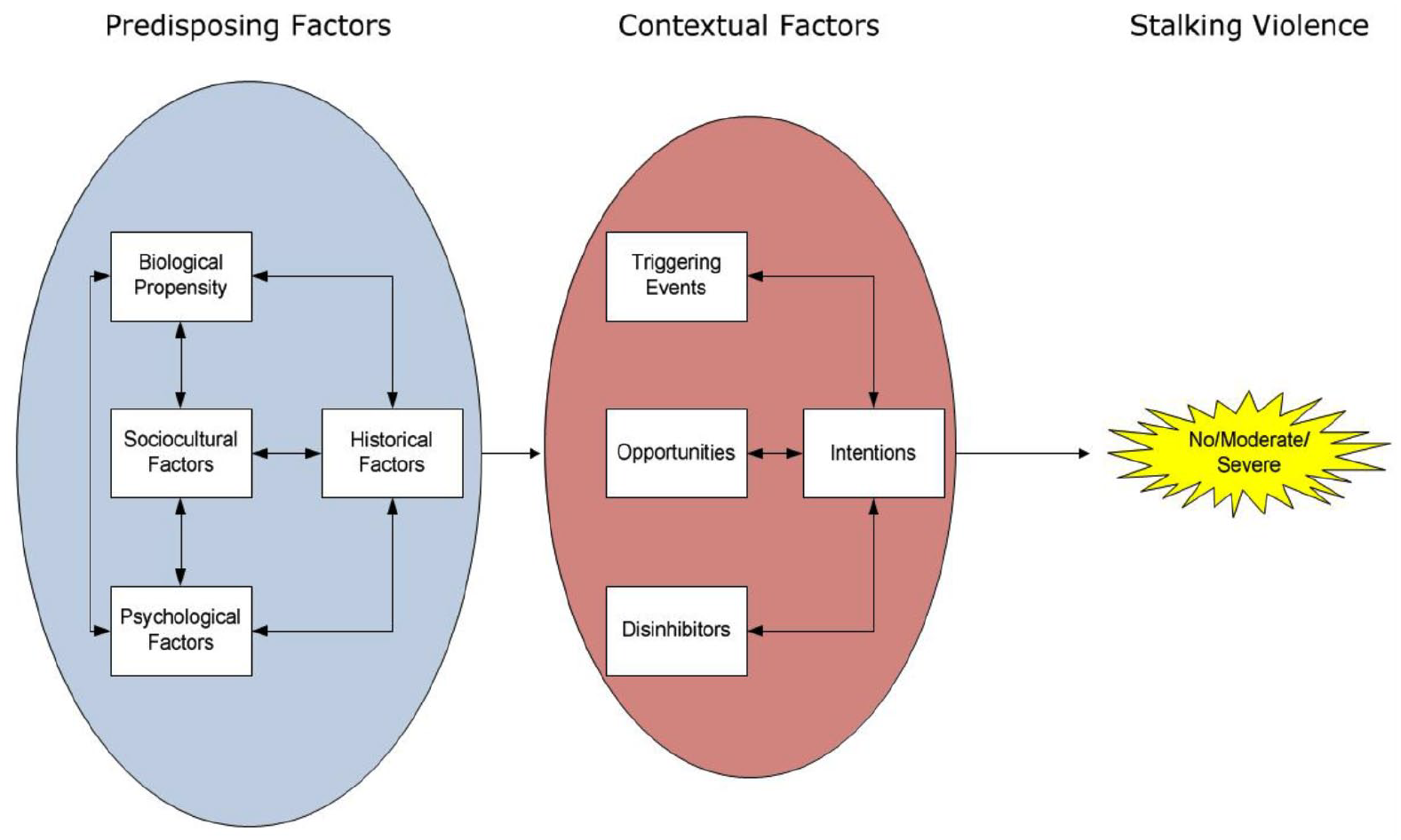
The Integrated Theoretical Model of Stalking Violence
Although all of these predisposing factors weaken stalkers’ restraints from violence, contextual factors determine if, when, and where violence actually occurs (Thompson et al., 2013). The ITMSV classifies contextual factors into four clusters: intentions, triggering events, opportunities, and disinhibitors. Risk factors in each of these clusters are subject to change over time; thus, the risk of violence itself is necessarily dynamic.
Intentions
Unless a stalker intends to inflict violence, violence is unlikely to ensue (Wortley, 2001). Intentions may be inferred from stalkers’ motives and direct threats of violence. In some cases, the intention may not be to harm the target, but to harm a third party interfering with his or her pursuit of the target. Intentions may also fluctuate, potentially quite rapidly, in response to a situation (Spitzberg & Cupach, 2014). Therefore, it is important not only to identify stalkers’ intentions but also to understand which factors prompt dangerous changes in intentions.
Triggering Events
Triggering events may engender violent intentions or augment existing violent intentions (Wortley, 2001). Triggering events are “events or circumstances that may evoke negative emotions or stress in individuals and subsequently violent retaliation” (Thompson et al., 2013, p. 6). The range of events that may constitute triggers is vast and likely differs according to individuals’ interpretations, backgrounds, and circumstances. Examples of triggering events relevant to stalking include confrontations, provocation, and the issuance of protection orders (Groenen & Vervaeke, 2009; Thompson & Leclerc, 2014). However, neither triggering events nor intentions can elicit violence without opportunity.
Opportunities
Opportunities for violence are a necessary precondition for violence, such as access to the target (Wortley, 2001). Therefore, if, when, and where violence occurs is contingent on opportunity. Different types of stalking behaviors afford more or less opportunities for violence. To illustrate, proximity-seeking behaviors (e.g., approaches) create opportunities for a motivated stalker to perpetrate violence or for triggering events to occur that culminate in violence. Therefore, each approach potentially provides a new opportunity for violence.
Disinhibitors
Disinhibitors reduce an individual’s capacity to refrain from violence by attenuating his or her social and moral inhibitions psychologically and/or physiologically (Indermaur, 1996). Examples of disinhibiting factors include intoxication or powerful emotions such as rage or jealousy (Logan & Walker, 2017; Sheridan & Roberts, 2011). Therefore, the risk of violence in stalking cases may fluctuate according to the presence or absence of these disinhibitors.
Integrating Factors
According to the ITMSV, there are many and varied pathways to stalking violence. The way that factors from the model interact to cause stalking violence is likely to vary across individuals, circumstances, and types of violence. Nevertheless, violence will not occur without two essential dynamic contextual factors—intentions and opportunities. The ITMSV also postulates that cases characterized by more risk factors are likely to present a higher risk of violence than stalking cases with no or very few risk factors. Building on Holtzworth-Munroe and Meehan’s (2004) research on domestic violence, the number of risk factors present may also be related to the severity of violence, with a greater number and more serious types of risk factors associated with a higher risk of severe violence. Although the stalker–target relationship is not a component of the model, Thompson (2009) proposes that several factors from the ITMSV may be exacerbated in the context of ex-intimate relationships (see Meloy, 2013). For example, opportunities for violence may occur during child visitations or triggering events may ensue during custody battles that subsequently escalate to violence.
Although there has been little direct empirical testing of the ITMSV, we are not the first to propose the importance of a number of the risk factors included in the model (see Kropp et al., 2008; McEwan et al., 2017; Sheridan & Roberts, 2011). Indeed, many individual factors already have some (albeit often preliminary) support for their independent utility (McEwan et al., 2017). In a direct examination of the ITMSV, Thompson et al. (2013) examined 18 risk factors from the ITMSV using a self-report perpetration survey administered to a community sample of relational stalkers. Almost all risk factors from the model were associated with violence, including violent family of origin, violent friends, relational entitlement, need for control, narcissism, borderline personality traits, history of moderate violence, history of moderate domestic violence, history of any severe violence, triggering events (arguments, confrontations, and disputes), revenge motives, threats, anger, illegal drug use, and alcohol use. Consistent with the model, risk factors varied across the severity of violence. Severe stalking violence was associated with more serious predisposing factors than moderate stalking violence. Most contextual factors were supported across the severity of violence. However, the questionnaire methodology precluded the examination of opportunistic factors and how contextual factors were related to an escalation to violence. In addition, this study did not examine cumulative risk, nor did it explore how predisposing and contextual risk factors combine to influence violence. The present study addresses some of these limitations.
The Current Study
Historical and dynamic contextual risk factors proposed in the ITMSV will be investigated in a content analysis of adjudicated stalking cases from Queensland (Australia) court transcripts. As the content of court transcripts depicts detailed accounts of behavioral and situational factors relevant to the stalking offense, contextual factors omitted from prior research will be examined. The sequencing of events recounted in court transcripts also enables us to examine how stalking behavior progresses and changes over time in response to situational factors. Data presented in court transcripts also contain information likely to be known to police and targets while stalking is occurring and therefore may inform police officers’ assessments of risk and the best way to respond to stalking cases.
We address four broad research questions:
Our results will add to evidence on the utility of the ITMSV as well as the value of dynamic contextual factors for assessments of the risk of stalking violence (e.g., SAM, SRP).
Method
Data Sources: Court Transcripts
Data for the present study were obtained from transcriptions of stalking cases heard in District, Supreme, and Appeal Courts in Brisbane (capital city of Queensland, Australia). All stalking convictions finalized in these higher courts over a 3.5-year period were included. Transcripts were accessed through three sources. First, stalking cases finalized in Brisbane District and Supreme Courts were accessed from the Brisbane Office of the Director of Public Prosecutions (ODPP) using a keyword search of “stalking” (n = 48). Second, the Supreme Court of Queensland Library Database was used to access judgments for stalking cases from the Queensland Court of Appeal (Brisbane; QCA) to (a) ensure convictions from cases at ODPP had not been quashed and (b) identify additional stalking cases heard in the QCA during the study period (n = 19), including 12 cases from originating courts outside the Brisbane region. Again, stalking cases were identified using a keyword search of “stalking.” Third, District and/or Supreme Court transcripts associated with QCA judgments (that could not be accessed from Brisbane ODPP) were requested from the Queensland State Reporting Bureau, the department that houses court transcripts from cases across all regions of Queensland, using case details from the QCA judgments. As transcripts are only available for cases finalized in higher courts (District, Supreme, Appeal), stalking cases finalized in lower court (Magistrates Courts) were excluded from this study (60% of all stalking finalizations in the study period).
Together, stalking court transcripts for 67 unique stalking cases were identified. However, 24 cases were excluded because the defendant was found not guilty (n = 6), the case was declared nolle prosequi (n = 9), the case had insufficient details of stalking behaviors or incomplete transcripts (n = 8), or the defendant died (n = 1). The final sample (43 cases) constitutes 22% of stalking cases finalized with a guilty verdict in District, Supreme, and Appeal Courts across the entire state of Queensland during the study period. The project was approved by the Griffith University Human Research Ethics Committee and the ODPP.
Stalking Cases Identified From Court Transcripts
The 43 stalking cases include 40 perpetrators, 43 targets, and 43 target-perpetrator combinations (three offenders were convicted of stalking two targets each). Most perpetrators were male (38 of 40 perpetrators, 95.0%) and most targets were female (41 of 43 targets, 95.3%). In the majority of cases the perpetrator was male and the target female (n = 39, 90.7%). In four cases, the target and perpetrator were the same sex (i.e., two female-to-female and two male-to-male combinations). Most perpetrators were aged 35 years or older (23 of 33 stalkers, 69.7%; missing n = 7; M = 40.27 years, SD = 12.07; range = 20-69 years). The target’s age was missing for 26 cases (60.5% of cases). When age was reported, more than half of the targets were under 35 years (10 of 17 targets, 58.8%; M = 28.25 years, SD = 11.94; range = 11-45 years). Four targets were children aged between 11 and 15 years. Most cases were finalized in the District (n = 24) or Appeal (n = 18) Courts, with one case finalized in the Supreme Court.
Queensland Stalking Legislation and the Characteristics of Stalking Cases
The nature of stalking may vary somewhat across different legislative definitions of stalking. In Queensland, stalking encompasses (a) one or more intentional acts, (b) “engaged in on any one occasion if the conduct is protracted or on more than one occasion,” that (c) could reasonably elicit fear, apprehension, or cause detriment (Queensland Criminal Code [Stalking] Amendment Act, 1999). Queensland legislation differs from much stalking legislation in two key ways. First, Queensland legislation does not require behavior to be repeated if it is protracted. Second, perpetrators do not have to intend to (or actually) engender fear in the target if it is determined that a reasonable person would experience fear, apprehension, or detriment. Given the breadth of the Queensland legislation, there may be differences between stalking behaviors prosecuted under this legislation and other jurisdictions (see Thompson & Dennison, 2008). Results need to be interpreted accordingly.
In our sample, the stalker–target relationship was most often an acquaintanceship (48.8%, 21 cases; e.g., neighbor, friend, client, or employee) or an ex-intimate relationship (44.2%, 19 cases). Three stalkers targeted strangers (7.0%). In most cases, stalking arose from the dissolution or pursuit of an intimate relationship (67.4%, 29 cases). In 90% of cases, stalkers perpetrated at least five intrusions/acts, with 60% committing 10 or more intrusions/acts (range = 1-150 acts). Two cases involved the legal minimum of either one protracted occasion (Case 38) or two repeated acts (Case 27). However, the stalker in Case 38 had eight prior convictions for stalking the same target. Most stalkers persisted for longer than 1 month (69%; 9% missing), with 15% persisting longer than 1 year. The most common stalking behaviors were phone calls (58.1%), threats (48.8%), watching (48.8%), verbal abuse (44.2%), approaching (41.9%), property damage (27.9%), and letters (27.9%).
Analytic Strategy
The association between risk factors from the ITMSV and stalking violence was investigated using content analysis. Descriptive statistics are supplemented with effect sizes. Statistical significance testing was not conducted due to the inherent limitations of doing so with small sample sizes (Kearney, 2017). Although many predisposing factors (i.e., biological, psychological, and sociocultural) could not be examined, the variables available in this study are typically accessible to law enforcement while stalking occurs and therefore we can test the practical utility of this model as it may be used at the front end of the criminal justice system. A deductive approach was adopted, with coding and analysis driven by risk factors derived from the model. Risk factors were coded present (i.e., present prior to violence in violent cases), absent (i.e., the transcript indicated the risk factor was absent or occurred subsequent to violence), or unknown/not mentioned (i.e., insufficient detail to ascertain presence or absence). Because court proceedings are driven by evidence for conviction, missing data (“not mentioned”) varied across risk factors and cases. These cases are excluded from analyses of individual risk factors. Furthermore, as triggering events may occur but have no influence on violence, we separated cases according to the apparent impact of these events on subsequent violence (i.e., did vs. did not trigger violence). The specific operational definition of each risk factor is provided in the “Results” section before each factor is analyzed to promote readability. To clearly differentiate between victims of stalking and victims of violence who were not also the target of stalking, we use the terms “targets” for the former and “third-party victims” for the latter.
Operationalizing Violence
Violence was defined as attempting to do, or actually doing, a range of physically violent acts to the target, or someone associated with the target, during the course of stalking. The specific violent behaviors were primarily derived from the physical assault and severe sexual coercion subscales of the Revised Conflict Tactics Scale (CTS2; Straus, Hamby, Boney-McCoy, & Sugarman, 1996). Additional behaviors coded as violent included those that resulted in or had the potential to result in personal injury or harm or led to a conviction for assault, including tackling, physically restraining, unwanted touching, biting, dragging along the floor, and vehicular violence (driving at a person, running a person’s vehicle off the road or into oncoming traffic, purposely driving into a person’s car while they were in the car, dragging a person along the road using a car). Cases were classified as “not violent,” “moderately violent,” or “severely violent” according to the CTS2 and probable severity of the consequences of the behavior. Insufficient details were available to classify the severity of one case of assault.
Results
What is the Rate and Nature of Violence in Court-Derived Stalking Cases?
Stalkers were physically violent in 18 cases (41.9%). All violent stalkers were male. However, there were only two female stalkers in the sample. The most common forms of violence were vehicular violence (33.3% of violent cases, n = 6), punching (27.8% of violent cases, n = 5), and using a knife (22.2% of violent cases, n = 4). Stalkers often used multiple types of violence in a single incident. To illustrate, in Case 19, the stalker forced himself on top of the [target] holding her down. He bit the inside of her upper arm and dragged her along the floor towards the shower. He grabbed her throat and held it with both hands tightly so she couldn’t breathe.
Almost all violent stalkers committed at least one act of severe violence (16 of 17 cases with known severity, 94.1%), often in conjunction with moderate violence (n = 7, 41.2%). Consequently, violence will not be disaggregated according to severity. Six stalkers were violent on more than one occasion (33.3% of violent cases), sometimes despite police intervention and/or charges or convictions. In three violent cases, violence occurred during the first intrusion (16.7%). Most violence was perpetrated against the target only (n = 11, 61.1% of violent cases). Stalkers were violent against both the target and a third party in three cases (16.7% of violent cases) and only a third party in four cases (22.2% of violent cases). Although in one of the latter cases, the stalker intended to attack the target but accidentally assaulted third parties (Case 35). One stalker kicked the target’s pet after assaulting a third party (Case 11b).
Are Predisposing Risk Factors From the ITMSV Associated With Stalking Violence?
Three historical predisposing factors were examined: criminal history (i.e., at least one adult criminal conviction, including violence), violent criminal history (i.e., at least one adult criminal conviction for a violent offense, such as assault, serious assault, manslaughter, rape), and physical domestic violence history (i.e., previous infliction of physical violence against an intimate partner). Stalkers had a criminal history in 70.0% of cases (28 of 40 cases; missing n = 3). However, the nature and seriousness of previous convictions varied markedly from traffic offenses to sexual assaults and manslaughter. In 50.0% of cases, the stalker had previously been convicted of at least one violent offense (17 of 34 cases; missing n = 9), ranging in severity from common assault to manslaughter. Consistent with the ITMSV, stalkers with criminal histories were more likely to be violent (46.4%, 13 of 28 cases) compared with stalkers with no criminal histories (25.0%, 3 of 12 cases; φ = .20). The same was true for stalkers with violent criminal histories (47.1% violence vs. 23.5% violence for stalkers with and without violent criminal histories; φ = .25). Importantly, though, half of the stalkers with criminal (53.6%) or violent criminal histories (52.9%, 9 of 17 cases) were not violent. Domestic violence history was not systematically reported, precluding a meaningful analysis of this factor. Nevertheless, stalkers had a history of domestic violence reported in seven cases, including four violent cases.
Are Contextual Risk Factors From the ITMSV Associated With Stalking Violence?
Intentions
Revenge motives
Motives were inferred from (a) the stalker’s behavior, (b) judicial comments, and (c) evidence presented in cases. Motives were coded as revenge (i.e., motivated to hurt, harm, or upset the target in response to perceived mistreatment or rejection), amorous/affectionate (i.e., motivated to either reconcile or initiate a relationship with the target), or sexual (i.e., motivated to obtain sexual gratification from the target such as asking for sexual favors). Because motives may vacillate within stalking cases, the primary motive prior to violence was used to explore how this motive may affect the course of stalking. Even so, in most cases, motives seemed fairly stable. Revenge was the most common motive (n = 22, 56.4%). One third of stalkers had amorous or affectionate motives (30.8%) and 12.8% had sexual motives (see Table 1). The rate of violence was higher among stalkers motivated by revenge (54.5%) than stalkers motivated by affection or sexual interest (29.4% combined; φ = .25). Still, 45.5% of stalkers with revenge motives were not violent.
The Distribution of Violence Across Contextual Factors
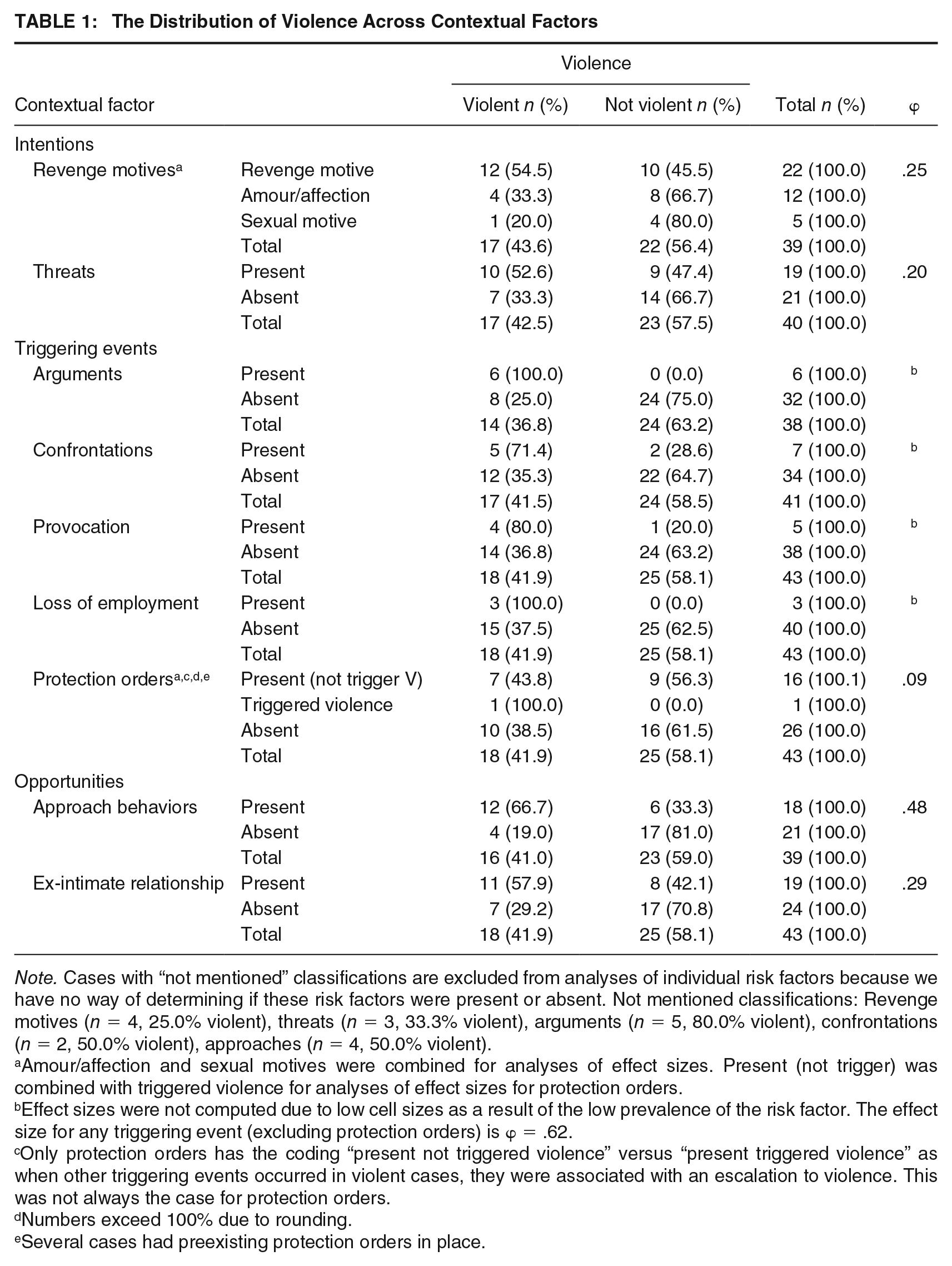
Note. Cases with “not mentioned” classifications are excluded from analyses of individual risk factors because we have no way of determining if these risk factors were present or absent. Not mentioned classifications: Revenge motives (n = 4, 25.0% violent), threats (n = 3, 33.3% violent), arguments (n = 5, 80.0% violent), confrontations (n = 2, 50.0% violent), approaches (n = 4, 50.0% violent).
Amour/affection and sexual motives were combined for analyses of effect sizes. Present (not trigger) was combined with triggered violence for analyses of effect sizes for protection orders.
Effect sizes were not computed due to low cell sizes as a result of the low prevalence of the risk factor. The effect size for any triggering event (excluding protection orders) is φ = .62.
Only protection orders has the coding “present not triggered violence” versus “present triggered violence” as when other triggering events occurred in violent cases, they were associated with an escalation to violence. This was not always the case for protection orders.
Numbers exceed 100% due to rounding.
Several cases had preexisting protection orders in place.
Violence in cases motivated by revenge was almost always nonsexual (n = 11, 91.7%), such as stabbings and vehicular violence. Interestingly, three of five instances of violence in cases motivated by affection or sexual interest involved sexual violence (e.g., attempted rape) or violence with sexual connotations (e.g., unwanted touching). Consequently, amorous or sexual motives may be associated with sexual violence, whereas revenge may be associated with nonsexual violence. In the remaining two violent cases that were not motivated by revenge, the violence appeared to be reactive to situational pressures. One case escalated when the target’s son confronted the stalker (Case 5, discussed in relation to triggering events below). The other case escalated after the stalker approached the target while she was driving and, after agreeing to pull over to talk, she attempted to flee in her car. The stalker reacted by chasing the target in his car, forcing her car into oncoming traffic, and ramming into her car (Case 10).
Threats
Threats occurred in 47.5% of cases (coded as explicitly expressing a desire or intention to physically harm, hurt, injure, or kill the target or someone the target cared about, either verbally or in writing; e.g., “You’re going to die bitch” from Case 1). Violence was more common in cases involving threats than in cases without threats (see Table 1; φ = .20). Nevertheless, threats were also made in 39.1% of nonviolent stalking cases. In some of these cases, situational factors may have prevented the stalker from acting on their threats. To illustrate, in Case 12, the target enhanced her home security, brought a boarder into her house, changed the venues where she socialized, changed her phone number, and after the stalker threatened violence against her children, she sent her children interstate to stay with family.
Triggering Events
Arguments
Arguments were operationalized as mutual verbal disagreements accompanied with expressed irritation or anger (excludes unidirectional verbal abuse). In most cases, arguments were explicitly identified in the transcripts (e.g., “they got into a heated argument”). Arguments occurred in six cases (15.8%), each occurring during face-to-face contact. In all of these cases, arguments led to violence. For example, in Case 7, a male ex-intimate stalker approached the target at her house and accused her daughter of stealing his money. A heated argument ensued between the stalker and target, culminating in the stalker “grabbing the target, throwing her to the ground, holding her down, and biting her nose with enough force to penetrate her skin. He grabbed a nearby baseball bat and held it up to her.” Violence was far more common in cases involving arguments (100.0%), compared with cases without arguments (25.0%; see Table 1).
In most cases, arguments escalated to violence during the altercation. However, in two cases, violence occurred shortly after the argument, whereby the argument was a contributing stressor for violence. To illustrate, in Case 20, an argument erupted when the stalker and his ex-partner (the target) were discussing their relationship while seated in the target’s car. The stalker punched the windscreen and cracked the glass. The target left. A few hours later, the stalker broke into the target’s home and confronted her, armed with a knife. He grabbed her and dragged her into the bedroom and held her in a headlock with the knife to her throat. She tried to push the knife away with her hand, severing her tendon. Her neighbor rushed in. The stalker yelled, “if you come any closer, I’ll kill her.” When the police arrived, a siege ensued. In three cases, multiple arguments elicited violence on multiple occasions (Cases 1, 7, and 20). All three of these cases involved ex-intimate stalking.
Confrontations
Confrontations were operationalized as physically approaching the stalker to pressure him or her to desist (e.g., asking him or her to desist, questioning his or her behavior, or trying to stop him or her from continuing). Confrontations occurred in seven cases, six of which were initiated by third parties trying to help targets. Five of the six confrontations by third parties triggered violence during the interaction, whereby violence was a direct retaliation to the confrontation. For example, in Case 5, the stalker was watching the target from his car while she was moving house. The target feared the stalker would follow her to her new house. Consequently, the target’s son and two of his friends approached the stalker. They banged on the windows and roof of the stalker’s car and asked why he was stalking the target. The stalker reversed his vehicle and rapidly accelerated toward the target’s son and his friends. They leaped out of the way and jumped into their car. The stalker deliberately crashed into their vehicle. Violence was more common in cases involving confrontations, compared with cases without confrontations (see Table 1).
Confrontations triggered almost all violence deliberately perpetrated against third parties (five of six cases). In the remaining case, the target’s son was assaulted alongside his mother, although too little information was available to determine the circumstances surrounding the violence. Regardless, no stalkers sought out third parties to violently attack them. Only one confrontation was initiated by a target. Although the confrontation did not elicit violence, the target was a male police officer and the confrontation occurred outside a courthouse. Arguably, these factors minimized the risk for violence during the interaction.
Provocation
Provocation was operationalized as intentionally disrupting the stalker’s ability to lawfully see his or her children, comply with protection orders or carry out his or her daily activities. To illustrate, in Case 26, the target asked her ex-partner (stalker) to take their children to school because she was ill. However, when he arrived to do so, she contacted the police and reported it as a breach of his domestic violence order. In most cases, the behavior was explicitly labeled provocative by the magistrate or judge. A target or third party provoked the stalker in five cases, eliciting a violent reaction in four of these cases. In all four cases, the target had provoked the stalker and the provocation either evoked an argument between the parties that culminated in violence or violence was perpetrated when the next opportunity arose, such as a chance encounter with the target. In Case 26 described above, shortly after the target provoked the stalker, he came across the target when he was driving. Still enraged from the incident, he followed her car and forced her vehicle out of her lane. Violence was more common in cases including provocations, compared with cases without provocations (see Table 1).
Loss of employment
Three stalkers were either fired or their business liquidated during the course of stalking (coded as loss of employment). In all three cases, the loss of employment seemed to be a contributing factor to subsequent violence (Table 1). For example, in one case, hours after the stalker was dismissed, and after consuming large quantities of alcohol and drugs, he broke into the target’s home and attempted to stab her.
Protection orders
In 17 cases, a domestic violence or restraining order was activated against the perpetrator during the course of stalking. In almost 95% of these cases, the stalking behavior did not escalate in response to the protection order; however, nor did it desist (see Table 1). Protection orders appeared to trigger violence in just one stalking case. Here, after being informed of the protection order, the stalker broke into the target’s home, verbally abused her, and attempted to punch her (although he missed and punched her infant instead; Case 35). Therefore, although protection orders did not typically trigger violence, these orders cannot be discounted as potential triggers in some cases. Furthermore, there was no evidence that protection orders reduced the rate of violence, with slightly higher rates of violence in cases with protection orders in place (φ = .09). Importantly, protection orders were typically only reported if the stalker breached the order, and therefore such actions were within the parameters of the stalking conviction. It is possible that additional orders were activated during the process of formally charging other stalkers and potentially played a role in deterring these stalkers from further intrusions but was not necessary for establishing evidence of the stalking offense.
Any triggering event
Aside from protection orders, triggering events had low rates of false positives. However, individually, these events were somewhat uncommon. When triggering events were combined (excluding protection orders), the occurrence of any triggering event was more common (37.2%). At the same time, the strong relationship with violence was retained (φ = .62), whereby 81.3% of stalkers who experienced at least one triggering event were violent (13 of 16 cases), compared with 18.5% with no triggering events (five of 27 cases).
Opportunities: Approach Behaviors
Approach behaviors were operationalized as behavior that brought the stalker into close proximity to the target so physical contact was possible. Approaches undertaken for the purpose of perpetrating violence were excluded because this would confound the results. Nearly half of the stalkers approached the target, with rates of violence 3 times higher in cases with approaches than cases without approaches (φ = .48; see Table 1). Approaches preceded violence in two broad ways. First, stalkers who previously approached the target in nonviolent encounters subsequently approached the target for the purpose of perpetrating violence (i.e., four cases). Second, and most commonly, violence escalated during the commission of what seemed to be nonviolent approach behaviors because interactions went awry, confrontations or arguments ensued or opportunities for violence arose (n = 8, 44.4% of cases including approaches). Of note, in five of the eight violent cases that escalated during nonviolent approaches, the stalker had also previously approached the target. Therefore, approaches may be indicative of escalation, more aggressive/emotional stalking, and/or may result in opportunities for violence or for triggering events that escalate to violence.
Approach behaviors did occur in six nonviolent cases. Interestingly, the nature of approaches in nonviolent cases was often different from approaches in cases that escalated to violence. Approaches in half of the nonviolent cases were still largely unidirectional and brief, limiting opportunities for escalation (e.g., handing the target a letter without conversing with him or her in Cases 14, 15, and 36). In contrast, approaches in violent cases were more prolonged and involved verbal interactions between parties, providing more opportunities for escalation.
Cases with no approaches infrequently escalated to violence. In these cases, stalking comprised distal behaviors or unidirectional contact, such as letters, phone calls, and watching from afar. In some instances, the lack of approaches appeared to signify a different nature of stalking that was typically less aggressive. In other cases, the lack of approach only occurred because the target thwarted the stalker’s approaches through safety measures. To illustrate, the target in Case 4 improved her home security, and when the stalker came to her house, she hid inside, locked her door, closed the curtains, and called the police. She did not respond or retaliate when he repeatedly knocked on her door, called out to her, and smashed furniture on her verandah. Therefore, the opportunity for violence was minimized. In another case, approach was not possible because the stalker was in prison at the time of stalking (Case 28). Still, violence occurred in four cases with no previous or preceding nonviolent approaches.
Disinhibitors: Substance Use
Substance use could not be systematically examined as drug and alcohol use only seemed to be reported when it influenced stalkers’ behaviors; limiting disconfirming evidence. Nevertheless, five stalkers were under the influence of drugs and/or alcohol when they committed violence and there was some suggestion that this played a role in the violence.
Ex-Intimate Relationship
Violence was twice as likely to occur when stalkers targeted ex-partners (Table 1; φ = .29). Moreover, all six cases that involved multiple violent incidents were either ex-intimate stalking cases or the stalker believed the target interfered with his intimate relationship. Still, 42.1% of cases of ex-intimate stalking did not escalate to violence.
How Do Risk Factors Combine to Influence the Risk of Stalking Violence?
It is clear that when individual risk factors are examined in isolation, there are moderate amounts of error. Indeed, 23 of 25 nonviolent cases had at least one risk factor, accounting for false positives on the associated factor(s). To explore how risk factors from the ITMSV combine to influence violence, we first examined whether rates of violence differ according to the number of risk factors present (see Table 2). Our results indicate that 21.4% of cases with two or fewer risk factors were violent (three of 14 cases), 20.0% of cases with three to five risk factors were violent (three of 15 cases), and 85.7% of cases with six or more risk factors were violent (12 of 14 cases). These findings suggest that the more risk factors that accrue, the greater the likelihood of violence. Moreover, an investigation of correct classification across the number of risk factors present suggests that a threshold of six risk factors quite effectively distinguishes violent from nonviolent cases in our sample. However, given the small sample size and small amounts of missing data for a number of risk factors, our results are still very preliminary.
Correct Classification Across Different Risk Factor Thresholds
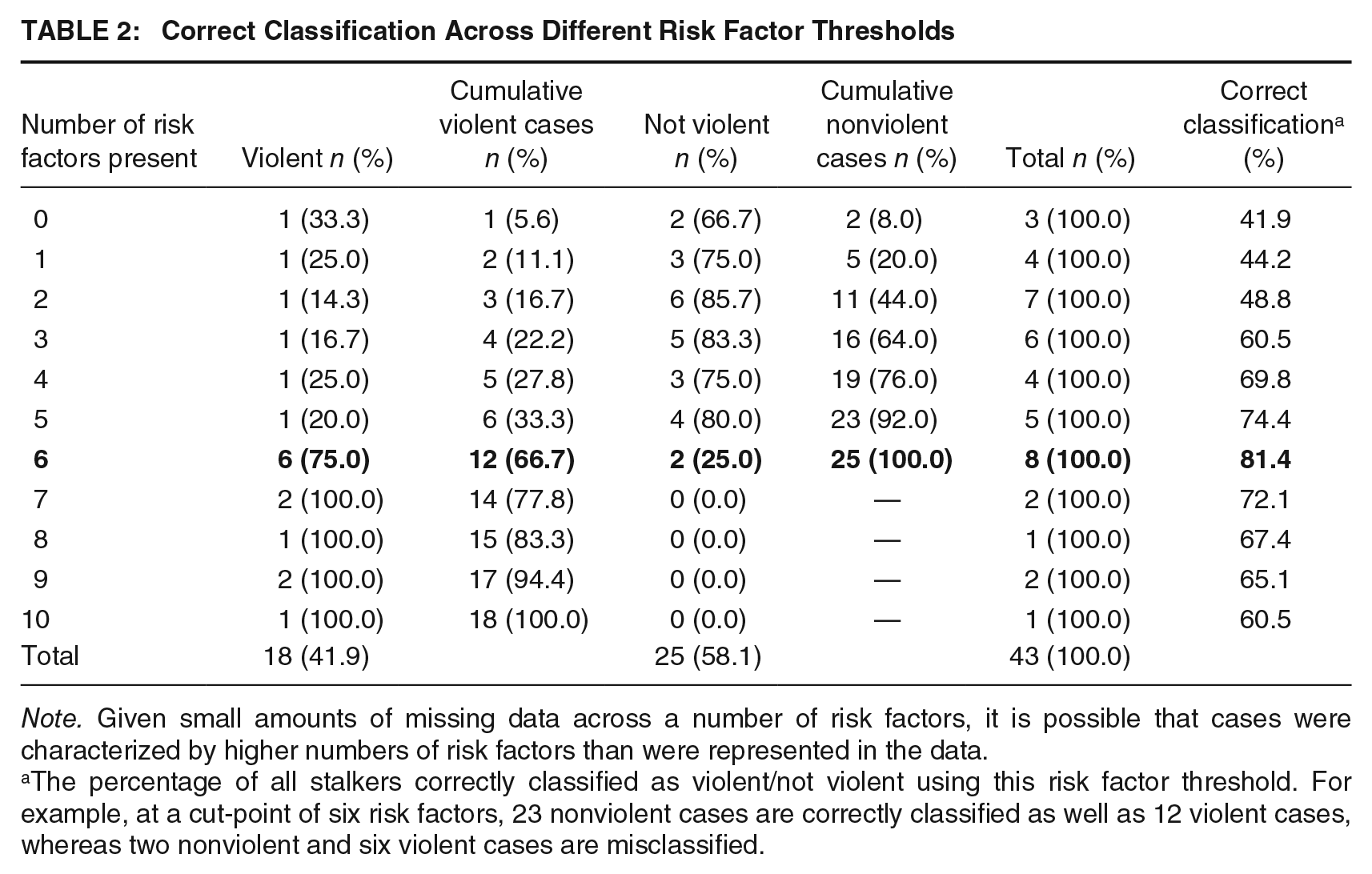
Note. Given small amounts of missing data across a number of risk factors, it is possible that cases were characterized by higher numbers of risk factors than were represented in the data.
The percentage of all stalkers correctly classified as violent/not violent using this risk factor threshold. For example, at a cut-point of six risk factors, 23 nonviolent cases are correctly classified as well as 12 violent cases, whereas two nonviolent and six violent cases are misclassified.
Not only is the number of risk factors important but so too is the type of risk factors present. Consequently, we explore how risk factors combine to influence violence next. To do this, we use a threshold of six or more risk factors as a mechanism for examining how risk factors operate in conjunction in (a) cases with many risk factors that are subsequently violent, (b) cases with many risk factors that are not violent, (c) cases with few risk factors that are subsequently violent, and (d) cases with few risk factors that are not violent.
Cases With Six or More Risk Factors From the ITMSV
Most cases with six or more risk factors were violent (12 of 14 cases, 85.7%). In 11 of these 12 violent cases, stalkers (a) had a history of offending or violence (historical predisposing factors), (b) intended to hurt or harm the target (i.e., threats or revenge motives), and (c) situational factors escalated the situation (i.e., triggering events) or provided opportunities for violence (either for planned or opportunistic attacks) or disinhibited their restraints. Despite being similarly characterized by risk factors across multiple domains, there were differences in the individual risk factors that comprised these combinations. In addition, the context in which violence occurred varied, including planned attacks, opportunistic attacks, and attacks that escalated from triggering events.
Some cases were characterized by a history of violence, a clear intent to harm the target, and the stalker sought out the target for the attack or seized an opportunity to attack the target during a chance encounter. To illustrate, in Case 6, a 50-year-old man stalked his ex-wife after their marriage breakdown. He had a long, violent criminal history and their marriage had been volatile and violent. Motivated by revenge, he primarily engaged in intimidating behaviors, including posting naked photos of her at her workplace, approaching her, and numerous death threats. He persisted despite a domestic violence order against him. The stalking culminated after the perpetrator sought out the target at the tavern where she worked. With a knife hidden behind his back, he asked his ex-wife if she wanted to talk to him, to which she replied “no.” He then stabbed her 3 times in front of patrons.
In other cases, although multiple risk factors were present, violence arose from nonviolent stalking behavior that escalated from arguments, confrontations, or approaches going awry. This includes the one violent case that did not exhibit risk factors across all three domains of the ITMSV. In these cases, triggering events were key for escalation and the violence was reactive to situational pressures. While it is impossible to know whether violence would have been avoided in the absence of such triggers, these triggers certainly affected when violence occurred. This is exemplified in Case 11a, whereby a male stalked his female neighbor after a dispute over a fence. He had a long criminal history, including a previous conviction for stalking the same target. Motivated by revenge, he threatened the target and her family numerous times. He was often intoxicated when he engaged in stalking behaviors. One afternoon, the stalker threw sticks at the target’s house. The target’s husband confronted him and an argument erupted. The stalker threatened that he “had friends with guns” and “they were going to get (him),” then he punched the target’s husband in the face. Ex-intimate stalkers were more likely to exhibit risk factors across domains of the ITMSV than non-ex-intimates (52.6% of all 19 ex-intimates vs. 29.2% of all 24 non-ex-intimates).
Two cases with six or more risk factors did not escalate to violence. While both cases were characterized by violent criminal histories and intentions to hurt/harm the target (i.e., threats of violence and revenge motives), neither stalker approached the target and no triggers occurred. In fact, there was no proximal contact in either case. Therefore, it is possible that there were few opportunities for violence to occur; certainly, there was no opportunity for violence to escalate from triggers or approach behaviors. It is unclear whether safety precautions adopted by their targets prevented these stalkers from making contact (and potentially from inflicting violence), but it is possible.
Cases With Fewer Than Six Risk Factors From the ITMSV
Most cases with fewer than six risk factors were not violent (23 of 29 cases, 79.3%). Not only were these cases characterized by few risk factors overall, but risk factors were typically not present across historical factors (i.e., predisposing factors), intentions, and situational factors (i.e., opportunities and/or triggering events). While some of these cases were characterized by predisposing factors and/or intentions to hurt/harm the target, there were limited opportunities for violence to occur and/or to escalate in the absence of approach behaviors or triggering events (e.g., Cases 8a, 8b, 9, 12, 13, 28, 30, and 33). For example, one stalker had a long, seriously violent criminal history; was motivated by revenge; and had made numerous threats to kill the target. However, the perpetrator was imprisoned at the time and therefore there was no opportunity for violence to occur. In other cases, although there were opportunities for violence, the stalker had no history of violence and it appeared that the stalker did not intend to hurt/harm the target or perpetrate violence (e.g., Cases 14, 16, 31, 36, 37, and 38). In almost all of these cases, triggering events were absent and therefore these intentions did not change across the course of stalking. In other cases, there were very few risk factors present at all (e.g., Cases 2, 4, 18, 25b, 27, 29, and 32).
Six of the 29 cases with fewer than six risk factors were violent. In two of these cases, triggers were important in the escalation to violence, illustrating the potential significance of these events. For example, in Case 5, the stalker was a family friend. Motivated by affection, he primarily perpetrated distal behaviors such as sending gifts and cards and telephoning. He had a criminal history, including a conviction for assaulting a police officer some years earlier. The stalking did not include any threats and only escalated after the perpetrator was confronted by the target’s son and his friends. Here, violence was a reaction to the third parties’ attempts to thwart his behavior. In three of the four remaining cases, violence occurred during the first intrusion. These cases are inherently difficult to predict. It is possible that these cases included biological, psychological, and sociocultural risk factors we could not measure. It is also possible unreported risk factors were present before stalking commenced.
Discussion
Our findings support the value of almost all risk factors examined. However, relying on individual risk factors in isolation led to moderate rates of error. Combining risk factors resulted in a more sophisticated understanding of stalking violence. Dynamic contextual factors played a pivotal role in understanding changes in risk, including when individuals with historical and/or static contextual factors pose a higher risk of violence. We explore these findings in more detail below, including associated implications for prevention strategies.
Prevalence and Nature of Violence
Violence occurred in 41.9% of stalking cases. This is somewhat higher than average rates of violence in clinical/forensic cases (38% across 78 studies; Spitzberg & Cupach, 2014) and is potentially attributed to our restricted sample of cases finalized in higher courts. Few violent incidents were life-threatening or resulted in severe injuries, yet almost all violent cases included acts that would be considered severe on the CTS2 and often had the potential to seriously injure the victim (e.g., dragging the victim along the road from a car, holding at knifepoint). The unusually high rate of severe violence in this study is likely driven by our more serious sample of stalkers as well as our broader definition of severe violence, whereby definitions adopted in previous research are typically contingent on violence inflicting (often serious) injuries (James & Farnham, 2003; Sheridan & Roberts, 2011). Most violence seemed reactive and affective, with seemingly little or no planning. Relatedly, opportunity played a key role in the type of violence perpetrated. For example, all cases of vehicular violence—the most common form of violence in this study—occurred in the context of (a) unplanned encounters with targets, or after planned encounters went awry, and (b) the stalker’s vehicle was available as a means to commit violence. These dynamics are consistent with Meloy’s (2002, 2013) expectations for violence in private-party stalking, though we suspect contrast with the nature of violence in public figure stalking (Meloy, 2013; Spitzberg & Cupach, 2014).
Predisposing Risk Factors for Stalking Violence
Most predisposing risk factors from the ITMSV are not systematically reported in legal proceedings. However, we did have sufficient data to explore stalkers’ criminal and violent criminal histories. These particular predisposing risk factors are not only key risk factors from previous stalking research (albeit with mixed results), but also arguably the most readily accessible and measurable predisposing factors from the ITMSV for police officers and thus may be crucial for “on-the-job” decision-making (see Sheridan & Roberts, 2011). Criminal history and violent criminal history were both associated with stalking violence, with small-to-moderate effect sizes comparable with prior research (e.g., Churcher & Nesca, 2013). However, neither factor was necessary nor sufficient for stalking violence as half of the stalkers with each of these risk factors were not violent and one quarter without these risk factors were violent. While it is possible that more sensitive measurements of criminal and violent histories may produce better predictions, as we detail below, it is clear from our findings that these risk factors must be considered in conjunction with contextual risk factors.
Contextual Risk Factors for Stalking Violence
This is one of few studies to examine contextual risk factors for stalking violence using a time sequencing approach (McEwan et al., 2012; Spitzberg & Cupach, 2014). We also explored several dynamic contextual factors for the first time (e.g., provocation). Contextual factors were pivotal in influencing if, when, and where violence occurred as well as to whom. Not only do these findings support the propositions of the ITMSV, but they also add to empirical evidence validating the inclusion of these factors in existing stalking violence risk assessments (SAM, SRP; Kropp et al., 2008; McEwan et al., 2018).
Stalkers who threatened to harm the target or someone the target cared about were more likely to be violent, as were stalkers motivated by a desire to hurt/harm/upset the target (revenge motives). Nevertheless, in approximately half of these cases, stalkers did not act on these threats/motives through physical violence. Mirroring prior research, in many cases, threats were not promises or warnings of imminent physical violence but appeared to have been attempts to frighten the target, exert influence, and/or express anger, rage, and frustration (e.g., Spitzberg & Cupach, 2014; Warren, Mullen, & Ogloff, 2011). Of course, the difficulty lies in determining which stalkers will and will not act on their threats. As we discuss below, the presence of additional risk factors seems critical to such assessments.
Revenge motives are similarly complicated. However, not only is it difficult to determine which stalkers plan to act on their apparent motives, but also different motives may be associated with different types of violence. While revenge motives were associated with nonsexual violence, almost all sexual violence in our sample occurred in the context of amorous/affectionate or sexual motives. Although our data contain too few cases of sexual violence to draw firm conclusions, Mullen, Pathé, and Purcell (2000) also found evidence that rejected, vengeful stalkers pose an elevated risk of physical assaults, whereas sexually motivated predatory stalkers pose an elevated risk of sexual assaults.
As a further challenge, motives may change over time and in response to triggers or other external events or pressures. This was evident in two cases with predominant amorous motives, whereby situational factors appeared to evoke a change in motive and an escalation to violence. The potential for such shifts in motives is recognized in stalking violence risk assessments and the broader literature (Kropp et al., 2008; McEwan et al., 2018). Therefore, it is important not only to identify stalkers’ intentions but also to understand which factors trigger risky changes in intentions. Even among stalkers with existing violent intentions, situational factors often play a critical role in inciting stalkers to act on these intentions.
Our study confirms previous findings that a variety of triggering events can elicit violence from stalkers (Groenen & Vervaeke, 2009; Kropp et al., 2011; Thompson et al., 2013; Thompson & Leclerc, 2014). In these cases, violence was either a direct retaliation to triggers (arguments, confrontations, provocations) or the triggering event was a contributing stressor alongside other risk factors (e.g., loss of employment coupled with substance use and revenge motives). Our findings also indicate that third parties who confront stalkers in an attempt to help targets may risk being victimized. In fact, it was almost exclusively under these circumstances that third parties were intentionally assaulted by stalkers in this study. Clearly, alternative guardianship strategies are required for violence prevention.
The salience of triggering events of an interpersonal nature is perhaps not surprising given the interactional nature of stalking. Stalkers often aim to evoke a reaction from the target or influence the target’s behavior, and it appears that some of these reactions potentially elicit violence (Sheridan & Roberts, 2011). Of course, an event that triggers violence for one stalker may not have the same impact on another stalker. An individual’s background, circumstances, and interpretations likely determine which conditions are provocative (Indermaur, 1996). This is best illustrated by our findings for protection orders. Protection orders are often the first formal intervention undertaken to deter stalkers. Despite this, and similar to some previous research (Logan, Nigoff, Walker, & Jordan, 2002; Malsch, de Keijser, & Debets, 2011; McEwan et al., 2017; Spitzberg & Cupach, 2014; Strand & McEwan, 2012), restraining orders appeared to have little impact on stalkers’ behavior—positive or negative. Nevertheless, in one stalking case, a protection order did trigger violence. Interestingly, in this case, the stalker was not violent against his ex-partner who obtained the restraining order, but toward his ex-partner’s friend (the stalking target) whom he blamed for the breakdown of his relationship, and for his ex-partner’s decision to obtain a restraining order. Therefore, factors surrounding protection orders are likely relevant. Hakkanen, Hagelstam, and Santtila (2003) reported that protective orders specifically were not associated with violence but that violence was associated with a target’s decision to voluntarily meet with the stalker contrary to order requirements. Indeed, one stalker in the current study escalated to violence after the target manipulated him to contravene his protection order and subsequently reported the breach to police (i.e., provocation). Consequently, protection orders cannot be discounted as a potential trigger or contributing stressor in some stalking cases and under the right circumstances. At the same time, the presence of protection orders provides targets with avenues for legal recourse and police intervention in the event of violations. It is also possible that protection orders formed part of the formal response to charging stalkers and therefore potentially played a role in desistance in some cases.
Violence was also more likely to occur if the stalker approached the target, with a strong effect size exceeding those attained in previous research that did not employ a time sequencing approach (e.g., φ = .48 vs. .2 in McEwan et al., 2017). This finding confirms the value of including approaches in stalking risk assessments (e.g., SAM; Kropp et al., 2008). The time-sensitive nature of our data also enabled us to unpack the specific pathways that link approaches to violence for the first time. Here, approaches appeared to be associated with violence in several ways. First, approaches may provide opportunities for triggering events to occur that subsequently escalate to violence, thus engendering violence. Second, approach behaviors may influence when violence is perpetrated by providing opportunities for violence to occur. Third, previous approach behaviors may signify an escalation in stalking, a general pattern of more aggressive stalking, or alternatively that the target is accessible and thus opportunities for violence may exist in the future. Regardless of the mechanism, it is evident that contextual factors often co-occur to incrementally or rapidly change risk. Targets should take heed of advice to avoid contact with the stalker and thus minimize opportunities for approaches, triggering events, and/or escalating stalkers to act on their intentions.
Combining Risk Factors to Better Elucidate the Risk of Violence
Despite support for almost all of the individual risk factors, our findings suggest it is the interrelationship among these factors that is paramount. Many and varied pathways to violence emerged, illustrating why even the most well-established risk factors have moderate rates of error when considered in isolation. Regardless of such heterogeneity, several broad patterns are clear. First, there is strong evidence for cumulative risk, whereby the more risk factors that accrue, the greater the likelihood of violence (see also McEwan et al., 2017). Second, violence is most likely to occur when stalkers (a) have a history (or predisposition) to violence or antisocial behavior, (b) they intend to hurt or harm the target, and (c) situational factors escalate the situation, provide opportunities for violence, or disinhibit the stalkers’ restraints (see Strand & McEwan, 2012). Third, cases without risk factors across these domains of the ITMSV are less likely to escalate to violence. Fourth, contextual factors play a fundamental role in overall risk. If, when, and where violence ensues is contingent on opportunity. Even among stalkers with violent histories and explicit intentions to hurt/harm the target, violence cannot occur without access to the target. Different types of stalking behaviors also afford more or less opportunities for escalation and violence, whereby cases with few risk factors may still escalate to violence in the context of certain situational stressors. Together, these results are consistent with the ITMSV, as well as several current approaches to stalking violence risk assessment, and highlight the importance of dynamic contextual factors for crime prevention strategies. Moreover, given the salience of capricious dynamic risk factors on the timing of violence, it may be valuable to focus on “what happens” during the course of stalking alongside broad risk markers such as the duration of stalking (Mumm & Cupach, 2010). Indeed, failure to do so may partially explain inconsistencies in previous research exploring the relationship between stalking duration and violence (see Johnson & Thompson, 2016; Mumm & Cupach, 2010; Spitzberg & Cupach, 2014).
Situating individual risk factors in the context of broader risk profiles also helps better understand false positives associated with key risk factors. For example, as noted by other researchers, the circumstances surrounding ex-intimate stalking are likely important in understanding which cases do and do not escalate to violence (Logan & Walker, 2017; McEwan et al., 2018; Meloy, 2013). It was most often when ex-intimate stalking was accompanied by risk factors across multiple domains from the ITMSV that these cases were violent. At the same time, ex-intimate stalkers were more likely to have multiple risk factors across domains of the ITMSV than non-ex-intimates, and several factors seemed exacerbated in the context of ex-intimate relationships. For example, ongoing communication was sometimes necessary due to shared child custody arrangements, providing more opportunities for violence or triggering events. Targets of ex-intimate stalkers were often involved in discussions with the perpetrator (usually about the relationship or breakup), which frequently involved approach behaviors and in some cases led to triggering events like arguments. Most ex-intimate cases that escalated to violence were also malevolent breakups that involved revenge motives. Additional risk factors exacerbated among ex-intimate stalkers have been identified in previous research, including attachment, stalking intensity, and “emotional reactivity” (see Logan & Walker, 2017; Meloy, 2013). Therefore, understanding the broader risk context helps us better understand why ex-intimate stalking often places targets at a greater risk of experiencing violence.
Implications for Prevention, Intervention, and Violence Risk Assessment
This research has important implications for practical preventive strategies. First, several triggering events are coping responses commonly adopted by targets or third parties assisting targets, such as obtaining protection orders and confrontations. This research indicates that these coping responses may either (a) escalate the situation, as may be the case with confrontations and arguments, or (b) have little impact on preventing stalking and the escalation to violence, as may be the case with protection orders. Consequently, there is a need to educate targets, and individuals and services assisting targets, of the potential problems associated with these responses. Moreover, it is necessary to identify alternative or complementary responses that do prevent escalation and/or persistence (Geistman, Smith, Lambert, & Cluse-Tolar, 2013; Spitzberg & Cupach, 2014). This is a difficult and complex challenge that requires far more research.
Second, a plethora of events could potentially constitute a triggering event, including events targets may not be aware of such as loss of employment. Therefore, there is a need to ensure that adequate safety strategies are adopted by targets and opportunities for contact are minimized, if not prevented completely (Meloy, 2013). For example, targets could regularly change their routine so their movements are not predictable. In addition, if targets know the stalker’s routine, as may be the case in ex-intimate stalking, targets should avoid places the stalker frequents to minimize chance encounters. Targets should also ensure they have adequate home security. These strategies may also minimize approach behaviors that have the potential to escalate to violence. Targets may need to be particularly vigilant around significant dates (e.g., anniversaries) or significant events (e.g., custody or divorce hearings; Logan & Walker, 2017). Importantly, a target’s ability to avoid contact with the stalker may be compromised in stalking cases involving neighbors, colleagues, or ex-intimate partners, particularly when parties share children (Logan & Walker, 2017). Given that these types of stalking cases are common, it is important that preventive strategies appropriate to such situations are developed and provided to these targets (Spitzberg & Cupach, 2014). More research is needed to inform this complex task. Third, for stalkers receiving treatment, there may be opportunities for practitioners to monitor some key dynamic contextual risk factors and, when they arise, modify or attempt to ameliorate the effect of such factors.
These findings also have clear implications for stalking violence risk assessment. First, as predisposing and contextual factors combine to influence risk, both predisposing and contextual risk factors should be included in assessments, as is the case in both the SRP (McEwan et al., 2018) and SAM (Kropp et al., 2008). Moreover, careful consideration should be given to the combination of predisposing and contextual risk factors in a given case. Second, as the risk of violence fluctuates according to dynamic contextual factors, risk assessments need to be dynamic and regularly reassessed (e.g., the SRP suggests every 4-6 months; McEwan et al., 2018). Third, as the risk of violence may change rapidly in response to unpredictable dynamic risk factors (e.g., triggering events), targets need to be aware of potential risky situations, how to best respond to these situations, and what strategies they should adopt to prevent escalation—regardless of assessed levels of risk. The scenario planning approach incorporated in the SAM provides one strategy for doing so (Kropp et al., 2008). Fourth, our study adds to (limited) evidence that there may be differences in motives associated with sexual and nonsexual stalking violence (Mullen et al., 2000). While this finding still requires further exploration and replication, it has obvious implications for assessing risk.
Limitations and Future Directions
The present study contributes to the growing body of research that attempts to elucidate the causes of stalking violence. However, these findings need to be interpreted according to the limitations of this research. First, as court transcripts are not available for cases finalized in the Magistrates Court (60% of stalking cases in the current sampling period), the present sample of District, Supreme, and Appeal Court transcripts likely comprises a more serious sample of stalkers. Findings should be replicated in samples that are representative of the full scope of stalking cases. Second, the sample size was small and there were small amounts of missing data for many risk factors. Consequently, the results (and associated effect sizes) potentially underestimate or overestimate the utility of individual risk factors. Furthermore, it is possible that cases were characterized by higher numbers of risk factors than were represented in the data. Nevertheless, given the comprehensive accounts of stalking behaviors and violence provided in the transcripts, we believe it is unlikely that key precipitating factors for violence were omitted from the narrative and evidence. At the same time, the absence of several risk factors was seldom discussed in court data, such as substance use and history of domestic violence. As a result, these risk factors may have only been discussed when they were present. Third, several theoretical constructs could not be measured (e.g., psychological factors, sociocultural factors, and unofficial histories of violence). Knowledge of these factors may enhance understanding of the causes of stalking violence (Thompson et al., 2012, 2013).
Fourth, stalking was defined using the Queensland stalking legislation which is relatively broad. Therefore, the present study potentially captures slightly different behavioral patterns than would be attained using more restrictive legislative criteria. Fifth, official records may exclude some cases of stalking violence. For example, in cases of very severe violence, such as homicide, the case may be recorded as a homicide while the less serious crime of stalking that preceded it may not be recorded at all. Sixth, although the use of a standardized tool to measure violence was a strength of this study, given the marked variation of behaviors within the classification of severe violence (i.e., punch through to using a knife), there may be value in identifying an additional level of violence for the most extreme forms of severe violence. Seventh, as there were few female stalkers in our sample, we could not investigate gender differences. Although risk factors appear to be more similar than different across gender, several factors may differ for males and females (see Strand & McEwan, 2012; Thompson & Leclerc, 2014). Eighth, violence in our sample was primarily affective violence. Although the ITMSV can account for both affective and predatory violence, it is likely that the pathways to violence and associated risk factors vary, as well as modes of violence (Meloy, 2002, 2013).
Conclusion
Our findings demonstrate that the risk of violence in stalking cases is dynamic and should be studied and assessed accordingly. Moreover, it is evident that multiple risk factors must be considered concurrently to more accurately assess risk, integrating both predisposing and contextual risk factors. It is possible that interactions between dispositional/historical/static factors and dynamic contextual factors account for some of the error rates and inconsistencies in prior research examining the former factors in isolation. Although dynamic contextual factors have been largely neglected in previous stalking violence research, these factors played an integral role in determining if, when, and where violence occurred. Furthermore, dynamic contextual factors directly inform practical prevention and intervention strategies to mitigate such risks. Together, these findings emphasize the need for researchers to look beyond the dispositional, historical, and static factors typically examined in stalking violence research toward new dynamic contextual factors. Moreover, our findings support the potential of structured professional judgment approaches to stalking risk assessment, such as the SAM and SRP, that can facilitate the integration of some of our key findings and recommendations into real-life decision-making.
