



Abstract
Recent scholarship suggests disciplinary protocols and incarcerated individuals’ perceptions of procedural justice toward correctional officers may be important in influencing one’s behavior and prison order. This study provides an examination of procedural and distributive justice in prison. We surveyed a stratified random sample of 144 respondents incarcerated in Maine state prisons about their perceptions toward the disciplinary process and corrections officers to assess the relationship between such views and patterns of institutional misconduct. Findings provide partial support for the procedural justice perspective in prison. Normative perceptions (e.g., legitimacy) are positively associated with voluntary deference measures while instrumental perceptions of officer effectiveness in controlling behavior are positively associated with respondent perceived risk. These results supply insight into theory development related to voluntary deference. Similarly, these findings can inform which relationships between officers and respondents may hold the potential to promote rule compliance and prison order.
Limiting misconduct is key to maintaining prison order and influencing post-release recidivism (Benefiel, 2019). Misconduct, or institutional rule violations, include actions ranging from possessing contraband to violent altercations. With such a wide range of behaviors, identifying the causes and effective means of controlling these transgressions is difficult giving rise to compliance theories related to importation or deprivation (Jiang & Fisher-Giorlando, 2002), facility transfers (Kigerl & Hamilton, 2016), and availability of rehabilitation programs (Randol & Campbell, 2017). However, few have investigated how perceptions of incarcerated people might help gain voluntary deference. Perceptions of an organization’s disciplinary process and outcomes are often contextualized as procedural and distributive justice (Tyler, 1988), which are often comprised of normative and instrumental perceptions, respectively. Normative perceptions include abstract feelings (e.g., perceptions of fairness) and have been shown to predict voluntary deference. That is, when people identify a process of punishment to be fair, trustworthy, legitimate, and affording of the opportunity to present their side of the story, they are more likely to accept decisions as fair, regardless of outcome favorability (Greenberg, 1993).
In addition, if one views a process to be procedurally just, the person is more likely to comply with other expectations of that organization and its actors (Crawford & Hucklesby, 2013). In contrast, instrumental perceptions include more functional or manifest observations that relate to the willingness to cooperate with justice system agents and accept their control. Instrumental perceptions have been associated with credible sanction threats and associated perceived risk of being caught, agent performance in controlling behavior, and perceptions of distributive fairness (see also Sunshine & Tyler, 2003). According to Tyler (1988), instrumental perceptions are less influential than normative perceptions in predicting voluntary deference; however, there exists inconclusive empirical evidence regarding this position.
Although empirical research largely suggests favorable perceptions of procedural and distributive justice reduce the likelihood of criminal behavior in the community (e.g., police and courts), there remain few investigations of these concepts in custodial settings (Bottoms, 1999; Tyler, 2010). Furthermore, available correctional studies often involve proxy (or indirect) measures of theoretical constructs, and focus on normative rather than instrumental elements (e.g., Beijersbergen et al., 2015). We argue it is important to include both normative and instrumental perceptions considering the possibility that addressing related perceptions in correctional institutions may help increase voluntary deference, and thereby increase safety and order. To address this gap, this study provides an empirical test of normative and instrumental perceptions in prison. Specifically, we surveyed a stratified random sample of people incarcerated in Maine to assess whether such perceptions toward the disciplinary process and correctional officers (COs) are associated with patterns of misconduct.
Background
Misconduct in Prison
Maintaining order in prison has long been a point of concern for correctional administrators (DiIulio, 1987). To address safety concerns adequately, officials must first identify potential causes of misconduct and target them with effective policies and practices. Identifying causes of misconduct, however, has proven to be a difficult task. In short, there are a host of potential factors that may lead to noncompliance. In a systematic review of literature from 1980 to 2013, Steiner and his colleagues (2014) outlined a list of measures most associated with prison misconduct from 98 studies. They found evidence that several characteristics, including age (i.e., younger people), classification level, instant offense (i.e., non-sex related), and criminal history were all associated with higher rates of misconduct. The authors also observed that only a few studies examined other theoretically relevant factors, such as institutional routines or prison characteristics. None of the studies included measures capturing incarcerated individuals’ perceptions of treatment or fairness.
Mitigating potential causes of misconduct with effective policies and practices has also proven difficult. Some common attempts include expanding direct supervision, increasing the frequency of security sweeps, and restricting prison movement. Some penologists have examined the role of certain prison management strategies, such as applying administrative control (e.g., disciplinary segregation, programming), and how it influences individual behavior (e.g., Butler & Steiner, 2017). Apart from treatment services aimed at reducing criminogenic thinking and impulsivity (e.g., Bonta & Andrews, 2017), many administrative controls have not been shown to increase voluntary deference. A small, but growing body of research, however, suggests that one way to gain such deference is by understanding experiences of those incarcerated, with a particular focus on the disciplinary process itself (e.g., Cochran et al., 2014). Some scholars have emphasized the need to improve prison climate and staff-resident relationships, all in efforts to bolster perceptions regarding institutional legitimacy (Beijersbergen et al., 2016; Bottoms, 1999; Wooldredge & Steiner, 2016). This lends support to notions that incarcerated individuals’ perceptions of disciplinary processes and its agents (i.e., perceptions of procedural and distributive justice) may influence their subsequent behavior in prison (Tyler, 2010).
Procedural Justice
Theoretically, legitimizing authority and its antithesis in delegitimization have been discussed for decades (e.g., Weber, 1958). More recent empirical focus has given a more nuanced perspective to legitimacy and what it means in procedure (e.g., Lind & Tyler, 1988). Tyler, a major contributor to this area, has noted perceptions of fairness and the importance of voice should accompany legitimacy (e.g., Sunshine & Tyler, 2003). His work has examined these in relation to the criminal justice system (Tyler, 1990) and specifically to law enforcement agents (Tyler, 2007). Tyler’s developments, among others (e.g., Greenberg, 1993), have built the foundation of procedural justice, or the degree to which systems and their agents are perceived as fair, trustworthy, respectful, and legitimate. Part of what sets Tyler’s work apart from others, however, is his differentiation between normative and instrumental perceptions.
Perceptions based on subjective feelings are largely understood as normative perceptions of procedural justice (i.e., norms, values, beliefs, and definitions; see Suchman, 1995; Tyler, 2007), or those having little to do with a procedural outcome (e.g., incarceration sentence). One’s normative perceptions are the major determinants of their beliefs about a system’s legitimacy and can help encourage (or discourage) cooperation and voluntary compliance (e.g., Crawford & Hucklesby, 2013). In order for an authority to gain and maintain voluntary deference, the public must perceive the authority figure (as well as laws and system by proxy) to be legitimate (see also Tyler, 2010). According to Tyler’s (2009) process-based model of regulation, legitimacy operates through an indirect path, which mediates procedurally just actions and compliance. Within the criminal justice system, legitimacy has been defined as the public’s belief that legal agents (i.e., police, courts, and legal system) are appropriate and just in their decision-making (Beijersbergen et al., 2015; Campbell et al., 2015).
This theory also includes elements of instrumental perceptions or judgments, which tend to emphasize external factors that might influence behavior through incentives or penalties (Tyler, 1990). These perceptions involve recognizing the importance and likelihood of a consequence, as well as how fairly consequences are distributed across similar situations (i.e., distributive fairness). According to Tyler, instrumental judgments are an important factor for gaining compliance. In contrast to the research on normative perceptions (i.e., legitimacy), however, current scholarship has provided far less empirical support for the role of instrumental judgments in influencing behavioral outcomes (Lind & Tyler, 1988; Tyler, 1990). Several studies have examined the role of procedural and distributive justice in policing (e.g., DeAngelis & Kupchik, 2007) and courts (e.g., Calton & Cattaneo, 2014); yet, few have explored these perspectives in an institutional setting. The general findings from these studies, as well as those from meta-analyses in other areas (e.g., organizational justice; see Colquitt et al., 2001), note that both forms of justice are important and influential in shaping general behavior and cooperation.
Procedural Justice in Prison
Recently, Tyler (2010) highlighted procedural justice research ought to be extended to corrections, especially given the issues related to mass incarceration. Noting the lack of attention given to corrections in this area, Tyler (2010) pointed to one study that supports the importance of legitimacy in prison. Franke et al. (2010) compared the perceptions of people sentenced to boot camp and traditional prison. Franke et al. (2010) found traditional prison settings yielded a delegitimizing effect, but boot camps did not, suggesting environment and possibly management style may actually worsen perceptions of legitimacy toward the system and agents.
The few studies available that have since investigated procedural and distributive justice in prison settings generally report similar findings to those from the policing and courts literature, though they often emphasize only parts of normative or instrumental perceptions. For instance, Bierie (2013) used the formal grievance system of the Federal Bureau of Prisons to investigate the potential relationship between rates of complaint dispositions (i.e., granted or denied, as a measure of distributive justice), rejections (i.e., technical or substantive, as a measure of procedural justice), timing of decisions (also procedural justice related), and prison violence. Although distributive justice (a form of instrumental judgment) was not related to fluctuations in prison violence, measures of procedural justice were. Substantive rejections and late decisions were associated with marginal effects, accounting for anywhere from two to eight serious assaults. That said, the study used aggregate proxies for individual procedural perceptions, where arguably a more accurate measurement would involve inquiring incarcerated people directly.
To our knowledge, only a few empirical studies to date have investigated individual-level influences of procedural justice perceptions on misconduct in a traditional prison setting. First, Reisig and Meško (2009) asked Slovenian incarcerated people about their normative perceptions regarding procedures, corrections officers, and self-report compliance with institutional rules. These data were connected with administrative records to corroborate official misconduct information. In their multivariate models controlling for demographic and criminal history information, legitimacy was not related to other normative perceptions (counter to Tyler’s position). However, legitimacy and other normative perceptions were all inversely related to misconduct. This suggests that while normative perceptions may be different from perceptions of legitimacy, they have the potential to impact misconduct behavior in a similar fashion.
Second, Beijersbergen et al. (2015) expanded on this work by incorporating two time points of survey data and disciplinary information in a longitudinal design. The study examined how perceptions of procedural justice and feelings of anger were associated with misconduct among a sample of prisoners in the Netherlands. Procedural justice measures included subscales of fairness, respect, humanity (e.g., degradation), and relationships between incarcerated people and officers. Using cross-lagged structural equation models, Beijersbergen et al. (2015) found that while prior misconduct (i.e., misconduct at Time 1) did not influence later perceptions of procedural justice (Time 2), initial normative perceptions (Time 1) directly predicted later misconduct (Time 2). Consistent with the procedural justice theoretical framework, this suggests that a prisoner’s misconduct history does not necessitate a poor perception of authorities and the process. Rather, it is the perceptions of the process and agents that predict later compliance.
Finally, Steiner and Wooldredge (2018) surveyed incarcerated people in 33 Ohio prisons. The researchers used a combination of structural equation modeling and multilevel analyses to assess influence of individual perceptions of legitimacy, procedural justice, and distributive justice on misconduct rates recorded in the 6 months following the survey collection. Findings indicated that perceptions of officer legitimacy among the total sample had an inverse relationship with subsequent rule violations. Similarly, among those with a recent violation, procedural justice measures were found to have a significant inverse effect on nonviolent infractions, but not violent offenses. In contrast, legitimacy and distributive justice measures did not have an effect on rule breaking for the violation-experienced subsample. Steiner and Wooldredge (2018) concluded that there was little support for both the normative and instrumental perspectives in their relationship to rule compliance, as prior literature suggests.
Apart from these quantitative studies, Hacin and Meško (2018) conducted a qualitative investigation to assess what factors might influence individual perceptions of legitimacy and compliance in Slovene prisons. Their findings revealed that perceptions of fairness and quality treatment were positively associated with cooperation (i.e., voluntary deference). Similarly, instrumental judgments related to perceived risk of being caught were influenced by prisoner perceptions of staff effectiveness in controlling behavior. The study highlights how a qualitative research component can help contextualize how normative and instrumental perceptions might manifest among incarcerated people. These findings suggest such perceptions possess a level of rationale that must be unpacked to better understand how perceptions relate to rule adherence. These results further provide insight into strategies that may help improve perceptions.
Current Study
Although research on normative and instrumental perceptions among incarcerated people has recently increased in frequency and design strength, more inquiry is needed to identify boundaries of each theoretical concept within prison environments. Many of the available studies are missing either an element of the normative or instrumental perspectives, or a type of outcome (e.g., self-report willingness to cooperate with authorities or compliance). For instance, in spite of strong methodological design provided by Bierie (2013) and Franke et al. (2010), these studies do not shed much light on other normative perceptions beyond the use of proxy measures or only legitimacy. Similarly, Beijersbergen et al. (2015) used only proxy measures and administrative data for outcomes. Moreover, the collective findings of prior research indicate mixed support for the importance of procedural and distributive justice in prison. While some evidence supports Tyler’s theory (e.g., Tyler, 1990, 2010), much of the findings either contained substantial caveats (e.g., only applies to nonviolent infractions; Steiner & Wooldredge, 2018) 1 or is incongruent among key theoretical foundations (e.g., normative perceptions were unrelated to legitimacy; Reisig & Meško, 2009).
With this in mind, the aim of the current investigation is to examine how normative and instrumental perceptions among incarcerated people toward COs relate to self-reported voluntary deference and perceived risk of being caught if one were to violate the institutional rules. We use measures adapted directly from Sunshine and Tyler (2003), which tap specific theoretical constructs, rather than relying on proxy measures. With such measures, we are able to advance the field’s understanding of procedural justice beyond a focus on legitimacy and distributive justice. We also emphasize the potential importance of COs to build on past claims by qualitative criminologists who note that prisoner labeling of officers often dictate how incarcerated individuals will respond to that officer (DiIulio, 1987; Irwin & Owen, 2004). In addition, and in light of Hacin and Meško’s (2018) examination, we supplement our quantitative analysis with examples from a qualitative section of the survey to help shed light on how such normative and instrumental perspectives may manifest. Including a qualitative supplement recognizes individual perceptions are defined via experience (Hacin and Meško, 2018). As such, the contextual importance for the quantitative findings of respondent normative and instrumental perceptions are captured in experiential examples. Normative perceptions, in particular, requires a semi-blended approach, which builds off quantitative foundation and couples it with a qualitative probe, allowing for a brief snapshot of subjective individual experiences.
Method
Given the status of procedural and distributive justice perspectives, we derive four hypotheses, three of which are depicted in Figure 1. First, if we assume the disciplinary process and practices are “procedurally just,” then as per the literature, it follows that those incarcerated likely view COs as fair, trustworthy, and legitimate, and further perceive a sense of voice during the disciplinary process. Therefore, we hypothesize what could be understood as a type of null, stated as H1. Second, prior scholarship suggests that higher respondent perceptions of procedural justice and legitimacy in COs and policies should associate with a greater willingness to adhere to the institutional rules and regulations (i.e., increase voluntary deference). Furthermore, this literature also indicates that normative perceptions (i.e., norms, values, beliefs) should have a greater influence on measures of voluntary deference (i.e., compliance, cooperation, empowerment) than do instrumental judgments (i.e., distributive fairness, effectiveness of COs; see Tyler, 1990). Subsequently, we hypothesize H2. Third, research suggests that instrumental judgments regarding the effectiveness of COs in controlling institutional misconduct should influence a respondents’ calculus of being caught. As such, we hypothesize H3. Finally, research has shown that there is an association between perceived risk and the likelihood to comply with laws (e.g., Sunshine & Tyler, 2003). Subsequently, we hypothesize H4.
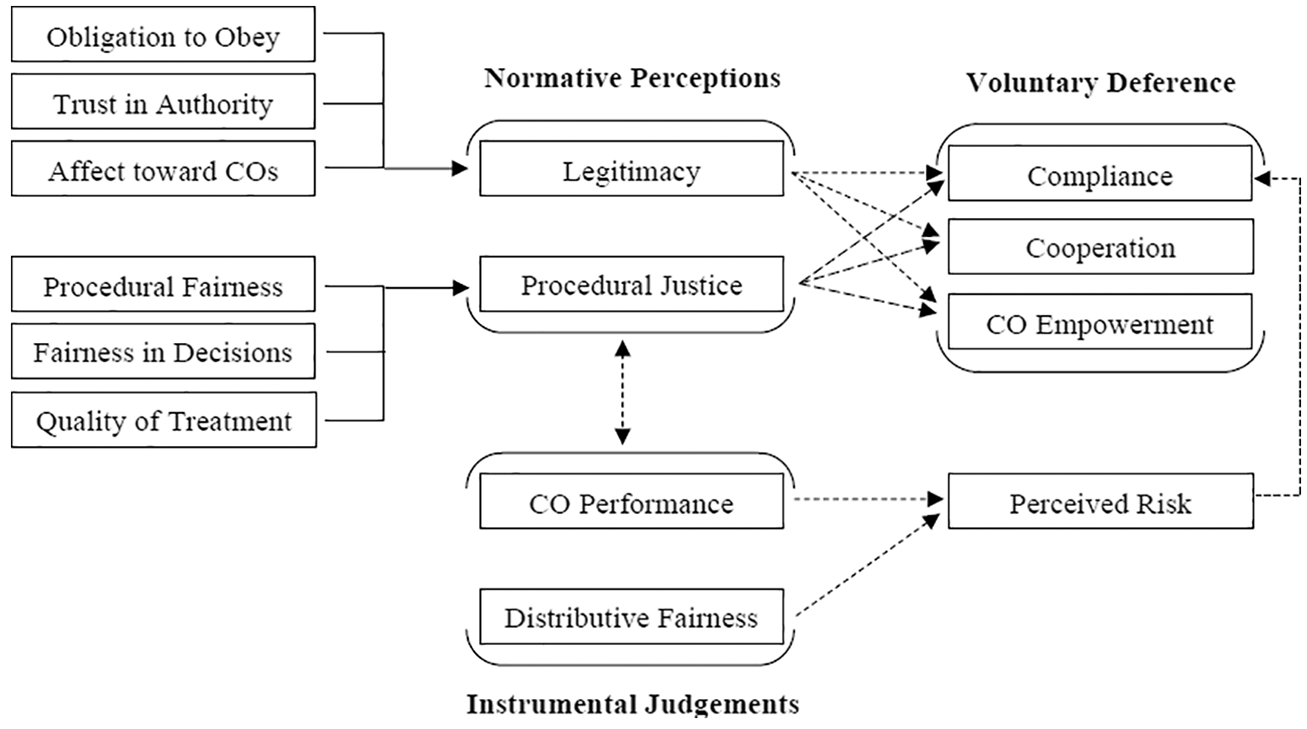
Hypothesized associations between normative perceptions, instrumental judgments, and voluntary deference
Participants
Table 1 provides an unweighted breakdown of the administrative data for the 144 survey participants. 2 To gauge how our sampled participants differed from those who refused or were not given the opportunity to take the survey, we compared the administrative information of survey participants with those of nonparticipants from our randomized list within each of the three strata. 3 These analyses revealed only one statistically significant difference (p ≤ .05) across the administrative measures. More specifically, there are fewer White survey respondents than nonrespondents within the no misconduct group (71% vs. 85%, respectively). In addition, respondents with three or more misconducts were significantly older and had a higher custody level than respondents with fewer rule violations. However, we expected this difference due to the number of violations in which the members of each group engaged.
Breakdown of Survey Participants by Strata

Note. No mis. = no misconduct group; 1–2 mis. = 1–2 misconduct group; 3+ mis. = 3+ misconduct group; GED = general equivalency diploma.
p ≤ .001.
To increase generalizability to the broader population from both facilities, we applied probability weights based on count reports of 2017 (the same year the data were collected) which is common practice in survey analysis (Little, 2008). Probability weights account for how the sample was drawn and how many potential participants there were based on the population from the sampling frame. Using an MDOC data report (Thornell, 2017), we constructed probability weights to account for any remaining proportional differences in the general population by strata within these two facilities. Response weights were also calculated to account for those who did not participate from within the stratified sample.
Procedure
With the help of agency officials, we created a stratified random list of 600 men from the Maine Correctional Center (MCC) and Maine State Prison (MSP). 4 We focused exclusively on these two facilities because these institutions are the most populated within the MDOC state prison system. 5 We based our stratification on the total number of guilty rule violations during the previous 2 years, which we grouped equally into three categories: low (i.e., no violations), moderate (i.e., 1–2 violations), and high (i.e., 3 or more violations) misconduct history. We opted to stratify the sample in these subgroups because this procedure allowed us to capture roughly equal proportions of those with such misconduct histories. As it is common in minimum security facilities to have many people who have no, or few infractions, stratification allowed us to oversample those with three or more, and minimize those with no or few infractions in the sample.
We administered the surveys in both facilities across two days in the summer of 2017. At both locations, the researchers had a non-uniformed staff member assigned to aid in the logistics of survey administration. Within each housing unit visited, we gave the CO in charge a copy of our randomized list, who then instructed those in their unit to report to our location in a nearby private room. People were not told the reason for our visit, only that “some university researchers want to talk with you.” We administered the paper-and-pencil surveys in a small group format, though the room size and occupants varied due to space availability. We often had only two or three people participating at once, but at other times, we had as many as 10. As people returned back to the unit, the next person on the list was sent to our location. We did not permit correctional staff to be present during the survey, nor did we provide the department with information about who participated in the study. We also did not allow participants to discuss or see each other’s surveys. As individuals arrived, the project’s description and consent language were read aloud. Respondents read and answered the survey questions independently, but researchers also walked the room answering any questions (e.g., question clarification), as well as read aloud and recorded the answers for a few respondents who had difficulty reading and writing.
Materials
This investigation combines survey and secondary data of people incarcerated in the Maine Department of Corrections (MDOC). Our survey instrument measures individual normative and instrumental perceptions. In addition, we examine a qualitative probe to capture thoughts beyond the responses of closed-ended questions. Our survey consisted of 100 questions adapted from Sunshine and Tyler (2003). 6 More specifically, we modified their questions regarding police and criminal acts to be about perceptions of COs and misconduct behavior in prison. All of our questions possessed a 6-point Likert-type scale with a varying response type. For instance, questions about perceptions of one’s obligation to obey directives include a range of responses from “strongly disagree” to “strongly agree,” while one’s perceptions about being caught for violating institutional rules range from “very unlikely” to “very likely.” The alpha reliabilities for our scales ranged from .75 to .95 (see Supplemental Appendix Table S4, available in the online version of this article), which is on par with those reported by Sunshine and Tyler (2003). We constructed each scale using a maximum likelihood exploratory factor analysis with oblique rotation and determined that these scales load effectively on the appropriate and expected factors with few exceptions, which we discuss below. All coefficients are in the expected direction (positive) and indicate there is enough difference to support the discriminant validity of the scales (see Supplemental Appendix Table S6, available in the online version of this article).
Normative Perceptions
We conceptualized normative perceptions of legitimacy within prison as the credence given to COs in accordance with the perception of their status and behaviors, insofar as such actions are proper or appropriate within the system’s expectations (i.e., norms, values, beliefs, and definitions, see Tyler, 2007). This suggests that one’s willingness to follow the rules relates to their normative perceptions of the COs and the correctional system. As a subordinate social member in prison, an incarcerated individual must define COs and the disciplinary process as fair and trustworthy in order for legitimacy to exist. We use three subscales to tap the construct of legitimacy: (a) feeling of obligation to obey directives of COs (12 items; e.g., there are times when it is ok to ignore what the COs tell you to do [reverse coded]), (b) trust in the prison system and COs (12 items; e.g., COs can be trusted to make decisions that are right for everyone), and (c) affective feelings toward COs (six items; e.g., overall, I respect the COs). Following Sunshine and Tyler (2003), we also combined all 30 of these items to create one overall Legitimacy scale, with higher scores indicating greater perceptions of legitimacy regarding the authority of COs and the prison system.
From a normative perspective, for one to view an institution and its agents as legitimate, their actions must be openly acceptable to the participating members of the establishment given their context (Tyler et al., 2007). In accordance with the procedural justice literature, we conceptualized the antecedents of legitimacy in prison to include three constructs: (a) procedural fairness (five items; e.g., fairness in handling problems between those incarcerated), (b) fairness in decision-making (nine items; e.g., unbiased decisions on whose cell should be searched), and (c) perceptions of the quality of treatment (nine items; e.g., being respectful toward incarcerated people). We also combined all 21 of these items to create one overall Procedural Justice scale, with higher scores indicating a greater belief that COs are procedurally just in their actions.
Instrumental Judgments
Instrumental perspectives tend to focus on perceptions of exogenous factors, or external controls, which shape behavior through “tangible, immediate incentives, and penalties” that correspond with rule-following or rule-breaking behavior (Tyler, 1990, p. 3). We conceptualized instrumental judgments through two constructs: (a) perceptions of CO effectiveness in controlling institutional misconduct (10 items; e.g., from gang violence to gambling) and (b) perceptions of distributive fairness or the extent to which incarcerated people believe COs administer punishments equally across all people and similar situations (two items; e.g., how often people get the outcome they deserve according to the rules).
Outcome Measures
Prior research identifies a link between normative perceptions and the likelihood of adhering to its rules and policies (Tyler, 2007). Tyler (2007) suggests normative perceptions appear to increase one’s self-monitoring, or voluntary deference, as one comes to view the authority as instrumentally and normatively acceptable. We conceptualized the consequences of normative perceptions into three constructs: (a) compliance with institutional rules (10 items; e.g., how often do you possess a weapon?), 7 (b) cooperation or willingness to work with COs to address concerns (six items; e.g., how likely are you to discuss problems in your pod with COs?), and (c) empowerment or openness to the idea of giving more rights and powers to the COs to search belongings, mediate problems, or provide protection, all in the name of prison order and safety for everyone (five items; e.g., if we give enough power to the COs, the prison will be a safer place). Finally, we include an instrumental outcome measure of one’s perceived risk of being caught for violating the prison rules (11 items; e.g., how likely is it that you would be caught if you possessed a weapon?).
Qualitative Context
In an attempt to capture some qualitative context of the respondent perceptions, as per the efforts of Hacin and Meško (2018), we included an open-ended question in our survey. More specifically, we asked if there was anything else about disciplinary write-ups, procedures, or punishments in general that respondents thought we should know. We coded these responses in accordance with the normative and instrumental perceptions, and then used this information to provide examples of how people explain their perceptions of COs and the procedural justice elements in the prison setting.
Administrative Data Measures
Administrative data include various demographic, criminal history, risk classification, and institutional infraction information. We drew upon a wide range of covariates of institutional misconduct that the MDOC collects for internal purposes. These variables included age at time of survey (measured in years), race (1 = White, 0 = other), education level (i.e., high school diploma/GED or higher, 1 = yes, 0 = no), and instant offense (i.e., separated into dichotomous subcategories for violent, sex, drug, and nonviolent crimes). It also contained risk assessment information, including the current MDOC classification rating (minimum [1], medium [2], and close custody [3]), and the Level of Service Inventory–Revised risk category (low risk [1], moderate risk [2], and high risk [3] for recidivism). In addition, we also included measures of the total prison sentence length and time spent in custody to date (both measured in months). 8 Finally, we have a record of the total number of guilty rule infractions during the previous 2 years.
Analytical Plan
To test our four hypotheses, we applied a series of robust regression analyses that are consistent with the scope of each hypothesis. For H1, we conducted an analysis of covariance (ANCOVA) to examine if differences in normative perception scores existed across the misconduct groupings. We chose to use ANCOVA because it is reasonable to expect that the perceptual scales may covary with one another. 9 Although ANCOVA can detect differences across the strata, it is not able to capture the variation within the high misconduct group. This is an important limitation because the number of rule violations for the respondents in the high misconduct group ranged from three to 47 incidents (M = 8.4, SD = 7.5). With this variation in mind, we expanded our examination of this hypothesis. Specifically, we used post-multiple imputation Poisson regression to test how strong the perceptual scales were associated with the number of rule violations, rather than just the trifurcated misconduct history groupings. For H2, H3, and H4, we investigated if normative and instrumental perceptions were associated with voluntary deference and perceived risk of being caught, after controlling for misconduct history. We used a Poisson regression to test the hypotheses as it relates to compliance, 10 and multiple linear regression to test the hypotheses as it relates to cooperation, empowerment, and perceived risk.
Missing Data
There were a range of missing values across measures in both the administrative data and the survey responses. 11 Considering the relatively small sample size in this investigation, the loss of observations due to missing data is not ideal and may increase the likelihood of a Type II error (i.e., failing to detect an effect that is present) in our analyses. As a result, we explored options to deal with the missing data and assessed the missingness for any patterns. According to Little’s (1988) test for missing data, the data elements in our study were missing completely at random (χ2 distance = 532.91, df = 489, p = .083). This suggests that multiple imputation is an appropriate method for dealing with our missing information. Multiple imputation uses iterative regression equations to estimate the missing values and produce a reliable estimate of the effects and standard errors in subsequent statistical tests (Rubin, 1996). Using chained equations, we imputed the missing values for normally distributed continuous measures with linear regression, for dichotomous or categorical measures with logistic regression, and for positively skewed measures (e.g., compliance) with Poisson regression. Due to the study’s sample size and various measures with missing data, we set the number of iterations to 100 (see Graham et al., 2007). We also included the sampling weights in our multiple imputation calculations.
Qualitative
Similar to Hacin and Meško (2018), we examined and tallied the responses to our open-ended question to connect with the scales described above. Among the 144 survey respondents, 53 left written feedback to this question. Our coding scheme allowed each response to contribute toward multiple constructs. For example, one respondent wrote, “Over punishment provokes a retaliatory mindset. Disciplinary actions should be more predictable.” We coded this response as including elements of both fairness in decision-making and distributive fairness. In addition, we also included a “no affiliation” option for statements unrelated to COs or the disciplinary process (e.g., “We NEED Fans!!”). Our coding procedure yielded 95 comments mentioning three of our primary scales: Legitimacy (34), Procedural Justice (44), and Instrumental Judgments (17). None of the responses mentioned voluntary deference or perceived risk.
Results
H1—Normative Procedural Justice Perceptions should not differ Across Misconduct History
Supplemental Appendix Table S7 (available in the online version of this article) provides a weighted breakdown of the ANCOVA marginal means and standard deviations for each group. Although this hypothesis focused on normative perceptions, we tested and present the findings for all of the scales in the same way to clarify the nature of the observed relationships. The scale in each row is the dependent variable for the ANCOVA model. Thus, the F and p values represent the difference between the three groups when accounting for covariance between the other scales and group membership for each row’s model. The combined scales yielded 119 total observations with no missing data. These analyses provide partial support for our first hypothesis. While Legitimacy differs significantly across the three misconduct groups in the anticipated direction (p = .002), we find no such evidence of a difference in Procedural Justice (p = .357). Despite reaching statistical significance, the practical difference between the group means for Legitimacy is relatively small (average difference between the means [Mdiff] = .2). Our analyses also detected statistically significant group differences across three additional scales (p ≤ .05) that are slightly larger in terms of magnitude: Performance (Mdiff = .3), cooperation (Mdiff = .5), and perceived risk (Mdiff = .5).
It is possible that our stratified sampling approach masked potential variation that exists within the perceptions of the three-or-more misconduct group. To test this possibility, we expanded our examination of this hypothesis using a Poisson regression to assess how strongly the perceptual scales are associated with the total number of misconduct incidents, rather than just the trifurcated group placement measure (not shown). The covariates in the Poisson model included age, race, education, risk level, normative perceptions (i.e., Legitimacy and Procedural Justice), and instrumental perceptions (i.e., Performance and Distributive Fairness). The offset measure in this analysis was the length of time spent in prison prior to survey administration. Although none of these measures reached the Neyman–Pearson threshold for statistical significance (p ≤ .05), the magnitude of the effect sizes for these scales are noteworthy. For instance, with every unit increase in Legitimacy, there was a 45% decrease in the probability of having a history of misconduct (incidence rate ratio [IRR] = 0.55, p = .44). Similarly, for every unit increase in Procedural Fairness, there was a 37% decrease in the chances of having a misconduct history (IRR = 0.63, p = .30). The instrumental perceptions findings, however, yielded the opposite effect. As perceptions of CO effectiveness in controlling misconduct increase, so too did the likelihood of having a misconduct history by 30% (IRR = 1.30, p = .33). Increases in Distributive Justice also corresponded to a 14% increase in the likelihood of having a misconduct history (IRR = 1.14, p = .70).
H2—Normative Perceptions should have a Positive Association with Voluntary Deference
In testing H2, we conducted three multiple regression models on the imputed dataset (see Table 2). 12 In this model, Legitimacy yielded the largest effect size (IRR = 0.79). As one increased their perceptions of legitimacy toward COs, the likelihood of their compliance with the institutional rules also increased by 21%. In contrast, increases in Procedural Justice appear to decrease one’s likelihood of following institutional rules by 20%. However, these two measures did not reach our threshold for statistical significance (p ≤ .05), and their strength weakens as we introduced age and other risk measures into the model. In addition, when holding all else constant in the Poisson regression compliance model, one’s history of misconduct did not produce a statistically significant influence on their engagement in self-report rule violations. Regardless of the manner in which we specified misconduct history, prior rule violations appear to be a weak predictor of self-report compliance at best.
Regressions Predicting Outcomes While Accounting for Administrative Measures
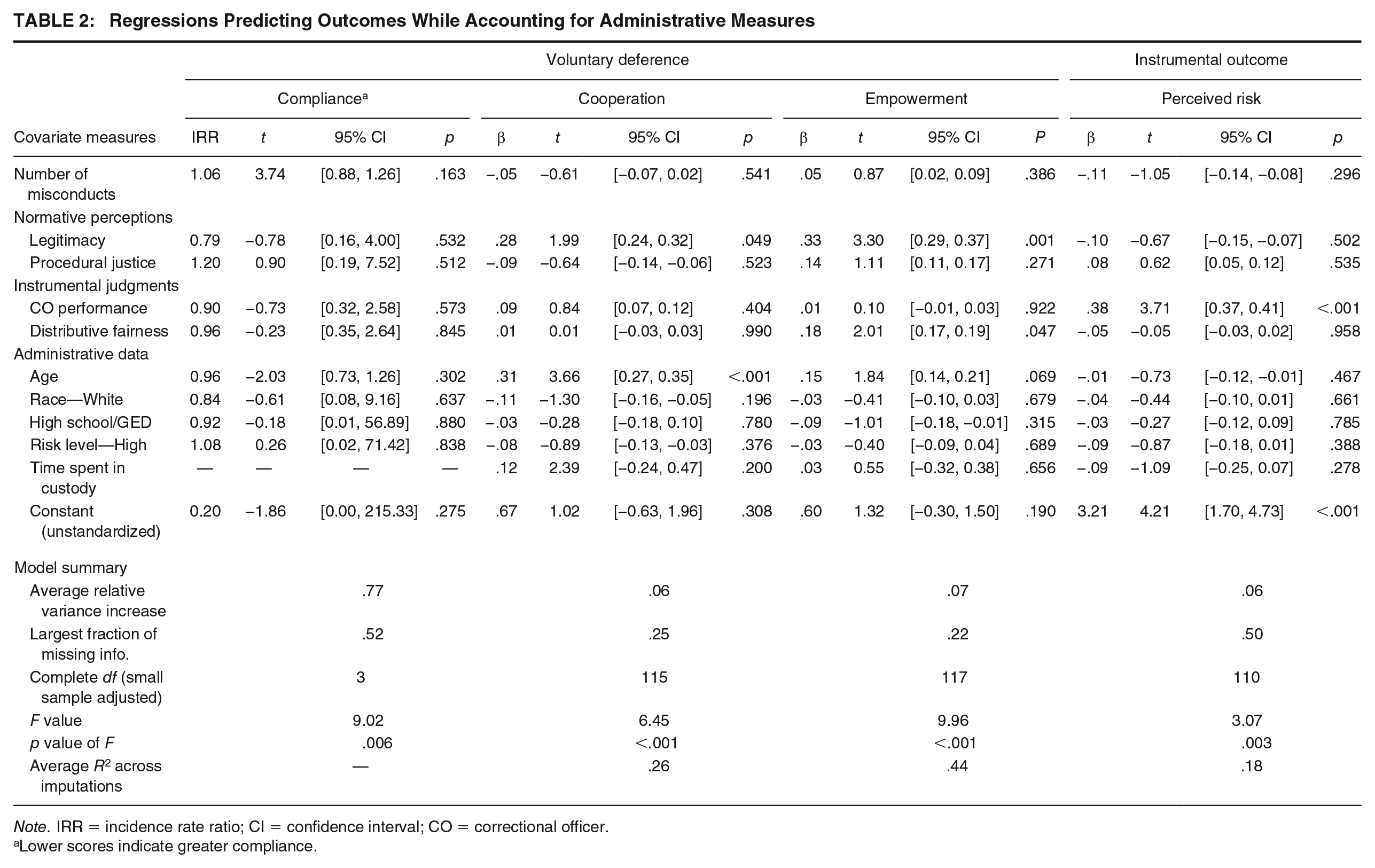
Note. IRR = incidence rate ratio; CI = confidence interval; CO = correctional officer.
Lower scores indicate greater compliance.
Similarly, Legitimacy was a strong predictor in the Cooperation model (β = .28). This suggests that for every standard deviation increase in one’s perceptions of legitimacy among COs, there was a corresponding one-third standard deviation increase in their willingness to cooperate with prison authorities (p = .049). In addition, age was also a strong predictor of cooperation, with older people being significantly more willing to cooperate than were younger people (β = .31, p < .001). In contrast, Procedural Justice (β = −.09) and both instrumental judgment scales (i.e., CO Performance, β = .09, and Distributive Fairness, β = .01) produced a trivial and nonsignificant relationship with Cooperation willingness. The final model explains an average of 26% of the variance across the imputations.
In the next model, we again find that Legitimacy is the best predictor of empowerment (β = .33, p < .001). More specifically, as one’s perception of legitimacy increases by one standard deviation on a 6-point scale, their willingness to support the empowerment of COs also increases by nearly a third on a similar scale. Distributive Fairness (β = .18) and Procedural Justice (β = .14) also share a moderate and positive relationship with empowerment, although the latter scale did not achieve statistical significance (p = .271). The other instrumental judgment scale regarding CO Performance possesses no substantively meaningful relationship with empowerment (β = .01, p = .922). The final model explains an average of 44% of the variance across the imputations.
Taking these three voluntary deference models in totality, we find partial support for H2. Our analyses reveal that Legitimacy possesses a meaningful relationship with Compliance, Cooperation, and COs Empowerment to provide institutional safety and security. These analyses also suggest, however, that Procedural Justice has only a marginal (nonstatistically significant) association with one measure of deference, CO Empowerment. Our three models also indicated that instrumental judgments have very little association with the voluntary deference measures, with the exception of the relationship between Distributive Justice and CO Empowerment.
Qualitative statements related to normative perceptions captured both legitimacy (34 comments) and procedural justice (44). Regarding legitimacy, some comments provided insight into what incarcerated people might view as examples of delegitimizing events, and often contained references to trust. For example, one respondent reported, I did something wrong that was very small, giving a pair of boots away, and I was honest with a guard and he is still giving a write up. If being honest is no different than lying to them, then what is the point. (Respondent legitimacy score: 2.14)
Another respondent expressed a similar frustration: “It seems as though the COs, even though they will follow the rules, will get any information from someone instead of helping a person, will use it against them” (Respondent legitimacy score: 3.38). These responses suggest that willingness to be honest and trust COs in disclosing information may be lost after receiving a write up in a situation where he does not understand its purpose. Such experiences may weigh heavily for distrust in the institution and its agents. Yet another individual described a situation where he felt degraded during a search of his pod: During the last facility wide shake down, strip searches were conducted in full view of the entire Pod and also female DOC staff. Answers these questions numerically is difficult because of the COs who power trip over the most miniscule things rather than allow people the semblance of choice. Those outliers (COs) are also countered by COs that instead of power tripping instead ask for inmates to respect them and in turn respect the inmates. (Respondent legitimacy score: 1.97)
In this instance, the respondent seems to view the manner in which COs conduct strip searches to be particularly impactful. As a result, this appears to delegitimize his perceptions of the COs and the institution. This is an important consideration because, as we demonstrated in our quantitative analysis, such delegitimization holds the potential to breakdown one’s willingness to comply with institutional orders and rules. Related to procedural justice, comments embodied issues regarding the fairness of COs’ decisions and how COs treat incarcerated people, although respondents did not appear to view all COs similarly on these constructs: Not all of the COs are bad. But 90 percent of them treat us like animals. Show us no respect. And are very corrupted and corrupt. Medical and the higher ups are not doing their jobs. I speak on all inmates. (Respondent procedural justice score: 2.05)
Many of these comments also reference a lack of CO professionalism: In general, write-up procedures and punishments are very unprofessionally dealt with. Write-ups and punishment for minor violations are routinely more severe than more severe one’s committed by the majority of COs entitled inmates’ some people get away with everything and others have to do almost nothing to get severe punishments. I am older and most COs 80–85% of them are truly unprofessional. I have lived mostly out of prison in my life and worked at some good places. I realize this is a prison, but the unprofessionalism is overwhelming. It would be way more productive and efficient here with COs trained to deal with human beings. Overall, it is totally disrespectful, unproductive, and wasteful time here. It’s no wonder recidivism is [high] here. It is very easy to see why. You only need to experience it here for a short time. (Respondent procedural justice score: 2.24)
Examples like this provide context to how those incarcerated may view COs as treating them with little respect. The low mean score among respondents regarding the quality of treatment by COs indicates that participants believe this is an important issue (see Supplemental Appendix Table S4).
H3—Instrumental Judgments should have a Positive Association with Perceived Risk
We used an ordinary least squares (OLS) regression model to test H3, also shown in Table 2. When holding all else constant, one’s beliefs about how effective COs are in controlling misconduct possesses the strongest association with an anticipated risk of being caught if they were to violate the institutional rules (β = .38, p < .001). Specifically, as one’s perceptions of CO effectiveness increases by one standard deviation on a 6-point scale, their perceived risk of being caught increases by more than a third on a similar scale. In contrast, both normative perceptions (i.e., legitimacy, β = −.10, and procedural justice, β = .08) and distributive fairness (β = −.05) possessed only small and nonsignificant relationships with perceived risk. The final model explains an average of 18% of the variance across the imputations. This model suggests that, similar to H2, there is only partial support for H3, because only one of the instrumental judgments was predictive of perceived risk.
Among the 53 respondents who left us written feedback, there were 17 comments regarding instrumental judgments. None of the responses mentioned voluntary deference or perceived risk. While the overwhelming majority of the comments in this category about job performance and distributive fairness were negative in nature, one in particular highlights the view that COs are getting more effective in their jobs: “This [higher security] prison has evolved from a violent prison to a laid back more efficient prison in the [10+] years I’ve been in. There is much more respect in general here” (Respondent CO effectiveness score: 4.33). This statement provides some context to the quantitative findings indicating that participant perceptions of COs ability to combat misconduct is quite positive (see Supplemental Appendix Table S4). This observation, however, pales in comparison to those about fairness. In particular, respondents stressed the importance of distributive fairness and consistency, especially with respect to how COs apply punishment. Examples included comments such as the following: “Over punishment provokes a retaliatory mindset. Disciplinary actions should be more predictable” (Respondent distributive fairness score: 3.00); “Staff and admin are very inconsistent in all areas. They generally are more punitive than helpful or corrective” (Respondent distributive fairness score: 3.00); and Some COs use their power to control their reasoning for their actions and don’t care for your explanation. It doesn’t help when the facility has rules they have put in place and then they contradict themselves and say its CO’s discretion. It allows the COs to have full say and control over the rules put in place, so why have any. No matter what you still loose [sic] good time if you win or lose your case so what good does it do to fight for your rights if you have none. There are other things I can say but don’t have enough paper or time to do it other than the staff here can be very unfair at times. (Respondent distributive fairness score: 3.00)
These examples provide insight into ways that perceptions of distributive fairness may influence other aspects related to animosity and hostility toward COs and the institution.
H4—Perceived Risk should be Positively Associated with Greater Compliance
The final hypothesis was tested by including perceived risk as an independent variable in additional regression models (see Supplemental Appendix Table S8, available in the online version of this article), similar to those reported for H2 and H3. None of the models examined yielded a significant point estimate that suggested perceived risk is associated with reported compliance. Subsequently, there was no support found for H4.
Discussion
There is much to be gained from this work involving both theoretical and policy implications. Apart from including measures of both normative and instrumental perceptions as prescribed by prior research (e.g., Sunshine & Tyler, 2003), our findings supply needed insight into how these concepts might manifest in prison. This study provides some support for aspects of procedural justice theory and prior literature but runs counter to other aspects.
Theory
While perceptions of legitimacy and some instrumental judgments were weak, though significantly related to one’s misconduct history, procedural justice perceptions were not. While this is somewhat in contrast to some prior research (e.g., Beijersbergen et al., 2015), discrepancies may be due to perceptions being measured differently, and our Maine sample (e.g., oversampled high-misconduct populations). Beyond this, our analyses demonstrate that while normative and instrumental relationships exist in this prison setting (see Supplemental Appendix Table S6), none of the relationships with compliance were found to be statistically significant after controlling for additional factors. Although some associations were in the theorized direction (e.g., greater legitimacy was related to increased compliance), others ran contrary (e.g., procedural justice possessed a nonsignificant, negative association with cooperation). Consistent with procedural justice theory posited by Tyler and his colleagues (e.g., Lind & Tyler, 1988), we found that elevated perceptions of legitimacy was the strongest predictor of increased willingness to cooperate and empower COs. In addition, instrumental judgments of CO effectiveness were the only predictors of perceived risk. These results add to the somewhat mixed findings of previous studies of similar constructs (e.g., Reisig & Meško, 2009; Steiner & Wooldredge, 2018). Some prior research has demonstrated instrumental judgments are inversely related to various misconduct outcomes (e.g., Beijersbergen et al., 2015), which is consistent with research in policing and courts. Other studies have noted important caveats or incongruence among key theoretical relationships of procedural justice (e.g., Steiner & Wooldredge, 2018).
We also demonstrate that while normative perceptions are meaningful for some forms of voluntary deference, this is not the case for others. It is possible our findings speak specifically to the prison experience in Maine, particularly of the high-misconduct group. Experiences of this group may foster a delegitimizing effect and subsequently influence willingness to cooperate, but may mean less when it comes to compliance driven by something not studied here (e.g., situational opportunity). Weak statistical significance observed here may be due to sample size 13 or because we oversampled a commonly overlooked population in prison-based surveys—closed custody.
Overall, our study suggests there may be a meaningful relationship between how incarcerated people perceive disciplinary processes and measures that could influence institutional order—willingness to comply, cooperate, empower authorities, and perceived risk. However, we also demonstrate that normative effects found in the community (e.g., Sunshine & Tyler, 2003) may not directly apply to Maine prison settings. Areas where our groups did not differ (e.g., viewing the process as procedurally just) suggest the processes in Maine may be viewed as fair overall. Instead of normative effects, it appears instrumental judgments mean more in explaining the perceived risk of being caught for prison misconduct. Unpacking this is an area for future research.
In spite of revealing a complicated relationship between perceptions and behavior in prison settings, the qualitative supplement provides an opportunity to broaden the theoretical scope of procedural justice, legitimacy, and instrumental judgments. Although the qualitative examples must be kept in context of potential selection bias, they reflect similarities to the findings by Hacin and Meško (2018). Participant perceptions of a just or fair process appear to be as much about experiences within a process as they are about understanding the entire process. Moreover, these narratives allow us to consider procedural justice constructs from an experiential or humanistic perspective by emphasizing trust development as a foundation of changing behavior through intervention (Polizzi, 2014). Failing to develop trust in some capacity may serve to perpetuate the adversarial nature of staff–resident relations. At a minimum, more emphasis on professionalism highlights the humanity of people incarcerated and may help with promoting more trust. The supplemental statements suggest participants experienced both the coercive and adversarial aspects of incarceration at the expense of important therapeutic relationships and trust development. Considering trust continues to be demonstrated as being key to legitimacy, it stands to reason that perceptions of any process will impact a person’s ability to trust authorities and the institution employing that process. This is particularly consequential for our participants who lack trust in a process that, in their words, dehumanizes them. Theoretical lessons learned from the qualitative supplements highlight the possibility that procedural justice fails to account for the nuanced reality of individuals. Viewing the narratives from a humanistic perspective emphasizes how understanding empathic engagement oriented toward trust can foster behavioral change and compliance (Polizzi, 2014). By placing trust at the center of correctional discourse, we empower both practitioners and incarcerated individuals to reexamine their perceptions of the institution as whole, which can transform perceptions of sanctions as well as rewards.
Institutional Utility
With regard to professionalism and humanistic measures, our findings can inform which relationships between COs and people in custody hold the most potential to promote compliance (Polizzi, 2014). Our findings echo those of Steiner and Wooldredge (2018) who found perceptions of legitimacy toward COs relate to certain rule infractions for some, but not all. Other research also suggests that legitimacy can increase via the use of fair procedures, regardless whether the outcome is positive or negative (Tyler & Fagan, 2008). Consequently, our findings suggest there may be something to be gained from stressing normative antecedents in institutional protocols. For example, CO training can incorporate elements of procedural justice, professionalism, and developing a humanistic culture to promote fairness and legitimacy perceptions in prison. This is similar to many police officer trainings that share the same goal.
Missing from prior literature related to procedural justice concepts (particularly in prison settings) is the importance of instrumental judgments. Relationships examined in this study highlight a balance between legitimacy and perceptions of how effective COs are at controlling behavior. This balance may yield direct connections to management in maintaining a facility that upholds humanistic qualities (e.g., treating people with fairness and respect), while also promoting more transmission of staff successes in controlling behaviors. For instance, if rates of violence are decreasing, the statistics could be posted for residents to see (e.g., infographics). Such broadcasts can contextualize reports on facility safety for residents and staff. Another example that holds the potential to implement findings related to both normative and instrumental perceptions could involve an incarcerated council of sorts that actively participates with staff and management (Brosens, 2019). Such models have been fruitful in European countries, where councils foster a voice for those in custody (Inderbitzin et al., 2016), improved resident–staff relations (Bishop, 2006), and improve working conditions for staff (Edgar et al., 2011).
While our results promote creating supplemental material or guidelines for continued training among COs and management, it is still unknown what specific policy changes would be most effective. That said, recommendations might include initiatives that provide more oversight to the disciplinary process, transparency in write-up decisions, use of rehabilitation programs (Randol & Campbell, 2017), improve therapeutic relationship efforts (Polizzi, 2014), and incentive–sanction contingencies to promote positive behavior (Gendreau et al., 2014). Finally, considering this study focused only on two male prisons in the United States, further tests are needed in other correctional systems, populations (women and juvenile), and countries.
Limitations
It is important to interpret the findings of research within the context of the study’s limitations. This study involved a cross-sectional examination, and subsequently, the relationships we identify are correlational, not necessarily causal. In addition, our design emphasizes self-report information, particularly on sensitive issues such as deviance in prison. Although the potential for untruthful responses always exists in survey research, there is simply no other way to gauge perceptions or attitudes of those in custody without relying on self-report information. Finally, the possibility of selection bias also exists in our research design. In addition to the handful of those opting not to participate in the survey room, an unknown number of refusers or those not in the living unit during our rounds also did not complete the survey. It is therefore possible that our sample of respondents may comprise of people who are more willing to divulge personal information, which may make them qualitatively different from the nonparticipants on our randomized list. Although we did not capture the reason for refusal, our examination of the administrative data between respondents and nonrespondents suggests they were highly comparable. We argue, therefore, that selection bias was not a major concern or threat our findings.
In addition, along with limitations associated with administrative data (e.g., uncaught “zero-misconduct” respondent, see Supplemental Appendix Table S7), there is a possible stigma surrounding cooperation. Some measures regarding cooperation could be interpreted as “snitching,” whereby someone reports misconduct activity of a fellow incarcerated person to authorities. Snitching has long been a condemned behavior in prison culture, often expected to either increase chances of physical harm for the snitch while also possible preferential treatment in lenient sanctions. This was highlighted by a few open-ended responses (e.g., “If your [sic] not a snitch your punished more than the snitches”). Subsequently, it is possible the Cooperation scale is not an accurate measure of willingness to cooperate. However, such questions only make up a few points of the six-item scale, which was averaged. Given our response options, we argue this scale is a valid measure of cooperation.
Finally, a couple unexpected issues were highlighted in open-ended responses. For instance, two respondents noted that perceptions of legitimacy and fairness could be improved by addressing unfair practices related to fines and loss of good time credit as punishments for misconduct: Fines of up to $100 are imposed on prisoners who violate the rules, yet only about 30% of the population receive any type of [money] for work. Family–friends & loved ones’ end up paying the fine. There are at least 4 good time laws. It takes some prisoners three times as long to earn good time deductions as those sentenced in the 80s–90s. This is seen as unfair and creates tension and unrest. Work is denied to those who are fined—sometimes for a year or more. This CAUSES theft and violence. (Original emphasis; respondent legitimacy score: 3.57) Fines and monetary sanction are hurting only our friends and family. Also the percentage that is taken to pay these is greater than it should 50% for me and up to 100% for others. Also there is almost no fair reasoning when given write ups. You can get one for almost anything and for no reason. (Respondent legitimacy score: 1.83)
Each of these hold the potential to influence voluntary deference, and as a result should be the focus of future research. Unfortunately, there is no way of telling the magnitude of such potential influence. We err on the side of extant research, in that the measures we collected were appropriate.
Conclusion
This study demonstrates how perceptions of incarcerated people might be used to help inform practice to improve prison order. Continued research in the area of prison order and its intersection with procedural justice are important and may help advance contextual understandings of related constructs. The manner in which experiences and perceptions can impact the effectiveness of prison policies and management can help show how best to gauge and address prison climate. In dealing with overcrowding and mass incarceration, accumulated empirical evidence on voluntary deference will add to what is known about improving prison safety. Moreover, if shown to have a link to the reoffending behavior of offenders upon release, then the experiences highlighted here, being potentially avoidable and remedied, are ones that should be the subject of potential DOC policy reform.
Supplemental Material
CJB-19-0215.R4_Online_Appendix_for_Publication – Supplemental material for Do Perceptions of Legitimacy and Fairness Matter in Prison? Examining How Procedural and Distributive Justice Relate to Misconduct
Supplemental material, CJB-19-0215.R4_Online_Appendix_for_Publication for Do Perceptions of Legitimacy and Fairness Matter in Prison? Examining How Procedural and Distributive Justice Relate to Misconduct by Christopher M. Campbell, Ryan M. Labrecque, Roger L. Schaefer, Molly Harvis, Karma Rose Zavita, Leah Reddy and Kayla Labranche in Criminal Justice and Behavior
Footnotes
Authors’ Note:
This project is the product of the efforts and collaboration of many individuals. The authors would like to thank everyone involved in the project for their time and cooperation. Specifically, we would like to express our sincere gratitude to the following individuals from the Maine Department of Corrections: Ryan Thornell, Gary LaPlante, Ryan Andersen, Joel Gilbert, Scott Landry, Randall Liberty, Norene Hopkins, Michael Tausek, and the correctional officers, support staff, and respondents from the Maine Correctional Center and Maine State Prison for their assistance in making this project possible. This project was supported by a 2016 Public Service Grant from the Portland State University, College of Urban and Public Affairs, Mark O. Hatfield School of Government. The opinions, findings, conclusions, and recommendations expressed in this report are those of the authors and do not necessarily reflect the views of the Hatfield School of Government or the Maine Department of Corrections.

Supplemental Material
Notes
References
Supplementary Material
Please find the following supplemental material available below.
For Open Access articles published under a Creative Commons License, all supplemental material carries the same license as the article it is associated with.
For non-Open Access articles published, all supplemental material carries a non-exclusive license, and permission requests for re-use of supplemental material or any part of supplemental material shall be sent directly to the copyright owner as specified in the copyright notice associated with the article.
