



Abstract
Whereas research has shown improvements in decision-making shortly after the introduction of risk/need assessment (RNA) tools, studies of routine practice nonetheless show shortcomings in RNA utilization. The current study uses an experimental survey-based vignette method to assess juvenile probation officer decision-making several years into a sustained evidence-based effort to implement an RNA in Pennsylvania. Consistent with the risk-need-responsivity (RNR) model, results show officer decisions correspond with clients’ risk and need. Moreover, adherence to the RNR model was found for clients across risk levels and offense categories. However, officers often relied on services for low-risk clients, and made decisions about interventions based on offense characteristics. Results suggest a discretionary form of decision-making, taking cues from within and beyond the RNR model, including from punitive and traditional welfare-oriented approaches. Findings highlight the challenges of producing RNR-consistent decision-making, even when using a sustained scientific RNA implementation strategy.
In recent decades, evidence-based principles have become a key reference point for criminal and juvenile justice policy. Holding the promise of effective rehabilitation, they have formed the foundation of a wave of reform efforts (Greenwood & Welsh, 2012; Pew Charitable Trusts, 2019). Central to this movement is the risk-need-responsivity (RNR) model that directs decision-making based on clients’ actuarial risk, criminogenic needs, and styles of learning, and is underpinned by contemporary risk/need assessment (RNA) tools (Bonta & Andrews, 2017). Even with the best intentions, however, agency leaders often struggle to reshape organizations according to evidence-based ideals. Frontline practitioners are often resistant to new policy mandates, continuing to exercise discretion that is shaped by the rigors of frontline practice and their broader professional orientations (Haynes & Licata, 1995; Kelly, 1994; Lipsky, 1980). Studies focused on community corrections echo these findings (Lynch, 1998; Viglione, 2017), including those that focus on the use of RNAs (Haas & DeTardo-Bora, 2009; Hannah-Moffat et al., 2009; Miller & Maloney, 2013; Viglione et al., 2015).
Notwithstanding, the science of policy implementation offers hopes of improving workers’ adherence to new organizational strategies (Bertram et al., 2015; Damschroder et al., 2009), including in community corrections settings (Taxman & Belenko, 2011). This literature emphasizes leadership, staff engagement, training, data systems, and relationships with internal and external stakeholders. Literature focusing on RNA implementation echoes these insights (Vincent et al., 2012).
However, whereas quantitative studies have found improvements in decision-making shortly after pilot RNA efforts (Vincent et al., 2016; Young et al., 2006), studies of routine practice have consistently identified shortcomings in adherence to RNAs (Miller & Maloney, 2013; Viglione et al., 2015). The current article fills a gap in the literature. It does so by testing the proposition that a sustained effort to implement an RNA, which has paid attention to implementation science principles, has resulted in juvenile probation officers making decisions that are consistent with the RNR model several years later.
Literature Review
The RNR Model and RNAs
The RNR model is central to decision-making in evidence-based correctional practice (Andrews et al., 1990; Bonta & Andrews, 2017). Key features of the model include (a) the risk principle, which demands that the intensity of services (including correctional supervision) be matched to a person’s level of risk; (b) the need principle, which indicates interventions should target the specific needs of the person that lead to criminal behavior; and (c) the responsivity principle, which affirms the superiority of cognitive and social learning interventions (“general responsivity”) and requires interventions to be tailored to relevant characteristics of the person (“specific responsivity”), such as strengths, motivation, or learning ability (Bonta & Andrews, 2017). While the model allows for occasional deviations from these core principles, these should be exceptional and happen only for clearly specified reasons (Bonta & Andrews, 2017). These principles are underpinned, in practice, by RNA tools. Based on a range of tool items, these tools classify system clients into recidivism risk categories, indicate criminogenic needs that might be changed through intervention, and may highlight responsivity factors to be taken into account in case management (Bonta & Andrews, 2017).
Understanding Probation Officer Decision-Making
Empirical Studies of Probation Officer Decisions
The use of the RNR model to organize decision-making must confront a broader set of dynamics that may also shape practitioner decision-making. Studies of enforcement-oriented decisions by juvenile and adult officers, such as diversion, supervision, or incarceration, show they are predicted by offense characteristics, prior offending, and personal and demographic characteristics. Moreover, the latter is sometimes suggestive of bias (Bridges & Steen, 1998; Drass & Spencer, 1987; Leiber et al., 2018; Lin et al., 2008).
Studies of welfare-oriented decisions, such as service decisions or treatment goals, show that officers use discretionary professional judgments, alongside objective criteria, in evaluating clients. Examining adult officers’ assessments of rehabilitative needs in decision-making, Erez (1989) found judgments were based on factors that included financial management, substance use, peer associations, employment, and domestic relations, with their influence varying according to gender stereotypes. In a vignette-based experiment (Eno Louden, & Skeem, 2013), adult probation officers saw mental health issues as a greater risk than substance use issues in their decisions, contrary to empirical evidence. Haqanee et al. (2015) noted a preference among juvenile probation officers, working with RNAs, to address needs that they viewed as more “concrete,” such as education and employment.
Theorizing Decision-Making
Decision-making theory further helps us understand how officers make decisions. Contemporary theories across disciplines tend to acknowledge the role that intuitions and practical experiences play in decision-making, over and above formal rational deliberation (Klein, 2008; Schwalbe, 2004; Thompson, 1999; Van de Luitgaarden, 2007). Thus, Simon (1957) has argued that actors often make decisions using “bounded rationality” because they work with incomplete information and have a limited ability to cognitively process relevant information. Albonetti (1991) suggests that judges use stereotypes (notably about race) to link readily observable social characteristics of people being sentenced with expectations about future criminality. Outside of the criminal justice field, “recognition primed decision-making” theory suggests decision-making in dynamic and pressured environments utilizes generic responses to familiar situational patterns, often with minimal deliberation (Klein, 2008; Schwalbe, 2004).
Theory, including that focused on probation officers, also highlights the influence of professional norms and organizational contexts on decisions. Drass and Spencer (1987) provide evidence that, in classifying and responding to clients, probation officers apply a generic working client typology, anchored in their organizational and peer group setting. In a similar fashion, scholars have concluded that enforcement decisions among community corrections officers are made with reference to “focal concerns” (Freiburger & Hilinski, 2011; Harris, 2009; Kras et al., 2019; Leiber et al., 2018; Steffensmeier & Demuth, 2000; Steiner et al., 2011). The perspective sees decisions as expediently based on attributions concerned with a client’s: “blameworthiness” interpreted from their offense characteristics, “dangerousness” interpreted from their use of violence, criminal history and demographics, and “practical constraints,” anchored in relationships with other court actors (Richardson, 2015; Steffensmeier & Demuth, 2000). Another view is provided by Viglione and colleagues (2015) based on an ethnographic study of an adult probation office. They suggest that a pervasive organizational concern with risk management tended to undermine decision-making based on RNR assessments, particularly with seemingly higher risk clients.
Other theory highlights the influence on decision-making of other key actors (such as judges, prosecutors, and defense attorneys) in the court community. These work to ensure that case processing is safe, efficient, and avoids uncertainty (Eisenstein & Jacob, 1991; Ulmer, 1997), and may involve the use of agreed “going rates” that establish accepted responses according to clients’ offenses and characteristics. Miller and Trocchio (2016) suggest that RNA-using practitioners sometimes adjust scoring or decisions according to the expectations of other court actors.
Changing Correctional Environments
The professional and organizational contexts that influence officer decision-making are likely shaped, in turn, by the legacy of recent correctional traditions. Whereas prior to the 1970s, probation systems had strong welfare orientations (Miller, 2015; Taxman, 2008), community correctional systems became increasingly focused on monitoring and enforcement activities following a punitive shift beginning in that decade (Butts & Mears, 2001; Garland, 2001; Miller, 2015; Taxman, 2008). This period also saw an increasing focus on the use of actuarial strategies which focused attention on higher risk clients (Cochran et al., 1986; Feeley & Simon, 1994; Lynch, 1998).
The popularization of evidence-based policies (e.g., Sherman et al., 1998), beginning around the 1990s, saw a new emphasis on rehabilitative ideals that challenge punitive or control-based approaches (Lipsey, 2009; Lipsey & Cullen, 2007), albeit one that is far more prescriptive than traditional rehabilitative approaches (the RNR model of decision-making forms a key example). This shift provides the basis for a new kind of supervision practice. However, a continued focus on monitoring and control in the present era also suggests that older influences may continue to shape decision-making (Taxman, 2008).
RNA Implementation and the Challenges of Reform
Given the discretionary nature of probation officer decision-making, and the normative and organizational influences that bear on it, it is perhaps not surprising that RNA implementation often fails to produce decision-making that aligns with RNR principles. Indeed, research on RNA use is consistent with a broader body of research showing that frontline practitioners tend to resist and reformulate policy mandates (Haynes & Licata, 1995; Kelly, 1994; Lipsky, 1980; Miller & Trocchio, 2016). This includes a national survey of community corrections practitioners, which showed that they tended to fill out RNAs when required, but often made decisions that did not correspond with results—a pattern shaped by personal and organizational characteristics (Miller & Maloney, 2013). Other studies further highlight the underutilization or subversion of RNAs, given behaviors that are shaped by organizational and professional norms (Haas & DeTardo-Bora, 2009; Hannah-Moffat et al., 2009; Viglione et al., 2015).
Research further suggests that officers, even when utilizing evidence-based decision-making principles, may be selective about the clients to whom they apply them. Thus, Hannah-Moffat and colleagues (2009) found that practitioners routinely adjusted RNA scores to downgrade risks for members of socially marginalized racial groups or women who had committed minor offenses, while upgrading them for people committing sexual or violent offenses. Similarly, in examining the implementation of evidence-based practices in probation, Viglione (2017) suggests that probation officers tend not to apply these strategies with higher risk clients because they are seen as less amenable to intervention.
Notwithstanding, recent years have seen a body of “implementation science” emerge that challenges the disconnect between policy mandates and frontline practice, and offers some guidance for overcoming implementation challenges. For example, the National Imple-mentation Research Network’s (NIRN) “implementation frameworks” (Bertram et al., 2015; Fixsen et al., 2005) highlight key “drivers” that help advance implementation, including “competency drivers” that develop skills and confidence among practitioners; “organization drivers” that include performance tracking, problem-solving, efforts to maintain funding and political support for reforms, and data systems to support decision-making; and “leadership drivers” focused on the quality of management both in moments of stability and uncertainty. Moreover, a number of case studies on RNA implementation are consistent with these insights. These highlight the importance of leadership, training, data and monitoring, policy development, piloting, staff buy-in, and broader stakeholder relationships (Ferguson, 2002; Vincent et al., 2012; Young et al., 2006). These are the same kinds of dynamics that leaders in Pennsylvania attended to in their implementation of the Youth Level of Service/Case Management Inventory (YLS/CMI), which form the focus of this article.
The Current Study
This study addresses two questions about Pennsylvania’s juvenile probation officers, several years into a sustained juvenile justice reform effort including implementation of the YLS/CMI RNA. First, is probation officer decision-making consistent with the RNR model, as we would expect if implementation has been successful? Second, given research suggesting community corrections officers are more resistant to evidence-based decisions for clients with higher risks or more serious offenses (Hannah-Moffat et al., 2009; Lynch, 1998; Viglione, 2017), is adherence to risk and need principles less for these kinds of clients? To assess these questions, we test a series of hypotheses.
Hypotheses
Testing RNR Principles
Under the RNR model, decision-making about the intensity of interventions is tied to actuarial risk, with lower risk cases expected to receive minimal services, and higher risk cases expected to receive more intensive services (the risk principle). Service provision is tailored to the specific criminogenic needs highlighted by an RNA, with services used primarily for those experiencing higher scores on a criminogenic domain (the need principle; Bonta & Andrews, 2017). Current offense characteristics, however, should not affect these decisions because they do not feature among the central risk factors for recidivism (Bonta & Andrews, 2017) and appear only inconsistently (and often in counterintuitive ways) in empirically based juvenile RNAs (Office of Juvenile Justice Delinquency Planning, 1995); they are also entirely absent from the YLS/CMI used in Pennsylvania. Moreover, their application may lead to higher levels of intervention for low-risk clients (or the reverse), which cut across the RNR model and likely produce counterproductive outcomes (Lowenkamp et al., 2006). The following hypotheses are therefore used to test the application of the RNR model:
Testing Interactions With Risk and Offense
Our second key question asks whether higher risk or serious/violent instant offenses cause officers to reduce their reliance on RNR-based decision-making. In particular, we speculate that the need principle may be applied less to higher risk cases or cases with serious/violent offenses. In addition, we suspect that officers may adhere less to the risk principle with serious/violent offenses. We test these ideas with the following hypotheses:
Context
The research takes place in Pennsylvania, a state of 12.8 million people. Here, juvenile probation is a patchwork of county-based agencies, with strong policy coordination through state-level organizations. In the late 2000s, state leaders chose to implement the YLS/CMI to support the RNR model in the state’s juvenile probation offices. This tool measures eight criminogenic domains and provides an overall risk categorization, as well as identifying strengths and responsivity factors. Research testifies to its predictive validity (e.g., Bechtel et al., 2007).
County rollout of the YLS/CMI began several years prior to our study (between 2009 and 2012), with 66 out of 67 counties ultimately implementing it. Reforms built on existing momentum from state implementation of balanced and restorative justice principles during the 1990s, and the state’s involvement in MacArthur Foundation’s “Models for Change” juvenile justice reform program during the 2000s. Implementation was well planned, giving attention to ongoing problem-solving, adaptation, and quality assurance, with strategies closely resembling best practices highlighted in implementation literature (Vincent et al., 2012). Whereas early planning and training had relied on external consultants, a “train-the-trainer” model had developed in which probation officers trained during earlier phases took on the role of training and coaching staff in counties newly implementing the tool and within their own counties. State reform leaders’ attention to YLS/CMI implementation had not subsided at the time of the research, with attention continuing to focus on maintaining frontline staff’s fidelity to the YLS/CMI through regular booster training, data analysis, and problem-solving any implementation issues that arose. From 2010, the implementation effort became part of a broader evidence-based juvenile justice reform strategy which further reinforced the state’s commitment to evidence-based practices. Case study research conducted across five Pennsylvania counties as part of the broader current research project (Miller et al., in press) showed that these implementation efforts had produced significant local impacts. Although there was some unevenness across people and counties, all counties had implemented policies requiring officers to complete and apply the YLS/CMI in line with risk, need, and responsivity principles; officers had on balance a positive view of the tool; and officers tended to use the tool in their work.
Method
Survey
In the summer of 2018, we distributed a statewide web-based survey to all juvenile probation officers in Pennsylvania. The survey instrument, which was informed by preliminary pilot-testing, focused on a range of questions related to the use of the YLS/CMI, and included a set of questions tied to a randomly varied vignette. To distribute the survey, the deputy director of the Juvenile Court Judges Commission (JCJC) emailed the survey to county probation chiefs, on behalf of researchers, with a request to forward it to probation staff. Outreach included a presurvey email, followed by an initial survey email, and then three additional reminders at roughly 1, 3, 5, and 7 weeks afterwards. Participants were also offered the opportunity to enter a drawing for one of five US$20 store vouchers. Researchers tracked survey responses and made follow-up phone calls and emails to counties with limited responses.
Overall, a total of 492 officers responded to the survey (who also indicated their county affiliation) from 56 counties (though effective sample sizes used in core analyses ranged from 485 to 488, given some missing data). This represents a response rate of 37.22% of officers across all 67 PA counties. Although less than ideal, and falling short of response rates achieved in some probation officer surveys (Fulton et al., 1997; Whetzel et al., 2011), it was similar to rates achieved in a number of other published studies (Gunnison & Helfgott, 2011; Kerbs et al., 2009). One consequence of the lower response rate may be that respondents are, overall, a more motivated and engaged group, which may tilt our findings in favor of officer adherence to the RNR model. We return to this issue in our final discussion.
Vignette Design
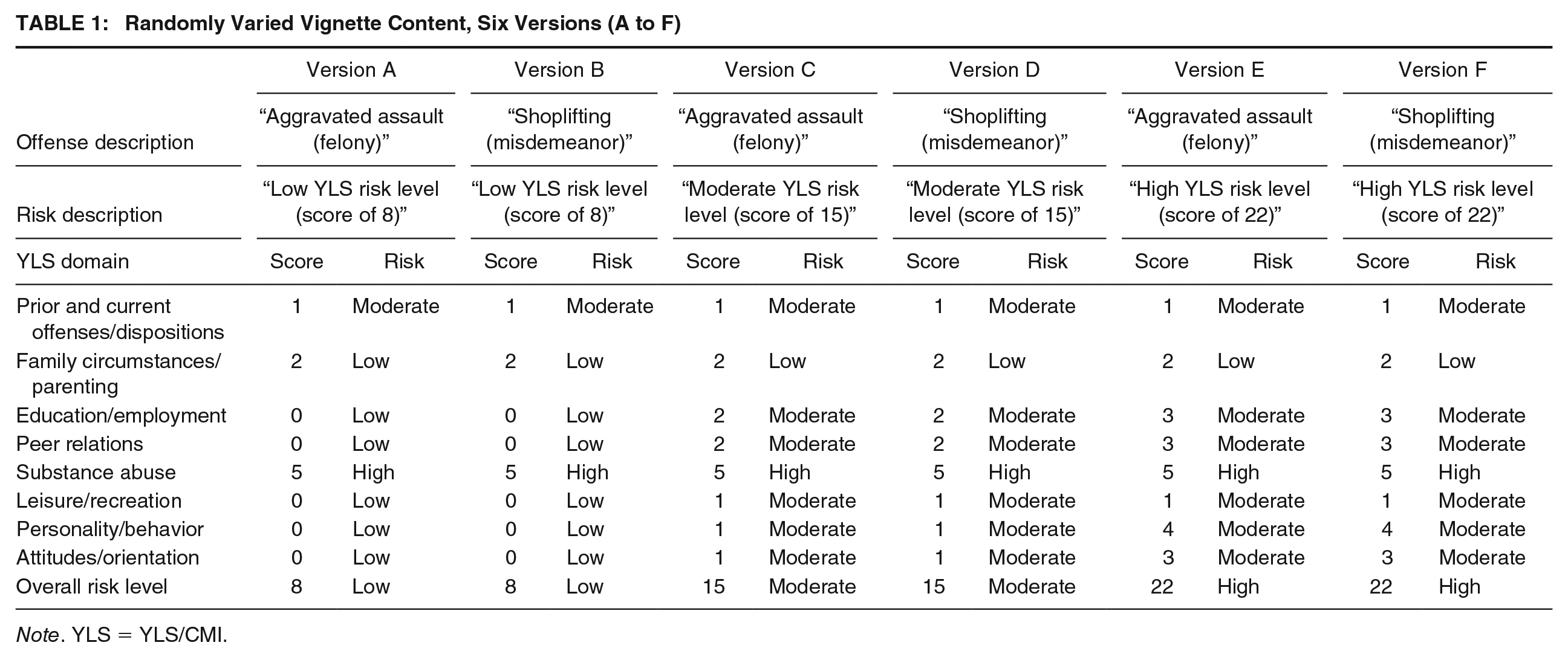
The survey randomly assigned six versions of a single generic vignette, followed by the same questions (see online materials for the generic wording). The generic vignette asked respondents to estimate their likelihood of making certain decisions in relation to a 16-year-old boy who, regardless of vignette version (a) had a prior disposition for a misdemeanor offense; (b) had a prior completed period on probation supervision, during which he once violated his supervision conditions; and (c) lived with his mother with whom he often argued. Across variations, the youth consistently had only one “high-risk” criminogenic need, for substance abuse, and consistently scored “low-risk” for family circumstances and parenting. Arguing with his mother does not, alone, lift the boy from a low-risk category, given the scoring of the YLS/CMI, although it could be a trigger for probation officer judgments outside of the RNR model.
Meanwhile, specific details of the vignette randomly varied across respondents in a 2 × 3 factorial design, as illustrated in Table 1. The first factor concerned the youth’s current offense. It varied between (a) a serious/violent crime, “aggravated assault (felony),” and (b) a minor/property crime, “shoplifting (misdemeanor).” The second factor indicated the risk level. This varied between (a) “low,” (b) “moderate,” and (c) “high.” In keeping with variations in the overall risk levels, scores for criminogenic needs, other than substance abuse or family circumstances/parenting, mostly varied, but none (other than substance abuse) ever scored “high,” with specific domains varying between “low” and “moderate.”
Randomly Varied Vignette Content, Six Versions (A to F)
Note. YLS = YLS/CMI.
Measures
The experimental analysis relied on a series of single-item measures, probing the probability of decisions the officer would make in relation to processing, disposition, and services of the youth client. Specifically, the officer was asked how likely it is they would “Seek an informal adjustment (if at intake)” (diversion), “Seek residential placement (if making a disposition recommendation)” (placement), “Ensure the youth receives a range of general intensive services” (varied services), “Ensure the youth receives intensive services for substance use” (substance use services), and “Ensure the youth receives intensive family-based services to improve family functioning” (family-based services). These were 11-point measures, visually represented as numbers from 0 to 10, with the words, extremely unlikely and extremely likely, over each of two extremes, respectively.
We also calculated a derived service differential measure, by subtracting the family-based services measure from the substance use services measure, producing a theoretical range of −10 through 10. If the need principle was being honored, we would expect a positive score on this measure, indicating a difference in the propensity to choose family-based compared with substance use services. This is because the vignette was consistent in including high-risk substance abuse needs and low-risk family circumstances/parenting needs.
Finally, the article uses some single-item descriptive measures. Occupational measures include whether the respondent is a supervisor/manager, completes the YLS/CMI, supervises people on probation (and their caseload if so), and has had YLS/CMI training in the past year. Demographic measures include age, graduate degree, gender, and being a person of color. In addition, two items measure perceptions of the YLS/CMI, one further item measures whether respondents use the YLS/CMI to make need decisions, and another item measures whether they use the YLS/CMI to make risk-based decisions. More details of the attitude and experience measures are provided in the text along with results.
Analysis
The primary analysis relied on (a) descriptive statistics, (b) t tests, and (c) one-way and two-way analyses of variance (ANOVAs). A sensitivity power analysis for the ANOVAs was conducted based on the achieved sample using G*Power (Faul et al., 2007). Using a power of .80 and an alpha of .05, we estimated that all main effects and interactions would be detectable with partial eta-squared values lower than .02. Given that eta-squared values of .01 are considered “small,” .06 “medium,” and .14 “large” (Cohen, 1988), our design appears capable of detecting relatively small effects.
We also carried out robustness checks on results. First we conducted nonparametric versions of most tests, given some limited deviations from ANOVA assumptions. 1 Second, we reran all analyses just for frontline officers (i.e., excluding supervisors and managers), on the premise that supervisors and managers may be more removed from the kinds of decisions that were being assessed in the study. Finally, we ran variations of all core analyses to produce standard errors adjusted for county-level clustering, even though design effects owing to clustering were mostly modest. 2 These robustness checks produced substantially the same results as the core analysis. Minor deviations are indicated in the discussion of results.
Results
Sample Characteristics
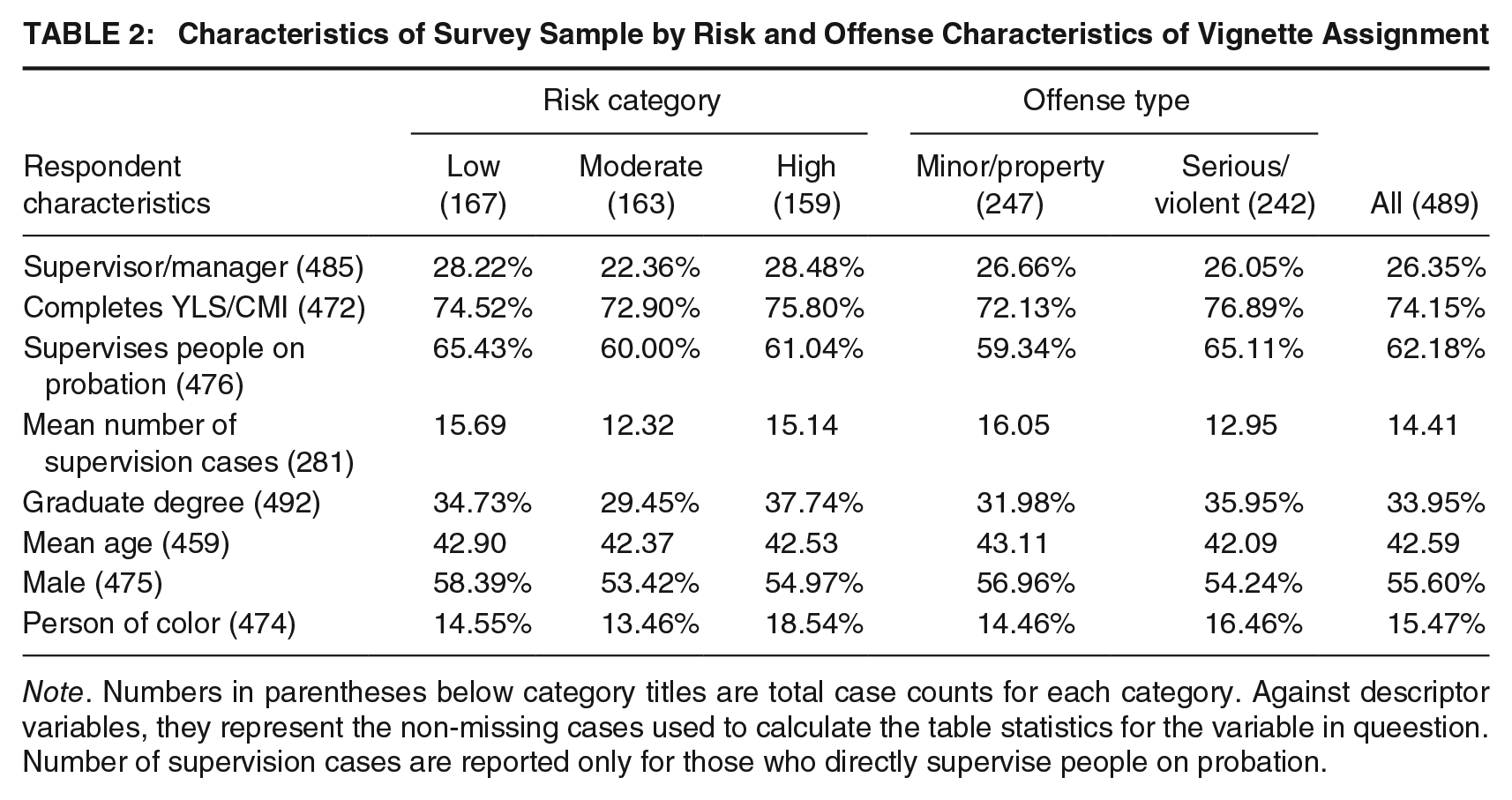
Table 2 reports the demographic and occupational characteristics of the sample, and it shows reasonable balance across experimental groups. The table also indicates that roughly a quarter of respondents are probation supervisors or other managers (such as chiefs or deputy chiefs), three quarters complete or update the YLS/CMI as part of their work, and three out of five are involved in directly supervising people on probation—among whom average caseloads were about 14 (14.41). Officers not directly supervising people tended to include staff supervisors and managers, and those in specialized roles including intake or investigations. The table also shows that about a third of respondents had a graduate degree, slightly over half were male, they averaged about 43 (42.59) years of age, and that more than eight out of 10 were White.
Characteristics of Survey Sample by Risk and Offense Characteristics of Vignette Assignment
Note. Numbers in parentheses below category titles are total case counts for each category. Against descriptor variables, they represent the non-missing cases used to calculate the table statistics for the variable in queestion. Number of supervision cases are reported only for those who directly supervise people on probation.
Additional survey results confirm the significant level of YLS/CMI implementation in the state. For example, 96.12% of respondents had received “booster” training on the YLS/CMI in the prior 12 months. In addition, 63.68% agreed or strongly agreed that the instrument “Provides helpful guidance to probation officers they wouldn’t otherwise have,” and 75.51% agreed or strongly agreed it was “. . . useful in informing decisions about appropriate treatment goals and services.” When asked how often, when making recommendations or decisions about client services or goals (when a YLS/CMI was available), they addressed “the main criminogenic needs highlighted by the YLS,” respondents involved in such decisions scored on average 8.51 out of 10. A similar question, focused on addressing YLS/CMI risk levels, scored an average of 7.85 out of 10.
Testing Risk and Need Principles
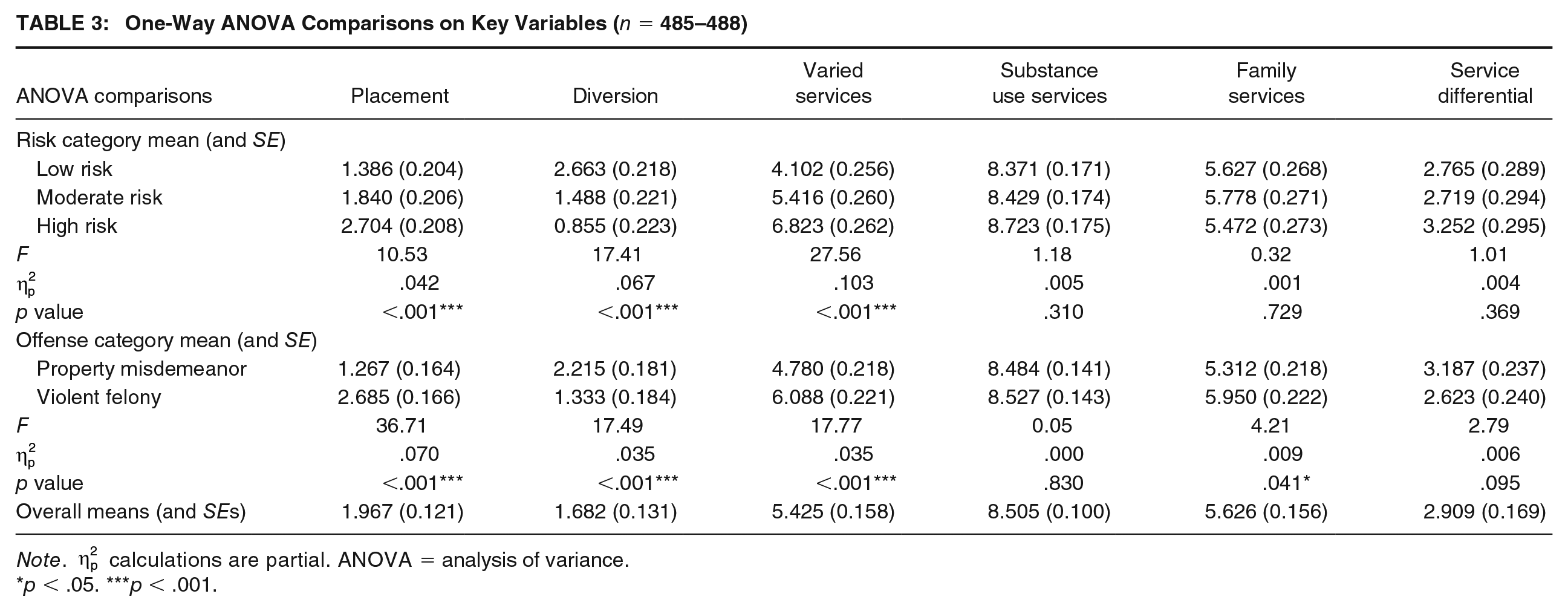
To test hypotheses concerning the application of risk and needs principles, we rely on a series of one-way ANOVAs and t tests. To this end, Table 3 provides results from one-way ANOVAs of all dependent variables with risk category and offense type as independent variables. It also includes the means and confidence intervals (CIs) of dependent variables overall as well as by risk and offense.
One-Way ANOVA Comparisons on Key Variables (n = 485–488)
Note.
p < .05. ***p < .001.
Risk-Based Hypotheses
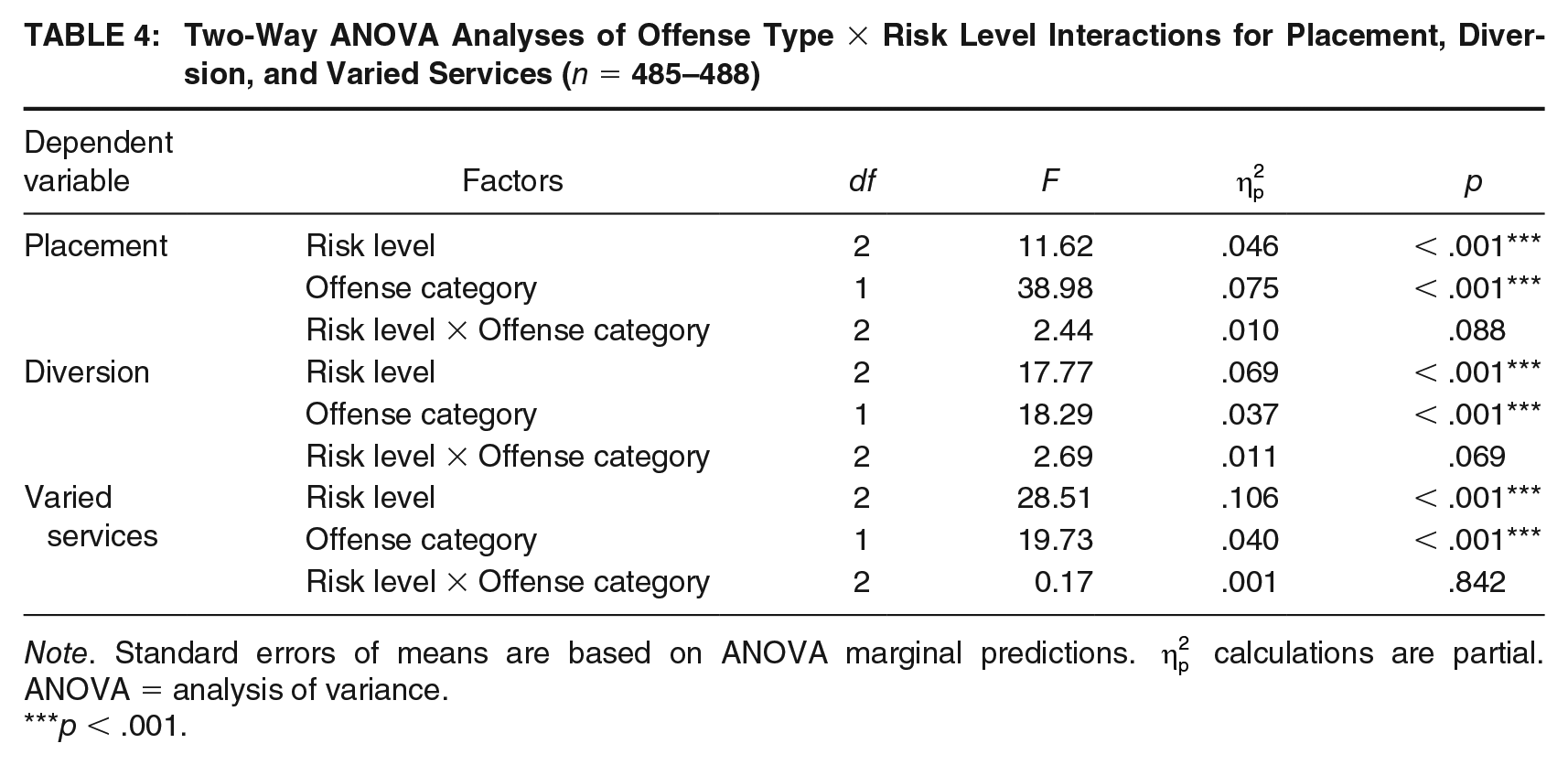
Table 4 allows us to test the risk principle. It shows statistically significant associations between risk and placement (p < .001) and risk and diversion (p < .001), both in the expected directions and with moderate effect sizes (
Two-Way ANOVA Analyses of Offense Type × Risk Level Interactions for Placement, Diversion, and Varied Services (n = 485–488)
Note. Standard errors of means are based on ANOVA marginal predictions.
p < .001.
H4 asserts that services are improbable for low-risk clients. We therefore assessed whether respondents to the “low-risk” vignette were more likely to say they would not (than would) implement services, operationalized as scoring less than 5 (out of 10) for each service measure. Whereas respondents averaged 4.10 (95% CI = [3.56, 4.64]) for varied services, they averaged 8.37 (95% CI = [8.03, 8.72]) for substance use services and 5.63 (95% CI = [5.12, 6.13]) for family-based service, and only varied services was significantly below 5 in a directional t test (p < .001). 3 In short, officers did not consistently limit services for low-risk youth, leading us to reject H4.
Similarly, H5 asserts that respondents exposed to the “high-risk” vignette more often than not recommend need-relevant services. We looked for a score of above 5 for substance use services (corresponding to the single high-scoring need) and varied services (recognizing that these cases have a diverse set of “moderate” needs). Both measures score in this range, with diverse services averaging 6.82 (95% CI = [6.34, 7.31]) and substance use services averaging 8.72 (95% CI = [8.44, 9.01]). Moreover, they were both significantly above 5 in directional t tests (p < .001 in each case). 4 H5 is therefore accepted.
Need-Based Hypothesis
H6 asserts there are differences in probability of services for high and low scoring needs, consistent with the need principle. This comparison rests on differences between responses within subjects, rather than across an experimental manipulation between them. Table 3 shows that the mean probability of family-based services (consistently scored “low risk” in the experimental vignette) is lower than the mean probability of substance use services (consistently scored “high risk”). The measures score, respectively, 5.63 and 8.51, values which are significantly different from one another (p < .001) in a paired t test (not shown in Table 3). H6 is therefore accepted.
Offense-Based Hypotheses
Next we consider the effects of a serious/violent offense on placement and diversion. These are tested, once again, through the ANOVA results in Table 3. Under a strict RNR model, we would expect placement and diversion to be unrelated to offense, as hypothesized in H7 and H8. However, we must reject these hypotheses because placement probability increases, and diversion probability decreases, in the presence of a serious/violent offense. Both of these relationships are highly significant (p < .001 in both cases) with moderate effect sizes (
Similarly, H9 hypothesizes no relationship between services and offense—consistent with application of an RNR model. However, Table 3 shows some statistically significant effects of this kind. The effect is most notable for varied services (p < .001,
Examining Interactions
The second part of our analysis assesses whether adherence to the RNR model is less for higher risk clients or clients with serious/violent offenses. We start by assessing whether officers’ tendency to differentiate services according to need (the need principle) is less for higher risk clients (H10) or more serious/violent clients (H11). The final column of Table 3 provides relevant results. The dependent variable tested here is the difference in indicated service probabilities for substance use and family-based services (“service differential”). The need principle would imply a difference between these service probabilities, corresponding to the differences in vignette need scores. Table 3 shows no statistically significant relationships between the service differential variable across either risk or offense type. Sensitivity analyses provide some qualification to this, with some significant effects for offense seriousness in the frontline practitioner-only models without cluster adjustment (p = .045 for the parametric model, and p = .044 for the nonparametric model). However, effect sizes even here are small (
To assess whether the risk principle is reduced for serious/violent clients (H12), we turn to Table 4. This presents results of two-way ANOVAs focused on the dependent variables of placement, diversion, and varied services. In addition to the main effects of risk and offense, the three ANOVAs presented include their interactions. The table shows that, whereas main effects continue to show significant relationships, none of the interactions were significant.
5
Sensitivity analyses show a slightly mixed picture for diversion, however. There were significant interactions in the hypothesized direction with ANOVA cluster-adjusted standard errors (p = .042 for the full model, p = .028 for the frontline-only models). However, none of the nonparametric models show effects even close to significance, and ANOVAs for both samples indicate only small effect sizes (
Discussion
Whereas prior studies have shown improvements in decision-making shortly after pilot projects to introduce RNAs (Vincent et al., 2016; Young et al., 2006), studies of routine practice nonetheless show shortcomings in adherence to the RNR model (Miller & Maloney, 2013; Viglione et al., 2015). This study breaks new ground by quantitatively assessing probation officers’ adherence to RNR decision-making principles several years into a sustained scientific RNA implementation effort. It does this, using an experiment involving survey-based vignettes administered to juvenile probation officers. Specifically, details of client risk level and offense were randomly varied and officers were asked to indicate their likelihood of various service and system responses to address two research questions: (1) Is probation officer decision-making consistent with the RNR model? (2) Is adherence to model principles less in the presence of higher risk clients or more severe offenses? Specific hypothesis tests helped answer these questions.
Key Findings
Table 5 summarizes the hypotheses tested, and the results of analysis. In relation to our first question (the first part of Table 5), some hypotheses (H1, H2, H3, H5, and H6) are supported, others (H4, H7, H8, and H9) are not. Specifically, the results provide some support for the risk principle, in that officers vary their use of interventions and services according to risk (although this applied to varied services, not substance use or family services). There is also support for the need principle because officers differentiate between high and low scored needs in whether they choose services for those needs. However, results suggest that decision-making criteria beyond the RNR model are also important. They show probation officers relying on some services, even for low-risk cases (indicated by the rejection of H4). They see officers relying on offense information as a basis for selecting services—specifically varied services (rejection of H9). Probation officers also use offense severity as a basis for deciding on placement and diversion, irrespective of client’s criminogenic characteristics or risk (rejection of H7 and H8).
Hypothesized Data Patterns and Empirical Results
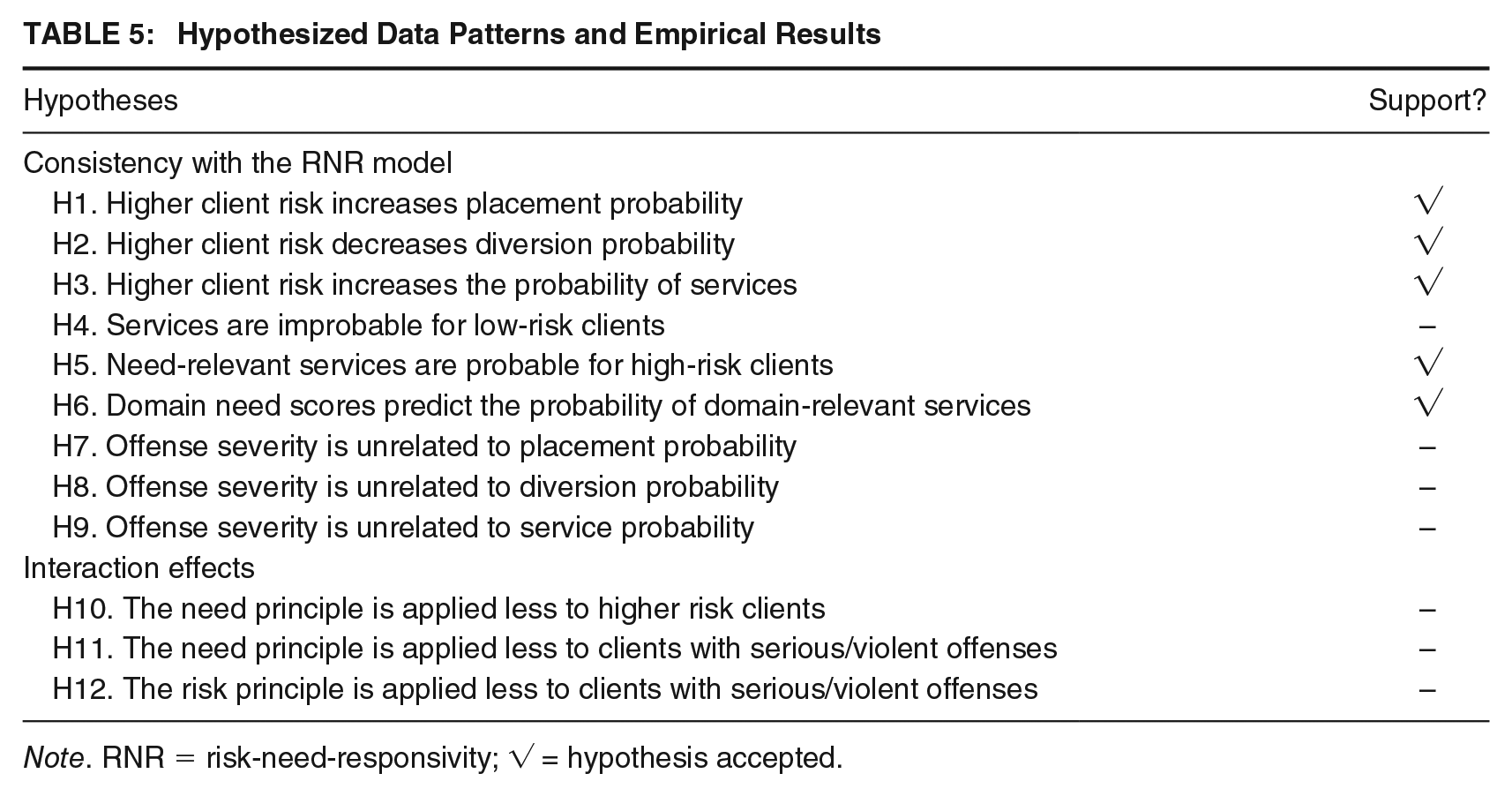
Note. RNR = risk-need-responsivity; √ = hypothesis accepted.
The second part of Table 5 addresses our second question. Results provide no clear evidence of RNR principles being compromised for higher risk clients or clients with the more severe offense. Specifically, the need principle (represented as the difference in officers’ propensity to assign services for low- and high-scoring family and substance domains, respectively) was not attenuated for higher risk cases (rejection of H10) or for serious/violent clients (rejection of H11). Similarly, there was no clear evidence that the risk principle (as applied to placement, diversion, and varied services) was applied less for serious/violent clients (with the exception that varied services registered a small significant effect in some, but not all, sensitivity analyses; rejection of H12). Overall, there is inadequate evidence to support Hypotheses H10, H11, or H12.
Implications
Taken together, these findings indicate a discretionary form of probation officer decision-making that draws on cues from within and beyond the RNR model. The relevance of offense severity to probation officers’ enforcement-oriented decisions is consistent with a variety of prior studies of probation officers (e.g., Bridges & Steen, 1998; Drass & Spencer, 1987; Leiber et al., 2018). It suggests an emphasis on punitive principles, perhaps in part a legacy of “get tough” juvenile justice policies (Butts & Mears, 2001). It may also relate to concerns about public safety based on discretionary probation officer judgments about risk, anchored in offense-based judgments rather than actuarial calculations. These impulses are consistent with the relevance of the focal concerns of “blameworthiness” and “dangerousness” as highlighted in some prior probation research (Freiburger & Hilinski, 2011; Harris, 2009; Leiber et al., 2018).
Meanwhile, the heavy reliance on services is consistent with a simultaneous focus on rehabilitation. Yet, the tendency to choose services in the absence of substantial actuarial risk, and to be guided in part by offense characteristics, suggests the operation of a traditional welfare-oriented approach. This may draw on professional typologies about clients and appropriate services (Drass & Spencer, 1987; Klein, 2008).
More generally, tendencies to invoke non-RNR decision-making criteria may be a product of the professional and organizational contexts of Pennsylvania’s juvenile probation offices. The latter may involve long-standing norms that persist among officers despite reforms (Miller & Maloney, 2013; Viglione et al., 2015), perhaps perpetuated by veteran officers. It may also reflect the expectations of a broader range of court officials with whom probation officers have to cooperate (Eisenstein & Jacob, 1991; Miller & Trocchio, 2016) and who may be more familiar with conventional justice principles and traditional client welfare considerations than RNR principles.
Importantly, while these results apply to juvenile probation officers in Pennsylvania, they provide lessons that apply more broadly. In particular, given the significant scientific efforts to implement the YLS/CMI in Pennsylvania over several years, results highlight stubborn obstacles to promoting RNR decision-making even in a favorable implementation environment. Probation officer discretion, and a broader legacy of correctional traditions, are likely to persist in shaping decision-making in states working to promote RNR beyond Pennsylvania. This may be particularly true among those using less rigorous RNA implementation strategies.
Limitations
Our findings come with some limitations. First, the research relied on a single hypothetical vignette in which certain characteristics (e.g., age, gender, and prior offenses) were fixed. More varied juvenile vignette descriptions (e.g., including people adjudicated for the first time, females, or younger youth) or different variations of risk, need, and offense type may have produced different response patterns. The vignette methodology was further limited in not randomly assigning the high- and low-risk criminogenic needs in the vignette, creating the potential to confound domain scores with officer preferences for types of services. Vignette-based responses are also necessarily hypothetical and may be at odds with real-world officer decisions.
Second, there were limitations in relation to the sample we studied. Given that just a third of Pennsylvania officers participated, it seems likely that our sample disproportionately involved officers more engaged and enthusiastic about reforms, and who may have displayed tendencies different from more disengaged officers who did not respond. However, this would probably make our evidence of deviations from RNR among Pennsylvania juvenile probation officers more, rather than less, credible. Our analysis also focused on respondents as a collective group, without differentiating among them. Separate analyses of different demographic or occupational subgroups might have revealed some variations obscured by our focus on the full probation officer sample.
Set against these limitations, however, our design has some important strengths. As a randomized experiment, it provides an unambiguous test of the effects of the randomly assigned case details. Moreover, by varying clearly differentiated risk and offense information, the study maximized its potential to identify tendencies in officers’ responses. Finally, given the likelihood that the vignette method encouraged officers to present a more idealized version of their decisions than they would make in routine practice, we can probably have confidence that the deviations from the RNR model identified are likely also to be seen in the real world.
Conclusion
Evidence-based principles, and the RNR model, represent an important shift in contemporary correctional thinking that promise improved outcomes for system clients (Andrews et al., 1990; Bonta & Andrews, 2017). Yet, operationalizing this approach is difficult. Even with the best intentions, policy implementation is hard, and practitioners tasked with operationalizing new policies, including the RNAs that support the RNR model, often resist or reshape them (Haynes & Licata, 1995; Kelly, 1994; Lipsky, 1980; Miller & Maloney, 2013; Miller & Trocchio, 2016; Viglione et al., 2015). Even in Pennsylvania, several years into a sustained scientific effort to implement evidence-based juvenile justice reforms, the picture is consistent with this insight. Although probation officers certainly relied on RNR criteria, they also drew on cues beyond this model, suggesting a pattern of discretionary decision-making in which punitive and traditional welfare-oriented judgments remain relevant alongside risk and need.
Further strengthening adherence to the RNR in Pennsylvania will likely require continued efforts in line with existing RNA implementation research. These likely include a continued focus on building strong relationships with criminal justice stakeholders, buy-in among frontline staff, clear local policies, regular training (and regular retraining), and monitoring and quality checks (Vincent et al., 2012).
However, such efforts might be further focused. First, implementation leaders might explicitly acknowledge and challenge the competing influences on officers’ decision-making we have highlighted, for example, through training, officer supervision, and quality assurance strategies. Moreover, leaders should also further promote RNR principles among the broader community of juvenile justice stakeholders, given their likely role in shaping decision-making (Eisenstein & Jacob, 1991; Miller & Trocchio, 2016; Ulmer, 1997). Without consensus across court actors about the importance of RNR, officers’ decisions may continue to reflect other actors’ priorities.
Second, we suggest strengthening quality assurance strategies that focus on decision-making. Case study research in Pennsylvania (Miller et al., in press) suggested that more promising approaches to quality assurance involved supervisors assessing whether officers were addressing YLS/CMI defined needs in their case management, for example, through substantive discussion in sit-down meetings. This contrasts with efforts merely to check officers’ completion of bureaucratic tasks, such as filling out the YLS/CMI or writing a case-plan.
Finally, further innovations may help practitioners overcome the cognitive challenges of processing RNA information and making appropriate decisions. Theory and research suggest that practitioners often make decisions following limited deliberation, drawing on past experiences, attributions, and typologies (Albonetti, 1991; Drass & Spencer, 1987; Klein, 2008; Schwalbe, 2004; Simon, 1957; Steffensmeier & Demuth, 2000). This being the case, there may be ways to package RNA assessment information that fit better with officers’ decision-making styles. For example, Taxman and Caudy (2015) used latent class analysis to simplify the complexity of risk and need information among adults on probation to produce four generic risk/need profiles. The authors suggest that this classification structure could simplify the task of case management by allowing programs to be tailored to fit the reduced set of categories, thus making the cognitive decision-making task easier for probation officers.
The findings of this study remind us of the challenges of shifting the decision-making of street-level practitioners to coincide with evidence-based principles, even in the context of rigorous scientific implementation efforts. Although further implementation efforts may improve on the decision-making patterns seen, further policy refinements may also help improve on these prospects. We look forward to future research and innovation that supports these developments.
Supplemental Material
Online_Apendix – Supplemental material for Juvenile Probation Officer Decision-Making in a Reforming State: Assessing the Application of Evidence-Based Principles
Supplemental material, Online_Apendix for Juvenile Probation Officer Decision-Making in a Reforming State: Assessing the Application of Evidence-Based Principles by Joel Miller and Krissinda Palmer in Criminal Justice and Behavior
Footnotes
Authors’ Note:
This project was supported by Award No. 2015-R2-CX-0015, awarded by the National Institute of Justice, Office of Justice Programs, U.S. Department of Justice. The opinions, findings, and conclusions or recommendations expressed in this publication are those of the authors and do not necessarily reflect those of the Department of Justice. The authors would like to thank all the partners and participants in this project, including all the Pennsylvania juvenile probation officers and supporting staff who gave their time to assist with this research, the Pennsylvania Juvenile Court Judges’ Commission, and the Pennsylvania Council of Chief Juvenile Probation Officers.

Notes
References
Supplementary Material
Please find the following supplemental material available below.
For Open Access articles published under a Creative Commons License, all supplemental material carries the same license as the article it is associated with.
For non-Open Access articles published, all supplemental material carries a non-exclusive license, and permission requests for re-use of supplemental material or any part of supplemental material shall be sent directly to the copyright owner as specified in the copyright notice associated with the article.
