



Abstract
From media attention to legislative actions, individuals convicted of sex offenses are often perceived as dangerous and a threat to society. Previous research, however, has demonstrated that perceived dangerousness is gender-specific, often minimizing culpability for women convicted of sex offenses. Consequently, previous research on sentencing outcomes of these individuals have largely been male-only samples, leaving a gap in the literature as it pertains to females convicted of sex offenses. The current study sought to fill this gap by examining the impact that those convicted, victims, and offense characteristics had on sentencing outcomes for women convicted of sex offenses. We analyzed a sample of 262 females convicted of a sex offense in a Southern state. The results demonstrated that official case characteristics, along with victim characteristics, play an influential role in the judicial decision to impose an incarceration sentence.
Over the past two decades, the mass media has paid some attention to female sexual offending (Grimm & Harp, 2011), which has primarily focused on female teachers. Unfortunately, these accounts have only served to reinforce societal views of sexual scripts, while undermining the true scope and harm of female sex offending (Denov, 2001, 2003; Mellor & Deering, 2010) There have been a number of cumbersome laws enacted that reflect societal perceptions of the threat and danger individuals convicted of sex offenses pose to society (Berman, 2005; Sample & Bray, 2003); however, research has demonstrated that this perceived dangerousness is gender-specific, which often minimizes or discounts the existence of female sexual offending (Denov, 2001, 2003; Mellor & Deering, 2010). The reality is that females account for approximately 7% to 12% of this population, although scholars argue the true estimates of female sex offending are likely to be much higher than official statistics (Cortoni et al., 2017). This suggests that there is a greater need to understand sexual offending by females and the manner in which professionals respond to females convicted of sex offenses.
Research on women convicted of sex offenses has been limited but has grown over the past few decades. Scholars have explored professional perceptions (Denov, 2001; Mellor & Deering, 2010), typologies (Steely & ten Bensel, 2020; Vandiver & Kercher, 2004), comparative studies between types of female offenders (ten Bensel, Gibbs, & Burkey, 2019; Vandiver, 2006), and offending severity (ten Bensel, Gibbs, & Raptopoulus, 2019). One notably deficient area of scholarship is in the sentencing of these females (Darling et al., 2018). Much of the existing sentencing literature excluded females from samples (Amirault & Beauregard, 2014; Patrick & Marsh, 2011), while examining the effects that offense characteristics, victim characteristics, and the victim–offender relationship have on judicial sentencing decisions (Levesque, 2000; Patrick & Marsh, 2011). Previous studies that included females were comparative in nature without focusing on specific offense characteristics that may be unique to female sexual offending (Embry & Lyons, 2012; Hassett-Walker et al., 2014). Overall, research has indicated women convicted of sex offenses are sentenced more leniently than males, suggesting that judges view them as less dangerous and less of a threat to the community than their male counterparts (Shields & Cochran, 2020; Thompson et al., 2020). A gap in the literature, however, remains as researchers have yet to isolate specific offense characteristics that may be indicators of offense severity warranting harsher criminal sentences for these women.
To our knowledge, only one study has solely focused on the sentencing of females convicted of sex offenses (Darling et al., 2018). Although this study was insightful, we have expanded on this study by examining a larger sample of females with greater analytical rigor. Moreover, we included key offense and victim characteristics in our study to examine specific influences on judicial sentencing decisions and the manner in which judges perceive dangerousness among these women. We conducted a probit regression to understand the effects offender, victim, and offense characteristics have on the severity of sentencing sanctions among females convicted of a sex offense in a southern state (n = 262). The examination of these characteristics goes beyond using official charges (Embry & Lyons, 2012) as we accounted for several case characteristics (i.e., consensual nature of the offense, offender–victim relationship) to capture the true nature of offenses that can be lost in plea bargains (Levesque, 2000). Our sample included females who were convicted and assessed in a southern state between 1996 and 2018, which captured over two decades of sentencing data. The results of this study will provide a better understanding on how females who committed sexual crimes are sanctioned and the manner in which judges perceive the danger presented by this population. In the following section, we provided a discussion on the focal concerns perspective, which is the guiding theoretical perspective for this study. In addition, we reviewed research on judicial decision-making, overall sentencing patterns, and women who have been convicted of sex offenses.
Background
The focal concerns perspective posits that judges have three primary concerns when sentencing defendants—blameworthiness, protection of the community, and practical constraints and consequences (Steffensmeier et al., 1998). As an attribution-based theoretical framework, focal concerns, along with causal attribution theory (Albonetti, 1991), suggests the social construction of offense seriousness and the need to protect the community are likely to influence judicial decision-making, especially when there is limited defendant information (Shields & Cochran, 2020). When lacking a suitable amount of individual and offense information, judges rely on a “perceptual shorthand,” using stereotypes and generalizations to assess the dangerousness of the person convicted of a crime to protect the community (Steffensmeier et al., 1998). The judicial assessment of individual dangerousness is thought to be a complex interplay between the three focal concerns. Particularly salient in the current research, Steffensmeier and colleagues (1998) suggested that judicial assessment is “. . . based on attributions predicated on the nature of the offense, case information, the offender’s criminal history, and the facts of the crime. . . ” (p. 767). It was within this framework that the current research examined several offense characteristics to determine the impact each attribute had in judges’ assessment of an individual’s level of dangerousness, resulting in the severity of sentence levied.
Sentencing Patterns
Judicial decision-making is often the culmination of several factors, which can be legally relevant or irrelevant. The adoption of sentencing guidelines by the federal and many state governments transitioned sentencing philosophies from rehabilitation to incapacitation and deterrence (Berman, 2005; Wilmot & Spohn, 2004). The new sentencing structure, characterized by mandatory minimums and presumptive sentences, emphasized offense-conduct and minimized the characteristics of those convicted of a crime. Despite the focus on offense characteristics, studies have found individual characteristics, such as gender, race, and age to be influential in the sentencing decision (Koons-Witt et al., 2014; Ulmer & Johnson, 2004; Wu & Spohn, 2009). Specifically, males (Koons-Witt et al., 2014), people of color (Ulmer & Johnson, 2004), and younger adults (Wu & Spohn, 2009) have been frequently shown to be sentenced more severely. Notwithstanding, the legally relevant factors of offense seriousness and criminal history were consistently found to be the strongest predictors of sentence severity (Koons-Witt et al., 2014; Spohn, 2009).
As posited by the focal concerns perspective, judges perceive an individual’s level of dangerousness, in part, through the seriousness of offense committed (Steffensmeier et al., 1998). Several studies have isolated specific criminal charges and crime-types to determine which were perceived to be most serious in sentencing outcomes (Rodriguez et al., 2006; Warren et al., 2012). Previous research has found people, who are convicted of violent crimes, were most likely to be incarcerated, followed by property and drug crimes, with the exception of trafficking (Steffensmeier & Demuth, 2006). Moreover, several studies have isolated the direct effects of sex offenses on sentencing (Ulmer & Bradley, 2006; Warren et al., 2012). Males convicted of sex offenses were more likely to be incarcerated (Warren et al., 2012) and receive longer prison terms (Ulmer & Bradley, 2006) than other crime-type convictions, with the exception of certain violent offenses (Engen & Gainey, 2000), such as homicide (Bushway & Piehl, 2001). These results were consistent with research that have indicated those convicted of sex crimes were perceived to be a dangerous group (Quinn et al., 2004; Sample & Bray, 2003).
Perceived Dangerousness of Those Convicted of Sex Offenses
The perception of enhanced dangerousness of individuals convicted of sex crimes have led to a number of stringent federal and state laws, including the inception of the sex offender registry, community notification, residency requirements, and DNA collection (Sample & Bray, 2003; see Wright, 2014). It is reasonable to believe that the legislative attention garnered by these individuals has found its way into the courtroom and judicial-decision-making processes (Mellor & Deering, 2010). As a result, there has been a great deal of literature examining the influential impact that offenses have on sentence severity in sex offense cases (Amirault & Beauregard, 2014; McCormick et al., 1998; Patrick & Marsh, 2011).
Previous research on sentencing outcomes for those convicted of sex offenses have isolated offense characteristics, such as the victim–offender relationship (Kingsnorth et al., 1999; Levesque, 2000; McCormick et al., 1998), sexual nature of the offense (Berliner et al., 1995; Levesque, 2000), force used in the offense (Amirault & Beauregard, 2014; Patrick & Marsh, 2011), and demographics of the victim (Amirault & Beauregard, 2014; Thompson et al., 2020) as predictors of sentencing outcomes. Enhanced perceptions of an individual’s level of dangerousness, based on the severity of sentences levied, appear to be connected with those people who victimized strangers/non-relatives (Amirault & Beauregard, 2014; Berliner et al., 1995; McCormick et al., 1998; Patrick & Marsh, 2011), engaged in more intimate sexual relations (Levesque, 2000), used a weapon or cause personal injury (Amirault & Beauregard, 2014; Kingsnorth et al., 1999), offended against younger children (Thompson et al., 2020), and those who victimized children of the same sex (Walsh, 1994). Despite all that is gleaned from these studies, the results are derived from male-only samples. We know little about specific case characteristics that influence sentence severity for females convicted of sex crimes. Much of the existing literature involving women in courts research has been examinations of differential treatment in sentencing outcomes (Shields & Cochran, 2020; Thompson et al., 2020); thus, we lack an in-depth understanding of the manner in which these women are sanctioned in court.
Females Convicted of Sex Offenses
Although the majority of research on individuals convicted of sex offenses has predominately focused on males, there has been an increase in research over the past few decades on females (Steely & ten Bensel, 2019; Vandiver & Kercher, 2004). The estimated offending rate of this population varies greatly. Official records have estimated that females account for about 7% of all sex offense cases (Cortoni et al., 2017), while victimization research indicates as high as 12% nationwide (Cortoni et al., 2017). These discrepancies in offending rates are likely to be products of a lack of reporting and societal perceptions that women are incapable of committing such crimes, especially given that they are often viewed as the caring and nurturing members of a household (Denov, 2003). Regardless, research has found that women are capable of sexual abuse, and the repercussions of these crimes can be extremely traumatic for their victims (Denov, 2003; ten Bensel, Gibbs, & Raptopoulos, 2019; Vandiver & Kercher, 2004).
The limited research on women convicted of sex offenses has found that they are typically White (Lewis & Stanley, 2000; Vandiver, 2006) and in their 20s to 30s (Lewis & Stanley, 2000; Miller & Marshall, 2019). Mixed results exist regarding their educational attainment and marital status (Lewis & Stanley, 2000; Vandiver, 2006). Many have a number of issues, such as low-self-esteem, isolation, depression, and previous sexual victimization, ranging from 44% to 82% (DeCou et al., 2015; Lewis & Stanley, 2000). A number of scholars have also examined specific typologies of this offender-type (Mathews et al., 1989; Vandiver & Kercher, 2004). In addition, previous research has compared females who act alone in their offenses and those who perpetrate crimes with a co-perpetrator (ten Bensel, Gibbs, & Burkey, 2019; Vandiver, 2006). For example, ten Bensel and colleagues (2019) found women who acted alone in their offense were more likely to engage in sexual activity that did not exhibit force or threat of force, victimize non-relatives, and hold a position of trust than their accomplice.
Moreover, only a handful of research has examined sentencing outcomes of women convicted of sex offenses; however, the majority of this research examined differential treatment at sentencing between males and females (Shields & Cochran, 2020; Thompson et al., 2020). The clearest indication of the perceived dangerousness of these females lies in their differential treatment throughout the criminal court system (Shields & Cochran, 2020; Thompson et al., 2020). This line of research has often been couched in the chivalry hypothesis (paternalism) (Anderson, 1976; Chesney-Lind, 1986; Embry & Lyons, 2012), which suggested that women are perceived to be weaker, not fully responsible for their actions, and need the protection of men (Chesney-Lind, 1986). Subsequently, women were charged more leniently than similarly situated men (Hassett-Walker et al., 2014), and when charged, females were likely to receive less severe punishments (Shields & Cochran, 2020; Thompson et al., 2020). Through precision matching of more than 10,000 sexual offenders, Shields and Cochran (2020) found that females were 57% less likely to be incarcerated for their crimes, and when imprisoned, they received 17% shorter sentences. Despite this research, little is known about the offense-conduct within female perpetrated sex offenses that influences sentencing decisions.
To date, scholars have yet to examine the role offense and victim characteristics have on the sentencing outcomes of this population. Although Embry and Lyons (2012) isolated sex offense charges in their research, the actual criminal behavior was lost by not isolating specific offense characteristics, such as the offender–victim relationship, the sexual and consensual nature of the offense, and age of the victim. This information was often accounted for within specific sex offense charges, but the presence of plea bargaining may disguise the true nature of offenses (Levesque, 2000; Patrick & Marsh, 2011). As Levesque (2000) stated, “[r]eliance on (official) charges are problematic in that charges tend to be reduced, dropped, or pled in ways that mask sexual assault through charges that do not necessarily reflect the nature of sex crimes” (p. 333). Darling and colleagues (2018) examined 71 females who were arrested for allegedly committing a sexual offense within an organizational setting in England, Scotland, and Wales. The majority of the sample were teachers primarily working in high schools as teaching assistants. In regard to sentencing outcomes, they found that 73% of the sample were convicted, with 60% sentenced to immediate custody, and 27% receiving a suspended sentence. For those who went into immediate custody, their sentences ranged from 5 months to indeterminate incarceration. To our knowledge, this is the only research that has exclusively examined the sentencing outcomes for these individuals; however, this study was limited to the reporting of descriptive statistics and did not control for confounding factors, lack of threat or force, and offender–victim relationship through a multivariate analysis.
The current study sought to fill in the gap in the existing research by examining specific offense characteristics—as measures of an individual’s level of dangerousness—and the impact they had on sentence severity within a sample of females. With that said, we sought to understand the effects of offender, victim, and offense characteristics on the severity of sentencing sanctions among the individuals. We hypothesized (H1) that women convicted of more serious sex offenses (offense charge and level, greater number of charges, and with more prior arrests) will possess a greater probability of being sentenced to prison. Previous research has found that specific criminal charges (Koons-Witt et al., 2014; Ulmer & Bradley, 2006), number of charges (Steffensmeier & Demuth, 2006), and prior criminal history (Koons-Witt et al., 2014) are all predictors of sentencing severity.
We posited (H2) offender and victim characteristics will likely influence judicial decisions to incarcerate. Those women who victimized younger children and female victims will possess a greater probability of being sentenced to prison. As discussed in the literature review, the demographics of the victim are often predictors of sentencing outcomes (Amirault & Beauregard, 2014; Thompson et al., 2020). Finally, we hypothesized (H3) that women who used force, victimized acquaintances, and engaged in sexual intercourse with their victims will possess a greater probability of a prison sentence. Conversely, women who engaged in consensual sexual activity, victimized their own children or students, and had no direct contact with victims will be less likely to incur a prison sentence (Amirault & Beauregard, 2014; Berliner et al., 1995; Levesque, 2000; McCormick et al., 1998; Patrick & Marsh, 2011). To test our hypotheses, we conducted probit regression to examine the effects of offender, victim, and offense characteristics on sentencing severity among female sex offenders (n = 262).
Method
The data used in this study were gathered from the Department of Corrections in a southern state in the United States and included all females who were individually assessed for the sex offender registry and community notification from 1996 to 2018. This state requires all those who are convicted of a sex offense to report to a state agency for assessment within 6 months of conviction, institutional release, or residency in the state. Risk assessments for sex offender registry and community notification were conducted by trained correctional agents and supervised by a licensed psychologist. All those included in the sample were sentenced under the state sentencing guidelines that went into effect on January 1, 1994.
Data Collection
Our data were collected and mined from files provided by the Department of Corrections, which included police investigation reports, initial suspect and victim statements, indictments and sentencing judgments, assessment summaries, Personal History Questionnaire–Revised, 1 and criminal histories. These were all standard correctional protocol documents collected at the time of assessment by the state agents. Our primary data sources were the sentencing judgments and police investigation reports. The sentencing judgments provided information pertaining to the convicted charge(s), number of counts, offense level, and specific sentence rendered, while the police investigation reports provided offense-conduct information through suspect and victim statements, including the female’s relationship with the victim, sexual and consensual nature of the offense, age and sex of the victim, and age and race of the individual sentenced.
Sample
This study included 262 females who were convicted and assessed for sex crime between 1996 and 2018. This sample, however, did not include those who were convicted and remained incarcerated during the study’s time frame. It only included adult females who were assessed for registration and community notification. In total, the Department of Corrections assessed 464 females between 1996 and 2018; however, due to a number of methodological issues, our final sample was reduced. More specifically, 82 women were convicted in a different state than the current site; therefore, those individuals were not subjected to this state’s sentencing guidelines. It would have been methodologically unsound to include them in the current sample due to the differences in sentencing statutes between states. In addition, a significant number of files were missing information from the case sentencing order, which was integral for this study. Although the number of excluded cases was significant, there were no apparent differences between the individuals with complete files and those with missing data. Finally, we omitted cases from the analysis for methodological and interpretation purposes addressed below.
Dependent Variable
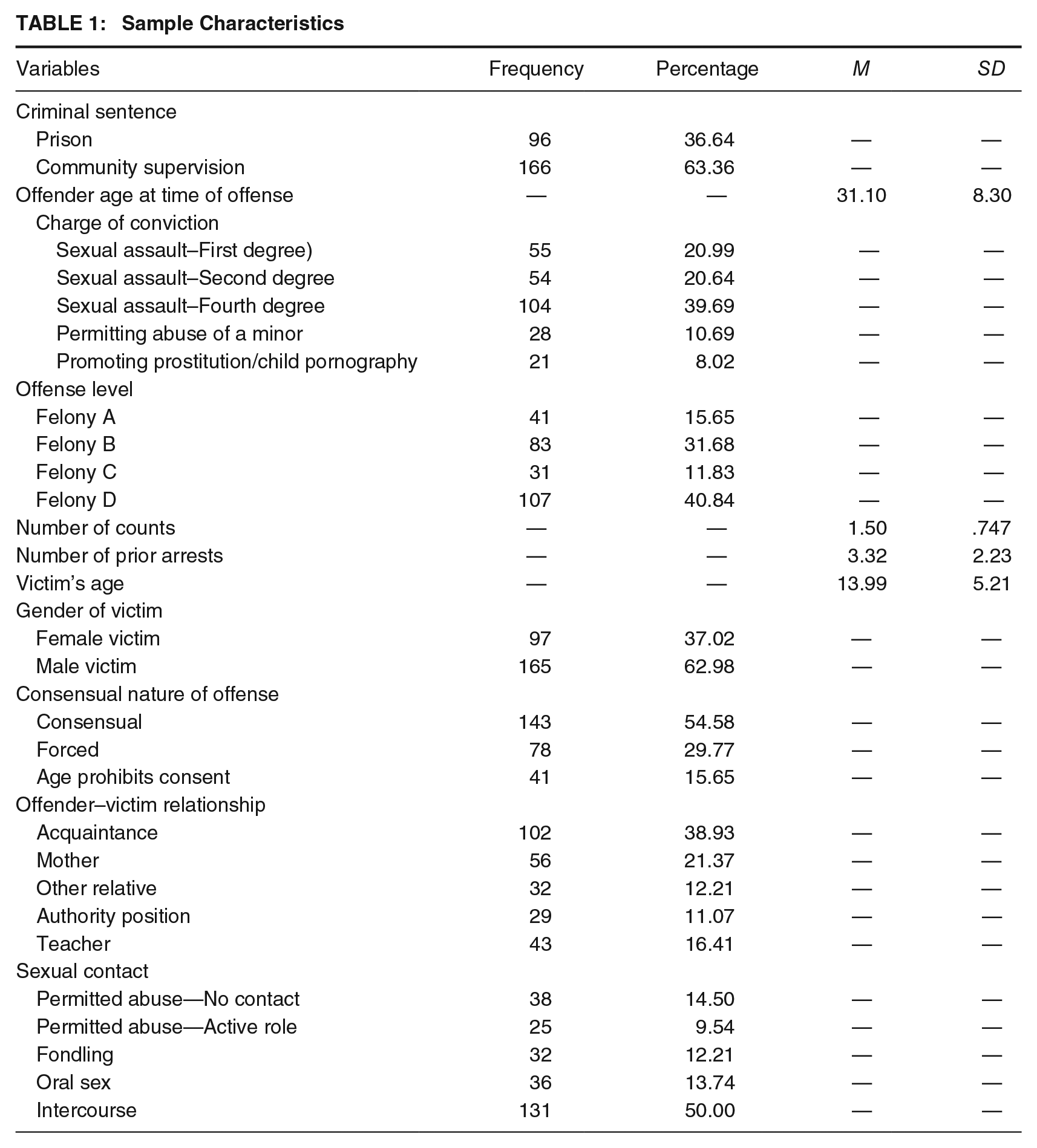
Criminal sentencing is often analyzed as a two-stage process. A judge first makes the decision to incarcerate or not to incarcerate (in/out decision) criminal defendants and then decides the sentence length for those incarcerated (Bushway et al., 2007; Wheeler et al., 1982). This study was unable to examine the second stage of this process due to insufficient numbers sentenced to prison. Of the 262 cases analyzed, 96 (37%) were sentenced to a period of confinement (see Table 1). The number of incarcerated females was unsuitable for a multivariate analysis to examine the second stage in the sentencing process (Wheeler et al., 1982); however, it is important to note that the average prison sentence was 13.6 months with a standard deviation of 6.57. As a result, our singular dependent variable was a binary categorical variable—sentence (1 = prison, 0 = probation). A significant majority of the sample were sentenced to community supervision (n = 166, 63%), while the remaining (n = 96, 37%) were sentenced to prison.
Sample Characteristics
Independent Variables
Individual-Level Characteristics
The average age of our sample was 31 years old at the time of offense (Table 1). In regard to the offenders’ race, approximately 90% (n = 235) were reported as White within the case files, while the remaining sample were people of color (n = 27; 10%). Although race is a predominant attribute in sentencing studies, we were unable to include this variable in the final analysis due to the low number of people of color in the sample, especially those who were sentenced to prison (n = 5; 2%; Peduzzi et al., 1996). This lack of variance created a methodological issue with underpopulated cells or events per predictive variable (EPVs). The lack of racial variation in our sample is not surprising given that the majority of this population, who are detected by authorities, are typically White (Lewis & Stanley, 2000; Vandiver, 2006).
Offense characteristics and criminal history
The criminogenic characteristics included four variables—charge of conviction, offense level, number of counts, and number of prior arrests. We delineated charge of conviction into five categories: sexual assault in the first, second, and fourth degrees; permitting abuse of a minor; and promoting prostitution/child pornography (see Supplemental Appendix A available in the online version of this article for definitions of specific charges). We excluded those who were convicted of rape, which included 18 individuals who were all sentenced to prison. Due to the lack of variance, these females could not be used in the final analysis. Twenty-one percent (n = 55) of the sample were convicted of sexual assault in the first degree, while nearly an equal number of the sample (n = 54, 21%) were convicted of sexual assault in the second degree. 2 A plurality (n = 104, 40%) of women were convicted of sexual assault in the fourth degree (reference category). The fewest number of females were convicted of permitting abuse of a minor (n = 28, 11%). These individuals were often convicted with an accomplice, who was the primary abuser. The female was convicted of being aware of the abuse but failed to report the offense to the authorities. The final 21 (8%) women were convicted of promoting prostitution/child pornography. These charges were combined into one category due to the limited number of convictions for the individual charges.
Common in sentencing literature is to control for the offense level of conviction. The state’s sentencing code includes six offense levels—Felonies A to D, Misdemeanor A, and Felony Y. The highest offense level is Felony Y and is associated with rape convictions for sex offenses. Consequently, this offense level was simultaneously dropped from our analysis along with rape convictions. Forty-one females (16%) were convicted of the highest offense level (F-A) remaining in the dataset. Thirty-two percent (n = 83) were convicted of an F-B, while another 31(12%) females were convicted of an F-C. The lowest offense-level category was F-D (reference category). This group was a combination of those convicted of an F-D (n = 97) and women convicted of an M-A (n = 10). There were a total of 107 females in this category, making up 41% of the total sample.
Finally, we included the number of conviction counts at the time of the offense and the number of prior arrests. Both variables were coded as continuous variables. On average, this sample were convicted of 1.5 (SD = 0.747) charges at the time they were convicted of the current sex offense. The sample also averaged 3.32 (SD = 2.23) prior arrests at the time of their conviction.
Offense characteristics
We analyzed five distinct offense characteristics—victims’ age, victims’ gender, lack of threat or force, offender–victim relationship, and sexual contact within the offense. On average, the victims’ age was 14 years old (SD = 5.21) and they were primarily male (n = 165, 63%). The majority of interactions between the female and her victim did not involve force or threat of force (reference category) (n = 143, 55%), while 30% (n = 78) possessed an element of force. It should be noted a lack of force is considered in the charging decision, but the act was still illegal due to the victim’s age, or the individual’s position held over the victim. The third category, age prohibited consent, was operationalized as any type of sexual contact with a victim less than the age of 14 where force or threat of force was not explicitly documented in offense narratives. 3
We measured the offender–victim dyad through five categories—acquaintance, mother, other relative, authority position, and teacher. Unfortunately, we were unable to include a “stranger” category because there were only six cases where a female in our sample victimized a person with whom they had no prior relationship. We were reluctant to group these offenders with the “acquaintance” category for interpretation purposes; thus, we excluded these six cases from our analysis. 4 Approximately 39% (n = 102) of the sample victimized an acquaintance (reference category), about 21% (n = 56) victimized their own children, while 32 (12%) observations were also related to their victims. We classified the remaining 72 females into two categories: authority position and teacher. Both classifications fall under the state’s criminal code (§5-14-03) 5 as positions of trust; however, we believed there was methodological value in examining these relationships separately. Individuals in an authority position were those who victimized individuals in their care or individuals within a correctional institution. Twenty-nine (11%) women fell into this category. Just over 16% (n = 43) were teachers or other school employees who victimized students who attended the school or district of the female’s employ.
Finally, we included a categorical variable that measured the sexual contact between those women convicted of a sex offense and their victims. This variable was grouped into five categories: permitting abuse–no contact, permitting abuse–active role, fondling, oral sex, and intercourse. Women who were classified under no contact (n = 38, 15%) were aware of the abuse of their child, but failed to report it to the authorities. Offenses that were categorized as permitting abuse–active role (n = 25, 10%) were found to have taken a more active role in the victimization. The third category, fondling, included individuals whose sexual contact with victims was characterized as inappropriate touching and rubbing of genitalia, digital penetration, and penetration with a foreign object. These cases made up nearly 12% (n = 32) of the sample. Approximately 14% (n = 36) of all cases included the convicted female and victim engaging in oral sex, while half (n = 131, 50%) of the sample engaged in sexual intercourse (reference category).
Statistical Diagnostics
Potential collinearity issues were examined through Pearson’s correlation matrix and variance inflation factors (VIFs). It is common in sentencing literature to include measures for presumptive sentence and offense severity score in the analyses. Although we had access to these measures, these variables demonstrated collinearity issues with the variable offense level. It is also typical to use a criminal history score assessed and reported within the presentence investigation report (PSI). Unfortunately, this measure presented a few statistical issues in our final analysis—incomplete data, lacked suitable variation, and demonstrated collinearity issues with our other criminal history measure (prior number of arrests). Subsequently, we chose to omit the criminal history score from our final analysis. The final analysis reported no collinearity issues with the highest VIF being 1.47 with an average of 1.31. In addition, attention was given to cell population or EPVs. Cross-tabulations demonstrated sufficient numbers within each cell to satisfy suggested EPVs (Peduzzi et al., 1996).
Analytical Strategy
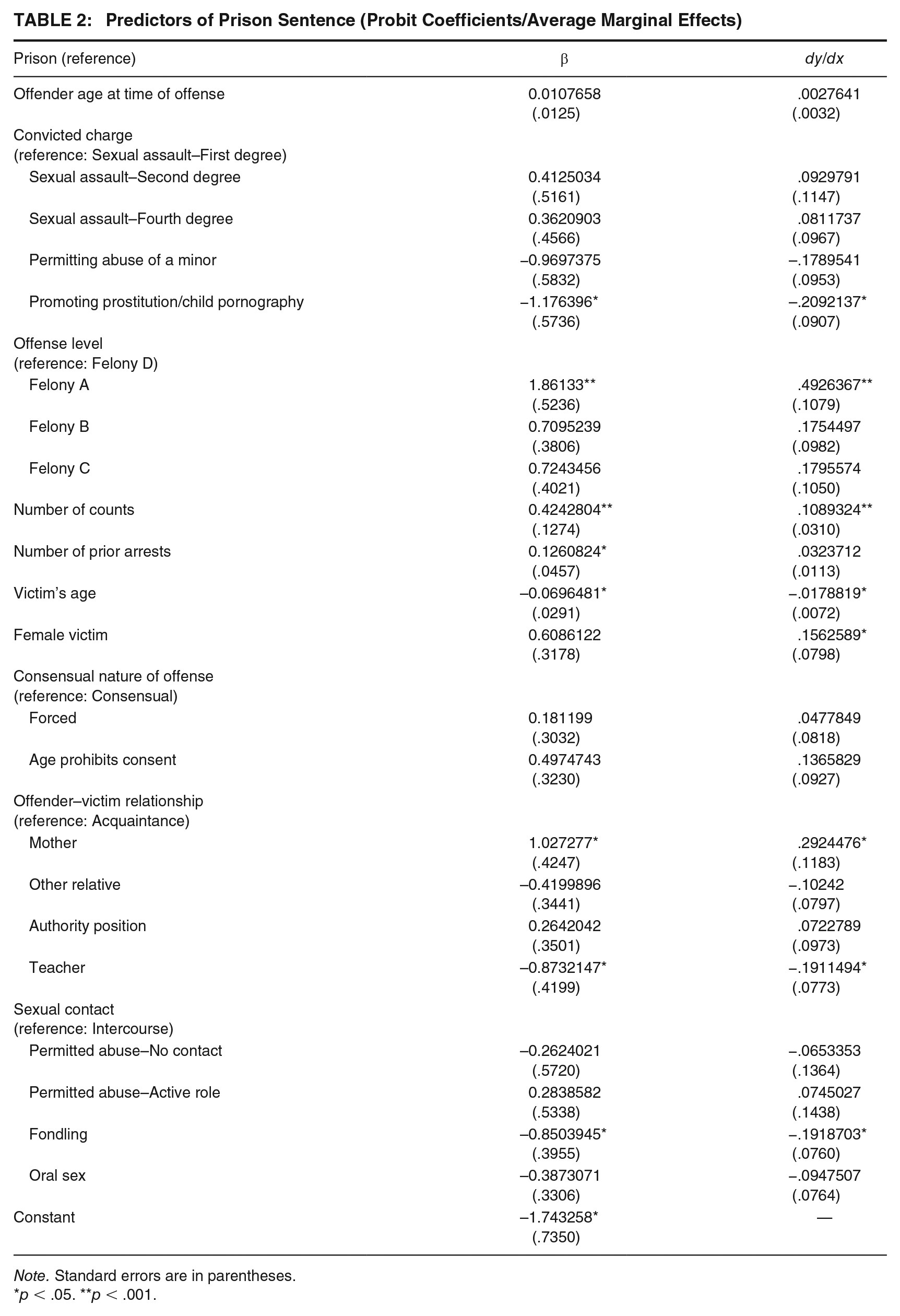
We used probit regression to examine the effects offender, victim, and offense characteristics had on the sentencing severity among females who were convicted of a sex crime. Bushway and colleagues (2007) advised that probit regression, rather than logistic regression, is a more appropriate analytical strategy when examining the binary in/out decision of judges (Bushway et al., 2007). They explained that probit models assume normality, rather than log normality (as in logistic regression), as its functional form (Bushway et al., 2007). Results from the probit model, χ2(252) = 106.50, p < .001, were reported in average marginal effects (AMEs) for greater clarity in interpretation (see Table 2). Unlike reported odds ratios in logit models, results from probit models cannot be converted into odds and the coefficients were not directly interpretable.
Predictors of Prison Sentence (Probit Coefficients/Average Marginal Effects)
Note. Standard errors are in parentheses.
p < .05. **p < .001.
Results
Guided by the focal concerns perspective and the limited research on the sentencing sanctions levied against females convicted of sex crimes, we hypothesized that individuals convicted of more serious offenses (charge and offense level), higher number of charges, and with more prior arrests will have a greater probability of being sentenced to prison. Our results partially supported this hypothesis. We expected that all charges referenced against our most severe convicted charge (sexual assault–first degree) would be significantly less likely to receive an incarcerated sentence. As Table 2 reported, only females charged with promoting prostitution/child pornography were less likely to be sentenced to a period of incarceration (AME = –.207) than those convicted of a sexual assault–first degree. These findings were similar to offense level. Those convicted of a Felony A (the highest offense level) possessed a greater probability (AME = .488) of imprisonment than those convicted of the least severe offense level. The number of counts an individual was convicted for was statistically significant in the judicial decision to incarcerate. For every additional count of conviction, the probability of being sentenced to prison increased by nearly 11%. The number of prior arrests responded in the predicted direction. For every additional prior arrest, the probability of being sentenced to prison increased by 2%.
We also hypothesized that offender and victim demographics were likely to be influential in the decision to incarcerate. Again, we found partial support for this hypothesis. The female’s age and the gender of the victim had no bearing on judges’ sentencing decision, but the victim’s age demonstrated a marginal effect (Table 2). For every year decrease in the victim’s age, the probability of the female receiving a prison sentence increased by 2%.
We analyzed three offense characteristics as additional measures of individual level of dangerousness. We were surprised to find the consensual nature of the offense played no role in judges’ decision to incarcerate. Women who used force or threats to coerce their victims into sexual activity were no more likely to experience a custodial sentence than those who engaged in consensual activity. Furthermore, females who did not explicitly force victims into participation, but offended against children younger than 14 were also no more likely to be sentenced to prison.
Beyond measures of offense seriousness, the offender–victim relationship played the greatest role in the decision to incarcerate. Females who perpetrated a crime(s) against their own child(ren) possessed a probability of a prison sentence 29 percentage points higher than those who victimized acquaintances. Teachers who committed their crime(s) against a student(s) were less likely (AME = .189) to receive a custodial sentence than females who victimized acquaintances. Unexpectedly, the sexual contact between the female and victim indicated little influence in the sentencing decision. Those who permitted abuse, whether active or inactive, were no less likely to be sentenced to prison than women who engaged in sexual intercourse. The same result was found with those who engaged in oral sex with their victims. The probability of a prison sentence, however, decreased by 19 percentage points for those who engaged in sexual fondling with their victim relative to those who engaged in intercourse.
Discussion
The current study sought to fill in a gap in the existing literature on female sex offending by examining the impact offender, victim, and offense characteristics had on judicial sentencing decisions. Guided by the focal concerns perspective, we hypothesized (H1) that women convicted of more serious sex offenses, which include offense charge and level, greater number of charges, and with more prior arrests will have a greater probability of being sentenced to prison. These measures of blameworthiness and culpability are the most often attributed to judicial perceptions of individual level of dangerousness and found to be the strongest predictors of sentence severity (Koons-Witt et al., 2014; Spohn, 2009). This is consistent with the current study as females convicted of more serious offenses, greater number of charges, and a more extensive criminal history experienced a greater probability of receiving a prison sentence. The two variables capturing offense seriousness—convicted charge and offense level—only showed variations at the margins. Those convicted of promoting prostitution/child pornography (the least serious charge) were less likely to be sentenced to prison than those convicted of the most serious charge sexual assault–first degree. Similarly, women convicted of a Felony A possessed a greater probability of being sentenced to a custodial sentence than those convicted of a Felony D. It is, however, worth noting that charges in the middle of the seriousness range were no more or less likely to be sentenced to prison. Individuals’ criminal history and the number of convicted counts were also influential in the sentencing decision. Those with a higher number of prior arrests and current convicted charges had a greater probability of being incarcerated.
Our second hypothesis (H2) posited that offender and victim characteristics will likely influence judicial decisions to incarcerate. We anticipated older women who victimized younger female children to be sentenced more harshly; however, only the age of the victim was predictive of sentencing outcomes. Consistent with prior research, as the victims’ age increased, the probability of an incarceration sentence decreased. As Thompson et al. (2020) noted, individuals who prey on younger children were treated more severely in terms of sentencing outcomes. This finding was also congruent with the offender–victim relationship. At first glance, the connection between victims’ age and offender–victim relationship may be hard to distinguish. Females who victimized or allowed the victimization of their own children had a greater probability of being incarcerated than those who were acquaintances with the victim. Moreover, acquaintances had a greater chance of incarceration than those who identified as teachers. These findings, however, are different from previous research that has found individuals who victimized non-relatives were perceived to be more dangerous and often experienced more severe sentences than those who targeted relatives and/or their own children (Amirault & Beauregard, 2014; Berliner et al., 1995; McCormick et al., 1998; Patrick & Marsh, 2011).
To understand these findings, we ran some additional descriptives and found the victim’s age per offender–victim category was relevant in interpreting these findings. More specifically, the average age of victims, who were victimized by their mothers or cases in which mothers permitted sexual abuse by an accomplice, was approximately 10 years old. The average age of victims who were abused by a relative was 13.25 years old, while the victim’s average age for acquaintances was 14.17 years old. Finally, the average age of victims of those who were in a teacher position was 15.7 years old. These findings indicated that the victim’s age and the relative closeness between women and their victims were important for judges when sentencing females. These findings partially supported our third hypothesis, which posited that women who victimized their own children or students would be less likely to incur a prison sentence. Surprisingly, mothers who victimized or allowed the victimization of their own children had the greatest probability of prison sentence, which contradicted our hypothesis. This could be because in cases where the mother was the perpetrator or accomplice, the victims were younger than other offender categories.
Teachers were the least likely to be sentenced when compared with the other categories. This could be a result of a number of factors. By societal convention and previous research, teacher–student relationships are often viewed as consensual relationships (Mathews et al., 1989; Vandiver & Kercher, 2004) and incidents in which male students brag or take pride in hooking-up with the “hot teacher” (Ratliff & Watson, 2014). These perceptions could have a spillover effect within the courtroom setting. In addition, the average age of victims who were abused by teachers was 15.7 years old, which could have also influenced sentencing decisions. These victims were older than those who were sexually abused by mothers, acquaintances, or relatives. The perceived diminishing culpability of teachers in these cases may be misplaced. Studies have found that teachers can have a profound impact on students as they often serve as role models and can create an atmosphere conducive to fostering academic achievement and efficacy (Graziano et al., 2007). Moreover, research studies have found that teachers who abuse their students often create a hostile and unsafe environment, in which students are manipulated, harassed, and overall adversely affected by this power imbalance (Steely & ten Bensel, 2019). Although the mothers in our sample, who held a position of authority over their victims, had a greater probability of being sentenced to prison, we would argue that teachers should be sentenced similarly as they also possess a level of authority over their students.
We also expected judges would have a greater inclination to protect female victims because they are often viewed as more vulnerable than their male counterparts, which would result in prison sentences for those who victimized females. Furthermore, Walsh (1994) found that individuals who victimized same sex children experienced harsher punishment. Although our analysis did not yield significant results, the coefficient variable moved in the expected direction. It could be that same sex victimization is perceived to be more deviant and carries a greater level of stigma.
Our third hypothesis (H3) asserted that women who used force and engaged in sexual intercourse with their victims would possess a greater probability of a prison sentence. Surprisingly, we found those who used force during the abuse were no more likely to be incarcerated than those who did not use force. Previous research has found that enhanced perceptions of individuals’ level of dangerousness were connected to the force used in the offense (Amirault & Beauregard, 2014; Patrick & Marsh, 2011). The lack of a significant relationship between force and incarceration in this variable could be a result of omitted cases. Due to a lack of variance, we were compelled to drop all convicted rape cases. By definition, these cases contained the most explicit force and violence. The remaining “use of force” cases were notably less violent in nature; thus, may bear little distinction to the other two attributes within the nature of the offense variable as perceived by judges. It is important to remember that all females convicted of rape were sentenced to prison; ultimately, demonstrating the influential significance of the use of force within the sentencing decision.
Guided by the focal concerns perspective, we focused on offender, victim, and offense attributes. Seriousness of offense, number of charges, criminal history, victim demographics, consensual nature of offense, and offender–victim relationship are all attributes that were theoretically relevant to an individual’s blameworthiness and dangerousness. In combination, judges often rely on this social construction of an individual’s level of dangerousness to assess to what extent they must protect the community from these people. Ultimately, judicial consumption of this information results in the harshness of the punishment levied against an offender. As this relates to the current findings, judges perceived women convicted of the more serious offenses, with the greater number of counts and prior arrests, who victimized young children and their own children, to be the most dangerous. Thus, these individuals received the most severe punishment—prison sentence.
Our data derived from a state that legislates specific sentencing guidelines, which are inherently retributive in nature (Berman, 2005; Wilmot & Spohn, 2004). The adoption of sentencing guidelines often replaces the more rehabilitative-aligned sentencing structure of indeterminate sentencing. In states where there is determinate sentencing, such as in the current study, judges are mandated to primarily consider offense severity and criminal history and have limited discretion in sentencing outcomes. Determinate sentencing takes away the option for judges to consider a more individualized metric for sentencing outcomes and specialized treatment options. Research, however, suggests individuals convicted of sex offenses have a low recidivism rate compared with other types of offenders and may pose a limited threat to the community (Hanson & Bussiere, 1998; Sample & Bray, 2003). With this in mind, judicial perceptions of dangerousness may be misguided in the instances of individuals convicted of sex crimes. State legislatures should allow for the consideration of overall criminal risk assessments within sentencing guidelines in an effort to more accurately assess dangerousness.
The focal concerns perspective based on the notion that judges make their assessments of an individual’s level of dangerousness based on limited information availed to them at the time of sentencing is problematic. The constructs of perceived dangerousness (i.e., severity of offense, criminal history) posited by Steffensmeier et al. (1998) do not completely equate to the dangers individuals represent to the community, but are used as part of a perceptual shorthand necessary to make decisions with little information. The sentencing decisions examined for the current study are no different. Judges in this jurisdiction glean offender information through a PSI, which includes information regarding the instant offense, individuals’ criminal history, mental and physical health history, and substance abuse history. Unfortunately, offender risk assessments are not available to judges at the time of sentencing that provide validated risk information to base their decisions and provide a more accurate construct for individual dangerousness.
Judges are primarily concerned with blameworthiness, protection of the community, and practical constraints and consequences when making judicial sentencing decisions (Steffensmeier et al., 1998). Judges can typically assess blameworthiness through the available information they possess (i.e., PSI), while determining the practical constraints and consequences based on their knowledge of resources in their jurisdiction. The protection of the community is grounded in understanding the likelihood that a person will recidivate when released back into the community. Although most judges will have information regarding the offense, criminal history, mental and physical health history, and substance abuse history, offender risk assessments are not a common standard of available information for judges. Risk assessment are typically validated instruments that are used to predict the likelihood of recidivism, assess criminogenic needs, and provide information on the resources people need to avoid recidivism (Andrews & Bonta, 2010; Cohen, 2017). There has also been an abundance of literature that have found that validated risk assessment instruments are better at predicting recidivism than other methods utilized by criminal justice agents (Cohen, 2017; Duwe & Rocque, 2017). The incorporation of risk assessment tools have been increasing in a multitude of contexts within the criminal justice system and should be available and utilized within the context of judicial sentencing (Andrews & Bonta, 2010; Duwe & Rocque, 2017). Future research should replicate this line of research in a state that has adopted a broader use of risk assessments in the sentencing phase of criminal procedure to examine their use and function in judicial sentencing decisions.
Like all research, there are a number of limitations that should be noted. Although the current study encompassed close to two decades of data on females convicted of sex offenses and sentencing outcomes, we are cautious about interpreting our results. When examining sentencing outcomes, previous research has typically looked at sentencing types (i.e., incarceration and community supervision) and the length of sentences levied. Future research should exclusively examine a sample of females convicted of sex offenses in which sentencing type and sentencing length are examined as it relates to factors that measure the dangerousness and culpability of individuals. For the current study, we were only able to examine sentencing types due to low numbers in the number of participants who were sentenced to prison. In addition, close to half of our sample was omitted from the study due to missing data and other methodological issues. Although there were no confounding issues with the retained or missing data, a larger sample size would have been beneficial for our study. A larger sample would have allowed us to examine the two-stage process and potentially enabled us to include a race variable in our multivariate analysis. In addition, we excluded cases in instances where the females and their victims were strangers due to the limited number of cases (n = 6). Future research should attempt to capture these types of cases to better understand the dynamics and sentencing outcomes of women who committed stranger sexual assaults, although this may be difficult as stranger cases are relatively low for females. In addition, we did not control for whether the sample committed their offense alone or with an accomplice. This is a limitation as it could have potentially affected sentencing decisions. Future research should examine whether acting alone versus co-offending with another affects judicial sentencing decisions. Finally, we are cautious about generalizing our findings beyond our sample. The sample in this study consisted of females convicted of a sex offense from one state and those who were assessed for registration and community notification. It excluded females who were still serving a prison sentence and those who were not assessed outside the study’s timeframe.
Regardless of these limitations, our study expanded on previous research in a few distinct ways. We expanded upon the limited research on the sentencing of females convicted of sex crimes by analyzing a robust set of variables in a multivariate analysis that go beyond official charges and offense measures. It is our understanding that this study is the first to examine sentencing outcomes with a female-only population through multivariate analysis. Moreover, we included offender, victim, and offenses characteristics that more accurately captured the nature of offense that is often lost to plea bargaining (Levesque, 2000). By accounting for these characteristics, we gained greater clarity into judicial perceptions of individual level of dangerousness as posited by the focal concerns perspective.
Supplemental Material
sj-docx-1-cjb-10.1177_00938548211032708 – Supplemental material for Sentencing Females Convicted of Sex Offenses: Examining Measures of Perceived Dangerousness and the Decision to Incarcerate
Supplemental material, sj-docx-1-cjb-10.1177_00938548211032708 for Sentencing Females Convicted of Sex Offenses: Examining Measures of Perceived Dangerousness and the Decision to Incarcerate by Benjamin R. Gibbs and Tusty Ten Bensel in Criminal Justice and Behavior
Footnotes

Supplemental Material
Notes
References
Supplementary Material
Please find the following supplemental material available below.
For Open Access articles published under a Creative Commons License, all supplemental material carries the same license as the article it is associated with.
For non-Open Access articles published, all supplemental material carries a non-exclusive license, and permission requests for re-use of supplemental material or any part of supplemental material shall be sent directly to the copyright owner as specified in the copyright notice associated with the article.
