



Abstract
Although the global diffusion of e-mental health has increased in recent years, research on the use of technologies in criminal justice settings is limited. To bridge this knowledge gap, we conducted an international online survey (N = 555) of forensic and correctional mental health professionals from Germany, Switzerland, the United Kingdom, the United States, and 20 additional countries. Telecommunication technologies and mental health platforms had the highest numbers of users, the broadest scope, and the largest increase in use due to the coronavirus disease 2019 (COVID-19) pandemic. In contrast, the use of social media and advanced technologies was lower, narrower in scope, and remained the same or decreased during the COVID-19 pandemic. Respondents’ age, professional discipline, country, and clinical setting significantly predicted total technology use in clinical practice. The study findings provide an overview of the current patterns of technology use and point to opportunities for research and development.
Keywords
Sixteen years ago, the World Health Assembly (2005) acknowledged that information and communication technologies could exert a prominent impact on health systems worldwide and advised its member states to take steps to implement e-health into health care. The benefits of e-health include improved access to health care services, comparable effectiveness to that of in-person services, specific usefulness for underserved areas and populations, high acceptance among service providers and recipients, and reduced costs (Stoll et al., 2020). In the past decade, the adoption of e-health programs to support physical, mental, and social well-being has grown around the world, reflecting an increased interest in this area of service provision (World Health Organization, 2016). The coronavirus disease 2019 (COVID-19) pandemic has further accelerated this trend, as protective measures such as physical distancing have led health care professionals to overcome barriers to e-health and search for virtual alternatives to deliver health care services (Torous et al., 2020). Although such advancements have taken place across fields, adoption rates within forensic and correctional mental health have been found to be lagging behind (Kois et al., 2021).
To date, only a few surveys have been published that explore what technologies mental health professionals are using in criminal justice settings. For example, a study from the United States examined psychologists’ use of social media to obtain additional information about examinees when conducting forensic mental health assessments (Coffey et al., 2018). Another study assessed the use and perceptions of videoconferencing to perform forensic assessments and included both mental health professionals and legal personnel in the United States (Batastini et al., 2019). In addition, a study from the Netherlands investigated the perceived benefits of, barriers to, and recommendations for using various technologies among forensic mental health professionals, patients, and e-health experts (Kip et al., 2020). Finally, a recent study evaluated psychologists’ and psychiatrists’ use of telephone calls and videoconferencing to provide forensic assessment and treatment before and during the COVID-19 pandemic in English-speaking countries (Daffern et al., 2021). None of these studies examined the use of different technologies for different clinical services, among different professional disciplines, and in different countries. The present study aimed to address this gap in the literature.
e-Mental Health
Maintaining an overview of the technologies subsumed under the term e-mental health and their potential applications in forensic and correctional practice is challenging. Some of the difficulty stems from the ambiguous definitions and synonymous use of e-health, telehealth, m-health, and related terms in the literature (Oh et al., 2005; Otto et al., 2018). For the purposes of this study, we adopt the same conceptualization of e-health advocated at the World Health Assembly in 2005, which captures the essence of various other published definitions (e.g., Eng, 2001; Eysenbach, 2001; Mitchell, 1999), and refer to e-health and e-mental health as the use of information and communication technologies for health and mental health. Furthermore, we do not restrict the definition of e-health to specific users (e.g., health care providers, recipients, or organizations), purposes (e.g., clinical, administrative, or educational), or technologies (e.g., the internet or new technologies) to reflect its broad scope (Pagliari et al., 2005).
Telehealth, telemental health, and other tele-terms constitute subcategories of e-health and refer to the provision of health and mental health services using technologies that mediate information processing and communication between health care providers and recipients from one location to another (Doarn et al., 2014; Otto et al., 2018; World Health Organization, 2016). These interactions encompass text, image, audio, and video formats and are either synchronous, meaning that communication partners participate in the conversation at the same time (e.g., telephone calls, videoconferencing, and online chats), or asynchronous, meaning that information is sent and received at different times (e.g., SMS, messaging, emails, and store and forward; American Psychological Association, 2013; Huggins, 2016). Several review articles have explored the clinical and cost-effectiveness of telemental health in forensic and correctional settings with overall positive results (e.g., Batastini et al., 2015; Sales et al., 2018).
Similar to telehealth, m-health and m-mental health are subcategories of e-health, but involve the use of mobile devices such as smartphones, tablets, and fitness trackers (Clough & Casey, 2015; World Health Organization, 2011). Two specific technologies in this area include mobile applications and wearable computers, although mobile devices also enable telecommunication and provide access to social media, websites, and dialogue systems (Luxton et al., 2011; Morris & Aguilera, 2012). In forensic and correctional settings, mobile applications have been tested for the treatment of substance use disorders and the supervision of offenders in the community, providing features such as symptom monitoring, psychoeducation, skills training, feedback, appointment reminders, support groups, and location monitoring (Pattavina & Corbett, 2019; Ross, 2018). Similarly, tablets have been used for computerized self-assessment of risk factors for recidivism and treatment readiness in correctional populations (King et al., 2017).
The overlap and blurred boundaries between different types of technologies make it even more difficult to maintain an overview of e-mental health. Yet one important distinction relates to whether technologies involve communication between humans, as in telehealth, or whether humans interact with computers, as in the mobile applications described above (Barak et al., 2008; Mohr et al., 2013). Human–computer interaction implies that software running on platforms such as personal computers, landline phones, web servers, and mobile devices serves as the health care provider and delivers at least part of the service (Cavanagh & Grist, 2016). For web platforms, these services range from informational websites to online assessments to self-help interventions (Ybarra & Eaton, 2005). In addition, mental health platforms include different levels of human support, ranging from professional- and peer-led services to unguided services (Barak et al., 2009; Fairburn & Patel, 2017). In forensic and correctional settings, a guided web-based intervention adhering to the Risk-Need-Responsivity principles has been developed for individuals under community supervision who have committed sexual offenses against children (Fromberger et al., 2021). In addition, interactive voice response systems have been used to monitor recidivism risk and treat impulsive behavior among supervised offenders and forensic psychiatric outpatients (Andersson et al., 2020; Berman et al., 2012).
Social media and advanced computing systems such as expert systems, virtual reality, augmented reality, wearable computers, and video games are also used for mental health care (Barak et al., 2009). Social media refers to internet platforms that enable users to generate and share content with one another and, like telehealth, involves interaction between humans, either within selected groups or on public websites (Kaplan & Haenlein, 2010, 2014). In criminal justice settings, internet forums have been used for online self-help groups of sexual offenders (Kernsmith & Kernsmith, 2008). Virtual reality applications have been developed to diagnose deviant sexual interests, monitor the behavior of individuals who have committed sex offenses against children in high-risk situations, and treat aggressive behavior in forensic psychiatric inpatients (Fromberger et al., 2018; Klein Tuente et al., 2020; Renaud et al., 2014).
The Present Study
Based on the knowledge gaps in the literature, this study aimed to investigate the following five research questions:
To address these research questions, we conducted an international online survey of psychologists, psychiatrists, social workers, and other professionals to examine the use of telecommunication technologies, social media, mental health platforms, and advanced technologies in forensic and correctional settings.
The findings of this study may have important implications for practice and research. On the one hand, knowledge of what technologies professionals are currently using and for which purposes could increase the perceived usefulness and relevance of these technologies for clinical practice and assist practitioners in their decision to implement e-mental health solutions in criminal justice settings. On the other hand, information about what technologies professionals are using and not using could provide insight into the research and development needs of e-mental health in forensic and correctional settings. As such, the study findings could advance the dissemination and evaluation of technologies in the field and help researchers and software developers create new e-mental health solutions as well as improve existing ones.
Method
Reporting Standards
The Checklist for Reporting Results of Internet E-Surveys (CHERRIES), a 30-item list of web survey characteristics (Eysenbach, 2004), and the Journal Article Reporting Standards for Quantitative Research (JARS-Quant), a set of guidelines for empirical research developed by the American Psychological Association (Appelbaum et al., 2018), were used to improve the transparency and quality of reporting. See Supplemental Table S1 (available in the online version of this article) for additional methodological information.
Respondents
The target population of the online survey was mental health professionals who provide clinical services such as assessments and interventions to criminal justice–involved individuals. Respondents who did not meet the inclusion criteria on the basis of information collected during obtained the survey were determined to be ineligible and, thus, were excluded from the analysis (n = 42). The final sample (N = 555) comprised psychologists (n = 300, 54.05%), psychiatrists (n = 190, 34.23%), social workers (n = 39, 7.03%), and other professionals (n = 24, 4.32%). Twenty-four countries were represented among the respondents, including the United States (n = 136, 24.50%), Germany (n = 124, 22.34%), Switzerland (n = 107, 19.28%), the United Kingdom (n = 91, 16.40%), Austria (n = 37, 6.67%), New Zealand (n = 21, 3.78%), and other countries (n = 37, 6.67%). About one half of the sample worked in forensic and correctional practice for 10 years or less (n = 304, 54.77%), one quarter for 11–20 years (n = 142, 25.59%), one eighth for 21–30 years (n = 73, 13.15%), and one sixteenth for 31 years or more (n = 35, 6.31%). On average, the respondents spent 52.29% (SD = 23.75) of their professional time per week on clinical, 27.63% (SD = 18.57) on administrative, 6.73% (SD = 10.25) on teaching, 4.50% (SD = 10.34) on research, and 8.85% (SD = 14.75) on other activities. Most of the respondents reported psychiatric inpatient facilities as their primary clinical setting (n = 216, 38.92%), followed by correctional facilities (n = 177, 31.89%), psychiatric outpatient facilities (n = 72, 12.97%), private practices (n = 66, 11.89%), community corrections (n = 14, 2.52%), and other settings (n = 10, 1.80%). Three fifths of the sample were female (n = 321, 57.84%) and two fifths were male (n = 233, 41.98%). The age distribution of the respondents was as follows: 29 years or below (n = 69, 12.43%), 30–39 years (n = 168, 30.27%), 40–49 years (n = 120, 21.62%), 50–59 years (n = 108, 19.46%), and 60 years or above (n = 89, 16.04%). The sociodemographic and professional characteristics of survey respondents by country are provided in Table 1.
Sociodemographic and Professional Characteristics of Survey Respondents by Country

Note. The data for other countries are not reported due to the low number of observations. A dash indicates that none of the survey respondents met the specified characteristics.
M (SD) are shown for the average percentage of professional time per week spent on clinical, administrative, teaching, research, and other activities.
Measures
The questionnaire was divided into three sections: sociodemographic and professional characteristics (12 items), prevalence and frequency of technology use (12 items), and user acceptance of technology and digital competence (five items). Apart from the sociodemographic and topic-specific characteristics reported above, the respondents were asked in the first section about the number of years they had worked in their professional discipline, which clinical services they provide, whether they had served as an expert witness in criminal court, and which forensic evaluations they had performed. In the second section, the respondents were asked to indicate whether they had used specific technologies to provide clinical services. Tooltips with definitions and examples were constructed for each of the technologies to avoid ambiguities. Respondents who reported using specific technologies were asked for which clinical services they had used those technologies, how often they had used those technologies in the past 12 months, and how much their use of those technologies had changed due to the COVID-19 pandemic. For mental health platforms and virtual reality, the respondents were asked to specify which software or visual output devices they had used to display the virtual environment. The frequency of technology use was rated on a 7-point Likert scale (1 = never, 2 = very rarely, 3 = rarely, 4 = sometimes, 5 = frequently, 6 = very frequently, and 7 = always). Change in technology use due to the COVID-19 pandemic was also measured on a 7-point Likert scale (1 = greatly decreased, 2 = moderately decreased, 3 = slightly decreased, 4 = remained the same, 5 = slightly increased, 6 = moderately increased, and 7 = greatly increased). Respondents could select the response option “does not apply” if they had not used specific technologies before the disease outbreak.
Procedure
The questionnaire was developed based on a review of the literature on e-mental health, previous surveys of mental health care providers, and recommendations for designing surveys (Dillman et al., 2014). After English and German versions of the questionnaire were created, four experts from the United States, Germany, and Switzerland with expertise in the topic area, target group, or research method provided feedback on the survey instrument. Based on their suggestions for improvement, the survey was revised and subsequently translated into French by a professional translation service (www.multilingua-24.de) specializing in psychology and medicine. The quality of the French version was assessed, errors in translation were identified, and all versions of the questionnaire were checked for consistency. The electronic version was programmed using the Unipark online survey software (Questback, 2020), and prior to the field phase, the survey was tested using various devices, browsers, and user settings. Finally, the questionnaire layout was optimized for mobile devices, including smartphones and tablets.
A nonprobability sampling method was implemented with professional organizations, forensic and correctional institutions, and mental health professionals self-selecting into the study. First, national and international organizations 1 of forensic and correctional mental health professionals in Austria, Germany, New Zealand, Switzerland, the United Kingdom, and the United States were invited to disseminate the online survey among their members. Second, forensic and correctional institutions in Germany and Switzerland were also approached for dissemination based on previously compiled lists, and experts in the field were asked to share the online survey through their professional network. Data were collected between January and March 2021, and potential participants received an invitation to participate in the online survey through email lists, specialist directories, or newsletters. A reminder email was sent to members of the professional associations 2 weeks after the initial email invitation to increase response rates. Of note, we did not have access to the professional associations’ email lists. Instead, the administrators of these email lists sent the solicitations for participation to members through listservs. The participation and completion rates for the online survey were 91.34% and 74.86%, respectively (see Supplemental Table S1). Additional statistics on response metrics are available for the American Psychology–Law Society: Of all initial emails sent, 2.93% (n = 62) were returned as undeliverable, 44.78% (n = 948) of members opened the email, 3.50% (n = 74) clicked on the survey link, and 2.50% (n = 53) submitted completed or partial questionnaires.
The survey invitation included the link to the online survey and information about the purpose of the study, the expected duration (15 min), the voluntariness of participation, the confidentiality of responses, incentives for participation, and contact details of the investigator. Respondents who completed the questionnaire and provided their email address along with their voluntary informed consent had the opportunity to take part in a drawing for three cash prizes, each valued at 50 euros. This study complied with the General Data Protection Regulation of the European Union (2016) and was determined to be exempt from review by the Advarra Institutional Review Board (Protocol Number: Pro00049609).
Statistical Analysis
The statistical analysis was performed through Stata (StataCorp, 2019) and involved the following two steps. Descriptive statistics and frequency distributions were used to describe the demographic and professional characteristics of survey respondents and to analyze Research Questions 1 to 4. Negative binomial regression was conducted to predict total technology use in clinical practice (the number of technologies used in the past 12 months) based on sex (male or female), age (29 years or below, 30–39 years, 40–49 years, 50–59 years, and 60 years or above), professional discipline (psychology, psychiatry, or other disciplines), country (Germany, Switzerland, the United Kingdom, the United States, or other countries), and primary clinical setting (psychiatric inpatient facilities, psychiatric outpatient facilities, private practices, correctional facilities, or other settings). Negative binomial regression is the standard statistical method for analyzing overdispersed count data and is often appropriate for statistical modeling in forensic and correctional research contexts (Walters, 2007).
Results
Missing Data
Consistent with the recommendations of the American Association for Public Opinion Research (2016), questionnaires were classified as complete (i.e., the last questionnaire page was submitted), partial (i.e., the questionnaire was discontinued after answering the items required for the first research question), and dropout (i.e., the questionnaire was discontinued before meeting this criterion). Complete (n = 502) and partial questionnaires (n = 53) were analyzed, whereas dropouts (n = 125) and observations with high amounts of missing data (n = 6) were excluded from the analysis. The amount of missing data was less than 2% for all items except the number of technologies used in the past 12 months (n = 34, 6.13%), a composite variable constructed from frequency of technology use, the items regarding the specific mental health platforms used (n = 146, 26.31%), and the clinical services for which technologies were used (maximum: n = 44, 7.93%). Possible reasons for missing data were ineffective organization of response options, open-ended question formats, increased item complexity, and respondents’ misinterpretation of certain concepts. For the regression analysis, the pattern of missing data was analyzed using Little’s test of missing completely at random, χ2(25, N = 555) = 28.78, p = .273. The statistically nonsignificant result suggests that the probability that missing values were related to other variables in the data set was less than .05 (Tabachnick & Fidell, 2014).
Descriptive Statistics
Respondents used an average of 3.62 (SD = 2.47, range = 0–13) technologies to provide clinical services in their lifetime, with telecommunication technologies (62.11%) accounting for the largest proportion in the summed technology use, followed by mental health platforms (29.14%), social media (5.57%), and advanced technologies (3.18%). Similarly, nine in 10 mental health professionals used at least one technology (n = 501, 90.27%) in clinical practice, about nine in 10 used telecommunication technologies (n = 482, 86.85%), one in two used mental health platforms (n = 296, 53.33%), one in 10 used social media (n = 73, 13.15%), and one in 10 used advanced technologies (n = 53, 9.55%). The lifetime prevalence and frequency of technology use in the past 12 months for the full sample are provided in Table 2.
Lifetime Prevalence and Frequency of Technology Use in the Past 12 Months (N = 555)

Frequency of use was rated on a 7-point Likert scale (1 = never, 2 = very rarely, 3 = rarely, 4 = sometimes, 5 = frequently, 6 = very frequently, and 7 = always). bTwo in three virtual reality users used head-mounted displays as visual output devices, whereas one in three used monitors and projectors to display the virtual environment.
In total, the highest numbers of users were reported for telecommunication technologies and mental health platforms, including telephone calls, videoconferencing, emails, websites, computer applications, and mobile apps. In contrast, the lowest numbers of users were reported for social media and advanced technologies, including augmented reality, wearable computers, blogs, virtual reality, content communities, and virtual worlds. In Supplemental Tables S2 to S5 (available in the online version of this article), the lifetime prevalence of technology use of survey respondents by age group, country, professional discipline, and clinical setting is provided. Across groups, the ranking of the highest and lowest numbers of users for technologies is largely consistent, with only minor changes in order. As shown in Table 2, the only technology that respondents indicated using frequently in the past 12 months was videoconferencing, whereas telephone calls, emails, expert systems, wearable computers, and computer applications were used only sometimes. All other technologies were used rarely, with blogs, video games, and virtual reality used very rarely.
Respondents who used specific technologies were also asked how much their use had changed due to the COVID-19 pandemic. As illustrated in Figure 1, for most technologies, the largest proportion of mental health professionals reported that their use had not changed due to the COVID-19 pandemic. However, for telecommunication technologies (except for SMS), computer applications, mobile apps, and social networks, the largest proportion of mental health professionals indicated that their use increased due to the health crisis, with 62.50% of videoconferencing users and 25.29% of telephone users reporting that their use of these technologies increased greatly. The only two technologies that experienced an average and median decrease in use due to the COVID-19 pandemic were augmented reality (M = 2.67, Mdn = 3.00, SD = 1.53) and virtual reality (M = 3.00, Mdn = 3.00, SD = 1.10), although these results should be interpreted with caution due to the low numbers of users.
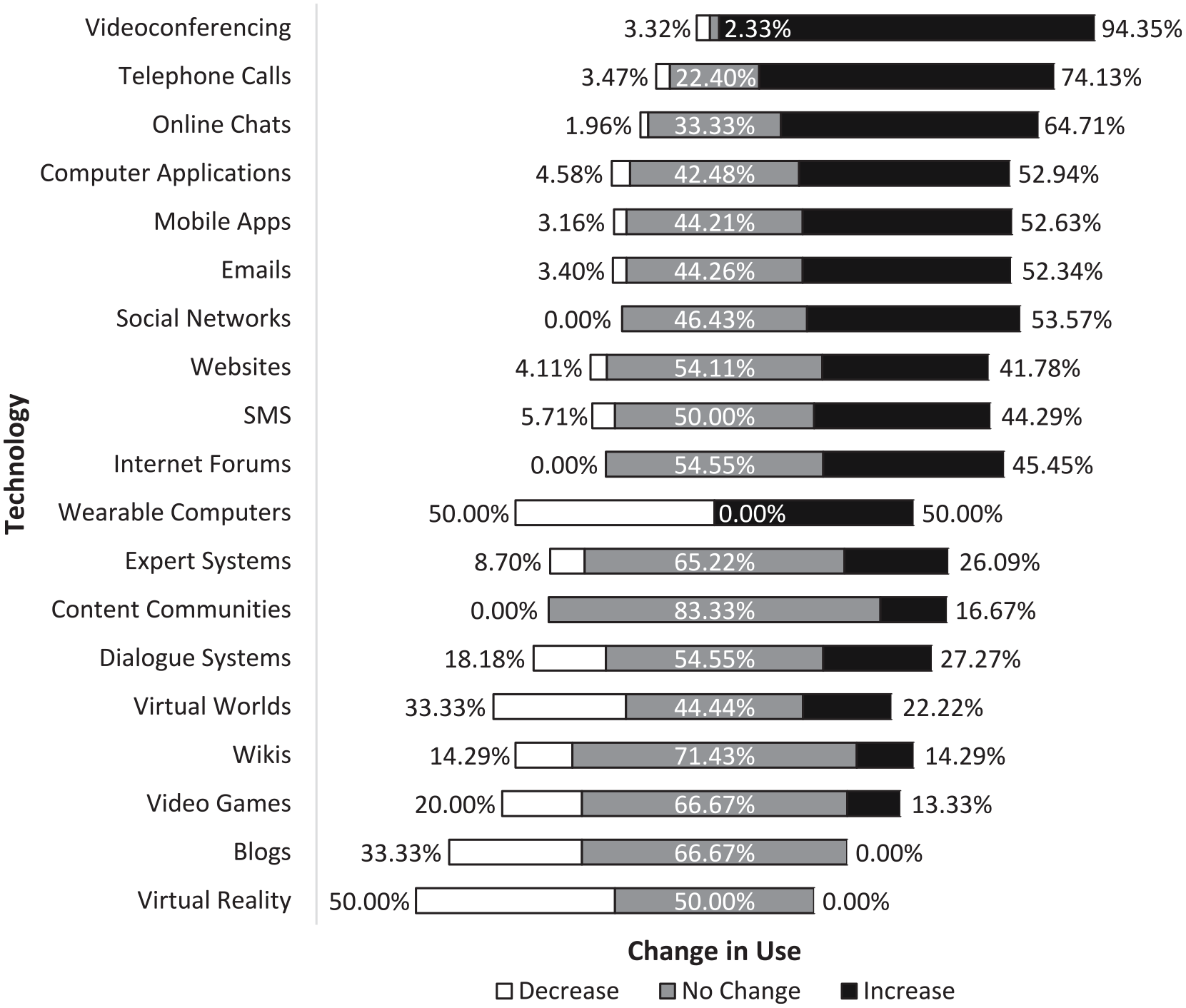
Changes in Technology Use Due to the COVID-19 Pandemic in Rank Order (N = 555)
A software list, compiled from reviews of health care associations and online directories from which respondents could select, was provided along with an open text field to determine which specific mental health platforms were used in clinical practice. Of that list, the highest numbers of users were reported for Headspace (n = 69, 12.43%), Moodgym (n = 18, 3.24%), Breathe2Relax (n = 18, 3.24%), Stop, Breathe & Think (n = 17, 3.06%), CBT-I Coach (n = 15, 2.70%), and Medisafe (n = 14, 2.52%). Many of the applications mentioned in the open text field were telehealth (e.g., Cisco Webex, Doxy.me, and Zoom) or practice management software (e.g., PointClickCare, SimplePractice), although these do not provide mental health care and thus should not be referred to as mental health platforms. Other prevalent categories included mindfulness (e.g., Buddhify, Calm, and 7Mind), mental wellness (e.g., Healthy Minds Program, NeuroFlow), and cognitive training software (e.g., Cogpack, Lumosity, and NeuroNation). While few applications targeted specific mental or physical conditions, software for anxiety disorders, posttraumatic stress disorder (PTSD), schizophrenia, sleep disorders, and erectile dysfunction was mentioned (e.g., Unwinding Anxiety, PTSD Coach, MKT & Mehr, Sleepio, and Regimen). In addition, some of the applications focused on screening and assessment (e.g., MyDrinkControl, True Color), including online versions of risk assessment tools, while others were developed for health care providers (e.g., MediQ, Pschyrembel Online). None of the mental health platforms listed were specifically designed for use by criminal justice–involved individuals.
Table 3 shows the lifetime prevalence of technology use for specific clinical services for the full sample. Of those respondents who reported the purposes of their technology use (n = 479, 86.31%), assessment was the most common clinical service (n = 346, 72.23%), followed by crisis interventions (n = 199, 41.54%), psychoeducation (n = 181, 37.79%), psychotherapy (n = 174, 36.33%), counseling (n = 134, 27.97%), pharmacotherapy (n = 103, 21.50%), and other services (n = 164, 34.24%). In contrast to telecommunication technologies and mental health platforms, social media and advanced technologies were not used across the spectrum of clinical services. Some of the patterns of technology use warrant further attention.
Lifetime Prevalence of Technology Use for Specific Clinical Services (N = 555)

Note. The relative frequencies are based on survey respondents who used the respective technologies. The data for technologies with high amounts of missing values are not reported. A dash indicates that the technology was not used for the specified clinical service.
Relative to their respective total number of users, expert systems, videoconferencing, and computer applications were commonly used for assessment; telephone calls and dialogue systems were commonly used for crisis interventions; and virtual reality and video games were commonly used for assessment and psychotherapy. In addition, frequent uses of social media included psychoeducation and counseling, whereas frequent uses of mobile apps and websites encompassed assessment and psychoeducation. Most other uses of technologies mentioned did not involve direct services but included administration, consultation to other professionals and organizations, and training and supervision. However, the most prevalent other clinical service, for which technologies were used, was related to the social support network.
Regarding forensic evaluations, 38.02% (n = 211) of respondents used technologies for this purpose. Technologies were used for risk assessment (n = 169, 30.45%), competency to stand trial (n = 103, 18.56%), criminal responsibility (n = 101, 18.20%), and other evaluations (n = 42, 7.57%). To provide context, more than half of the sample served as an expert witness in criminal court cases (n = 315, 56.76%) and the forensic evaluations performed included risk assessment (n = 287, 51.71%), criminal responsibility (n = 253, 45.59%), competency to stand trial (n = 221, 39.82%), and other evaluations (n = 103, 18.56%). Onefourth of respondents used synchronous audio and/or video communication for risk assessment (n = 146, 26.31%), while onesixth used this form of telecommunication to evaluate competency to stand trial (n = 100, 18.02%) and criminal responsibility (n = 93, 16.76%). One third of expert system users (n = 11, 37.93%) reported using the technology for forensic evaluations, and onethird of virtual reality users (n = 2, 33.33%) reported using the technology for risk assessment.
Negative Binomial Regression
In Table 4, the results are provided of the negative binomial regression model, predicting the number of technologies used in the past 12 months. Although respondents’ sex, did not predict the number of technologies used in clinical practice, χ2(1) = 0.30, p = .582, their age, χ2(4) = 9.55, p = .049, professional discipline, χ2(2) = 6.81, p = .033, country, χ2(4) = 14.29, p = .006, and clinical setting, χ2(4) = 27.21, p < .001, were statistically significant predictors of total technology use, χ2(15, N = 515) = 73.26, p < .001. Holding constant all other variables in the regression model, the expected number of technologies used by mental health professionals aged between 40 and 49 years was 1.28 times the expected number of technologies used by those aged 29 years or below. Furthermore, being between the ages of 40 and 49 years or 50 and 59 years increased the expected number of technologies used by a factor of 1.25 or 1.21, respectively, compared with being between the ages of 30 and 39. Although there were no statistically significant differences between psychologists and psychiatrists, the regression model estimated that other professionals (e.g., social workers and nurses) used 32.44% more technologies than psychologists. Furthermore, no statistically significant differences were observed between countries except for Switzerland: Compared with Germany and the United Kingdom, working in Switzerland decreased the expected number of technologies used in clinical practice by 22.00% and 36.91%, respectively. Finally, working in psychiatric outpatient facilities and private practices was related to higher total technology use compared with psychiatric inpatient facilities, whereas working in correctional facilities was related to lower total technology use compared with psychiatric inpatient facilities, psychiatric outpatient facilities (incidence rate ratio [IRR] = 0.64, p < .001), and private practices (IRR = 0.65, p = .001).
Results of the Negative Binomial Regression Model Predicting the Number of Technologies Used in the Past 12 Months (N = 515)

Note. Reference categories of predictor variables are shown in parentheses. % = percent change in the expected number of technologies used between two groups. IRR = incidence rate ratio; CI = confidence interval.
Model fit was compared for the Poisson, negative binomial, and zero-inflated negative binomial models. The statistically significant result of the likelihood ratio test indicated that the negative binomial model fit the data better than the Poisson model, G2 = 43.74, p < .001. In contrast, comparative statistics of the negative binomial and zero-inflated negative binomial model were inconsistent, with the Akaike information criterion favoring the latter model and the Bayesian information criterion favoring the former model. However, because the observed number of zeros was only 3.45% higher than the expected number of zeros in the negative binomial model, the less complex model seemed preferable.
Discussion
The results indicate that telecommunication technologies and mental health platforms were the most common types of technologies used in forensic and correctional practice, while also showing the largest increase in use due to the COVID-19 pandemic. In contrast, the use of most social media and advanced technologies either remained the same or decreased since the disease outbreak, and few mental health professionals used them to provide clinical services to criminal justice–involved individuals. Despite the high prevalence rates reported for some technologies, videoconferencing was the only technology that respondents used frequently in the past 12 months, whereas all other technologies were used sometimes, rarely, or very rarely. Although mental health platforms have found their way into clinical practice, none of the software that respondents mentioned was developed specifically for forensic and correctional populations. With few exceptions, technologies were used for the full range of clinical services, including forensic evaluations, but some technologies were preferred for certain purposes.
The statistical analysis revealed that age, professional discipline, country, and clinical setting predicted the number of technologies used in clinical practice. In comparison with forensic and correctional mental health professionals in middle adulthood, those in early adulthood used fewer technologies in clinical practice. In addition, mental health professionals in Switzerland used fewer technologies than those in Germany and the United Kingdom. Except for Switzerland, this study did not demonstrate differences in total technology use between countries although the prevalence rates for specific technologies might have differed across countries. However, the data suggest that mental health professionals working in open settings used more technologies than those working in closed settings. In the following sections, these key findings are placed into the context of previous research on e-mental health.
Several factors might explain the high prevalence rates reported for telecommunication technologies and the large increase in use due to the COVID-19 pandemic. Telemental health offers many advantages to criminal justice settings, including improved access to mental health care, high user satisfaction, increased security for all parties, enhanced continuity of care after discharge, and reduced costs (Batastini et al., 2013; Kaftarian, 2020). During the coronavirus pandemic, telecommunication technologies had the added benefit of allowing mental health professionals to provide the same services as usual while keeping physical distance (Hewson et al., 2021; Whaibeh et al., 2020). Adherence to protective measures was of great importance in criminal justice settings because incarcerated individuals are at higher risk of contracting infectious diseases compared with the general population (Akiyama et al., 2020; World Health Organization, 2021). In some jurisdictions, the use of telecommunication technologies has been the only means to provide mental health services to criminal justice–involved individuals and prevent existing gaps in health coverage from widening (Kois et al., 2021).
In addition to the high utility of telemental health, the different stages of development of technologies might also have contributed to their varying levels of use. Whereas the first telemental health programs were introduced into criminal justice settings in the 1990s (Deslich et al., 2013), artificial intelligence, extended reality, and the Internet of Things are more recent developments in the field. At the moment, these innovations meet the definition of emerging technologies and, unlike telecommunication technologies, are still in the process of coming into existence (Rotolo et al., 2015). Many of the barriers to implementing telemental health were overcome before the COVID-19 pandemic, and the remainder were addressed in the meantime (Pierce et al., 2021). Specific measures taken included establishing an evidence base, offering training programs, publishing practice guidelines, addressing issues related to health insurance coverage, and regulating cross-border practice (Pierce et al., 2021; Torous et al., 2020). In contrast, many barriers to implementing the other types of technologies still remain. For example, although virtual reality has become more affordable in recent years, the costs for hardware acquisition and software development are still an important barrier for many criminal justice agencies (Ticknor, 2019). Yet two possible strategies to overcome this barrier would be to evaluate the cost-effectiveness of virtual reality and to share the costs of procuring and developing these systems between organizations (Kip et al., 2020).
Apart from these findings, the differences in total technology use between age groups, countries, and clinical settings require some explanation. The positive relationship between age and technology use is unexpected. Based on education research, the assumption that younger generations use more technologies than older generations seems reasonable (Prensky, 2001). However, the finding of this study is consistent with previous work from the United States that examined psychologists’ use of telecommunication technologies in clinical practice and found that the proportion of telemental health users is higher in older age groups than in younger age groups (Glueckauf et al., 2018). Although the authors of that previous work do not provide an interpretation for this result, their data also suggest that older age groups hold fewer ethical concerns regarding telemental health and are more familiar with relevant laws and regulations. Another study demonstrated that factors other than age (e.g., scope of use, experience, self-efficacy, and level of education) are also important determinants of technology use (Helsper & Eynon, 2010). Therefore, other factors could influence the relationship between age and technology use, and future research should explore the factors which best explain individual differences in technology use. For example, middle-aged mental health professionals might have more decision-making authority in their jobs compared with those in early adulthood and, given their experience, might be more open to testing new service-delivery modalities.
Apart from age groups, there were also differences in total technology use between countries. One reason for the higher levels of technology use in Germany and the United Kingdom might relate to the favorable conditions that both countries have created for e-mental health. In Germany, the Digital Health Care Act, which entered into force in 2019, promotes access to electronic health records, expands the range of telehealth services, and regulates the prescription and reimbursement of digital health apps (Bundesministerium für Gesundheit, 2020). In the United Kingdom, regulatory bodies and professional associations have published guidelines, health care organizations have provided information and resources on e-health, the same laws that regulate in-person services extend to remote service provision, and the national health insurance covers telehealth services (Bodulovic et al., 2020). Besides, during the current health crisis, the infrastructure for telehealth was expanded and all correctional facilities in England were equipped with network-enabled tablets (Edge et al., 2020).
The finding that technology use was less prevalent in correctional facilities than in other clinical settings provides further evidence of the digital divide. Incarcerated individuals have less access to digital technologies than the general population, which also limits opportunities for communication with mental health professionals over distance and hinders software-guided service provision (see Jewkes & Reisdorf, 2016). Several factors contribute to this digital divide, however, the most important ones include security concerns, fear of misuse of digital services for criminal activities, and low public acceptance of granting incarcerated individuals access to digital devices (Lindström & Puolakka, 2020). By contrast, forensic outpatients and supervised offenders live in freedom and therefore have access to the same technologies as the general population, which also creates greater opportunities for e-mental health.
Limitations
This study has several limitations that are relevant to the results and their interpretation, including coverage, sampling, nonresponse, and measurement error (see Dillman et al., 2014). As there was no sample frame of all forensic and correctional mental health professionals, email lists were used to disseminate the online survey. Even if this distribution method covered large segments of the survey population, individuals who did not have an email address or did not agree to receive emails requesting participation in research were not included on these email lists. Furthermore, members of professional associations might have differed on relevant characteristics from nonmembers. As representative probability samples were not available for comparison, assessing the extent to which the sample corresponded to the larger population was not possible. Nonetheless, most mental health professionals were expected to have email access and the technical skills necessary to complete the online survey. In addition, coverage error should have been reduced in the samples from Germany and Switzerland because more comprehensive recruitment strategies were employed in these countries.
Besides, this study relied on nonprobability convenience sampling of individuals who volunteered to participate. Sample members who used technologies to provide clinical services might have been more likely to participate in the online survey than those who did not use technologies. Hence, the reported prevalence rates may overestimate actual technology use in the target population. Although the available response metrics speak to the data quality, the possibility that nonresponse error affected the results cannot be eliminated. Also, due to the sampling method implemented, standard response rates such as those defined by the American Association for Public Opinion Research (2016) could not be calculated because the number of sample members eligible to participate in the online survey was unknown. Furthermore, the open-ended responses suggest that respondents’ interpretation of some technological concepts, such as mental health platforms and social networks, might have differed from the definitions provided in the online survey. These measurement errors seem inherent to e-mental health as inconsistent definitions, specialist terms originating from computer science, and new words that have not yet entered common use characterize this subject area (cf. Oh et al., 2005; Otto et al., 2018). Overall, the potential sources of bias limit the generalizability of the findings, and readers should view the results as tentative until future studies provide replication.
Study Implications
Although the diffusion of e-mental health has increased in recent years (World Health Organization, 2016), there is limited research on the use of technologies in criminal justice settings. The present study aimed to bridge this knowledge gap by exploring current patterns of technology use among forensic and correctional mental health professionals and the impact of the COVID-19 pandemic on e-mental health. Strengths of this study include its large sample size and broad focus on different technologies, professional disciplines, clinical settings, and countries. The study implications are relevant for practice and research.
First, the findings provide an overview of what technologies forensic and correctional mental health professionals are currently using in clinical practice and for which purposes they are using those technologies, thus addressing an important barrier to the adoption of e-mental health identified in the literature (Kip et al., 2020). Technologies offer great potential for the criminal justice system that extends beyond the current COVID-19 pandemic. In addition to the advantages already mentioned, e-mental health could help tailor interventions to specific individuals, increase patient motivation and adherence, ensure that interventions are delivered as intended, and save time for professionals (Kip et al., 2018). Moreover, technologies such as virtual reality allow professionals to observe human behavior in realistic environments and enable criminal justice–involved individuals to practice new skills without putting others in danger (Fromberger et al., 2014). As such, e-mental health could help address some of the challenges of service-delivery in forensic and correctional settings (Kip et al., 2018).
Besides providing an overview, the current pattern of technology use also points to opportunities for research and development. At present, few forensic and correctional mental health professionals use social media and advanced technologies to provide clinical services to criminal justice–involved individuals. Professionals’ reluctance to adopt these technologies might reflect the limited empirical research in these areas. Previous studies indicate that mental health platforms for criminal justice–involved individuals have already been developed (cf. Fromberger et al., 2021; Ross, 2018). However, the data suggest that these software solutions have not yet found their way into forensic and correctional practice. Instead, professionals turn to mental health platforms from other psychological and medical disciplines, and this approach is not without its problems. Due to the specificities of forensic and correctional populations and settings, research on e-mental health based on the general population may not generalize to criminal justice–involved individuals (Kois et al., 2021). Future studies should establish an evidence base for mental health platforms from both forensic and other disciplines.
The finding that technologies were used across the spectrum of clinical services further highlights the considerable potential that e-mental health offers for criminal justice settings. The frequent use of some technologies for specific purposes could reflect their usefulness for these tasks and guide software developers, researchers, and practitioners in creating, evaluating, and implementing e-mental health solutions. Eventually, the differences in the number of technologies used in clinical practice between age groups, professional disciplines, countries, and clinical settings merit further study. Future research should explore the factors that might explain these differences in total technology use as this information could inform targeted measures to promote the dissemination of e-mental health in the field.
Supplemental Material
sj-docx-1-cjb-10.1177_00938548211042057 – Supplemental material for International Survey on the Use of Emerging Technologies Among Forensic and Correctional Mental Health Professionals
Supplemental material, sj-docx-1-cjb-10.1177_00938548211042057 for International Survey on the Use of Emerging Technologies Among Forensic and Correctional Mental Health Professionals by Madeleine A. Kirschstein, Jay P. Singh, Astrid Rossegger, Jérôme Endrass and Marc Graf in Criminal Justice and Behavior
Footnotes
Acknowledgements
The authors thank Dr. André Tatjes for his feedback on the survey instrument and Dr. Leonel da Cunha Gonçalves for his advice on the statistical analysis.
The authors have no known conflict of interest to disclose.

Supplemental Material
Notes
References
Supplementary Material
Please find the following supplemental material available below.
For Open Access articles published under a Creative Commons License, all supplemental material carries the same license as the article it is associated with.
For non-Open Access articles published, all supplemental material carries a non-exclusive license, and permission requests for re-use of supplemental material or any part of supplemental material shall be sent directly to the copyright owner as specified in the copyright notice associated with the article.
