



Abstract
While investigations examining the effects of direct and vicarious police stops on youth attitudes toward the police have been limited, even less research has explored how these processes vary by race/ethnicity. Thus, this study uses the Fragile Families and Child Wellbeing Study (FFCWS) to examine how race/ethnicity shapes: (1) the relationship between direct and vicarious police stops and youth attitudes toward police and (2) how the contextual nature of these stops (intrusiveness) influence youth perceptions of police. The results suggest that direct and/or vicarious police contact can generate negative attitudes toward police among black, Hispanic, and in some cases, white youth, though these effects vary across type of police stop and type of attitude. When a direct stop involved more officer intrusiveness, black youth reported less respect and more negative perceptions of procedural justice. As such, policymakers and criminologists should consider how race/ethnicity influences youth attitudinal responses to police encounters.
Recent national data on public–police contact show that adolescents and young adults aged 16 to 24 years are more likely to experience police contact than any other group, making up 41.3% of the roughly 53 million U.S. residents who had contact with police in 2015 (Davis et al., 2018). While youth account for a significant proportion of encounters with the police, less than 1% of law enforcement training focuses on interactions with juveniles (Bostic et al., 2015). Given the frequency of interaction, research examining the role of youth encounters with police on perceptions of police legitimacy is imperative.
Substantial research on perceptions of and attitudes toward police has shown consistent variation in attitudes across demographic characteristics (e.g., age, gender, and race/ethnicity; Fine, Donley, et al., 2020; Murphy, 2015), individual experiences (e.g., type of police encounter and nature of police stop; Harris & Jones, 2020; Lim & Lee, 2021), and neighborhood contexts (Brunson & Weitzer, 2009; Taylor et al., 2015). For example, compared to adults, youth attitudes toward police tend to be more negative (Hurst & Frank, 2000), with the levels of negativity increasing during late adolescence (Fagan & Tyler, 2005; Fine, Padilla, et al., 2020). Moreover, black youth tend to be less supporting and less trusting of police than their white counterparts (Fine, Donley, et al., 2020; Fine Padilla, et al., 2020; Sanden & Wentz, 2017; Slocum & Wiley, 2018; Zhang et al., 2020). Furthermore, while less scholars have examined Hispanic youth attitudes toward police, studies have shown that their perceptions of police are generally lower than that of white youth, but higher than that of black youth (Rengifo & McCallin, 2017; Slocum & Wiley, 2018; Wu et al., 2015). Although race/ethnicity has been of interest in research examining youth attitudes toward police, questions still remain as to how various types of police encounters shape attitudes toward police by race/ethnicity. Understanding how responses to police encounters may differ for racial/ethnic groups can have significant implications for policing policy and practice.
As youth are in a malleable stage of life, experiences with police officers can be remarkably formative. As such, the type of police encounter, whether direct or vicarious (knowing someone who has been stopped by the police) can have detrimental consequences for youth, such as posttraumatic stress (Gearhart et al., 2021), worse self-reported health (McFarland et al., 2019), increased legal cynicism (Geller & Fagan, 2019), and later arrests (McGlynn-Wright et al., 2020). Moreover, encounters with police can significantly affect youth respect and confidence in law enforcement (Brick et al., 2009; Harris & Jones, 2020; Hurst, 2007; Sanden & Wentz, 2017); and insights from procedural justice research indicates that how youth are treated during a police stop can significantly influence their perceptions of and attitudes toward police (Friedman et al., 2014; Harris & Jones, 2020).
While a growing body of literature considers the role of police stops in youth perceptions of and attitudes toward police, studies that consider the effects of both direct and vicarious police stops have been limited (for exceptions see Friedman et al., 2014; Harris & Jones, 2020; Sanden & Wentz, 2017) and even fewer studies have considered how race/ethnicity shape these processes. Indeed, most studies tend to focus on the effect of direct police stops (positive or negative) on attitude formation, with fewer studies focused on the effect of vicarious police encounters in youth perceptions of police, though those that do suggest that vicarious police stops play a crucial role in attitude formation (Brunson, 2007; Lim & Lee, 2021; Sanden & Wentz, 2017). Using data from the Fragile Families and Child Well-Being Study (FFCWS), a national urban birth cohort, this study aims to address this important gap in the policing literature by examining how race/ethnicity shapes: (1) the relationship between direct and vicarious police stops and youth attitudes toward police and (2) how the contextual nature of these stops influence youth perceptions of police.
Literature Review
Direct and Vicarious Police Stops and Youth Attitudes Toward Police
Millions of adolescents’ experience police-initiated face-to-face contact with the police each year (Davis et al., 2018). In response to this trend, a growing body of literature has examined whether police stops have a positive or negative effect on youth perceptions of and attitudes toward police (Brick et al., 2009; Friedman et al., 2004; Harris & Jones, 2020; Hurst, 2007). However, findings are mixed, some studies suggest that direct police stops have a positive effect on perceptions and attitudes toward the police (Brick et al., 2009; Harris & Jones, 2020; Tyler, 2006), while other studies find that direct police stops are strongly associated with negative attitudes toward police (Lim & Lee, 2021; Sanden & Wentz, 2017). Yet, contact with police can also be experienced vicariously through observed police interactions. Youth experience police contact through family members, neighbors, and peers that may further shape their perceptions of police (Brunson & Weitzer, 2009; Sanden & Wentz, 2017). In fact, studies suggest that vicarious police encounters may be a more common occurrence during adolescence than direct police encounters (Gau & Brunson, 2010) and are significantly related to youth attitudes toward police (Harris & Jones, 2020; Hurst et al., 2000). More specifically, findings among both adults and adolescents indicate the vicarious experiences with police can be more impactful on negative perceptions of and attitudes toward police than direct experiences (Hurst & Frank, 2000; Lim & Lee, 2021; Rosenbaum et al., 2005). For example, Rosenbaum and colleagues (2005) found that direct experiences with police did not lead to any substantive changes in attitudes, while vicarious contact did predictably affect negative attitudes toward police over the course of a year. On the contrary, Harris and Jones (2020) found using data from the FFCWS that both direct and vicarious police stops were associated with lower levels of respect and confidence in the police among youth and increased perceptions of procedural justice.
It is important to note that attitudes toward police are not only a function of the type of police stop but are also shaped by respondents’ treatment by the police during encounters (i.e., intrusiveness and procedural justice). Procedural justice theory maintains that the effect of police stops on attitudes toward police is dependent upon the persons’ perceived fairness of their exchange with the officer (Tyler, 2006). When people view police decision-making as fair and impartial, and when they perceive that they are being treated with dignity and respect, they are more likely to report positive views of the police (Skogan, 2005). Research suggests, however, that negative encounters are significantly more impactful than positive encounters (Skogan, 2005, 2007). In other words, the relationship between how people are treated and their general confidence in the police may be asymmetrical, rather than balanced. For example, Skogan (2007) found that a police encounter that is perceived as unfair will have up to nine times greater effect on the attitude of an individual toward law enforcement than one encounter that is perceived as fair. Other studies show that stop intrusion, which includes disrespectful treatment, harsh/insulting language, patting/frisking, threats of force, and use of force during the police stop undermine legitimacy of police (Harris & Jones, 2020; Kramer & Remster, 2018).
Race/Ethnicity, Police Stops, and Attitudes Toward Police
Relative to other demographic characteristics, a person’s racial background has been one of the most consistent predictors of attitudes toward police. In general, existing research has largely focused on the experience of black individuals, showing that they have less favorable views of the police than white individuals (Dennison & Finkeldey, 2021; Kramer & Remster, 2018; Peck, 2015; Weitzer & Tuch, 2004; Wheelock et al., 2019). Moreover, Hispanic individuals’ support for the police tends to be lower than that of white individuals yet higher than that of black individuals (Ekins, 2016).
Much of the research examining perceptions of and attitudes toward police by race/ethnicity has focused on adult samples, with less focus on youth. Although studies in this growing area of research have produced some contradictory results: that black and/or Hispanic youth view police less favorably than white youth (Fine, Donley, et al., 2020; Fine, Padilla, et al., 2020; Slocum & Wiley, 2018; Wu et al., 2015; Zhang et al., 2020), that Hispanic youth view the police similar to white youth (Romain & Hassell, 2014), that race/ethnicity has no impact on perceptions of police (Friedman et al., 2014; Hurst et al., 2000), or that while black youth are more likely than Latino youth to have police encounters, Latino youth are more likely to react negatively to those encounters than black youth (Hagan et al., 2005). Thus, further research is needed to explore youth attitudes toward police by race/ethnicity.
When it comes to direct encounters with the police, black male youth ages 10 to 24 are the most likely to be stopped and frisked (Brunson, 2007; Hayle et al., 2016) and are about 2.43 times more likely to get arrested than their white counterparts (The Office of Juvenile Justice and Delinquency, 2019). In addition, black youth and adults are also more likely to report poor treatment when stops occur (Brunson & Weitzer, 2009; Dennison & Finkeldey, 2021). For example, Weitzer and Tuch (2004) found that black and Hispanic individuals are more likely than white individuals to report personal experiences with police misconduct, and to report that they have been recipients of repeated abuse. Furthermore, Friedman et al. (2014) found that black youth were four times as likely as white youth and 1.5 times as likely as Hispanic youth to indicate that they were victims of physical abuse. Other studies suggest that black individuals and, in some cases, Hispanic individuals are not only more likely to report negative attitudes toward police but are more likely to be treated as criminals when being stopped by police (Brunson, 2007; Jones, 2014), to have invasive or long-lasting stops (Dixon et al., 2008), to be subjected to use of police force during their interaction (Brunson & Weitzer, 2009; Kramer & Remster, 2018; Rengifo & McCallin, 2017) and to experience a greater rate of police drawing their weapons (Kramer & Remster, 2018) than white individuals.
Although studies have shown that race/ethnicity can shape direct police stop experiences as well as attitudes toward police among adults and youth, there are fewer studies examining the role of vicarious police encounters. Moreover, most of these studies have been done among adult samples (Lim & Lee, 2021; Rosenbaum et al., 2005; Weitzer & Tuch, 2004, 2005). For example, Rosenbaum and colleagues (2005) observed racial differences in how study participants obtained vicarious negative information. Black and Hispanic adults were more likely to acquire adverse vicarious information from family, friends, and neighbors, whereas white adults received such reports from the media (Rosenbaum et al., 2005). Weitzer and Tuch (2004) found that black and Hispanic adults who reported more vicarious experiences with police misconduct held more negative perceptions of police than white adults. Recent studies done among youth samples indicate that black youth in general report more experiences with vicarious police contact than white and Hispanic youth (Romain & Hassell, 2014). Nevertheless, only one study could be located by the authors who explicitly examined how youth race/ethnicity shaped the relationship between direct and vicarious police stops and attitudes toward police. Rengifo and McCallin (2017) examined qualitatively how youth interpret their police encounters utilizing a sample of 43 black and Latino youth aged 13 to 21 from New York City. Their results showed that both direct and indirect police counters were linked to negative perceptions of police among black and Latinx youth. Overall, there is evidence to suggest that the role of direct and various police stops in the perceptions of police may vary by race/ethnicity. However, more research is needed to explore these relationships, including how police treatment during the direct or vicarious stop may shape attitude formation.
The Current Study
Overall, the majority of studies examining the relationship between police encounters and attitudes toward police have focused on direct police encounters predominately among adult samples, with significantly less research focusing on vicarious police encounters. Moreover, prior work utilizing the FFCWS has identified both direct and various police stops as a significant predictor of youth attitudes toward the police (see Harris & Jones, 2020). The purposes of this study are two-fold. First, we examine how race/ethnicity influences the association between direct and vicarious police stops and youth attitudes toward police (i.e., respect, confidence, and perceptions of procedural justice). Second, we examine how the contextual nature of direct and vicarious police stops influence youth perceptions of police by race/ethnicity. In doing so, this study moves beyond previous explorations of police stops and attitudes toward police among youth by expanding to specifically consider the role of race/ethnicity in these processes.
Method
Data
Data are drawn from the Fragile Families and Child Wellbeing Study (FFCWS), a birth-cohort, longitudinal study. The study follows individual focal children born between 1998 and 2000 in 20 major U.S. cities. Baseline interviews were done with the mothers and fathers of focal children soon after their birth. The baseline response rate for mothers was 86%. The FFCWS participants were contacted for follow-up interviews over the phone with a variety of in-home assessments five times, when the focal child was 1, 3, 5, 9, and 15 years old. The focal child was interviewed in year 9 and year 15, with response rates of 76% and 74%, respectively. Considering the roughly 4,700 families in the sample, the study design utilized a 3:1 sample of nonmarital-to-marital births resulting in 3,600 unwed couples and 1,100 married couples. The goal of this study design is to learn more about the nature of the relationships within “fragile families” in the United States. These families, generally made up of unmarried, poor, and/or black or Hispanic individuals, often encapsulate multiple risk factors associated with the intersections of these statuses that signify the vulnerability of the relationships within these families. Thus, parents in this sample are more likely to have reduced educational attainment, low-income, marginalized race/ethnicity, and be unmarried relative to the U.S. population (for a description of the sampling design see Reichman et al., 2001).
To examine various factors that may shape youth perceptions of and attitudes toward the police, we combined baseline data with core mother and father surveys at year 1, 3, 5, and 9, the primary caregiver (P.C.G.) survey at year 15, and the youth survey from year 15 (also see Harris & Jones, 2020). At the most recent wave of data collection, 1,454 cases (29.7%) were lost due to attrition resulting in 3,444 youths who completed the year 15 survey. We performed our analyses separately by youth race/ethnicity with valid responses on each outcome: respect for police (N = 2,990 with 1,595 black, 809 Hispanic, and 586 white youths), lack of confidence in the police (N = 2,977 with 1,588 black, 805 Hispanic, and 584 white youths), and perceptions of procedural justice (N = 2,080 with 1,174 black, 541 Hispanic, and 365 white youths).
In general, the explanatory variables used in the models had modest proportions of missing data (median – 3%). About half of the observed variables had less than 1% missing. To account for the missing data, we used multivariate data imputations (MIs) to improve the efficiency of estimates in our model. We constructed 20 multiply imputed data sets that included the explanatory variables, outcome variables, and a set of auxiliary variables (youth age, race/ethnicity, and gender) to reduce potential bias in the estimates (Graham et al., 2007). MI is a notable strategy to account for missing data across data sets; however, imputing data that are not missing at random may produce biased estimates of coefficients and standard errors (Allison, 2002). As participants who left the study are not missing at random, we took a conservative approach outlined by Von Hippel (2007), in which we used both our explanatory and outcome variables to impute missing values but ultimately excluded missing cases on the outcome variables (e.g., respect for police, confidence in police, and perceptions of procedural justice). Analyses were done pre-MI and post-MI to understand the effect of missing data on our findings. Overall, there were no meaningful differences in the results.
Attitudes Toward Police
We had three primary outcomes reported by the youth in the year 15 survey: respect for police, lack of confidence in the police, and perceived procedural justice during police stops. Respect for police was measured with a single survey question: “I have a great deal of respect for the police.” Lack of confidence in the police was also based on a single survey question: “The police create more problems than they solve.” The possible responses for both questions were coded 4 to 1 “strongly agree,” “somewhat agree” “somewhat disagree,” and “strongly disagree” such that higher scores represent increased respect and increased lack of confidence in police. To measure procedural justice, youth who reported a direct or vicarious stop were asked, How often in the times you were stopped/in the incidents you witnessed or heard about did the police: (1) explain why they stopped you/the person in a way that was clear to you/them?, (2) treat you/them with dignity and courtesy?, and (3) respect your/their rights?
Response options included never (0), sometimes (1), or often (2). Responses were coded so that higher scores reflected a greater sense of just treatment by police officers. Scores were ultimately summed into an index ranging from 0 to 6 (alpha = .72).
Direct and Vicarious Encounters With Police
Direct police stops were measured by asking youth at year 15 the following question: “Have you ever been stopped by the police while on the street, at school, in a car, or some other place?” Response options include yes (coded as 1) and no (coded as 0). Vicarious police stops are categorized into three separate groups. The first is witnessing a police stop in one’s neighborhood based on the survey question, “Have you ever seen someone stopped by the police in your neighborhood?” The second is witnessing a police stop in one’s school which is based on the question, “Have you ever seen someone stopped by the police in your school?” The final measure of vicarious stops is simply knowing someone who has been stopped by police. This is determined using the question: “Do you know anyone who has been stopped by the police?” Possible responses for the three questions were yes (coded 1) and no (coded 0).
Officer Intrusiveness
Youth who reported a vicarious or direct encounter with the police were asked six follow-up questions about situational features of the stop they experienced or observed to provide more context into these encounters. Youth responded yes (coded 1) or no (coded 0) to: In your most memorable incident/In the incident you witnessed or heard about did the officer 1. Frisk you/them or pat you/them down?, 2. Search your/their bags or pockets?, 3. Use harsh language?, 4. Use racial slurs?, 5. Threaten physical force?, and 6. Use physical force?
We summed these six items and called it a measure of officer intrusiveness based on previous literature such that a score of six represented the highest level of intrusiveness and zero represented the lowest (Harris & Jones, 2020; Jackson et al., 2020).
Race/Ethnicity
Race was measured by the youth self-reporting their race/ethnicity at the year 15 survey. The race/ethnicity variable was divided into three categories: non-Hispanic white, non-Hispanic black, and Hispanic.
Control Variables
Various controls such as low self-control, neighborhood effects, parental encounter with police/criminal justice system, being a crime victim, youth delinquency, and different youth demographics were used for the purpose of this study. Previous findings have shown that youth with low self-control are more likely to be stopped by the police and report more negative perceptions of police (Jackson et al., 2020). Using Dickman’s (1990) Impulsivity Scale, self-control was measured with six-items at year 15: (1) “I don’t spend enough time thinking over a situation before I act,” (2) “I often say whatever comes into my head without thinking first,” (3) “I often get into trouble because I don’t think before I act,” (4) “I often say and do things without considering the consequences,” (5) “The plans I make don’t work out because I haven’t gone over them,” and (6) “I often make up my mind without taking the time to consider the situation from all angles.” Responses were “strongly agree,” “somewhat agree,” “somewhat disagree” and “strongly disagree.” The additive index ranged from 0 to 18 (alpha = .73), higher scores reflected lower levels of self-control.
Using the primary caregiver survey at year 15, neighborhood safety was measured as a dichotomous variable: “Have you ever been afraid to let your child outside due to neighborhood violence?” (coded yes = 1, no = 0). Responses to the following seven items were summed together in an index to represent neighborhood collective efficacy (alpha = .76): (1) “People around here are willing to help their neighbors.” (2) “This is a close-knit neighborhood.” (3) “People in this neighborhood generally don’t get along with each other” (reverse coded). (4) “Neighbors would get involved if children skip school.” (5) “Neighbors would get involved if children spray paint buildings.” (6) “Neighbors would get involved if children show disrespect to adults.” (7) “Neighbors would get involved if a fight broke out in front of the house.” Response for the previous 7 items were “strongly agree,” “somewhat agree,” “somewhat disagree,” and “strongly disagree.” Higher scores indicate more neighborhood collective efficacy.
Past literature has shown that parental involvement with the criminal justice system can greatly affect youth attitudes toward the legal system, thus we account for parental encounters with police and/or the criminal justice system (Geller & Fagan, 2019). Parental incarceration was indicated if the mother or biological father had spent any time in prison at year 1, 3, 5, and/or 9 (coded 1 = yes, 0 = no). In addition, being subjected to crime as a victim can influence how an individual perceives law enforcement; for this reason, we have included it as a control in this study (Skogan, 2007). The question, “Have you ever been the victim of crime?” at survey year 15 was used to analyze if the youth had ever been a victim of crime (coded 1 = yes, 0 = no).
Youth delinquency has also been linked to attitudes toward police (Hurst et al., 2000; Wu et al., 2015). Using the year 15 survey, youth were asked to self-report their involvement in 13 acts to determine their delinquency. These acts included things like paint graffiti or signs on someone else’s property or in a public place, deliberately damage property that did not belong to you, take something from a store without paying for it, or get into a serious physical fight. Responses were “never” “1–2 times” “3–4 times” or “5 or more times” within the past 12 months. We created a dichotomous variable with the response “never” being coded as 0 and responses “1–5” was coded as 1. These were added together to create a cumulative measure of delinquency, 0 signifying there was no participation in delinquent behavior and 13 signifying participation in all delinquent behaviors.
In our models, we controlled for sociodemographic characteristics that may be related to youth attitudes toward the police. We included gender, age, family wealth, mother’s marital status, and mother’s education in our analyses. Gender and age were self-reported by the youth at year 15. Male was used as the reference category. We created a dichotomous measure for wealth as the baseline groups of families who were above the poverty level (200+%) and those who were in extreme (0%–99%) or moderate poverty (100%–199%) as the reference category. We created a variable for mothers’ education (educ = high school, educ > high school, with educ < high school being the reference group) and a variable for maternal marital status (1 = married to the child’s biological father, 0 = not married to the child’s biological father).
Analytical Strategy
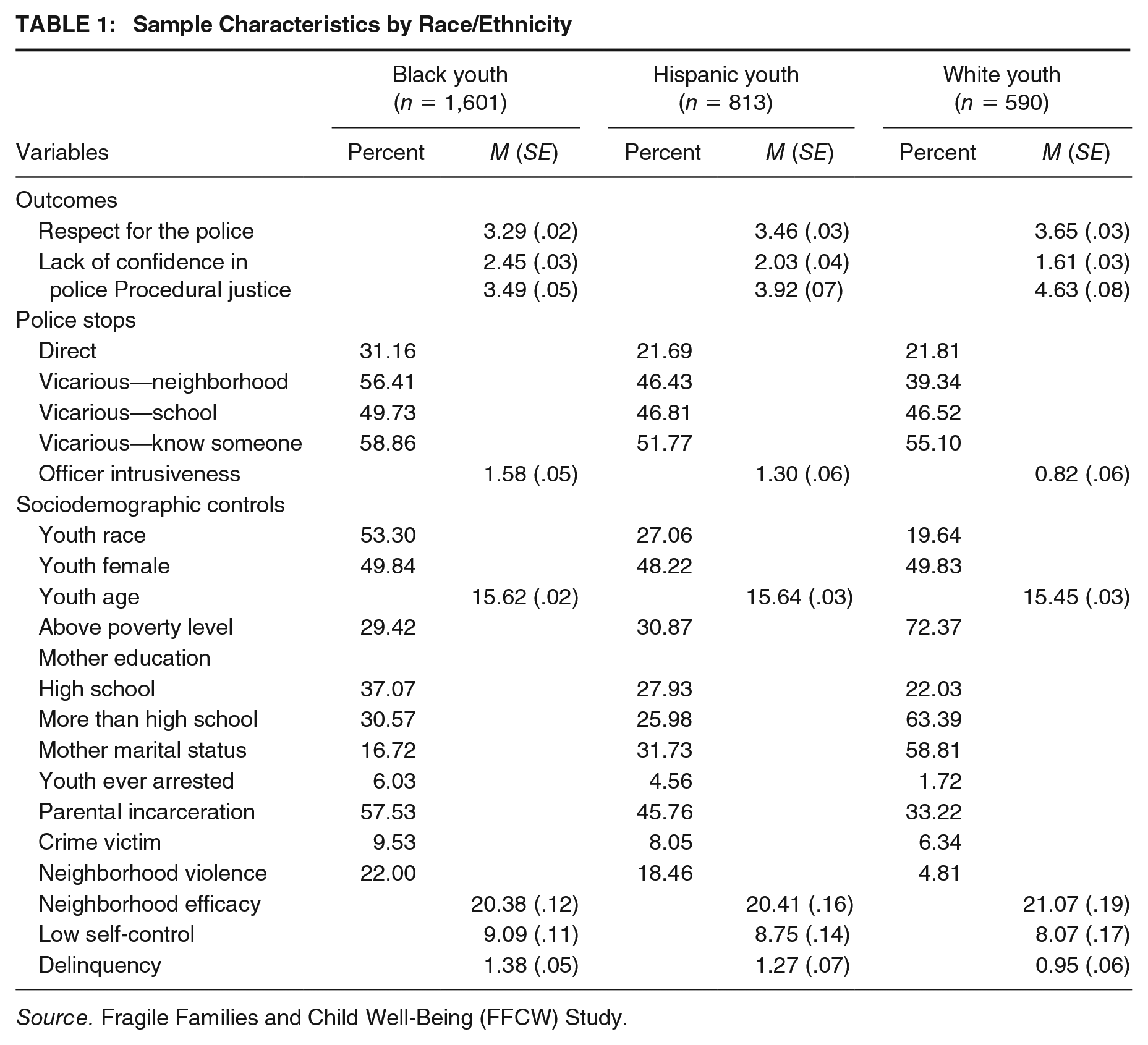
Table 1 shows the basic descriptive statistics for the FFCWS sample. Multiple statistical models were used to examine the relationships between youth race/ethnicity, direct and vicarious police stops, and youth attitudes toward police. As two of the dependent variables are ordinal, a model that was appropriate for ordered data and evaluating the proportional odds assumption was needed. We estimated an ordered logit model and a “generalized” ordered logit model for each of the ordered attitudinal outcomes by race. We then ran a series of likelihood-ratio tests for each of the models which indicated that the proportional odds assumption was not violated (Hoffmann, 2016). Thus, we used ordered logistic regression (OLR), presented as incidence rate ratios (IRRs), to examine the relationships between direct and vicarious police stops and respect for police and lack of confidence in the police by race/ethnicity as shown in Tables 2 and 3, respectively. In Table 4 we used ordinary least squares (OLS) regression to examine the association between direct and vicarious police stops and perceptions of procedural justice by race/ethnicity. In addition to separate models by race, Tables 2–4 include simple models without interactions between intrusiveness and type of stop while the expanded models include interactions in which we explored how officer intrusiveness interacted with direct and vicarious police stops and if it affected youth attitudes toward police. We also included difference tests on the untransformed coefficients (before the coefficients were transformed into IRRs) to assess whether the models for each race/ethnicity group were statistically different from each other (Paternoster et al., 1998). These difference tests were done with the expanded models, including all controls.
Sample Characteristics by Race/Ethnicity
Source. Fragile Families and Child Well-Being (FFCW) Study.
Ordered Logistic Regression Results Examining the Effects of Type of Police Stop and Officer Intrusiveness on Respect for Police by Race/Ethnicity
Source. Fragile Families and Child Well-Being (FFCW) Study. The analyses used 20 multiple imputed data sets to adjust for missing data in the variables.
Note. Reference categories include mother education less than high school, white, male, and extreme and/or moderate poverty level. IRR = incidence rate ratios.
p < .05 for Paternoster et al.’s (1998) test of equality for regression coefficients for black youth and Hispanic youth using the untransformed coefficient. bp < .05 for Paternoster et al.’s (1998) test of equality for regression coefficients for black youth and white youth using the untransformed coefficient. cp < .05 for Paternoster et al.’s (1998) test of equality for regression coefficients for Hispanic youth and white youth using the untransformed coefficient.
p < .05. **p < .01. ***p < .001.
Ordered Logistic Regression Results Examining the Effects of Type of Police Stop and Officer Intrusiveness on Lack of Confidence in Police by Race/Ethnicity
Source. Fragile Families and Child Well-Being (FFCW) Study. The analyses used 20 multiple imputed data sets to adjust for missing data in the variables.
Note. Reference categories include mother education less than high school, white, male, and extreme and/or moderate poverty level. IRR= incidence rate ratios.
p < .05 for Paternoster et al.’s (1998) test of equality for regression coefficients for black youth, and Hispanic youth using the untransformed coefficient. bp < .05 for Paternoster et al.’s (1998) test of equality for regression coefficients for black youth and white youth using the untransformed coefficient. cp < .05 for Paternoster et al.’s (1998) test of equality for regression coefficients for Hispanic youth and white youth using the untransformed coefficient.
p < .05. **p < .01. ***p < .001.
OLS Regression Results Examining the Effects of Type of Police Stop and Officer Intrusiveness on Perceptions of Procedural Justice by Race/Ethnicity
Source. Fragile Families and Child Well-Being (FFCW) Study. The analyses used 20 multiple imputed data sets to adjust for missing data in the variables. OLS = ordinary least squares.
Note. Reference categories include mother education less than high school, white, male, and extreme and/or moderate poverty level.
p < .05 for Paternoster et al.’s (1998) test of equality for regression coefficients for black youth and Hispanic youth using the untransformed coefficient. bp < .05 for Paternoster et al.’s (1998) test of equality for regression coefficients for Hispanic youth and white youth using the untransformed coefficient. cp < .05 for Paternoster et al.’s (1998) test of equality for regression coefficients for black youth and white youth using the untransformed coefficient.
p < .05. **p < .01. ***p < .001.
Results
Table 1 shows the basic descriptive statistics for the variables in this study. Youth in the sample were about 49% female with an average age of around 15.6 years. The racial/ethnic makeup of the study is about 49% black youth, 33% Hispanic youth, and 18% white youth. Roughly 29% of black families that participated in this study were above the national poverty level, for Hispanic families it was about 31%, and for white families it was 72%. While looking specifically at the mothers, around 37% of black, 28% of Hispanic, and 22% of white mothers had a high school education, whereas about 31% of black, 26% of Hispanic, and 63% of white mothers reported having more than a high school education. Looking at mothers’ marital status, 17% of black, 32% of Hispanic, and 59% of white mothers were married to the focal child’s biological father at Wave 1. Moreover, 6% of black, 5% of Hispanic, and 2% of white youth reported that they have been arrested. In addition, black youth in the study reported higher rates of having a parent incarcerated by year nine of the study (58%), compared to Hispanic (46%), and white youth (33%). Nearly 10% of black youth have been a victim of a crime compared to 8% of Hispanic and 6% of white youth. 22% of black PCGs, 18% of Hispanic PCGs, and 5% of white PCGs answered that yes, they have been afraid to let their child outside due to neighborhood violence. Although, neighborhood efficacy scores are similar by race, averaging 20.62. Low self-control scores are an average of 8.64 across the groups and delinquency had an average of 1.2 acts.
Mean scores for respect for the police for black, Hispanic, and white youth were 3.29, 3.46, and 3.65, respectively. Conversely, mean scores for lack of confidence in police for black, Hispanic, and white youth were 2.45, 2.03, and 1.61, respectively. Finally, scores for procedural justice were 3.49 for black, 3.92 for Hispanic, and 4.63 for white youth. Regarding youth contact with the police, there was an average officer intrusiveness score of 1.23, with scores of 1.58 for black, 1.30 for Hispanic, and 0.82 for white youth. About 31% of black youth and 22% of Hispanic and white youth reported having a direct police stop. Vicarious neighborhood stops were reported by 56% of black, 46% of Hispanic, and 39% of white youth and an average of 48% of youth reported a school stop across all races. Knowing someone who was stopped was reported by 59% of black, 52% of Hispanic, and 55% of white youth.
Race/Ethnicity, Police Stops, and Respect and Confidence in the Police
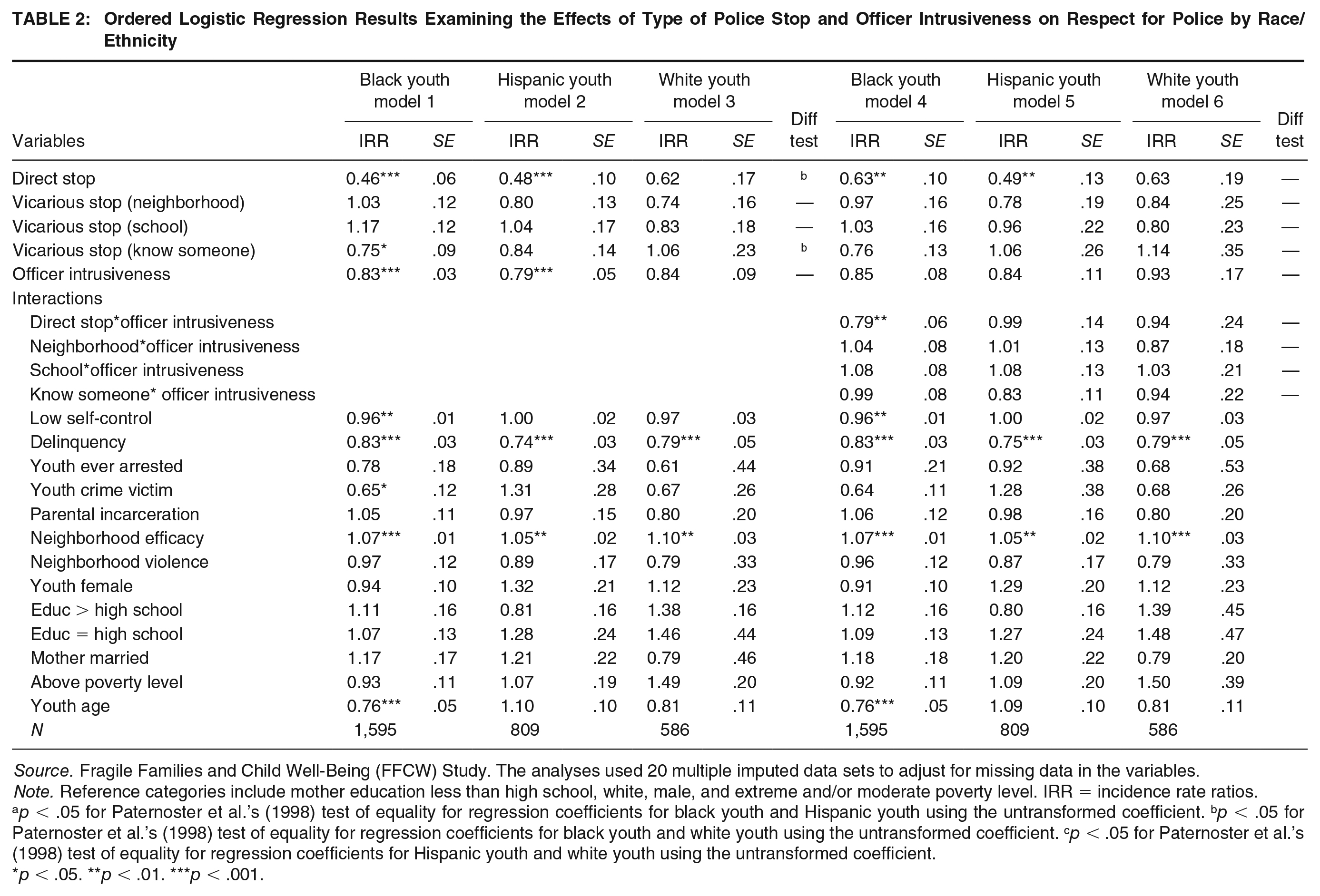
Table 2 showed results for the ordered logistic regression models looking at the effect of direct and vicarious police encounters on respect youth have for police by race/ethnicity. The simple respect model suggested that black youth (IRR = 0.46, p < .001, Model 1) and Hispanic youth (IRR = 0.48, p < .001, Model 2) who experienced a direct stop were less likely to strongly agree that they had respect for police than those who did not have a direct stop. However, this relationship was not significant for white youth. Perceived officer intrusiveness was also associated with reduced respect for black (IRR = 0.83, p < .001, Model 1) and Hispanic (IRR = 0.79, p < .001, Model 2) youth, but not for white youth. Once interactions between type of stop and officer intrusiveness were added in the expanded respect models (Models 4–6), the effect size of direct stop was slightly increased for black youth from 0.46 in Model 1 to 0.63 in Model 4 (p = .004) and for Hispanic youth from 0.48 in Model 2 to 0.49 in Model 5 (p = .006).
Aside from one exception, it is interesting to note that not many significant results concluded from vicarious stops. Black youth were less likely to respond that they strongly agree that they have respect for police if they knew someone who had been stopped (IRR = 0.75, p = .012, Model 1), though this relationship was no longer significant in the expanded model (Model 4). Similarly, the only significant interaction between officer intrusiveness and type of stop is for black youth experiencing an intrusive direct stop (IRR = 0.79, p = .001, Model 4).
The control variables in the expanded respect model for black youth (Model 4) suggested that low self-control (IRR= 0.96, p = .002), increased delinquency (IRR= 0.83, p < .001), and being older (IRR= 0.76, p < .001) were associated with decreases in respect for the police. For both Hispanic (Model 5) and white (Model 6) youth, increased delinquency was associated with decreased respect for police (IRR= 0.75, p < .001 and IRR= 0.79, p = .001). Conversely, for all races/ethnicities, if the youth had a stronger perception of neighborhood efficacy, they were more likely to answer that they strongly agree that they have respect for police. Paternoster et al.’s (1998) test of equality using the untransformed regression coefficients leads to discovering that type of stop has a statistically different relationship with youth respect for the police among black youth compared to white youth with a direct stop and a vicarious stop where they know someone who was stopped in the simple models (Models 1 and 3). These relationships were no longer significant in the expanded models (Models 4 and 6).
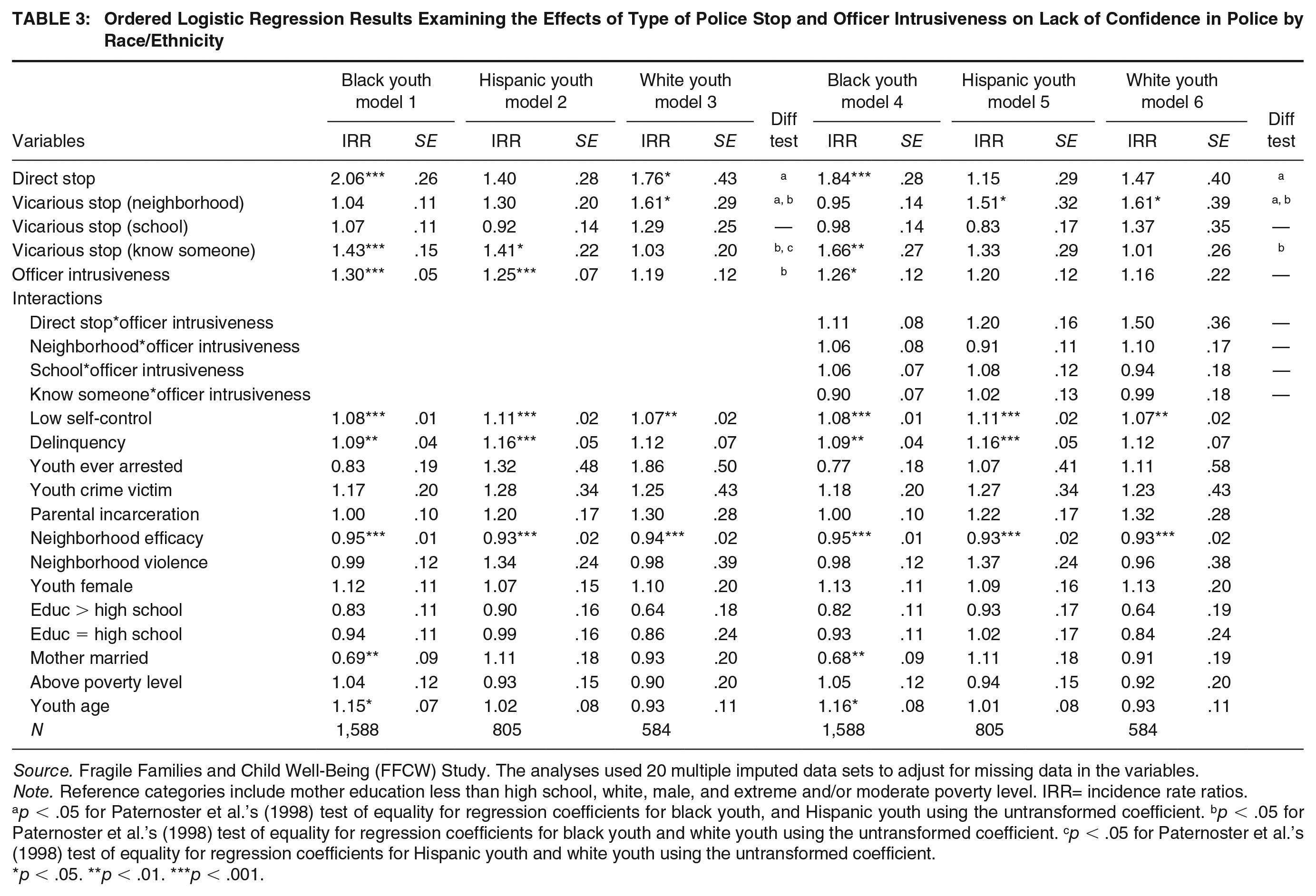
Table 3 shows results for the ordered logistic regression models looking at the effect of direct and vicarious police encounters on lack of confidence that youth have in the police by race/ethnicity. Seen in the simple lack of confidence model for black youth (Model 1), a direct stop was associated with decreases in confidence (increased lack of confidence) in police (IRR = 2.06, p < .001), which changed slightly in the expanded model (IRR = 1.84, p < .001, Model 4). Similarly, in the simple lack of confidence model for white youth (Model 3), direct stops were associated with a lack of confidence in police (IRR = 1.76, p = .021), though this relationship was no longer significant in the expanded model (Model 6). Confidence in the police was not significantly related to direct stops for Hispanic youth in the simple or expanded models. Decreases in confidence were associated with neighborhood stops for Hispanic youth in the expanded model (IRR = 1.51, p = .05, Model 5) and white youth in both the simple model (IRR = 1.61, p = .011, Model 3) and the expanded model (IRR = 1.61, p = .049, Model 6). In addition, for black youth, knowing someone who was stopped was associated with decreased confidence in police in both the simple (Model 1) and expanded (Model 4) models (IRR= 1.43, p = .001 and IRR = 1.66, p =. 002, respectively). Officer intrusiveness was associated with decreases in confidence in police for black (IRR = 1.30, p < .001, Model 1) and Hispanic (IRR= 1.25, p < .001, Model 2) youth in the simple models, though these numbers reduce slightly for black youth (Model 4) and were no longer significant for Hispanic youth (Model 5) in the expanded models. Finally, no interactions between stop and intrusiveness yielded statistically significant results.
The expanded models suggested that low self-control was related to decreased confidence for all race/ethnicities. Delinquency was related to decreased confidence in the police for black and Hispanic youth. Increased perception of neighborhood efficacy increased their confidence in the police for all racial/ethnic groups. Finally, for black youth, mother’s marital status was associated with increases in confidence while increased age was associated with decreases in confidence in police. Paternoster et al.’s (1998) test of equality using the untransformed regression coefficients leads to discovering that police stops have a statistically different relationship for black youth and Hispanic youth who experienced a direct stop, black youth compared to both white and Hispanic youth who experienced a vicarious neighborhood stop, white youth compared to both black and Hispanic youth that knew someone who was stopped, and officer intrusiveness for black youth compared to white youth.
Impact of Race/Ethnicity on Police Stops and Perceptions of Procedural Justice
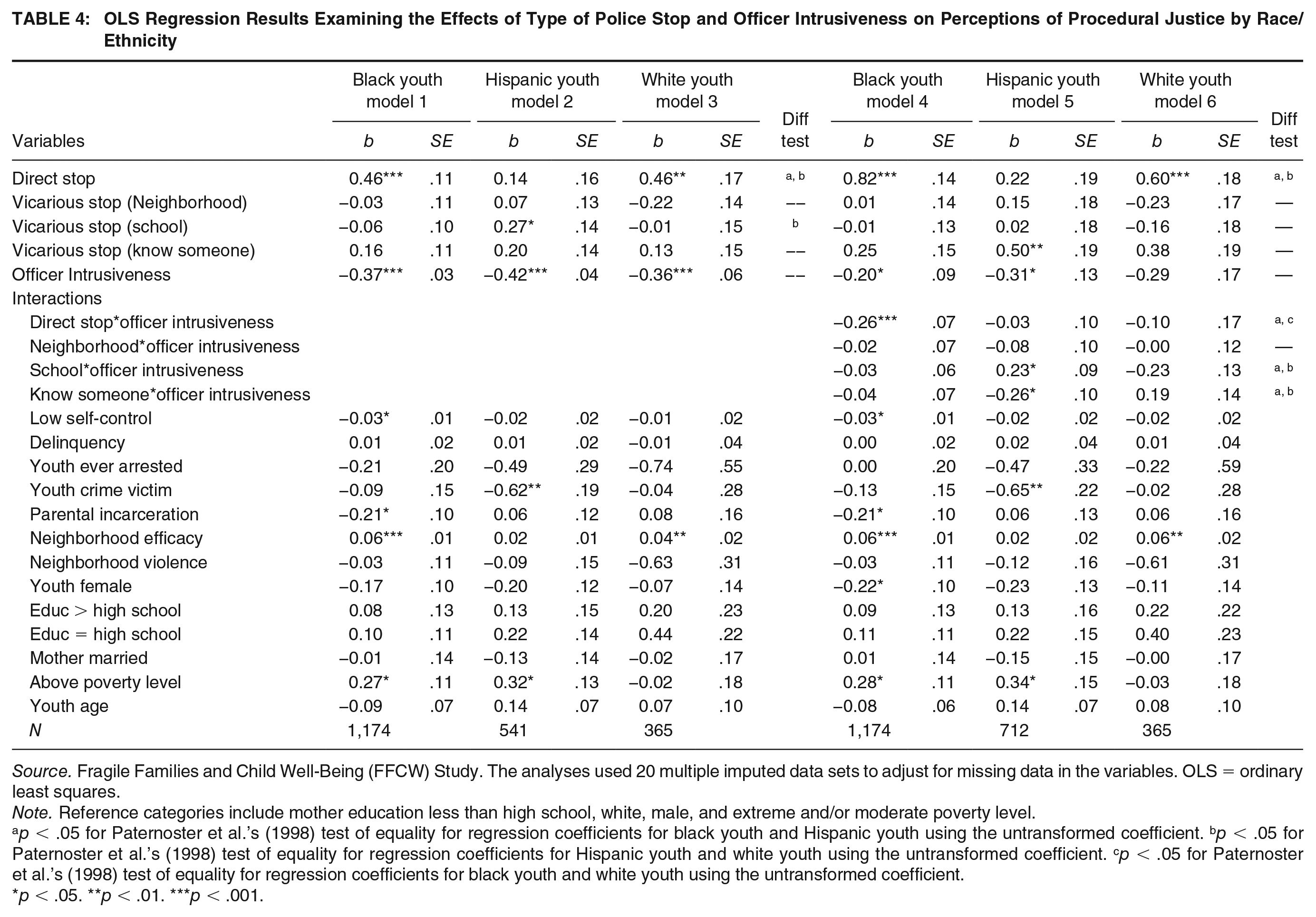
Table 4 showed the OLS regression results examining the effect of perception of procedural justice after direct and vicarious police stops, by race/ethnicity. The simple models suggested that direct stops were associated with increased perceptions of procedural justice for black (b = 0.46, p < .001, Model 1) and white youth (b = 0.46, p = .005, Model 3). These perceptions of procedural justice increased further in the expanded models for black (b = 0.82, p < .001, Model 4) and white youth (b = 0.60, p =.001, Model 6). In addition, knowing someone who was stopped was associated with increased perceptions of procedural justice for Hispanic youth in the expanded procedural justice model (b = 0.50, p =.009, Model 5). However, perception of procedural justice did not change for any other vicarious police stops, for all race/ethnicities. Officer intrusiveness was negatively associated with youth perception of procedural justice for black (b = −0.37, p < .001), Hispanic (b = −0.42, p < .001), and white (b = −0.36, p < .001) youth in the simple procedural justice models, though these numbers reduce slightly for black and Hispanic youth and are no longer significant for white in the expanded models. Furthermore, the expanded procedural justice models suggest that decreases in perceptions of procedural justice for black youth were associated with a direct stop where officer intrusiveness occurred (b = −0.26, p < .001) and decreases for Hispanic youth when they knew someone who was stopped and where officer intrusiveness occurred (b = −0.26, p = .010). Conversely, the expanded procedural justice model for Hispanic youth (Model 5) suggests that perceptions of procedural justice increased for Hispanic youth when a vicarious school stop where officer intrusiveness occurred (b = 0.23, p = .015).
Low self-control and parental incarceration were associated with reduced perceptions of procedural justice for black youth in both the simple and expanded models. Being a victim of crime was associated with reduced perceptions of procedural justice for Hispanic youth in both the simple and expanded models. Neighborhood efficacy was positively associated with view of procedural justice for black and white youth in both the simple and expanded models. Finally, being above the poverty level was associated with increased perceptions of procedural justice for black and Hispanic youth in both the simple and expanded models. Paternoster and colleagues (1998) test of equality using the untransformed regression coefficients leads to discovering that type of stop has a statistically different relationship for Hispanic youth compared to both black and white youth who experienced a direct stop. Significant differences exist for black youth compared to both Hispanic youth and white youth who experienced an intrusive direct stop, and Hispanic youth compared to both black and white youth who experienced an intrusive school stop or an intrusive stop where they knew someone who was stopped.
Discussion and Conclusion
Much research has demonstrated that direct police stops are linked to attitudes toward police. However, significantly less research has focused on the potential role of vicarious police encounters in perceptions of and attitudes toward the police as well as the role of race/ethnicity in these processes among youth. Our first aim was to examine the relationship between direct and vicarious police stops and youth attitudes toward police. The empirical results indicate that race/ethnicity significantly influences the relationship between direct and vicarious police stops and youth attitudes toward police. Specifically, for black and Hispanic youth, we found that those who reported a direct stop or vicarious stops (e.g., neighborhood and know someone) and experienced or witnessed officer intrusiveness during a stop reported lower levels of respect for the police than youth who were not stopped. In contrast, direct and vicarious police stops were not significantly related to respect for the police for white youth. Moreover, when it comes to lack of confidence in police, black youth who reported a direct stop, a vicarious school stop or knowing someone who had been stopped was linked to less confidence in the police. Hispanic youth who reported knowing someone who had been stopped and white youth who reported a vicarious neighborhood stop had less confidence in the police. Black and Hispanic youth who also experienced or witnessed officer intrusiveness reported less confidence in police. These findings are generally in line with previous studies (Brunson, 2007; Brunson & Weitzer, 2009; Jones, 2014; Rengifo & McCallin, 2017; Slocum & Wiley, 2018). Contrary to previous studies (e.g., Wheelock et al., 2019), we found that police stops account for significant differences in attitudes toward police among Hispanic and white youth, particularly for vicarious stops that involved someone they know.
Furthermore, we found that direct and vicarious police stops were also related to perceptions of procedural justice and that these effects varied significantly by race/ethnicity. Surprisingly, we found that procedural justice increased for both black and white youth who experienced a direct stop. Moreover, procedural justice increased for Hispanic youth who reported knowing someone who was stopped by police at school. Our results also indicated that perceptions of procedural justice decreased for black, Hispanic, and white youth who witnessed or experienced more officer intrusiveness during a police stop. These findings, coupled with our findings from the respect for police and confidence for police models, suggests that direct and vicarious police stops can both positively and negatively shape perceptions of and attitudes toward the police. While direct and vicarious police stops are associated with less favorable attitudes toward police, such as respect and confidence, they can also be associated with greater perceptions of police officers’ behavior and fairness during police stops. Based on these findings, expectancy theory may be especially helpful in contextualizing these contradictory results. Expectancy theory proports that people expect police stops to be pleasant and are therefore less affected by them when they are (Reisig & Chandek, 2001; Rosenbaum et al., 2005). In other words, only in rare cases does one expect an experience with the police to be extremely negative. Thus, satisfaction with police encounters that involve police contact may be dependent upon the congruence between the individual’s expectations for the encounter and the actual encounter experience (Reisig & Chandek, 2001). Subsequently, encounters that align with an individual’s expectations should have little to no effect on one’s perceptions of the police while encounters that conflict with one’s expectations run the risk of changing perceptions of police. Respect for and confidence in the police are abstract attitudes, and, as such, may be difficult to hold clear expectations for. Perceptions of procedural justice, however, is a more concrete measure that is directly connected to actual experiences. Thus, a positive experience during a police stop could cause a significant shift in perceived procedural justice.
The second aim of our study was to examine how the contextual nature of direct and vicarious police stops (i.e., officer intrusiveness) influence youth perceptions of police. To examine the contextual nature of police stops, we explored whether the effects of direct and vicarious police stops on attitudes toward police (i.e., respect, confidence, and procedural justice) were moderated by experiences of officer intrusiveness and whether these effects varied by race/ethnicity. Our findings indicate that when a direct stop involved more officer intrusiveness black youth reported less respect and more negative perceptions of procedural justice, in line with previous research, (Brunson, 2007; Brunson & Weitzer, 2009; Hayle et al., 2016; Rengifo & McCallin, 2017; Zhang et al., 2020). Thus, a nonintrusive direct stop may yield more positive sentiments of procedural justice for black youth while a more intrusive stop has the opposite effect. In addition, Hispanic youth who witnessed a more intrusive stop of someone they knew reported a decrease in perceptions of procedural justice.
Overall, consistent with literature on youth attitudes toward police, the results suggest that direct and/or vicarious police contact can generate negative attitudes toward police among black, Hispanic, and in some cases white youth (Fine, Donley, et al., 2020; Fine, Padilla, et al., 2020; Sanden & Wentz, 2017; Slocum & Wiley, 2018; Wu et al., 2015; Zhang et al., 2020), though these effects can vary across type of police stop and attitude toward police. Our findings also indicate that the nature of direct and vicarious police stops shape attitudes toward police, particularly among black and Hispanic youth. We can only speculate as to the source of these differences. We contextualize these findings utilizing the group-position model of race relations, which is a variant of conflict theory. Group-position theory views racial animus not simply because of prejudices between members of different racial groups, but more centrally, as a reflection of group competition and conflict over material resources, power, and status in a multiracial society (Blumer, 1958). According to this model, prejudice is rooted in a collective “sense of group position” and group interest is the driving force underlying contentious intergroup relations. Consequently, if the dominant group believes it is entitled to valuable resources, it follows that the group will have an affinity with such an institution that serves their interest (Weitzer & Tuch, 2004). This may help explain why white youth tend to hold more favorable attitudes toward the police, favor more aggressive law enforcement, and may be more suspicious of criticism of the police. In contrast, black and Hispanic youth may be more inclined to view the police as a visible “sign of majority domination” (Bayley & Mendelsohn, 1969, p. 195), as contributing to both their subordination through legal and extralegal practices, as frequently involved in mistreatment of black and Hispanic individuals, and in feeling that greater controls on police would serve their group interests. Although this study did not have direct measures of interests or threats, we were able to capture the role of type of police stop and the role of officer intrusiveness, which findings generally yielded more favorable perceptions of police among white youth compared to black and Hispanic youth.
Limitations and Future Research
There are several limitations that warrant mention. First, we only have single measures of respect and confidence in police and perceptions of procedural justice (year 15 only) and are unable to measure whether the youth (direct or vicarious) experience with police caused a change in their attitudes toward police, or whether the reports at year 15 reflect long-standing attitudes unaffected by police contact. Thus, longitudinal data that track the stability of youth attitudes toward the police over time would be beneficial. Second, our measurement of confidence in the police is less than ideal. Prior research has measured confidence in police as perceptions of fairness, visibility, reliability, honesty, cooperation, and trust (Ren et al., 2005). Often, a mixture of these items are used to create an index measuring confidence in the police. In other cases, it has been measured by simply asking: “How much confidence do you have in the police” (Cao et al., 2012). Thus, the single item we based our confidence in the police measurement on lacks the multidimensionality or specificity incorporated in previous studies. Third, our analyses were limited to only one contextual measure of police stops: officer intrusiveness. While officer intrusiveness does provide us with some contextual measures of police stops, it is not a perfect measure of how positive or negative the police stop actually was. Future research should consider including more contextual measures, particularly capturing overall positivity or negativity of the police encounter, including whether these experiences vary by race/ethnicity. Finally, youth in the FFCW study were asked to report their most memorable incidents with police. Thus, our analyses are limited by the potential for recall errors in relation to less memorable police incidents.
Policy Implications
The current study has important policy implications. First, we must prioritize just and unbiased policing. This process may be accomplished through police departments providing officer training on procedurally just policing techniques as one avenue to influence youth perceptions of police. One element of this training should seek to educate officers that there are consequences of how they initiate and conduct a stop (i.e., intrusiveness), particularly among adolescents. These consequences can have long-lasting effects on how youth may relate to law enforcement efforts in the future. In addition, there is an emerging body of research that suggests that when police agencies treat their officers in a procedurally just manner, officers are more likely to employ these same principles during their interactions with citizens (Van Craen & Skogan, 2017). It is also important to note that, on average, black youth in our sample not only reported more direct and vicarious police stops than Hispanic and white youth, but they also reported having witnessed or experienced more officer intrusiveness during a police stop. This finding is consistent with research arguing that in-depth training on racial bias, including encouraging officers to take an implicit bias test, is a necessary start to help reduce disparities in police stops (Staats et al., 2015). Recent research suggest that this form of training may help reduce police implicit bias (Kramer & Remster, 2018). More broadly, agencies should encourage perspective taking, stereotype replacement, and stereotype countering, all of which have been shown to reduce the use of stereotypes by police (Dunham & Peterson, 2017; Hall et al., 2016).
Second, police departments should implement evidence-based changes in policing policies and training to reduce officer-involved shootings and other police reforms. To facilitate the implementation of evidence-based approaches, law enforcement agencies must: (a) consider findings from available research and (b) where evidence is lacking, engage in opportunities to fill that void. Indeed, a recent review of police training and practices suggests that much of the evidence base surrounding the most popular reform initiatives to reduce police brutality, such as officer shootings, is limited in scope or nonexistent (Engel et al., 2020). Thus, to advance evidence-based changes in policing, agencies must monitor the application and impact of training, policies, and procedures designed to improve policing practices. Finally, racially-sensitive-policing-policies should be created in collaboration with physicians, other public health practitioners, and police which may present a novel approach to not only reduce citizen exposure to adverse and/or hostile police encounters but work toward improving the reputation of police in distressed communities.
Footnotes
Authors’ Note:
Authors are listed alphabetically due to equal authorship. Kathryn Foster is now studying at the Department of Sociology, Cornell University. We have no conflicts of interest or funding to disclose.
