



Abstract
The detailed study of officer experience has received relatively little attention within the policing literature despite it being integral to nearly every facet of their role. Drawing on survey data (N = 691 officers), the current study examines how the unique work experiences of officers (i.e., shifts, crime areas, duty assignments, in-service trainings) are related to their perceptions of confidence (i.e., self-efficacy) in the ability to perform different job-related tasks. Results revealed that more tenured officers, having worked a greater number of shifts, and those who completed increased in-service trainings had significantly higher confidence in performing both law enforcement and order-maintenance/service-oriented duties. Several other officer characteristics were also found to have varying levels of significance in relation to their confidence. Overall, the findings support the inclusion of more nuanced measures of officer experience, as well as the potential applicability of self-efficacy theory within policing research moving forward.
Introduction
The ambiguous nature of the police role leaves patrol officers with a wide range of responsibilities. Not only are they tasked with reducing crime and enforcing laws, but a significant portion of their job is also related to other duties such as directing traffic, providing emergency first-aid, and settling disputes (Germann, 1969; Parks et al., 1999; Scott, 1981; Willis & Mastrofski, 2014, 2017, 2018). To resolve these matters efficiently, officers are believed to build necessary skills from experiencing constant repetition and exposure to unique situations while working different shifts (i.e., times of day), crime areas (i.e., high, medium, low), duty assignments (i.e., patrol, supervisors, investigations), and attending in-service trainings. Prior research contends that through this learning process officers also develop confidence in their abilities (Bayley & Bittner, 1984; Brown, 1988; Wilson, 1968). The relationship between experience and confidence is also at the very root of self-efficacy theory, which provides a theoretical framework for how perceptions of confidence influence an individual’s decision-making, whether they can problem solve, their effort and motivation to complete goals, and their willingness to persevere when faced with adversity (Bandura, 1997, 2000). With this theoretical positing in mind, an officer with high self-efficacy could be expected to think more strategically, refrain from avoiding difficult tasks, operate well in unpredictable situations, better handle the stress of the job, and use the least amount of coercion necessary to resolve a situation. However, despite both police researchers and practitioners acknowledging the connection between officer experience and their confidence beliefs, this relationship has rarely been explored.
This gap in the literature is largely attributable to two limitations. First, the majority of research articles that include officer experience measure it based solely on the length of an officer’s tenure (Alpert et al., 2005; Brandl & Stroshine, 2013; Kaminski et al., 2004; Lawton, 2007; McCluskey et al., 2005; Paoline & Terrill, 2005, 2007; Rydberg & Terrill, 2010). Although widely accepted, operationalizing experience in this way fails to capture the nuance and complexity that comes with a policing career that may consist of working in different shifts, crime areas, and duty assignments. Second, there is only a small sample of studies that have examined self-efficacy (i.e., perceptions of confidence) in relation to the policing profession. Within them, there is also only scarce discussion of the intricacies of officer experience and how it relates to the development of confidence (Aremu, 2005; Hsieh et al., 2012; Love & Singer, 1988; Singer & Love, 1987). Furthermore, there is yet to be a self-efficacy study conducted with police officers from the United States, despite being the focus of both classic (see Bayley & Bittner, 1984; Brown, 1988; Wilson, 1968) and contemporary (see Willis & Mastrofski, 2014, 2017, 2018) examinations of officer experience and craft.
The current study aims to assess the relationship between officers’ unique work experiences and confidence in their abilities to resolve different law enforcement, order-maintenance, and service-oriented tasks. We first examine the prior police experience literature along with a discussion of how shifts, crime areas, duty assignments, and in-service trainings generate differential and repetitive types of interactions. From there, research surrounding self-efficacy theory is introduced to demonstrate how these unique work experiences have the potential to build officer confidence. Next, data from a large metropolitan police department located in the United States are used to examine officer work experiences and their self-efficacy beliefs. Finally, we close with discussing the ways in which these findings can be implemented to improve police practice and advance policing scholarship moving forward.
Literature Review
Officer Experience and Craft
For nearly six decades, researchers and practitioners have noted the importance of officer experience in relation to nearly every aspect of police work. Early studies noted how experience was essential to learning how to become an effective police officer, likening this apprenticeship process to the development of an officer’s “craft” (Bayley & Bittner, 1984; Brown, 1988; Wilson, 1968). As Bayley and Bittner (1984, p. 41) noted, “Being skilled in policing, as in carpentry, is a matter of learning to be effective with the materials and tools at hand.” These “tools” include gaining confidence in terms of developing suspicions, defusing situations, using coercion, and coping with job stressors (Bayley & Garofalo, 1989; Brown, 1988; Riksheim & Chermak, 1993; Skolnick, 1966; Worden, 1989).
Important to note is that very few of these craft-related skills are thought to be built in the preservice academy (Brown, 1988; Ingram et al., 2013; Paoline, 2003; Paoline & Gau, 2018). Instead, officers view their early socialization on the street as particularly relevant to the development of their craft (Bayley & Bittner, 1984; Reuss-Ianni, 1983; Sherman, 1980; Van Maanen, 1974). For example, Field Training Officers (FTOs) are seen as being pivotal to helping officers interpret their initial experiences and teaching them the “tricks of the trade” (see Brown, 1988, p. 243). Furthermore, as officers continue to gain experience, they also learn what works best for them personally. As Willis (2013, pp. 3–4) states, Craft places a high value on flexibility to fit the right response to the particulars of the situation and does not necessarily demand orthodoxy in response. It also recognizes that what works well for one officer might not work so well for another due to differences in skills and personal traits.
Other recent work of Willis and Mastrofski (2014, 2017, 2018) has been crucial, and most influential, for moving the study of police experience and craft into the 21st century. Using data from police officers in two departments, they were able to identify a group of high performers (termed master craftpeople) who were particularly skilled at being able to remain calm, mediate problematic interactions, and make informed judgments to resolve situations (Willis & Mastrofski, 2017). Other elements of these elite officers included having strong work habits (i.e., detailed-oriented, disciplined), interpersonal skills, and thorough knowledge and experience with the people, places, and the problems of the areas they were assigned. Moreover, Willis and Mastrofski (2018) conducted in-depth interviews with a sample of 17 high performers and a comparison group of 21 regular patrol officers. Both groups overwhelmingly identified the importance of communication (i.e., asking pertinent questions, listening carefully, and demonstrating understanding) as being vital to keeping a situation from escalating (Willis & Mastrofski, 2018). The collective implications from this work suggest that reformers and others who are looking to translate evidence-based policy into policing would be wise to consider craft when doing so.
Due to its presumed significance, researchers have included “experience” in a host of statistical models that attempt to estimate officers’ attitudinal orientations and discretionary decision-making (i.e., stops, arrests, uses of force). The vast majority of these studies have measured officer experience based solely on their years of tenure (Alpert et al., 2005; Brandl & Stroshine, 2013; Brandl et al., 2001; Crawford & Burns, 1998; Lawton, 2007; McCluskey et al., 2005; Paoline & Terrill, 2005, 2007; Rydberg & Terrill, 2010; Sun et al., 2008). This unidimensional experience variable has been found to be a significant factor in some models (i.e., more seasoned officers being less likely to make an arrest compared with novice officers), but the bulk of the empirical results have been mixed (Bolger, 2015; Crawford & Burns, 1998; Lawton, 2007; Paoline & Terrill, 2005; Smith & Klein, 1983; Sun et al., 2008). However, years of tenure does not tell the whole story in terms of officer experience. In fact, such operationalization fails to capture the nuanced variation that exists between officers’ different shift assignments, crime area assignments, duty assignments, and in-service trainings. Such specific work experiences generate unique types of repetitive encounters that may create variation in officers’ confidence in their abilities to resolve them.
The Role of Officers’ Unique Work Experiences
Beginning with shift, the time of day officers work has important implications for the types of interactions they are asked to resolve. For example, research has shown that officers who work an overnight (e.g., graveyard) shift are increasingly likely to encounter situations that involve drugs and alcohol, violence, and the commission of felonies (Brown, 1988). Conversely, officers working day shift have a higher chance of responding to service or order-maintenance related calls for service (Paoline, 2003), which could involve providing wellness checks, directing traffic, or resolving issues at a local business. The type of crime area an officer works also has the potential to generate differential exposure to certain encounters. Similar to shift, officers working in high-crime areas are likely to be involved in a greater amount of law enforcement-related duties (i.e., making arrests, interacting with a violent offender, investigating robberies) compared with those working in low-crime areas (Brown, 1988; Terrill & Reisig, 2003).
Furthermore, officers who have duty assignments outside of patrol (i.e., supervisors, specialized units) have vastly different job functions (Parks et al., 1999). For instance, once officers transition from patrol to management, they often have far fewer interactions with the public (Manning, 1994; Paoline, 2003; Paoline & Terrill, 2014; Reuss-Ianni, 1983). The same may apply to officers assigned to specialized units (e.g., investigations, special weapons and tactics [SWAT]) who transition from being generalists on patrol to handling more targeted problems involving specific populations (e.g., gangs, violent offenders). These units rarely respond to everyday calls for service and operate in a paramilitary structure (Kraska & Cubellis, 1997; Todak et al., 2022). Furthermore, many specialized units also have unique policies in place that differ from patrol, such as not being required to wear body cameras (Gaub et al., 2020).
Finally, patrol officers can gain differential exposure to situations through continued in-service training. These trainings are typically done on topics such as de-escalation, interviewing, investigations, mental health, domestic violence, search and seizure, procedural justice, crisis intervention, and the use of force (Hails & Borum, 2003; Huey, 2018; Wolfe et al., 2020). Thus, officers who have received increased inservice training in certain areas may be better equipped to handle related incidents. Altogether, the different work assignments officers have may lead to the development of unique self-efficacy beliefs (i.e., perceptions of confidence in their abilities) when confronted with distinct citizen encounters.
Self-Efficacy Theory
Few theories that attempt to explain how cognitive factors shape action have enjoyed as much empirical support as self-efficacy theory (Stajkovic & Luthans, 1998). High self-efficacy has been consistently found to have a positive relationship with outcomes such as academic achievement (Honicke & Broadbent, 2016; Peura et al., 2021; Talsma et al., 2018) and job performance (Cherian & Jacob, 2013; Gist & Mitchell, 1992; Wood & Bandura, 1989). The theory operates under the umbrella of social cognitive theory, which contends that personal and environmental factors, behavior, and cognitions have a triadic reciprocal relationship with each other (Bandura, 1977, 1988, 1997; Gist & Mitchell, 1992). Self-efficacy is a key cog within this theorizing by meshing these factors together to form our beliefs about the confidence we have in performing certain behaviors and their resulting impact on our decision-making. Bandura (1997, 2000, 2006) also notes that self-efficacy beliefs vary across individuals depending on a task’s level of difficulty and the different circumstances, environments, and contextual factors that are present during performances. As such, it is important to better understand how self-efficacy and perceptions of confidence are developed.
Bandura (1977, 1997) asserts self-efficacy is built through four main sources that impact our knowledge structures and serve as cognitive guides to our behavior. These include mastery experiences, vicarious experiences, social persuasion, and somatic or emotional states. Of these, mastery experiences are thought to be the most effective or influential way to develop self-efficacy beliefs (Bandura, 1977, 1982; Byars-Winston et al., 2017; Gist & Mitchell, 1992). Mastery experiences entail being exposed to a diverse set of experiences where through a process of trial and error, individuals can adjust their response patterns and develop confidence in their abilities to overcome obstacles and perform (Bandura, 1977; Wood & Bandura, 1989). Repeated success at a given task ultimately enhances their capabilities, which can then be used to manage future failures without losing confidence (Talsma et al., 2018; Wood & Bandura, 1989).
Self-Efficacy Theory and Policing
This process of increasing confidence in one’s capabilities is highly transferrable to policing. Police professionals and scholars have long noted the importance of learning, which takes place throughout an officer’s career (Bayley & Bittner, 1984; Brown, 1988; Reuss-Ianni, 1983; Sherman, 1980; Van Maanen, 1974). Experience working a variety of shifts, crime areas, and duty assignments exposes officers to a vast array of situations where they must conduct law enforcement, order-maintenance, and service-oriented tasks. The unpredictability of these tasks also places officers in a position where they must be creative when intervening with the public (Drenth & van Steden, 2020). Continual inservice trainings are also designed to instill mastery experiences by allowing officers to practice and develop skills with the help of modeling and social persuasion that reinforces correct behavior. Unfortunately, the current state of policing research has not advanced to the point where officers’ self-efficacy beliefs have been assessed in relation to their behavior.
However, that is not to imply that police self-efficacy has never been examined (see Aremu, 2005; Hsieh et al., 2012; Love & Singer, 1988; Singer & Love, 1987; Taris et al., 2010). Although each of these studies have been important for laying the groundwork for the study of policing and self-efficacy, there are noteworthy limitations future research can expand on. First, nearly all these studies were conducted using data from international countries such as New Zealand, Taiwan, and Nigeria (Aremu, 2005; Hsieh et al., 2012; Love & Singer, 1988; Singer & Love, 1987). Second, prior measures of police self-efficacy have largely been broad in nature and only a couple of studies have considered the complexity that is involved in the array of different modes of behavior officers are asked to accomplish (Love & Singer, 1988; Singer & Love, 1987). Third, there has been only one study that has explicitly attempted to examine how officers develop confidence in their capabilities (Taris et al., 2010). As a result, this is an especially promising area to expand upon given the potential implications self-efficacy has for the development of policies and practice within policing.
As astutely noted during the peer-review process, there is also a burgeoning body of recent literature aimed at assessing officers’ perceptions of self-legitimacy, which some may contend is a similar construct to self-efficacy given they are both related to how officers think about their job. Although similar in some ways, police self-legitimacy has largely been conceptualized as officers’ views of their own moral/ethical authority and how they believe they are perceived by the citizenry (see Bottoms & Tankebe, 2012; Gau & Paoline, 2021; Nix & Wolfe, 2017; Tankebe, 2010; Wolfe & Nix, 2017). The current study contends that officers’ self-efficacy is a distinct construct given its focus on assessing their confidence in resolving task-specific domains of activities rather than a macro-level evaluation of how they view their place within society (i.e., self-legitimacy).
Current Study
The current study posits that the process of building self-efficacy is applicable to the same process that policing scholars describe when detailing how an officer develops their craft. More specifically, the aim of the study is to assess the relationship between varying officer work experiences (i.e., shifts, crime areas, duty assignments, inservice trainings) and their perceptions of confidence in handling different types of law enforcement, order-maintenance, and service-oriented tasks. To do so, survey data of officers from a large metropolitan police department are analyzed. The results are used to inform future research on officer experience, police policy, and the viability of incorporating self-efficacy within policing moving forward.
Method
Data
The data for the current inquiry stem from the Officer Perceptions of Danger survey conducted by the authors within a large U.S. metropolitan police department employing more than 2,000 officers and serving a population of more than a million residents. Despite near universal agreement across the policing literature as to the importance of officer perceptions of danger in their decision-making, prior empirical research has been scant beyond simply asking officers whether they view their job as dangerous. In addition to the danger element of the study, we were also interested in collecting data related to the present inquiry to help shed light on the relationship between officer work experiences and their perceptions of self-efficacy.
After numerous iterations with a working group of various department personnel, and pretesting the survey with officers from a neighboring police department, data collection officially began in December 2019. Prior to the research team attending and administering the survey during patrol roll-calls, a series of coordinated steps were taken to maximize the potential response rate. First, emails were obtained for more than 120 administrative supervisors across the department’s precincts. Although the supervisors had already received emails regarding the project from upper management, researchers sent an additional email a week before coming to survey their squads which offered a description of the project and signed authorization from the chief. This also allowed the supervisors to verify their rosters, change the date of the survey if needed, and ask any questions they may have had. Furthermore, each shift in every precinct was assigned two squads who shared an overlap workday. To maximize efficiency, the research team attended and conducted the survey on each double-squad day, for each shift, in each precinct.
All patrol officer surveys were completed by March 2020. Due to the COVID-19 pandemic and university restrictions, researchers were not able to return to the department until April 2021. It was during this time that officers currently assigned to specialized units were surveyed. Overall, this resulted in 60 total briefings and 850 completed surveys with a response rate of 85%, which is slightly higher than the 79% average response rate across officer surveys administered in-person (Nix et al., 2019). After conducting listwise deletion on cases that were determined to be missing at random, the final sample consists of 691 officers.
Dependent Variables
Officers’ self-efficacy beliefs toward their ability to perform different law enforcement, order-maintenance, and service-oriented tasks serve as the dependent variables in subsequent analyses. Bandura (2006) discussed the intricacies of measuring self-efficacy and offered a number of considerations. He noted that when creating self-efficacy-related items, participants must be made to judge their capability of performing certain types of activities, which differs from asking a participant what they would do behaviorally in that situation. By doing this, researchers focus solely on capabilities while avoiding questions of personality traits such as self-concepts, outcome expectancies, and perceived control (Zimmerman, 2000). Also, to avoid construct and discriminant validity issues, self-efficacy measures should contain multiple items that consider the multifaceted nature of an activity domain (Bandura, 2006, p. 310). The self-efficacy confidence domains that are used in the present study follow these guidelines.
Officers were asked on a scale from 1 to 10 how confident they were in resolving 15 different types of citizen encounters. These tasks were wide ranging and included matters such as handling a traffic collision, providing a wellness check, breaking up a fight among family members, and interacting with a known violent offender. 1 Using prior research as a guide (see Korre et al., 2014; Parks et al., 1999; Willis & Mastrofski, 2017, 2018); these tasks were initially designed to be organized under the separate task domains of law enforcement, order-maintenance, and service-oriented duties. However, the use of exploratory factor analysis (EFA) indicated that the tasks loaded on two domains rather than three, as order-maintenance and service-oriented tasks loaded onto the same dimension.
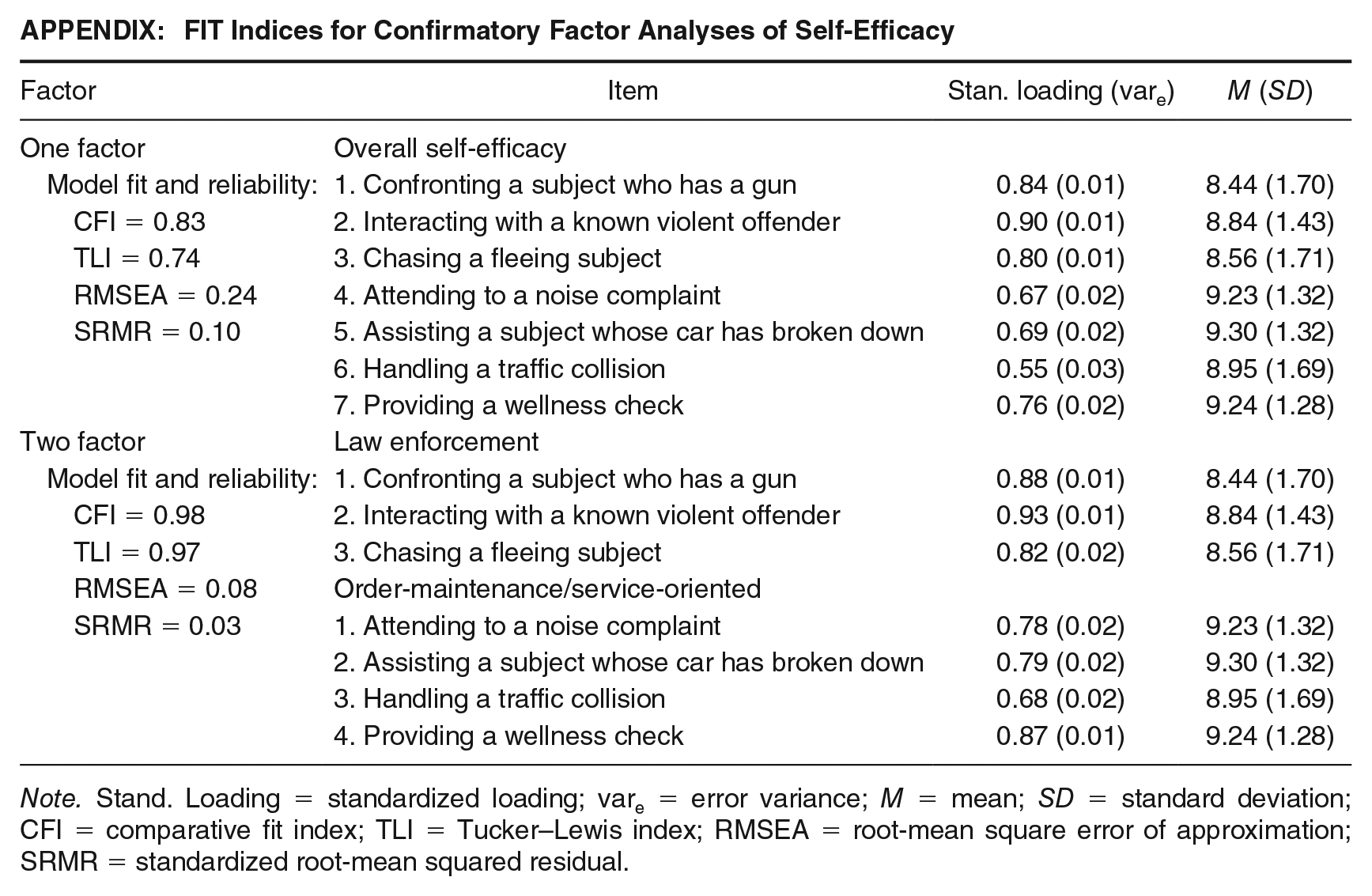
To increase confidence in the measurement of these self-efficacy domains, confirmatory factor analysis (CFA) was conducted using STATA 17’s SEM Builder function. Overall, the results showed satisfactory model fit as the comparative fit index (.98), Tucker–Lewis index (.97), and the standardized root-mean squared residual (.030), were all within established ranges. 2 The root-mean square error of approximation (.080) was right at the cut-off for an accepted range (Hu & Bentler, 1999; McDonald & Ho, 2002). Next, additive indices were created from these items for both a “Law Enforcement” and a merged “Order-Maintenance/Service-Oriented” measure. Law enforcement consisted of officers’ confidence in performing three tasks: (a) confronting a subject who has a gun, (b) interacting with a known violent offender, and (c) chasing a fleeing subject (eigenvalue = 6.60, factor loadings > .75, α = .91). The additive index for the order-maintenance/service-oriented measure contained four tasks: (a) attending to a noise complaint, (b) assisting a subject whose car has broken down, (c) handling a traffic collision, and (d) providing a wellness check (eigenvalue = 1.15, factor loadings > .65, α = .84).
Independent Variables
We draw on guidance from prior research (see Kaminski et al., 2004; Paoline & Terrill, 2007) to cluster “Officer Tenure” into an ordinal variable based on whether the officer had 0 to 2 years (0 to 24 months), 3 to 10 years (25 to 120 months), or 11+ years (121+ months) of service. 3 Next, in the “Current Shift” (i.e., first, second, third) and “Current Crime Area” (i.e., high, medium, low), the officer assigned was coded using dummy variables. 4 In relation to the additional independent variables, officers’ “Current Duty Assignment” (i.e., patrol, supervisor, specialized unit) was coded into individual binary variables, whereas the overall “Number of Shifts” and “Number of Crime Areas” the officer had worked during their career were measured ordinally. 5 Whether the officer had completed “Additional Training” was also included as a dummy variable, and created based on an item asking if they participated in training beyond the state mandated amount in the previous year. 6 The final independent variables, captured as dummy variables, indicate whether officers had “Prior Investigation Experience” or “Prior Specialized Unit” experience. Note that the coding decisions for current shift, current crime area, cumulative shifts and crime areas, and officer duty assignments have all been used in prior research (Brandl & Stroshine, 2013; Brandl et al., 2001; Somers, 2022; Somers & Terrill, 2021; Sun et al., 2008).
Control Variables
We control for a number of officer characteristics and theoretically relevant variables that may be related to officer self-efficacy (Love & Singer, 1988; Singer & Love, 1987). Dummy variables were created for whether the officer was “Male,” their “Race/Ethnicity” (i.e., White, Hispanic/Latino, Other), as well as prior “Military” service and the highest level of completed “Education” (i.e., high school, some college, bachelor’s degree or above). 7 Finally, whether the officer had “Consulted Research” conducted by universities or research organizations about effective practices in policing over the past year, and whether an officer identified themselves as coming from a “Police Family” were each coded as dummy variables. 8
Analytical Strategy
The goal of the subsequent analyses is to assess the relationship between unique officer work experiences and their perceptions of confidence (i.e., self-efficacy) in their abilities to perform law enforcement and order-maintenance/service-oriented related tasks. To do this, linear regression analyses is used. 9 First, two models are estimated that include respondents that were currently assigned to the patrol division. A second set of models are then presented that also incorporates officers who were actively assigned to specialized units. Given that officers actively working in specialized units are not assigned to a specific shift or crime area, we were unable to assess the impact of these variables without analyzing them separately. 10 Overall, the results from this series of models will help determine whether work experiences are significantly related to higher or lower officer confidence in performing various tasks. 11
Results
The coding scheme and the descriptive statistics for the dependent, independent, and control variables are found in Table 1. Beginning with the dependent variables, values for the law enforcement domain ranged from 5 to 30 with an average of 25.80 while the order-maintenance/service domain had a range from 4 to 40 and an average of 36.81. In relation to the independent variables, 26% of the officers had 0 to 2 years of tenure, 30% had 3 to 10 years, and 44% had 11+ years. For current shift, 32% of the officers were assigned to first shift, 39% to second shift, and 29% to third shift. For crime area assignment, 31% were currently working in a low-crime area, 45% in a medium-crime area, and 24% in a high-crime area. Finally, in terms of current duty assignment, the vast majority of officers in the sample were currently working patrol (82%), followed by supervisors (12%), and those in specialized units (6%). 12
Variable Coding and Descriptive Statistics (N = 691)
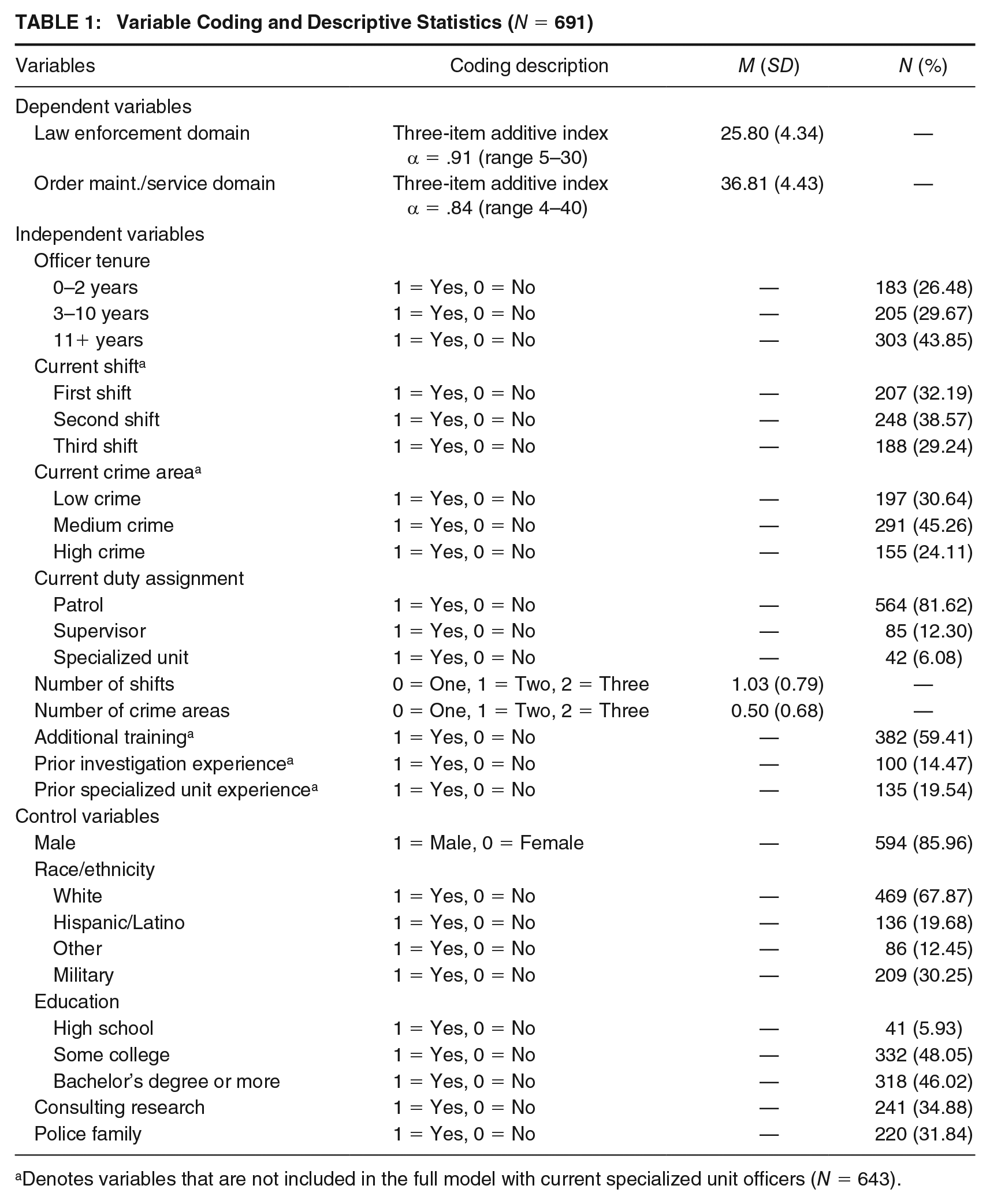
Denotes variables that are not included in the full model with current specialized unit officers (N = 643).
For the remaining independent variables, officers were more apt to have worked multiple shifts (M = 1.03, range 0–2) in their career compared with multiple crime areas (M = 0.50, range 0–2). Close to 60% of officers also noted they had completed additional training in the previous year. A little over 14% of officers had prior investigation experience whereas close to 20% had worked in a specialized unit. In relation to the control variables, officers were predominately Male (86%) and White (68%), and over 30% had served in the military. In addition, most officers had at least some college background (94%), but only 35% stated that they consulted research on effective policing strategies in the past year. Finally, 32% of the sample had a close family member who had been an officer at some point.
In Table 2, the analysis shifts to assessing the impact of work experience on confidence in performing law enforcement and order-maintenance/service-oriented related tasks. The first model uses the law enforcement domain as the dependent variable. Regression analysis revealed that four independent and two control variables had a significant relationship with officers’ confidence. First, officers in the 3- to 10-year group (b = 2.63, p ≤ .001) and the 11+ year group (b = 3.27, p ≤ .001) were found to have significantly higher confidence when compared with the reference category (0–2 years). Furthermore, higher confidence was found among officers who had worked an increased number of overall shifts (b = 0.76, p = .013) and those who completed additional inservice training (b = 1.27, p ≤ .001). With regard to the control variables, male (b = 1.33, p = .013) and Hispanic/Latino (b = 1.31, p ≤ .001) officers were also shown to have increased confidence in performing law enforcement-related duties.
Linear Regression Models Examining the Impact of Work Experiences on Confidence With Patrol Officers (N = 643)
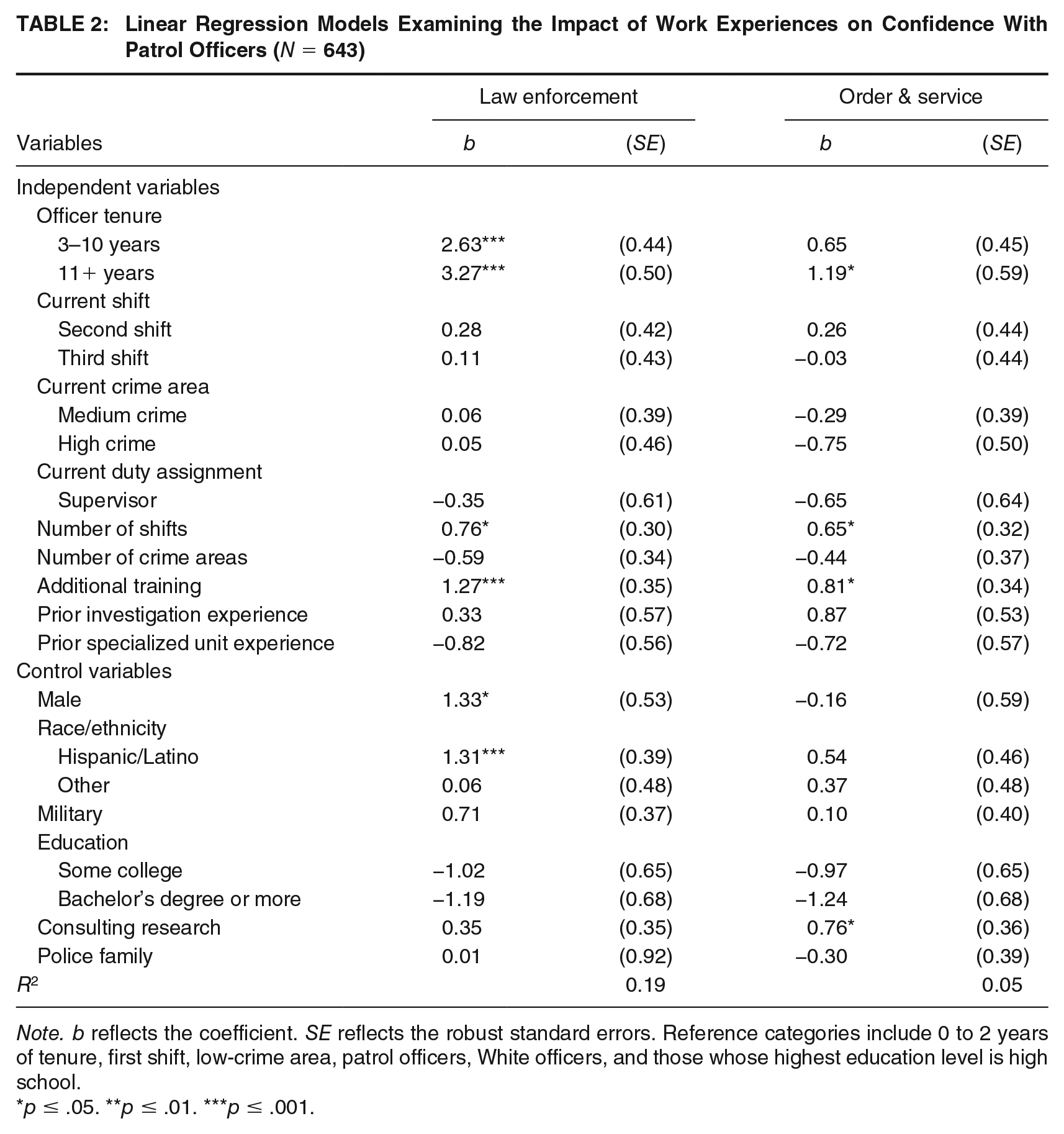
Note. b reflects the coefficient. SE reflects the robust standard errors. Reference categories include 0 to 2 years of tenure, first shift, low-crime area, patrol officers, White officers, and those whose highest education level is high school.
p ≤ .05. **p ≤ .01. ***p ≤ .001.
The second model in Table 2 assesses the relationship between officers’ work experience and their self-efficacy toward order-maintenance/service-oriented duties. As shown, officers with 11+ years on the job (b = 1.19, p = .045) had significantly higher perceptions of confidence than officers with 0 to 2 years of tenure. Similar to the law enforcement model, both the number of shifts worked (b = 0.65, p = .041) and having completed additional training (b = 0.81, p = .018) had significant positive relationships with confidence. Of the control variables, the only significant factor was consulting research (b = 0.76, p = .036), with officers who stated that they had done so having greater confidence in performing order-maintenance/service-oriented duties.
Taken together, the results displayed in Table 2 provide some evidence of significant relationships between officers’ work experience and their self-efficacy beliefs. Increases in years of tenure, working a greater number of shifts, and having completed additional inservice training were all linked with higher perceptions of confidence. However, other measures such as current shift, crime area, and duty assignment, the number of overall crime areas worked, and having prior investigation or specialized unit experience failed to reach statistical significance. One other finding worth noting is that the amount of explained variance (R2) was higher in the law enforcement model (.19) than the order-maintenance/service-oriented model (.05).
Table 3 includes officers who were assigned to specialized units and patrol officers. Looking at the law enforcement model, increases in officer tenure (3–10 years, b = 3.08, p ≤ .001; 11+ years, b = 3.13, p ≤ .001) and the number of shifts (b = 0.70, p = .005) that an officer had worked were statistically related to increased confidence. For the control variables, male (b = 1.28, p = .010) and Hispanic/Latino officers (b = 1.25, p ≤ .001), as well as officers with prior military experience (b = 0.80, p = .020), were all associated with higher confidence. Moving to the order-maintenance/service-oriented model, officers in the 3- to 10-year group (b = 0.99, p = .036) had significantly higher confidence than those in the 0- to 2-year group. Furthermore, working an increased number of shifts (b = 0.54, p = .046) and having consulted research (b = 0.80, p = .022) were again significant positive factors. Interestingly, unlike the law enforcement model, an officer’s current duty assignment was found to be related to confidence. That is, officers currently assigned to a specialized unit (b = −1.87, p = .016) had significantly lower confidence in handling order-maintenance/service-oriented related duties when compared with patrol officers.
Linear Regression Models Examining the Impact of Work Experiences on Confidence With Patrol Officers and Specialized Unit Officers (N = 691)
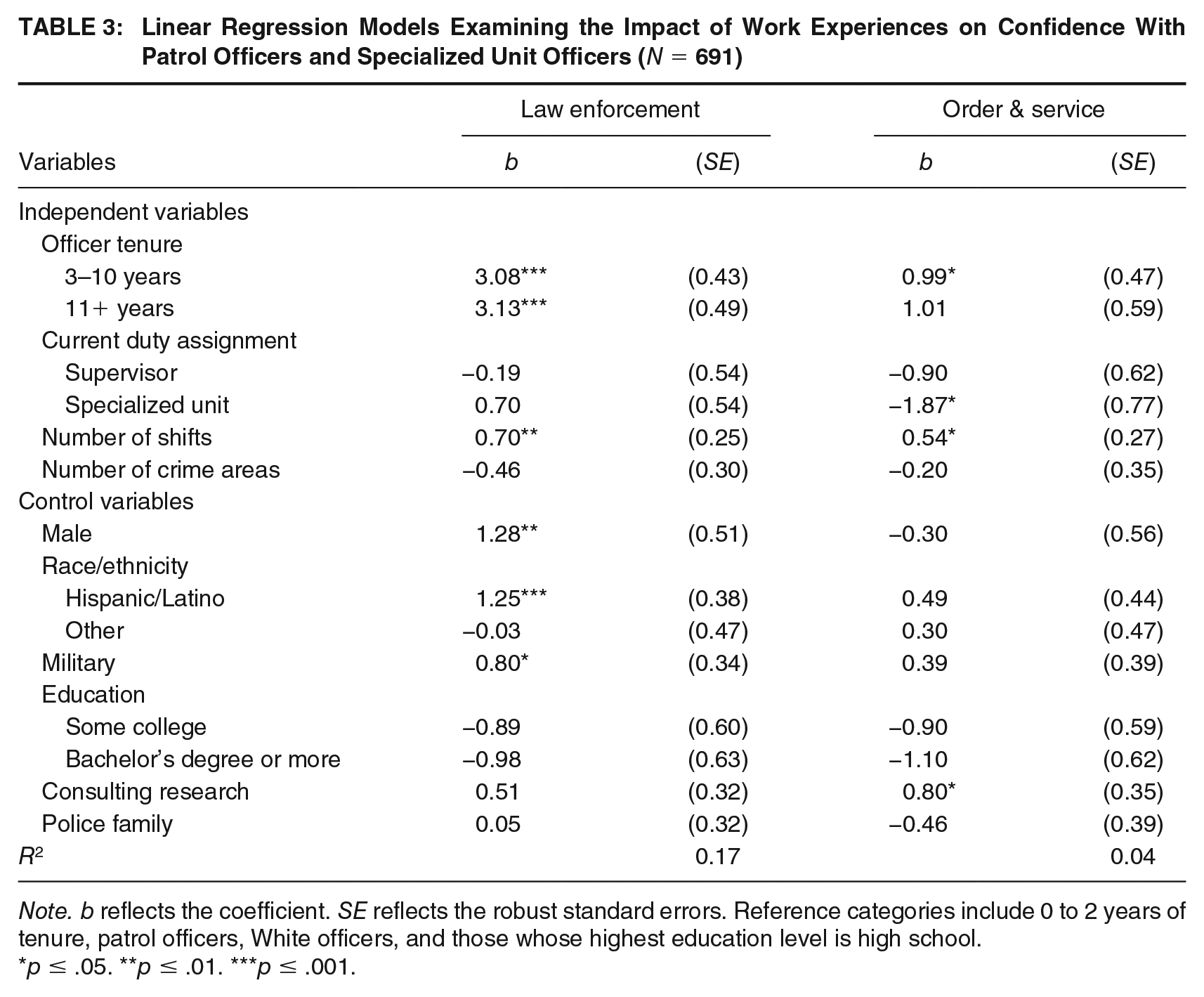
Note. b reflects the coefficient. SE reflects the robust standard errors. Reference categories include 0 to 2 years of tenure, patrol officers, White officers, and those whose highest education level is high school.
p ≤ .05. **p ≤ .01. ***p ≤ .001.
Overall, we found a number of variables significantly related to confidence across the models presented in Tables 2 and 3, most notably officer tenure and the number of shifts officers had worked. In addition, although the inclusion of officers currently assigned to specialized units had no impact in the law enforcement model, these officers had significantly less confidence in handling order-maintenance/service-oriented duties compared with their patrol counterparts. This would appear to support the proposition that officers assigned to specialized units may be less confident in these types of encounters given that their current assignment has them focusing almost exclusively on law enforcement duties.
A supplementary analysis was also conducted to further tease out the findings related to officer tenure. For nearly every model, officers who were in the 3- to 10-year and the 11+ year groups had significantly higher confidence than officers in the 0- to 2-year group (the reference category). Again, this finding is congruent with what was expected as prior research contends that officers with more years of service should have higher confidence given their increased level of exposure and opportunities to handle unique citizen situations. Although this finding is clear in relation to the 0- to 2-year group, it does not allow for insight into whether confidence is significantly higher among the officers in the 11+ years group compared with those in the 3- to 10-year group. To assess this possibility, we estimated additional models using the 3- to 10-year group and the 11+ year group as reference categories, rather than the 0- to 2-year group. 13
When the 11+ years group served as the reference category, both the 0- to 2-year and 3- to 10-year groups had less confidence in comparison, but only the 0- to 2-year group reached statistical significance. When the 3- to 10-year group was used as the reference category, the 11+ year group had higher confidence but the relationship was not statistically significant. Conversely, the 0- to 2-year group had a significant negative relationship with confidence when compared with the 3- to 10-year group. This implies that the 0- to 2-year group is driving the significant findings in relation to officer tenure, while the other two groups are indistinguishable from each other statistically. This lends credence to the notion that officer tenure may be far more important early in a career than later in terms of confidence. It also suggests that though years of tenure may be a driving aspect of confidence, other factors may matter as well. The implications of these results for future research and police policy and practice are discussed below.
Discussion
For many decades, police officers, and those who study them, have expressed the importance that officers’ work experiences have in nearly every aspect of their role. In fact, work experience is seen as a core component in developing an officer’s craft because it is through a process of being exposed to a variety of unique citizen interactions that they learn the skills, knowledge, and judgment essential to perform at a high level (Willis, 2013; Willis & Mastrofski, 2014). Despite its presumed significance regarding officer decision-making, the study of officer experience beyond years of tenure is almost nonexistent. Although accounting for years of tenure may be a significant aspect of police experience, prior operationalizations that measure it as a complete construct potentially fail to capture the nuance and complexity of experience. The aim of the current study was to move in that direction by assessing whether the work experiences of officers were related to confidence in their abilities to perform different aspects of their craft. We drew on self-efficacy theory to assist in developing outcome measures of law enforcement and order-maintenance/service-oriented task domains. This was followed by a series of multivariate models accounting for the unique shifts, crime areas, and duty assignments officers worked. The key findings are discussed in the following paragraphs.
First, we found that factors related to shift, current duty assignment, and inservice training had significant relationships with officer confidence even after controlling for tenure. For example, in both the law enforcement and order-maintenance/service-oriented domains, the greater number of shifts that officers had worked during their tenure was associated with an increase in their confidence. Having completed additional in-service training was also a consistent positive indicator of increased confidence. Regarding current duty assignment, officers who were currently working in a specialized unit had significantly lower confidence in their abilities to resolve order-maintenance/service-oriented encounters compared with those currently working in patrol. Other experiential factors such as measures related to an officer’s current shift and crime area, the number of crime areas they had worked, and prior investigation or specialized unit experience did not reach statistical significance in any other model. These results were rather surprising given that each of them could be logically posited to impact an officer’s confidence. Nonetheless, when viewed collectively, the findings encourage incorporating self-efficacy theory into policing research moving forward.
Second, despite officer tenure being a significant variable in each of the models, it did not appear to have a true linear relationship with officer confidence in performing different job-related tasks. Once an officer had worked with the department for more than 2 years, results showed that the other tenure groups (3–10 years and 11+ years) were not statistically different from one another in relation to confidence. This offers preliminary evidence that there may be a ceiling effect in relation to tenure and confidence (at least as measured here), which stands in contrast to those who may view that more years of service automatically equates to more confidence. In addition, we conducted supplementary analyses by estimating a series of regression models (see Supplemental Appendix C, available in the online version of this article) with officers in the 0- to 2-year group to assess self-efficacy in resolving the two tasks that had the lowest average confidence levels for each domain (i.e., confronting a subject who has a gun, handling a traffic collision). Similar to the full models, the results showed that working an increased number of shifts, having completed additional inservice training, and prior military experience were all positively linked with higher self-efficacy when confronting a subject who has a gun. For handling traffic collisions, only having completed additional inservice training was linked with increased confidence. These additional analyses are informative as they point to the need for future research to tap into certain routine tasks where entry level experience is particularly deficient in terms of officers’ confidence levels.
A third finding relates to the amount of explained variance that was found among the linear regression models. This hovered between .17 and .19 for the law enforcement domain and .04 to .05 for the order-maintenance/service-oriented domain. Although there is substantial room for improvement in estimating both domains (e.g., even 17%–19% is low), the differences in explained variance between the models may support the notion that the unique work experience variables included in this study are better indicators of confidence in law enforcement encounters than in order-maintenance/service-oriented situations. Perhaps this is also an indication that confidence in order-maintenance/service-oriented situations may be built outside of the policing profession, or are a function of an officer’s unique personality and mind-set.
Finally, a few of the control variables were found to have statistically significant relationships with confidence across the models. Officers who were male, Hispanic/Latino, or had prior military experience, all had increased confidence in handling law enforcement tasks. Moreover, officers who consulted research within the past year about effective policing tactics had higher confidence in resolving order-maintenance/service-oriented tasks. The finding related to male officers is also in line with prior police self-efficacy research (see Singer & Love, 1987), which found that females had lower confidence in their abilities to resolve some law enforcement related encounters. Finally, it is not immediately clear as to why Hispanic/Latino officers had significantly higher confidence in performing law enforcement tasks, and thus future research that teases out this relationship is recommended.
Because this study is one of the first to provide a closer look at police experience and officer self-efficacy beliefs, there are a host of other future research and policy suggestions in need of discussion. Given that work experiences beyond just a measure of tenure were found to be significantly related to confidence, researchers may want to consider including similar items on surveys and controlling for them in their analyses moving forward. Similarly, the study only begins to tap into what the incorporation of self-efficacy theory may add to policing research. To advance the measurement of police confidence, future work may want to include additional layers of complexity to the self-efficacy items. This could involve incorporating environmental and contextual factors into the items such as whether the officer has backup, the time of day, or if other citizens are present. These additional factors could improve measurement in two areas. First, increasing task complexity would almost certainly create more variation in confidence perceptions across different interactions. Second, the inclusion of these factors would make for a better representation of actual situations which often involve interacting with citizens alone or trying to operate while being surrounded by citizens who may pose a threat to the officer.
Furthermore, recall the earlier positing that officers with high self-efficacy may be expected to think more strategically, refrain from avoiding difficult tasks, operate in unpredictable situations, better handle the stress of the job, and use the least amount of coercion necessary to resolve a task. To date, these hypotheses remain untested. Now that a link between work experiences and self-efficacy has been found, one logical next step is to assess whether perceptions of confidence are predictive of these outcomes. This could be accomplished using a number of different methodologies. Recent studies that include showing officers body camera footage and having them talk through the interactions (see Mangels et al., 2020; Willis & Mastrofski, 2018) could be expanded and designed to assess how strategically officers are thinking through situations that vary in complexity. Use of force reports or body camera footage could also be used to assess the relationship between officer confidence and the use of coercion.
There are a number of potential policy implications that may be gleaned as well. First, and perhaps most illuminating, is the finding that the 2-year mark for experience seems to be a demarcation point in terms of confidence. Hence, agencies may wish to consider how they structure assignment practices. For instance, if a particular unit has a disproportionate number of officers with less than 2 years of experience, police administrators might consider reassigning a number of more experienced officers to ensure greater confidence levels in performing tasks. Second, officers who worked a greater number of different shifts had significantly higher confidence in terms of performing both law enforcement and order maintenance/service tasks. Such a finding suggests that agencies may benefit by ensuring there is some degree of regular rotation in terms of assignments, as such movement exposes officers to different working environments that enhance their confidence in performing a wider degree of tasks. Third, officers who consulted research about effective policing practices during the past year had higher confidence in terms of performing order maintenance tasks. Given long-standing empirical support demonstrating that police officers spend a majority of time on such tasks, agencies may wish to place an enhanced emphasis on encouraging officers to seek out research as it can bolster confidence levels in terms of those duties they are most frequently asked to handle.
Fourth, recall that one of the significant correlates of confidence was having completed additional inservice training. Out of the officers that did identify what type of additional training they had received, the most common responses were child crimes, drug and alcohol, crisis intervention, interviewing, investigations, and special tactics. Thus, those looking to develop new police trainings that center on building officer confidence in performing specific tasks may consider adopting a self-efficacy informed model which has been shown to be effective in other professionalized occupations (Gist, 1987; Pajares, 1997; Stajkovic & Luthans, 1998; Wood & Bandura, 1989). If done properly, this type of training entails the modeling of preferred behaviors by a respected peer, and then allows trainees hands-on experience where they can practice and receive positive feedback and guidance. A recent study by Wolfe and colleagues (2020) provides support for this training style as their “Deliberate, Repetitive Practice” approach involved learning from respected peers and increased repetition to help build de-escalation skills.
Finally, there are a number of limitations to note. First, though we draw on cross-sectional data to assess the relationship between work experiences and officer confidence, the use of longitudinal data would have been ideal to make true causal inferences. 14 As one reviewer pointed out, there is the possibility that an officer with low self-efficacy could actively try to avoid certain work experiences (i.e., work fewer shifts, pursue less training). Although the use of cross-sectional data is a widespread limitation within both policing and self-efficacy scholarship (see Peura et al., 2021), it is still a fruitful area for future research to grow. Second, with both the COVID-19 pandemic and the social unrest in summer 2020 after high profile police incidents, there may be important unknown differences in the responses from our sample of patrol officers (completed pre-COVID-19) and the small sample of specialized unit officers (completed during). Despite this drawback, we included the specialized unit officers given how rarely these units have been studied in comparison to their patrol counterparts.
Another limitation is related to the way in which crime area is measured. Although the precinct level is appropriate for analysis (see Klinger, 1997), measuring crime area at a micro-level (e.g., squads/beats) may have produced a more accurate representation. In addition, another key limitation is that we were only able to obtain data related to the squad officers were assigned when they completed the survey, rather than all squads they had worked during their tenure. Unfortunately, there was no official department record of the squads that officers had been assigned to during their career. There were also missing data on multiple survey items that asked officers to identify the specific types of additional inservice training they had completed, and others that asked officers to identify how much time they had spent working in each shift, precinct, and duty assignment. For example, only 172 out of the 382 patrol officers (45%) who stated they had received additional training identified the type of training they received. While this resulted in measures of experience that are admittedly blunt, albeit an improvement upon prior research, it is still a limitation we and others can hopefully improve upon in future studies (e.g., perhaps by focusing on these items and cutting others to keep the survey instrument manageable, or by surveying separately in a stand-alone survey and then linking surveys). As one reviewer aptly pointed out, officers with many total years of tenure may be less confident when assigned to a new shift or area (or coming from nonpatrol), compared with officers with less years of total tenure, but have worked in their current shift or crime area assignment for longer.
In closing, the importance of officer experience is not lost on practitioners or academics. Yet, the current state of policing research could benefit greatly from a better understanding of experience and self-efficacy. We believe this study takes a much needed first step in that direction.
Supplemental Material
sj-docx-1-cjb-10.1177_00938548221105879 – Supplemental material for Confidence in Their Craft: Assessing the Relationship Between Officer Work Experiences and Their Perceptions of Self-Efficacy
Supplemental material, sj-docx-1-cjb-10.1177_00938548221105879 for Confidence in Their Craft: Assessing the Relationship Between Officer Work Experiences and Their Perceptions of Self-Efficacy by Logan J. Somers and William Terrill in Criminal Justice and Behavior
Footnotes
Appendix
Fit Indices for Confirmatory Factor Analyses of Self-Efficacy
| Factor | Item | Stan. loading (vare) | M (SD) |
|---|---|---|---|
| One factor | Overall self-efficacy | ||
| Model fit and reliability: | 1. Confronting a subject who has a gun | 0.84 (0.01) | 8.44 (1.70) |
| CFI = 0.83 | 2. Interacting with a known violent offender | 0.90 (0.01) | 8.84 (1.43) |
| TLI = 0.74 | 3. Chasing a fleeing subject | 0.80 (0.01) | 8.56 (1.71) |
| RMSEA = 0.24 | 4. Attending to a noise complaint | 0.67 (0.02) | 9.23 (1.32) |
| SRMR = 0.10 | 5. Assisting a subject whose car has broken down | 0.69 (0.02) | 9.30 (1.32) |
| 6. Handling a traffic collision | 0.55 (0.03) | 8.95 (1.69) | |
| 7. Providing a wellness check | 0.76 (0.02) | 9.24 (1.28) | |
| Two factor | Law enforcement | ||
| Model fit and reliability: | 1. Confronting a subject who has a gun | 0.88 (0.01) | 8.44 (1.70) |
| CFI = 0.98 | 2. Interacting with a known violent offender | 0.93 (0.01) | 8.84 (1.43) |
| TLI = 0.97 | 3. Chasing a fleeing subject | 0.82 (0.02) | 8.56 (1.71) |
| RMSEA = 0.08 | Order-maintenance/service-oriented | ||
| SRMR = 0.03 | 1. Attending to a noise complaint | 0.78 (0.02) | 9.23 (1.32) |
| 2. Assisting a subject whose car has broken down | 0.79 (0.02) | 9.30 (1.32) | |
| 3. Handling a traffic collision | 0.68 (0.02) | 8.95 (1.69) | |
| 4. Providing a wellness check | 0.87 (0.01) | 9.24 (1.28) |
Note. Stand. Loading = standardized loading; vare = error variance; M = mean; SD = standard deviation; CFI = comparative fit index; TLI = Tucker–Lewis index; RMSEA = root-mean square error of approximation; SRMR = standardized root-mean squared residual.
Authors’ Note:
No financial support was received for this project. The authors would also like to acknowledge Drs. Cody W. Telep and Jacob T.N. Young for their comments on early iterations of this manuscript.

Supplemental Material
Notes
References
Supplementary Material
Please find the following supplemental material available below.
For Open Access articles published under a Creative Commons License, all supplemental material carries the same license as the article it is associated with.
For non-Open Access articles published, all supplemental material carries a non-exclusive license, and permission requests for re-use of supplemental material or any part of supplemental material shall be sent directly to the copyright owner as specified in the copyright notice associated with the article.
