



Abstract
Pre-sentence reports (PSRs) provide important information about an individual’s background and circumstances to assist judicial officers in the sentencing process. The present study analyzed PSRs for 63 Aboriginal and Torres Strait Islander people sentenced by either an Indigenous sentencing court or a mainstream court in the Australian State of Victoria. Using natural language processing techniques, our analyses revealed few differences between PSRs conducted for each court. However, PSRs were found to predominantly feature key words that are risk-based, with mainstream court PSRs more negatively worded than the Indigenous sentencing court’s PSRs. This may have been due to the inclusion of results from a risk and need assessment tool. Pro-social factors did comprise more than one third of extracted keywords, although the number of strength-based culture-related keywords, in particular, was low across PSRs in both courts. It is possible that courts may not be receiving all the information needed to promote individualized justice.
Keywords
Courts use pre-sentence reports (PSRs) in various jurisdictions internationally to provide important information about an individual’s background and current circumstances, with the aim to assist judicial officers in the sentencing process. The content and processes involved in producing these reports differ between jurisdictions but do contain similarities. Often PSRs are completed by court or corrections staff (either as a matter of course or by request of a judicial officer) and are intended to include information such as the individual’s (social, medical, educational, and employment) history, their risk of re-offending, rehabilitative likelihood and needs, and sentencing options (see, for example, Criminal Code, RSC 1985, c. C-46, s 721(3); Sentencing Act, 1991 (Vic.), s 8B; Sentencing Act, 2002 (NZ), s 26(2)). In Australia, PSRs are often prepared by courts and/or community corrections staff using similar processes for both Indigenous sentencing courts and mainstream courts.
Although the requirement for PSRs is enacted in legislation in countries such as Australia (see, for example, Sentencing Act, 1991 (Vic.), s 8A), Canada (Criminal Code, RSC 1985, c. C-46, s 721(1)), and New Zealand (Sentencing Act, 2002 (NZ), s 26(1)), often (with the exception of Canada), these Acts do not prescribe their content. Neither PSRs, nor sentencing legislation in Victoria, require sentencing courts to specifically consider factors associated with an Indigenous individual’s cultural background and unique socio-historical circumstances, including experience of colonization.
Considering Cultural Factors When Sentencing Indigenous Peoples
Sentencing legislation differs by jurisdiction but is often guided by principles such as punishment, deterrence of further similar behavior, assisting rehabilitation, denunciation of the past behavior, community protection, to provide reparations for harm done by the offending, and to promote a sense of responsibility in the offending person for the harm caused to the community or victims (see, for example, Criminal Code, RSC 1985, c. C-46, s 718); Sentencing Act, 1991 (Vic.), s 5(1); Sentencing Act, 2002 (NZ), s 7(1)). Cunneen (2018) argued that many circumstances unique to Aboriginal and Torres Strait Islander Peoples may be relevant to these sentencing principles. The background and unique circumstances of the person may be relevant to the severity of punishment. For example, a remote living situation may inform which rehabilitation services are readily accessible, adjustment issues when moving from a remote traditional community to an urban environment may be relevant to both punishment and community protection. Racism (including in policing), social and economic disadvantage, and Indigenous laws that may explain the commission of an offense (e.g., taking a totem from public property) could all be relevant considerations during the sentencing process (Anthony, 2010; Anthony & Longman, 2017; Cunneen, 2018). Furthermore, the strengths and protective factors of culture and community and how these factors relate to the rehabilitative prospects of the individual are also relevant (Anthony et al., 2015).
Consideration of Culture in Australian Sentencing Practices
In 2013, the High Court of Australia identified that an individual’s Aboriginal and Torres Strait Islander background was relevant to sentencing insofar as it related to an individual’s belonging to a particular disadvantaged community and upbringing (Bugmy v. The Queen, 2013). The court stressed that if such information is to come to the court, (a) evidence needed to be tendered to establish the existence of this deprivation and relationship with the individual’s behavior and (b) a deprived background may mitigate the sentence of an Aboriginal and Torres Strait Islander person in the same way as the deprived background of a non-Indigenous person would mitigate their sentence (Bugmy v. The Queen, 2013). Bugmy v. The Queen (2013, [41]) also noted that taking into account social and economic disadvantage experienced by Aboriginal and Torres Strait Islander peoples as a group, and without reference to the individual’s experience, would be “antithetical to individualised justice” in sentencing. Following this decision, there has been growing interest in how Aboriginal and Torres Strait Islander individuals’ unique circumstances are (or should be) conveyed in pre-sentencing information (Anthony et al., 2015). There are also growing initiatives by Australian First Nation organizations to tender information on the individual’s background circumstances, including the relevance of culture and experiences of colonization and racism (see Deadly Connections, 2021; Victorian Aboriginal Legal Service, 2021).
Australian sentencing legislation does not explicitly require the unique circumstances of Aboriginal and Torres Strait Islander peoples to be considered, including when completing PSRs. Three jurisdictions within Australia (Australian Capital Territory [ACT], Queensland, Northern Territory (NT)) set parameters for cultural considerations (Crimes (Sentencing) Act, 2005 (ACT), s 33(1)(m); Penalties and Sentences Act, 1992 (Qld.), s 9(2)(p); Sentencing Act, 1995 (NT), s 104A); however, there exists no broad provision for the consideration of systemic circumstances unique to Aboriginal and Torres Strait Islander peoples. When preparing a PSR, the ACT is the only jurisdiction that lists cultural background as a PSR matter (Crimes (Sentencing) Act, 2005 (ACT), s 40A(b)). In Queensland, legislation states that when sentencing an Aboriginal and/or Torres Strait Islander individual, the court must have regard to any submission made by an Aboriginal and/or Torres Strait Islander Community Justice Group (Penalties and Sentences Act, 1992(Qld.), s 9(2)(p)). The submissions may include the relationship of the individual to their community and considerations of culture and participation in the Community Justice Group’s programs or services. In the NT, legislation acknowledges that information pertaining to customary law or cultural practice may be presented to the court prior to sentencing (Sentencing Act, 1995 [NT], s 104A). However, this information cannot be used to aggravate or mitigate a sentence in the NT or for federal offenses (Crimes Act, 1914 (Cth) ss 16A(2A), 16AA(2A).
Notwithstanding the foregoing prohibition in the NT and Commonwealth, courts tend to have broad discretion to consider culture and factors relevant to First Nations background, experiences, and laws. Discretion arises from the broad nature on sentencing principles and the need for individualized justice that is recognized in case law and legislation (Anthony et al., 2017; Australian Law Reform Commission, 2017). However, relevant cultural and First Nations systemic experiences are not widely reflected in the content of PSRs. Anthony et al. (2017) conducted a series of interviews with judicial officers and lawyers in two Australian states (New South Wales and Victoria) to gain an understanding of the inclusion of culturally relevant factors in PSRs for First Nations individuals. PSRs in these two jurisdictions tended to overlook important considerations such as intergenerational trauma and socioeconomic factors stemming from a history of colonial policies, and the relationship of these factors to the current offending. Legal Aid services have drawn attention to the superficial coverage of cultural and community concerns in PSRs, noting that they rarely encompass a holistic, accurate picture of Aboriginal and Torres Strait Islander people (Australian Law Reform Commission, 2017).
There is an absence of Australian research reviewing PSRs for the exclusion/inclusion of cultural factors relevant to First Nations people. Appropriate consideration of these factors is necessary to enable judicial officers to have relevant information pertaining to an individual’s life and behavior. A consideration of culture, community, and systemic factors relevant to an individual’s life can inform sentencing considerations, including moral culpability, moderating the weight given to deterrence and shaping the conditions to enhance the prospects of rehabilitation (Edwige & Gray, 2021; Shepherd & Anthony, 2018). Recommendations for available and appropriate treatment options may also be better informed when cultural factors are considered (Clarke et al., 2018; Council of Yukon First Nations, 2015).
Legislating the Consideration of Culture: Canadian Outcomes
Although the present study will focus on Australian outcomes, we summarize here how Canada has addressed the consideration of Indigenous culture during sentencing to inform our analysis. Unlike most jurisdictions in Australia, Canadian legislation specifically requires courts to consider Aboriginal individuals’ unique and collective circumstances when determining a sentence (Criminal Code, RSC 1985, c. C-46, s 718.2(e); see R v. Gladue, 1999). To ensure that courts receive an adequate overview of an Aboriginal person’s circumstances, Canadian Aboriginal legal services may produce a report separate to PSRs, commonly referred to as Gladue reports. Gladue reports are designed to include information about an individual’s unique circumstances, the systemic factors that shape the individual’s experiences, the strengths, relationships, needs, and capacities of the individual and how these may shape appropriate alternative options to incarceration (see Anthony et al., 2015; Clarke et al., 2018; Council of Yukon First Nations, 2015). Attention is also given to how historical disadvantage and marginalization may be directly relevant to the current offending, as well as appropriate healing options given the circumstances of the individual (Anthony et al., 2015; Clarke et al., 2018; Council of Yukon First Nations, 2015).
Research on the impact of Gladue reports is slowly emerging. Hannah-Moffat and Maurutto (2010) noted that PSRs in Canada rely heavily on actuarial risk items, whereas Gladue reports provide an opportunity for the court to understand an individual’s Aboriginal background holistically. In a review of Gladue reporting practices, Herbert (2017) asserted that Gladue reports contain more in-depth information about how an individual’s identity as an Indigenous person shapes their behavior compared with PSRs that connote Indigenous background with risk factors for offending. Interviews with justice system professionals have also revealed that Gladue reports allow the court to understand the link between intergenerational impacts of colonialism and the current offending (MacLennan & Shields, 2013). Individuals who received a Gladue report were incarcerated less, both in number and length of prison sentences, compared with individuals who did not have a Gladue report conducted (MacLennan & Shields, 2013). Both Herbert (2017) and MacLennan and Shields (2013) concluded that Gladue reports should be available to all Aboriginal persons who elect to have one.
Despite the promise of Gladue reports, their content, structure, and application are inconsistent across jurisdictions (April & Magrinelli Orsi, 2013). Furthermore, Gladue type information may be collected in other ways across Canadian jurisdictions including in the PSR itself or through specialized Indigenous sentencing courts (April & Magrinelli Orsi, 2013).
Australian Indigenous Sentencing Courts
Although Australian legislation may not always facilitate or promote the consideration of Aboriginal and Torres Strait Islander culture in sentencing, Indigenous sentencing courts may encourage increased cultural considerations. These courts currently operate in most Australian states and territories. Although they operate differently in each jurisdiction, they share common aims and purposes. Common goals of these courts include creating a more culturally appropriate criminal justice system, including more appropriate sentencing options and processes, as well as the encouragement of rehabilitation (Marchetti, 2017). Commonalities of the courts’ processes include that the person being sentenced must be Aboriginal and/or Torres Strait Islander; they must plead guilty or have been found guilty, the charge must be within the court’s jurisdiction, and the individual must agree to be sentenced by the Indigenous sentencing court (Marchetti, 2017).
Marchetti (2017) conducted a meta-review of evaluations and studies focused on the community and individual outcomes from Indigenous sentencing courts in Australia. Findings suggested that many of the community-building aims were realized by the courts. These included people being sentenced perceived the process as fairer, the inclusion of Elders in the sentencing process increased the respect and confidence in the sentencing process, and the relationship between the courts and Indigenous communities was strengthened. Individual outcomes realized from Indigenous sentencing courts included more culturally appropriate sentencing options, better compliance with court orders, improved court appearance rates, and that the sentencing process encouraged rehabilitation (Marchetti, 2017). Although some studies included in the meta-review (Borowski, 2010, 2011; Fitzgerald, 2008; Morgan & Louis, 2010) found that Indigenous sentencing courts had minimal or no impact on recidivism (despite finding some positive effects on community-building outcomes), Marchetti (2017) highlighted that many of the studies included in the review evaluated may have failed to incorporate understandings of Indigenous culture in their interpretation of findings.
A major aim of Indigenous sentencing courts is to create more culturally appropriate sentencing options and processes for Aboriginal and Torres Strait Islander people, but (like mainstream courts) they continue to use PSRs (which may not place substantial emphasis on the cultural background and unique socio-historical circumstances of those being sentenced) during the sentencing process. The current study explored whether report writers tailor their language and the information they include when preparing PSRs for Indigenous sentencing courts.
The Present Study
Given the literature reviewed in the preceding sections, we believe a study of PSR content for Aboriginal and/or Torres Strait Islander individuals is appropriate in Australia for three main reasons:
As demonstrated in Canada, there is a potential benefit for sentencing courts to have access to cultural information that would promote more appropriate sentences that enhance the well-being of Indigenous individuals (Hannah-Moffat & Maurutto, 2010; Herbert, 2017).
Although PSRs play a significant role in sentence outcomes (Anthony et al., 2017), no prior Australian study has investigated whether, or how, Aboriginal and Torres Strait Islander peoples’ culture and community circumstances are addressed in PSRs based on an empirical study of the reports.
Understanding the level of cultural information presented to the court during sentencing and whether it is embedded within deficit or strength-based language would be informative for jurisdictions examining the need for other methods to supplement current PSRs to ensure pro-social and cultural strengths are adequately addressed.
The present study employed text-mining and natural language processing (NLP) analyses to directly evaluate the content of PSRs. Furthermore, given the cultural focus of Indigenous sentencing courts, this study analyzed whether content of PSRs differed across mainstream and Indigenous sentencing courts. As report-writers are aware which court is requesting a PSR, we were interested in determining whether writers tailor the language and themes depending on the requesting court. Many analyses used in this article are novel to the forensic psychology field.
We obtained PSRs submitted to both the mainstream County Court of Victoria, and the County Koori Court of Victoria (an Indigenous sentencing court) for a cohort of Aboriginal and Torres Strait Islander people. Using text-mining analyses, we analyzed these PSRs to:
Ascertain if and how Aboriginal and/or Torres Strait Islander cultural and community issues are addressed in Victorian PSRs.
Evaluate the emphasis placed on issues of risk and reoffending as opposed to issues that would be relevant to protective factors and strengths of cultural identity.
Identify differences in PSRs between the mainstream County Court and County Koori Court in terms of: (a) themes and (b) sentiment.
Method
Sample
We received PSRs for 63 Aboriginal and/or Torres Strait Islander individuals conducted between July 1, 2016 and January 31, 2019 from Corrections Victoria. Of these, 31 were written for the mainstream County Court of Victoria, and 32 were written for the County Koori Court of Victoria. The majority of PSRs were completed for males in both the County Koori (78.1%) and mainstream courts (80.6%). The remaining individuals were identified as female by Corrections Victoria. Due to deidentification, the ages of individuals referenced in the reports were unknown.
Measures and Covariates
Courts
We received PSRs written for two different courts in Victoria, Australia; the County Court of Victoria (mainstream court), and its Indigenous sentencing court division, the Koori Court Division (County Koori Court).
The County Court of Victoria is an intermediate court that hears and determines the outcome (verdict and sentence) for serious indictable offenses (exceptions include manslaughter, murder, and treason; County Court Act, 1958 (Vic.), s 36A(1)). Unless it is hearing appeals, the County Court does not often have jurisdiction over low-level offenses such as driving and traffic-related offenses, offensive behavior, or minor assaults.
The Koori Court Division of the County Court aims to provide culturally relevant and appropriate justice by ensuring that members of Aboriginal and Torres Strait Islander communities (Elders or Respected Persons) are included in the sentencing process for Aboriginal and Torres Strait Islander individuals (Dawkins et al., 2011). The County Koori Court differs markedly from the mainstream courts in its accommodation of a sentencing “conversation” (Dawkins et al., 2011; Marchetti, 2017). This discussion often takes place at a round table and involves the judge, Aboriginal and Torres Strait Islander Elders or Respected Persons, the person being sentenced, the defense and prosecutions lawyers, and court and corrections staff. The court may also invite family and other support people of the individual being sentenced to join the conversation (Dawkins et al., 2011).
Pre-Sentence Reports
PSRs for adults in Victoria must be conducted if a court is considering making a community corrections order (unless the sole condition being considered is 300 or less hours of unpaid community work). These reports are required to establish the individual’s suitability for the order, the existence of necessary facilities, and the most appropriate conditions to be attached to the order (Sentencing Act, 1991 (Vic.), s 8A(2)). PSRs in Victoria do not have any required considerations, although the Act outlines numerous considerations that can be investigated that may be relevant to sentencing. These include, but are not limited to age, social, medical, substance use and psychiatric history, education, employment, and services or other treatments that may benefit the individual (Sentencing Act, 1991 (Vic.), s 8B(1)). In Victoria, some regions have an identified Aboriginal Advanced Case Manager who is expected to undertake PSRs for Aboriginal clients. Pre-sentence report writers for the Koori County Court are strongly encouraged to consult with Koori liaison officers or staff that possess cultural knowledge.
We collected two types of PSRs in this study; brief and extended PSRs. Brief PSRs are completed on (or shortly after) the day of request and are typically no longer than one page. Extended PSRs are more detailed and require an adjournment of up to 6 weeks and typically range between three and six pages in length. Although it is a judicial decision which type of report is requested, Corrections Victoria staff may request an extended report be conducted if they believe important issues need to be considered in more detail. Corrections staff are aware from which court (County Koori or mainstream) the request for a PSR has originated.
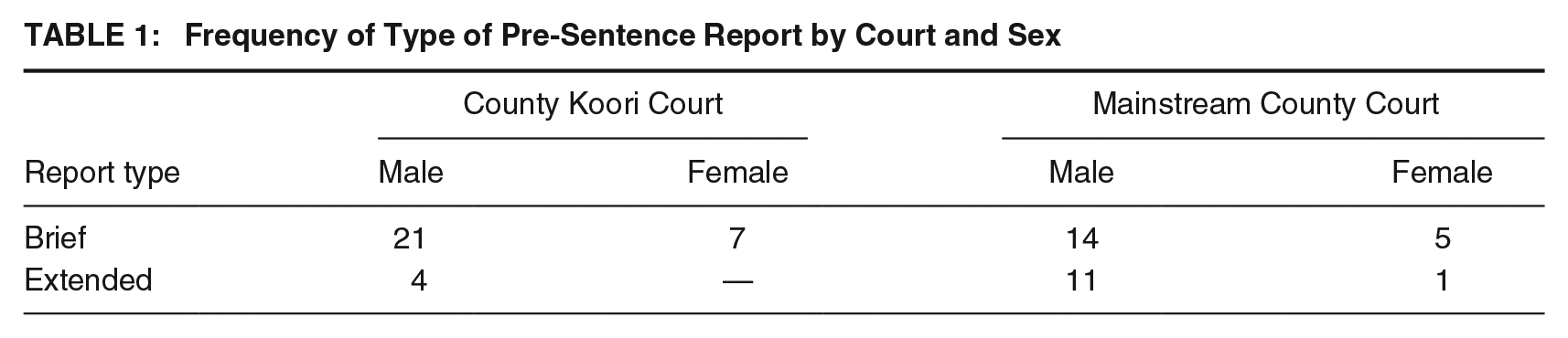
All but one individual who received an extended PSR across both courts in our study period were included. As the County Koori Court cannot deal with sexual offenses (County Court Act, 1958 (Vic.), s 4E(b)(i)), Corrections Victoria excluded the sole individual’s extended report (from the mainstream court) who had sexually offended. Corrections Victoria randomly selected brief reports from the study period. Table 1 presents the number of PSRs split by type, court type, and sex.
Frequency of Type of Pre-Sentence Report by Court and Sex
PSR writers have access to a template to complete the report or can access required fields that need to be completed through the organization’s internal system. For extended PSRs, writers incorporate the Level of Service/Risk, Need, Responsivity (LS/RNR; Andrews et al., 2008)—a risk/needs assessment tool that focuses on the Central Eight risk factors and criminogenic needs (e.g., criminal history, alcohol/drug problem, procriminal attitude/orientation; see Andrews & Bonta, 2010). In the current study, five brief PSRs also mentioned results from the screening version of the LS/RNR (Level of Service Inventory-Screening Version; Andrews & Bonta, 1998). Templates do not differ across the County Koori Court and mainstream County Court. Report-writing staff receive formal training specific to assessment, prosecutions, and the provision of court advice. Staff receive a 90-min session on writing for the community correctional service, which covers writing reports for the court. Staff also receive a 1-day Aboriginal cultural awareness training every 2 years.
Keyword Dictionaries
Authors, TA, EM, JT, and SS, identified pre-defined key terms in the PSRs pertaining to three categories: risk (i.e., violence, offending, breach), culture (i.e., healing, well-being, elders), and pro-social factors (i.e., health, support, relationship). We manually compiled the dictionary (see Supplemental Table S1, available in the online version of this article) from the criminological/forensic behavioral science literature to canvass risk and pro-social factors. We considered literature on culture-based rehabilitation programs and social and emotional wellbeing to identify cultural factors (Dudgeon et al., 2014; Maxwell et al., 2013). Cultural factors were also identified by members of the research team through their own experiences and knowledge. The aforementioned authors, one of whom is Indigenous, have worked extensively with Aboriginal and Torres Strait Islander communities in medico-legal-justice contexts, and some have specifically researched the use of cultural considerations when sentencing Aboriginal and Torres Strait Islander peoples.
Although we believe this process was comprehensive, it did not follow a formal structure. Although it is possible that this unstructured process biased the selection of keywords due to each author’s own experiences, we are confident that the number of authors involved and their expertise in these areas reduced the likelihood of notable analytical biases occurring.
Procedure and Plan of Analysis
We obtained ethics approval for the use of these data from the following institutional review boards: Locations omitted for blind review.
We conducted three types of text-mining analyses on PSRs.
Text-Mining Analysis
We used text-mining analyses to address Research Aim 1 and partly address Aim 2:
1. Ascertain if and how Aboriginal and/or Torres Strait Islander cultural and community issues are addressed in Victorian PSRs.
2. Evaluate the emphasis placed on issues of risk and reoffending as opposed to issues that would be relevant to protective factors and strengths of cultural identity.
Using our keyword dictionaries, we applied text-mining techniques to identify the keywords in each PSR. We extracted frequencies of keywords in each category and frequencies of unique keywords in each category for all PSRs. We also calculated the proportion of all extracted keywords for each category. As the number of keywords in each of our three dictionaries varied (risk = 73, culture = 17, and pro-social = 25), we also calculated normalized proportions of keywords in each category.
Keyword-to-Keyword Graph
We built a keyword-to-keyword graph which allowed us to analyze the associative strength, importance, and communities of keywords we extracted from the PSRs, and therefore address Research Aims 2 and 3a:
2. Evaluate the emphasis placed on issues of risk and reoffending as opposed to issues that would be relevant to protective factors and strengths of cultural identity.
3a. Identify differences in PSRs between the mainstream County Court and County Koori Court in terms of themes.
We performed analyses on the extracted keywords to gain further insight into the most important keywords in the collection of the sentence documents. We also measured how these keywords are associated with each other. Furthermore, we analyzed communities (or clusters) of keywords based on their usage in the collection. For this, we built a keyword-to-keyword graph, where an edge represents a co-occurrence of two keywords in context. The context window size defines the number of neighboring keywords to determine the context of each keyword. In our analyses, we chose 11 as the context window size. Thus, given each keyword, we created its edges with its five keywords ahead and its five keywords behind.
Keyword associative strength
To define the associative strength (weight) of each edge, we used the normalized pointwise mutual information (NPMI) of the keywords connected by the edge. NPMI has been widely used to measure the relatedness or closeness of two words in a given corpus (Bouma, 2009). The NMPI value is normalized into [0, 1], where the higher the value, the more associated the two keywords are.
Keyword importance
To measure the importance of each keyword, we used the two metrics: (a) degree centrality and (b) betweenness centrality. Each keyword’s degree centrality is measured by calculating the number of edges it has. Degree centrality identifies how many different keywords are associated with a particular keyword based on their co-occurrences within the PSRs. We also calculated the betweenness centrality of each keyword in the keyword-to-keyword graph. Using this keyword-to-keyword graph, betweenness centrality measures the shortest path between every pair of keywords, and calculates the number of times a keyword is on the shortest path between two other keywords. Betweenness centrality, thus, provides information on dominant keywords that are situated between pairs of keywords.
Keyword community detection
We also detected keyword communities from the keyword-to-keyword graph using the Louvain method (Blondel et al., 2008). The Louvain method scans the density of connections between nodes (i.e., keywords) and allowed us to detect communities of keywords. Communities contain keywords that are strongly connected, while keywords related to different communities are weakly connected. This analysis provided benefit for detection of a priori unknown communities of highly associated keywords in the collection.
Sentiment Analysis
We used sentiment analyses to research Aim 3b:
3b. Identify differences in PSRs between the mainstream County Court and County Koori Court in terms of sentiment.
Sentiment analyses can generally be categorized into two types of approaches (Pang & Lee, 2008); (a) lexicon-based approaches and (b) text classification approaches. Lexicon-based approaches use a lexicon where the sentiment of words and linguistic devices (e.g., punctuation, emoticons, etc.) has been pre-defined. Text classification approaches involve training a classifier from labeled text instances (or sentences), where a label indicates a positive and negative sentiment score of each text instance.
We chose to use a lexicon-based approach because; (a) labeling and training our own data is a time-intensive task, (b) a lexicon-based approach can be more transparent, easily interpretable by humans, and easily adapted or modified (see Jurek et al., 2015), (c) reliable lexicons that have been manually generated are easily findable and readily available to use, and (d) lexicons can provide high coverage and precision even for rare words. In lexicon-based approaches, the key premise is that the primary indicators of sentiments are represented by sentiment (or opinion) words (Behdenna et al., 2018). Specifically, such a lexicon assigns a categorical sentiment label (e.g., positive, neutral, negative) or a numerical sentiment score to each sentiment word. A neutral denotation are words that lack sentiment and include conjunctions (e.g., and/the) and pronouns (e.g., they/them).
We performed sentiment analysis on each of the reports. Sentiment analysis has widely been used to identify a text’s sentiment orientation (positive, negative, or neutral). For the sentiment analysis model, we used a pre-trained dictionary of opinions words using Valence Aware Dictionary and Sentiment Reasoner (VADER; Hutto & Gilbert, 2014). VADER is a lexicon and rule-based sentiment analysis dictionary that has been found to be successful for identifying sentiment analysis for Twitter comments, film reviews, newspaper editorials, and customer product reviews (Hutto & Gilbert, 2014). VADER uses a dictionary of positive and negative terms and can identify sentiment intensity based on grammatical rules and syntactical conventions. Since there are no pre-trained sentiment dictionaries available for sentiment analysis for legal/correctional texts, we chose VADER as it was constructed from a generalizable and human-curated gold-standard sentiment lexicon. The sentiment of a word in a given text is classified as positive or negative based on positive and negative ratings of dictionary terms in VADER. Also, a word can be classified as neutral if it is not identified in VADER’s lexicon (i.e., dictionary).
Using VADER, we obtained the proportions of each text that were classified as positive, negative, and neutral. VADER also produces a normalized sentiment compound score, calculated from these proportions. This score ranges from −1 (extremely negative) to 1 (extremely positive). Compound scores ≤−.05 are commonly suggested to be negative, scores >−.05 to < .05 are regarded as neutral, and scores ≥.05 are regarded as positive (Elbagir & Yang, 2018). We then conducted t-tests to detect whether any statistically significant differences existed in the proportion of reports that were identified as negative or positive between, and within, each court. Furthermore, within each court, we conducted similar t-test analyses with brief and extended PSRs separately, and also between PSRs with and without risk.
Results
Text-Mining Analysis
Are Aboriginal Cultural and Community Issues Addressed in Victorian PSRs?
Table presents the mean frequencies of extracted keywords for each category as well as the percentage of all extracted keywords in each category. Furthermore, we have presented these same descriptive statistics when only unique keywords were included (i.e., we coded multiple presentations of the same keyword within one PSR as though it appeared once). Less than 1.5 culture-related keywords on average were contained in the PSRs across both courts (County Koori M = 1.2, SD = 2.5; mainstream M = 1.2, SD = 2.1). When only analyzing unique keywords (i.e., only the first instance of each keyword is recorded), less than 1 culture-related keyword was contained in PSRs across both courts (County Koori M = 0.8, SD = 1.4; mainstream M = 0.7, SD = 1.3). Although the normalized proportion of culture keywords was higher in the County Koori Court’s PSRs than the mainstream court’s reports, this difference was not statistically significant for all keywords, t(61) = 0.94, p = .35, d = 0.24, nor unique keywords only, t(61) = 1.06, p = .29, d = .27.
What Emphasis is Placed on Issues of Risk and Reoffending as Opposed to Issues That Would be Relevant to Protective Factors and Strengths of Cultural Identity?
Risk keywords contained in our pre-defined dictionary made up the majority of all extracted keywords for both courts (see Table 2; County Koori M = 60.3%, SD = 15.7; mainstream M = 60.3%, SD = 15.6) as well as the majority of unique keywords (County Koori M = 67.7%, SD = 12.5; mainstream M = 69.4%, SD = 10.7) identified in both courts’ PSRs. Table 3 presents the mean proportion of all extracted keywords split by court type and whether the PSR contained LS/RNR or LSI-SV information. Results indicated that a higher proportion of all extracted keywords came from the risk dictionary for PSRs with LS/RNR and LSI-SV information (M = 66.6%, SD = 14.6) in the mainstream court than PSRs without (M = 55.1%, SD = 14.9), t(29) = 2.16, p = .04, d = 0.78. PSRs from the County Koori Court with risk assessment results (M = 67.5%, SD = 17.1) also had a higher proportion of extracted keywords coming from the risk dictionary than the PSRs without this information (M = 58.1%, SD = 14.9), but this difference was not statistically significant, Welch’s t(8) = 1.31, p = .23, g = 0.61.
Mean Frequencies and Percentage of Keywords by Category and Court-Type

Note. Mainstream n = 31, Koori n = 32. For percentage values, Koori n = 30 due to two brief PSRs containing no keywords. Normalized = the unequal number of keywords in each category of our pre-defined dictionary was accounted for. Mainstream = County Court of Victoria. Koori = Koori Court Division of the County Court of Victoria. Unique keywords = repeat presentations of same keyword within a pre-sentence report are not included in analyses.
Mean Proportion of All Extracted Keywords Belonging to the Risk, Pro-Social, and Culture Categories, and Mean Proportion of Pre-Sentence Reports’ Text Classified as Positive and Negative, Split by Pre-Sentence Reports With and Without Risk Assessment Information, Submitted to the County Koori and Mainstream County Courts of Victoria

Note. PSR = pre-sentence report; Level of Service = numerical or narrative information derived from Level of Service/Risk, Responsivity (LS/RNR; Andrews et al., 2008), or Level of Service Inventory—Screening Version (LSI-SV; Andrews & Bonta, 1998); Welch’s t = Comparison of means across court type; Koori = Koori Court Division of the County Court of Victoria; Mainstream = County Court of Victoria.
Four extended PSRs with LS/RNR information and three brief PSRs with LSI-SV information. b Twenty-three brief PSRs. Two brief PSRs were excluded from the full Koori sample for these calculations as no keywords were extracted and thus did not allow for a proportional calculation. c Twelve extended PSRs with LS/RNR information and two brief PSRs with LSI-SV information. d Seventeen brief PSRs. e Twenty-five brief PSRs.
The normalized results (which account for the size of each category’s dictionary) revealed that pro-social keywords appeared as the dominant category for both courts’ PSRs for both unique (County Koori M = 46.2%, SD = 46.1; mainstream M = 49.1%, SD = 38.5) and all (County Koori M = 58.3%, SD = 73.4; mainstream M = 58.8%, SD = 51.6) extracted keywords. This discrepancy in our own keyword dictionary sizes may reflect the emphasis that the criminal justice system places on risk.
Keyword Importance and Associative Strength
What Emphasis is Placed on Issues of Risk and Reoffending as Opposed to Issues That Would be Relevant to Protective Factors and Strengths of Cultural Identity?
Table 4 presents the top 25 pairs of keywords for both the mainstream and County Koori Courts. The majority of keyword pairs were from the same pre-defined dictionary category. Specifically, 36% of the top 25 keyword pairs in the County Koori Court PSRs were only risk keywords, while 28% were only culture keywords. Of the top 25 keywords in the mainstream court’s PSRs, 44% were risk keywords only, and culture only and pro-social only keyword pairs each made up 8%. Risk and pro-social keywords co-occurred to make up 20% and 16% of the top 25 keywords in the County Koori and mainstream courts’ PSRs respectively. These results may suggest that in both court’s PSRs, risk is often discussed separately to culture and (to a lesser extent) pro-social factors. The results also suggest that the County Koori Court PSRs often discuss culture separately to risk and pro-social factors.
Top 25 Keyword Pairs by Their Associative Strength in the County Koori and Mainstream County Courts of Victoria
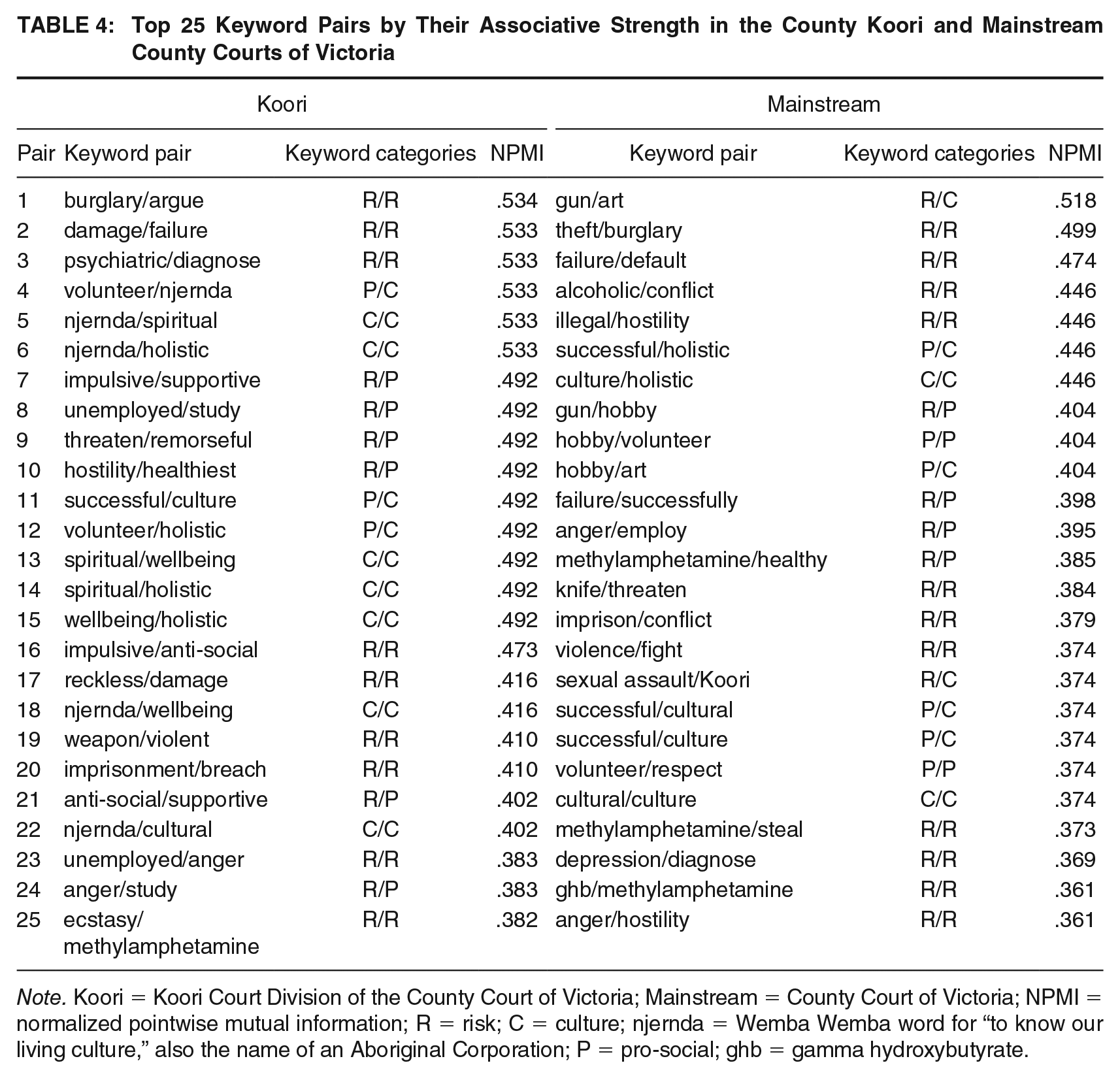
Note. Koori = Koori Court Division of the County Court of Victoria; Mainstream = County Court of Victoria; NPMI = normalized pointwise mutual information; R = risk; C = culture; njernda = Wemba Wemba word for “to know our living culture,” also the name of an Aboriginal Corporation; P = pro-social; ghb = gamma hydroxybutyrate.
Degree centrality scores showed that for the County Koori Court, the keywords that co-occurred with other keywords most often were “offend” (0.49), “custody” (0.48), “risk” (0.47), “drug” (0.46), and “support” (0.46). Similarly, “offend” (0.62), “criminal” (0.59), “risk” (0.59), “drug” (0.58), and “custody” (0.56) co-occurred most often with other keywords in the mainstream court’s PSRs. All these keywords were contained in the risk category of our pre-defined dictionary apart from “support,” which was classified as pro-social. PSRs in both courts revealed 3 pro-social keywords within the 10 most commonly co-occurring keywords. The remaining seven keywords were all risk-related. Full degree centrality results are presented in the Supplemental Table S2 (available in the online version of this article).
Betweenness centrality scores (see Table 5) showed that the five most important keywords were the same as the keywords with the most co-occurrences for the County Koori Court (“risk” = .03, “offend” = .03, “custody” = .02, “support” = .02, and “drug” = .02). Betweenness centrality scores for the mainstream court also showed similarities with degree centrality scores with “offend” (.03), “criminal” (.02), “drug” (0.02), “risk” (.02), and “work” (.02) found to be the five most important keywords. Similarly, to the degree centrality results, all these top keywords apart from “support” and “work” (both pro-social) were classified as risk keywords.
Top 3 Communities of Keywords and Betweenness Centrality Scores for Koori and Mainstream County Courts
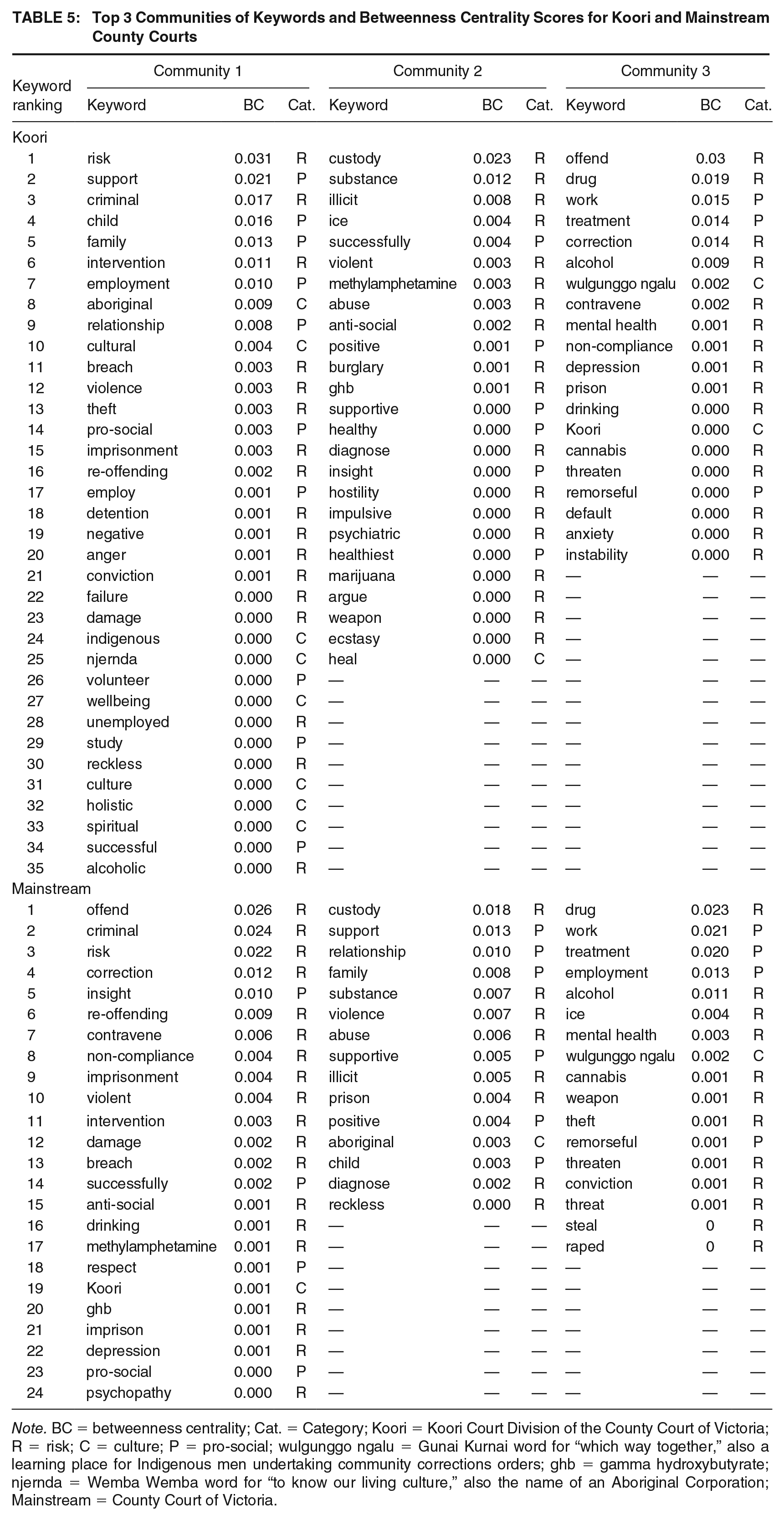
Note. BC = betweenness centrality; Cat. = Category; Koori = Koori Court Division of the County Court of Victoria; R = risk; C = culture; P = pro-social; wulgunggo ngalu = Gunai Kurnai word for “which way together,” also a learning place for Indigenous men undertaking community corrections orders; ghb = gamma hydroxybutyrate; njernda = Wemba Wemba word for “to know our living culture,” also the name of an Aboriginal Corporation; Mainstream = County Court of Victoria.
Keyword Community Detection
What Differences Exist in PSRs Between the Mainstream County Court and County Koori Court in Terms of Themes?
Eight keyword communities were detected in each court’s PSRs based on the top 50 most important words in each court. As > 95% of keywords were captured by three communities for each court’s PSRs, we focused only on these six keyword communities (see Table 5). We could not identify a common theme for the keywords in each community. This may suggest that the PSRs use risk, pro-social and cultural keywords within the same and/or adjoining sentences. Most keywords in all communities were risk words, though this is unsurprising given that risk keywords were overrepresented in our dictionaries. A notable finding from these analyses was that Keyword Community 1 for the County Koori Court PSRs contained more culture keywords (n = 8) than any of the mainstream court’s keyword communities (n =1).
Sentiment Analysis
What Differences Exist in PSRs Between the Mainstream County Court and County Koori Court in Terms of Sentiment?
Although often not offering any insight into how the person is characterized in PSRs, it should be noted that on average neutral sentiment accounted for 82.0% (mainstream court) and 84.6% (County Koori Court) of PSR text in each court. Setting that aside, for the mainstream court’s PSRs, on average, our analyses classified 9.6% of the PSRs’ text as negative, and 8.4% as positive in sentiment. These figures for the County Koori Court were 7.3% negative and 8.1% positive. Independent samples t-tests indicated that there was no statistically significant difference in the proportion of PSRs’ text identified as positive in sentiment across courts, t(61) = 0.31, p = .76, d = 0.08. PSRs from the mainstream court had a significantly higher proportion of text classified as negative compared with the County Koori Court’s PSRs, t(61) = 2.58, p = .01, d = 0.65. Results from dependent samples t-tests indicated similar proportions of text were classified negative and positive within the County Koori, t(62) = 0.67, p = .51, d = 0.21, and mainstream court’s PSRs, t(60) = 1.25, p = .22, d = 0.36. To further illustrate what these results refer to, examples of positive and negative sentences include:
Positive; “[NAME] indicated he has a strong interest in art/drawing and spends most of his time drawing objects in fine detail.”
Negative; “[NAME]’s criminal history commenced in December 1994 ([AGE]) in the [NAME OF COURT] for offences of Burglary, Theft and Theft from Shop.”
Independent samples t-tests revealed that extended PSRs from the mainstream court had a significantly higher mean proportion of negative text (M = .116, SD = 0.024) than the brief reports (M = .083, SD = 0.036) from the mainstream court, Welch’s t(28) = 2.99, p = .01, g = 1.01. We detected no significant differences in the proportion of positively classified text between brief and extended mainstream court PSRs, Welch’s t(28) = 1.68, p = .10, g = 0.54. This same pattern was observed in the County Koori Court’s PSRs. We found no difference in proportion of text classified as positive between the County Koori Court’s brief and extended PSRs, Welch’s t(4) = 0.18, p = .87, g = 0.10, though extended reports had a significantly higher proportion of text classified as negative, Welch’s t(21) = 2.41, p = .03, g = 1.82.
We conducted further analyses to explore whether the finding of more negatively worded text in the mainstream court was due to the greater number of extended reports in the mainstream court sample (which are significantly more negative than the brief reports and incorporate the LS/RNR). The County Koori Court sample contained four extended PSRs with LS/RNR information, and three brief PSRs with LSI-SV information. These numbers were 12 and 2, respectively, for the mainstream court. Independent samples t-tests indicated that PSRs that incorporated LS/RNR or LSI-SV results did not have statistically significant different proportions of negatively classified text across County Koori (M = 7.5%, SD = 2.8) and mainstream courts (M = 10.4%, SD = 3.7), Welch’s t(15) = 2.0, p = .07, g = 0.83. The proportion of negatively worded text was also not statistically significantly different across County Koori (M = 8.1%, SD = 2.7) and mainstream courts (M = 10.1%, SD = 2.6) in PSRs which did not incorporate structured risk assessment information, Welch’s t(12) = 1.67, p = .12, g = 0.78. This may indicate that the higher proportion of negatively classified text observed in the mainstream court’s PSRs is due to these reports containing more structured risk assessment information. Although given that the differences in means are similar (for the overall results, and results split by inclusion/exclusion of LS/RNR or LSI-SV), this may be due to the smaller sample size being inadequate to detect a statistically significant difference. See Table 3 for analyses split by inclusion/exclusion of risk assessments.
Using the compound scores, 67.7% (mainstream) and 56.3% (County Koori) of PSRs were classified as having a negative sentiment overall while the remainder were classified as positive overall. The mean compound scored demonstrated that on average, mainstream court PSRs were negative in their sentiment (M = −0.34, SD = 0.83) and County Koori Court PSRs were neutral in sentiment (M = −0.05 SD = 0.80).
Discussion
In this article, we analyzed the text of PSRs for Aboriginal and Torres Strait Islander individuals from both County Koori and mainstream courts. Broadly, our results indicated that the cultural strengths of Aboriginal and/or Torres Strait Islander individuals are discussed only briefly within PSRs across both courts, while risk is discussed more heavily. This is despite the potential benefits shown in Canada of actively and consciously including cultural information during sentencing (see Hannah-Moffat & Maurutto, 2010; Herbert, 2017).
More specifically, our results indicated that PSRs from the mainstream court were slightly more negative in sentiment than those written for the County Koori Court, while the proportion of positive text in each court’s PSRs did not differ. When we split our analyses by PSRs with and without LS/RNR or LSI-SV information included in the text, we no longer found a significant difference in negative sentiment across courts, but the smaller sample size may have contributed to this. When we assessed communities of keywords, our analyses detected a greater number of culture keywords in a major keyword community for the County Koori Court PSRs compared with the mainstream court’s PSRs. We also detected a number of similarities in PSRs across courts. Risk keywords were more prevalent than pro-social and culture keywords across both courts’ reports, although pro-social keywords were more prevalent when we accounted for the overrepresentation of risk keywords in our initial dictionaries. Given that risk words were the most prevalent category of keywords, our analyses also revealed the most important words, and words with the most co-occurrences, to be largely risk words across both courts’ PSRs. Although PSRs written for Aboriginal and Torres Strait Islander individuals in both the mainstream and County Koori Court were similar, the few differences we detected may have significant implications for Aboriginal and Torres Strait Islander peoples being sentenced.
The study revealed that reports written for Aboriginal and Torres Strait Islander individuals sentenced through the mainstream court were more negatively worded than those sentenced through the County Koori Court. This may have been due to the present study’s mainstream court sample containing more PSRs with risk assessment results included. Judicial officers interviewed in Anthony et al. (2017) described how PSRs can be influential in their sentencing decisions, as judicial officers may not depart from the PSR’s recommendations without strong evidence against them. Often, reports present non-custodial options designed to benefit the person being sentenced, but some reports can be overly punitive. Reliance on overly punitive reports may adversely affect the person being sentenced as the judicial officer may order a custodial over a non-custodial sentence, a longer term of imprisonment, or the person’s eligibility for parole may be affected (“HAS” v. The State of Western Australia, 2005).
Our analyses revealed that risk keywords were more prevalent than cultural or pro-social keywords in PSRs, regardless of which court we evaluated. The most important keywords and the keywords that co-occurred with other keywords most often were also predominantly risk words. The amount of risk words as a proportion of all extracted keywords was higher in the mainstream court’s PSRs, which included the general risk and needs section of the LS/RNR and LSI-SV results, than the PSRs within the same court that did not include this information. Many of the items measured in the LS/RNR mirror risk words from our keyword dictionary. Although the LS/RNR allows the assessor to record an individual’s strengths, these are limited to the risk/needs-based factors it measures. The extended PSRs do allow for a section on responsivity and protective factors, but without a structured tool to guide report writers to consider protective factors, a wide range of pro-social factors may be less likely to be considered. Prior literature has argued that risk instruments encourage punitive rather than rehabilitative outcomes given that they are framed through the prism of risk (Hannah-Moffat & Maurutto, 2010; Shepherd & Anthony, 2018). The LS/RNR, which is heavily focused on risk factors and criminogenic needs, could influence the written content of extended PSRs. Although our results demonstrated that the inclusion of structured risk assessment tools into PSRs is reflected in the proportion of risk keywords included in PSRs in the mainstream court (and possibly in the County Koori Court if the sample size was larger), PSRs which did not include risk assessment results also contained more risk keywords than pro-social or cultural keywords.
Although less contentious in situations where stakes are lower (e.g., identifying appropriate services for clients), the introduction of risk assessment tools into the sentencing process has been divisive in the legal and academic fields. Relying on data-driven, group-based aggregates of risk emerged in corrections throughout the latter part of the 20th century (see Feeley & Simon, 1992) and concerns have been raised that this shift is at odds with individualized justice (Hannah-Moffat, 2013). A major concern is that using such instruments during the sentencing process results in the perpetuation of systemic biases, and further discriminates against disadvantaged and marginalized groups (Starr, 2015). Furthermore, critics have argued that the use of risk tools promotes punitive rather than rehabilitative outcomes due to their use of deficit-based language (Hannah-Moffat & Maurutto, 2010; Harcourt, 2006; Shepherd & Anthony, 2018).
In recent years, there has been an increase in the number of correctional risk assessment tools, which have a focus on the strengths of the individual being assessed (see Borum et al., 2006; de Vogel et al., 2012; Serin, 2007; Webster et al., 2004). Protective items/factors measured by these tools mirror many of the keywords included in the present study’s pro-social dictionary. Protective factors are included in these tools for a number of reasons. Protective factors reflect an individual’s strengths, and the identification of these factors may assist a case manager/clinician to help the individual desist from further offending. When PSRs are heavily oriented toward an individual’s risk of reoffending, and with little consideration afforded to the protective or community strength factors that may mitigate this risk, the information presented to a judicial officer may not be an accurate portrayal of an individual’s circumstances, their available support options, or their capacity to desist from offending. When we accounted for the number of words in each of our dictionaries, pro-social words then had greater representation. Our own dictionary contained significantly more risk keywords than pro-social or cultural words which may reflect the criminal justice system’s focus on risk. Alternatively, this may be a true reflection of a person’s exposure to risk factors while having experienced few positive episodes in their life. For example, the majority of individuals in this study received LS/RNR scores of over 30, which places them in a high-risk category, according to the instrument.
Culture words were the least common keywords detected in the present study’s PSRs. We detected few differences in the use of cultural words in PSRs between courts. One of the top communities of keywords (i.e., strongly connected keywords) in the County Koori Court’s PSRs contained more cultural words than any of the top three communities of keywords from the mainstream court’s PSRs. Results also indicated report writers used more cultural words in the County Koori Court PSRs than the mainstream court’s PSRs. However, this difference was not statistically significant. The use of cultural words was low irrespective of which court’s reports we evaluated. The lack of cultural words identified in the current study’s PSRs may be a reflection of the assessors’ knowledge and experiences and the assessment tools that inform PSRs. It may also reflect the low numbers of report writers who are Aboriginal and Torres Strait Islander (Department of Justice and Community Safety, 2020) or identify with cultural backgrounds that shape their identity, family, and community. This may affect their knowledge, and level of comfort writing about cultural strengths and a person’s connection to their community and culture.
We suggest report writers should be cognisant that the inclusion of a formal risk tool in the PSR may affect the sentiment of the text and may result in a disproportionate amount of deficit-based language. Formally assessing pro-social/protective factors through a structured tool may result in the identification of protective factors that would otherwise have not been presented to the court. Report writers should also have a working knowledge of the community their client originates from and an understanding of the client’s culture in order to consider appropriate orders and conditions. Cultural information is important as it allows the reader to understand the context and circumstances of the individual’s behavior (Shepherd & Anthony, 2018). The low frequency of cultural keywords in the present study suggests that judicial officers may sentence Aboriginal and Torres Strait Islander individuals without all the relevant information to understand their unique circumstances.
To better address the impact that factors unique to Aboriginal and Torres Strait Islanders have on individuals’ offending, the Australian Law Reform Commission (2017) recommended the development of “Indigenous Experience Reports” (hereafter referred to as Aboriginal Community Justice Reports) for Australian sentencing courts. Aboriginal Community Justice Reports are currently being piloted in the Koori County Court and mainstream County Court of Victoria (Victorian Aboriginal Legal Service, 2021). These reports are designed to allow unique background and systemic factors that have an impact on Aboriginal and Torres Strait Islander peoples to be presented to the court. Similar to Gladue reports, Aboriginal Community Justice Reports are designed to be distinct from a PSR as their function is to identify facts and circumstances that exist solely due to the individual’s Aboriginal or Torres Strait Islander identity, as well as their strengths. Given that our results have demonstrated that PSRs encompass few cultural keywords, these reports may prove necessary in providing contextual cultural information to the court, particularly in the mainstream court where avenues to receive this information are limited. Judicial officers in Victoria operate within Western systems of justice, which have incarcerated Aboriginal and Torres Strait Islanders at disproportionate rates. As such, it is important that information from cultural reports will be carefully and sensitively considered through culturally responsive processes determined in consultation with the Aboriginal and Torres Strait Islander Community.
Through the use of novel techniques, the present study has demonstrated that PSRs used in County Koori and mainstream courts for Aboriginal and Torres Strait Islander individuals in Victoria are disproportionately focused on risk and provide minimal culturally relevant information to the courts. These findings are consistent with literature from Canada, where PSRs rely too heavily on risk items (Hannah-Moffat & Maurutto, 2010). Hannah-Moffat and Maurutto (2010) also argued that Gladue reports complemented PSRs, as they provided an opportunity to extensively discuss how the individual’s unique life circumstances had contributed to their risk factors and criminogenic needs. In Australia, the introduction of Aboriginal Community Justice Reports (analogous to Gladue reports) may act similarly to Gladue reports in Canada. The dominance of risk-related words in the PSRs may be less problematic if Aboriginal Community Justice Reports are presented to the courts alongside PSRs.
The present study has also demonstrated that text-mining and NLP analyses and techniques can be applied to legal texts.
Limitations and Future Directions
One criterion to be sentenced by the County Koori Court is that the accused must plead guilty (County Court Act, 1958 (Vic.), s 4E(c)). Some of the findings in the present study may have arisen because we did not systematically select only people who pleaded guilty in the mainstream court. The higher proportion of negatively worded text in the mainstream court’s PSRs could partially be due to the reports describing individuals who pled not guilty but who were subsequently found guilty. The negatively worded texts may be a reflection of how the individual presented to the report writer in terms of insight, remorse, and other relevant behaviors. Any replication of the current study would benefit from also evaluating whether the individuals from the mainstream court pled guilty.
The accused must also agree to be sentenced by the County Koori Court, and the County Koori Court must agree that it is appropriate for them to sentence the accused (County Court Act, 1958 (Vic.), s 4E(d)). These two criteria may result in Aboriginal and Torres Strait Islander individuals who already have a stronger connection to their culture being sentenced by the County Koori Court. The greater (but not statistically significantly greater) number of culture words found in the County Koori Court’s PSRs than in the mainstream court’s reports and the greater number of culture words in Community 1 of the County Koori Court’s PSRs, than the mainstream court report’s communities, may not be a function of the court itself. Instead, these differences may be a result of the differences in individuals who fit the County Koori Court’s criteria and those who do not. PSR writers are also aware if the request for assessment has originated from the County Koori or mainstream court. It is unclear whether this knowledge may have contributed to the differences seen between the PSRs of the two courts. Low rates of culture-related words across both court sub-groups could also reflect lost connections with families and communities.
Our analyses also revealed extended PSRs to be significantly more negative in sentiment than brief PSRs. The mainstream County Court’s significantly more negative PSRs overall may be a result of this sample also containing more extended reports, and thus more structured risk assessment information. Although we analyzed reports with and without LS/RNR and LSI-SV information separately, our lack of significant differences in sentiment may have been a feature of the small sample sizes. Future studies with larger sample sizes would benefit from analyzing these types of reports separately to minimize possible confounding variables.
The inclusion of skewed cultural information in PSRs can reinforce punitive assumptions relating to Aboriginal and Torres Strait Islander peoples’ deficit and risk (see Cunneen, 2020). Therefore, a holistic and strengths-based account of the individual’s culture would benefit courts’ capacity to account for the prosocial value of culture and/or the constraints posed by systemic racism and inter-generational experiences of colonization in the individual’s life. As set out in this article, First Nations justice or legal organizations can play an important role in preparing reports for sentencing that do not rely solely on a risk framework. They are well-placed to address cultural issues in a manner that promotes First Nations standpoints, strengths-based approaches and culturally appropriate sentence options. These reports are emerging across Australia in response to the limitations of PSRs, including those set out in this study.
Although it was beyond the scope of the present study, future studies would benefit from examining how the language and (non) consideration of pro-social cultural factors in PSRs affects sentencing outcomes. Also beyond the scope of this study, is the need for a more in-depth evaluation of how cultural information is presented outside of PSRs to the County Koori Court, and if this information may offset any negative, deficit-based language used in PSRs.
Furthermore, this study’s procedure and choice of analytical technique may have limited our findings. VADER was originally developed for and validated with text formats that may be less formal than a PSR (e.g., social media posts and customer reviews; see Hutto & Gilbert, 2014). There is a paucity of evidence of how VADER performs with formal texts. Legal texts such as PSRs may be deliberately stylized to avoid positive and negative sentiments. Further research that analyses the sentiment agreement between VADER and humans may be beneficial in determining how VADER performs with formal texts. A qualitative component may also add confidence to the comprehensiveness of the present study’s keyword dictionaries. Despite the current lack of research in this area, for the reasons described in this article’s “procedure and plan of analysis” section, we believe VADER to be an appropriate approach.
Conclusion
Courts should be provided with all relevant information when sentencing an individual. The present study has shown that PSRs written for Aboriginal and Torres Strait Islander individuals in Victoria focus disproportionately on risk, though with some consideration of pro-social factors. However, there was relatively little inclusion of strengths-based cultural-specific information in reports regardless of whether they are prepared for Indigenous sentencing or mainstream courts. In terms of the content of the PSRs, those prepared for Aboriginal and Torres Strait Islander peoples in the mainstream court were slightly more negatively worded than those in the Indigenous sentencing court. Overall, the study augments evidence that PSRs focus heavily on risk of recidivism regardless of the type of court for which they are prepared (Anthony et al., 2017; Hannah-Moffat & Maurutto, 2010). Courts should receive a meaningful account of culture and systemic factors to better understand the fullness of the individual’s life experiences.
Supplemental Material
sj-docx-1-cjb-10.1177_00938548221131952 – Supplemental material for Culture, Strengths, and Risk: The Language of Pre-Sentence Reports in Indigenous Sentencing Courts and Mainstream Courts
Supplemental material, sj-docx-1-cjb-10.1177_00938548221131952 for Culture, Strengths, and Risk: The Language of Pre-Sentence Reports in Indigenous Sentencing Courts and Mainstream Courts by Darcy J. Coulter, Abdur Rahim Mohammad Forkan, Yong-Bin Kang, Justin S. Trounson, Thalia Anthony, Elena Marchetti and Stephane M. Shepherd in Criminal Justice and Behavior
Footnotes
Authors’ Note:
The views expressed are those of the authors and not necessarily those of Corrections Victoria. This research was supported by an Australian Institute of Criminology Research Grant (04/19-20).

Supplemental Material
References
Supplementary Material
Please find the following supplemental material available below.
For Open Access articles published under a Creative Commons License, all supplemental material carries the same license as the article it is associated with.
For non-Open Access articles published, all supplemental material carries a non-exclusive license, and permission requests for re-use of supplemental material or any part of supplemental material shall be sent directly to the copyright owner as specified in the copyright notice associated with the article.
