



Abstract
The Norwegian Correctional Service ascribes to both a humane and rehabilitative approach to incarceration which includes the use of dynamic security practices, emphasizing relationship-building and communication between officers and incarcerated individuals. In addition, officers are expected to actively participate in the rehabilitative process. Despite Norway’s low rates of prison-based violence, there remain questions about officers’ ability to implement dynamic security and contribute to therapeutic goals. The current study explores perspectives about dynamic security and officer relationships using a questionnaire (n = 81) and semi-structured interview (n = 47) data from individuals incarcerated at Halden Prison in Norway. Findings indicate that officers have generally attained authoritative legitimacy through dynamic security, but their participation in the rehabilitative process is met with resistance stemming from prison culture expectations of officers’ role in enacting State punishment. Results from this study provide meaningful insights into the role of dynamic security implementation and the contributions of correctional officers to the rehabilitative process.
There is an increasing interest within correctional settings to encourage meaningful interactions between officers and incarcerated individuals as a method to reduce conflict and promote security. Often referred to as “dynamic security,” this process relies on relationship-building and open communication along with prioritizing rehabilitative goals. Perhaps the most well-known implementation of dynamic security is within the Norwegian Correctional Service (NCS). Halden prison, for example, has been the subject of numerous news stories, studies, and documentaries, inspiring correctional departments internationally to adapt dynamic security to their own penal institutions. The media has focused on the architectural design of this prison along with the emphasis on the importance of building relationships between correctional officers and those incarcerated to facilitate change and strengthen security within this facility.
Research suggests incarcerated individuals are more likely to respond positively when they feel correctional staff understand their experiences (Beijersbergen et al., 2015). Officers who engage in ongoing, meaningful communication, show respect toward those they supervise, and practice fair and flexible use of their authority are more likely to be perceived as legitimate sources of authority within the prison. Demonstrating genuine concern for the well-being of those incarcerated is instrumental in developing a rapport with them, gaining their trust, and diffusing potential conflicts (Crewe & Liebling, 2015).
While relationship building and communication are generally considered central to dynamic security, there are no established standards for a dynamic security model of correctional supervision. This can potentially result in correctional departments having dynamic security training and practices that vary greatly from one another. In addition, research on dynamic security and its impact on staff and incarcerated individuals’ behavior and well-being has often been atheoretical. As interest in dynamic security continues to grow, a theoretical understanding of how dynamic security works and what specific aspects of officer-incarcerated interactions are most effective at producing positive change becomes increasingly important.
This article begins with a review of the existing literature on dynamic security and how this model of correctional supervision differs from static security, including an overview of the NCS use of dynamic security to promote rehabilitation goals. We also review existing literature on practices related to dynamic security and how this approach contributes to the legitimacy of officers. We then share findings from qualitative interviews of incarcerated men at Halden Prison in Norway on communication and interactions with officers. These findings provide much-needed insight into how dynamic security practices are perceived by those directly impacted: incarcerated individuals. Going beyond identifying “what works” within Norway’s dynamic security model, we discuss the themes from the interviews within a theoretical context, drawing on the work of Liebling and Crewe to improve understanding of why certain aspects of dynamic security are effective at enhancing safety and compliance within the penal environment. Finally, we discuss the barriers to officer participation in the rehabilitative process within the context of dynamic security.
Given the findings of this study, a focus is placed on how the dynamic security model can be altered to potentially enhance rapport and positive interactions between officers and incarcerated populations. In addition to the recommendations for the dynamic security model, we call for more qualitative and quantitative research evaluating the mechanisms promoting rehabilitation within the dynamic security model. This includes additional research on the process used to build rapport and the effects of the dynamic security model on misconduct, reentry preparedness, and the lives of correctional populations after confinement. We conclude with a brief discussion of the challenges faced by correctional departments in other nations seeking to implement dynamic security.
Dynamic Security
Security within prisons is maintained through a variety of physical and operational strategies. A central method of ensuring safety is through static security. Static security provides the necessary level of security to keep the public, staff, and those incarcerated safe (Correctional Service Canada, 2016). It requires both physical (e.g., prison design, locks, cameras) and procedural measures carried about by correctional staff (Brooks, 2006; United Nations Office of Drugs and Crime [UNODC], 2015). Officers are tasked with enforcing the rules, maintaining order, supervising the daily routines of those incarcerated, reporting on misconduct, and, in some cases, aid in the rehabilitation and counseling of residents (Abdel-Salam & Sunde, 2018).
While static security is essential to the safety within a prison, some countries have adopted another layer of control strategies referred to as dynamic security. Although definitions vary, the phrase was originally coined by former Prison Governor for the Prison Service for England and Wales, Ian Dunbar, who described it as “when relationship and individualism come together in planned (and purposeful) activity, whether in a high or low-security setting, the result is a relaxed and better-ordered prison” (Dunbar, 1985, p. 35, as cited in Leggett & Hirons, 2007). Relatedly, the French National School of Prison Administration states that relationships and social interactions between correctional officers and incarcerated individuals should incorporate “‘presence’ based on dialogue and the capacity for self-affirmation; the relational ‘authenticity’ built on the control of one’s tasks and missions; the ‘respect’ of inmates based on a non-judgment attitude and on the reliability of the given word; the ‘empathy’ reflecting the prison officer‘s ability to feel what inmates experience, and the ‘modesty’ allowing you to know your own limits” (Ecole Nationale D’Administration Pénitentiaire [ENAP], 2018, p. 1). Each of these elements governs the expectations of officers as they carry out their duties (Kikas et al., 2021a).
Dynamic security is a proactive method of identifying and addressing threats to security that requires officers to be present, interact, and engage in meaningful activities with those incarcerated (Council of Europe, 2006). These social interactions are also intended to mitigate the pains resulting from the deprivation of liberty experienced by those incarcerated (Sykes, 1958) by reducing the friction between staff and incarcerated populations and promoting an environment of mutual respect. In addition to the focus on safety, the relationship-building that is central to dynamic security may also have the potential to promote rehabilitative goals. To carry out both functions, officers require specialized training. This begins with introducing the fundamental principle of respect for human rights and human dignity toward those incarcerated (Kikas et al., 2021b). Other topical areas covered during training include ethics, code of conduct as an officer, communication and relational skills, and familiarity with risk and needs assessment (2021b).
Building Legitimacy Through Dynamic Security
Given the emphasis on building a positive rapport, it is suggested that correctional officials in facilities that have implemented a dynamic security model are perceived as legitimate agents by the incarcerated population. Legitimacy is most often discussed in regard to authoritative power (Steiner & Wooldredge, 2018), where the correctional official is perceived as an agent that can rightfully administer punishments, but can also refer to rehabilitative legitimacy, where the correctional official is perceived as an agent of lifestyle or behavioral change. The use of relationship-building, frequent communication, and responding to the needs of incarcerated individuals can help establish trust between the officers and incarcerated populations (Crewe & Liebling, 2015; Leggett & Hirons, 2007). Moreover, officers perceived as legitimate authoritative actors commonly implement strategies that humanize incarcerated individuals (Hacin & Meško, 2018). However, while dynamic security can increase the authoritative legitimacy of officers, it is less certain whether officers can establish similar legitimacy within the rehabilitative or therapeutic process, given their primary roles of enacting State punishment and rule enforcement. That is, officers are inherently perceived as a disciplinarian, diminishing their ability to participate in the rehabilitative process and, in turn, potentially reducing the rehabilitative efficacy of dynamic security. These principles and mechanisms underpinning the efficacy of dynamic security can be directly observed within Norwegian Prisons.
Dynamic Security Within Norwegian Prisons
One country currently implementing dynamic security within its prisons is Norway. The NCS operates 58 prisons with about 70% of those incarcerated serving their time within a high-security facility (Kriminalomsorgens høgskole og utdanningssenter [KRUS], n.d.). The responsibilities of correctional officers in Norway reflect the training they receive and the underlying connection between the NCS and the welfare state system (Smith & Ugelvik, 2017). Similar to other Scandinavian countries, Norway considers the purpose of punishment within the broader benefit of society. Within this context, officers in Norway are trained to understand prisons as a place to maintain safety and security as well as a space in which rehabilitation takes place (Kolind et al., 2015).
Candidates must undergo 2 years of formal training to become a correctional officer in Norway (KRUS, n.d.). Upon placement in a correctional facility, they are expected to perform security, intervention, and rehabilitation-oriented duties (Kikas et al., 2021a). This includes preparing risk and needs assessment for individuals, engaging in frequent interaction and communication with incarcerated individuals, and conveying a sincere desire to support them. Contact between officers and those incarcerated includes both formal and informal exchanges. Formal interactions involve requests by those incarcerated with the assistance of officers to obtain needed services or concerns (e.g., request for medical care). Informal interactions are expressed through casual encounters, such as general conversation, between officers and incarcerated individuals. Spending time in the housing unit helps facilitate informal interactions. In Norwegian prisons, it is not uncommon to see officers eating dinner or playing board games with those incarcerated. In terms of safety, both formal and informal interactions associated with dynamic security can aid officers in gaining awareness of potential trouble and easing the discontentment of those incarcerated.
Correctional officers in Norway also serve as a “contact officer” for two or three designated incarcerated individuals (KRUS, n.d.). In the role of contact officer, they assist those assigned to them with developing a “future plan” that lists the specific rehabilitative services or treatment needs the individual will focus on during their incarceration. During the period of incarceration, the contact officer is also a source of information and support to those they work with. This includes offering them guidance concerning their rights while in prison as well as encouraging them to utilize the opportunities and resources available to them.
Research on Dynamic Security
There have been numerous publications through the media highlighting the humane approach of the NCS, and the potential benefits of building closer relationships between officers and those incarcerated. However, the information provided through academic scholarship has not yet produced a great deal of information exploring the impact of dynamic security on those incarcerated. Most research on this topic is framed within language such as “soft power” and the importance of minimizing social distance between officers and those incarcerated (Crewe, 2011b). A scan through the literature by the authors of this article using keyword searches for title and abstract including “dynamic security,” “dynamic security and prisons,” “dynamic security and inmates,” and “dynamic security and correctional officers” yielded few results. Findings included several training manuals, book chapters, and reviews of dynamic security. Only a handful of studies were found relating to perceptions of dynamic security practices, and they exclusively focused on the experiences of officers, and none were conducted in Norwegian correctional institutions (Ahalt et al., 2019; Douglas & Caulfield, 2014; Santorso, 2021). For example, the Santorso study (2021) set in two Italian prisons points to the challenges of implementing dynamic security and the expanding job responsibilities of officers. Many of the officers interviewed in this study found it difficult to prioritize the need to maintain security while also engaging in rehabilitation. Some even noted shifting policies, such as extending opportunities for those incarcerated to self-regulate, were leading to greater social distance between themselves and those incarcerated.
In the United States, the nonprofit organization AMEND has worked in conjunction with the NCS to support the travel of officers and officials from state correctional departments to tour Norwegian prisons and observe the implementation of dynamic security firsthand (Ahalt et al., 2020). Early adopters of dynamic security have reported promising results. The North Dakota Department of Corrections and Rehabilitation saw reductions in the number of people placed in specialized behavioral units and segregated housing as well as lower rates of recidivism (North Dakota Department of Corrections and Rehabilitation [NDDCR], 2020). Findings from a survey of officers for the Oregon Department of Corrections reveal improved working conditions for staff and reductions in violence incidents and use of physical force (Klocke, 2021). These improvements are attributed to the training process emphasizing rapport-building, respectful interactions, and authentic acts of support of individuals and their rehabilitative goals.
While the work in this area has led to important insights into both quality of interactions and perceptions of officer legitimacy, the potential therapeutic impact of this approach is less clear. In terms of official reports, the authors explored websites related to the NCS along with known states using some aspects of dynamic security (North Dakota and Oregon). Once again, nothing was found specifically mentioning dynamic security or the evaluation of these programs. Of course, it is possible information may exist but is not accessible to those outside of the departments of correction. Reports produced by the NCS may be for internal use or provided on their website in Norwegian (this may also be the case for other foreign systems using dynamic security). The former may also be true for correctional systems in other countries. Furthermore, the experiences of incarcerated individuals and how they perceive and benefit from the implementation of dynamic security are understudied. It seems clear that more theory and information are needed—particularly with respect to the experiences of those incarcerated.
The Current Study
Given the importance of dynamic security within Norwegian prisons as well as the increased interest in adapting the Norwegian model of dynamic security to other carceral settings, the current study explores how dynamic security practices are perceived by those directly impacted by its use: incarcerated individuals. Specifically, we examine the relationships between incarcerated individuals and their contact officers as well as other correctional staff at the prison. The frequency and quality of interactions with officers, perceptions of support and understanding from officers, and willingness to disclose sensitive information or conflicts to correctional staff were explored.
Method
Sample and Recruitment
Data collection for the current study took place at Halden Fengsel (prison) during a 3-week time period during the summer of 2017. This study was reviewed and approved by West Chester University’s Institutional Review Board as well as the Norwegian Correctional Service (NCS) and leadership at Halden. Approval from the Norwegian Center for Research Data was not required because identifiable information from participants was not collected. In addition, a memorandum of understanding (MOU) was agreed upon and signed by the Principal Investigator (PI) of the study and prison leadership authorizing the presentation and dissemination of Halden Fengsel-associated research findings in peer-reviewed, scientific journals.
Prior to data collection, the Research Team (RT) identified a time of the day/week when the greatest number of individuals within each of the residential units were likely to be there. During the first week of data collection, the RT visited each of the residential units within buildings “A,” “B,” “C,” and “O” (halfway house). Most of the participants completed the questionnaire sitting quietly within the community room or privately in their cells while the RT was present. Despite being provided 2 hr to complete the questionnaire, there were many individuals who did not begin completing this form immediately or who took longer than anticipated to complete. They were in the middle of working on other things at the time the questionnaires were distributed, not immediately interested in completing the form or wanting time to read over the consent form and questionnaire in private. The RT made a note of those who had asked for more time and kept a mathematical count of questionnaires remaining to be collected later from each of the residential units. Only members of the RT handed out the questionnaire. Both the questionnaire and the semi-structured interview required signed consent by the participants. They were given the opportunity to review the consent form that provided a description of the project along with information clarifying their participation as voluntary. Prior to signing the consent form, the interviewer asked if participants understood the information within the consent form and if they had any questions.
A closed box with a slit on the front side was provided for individuals to confidentially place their questionnaires once returned. While the RT counted the number of questionnaires distributed and returned, they did not monitor who was returning them unless they had been asked to return at a later time to pick them up. In this case, the RT would return at an agreed-upon date and time and collect the forms. The RT counted the number of questionnaires distributed and collected simply for the purpose of calculating the response rate. Of the 121 questionnaires distributed, 81 of them were returned. The response rate represents more than two-thirds of the questionnaires distributed (67%). Given the short time period allocated for the distribution of questionnaires and other barriers such as the different languages spoken by the respondents, this response rate is satisfactory.
During the initial period of distributing and collecting questionnaires (week one of the project), participants were asked if they would also like to be interviewed, and if so, in which language (Norwegian or English). Several agreed to complete both the questionnaire and the interview. There were others, however, who preferred not to complete the questionnaire but wanted to be interviewed (they were allowed to do so). Not all individuals who completed the questionnaire wanted to participate in the interview. No identifying information was collected to ascertain what percentage of those participating in the interviews also completed the questionnaire. A total of 47 semi-structured interviews were conducted with 26 interviews conducted in Norwegian and 21 in English. The interviews took place in a private room (doors were closed) within the residential buildings but outside the actual living units. In a few cases, the interview occurred within the individual’s private cell. Only the interviewer and the participant were present during the interviews and each interview lasted between 45 and 60 min.
When interpreting the results of this study, an important consideration is whether the sample of respondents is representative of the total population. A representative sample provides some confidence that information collected from the sample is reflective of the total incarcerated population at Halden, and not just the individuals who were recruited and agreed to participate. To address this question, researchers examined similarities and differences between the sample and the total incarcerated population using basic demographic characteristics, detention status, and sentence length as points of comparison. Official data on the total population provided by the administration of Halden indicates similarities between the questionnaire sample (n = 81) and the total population (N = 248) as shown in Table 1.
Demographic and Detention Status of Questionnaire Sample Versus Total Halden Prison Population at Time of Data Collection
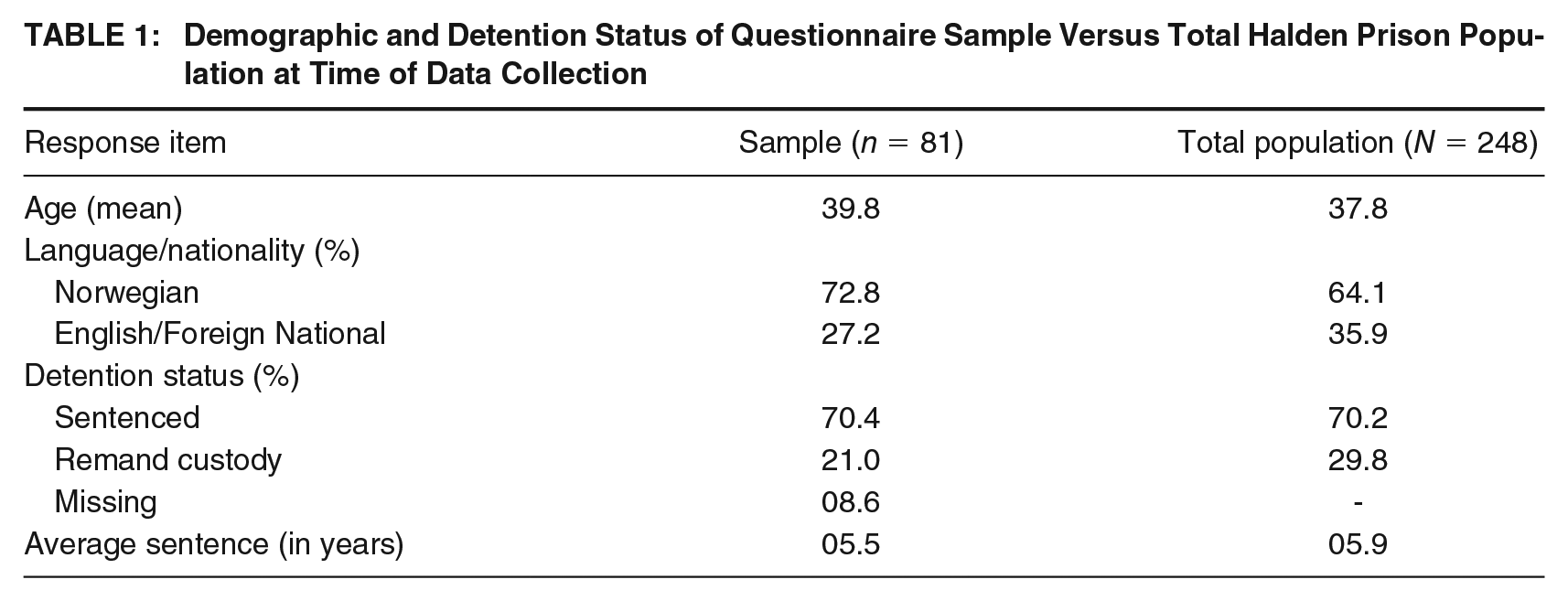
It should be noted, however, that it was not the intention of the current study to recruit a representative sample of participants for the purpose of generalization. Instead, the current study seeks to contribute to the extremely limited existing research that provides firsthand experiences and perceptions of those incarcerated at Halden. Also, due to the restrictions of what housing units were available to recruit from and language barriers, a fully representative sample of those incarcerated at Halden was not a feasible expectation. However, the degree of similarity between the sample and the total Halden population suggests that those who were available to recruit and who ultimately participated are not such outliers as to provide no connection to the broader prison population.
Data Collection and Analysis
The RT consisted of the PI and two Research Associates (RAs). The PI is from the United States while the RAs are both Norwegian. The RAs assisted the PI with the development of the questionnaire and semi-structured interview guide. The proper translation of the English versions of the questionnaire and interview guide into Norwegian was completed using a translation service provider from Norway. The RAs reviewed both English and Norwegian versions to help ensure consistency between versions.
Both the questionnaire and interview collected descriptive information about individuals’ attitudes and perceptions about the correctional officers (contact officer and other correctional staff), although the qualitative interview adds substantive insight and detail not obtainable through the questionnaire alone. Specifically, participants were asked to provide feedback about the amount of time they spend per day talking with officers, the overall quality of their relationships with officers, the extent to which they feel officers understand and support them, and how likely they would tell an officer about a conflict within the prison. The questionnaire required participants to answer most questions on Likert-type scales ranging from very poorly/unlikely to very well/likely, depending on the specific question.
The semi-structured interview guide consisted of 22 questions covering the same general topics as the questionnaire. The objective of these interviews was to solicit in-depth responses to topic areas from the questionnaire and included questions such as “How would you describe the nature of your relationship with your contact officer? What types of things do you discuss with him or her?” and “Do you involve correctional staff in helping to resolve these conflicts?” The interviewer used an audio-recording device to capture responses and all interviews were transcribed into English. In terms of post-data collection, interviews completed in Norwegian were first transcribed and then translated into English for analysis. The transcription of the interviews was completed by international undergraduate students from Norway attending an American university where the PI works. The translation of the transcripts was contracted out to the same translation service provider who also worked on the data collection instruments. Throughout the process, the translator and PI worked together to minimize instances where sections of the transcription or specific words unique to the Norwegian language were confused or mistranslated.
All interview transcripts were uploaded to NVivo (version 12 Pro) qualitative data analysis software for thematic coding using a two-step coding process. First, an initial coding framework was developed based on the interview questions and transcripts were reviewed line-by-line and coded from this initial framework to find themes within these broad content areas (Charmaz, 2006; Glaser & Strauss, 2009). During this first review of the transcript data, additional codes not previously identified were added to the initial coding framework whenever new topics or themes emerged (Berg & Hune, 2007; Charmaz, 2006; Rubin & Rubin, 1995). This second, inductive coding process of developing new codes “in vivo” during the data analysis allows the researcher to identify unexpected themes within the data that were not included in the initial coding framework. Transcripts that were coded earlier in the process were then reviewed and coded again using the expanded coding framework. This dual-step coding process results in a more comprehensive analysis of the qualitative data (Fereday & Muir-Cochrane, 2008). Descriptive data from the questionnaire responses are presented as a supplement to the qualitative data and themes that are the focus of this analysis.
Results
Halden Prison aims to create a therapeutic environment that prioritizes rehabilitation and positive change within the confines of a maximum security carceral setting. A central component of this environment is the use of dynamic security practices, emphasizing relationship building, officer discretion, and communication, rather than more explicit acts of coercion. In addition, the NCS envisions officers actively integrated into the rehabilitative process, using their interactions with incarcerated individuals as opportunities to promote therapeutic and rehabilitative goals. Findings from the questionnaire and interview data indicate that the Halden officers have been generally successful at attaining authoritative legitimacy through the implementation of dynamic security practices. However, incarcerated individuals were resistant to ascribing a “therapeutic legitimacy” to officers and did not see them as part of the treatment or rehabilitative process, suggesting that the long-established boundary between treatment and custodial staff may be difficult to dismantle.
“They’re Not Showing Their Authority”: Relationship-Building and Authoritative Legitimacy
Dynamic security emphasizes the use of communication and relationship-building to maintain security and control within prison environments. Liebling (2011) discusses the importance of striking a balance in how close officers become with those they supervise, referring to the distinction between “good” and “right” relationships. While incarcerated individuals may perceive an especially close relationship with an officer (or in contrast, the complete avoidance of officer interactions) as “good” for them, those types of relationships are not “right” and may hinder the establishment of authoritative legitimacy within correctional settings. According to Liebling, “‘right’ relationships lie somewhere between proximity and distance, between formal and informal interactions and between the under- and over-application of rules” (p. 491). Therefore, striking the balance in their relationships with incarcerated individuals is dependent on how officers communicate and use discretion when exercising their authority.
With the exception of a few individuals who described efforts to stay away from officers and minimize interactions, most participants indicated a similar preference for relationships with officers who made time for communication and engagement. Officers who did not regularly check in with individuals or kept to themselves in the control room throughout the day were criticized for not making efforts to build relationships: You know when I find them playing Solitaire in the little guard booth you know I’m like what the hell are you doing, you know? Like this is the best use of your time? (Interview 13) . . .the whole idea behind Halden and the way the correctional officers are supposed to be engaging on day-to-day basis of the inmates here, you know? And you’re supposed to see them as more than a uniform, and I’m not gonna lie, some of them I just see a uniform, you know, ‘cause they don’t engage with you, they don’t talk to you. . . (Interview 1)
These sentiments align with Liebling’s (2011) discussion of officer working styles where officers who adopt a defensive, security orientation are more likely to maintain distant relationships with incarcerated individuals, limiting their ability to gain authoritative legitimacy. One participant described how they are less willing to discuss personal aspects of their lives with officers who maintain a more impersonal relationship: The system becomes very cold and impersonal if [officers] get too friendly—prisoner friendly. So, the everyday officer is nice, but it’s not the everyday officer you are sitting and opening up to. (Interview 23)
In addition to establishing a relationship where individuals feel comfortable sharing more personal information with officers, participants emphasized the importance of receiving what one participant referred to as “words of support” when discussing difficulties they were experiencing. Participants also valued demonstrations of support by contact officers such as assisting them with the completion of paperwork for a request, getting information or referrals for programs, or helping them as they acclimated to Halden: I’ve had the same contact officer for a while now. He is the one that knows the most about my life, and my family life, and what I’ve told him. He gives me advice and motivates me and does a good job. (Interview 45)
Acknowledgment of efforts made by some contact officers to get to know the individuals they are assigned and provide support is reflected in the evaluations provided by participants who completed the questionnaire. Approximately 41% of questionnaire participants rated the support they receive from their contact officer as “quite-” or “very good” and 43% indicated that their contact officer understands them and their needs “quite-” or “very well.” This is in contrast to the evaluation of the other corrections staff where only 23% of participants felt they received that same level of support and 28% felt like the other officers understood them. The more favorable evaluations of contact officers are consistent with the NCS expectation that contact officers play a greater supportive role within the prison than other correctional officers, focusing on communication and relationship-building.
In addition to supportive communication, participants identified the use of discretion by officers as an important aspect of the relationship-building process that influenced their willingness to follow directives or accept the decisions of officers. There was a clear preference for officers who balanced their use of authority and rule enforcement with flexibility and compassion. Relatedly, participants voiced frustration with less experienced officers who “are afraid to make a mistake, so they do everything by the book” (Interview 38) or who frequently refuse requests or threaten disciplinary action without first trying to discuss issues or concerns. This aligns with existing research on dynamic security and the effectiveness of a “lighter” (Crewe & Liebling, 2015) staff culture that does not overly rely on the use of coercion and disciplinary action to gain cooperation from incarcerated individuals. Instead, officers can use their rapport with incarcerated individuals and discretion to de-escalate conflicts and resolve problems. Like the need to cultivate the “right” relationships between officers and those incarcerated, establishing authoritative legitimacy also requires what Liebling refers to as “good confidence” (p. 495), described as a balance of consistency with an awareness of one’s authority and when it’s more beneficial to exercise flexibility.
Finally, the role of respect was frequently identified when participants discussed their relationships with officers. Respect was often described as a dynamic, transactional process where they would show respect toward an officer as long as a similar level of respect was demonstrated toward them: If you speak respectfully to an officer, they’ll speak respectfully to you. But some of the officers, typically the younger ones—the power gets to their heads and it’s like I’ve been saying, if they speak disrespectfully towards me, I’ll answer disrespectfully. Respect is mutual. (Interview 46)
Like the individual quoted above, participants expected a certain degree of respect to be given and received in their social interactions with officers. However, earning respect as an officer often required more than courteous exchanges with incarcerated individuals, which are often the focus of officer training or policy on respectful interaction toward the incarcerated (Hulley et al., 2012). When asked to describe what respect “looks like,” participants seldom commented on the officers’ language or tone. Instead, one of the primary complaints that participants had about officers that resulted in a loss of respect was when the officers stated that they would submit paperwork or assist with a particular request only for participants to learn weeks or months later that the officer had never followed through: When I asked the unit supervisor, the unit supervisor said: “Yes, I will investigate.” And I sent a message to the regional, and you should get a response from me within 3 days. . .the application is still here, it hasn’t been sent to region yet. Three months, three months. (Interview 22) I go to my contact officer and I tell him I need this or this or something like this [he] always answers, “Okay, I help you. . .”we are grown up people and when I speak with you and you tell me, “Yes, okay I help you,” I believe this effort and five minutes after, you go wherever you are and you don’t do nothing. (Interview 17)
When officers failed to follow through with requests made by those incarcerated, it was perceived as evidence of a lack of respect for them and their needs. This conceptualization of respect that goes beyond communication style and demeanor aligns with what Butler and Drake (2007) refer to as “respect-as-esteem” (p. 117) and differs from definitions that center on treating others with dignity and consideration, behavior that is entitled to everyone. Respect-as-esteem is more of a transactional process where respect is earned or lost due to social status and expectations (p. 118). When respect is perceived as transactional, as many of the participants alluded to in their responses, Butler and Drake (2007) assert that incarcerated individuals may never feel that they can “earn” the same level of respect that officers are given and therefore the transaction always remains out of balance, creating tension between the two groups. This conceptualization of respect was clearly reflected in one participant’s description of the relationships he has with different officers: You have people I can laugh with, and we can joke around a little bit, but they’re not showing their authority, but they don’t need to because if you go with respect to them and you get respect back, then it’s okay, but you have like this correctional officer, they think they are high and we are like lower, they are like higher standard and we are not really like, same level people, because yeah, we are sitting as inmates. (Interview 15)
In relation to authoritative legitimacy, officers who are less willing to deem incarcerated individuals as “worthy” of respect are more likely to hold a “cynical” worldview, classifying people into distinct, “good” versus “evil” groups (Liebling, 2011). In contrast, officers with a “tragic” worldview are more likely to attribute differences between individuals as the result of life circumstances rather than a moral deficit. These officers more often view those incarcerated as complex individuals and recognize the impact of incarceration on their lives (p. 492). Dynamic security practices that emphasize respect, empathy, and modesty better align with this understanding of human behavior (ENAP, 2018). Given the transactional conceptualization of respect described by participants, successful implementation of dynamic security may depend on whether officers perceive incarcerated individuals as deserving of respect which is then demonstrated by the cumulative “sum” of following through in their actions.
It was clear from participant responses that the successful implementation of dynamic security practices promoted the establishment of authoritative legitimacy, allowing officers to exercise “soft power” and gain compliance from incarcerated individuals. Participants preferred officers who made efforts to regularly communicate and provide support, exercised discretion, and demonstrated respect by following through when asked to provide assistance. Participant responses coupled with the much-lauded low rates of conflict and violence within this maximum-security prison (Kirby, 2019) suggest that Halden’s use of specially trained contact officers and dynamic security practices has resulted in a social environment that reduces tension and hostility, avoiding the need for more coercive forms of control.
“The Uniform’s in the Way”: Barriers to Accepting Officers in the Therapeutic Process
Halden prison is designed and operated with the intention to promote an environment that is conducive to rehabilitation. As part of this model, contact officers at Halden are also expected to actively participate in the therapeutic process to help individuals work toward rehabilitative goals. Officers are required to assist incarcerated individuals assigned to them with obtaining the services and resources they need, check in about their progress and any challenges they are encountering, and develop a “resettlement plan” as they near release. While participants generally recognized the authoritative legitimacy of contact officers, the “therapeutic” legitimacy of officers, or acceptance of officers as having an active role within the treatment process, was largely rejected. When asked why they felt officers should not participate in the therapeutic process, a small number of participants cited a lack of education or training that is required for psychologists and other treatment staff, and therefore officers were not qualified to participate in the promotion of treatment goals. However, the explanations provided by most participants made it clear that they perceived impervious boundaries between individuals who supported the prison’s goals of security and control and those who were involved in rehabilitation and treatment. One participant even described the officer’s attire as symbolic of this distinction between security and treatment staff:
Can you talk to them about stuff?
No. The uniform’s in the way.
Why would you say that?
They can’t be trusted. They work here. (Interview 39)
Despite the appreciation for supportive communication from officers that was discussed previously, the majority of participants stated that they would not share more sensitive details about their lives with their contact officers. As one person stated, they would not discuss anything with their contact officer that “you couldn’t tell a random person on the street.” There were a small number of participants who acknowledged that contact officers are bound by a “confidentiality agreement” that prevents sharing of details from private conversations with others, and therefore, they are more willing to discuss personal topics with their contact officers versus other correctional officers. However, interview participants overwhelmingly cited a lack of trust as the primary reason for withholding more sensitive information, regardless of the confidentiality agreement. There was suspicion that officers were initiating conversations not as a genuine desire to build relationships but as a security tactic to gather intelligence: Yes, they pretend like they want to socialize with us but it’s only to listen, they listen to what we say, what we’re doing, you know. (Interview 31)
The distrust of officers’ motives is often in response to the perception that officers assume incarcerated individuals are inherently untrustworthy (Ugelvik, 2022). As a result, officer behavior is met with skepticism about whether they are genuinely interested in providing support or collecting intel for security or disciplinary purposes. This questioning of intentions behind the conversations with contact officers is also discussed by Crewe (2011a, 2011b, pp. 457–458) as one of the “pains of imprisonment” found in penal facilities exercising “soft power” through dynamic security and discretionary decision-making. These practices can produce a sense of uncertainty due to the perception that conversations with officers are used as tests or deliberate set-ups that can result in negative consequences. While frequent conversations can aid in relationship-building that is more superficial but still conducive to the establishment of an authoritative legitimacy, the skepticism of officer motives creates a significant barrier for officers seeking to establish therapeutic legitimacy that requires a greater level of trust to disclose more personal details about one’s life.
In addition, participants discussed aspects of prison culture that limited how willing they were to confide in officers about problems they were having. When asked whether they would disclose a conflict they had with another incarcerated individual to their contact officer, 58% of questionnaire participants indicated it was “quite-” or “very unlikely,” and 68% indicated they would not disclose that information to other correctional staff. The concept of “snitching” was frequently cited by interview participants as a reason they did not report problematic behavior or conflicts to officers. Despite officers’ attempts at relationship building, their efforts were not able to override long-standing prison culture norms that influence how incarcerated individuals approach relationships with those who are in positions of authority: It’s a code of honor. It’s like involving the police in a case. (Interview 33) You never talk with the officer about problems inside the prison. (Interview 14)
Participants, as illustrated by the quotes above, perceived interpersonal conflicts or issues within the prison as a topic that was off-limits when speaking with officers, including contact officers. The “no snitching” rule was discussed as a non-negotiable part of the code among those incarcerated, indicating how deeply enmeshed this aspect of prison culture is, even within correctional settings that aim to dismantle historically antagonistic relationships. When incarcerated individuals are unwilling to communicate with officers about unit-based conflicts for fear of the consequences of violating prison culture or distrusting officer motives, it seems unlikely that they will divulge far more personal issues with officers or see them as part of the therapeutic process versus their role in enforcing rules and enacting punishment.
Discussion
Halden Prison in Norway has been considered a model penal institution for prioritizing rehabilitation and treatment over retribution and punishment. Departments of Corrections from around the world have sought to adapt aspects of NCS model within their carceral systems to reduce in-prison conflict and improve reentry outcomes. Changes to officer training on how to communicate and interact with incarcerated individuals have already been implemented in prisons outside of Norway (Ahalt et al., 2020). As Halden’s influence continues to grow, it becomes increasingly important to understand what aspects of Norway’s dynamic security practices have been effective and where barriers to communication and relationship-building continue to exist. Perspectives from those who are incarcerated, and are therefore the targets of security and rehabilitative goals, provide much-needed insight into how Norway’s approach is received and where it is met with resistance. Results from the current study have raised important considerations about the role of officers in the rehabilitative process and whether they can realistically play a prominent role in both treatment and security.
Participant responses and data on Halden’s rates of violence and misconduct (Norwegian Correctional Service [NCS], n.d.) indicate that the use of dynamic security and specialized training has been largely successful, resulting in low levels of conflict and non-compliance within the prison. Officers were able to attain authoritative legitimacy through relationship-building efforts that prioritized supportive communication and respect. Participants described a form of respect that was transactional and earned by the actions and follow-through of officers rather than their language usage or tone. These demonstrations of respect were often described by participants as indicative of how officers perceived incarcerated individuals or recognized their humanity. This aligns with other existing literature that has recognized that respect within prison settings is often more complex than the traditionally narrow focus on professionalism and courteous social exchanges (Butler & Drake, 2007; Hulley at al., 2012).
Despite successful efforts at attaining authoritative legitimacy, officers failed to establish “therapeutic legitimacy” as accepted contributors to the treatment or rehabilitative process. A lack of requisite education and training was cited by some as a reason to not discuss sensitive or treatment-related concerns with correctional officers. However, the primary explanation for why participants rejected Halden’s attempts to integrate contact officers into the treatment process was grounded in deeply ingrained prison culture expectations regarding officers’ roles and motivations. Incarcerated individuals viewed officers as central actors within the penal system of rules and punishment, a system that is distinct from, and potentially in opposition to, rehabilitation and treatment goals. Existing research has documented similarly held views by treatment- and custodial staff about their own roles within the prison (Appelbaum et al., 2001; Hepburn & Albonetti, 1980; Josi & Sechrest, 1996) and attitudes toward rehabilitation (Camp & Daggett, 2016; Young et al., 2009). Findings from the current study demonstrate that the distinctions between staff roles are also recognized by those incarcerated, who are resistant toward attempts at blurring those boundaries.
Even within rehabilitation-focused environments such as Halden’s, which emphasizes the importance of collaborative practice between treatment- and correctional staff (Hean et al., 2017), officers may still prioritize security goals when choosing how to communicate and engage with incarcerated individuals (Ricciardelli & Perry, 2016). As a result, incarcerated individuals navigate relationships with officers with an inherent skepticism about officer motivations and perceive any switch between therapeutic outreach and exercises of authority as evidence of the disingenuous nature of their behavior. Crewe (2011b) documented these same concerns when researching officer power and legitimacy in an English prison, stating “prisoners cannot assume that staff engagement is sincere, and many struggle to reconcile the apparently conflicting responsibilities of officers to deliver decency alongside control and public protection” (2011b, p. 457, emphasis in original).
This raises important questions about whether officers can realistically participate in the rehabilitative process while also maintaining their role as the enforcer of rules and punishment, which can include the use of coercion and physical force. This is not to say that correctional officers are unable to serve a crucial role in the creation of an environment that is conducive to rehabilitation. The officers’ implementation of dynamic security at Halden has contributed to a carceral environment with low levels of interpersonal conflict and increased communication with staff, conditions that facilitate therapeutic change and rehabilitation (Blagden et al., 2016; Dvoskin & Spiers, 2004). However, can officers permeate a long-established prison culture that conditions incarcerated individuals to view officers as instruments of State control rather than agents of rehabilitation? It could be argued that the more authoritative legitimacy an officer gains within their role as a rule enforcer, the less likely it is that they will be accepted by incarcerated individuals as having legitimacy in the rehabilitative process. The forms of communication and officer-incarcerated interactions that promote compliance without the use of coercion may be insufficient or even detrimental to the rapport-building and trust that is needed in more therapeutic relationships. In addition, the role of officers in enacting sanctions for non-compliance or rule violations makes it less likely that incarcerated individuals will “confide” in an officer about a conflict they are having with another individual or their engagement in prohibited behaviors.
Recommendations for Policy and Future Research
Dynamic security is a relatively straightforward concept—improving relationships between officers and those incarcerated will improve the social atmosphere within the prison and lead to a safer environment for all. Despite the apparent benefits of this approach, there are significant logistical and resource barriers for other countries outside Norway looking to adopt this practice. While Halden prison houses approximately 250 individuals in small residential units, prison populations in places such as the United States and the United Kingdom can reach hundreds or thousands. Without significantly increasing the number of correctional officers, opportunities for informal conversations within a housing unit will be limited. In large dining halls, it may be next to impossible to sit and eat with a small group of those incarcerated while ensuring the safety of the larger physical space. Stakeholders must think about how best to incorporate certain aspects of dynamic security within general housing units, or perhaps, limit the application of it to specialized units containing smaller populations. This also includes the training of officers to successfully meet these expectations, as staff buy-in is essential if it is to work effectively.
Relatedly, resource limitations and housing unit differences may limit which aspects of dynamic security can be realistically implemented. Therefore, it is important to identify what aspects of officer training, communication, and engagement with rehabilitation are the most effective at: (a) preparing officers to successfully exercise dynamic security practices; (b) developing authentic, supportive relationships with incarcerated individuals; and (c) reducing conflict between therapeutic and security goals. While dynamic security is a straightforward concept, it is difficult to clearly identify and articulate the particular features that are most likely to yield the desired benefits correctional facilities are seeking. Additional research on relationships and communication between officers and incarcerated individuals, especially research that centers the perceptions of those incarcerated, can further elucidate the most essential elements of dynamic security. Findings from the current study and future research can aid in the development of an evidence-based training curriculum in dynamic security practices.
The current study is consistent with findings from existing research (Logan et al., 2022) that incarcerated individuals do not perceive officers as playing a meaningful role in the therapeutic process, even when officers’ job responsibilities include involvement in rehabilitation efforts. Resistance to the inclusion of officers in the therapeutic process could be attributed to the seemingly immutable prison culture that compels officers and incarcerated individuals to adopt an “us” versus “them” orientation (Crewe, 2011a). This adversarial dynamic is in direct conflict with therapeutic efforts that require staff and the individuals receiving treatment to be “on the same team.” The predisposition to distrust the intentions of officers coupled with the avoidance of “snitching” behavior can ultimately discourage the disclosure of sensitive information to officers, impeding the therapeutic process. Consequently, existing prison culture may present significant challenges to efforts to expand the role of officers beyond the traditional focus of security and control. Expectations of dynamic security’s ability to promote rehabilitation or treatment goals in addition to increasing control within housing units should be tempered with acknowledgment of the pressure for officers and incarcerated individuals to adhere to long-standing prison culture norms.
Study Limitations and Challenges
The current project was not without challenges and limitations. The most prominent challenge to the project involved reaching the total population at Halden. Although significant planning was made to reach as many incarcerated individuals as possible, there were situations that prevented many of them from being asked to participate (e.g., some were at work, confined to their cells, etc.). Relatedly, the relatively small sample size makes a meaningful comparative analysis of questionnaire responses between participant groups based on differences in demographic or offense characteristics difficult—and impossible for the interview responses since data on participant characteristics was not collected. While findings from the current study are presented from the sample as a whole, we fully acknowledge that factors such as primary language, offense type, and prior incarceration history likely influence the relationships between incarcerated individuals and correctional staff. However, due to the methodological limitations previously identified, an analysis of such dynamics is beyond the scope of this study. Another notable obstacle was overcoming linguistic differences between English, Norwegian, and various other languages spoken by several of those incarcerated. Differences between these languages created issues with the initial translation of the consent forms, questionnaire, and semi-structured interview guide as well as barriers involved in the distribution and collection of data instruments. This problem was particularly complicated for foreign nationals and others who were non-native Norwegian speakers. In all cases, English was not the first language for these incarcerated individuals, and some were unable to participate because they did not speak either language. Others chose to complete the questionnaire in English, with the added obstacle of translating meaning to and from their own native language.
Conclusion
The current study provides an important contribution to the existing literature on dynamic security by sharing the perceptions of incarcerated individuals, a population whose voice is often underrepresented when evaluating correctional officer practices. Findings provide much-needed context about officer-incarcerated interactions and what types of communication and behavior are appreciated and which efforts are met with resistance. The importance of demonstrating respect through language, consistency, and follow-through aligns with other research on authoritative legitimacy and dynamic security. However, participants identified aspects of prison culture that can impede relationship-building efforts and limit the capacity of dynamic security to bridge the gap between security and treatment goals. Regardless of officer communication style, relationship-building, and use of soft power, incarcerated individuals resist the efforts of officers to participate in the therapeutic process, continuing to view them as an adversary instead of an ally. Despite these potential limitations, dynamic security has been an effective strategy to reduce conflict and noncompliance within prison housing units, creating safer environments that are more conducive to therapeutic efforts. Future research should continue to explore the aspects of dynamic security that can be incorporated into officer training programs and adapted to diverse carceral settings.
Footnotes
Authors’ Note:
Special thanks to the Norwegian Correctional Service for their support in recruitment for this study. We also want to thank editor Mark Olver and the three anonymous reviewers for their thoughtful and constructive comments which helped us significantly strengthen our article.
