



Abstract
Most criminal court cases are resolved through a plea, yet the plea decision-making process remains largely unexplored in comparison to other phases of case processing. With defendants reliant on their defense attorney during the plea process, it stands to reason that the characteristics of the defense attorney would impact plea decision-making. To assess this possibility, we administered an experimental vignette to a national sample, manipulating defense attorney type, race, sex, experience, familiarity with other courtroom workgroup members, and empathy toward the defendant. We found that respondents were more likely to accept a plea offer if the defense attorney was experienced and empathic. When the defense attorney was private, experienced, familiar, or empathic, respondents rated their defense attorney as more qualified, which then influenced their acceptance of the plea offer. Uncertainty of the outcome, consequences of a plea, and reasonableness of the plea offer were the common motivators in decision-making.
Within the criminal court system, judges, prosecutors, and defense attorneys are incentivized to plea bargain (Bibas, 2004), and as such, the vast majority of cases are resolved through a plea versus a trial (Motivans, 2021). From the standpoint of these court actors, plea bargains provide certainty about an outcome of a case and increase efficiency in case processing (Eisenstein & Jacob, 1977; Metcalfe, 2016). While these and other reasons lead the court actors to favor plea dispositions, the resolution of a case ultimately comes down to a decision made by a defendant. Of course, defendants are also attracted to plea bargains for the degree of certainty they provide. In this respect, they face a difficult choice when weighing the certainty offered by a plea bargain against the uncertainties anticipated at trial (Bushway & Redlich, 2012).
While studies in recent years have made important strides in our understanding of the factors that weigh into disposition decisions for defendants, the plea decision-making process is still largely a “black box” within studies of criminal case processing. In fact, much of the research in this area relies on administrative court data to assess legal and extralegal factors that influence case resolutions, and the value defendants receive for their plea (e.g., Johnson & Larroulet, 2019; Metcalfe & Chiricos, 2018; Testa & Johnson, 2020). Unfortunately, though, these official court data are unable to capture the nuances of defendant decision-making, including the pressures and incentives defendants face when confronted with a plea offer (Bibas, 2004).
Criminologists and psychologists have tried to overcome this limitation through the use of various alternative methods, including computer simulations (e.g., Bordens, 1984; Wilford, Sutherland, et al., 2021; Wilford, Zimmerman, et al., 2021), high-stakes deception studies (Dervan & Edkins, 2013; Wilford, Wells, & Frazier, 2021), and experimental vignettes (e.g., Henderson & Shteynberg, 2020; Viljoen et al., 2005) involving plea decision-making scenarios. Within this work, recent attention has been drawn to the defense attorney as a key source of defendant information regarding a plea. For example, using an experimental vignette, Henderson and Shteynberg (2020) manipulated attorney expertise, trustworthiness, and plea recommendations, and found that each of these elements had a consequence on respondents’ acceptance of an offer. Also using a vignette, Lee, Jaynes, and Ropp (2021) considered the effect of factual guilt, value of a plea offer, and attorney’s perception of an offer on a defendant’s willingness to accept a plea offer. Still, there is limited experimental research considering how the court actors affect plea decision-making. Given the influential role of defense attorneys within plea negotiations, we seek to expand upon the existing knowledge regarding the role of defense attorneys in the decision-making process.
Defendants can gauge their expectations regarding the outcome of their case and their future based on the advice of the person negotiating and advocating for them—their defense attorney. As Henderson and Levett (2019) explain, “defendants’ perceptions . . . might be shaped through their interactions with their defense attorney” (p. 18). In fact, many defendants have limited understanding of the plea-bargaining process and the consequences of accepting a plea deal (Zottoli & Daftary-Kapur, 2019). The shadow of trial theory, for example, proposes that defendants are expected to base their decision to accept a guilty plea on the perceived outcome at trial (Bushway & Redlich, 2012; Henderson & Levett, 2019; Redlich et al., 2016). Defense attorneys can guide defendants through the criminal justice system and plea-bargaining process (Henderson, 2019), giving defendants the information needed to make an informed decision. Legal scholars also propose that defense attorneys are in a unique position to help moderate bias (Bibas, 2004; Covey, 2008). Even still, the willingness to accept the advice of a defense attorney depends on how the defendant perceives his or her defense attorney, which can be related to a number of factors.
To this end, we present an exploratory study focused on the effect of defense attorneys on plea decision-making and built off the work of scholars who have previously examined factors related to defendants’ acceptance of plea bargains (Bordens & Bassett, 1985; Henderson & Shteynberg, 2020). Drawing on several key theories within the court literature, we use a factorial survey design to consider characteristics of defense attorneys that can affect decision-making at the disposition phase. We identified (and manipulated) six key factors about defense attorneys, the dynamic between defense attorneys and defendants, and roles of defense attorneys in the courtroom workgroup that could influence decision-making. We utilized a matched opt-in panel for purposes of fielding the vignette. We begin by reviewing the theory and research that was drawn upon to identify the key factors of interest and how these defense attorney characteristics may affect decision-making. We then assess the effect of the experimental manipulations on acceptance of a plea offer and assessment of the quality of the defense attorney.
Characteristics of Defense Attorneys and Plea Decision-Making
As described, the characteristics and perceptions of defense attorneys are likely impacting a defendant’s willingness to plea bargain, especially if these factors influence the perceived quality of the defense attorney. In our view, no single theory can explain the full extent of the defense attorney’s impact on defendant plea decision-making; rather, several theories highlight various facets of the defense attorney that may influence perceptions, and thus, are worth exploring. The following six theoretically grounded factors are the focus of this exploratory study: (a) type of defense attorney, (b) race, (c) sex, (d) prior experience, (e) familiarity with other workgroup members, and (f) empathy toward the defendant.
Public Versus Private
The type of defense attorney representing the defendant, that is, public versus private, can be of consequence in plea decision-making. From an organizational standpoint, it is argued that public defense attorneys are in a better position when it comes to the plea-bargaining process than private defense attorneys. In particular, public defense attorneys are seen as better equipped to negotiate plea deals and less likely to cause friction in the courtroom given their regularity within the courtroom workgroup, which often serves to their benefit during plea negotiations (Alschuler, 1975; Bibas, 2004; Henderson, 2019). As insiders with increased familiarity of the courtroom workgroup dynamic, public defenders are better acquainted with the norms and going rates for various offenses (Henderson, 2019; Henderson & Levett, 2019). In this sense, the defendant may benefit from having a public defense attorney.
Still, research has shown that there are not substantial differences in outcomes based on attorney type (Cohen, 2014; Hartley et al., 2010; Williams, 2002), although there are instances where having a public defender can be an advantage, while having a private attorney can have its benefits at other phases of the court process (Cohen, 2014; Hartley et al., 2010). Despite some of the favorable findings related to public defenders, defendants often perceive that they are at a disadvantage by having a public defender. Clair (2021) found this to be the case qualitatively, such that there was greater skepticism regarding the abilities of public defenders solely on the basis of them being public defenders. In their study of attorney–client trust, Boccaccini, Boothby, and Brodsky (2004) found that defendants with privately hired attorneys reported higher levels of trust than those who had been appointed an attorney. In line with these findings, Henderson (2019) recognizes public defenders may lack legitimacy in the eyes of the public. In particular, public defenders are often criticized for their large caseloads and limited resources, meaning they are unable to devote the required time and attention to each of their clients and may be too quick to plea bargain (Hartley et al., 2010).
Ultimately, the type of defense attorney has the potential to influence heuristics and biases among defendants in the plea decision-making process. To our knowledge, no vignette study focused on plea decision-making to date has considered the effect of attorney type. We expect that representation by a public defender versus a private defense attorney will affect decision-making, such that people will be less accepting of a plea offer when a public defender is representing them. They will also see public defenders as less qualified, which should then also lead to less acceptance of a plea offer.
Race and Sex
Extralegal characteristics, such as the race and sex of a defense attorney, may influence defendant decision-making through the use of stereotypes and shortcuts. Within the larger court literature, it is acknowledged by both causal attribution theory and focal concerns theory that incomplete knowledge about a case can lead to shortcuts and inferences about defendants based on preexisting stereotypes, biases, and attributions, resulting in disparate outcomes based on extralegal factors, like race and sex (Albonetti, 1991; Steffensmeier et al., 1998). Studies that have drawn upon these theories focus attention on the attorneys and judges in a case and how their unconscious biases can affect defendants within particular groups. For example, in a hypothetical scenario presented to defense attorneys, Edkins (2011) found that attorneys perceived plea recommendations as harsher for Black defendants even though White defendants were perceived as slightly more guilty.
It should also be considered that defendants may draw upon stereotypes and attributions when coming to conclusions about their defense attorneys, especially given that they often know very little about their defense attorneys and may resort to preconceived notions in the absence of other information, also known as the default hypothesis (Bodenhausen & Wyer, 1985). The conclusions people draw about defense attorneys may reflect feelings about similarities between the characteristics of their defense attorney and themselves. People often value the contributions of others who share similar characteristics (Hoskins Haynes et al., 2010; Ulmer, 1995). This idea is rooted in social identity theory, such that people rely on those in their in-group as trusted sources in which to base their views on situations (Abrams & Hogg, 1990; Baker et al., 2015). In fact, research has shown that shared characteristics can contribute to more positive perceptions of court personnel (Baker et al., 2015; Lind & Tyler, 1988; Tyler & Huo, 2002; Weitzer & Tuch, 2004). Clair (2020) found this to be the case in his study of defense attorney–client relationships. A client with similar background as the defense attorney perceived the attorney as trustworthy and an advocate for his case, while a defendant who did not share similar life circumstances with his attorney showed disrespect in the courtroom, negatively contributing to his case outcome.
Vignette studies to date have not considered this element in affecting plea decisions. Based on social identity theory, we do not anticipate main effects of defense attorney’s race and sex, but rather that sharing the same race or sex with the defense attorney can increase acceptance of a plea offer and lead to higher assessments of attorney quality. In this respect, the respondent’s race and sex are expected to moderate the effect of the defense attorney’s race and sex on these outcomes.
Experience and Familiarity
Defense attorney’s experience and familiarity may impact defendant decision-making, as these characteristics influence perceived trustworthiness of a defense attorney (Henderson & Shteynberg, 2020). As alluded to in the discussion of public versus private defense attorneys, Eisenstein and Jacob (1977) recognized that members of the courtroom workgroup, including defense attorneys, have varying levels of familiarity and experience, with some becoming repeat players in the courtroom workgroup (Blumberg, 1967; Galanter, 1974). These lawyer regulars are aware of the charging and sentencing practices of prosecutors and judges, respectively, thereby reducing uncertainty in the outcome and easing communication (Alschuler, 1975; Eisenstein & Jacob, 1977; Flemming et al., 1992). They are also familiar with the complexities of the laws and rules that govern criminal case processing, as well as the going rates for certain types of cases (Bibas, 2004). These factors are expected to make negotiation easier and place familiar and experienced defense attorneys at an advantage (Bibas, 2004; Eisenstein & Jacob, 1977), even if this experience means pushing for a case to go to trial rather than a plea bargain (Metcalfe, 2016).
While there has been some consideration given to how this familiarity and experience of defense attorneys can impact case resolutions (e.g., Metcalfe, 2016, 2021), it is not explicitly clear how or if these factors weigh into defendant decision-making. Henderson and Shteynberg (2020) found that confidence in plea decision-making is improved when the defense attorney has more expertise. According to Bibas (2004), experienced defense attorneys can foster trust (Bibas, 2004), and we know people may be more willing to accept plea bargains if the defense attorney is perceived as trustworthy in nature (Henderson & Shteynberg, 2020).
While experience has been considered, prior research has not accounted for whether perceptions of a defense attorney’s familiarity with the other attorneys also affect their decision-making. In accordance with Henderson and Shteynberg (2020), we anticipate that defense attorney’s experience will be positively related to accepting a plea offer and the perception that the defense attorney is more qualified, as well as indirectly related to acceptance of a plea offer through defense attorney quality assessments. Furthermore, we expect familiarity to have similar direct and indirect effects.
Empathy
A final factor to consider is perceived empathy of the defense attorney. Eisenstein and Jacob (1977) mentioned how empathy and mutual understanding among courtroom workgroup members are important in plea negotiations. While this level of empathy is relevant in this context, so too is the level of empathy extended from the defense attorney toward the defendant, given that the tone and attitude of the defense attorney can affect decision-making (Henderson & Levett, 2019).
There are at least two reasons why the defense attorney’s level of empathy would matter. One, an empathic defense attorney may be seen as more trustworthy. Henderson and Shteynberg (2020) found that respondents in their vignette study were more likely to take the advice of their defense attorney regarding the plea if their attorney was perceived as trustworthy. Clair (2020) found a similar connection between trust and willingness to accept attorney recommendations. Henderson and Shteynberg (2020) explain that trustworthiness can be exercised by the defense attorney through actively listening to the client and keeping them informed of the process—in essence, empathizing with the defendant. Two, an empathic defense attorney also gives the defendant a voice in a setting where the defendant has little input. Within the procedural justice literature, it is recognized that the opportunity to voice opinions and concerns increases procedural justice perceptions of the courts, even if those opinions do not have an impact (Baker et al., 2015; Casper et al., 1988; Tyler, 2006). In this respect, a defendant may be more trusting of the system and the plea-bargaining process when he or she is provided the opportunity to be heard.
As empathy by the defense attorney is largely unexplored in the context of plea decision-making, our study fills this gap. We anticipate that respondents will accept a plea if they perceive their defense attorney to be more empathic to their situation. We also expect that participant’s perceptions of defense attorney empathy will positively influence their perceptions of defense attorney quality, which would then influence acceptance of a plea offer.
Current Study
Ultimately, the current study sought to expand the limited literature surrounding defendant plea decision-making by exploring the effect of six defense attorney characteristics on acceptance of a plea offer and assessments of defense attorney quality. The contribution of this exploratory study is twofold. First, we build upon the more limited literature that has considered how the court actors, and specifically the defense attorney, can impact decision-making. Second, we draw attention to factors theoretically grounded within the criminological literature on defense attorneys, defendant and defense attorney relationships, and courtroom workgroups to consider not only how relevant qualities of defense attorneys weigh into decision-making when a plea offer is given (e.g., private vs. public, race, sex), but also how this decision-making is affected by the defense attorney–defendant dynamic (i.e., sharing of characteristics and levels of empathy) and the defense attorney’s relationship with the other courtroom workgroup members. Based on prior theory and research, we proposed the following hypotheses:
Method
The study utilized a 2 × 3 × 2 × 2 × 2 × 2 factorial survey design (96 experimental cells) embedded within a larger survey. 1 This type of design allows researchers to manipulate multiple variables to investigate human judgments about a social topic (Wallander, 2009), as well as identify preferences that respondents have when considering choices (Hainmueller et al., 2015). As discussed above, recent prior studies have utilized this strategy as a means of trying to better understand the factors defendants consider when making plea decisions (e.g., Quickel & Zimmerman, 2019; Redlich & Shteynberg, 2016; Zimmerman & Hunter, 2018).
The survey was administered online by YouGov America Inc in the summer of 2021. YouGov has become a popular platform for fielding experimental vignettes within the discipline (e.g., Metcalfe & Pickett, 2021; Norris & Mullinix, 2020; Socia et al., 2021). The company was chosen given that its matched opt-in panel structure produces multivariate estimates that are more likely to generalize to the general population and compare to data gathered from telephone and face-to-face survey modes (Ansolabehere & Schaffner, 2014; Graham et al., 2021; Simmons & Bobo, 2015). YouGov utilizes a two-stage sampling strategy, whereby they first draw a random sample from the U.S. Census American Community Survey to represent the target population—U.S. adults aged 18 and over—and then use an algorithm to match the millions of participants in their opt-in panel to this target population on a range of demographic characteristics (Ansolabehere & Schaffner, 2014; YouGov, 2017). 2
As a preliminary step, YouGov first fielded a pilot version of the survey with 100 respondents, and, after some minor adjustments to the survey questions, distributed the final survey to the matched sample of 1,000 U.S. adults. G*Power was used to conduct an a priori test for statistical power. The target and achieved sample size (n = 1,000) would ensure greater than 80% statistical power to detect the main effects of the manipulations. In this analysis, we assumed an effect size of .25, alpha level of .05, 2 degrees of freedom for the three-level factor, 1 degree of freedom for the two-level factors, and 96 cells in the factorial design (Wuensch, 2018). Overall, there was a mean of 10.42 individuals and a median of 10 individuals in each of the 96 experimental cells.
Experimental Procedure
For purposes of the survey experiment, each of the respondents read a vignette in which they were told to play the role of a defendant in a criminal case (see Table 1). Within the larger survey, this vignette was presented first (before all other questions). Respondents were asked to imagine that they committed the crime being discussed (i.e., they were guilty). They were also instructed to treat the information and choices they made as if they were real and to carefully consider the options and potential consequences of their choices (modeled after Zimmerman & Hunter, 2018). All respondents were told that they were being charged with aggravated assault for attacking and seriously injuring another person—a violent felony. They were also offered the same plea deal, which entailed a reduction in the charge and sentence so that they would spend 3 years in prison instead of 10 years. Within this scenario, we randomly assigned six characteristics related to the defense attorney, including (a) public versus private, (b) race (i.e., Black, White, Hispanic), (c) sex (i.e., male, female), (d) experience, (e) familiarity with the judge and prosecutor, and (f) empathy toward the respondent (see Appendix Table A1 for the full vignette text). At the end of the vignette, respondents were told of the consequences of not taking the offer, including the potential for a less desirable offer or a withdrawal of the offer by the prosecutor (similar to Henderson & Shteynberg, 2020).
Descriptive Statistics
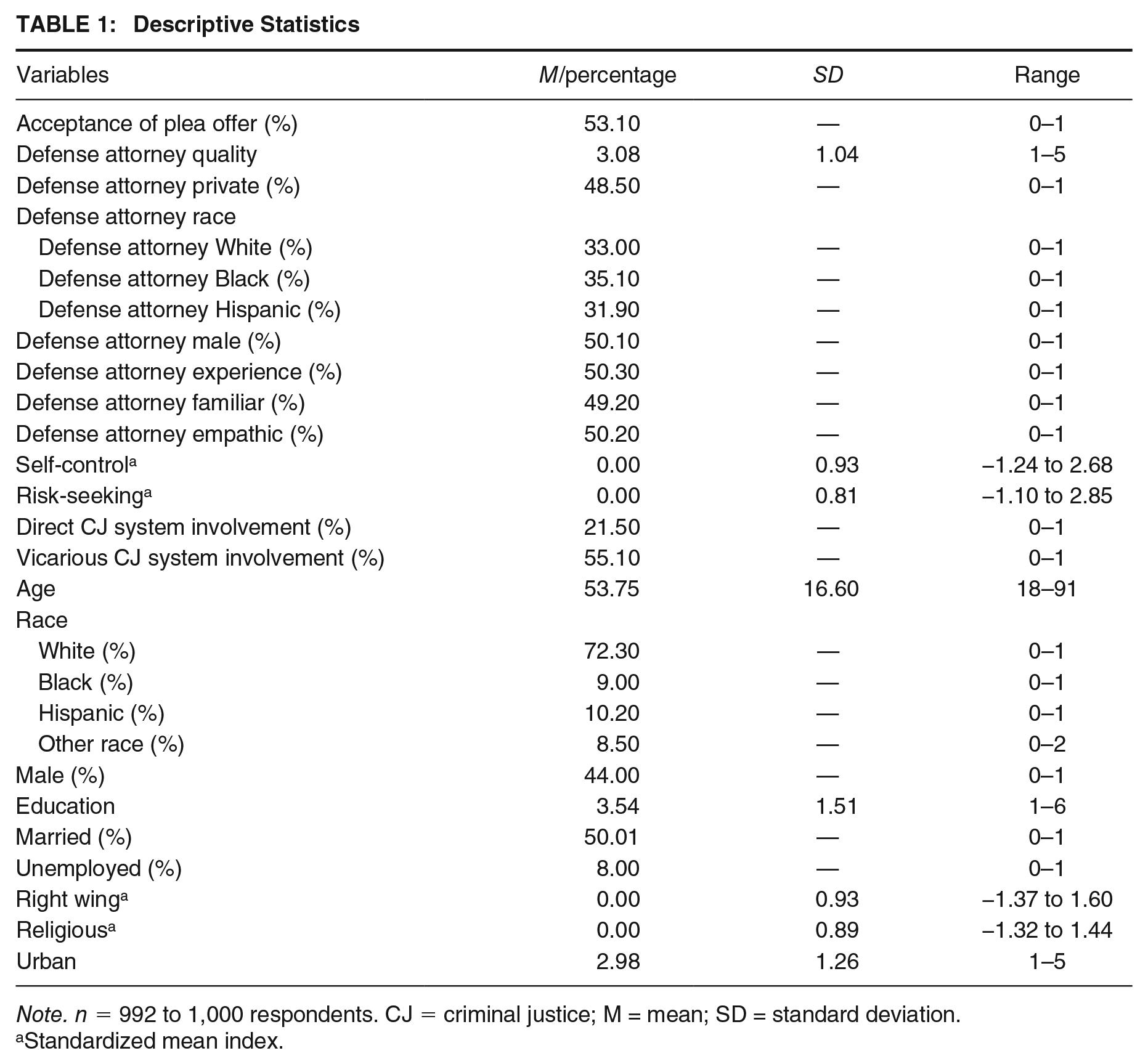
Note. n = 992 to 1,000 respondents. CJ = criminal justice; M = mean; SD = standard deviation.
Standardized mean index.
As noted, we standardized both the guilt of the defendant and the attorney’s recommendation to accept the plea offer. Several prior studies focused on the effect of innocence versus guilt in plea decision-making (e.g., Quickel & Zimmerman, 2019; Redlich & Shteynberg, 2016; Wilford, Sutherland, et al., 2021), and Henderson and Shteynberg (2020) drew attention to plea recommendations as one of three key factors about defense attorneys that can influence plea decisions. As such, we opted to consider whether additional aspects of the defense attorney weigh into decision-making when the defense attorney is recommending acceptance of the offer and the defendant knows he or she is guilty—two factors these prior studies have noted should lead to a greater willingness to accept the offer in the first place.
Also, while prior studies utilized lengthier plea scenarios with greater details of the charge and plea offer, we were concerned most respondents would not read that level of detail, and, thus, not properly receive the treatments. It is not uncommon within the vignette literature to use manipulation checks after the treatments to check for retention of the subject matter and drop respondents who failed the manipulation checks. Recent research showed that dropping respondents who fail manipulation checks can “imbalance the sample with respect to observed or unobserved confounders” (Montgomery et al., 2018, p. 766). Ultimately, dropping these respondents can create bias and asymmetry across treatments (Aronow et al., 2019). Therefore, we opted to streamline the scenario and remove manipulation checks. 3
Dependent Variables
After reading the vignette, two key outcomes of interest were considered. The first was labeled acceptance of plea offer. Specifically, respondents were asked whether they would accept the offer provided by the prosecutor and plead guilty (1 = yes, 0 = no). About 53.1% of respondents accepted the plea offer. The second was defense attorney quality. We asked respondents whether they agreed or disagreed on a 5-point Likert-type scale (1 = strongly disagree, 5 = strongly agree) with a series of statements about their defense attorney, including: (a) “My attorney possessed the necessary ability to do his or her job correctly,” (b) “My attorney possessed the necessary knowledge to do his or her job successfully,” and (c) “My attorney possessed the necessary skill to do his or her job successfully.” These items were adapted from Henderson and Shteynberg (2020) and combined into a mean standardized index (α = .937), with higher values suggesting the defense attorney was perceived as more qualified. On average, respondents rated the defense attorney in the scenario as moderately qualified.
Control Variables
We controlled for several observational characteristics that were expected to be related to plea decision-making and assessments of attorney quality. Given the use of experimental manipulations, these control variables were not necessary. However, controlling for these factors can help explain more of the variation in the outcomes of interest (Mutz, 2011) and are advisable for purposes of the mediation analysis (to explore the indirect effect of each of the experimental manipulations on acceptance of the plea offer through defense attorney quality as proposed in Hypothesis 6), especially given that the mediator was not randomized (MacKinnon & Pirlott, 2015).
Mean standardized indices were created to measure levels of self-control and risk-seeking given that these factors can serve as psychological pitfalls that lead people to discount future costs and alter decision-making (Bibas, 2004; Henderson, 2019). Full descriptions of these measures can be found in the Supplemental Material (available in the online version of this article). Respondents reported if they had been directly involved in the criminal justice system since the age of 18 (1 = been arrested by the police, been on probation, spent time in jail, and/or spent time in prison). They also indicated vicarious involvement with the criminal justice system (1 = family member or close friend who had been arrested, been on probation, spent time in jail, and/or spent time in prison). Bibas (2004) proposed that people with little or no previous criminal justice system involvement would be more likely to accept an offered plea bargain to avoid loss at trial. About 21.5% of respondents were directly involved in the criminal justice system at some point, while about 55.1% reported vicarious involvement.
In addition to these control variables, we accounted for several personal and demographic characteristics that either (a) could influence decision-making and/or (b) have been shown to be related to attitudes toward the criminal justice system. We accounted for the respondent’s age in years, race (White, Black, Hispanic, or Other race, with the latter used as the reference category), sex (1 = Male), education (1 = No high school degree, 6 = Postgraduate degree), marital status (1 = Married), employment status (1 = Unemployed), and urbanicity (1 = Rural area, 5 = Big city). We also accounted for right wing affiliation and religiosity, which are described in further detail in the Supplemental Material. Ultimately, these characteristics could have influenced how the respondents perceived the situation presented to them.
Analytic Strategy
The analyses proceeded in three steps. First, ordinary least squares (OLS) regression analyses with robust standard errors were conducted to consider the effects of the treatments on both acceptance of the plea offer and defense attorney quality. Recent research demonstrated that linear regression was appropriate in experiments with categorical outcomes (Gomila, 2020; Huang, 2019). Still, we also analyzed the acceptance of plea offer model with logistic regression and attained substantively similar results (these results can be found in the Supplemental Material). The models reported included the control variables noted (with a total of nine respondents lost due to nonresponse on some of these control variables). The models were also analyzed without the control variables with similar treatment effects found.
Second, we tested for interaction effects between defense attorney’s race and respondent’s race, as well as defense attorney’s sex and respondent’s sex, using Bansak’s (2021) parallel estimation approach to test for causal moderation. The data were disaggregated into subsets by treatment level and OLS regressions were conducted for each treatment subset accounting for the moderators of interest, as well as pretreatment control variables (i.e., the personal and demographic characteristics that were collected by YouGov prior to distribution of the survey and provided to the researchers). Finally, we considered whether attorney quality mediates the relationship between the defense attorney’s characteristics and acceptance of the plea offer. We relied on Hicks and Tingley’s (2011) causal mediation with bootstrapping for these analyses.
Results
Main Effects: Acceptance of Plea Offer
Table 2 reports the effects of the experimental manipulations on the acceptance of a plea offer and defense attorney quality. Two treatment effects were found with regard to the decision to accept the plea offered. When the defense attorney was more experienced (b = .096, p = .002) and empathic (b = .172, p < .001), respondents were more accepting of the offer and plead guilty. Only two of the observational factors were related to this decision, such that respondents who identified as Black (b = −.126, p = .030) and male (b = −.079, p = .016) were not as accepting of the offer. Overall, the experimental manipulations and control variables explained about 8.8% of the variation in acceptance of the plea offer, suggesting that additional variables were factoring into respondents’ decisions.
Ordinary Least Squares Regressions Predicting the Acceptance of Plea Offer and Defense Attorney Quality

Note. n = 991 respondents. b = unstandardized coefficient; SE = standard error; β = standardized coefficient; CJ = criminal justice.
p < .05. **p < .01. ***p < .001 (two-tailed).
When turning to defense attorney quality, four of the treatment effects emerged as significant, with these experimental manipulations and the control variables explaining about 25.2% of the variation in the ratings of defense attorney quality. In particular, respondents saw the defense attorney as more qualified when the defense attorney was private (b = .193, p = .001), experienced (b = .730, p < .001), familiar (b = .366, p < .001), and empathic (b = .532, p < .001). Defense attorney experience had the largest treatment effect (β = .351), followed by empathy (β = .256), familiarity (β = .176), and type of attorney (β = .093). The only observational characteristic that was relevant to ratings of defense attorney quality was respondent sex, whereby male respondents rated the quality of the defense attorney lower than female respondents (b = .133, p = .034). Together, these findings provided partial support for the first four hypotheses.
Interaction Effects: Defense Attorney’s Race/Sex and Respondent’s Race/Sex
Next, we tested for causal moderation using Bansak’s (2021) parallel estimation approach, with a focus on the defense attorney’s race and sex treatments, and respondent’s race and sex as potential moderators. Contrary to Hypothesis 5, we did not find the significant moderating effects anticipated. The models in the Supplemental Material show that when the defense attorney was randomly assigned as White, Black respondents (compared to White respondents) were less accepting of the plea offer (b = −.236, p = .022), while Hispanic respondents (compared to White respondents) were more accepting of the offer (b = .200, p = .042). Coefficient difference tests revealed that the estimate for Hispanic respondents in this treatment group was significantly different than the estimate for Hispanic respondents in the Black defense attorney treatment group (p = .004), suggesting that Hispanic respondents were more receptive to an offer presented by a White defense attorney than a Black defense attorney, but there was not a significant difference when the offer was presented by a Hispanic defense attorney (vs. White defense attorney). In addition, when the defense attorney was randomly assigned as male, male respondents were less accepting of the plea offer than female respondents, whereas when the defense attorney was randomly assigned as female, male respondents (when compared to female respondents) rated the defense attorney as less qualified. These estimates were not significantly different across the treatment subsets.
Mediating Effects: Defense Attorney’s Quality
Finally, we considered the mediating effect of defense attorney quality using Hicks and Tingley’s (2011) causal mediation with bootstrapping. Figure 1 reports the indirect effects of the experimental manipulations on the acceptance of a plea offer through the assessments of defense attorney quality. As seen in the figure, respondents who rated the defense attorney as more qualified were more accepting of the plea offer given (b = .137, p < .001). Four of the experimental manipulations regarding the defense attorney had significant indirect effects through defense attorney quality: defense attorney private (b = .027, 95% confidence interval, CI [.013, .044]), defense attorney experience (b = .100, 95% CI [.073, .130]), defense attorney familiarity (b = .050, 95% CI [.034, .070]), and defense attorney empathy (b = .073, 95% CI [.051, .098]). These indirect effects were also robust to possible violations of the sequential ignorability assumption (p = .259). In support of the sixth hypothesis, then, each of these factors increased assessments of defense attorney quality, which, in turn, increased respondents’ acceptance of the offer to plead guilty. 4
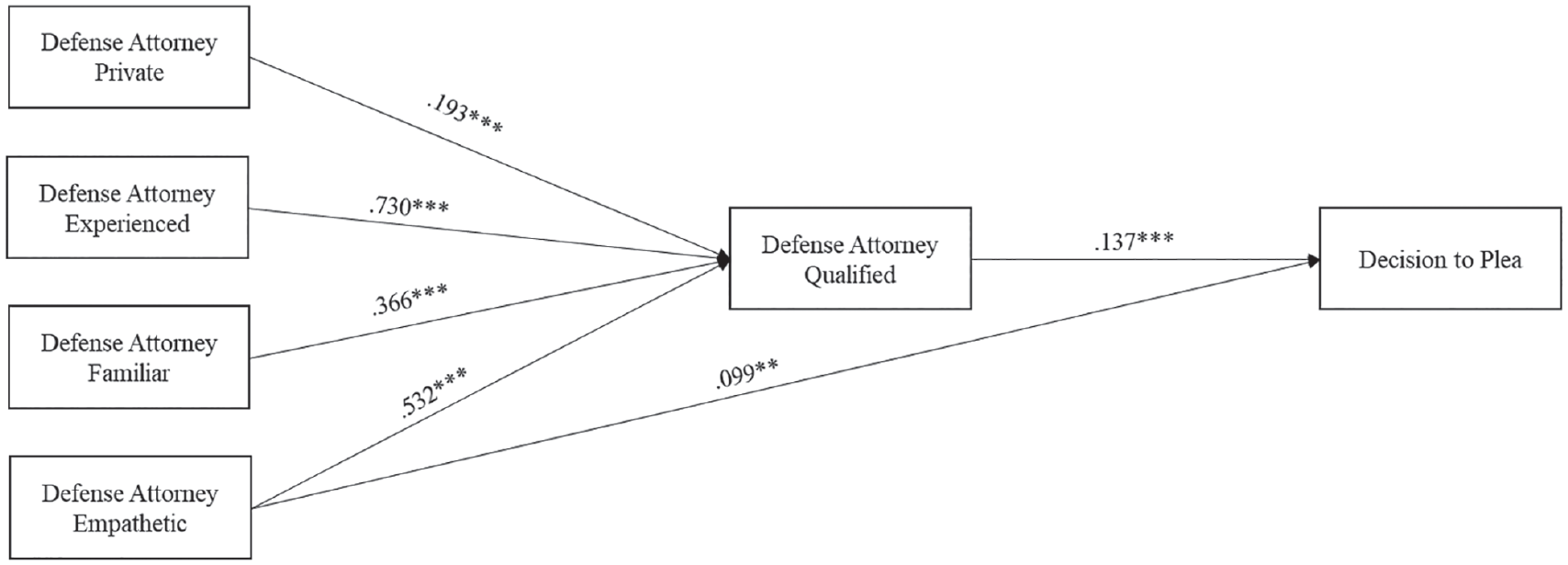
Indirect Effects.
Supplemental Analyses: Motivations for Plea Decisions
As a supplement to the main analysis, we followed the lead of Henderson and Shteynberg (2020) and considered several motivations for the decisions made. Using a 5-point Likert-type scale, respondents were asked how important or unimportant (1 = very unimportant, 5 = very important) the following factors were in making their decision to either accept or decline the plea offer: (a) “reasonableness of the plea offer,” (b) “defense attorney’s recommendation,” (c) “uncertainty of the outcome at trial,” (d) “confidence in the plea being offered,” and (e) “concern of the long-term consequences of the plea.” Respondents were also asked to rank order these decision-making factors from most important (1) to least important (5).
Figure 2 presents the percent of respondents that ranked each motivation first as a means of assessing the priorities that went into the decisions made. These percentages are presented for the full sample and then separately for respondents who declined the plea offer and respondents who accepted the plea offer. Among the full sample, uncertainty of the outcome was ranked first by roughly 30.5% of the sample, followed by consequences of the plea (27.9%) and offer reasonableness (25.6%). Interestingly, very few respondents ranked defense attorney recommendations (8.3%) and confidence in the offer (7.7%) first among their motivations. Uncertainty of the outcome remained a leading motivator among those who accepted the plea offer. However, among those who declined the plea offer, consequences of the plea was the prime motivator in decision-making.
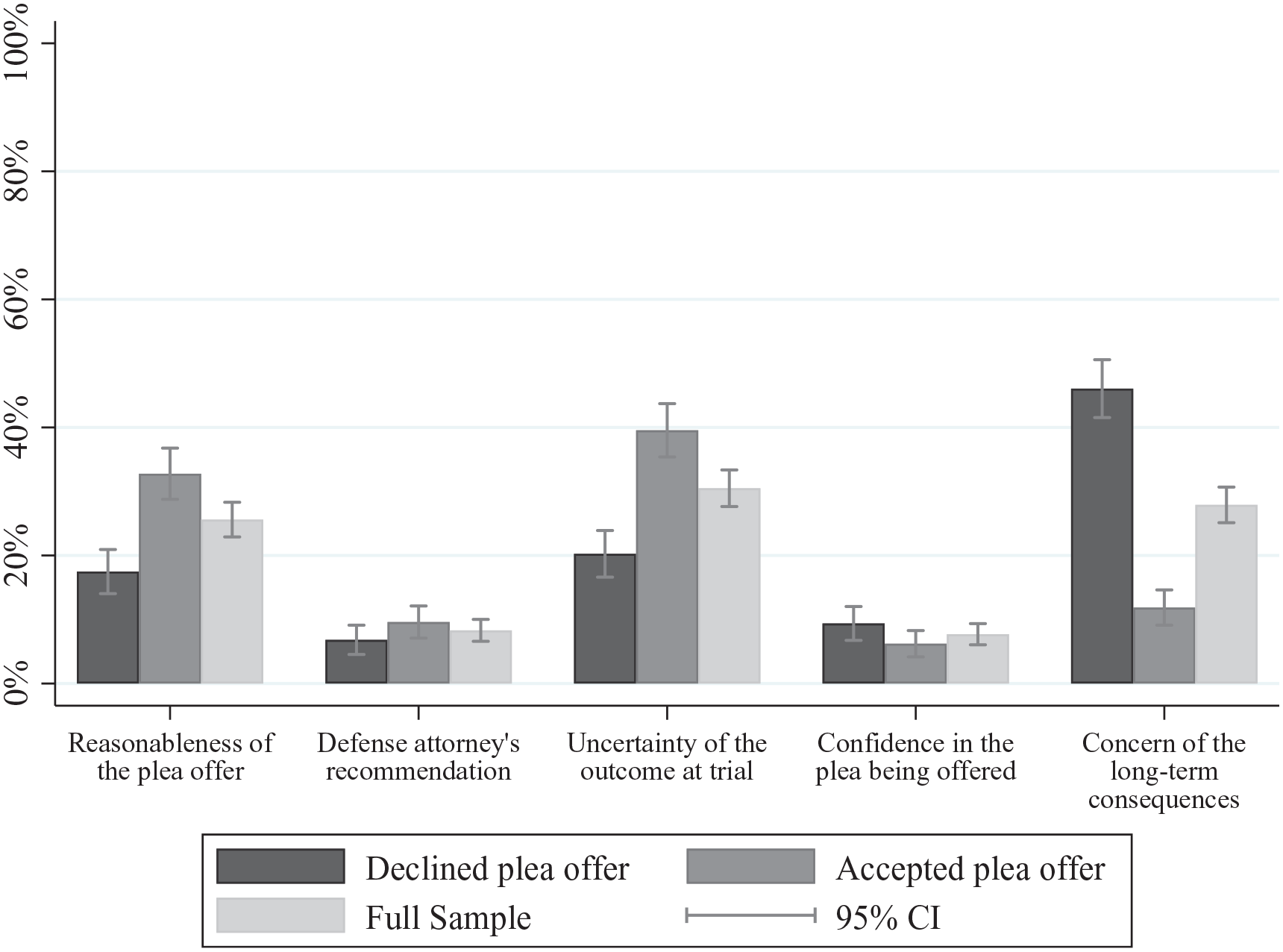
Motivations for Decision-Making
Table 3 presents the results of several OLS regressions exploring the effects of the experimental manipulations on assessments of the importance of each motivation for those who accepted the plea offer and declined the plea offer. For the most part, the treatments did not affect the importance given to these motivations, although there were some exceptions. Among those who accepted the plea offer, defense attorney experience (b = .189, p < .05), familiarity (b = .194, p < .01), and empathy (b = .276, p < .001) were all positively related to seeing the defense attorney recommendation as important in decision-making. Also, having a private defense attorney increased the importance of having confidence in the offer (b = .147, p < .05), whereas having a male defense attorney decreased the importance of the consequences of the plea offer (b = −.153, p < .05). Regarding those that declined the offer, defense attorney experience was positively related to the importance of the reasonableness of the offer (b = .214, p < .05), defense attorney’s recommendation (b = .312, p < .01), and uncertainty of the outcome (b = .178, p < .05).
Ordinary Least Squares Regressions Predicting the Motivations in Decision-Making
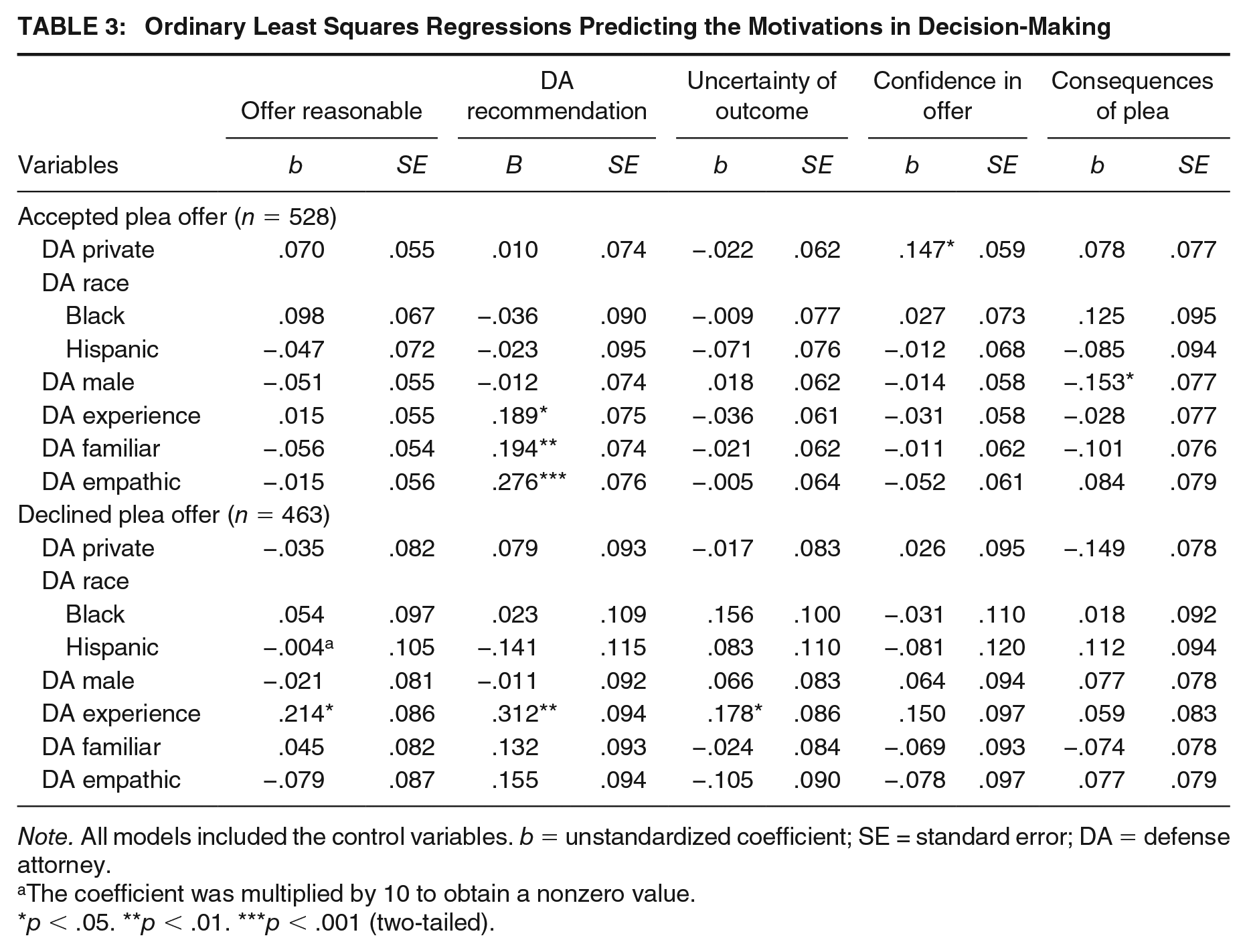
Note. All models included the control variables. b = unstandardized coefficient; SE = standard error; DA = defense attorney.
The coefficient was multiplied by 10 to obtain a nonzero value.
p < .05. **p < .01. ***p < .001 (two-tailed).
Discussion
The current study was designed to be exploratory in nature and contribute to the more limited literature on defendant plea decision-making, thereby expanding upon prior research recognizing that characteristics of defense attorneys can impact defendants’ decisions. Specifically, we explored how various theoretically and empirically relevant defense attorney attributes both directly and indirectly impact the acceptance of a plea offer through perceptions of the quality of the defense attorney. To this end, we relied upon a factorial survey design describing a plea negotiation situation and manipulated six defense attorney characteristics—type of attorney, race, sex, experience, familiarity with the judge and prosecutor, and level of empathy. We proposed several hypotheses, each of which is reviewed, in turn, below.
With respect to our first four hypotheses, we anticipated that when the defense attorney was private, experienced, familiar, or empathic, respondents would be more accepting of a plea offer and would rate the defense attorney as more qualified. We found partial support for these hypotheses, with respondents more accepting of the plea offer if the defense attorney was more experienced or empathic. Also, respondents rated the quality of the defense attorney higher when the attorney was either private, familiar, experienced, or empathic.
Per our fifth hypothesis, we also anticipated that respondents would be more accepting of a plea offer and assess the defense attorney as more qualified if the defense attorney was of the same race and sex as the respondent. This hypothesis was not supported by the data. The lack of support for this hypothesis was surprising given that studies have noted the contribution of shared characteristics in facilitating more positive perceptions of court personnel and greater perceptions of procedural justice (e.g., Baker et al., 2015). One thing to consider is that the empathy condition within the experiment captured aspects of procedural justice, in the sense that respondents given the empathic condition were told that the defense attorney listened to their concerns and was understanding of their circumstances. In this respect, respondents presented with an empathic defense attorney did not have to infer these characteristics based on external factors, suggesting that procedurally just behavior might be able to garner trust regardless of the defense attorney’s racial and gender identity. While the interplay between race, sex, and empathy in affecting decision-making is beyond the scope of the article, this area is worth exploring further given that we know defendants of color often are less willing to enter into a plea bargain, possibly because of lower procedural justice and legitimacy perceptions (Albonetti, 1991; Frenzel & Ball, 2008; Kellough & Wortley, 2002; Metcalfe & Chiricos, 2018). Also, with respect to the race interactions, statistical power may have been an issue given the number of Black and Hispanic respondents receiving the treatment of interest. For instance, there were 90 Black respondents and 23 of them received a scenario involving a Black defense attorney. There were 102 Hispanic respondents and 40 received a scenario involving a Hispanic defense attorney. Put simply, smaller effects may have been detected with a larger sample, especially one with an oversample of non-White respondents.
Our sixth hypothesis proposed that characteristics of the defense attorney would indirectly influence respondents’ acceptance of a plea offer by altering assessments of defense attorney’s quality. Our findings supported the mediating effect of defense attorney quality. Those respondents whose defense attorney was designated as private, experienced, familiar, or empathic rated their defense attorneys as more qualified, and in turn, were more accepting of the plea offer and plead guilty. Finally, an assessment of the motivations in decision-making indicated that uncertainty of the outcome and offer reasonableness were high-priority considerations among respondents generally, although consequences of the plea was a prime motivating factor for those that declined the plea offer. Interestingly, defense attorney experience seemed to elevate the importance of these factors, along with the defense attorney’s recommendation. Also, among those who accepted the plea offer, the defense attorney’s recommendation became more important in decision-making when the defense attorney was more familiar and empathic.
Overall, the findings suggest defense attorney characteristics weigh into decision-making, though mostly in an indirect way. The mediation analysis revealed that many of these characteristics are operating indirectly on plea decisions by informing the perceived quality of the defense attorney, which explained more of the variation in decision-making. Also, our supplementary analysis revealed that concerns related to reasonableness of the offer, uncertainty of the outcome, and long-term consequences weighed more heavily than the defense attorney’s recommendation. In this respect, personal motivations and self-serving biases (Bibas, 2004) seemed to be important motivating factors. Still, among those who declined the plea offer, the defense attorney’s experience influenced the importance placed on the offer’s reasonableness and uncertainty of the outcome. Thus, the findings point to the need to better understanding the interplay between the defense attorney and these self-serving biases/motivations in informing decision-making, especially given that defense attorneys can potentially mitigate these biases (Bibas, 2004; Covey, 2008).
From a policy standpoint, there are also a few key takeaways. A negotiated plea is not always in the best interest of the defendant, and in accepting a plea deal, the defendant is giving up his or her right to a trial. That said, there are circumstances where defendants can benefit from a plea outcome—in the scenario presented, for instance, the respondent was told he or she committed the crime (i.e., he or she was guilty) and was given a reduction in prison time from 10 years to 3 years. Despite the reasonableness of the bargain offered, about 46.9% of respondents did not want to accept it. Of course, this outcome could have been related to surveying a general population sample who may have a misconception of the trial court process (this is explained further below). Still, one reason for not wanting to accept the bargain may be the desire to go to trial. Another reason for not accepting the plea offer could be a lack of confidence in the defense attorney.
We found some evidence to support this latter possibility, suggesting that the defense attorney can play a consequential role in helping the defendant navigate through the court process and bargain presented (Bibas, 2004; Henderson & Levett, 2019; Henderson & Shteynberg, 2020). This finding is relevant in a system that relies heavily on plea bargaining to move caseload. The defense attorney in the scenario advised the defendant to take the offer, yet not all respondents did. Experience and empathy of the defense attorney repeatedly emerged as consequential for respondents. As previously discussed, the empathy condition contained elements of procedural justice. Therefore, this finding contributes to the larger and more expansive body of literature that recognizes the benefits of procedurally just behavior in promoting trust in criminal justice authorities and cooperation with those authorities (Kirk & Matsuda, 2011; Wolfe et al., 2016). However, these results also suggest that having experienced attorneys involved in the process can build confidence. Public defender offices handle the vast majority of criminal cases, yet their offices often suffer from turnover (Brink, 2019), resulting in few attorneys that stay around for extended lengths of time. Also, experienced attorneys are going to be more familiar with the other workgroup members (Metcalfe, 2016), and we found increased familiarity led respondents to believe the defense attorney was more qualified. Therefore, turnover in public defender offices might hinder the movement of cases in this more unforeseen way by affecting defendants’ perceptions of the quality of their attorney, and as a result, their later decision-making.
The findings presented, while enlightening, were not without limitations. Within the acceptance of the plea model, there was a large amount of variance left unexplained, with the experimental manipulations and control variables explaining about 8.8% of the variation in acceptance of the plea offer. While we found that some of this lack of variation was due to a mediating effect of attorney quality, we also acknowledge that there are other consequential factors within decision-making that were not presented in our scenario by focusing on the defense attorney. For example, Bibas (2004) suggests that defendants might be swayed by underlying heuristics and biases, such as overconfidence, risk-taking, discounting of future costs, anchoring, and framing. Future research would benefit from considering these factors further (Wilson, 2019).
Also, the court literature recognizes the influential role of prosecutors and their discretion in the plea process (Bushway & Forst, 2013; Metcalfe & Chiricos, 2018). With the ability to charge and suggest sentences, it is reasonable for the attitude and demeanor of the prosecutor to influence defendant decision-making. Similarly, the behavior of the judge may affect defendants’ perceptions of the situation, particularly in courthouses where defendants can open plea to the judge. In this respect, future research should consider how these other members of the courtroom workgroup factor into defendant decision-making. Even further, the familiarity measure was not based on observational detection, such that respondents were told that the defense attorney was familiar with the judge and prosecutor. Thus, studies might consider whether observational indicators of familiarity (as opposed to directly stating it) make a difference in defendant perceptions—that is, when a person is forced to infer the characteristics from certain behaviors.
While we adopt the traditional vignette method in the current study, more recent research has considered the use of computer simulations to study plea decision-making as a means of making the scenarios presented more realistic (Wilford, Sutherland, et al., 2021; Wilford, Zimmerman, et al., 2021). While these studies recognize that simulations cannot be modified as easily as vignettes, the authors note that the scripts in these simulations can be altered, including the scripts of the court actors (Wilford, Sutherland, et al., 2021). As such, computer simulations would be a noteworthy next step in considering how actions taken by the defense attorney in conjunction with the other court actors can affect defendant decision-making.
We considered several motivational factors for the decisions made. Still, future research might consider other factors that motivate defendant decision-making. For example, the influence of defense attorneys might be affected by the advice provided, which can be manipulated. Also, the early work of Bordens and Bassett (1985) focused on motivations to accept or reject plea offers and used open-ended questions to assess motivations. In their vignette study, Henderson and Shteynberg (2020) provided an open-ended question where participants could explain the reason for their plea decision. Additional qualitative work of this kind could add more context to the decision-making process that could not be captured by the experimental manipulations alone.
Finally, a benefit of our survey was the ability to gather responses from a representative sample of the United States to contribute to the study’s external validity. As previously mentioned, it should be recognized that the experiences and perceptions of those who have gone through the criminal justice system may be different than those who have not gone through the criminal justice system. In particular, those who have gone through the system may be more attuned to common practices and the heavy reliance on pleas. As a precaution, we controlled for both direct and vicarious involvements in the criminal justice system. Studies have shown that the relationship between procedural justice and obedience to the law is similar among both general and incarcerated populations (Baker, 2017, 2018; Baker et al., 2014, 2015; Baker & Gau, 2018), which may also be the case with the relationships of interest in the current study. To be sure, replication of the study is necessary with a sample of solely criminal justice-involved respondents.
Conclusion
In conclusion, this study found support for the proposition that defense attorney’s characteristics impact plea decision-making, although mostly in an indirect way. Experienced, empathic, private, or familiar defense attorneys were seen as more qualified, which then increased respondents’ acceptance of the plea deal presented and the defense attorney’s advice to accept the offer. Respondents appeared particularly motivated by self-serving factors, such as the uncertainty of the outcome, consequences of the plea offer, and reasonableness of the plea offer. Future research should continue to explore additional factors that affect plea decision-making and motivate plea decisions and the interplay between the defense attorney and these motivations.
Supplemental Material
sj-docx-1-cjb-10.1177_00938548231208201 – Supplemental material for The Impact of the Defense Attorney on Plea Decision-Making: An Experimental Analysis
Supplemental material, sj-docx-1-cjb-10.1177_00938548231208201 for The Impact of the Defense Attorney on Plea Decision-Making: An Experimental Analysis by Emily Suiter and Christi Metcalfe in Criminal Justice and Behavior
Footnotes
Appendix
AUTHORS’ NOTE:
The survey was funded by an internal grant through the College of Arts and Sciences Research Initiative at the University of South Carolina. The authors report no competing interests to declare.

Notes
References
Supplementary Material
Please find the following supplemental material available below.
For Open Access articles published under a Creative Commons License, all supplemental material carries the same license as the article it is associated with.
For non-Open Access articles published, all supplemental material carries a non-exclusive license, and permission requests for re-use of supplemental material or any part of supplemental material shall be sent directly to the copyright owner as specified in the copyright notice associated with the article.
