




Abstract
The importance of procedural justice for reducing offending behavior has been demonstrated in numerous contexts and among various criminal justice authorities. However, to date, few studies have evaluated the importance of procedural justice in the probation officer–client relationship. Understanding how to reduce offending and prevent recidivism among people on probation is important as this group represents people among the most likely to engage in future offending. Using longitudinal data from the Prison Project, this study examines the association between perceptions of probation officer procedural justice, felt obligation to obey the law, and recidivism during a 12-month follow-up period. Results indicate that procedural justice is associated with a greater felt obligation to obey the law and lower odds of recidivism. Like other criminal justice authorities, how probation officers interact with their clients may impact their clients’ offending behavior.
Existing research on the procedural justice framework has provided criminal justice practitioners with important insights into how to best approach interactions with people having criminal justice involvement. Contrary to deterrence-based strategies relying on sanctions and incentives to regulate individuals’ behavior, insights from social psychology have drawn attention to an alternative strategy, namely that of fair and respectful treatment of people (Tyler, 2006). Scholars formulating the procedural justice framework (Lind & Tyler, 1988; Thibaut & Walker, 1975; Tyler, 2006; Tyler & Lind, 1992) have argued that when individuals perceive procedural justice in encounters with criminal justice authorities, they are more likely to view those authorities and their rules as legitimate. In turn, people are more likely to abide by decisions and rules established by those authorities (for recent discussions on the procedural justice framework, see Nagin & Telep, 2020; Radburn & Stott, 2019; Tyler, 2017). Procedural justice includes, for example, giving people the opportunity to tell their side of the story, applying rules in a neutral and consistent manner, and treating individuals with respect and dignity (e.g., Ansems et al., 2020; Henderson et al., 2010). Legitimacy is often operationalized by using two subconstructs: (a) trust in authorities (i.e., belief that criminal justice authorities can be trusted to make decisions that are right for the community; see e.g., Shook et al., 2021; Steiner & Wooldredge, 2015) or (b) felt an obligation to obey (i.e., internalized beliefs that one should obey the law or officers’ directives; see e.g., Baker & Gau, 2018; van Hall et al., 2024) in prior studies among justice-involved individuals.
There is a substantial number of empirical studies employing the procedural justice framework among people who are justice-involved. These studies have mainly examined the consequences of procedurally just treatment by police officers (e.g., Baker & Gau, 2018; Paternoster et al., 1997; White et al., 2016), judges (e.g., Baker et al., 2015; Shook et al., 2021; Sprott & Greene, 2010; van Hall et al., 2023a), lawyers (Peterson-Badali et al., 2007; Sprott & Greene, 2010), and correctional staff in prison and jails (e.g., Baker et al., 2021; Barkworth & Murphy, 2021; Beijersbergen et al., 2016; Steiner & Wooldredge, 2015, 2018; van Hall et al., 2023b). In general, this strand of procedural justice literature suggests that fair and respectful treatment by criminal justice authorities results in higher legitimacy beliefs (e.g., Baker & Gau, 2018; van Hall et al., 2024), lower levels of misconduct in detention (e.g., Maguire et al., 2021; Reisig & Meško, 2009), and a lower likelihood to be reconvicted after release (Beijersbergen et al., 2016; van Hall et al., 2023a, 2023c).
However, few prior studies have examined the consequences of perceived procedural justice arising from interpersonal encounters between probation officers and their clients (Alward, 2022; Blasko & Taxman, 2018; Gladfelter et al., 2018; Jannetta et al., 2021; Penner et al., 2014). In essence, the procedural justice framework argues that all criminal justice authorities can foster legitimacy beliefs and rule-following behavior by exercising their power in a procedurally just way (Tyler, 2006). From a theoretical point of view, studying whether perceived procedural justice in contact with probation officers exerts a positive impact on legitimacy and recidivism is important to critically test the procedural justice framework but also to expand existing knowledge to other criminal justice contexts. Practically, this paucity of research is remarkable given that probation officers play a crucial role in the criminal justice system.
In several countries, like the Netherlands (Boone, 2016; van Kalmthout & Tigges, 2008), probation officers can play multiple roles including writing presentence reports, supervising people who have been sentenced to various community controls as an alternative to incarceration, and by supervising people after release from prison or other mixed sentences. In the United States, probation officers have similar roles like those of probation officers in other countries. However, parole officers in the United States are responsible for the supervision of people post-incarceration during their return to society (Petersilia, 1997, 2003; Travis et al., 2014). Whether sentenced directly to community control or supervised post-release, the main goal of probation officers is to prevent people under their supervision from recidivating. Worldwide, recidivism rates remain high and thus represent a major concern for society at large (Fazel & Wolf, 2015; Yukhnenko et al., 2020). Improving knowledge on how probation officers can help to reduce recidivism is, therefore, essential for criminal justice practitioners and policymakers.
Of the works that have analyzed the procedural justice framework in the probation setting, 1 studies have predominantly supported the link between procedural justice and compliance. Penner and colleagues (2014) found that youths involved in the justice system who felt treated more fairly and respectfully by probation officers were less likely to re-offend but did not find a relationship between legitimacy and offending behavior. Furthermore, Blasko and Taxman (2018) showed that when adult probation clients perceived their community supervision as procedurally just, they demonstrated positive criminal justice outcomes, such as less self-reported reoffending behavior and fewer official arrests. In addition, Jannetta and colleagues (2021) developed a new procedural justice training for probation officers to practice elements of procedural justice. Their findings suggested that participation in the procedural justice training resulted in probation officers treating supervised individuals more fairly and respectfully, and, ultimately, improved supervisory outcomes (e.g., lower number of re-arrests). Moreover, Gladfelter and colleagues (2018) showed that probation clients who felt treated fairly and respectfully by probation officers were more likely to comply with restitution orders. In contrast to these studies, Alward (2022) assessed relationships between procedural justice, legitimacy, and compliance outcomes and found that both procedural justice and legitimacy were unrelated to technical violation and having a positive drug test.
Current Study
Building on an increasing body of empirical research exploring the procedural justice framework in the probation context, the current study examines relationships between probation officer procedural justice, felt obligation to obey laws, and recidivism among a sample of individuals released from prison who are supervised by probation officers in the Netherlands. Based on the procedural justice framework (Tyler, 2006) and previous research among individuals supervised by probation officers, three hypotheses are tested:
This study seeks to extend the existing procedural justice literature in the probation context in, at least, five ways. Although previous research added some background variables (Alward, 2022; Blasko & Taxman, 2018; Penner et al., 2014), this study includes several other potential factors, such as low self-control and perceived sanction severity, to adjust for other criminological theories when assessing the impact of procedural justice and felt obligation to obey laws on recidivism. In addition to some existing studies (Alward, 2022; Penner et al., 2014), the current study explores the mechanism through which individuals translate experiences of procedural justice into subsequent attitudes (i.e., felt obligation to obey), to explain why procedural justice may exert beneficial effects on individuals’ offending behavior. Moreover, in line with some prior studies (Blasko & Taxman, 2018; Penner et al., 2014), the current study uses a longitudinal design which allows for proper temporal ordering in the relationship between probation officer procedural justice and recidivism. Furthermore, this study contributes to existing research by using registered data on recidivism as well as self-reported data to overcome a single-source bias (for an exception, see Blasko & Taxman, 2018). Finally, prior research examining probation officer procedural justice among individuals involved in the justice system is primarily based on data from the United States (Alward, 2022; Blasko & Taxman, 2018; Jannetta et al., 2021) and Canada (Penner et al., 2014). By using data about adults under supervision of the Probation Service in Europe (i.e., the Netherlands), the current study extends prior empirical work and explores whether similar conclusions will be reached in a different context.
Research Context
In the Netherlands, the Probation Services is involved in every phase of the criminal justice process: (a) diagnosis and advice at criminal courts, (b) supervision of suspended sentences, conditional suspension of pre-trial detention or after release from prison (parole), (c) performing behavioral interventions (e.g., cognitive skills training), and (d) organizing and monitoring community service sentences (De Jongste, 2022; van Kalmthout & Tigges, 2008). The Probation Services mostly perform probation activities as imposed by judicial authorities, such as the Public Prosecution Service, the judiciary, or the prison system. This implies that encountering probation officers is often not voluntary but mandatory. The Probation Services form professional organizations responsible for two main tasks: monitoring (control) and support for people under their supervision (Boone, 2016). All probation officers are professionals, which means that they often have received education in, for instance, social work at a higher educational level (De Jongste, 2022; van Kalmthout & Tigges, 2008).
When focusing on supervision, the Dutch Probation Services generally aims to make society safer by implementing and executing effective sanctions and reducing recidivism through monitoring and supervising people in their reintegration process into society after incarceration (De Kogel & Nagtegaal, 2008). More specifically, the Probation Service has three goals regarding supervision, namely (a) ensuring adherence to probation requirements that are imposed by criminal judges or public prosecutors, (b) preventing recidivism during and after supervision, and (c) supporting individuals with their resocialization to society (De Kogel & Nagtegaal, 2008; Menger, 2018). The ultimate goal, reducing recidivism, is sought by assisting people in—among other things—finding a place to live, obtaining a job or education, and developing and maintaining pro-social relationships (van Kalmthout & Tigges, 2008; Menger, 2018). At the time of the data collection of the current study (2010), the Probation Services completed roughly 13,000 supervision cases (Lamet et al., 2013).
Method
Data Collection
The data for this study were used from the Prison Project, which is a nationwide longitudinal panel study into the effects of detention on the life course. The target sample consisted of adults between 18 and 65 years old, born in the Netherlands, and who entered Dutch pre-trial detention centers between October 2010 and April 2011 (Dirkzwager et al., 2018). Participation was voluntary and participants were guaranteed confidentiality. All participants signed an informed consent declaration. The research protocol was positively assessed by the Ethical Committee for Legal and Criminological Research of the VU University Amsterdam.
Two waves of data were utilized in this study, which were obtained 3 weeks after arrival in pre-trial detention (T1) and 6 months post-release (T2). The first wave in detention (T1) consisted of a computer-assisted personal interview (CAPI) and a paper-and-pencil questionnaire. The interviews were conducted in private rooms by employees of the Prison Project. Both interviews and questionnaires were completed in Dutch and were translated into English for the purpose of this article. Questionnaires were filled out by participants in their cells. Of the target sample (N = 3,983), 2,837 people could be approached and were asked whether they were willing to participate in the Prison Project. Most eligible respondents who could not be approached were already released. Of those who could be approached (N = 2,837), interview data were available for 1,904 people (67%) and 1,748 people (62%) filled out the questionnaire. Using administrative data from the Prison Service, people who participated in the Prison Project were compared with those who refused to participate, and those who could not be approached. Participants were highly comparable to non-participants (Dirkzwager et al., 2018).
During the second wave (T2), those who had been released were approached and asked to participate in a post-release interview at 6 months. These interviews were conducted at the respondents’ homes, in public spaces (e.g., in a pub), or at institutions in which participants were housed (e.g., in a correctional facility again). To encourage participation, respondents received a gift voucher of 10 euros. Of the 1,904 people who participated at the baseline measurement in detention (T1), 1,481 of those people were successfully located during the first post-release wave, and 946 of them agreed to participate (52%). Respondents who participated (N = 946) at the first post-release interview were comparable to those who participated in the baseline measurement (N = 1,904). For further in-depth details related to the non-response, method of data collection, and characteristics of the non-participants, see Dirkzwager et al. (2018).
Participants
The sample in the current study consisted of respondents who have had contact with a probation officer at T2, who answered questions about procedural justice, felt obligation to obey laws, and for whom registered data on recidivism was available. Of the 946 people who participated in the post-release wave (T2), 603 (64%) had contact with a probation officer. After excluding people because of missing data on scales used in this study, the final sample size consisted of 600 respondents. 2
Measures
Procedural Justice
To measure perceptions of procedural justice, respondents were asked to think about encounters with their probation officer (“current or last officer”) which was measured at T2 (6 months post-release). To assess these perceptions, respondents were presented four statements regarding how they felt treated by their probation officer: (PJ1) “Probation officers give me proper information”; (PJ2) “Probation officers treat me with respect”; (PJ3) “Probation officers behave professionally”; (PJ4) “Probation officers listen carefully to me.” These items largely corresponded with operationalizations of procedural justice used in prior studies (e.g., Blasko & Taxman, 2018). Response categories were presented on a 5-point scale of agreement (1 = strongly disagree; 5 = strongly agree). Higher scores reflected higher levels of procedural justice in contact with the probation officer.
Felt Obligation to Obey
Felt obligation to obey the law was operationalized as respondents’ felt obligation to obey laws and measured at T2 (6 months post-release). The operationalization of legitimacy used in the current study was relatively similar to measures used in prior studies (Baker & Gau, 2018; Baker et al., 2015). Items from the Criminal Sentiments Scale (Gendreau et al., 1979) were used to operationalize felt obligation to obey laws. Respondents were asked to indicate on a five-point scale (1 = strongly disagree; 5 = strongly agree) to what extent they agreed with four statements: (OB1) “People like me must break the law to get ahead” (reverse coded); (OB2) “You should not break the law to try to get ahead in life”; (OB3) “It’s okay to break the law as long as you don’t get arrested” (reverse coded); (OB4) “There is never a good reason to break the law”; (OB5) “Only obey laws that seem reasonable” (reverse coded); (OB6) “It is best to earn an easy living, even by breaking the law” (reverse coded). Higher scores on the items indicated greater felt obligation to obey the law.
Recidivism
Recidivism is a measure of respondents’ reconvictions for a wide variety of different types of offenses in the period between 6 and 18 months after release from detention. In this follow-up period, most respondents were still in contact with their probation officer. However, to ensure a temporal ordering in the research design (i.e., longitudinal design), we chose to select a follow-up period after the first post-release wave (i.e., 6 months after release). The recidivism measure was based on registered data from the nationwide Judicial Documentation System of the Research and Documentation Center of the Dutch Ministry of Justice and Security. This database comprised information on all registered crimes and convictions in the Netherlands. Acquittals, dismissals because of the unlikelihood of conviction, minor offenses (in most cases traffic offenses), and cases that had not yet been settled were excluded (Wartna et al., 2011). At 6 months after release, a large majority of respondents (89%) reported that a final decision was made in their criminal case, suggesting that recidivism could be adequately measured despite the relatively short follow-up period (i.e., 12 months). 3 Recidivism was measured by creating a dichotomous measure (0 = no reconviction; 1 = at least one reconviction) and by creating a count measure (i.e., number of reconvictions).
In addition to official data on recidivism, data on self-reported offending behavior within 8 to 24 months after release was also available. In the Prison Project, respondents reported per 4-month period post-release whether they committed crimes, such as violence, burglary, robbery, theft, fraud, or dealing drugs. Self-reported offending was measured dichotomously (0 = no reported crime; 1 = at least one reported crime). Data about self-reported offending behavior was collected in a subsequent post-release interview at 24 months after release, and, as a result, not all respondents could be approached on this wave which led to a reduced sample size for analyses on self-reported reoffending (N = 404). Descriptive statistics showed that 29.5% of the respondents reported offending behavior within 8 to 24 months after release.
Control Variables
We included several background characteristics that might affect legitimacy or recidivism, measured at T1 (3 weeks after arrival in pre-trial detention) or T2 (6 months after release). Based on criminological theory and research showing that people’s age (Sweeten et al., 2013), ethnicity (Piquero et al., 2015), and educational level (Lochner & Moretti, 2004) might be related to recidivism, we accounted for several demographic characteristics of respondents: (a) age upon arrival in pre-trial detention, based on the Dutch Prison Service registration, (b) ethnicity reflecting whether people had a Dutch background (score = 0) or a non-Dutch background when one or both parents were born outside the Netherlands (score = 1), based on the Municipal Population Register, and (c) educational level (0 = low; 1 = middle/high). 4 In addition, because empirical research showed that past criminal history is often related to criminal behavior (e.g., Bonta et al., 1998; Gendreau et al., 1996), we added control variables relating to respondents’ criminal history: age of onset, number of prior convictions, and type of offense (i.e., violent, property, drug, other).
In addition, we took several characteristics related to the probation officer into account, as these characteristics might affect the likelihood of getting reconvicted (see e.g., Farrall, 2002; Trotter, 2013): (a) whether people were still in contact with the Probation Service (0 = no; 1 = yes), (b) whether respondents had the same probation officer that supervised them (0 = yes; 1 = no), (c) the reason why respondents had contact with a probation officer (0 = other; 1 = supervision), and (d) felt the support of the probation officer. Felt support consisted of 4 items that reflected the extent to which the probation officer helped their client to stay out of crime: “The probation officer helped me with my reentry in society,” “The probation officer helped me to stay out of prison,” “The probation officer helped me to stay off drugs,” and “The probation officer helped me to stay out of crime.” Exploratory factor analysis was used to examine to what extent items about probation officer procedural justice and felt the support of the probation officer tapped into the same factor or distinct factors. The factor analysis showed two distinct factors (i.e., procedural justice and felt support), which were also positively correlated (r = .57). The measure of felt support of the probation officer was computed by taking the mean of the four items. This measure had an excellent internal consistency (Cronbach’s Alpha [α] = .90). All characteristics related to the probation officer were measured 6 months post-release (T2).
Finally, criminological theories about self-control (e.g., Gottfredson & Hirschi, 1990) and deterrence (e.g., Becker, 1968; Chalfin & McCrary, 2017) argued that these constructs might be associated with recidivism. Therefore, we included low self-control and perceived sanction severity in our analyses. Low self-control was measured by using the Dutch adaptation of Tangney’s Brief Self-Control Scale (Tangney et al., 2004). We used 13 items to measure self-control (e.g., “Sometimes I can’t stop myself from doing something, even if I know that it is wrong”). The scale for low self-control was computed by taking the mean of the 13 items (α = .81). High scores reflected low levels of self-control. Perceived sanction severity was measured 6 months post-release based on three items (e.g., “My stay in detention was severe”). The perceived sanction severity scale was computed by taking the mean of the three items. The internal consistency of the scale was good, with a Cronbach’s alpha of .82. High scores reflected high levels of sanction severity. Descriptive statistics of the study sample are presented in Table 1.
Descriptive Statistics of the Study Sample

Note. N = 600. M = mean; SD = standard deviation.
Summated scores on these constructs (procedural justice & felt obligation to obey laws) are presented.
Analysis
Before the hypotheses were tested, confirmatory factor analyses were carried out. Previous empirical work on the procedural justice framework among justice-involved individuals has examined the discriminant validity of the key concepts underlying the framework (Baker & Gau, 2018; van Hall et al., 2023c, 2024; White et al., 2016). Following this strand of research, we explored the discriminant validity of procedural justice and felt the obligation to obey by conducting confirmatory factor analyses (CFA) on two measurement models. The first CFA estimated the a priori measures of procedural justice and felt obligation to obey combined in a single latent factor (“single-factor solution”). The second CFA estimated the a priori measures of procedural justice and felt obligation to obey as separate latent factors (“two-factor solution”). Because the items were ordinal, we used a weighted least squares-mean and variance-adjusted estimation method in Mplus (Muthén & Muthén, 1998–2017). Results of the CFAs, as presented in Table 2, indicated that a two-factor solution fitted the data best. In the single-factor solution, fit indicators (e.g., root mean square error of approximation [RMSEA], comparative fit index [CFI], and Tucker–Lewis index [TLI]) were all below minimum acceptable thresholds, and all factor loadings of felt obligation to obey items were below .2. In the two-factor solution, fit indicators like the CFI (.963) and RMSEA (.065) suggested acceptable model fit and all items showed factor loadings of .38 or higher (see Table 2). Thus, discriminant validity between procedural justice and felt obligation to obey is established, and we continued with the two-factor model in full structural equation models.
Confirmatory Factor Analysis of Perceptions of Probation Officer Procedural Justice and Felt Obligation to Obey the Law: Comparing the Single-Factor Solution With the Two-Factor Solution
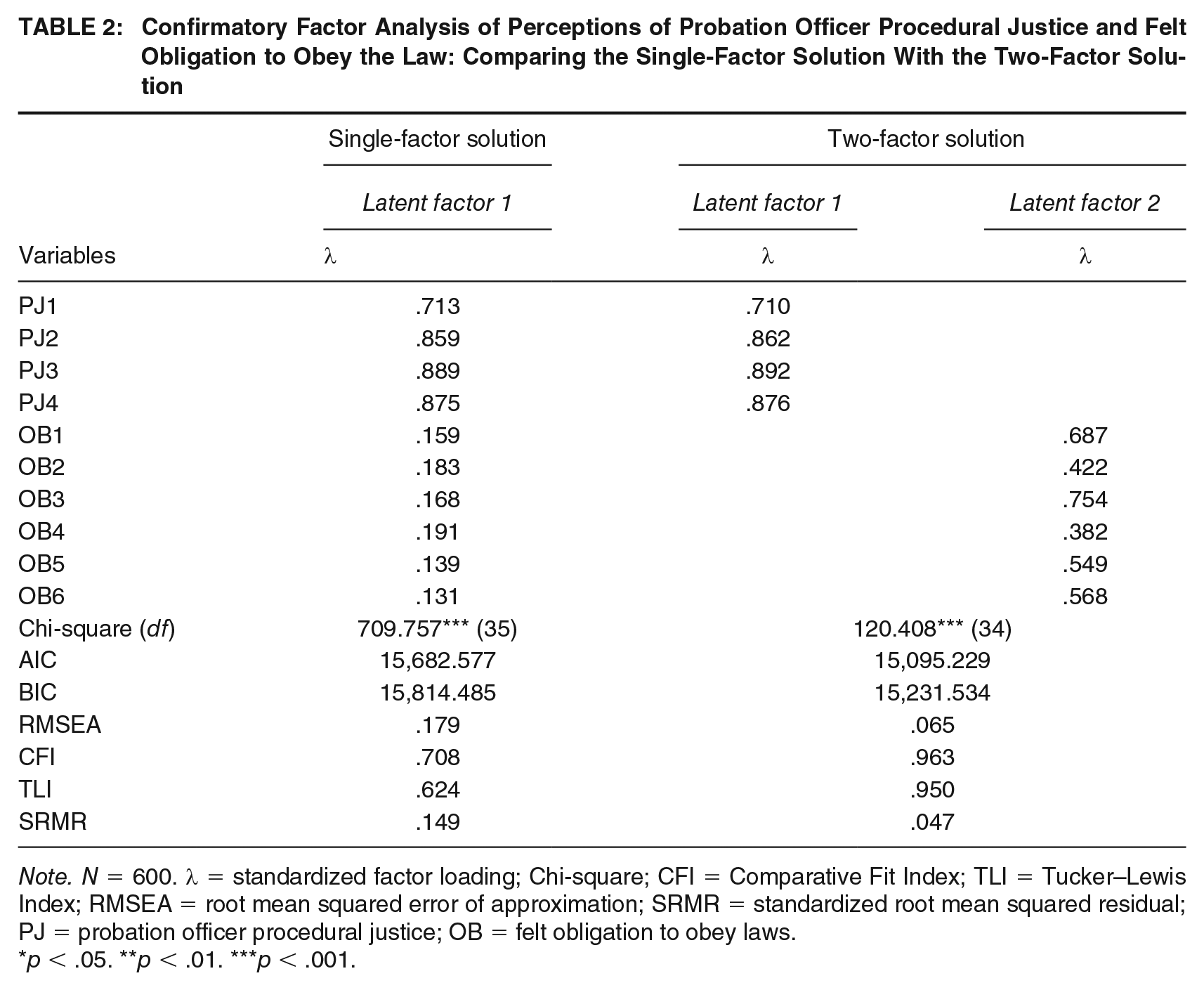
Note. N = 600. λ = standardized factor loading; Chi-square; CFI = Comparative Fit Index; TLI = Tucker–Lewis Index; RMSEA = root mean squared error of approximation; SRMR = standardized root mean squared residual; PJ = probation officer procedural justice; OB = felt obligation to obey laws.
p < .05. **p < .01. ***p < .001.
To test our hypotheses, our analyses proceeded in two stages. First, we tested the relationships between probation officer procedural justice, felt obligation to obey, and recidivism using bivariate analyses. Second, we used Structural Equation Modeling (SEM) in Mplus (Muthén & Muthén, 1998–2017). SEM allowed us to include latent constructs (i.e., two-factor measurement model consisting of procedural justice and felt obligation to obey laws), followed by an estimation of the direct pathway (i.e., procedural justice predicts obligation to obey, Hypothesis 1; obligation to obey predicts recidivism, Hypothesis 2; procedural justice predicts recidivism, Hypothesis 3) and the indirect pathway (i.e., procedural justice predicts recidivism via felt obligation to obey the law, Hypothesis 3) simultaneously. The theoretical model is presented in Figure 1. In these structural models, all other background characteristics were added as exogenous variables. The “model indirect” command in Mplus was used to perform the mediation analysis. This command produced confidence intervals for the direct and indirect effects (Muthén & Muthén, 1998–2017). Because our outcome (i.e., recidivism) was measured using a binary or count measure, we used maximum likelihood estimation (ML) in Mplus (Muthén & Muthén, 1998–2017). Logistic models in Mplus do not produce the model fit statistics discussed above for the CFA. Therefore, we presented the Akaike information criterion (AIC) and the Bayesian information criterion (BIC).
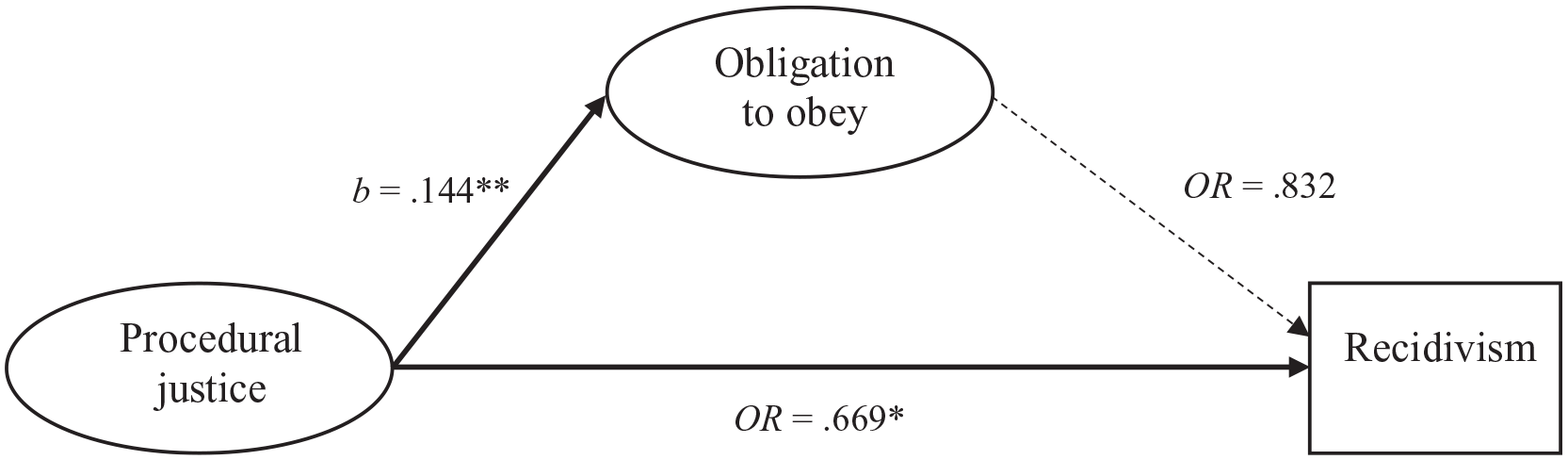
Structural Equation Model: Logistic Regression Multivariable Model Predicting Recidivism
Results
Descriptive statistics showed that 27.5% of all respondents reoffended in the follow-up period ranging from 6 to 18 months after release (see Table 2). Of those who reoffended, most respondents were reconvicted once or twice. About 29.5% of all respondents reported having committed a crime. Respondents perceived their treatment by the probation officer as relatively positive (score of 3.42 on a scale ranging from 1 to 5). On average, respondents also felt an obligation to obey laws (score of 3.12 on a scale ranging from 1 to 5).
Examining the Pathways in the Procedural Justice Framework
Bivariate analyses showed that the more respondents feel treated fairly by their probation officer, the more likely they are to feel obligated to obey the law (Pearson’s r [r] = .21) and the less likely they are to get reconvicted after release (spearman’s rho = −.093). In addition, respondents’ felt obligation to obey is related to recidivism (spearman’s rho = −.142).
We performed structural equation models predicting recidivism in the follow-up period of six to 18 months after release. The results are reported in Figure 1 and Table 3. Both the AIC (15600.308) and BIC (15881.390) in the full SEM model–with all control variables–had reduced values compared with the AIC (15790.155) and BIC (15939.650) in the model without control variables, suggesting better model fit when including control variables. In the final model, including control variables, the reliability and validity of both key constructs (i.e., procedural justice & felt obligation to obey) were tested. Composite reliabilities ranged from .75 (felt obligation) to .90 (procedural justice), which indicates good to excellent internal consistency. 5 The Average Variance Extracted (AVE) ranged from .36 (felt obligation) to .70 (procedural justice). Summarized, the results of the measurement model showed that the latent constructs are adequately represented by their observed indicators.
Structural Equation Model Examining Felt Obligation to Obey the Law and Registered Recidivism
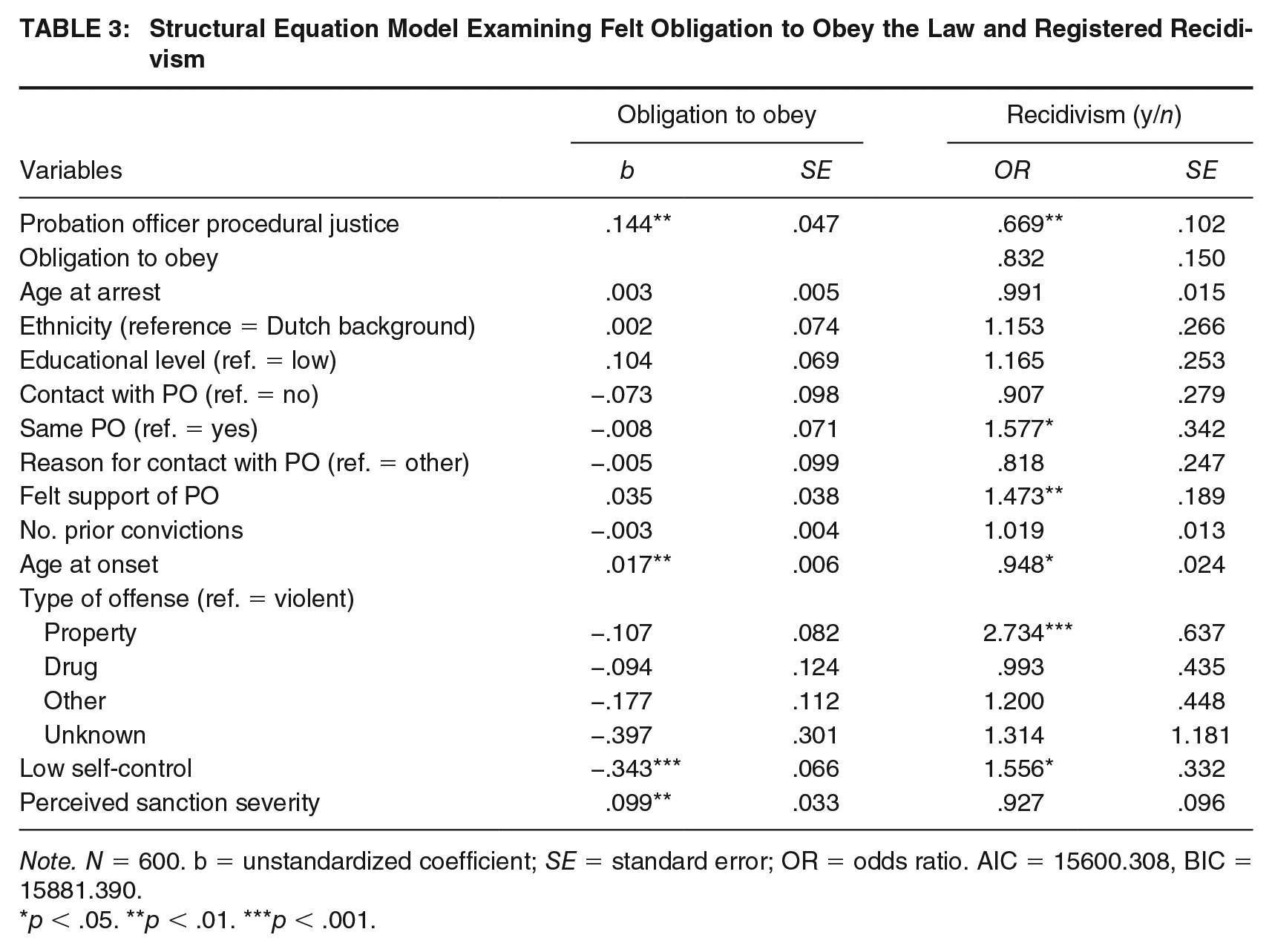
Note. N = 600. b = unstandardized coefficient; SE = standard error; OR = odds ratio. AIC = 15600.308, BIC = 15881.390.
*p < .05. **p < .01. ***p < .001.
Consistent with the procedural justice framework (Tyler, 2006) and previous empirical work (Blasko & Taxman, 2018; Penner et al., 2014), we found that procedural justice experienced in encounters with probation officers was associated with rule-following behavior. Even when taking into account individual characteristics (e.g., age or the number of prior convictions) that might be related to recidivism, it turned out that respondents who felt treated procedurally just by the probation officer within the first 6 months after release were less likely to recidivate in the follow-up period (odds ratio [OR] = .669). This finding means that, for one unit increase in the latent construct of probation officer procedural justice (e.g., from value 2 to 3), the odds of recidivism decreased by 33%.
In addition, perceptions of probation officer procedural justice were associated with higher levels of a felt obligation to obey the law (b = .144). In other words, respondents who felt treated in a procedurally just manner by their probation officer perceived a greater willingness to obey the law. However, the obligation to obey the law at 6 months was not significantly associated with recidivism in the follow-up period (OR = .832, p value = .308). When accounting for individual differences in various background characteristics that might be related to recidivism (e.g., low self-control), respondents’ felt obligation to obey the law did not affect their likelihood of being reconvicted. Hence, the indirect pathway from procedural justice perceptions to recidivism—via felt obligation to obey—was not statistically significant. 6
Besides the main pathways in the procedural justice framework (see Figure 1), some background characteristics were related to respondents’ felt obligation to obey and the likelihood of recidivism. Respondents who were older at the time of their first arrest (b = .017), who had lower levels of self-control (b = −.343), and who perceived their sanction as more severe (b = .099) also reported a greater felt obligation to obey. In addition, respondents who had a different probation officer (OR = 1.577), who felt more support from their probation officer (OR = 1.473), who had a property offense (OR = 2.734), and who reported lower levels of self-control (OR = 1.556), were more likely to get reconvicted in the follow-up period.
Assessing the Robustness of the Pathways in the Procedural Justice Framework
To assess the robustness of these findings based on registered recidivism within 6 to 18 months after release, we performed several additional analyses. We repeated our analyses based on the number of reconvictions within the follow-up period (see Supplemental Table A1, available in the online version of this article). These analyses showed similar findings, indicating a negative relationship between perceptions of probation officer procedural justice and the number of reconvictions (b = −.361). In other words, the number of reconvictions decreases when respondents feel treated in a procedurally just manner by their probation officer. In addition, the negative association between felt obligation to obey and recidivism did not reach significance (b = −.177, p = .203).
Furthermore, we re-ran our analyses using a dichotomous measure of recidivism based on self-reported data (see Supplemental Table A2, available in the online version of this article). Respondents’ perceptions of probation officer procedural justice were related to their felt obligation to obey the law (b = .139), and this felt obligation was associated with the likelihood of self-reported recidivism in the following 18 months (OR = .557). The direct association between procedural justice and recidivism failed to reach statistical significance (OR = .728, p = .064). Taken together, unlike the results based on registered recidivism, there was an indirect relationship between procedural justice and self-reported recidivism via feelings of obligation to obey the law (confidence interval 90%: OR = .858-.988).
Discussion
The aim of this study was to test three hypotheses related to probation clients’ perceptions of probation officer procedural justice, how this affects their felt obligation to obey the law, and how these attitudes are associated with recidivism. To reiterate, the three hypotheses we tested were: (H1) Probation clients’ perceptions of probation officer procedural justice will be significantly and positively associated with their felt obligation to obey the law; (H2) Probation clients’ obligation to obey the law will be significantly and negatively associated with recidivism; and (H3) Perceived probation officer procedural justice will be significantly and negatively associated with recidivism, but this relationship will be mediated by probation clients’ felt obligation to obey the law.
In line with the first hypothesis, we found that probation clients who perceived that their probation officer was more procedurally just also reported a greater obligation to obey the law. This finding supported the procedural justice framework (Tyler, 2006) and aligned with prior studies regarding justice-involved individuals’ interactions with other criminal justice authorities such as police (e.g., Baker & Gau, 2018; van Hall et al., 2024; White et al., 2016), court actors (e.g., Baker et al., 2015; Shook et al., 2021), institutional corrections personnel (e.g., Steiner & Wooldredge, 2015; van Hall et al., 2023a), and probation officers (Alward, 2022; Penner et al., 2014). Finding a consistent relationship for probation clients’ perceptions of probation officers reinforces the importance of procedural justice in every encounter individuals have with the criminal justice system.
The results of the analyses indicated that the relationship proposed in Hypothesis 2 was not supported. Based on registered data, our results did not show an association between felt obligation to obey the law and the likelihood of being reconvicted or the number of reconvictions during a 12-month follow-up period. This finding was consistent with prior studies by Penner et al. (2014) and Alward (2022). Nonetheless, the obligation to obey the law was significantly associated with self-reported recidivism in an 18-month follow-up period in our robustness checks. A potential explanation for the different results depending on the measure of recidivism might be that self-reported recidivism included criminal behavior that was not identified by law enforcement authorities and thus not captured by registered recidivism. Another explanation might be related to a single source bias because respondents were asked about their felt obligation to obey the law and are asked about their compliant behavior. As a consequence, the relationship between felt obligation to obey and self-reported recidivism may be partly attributable to the method of research (Podsakoff et al., 2003). Overall, this finding may indicate that the relationships posited by the broader procedural justice framework are sensitive to how recidivism is measured.
Our results partly supported Hypothesis 3. In our main analyses, procedural justice was significantly and negatively associated with registered recidivism. This finding was in line with previous research on probation officer-client relationships (Blasko & Taxman, 2018; Gladfelter et al., 2018; Penner et al., 2014). However, there was no support for a significant mediating influence of the obligation to obey the law in our main analysis or in our robustness checks using the number of registered reconvictions as the outcome measure. At the same time, we did find some evidence for the mediating impact of the obligation to obey on the association between procedural justice and self-reported recidivism. Thus, the results showed partial support for the association between procedural justice and recidivism, but based on all of our analyses, the mediating role of felt obligation to obey in the relationship between procedural justice and recidivism remains unclear.
Several other findings from this study merit comment. First, we accounted for other theoretically relevant variables in our model that were significantly associated with the obligation to obey and recidivism. Primarily, low self-control was negatively and significantly associated with obligation to obey and positively and significantly associated with recidivism. This provides additional evidence regarding the importance of self-control in understanding offending behavior and the importance of controlling for this factor when examining other potential explanations of offending. In addition to low self-control, we controlled for perceived sanction severity which captured an element of how deterrence may be associated with obligation to obey and recidivism. Although perceived severity was associated with the obligation to obey, it did not have a direct effect on recidivism. Similar to previous research (Baker, 2018; van Hall et al., 2023a; Yasrebi-De Kom et al., 2022), this suggests that normative factors like procedural justice perceptions may be more likely to reduce recidivism than instrumental or deterrence-based solutions.
Second, we found a positive association between probation clients feeling supported by their probation officer and recidivism. This variable operated in an unexpected direction but may be explained by the specifics of the items. The questions included, for example, whether respondents felt supported by the probation officer in avoiding criminal activity. Individuals more actively engaged in offending may have reported higher scores on such questions because probation officers were directly involved in trying to help them with ceasing their criminal activity. Alternatively, other respondents may have been more focused on reentry related concerns such as housing and employment, and they may have reported lower scores on probation officers helping them stay out of crime, because they were already focused on avoiding recidivism and instead felt supported in other ways. Future research should explore how various types of support might differ in their association with recidivism.
While our findings are noteworthy, no study is without limitations. There are several areas in which other measurement strategies could have been considered. First, our measure of probation officer procedural justice could be strengthened. Measures of procedural justice related to other criminal justice agencies used in the Prison Project data, such as perceptions of police procedural justice, had more items and more detailed questions measuring procedural justice (see for example van Hall et al., 2022). Next, we did not measure legitimacy as a total construct as would be posited by the procedural justice framework (e.g., Tyler, 2006). Instead, we focused on a single subconstruct of legitimacy: felt obligation to obey the law. While this measure has been widely used in previous studies (see Baker, 2018; Baker & Gau, 2018; Beijersbergen et al., 2016; van Hall et al., 2024), it did not capture the totality of legitimacy. Felt obligation to obey as we measured it might tap into a dull compulsion or pragmatic adherence as much as it does a normative commitment to the law. In addition, although there are different levels of supervision exist in the Dutch probation context, this study did not include respondents’ level of supervision into account due to data limitations. Finally, while this study made progress in measuring the associations of interest longitudinally, we still could not be certain about the generalizability of our findings outside this study’s context. Because the scope and meaning of probation in the Netherlands—for example, encapsulating aspects of both probation and parole in a U.S. context—differs from other Western countries, we encourage future research to test whether the study’s findings are generalizable.
Despite these limitations, this study has important implications for both theory and practice. From a theoretical perspective, this study provides further evidence that principles of the procedural justice framework (Tyler, 2006) are applicable across context and criminal justice authority. Our findings also help to address temporal concerns regarding the association between procedural justice and recidivism found in cross-sectional studies, as we found a similar association when using a longitudinal research design. In addition, we found that even with the inclusion of competing theoretical correlates of offending—specifically, low self-control and perceived sanction severity—procedural justice remained a significant factor for discouraging registered recidivism as well as self-reported recidivism through felt obligation to obey laws.
For practice, our findings reinforce the importance of taking a procedurally just approach to engaging with people throughout the criminal justice system. There are various opportunities throughout a person’s experience with the criminal justice system to affect perceptions. That is, interactions with the police, courts, correctional institutions, and probation/parole all provide different opportunities to demonstrate that the individual authorities that make up the system and the system itself are procedurally just. It may be that, on the one hand, police and courts recognize their ability to affect perceptions of the criminal justice system and perhaps offend by demonstrating their fairness. While, on the contrary, correctional personnel may view themselves as dealing with “offenders” and so unable or unlikely to change offending behavior. This study, like others examining correctional or probational personnel, contradicts this latter view. Rather, it demonstrates that the importance of procedural justice for reducing offending is not limited to the police and courts. Community-based correctional personnel should be encouraged to engage with clients according to the principles of procedural justice to help reduce recidivism and encourage successful reintegration into society.
Future research should continue to explore how procedural justice can be used to reduce recidivism and encourage desistance from offending. Studies should explore how different measures of procedural justice, legitimacy, and recidivism impact the support found for the procedural justice framework. For example, besides recidivism after release, future research may include other outcome measures, such as re-arrests or probation violations. In addition, more research employing longitudinal analyses is needed. Similarly, analyzing longer periods of recidivism are important for understanding the impact of procedural justice. If procedural justice can continue to impact recidivism at longer reference periods of offending, such as 3 years or 5 years post-release, it will demonstrate the lasting effect of interactions between criminal justice actors and the people they serve. Alternatively, if the effects of procedural justice wane over time it may be important to conduct follow-ups between probation officers and their clients. This could reinforce the principles of procedural justice that may be most effectively conveyed with recent interactions.
To conclude, the current study demonstrated general support for the procedural justice framework when applying it to probation clients’ interactions with probation officers and their subsequent recidivism. This study adds to the growing body of literature demonstrating the importance of procedural justice for all authorities in the criminal justice system. It further demonstrates the ability of criminal justice authorities to affect people’s offending behavior simply by treating them in a procedurally just manner.
Supplemental Material
sj-docx-1-cjb-10.1177_00938548241244502 – Supplemental material for Perceptions of Probation Officer Procedural Justice and Recidivism: A Longitudinal Study in the Netherlands
Supplemental material, sj-docx-1-cjb-10.1177_00938548241244502 for Perceptions of Probation Officer Procedural Justice and Recidivism: A Longitudinal Study in the Netherlands by Matthias Van Hall, Thomas Baker, Anja J. E. Dirkzwager and Paul Nieuwbeerta in Criminal Justice and Behavior
Footnotes
Authors’ note:
The authors declare no potential conflicts of interest with respect to the research, authorship, and/or publication of this article. This study was funded by an Open Competition grant of the Netherlands Organization for Scientific Research (NWO; grant number: 406.18.RB.011).

Supplemental Material
Notes
References
Supplementary Material
Please find the following supplemental material available below.
For Open Access articles published under a Creative Commons License, all supplemental material carries the same license as the article it is associated with.
For non-Open Access articles published, all supplemental material carries a non-exclusive license, and permission requests for re-use of supplemental material or any part of supplemental material shall be sent directly to the copyright owner as specified in the copyright notice associated with the article.
