




Abstract
Why have public reactions to police misconduct been so polarized, and why have opposing social movements emerged in response? This study explores attributions of police misconduct, using a myriad of possible attributions and a population-matched national sample (N = 700), to extend our understanding of the perceived causes of police misconduct and who holds which attributions, focusing on race, racial attitudes, and political ideology. We find that attributions could be divided into (a) multifaceted attributions—the belief that misconduct has multiple causes; and (b) excusatory attributions—the belief that misconduct is caused by factors external to police officers and agencies. Endorsement of these attributions stems from racial and political attitudes, with mediation analyses finding that race plays an indirect role in endorsing attributions of police misconduct. As such, efforts to address police misconduct face not only a political power struggle but also a racially attitudinal one.
Instances of police misconduct—of officers harassing, brutalizing, and even murdering civilians—now appear regularly in the news. They are often captured on camera and shared internationally (e.g., Buchanan et al., 2020; Eligon et al., 2021). Protest groups, such as Black Lives Matter (BLM), have mobilized in response, arguing that officer mistreatment of civilians, and Black civilians specifically, is widespread and reflects systemic racism in policing aimed at Black communities, who are “systematically and intentionally targeted for demise” (Black Lives Matter, n.d.-b). As a result, one of this group’s key “demands” is defunding of the police (Black Lives Matter, n.d.-a).
In response, the counter-movement Blue Lives Matter (BLUE) emerged to defend officers against perceived anti-police bias, “vilification” of law enforcement, and criticism in the media. BLUE supporters argued that civilization requires a well-funded and strong police force and that negative publicity of policing is counterproductive and dangerous, producing de-policing—the so-called “Ferguson Effect” (Nix & Pickett, 2017)— as well as violence against officers (Berg, 2020; Blue Lives Matter, 2023). Furthermore, the BLUE position is that BLM “overlooks [the] root cause of police encounters,” that it is civilians who are to blame for “causing issues with the police in the first place; it’s the lawbreakers!” (Reed, 2023). In other words, BLUE advocates argue that officers are often “put in a position where they are required to use force,” and yet society then ignores “the context behind these incidents” and focuses only on “the skin color of the people involved” when drawing conclusions (Berg, 2020).
Why have public reactions to police misconduct been so polarized, and why have opposing social movements emerged in response? Sociologists emphasize that “the meaning social phenomena have for us turns crucially on how we explain or account for the observation of them” (Thompson & Bobo, 2011, p. 17). This means that what likely underlies divergent responses to police misconduct is differing causal attributions for it. Referred to as diagnostic framing, social movements identify a problem and provide attributions of blame for it (Benford, 1993; Snow & Benford, 1988). A large body of scholarship has shown that attributions play powerful roles in explaining reactions to and mobilization against social problems, such as crime, gun violence, and mass incarceration (Drakulich, 2015; Hagan, 2010; Thompson & Bobo, 2011).
Surprisingly, however, research on attributions for police misconduct is scarce, which poses a challenge for reform efforts to curb misconduct and for understanding the public’s different responses to police misconduct. Still, broadly speaking, attribution theory provides a basis for hypothesizing about both the nature and correlates of such attributions. Behavior is typically attributed either to internal (i.e., individual) or external (i.e., situational) factors (Heider, 1958; Weary, 1984; Weiner, 1985), which then supports prognostic framing in social movements, leading to proposed “strategies, tactics, and targets” to address the problem at hand (Benford, 1993; Snow & Benford, 1988, p. 201). In other words, the purported causes of a social problem, which normally bifurcate into those blaming individuals and those impugning broader social processes, provide “reasonable” strategies (e.g., policies) that can be advocated for, as well as the emotional content necessary for collective action (Benford & Snow, 2000; Pickett & Ryon, 2017).
In this context, our study undertakes the first systematic exploration of attributions of police misconduct, using a myriad of possible attributions and a population-matched national sample (N = 700). We go beyond the rare instances in which officers shoot or kill someone (Zimring & Arsiniega, 2015), extending our understanding of the perceived causes of police misconduct to deviant officer behavior in general. Although prior literature is mixed on defining or classifying police misconduct (e.g., Kappeler et al., 1998; Weitzer & Tuch, 2004), we are referring to officers engaging in deviant behavior including: profit-motivated crimes, off-duty crimes against persons, off-duty public order crimes, drugs, on-duty abuse, obstruction of justice, failure to perform, and conduct-related probationary failure (see Kane & White, 2009). We also seek to understand who holds which attributions, focusing on how race, racial attitudes, and political ideology are associated with views about what causes officers to misbehave. Before turning to our study, we review attribution theory, discuss why cleavages might exist in policing attributions, and consider the likely role of racial attitudes in shaping attributions for police misconduct.
Theoretical Background: The Nature of Attributions
To understand the perceived causes of others’ behavior, a common theoretical lens used is attribution theory. Heider (1958) posited that to make sense of the world around us, and to provide predictions and control of outcomes, we make causal judgments about our physical and social environment. Heider (1958) argued that “the result of an action is felt to depend on two sets of conditions, namely factors within the person and factors within the environment” (p. 82). Scholars have since referred to these factors as internal (dispositional) attributions and external (situational or environmental) attributions. Dispositional attributions are those that demonstrate “intrinsic invariance” (Heider, 1958, p. 30), which leads “objects and events to manifest themselves in certain ways under certain conditions” (Heider, 1958, p. 80). Internal attributions equate to personal blame. Alternatively, external attributions are those that stem from “the environment and with which the person has to cope, such as what another person does to him, the strokes of fortune or misfortune, etc.” (Heider, 1958, p. 164). Such environmental circumstances are the “nurture” in “nature versus nurture” discussions and are understood to be malleable and to mitigate personal blame.
Although attribution theory has advanced since Heider (see Funder, 1982; Weary, 1984), the distinction between dispositional/internal attributions and environmental/external attributions persists. Past studies have shown that it emerges empirically in attributions for many social problems, such as crime and carceral inequality (Grasmick & McGill, 1994; Pickett & Ryon, 2017; Unnever et al., 2010). Studies have also found that the distinction is useful for understanding diverse issues, such as jurors’ perceptions of false confessions (Woestehoff & Meissner, 2016), civilians’ perceptions of COVID-19 risk (Dunning et al., 2020), beliefs about the role of genetics in crime (Graham et al., 2022), and perceptions of school-aged peers’ reputations (Waas & Honer, 1990).
Regardless of the attributions made, be they dispositional or environmental, Kelley and Michela (1980) argue that these causal beliefs “play a central role in human behavior” because they determine how we interact with our world (p. 460). They also note that ascribed causes influence our behavior, relevant emotions, and expectations about the future. Furthermore, the attribution of a grievance to an external source (i.e., system attribution) may motivate collective action to address it (Ferree & Miller, 1985). Finally, attributions also strongly shape policy preferences (Cullen et al., 1985). For example, internal attributions foster punitiveness (Peffley et al., 2017; Unnever et al., 2010), lower support for governmental intervention to address the Black–White socioeconomic gap (Kluegel, 1990; Kluegel & Smith, 1982), and lower support for diversity training and racial diversification of law enforcement (Pickett & Ryon, 2017), whereas external attributions foster support for policies to address the social conditions (e.g., poverty) underlying social problems (e.g., crime) (Templeton & Hartnagel, 2012; Thompson & Bobo, 2011).
By extension, because attributions impact not only emotions, expectations, and mobilization for collective action but also policy preferences, an important first step is understanding the nature of attributions for police misconduct. In this context, prior theory and research lead to two predictions. First, we predict that attributions for police misconduct will bifurcate into two dimensions: internal and external. Second, we predict that some types of individuals will most strongly endorse internal attributions, attributing misconduct to the police officers themselves. That is, these types of individuals are likely to argue that it is the dispositional traits of police officers (e.g., as racist, morally bankrupt) that cause them to engage in misconduct. By contrast, other types of individuals should most strongly endorse external attributions, believing that police misconduct is a result of situational or environmental factors, such as public hostility toward the police, which mitigate officer blameworthiness.
Attributional Divides: The Group Position Thesis
Existing theory and research suggest that different groups (e.g., White Americans, Black Americans, Republicans, and non-Republicans) are likely to diverge in the attributions they endorse for social problems. The literature on collective action provides a birds-eye-view theoretical explanation for why such divergence occurs, using the concepts of narrative fidelity and experiential commensurability (Benford & Snow, 2000; Snow & Benford, 1988, 2000). Put simply, individuals should be most likely to endorse attributions that accord with their existing ideological and cultural beliefs (narrative fidelity) and that are also consistent with their personal and vicarious experiences (experiential commensurability) (Baranauskas & Drakulich, 2018; Pickett & Ryon, 2017). By extension, groups differing ideologically, culturally, and/or experientially are likely to endorse different attributions.
In the case of police misconduct, the group position thesis sheds light on why some attributions may resonate more strongly in certain groups than in others. As initially theorized by Blumer (1958) and extended by Bobo and Hutchings (1996), the group position thesis argues that the positional arrangement of people within groups (i.e., dominant or subordinate) shapes narratives about group relations and social control (Bobo, 1999). According to Blumer (1958), historical patterns of intergroup interaction gave rise to different cultural understandings of ingroup interests, outgroup threats, and legal institutions, which were then reinforced and cemented through framing efforts. By extension, the resultant cultural understandings (e.g., racial and political ideologies) should determine the narrative fidelity (and thus resonance) of causal attributions for social problems that affect one’s ingroup or the outgroup. In the same way, group differences in relevant personal and vicarious experiences should also affect the experiential commensurability (and thus resonance) of internal versus external attributions.
Within the policing context, the most germane divide between groups is racial (Pickett et al., 2022), with the police in the U.S. historically being part of the White ingroup (Walker, 1980), and used to support the goals/values of White Americans (see, e.g., slave patrols, oppression of civil rights protests) (Francis & Wright-Rigueur, 2021; Johnson, 2019). As such, Weitzer and Tuch (2004) argue that American policing is viewed through a racial lens, with White Americans downplaying officer misconduct and reacting defensively to calls for police reform, whereas Black and Hispanic Americans believe police misconduct is common, that it contributes to their subordination, and that reform is vital.
In the language of collective action theory, White and non-White Americans have different vocabularies of motive (severity, urgency, and prognostic frames) about police misconduct. These divergent vocabularies of White and non-White Americans signify an underlying racial divide in relevant attributions that likely stems from two factors (Haider-Markel & Joslyn, 2017; Pickett & Ryon, 2017). The first is group differences in racial ideology—symbolic racism among White Americans, but “collectively shared historical memories of police malfeasance” among non-White Americans (McCarthy et al., 2020, p. 510)—that affect the narrative fidelity of attributions. The second factor is group differences in experiences with police, which should influence the experiential commensurability of attributions—for example, Black Americans experience (both personally and vicariously) more police mistreatment than White Americans (Pickett et al., 2022; Tapp & Davis, 2022). The theoretical implication is that non-White Americans should be more likely to attribute police misconduct to internal factors (e.g., racism), whereas White Americans should be more likely to attribute it to external factors (e.g., underfunding, public criticism) (Haider-Markel & Joslyn, 2017; Pickett & Ryon, 2017).
Likewise, political orientations may shape attributions for police misconduct. Since the 1960s civil rights protests and the police repression of them, American politics and criminal justice policy have both revolved around the issue of race, with those on the political right viewing advocates for racial progress as a threatening outgroup (Beckett & Sasson, 2004; Edsall & Edsall, 1991; Fording & Schram, 2020). The connection between racial concerns, political orientation, and criminal justice issues has, if anything, strengthened in recent decades (Alexander, 2020; Enders & Scott, 2019; Tesler & Sears, 2010). In Griffin et al.’s (2021, p. 1) words, Republicans and non-Republicans are “racing apart” in their attitudes about race and police. Hansen and Navarro (2023) found that political partisanship was one of the strongest predictors of policing attitudes. Reny and Newman (2021) found that Republicans and non-Republicans responded differently to the protests that followed George Floyd’s murder. Notably, police officers are even more likely than the civilians in their jurisdictions to be Republican (Ba et al., 2022) and, in recent years, have increasingly made campaign contributions to Republican rather than Democratic politicians (Bump, 2021). The implication is that civilians on the political right are likely to view the police as an ingroup.
Theoretically, the above indicates that politics are strongly intertwined with narratives about race and policing. By extension, individuals’ political views are likely to affect the narrative fidelity (and resonance) of diagnostic framing efforts about how officers exercise discretion and, in turn, are likely to influence the attributions they ultimately endorse for police misconduct (Haider-Markel & Joslyn, 2017). Specifically, we expect civilians with rightward political views to endorse external attributions that excuse or minimize police misconduct. By contrast, those with left-leaning political views should tend to endorse internal attributions that direct the blame for police misconduct on the officers themselves. Prior studies that have examined civilians’ evaluations of specific instances of officer-involved shootings have found political divides in attributions (Cooley & Brown-Iannuzzi, 2019; Patil, 2018). However, our study extends the focus to attributions for police misconduct more generally.
Another contribution of our study is to try to identify the “narrative” mechanism underlying racial and political divides in attributions. Racial animus has been one of the most potent predictors of public policy attitudes for the last quarter-century (Cullen et al., 2021). Specifically, the emphasis on symbolic or modern racism—characterized by “resentment over blacks getting ahead unfairly” (Kinder & Sanders, 1996, p. 110)—has provided a means to understand support for family leave, sexual harassment, immigration restrictions, capital punishment, and more (Cullen et al., 2021). However, Bobo and colleagues provide a vast body of evidence that racial resentment (or symbolic racism) is also the strongest predictor of attributions (Bobo, 1999; Kluegel, 1990). Such racism may thus serve as a narrative that influences judgments about police misconduct, with those holding greater resentment being more inclined to endorse external attributions that blame others for police misconduct. In contrast, the less resentful—people favorable toward Black Americans (Agadjanian et al., 2023)—should be more inclined to endorse internal attributions that blame officers for their misbehavior.
Unsurprisingly, race is strongly associated with racial resentment; White Americans tend to be more resentful. Racial resentment is also heavily tied to political views, with right-leaning Americans tending to be more resentful (Enders & Scott, 2019; Tesler & Sears, 2010). As such, our study includes racial resentment as a potential “narrative” mediator in two key relationships: (a) that between race and attributions for police misconduct, and (b) that between political views and attributions for police misconduct. Essentially, with this mediation, we ask whether the reason that some Americans (and groups thereof) assert that “emphasizing Black Lives Matter . . . will never win me over” (Reed, 2023, p. 2) is that they are racially resentful.
Methods
Data used in this study come from a 2021 nationwide survey (N = 1,150) constructed by the research team and fielded by YouGov, an international survey company. YouGov uses a two-stage matching and weighting sampling strategy to produce samples that approximate the adult U.S. population (on the sampling variables), and its opt-in samples outperform other large probability-based samples, such as Gallup and IPSOS, when it comes to election predictions (Ansolabehere & Rivers, 2013). Likewise, a wealth of research provides evidence that estimates from YouGov samples tend to be generalizable to the adult U.S. population (Ansolabehere & Schaffner, 2014; Graham et al., 2021).
Our survey was administered to a general population sample (N = 700), with YouGov constructing its synthetic sampling frame using the 2018 American Community Survey 1-year sample, matching respondents on gender, age, race, and education. 1 Subsequently, these matched responses were weighted to the SSF using propensity scoring based on these same characteristics as well as region. These weights were then post-stratified on 2016 presidential vote choice and a four-way stratification of gender, age, race, and education.
Dependent Variables
As mentioned above, based on existing theoretical and empirical literature from outside of the policing context, we anticipated attributions for police misconduct would separate into internal and external causes. Few previous studies measured attributions for police misconduct, and those that did focused on a small number of attributions, failing to ask about both internal and external factors. Therefore, we began by constructing a set of eleven questions that asked about a diverse range of potential causes of police misconduct. In developing the questions, we drew from scholarly and popular commentary explaining police misconduct; commentators have attributed officer misbehavior to internal factors (e.g., bad officer character, racism, obsession with power) as well as external factors (e.g., low organizational accountability, insufficient training, problematic police culture). The 11 items we used asked respondents “how large or small of a role” (1 = very large, 5 = very small) each factor played in “CAUSING police misconduct (e.g., brutality, harassment, profiling) in this country.” Note that this question does not ask whether the respondent supports misconduct, whether they can define it, nor whether they believe an event is an example of misconduct; our question is what they think explains misconduct, when it does occur. We intentionally provided a broad definition for police misconduct, so that we did not bias respondents’ personal definition of police misconduct or its causes. The items are listed in Table 1. For the analysis, we reversed coded responses so that higher values indicated the respective factor was perceived to play a larger role.
Factor Loadings for Officer Misconduct Attributions
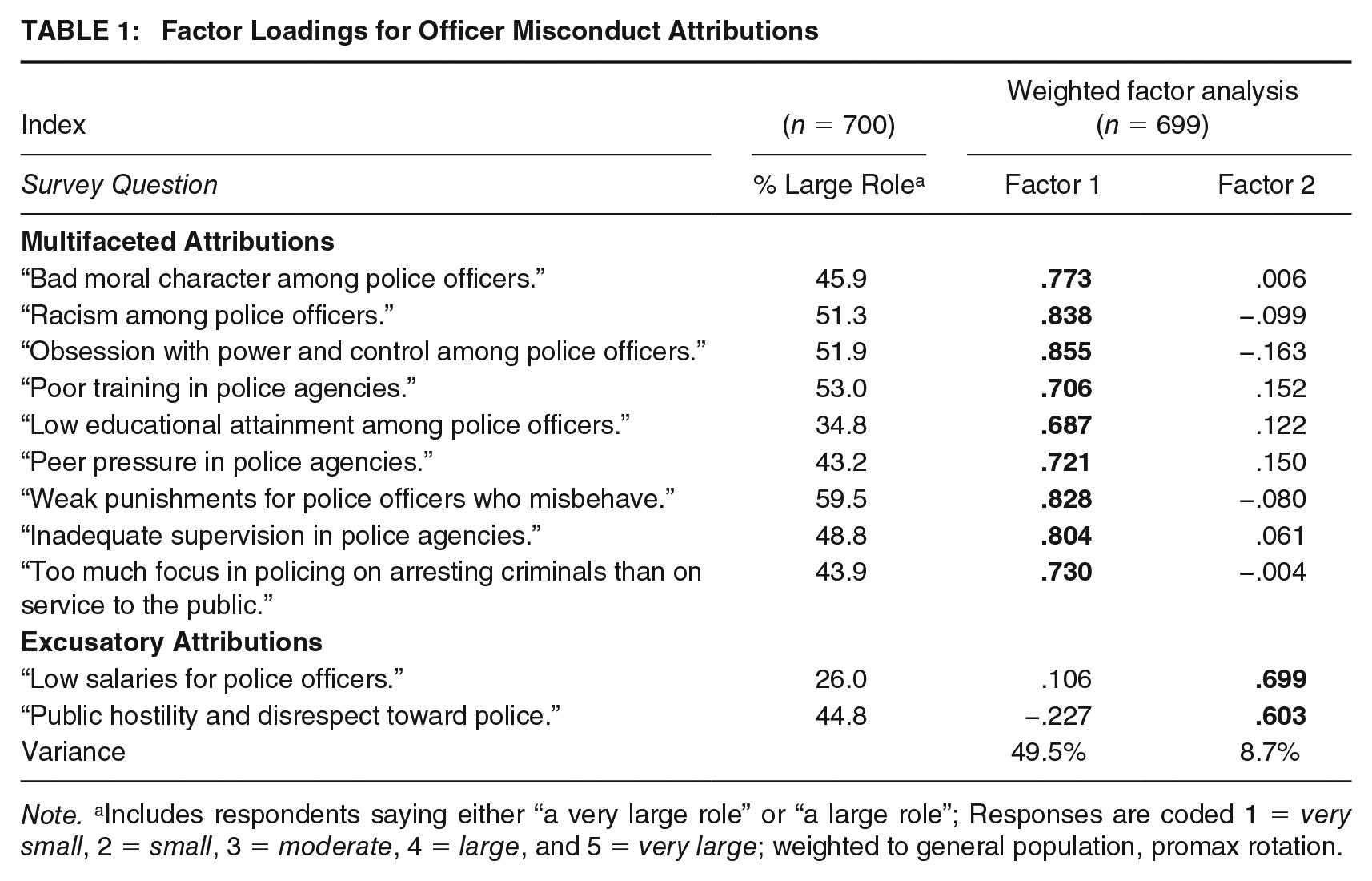
Note. aIncludes respondents saying either “a very large role” or “a large role”; Responses are coded 1 = very small, 2 = small, 3 = moderate, 4 = large, and 5 = very large; weighted to general population, promax rotation.
As noted, we anticipated these items would load on two dimensions reflecting internal and external attributions. This was not the case. As seen in Table 1, using exploratory factor analysis and the weighted general population sample, a two-factor solution did fit the data best. However, substantively, it appears that the two factors are not reflecting internal versus external attributions, but instead are reflecting two divergent approaches to explaining police misconduct. One approach recognizes the complex etiology of officer misconduct and entails endorsement of multiple causes, some located within officers and some within the police organization. Thus, we termed this attributional approach “multifaceted.” As such, the first scale, Multifaceted Attributions, is based on the nine items that loaded on Factor 1 (loadings .687 to .855, α = .931).
The second attributional approach reflected a resistance to attributing misconduct to any problems in policing, either with individual officers or the organizations. Instead, police misconduct was attributed to problems with civilians—either the public’s lack of financial support (inadequate officer pay) or the public’s animus toward officers (hostility and disrespect). These attributions thus were “excusatory,” as they directed blame not at the police but at the public. As such, the second scale, which we termed Excusatory Attributions, is based on the two items that loaded on Factor 2 (loadings .603 to .699, α = .556; r = .406). 2 A key issue is which respondents embrace these competing attributional frames.
Key Independent Variables
There are two key independent variables in our analysis. The first is respondents’ race, which we measure with two dichotomous variables, Black and Other Race, setting White as the reference category in analyses. The second independent variable is Rightward Political Views, which is based on responses to two items: (a) political party affiliation and (b) political ideology. Political party affiliation was measured using five categories that ranged from strong Democrat (=1) to strong Republican (=5), with other/not sure coded as Independent (=3). Political ideology was captured on a five-point scale that ranging from very liberal (=1) to very conservative (=5), with other/not sure coded as moderate (=3). Responses to these items were standardized and averaged to produce an index (r = .660) on which higher values indicate greater rightward political views, as done in prior research (Jonson et al., 2021).
Mediator
Given the likely importance of racial attitudes for understanding racial and political divides in attributions of police misconduct, we included a measure of Racial Resentment in our analysis as a mediator. It was measured using five items taken from prior work (Kinder & Sanders, 1996; Pickett & Chiricos, 2012). The items focus on denial of discrimination and opposition to affirmative action (e.g., “Generations of slavery and discrimination have created conditions that make it difficult for Blacks to work their way out of the lower class”). Respondents rated these statements using a 5-point Likert-type scale ranging from 1 = strongly disagree to 5 = strongly agree. Responses to these items were recoded so that higher values indicated greater resentment and then averaged to produce the index (factor loadings: .678 to .895, α = .908).
Control Variables
Additional sociodemographic characteristics of respondents were collected for use in analyses as standard sociodemographic controls (e.g., Thompson & Bobo, 2011; Unnever & Cullen, 2010) and to control for the independent effects of these variables and to isolate the effects of key independent variables and mediators. These include sex (0 = male; 1 = female), age (in years), income (measured ordinally on a seven-point scale from “0-$9,999” to “$100,000+”), marital status (1 = married, 0 = all others), education (measured ordinally using seven categories ranging from “less than high school degree” to “Doctoral degree”), and region (1 = South, 0 = all other geographic regions). 3 Finally, respondents were asked whether “[they], a family member, and/or close friend work for a police agency (local, state, federal)” (1 = officer, 0 = not officer/don’t know). 4
Analytic Strategy
Analyses for this study unfolded in three broad phases, using our weighted sample. The first part of the analysis focuses on the prevalence of attributions for police misconduct. Second, using ordinary least squares (OLS) regression, we estimate two models to understand the correlates of the two attributional approaches, multifaceted versus excusatory, with a specific focus on three predictors: race, political attitudes, and racial attitudes. Finally, using structural equation modeling to estimate serial bootstrap mediation models (5,000 bootstraps, MM-regression estimator), we examine the potential mediating impact of racial attitudes on each attributional approach, as seen in the conceptual model presented in Figure 1. In these models, none of the variance inflation factors exceeded the standard 2.0 cutoff, indicating that multicollinearity is not a concern.
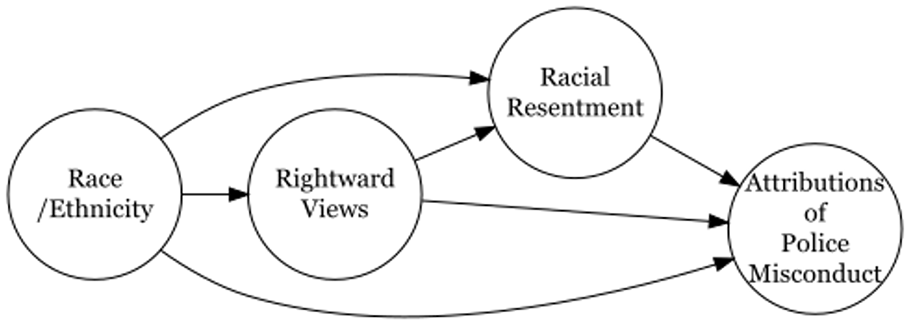
Conceptual Model
Results
To understand which factors the public believes are important causes of police misconduct, we start by turning to the prevalence estimates for each attribution. Table 1 shows the weighted percentage of respondents who said that each factor played a large or very large role in causing police misconduct. Notably, the most endorsed attribution dealt with low accountability in policing—nearly six in 10 respondents (59.5%) felt that weak punishments for officers who misbehave played a large or very large role in causing police misconduct. Likewise, more than half believed that poor training (53.0%), racism among police officers (51.3%), and obsession with power and control among officers (51.9%) played a large or very large role. By contrast, few respondents attributed police misconduct to low educational attainment among officers or low pay (35% and 26% said these factors played a large or very large role, respectively).
Bivariate Relationships Between Key Variables
Given the variation present, we next sought to understand who held these attributions. As seen in Figure 2, there are divides in attributional endorsement by respondents’ race/ethnicity. Most notably, respondents from racial and ethnic minority groups were more likely than White respondents to endorse multifaceted attributions. The difference between non-Black minority and White respondents was statistically significant (

Weight Density Curves of Attributes, by Respondent Characteristics
Just as notable as the racial divides in attributions were the political divides. Democrats were far more likely than Republicans to endorse multifaceted attributions of police misconduct (
Finally, those low in racial resentment (below the median on the index) were much more likely than their high-resentment counterparts to endorse a multifaceted attributional style (
Descriptive Statistics (n = 700)
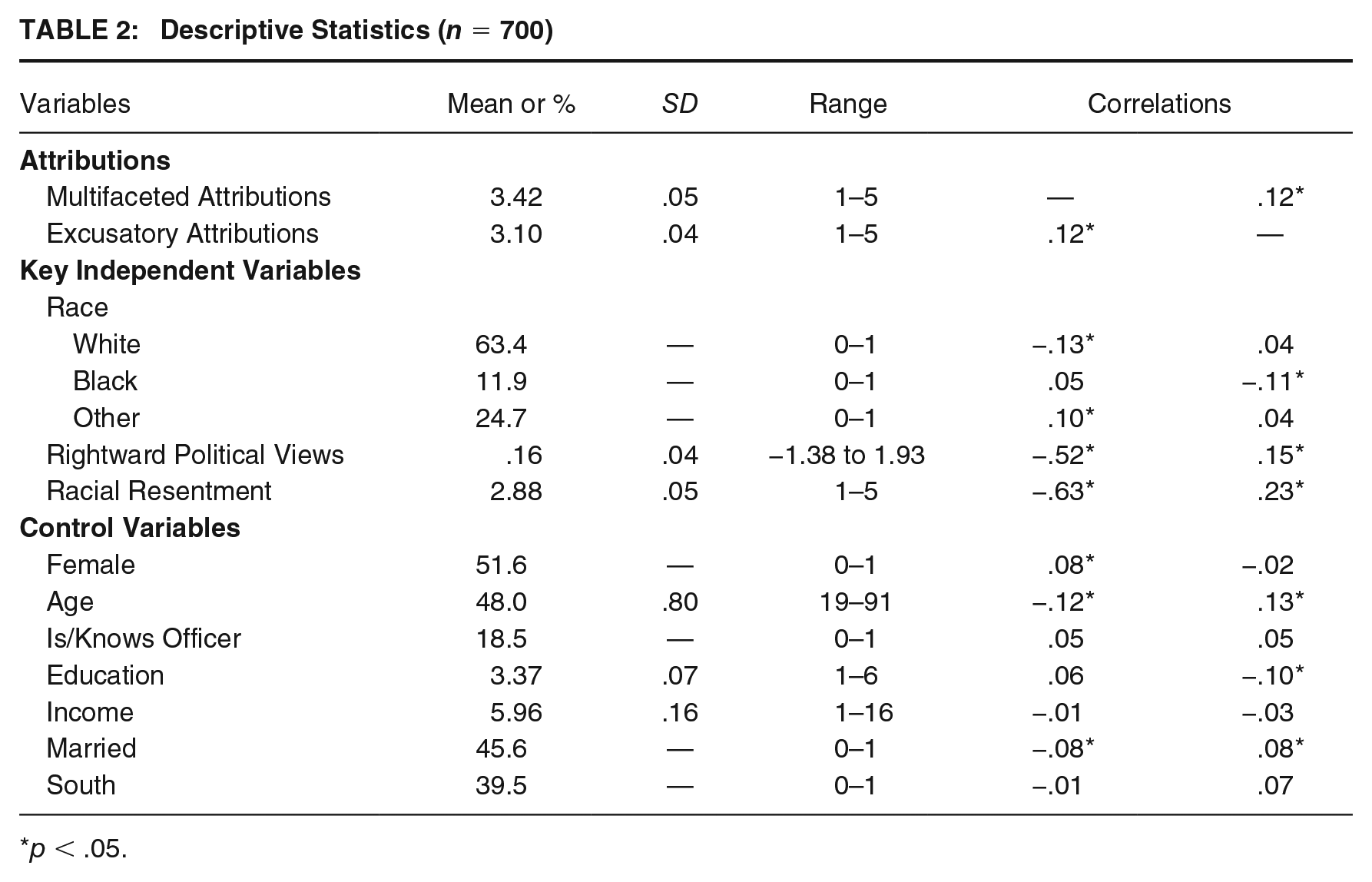
p < .05.
OLS Regression
Next, we estimated two OLS regression models for each attributional style. In the first model, we include all sociodemographic variables, and in the second model, we introduce rightward political views and racial resentment. The first two models in Table 3 show the results for multifaceted attributions. Model 1 in Table 3 reveals that White respondents are less likely than their non-White counterparts to endorse a multifaceted attributional style, although only one of the race coefficients is statistically significant. Model 2 in Table 3 introduces rightward political attitudes and racial resentment. Both are strongly and negatively associated with endorsement of multifaceted attributions. In addition, the inclusion of these attitudinal predictors narrows (or even reverses) the effects of the initial racial divide in endorsement of multifaceted attributions.
Regression Results (N = 700)
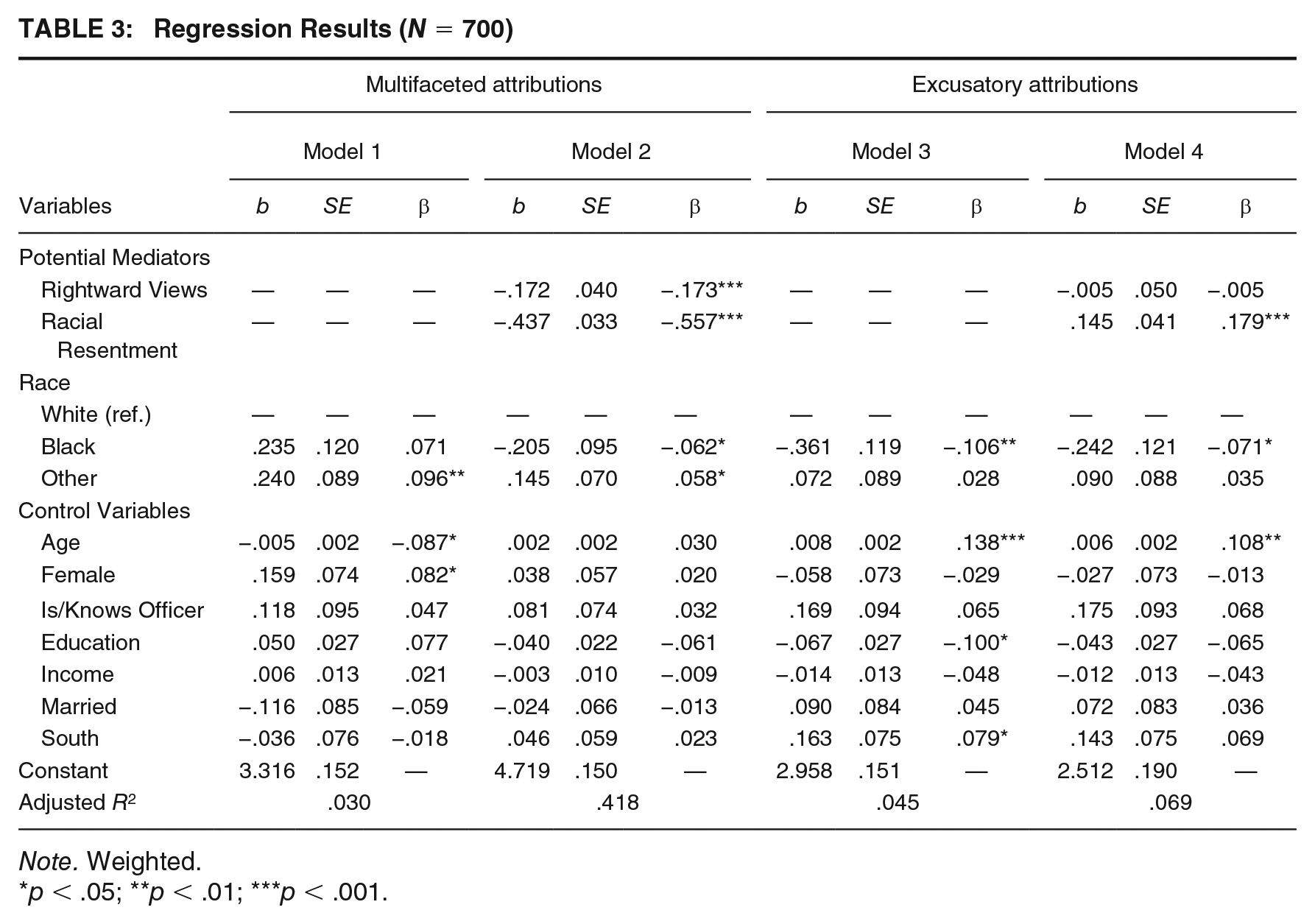
Note. Weighted.
p < .05; **p < .01; ***p < .001.
Attention now turns to the regression results for excusatory attributions, which are shown in Table 3, Models 3 and 4. The first model reveals a racial gap; Black respondents are less likely than White respondents to endorse an excusatory attribution style. The next model incorporates the rightward political views and racial resentment variables. It shows that racial resentment is a strong predictor of endorsement of excusatory attributions. Furthermore, the inclusion of political and racial attitudes reduces the racial divide in attributional endorsement; Black respondents remain less likely than their White counterparts to endorse excusatory attributions.
Structural Equation Modeling
Consistent with existing theory, the analysis thus far suggests that racial resentment may help account for racial and political divides in attributions for police misconduct. To test this formally, we used structural equation modeling to estimate a serial mediation model (see Supplemental Table S3 [available in the online version of this article]). Specifically, we estimated two models using the weighted sample—one for multifaceted attributions and one for excusatory attributions. As seen in Figure 3, after controlling for other sociodemographic variables, the total association between being Black and endorsement of multifaceted attributions is partially mediated by rightward political views and racial resentment. There is a significant indirect association through rightward political views (b = .081, 95% confidence interval [CI] = .036, .150), through racial resentment (b = .105, 95% CI = .015, .203), and through a linked path of rightward political views and racial resentment (i.e., Black → rightward views → racial resentment, b = .161, 95% CI = .086, .260).
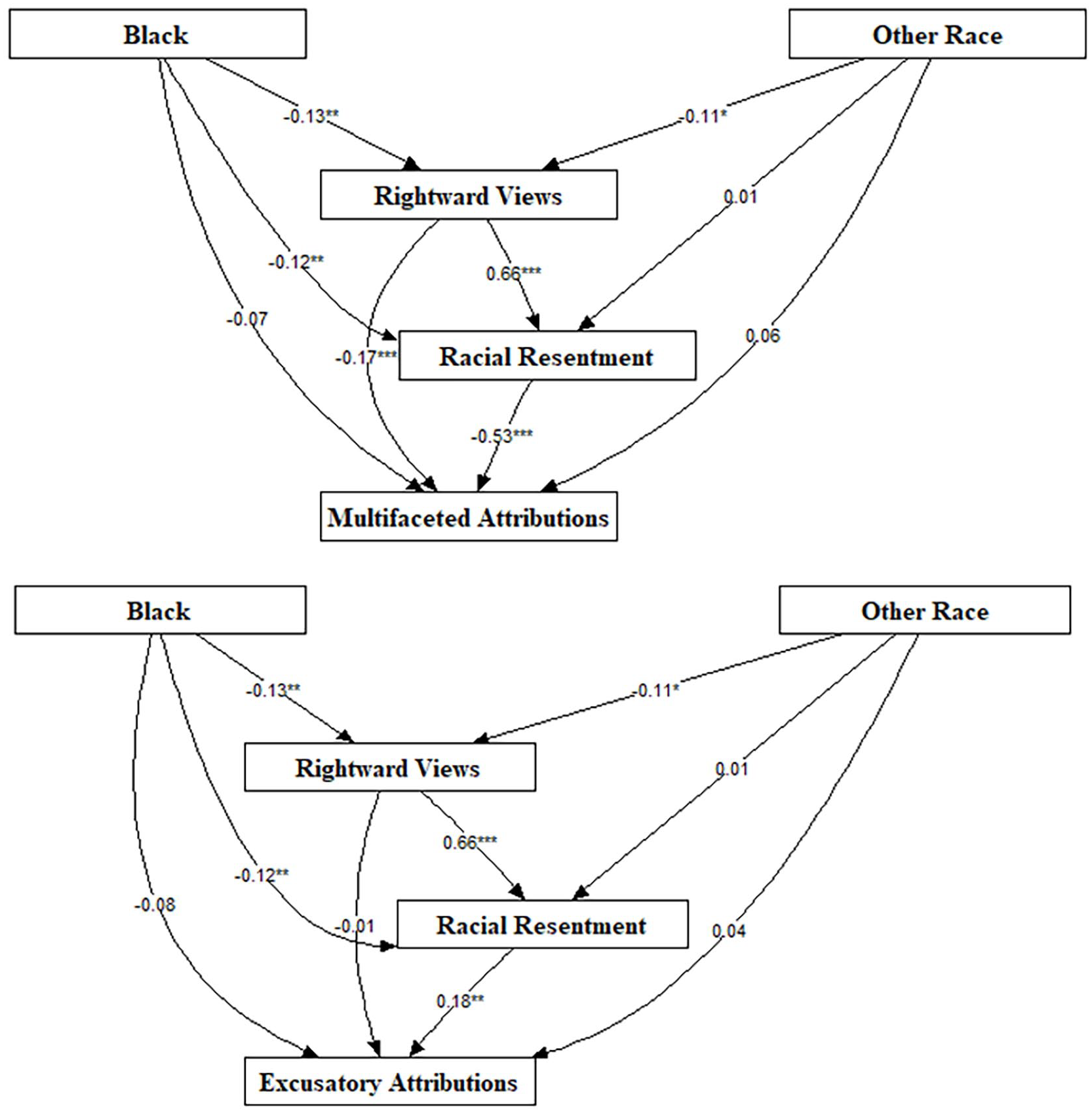
Models With Key Variables Shown (Standardized Coefficients Shown)
A similar set of findings emerges for other/race ethnicity respondents. There are significant indirect associations through rightward political views (b = .046, 95% CI = .013, .097) and through a linked path involving racial resentment (i.e., other race/ethnicity → rightward views → racial resentment, b = .092, 95% CI = .027, .178). In other words, the racial divides in multifaceted attributions seen in Figure 3 are due, in large part, to racial divides in political and racial attitudes, with Black and other race/ethnicity respondents endorsing a complex view of police misconduct because they are less inclined to hold rightward views or to harbor racial resentment.
As seen in the bottom panel of Figure 3, after controlling for other sociodemographic variables, the total association between being Black and endorsement of excusatory attributions is completely mediated through racial resentment (b = −.055, 95% CI = −.122, −.012), and the linked path of rightward political views and racial resentment (i.e., Black → rightward views → racial resentment, b = −.085, 95% CI = −.158, −.038). The same is true for the comparison of other races/ethnicities to White respondents. Here, there is only an indirect association through rightward political views and racial resentment (i.e., other race/ethnicity → rightward views → racial resentment, b = −.049, 95% CI = −.107, −.012). 5 In other words, the racial divides in excusatory attributions seen in Figure 3 are due, in part, to racial divides in political and racial attitudes, with White respondents endorsing excusatory attributions of police misconduct because they are more likely to endorse rightward views and to harbor racial resentment.
Discussion
Viral videos of police misconduct (e.g., brutality, harassment, and profiling) permeate the airwaves, making this problem salient in the minds of the public. In response to this misconduct, pundits, reformers, and politicians provide attributional accounts that outline the causal antecedents of misconduct and justify (or undercut) specific reforms. These purported causes of police misconduct span from racist officers and low accountability to a “War on Cops” and low pay, providing attributional frames for people to use to judge the proposed policy solutions (e.g., Armacost, 2003; Berg, 2020; Black Lives Matter, n.d.-b; Haider-Markel & Joslyn, 2017; Kane & White, 2009). Furthermore, these attributional frames provide a powerful narrative for collective action or inaction (Benford & Snow, 2000; Thompson & Bobo, 2011). Therefore, how these attributional frames and narratives resonate with the public has implications for reforms aimed at addressing police misconduct. As such, our study sought to unpack the prevalence and cleavages of endorsement of several common attributions for police misconduct using a population-matched national sample. Specifically, we sought to explore who held these attributions and why. On the latter front, we investigated how racial and political attitudes related to attributional endorsement.
Attributions of Police Misconduct
On the whole, most respondents understand that police misconduct is derived from a complex set of circumstances, including personality traits, organizational characteristics, and structural/societal features. Accordingly, research also points to several actual causes of police misconduct, including officer education, officer low self-control, officer criminal background, civilian complaints against an officer, structural disadvantage in a community, population mobility, and organizational culture (Armacost, 2003, Donner et al., 2016; Kane, 2002; Kane & White, 2009). Still, respondents placed the largest causes of misconduct at the feet of the law enforcement agencies, with nearly 6 in 10 respondents endorsing weak punishments for misbehaving officers, and just over half (53%) of respondents endorsing poor training of officers. These findings highlight the public’s awareness of the historically opaque nature of punishment in policing, limited accountability for officer misconduct (Brown & Conti-Cook, 2021; Stephens, 2011), and insufficient training of the police. Implicitly, these findings suggest that the public presumes that officers would be deterred from misconduct if misbehavior was more easily detected and/or if punishments were more severe.
Respondents also placed some responsibility for police misconduct at the feet of the officers themselves, with just over half of respondents endorsing racism and an obsession with power and control among officers as large or very large causes of police misconduct. Notably, we observed a stark racial divide, with, for example, 44.3% of White respondents compared with 68.8% of Black respondents believing racism of officers was a large or very large contributor to police misconduct. These attributions are likely reflective of the historical roots of policing that persist today. For example, gang members and extremists, such as White nationalists and KKK members, have become law enforcement officers in departments across the country (Barnes, 1996; Johnson, 2019). Furthermore, the practices of some agencies have been found to be discriminatory, disproportionately impacting communities of color (e.g., NYPD stop, question, frisk), which likely contributes to this attributional frame (Associated Press, 2022; Gelman et al., 2007; Petersen et al., 2023). Policing is one of the few occupations that provides employees the opportunity to exert direct/physical control over community members (Bittner, 1970). As such, efforts to address public beliefs about racism and aggression in policing will have to, in part, center on providing evidence to the community that officers are not racist or obsessed with power and control. Current policy recommendations include the use of procedural justice in police-community interactions and police racial and gender diversification (Ba et al., 2022; Pickett et al., 2024; President’s Task Force on 21st Century Policing, 2015).
Notably, the least endorsed attributions were low educational attainment and low salaries for officers, with just over three in ten respondents and one in four respondents, respectively, endorsing these as playing a large or very large role in causing police misconduct. These attributional frames may be less salient because of the perceived distal causal relationship between educational attainment/salary and behavior. Yet, prior research has tied education (Carter & Sapp, 1989; Kane & White, 2009; Lersch & Kunzman, 2001) to police misconduct. Thus, the public may be unaware of the empirical associations of police misconduct or may be engaged in a fundamental attribution error (Heider, 1958; Ross, 1977). Perhaps providing members of the public with information about the empirical evidence on the relationship between officer education and behavior would change their beliefs on this issue and affect preferences for policing policy (e.g., hiring/promotion requirements).
Despite the theoretical proposition from attribution theory that attributions for police misconduct would be assigned to internal or external causes, we found a more complex pattern of attributional endorsement. Policing attributions could best be described as being divided into two distinct types: (a) multifaceted attributions—the belief that misconduct had multiple causes; and (b) excusatory attributions—the belief that misconduct was caused by factors external to police officers and agencies. As such, a substantial segment of the population takes a balanced and complex perspective when understanding the causes of police misconduct; however, another segment of the public appears resistant to placing blame on officers for their behavior, choosing instead to staunchly defend the police. This pattern of results is consistent with Weitzer and Tuch’s (2006) extension of the group position thesis, which posits that some groups (e.g., White racists) recognize the role of policing in protecting the racial status quo and thus are unwilling to criticize officers. More broadly, this indicates that, provided an affinity to an institution or group that serves one’s interests, we might anticipate the public to engage in motivated reasoning about the causes of social problems, similar to what we observe with police misconduct.
Sources of Attributional Beliefs
Turning back to our hypotheses, we anticipated, based on the group position and collective action theories, that some attributions of police misconduct would be more salient for certain individuals and less so for others. Although police misconduct is a relatively rare event (Son & Rome, 2004; Tapp & Davis, 2022) and severe cases of misconduct are even more rare (Kane & White, 2009; Son & Rome, 2004), because Americans’ personal and vicarious experiences with police misconduct vary along racial/ethnic lines, as do these groups’ cultural beliefs, certain attributions resonate more than others (Pickett et al., 2022; Tapp & Davis, 2022). In the same way, we hypothesized political differences in attributional frames (Cooley & Brown-Iannuzzi, 2019; Patil, 2018) as well as attributional framing that varied by levels of racial animus (Cullen et al., 2021).
We find some evidence of these divides in endorsing attributions of police misconduct. Although White respondents were more inclined than Black respondents to endorse multifaceted and excusatory attributions at the bivariate level, the importance of racial attitudes in multivariate analyses towers over the impact of respondent race, with those holding more racial resentment being less inclined to endorse multifaceted attributions and more inclined to endorse excusatory attributions than their less resentful counterparts. Similarly, those with greater rightward political views were less inclined to identify multifaceted attributions than their leftward politically oriented counterparts.
Mediation analyses provide further insight into how these constructs relate, finding that race plays an indirect role in endorsing attributions of police misconduct. Rather, White respondents were more likely to hold rightward political views and greater racial resentment, which leads to their rejection of multifaceted attributions and more fervent endorsement of excusatory attributions. Therefore, as set forth by collective action theory, the narrative fidelity and experiential commensurability of Americans are divided by political viewpoints, and racial resentment provides a narrative mechanism to endorse these attributional frames.
As such, collective mobilization and policy efforts to address police misconduct face not only a political power struggle but also a racially attitudinal one. On one hand, a strong contingent of the population believes that police misconduct has many sources, which means any one policy aimed at addressing this misconduct may not satisfy all community members, and furthermore, may not address the known complex causes of police misconduct. For the same reason, progress in implementing any policy to address these multifaceted causes may be slow/incremental due to the complex causes of misconduct. Furthermore, success of any of these policies is likely contingent on the political party in power. For example, if a Rightward political leader is in power, addressing the multifaceted causes of police misconduct may be unpopular to their voting base, and therefore leadership may not put forward corresponding policy recommendations.
On the other hand, policy efforts or political leaders, who seek to offload the blame to external sources, such as low salaries and public hostility/disrespect, may garner more support from individuals who hold greater racial resentment. As described by Weitzer and Tuch (2005), these individuals may perceive multifaceted reform efforts as a threat to their group’s interest, instead choosing to dismiss such allegations to protect the status quo. As a result, police reformers may run into a full headwind when attempting to address the complex sources of police misconduct. Policies aimed at addressing racism, poor training, punishment, or peer pressure may be stymied by those holding higher levels of racial resentment who wish to excuse the misconduct, citing low salaries and public hostility faced by officers.
Limitations
As with any study, several limitations should be considered. Given the dearth of research in this area, we encourage other researchers to continue to explore this possible framework for attributions of police misconduct. For example, the question stem used in this study broadly asks respondents about their beliefs about the causes of misconduct instead of asking about specific types of misconduct. Therefore, future research may explore whether specific attributions are endorsed more fervently for specific acts of misconduct (e.g., racial profiling, excessive force). Furthermore, it is possible that media consumption may also contribute to these attributions, which should be explored by future research. Additional research may be able to understand whether attributions of police misconduct conform to Blumer’s (1958) theory when specific forms of misconduct are used. Likewise, future research should include additional improvements for measuring excusatory attributions beyond our two-item measure to produce a robust understanding of this construct. Finally, future research may wish to explore this relationship beyond the United States to understand the generalizability of these attributions in other contexts.
Conclusion
Ultimately, what the public thinks causes police misconduct is nearly as important as what does cause police misconduct because these perceived causes (i.e., attributions) provide for collective mobilization to address this societal problem. As such, policymakers, movement organizers, and future research should be attuned to the role of not only race/ethnicity but also racial attitudes and political views when attempting to build support for reforming policing to address police misconduct. As with most things, the solution to addressing police misconduct will not be simple.
Supplemental Material
sj-docx-1-cjb-10.1177_00938548241253737 – Supplemental material for How Does the Public Explain Police Misconduct? Race, Politics, and Attributions
Supplemental material, sj-docx-1-cjb-10.1177_00938548241253737 for How Does the Public Explain Police Misconduct? Race, Politics, and Attributions by Amanda Graham, Justin T. Pickett and Francis T. Cullen in Criminal Justice and Behavior
Footnotes
Authors’ note:
This study was funded by Georgia Southern University through an internal stipend of the first author.

Supplemental Material
Notes
References
Supplementary Material
Please find the following supplemental material available below.
For Open Access articles published under a Creative Commons License, all supplemental material carries the same license as the article it is associated with.
For non-Open Access articles published, all supplemental material carries a non-exclusive license, and permission requests for re-use of supplemental material or any part of supplemental material shall be sent directly to the copyright owner as specified in the copyright notice associated with the article.
