



Abstract
Extant research on juvenile legal system (JLS) involved girls generally focuses on individual and proximal environmental levels that bring girls into contact with the JLS. There is less research on how the JLS responds to girls in case dispositions (e.g., sanction-based responses, treatment-focused services), and how combinations of dispositions relate to girls’ further system involvement. In this study, we apply latent class analysis (LCA) to the juvenile legal context to categorize system responses in a sample of 1,133 adjudicated girls. We identify four distinct classes, comprising different types and combinations of dispositions. We then further analyzed the classes using individual characteristics and risk factors of girls to understand precursors to the system’s response and further JLS involvement. Our findings offer insight into how packages of court dispositions are correlated with increased recidivism. We consider implications for JLS intervention with girls and provide suggestions for further research.
Juvenile legal system (JLS)-involved girls are typically a high-need and low-risk group of youth. Girls account for approximately 28% of all delinquency cases and 44% of status offense cases (Puzzanchera et al., 2022). Since the late 90s, the system has pursued efforts for gender-responsive reforms that address girls’ pathways into the system, their heterogeneity of treatment needs, and risk for recidivism (Bright et al., 2014; Walker et al., 2016; Watson & Edelman, 2012). While system-involved girls may have dispositions comprising a multitude of interventions including approaches that confine them close to or in their homes and community-based services (Ryan et al., 2014). Locally, these responses vary widely due to resource availability, access to evidence-based practices, and system actor decision-making (Sullivan, 2019). Court dispositions also vary widely across jurisdictions; however, the stated goal of reducing recidivism does not. As such, examining how dispositions, which typically occur in combination, impact girls’ recidivism is important.
Latent class analysis (LCA) is well-suited to identify subgroup patterns in data and then consider correlates and outcomes. LCA has been used by researchers to classify system-involved youth based on underlying characteristics and needs (Childs et al., 2014; Schwalbe et al., 2008; Walker et al., 2015). Extant scholarship using LCA suggests that girls charged with delinquency present with a wide range of treatment needs ranging from low adversity with substance use to mental health needs with strong social assets (Walker et al., 2015). However, the JLS literature using LCA has focused on girls, particularly how their risk factors serve as pathways, and not the systems’ response to those needs. It is important to examine court responses to girls given contemporary reform efforts to center the social welfare mandate of the JLS—including building evidence-based practices and expanding gender-responsive approaches. The current study addresses this gap by employing LCA to describe dispositional patterns, consider their composition and correlates, and investigate their association with recidivism.
Girls in the JLS and Heterogenous Court Responses
Despite recent historic reductions in juvenile crime rates, the proportion of system-involved girls on juvenile court caseloads has remained steady at ~30% since the early 2000s (Ehrmann et al., 2019). Girls typically are referred for status or low-level offenses, but still lead to typical court dispositions, detention, and residential placement (Puzzanchera et al., 2022; Reed et al., 2021). Feminist criminological scholarship has stressed the importance of investigating court responses to girls given that the system’s typical dispositions and intervention approaches are built around the needs and experiences of boys (Chesney-Lind et al., 2008).
Juvenile courts have an array of responses to respond to the various needs of court-involved youth (McKenna & Anderson, 2021; Sullivan, 2019). These include, but are not limited to complete dismissal, restitution, fines, community-based responses, such as probation, restorative justice diversion, community services, referral to outside agencies, or evidence-based treatment programs, such as multisystemic therapy (MST), family functional therapy (FFT), referral to a specialty court (e.g., mental health, substance use), and confinement-based responses, such as out-of-home placements in group-home like facilities with varying levels of security, training schools, and incarceration in secure facilities (Leve et al., 2015; Ryan et al., 2014). Community-based responses, such as probation, are more prevalent than deeper system-involvement responses, such as out-of-home placement (Puzzanchera et al., 2022).
Community-based responses include substance abuse treatment, cognitive behavioral therapy, sex offender therapy, anger management or aggression replacement therapy, general skills training, mentoring, family therapy, mediation, and gang interventions (Sullivan, 2019). Probation, one of the courts’ most prevalent community-based responses, can vary its conditions from little monitoring to house arrest, electronic tracking, curfews, other forms of surveillance, and can also include intensive treatment services (Leve et al., 2015). A recent meta-analysis focused on wraparound services for youth who remained in community and received a variety of unique responses, such as group-based cognitive behavioral therapy, mentorship, and multidimensional family therapy (MDFT), MST found that the impact of these interventions had “a nonsignificant effect for juvenile justice-related outcomes” (Olson et al., 2021, p. 1359).
Research using gender-specific analysis suggests that some forms of community-based programming (e.g., family-based intervention, in-home detention) may produce harmful effects for girls (Morash et al., 2014). Furthermore, service-oriented programming implementing gender-responsive approaches—in contrast to punishment-based sanctions—generates higher rates of treatment engagement and lower recidivism rates among girls (Granski et al., 2020).
Capturing Heterogeneity of Court Responses Using LCA
Although the literature cited above presents court responses as singular, in practice youth and their families are often subject to multiple interventions within and outside of community-based settings. For example, youth on probation may be required to participate in substance use therapy and receive mentoring or skills training. This mixing and matching of sanctions and services is common for system-involved youth, making it important to capture the heterogeneity of court responses and effectiveness—especially for subpopulations of youth (e.g., girls) who have been historically excluded from JLS research. One particularly critical area to explore is heterogeneity in court dispositions as prior research typically conceptualizes these responses as singular, discrete “sanctions” or “treatments” or as summary, aggregate dispositions (McKenna & Anderson, 2021). However, in practice, these dispositions are much more complex in configuration and the degree to which they effectively match youths’ needs affects subsequent contact with the JLS (Vieira et al., 2009).
Studies of court responses to girls have identified the importance of the quantity of dispositions—such that girls who received three (or more) dispositions were more likely to recidivate within 2 years compared with girls who received no dispositions while controlling for known correlates of recidivism (McKenna & Anderson, 2021). As such, even when controlling for other factors, including risk score and prior involvement, the quantity of dispositions matters. Engagement with the court via dispositions begets more court involvement, and fewer court orders lead to better outcomes (i.e., lower recidivism rates). However, there may be dispositions that support girls’ success, and understanding the qualitative distinctions in dispositions can more fully illuminate the response of the JLS and its impact on girls.
Given the mixing of sanctions and services in juvenile courts, we advance the extant literature and examine the constellation of system responses to girls based on dispositions and program referrals using LCA. In so doing, we provide insight into patterns of system responses, how they associate with measures of later court involvement, and the extent to which any of these classes are associated with the stated JLS goal of reducing recidivism.
Current Study
Our study aims to characterize the system response, rather than solely examine individual or proximal characteristics (e.g., risk factors, sociodemographic variables) and its relationship to recidivism for court-involved girls. We use LCA to examine the patterns and constellations of court responses including the extent to which those court responses are “packaged” together—both in quantity and quality, consider the correlates of these dispositional packages, and investigate the association of these responses to recidivism. Prior research demonstrating LCA as a useful method to assess the heterogeneity of probation responses has only used adult records (Kimchi, 2019; Yan, 2017). The current study extends the use of this method by examining juvenile court records—whereby we often see more types of services or sanctions in contrast to the adult court given that youth are perceived to be more amenable to treatment, and the JLS is expected to work to rehabilitate young people (Sullivan, 2019).
The contribution of the current study is twofold. First, we add to the literature by explicitly analyzing dispositions using LCA to uncover the patterns of court responses—their composition and correlates—with a large dataset of adjudicated girls. Second, we examine the characteristics and recidivism outcomes of girls within and across those classes. This dataset offers potential variability for identifying latent classes and statistical power to assess relationships with covariates and recidivism.
Method
We used approximately 10 years of agency records from a Midwestern court to examine juvenile court dispositions and recidivism outcomes for girls between 11 and 17 years of age (N = 1,133). Records were pulled and merged across three databases within the court data management system including (a) initial risk assessment scores, petitioned offense type, and demographic information (e.g., age, race/ethnicity) for all court-involved girls between 2004 and 2015, (b) recidivism follow-up for a 1-year period after the date of their initial risk assessment, and (c) records of all dispositions received while court-involved during the same period of time (2004-2015). These records were linked across sources using a unique identification number assigned to each girl by the court. Cases were cross-checked for accuracy using date of birth.
Participant Characteristics
The secondary dataset included 1,133 girls between the ages of 11 and 18 years with the majority ages 14 (25.1%) or 15 years (31.1%). The racial/ethnic composition of the sample was White (34.8%), Black/African American (33.4%), and Hispanic/Latino/a/x (10.9%). More than half (56.5%) of the girls were processed through a truancy unit, with the remainder (43.5%) processed through a delinquency unit. Girls were truancy court eligible if being chronically absent from school without permission was their only petition at the time of their entrance to court and they had no prior court involvement. If girls had any other prior petitions or additional petitions beyond truancy (even if this was their first encounter with the JLS), they were automatically referred through the delinquency unit. The initial offense for which girls were petitioned primarily consisted of status offenses (57.5%), with the majority of those coming from the truancy division. Person-related offenses (21.9%), such as domestic assault, and property-related offenses (14.5%), such as retail fraud, were the next most common charges against girls in this sample.
Measures
Demographics and Risk Assessment Data
The risk assessment data file included all demographic variables, initial offense type, and risk assessment scores. Demographic data included age at initial contact (ranging from 11 to 17 years old), the race/ethnicity of girls (White, Black/African American, Hispanic/Latina, Multi-racial, and other), and binary sex (male or female). The court did not collect detailed information about gender nonconforming youth; as such, we are not aware if any of the youth self-identified outside of the gender binary. Data also included the referral unit and initial petitioned offense. Initial offenses were labeled using the following categories: person, property, weapon, drug, status, sex, public ordinance, or other.
Risk assessments were completed on all girls (truancy and delinquency), post-adjudication, but prior to disposition, based on their initial offense as they were intended to inform decision-making and case planning. The Youth Level of Service/Court Management Inventory (YLS/CMI) was administered to all girls referred to the court. The YLS/CMI is a widely used risk assessment tool comprising 42 items divided into eight subscales (Schmidt et al., 2005). The eight subscales measured with the YLS/CMI include prior offenses, family and parenting, education, peer relationships, substance use, leisure and recreation, personality and behavior, and attitudes and orientation. Scores are calculated using an additive scale, across all domains, and assigned risk levels based on total score (0-8 = low risk, 9-22 = moderate risk, 22-34 = high risk, and >35 = very high risk). Approximately 20.8% of girls were classified as low risk (n = 236), 67.0% were classified as moderate risk (n = 759), and 12.2% of girls were classified as high risk (n = 138). These risk levels are primarily used to determine the likelihood of recidivism and provide the court system insight into youth needs.
Disposition Records
The disposition records included any sanctions or program referrals during their court involvement following their initial offense and risk assessment. Court administrative data included the disposition type and date with 99.8% of case dispositions censored at age 18 years (i.e., were not measured beyond that point). Since girls could be referred to multiple dispositions at once (either concurrently or sequentially), the dispositional records were coded as a dichotomous variable to reflect the presence or absence of receiving the treatment or sanction while court involved. Girls were ordered to anywhere from 0 to 7 dispositions. Each disposition was coded as “0” if the girl did not receive the disposition or as “1” if the girl did receive the disposition. Most girls did not receive any disposition (approximately 60%) while the remaining girls received one or more of the court-ordered dispositions. These dispositions included a range of sanctions, placements, and treatment-oriented services.
Dates were used to align dispositions relative to initial assessment and recidivism (e.g., dispositions must occur after the initial risk assessment date and must allow for at least 1 year of follow-up for new petitions). Risk score and petitioned offense were based on data gathered at the point of initial court involvement. The disposition measures were connected to this initial point of contact. The dataset was structured based on the date of initial risk measure, dispositions for the case attached to that risk measure, and recidivism following either the initial risk measure (if no dispositions were recorded) or in the period following the initial disposition date(s).
Recidivism
Recidivism records were merged with the demographic, disposition, and risk assessment data files. Recidivism was defined as any new petition to court and coded as a dichotomous variable. To account for time under court supervision, recidivism was measured following the court-recorded completion date of their final disposition. For girls who did not have any formal dispositions, recidivism was counted following their initial risk assessment date. The measure of recidivism included both juvenile and adult court record checks within the follow-up period.
Data Analysis
We conducted LCA to identify patterns of juvenile court responses to adjudicated girls. LCA, also known as finite mixture modeling, is an approach to probabilistically cluster cases through statistical modeling—with an aim to identify underlying relationships in the data (Muthén & Muthén, 2017). LCA is particularly useful when studying heterogeneity in data. This is important for categorical variables, as the analysis can distinguish between cases that are similar within a single category of variables, but distinct across categories of variables (Muthén & Muthén, 2017). The overall purpose of LCA is to identify the most parsimonious latent class model that adequately describes the data with the goal of examining differential system responses to court-involved girls. This approach is especially useful given the need to synthesize multiple, qualitatively distinct court orders common in the JLS.
The analysis begins with the smallest number of classes possible, adding them stepwise until adequate model fit is attained (Muthén & Muthén, 2017). To identify good model fit and select the optimal number of classes, absolute fit statistics, relative fit statistics, and model entropy were assessed. The final number of classes was selected based on these criteria and reviewed considering posterior probabilities and substantive information from the current literature. On selection of the best-fitting latent class model, regressions were estimated to pursue the study’s third research question regarding the probability of recidivism within 1 year across classes. We used an integrated, model-based approach with multinomial latent class regression where we estimated the classes with the distal outcome variable and covariates (Lanza et al., 2013). This does not require treating the latent classes as observed in regression modeling, which is more appropriate given their estimated nature (see, e.g., Clark & Muthén, 2009). Class membership served as the focal independent variable and dichotomous recidivism outcomes served as the dependent variable.
Analyses were conducted using Mplus (Version 8.2, Muthén & Muthén, 2017). Missing data were accounted for using the full information maximum likelihood estimation algorithms integrated into Mplus software. Multiple random sets of starting values (0 0 300 20) were used to assure satisfactory replication of the best maximum log likelihood value. LCA class enumeration began by fitting latent class models with nine binary court disposition variables. Classes were fit, increasing K by a value of one until the model ceased to be well identified (Masyn, 2013).
Results
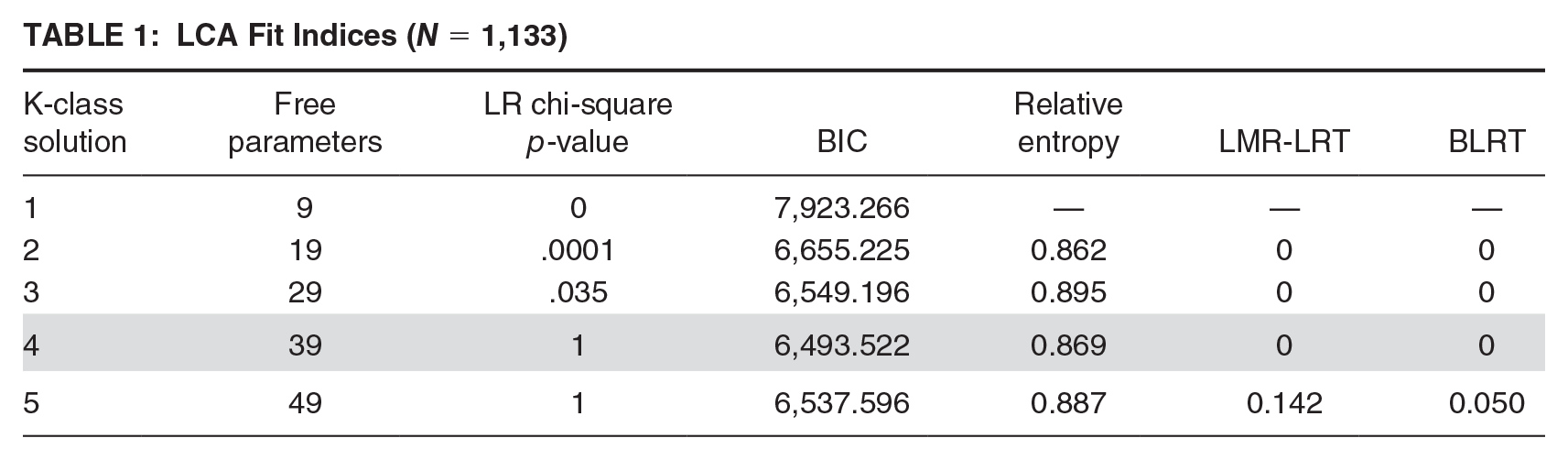
LCA was conducted to answer the study’s first two research questions—first, what types of dispositions does the court use with adjudicated girls and, second, are there distinct patterns, or latent classes, in court responses to girls (and, if so, what are the characteristics of class membership)? Ultimately, five latent class models with K = 2 to K = 5 classes were estimated. All models were assessed based on fit statistics and the substantive information from the relevant literature. Absolute fit was examined using the likelihood ratio chi-square goodness-of-fit test; only the 4- and 5-class solutions met this criterion with p = 1.0. Relative fit was assessed using Bayesian Information Criterion (BIC; Nylund et al., 2007). BIC continued to decrease with each additional class added to the model, until the 5-class solution, suggesting the 4-class solution as the best-fitting model. Relative entropy was examined, reaching its highest points at the 3- and 5-class solutions, suggesting these models had the most clearly delineated classes. Finally, both the Lo-Mendell-Rubin Adjusted LR test (LMR-LRT) and parametric bootstrapped LR test (BLRT) were assessed. Both tests produced significant p-values for solutions with 2-, 3-, and 4-classes, suggesting that the 4-class solution as the best-fitting model to capture disposition patterns (Table 1).
LCA Fit Indices (N = 1,133)

Model Interpretation
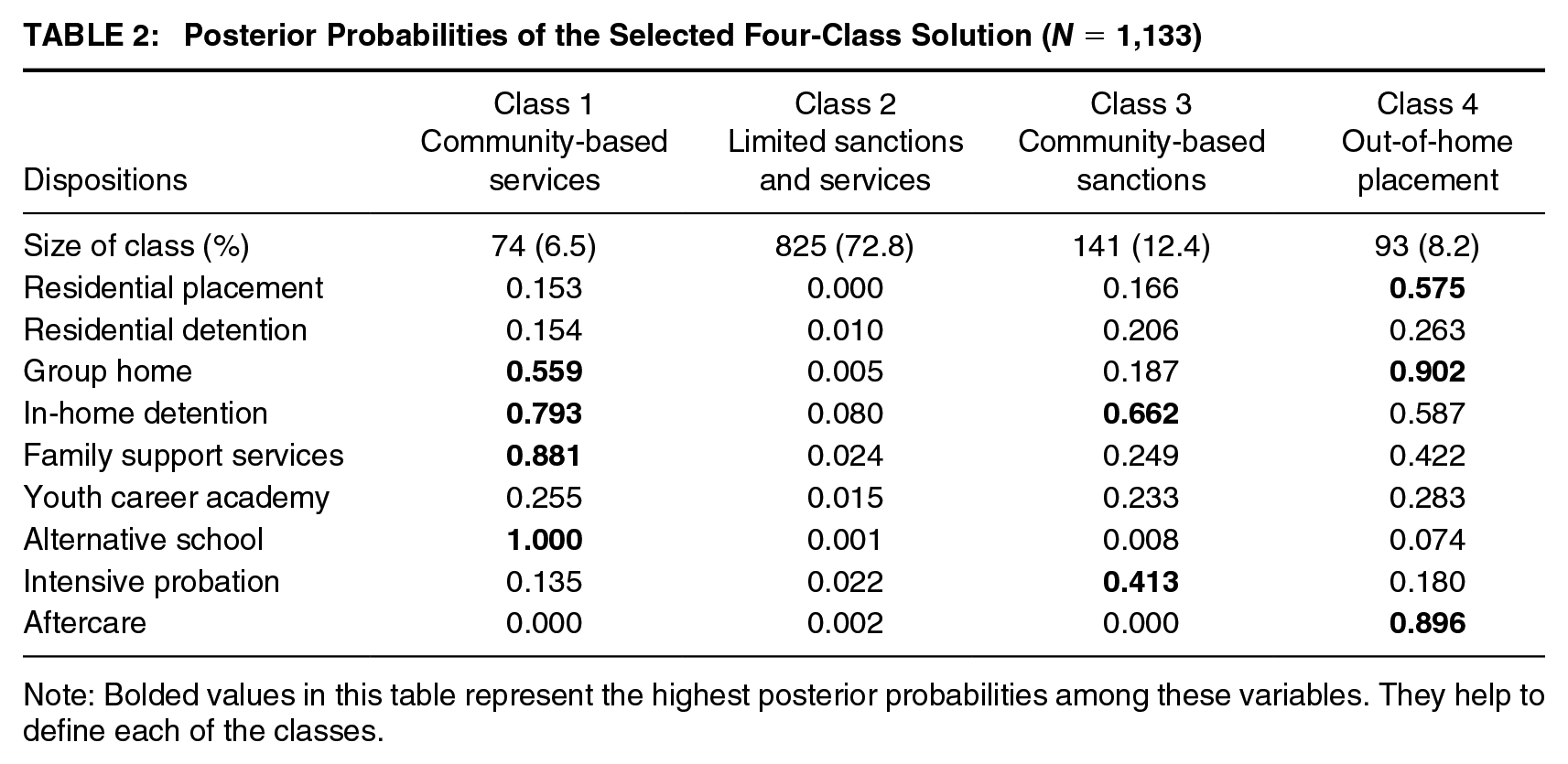
The 4-class solution identifies four differentiated patterns of case dispositions: (a) community-based services, (b) limited sanctions and services, (c) community-based sanctions, and (d) out-of-home placement. Table 2 reports posterior probabilities for the selected solution, with the most likely response option for each class in bold.
Posterior Probabilities of the Selected Four-Class Solution (N = 1,133)
Note: Bolded values in this table represent the highest posterior probabilities among these variables. They help to define each of the classes.
Characteristics of Girls Within Classes
Class 1: Community-Based Services
This class of dispositions is the least prevalent, representing 6.53% of girls. As shown in bold type in Table 2, the set of dispositions most likely to comprise this class are alternative school, family support services, in-home detention, and group-home placement. Table 3 summarizes the composition of the latent classes. Demographically, this class is characterized by the largest proportion of Black (36.5%) and multi-racial girls (27%), and the largest proportion of girls is classified as moderate risk (73%). The proportion of girls who are classified as high risk in this class (21.6%) is comparable to Classes 3 and 4. This estimated class is like Class 2 in its proportion of girls who come into court contact through the truancy unit (58.1%). As in other classes, status offenses were the most common charge (58.1%) levied against this group, followed by person charges (28.4%). 1
Composition and Outcomes of Court-Involved Girls’ Latent Classes

Class 2: Limited Sanctions and Services
As shown in Table 2, this class of dispositions represents 72.82% (i.e., the most prevalent) of the court’s responses to girls. As indicated in Table 2, girls in this class are unlikely to receive any of the court dispositions. As shown in Table 3, Black and White girls are the most equally represented in this group at 33.9% and 34.5%, respectively, and this class entails the largest proportion of girls classified as low risk by the YLS (26.8%). This group also comprises the lowest proportion of girls who are classified as high risk (6.8%), and the proportion of girls who are classified as moderate risk in this class (66.4%) is similar to Classes 3 and 4. This class comprises the largest proportion of girls who come into court contact through the truancy unit (61%). Status offenses were the most common charge (62.7%), followed by person charges (19%) in this latent class. Notably, this class emerged as the one where the likelihood of person charges was the lowest across all the classes.
Class 3: Community-Based Sanctions
This estimated class represents the second most prevalent set of dispositions (12.44%) for girls’ cases. The dispositions most likely in this class are in-home detention and intensive probation. As summarized in Table 3, this set of dispositions is the second most prevalent response to White girls (37.6%). It is proportionally comparable to Class 4 around girls being classified as moderate (66.7%) and high risk (28.4%). This class comprises the largest proportion of girls who come into court contact through the delinquency unit (64.5%). Status offenses represent 39.4% of the charges levied against girls placed statistically into this dispositional class. This class also has the highest proportion of girls charged with person-related offenses (35.5%).
Class 4: Out-of-Home Placement
This class was the second least prevalent of the four (8.21%). The set of dispositions most likely to comprise this class is the most restrictive and includes group-home placement, aftercare, and residential placement. As show in Table 3, this set of dispositions is the most prevalent response to White girls (41.3%), and least prevalent response for Black girls (26.1%). Notably, the average age of girls in this group is the youngest of all the classes (M = 13.91). This group comprises the smallest proportion of girls who are classified as low risk (4.3%) and is the most similar proportionally to Class 3 for girls who are classified as moderate (67.7%) and high risk (28.0%). This class comprises the second largest proportion of girls who come into court contact through the delinquency unit (52.7%), the highest proportion of girls with person-related offenses (25.3%) and property-related offenses (22.0%).
Regression of Latent Classes on Covariates and Recidivism
Multinomial logistic regression models were estimated to answer the research questions about the relationship between estimated latent class membership and recidivism, defined as having received a new petition within a year of disposition. Table 4 presents the results from multinomial logistic regression analysis conducted with the four-class model. 2 This extends the analysis above to consider (a) how relevant covariates might be associated with the relative odds of placement in one latent class versus another and (b) the relationship between probabilistic latent class membership and the odds of new petitions. Three reference classes were chosen for the model parameterization: out-of-home placement, limited services and sanctions, and community-based services. The age covariate is statistically significant in each comparison with an odds ratio (OR) ranging from 1.37 to 1.80 when the reference group out-of-home placement. In each of the latent classes, a 1-year increase in age is associated with a greater likelihood of being in that class relative to the out-of-home placement class. Conversely, the risk score variable was statistically significant only for the Limited Services and Sanctions comparison. That regression estimate suggests that—for each unit increase on the risk assessment—girls had 20% lower odds of being placed in the Limited Services and Sanctions class relative to the Out-of-Home Placement class. The Black/African American indicator is the only other statistically significant covariate. Relative to White girls—African American girls had roughly 2.5 times greater odds of placement in the Community-Based Services class compared with the Out-of-Home placement class.
Logistic Regression of Latent Classes on Covariates and Recidivism Outcomes (N = 1,110)

Note. OR = odds ratio; RR = recidivism rate. Bolded values reflect statistical significance at p < .05 using a Z test for regression coefficients.
The second panel of Table 4 shows two significant relationships between age and class membership. Specifically, when compared to the Limited Services and Sanctions class, for each year that they aged those girls had lesser odds of placement in the Out-of-Home Placement class (OR = 0.56) and those in the Community-Based Sanctions class (OR = 0.76) compared with the Limited Services and Sanctions class. In addition, with each unit increase in the risk score, girls had between 1.22- and 1.26-times greater odds of placement in one of the classes besides the Limited Services and Sanctions class. The only other significant comparison around charges emerged for the status offense charge in the community-based sanctions class versus the limited services and sanctions class. Compared to the limited services and sanctions class, girls placed in the community-based sanctions class were 70% less likely to have a status offense charge.
The third panel of Table 4 presents the results of the latent class regression analysis using the Community-Based Services class as a comparator for the other three. Although there are differences in the overall prevalence of a new petition, the ORs contrasting the three other classes with Community-Based Services are nonsignificant. Overall, there are relatively few significant differences in this portion of the analysis. The OR associated with the risk assessment score, (OR = 0.82), however, suggests that girls have 18% lower odds of being in the “Limited Services and Sanctions” class compared with the “Community Services” class for each unit increase.
Recidivism by Latent Class
The results of introducing the 1-year recidivism measure are presented at the bottom of each of the panels in Table 4. Looking first at the Out-of-Home Placement reference class, only Limited Services and Sanctions was significantly different in terms of the odds of a new petition (OR = 0.36). This suggests that compared to girls in the estimated Out-of-Home Placement class, the limited services and sanctions class is 64% less likely to have a new petition—controlling for age, race/ethnicity, petition referral, and risk assessment scores. All three coefficient estimates were statistically significant when Limited Services and Sanctions was used as the reference class. Specifically, girls probabilistically placed in each of those classes were expected to have increased odds of recidivism relative to those in the Limited Services and Sanctions class. That ranged from 2.14 times greater odds of having a new petition filed for Community-Based Services to 3.11 times greater odds of having a new petition filed for Community-Based Sanctions. Girls in the Out-of-Home Placement class had 2.8 times greater odds of recidivism relative to girls in the Limited Services and Sanctions class.
Discussion
The JLS response to girls varies widely within and across juvenile courts (Ryan et al., 2014) and is an underdeveloped area of inquiry, particularly in contrast to the large body of research about girls’ pathways to the JLS (Belisle & Salisbury, 2021). We address this important gap by examining the patterns of the system response to girls and the relationship between those responses and recidivism in a sample from a midwestern court. In our modeling process, we found that a four-class solution in patterns of juvenile court responses was best based on both statistical fit and substantive meaning. These classes are not mutually exclusive, fixed groups, but rather, estimate a probabilistic pattern of the court’s response directly from the data. The four “packages” of juvenile court responses were (a) limited sanctions and very limited or no programming (most prevalent response), (b) sanction-oriented community-based responses, (c) out-of-home placement, and (d) primarily community-based, treatment-oriented services (least prevalent response).
The distribution of cases across the four latent classes offers insight into the JLS’s response to delinquent and truant girls—revealing a nuanced combination of both punitive and therapeutic responses. First, a large portion of system-involved girls had no formal disposition. Second, in-home detention, which is a punitive system response, is common across the remaining dispositions. Third, the three classes with active dispositions are each characterized by one or two related disposition types (i.e., Class 1—alternative school and family support services, Class 3—intensive probation, Class 4—group home/residential treatment). The bivariate and multivariate analyses extend these findings, suggesting that truancy cases appear across all classes—although those are status offenses. This is consistent with prior research that suggests girls’ contact and subsequent system involvement often occur through low-level offenses (Ehrmann et al., 2019). Finally, risk assessment also plays an important role in driving class membership.
Driving Characteristics and Recidivism Outcomes by Class
We found that this court used nine dispositional responses, some of which can be categorized as more punitive (e.g., in-home detention) or therapeutic (e.g., family support services). The modal disposition across classes is in-home detention—a sanction-oriented response.
Community-Based Services
The disposition drivers in this class include girls with a high probability of receiving family support services, in-home detention, and the court-run alternative school. Notably, this class also partly comprises punitive responses, such as in-home detention and group home placement, occurred with high probability underscoring the consistent undercurrent of punitive approaches. Girls in this class had a considerably greater likelihood of recidivism compared with girls probabilistically placed in the limited services and sanctions class suggesting that punitive responses may be tied to deeper involvement in the system. Although risk score was a strong correlate of assigned dispositions, the findings still highlight some disparities. Specifically, the Black/African American youth indicator revealed that—relative to White youth—African American girls have greater odds of placement in the Community-Based Services class compared to the Out-of-Home Placement class. This response may be indicative of a net-widening and increased surveillance in the community for Black girls. Previous research indicates that risk assessments are a good indicator of needs that are interpreted as criminogenic risk instead of the consequence of structural factors along the interconnected axes of race, gender, and class (Goshe, 2015). Indeed, the fact that family support services show up with such a high posterior probability in the class where Black girls disproportionately fall may reflect a racialized, paternalistic logic about girls of color and their families. Family support services, particularly for low-income families, may place further stress on households with already strained family dynamics, especially given the role of families and relationships in girls’ pathways into the JLS (Anderson et al., 2021; Chesney-Lind et al., 2008).
Limited Sanctions and Services
This latent class is the largest group in terms of prevalence. It comprised a diverse subgroup of girls who were identified as low risk and engaging with the courts because of truancy. Given the low-risk nature of this classes’ typical offenses, it is unsurprising that they consistently had the fewest court-ordered dispositions of the four classes. Girls placed in this class were unlikely to have court dispositions yet had the overall lowest recidivism rates when controlling for the known correlates of recidivism. This should be the case as most girls were referred for status offenses or minor delinquency and so it likely reflects a place where the JLS is functioning as intended.
Community-Based Sanctions
Girls probabilistically placed in this class were most likely to be detained in their homes or be on intensive probation—both of which are characterized by a more punitive system response (i.e., each surveils youth while in the community). Girls probabilistically placed in this class had more than twice the odds of recidivism compared to the limited services and sanctions class. This is likely due in part to heightened surveillance. This finding highlights how probation, while often perceived as a constructive alternative to incarceration, may unintentionally contribute to increased risk of recidivism due to increased surveillance (Sherman & Balck, 2015).
Out-of-Home Placement
The defining characteristics of the out-of-home placement class are the relatively higher posterior probability of residential and group home placement and short-term detention. These dispositions are the most restrictive options the court can impose. Like other more restrictive placement classes, girls who were probabilistically assigned to this class were much more likely to recidivate than those who experienced limited sanctions and services—when controlling for risk assessment scores and other covariates. These findings likely stem from the fact that sanctions and out-of-home placements are less effective at directly addressing girls’ pathways into the system compared to more treatment-oriented approaches (Epstein & Edelman, 2014).
Implications for Understanding JLS Response to Girls
In this study, we sought to move beyond classifying girls solely in terms of pathways into juvenile court and instead consider what happens to them in terms of dispositions. This considers the fact that youth have paths to, within, and from the JLS (Scott & Steinberg, 2008; Sullivan, 2019). As mentioned earlier, we characterize court dispositions using an LCA approach to capture potential packages of sanctions and services, which tend to co-occur in the JLS. In-home detention and surveillance dispositions show up in all four classes. The presence of punitiveness in virtually all of these disposition packages is especially striking given that most girls were referred for truancy or other status and property-related offenses (e.g., retail fraud). Truancy petitions (e.g., chronic unexcused absences) represent the pathway into court involvement for more than 50% of cases in both the Limited Sanctions and Services and the Community-Based Services class. Truancy charges characterize 47.3% of the girls placed in the most restrictive class, Out-of-Home Placement as well. This is potentially problematic given the social welfare mandate which explicitly seeks to rehabilitate youth and balance their needs with that of public safety. The omnipresence of girls with truancy charges—that is, low risk to public safety—across classes highlights the fact that a different approach to truancy would reduce the need for JLS presence in their lives. In turn, this necessitates reevaluation of how and which systems should intervene in the lives of girls who pose little to no risk to public safety. Despite efforts to reduce punitiveness, these data show that too much intervention with status offenses (e.g., truancy) has consequences for youth.
In addition to truancy, the latent classes largely appear to be driven by risk scores and subscales, demonstrating the emphasis court actors place on risk scores when determining court responses. For example, the Limited Services and Sanctions group had the highest proportion of low-risk girls when compared to the other classes but had a similar proportion of girls identified as moderate risk across all classes. Girls in the more punitive classes—the community-based sanctions and out-of-home placement groups—had higher proportions of high-risk girls (~28% for both). This begs the question, how are sanctions or service combinations being selected for moderate-risk girls and with what intended goals? These relationships highlight the importance of modeling the full pathway of the assessment to disposition to outcome pathway if we want to understand JLS processing (Petkus et al., 2022).
This study highlights how constellations of court-ordered sanctions and services are inconsistently delivered, not necessarily based on girls’ offenses or identified risk levels (e.g., moderate-risk youth represented across classes), but perhaps based on individual-level factors or extralegal characteristics such as race. If services were being mandated consistently and intentionally by the courts, we would expect to see constellations of service mandates being driven primarily by risk level, with other demographic variables superseded by risk (e.g., girls who entered via truancy court still showing a large proportion of community-based services, sanctions, and out-of-home placement). Although individual-level risks and needs have been shown to be useful in informing next steps for the JLS, the success of this approach is only as good as the assessment processes implemented with system-involved girls.
Finally, this study examined the probability of recidivism, defined as receiving a new petition, within 1 year. Our findings highlight the need to limit sanctions and services for girls as much as possible. Controlling for other recidivism influences, girls in the limited sanctions and services group were far less likely to have a new petition compared to those with out-of-home placements. Furthermore, when compared against the Limited Services and Sanctions group, girls who received any other class of dispositions were two-to-three times more likely to have a new petition filed against them within a year. In other words, girls who received community-based services or the out-of-home placement cluster of responses were more likely to recidivate than their peers who received the Limited Sanctions and Services response. These findings are in line with prior research that found girls in community-based placements were more likely to recidivate compared with girls who did not receive any placements (McKenna & Anderson, 2021), and other research that suggests a non-interventionist approach is most likely to ensure youth do not cycle in and out of the JLS (Cox, 2017).
Girls were court ordered to different types of dispositions that varied in nature and scope relative to their treatment or sanction focus. In turn, this leads them to different experiences in the JLS and a lesser or greater likelihood of new juvenile court petitions—even when controlling for other important baseline factors (e.g., risk assessment level, offense type, and prior system involvement) and considering different levels of surveillance. Taken together, these findings demonstrate anything beyond limited sanctions or services may be detrimental to girls as they are more likely to recidivate. Non-intervention or limited intervention appears to be effective at reducing recidivism among girls.
Theoretical and Methodological Contributions
The current paper provides methodological and substantive contributions to the literature on court responses to youth. First, this study applied LCA to measure patterns of court responses—something that has not been done in previous research using LCA with youth populations or juvenile court data (previous studies on adult sentencing have used LCA, see, e.g., Kimchi, 2019; Yan, 2017). Most juvenile legal LCA research focuses on risk factors (e.g., Childs et al., 2014; Dembo et al., 2012), risk and protective factors (Bowen et al., 2007), and need profiles (Schwalbe et al., 2008; Walker et al., 2015). The current study goes beyond youth risks (or needs) to focus on patterns of action in the system itself (i.e., courts). More specifically, the current study focuses of how heterogeneity in court responses manifest and the resulting characteristics and outcomes relative to the “packaging” of court orders.
In addition, our study offers some useful findings for theoretical development in the feminist criminological literature by expanding on our understanding of dispositions and treatment of girls in the JLS. Prior research on juvenile court decisions has used mixed-gender or male-only samples, often with a gender-neutral approach. This study moves beyond gender-neutral examinations of interventions and considers how courts respond to girls specifically and with greater depth. Our findings demonstrate that higher risk assessment scores are correlated with more frequent use of court dispositions. Gender-neutral risk assessment tools may inadvertently drive more sanctioning of girls, who typically enter the JLS with low-risk offenses, especially given prior research on how these tools overclassify risk for recidivism among girls and women (Belisle & Salisbury, 2021). Our findings suggest that higher risk scores are associated with the latent classes that include receiving some combination of dispositions. Despite this, the least prevalent class from this study was community-based services with treatment-oriented interventions. These findings offer an important extension to the discussion of failing to provide gender-responsive intervention in the JLS or engage in more focused diversion efforts for girls.
The feminist criminology literature emphasizes centering girls’ experiences. By extension, it is important that sanctions or interventions for girls are aligned with gender-responsive principles instead of the current response in which dispositions are sanction-based or place girls outside of their homes. These current punishment-oriented system practices appear to have limited impact on reducing recidivism for girls. Gender-responsive diversion efforts are important for addressing existing disparities given girls’ consistently lower base rates of delinquency, less serious offenses, and higher levels of traumatic experiences (Puzzanchera et al., 2022).
Limitations
It is well-documented that girls have unique pathways, variation in their risk and need profiles, and may be perceived by the system as needing more court intervention. However, since these data included girls only, the study cannot provide a comparison by gender between girls and boys or non-binary youths. Therefore, findings cannot be generalized to youth of other genders and future research should consider a comparative analysis of court responses based on gender and across various juvenile courts.
The quality of an LCA solution and its interpretation, depends critically on the quality of the measuring instrument(s) used. This matters for three key reasons. First, there are limitations of using court-based archival records given that we only have data from observed and recorded responses by the system. Second, the items included in the LCA are subject to the data collection protocols within this court. As shown in Table 3, there was a mix of precision in how different dispositions were counted, potentially influencing the LCA results. Third, the sizes for latent Class 1 (n = 74) and Class 4 (n = 93) are relatively small, which means that regression estimates involving those classes may have somewhat limited data support. Nevertheless, those contrasts did not appear to behave abnormally in the multivariate models including recidivism.
More generally, data were collected from only one county court system during a fixed period from 2004 to 2015. Given the heterogeneity of how local courts operate, it is difficult to extrapolate findings from one jurisdiction to another. However, research examining how court responses are “packaged” may be difficult to generalize given this characteristic of the system. Recent reforms may also impact the degree to which findings from data last collected several years ago precisely map to current conditions. At the same time, given a recently renewed punitive focus around youth crime (see, e.g., Mendel, 2022), these findings offer a sense of the possible outcomes for different constellations of response to girls when they first encounter the JLS. Despite this, it is important to note the correlational nature of the research design.
Conclusion
The distribution of cases across the latent classes described in this study presents useful insight into how the JLS responds to girls referred for either delinquency or truancy petitions. Given the types of dispositions used in this court system, the latent classes revealed nuanced packaging of both therapeutic and punitive system responses. These findings demonstrate how court responses may be detrimental to girls as intervention and sanction use patterns appear to be related to recidivism among girls. It would be beneficial to consider alternatives to court dispositions for girls to reduce system net-widening—especially since our findings demonstrate that a large portion of girls were petitioned to the JLS but did not receive any formal dispositions. Integrating a gender-responsive approach with current court responses would provide an opportunity to address inequities in treatment and mitigate the harms that girls face when system involved (Belisle & Salisbury, 2021; Office of Juvenile Justice and Delinquency Prevention, 2022). The current study changes the narrative from one that examines constellations of individual risk and needs, as prior research has done, to one focused on how the system responds to girls though court dispositional records. Critically examining those response packages is important since the stated goal of the JLS is to work toward ensuring youth do not come back into contact with the system.
