




Abstract
This qualitative study explores the gendered dimensions of community- and family-level adversity among justice-involved young people in Northern Ireland. Drawing on 30 semi-structured interviews with boys and girls referred to the Northern Ireland Youth Justice Agency, this research examines how gender shapes experiences of community and family deprivation, instability, and adversity, generally considered to be gender-neutral criminogenic needs. Findings reveal that while socioeconomic and family stressors affect both genders, their impacts on girls, as compared with boys, differ. The lens through which their community was viewed differed according to gender. Street violence and crime were more salient in boys’ lives, while family dysfunction appeared to impact girls more acutely. These insights underscore the need for early, gender-responsive youth offending interventions that meaningfully address relational safety and community marginalization.
Keywords
Introduction
Girls represent a minority within the youth justice system; their pathways into offending are often more complex, more traumatic, and less well understood than those of boys (DeHart & Moran, 2015; Menon et al., 2024; Parrish et al., 2021). Girls are equally likely as boys to grow up in socioeconomically deprived communities and with family instability, known risk factors for offending behavior (Walker et al., 2025). However, drawing on 30 semi-structured interviews with both boys and girls in contact with the Youth Justice Agency (YJA) in Northern Ireland, this article demonstrates that there are gendered dimensions to community, economic, and family strains. These insights are vital in supporting a meaningful response to increased numbers of girls in contact with youth justice systems worldwide (Menon et al., 2024).
Historically, criminology has been dominated by male-centric analyses of offending, overlooking the specific, gendered mechanisms by which girls enter the justice system (Belknap, 2007; Sharpe, 2016). While girls commit fewer, and generally less serious, offenses than boys (Youth Justice Board, 2022), we know that the conditions surrounding their justice involvement are disproportionately shaped by adversity (Flores et al., 2020), poly-victimization, and systemic failures across time (Baglivio et al., 2014; Baidawi et al., 2023). Despite observations of a steady decline in the number of young people involved in the formal justice system (Department of Justice [DOJ], 2022; Parker et al., 2017), few of these illustrate gendered trends. When data is disaggregated, the gender gap appears to be narrowing (Schwartz & Rookey, 2008), and justice involvement among women is rising (Menon et al., 2024), precipitating, over recent years, increased government (Local Government Association, 2024), media, and academic interest (Johansson & Kempf-Leonard, 2009) in offending by women and girls, as well as interest around how best to facilitate their exit out of the system at the earliest possible stage (DOJ, 2022).
While those such as Howell (2003) have sought to conceptualize the distinctive pathways for girls into offending, studies that have tested his five risk factors (child abuse, mental health, running away, gang involvement, and justice involvement) have often involved single-sex or single-gender groups (see, for example, Johansson & Kempf-Leonard, 2009). Furthermore, it is not clear if the five risk factors proposed are also common among boys in the youth justice system. Some have suggested that failing to identify the gender-specific experiences of girls (Ryan & Walsh, 2025) and ignoring their gendered exposure to abuse and neglect (DeHart & Moran, 2015; Howell, 2003; Staines et al., 2024) could impede crime prevention. Recent research has shown that some types of adverse childhood experiences (ACEs) are highly gendered (e.g., Walsh et al., 2025), with exposure to sexual abuse, domestic violence, and emotional neglect endemic among justice-involved girls (Flores et al., 2020) and closely linked to behaviors (e.g., substance misuse, running away, or survival-based offenses) that elevate the risks of justice system contact (Marsiglio et al., 2014; Pasko & Chesney-Lind, 2016). Justice-involved girls also tend to have more ACEs than justice-involved boys (Baglivio et al., 2014).
Despite these observations, youth justice systems globally operate largely within gender-neutral frameworks, assuming homogeneity of risk factors and intervention outcomes (Cauffman et al., 2015; Ho & Rocheleau, 2021). Yet many of these risk domains are, in fact, reflections of unmet gendered needs, such as the lack of relational safety, gender-specific exploitation, and persistent marginalization (Schwartz & Steffensmeier, 2017). Girls who offend are sometimes deemed “doubly deviant”: violating not only legal norms but also expectations of femininity (Staines et al., 2024; Terry & Williams, 2021). This can result in their behavior being interpreted more harshly, and their needs being more readily medicalized or moralized. The literature shows that girls are routinely labeled as manipulative or difficult, particularly in justice and institutional settings, and are often considered more challenging to work with than boys (Parrish et al., 2021; Staines et al., 2024). These perceptions feed into systemic practices that overlook the structural violence and cumulative harm many girls have endured. Family dysfunction, care system involvement, and residential instability are especially salient for girls. Social care systems appear to exacerbate justice involvement among girls more than boys, with girls in care being disproportionately criminalized for behaviors that would not warrant police involvement in a family setting (Staines et al., 2024). Ethnicity may further compound vulnerability, with minority girls (similar to boys) being overrepresented in both the care and justice systems and often facing additional barriers to support (Flores et al., 2020; Sutton & Simons, 2021).
There is growing consensus that justice responses must shift from risk-focused to needs-oriented frameworks, recognizing promotive and protective factors specific to girls (Baidawi et al., 2023; Menon & Barthelemy, 2023). This includes supporting girls’ relational and emotional development, ensuring consistent adult support, and addressing the gendered dynamics of power and exploitation that often underpin their offending. Decades of feminist pathways research have enriched our understanding of the lives of women who offend, as we know that gender-informed interventions are more effective for women in terms of recidivism than gender-neutral ones (Gobeil et al., 2016; Summers et al., 2025). We also know that successful gender-responsive interventions are those which avoid relying on gender stereotypes (Best et al., 2021; Kruttschnitt et al., 2019). Despite this, knowledge gaps persist in relation to girls (Rice et al., 2026; Summers et al., 2025). Furthermore, recent research has argued for a gender-responsive approach for justice-involved young people in the Northern Irish context specifically (Ryan & Walsh, 2025).
The present study builds on these foundations by investigating the gendered experiences of boys and girls in the youth justice system in Northern Ireland in relation to family- and community-level stressors. Brennan et al. (2012, p. 1499) argue that “financial problems and poverty” are gender-neutral criminogenic factors. We agree with this insofar as these are factors that do not discriminate by gender; however, we wish to illuminate the gendered results of such factors. This chimes with recent research by Ryan and Walsh (2025), who found that although, irrespective of gender, there is a relationship between well-being and violence for justice-involved young people, the “mechanisms are different” for boys and girls (p. 271). Where researchers have identified certain needs particularly relevant to women at the family and community level, including “family support,” “housing safety,” and “relationship dysfunction,” these tend to be in studies where there is no male comparison group (Wardrop et al., 2019, p. 266), and these studies generally focus on adult women, rather than girls. We interviewed both boys and girls to establish a basis for comparison, thus distinguishing between what is common across all justice-involved youth, and what is distinct to girls (see Bender, 2010). By foregrounding the lived experiences of both groups, this research aims to disentangle gendered vulnerabilities from general need factors to enhance youth justice systems’ capacity to respond to youth offending.
The Current Study
This study collected contemporaneous accounts (semi-structured interviews) from both girls and boys in contact with the Youth Justice Agency (YJA) in Northern Ireland. The YJA works with children aged 10 to 17 years who are involved in or are at serious risk of offending behavior in order to divert them from crime. Participants in this study are referred to as boys and girls throughout this article in reference to their status as children. Although some of our participants were aged 18 or 19 at the time of interview, they were under the age of 18 when they were referred to the YJA. This study was conducted in response to a rise in the number of girls being referred to the YJA in recent years, and a concern that the system was insufficiently prepared to address girls’ particular needs and pathways to offending. Girls accounted for 38% of all YJA PSNI (Police Service of Northern Ireland) referral schemes in 2023/2024 (Department of Justice [DOJ], 2024, p. 8) and 32% in 2024/2025 (Department of Justice [DOJ], 2025).
This study was informed by a rapid review of literature on the needs and pathways of justice-involved girls and young women, conducted by the authors together with another colleague (Rice et al., 2026). The review identified, among other gaps, a need for more empirical research to include both boys and girls in their sample, to differentiate between gender-neutral and gender-specific needs (Rice et al., 2026). The overarching research question for this study was as follows: How does gender shape the life experiences of justice-involved girls, as compared with justice-involved boys?
This research focuses on the needs of young people rather than the risk they present, informed by the criticisms directed at the traditional risk-based approach to youth crime adopted in the United Kingdom (Case et al., 2024). This research was conducted using a gendered lens to better understand the distinct experiences and pathways of girls into contact with the justice system. This means “making gender visible” (House et al., 2023, p. 300) in every aspect of the journey to and through the youth justice system. The researchers are aware that many social characteristics (e.g., ethnicity, sexual orientation, social class) intersect to impact on life experience (Crenshaw, 1989) and, though beyond the scope of this study, future research should focus on these intersectional aspects, as other researchers have also acknowledged (Best et al., 2021; Rice et al., 2026). The researchers are also cognizant of the social construction of gender. As young people are predominantly dealt with throughout the justice process in terms of a gender binary, we refer to participants as boys or girls, according to the gender they identified as.
Participants
The sample was obtained using a purposive sampling strategy. The eligibility criteria were as follows: young people had to have been actively involved with the YJA in the 18 months prior to the start of data collection: December 2024. Young people had to be over the age of 14, and they also had to have been referred to the YJA as a “statutory” referral, rather than as a “voluntary” referral. Statutory referrals include diversionary, court ordered, and community order referrals (DOJ, 2025). This reflects a more serious referral type, where the young person has engaged in offending behavior. This allowed us to focus on the young people who were likely to have the most complex needs (Casswell et al., 2012). YJA staff acted as gatekeepers and assisted in recruitment and facilitation of interviews.
Our sample contained 17 boys and 13 girls. Boys were included as a comparison group. Girls were deliberately oversampled and consisted of approximately 43% of the sample. Participants included young people who had previously been detained, those on probation, and those awaiting adjudication. We learned from our interviews that participants, regardless of gender, were highly likely to have a disrupted family life and living situation, be early school leavers or otherwise not be in mainstream education, have experience of substance use, and to have diagnosed mental illnesses or developmental disorders including anxiety, depression, ADHD, and autism. The average (mean) age of first referral to the YJA for the boys in this study was 13.7 years, and for the girls it was 14.2; thus, boys appear to be referred to the YJA typically at a younger age than the girls. The youngest a participant had been referred was at age 11, and this was one of the boys. Almost 30% of the boys were referred at age 12. In contrast, no girl had been referred under the age of 13. The most common age of referral across the board was 14. At the time of interview, participants ranged in age from 14 to 19 years of age. For data protection and confidentiality purposes, all participants were assigned a pseudonym, based on popular baby names in Northern Ireland in the mid-2000s. Demographic information can be found in Table 1.
Sociodemographic Characteristics of Participants
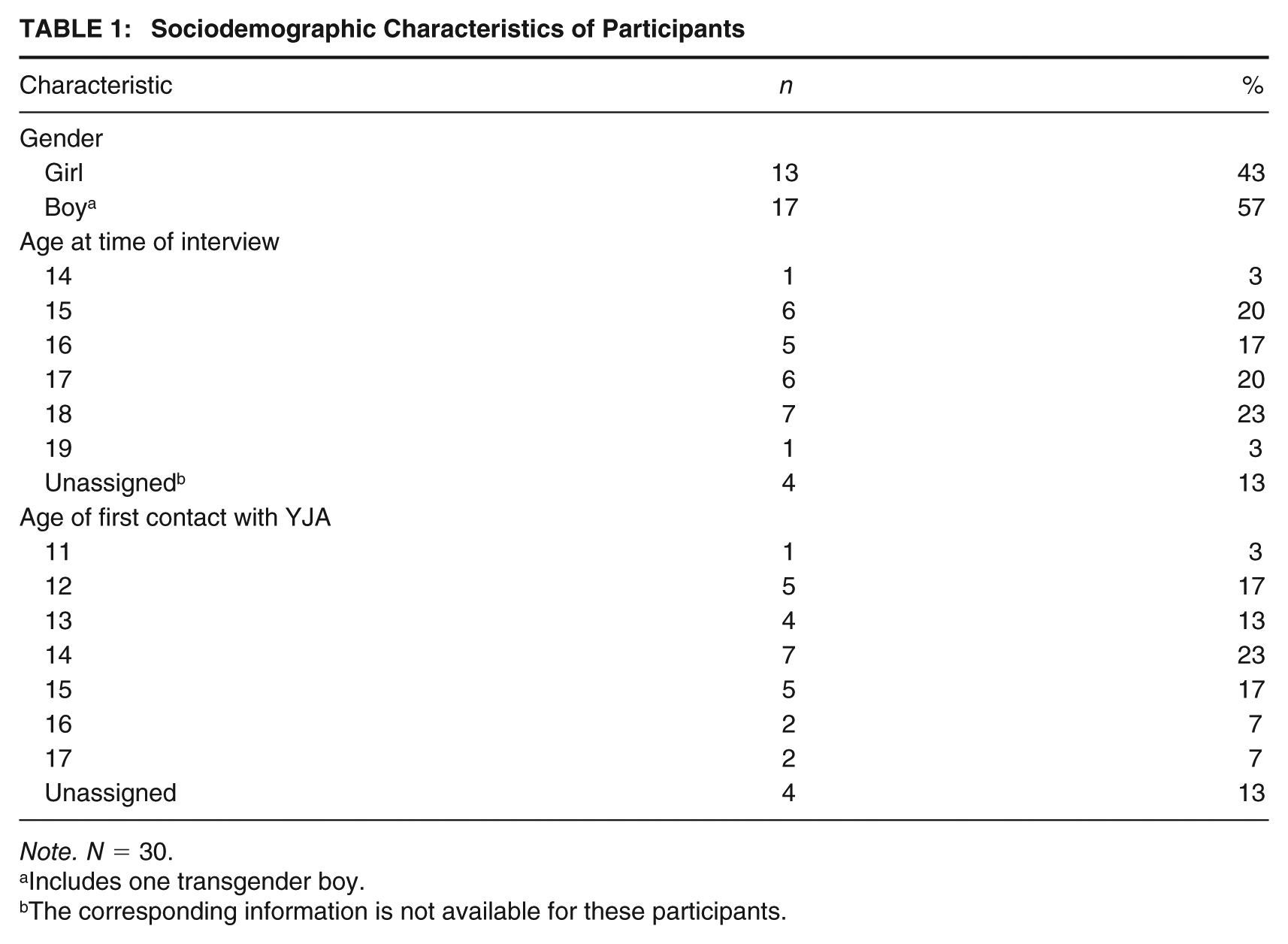
Note. N = 30.
Includes one transgender boy.
The corresponding information is not available for these participants.
Data Collection
The 30 interviews took place in person at YJA offices across five areas in Northern Ireland between December 2024 and February 2025. The first author conducted 24 interviews, and the second author conducted six interviews. The researchers developed a list of open-ended questions to act as a guide, based on their experience with similar projects. These questions centered on the participants’ experience of school, home, the community, the YJA, and the police and court system (if any). The interview schedule can be found in the appendix. In terms of transcript length, the interviews with boys versus girls were roughly on par, with an average of approximately 4,500 words per transcript for the boys’ interviews, and 5,000 words for the girls, indicating similar data quality across interview transcripts, regardless of gender. Interviews lasted on average 24 min, ranging between 8 and 69 min.
Data Analysis
The recorded interviews were transcribed verbatim and imported into NVivo (version 15). Reflexive thematic analysis (TA) was employed to analyze the transcripts to identify and interpret patterns of meaning across the dataset (Braun & Clarke, 2006, 2022). Themes were generated inductively, with reference to the largest codes. Based on initial coding, the most salient areas for analysis—the code labels which contained the most references from the transcripts (including “family” and “community” and “lack of opportunity”)—were focused on to develop the themes discussed below. Coding under reflexive TA is an evolving and subjective process (Braun & Clarke, 2022). Different researchers may interpret the same dataset differently. The first author coded the interview transcripts, and the second author reviewed the codes and provided further insights. From the initial code levels, which are descriptive and do not contain an analytic take, themes were developed which each contained a “central organizing concept” (Braun & Clarke, 2022, p. 77). These themes are discussed later.
Ethical Considerations
The current study received ethical approval from the University of Limerick where the first author is based. YJA staff were informed of the purpose of our study and the inclusion and exclusion criteria for sampling. Staff then identified and informed young people, with whom they worked with and who were eligible to participate, about the study. Participation was voluntary and young people were not coerced or pressured into participating. Participation had no impact on access to services or court or probation decisions. Once a young person agreed to participate, the researchers coordinated with staff to conduct the interview on site in the relevant YJA office. All participants were over the age of 14. While consent and assent (for those under the age of 16) forms were read and signed in advance of the interview by participants and facilitated by staff, informed consent or assent was reaffirmed in a private setting by the researchers immediately prior to the commencement of interviews. If the participant was under the age of 16, consent from a parent or guardian was also required. Age-appropriate, plain language consent materials were used. Researchers were cognizant of the sensitive nature of these interviews and were careful to avoid retraumatizing participants. Participants could choose not to answer questions and to end the interview at any time. Participants could withdraw from the study up to 4 weeks after the interview took place. Both the researchers are security vetted to work with children and have undertaken child safeguarding training. Child safeguarding protocols were followed. Interviews were conducted between the interviewer and the young person in rooms with internal windows, thus, in view of YJA staff. Often, the young people’s parent or guardian were nearby in the same building. Interviewers did not ask about specific offending behavior that young people had been involved in, though participants could discuss this if they were comfortable doing so. Young people were informed about the limits of confidentiality if disclosures related to harming themselves or others. Participants received a small token in recognition of their participation by way of a branded Queen’s University Belfast sweatshirt (where the second author is based). All procedures were approved by the University of Limerick Research Ethics Committee.
Deprivation, Adversity, and Gendered Strain
Northern Ireland is a post-conflict society (McAreavey et al., 2025), having suffered a period of ethno-nationalist conflict between nationalist (Catholic) and unionist (Protestant) communities in Northern Ireland, known as “The Troubles,” approximately from 1968 to 1998. Proportionately, Northern Ireland is the most deprived area of the United Kingdom (Lloyd et al., 2025). Close to one in four children in Northern Ireland currently live in “relative poverty” (O’Kane et al., 2025, p. 2) and 16% in “extreme poverty” (p. 3). The threads of community poverty and deprivation, low social mobility, and family adversity were common across genders in our interviews. However, the discussion among boys and girls with reference to the same issues contained distinct nuances and differences. Two primary themes are discussed below: (1) gender shapes experience of community-level deprivation and (2) family-level adversity and relational support gaps especially salient for justice-involved girls.
Gender Shapes Experience of Community-Level Deprivation
The theme Gender shapes experience of community-level deprivation explores a central message expressed in differing ways throughout interviews: that growing up in socioeconomically deprived areas in Northern Ireland appears to have divergent impacts on girls versus boys. Participants spoke about how their experiences are filtered through a gendered lens both explicitly and implicitly.
Although both boys and girls in this study were sampled from the same communities, the discussions of deprivation differed according to gender. Both girls and boys expressed a desire for future financial stability; however, for the girls, this was more often in relation to them achieving financial independence for themselves, rather than supporting their families, which was more common among boys. For example, the girls expressed sentiments including the following: “I would love to be rich” (Sophie); “I want to go and rent out an apartment in Dubai, and maybe even move to another country” (Chloe); “I’m just going to get my flat . . . and I’m just going to do my own thing” (Sarah).
In contrast, and in keeping with the gender stereotype that men should be protectors and providers, many boys expressed a strong desire to support their families financially. For example, Jack said: “I’ve caught my ma crying or something because she can’t pay a bill or something . . . I want to help my mum . . . I want to take care of her.” When asked about his goals for the future, Conor said: “I’d just get a load of money for the family like.” Other boys also expressed a desire to provide financially for family members (Dylan, Thomas, Sean). To achieve these goals, the majority of the boys aspired to trades such as joinery, construction, plumbing, and barbering. These were viewed as practical ways for them to achieve a sense of security. Approximately 30% of the boys interviewed did not have any future aspirations, or at least, none that they could articulate (Daniel, Harry, Adam, Charlie, James). Boys and girls also differed when talking about their dream careers. Girls were more varied in their aspirations and were more likely to discuss the steps, educational or otherwise, required to achieve these careers, indicating a more structured approach to their goals (10 out of 13 girls). Fewer girls than boys had no future aspirations (Emily, Anna). This perhaps indicates more optimism and forward thinking on the part of girls.
There were also gendered nuances in the discussion when the conversation turned to community marginalization. When talking about the areas in which they grew up across Northern Ireland, boys described their communities in terms of chaos and criminality, whereas girls described their communities in terms of the lack of support and resources. Girls expressed a desire to improve their communities, whereas boys did not speak about this. However, young people of both genders expressed a desire to leave their communities because of criminogenic conditions caused by a lack of legitimate, prosocial opportunities. Girls conveyed frustration with their communities. Chloe indicated a desire to move elsewhere: “walk down the street and it looks so depressing. Like the weather, the people, the stuff that goes on, the family life, like just everything. I just want to go and move away.”
Eva did not want to raise a family in her hometown, in order to break the cycle of offending that she had been caught up in: “I wouldn’t raise my kids in [name of town] . . . it’s got nothing going for it, and it’s got nothing going for the people in it.” She described her past self as a “stereotypic [name of town] teenager, you know, like causing ruckus, you know, being bad.” She attributed this to the lack of resources and support available in her hometown: “I think [name of town] has no community . . . has no like community center,” contrasting this with a community center in a larger city. She felt crime among young people is romanticized in her community: “taking drugs and stealing cars and doing all that there is almost glamourized.” She suggested that increased resources could help: “a community center or like a football club or, you know, something like that there that will bring a whole community together.”
Eva highlighted that resources only become available to young people after contact with the justice system: “The only thing kids have is whenever they fall into the justice system and they have to get in touch with youth justice . . . then they start giving them these opportunities, and that’s where they get their opportunities from.” For Anna, the resources that existed were targeted at boys, for example, football pitches: “there’s nothing really there for us [girls].”
Boys similarly described deprivation in their communities, but with more of a focus on crime and violence. Dylan characterized where he grew up as “chaotic.” His perception of where he grew up was violent, describing: “the fights and the robberies and the hijackings and the stabbings.” Callum described his community as “rough,” with a heavy police presence. Matthew similarly reported: “loads of like fighting and all, and like rioting.” For Ethan, the lack of opportunities in his community was directly related to justice system contact: “the only thing you can really do is just mess about, get chases from the cops. There’s nothing really to do like, just nothing entertaining.” Aaron felt the lack of resources meant that drug use among young people was inevitable: “there’s not really much to do in [name of town] . . . as soon as you hit about the age of 12 to 13 [inaudible] like weed, or you’ll go out and you’ll try something. There’s no way you’ll get away.” Harry also voiced this inescapability: “all teenagers in [name of town] do drugs.” From these conversations, there was a palpable feeling of despair—that there was little these boys could do to break the cycle of drug use and offending they found themselves in.
Adam wanted to move away from his community for this reason: “I didn’t really like growing up there, and I feel living there, drugs are very much just a part, like things which shouldn’t be a part of normal life.” In his community, paramilitaries are still active, a legacy from the Troubles: “there’s a lot of like paramilitary stuff around there, and I just, I wouldn’t want, in like the long-term, to like raise my kids around that.” Callum suggested that paramilitary exploitation of young people was gendered, and girls had the privilege of escaping active recruitment by paramilitary groups to engage in violence: “If I was the girl, I wouldn’t have rioted. Like no one [paramilitaries] would come up to me in a riot and ask me like” (Callum). For Ben, Northern Ireland was “just not a good place.” Like Adam, he did not want to raise a family in the community he was from: “I’d do anything to move away from here like. You know, I definitely wouldn’t want my children growing up, you know, anywhere near the way I grew up like” (Ben). This again evokes the motif as men as protectors of their family. Although none of the sample were parents themselves, many of them spoke about a desire to escape the community for the sake of future children.
When offending behavior was met with a police response, this too was perceived as gendered. Both boys and girls reported a perception that the police used less force and more discretion with girls than boys: “I would say police would be a lot more aggressive with boys . . . someone I know, he’s told me like when he was getting arrested they beat him . . . But then I’ve hit police officers, but they’ve never beat me” (Sophie). Lucy said: “I think there is a really big difference to be fair . . . I think they [police] treat boys worse than they do with girls.” Erin viewed this perceived leniency toward girls by the police and justice system more generally as “sexism,” rather than something positive: “when I lived with boys [in residential care] like if they had done something stupid, they would’ve been straight to custody, where I could’ve done something way worse and just got like a slap on the hand.” Some girls, however, also reported negative encounters with police (Chloe, Eva). For example, Chloe revealed that she had repeatedly requested to interact with a woman police officer, but that this had been ignored: “I’ve been tackled to the floor so many times by male officers . . . I was asking for a female officer. I’ve never, ever, ever gotten a female officer.” Accommodating reasonable requests by young people in the context of an arrest, such as Chloe’s, would be a step toward gender-responsive policing.
Boys also reported that police treated boys versus girls differently: “They’d be less rough [with] the girls” (Daniel). Ben also had this view: “the police would like, whenever they’re arresting people and all they’re definitely a lot more rougher on the boys than what they would be on the girls.” Conor explained that he thought the police might use more force with the boys because boys tended to be “stronger” and have “more testosterone” and also be more likely to act defensively with police. Interviews revealed a clear perception of gender bias on the part of PSNI officers.
Family-Level Adversity and Relational Support Gaps Especially Salient for Justice-Involved Girls
The theme Family-level adversity and relational support gaps especially salient for justice-involved girls refers to another core pattern across the dataset: most participants reported some level of family adversity, which often led to them spending significant periods of time outside the house and increasing their risk for antisocial behavior. For girls, the absence of support at home was particularly germane to this theme, and the positive relational support they received through the YJA was reported as transformative. By salience, we mean the degree to which girls discussed family-level adversity and the importance of supportive relationships in interviews.
In addition to community deprivation, young people also discussed family-level adversity. Most participants in this study reported disrupted living situations, including moving several times over the course of their childhood, living in foster/residential care or independent living, living with extended family members for periods of time and then back with parent/s, living in different households to their siblings, or being expelled from the home by family members. It was especially common for participants to have no relationship with their birth father. Both boys and girls discussed instability in the home. For Jack, this affected his experience of education: “I had a load of school changes. See, first I was in [name of school], and then . . . that’s whenever we moved to my granny’s as well, so we moved house.” Charlie described how he was “bounced around” different living situations. These disruptions were negative experiences for boys: “I just hated like change and moving all the time” (Matthew), “families are complicated” (Dylan). For Ethan, being removed from his mother’s care stood out as a significant event in his life. Aaron left the family home as a result of a dispute: “I didn’t get on with my mother’s partner at the time and we just clashed all the time like . . . So then I moved out.”
Even though family-level adversity had considerable consequences for boys, girls discussed this instability more emphatically in terms of the impact it had on them. Sarah had difficult experiences in care placements: “It’s because I don’t like being there, or I just leave, or I just run away . . . I preferred to live in the tent than live in my care home.” This poignant quote is a powerful illustration of girl whose needs have not been met by the systems purported to support her. Katie gave an example of how she had to move home several times over the course of a few months. For her, this was a particularly tough experience, lacking the “one good adult” who could have provided crucial support for her: Obviously when you’re growing up you would have like your mum, like that’s who you’d go to, but I didn’t really have that. Like because I was with my mum and then I was like with my granny and then I was here and I was there and I was everywhere . . . so I didn’t really have like that person that, who would’ve like told me off, do you know what I mean?
In addition, Emma, who lived in residential care, described an inconsistent relationship with her mother.
How would you describe your relationship with your mum?
It’s okay. Goes up and down.
Anna also had a difficult relationship with her mother: “my mum had like drinking problems and all. . . . I’d say about last year it started getting really bad for her . . . and then she just lost it.” For these girls, their relationship, or lack thereof, with their mother was significant.
As a result, girls’ engagement with the YJA appeared to be more relational, with girls being more effusive about what their youth worker meant to them. For Lucy, her youth worker was “more like a best friend that you can just tell [anything], like she would have a laugh with you all the time. But like she would also help me with like things that I can’t tell anyone else.” Chloe also felt that her relationship with her youth worker was extremely important to her well-being: “I can just tell her anything. I just love her. She’s so supportive . . . to be honest I don’t think I would be here today if it wasn’t for her.” Chloe felt that she had a close connection to her youth justice worker because of their shared gender: “I feel like if it’s a girl speaking to a girl they’re going to like relate more.” When Eva was asked about her experience with the YJA, she replied: I wouldn’t change it for the world, do you know what I mean? I came in here as a broken little girl who had no idea what she wanted to do with her life, my friend had just died . . . and . . . [youth worker] and [other youth worker] just . . . talked me through it. And, you know, and were like “you know, this happens, and, you know, it doesn’t shape you for the person you are for the rest of your life.”
For these participants, their relationship with their youth worker was described as fundamental for their mental health and well-being.
Regarding the boys, though they also reported very positive experiences of their interactions with the YJA, the agency for them represented very practical help and support. For example, the YJA provided resources including a gym membership (Jack), a bike (Jack), and DJ decks (Callum). Other boys mentioned the everyday tasks that their youth worker helped them with, such as bringing them to school, or bringing them for a meal, as well as administrative tasks such as assisting with work or educational program applications. This could point to the very basic support gaps that the YJA fills, if these young people do not have other adults in their lives who can help them in this way. Alternatively, it could instead illustrate the differing levels of engagement with the YJA that boys were willing to demonstrate, as compared with girls.
Young people appeared to cope with home instability by spending more time outside of the house. Boys often talked about “running about”—essentially, spending time out of the house with peers. Often this included antisocial and/or criminal behavior: “I spent like loads of the time just running about, because I was like a really active kid. I never wanted to stay in” (Jack); “There’s nothing really to do. We just walk about the town and just explore” (Ethan); “I was just running around burning places and stuff like that, you know, putting sheds on fire and all, like, you know” (Ben). Most of the participants in this study, boys and girls, did not attend school on a regular basis, or at all, due to expulsion, bullying, or other reasons. Thus, if these young people were not safe or comfortable at home, there were very few other (safe) places for them to go. For the girls, this led to potentially exploitative situations (Eva): I was in a very horrible relationship with a fella that was maybe five years older than me. I shouldn’t have been anywhere near him. He shouldn’t have been in my company. I was running about with people who are probably now doing life sentences.
Family-level adversity in this study served to compound community-level adversity, pushing young people outside of the home and on to the streets.
Discussion
Despite the increased research focus on justice-involved girls in recent decades, there are still gaps in the current scholarship on the underlying needs influencing girls’ pathways to offending, which this study goes some way in addressing. Contemporary youth justice systems often operate within androcentric frameworks that fail to account for the distinctive experiences of girls. By including boys as a comparative group, this research isolated the specific vulnerabilities and needs of girls from more general risk factors that are common across genders. We did this by focusing on community and family distress, which affect both boys and girls, but are different in their impacts. We know that gender-responsive interventions to offending work, indicating that continuing to tease out the influence of gender on the life experiences of girls and addressing criminogenic needs appropriately would reap significant benefits.
Both boys and girls desired a level of financial stability. For boys, this was to achieve a normative masculine ideal and provide for loved ones. This resonates with Walker et al.’s (2025) research with young people involved in offending behavior (both victims and perpetrators) in the North East of England, where this traditional ideal was seen as achievable through criminal activity. Girls desired money to achieve a level of independence. Although they came from the same communities and dealt with similar levels of school exclusion, girls had more varied ideas about how to achieve financial success. Participants wanted to leave the communities they grew up in, regardless of their gender. For boys, violence, paramilitary activity, and widespread drug use were especially salient reasons. There was a suggestion that girls are comparatively safer from child criminal exploitation (CCE). Boys’ pessimistic outlook regarding their future and the future of their communities was striking. A lack of future orientation has long been linked to delinquency (see Clinkinbeard, 2014); in the current study, this lack of future aspirations was concentrated among the boys. For girls, it was the lack of prosocial activities and resources that were the driving factors of a desire to move elsewhere.
A structural factor such as socioeconomic marginalization has consistently been identified as a push factor toward crime (Walker et al., 2025). Several previous studies have emphasized this systemic failure. For example, Jones et al. (2014) found that it was primarily exclusionary and system level failures that were gender-specific pathways to crime for girls. Girls in this study identified a lack of opportunities and support tailored to them in their communities. The lack of resources that girls would find beneficial or enjoyable in youth justice contexts has been noted elsewhere (Staines et al., 2024). Staines et al. (2024) concluded, similar to a participant in our study, that “girls need targeted, gender-specific support before they enter the youth justice system” (p. 199, emphasis added). Thus, there is a need for tailored resources and interventions for girls at risk of offending, both in the community and in the youth justice system. This could go some way to mitigate the adverse effects of community-level stressors, particularly for girls.
In the communities where the participants grew up, there was a notable gendered difference in how the police responded to offending behavior, with a strong perception that PSNI officers use more force with boys. This suggests a potential gender bias among the Northern Ireland police force and may affect young people’s levels of trust regarding the police. Furthermore, though both boys and girls indicated that the police in general used more force with boys, some girls also expressed frustration with aggressive interactions at the hands of male police officers. Thus, the perception that girls may get an “easier” time throughout the criminal justice process may be hiding some contradictions, similar to the inherent tensions between the “chivalry” and “doubly deviant/evil woman” hypotheses put forward to explain the sentencing of women who offend (Trist et al., 2025). These contradictions, in sentencing and in the current study, may be explained by the degree to which girls and women fit hegemonic gender role expectations. Participants’ frustration with police officers suggests a need for gender-sensitive training for justice actors. While this study did not interview youth justice staff, prior research indicates that youth justice practitioners also require and request targeted training and resources to understand and respond effectively to the distinct needs of girls (Best et al., 2021; Parrish et al., 2021; Rice et al., 2026).
The majority of participants in this study discussed some level of family instability; however, this seemed to have a more acute and profound impact on girls. They relied heavily on close relationships with youth justice workers in the absence of supportive relationships at home. This finding is further evidence supporting the importance of relational theory, which has been key in previous studies examining the lives of women who offend; they are “far more likely than males to be motivated by relational concerns” and a sense of connection (Covington & Bloom, 2006, p. 16). The absence of close positive relationships is a key criminogenic need among girls who offend, and romantic relationships with boys or men involved in offending may have a criminogenic effect (Kruttschnitt et al., 2019), as alluded to by a participant in our study. Thus, appropriate relational support for girls is needed, both within and outside youth justice settings. However, supportive relationships with youth justice staff must not lead to the blurring of professional boundaries or “prolonged involvement with the youth justice system” (Staines et al., 2024, p. 186).
Menon et al. (2024) argue that the “family, social and peer contexts” pose particularly high social risks for justice-involved girls and young women (p. 885). Best et al. (2021), in a study of offending girls in New Zealand, also found that family dysfunction consistently characterized the background of these girls. That family-level adversity in this study appeared to have a more profound effect on girls than boys has also been noted in Shepherd et al.’s (2019) study with girls in a youth detention center in Australia. The findings of this study indicate that opportunities and resources need to be invested in marginalized communities as a priority, with an emphasis on gender mainstreaming.
Limitations
The findings of this research should be interpreted with caution given the particular context in which this study was situated (post-conflict Northern Ireland). In terms of the interviews, most young people did not provide elaborate answers during the interviews, and they generally appeared hesitant or unwilling to answer more abstract questions. This is perhaps in part due to their young age. Social desirability bias may have also been a factor in these interviews where sensitive issues were discussed. The participants in this study overwhelmingly reported very positive experiences of their interactions with the YJA and their youth workers. However, young people with poor relationships with the YJA were potentially less likely to volunteer to participate in a related research study. Furthermore, participants may have been reluctant to criticize the YJA in interviews, despite the researchers emphasizing that they were independent and that the interviews were confidential. Efforts were made to reduce this tendency, including fully explaining the purpose of the study to participants, ensuring privacy in interviews and establishing rapport (Bergen & Labonté, 2020). Finally, this study focused solely on gender; further research could use an intersectional lens to explore the intersection of gender with other characteristics.
Conclusion
This study investigated the gendered nature of community- and family-level adversity among justice-involved young people in Northern Ireland. It makes a novel contribution to knowledge by arguing that socioeconomic deprivation, while a gender-neutral criminogenic need, does not exert the same effects on boys and girls, indicating a requirement for gender-specific resources for girls. Experiences of violence and overall deprivation affected the boys and girls differently in our study. Young people reported their experience of gender-based differences in treatment, particularly by police. Family dysfunction appeared to impact girls more acutely, at least from what participants were willing to discuss in interviews, though it led to both boys and girls spending a significant amount of time outside the home and school, increasing their vulnerability. Girls in this study were more likely to describe a lack of relational safety as being precipitous to youth justice contact. Girls engaged differently with youth justice practitioners, valuing the supportive and trusting relationships in the absence of family and community support. This study underscores the importance of early, gender-specific interventions and relational support structures that respond to the lived realities of girls, before justice contact, particularly in jurisdictions outside of the United States where these interventions are less common. By advancing a nuanced understanding of gendered justice pathways, this research adds to the evidence base to inform preventive work and to ensure fairer and more effective youth justice policy and practice.
