




Abstract
In The Everyday World as Problematic (1987), Dorothy Smith outlined a sociology that would find its questions in everyday life—that is, “the world in which we are located physically and socially” (p. 89). Her sociology would address the “puzzles” that are “latent” in that experienced world (p. 91). Such puzzles included questions that feminists of the era had begun to ask (e.g., how do women’s troubles become ‘sickness’? how is their work obscured and devalued?). But Smith’s discussion made clear at the outset that the “sociology for women” she proposed could be a sociology for people, more generally, and that exploring the problematics of any group’s social standpoint would begin with narration. She presented the following example: “People who have lived for years in communities in the interior of British Columbia, in telling their lives and experiences, show us a typical layering sequence of change—the opening of the mine, the coming of the railroad, the market gardening enterprises established by local Indians to feed the miners, the closing of the mine, the decline of market gardening, the decline of the railroad, the dependence of the native people on the Indian Affairs Department, the building of a hydro plant, a brief period of employment for the native people while it is being built, the refurbishing of the railroad, the development of a small tourist trade, the transformation of the settlement into a retirement village for hydro engineers” (p. 94). People know and can tell of these changes, but “the logic of transformation is elsewhere” (p. 94)—that is, those living through the changes do not so easily see what drives them. As one teacher put it, in an institutional ethnographic study of curricular reform, “these things just happen” (Jackson 1995). Institutional ethnography was designed to open and explicate the extended social processes behind such changes.
In the 1970s and 1980s, Smith and many other feminist scholars were exploring a distinctively gendered organization of work, in which women supported men, in varying racial and class locations, through distinctive forms of household labor and by virtue of paid work in professional, clerical, and other subordinate jobs (e.g., nursing, secretarial, and service work) that underlay men’s ostensibly autonomous performance of expertise and control. In 2012, that gendered division of labor has not disappeared, but it has undergone substantial transformation. New puzzles arise now, from everyday worlds that rely on shifting patterns of racialized and gendered work and that are increasingly penetrated by regimes of accountability (DeVault 2008); and institutional ethnographers are exploring how people are drawn into new relations on factory floors (Jackson and Slade 2008), in hospitals (Rankin and Campbell 2006) and universities (Tuchman 2009), in welfare offices (Ridzi 2009) and community-based organizations (Jurik 2005), and in all of the places where mothers work to support children’s schooling (Griffith and Smith 2003; André-Bechely 2005). Dorothy Smith and others have continued to develop institutional ethnography as a mode of inquiry meant to open such changes to analysis, and a line of empirical studies illustrates its potential.
The obvious sequel to the early Smith is Institutional Ethnography: A Sociology for People (2005)—a compact volume which provides a restatement and elaboration of institutional ethnography—but readers should not neglect Writing the Social: Critique, Theory, and Investigations (1999), in which she develops theoretical underpinnings of the approach. What makes Smith’s work so distinctive is the insight that social coordination (or “ruling”) is now accomplished textually, through the production, deployment, and uptake of documents of myriad sorts, and the methods of ethnographic inquiry she has developed from that insight. Chapter Five on “The Ruling Relations” makes clear that these textual forms of coordination are situated historically, the manifestation of an ongoing process of transformation of capitalist economies, with distinctive consequences in different places (such as the mining communities of British Columbia, referenced in the opening quotation). The “ontological shift” that Smith proposes relies on the idea that such extralocal coordination is always and only accomplished in people’s work, broadly conceived.
In the boldly titled Chapter Six, “Telling the Truth after Postmodernism,” Smith stakes out a position that joins the discursive and materialist elements of her sociology. This position acknowledges and builds upon the linguistic turn—recognizing with Foucault and many others the profound significance of language and discourse—but it also preserves the analytic significance of an embodied and agentic subject in a material world. A mother, pointing and speaking to an infant, so that the child learns to recognize and name the elements of a social world, stands as a primordial instance of the coordinative power of language. As the poststructuralists would have it, the infant needs language to make sense of the world, but Smith points out that what language does is link people to each other and also to a shared, material world. It is that process of coordination that underlies the “conceptual practices” (Smith 1990) that institutional ethnographers aim to reveal in the social relations of work and governance.
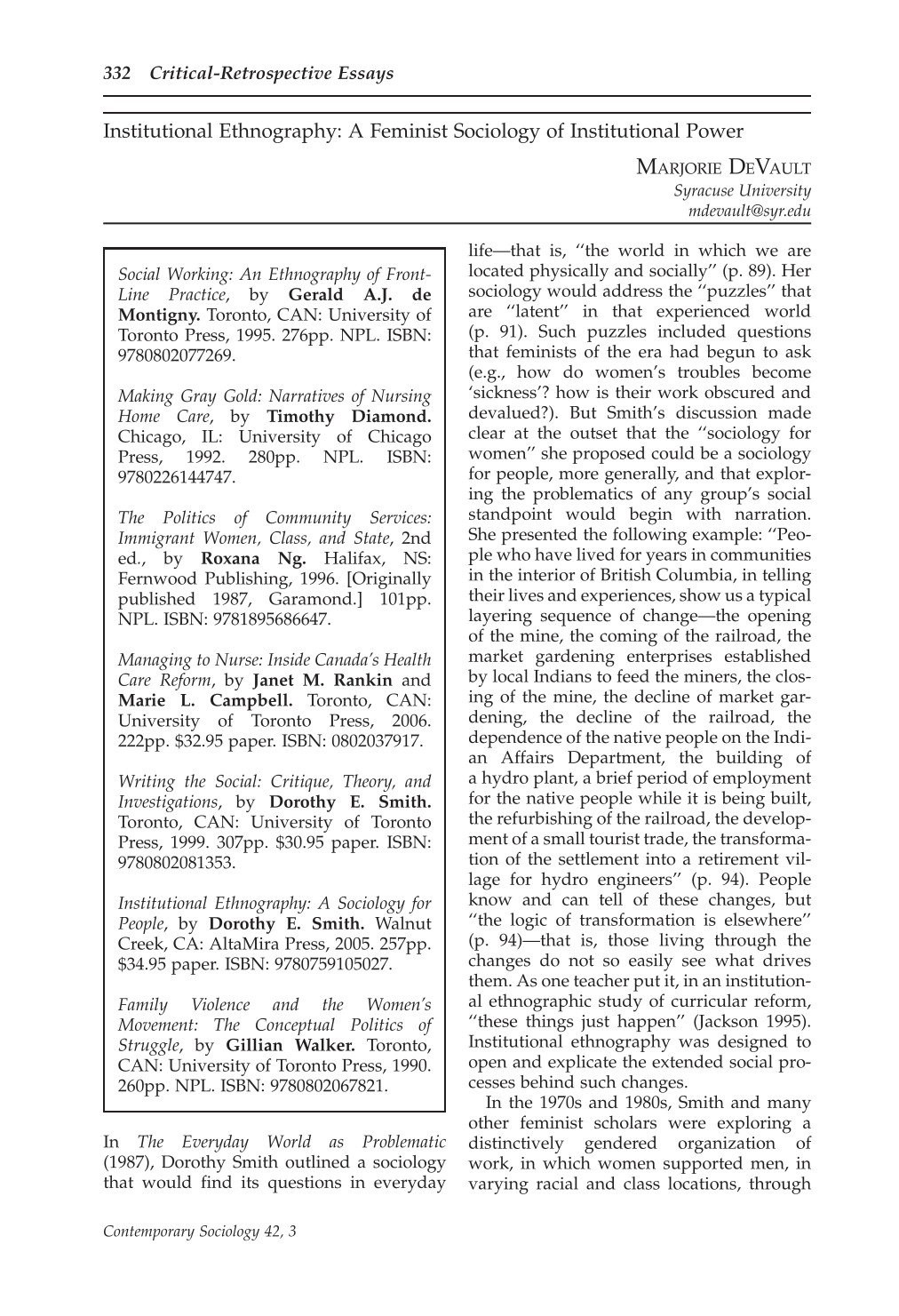
Early book-length examples of institutional ethnography (Ng 1996 [orig. 1987], Walker 1990, Diamond 1992, de Montigny 1995) illuminate various aspects of the approach, as well as its common features. Two of those I discuss here were rooted in the work and puzzles of feminist activists, while two others were anchored in professional and paraprofessional work in predominantly female occupations. Each study was concerned with the social organization of knowledge and with the ways that people are drawn into particular ways of knowing and acting. The analyses were also implicitly relational; those studies whose entry points lay in the work and concerns of feminist activists spoke to the troubles of battered women and immigrant women seeking employment, and those which began in the work of social workers and nursing assistants illuminated gaps in institutional responses to low-income clients and nursing home residents. Looking back, we can also read these monographs as snapshots in an ongoing transformation of the relations among activist groups, professionals, and the state—a transformation that continues to the present. Institutional ethnography is proving especially valuable in revealing the mechanisms and consequences of that transformation, because of its open-ended and cumulative character.
Gerald de Montigny’s Social Working: An Ethnography of Front-Line Practice (1995), an analysis of child protection work in Canada in the 1980s, offers an extended analysis of the ideological practice of seeing through an institutional “lens,” inscribing institutionally warranted “facts” in case notes, and then acting authoritatively. Working systematically with cases from his own practice, de Montigny documents the artful way in which a social worker learns to shift perceptually from an everyday mode of perception to a professional one. Drawing on Smith’s notion of a “disjuncture” or “line of fault,” he attends not only to the official story that warrants action (e.g., removing a child from a home), but also to other potential but suppressed stories of what might have happened, and of the elements in those stories that may drop out of the official record. What would disappear from the report to the court were the particulars of the mother’s life: “what it meant to be a Native Indian, a young woman (nineteen years old), a single mother, a grade eight drop-out, and disabled” (p. 166)—a potential story in which “[the mother’s] act gave voice to her place in the world” (p. 166). De Montigny’s text is notable for the way he weaves into the analysis a poignant meditation on his own growing up in a working-class family and of the “ruptures, tensions, and conflicts” (p. xi) he experienced as he became a student and then a professional. At times in his practice, although he knows that he has properly executed an investigation and apprehension, he also “felt that I had not done enough and that what I had done was wrong” (p. 169).
The same kind of ideological practice—seeing through an institutional lens—can be seen in the work of community-based advocates doing job counseling for immigrant women, the activity at the center of Roxana Ng’s analysis in The Politics of Community Services: Immigrant Women, Class, and the State (originally published in 1987 and reprinted in 1995). Ng worked as a participant observer in an advocacy group as they struggled to maintain funding and found themselves increasingly drawn, by the requirements of state funding, into modes of work that aligned them more closely with the interests of employers than with those of the women who sought their help. Whether in seeking job openings or in talking with women who sought work, counselors found themselves fitting their clients into low-wage positions; as their funding came to depend on successful job placements and as they cultivated relationships with employers, they found that it was increasingly difficult to engage in advocacy that might make a difference in the conditions of work for their clients. They found that, despite their intentions, they were in fact shaping up clients so that they became recognizable members of the category “immigrant workers.” Ng’s analysis illustrates how tensions within the organization that are experienced as personal conflicts can be traced to contradictions that arise from the management of community advocacy by the state. She also shows how documents (in this case, those such as the organization’s internal “application form” which documents the client’s skills and circumstances) are “central to holding the mandated courses of action of the state in place” (p. 86).
Timothy Diamond’s widely-read ethnography Making Gray Gold: Narratives of Nursing Home Care (1992) examines the documentary process in health care. Taking his problematic—the puzzle he wished to explore—from a group of nursing assistants he came to know, he underwent training for certification and then worked as a nursing assistant in three different nursing homes. Diamond places the rhetorical apparatus of institutional ethnography in his footnotes, but his analysis is replete with references to the documents that organize daily routines in the facilities, from nursing charts and nutrition records to the annual reports of the corporate owners of the homes. Like de Montigny and Ng, he places work—and the institutional accounting of that activity—at the center of the analysis, showing how the work of care is structured by carefully documented tasks such as leading (and documenting) twice-daily exercises or turning bedridden patients (and making every-two-hour notations in Restraint and Position forms). He juxtaposes the unacknowledged skills of the nurses’ aides who do the hands-on caregiving against the institutional, documentary reality such forms produce.
These authors examine the inscriptive processes that lie at the core of front-line organizational work, in the spaces where clients and residents encounter and are subdued to the power of institutional regimes. It is easy to say that social workers or activists learn to see through an organizational lens; these studies show what that means, concretely. These workers learn to take up a conceptual machinery produced elsewhere and deployed in the management of front-line work, and institutional ethnographers look carefully to see how that institutional gaze is generated, and held in place. What is at stake is an understanding of—and therefore, the capacity to open to dialogue—the accountabilities introduced into front-line work. In the kind of social work or health care that de Montigny and Diamond examine, documentation can usefully guide front-line workers through agreed-upon procedures that produce desired outcomes: lifting and turning bedridden patients, for example, is work that is essential to their well-being. But institutional ethnographers often discover other kinds of work left out of the managerial scheme, so that when resources are short they may not get done at all. Diamond, for instance, learns in his training to finish recording vital signs and only then see if there is time for “some psycho-social stuff” (p. 27). De Montigny points out that, in child protection work, a social worker may have a broader sense of how to help a family, but often has the resources only to remove a child from the household. Examination of these dilemmas of front-line work gives rise to a critique of documentary reality and its consequences—encapsulated in Diamond’s report of a co-worker’s wry commentary on measurement: “There’s nothing wrong with the scale, it’s the building that’s tipped” (Diamond 1992: 171).
The schemata that organize front-line work of this sort—the signs of a child “at risk,” for example, or an immigrant woman who is “job-ready”—come from beyond the front line. Given the ontology of institutional ethnography (it is always and only people who are acting), it makes sense to inquire ethnographically into where and how those conceptual “shells” (Smith 2005: 111–113) are produced. Those activities can be opened to investigation in various ways: for example, by interviewing people who work within the “ruling relations”—in think tanks, government agencies, policy institutes and the like (including those academic fields—like our own—which supply conceptual material for these activities)—or by tracing the development of discursive regimes through documentary analysis. Such was the approach in Gillian Walker’s Family Violence and the Women’s Movement: The Conceptual Politics of Struggle (1990). She anchored her research in the standpoint of activists who were providing shelter for “battered women,” but the activists themselves were not the focus of her analysis. Instead, she examined the discourses they were drawn into during their struggles to put the issue on the local government’s agenda, analyzing a series of legislative hearings and reports in order to reveal how, over time and through the political process of seeking institutional legitimacy, the problem they had identified was redefined as “family violence,” a framing that moves thought (and action?—a question for empirical study) away from their earlier, more explicitly feminist stance. Walker’s analysis points to the complex web of texts that carry broader discourses, and to the ways that local texts rely upon, incorporate, and reinforce conceptual tools that are gaining acceptance throughout (and sometimes across) institutional landscapes.
In the years since these early studies were published, institutional ethnographers have developed stronger conceptual tools for the analysis of “texts in use”; Smith’s Institutional Ethnography (2005) reflects those advancements. In addition, there have been very significant developments in the coordinative processes that are the focus of their analyses. Many analysts have commented on the growing ascendancy of managerial theories associated with neoliberalism and their increasingly widespread application to public sector activities. Institutional ethnographers call attention as well to the development of electronic technologies to support them. For example, the paper records kept by social workers and nursing assistants in de Montigny and Diamond’s studies have been largely replaced by computerized charting and decision tools—and indeed, medical (and other) software development has become extremely big business. Such tools “carry” the kind of extralocal coordination that institutional ethnographers wish to uncover.
These new developments—in the approach and in the world we confront—are both central to Managing to Nurse: Inside Canada’s Health Care Reform (2006) by Janet Rankin and Marie Campbell, a more recent and extremely impressive exemplar of the practice and potential of institutional ethnography. The authors are nursing researchers and the book is based on ethnographic studies they conducted in hospitals during the 1990s; Campbell is also well known as a mentor in the institutional ethnography network and as co-author of an early “primer” on the approach (Campbell and Gregor 2002). Their book offers a view of the ongoing restructuring of Canadian health care, opening for examination new managerial efforts to increase its cost-efficiency and exploring how they are experienced in the daily practice of hospital nurses.
Rankin and Campbell open their analysis with a brief description of a nursing shift change, a key “processing interchange” (Pence 2001)—that is, a moment in which workers pass along authorized knowledge that will guide subsequent action. The point is to call attention to several kinds of knowledge—both explicit and implicit—that will guide the nurses’ actions through the coming shift of work: not only diagnostic categories, but also their basic nursing knowledge and professionalism, their experientially-based knowledge of carework, and bits of information about the particular patients they are assigned for the day. Highlighting the issue of ongoing transformation, the authors note two features of shift change they would not have seen two or three decades earlier: an acute attention to patient discharge plans and a new patient designation, “ALC” (discussed below). And further highlighting “a consensus that health care should be managed more efficiently” (p. 6), they note that, “No longer is it sufficient for caregivers to ask, ‘What is it I need to know and do to help my patient?’ Now nurses must know what they can do for their patients that brings the best value for money spent” (p. 8). The ensuing analysis provides a complex and subtle portrait of nurses taking up these new ways of knowing their job. Each chapter explores a different facet of change; all of the analyses are designed to show how nurses are located in relation to new technologies of hospital administration: how they are drawn into knowing their work from a managerial standpoint and also how they juggle and improvise as they encounter competing mandates rooted in their professional nursing knowledge versus efficiency imperatives.
For example, one chapter takes up the efforts of hospitals to make the most of their fixed investments in infrastructure—put simply, the challenge of having just enough beds and keeping them filled. An extended fieldnote excerpt shows a nurse’s attention to the varied needs of a post-surgical patient due for discharge and her rising tension as she deals with unpredictable problems and the clock ticking toward the projected discharge. In one instance, she deviates slightly from professional practice, working on the basis of her common sense and offering the patient an over-the-counter pain medication without a physician’s authorization—perhaps a good and reasonable decision but one that likely caused her stress, and caught the authors’ attention. Is the patient ready to leave? What’s the rush? In fact, a new patient has arrived on the unit, and Rankin and Campbell go on to analyze “a whole system of organizational texts and people’s activity . . . that tie this admission to the predicted discharge” (p. 50). Here, organizational “texts” are part of a proprietary software program (operated by specialized clerical staff) which creates a “bed map” for the hospital, assigns new patients where beds are expected to become available, and produces summary statistics on usage and other efficiency measures. Efficiencies are produced in part through the system’s “fictitious beds” (p. 52) which allow overlap as new patients are admitted before others have actually been discharged—the software thus produces a documentary reality of “110% bed utilization” (p. 54), as well as challenges for nursing care that may lead to a speed-up or to compromises in patient care. The critique here is not of efficiency per se; rather, the point is to make clear that the bed map produces one way of knowing reality on the unit, while the front-line nurses know their work in other ways as well. Rankin and Campbell note further that summary information produced by these systems is used in other ways as well—by administrators within the hospital to monitor performance and by provincial and federal officials to make decisions about the allocation of resources.
The ALC, or “Alternate Level of Care” designation mentioned above is also related to efficient bed management—it is an administrative rather than medical “diagnosis,” and Rankin and Campbell explore its meaning in order to show how the relevancies of management are taken up by nurses on the unit. Increasingly, health care is being organized through length of stay “pathways” tied to particular diagnoses; when a patient cannot be discharged “on time”—because of unplanned-for care needs, or because no appropriate discharge placement can be found—that patient is flagged with the ALC designation. Typically, these are frail, elderly patients. Nurses see that they need attention (“they’re often confused”. . .”they take a long time to feed”. . .”you know, you can’t rush these folks” [p. 83]), but they also report that they prioritize their work with more acute patients who “really need to be” on the unit (p. 84). What the analysis shows is how the floor nurses take up a managerial consciousness, responding to documentary processes that foreground efficient utilization of hospital resources rather than the needs of particular patients; the authors refer to this phenomenon as “adjusting the mindset of nurses” (Chapter Three). (Interestingly, the ALC category is taken up somewhat differently by LPNs, RNs, and nurse managers, whose work is differently organized by the designation. LPNs, who do the bulk of daily hands-on care, are often the ones to flag patients for a potential ALC designation, while physicians are the ones who can authorize it; but it is the RNs and nurse managers whose work seems most affected by the ensuing complexity of juggling patient assignments and workloads.) Nurses do resist some of these new pressures—individually and also collectively, at times—but Rankin and Campbell show the power of “double-sided” workplace concepts that subtly reorganize nurses’ understandings. Drawing on their fieldwork and also on nursing research literature, they show how a commitment to “holistic care,” for example, comes to include not only a concern for patients’ best interests but also managerial interests in efficiency (pp. 144–146).
The analyses developed by Rankin and Campbell rely on and illustrate advancements in the tools that institutional ethnographers use to explore textually-mediated social organization—tools that Smith has elaborated in Institutional Ethnography (2005). Building an approach to language and text upon ideas drawn from George Herbert Mead, Mikhail Bakhtin, and others, she develops the idea of the “text-reader conversation” as a framework for investigating how people activate texts in their local activities. The text may appear to be static and inert (and that appearance may explain why ethnographers so often overlook texts), but a person who encounters a text is often not only actively reading it, but also responding to it in ways that will influence subsequent courses of action. That response or “conversation” weaves a “documentary reality,” carried in the text, into the ongoing action—for example, as nurses respond to a patient with the ALC designation as “not really needing to be here.”
Rankin and Campbell’s Managing to Nurse is a marvelously realized institutional ethnography, offering a detailed, subtle exploration of on-the-ground realities of neoliberal reforms in Canadian health care during the 1990s, which my summary here can only begin to sketch. Like any institutional ethnography, it offers only one thread in an extremely complex institutional landscape, but as I hope the examples above make clear, it brings into view institutional technologies—like the bed management software—that operate powerfully, but largely invisibly, in the background of people’s everyday experiences. The Canadian national context is distinct, of course, from others, but the technologies of cost containment in health care are and will increasingly be shared across national and institutional boundaries. These analyses also call attention to the significance of a shift from paper to electronic documentation, already racing ahead of most sociological analyses of the work and organizations it is transforming (and perhaps signaling the emergence of novel modes of software-driven social organization that Aneesh [2009] has labeled “algocratic”). While many of the earlier institutional ethnographies showed concretely what it means to adopt an institutional lens, now as a “new managerialism” advances, some of the more recent studies are also showing with great precision, how action is not only coordinated but also significantly constrained by the new technologies of accountability. These dynamics in the governance of front-line work have become a focus for institutional ethnographers and will be featured in a forthcoming edited collection (Griffith and Smith, in press).
Institutional ethnographic studies such as these certainly resonate with the analyses of other sociologies, perhaps especially the strand of ethnomethodological work that has grown from early analyses of inscription and record-keeping in bureaucratic organizations (e.g., Zimmerman 1969); Rankin and Campbell also mention related studies of managerialism and governance; and an emerging sociology of information based in science studies (Bowker and Star 1999). However, institutional ethnographers have resisted the kind of incorporation and synthesis that would require adopting the very concepts that, in their view, require analysis; indeed, they have invented a term (“institutional capture”) meant to warn against taking those concepts for granted rather than treating them as data (Smith 2005: 155–157). Research that begins with the concept of “immigrant women” or “family violence,” for example, has already worked up its phenomenon to a considerable degree, and institutional ethnographers would instead want to locate the terrain of the inquiry firmly in people’s activities, from beginning to end.
The character of institutional ethnography as “mode of inquiry” has influenced its trajectory; it is a sociology that can be useful in varied fields of practice—social work, health care, activism, and community services—and much of the developing scholarship lies in those areas. In my own teaching, I find that often the students who are drawn to this sociology are those in fields that are drenched in categorical ways of knowing, such as education, disability services, and the like. Indeed, one line of work that has developed from institutional ethnography, and is most visible to domestic violence advocates, is the “institutional analysis” or community auditing approach developed by the late Ellen Pence. Combining her work as an advocate with insights from institutional ethnography, Pence developed widely disseminated models and techniques for working collaboratively with local advocates and responders to investigate how women’s safety can be prioritized in domestic violence case processing (Pence 2001; Pence and McMahon 2003). Materials outlining the principles and tools used in these “safety audits” are available from the organization she founded, Praxis International (www.praxisinternational.org). As Rankin and Campbell explain, “what our analysis makes possible is a way to ‘talk back’ (Smith 1987) to forms of knowledge that misrepresent the everyday/everynight world and undermine patient care” (p. 177). But they also emphasize the possibility and challenges of moving beyond critique to action based on other ways of knowing the world: “Alternative accounts do not come ready-to-hand, but must be researched and developed. There is much analysis waiting to be done” (p. 180).
Other recent books take up institutional ethnography in different arenas of ruling, and in somewhat different but related ways. I would recommend, for example, Lauren Eastwood’s study of NGO activism in UN environmental policy-making bodies (2005); a fascinating book by Gary Kinsman and Patrizia Gentile (2010), which examines the efforts of the Canadian national security apparatus, in the 1950s to 1990s, to detect and purge suspected “homosexuals”; and Gaye Tuchman’s fieldwork-based study of the accountability regime of contemporary higher education (2011), which draws on key ideas from institutional ethnography. However, I have emphasized here a line of work focused on knowledge and practice in the human services and advocacy work (fields in which women practitioners predominate), in order to highlight the feminist sources and uses of the approach.
Institutional ethnography stands as one strand of feminist inquiry with roots in the feminist scholarship of the 1970s and 1980s—a time that has since produced multiple feminisms offering a range of contributions across the disciplines. While it will not answer the demands of every feminist project, the approach retains a deeply feminist impulse at its core, even as it is also increasingly used in the service of groups other than women. It is worth noting, I believe, that the imperatives of intersectionality arguably imply that any feminist sociology must also be a people’s sociology. That claim is rooted in the necessary critique of the category “women” and the core insight that women share with other genders all of the other cross-cutting categorical identities and associated troubles; thus, in order to liberate all women, all must be liberated. Institutional ethnography does not make any sweeping promise of “liberation”; rather, it offers a mode of inquiry (or as Smith calls it, a “sociology”) that can be of use in exploring, piece by piece, the myriad “puzzles” of everyday life. And it is a sociology that some have crafted into a tool of activist change.
Institutional ethnography also remains deeply critical of the abstracted sociologies that drew feminist critique in the early days. The analyses of institutional ethnographers ask for an assessment of ruling modes of representing everyday realities and of the social accounting based on those representations—and they make us aware of the ways that the abstractions of sociological theory—”social capital,” for example, or “quality of care”—may contribute to ruling representations and accounts despite progressive intentions. Instead, Smith and her followers continue to ground their sociology in everyday life—in the places and moments in which mothers teach children to speak, immigrants struggle to find work and dignity, women experience and escape from men’s violence, nurses care for people who are sick or old—and they strive to keep the work of everyday life in view as new accountabilities transform the social world.