




Abstract
The violence and de/reterritorializing strategies used by armed groups in Colombia disproportionally affect indigenous peoples, especially indigenous women, whose ethno-gender roles, forms of territoriality, agency, and autonomy are being altered. Conflict and new forms of territoriality restrict the satisfaction of ethno-gender-based material needs and interests, with negative impacts on women’s own and their families’ lives. At the same time, they offer some women new roles, agency, and autonomy and empowerment through individual and collective action. Policy makers should strive to open up these windows of opportunity for indigenous women while protecting them from the depredations of war.
La violencia y las estrategias de des/reterritorialización utilizadas por grupos armados en Colombia afectan desproporcionadamente a los indígenas, especialmente a las mujeres indígenas, cuyos roles etno-géneros, formas de territorialidad, agencia, y autonomía están siendo alterados. El conflicto y las nuevas formas de territorialidad restringen la satisfacción de necesidades materiales e intereses de tipo etno-género con impactos negativos en las vidas propias de las mujeres y de las de sus familias. Al mismo tiempo, presentan nuevos roles, agencia, autonomía, y empoderamiento a algunas mujeres a través de la acción individual y colectiva. Los formuladores de políticas deberían esforzarse para abrir estos espacios de oportunidad para mujeres indígenas al mismo tiempo que las protejan de las depredaciones de guerra.
Colombia has experienced long periods of internal conflict even before 1948–1957, the period of confrontation between liberals and conservatives known as “La Violencia.” As a consequence, rural and especially indigenous communities have faced acute humanitarian crises, becoming vulnerable victims of displacement, massacres, kidnappings, and disappearances. Although extensive research has been done on Colombian violence, insufficient attention has been paid to its impact on indigenous women and the cultural strategies they use to cope with violent actors and conflict. Thus, we aim to contribute to the understanding of the way ethnic and gender identity markers determine the way indigenous women experience armed conflict in Colombia.
Drawing on ethnographic findings among Arhuaco and Pasto indigenous peoples, we argue that the de/reterritorializing strategies used by armed groups to expand their control over land and their political power over local populations and sometimes to facilitate illegal activities that finance violence disproportionately affect indigenous peoples, especially indigenous women. Armed conflict is redefining the way agency and cultural autonomy processes are being (re)shaped among Arhuaco and Pasto indigenous peoples, especially among women. We discuss how issues of territoriality and the satisfaction of women’s material needs and interests are at stake in these processes. Analyses of conflict in Colombia that combine gender, ethnicity, and territoriality are rare. 1 The new forms of territoriality restrict the satisfaction of ethno-gender-based material needs and interests, with negative impacts on women’s and their families’ lives. At the same time, they offer some women new roles, agency, autonomy, and unprecedented empowerment. These processes may be experienced by women as simultaneously oppressive and liberating, presenting new challenges and new forms of identity that transform their subjectivities and the cultural significations that define them as indigenous women. This should motivate policy makers to envision and promote ways to expand indigenous women’s access to the opportunities that empower them while protecting them from the ravages of violence.
Methodology
Our guiding analytical categories are borrowed from various disciplines: anthropology, geography, critical race theory, and gender and ethnic studies (for a few key sources, see Okin, 1999; Benhabib, 2000; Nelson, 2006; Nussbaum, 2000; and Anzaldúa, 1990). However, we do not intend to discuss in depth gender and ethnic theory here but will present ethnographic results that throw light on the incipient discussion of gendered and ethnoracialized systems of oppression in the Colombian context. Following intersectional theory as described by Crenshaw (1989; 1991), we argue that the imbricated impacts of gender and ethnicity upon indigenous women place them in a singularly subordinated position in Colombian society in general and in communities impacted by armed conflict in particular. We focus on indigenous women because of their disadvantaged position in relation to indigenous men and to nonindigenous men and women. Our research was aimed at understanding how ethno-gender identity markers influence the way Arhuaca and Pasta women experience and cope with armed conflict. Ethnographic techniques, primarily participant observation and structured and semistructured interviews, were our main tool. Our focus was on women who had been victims of or confronted armed conflict with whom we could talk with relative ease, who understood the purpose of our study, and who were willing to share information with us about their experiences. This is what Bernard (2006: 196–197) calls “key-informant selection.” Furthermore, we employed what LeCompte and Schensul (2010: 158–159) call the criterion-based selection of informants, which involves (1) typical cases, reflecting an average set of characteristics or situations faced by women such as mobility restrictions or threatening situations; (2) unique cases, in which an event or condition of the informant differentiates her from the regular situation or flow of events in the community; and (3) reputational cases, in which the informant best exemplifies the kind of person we want to interview—for example, an indigenous woman leader who has confronted violent actors and directly faced conflict. We also took into account informants’ geographical locations (trying to build a variegated sample of women from both groups distributed across their territories), their indigenous cultural construction of their natural environment, the impact of armed conflict, and their political participation in the community, including the performance of leadership roles. We selected these two indigenous peoples because of our long-standing relation with them from previous ethnographic experiences since 1991, 2 the important cultural differences between them (including different strategies for coping with armed conflict), and their location in what Gonzáles, Bolívar, and Vásquez (2003) call strategic corridors in the Colombian armed conflict. 3 The challenges dealt with in our interviews were complex and involved security issues, given the presence of armed actors in the communities, and therefore the establishment of trust was critical.
We conducted around 30 interviews that complemented our participant observation sessions in various community events such as social gatherings, community meetings with the traditional authorities, and gender and women’s rights workshops. All of these enriched the knowledge and experience we had accumulated through our 20 years of work with indigenous peoples. Given our special interest, many of the interviews were conducted with women between 23 and 65 years old, all but two of whom had children. All of them worked in and/or outside of their households, some of them for wages. On many occasions women asked not to be interviewed in public and constantly cautioned us not to make public the information they were providing. We have been faithful to their petitions and have used their information to develop the arguments we present here without making its sources explicit. 4 We also interviewed important leaders of local women’s organizations and some Arhuaco males, including elders and traditional authorities (mamus). A young man was our translator from Ika (the Arhuaco language) to Spanish in the community meetings. From the Pasto people, we interviewed one male traditional authority (taita) and three men who participated in community meetings. In addition to these interviews, we did some informal interviews with nonindigenous authorities, nongovernmental organization (NGO) personnel, and local functionaries working with indigenous communities in these regions. Everyone who was interviewed knew the purpose of our work and agreed to participate in it.
Territoriality, Agency, Autonomy, and Material Interests
According to Brenner (1999: 50), territorialization is “a historically specific, contradictory, and conflictual process rather than a pregiven, fixed, or natural condition.” Territories are “continually produced, reconfigured, and transformed as a key geographical infrastructure for capital’s developmental dynamic” (44). For Brenner, processes of territorialization “remain endemic to capitalism” (53), whereby “deterritorialization can be reinterpreted as a countervailing strategy to ‘jump scales,’ e.g., to circumvent or dismantle historically entrenched forms of territorial organization and their associated scalar morphologies” (62). These processes constantly reinscribe “the role of places and territories on capitalism’s geographical landscape while, at the same time, radically reconfiguring this landscape to enhance its locationally specific productive capacities” (64).
In this study, we examine the processes of territorialization involved in the armed conflict in Colombia and show how the complex web of actors (including military, paramilitary, police and guerrilla agents, rural and indigenous communities, and civilian victims) participate (willingly or not) in these processes. The indigenous Arhuaco and Pasto territories, marked as resguardos (protected indigenous lands), 5 have become desirable to agents involved in armed conflict activities, land use management, drug production, processing and/or transportation, and profit-making policing. The de/reterritorialization of these lands as part of these criminal and war-related economic circuits makes them acutely contested terrains in which dissimilarly situated agents confront each other. The power asymmetries that mark indigenous peoples—particularly indigenous women—vis-à-vis armed actors frequently make them victims of great losses, both human and health-related and with regard to land and other material resources, which cause dispossession and displacement. These conditions also contribute to the de/reterritorialization of their lands, enhancing their location-specific productive capacities for the expansion of capital (Irazábal, 2009a).
Natural resource management is a central factor in armed disputes in Colombia 6 and a central axis of processes of de/reterritorialization. Access to, use of, and ownership and control of natural resources are constitutive elements of indigenous women’s identities that shape their agency and cultural autonomy processes. This correlates with Gow’s (2008: 15) appreciation of the indigenous struggle in Cauca, Colombia, as expressions of self-determination or autonomy. Contests over territory and the management of natural resources involved in armed groups’ practices squarely place armed agents and indigenous women in an abysmal asymmetrical confrontation.
As Appadurai (1996: 178) points out, the relationship between local subjects and the communities in which they are produced and empowered to act is historical and dialectical. The transformation of spaces into places (embedded with meanings and a sense of belonging) is an exercise of power (Irazábal, 2009b), and therefore the processes aimed at satisfying indigenous women’s material needs and interests can be analyzed as instances of the production of territoriality.
Indigenous women’s cosmogonies, beliefs, and traditions often put them in virtually seamless relation to their environment, with land and natural resources, particularly the ones that directly nurture their livelihood, being conceived of and treated as extensions of the self. Thus land and natural resources are inherently related to the individual and collective sense of the self and well-being. When such relations and living practices are violently disrupted, the sense of self and well-being is shattered and the struggle to transform spaces into places resurges as people try to make room for themselves in the new world as best they can. These conditions have created flux and redefinition both in rural/indigenous territories co-opted by the armed conflict agents and in the urban milieus where the displaced pursue relocation (Calderón, Gáfaro, and Ibáñez, 2011; Ibáñez and Calderón, 2009; Ibáñez and Moya, 2009; Ibáñez and Muñoz, 2010).
The relation between indigenous peoples and their territories expresses itself in certain forms of sociability, agency, and autonomy in the case of indigenous women. By “agency” we mean the creation of a satisfactory life through access to various resources, including decision making and the satisfaction of one’s needs and interests (El-Bushar, 2000: 67). As Escobar (2011 [1995]: 178) has pointed out, indigenous women’s agency is central to an understanding of the way they “negotiate power, construct collective identities, and develop perspectives on the world in which they live” (see also Lind, 1992; Fernandes, 2007).
We rely on Castoriadis’s (1991: 160–170) approach to autonomy as the capacity of individuals and social groups to give themselves their own laws and social institutions, by collectively appropriating their social instituting power and its capacity to generate new social forms and identities through a creative radical imagination (see Tovar-Restrepo, 2012). This goes beyond an individual-rights-based approach, which, as Gow (2008) notes, can sometimes be limiting (especially in the context of indigenous peoples). It involves collective empowerment processes and the actions taken by groups of women and/or by their communities when they recognize and acknowledge women’s leadership in conflict situations.
Our ethnographic results show that the dynamics of agency, autonomy, and territoriality are intimately linked. Indigenous women’s narratives about their experiences of armed conflict constantly alluded to territoriality and the way it both shaped their agency and autonomy and mediated the satisfaction of their material needs and interests.
Arhuacos and Pastos
Of Colombia’s population of 41,468,384, approximately 3.43 percent (1,392,623) are considered indigenous. The majority of indigenous peoples inhabit 254,879 square kilometers of the total Colombian area, which is 1,142,142 square kilometers. There are 87 different indigenous cultures/peoples and 64 different languages (DANE, 2007: 16–34). In 1991, a new constitution recognized the cultural, environmental, social, and political rights of indigenous peoples for the first time in history, 7 but many of these rights remain to be implemented (Tovar-Restrepo, 1999).
The Arhuaco people, who inhabit the Sierra Nevada of Santa Marta (in the Northeast), and the Pasto people, who live in the Department of Nariño (in the Southwest), share a distinctive relation to their territory and current subjection to the impact of armed conflict. There are, however, some salient cultural differences between them. While the Arhuaco people are traditional (i.e., less influenced by the nonindigenous society), the Pasto people’s cultural practices resemble those of nonindigenous peasants. The traditional cultural practices among Arhuacos favor certain strategies of resistance, while Pastos confront more obstacles to claiming autonomy and tend to distance themselves from armed actors. While patriarchal practices are present in both groups, important cultural distinctions mediate the way Arhuaca and Pasta women experience and react to conflict and its territorial dimensions.
The Arhuaco population, estimated at 14,799, shares a traditional territory with three other indigenous peoples: the Kogi, the Arzarios, and the Kankuamos. Their territory is in a mountain range isolated from the Andean chain that reaches an altitude of 5,700 meters at 42 kilometers from the Caribbean coast (DNP, 2006: 71). Most of the Arhuacos live in isolated areas and have to travel long distances to exchange goods and obtain services such as health care and education. Their territory has been especially affected by the actions of paramilitaries, guerrilla groups, and the military during the past two decades.
The Pasto population, estimated at 69,789, inhabits the mountains and valleys of the Andean chain at altitudes of 2,950 meters. Given their proximity to the Ecuadorian border, many communities are engaged in commercial exchange with Ecuador (DNP, 2006). This region also borders the Pacific Ocean on the west and the Department of Putumayo, a region of intense coca cultivation, on the east. This has transformed Nariño into a corridor for the transport of coca and cocaine to the coast. Consequently, several armed groups associated with drug trafficking are also present in this zone. Although most Pasto communities do not take part in the illegal activities associated with drug production and trafficking, it is often difficult for them to disassociate themselves from these activities completely.
The economic activities of most of the Arhuaco and Pasto communities are based on agriculture, but economic activities associated with cities are important for their subsistence. This is especially the case for the Pasto people, who sell their agricultural products. Arhuaco people tend to depend more on subsistence agriculture (Guzmán, 1996). Pasta women tend to engage in more paid activities, but they often perform unremunerated work on the land parcels they inhabit, producing goods for their own and their families’ consumption. In most cases in which women produce commodities exchanged in local markets (e.g., milk or vegetables) their male partners (if they have them) manage the money (Figures 1 and 2).

Arhuaca mother and child. (Photo Marcela Tovar-Restrepo)
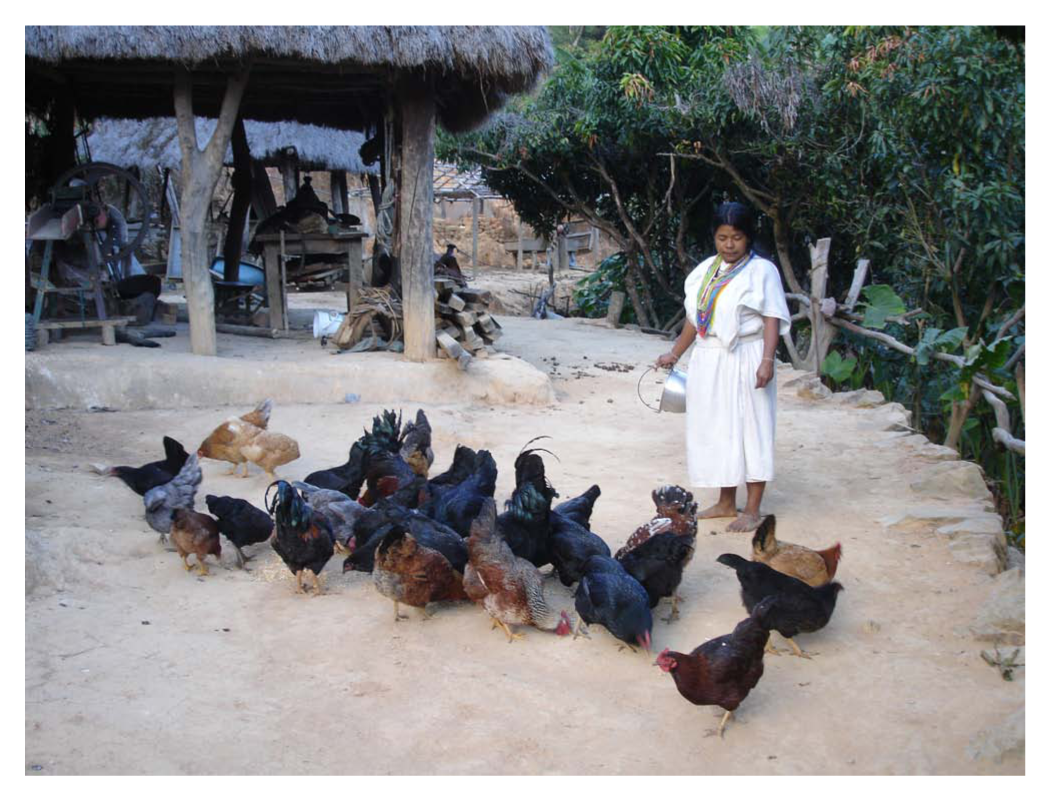
An Arhuaca’s livelihood. (Photo Marcela Tovar-Restrepo)
For both peoples, the division of labor is gendered. Women are usually responsible for most unpaid and domestic activities, while men perform the best-paid activities and the traditional political ones. Some women—especially Pastas—may sell some of the agricultural products they grow on their own parcels, but this practice is not general for either group. Moreover, it is men who are the traditional communal and household authorities. Neither group has a tradition of the participation of women in collective decision making in relation to their territory or community.
Nonetheless, women play important roles in their communities’ cultural and physical survival, the transmission of traditional knowledge, and the sustainable management of natural resources. Because of this, they experience a special impact when armed conflict involves the use and control of those resources. Water, energy, and land are the resources that most frequently cause territorial conflicts (Ibáñez and Moya, 2009; Ibáñez and Muñoz, 2010; Tovar-Restrepo, 2012: 10–14).
Contextualizing the Conflict
Colombia has been internationally recognized as having one of the world’s most severe internal conflicts in terms of displacements and killings. Between 1985 and 2010, 5,195,620 people were displaced (CODHES, 2011: 8). Since 2002 at least 385,000 rural families have abandoned an estimated 5.5 million hectares of agricultural land, 10.8 percent of the total (CODHES, 2009a: 3). From 2000 to 2004, one woman died every day and one woman disappeared every 15 days for political reasons (CCJ, 2003). The number of direct war victims—including women—has decreased in the past few years, and the number of kidnappings has dropped from 3,000 (one of the highest in the world) in 2001 to 687 in 2006. However, the incidence of land-mine explosions increased by 250 percent from 2004 to 2008 (Avila, n.d.; Fundación Arco Iris, n.d.; UNICEF, 2004). It is estimated that more than 100,000 antipersonnel land mines are hidden under Colombian soil (30 of the 32 Colombian states have land mines) (Armada Nacional de Colombia, n.d.). More than half of the victims are civilians, and the majority of them are children.
There are very few statistics available about indigenous women. Despite efforts by indigenous organizations, there are no systematic and reliable methodologies for accounting for human rights violations perpetrated against indigenous women. Acknowledging this caveat, some sources have published numbers that, while not completely consistent, partially reflect the way indigenous women are affected by some forms of violence. In 2009 the Mesa de Trabajo Mujer y Conflicto Armado reported that 70 percent of human rights violations against indigenous individuals between 1998 and 2009 were perpetrated against women and children, boys and girls. The report also states that 15,151 indigenous women and 10,018 indigenous girls had had their human rights violated between 2002 and 2009. Oxfam (2009) reports that, of the more than 3.5 million people displaced by 2009, 71 percent are estimated to be women and children. Of these youngsters, between 49 and 58 percent are female. Out of this total, 38 percent are indigenous and Afro-Colombian peoples (Oxfam, 2009). The Inter-American Court of Human Rights (2006: 55) stated that by 2006 four out of ten displaced Colombian families were female-headed, 47 percent of them by Afro-descendant and 49 percent by indigenous women.
Indigenous peoples that inhabit strategic territories with valuable natural resources have also been affected by conflict caused by exploration for and exploitation of these resources. Mining companies and transnational corporations also pose increasing threats to indigenous territories (Avilés, 2012). Some salient examples are the exploitation of wood in the Paez people’s territories and of oil in those of the Uwa. In the case of the Pastos, the use of land for illegal plantations and to transport coca and cocaine to the coast has become the main factor increasing the incidence of violence and the presence of illegal groups and military in the region (CODHES, 2009b: 27). Since 2006 Nariño has been the Colombian department with the largest area under coca cultivation. In 2007 the cultivated area increased by 30 percent, from 15,606 hectares in 2006 to 20,259 in 2007 (UNODC, 2008: 13). In the case of the Arhuacos, control over water sources has also become a cause of social unrest.
These violent environmental conflicts worsen what are already precarious conditions for indigenous peoples in Colombia: 28 percent of the indigenous population live in extreme poverty, 400,000 indigenous households do not hold land titles, and only 10 percent of the land they own is optimal for agriculture. Eighteen of Colombia’s 87 official indigenous peoples are considered to be at risk of extinction due to violence (Anaya, 2010; Stavenhagen, 2004: 19–20). Indigenous territories including those of the Pasto and Arhuaco peoples have been the scene of combat, massacres, kidnappings, bombardments, forced disappearances, forced drafts, antipersonnel land mines, and displacements (ONIC, 2009). Arhuaco people are victims of the fumigations and bombardments carried out by the military against coca growers, drug traffickers, and guerrillas (CODHES, 2009b).
Indigenous Women Experiencing Conflict
Changing patterns of territorial control by armed groups and normalized ethno-gender roles guide the dynamics of conflict. It is mainly men who have control over land and its economic production. Formally or informally, they are in military, political, and administrative control of these zones. Mainly men act as direct combatants, while women are kidnapped and used for domestic work and/or sexual exploitation. Both women and men are forced to leave their land because of direct war threats or aerial fumigation campaigns to destroy illicit crops.
Indigenous people—especially indigenous women—frequently face serious challenges in resisting the planting of illicit crops. They may be forced to grow coca or poppy to exchange for products they need in local markets. While illicit crops may constitute only a small percentage of the land under cultivation, they usually provide a far more reliable income for poor families than the meager one obtained from more traditional subsistence crops such as maize, yucca, coffee, and potatoes. The micro-economies created at the local level by the commercialization of coca force some women to produce and exchange these more competitive illicit products, but this increases their vulnerability vis-à-vis drug traffickers, paramilitaries, guerrillas, and government forces. In addition, abandoning the cultivation of diverse crops threatens women’s food security and that of their families and undermines the soil’s regeneration capacity.
Although some women play active roles as combatants in war, they are more likely to serve as peacekeepers, protecters of the environment, and mediators. As caregivers and food providers, they are more inclined to preserve than to destroy the environment (Dankelman, 2004). They are direct recipients of violent actions as combatants or as civilian victims and are affected by the loss of their partners, parents, or children. As mothers, wives, daughters, and widows, they face the rupture of important social and familial networks, which brings trauma and instability to their material and emotional lives. They may suffer vicious attacks in their roles as peacekeepers, mediators, and political activists against conflict. Rapes, unwanted pregnancies and abortions, and the prohibition of social and/or sexual relations may result from these attacks. Given that for most of their lives indigenous women have been restricted to an ethno-gendered niche in the domestic sphere, many are not prepared to interact in public spaces, and this makes their recovery from conflict particularly challenging. 8
Armed conflict also intensifies preexisting discrimination against indigenous women. Mobility control or direct threats from armed groups prevent them from raising animals and planting crops. The Arhuaco people live, for the most part, in small settlements and scattered houses and lack infrastructure and services such as clean water, energy, or drainage. Women are in charge not only of the care of their children and elders, cooking, and housecleaning but also of agricultural work on their small parcels. They must travel some distance to obtain water from rivers or water reservoirs, gather wood for cooking and heating, seek health care, and exchange or buy food, plants, and seeds.
In various interviews, women mentioned that they sometimes could not leave their houses to seek needed resources because they knew that armed groups were moving around their territory and felt threatened by them. Some women reported violent intrusions into their homes. For example, an Arhuaca woman (49 years old), who works as a school teacher and is the mother of three girls, told us that one day an armed group came into her home, ordered her to prepare food for all the men, and took some of the food she had in storage. She said that armed groups blocked the use of certain paths and children were unable to go to school:
We could not freely travel through corridors and localities in the Sierra. Our security was threatened and our physical integrity was in danger, especially if you were a female and went to get water or exchange food products. . . . We also had to close our schools for two years because it was not safe for children and teachers to walk to school.
Another woman said, “We were afraid of planting large plots or raising animals for our family’s consumption. Armed groups would break into our homes and take our food, our animals. They threatened women and ordered them to cook and wash for armed men while they were passing through.”
Mobility restrictions also impacted the availability of food and medicine. Men and women who live in the Sierra occasionally go to small towns such as Sabana Crespo and Pueblo Bello or the city of Valledupar (capital of Department of César) to get medicine, clothes, or food. However, as an Arhuaca mother noted, this became difficult: “Mothers trying to bring powdered milk or sugar for their children from Valledupar to the Sierra were exposed to military inspection, and these products were confiscated. The same thing would happen with medicines; the military supposed that those products were going to be given to the guerrillas and took them away from us.”
Furthermore, many displaced indigenous women who move into urban contexts that are not prepared to host refugees face lack of adequate housing, water, sanitation, energy, and waste management services. While serving as the UN Special Rapporteur for Indigenous Peoples, James Anaya confirmed in 2009 figures provided by Rodolfo Stavenhagen in 2004 stating that 60 percent of displaced indigenous women and their children living in cities could not meet their health needs and suffered conditions such as diarrhea, respiratory problems, and malnutrition (Anaya, 2009: 10–12).
Some of the main reasons indigenous women are disproportionately affected are patriarchal values and practices that exploit them, their location in rural and isolated areas, their direct dependence on the land for subsistence, illiteracy or limited language proficiency in Spanish (the dominant national language), lack of preparedness to interact in rural or urban labor markets as paid workers, poverty and limited access to credit, invisibility as rights claimants and as a social group with particular needs, and the limitations of their worldview, cultural practices, and social networks with regard to their agency and autonomy (UNPFII, n.d.; World Bank, 2005). These conditions affect and mediate their production of territoriality. War widows, for example, facing their new condition as heads of households, must choose between leaving their small subsistence farms for towns or cities and remaining on site to cope with duties and responsibilities they have never assumed before—managing agricultural production/distribution on their own, learning to interact with businesspeople and public officials, and claiming property. A young widow from Nariño told us that she was facing great difficulties in feeding and educating her three children and maintaining agricultural production/distribution. Her husband had been mistaken for a guerrilla member by the military one morning as he was leaving for work in the fields. She had worked on her family’s small farm when she was young, and her married life had centered on domestic and agricultural work that helped support the household. Until her husband was killed, however, she had never directly managed the financial matters related to her small farm and household. She now had to learn to deal with new situations and problems and acquire new skills. She was proud of having learned to cope with new challenges and eager to join new groups, activities, and spheres of action, including political activities focused on indigenous women’s issues.
These activities had empowered her in ways she might never have experienced had she not become a widow: “I am very sad, but I am coping well with this situation. I am doing agricultural work on my parcel; I am doing the things he used to do for our household. I have learned new skills, how to take care of our home and land. I even attend activities where I can meet more indigenous women like me.” An older Arhuaca widow (65 years old), who had had to migrate to the city for her safety, spoke of violence as such a regular thing that “everyone was familiar with it and had to take precautions”
After my husband was killed near my home by paramilitaries; I had to leave my parcel because of security reasons. They said they would also kill me if I did not leave. I have no knowledge of why they wanted to kill him. But as soon as they killed him, I did some rituals with my traditional authorities to clean up the bad energies left on my parcel by my husband’s assassination. Immediately, I had to abandon my home and go to Valledupar.
Without educational skills and with few opportunities to get job training in the urban context given her age and ethnicity, she had managed to find a job as a domestic worker in exchange for food and a place to live. She added, “Here, I clean and take care of this place. I also sell some mochilas [traditional Arhuaco handbags] that other women and I knit. I get my food and have a place to live and share with other indigenous people.” This woman’s basic living needs were being met in a very precarious way and she had no guaranteed labor or women’s rights, but this experience has prompted her to face what she considered, a completely different way of living and interacting with the world that demands that I become a new person. Now I do many things I never did, I have learned many new skills when selling mochilas. Despite everything, my life is not totally unhappy, and I am very active and alert now. Nevertheless, I do not know if I will ever go back to my parcel and my old life.
In general, we found that indigenous women of both groups have confronted these challenges by maintaining an explicit commitment to collective action, principles of nonviolence, the sustainable use of local natural resources, and a determination to defend their rights, as Gray (2012) has also corroborated. 9 These strategies have also altered their subjectivities and their traditional ethno-gender roles.
Ethno-Gendered Mediation of Armed Conflict
Identifying the links among ethno-gender identity, agency, and autonomy in indigenous women’s production of territoriality and natural-resource management is key to new understandings of the way indigenous women negotiate armed conflict. Armed conflict is prompting involved agents—and indigenous women in particular—to produce new forms of territoriality. These reinscriptions transform the role of indigenous territories, reconfiguring indigenous people’s livelihoods, mental/physical landscapes, and self-emplacement. The new forms of territoriality mostly disenfranchise indigenous women, but they can also open up opportunities for individual and collective empowerment. Conflict has obliged women to relate to their environments and the other co-producers of territoriality in ways that problematize normalized ethno-gendered and cultural roles.
Women’s accounts suggest a twofold and often paradoxical consequence of their exposure to armed conflict. On the one hand, the new forms of territoriality restrict the satisfaction of ethno-gender-based material needs and interests. On the other hand, they often enable or force women to adopt new roles and increase and diversify their agency and autonomy, sometimes empowering them and their communities in unprecedented ways. These processes can be experienced simultaneously as oppressive and liberating, and they are conducive to the re-creation of cultural practices and meanings. Indigenous women can be understood as producers and reproducers of territoriality on new material, psychological, and social grounds. Their responses to conflict are expanding their subjectivities in ways that position them differently with regard to their communities and their material and environmental assets.
This twofold outcome is particularly evident in the growing number of indigenous women’s organizations formed to resolve conflicts and defend their territoriality. It was only about a decade ago that women started to raise their voices as gendered subjects. Previously they had been prevented from becoming visible political actors not only by their traditional gender roles and the strong presence of male leadership but also by their conviction that their marginalization as indigenous was the main cause of their disenfranchisement. Today, with a more nuanced understanding of the intersectionality of their disenfranchisement, women’s collectives are responding to their conflictive local realities by trying to meet their own ethno-gender needs and interests and safeguard and recreate their territoriality.
For indigenous peoples, their relation to their environments is a precondition for their existence as individuals and as collectives; they identify themselves as one with nature and their territory. Women refer to their territory as essential for their being and subsistence; it is their territory that gives them their identity as women and as indigenous people. There is a marked component of identity mimesis or self- and collective construction through identification with and appropriation of natural resources. It is through these processes of identification and appropriation that indigenous women reaffirm, contest, or alter the ethno-gender roles and/or cultural practices that they experience as limiting or, conversely, empowering.
Arhuaco people say that there is no sharp separation between the natural and the supranatural world. In their cosmogony, their territory resembles the human body and the collective spirit—the ethos—of their culture. Metaphors that relate the territory and its natural resources to the body (such as water as blood) are frequently used to explain these relations. Likewise, the territory represents their cultural life in the making, their cultural reproduction as a collective entity exercising their territoriality—living in it, working in/on it, practicing rites, and ensuring its sustainability. People say that without their territory they would not survive. This is why violence or direct attacks on it are interpreted as causing “negative imbalances to the whole universe.” 10 Faced with violence, the traditional authorities have to counteract its “negative charge.” In the Arhuacos’ view, their lack of special knowledge and connection to the earth is the reason non-Arhuacos form armed groups and harm the earth in their disputes for control over territory. The cosmogony of Pasto people is not as closely related to territory, but it is treasured for its material worth and subsistence value. It is clear in their accounts that their territory is a necessary condition for their survival and represents the materialization of their life as indigenous people.
For these reasons, the collective defense of territory is crucial. This is a difficult challenge that requires a strong leadership and collective support. In both groups it is males who have the responsibility for collective representation and decision making with regard to the life of the community. Nevertheless, in recent years women have assumed unprecedented leadership roles, promoted and supported by the collective decisions of their communities. Some communities have invested a woman or a group of women with the authority to represent them before nonindigenous authorities. It was an Arhuaca woman who was made responsible for the national and international legal action against the Colombian state in response to the assassination of five mamus in 1991. Women of both groups report having negotiated in the name of their communities with guerrilla commandants or military authorities in conflict situations. These leaders maintain their communities’ neutrality in the armed conflict by, for example, preventing the recruitment of young men and women from their communities and organizing small groups of women to rescue girls kidnapped by the guerrillas for domestic and sexual services. One woman gave an account of a girl rescued by indigenous men and women and then reincorporated into the community by the traditional authorities through cleansing rites and finding her a husband.
Grouped in small local organizations, indigenous women have verbally confronted armed groups, demanding respect for their neutrality in the conflict. By explaining their cultural tradition of peaceful resolution of conflicts, Arhuaca women have sometimes succeeded in these efforts, causing the armed groups to stop or reverse actions that their communities repudiated. As Benavides (2012) argues, collective indigenous cultural tactics help to defend indigenous communities from risky situations. Pasta women have also actively participated in recovering land parcels that had been taken away from their people and organized to do agricultural work for their own benefit or to get property titles. One woman (aged 37), a single mother of two, told us that a group of 10 indigenous women had gathered to work their parcels collectively, obtain property titles in their own names, and share the surplus they extracted from their work. Although this person refused to tell us about her experiences with armed groups and did not consider herself a victim of displacement, she was willing to share with us the efforts she had made together with other women to get her parcel back and overcome the financial obstacles she was facing. These women work one day a week in what they call mingas (collective work, the product of which is generally appropriated or spent for community needs or allocated as needed to members of the group). They share what they produce and use those resources to invest in legal actions that will allow them to get land titles in their names by demonstrating that they have inhabited the land for certain number of years. This woman had received legal advice provided by a local NGO and was pursuing a judicial process.
Pasto organizations have also gained visibility and public leadership positions by working together in various areas of their daily life. An NGO created by a young Pasta woman six years ago sells women’s agricultural products, runs training workshops in managerial skills, and intervenes in the political affairs of its community, including successful mediations for rescuing kidnapped individuals.
These experiences show that despite the negative impacts of armed conflict experienced by women and their families, women from both peoples have often found new and creative ways to satisfy their material needs and make gains with regard to their interests and empowerment as they cope with conflict. Traditionally, they have not played leadership roles. As a direct result of these new dynamics, however, traditional ethno-gender roles and attitudes have been questioned and occasionally modified. Women have assumed new roles and in some cases gained more control over natural resources and decision making. All these women’s responses have created new forms of territoriality and contributed to modifying ethno-gender relations in everyday life. We cannot, however, be overly celebratory of these new practices and roles, derived as they are from the hardships that indigenous women are confronting because of the armed conflict.
Conclusions
Armed conflict affects men and women differently. The ethno-gender identity markers and roles of indigenous women in Colombia are being modified through contestation over land and other natural resources in the context of armed conflict. The negative effects are clear—changes in forms of territoriality substantially affect the satisfaction of women’s material, psychological, and sociocultural needs and the well-being of their families. At the same time, some changes in ethno-gender relations or roles are perceived by indigenous women as empowering. As has been documented in different contexts, armed conflict has sometimes offered opportunities for women’s empowerment. Women have used new leadership positions to disrupt violent dynamics and secure some peaceful gains and autonomy for their communities. This scenario has been documented for nonindigenous women in Colombia (Meertens, 2000a; 2000b), and our findings indicate that it is also valid for indigenous women, who start from a much more disenfranchised position in Colombian society (Irazábal, 2009a). Nevertheless, the significance and scale of these phenomena remain to be further explored. In particular, it is fundamental to recognize that the political and economic gains made by the indigenous women we studied came as they made adjustments to their lives and roles in response to conditions inflicted upon them and their communities by radically asymmetrical confrontation. Such gains must therefore be assessed in conjunction with the grave stresses and material and emotional losses to which they have been subjected. In this process of assessment, it is essential to prioritize the indigenous women’s appreciation of their own new positionalities and subjectivities.
The experience of armed conflict in Colombia is redefining indigenous women’s agency and autonomy, with particularly strong effects on their subjectivities and their communities’ territorial dynamics. Paradoxically, while conflict threatens indigenous continuity and sustainability, it is also opening new windows of action for indigenous women by transforming traditional cultural practices and significations that have defined them. Their experiences have involved the production of new ethno-gendered identities and performativities that, in Castoriadis’s (1987) terms, are an example of the self-instituting capacity of societies (Tovar-Restrepo, 2012). This is a struggle for a citizenship project that goes beyond a human rights base to include individual and communal rights, in particular the right to control land and manage natural resources (see Gow, 2008). As Gray (2012) and Benavides (2012) point out, both indigenous cultural practices and community networks at the regional, national, and international level are crucial to providing visibility, financial support, and legal aid that can sustain indigenous peoples in these struggles for autonomy.
Indigenous women’s collective practices and organizations have proved crucial in disrupting violence in Colombia and hold the potential for counterbalancing its effects. Indigenous women have an impact on both indigenous and nonindigenous actors involved in conflict. By appealing for individual and collective recognition and rights and at the same time adopting new roles as political actors, indigenous women are strengthening their agency and opening new venues for individual and collective citizenship and autonomy. Despite their suffering, they have generated new roles and new subjectivities for themselves and their peoples. They have also created pressure for other Colombian stakeholders to reimagine and redesign the nation in more inclusive terms. Agency and autonomy can be understood as potentially empowering social fields that can make cultural patterns and ethno-gender roles better suited to the conditions caused by conflict, push for peaceful resolution of conflict, and thrive in postconflict conditions. Much work remains to be done to translate this knowledge into action in the realms of planning and policy making. It is not only violence, even when it opens new avenues for women’s agency, that is to be condemned but the failure to make these opportunities available to women without requiring them to pay the price of war losses. The particularities of intervention proposals and their implementation strategies need to be tailored to the context of armed conflict and sensitive to the nuanced ethnic and gendered differences, needs, and interests of the actors involved.
Footnotes
Notes
Marcela Tovar-Restrepo is a lecturer in the Urban Studies Program at the New School for Social Research. She has more than 15 years of experience in planning processes in Latin America and the United States, working with women’s and indigenous movements, local and global human rights organizations, national governmental institutions (in Colombia and Chile), and the UN. Clara Irazábal is the director of the Latin Lab and an assistant professor of urban planning at Columbia University’s Graduate School of Architecture, Planning and Preservation. Her research focuses on processes and politics of place-making, especially in Latin America and the Latina/o United States, and their impact on community development and socio-spatial justice.