




Abstract
Between 2002 and 2007, Tsotsil Mayas from San Juan Chamula, Chiapas, Mexico, joined the “boom” of undocumented migration to the United States. At the migration’s peak, 41 percent of the men 15–34 years of age in a sample hamlet of 1,350 had crossed the border, most having borrowed the equivalent of US$1,500–2,000 at 10 percent/month interest to pay for the trip. Before most were able to pay back their loans, however, demand for their labor declined, finally crashing with the recession of 2007–2008. The men’s prolonged absences, first in the North and then as they were forced to depart a second time to try to pay their debts, have led to profound changes at home, including the feminization of work and shifts in family structure and roles in a community without young men.
Entre 2002 y 2007, los Mayas Tsotsiles de San Juan Chamula, Chiapas, México, se unieron al “boom” de la migración indocumentada hacia los Estados Unidos. Para 2006, 41 por ciento de los hombres de 15 a 34 años de edad en una aldea de muestra de 1,350 habitantes habían cruzado la frontera, habiendo pedido prestado cada uno el equivalente de US$1,500–2,000 con 10 por ciento de interés mensual para pagar su viaje. La demanda laboral disminuyó antes de que la mayoría pudiera saldar sus deudas, desplomándose finalmente con la recession de 2007–2008. Las ausencias de los hombres, primero en el Norte y luego conforme se vieron obligados a salir una segunda vez para tratar de satisfacer a sus acreedores, han resultado en profundos cambios en el lugar de origen. Estos incluyen la feminización del trabajo y cambios en la estructura familiar y roles establecidos en una comunidad sin hombres jóvenes.
In the best of circumstances, the decision to migrate from Mexico to the United States as an undocumented worker is a perilous one. At the start of the journey, it means leaving one’s family and loved ones for at least a couple of years, absences that are known to strain relationships with parents, spouses, and children and in a significant percentage of cases to lead to divorce. At the border, it means putting oneself in the hands of gangs of smugglers and running a gauntlet that includes the narco cartels that control the contraband trails on the Mexican side, followed by days and nights walking in a shadeless desert and then evading the surveillance of the Border Patrol on the U.S. side. Once in the United States, it means lying low to avoid detection and working as hard as possible in order to pay back the cost of one’s crossing and begin to send money home. If everything goes well—if one finds steady work, a secure place to live, and perhaps a welcoming community—one hopes to send enough money home to improve the lives of one’s family and after a few years, with luck, to save enough to return to an improved house and perhaps a modest business.
But so much can go wrong. This is the story of a Tsotsil Maya community in highland Chiapas that made large bets on migration to the United States in the early 2000s and then, with the contraction of the demand for undocumented workers as a result of the U.S. mortgage crisis and downturn in home construction in mid-2006, followed by the recession that started in 2007, lost more than it could afford. As the migrants scrambled to find even part-time work after 2006, families back in Chiapas began to lose their hold on the houses and land they had put up as collateral for loans to pay for the migrants to be smuggled north. Eventually dispossessed, a few had no choice but to migrate to the city. Wives and children had to find new ways to make money to feed themselves, marriages broke up, and eventually even the structure of extended families began to shift as they struggled to adapt to the loss of income, property, and young men.
These losses did not occur all at once. Rather, they unfolded over almost a decade and are still unfolding. The following pages, based on interviews and surveys that began within a year and a half of the start of the U.S. migration and continue up to the present, attempt to describe this process and recount some of the responses to it as it went along.
The Community
We began working in Ch’ul Osil, a mountain hamlet in the municipio (township) of San Juan Chamula and the site of the events described here, as graduate students in the mid-1970s. 1 Early on we became friends and then compadres with a network of local families with whom we have shared major stretches of our lives over the decades since. Like the people of all of the Tsotsil- and Tseltal-speaking municipios of Chiapas’s rugged highlands, since the end of the nineteenth century the men of Ch’ul Osil had earned the largest part of their households’ income from migratory labor in the commercial agriculture of Chiapas’s tropical lowlands. Already land-poor at the beginning of this long period, the populations of the highland communities quadrupled between 1900 and the mid-1970s, and some 80 percent of the region’s men were eventually spending more than six months a year outside of the highlands at such work. Whether they were harvesting coffee, tropical fruits, or sugarcane on large plantations or sharecropping corn and beans on mixed cattle and corn haciendas, by the time we arrived in the 1970s their migratory labor accounted for 50–90 percent of the annual food supply of the 14 Tsotsil and Tseltal municipios (D. Rus, 1990; J. Rus, 1995; 2012: 32–39, 64–70; Wasserstrom, 1976; 1980).
One of the poorest hamlets in the highlands, Ch’ul Osil was an extreme example of this dependence. About two miles from Chamula’s cabecera (head town), it had very little level land. Its principal resource and the justification for its existence was that it lay along the traditional trade route that crossed the highlands. As a result, since at least the mid-eighteenth century the men of Ch’ul Osil have moved in and out of the highlands as cargo bearers and mule drivers and since the late nineteenth as plantation workers. As in the other indigenous communities of the highlands, the series of crises in commodity prices, costs of oil-based agricultural inputs, and credit that overtook Mexico’s tropical agriculture beginning in the mid-1970s, undermining the plantations, eventually swept away Ch’ul Osil’s economic foundation as well.
The Forty-Year Crisis of Rural Chiapas
According to an economic survey conducted in 1974 with the help of our collaborators, over the previous four years Ch’ul Osil’s 138 households had drawn only about 5 percent of the corn and beans they consumed each year from crops grown on their own lands. At the same time, 85 percent of adult men, slightly more than the regional average, had worked at least half the year as migrant agricultural laborers (Wasserstrom, 1980: 7–16; see also Kearney, 1980). It was a spare living and life but was regular and predictable, and the stability of the region and of the “traditional” Mayan community cultures enshrined in so many ethnographies from the region was built on it.
When Chiapas’s commercial agriculture began to stall and then decline in the second half of the 1970s, the demand for migrant laborers also stalled (D. Rus, 1990; J. Rus, 1995; 2012: 70–77; Villafuerte and García, 2004; 2006). Meanwhile, indigenous highland Chiapas was in the midst of a population explosion, and the number of Tsotsil and Tseltal men was rising rapidly. The result was a sharp decline in the percentage of men who could find seasonal agricultural work. From the original 138 Ch’ul Osil households counted in 1974, the number of “descendant” households (that is, continuing households plus those of their children and grandchildren, whether they still lived in Ch’ul Osil or had emigrated) climbed to 242 by 1987 and reached 352 in 1996–1998. The number of people had tripled in just a generation, from 600 to 1,765, leaving the median age of Ch’ul Osil’s descendant population in 1998 just slightly more than 16 years (Rus and Rus, 2004; J. Rus, 2012: 57–64). 2 With very little land and declining seasonal agricultural work, men and their families eventually had little choice but to find new ways and places to make a living, a search that eventually led large numbers to leave the hamlet.
The exodus began slowly and was at first perceived as temporary. During Mexico’s depression in the 1980s, some 200 members of the community moved away. In 1987, the expression used by those who remained to describe the emigrants was “Chtalik to ta Santo” (“They still come for All Saints Day and the Day of the Dead” [the year’s most important family gathering]). The implication was that they were sojourners, temporarily displaced by their pursuit of jobs, but had not lost their place. By 1996–1998, however, their number had grown to 575 (121 households), and it was finally acknowledged that their absence was permanent: “Batemik xa o,” our colleagues muttered: “They are gone, full stop.” Nor was it just young people who were leaving. Whole lineages were picking up and reestablishing themselves outside of their ancestral lands. Approximately 30 percent of the emigrants moved to the nearby city of San Cristóbal, while most of the rest went to Chiapas’s central valleys, 25–100 miles away, where they worked as agricultural day laborers or rented land as sharecroppers in the new ejidos formed in the wake of the 1994 Zapatista Rebellion. 3 The reason for emigrating was clear. With the stagnation of plantation agriculture and the glut of rural workers, household income in Ch’ul Osil had become more precarious than at any time in living memory. In 1998 only 3.4 percent of resident households took in more than US$1/person/day in cash and goods. Of the rest, approximately half earned US20¢–$1/person/day, while the other half, the poorest 48 percent, earned US14–20¢/person/day, barely enough to buy corn and beans. Those at the very bottom depended on communal sharing to survive (Rus and Rus, 2004; J. Rus, 2012: 98–105). By 1998 more than 25 percent of the men who still maintained houses in Ch’ul O’sil were away most of the year working as street vendors or doing other casual jobs in cities throughout southeastern Mexico. Another 50 percent were trying to scrape by on the cash they could make from selling flowers and vegetables grown on their marginal fields (J. Rus, 2012: 74–77). The remaining 25 percent depended on a combination of sharecropping and agricultural day labor, this last an activity that provided occasional part-time work for many of the street vendors and horticulturists as well.
Struggling to make up for the plunge in men’s incomes, women, who had not worked for money before the 1970s, had also been forced to take up new jobs. By 1998, 30 percent of women were being paid as day laborers in the fields of neighbors who grew flowers and vegetables, doing work women had only done for short periods in their own family’s fields in the past. Now doing it to eat, they were typically paid approximately US$1.50 for 8 hours of work in the late 1990s, half the rate for men. A somewhat overlapping 44 percent of women were producing textile products for the tourist market, often simply applying embroidery to garments given to them by store owners. For this they were paid US$1–1.50 for 12 hours of stitching (Rus and Rus, 2004; J. Rus, 2012: 77–86). 4
Families were often separated by this new economic reality. Men increasingly gravitated to urban places, where they rented just enough space to spread a bedroll and hung around hoping for casual jobs. 5 Although the work was ill-paid and irregular, it was still better than they could do in the countryside. But their visits home became less frequent and predictable. Women, meanwhile, were more and more compelled to accept tedious, ill-paid work near their homes and children to make ends meet. If making a living had never been easy for the people of Ch’ul Osil, in the same three decades when clean water and public health had helped their numbers increase so rapidly their economy had collapsed.
The specific details of the history sketched above are Ch’ul Osil’s, but until the mid-1970s almost all of Chiapas’s indigenous people were, again, dependent on one form or another of seasonal agricultural labor. As such work grew scarce, their responses varied from region to region, but everywhere people were jarred out of their communities and routines as they struggled to find ways to get by. The colonization of Chiapas’s Lacandón Jungle, where the population grew from 5,000 at the start of the 1970s to some 250,000 by the time of the 1994 Zapatista Rebellion, most of them from indigenous communities to the north and east of Chamula, is one example of such change. The vast, sudden migration to the five largest cities of central and northern Chiapas over the same period, taking them collectively from virtually no indigenous residents in 1970 to more than 100,000 by 2000, is another. 6 By the end of the 1990s it had been more than a generation since Chiapas’s indigenous people had been able to count on readily available work that would feed a family. 7 In the words of one of our comadres lamenting the deterioration of her family’s ability to make a living and stay together, “Sokem li balamile” (“The world is broken”).
Chiapas Discovers Migration to the United States
This was the context in which news reached the hamlet in the early 2000s of the bonanza of undocumented labor in the United States, a discovery that swept through all regions of Chiapas between 1998 and 2001. In 1997, Chiapas was twenty-seventh of Mexico’s thirty-one states plus the federal district of Mexico City in the amount of money remitted from workers in the United States. By 2003 it had jumped to twelfth and by 2005 to eleventh. 8 In actual numbers of migrants, the boom was even more pronounced. According to widely trusted statistics collected at the border by Mexico’s Colegio de la Frontera Norte, in 2002 Chiapas was the ninth-most-important state in the number of migrants it sent north, and by 2005 it was the fifth. By 2006 it had climbed to second, sending more undocumented workers across the border than all but one other Mexican state and more than any other country (COLEF, 2010). 9 It maintained this level of migration in 2007, providing more than 130,000 migrants a year in those two years, 15 percent of Mexico’s national total.
After three decades of studying family economy in Ch’ul Osil, this sudden development took us by surprise. Though household economic surveys conducted in Chiapas’s central highlands had never focused on out-migration, it was strikingly clear that we needed to document this new phenomenon of long-distance migration to the United States at the source. Thus in 2004, after watching the migration from Ch’ul Osil informally for two years, we began a long-term survey of the migrants’ comings and goings with information from their neighbors and relatives. We understood that secondhand accounts might be incomplete and possibly unreliable, but during the early years firsthand accounts were almost impossible to obtain: until 2008, virtually none of those who went north had returned home. 10 Comparing the characteristics of the yearly cohorts of migrants with our aides’ volunteered comments about them, we began to get a picture of who the migrants were, how the profile of new migrants shifted over the years, and, at least in a general way, how they made their migration decisions.
As the years passed and the migrant population grew, we could see that fragile migrant networks were taking root at both ends of the trip. Polleros (smugglers) and moneylenders dependent on the movement north appeared in Chamula, and incipient colonies of Tsotsils began to form in the United States. We heard, for instance, that there was a concentration of Chamulas known as Bik’it Chamu (Little Chamula) in Tampa, Florida, and that there was another in West Palm Beach. Almost immediately, however, the development of these networks was stopped in its tracks by the employment crisis that suddenly hit all undocumented workers after mid-2006. Our migrant data from this one tiny Mayan hamlet demonstrated this slowdown almost two years before the economic crisis of 2008 severely affected the U.S. economy as a whole.
Ch’ul Osil’s Migrants
The first modern U.S. migrants from Ch’ul Osil, two in 2001 and and five more in 2002, were among the best-educated and most ambitious of the community’s young men. Although none of them had enough land to make a living from their own fields, their households—or, for the youngest of them, their parents’ households—had slightly more than most of their neighbors. They also tended to come from families with slightly higher cash incomes. In 1998, only 8.5 percent of Ch’ul Osil households (almost always with more than one worker) received 1.5 minimum wages or more in cash income over the course of the year, while 18.8 percent of the migrants’ households earned at that level. (The federally defined minimum wage in Chiapas at the time was approximately US$3.80/day.) 11 In other words, the migrants tended to be drawn from families that, while still extremely poor, were slightly better off than their neighbors. With the exception of one 18-year old in the second year, all were in their early to mid-twenties, and all had strong Spanish skills and some experience working outside the community as other than agricultural laborers. All quickly found work—six in the fields of Florida and Georgia, the other in a chicken-packing plant—and were soon sending regular remittances to their families. 12 In five of the seven cases, these funds were rapidly turned into large new cement-block houses, a few with two stories and all with various modern conveniences. In a community that had always gotten along on little and in which until late 2002 everyone had lived in one- or two-room houses with simple corrugated metal roofs, this sudden, visible prosperity could not have been more of a jolt. Six more migrants, two of them teenage relatives of the first seven and another a man in his thirties, joined the pioneers in 2003. One of these, the 18-year-old just mentioned, was widely known from his parents’ proud stories to have built up a savings account of more than 40,000 pesos (US$4,000) in just his first year. 13 And with that, the boom was on.
In 2004, 26 more Ch’ul Osil workers went north; an additional 32 went in 2005 and 24 more in 2006. From a community of just 1,350 in 2005 (some 315 families), 14 96 had made the trip to the United States by the end of 2006, and 86 were still there. Eighty more were said to be preparing to go, including older men in their late forties and fifties. As one of our oldest friends, a former plantation worker hobbled by arthritis, noted, his grandson was now making more money in a week than he had ever made in an entire season of picking coffee. If he had been strong enough to walk across the desert between Sonora and Arizona, nothing would have stopped him from going north himself!
Of the 96 who had made the trip by 2006, 4 were women who had gone north to meet their husbands in 2004–2005, and 6 more were unmarried women who had gone with male relatives in 2005. Two more women accompanied Ch’ul Osil polleros north in 2007. All the rest were men, making the gender composition of the migration 89 percent male. If the migration had followed the pattern of earlier migrations from Ch’ul Osil—to the urban colonies in San Cristóbal, for example, or to the agrarian settlements of Protestant converts in Chiapas’s central valleys—once the young men had gotten a toehold and felt secure they would have sent for their wives. Typically, other young women would soon have moved in with older relatives and eventually found spouses. Within a few years the gender ratio would have evened out somewhat and real colonies of families would have formed. But as we shall see, the U.S. migration was truncated before it ever got that far.
There are several ways to represent this explosive growth and the relatively large number of migrants. Figure 1 shows the annual flow of migrants from Ch’ul O’sil to the North, the annual returns, and the total number in the North in any one year. By 2009, when the last migrant crossed the border, approximately 8.5 percent (112) of the hamlet’s 1,350 people had attempted the trip, and 8 percent (108) had spent some amount of time in the United States They represented 90 households, or almost 30 percent of the total of approximately 315. Even more striking than the total number, however, is the percentage of young males who had made the trip. At the time of the construction downturn in 2006, of the 83 men and boys who had managed to cross the border, 74 were between 14 and 34 years of age. The eventual total, reached in mid-2008, was 83 of 96 male migrants, or 41 percent of all the community’s young men. 15 Four years later, at the beginning of 2013, 26 of the 29 men still there had been 14 to 25 years of age when they first entered the United States. Since no one new had managed to get across after 2009, none of these men had been there fewer than four years; the mode was eight.
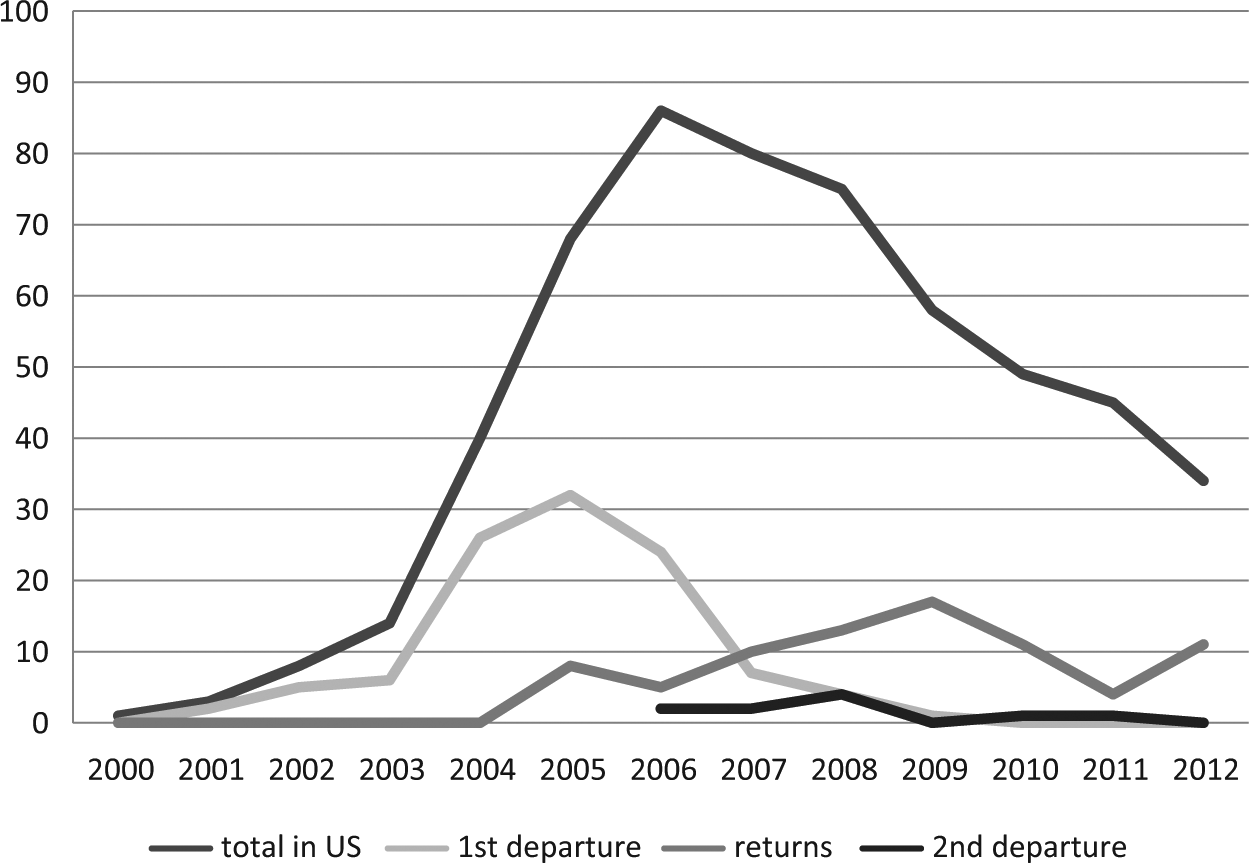
Ch’ul Osil migrant flow: Departures, returns, and total in the United States, 2000–2012.
Even more noteworthy than the sudden flood of migration from highland Chiapas to the United States, however, was how suddenly it ended. After the euphoria of 2004–2006, the number of migrants from Ch’ul Osil fell sharply: seven in 2007, five in 2008, and one in 2009. What had happened was that the U.S. market for sub-prime mortgages had collapsed in mid-2006, followed almost immediately by the collapse of new home construction. By 2007 housing starts had fallen 25 percent from their 2006 peak. By the spring of 2009 the decline was approximately 75 percent (American Business Analytics and Research, 2012; National Association of Homebuilders, 2012). While some 1.65 million “foreign-born Hispanics” were employed in construction in 2004, the housing boom of the mid-2000s had driven that number up to 2.25 million by 2006. Of these, approximately 850,000 were “newly arrived Hispanics,” new undocumented workers who had entered the United States after 2000 (Pew Hispanic Center, 2007: 4–7, esp. Table 3). New hiring finally stopped late in 2006; during 2007 a quarter of a million Hispanic construction workers lost their jobs (Kochhar, 2008: 9–19). 16 In another year, most of the rest of the foreign-borns were also out of construction. As these more than 2 million workers fell back from relatively well-paying construction work to other sectors, especially to services (restaurants, car washes, yard care) and agriculture, competition for those jobs, which had until late 2006 often been filled by relatively less-skilled newcomers like the young men from Ch’ul Osil, became much stiffer. According to testimonies, both hours and hourly wages in all kinds of work declined after mid-2006. By the spring of 2007, many Ch’ul Osil migrants were reduced to accepting casual jobs that lasted only one or two days, often waiting a week or more for another. Back in Chiapas, by the summer of 2007 our friends reported that their husbands and sons in the southeastern United States were eating irregularly, and some had heard that other Chamula men, although none would say their own relatives, were sleeping under bridges.
Trapped in the North, 2006–2008
Despite the new hardships, at least at first most of Ch’ul Osil’s undocumented did not go home. The first and most compelling reason was debt. The largest number of the migrants had just gone north in 2004–2006. Most had borrowed around 20,000 pesos (US$2,000) before leaving Chiapas, both to pay for the trip and to leave something with their families. During the early years of the migration, when the cost had been slightly less (see Table 1), repaying the loan and accumulated interest had taken approximately a year and a half. At best, then, the migrants who left in late 2004 and early 2005 would have been just clearing their debts when the slowdown started in mid-2006. The new migrants from mid-2005 on, meanwhile, were still in the midst of paying. Very few of the 82 migrants from the boom of 2004–2006, in other words, would yet have begun to reap the benefits of crossing the border. If they were to justify the debt and strain of their trips, they had to hold on, hoping for a return to full-time work.
Loans for Undocumented Migration (in pesos) in Ch’ul Osil, 2001–2009
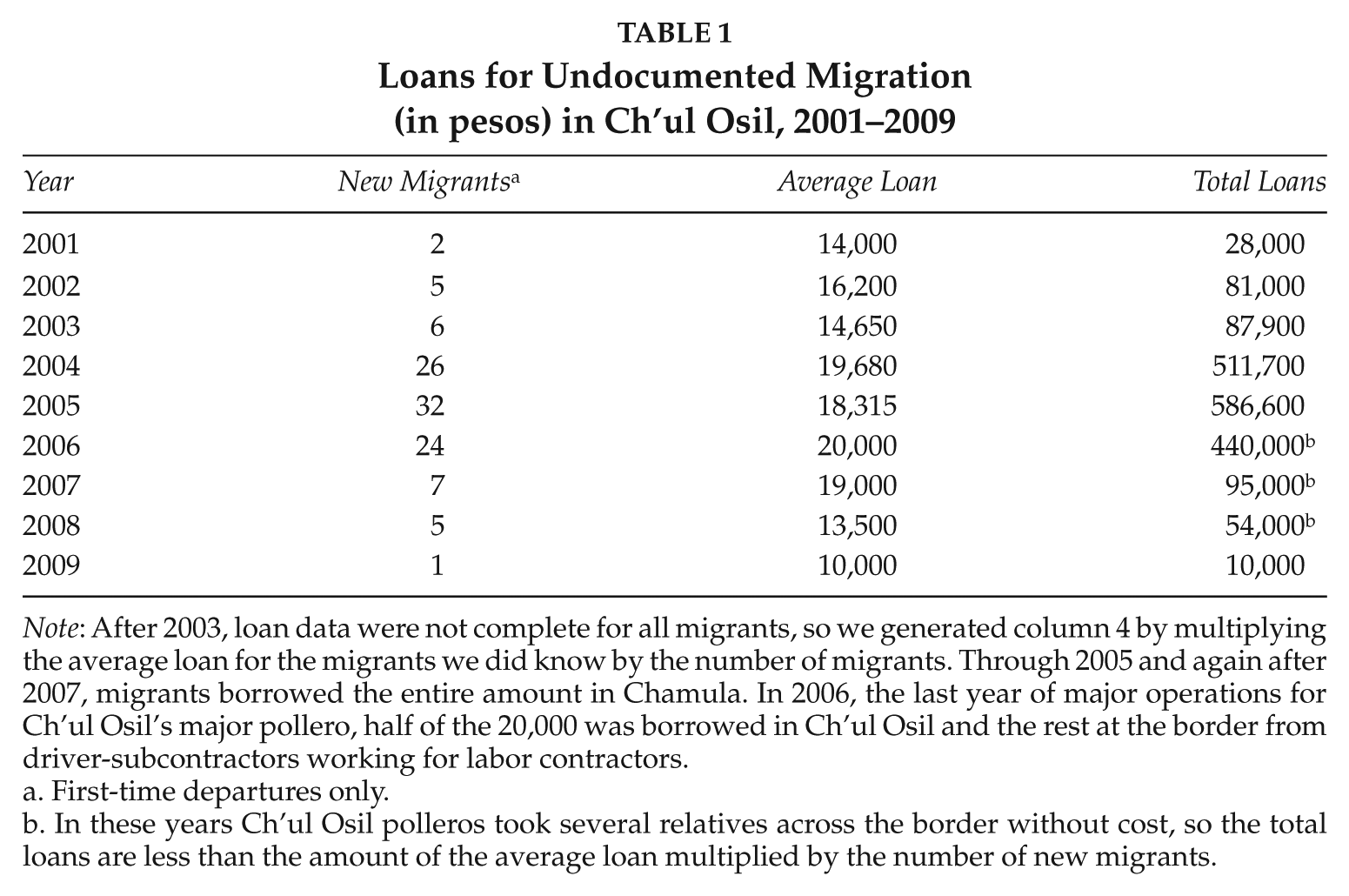
Note: After 2003, loan data were not complete for all migrants, so we generated column 4 by multiplying the average loan for the migrants we did know by the number of migrants. Through 2005 and again after 2007, migrants borrowed the entire amount in Chamula. In 2006, the last year of major operations for Ch’ul Osil’s major pollero, half of the 20,000 was borrowed in Ch’ul Osil and the rest at the border from driver-subcontractors working for labor contractors.
First-time departures only.
In these years Ch’ul Osil polleros took several relatives across the border without cost, so the total loans are less than the amount of the average loan multiplied by the number of new migrants.
The second reason the migrants lingered in the United States, a direct effect of their debts, was that they would lose the collateral on their loans, usually their families’ houses and/or land, if they returned to the hamlet before repaying. The customary rule in Chamula is that lenders do not confiscate collateral as long as the debtor is away working, trying to pay. 17 Families are allowed to continue living in their houses and using their land. When the debtor comes home, however, unless other arrangements for repayment are negotiated the debt is due. If it is not paid or a schedule for repayment cannot be worked out, lenders can get help from the ayuntamiento (town council) to foreclose. As long as they could, then, borrowers stayed away.
The third reason many did not return was that they were aware of the rising cost and risk of recrossing the border. Enforcement on the U.S. side and crime on the Mexican were well known to be increasing after 2006. To go home in the face of declining job prospects in the United States in the hope of returning later, when it would surely be even harder to get across, was therefore for most not an option. If the dip in work opportunities could be waited out, at least in 2006–2008 it appeared a better idea to wait in the United States. Ironically, increased border enforcement thus trapped many in the North who would rather have gone home.
Finally, the fourth reason the migrants stuck it out was their awareness, via regular cell phone contact, of worsening job prospects at home. The local economy in Chiapas after 2006 was no better than it had been when the migrants went north. After 2008, with steep declines in tourism in Chiapas as a result of the world economic crisis, anxiety about drug violence, and the swine flu panic of 2009, many Ch’ul Osil families judged a bad economic situation to be steadily deteriorating. 18
Thus the migrants stayed on, lasting it out. Although many of our friends who had chatted so positively about migration just a year or two before were reluctant to talk about their troubles after 2006, total remittances had diminished and for many families all but ceased. Indeed, by the summer of 2007, a new kind of financial story was being whispered in the community. Some families, it was said, were sending their own meager cash incomes, as little as US$50/month, mostly from government programs meant to provide food to mothers and children in “extreme poverty,” to their sons and husbands in the United States to help them hang on until the job market improved. 19
But not all families were so understanding. By 2007, with 80 people in the United States, 50 had been away for two years or more. Families, especially wives, who had often waited through a first year or two of meager remittances while their husbands paid off their travel loans, were often suspicious when funds dwindled or stopped arriving altogether in the summer of 2006. At the same time, many men also stopped calling their families regularly. Accounts from inside the community, so hopeful through 2005, turned darker as the crisis in the United States deepened. At least at first no one comprehended the state of the U.S. job market. Instead stories spread among neighbors that migrants had found new girlfriends or wives or were drinking or even that men and boys who had faithfully sent remittances for a year or two had actually never been good workers and were now making only enough effort to satisfy their own needs.
When Ch’ul Osil’s migrants finally did begin to come home in significant numbers in the final months of 2008, their propensity to give up on the United States varied to some extent according to age, gender, and marital status (Figures 2 and 3). Of the 63 men who were older than 21 when they first crossed the border, 48 (76 percent) were still there in 2008. Not until two years after the onset of the employment crisis, in 2008, did large numbers start to give up, leaving only 17 (27 percent) by the end of 2012. Meanwhile, although relatively fewer 14–20-year olds (33) had ever gone north, 12 (36 percent) were still there in 2012. If we divide the age categories slightly differently—26 and older and 25 and younger—the contrast between the older and younger migrants is even more pronounced. Of the 35 men 26 and older who went north, only 3 (9 percent) were still there at the end of 2012 compared with 26 of 61 of those younger than 25 (43 percent). These numbers confirm what community members said in interviews—that older, married men (all of those 26 and older when they migrated were married) had gone to the United States with the specific, urgent intention of making money and saw less and less reason to stay as that became more difficult. They were not paying their debts and not sending remittances to their families, and, perhaps more important, with reverse remittances many felt they had in fact become a drain on the fragile resources their wives and children needed to eat. Men younger than 25, only 53 percent of whom were married when they went north, had a greater propensity to stay on. Married or not, more than half appeared willing to try to ride out the economic downturn. 20

Number of Ch’ul Osil migrants in the United States by age at migration (men) and gender.
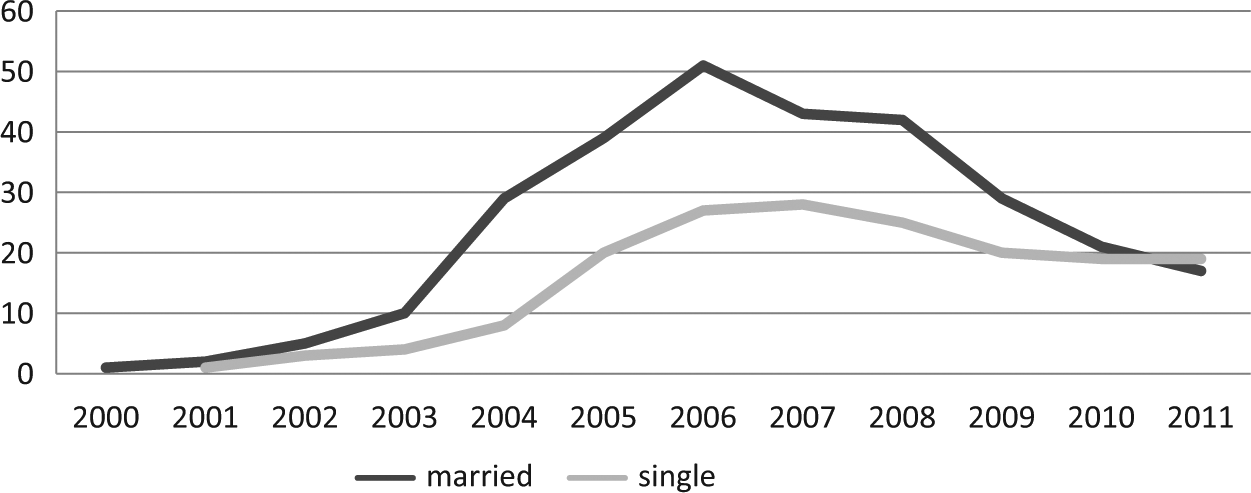
Ch’ul Osil migrant marital status at time of first entry to the United States.
Finally, the relatively few female migrants had as high a propensity to stay in the United States as the young men. Of 12 Ch’ul Osil women who ever crossed the border, 5 were still there at the end of 2011. All of them had husbands and U.S.-born children, and with each passing year it appeared less and less likely that they would return to Mexico voluntarily.
Coming Home
Beyond differences of age and marital status, the time of the migrants’ trip north with respect to the crises of 2006 and 2008 and whether they had made a profit or were still in debt seem to have been the biggest factors in their decisions to stay or to return home. Looking at the returnees by years, they fall into four categories: (1) those who returned in mid-2006 and earlier, (2) those who returned from late 2006 to 2009, (3) those who returned in 2010–2012, and (4) those who were still in the North in 2013.
The six who returned before the summer of 2006, while there was still money to be made, were all victims of misfortune. Four were caught by the Border Patrol early in their stays, before they even had a chance to pay their debts. A fifth had his leg crushed in a tractor accident soon after beginning work in Florida. The farmer readily put up money to send him back to Mexico but gave no indemnification or medical expenses, and the injured man came home still owing 16,000 pesos. The sixth was an alcoholic who returned to Ch’ul Osil within six months of going north, having made no money and still owing all of his fare.
The 33 men who came home between late 2006 and 2009 had the most mixed results. Twenty-nine of them had gone during or after the years of the boom—10 in 2004, 16 in 2005–2006, and 3 even later. The last 19 in particular had struggled during their entire sojourns in the United States to find enough work to make payments on their travel debts. Many were the subjects of rumors in the community about their families’ sending reverse remittances to maintain them in the United States. At the end of 2012, only 5, all from the earlier months of the boom years or before, had come home with savings and been able to build new houses and buy cars that they operated as taxis. Another 7 had eventually managed to pay their debts while they were still in the United States and send regular remittances to their families. All of these men essentially returned to the lives they had left, living in their same houses and looking for work in Chiapas but debt-free. Twenty-one, however, came home still owing large amounts of money. Three of these, after visiting their families and seeing that there was still no work in Chiapas, secured new loans from labor contractors at the border and went back to the United States A fourth, unwilling to migrate again, gave up his house and his inherited land and moved with his family to the colonias of San Cristóbal, where he now works as a chiclero (candy vendor). The other 17, hoping to save their families’ places in Ch’ul Osil, left home again by themselves to become full-time chicleros in tourist destinations around southern Mexico. Nine of these were mature men, 31–53 when they came home, all married, all with several children. Working as street vendors would have been a last resort for all, but it would have been particularly hard for these older men, who nevertheless had little choice if they wanted to save their houses and land.
The last of the migrants, 15 who returned home from 2010 through 2012 and 29 still in the United States in 2013, appear to be a slightly better-adapted, more successful group. Of the 10 returnees from 2010 and 2011, 3 had saved enough money to build better houses and buy taxis when they came home. Another, a boy who had labored from age 15 to 20 as a migrant farmworker to pay off his alcoholic father’s debts, had also saved a little for himself and had built a house and begun looking for wife when he returned in 2011. Six, however, despite having managed small remittances over the preceding three or four years, still came back to significant debts. Within months of returning, 2 had taken out new loans and gone back to the United States, and the other 4 were working as chicleros in cities of Mexico’s Southeast. Finally, of the most recent (2012) cohort of returnees, all 5 had sent regular remittances in their last years, and at least 4 had enough savings to begin building new houses on their return.
As for the 29 men who remained in the United States in 2013, the most notable thing about them as a group was their youth when they crossed the border. Only 3 had been older than 25. Of the rest, 12 had been adolescents. These men had fewer wives and children to tie them to their community of origin and essentially had come of age in the United States. 21 By 2013, 17 had been there at least eight years and the other 12 no less than five. As might be expected of men who have not come home in so long, they tend to be described by their families as having made significant adjustments to life in the North. Three are said to get along in English. Four are known to have married women they met in the United States and started families. A couple of others, in their early 20s and married when they left, are reported by fellow migrants to have found new wives and to have no plans to return to Chiapas, although at least one still supports his first wife and two children in Ch’ul Osil. Indeed, despite their long absences and the divorces of 5 of them, 8 of the 11 who were fathers when they migrated still remit money regularly to their wives or ex-wives and children, and 12 of the 16 who were unmarried still send money to their parents. Only 5 of the 29 no longer maintain contact with their families and are essentially “lost.” As a group, considering the length of time they have been away and the fact that all seem to have settled down on the other side of the border, their continuing commitment to their families is noteworthy.
Financing Migration, Inequality, and Lingering Debt
If undocumented migration represented new opportunities for Ch’ul Osil’s unemployed and underemployed workers to work and get ahead in the early 2000s, at least at first it was a bonanza for lenders. The first undocumented Chamulas we knew of, in the early 1990s, walked across the then relatively unprotected border a few miles from downtown Tijuana at a cost of just US$200–300 apiece (Rus and Guzmán, 1996). As the United States tightened controls, however, erecting barriers near major cities and driving migrants out into the mountains and desert, the complexity of crossing increased, and with it the expense. This had a number of tragically ironic results.
The first and greatest of these was that, as the cost increased, migrants had to borrow larger and larger sums. By 2001–2002, when the first Ch’ul Osil migrants joined the flow, the cost had risen to 15,000–20,000 pesos (US$1,500–2,000) each. This was more than all but a handful of extended families could muster from their own resources and forced potential migrants into the hands of local moneylenders. At the 10 percent/month simple interest that Chamula lenders charged, 10 percent of the outstanding balance was added each month to the total that had to be paid back. Thus if a migrant with a 20,000-peso debt was fortunate enough to be able to pay 2,000 pesos/month beginning the first month, it would take 10 months to pay the principal. But by that time the diminishing simple interest accruing each month (2,000 + 1,800 + 1,600 . . . ) would have come to another 11,200 pesos, or, continuing at 2000 pesos/month, an eventual total of 16 months and 31,200 pesos. If very many months of payments were missed, however, particularly at the beginning when interest was being added at the rate of 2,000 pesos/month, the migrant could quickly find him- or herself with an unpayable debt.
Ironically, if the purpose of tightening controls at the border was to discourage people like those of Ch’ul Osil from entering the country, given their desperation to get to where they could work the effect was rather to indebt them, forcing them to stay a year or two just to cover the cost of the trip and then another year or two to make a small profit for themselves. Since they had to keep up their payments and eat throughout the year, as their first season as agricultural laborers ended many began looking for nonagricultural jobs to get through the winter. 22 Stricter border enforcement and the debt it engendered, in other words, compelled migrants to stay longer than they might have wished and drove those who started in agriculture to find other work—all of which, in turn, continually opened vacancies in agriculture to entice new waves of workers across the border.
This shift from agriculture to off-farm work after a season or two in the United States describes the more successful of the Ch’ul Osil migrants. Although our knowledge of the work histories of the migrants still in the United States is incomplete, those who came home with savings had for the most part spent the years after 2005 off the farm. Long-term—that is, year-round—jobs reported by these more successful returnees included working in ethnic markets, washing dishes and cooking in restaurants, working in chicken-packing plants and small factories, and doing such maintenance-related jobs as yard care and painting. The great majority of those who returned home between 2006 and 2009 still in debt, in contrast, had worked only as migratory agricultural laborers and had been forced to spend their savings or go farther into debt to get through the winters.
The ironies and tragedies of debt-financed migration continued at the point of origin, in Ch’ul Osil. First of these was that the initial benefits of undocumented migration and the remittances it generated served not to lift the migrants’ families out of poverty, as many analysts believed, but to enrich moneylenders (IADB, 2006; Kapur, 2003; Ratha, 2003). As Table 1 shows, in 2005 the new migrants had borrowed a total of 586,600 pesos. If all had managed to pay back 2,000 pesos/month, they would have been debt-free 16 months later at a total cost of some 832,500 pesos—all of which, of course, would have gone to moneylenders, including 246,000 pesos of profit on their loans. 23 Empirically, however, we found that just before the collapse, in late 2005, the migrants from 2004 were only remitting an average of between 1,140 and 1,640 pesos/month, while the new arrivals were sending only 530–750 pesos/month. 24 Therefore virtually all of the migrants from 2004 on would still have been paying down their loans when the employment crisis hit in mid-2006. In fact, they would have been steadily losing ground to their accumulated interest. Perhaps more significant, even if their families managed to skim a small portion of the remittances for themselves, virtually all of the money sent back by the large number of 2004–2006 migrants would still in mid-2006 have been going to lenders. In 2005, we found that although five men were making loans in the community, two, both of whom had become polleros, were doing the bulk of the lending. We and our aides calculated that, between their fees for guiding migrants north and their lending, one of them was making more than 80,000 pesos/month (US$8,000!) in 2005 and the other approximately 24,000 pesos/month (Rus and Rus, 2008: 369–373). The other three lenders were profiting less than 10,000 pesos/month.
When the migrants began sending less and less beginning in mid-2006, however, and then many stopped altogether, their misfortune quickly engulfed the lenders as well. While just five men lent to other than family members in mid-2005, by the end of the boom in 2006 several more of Ch’ul Osil’s better-off residents were reportedly lending money that they had borrowed at a discount from major moneylenders in the cabecera of Chamula. By 2008–2009 many of these opportunistic lenders were in default, in some cases that we heard about incidentally for more than 100,000 pesos. 25 Many were reported to be hiding from their creditors and some to have fled. Among those who had left was the lender-pollero who had made 80,000 pesos/month in 2005. At last report, he had become a chiclero on the streets of Oaxaca and faced physical harm from his creditors if he were to return to Chamula.
If the total borrowing in Ch’ul Osil between 2004 and 2006 was approximately 1.5 million pesos (see Table 1), what would that debt have grown to by 2007 and later years if most had stopped paying? Double? More? Our guess is much more. Unfortunately, although community members talked freely about how much migrants had borrowed before 2006 when migration was still considered a good investment, as debt began to get away from the migrants and their families information became much harder to obtain. Not until migrants came home still owing money and having to find a way to make payments or lose their property did the debt, or at least its effects, again become visible.
Most of the Ch’ul Osil migrants, again, had put up their families’ modest houses and/or land as collateral for their loans. When migrants began to drift home in 2008, those still in debt were forced to depart again almost immediately to do the one job available to them, becoming chicleros. And therein lies one of the continuing tragedies of undocumented migration in Ch’ul Osil: the removal from the community of men not just during the long years they spent in the United States but years even after they returned to Mexico.
Long-Term Impacts on Family and Community
From the end of the nineteenth century to late in the twentieth, the people of Chamula and the other Tsotsil and Tseltal communities of Chiapas’s central highlands became accustomed to the prolonged seasonal absences of most men. Women stayed home, isolated as much as possible from exploitation and mistreatment by the surrounding mestizo society. In the fastness of Chamula’s mountains, they raised their children and tended their families’ houses and gardens. Men brought home money and food from their migratory labor and during their stays at home planted and harvested their local fields.
But what if men are absent for longer and longer periods or do not come home at all? As we would expect, family and community life have been restructured in significant ways by the changes of recent years and are still being restructured. With so many women, both single and married, left behind, life and work in the hamlet have become increasingly “feminized,” women assuming the agricultural and other heavy work formerly reserved to their husbands, brothers, or fathers. With even men’s monetary contributions uncertain in many families, women’s participation in the cash economy, a novelty and “supplement” 20 or 30 years ago, has become essential, established, and routine (Rosenbaum, 1993; D. Rus, 1990; J. Rus, 2012: 77–86).
The large numbers of children left by migrants are also growing up in circumstances not experienced by earlier generations. The average stay in the North of all 108 Ch’ul Osil migrants was 5.2 years. During these long absences, most of their 214 children were looked after by their mothers, but in 50 cases the children’s mothers were also gone for long periods, for the most part selling artisan products in tourist destinations, and the children were left with their grandparents. That members of extended families live close to each other is one of the strengths of Chamula communal life and a feature that has made it possible for men to migrate seasonally, knowing that their wives and children would be looked after. Nevertheless, these children have become the first large group in anyone’s memory raised primarily by neither of their parents and with little contact with working-age men, and the long-term effects are yet to be seen.
Finally, family relationships have also been altered since the late 1990s by the several forms of “direct assistance” offered to families in “extreme poverty” by the federal and state governments. Foremost of these is Oportunidades (1998–), a federal program that gives money to women with children in the form of becas (scholarships) as long as their children remain in school. Oportunidades also provides food aid to pregnant women and women with toddlers. Of the 53 migrant families with children in our sample, we were able to obtain information about participation in Oportunidades and other government programs for 44. Forty received scholarships during their children’s school years. All 40 had also received other subsidies, among them construction materials to improve their houses and build latrines, landline telephones, and fertilizer and agricultural inputs. The monetary aid of Oportunidades, in particular, which provides a woman with four school-age children an income approximately equal to the earnings of an agricultural worker making the minimum wage in Chiapas, is agreed by most to be the difference between eating and not eating for their families. 26 Interestingly, the implementation of the program paralleled the rise of U.S. migration, and discourse in the community suggests that as couples realized there would be a secure income coming into the household, married men were enabled or even encouraged to leave. At the same time, to receive monthly grants a mother has to register in her home community and then remain there with her children; aides from local communities regularly verify the recipients’ presence. If a woman leaves to work she can be disqualified from receiving funds, and if she moves to be close to a job it takes a year or more to reregister in her new locale. So even as Oportunidades in a sense “frees” fathers to migrate, it ties mothers to their registered place of residence. 27
Given this combination of male absence due to both migration and the debt resulting from migration, and government encouragement, intended or not, of fixed, permanent residence for mothers and migration for fathers, how have the marriages of the U.S. migrants fared? Sixty-six men (69 percent of the 96 men), and 8 women (67 percent of the 12 women) from Ch’ul Osil were married when they crossed to the United States. Of these 74 married people, 34 (or 46 percent) had marital problems amounting to divorce, often followed by remarriage, during their years away from each other.
To understand these dynamics, we looked at two variables. First, we related marriage breakups to time apart and found that migrants in the United States under two years experienced marriage breakups in 39 percent of the cases, while for those there from three to five years the rate rose only slightly, to 41 percent. For those who stayed in the United States six years or more, however, breakups rose to 53 percent. Since the average stay of our migrants was over five years, clearly many would experience great marital stress during their absences.
Second, we attempted to relate marriage breakdown to the specific years migrants returned home. We suspected that migrants who returned during 2007–2008, when they were having most difficulty repaying their debts and remitting money to their families, might also have a higher incidence of divorce. What we found was that those who returned to the hamlet before 2007—that is, those whose U.S. sojourns were largely completed before the 2006–2008 crisis—had a 33 percent rate of divorce. Those who returned in 2007–2008, in the midst of the crisis, had a divorce rate of 53 percent, and those coming back in 2009–2011 had a rate of 40 percent. Thus, it seemed that the more difficult years of downturn in the U.S. economy contributed to marital friction.
When people in the hamlet talked about marriage stability, they often referred to whether the couple was talking by cell phone. Virtually all of the migrants had access to phones or cell phones, often at first through labor contractors or fellow workers at the camps where they lived. Later many paid for plans that allowed them inexpensive calls to Mexico on Sundays. From the fall of 2006 through 2008, many began calling less frequently or stopped altogether. At the same time, remittances were tailing off. In retrospect, it is clear that many migrants had less money and may have had to give up their cell phone contracts or may simply have been embarrassed that they were out of work or not making much. Many families, however, interpreted sudden silences as evidence that something had interfered with the migrant’s resolve to stay in touch. We heard quietly from intimate friends that when less frequent calls did come during these years they sometimes devolved into angry, suspicious questioning about why contact had become so hard, and anxious accounts of the hounding of increasingly insistent lenders.
Even beyond men’s and women’s private doubts about their partners’ fidelity in such difficult circumstances, gossip in communities like Ch’ul Osil can be brutal, especially in times of stress. In several widely discussed cases husbands and wives were pulled apart, or almost pulled apart, by rumors. A mother of three who got through the crisis of 2007–2008 by carrying artisan goods to the Gulf Coast city of Villahermosa to sell on street corners, for instance, was whispered to be making her money as a prostitute—a story that got back to her husband. Fortunately, when he came home in early 2010 they reconciled, and he joined her in business there selling artisan products. In four other cases that were dissected in elaborate detail, women whose husbands had stopped sending money and fallen silent found new mates—in one case the husband’s brother. In two instances, these relationships led to death threats when the migrants returned to Chiapas and to the departure from the community of one or more of the people involved. This was the outcome with the crossed brothers. The original husband threw his wife out of the house that his remittances had built, kept their young children, and found a new wife. His brother escaped to the United States and has not been heard from. There were also two suicides in the community during the years of crisis, one of a man who came home after years of sending remittances to find his wife pregnant and the other of an unmarried young mother whose boyfriend abandoned her to return north.
Among migrants who were still in the United States in 2012, 13 of the 29 men had been married when they left Chamula, and of these 7 (54 percent) had gotten divorced, a figure comparable to the rate of divorce of migrants overall. Meanwhile, of the 5 women still in the United States in 2012, 2 had gone north to escape the husbands they abandoned in Ch’ul Osil, while 2 others had gone to reunite with their migrant husbands and had subsequently separated from them. All 4 of these women had left children with their own parents, the children’s grandparents. All had subsequently married new men in the United States, as had the one woman still there who had been single when she migrated. The divorce rate among women still in the United States was therefore80 percent.
In sum, the long absences and the eventual collapse of undocumented migration from Ch’ul Osil left a deep mark on the community’s families. At the end of 2012, four years after the last migrant crossed the border, of 108 mostly young people who had ever gone, 29 men and 5 women were still there. Of those who had come home to Mexico, 23 men now lived outside of the community essentially permanently as they struggled with debts from the trip, many of those debts by this point nine years old. Of the 51 who had come back to the community, 24 were divorced from those who were their spouses when they left home between 2001 and 2009.
With that we come to the last and perhaps most pathetic effect of U.S. migration on the people of Ch’ul Osil. The absence of such a large group of young men, eventually 41 percent of the 15–34-year-olds, over a period of several years left a large number of young women unable to marry and form their own households. Marriageable, proper Chamula girls are expected to remain close to home, under the watchful eyes of their elders, until they move into the households of their husbands, usually between the ages of 15 and 20. Historically they have not migrated or left the community by themselves even to go to market. As the draining of men progressed, by 2008 Ch’ul Osil had become an overwhelmingly feminized place, with dozens of wives without husbands and dozens of young unmarried women. It was a topic of conversation even for the two of us, as in our visits Diane took the lead in random encounters and, in the absence of men, Jan was more and more limited to talking to our comadres and their daughters. And then in 2009 we heard of the revival of the old custom of plural marriages. Historically, Chamula men who could support more than one family have been able to marry more than one wife. It is a practice undoubtedly related to the excess of women in a community of migratory male workers that in every generation lost men. But the custom had almost died out by the 1980s and in more recent years had been considered embarrassing, even ugly—a subject of joking. By 2010, however, we knew of 18 new cases. Beyond their original wives, the men involved had married a total of 23 teenage women, 8 of them younger than 15. In a community without young men, becoming a second or third—or, in one case, fifth—wife was a girl’s only choice if she wanted to be married and not break with tradition entirely. 28
In the Wake of the Migration Boom
Despite the enthusiasm our friends in Ch’ul Osil felt for U.S. migration in the early 2000s, we from the beginning felt trepidation and, when asked, counseled caution. But the difficulties we foresaw were those widely associated with undocumented labor in general—the strain of extended separations, the dangers of the border, and the vulnerability of working without papers in the United States. What we did not foresee was the magnitude of the rush to the North from 2004 to 2006 and the collapse of demand that left migrants stranded on the other side of the border thereafter. Although we wrote early on about the debts to which Ch’ul Osil workers were tying themselves and the inequality it was fostering in the community, 29 neither did we foresee the devastating aftereffects of unpaid, unpayable debt on the migrants themselves, their families, and the community as a whole.
What is the tipping point of community survival? After observing Ch’ul Osil over the last four decades, we are struck by how profoundly the last 10 years have changed the community’s landscape. Through previous earthquakes—from the crash in plantation agriculture in the 1970s through the national depression and “lost decade” of the 1980s to the elation of the Zapatista Rebellion, followed by the use of aid to divide communities and foster dependency—the people of Ch’ul Osil managed time after time to right themselves and survive as a community. When migration to the North suddenly presented itself in the early 2000s, it seemed to offer a chance to get out of debt and for the first time even experience economic security. With excitement and a good measure of stoicism, knowing full well that they would encounter hardships, the Ch’ul Osil migrants and their families set out for an unknown future. Little did any of us know that factors beyond their control—the increasingly controlled border and the economic downturn in the United States—would affect them as deeply as they did. Migrants who had assumed enormous financial obligations and taken incredible physical risks in order to participate in an “illegal” underground and underpaid U.S. economy were suddenly left high and dry, cut off across the border. They bet the house, and many lost. Many still cannot come home.
With men gone, families in disarray, children growing up without their parents, a deepening chasm between rich and poor, and individuals and families on the move looking for ways to feed themselves, how well will they come through their current crises? Will there be a future for Ch’ul Osil’s traditions, language, clothing, foods, habits, and mores? What will be the cost of repairing the damage? What might be the cost of channeling individual and communal confusion, anger, and cynicism? Why should the people who are the most vulnerable be asked to bear the burdens of a migration policy that allows them to get into the United States when their labor is needed but takes no responsibility for their well-being when it is not? Ch’ul Osil migrants are brave, intelligent, and hardworking, with aspirations to lead a life of dignity and stability. They deserve our attention.
Footnotes
Notes
Diane L. Rus is a research associate and Jan Rus a research professor at the Centro de Estudios Superiores de México y Centroamérica, Universidad de Ciencias y Artes de Chiapas in San Cristóbal de Las Casas. They thank their collaborators in Ch’ul Osil, who worked with them over the years on the migrant survey and helped analyze the results. For comments on earlier versions of the text they also thank Laura Velasco Ortiz, Dolores París Pombo, Daniel Villafuerte Solís, María del Carmen García Aguilar, David Stoll, Richard Stahler-Sholk, Marjorie Bray, Rosalind Bresnahan, and George Leddy.