




Abstract
The integration of Latin America and the Caribbean is a disputed process. In the new phase of integration represented by the Alianza Bolivariana para los Pueblos de Nuestra América and the Unión de Naciones Suramericanas, the control of natural resources has acquired central importance in a global scenario characterized by hegemonic reconfiguration and a tendency toward the creation of a multipolar world. For the integration to be viable, it must overcome the extractivist model and establish new forms of state-society relations.
La integración de América Latina y el Caribe es un proceso disputado. En la nueva fase de integración representada por la Alianza Bolivariana para los Pueblos de Nuestra América y la Unión de Naciones Suramericanas, el control de los recursos naturales ha adquirido una importancia central en un escenario mundial caracterizado por la reconfiguración hegemónica y una tendencia a la creación de un mundo multipolar. Para que la integración sea viable debe poderse superar el modelo extractivista y se deben poder establecer nuevos tipos de relaciones entre Estado y sociedad.
This study of the new phase of integration in Latin America and the Caribbean, focusing on the Alianza Bolivariana para los Pueblos de Nuestra América (Bolivarian Alliance of the Peoples of Our America—ALBA) and the Unión de Naciones Suramericanas (Union of South American Nations—UNASUR), highlights the importance of natural resources as a spur to strategic integration in a global scenario characterized by hegemonic reconfiguration and the emergence of a multipolar world. Taking a world-systems perspective and employing geopolitical analysis as a general theoretical framework, the article has six sections. The first section is dedicated to the reconfiguration of the world and regional order; the second examines the ALBA and the third the UNASUR; the fourth treats the importance of natural resources in this new stage of capitalist development; the fifth points to the main risks and challenges of this new integration; and the last argues that the integration being carried out by the ALBA and the UNASUR is a disputed process and that, for it to be viable, it must overcome the extractivist model based on the intensive exploitation of natural resources and establish and consolidate new forms of state-society relations.
Toward a New Global and Regional Order
The new mechanisms of integration and South-South cooperation that emerged in the first decade of the twenty-first century in Latin America and the Caribbean, conditioning a multidimensional systemic crisis that determines the scope of national and regional policies, continue to be deployed amidst multiple tensions, the product of struggles in which various competing interests converge and pose new and complex challenges. This global instability and uncertainty has brought about the formation by governments that share economic, political, and ideological interests of regional blocs.
The emergence at the end of the twentieth century and in the first decade of the twenty-first of important social and political movements that opposed the application of neoliberal policies in their respective countries led in a number of cases to the assumption of political power and the control of the state by governments with a centrist or center-left orientation that have been ratified by their populations in successive democratic elections and in some cases have managed to advance in the construction of post-neoliberal scenarios (Figueroa, 2011). The change in the internal balance of power brought the possibility of creating other forms of relations as an expression of the new need for external connections derived from the conceptual, institutional, and functional rethinking of the role of mechanisms of integration and regional cooperation. With the creation of the ALBA and the UNASUR, a new stage in the development of mechanisms of regional integration seeking to overcome the markedly commercial character of the previous stages was initiated (Estay, 2014).
This new stage could be called “strategic integration,” since it not only differs from the proposals for regionalization pushed by Washington but also goes against the grain of neoliberal discourse in relying on a political economy that involves the active participation of the state in the promotion of development. This includes the redefinition of links to the outside, the defense of regional space, the recovery of autonomy, and, through the control and usufruct of natural resources, the reduction of inequality and social exclusion. It is also strategic in the framework of the disarticulation of the political architecture and power constructed by the victorious countries after World War II and the reconfiguration of the global geopolitical chessboard, in which both the ALBA and the UNASUR are pursuing growth with greater regional sovereignty.
In the following we provide a brief discussion of the ALBA and the UNASUR, emphasizing the aspects that reveal a clear strategic orientation linked with the control of natural resources.
The Alba
Although mechanisms of integration and cooperation in Latin America and the Caribbean such as the Central American Integration System (SICA), the Caribbean Community (CARICOM), the Andean Community (CAN), the Southern Common Market (Mercosur), and the Community of Latin American and Caribbean States (CELAC) have shown advances in institutional structure, it is in the ALBA and the UNASUR that a strategic integration has been emerging. Initially conceived as a political alliance between Venezuela and Cuba to resist the proposed Free Trade Area of the Americas, the ALBA broke with the neoliberal principles of foreign relations based on trade liberalization and the opening of borders, which sought to adapt the legal and regulatory frameworks of the Latin American countries to the U.S. geopolitical project. Based on the principles of solidarity, cooperation, complementarity, and mutual benefit, the ALBA 1 condenses and synthesizes the new political realities that are emerging in the region.
Made up of countries that to different degrees distance themselves from capitalism—among them Cuba, with its socialist strategy, Venezuela, with its twenty-first-century socialism, and Bolivia and Ecuador, with their novel positions of living well and the Citizens’ Revolution—the ALBA uses anti-imperialist language and seeks options outside the neoliberal framework in relations among member countries, with a state that is constituted as a fundamental political and economic agent. Almost a decade after it began operating, an assessment of it allows us to identify both difficulties and accomplishments.
In the social realm, the most representative achievement has been the extension of fundamental rights to education and health care through the social missions. Originating in Venezuela, these projects have been extended on a regional scale to member countries seeking to combat social inequality and construct more inclusive societies through organized community participation and the creation of citizen power. The social missions entail new forms of state-society relations based on a reconfiguration of the social fabric and the emergence of grassroots power in the context of a participative democracy. As international organizations have recognized, “in the dynamic of the missions people lose their anonymity. In their daily lives, they are transformed into citizens who acquire visibility as themselves, taking on projects and, most of all, sharing with others a sense of belonging and a way of life, not just a transitory experience in a particular situation or conjuncture” (Organización Panamericana de la Salud, 2006: 68) In education, more than 1.5 million people have become literate, allowing Venezuela, Bolivia, Nicaragua, and Ecuador to join Cuba as areas free of illiteracy, while in health the achievements include free care for nearly 2 million patients with ophthalmological problems as part of the “Miracle Mission” (Secretaría Ejecutiva del ALBA-TCP, 2010).
In the financial and monetary realm, two new institutions have been established to construct a regional monetary-financial space designed to reduce the impacts of the international financial crisis: the Sistema Unitario de Compensación Regional de Pagos (Unitary System of Regional Compensation Payments—SUCRE) and the Banco del ALBA (ALBA Bank—BALBA). SUCRE, in which Bolivia, Cuba, Ecuador, Nicaragua, and Venezuela participate, is a mechanism for the channeling of international payments in the course of trade among member countries. The system is based on the use of a virtual currency called the sucre, administered by the countries’ central banks, while local payments to exporters and importers’ charges are made in the local currencies. Having begun operations in January 2010, the system has grown from 6 transactions in 2010, amounting to just over US$12.5 million, to 5,178 transactions amounting to over US$2.25 billion at the end of 2013 (Secretaría Ejecutiva del Consejo Monetario Regional del SUCRE, 2014). The gradual acceptance of the sucre at the regional level contributes to monetary and financial sovereignty by fostering a decoupling of transactions in the region from the dollar.
The Banco del ALBA, which began functioning September 1, 2009, is the other pillar of the region’s new monetary-financial architecture. Disposing of subscribed capital of US$850 million, the bank includes Bolivia, Cuba, Nicaragua, Saint Vincent and the Grenadines, Dominica, and Venezuela (Jefes del Estado y Gobierno del ALBA, 2008). The role of the bank is contributing to the financing of projects that pursue sustainable economic and social development, the reduction of poverty and inequality, and the strengthening of integration and the promotion of trade. In addition, it has been supporting the design and development of social, productive, and commercial projects between member countries such as those known as Great National Projects. 2 These are projects in which two or more ALBA member countries participate and cover a wide range of areas—social, cultural, economic, scientific, and industrial, among others. Among the most important are the Literacy and Post-Literacy Project, the Medicine Project, and the Culture Project. Actors such as the BRICS (Brazil, Russia, India, China, and South Africa) are taking steps in the same direction, creating financial institutions with greater autonomy such as the new development bank established at the Sixth BRICS Summit held in Fortaleza, Brazil, in 2014. 3
In the field of energy, the Petrocaribe initiative stands out for seeking to ensure cooperation on an integrated energy policy, incorporating oil and its derivatives, gas, and electricity, with the aim of guaranteeing a stable supply and a balanced energy matrix among the region’s countries. Created on June 29, 2005, and mainly promoted by Venezuela, the initiative includes 18 countries from the Caribbean and Central America 4 and involves a financial scheme that allows deferred payment and long-term financing. In addition, 9 countries have binational mixed state companies aimed at achieving energy independence (Table 1). The case of Petrocaribe is a clear example of the strategic character of the ALBA, considering the fundamental role of hydrocarbons—particularly oil and gas—in an international scenario characterized by uncertainty with regard to the supply of fossil minerals and increasing conflict over access to nonrenewable resources intensifies.
Mixed Corporations in the Framework of Petrocaribe
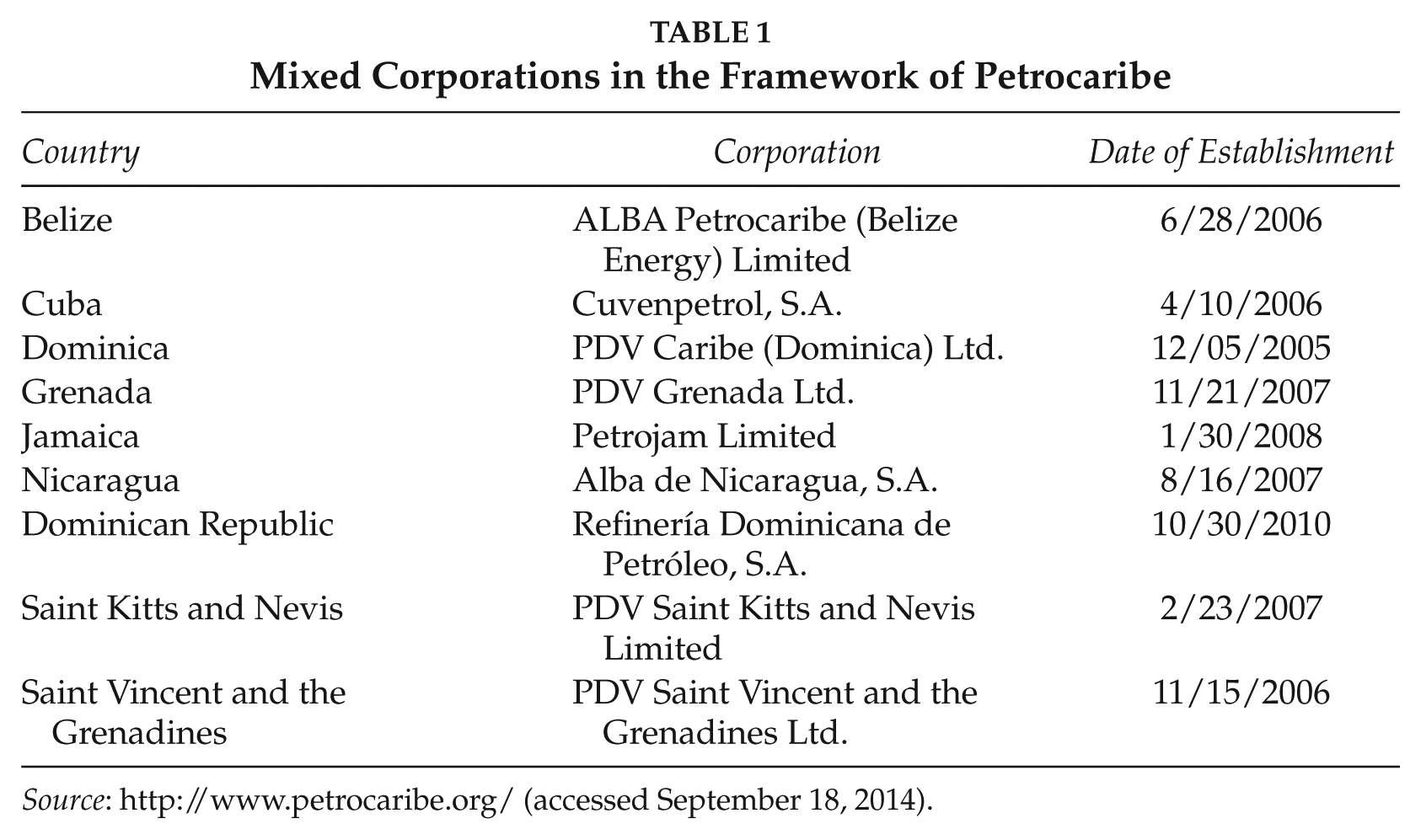
Source: http://www.petrocaribe.org/ (accessed September 18, 2014).
The Unasur
Formally established on May 23, 2008, by 12 South American presidents (Presidentes de América del Sur, 2008a), 5 the UNASUR has promoted agreements aimed at the resolution of regional conflicts such as the defense of the democratic order and constructed and consolidated a broad institutional structure. It has been creating a strategic vision of integration aimed at development that recovers the importance of natural resources as the dynamic axis of the process. It has strengthened its regional presence with actions such as the Moneda Declaration, issued on September 15, 2008, in the presidential palace in Santiago, Chile, where the South American presidents expressed their support of Bolivian president Evo Morales when he was facing the separatist efforts in the Media Luna and the Pando massacre (Presidentes de América del Sur, 2008b). A similar statement was made in connection with the coup d’état and sequestration of Ecuador’s president, Rafael Correa, on September 30, 2010. In a special meeting held October 1, 2010, in the San Martín Palace in Buenos Aires, the presidents signed the Buenos Aires Declaration, in which they asserted that their governments would not tolerate “any new challenge to the institutional authority or coup attempt against a legitimately elected civil power” and agreed to go to Quito to express their full support of Correa and the Ecuadorean people (Jefas y Jefes del Estado y Gobierno de la UNASUR, 2010). Again, on June 28, 2012, the UNASUR condemned the coup d’état perpetrated by the Senate in Paraguay against President Fernando Lugo and agreed to bar the Paraguayan representatives from participation in the UNASUR meeting to be held in Mendoza, Argentina, on the following day.
The UNASUR’s participation as a regional interlocutor has been strengthened by the adoption of common positions against foreign meddling such as the British military presence in the Falkland Islands (Estados Miembros de UNASUR, 2012) and the blockade imposed on Cuba by the United States for more than half a century and in support of Argentina’s efforts to restructure its outstanding sovereign debt (Jefas y Jefes del Estado y Gobierno de la UNASUR, 2014).
Its institutional structure includes the following sectorial councils: 6 Energy, Defense, Health, Social Development, Social Infrastructure and Planning, Drugs, Economy and Finance, Electoral, Education, Science, Technology, and Innovation, and Citizen Security, Justice, and Coordination of Actions against Transnational Organized Delinquency. This broad spectrum of issues reveals both the objectives of this regional mechanism and its strategic vision. Although all of these councils have established initiatives in their areas of competence, we will focus here on the Council of Defense and the Energy Council and their strategic components.
Among the actions carried out by the Council of Defense are a study of the military inventories of the South American countries, the establishment of policies to confront cyber threats, the design and development of a system of unmanned aircraft, and a proposal for a South American School of Defense. 7 Yet another is the establishment of the Center for Strategic Defense Studies, 8 with headquarters in Buenos Aires, Argentina, which promotes the identification of regional interests, challenges, threats, and opportunities for defense and regional security in the near as well as in the middle and long term. The center promotes the construction of a new shared vision that will permit the development of regional security policies.
The Energy Council has held a series of meetings at the highest level, with the participation of ministers of energy, oil, and related sectors, for the creation of an energy agreement. All of the South American countries have expressed interest in these meetings. Recognizing the great concentration of natural resources in the region, in particular its great reservoirs of oil and one of the largest of gas, as well as its great hydroelectric potential, coalfields, and bioenergy, which require the exercise of sovereign rights over these resources (Ministros de Energía, 2012), the council has also been working on a regional energy assessment. With the possibility of creating an UNASUR Institute of Energy Research under study, the council has been working with the Oficina Latinoamericana de Energía (Latin American Energy Office—OLADE), 9 emphasizing the necessity of sovereign management of natural resources by the UNASUR countries to guarantee national energy security.
Natural Resource Geopolitics
In a global context characterized by conflicts, tensions, and contradictions—in which the struggle for hegemony is condensed—access to and the management and use of natural resources becomes vital. These resources are effective supports of power, and therefore reviewing their role at this stage of Latin American strategic regionalism is imperative. Although the struggle for global leadership has political, strategic, geographic, demographic, military, and cultural aspects, from a strictly economic point of view the capacity for hegemony is based on the development, control, management, and monopolization of strategic production and the strategic elements of reproduction.
Having a set of primary resources that are essential for global material reproduction makes it important to know the location and the extent of the production and management of these resources. Latin America possesses important reserves of natural resources that are considered strategic, including fossil and nonfossil minerals, water, and biological and ecosystem diversity. Strengthening the sovereignty of states over natural resources is important because “global conflict over strategic natural resources will direct the movements of major consumers toward the principal reserves of the planet” (Bruckmann, 2013: 10). A recent CEPAL study carried out at the request of the UNASUR shows that Latin America and the Caribbean, with less than 6 percent of the world population, have around 30 percent of the world’s renewable water resources, representing more than 70 percent of the continent’s water (CEPAL, 2013). Conflict over the appropriation and control of water has intensified in recent years in the context of its increasing privatization and commodification by transnational corporations. The grassroots protests and the so-called water war in Cochabamba, Bolivia, in 2000 were the first indication of the intensity of the continent’s conflicts over water (Shultz, 2008).Taking into account elements of a strategic character such as those over water extraction and the magnitude of reserves of subterranean water in each country and region, the United States appears to be a potential danger in the struggle over the control and appropriation of water (Bruckmann, 2012: 13): The interests in dispute are colossal. The U.S. needs to ensure the supply of freshwater. The facts show that the level of consumption is depleting its underground water reserves. . . . In this context, South America represents the best option for the United States. . . . The continent should prepare to confront multidimensional strategies for the appropriation and control of the water that it possesses and of the ecosystems that depend on it.
Another central aspect in natural resources has to do with the production and magnitude of global reserves of strategic minerals. Latin America contains a significant proportion of the world’s proven reserves of strategic minerals (Table 2), and they are an effective support in the exercise of hegemony because of their significance to the industries that determine the direction of world capitalist production. The indispensability of some of these minerals to industries producing technology and the relative scarcity due to their intense use by the military and in the reproduction of the fundamental structure of the productive apparatus make access to them a matter of national security. Because of this, one cannot rule out increasing economic, financial, political, and/or military pressures both from the governments of the major powers and from transnational companies based in different countries seeking to control these resources.
Latin America’s Proven Reserves of Strategic Minerals (Percentage of World’s)
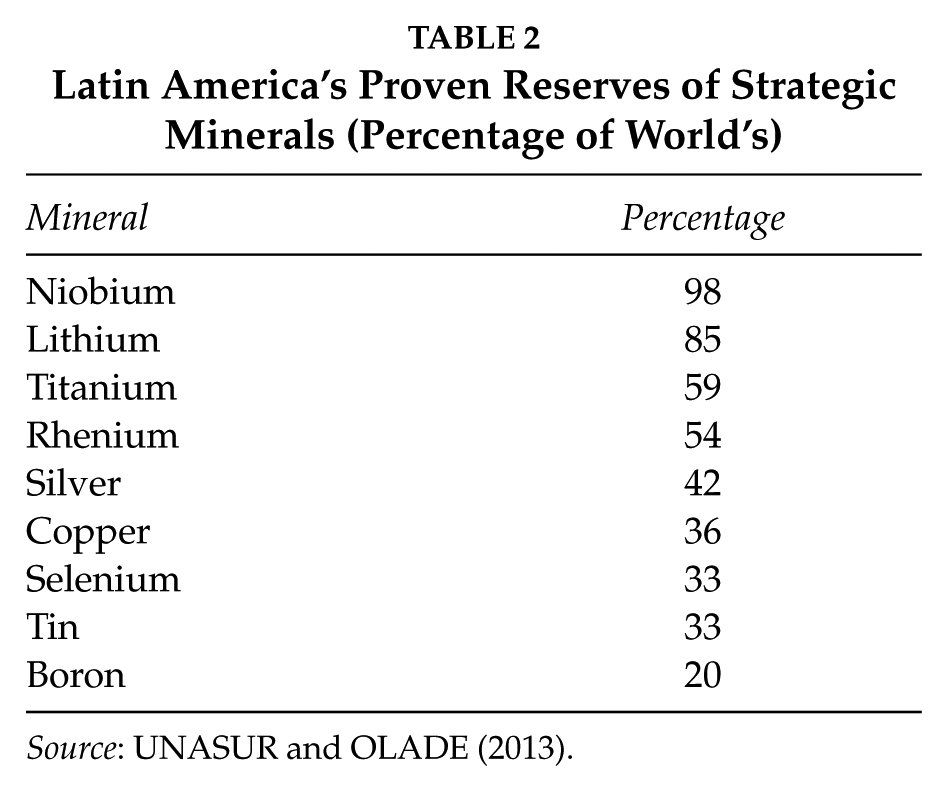
Source: UNASUR and OLADE (2013).
Risks and Challenges
The integration being driven in Latin America and the Caribbean has its ups and downs. Among the challenges to its consolidation are those linked to the various internal and external conflicts taking place in different areas. The development strategy promoted by the countries of the ALBA and the UNASUR has been intensely criticized by social movements, grassroots organizations, indigenous groups, and peasants, as well as militant intellectual sectors, for its serious environmental implications and its reliance on intensive exploitation of natural resources as part of a new extractivism (Gudynas, 2009). Although it has been used to allow the reduction of poverty and polarization by improving the living conditions of the population, this new extractivism must be overcome through the formulation of a comprehensive regional strategy for the management of natural resources, involving a social reappropriation of nature and the establishment of a new man-nature relationship.
In addition, it is urgent to implement mechanisms for effective consultation with indigenous and peasant groups with regard to the management of natural resources located in their territories. The populations that have been affected by extractive activity have launched resistance and emancipation struggles against the plunder, which has sometimes involved their expulsion from the territories in which these resources are located with the permission of governments that, while theoretically progressive, have tended to reproduce the patterns of behavior of transnational corporations (Delgado, 2013).
The accelerated increase in economic relations with China reflects a reconfiguration of the world economy that calls into question U.S. hegemony in the world but most of all in the Latin American continent, establishing a new multipolar scenario. 10 In the past 15 years, China’s presence in Latin America has been consolidated in an impressive way, combining multimillion-dollar investments with bilateral and multilateral agreements that make the Asian giant one of the region’s most important trading partners (Lo Brutto, 2014). The decisive role of natural resources in this relationship is undeniable, given China’s need for increasing amounts of primary materials from outside, and combined with its comparative advantage in cheap labor has buttressed its economic growth, which has not dropped below 7 percent annually in the past 20 years. This change has influenced decision making by governments on the left, allowing them to advance in the direction of a new position in the world economy as a consequence of China’s geoeconomic, geopolitical, and geostrategic importance (Lo Brutto, 2014).
South-South cooperation between China and the Latin American and Caribbean countries, in addition to seeking social equity, political multilateralism, and economic development, also seeks to contribute to the pursuit of a new world order that attributes due importance to the countries of the South, the motive force of the world’s economy for the past 10 years. The new strategic multilateralism of the South will call into question the role of the dollar in the world economy and grant the region greater prominence in relation to international institutions, which reflect an archaic world order.
In the area of foreign relations, another challenge to strategic integration is the Pacific Alliance. Established on June 6, 2012, it links Colombia, Chile, Mexico, and Peru—countries that have shown a greater rapprochement than others with the United States and have signed bilateral free-trade treaties with it under conditions imposed by Washington, including changing laws on investment, intellectual property, labor rights, and environmental protection. The alliance is being introduced as a wedge among the mechanisms of strategic regionalism, and it is forcing the other countries of the UNASUR to block attempts to expand it.
Another challenge to these efforts at integration and cooperation is the preponderant role in each of these mechanisms of a single country, in the case of the ALBA Venezuela and in the case of the UNASUR Brazil. The unequal distribution and lack of balance among the ALBA countries, with Venezuela leading the process and the Caribbean countries playing a marginal role, has been accompanied by a pronounced presidentialism. In addition, a change in the make-up of the congress and the election of a president supported by the current opposition could put this important project at serious risk. With regard to the UNASUR, the growing political, economic, financial, technological, and military influence of Brazil as an emerging power with other countries of the BRICS has meant that many of the initiatives it promotes are functional to the geopolitical vision and interests of the South American giant.
Marini (1977) used the concept of “subimperialism” to refer to Brazil’s particular situation and its capacity to exercise a relatively autonomous expansionist policy. Recently, various writers have addressed different aspects related to Brazilian subimperialism and globalization (Bueno and Seabra, 2009; Flynn, 2007; Luce, 2011; Tavares, 2011; Zibechi, 2012). The threat of the imposition of an imperialist or subimperialist project in South America must be tackled on several fronts: by the governments of the countries that are part of the UNASUR and perceive the danger of an integration subordinated to the Brazilian geopolitical interests; by those countries’ indigenous communities and peasant groups, which are being affected by the strategic integration of Latin America and, particularly, by the UNASUR’s Initiative for Integration of the South American Regional Infrastructure (IIRSA), in which Brazilian capital and investments play a fundamental role; 11 and by the social movements, civil-society organizations, and members of Brazilian society in general that seek to bring both investment and the project of Brazilian expansion under popular control.
By Way of Conclusion
A new type of strategic integration such as that being attempted by the countries of Latin America and the Caribbean that would make possible a regional repositioning with greater autonomy as part of the global construction of a multipolar and pluricentered world, that distances itself from the dictates of Washington, that is aimed at development that benefits people, and that incorporates the rational control and management of natural resources as one of its axes of integration is by definition a project in dispute. First, it entails a great practical-theoretical challenge, taking into consideration the serious problems and difficulties that confront the European process of integration that for more than five decades has served as a referent. Second, it must correct the mistakes derived from the fact that such a strategic integration is unprecedented in the region. Third, it must find short-term solutions for the new extractivism, generating policies to take sustainable and rational advantage of natural resources while keeping in mind the strategic role of control of those resources in the current global context, which is characterized by the deterioration of the environment and the search for solutions to the critical problem of climate change at the international level.
The construction and projection of strategic thinking on integration in the region is obligatory in a scenario of conflict, uncertainty, and crisis. In this dilemma, the governments of the Latin American countries may be severely limited in their possibilities for progress unless they incorporate the people into their plans. The creation of new forms of state-society relationships seems to be an Achilles’ heel of the new integration, and the need for intense and persistent political effort is clear. Community participation in decision making at all levels is necessary for the construction of a broad network of defense of national and regional projects that enhance the possibility of achieving integration with the strategic vision that we have described.
Footnotes
Notes
Giuseppe Lo Brutto is a professor and researcher at the Instituto de Ciencias Sociales y Humanidades of the Benemérita Universidad Autonóma de Puebla, Mexico, and a member of the Sistema Nacional de Investigadores. Carlos Otto Vázquez Salazar is an economist with a Master’s degree in sociology and a Ph.D. candidate at the same institution. Margot Olavarria is a political scientist and translator living in New York City.
References
Supplementary Material
Please find the following supplemental material available below.
For Open Access articles published under a Creative Commons License, all supplemental material carries the same license as the article it is associated with.
For non-Open Access articles published, all supplemental material carries a non-exclusive license, and permission requests for re-use of supplemental material or any part of supplemental material shall be sent directly to the copyright owner as specified in the copyright notice associated with the article.
