



Abstract
A new interpretation of Evangelical actors’ increasing participation in Brazilian political and electoral contests is that elements of Pentecostalism predispose a believer to see the world as the site of an eternal struggle between God and Satan. The belief in demons that have territorial jurisdictions, known as territorial spirits, is one aspect of this theology. The cognitive universe of this belief induces the Evangelical voter to make electoral decisions on the basis of religious premises. It teaches the voter to conceive, without much reflection, the spiritual battle and the electoral game as territorial disputes.
Uma nova interpretação para a crescente participação de atores evangélicos nas disputas político-eleitorais do Brasil é que elementos pentecostais predispõem a fazer a leitura do mundo como sendo resultado da disputa desde sempre travada entre Deus e o Diabo. Importante aspecto desta teologia é a crença em demônios dotados de jurisdição territorial, referidos como espíritos territoriais. O universo cognitivo onde prospera esta crença torna o eleitor evangélico propenso a tomar decisões eleitorais a partir de premissas religiosas. Embora nem sempre de modo reflexivo, tal crença leva o fiel a conceber batalha espiritual e jogo eleitoral como disputas por territórios.
Keywords
In previous works (Smiderle, 2011a; 2011b; Smiderle, Azevedo, and Peixoto, 2012; Smiderle and Mesquita, 2011), we have sought to demonstrate the link between a cosmology of neo-Pentecostal inspiration and the politico-electoral engagement of Brazilian Evangelicals. There is consensus that the Constitutional Congress of 1986 was the starting point of this phenomenon (Mariano, 2001: 156). Since then, the number of Evangelical congressmen has risen from 32 in 1986 to 49 in 1998 and about 70 in 2010 (Smiderle, 2013: 142). Initially, the Igreja Universal do Reino de Deus (Universal Church of the Kingdom of God—IURD) 1 has launched and supported the electoral campaigns of Evangelical candidates. Besides its pioneering electoral endeavors, which have inspired other Evangelical churches to adopt the same strategy (Oro, 2003), it has expanded its presence in Brazil, Latin America, the United States, Africa, and Europe. We argue that the neo-Pentecostal social environment influences the believer to see the world as the result of the eternal dispute between God and the Devil. In this article, we highlight an important aspect of this phenomenon for understanding the politico-electoral engagement of Brazilian Evangelicals: the role of the belief in territorial spirits as support for the intersection between the political and the religious domains.
According to one of the most common typologies used in the contemporary sociology of religion, Brazilian Evangelicals are categorized as historical, Pentecostal, and neo-Pentecostal. The historical branches are the ones more clearly rooted in the movements that sprang from the Protestant Reformation in the sixteenth century—Lutherans, Presbyterians, Baptists, and Anglicans, among others. In the Brazilian context, these groups are commonly referenced as missionary Protestants, since they came to Brazil as a result of European and North American missionary activities. The Pentecostal classification applies to the churches that have a more immediate link to the movements that followed the Reformation. 2 These groups emphasize the contemporaneity of the charismatic gifts of the Holy Ghost (miracles, speaking in tongues, etc.) as described in the first chapters of Acts.
Pentecostalism in Brazil was born with the founding of the Assembly of God and the Christian Congregation, classical Pentecostal churches descended from North American institutions. However, it was their Brazilian leadership that founded their neo-Pentecostal counterparts (Mariano, 1999). These churches are called “neo-Pentecostal” because they evolved from a Pentecostal movement characterized by “the abandonment of ascetic practices and reduction of sectarianism” and by the dissemination of the so-called Prosperity Gospel, which promises “health, material progress, victory in endeavors, and happiness in this life to Christians who are loyal in the payment of tithes and generous with donations” (Mariano, 2001: 171–172).
The Brazilian Evangelical environment is highly heterogeneous, a fact that delegitimizes casual generalizations. Thus, in this article, we will draw attention to shared elements that are more salient in certain religious communities than in others. The segment of Pentecostalism that is growing the most is that of the neo-Pentecostals, which has been achieving increasing notoriety on the Brazilian public scene and influencing the liturgical styles and theological aspects of Evangelical denominations in general. According to Leonildo Campos (2008), even the numerical growth of Presbyterians, Methodists, and Congregationalists, normally considered historical Protestants, seems to depend on the adoption of “practices, discourses, liturgies, and behavior commonly linked to Pentecostalism and the charismatic revolution.” Among the neo-Pentecostals, the IURD has until recently been the most important agent in the dissemination of Pentecostalism in the Brazilian Evangelical environment and the most influential religious organization in Brazil in the three decades since its founding. 3 Oro (2003: 59–60) points to an imitation effect (mimesis) that has resulted from this church’s successful politico-electoral strategies. Mariano (2004: 124–125) also highlights the IURD’s role as a protagonist: “In less than three decades [the IURD] became the most successful religious phenomenon in the country, operating in a unique manner on the political scene and in the electronic media. No other Evangelical church in Brazil grew so much and in so short a time.”
We believe that the juxtaposition of religion and politics in the Brazilian neo-Pentecostal environment is more than a simple rhetorical strategy for political mobilization such as is observed when adversarial groups, despite their common biblical culture and social compatibility, exchange accusations of serving the Devil. Analysts of this topic must be cautious about the multiplicity of meanings and the possible applications of these religious symbols (Novaes, 1997). For example, when IURD members rejected Lula’s first presidential bid in 1989, the church leadership worked explicitly and successfully to link Lula’s image to that of an agent of evil. However, it reversed its position years later: with the same dedication and success, it supported his presidential election in 2002. The strategic use of religious categories in political battles, visible in several contexts of sociability, also occurs in the neo-Pentecostal one. However, from our perspective, this instrumental use is only the most visible aspect of the issue. It is important to understand the concept of a supernatural environment that allegedly controls life on earth, a concept that is specific to believers in dominion theology and Evangelicals influenced by the neo-Pentecostal media.
There is a significant difference between neo-Pentecostal and liberation theology worldviews regarding their application to politics. Liberation theology understands the world as a project to be undertaken by human subjects inspired by the Gospel. It depersonalizes and historicizes the Devil while it encourages combat against him with historical weapons (Mariz, 1997a: 48). In contrast, the neo-Pentecostal perspective emphasizes the agency of both God and the Devil, in constant tension with one another, albeit through human instruments. Thus, everything that is strictly religious—and apart from other spheres of collective life, in post-Enlightenment terms—tends to emerge in the political, economic, artistic, and legal domains. In this framework, our approach seeks to offer a cognitive context capable of complementing explanations of the politico-electoral engagement of the IURD and other religious organizations (Oro, 2003: 59–60) 4
Many researchers structure their political action research in terms of classical variables such as relations of power and conflict based on “race,” class, or gender identities. Our work here deviates from this approach. 5 In the case of Evangelical leaders in Brazil, the motivations for political action are complex and include many factors in addition to religion. In addition to churches’ corporate interests as organizations immersed in a religious market, 6 which serve as obstacles to the construction of a major collective actor that is generically Evangelical, there is ideological diversity in the environment of Evangelical sociability. For instance, while on one hand Evangelical leaders such as Silas Malafaia epitomize activism against the civil rights of homosexuals, on the other hand there are Evangelical churches primarily dedicated to that segment of the population (Natividade, 2010). What matters to us here is analyzing how a creed and its appropriation can play a role in believers’ politico-electoral mobilization.
Other researchers have studied the political-electoral participation of Brazilian Evangelicals (among them Freston, 1993; Mariano, 2004; Oro, 2003; and Machado, 2006). In this article, we intend to focus on one important aspect for the understanding of the process: the belief in territorial spirits as an anchor for enchantment practices, in the Weberian sense, and for the moral and sociological strength of the association between neo-Pentecostalism and the domains of politics and religion. This neo-Pentecostal trait represents a problematic element of public debate in a democracy. In an article on religion in the public sphere, Habermas (2006) recognizes that the conflicts between laicized and religious mentalities cannot be described as a counterpoint between modern and premodern. He argues that the integrity of a political community depends on mutual understanding based on learning between religious and secularized citizens. In addition to other factors, he recognizes the historical importance of religious doctrines to the genealogy of the Western idea of reason (Montero, 2009). Recognizing the theme’s nuances, he defends respect for the “polyphonic complexity of public voices” on the understanding that the liberal state has an interest in the full manifestation of religious voices in the public sphere and in the political participation of religious organizations. For him, the crux of the problem is that legitimate political deliberation must be capable of being formulated and justified in a language equally accessible to all citizens, regardless of their religious beliefs. However, the translation of causes defended by religious actors into language that is intelligible to laicized minds has been absent from the political activism of Brazilian Evangelicals. This failure of communication was illustrated in 2013 by the crisis that overtook the Human Rights Committee of the lower house of Congress when Congressman Marcos Feliciano became the chairman without a thought to redrafting his religious discourse on themes that were important to the committee. 7
Throughout the article, we will see that belief in territorial spirits makes the Evangelical voter particularly inclined to make decisions based on religious premises. The theology or doctrine of pastors may differ from believers’ practices in their daily lives (Hervieu-Lèger, 2006), which are marked by transience (Almeida and Montero, 2001; Fernandes et al., 1998; Prandi, 1996) and by the combination of elements originating in various cults (Montero, 2006). However, we are dealing with a mechanism that is not necessarily reflexive and that is completely familiar to the syncretic repertoire of most Pentecostals. Many of them were socialized in Afro-Brazilian religions or in popular Catholicism, which are, according to Max Weber, strongly enchanted. Even without rational elaboration, the truth of the matter is that this religious universe leads the believer to conceive of both the spiritual battle and the electoral game as disputes for the control of territory in a strict sense.
The Projection of the Religious Domain onto Other Fields of Life from the Neo-Pentecostal Perspective
While the data obtained from a survey in five major cities (São Paulo, Rio de Janeiro, Porto Alegre, Belo Horizonte, and Natal) 8 (see Smiderle, 2011a; Smiderle and Mesquita, 2011) will not all be reproduced here, it is worth referencing one indicator that may explain other trends: the result of crossing the respondent’s religious affiliation with his or her primary sources of information during an election campaign. In all of the cities examined, a large percentage of the respondents who identified themselves as Evangelicals said that the church was the most important source of information for forming an opinion on elections. This result was heightened among those who considered themselves Pentecostals. Pentecostal Evangelicals were, in general, six times more likely than the average to have their opinions on elections formed in the church in Porto Alegre and Natal, four times more likely in Belo Horizonte, three times more likely in São Paulo, and twice as likely in Rio de Janeiro. In Porto Alegre, the contrast between Pentecostal and traditional Evangelicals was even sharper (Table 1). Moreover, even when we controlled for variables such as income, education level, sex, and age (Table 2), Pentecostal Evangelicals were 466 percent (5.6 times) and non-Pentecostal Evangelicals 321 percent (4.2 times) more likely than the average to consider the church as the most or second-most important source of information for shaping opinions about elections (Smiderle, 2013: 79–80). Practicing Catholic respondents were only 50 percent more likely to consider the church central in this respect. Being Spiritualist or lapsed Catholic reduced this probability by 28 percent and 8 percent respectively.
Religion and Primary Sources of Information (%), Porto Alegre
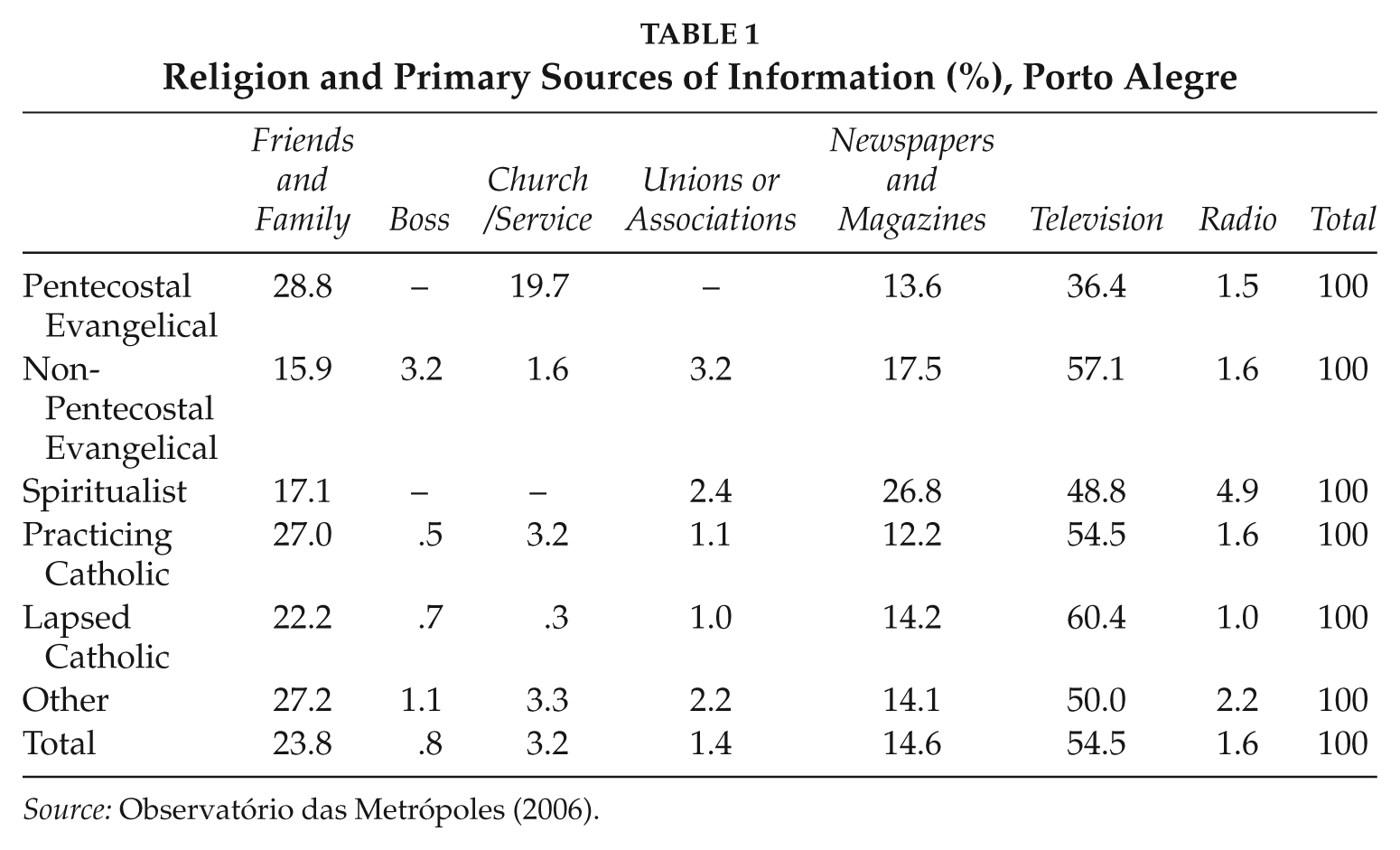
Source: Observatório das Metrópoles (2006).
Influence of Income, Gender, Level of Education, Religious Affiliation, Age, and Social Class on the Response Option “Church/Service as Primary or Secondary Source of Information on Elections”
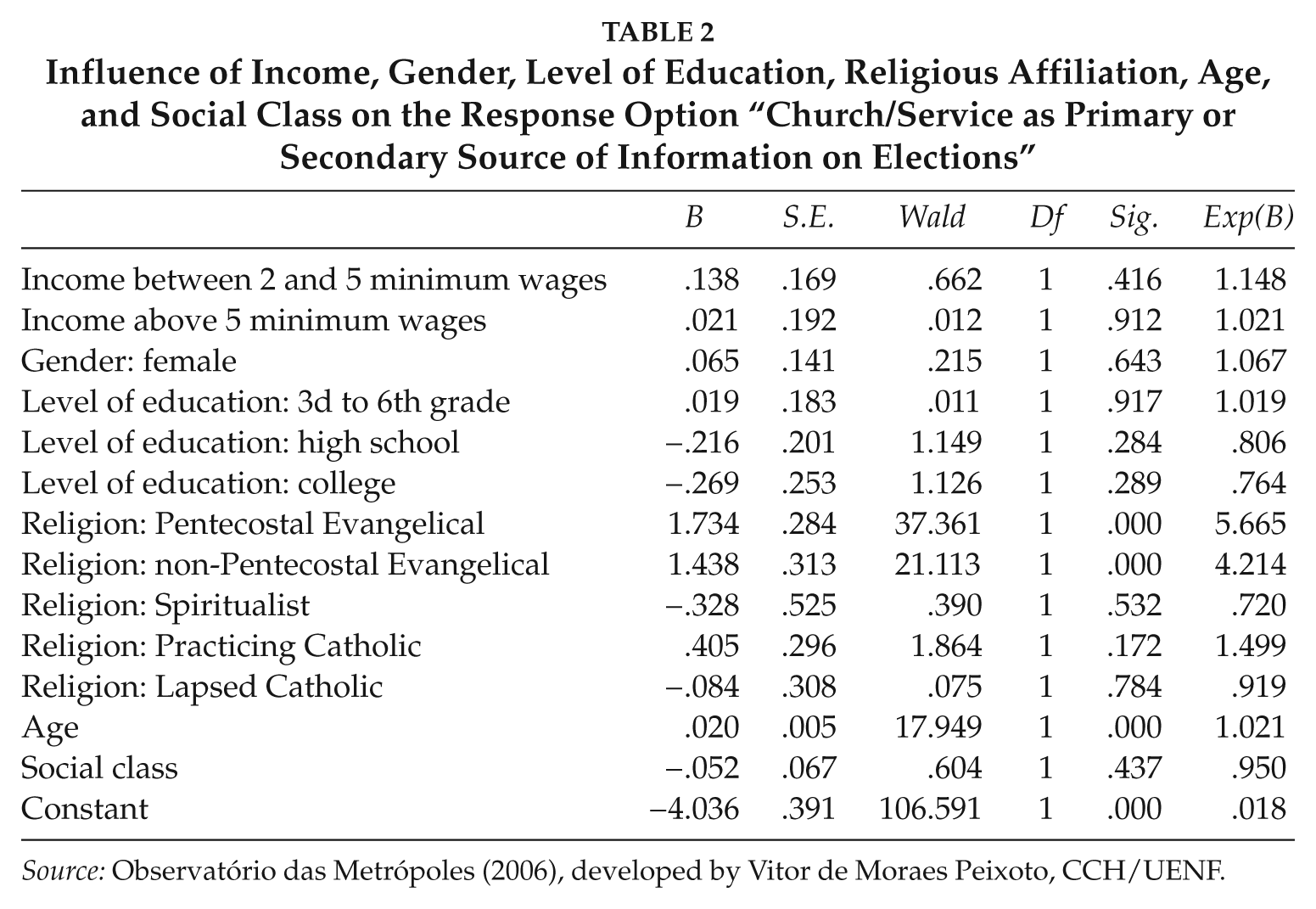
Source: Observatório das Metrópoles (2006), developed by Vitor de Moraes Peixoto, CCH/UENF.
With these observations in mind, we may now proceed to the focus of this paper. We interviewed 10 leadership staff members of Evangelical churches in Campos dos Goytacazes, in Rio de Janeiro. These leaders spanned various denominational profiles: historical congregations such as the Brazilian Presbyterian Church and the Baptist Church, classical Pentecostal denominations such as the Assembly of God, and neo-Pentecostal branches such as the IURD, Bola de Neve, Semear, and the Santa Rosa Presbyterian Evangelical Community (unrelated to the traditional Presbyterian Church). Founded in 1859, the Brazilian Presbyterian Church is one of the Evangelical denominations that best fit the category of historical Protestantism. The Baptist Church, also considered historic, has been in Brazil since the nineteenth century. The Assembly of God, categorized as a classical or first-wave Pentecostal church (Freston, 1993), has been in Brazil since 1911 and today is home to the majority of Brazilian Evangelicals, representing 5.7 percent of the population (IBGE, 2012). The IURD was founded in 1977 in Rio de Janeiro and became the most visible expression of third-wave Pentecostalism according to Freston’s typology. Although Bola de Neve has a neo-Pentecostal aspect, its main feature is the use of language and media instruments associated with young people. Semear, also neo-Pentecostal, derives from Ceifa, an offshoot of the Assembly of God, and is present in Campos dos Goytacazes and São Fidelis. Finally, the Santa Rosa Presbyterian Evangelical Community is an independent neo-Pentecostal congregation located in a suburb of Campos dos Goytacazes.
The most important element at the intersection of religion and politics is the belief in territorial spirits. According to a concept ubiquitous in the Evangelical environment (especially among neo-Pentecostals), demons are fallen angels who maintain the hierarchical positions in which God created them even though they have switched from the “good” to the “evil” side by rebelling against God. In the Pentecostal mentality, each malignant spirit holds a rank that has not been lost with the rebellion against God and the consequent banishment from Paradise. Thus, the authority of each evil spirit in the hierarchy of demons is expressed in the jurisdiction for which it is responsible. A demon may target an individual, a family, a neighborhood, a city, or a country.
Mariano (1999: 137) has written about the neo-Pentecostal belief in territorial spirits and the appropriation of these elements for politico-electoral use (144):
Candidates, campaign managers, and proponents of the election of Evangelicals to high political offices claim that such election will bring endless blessings to society. Beside displacing unbelieving politicians, pagans, believers in Afro-Brazilian religions, and idolaters, who are partially guilty of the terrible curses that afflict the country, Evangelical politicians, once elected, would have the unique opportunity to intercede, both materially and spiritually, in the places where the powerful territorial demons oppress the Brazilian population.
Referencing Mariano’s argument, de Paula (2011) proposes that the change in the political stance of neo-Pentecostals toward greater electoral engagement “is a product of changes in their theological orientation, not the other way around.” Although several writers highlight the enchanted and antimodernizing character of spiritual-battle theology, Mariz (1997b: 40) emphasizes that such a characterization must take into account the trajectory of those who convert to this religious context. In relation to the previous stage, the emphasis on spiritual battle may act in the direction of disenchantment:
Demonization disenchants the world, as it reduces the supernatural universe to only God and the devil(s). The war against Satan contributes to the decline of magic inasmuch as it questions magical efficacy as the most important criterion for the adoption of a ritual or worship. This religious discourse emphasizes not only God’s power but also his clemency and justice. Despite all the power he holds, the devil must be rejected along with his miracles. The moral and ethical criterion is more important at this point.
We intend to highlight the power of this set of beliefs to mobilize Brazilian Evangelicals in elections. To this end, we will link the quantitative data summarized above to the qualitative approach. Notwithstanding the exploitation of religious convictions (full of normative meaning), the belief in the power of the Devil to impact societies should not be seen as a simple electoral artifact. Nor should it be understood as a manifestation of simplified statements such as “Mr. X is a candidate of God, while Mr. Y is a candidate of the Devil.” More important than making pejorative judgments is understanding the cognitive context (often implicit and nonreflexive) that makes the intersection between politics and religion plausible to the Evangelical voter.
In the next sections we will summarize our argument’s analytical perspective and then call attention to telling aspects of neo-Pentecostalism using comparisons between more and less Pentecostal segments of Protestantism and Catholicism. 9 At the end, we will offer a sketch of the belief in territorial spirits and show how it expresses the intersection between religion and politics from the neo-Pentecostal perspective.
The Religious Filter in Voting Decisions
Sociological tradition has frequently treated magic and religion as adversaries. This treatment is observable both in Durkheim (1996: 507 n. 62) and in the Weberian description of rivalry between wizards and priests. In Weber’s vein, Pierucci (2001: 82–85) emphasizes that magic targets specific ends with topical results in this world, while religion promises eternal salvation and spiritual peace. In this paper, however, we invoke a broader meaning for the terms “magic” and “enchantment,” a meaning that does not allow for such a dichotomy. Consistent with Oro (2001), we conceive of these terms not as a merely “utilitarian,” “self-interested,” and “instrumental” practice but as a complex worldview that sees an intimate connection between the spheres of the person, nature, and the supernatural. This perspective is “an explanatory resource linked to a totalizing worldview according to which all evil and all good begin on the mystical plane” (Oro, 2001: 80–81). Berger (1985: 126) discusses the “continuities between the empirical and the supra-empirical, between the world of men and the world of gods” found in the cosmological religions that “the ethical monotheism of ancient Israel” and the ascetic Protestantism described by Weber opposed. Thus, the atmosphere of enchantment, in which belief in territorial spirits flourishes, has a visible affinity to typical elements of those cosmological religions.
One feature of neo-Pentecostalism is the need to identify a spiritual logic in the most varied contexts of daily life. This feature is present in the results of the surveys we conducted in Campos dos Goytacazes in 2008 and in Macaé in 2009. 10 We divided Evangelicals into “Pentecostal” and “non-Pentecostal” and Catholics into “charismatic” and “noncharismatic” and were able to show that Pentecostals and charismatics tended to adopt the religious filter more intensely than others in their electoral decisions.
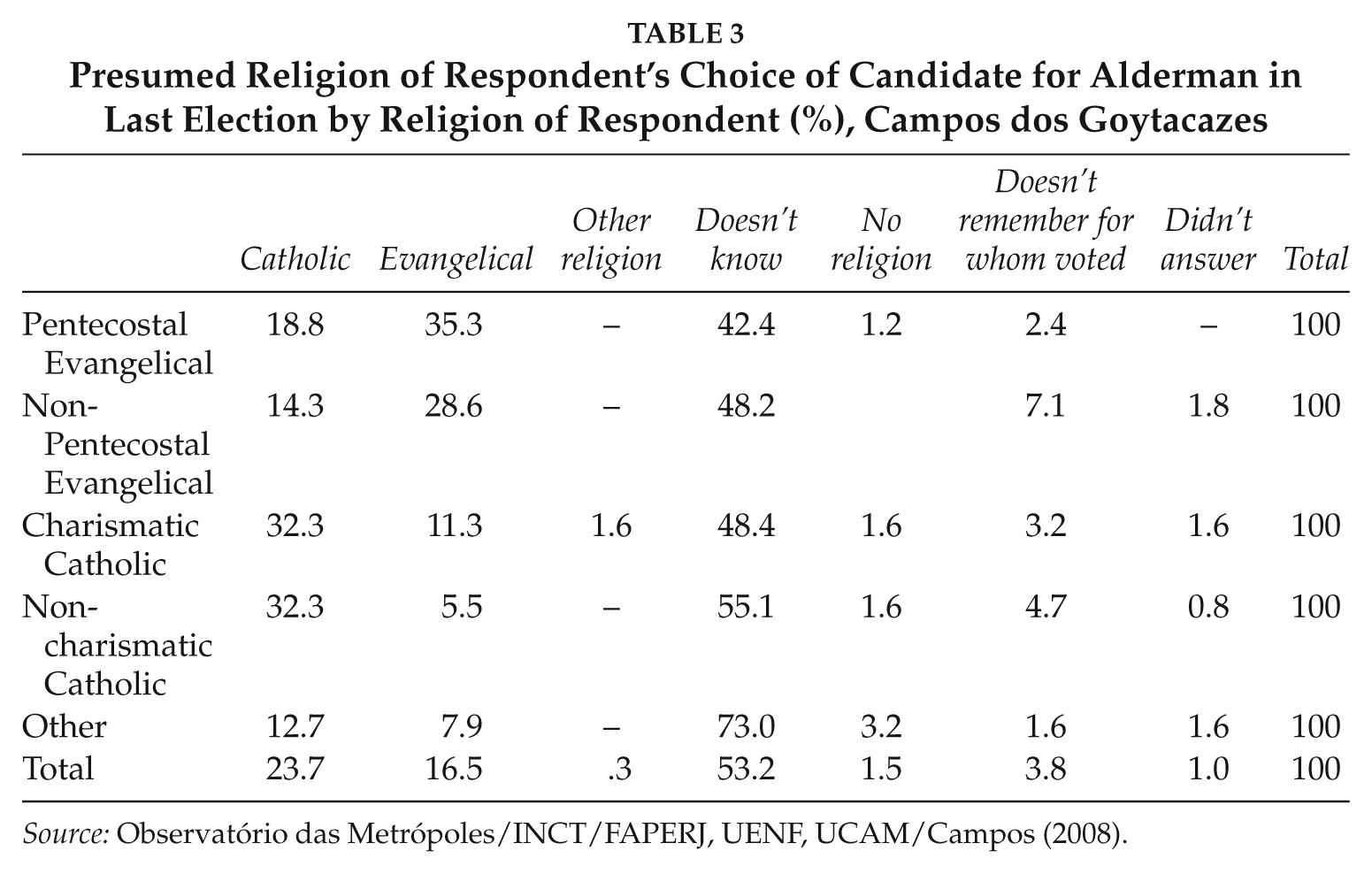
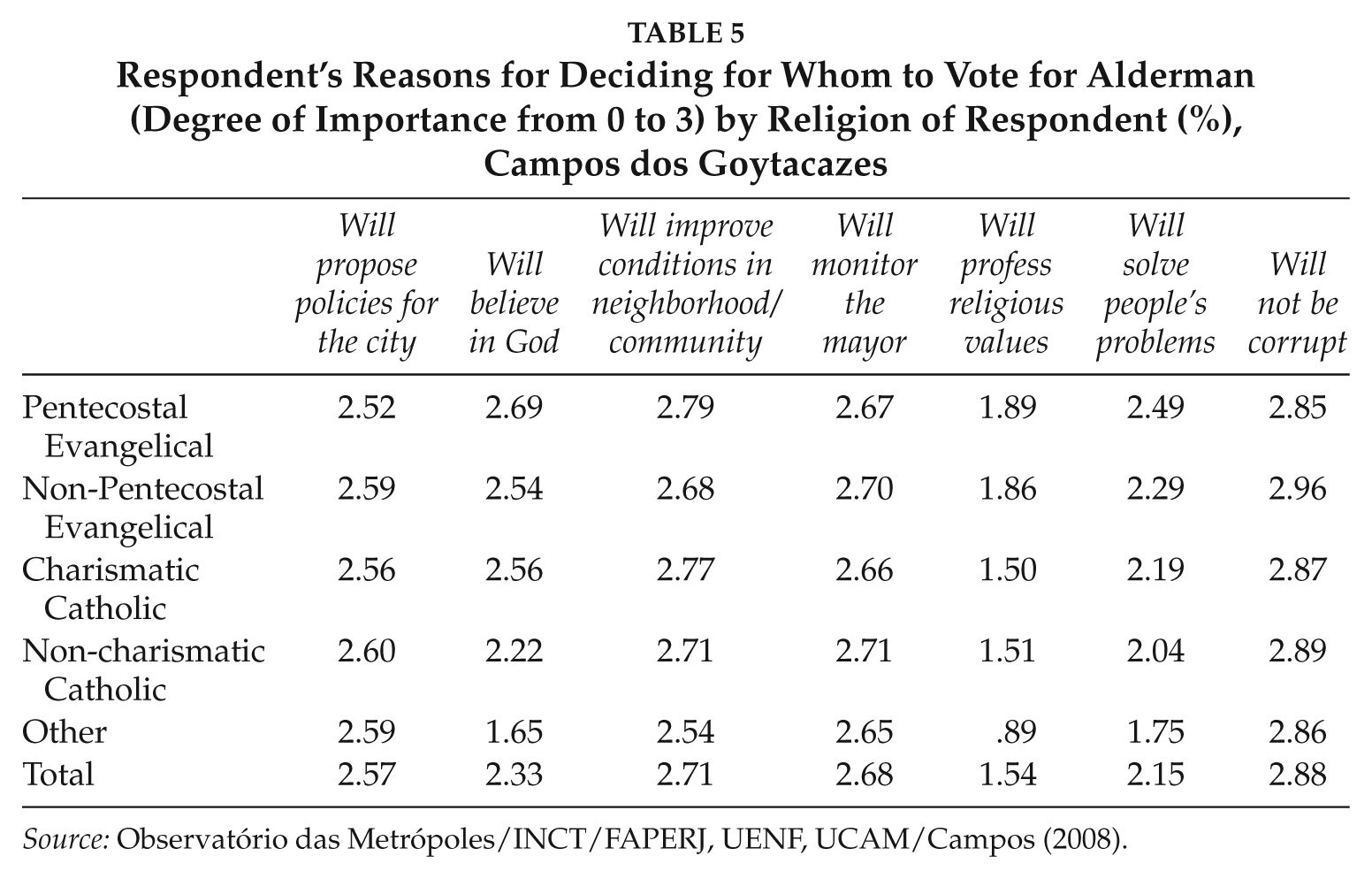
When asked about the religious affiliation of an alderman candidate in a previous election, 11 a secular voter would likely answer that he or she did not know the candidate’s religion. Although some respondents offered this answer, Pentecostals and charismatics said that they did not know the candidate’s religion in smaller numbers than non-Pentecostal and noncharismatic respondents (Tables 3 and 4). In both Campos dos Goytacazes and Macaé, the religious filter for voting decisions emerges in answers to a question about the importance of various reasons for choosing an alderman. On a scale of zero to three, where zero means “not important” and three means “very important,” the more Pentecostal respondents ascribed higher value to “belief in God” (Tables 5 and 6).
Presumed Religion of Respondent’s Choice of Candidate for Alderman in Last Election by Religion of Respondent (%), Campos dos Goytacazes
Presumed Religion of Respondent’s Choice of Candidate for Alderman in Last Election by Religion of Respondent (%), Macaé

Respondent’s Reasons for Deciding for Whom to Vote for Alderman (Degree of Importance from 0 to 3) by Religion of Respondent (%), Campos dos Goytacazes
Respondent’s Reasons for Deciding for Whom to Vote for Alderman (Degree of Importance from 0 to 3) by Respondent’s Religion (%), Macaé

Territorial Spirits
Although it is not professed by all Pentecostals, 12 the belief in territorial spirits carries sociological significance because it shows affinity with an Evangelical Pentecostal cosmology that interprets the physical and social world as an extension of the supernatural realm. We do not ground our argument about the electoral mobilization of Evangelicals exclusively in the theology of territorial spirits. Instead, we intend to show how this ideological artifact clarifies a trend in Pentecostal cosmology writ large: the juxtaposition of the political and religious spheres of life.
The notion of territorial spirits has been spreading in the Evangelical environment. According to it, a church-inspired outcry should mobilize God’s angels to fight and stop the spirits, whose area of influence may be a neighborhood, a city, or a country. One of the church’s missions is to combat these malignant spirits and recover parts of their territory from their power. According to Wagner (1993: 15),
The entire Church is an army, and this army is in the midst of a spiritual war. All believers should sing the hymn “Onward, Christian Soldiers.” However, not all soldiers in the army go to the front lines. Some stay behind. Thus, the ones who are on the front lines depend on the ones that stay behind, and the ones that stay behind depend on the ones on the front lines.
Pentecostalism (including its neo-Pentecostal version) urges individual conversion. It questions individuals and uproots them from the social group to which they belong (Contins, 2003: 233; Pierucci, 2006; Prandi, 2008). However, it also socializes them, bringing them into an environment that reifies spiritual battles fought for territories and groups. Analyzing two cases of “witchcraft,” one in a Rio de Janeiro slum and the other in a so-called community of believers four hours away, Birman (2009: 344) exposes this notion’s territorial dimension: “The conversion discourse presents strong territorial components: expelling demons carries the meaning of conquest and purification vis-à-vis a barbarian world.” Describing the reality of this community of believers, Birman observes that the filter of the local Pentecostal church guides the state’s action in the territory in question. Church leaders urge teachers to avoid controversial themes, schools accommodate their calendars to the church schedule, and even the police choose their suspects in accordance with church guidance (337–338):
Garbage collectors recognize the political importance of keeping the plaza clean in front of the church or the pastor’s residence. They also know where garbage may accumulate without eliciting political problems for them. Electricity services also correspond to territorial limits. Thus, the state conforms to the values and demands of the local religious elite through the control of services and the mediation of exchanges between local and governmental institutions. It is not farfetched to state that government officials were “Pentecostalized” in those areas, and that . . . they recognize religion and cultural unit in that territory as dominant and indivisible.
According to Gonzales (2008, cited in Birman, 2009: 344), evangelization is “an incursion into enemy territory” and subversion of its order. Evangelicals know “that they work in the intersection of two worlds.” Thus, they aim at “freeing captives from the devil and bringing them to God’s reality. . . . Missionary action turns out to be a tool to create a cleavage in enemy territory, and its purpose is to divide the spiritual terrain.”
Throughout this research, we collected responses and reports that we classified according to their degree of inclination toward Pentecostal beliefs. On this spectrum of classification, pastors in the Brazilian Presbyterian Church were at the opposite end from the IURD’s pastors. Between the two poles, in increasing degree of adherence to Pentecostal ideals, we inserted the leaders of the Baptist Church, the Assembly of God, Bola de Neve, the Missionary Assembly of God, and Semear. Pastor Elsson da Silva Moraes, responsible for the Presbyterian Church of Guarus in Campos dos Goytacazes, said that the Prosperity Gospel (a typical element of the belief system of neo-Pentecostalism) had influenced the members of his congregation. Among them was the city’s mayor (and Rio de Janeiro’s former governor), Rosinha Garotinho. Pastor Elsson, however, had reservations about the exploitation of religious affinities for electoral purposes: “In my opinion, an Evangelical president today would be a disaster! . . . This story of an Evangelical caucus tells me nothing! What we see today in the Evangelical environment is shallow Christianity, with no depth and no impact on people’s daily life and work” (interview, Campos dos Goytacazes, May 4, 2011).
Rejection of the emphasis on cures, miracles, and the solution of immediate problems permeated the discourse of the Presbyterian pastor Alecil Amaro dos Santos, leader of the Brazilian Presbyterian Church in the neighboring city of Cardoso Moreira. Pointing to the IURD, this pastor disagreed with its strategy, whose main purpose, according to him, was “not preaching the Gospels but the realization of miracles, etc.” (interview, Campos dos Goytacazes, April 26, 2011). However, criticism of the constituents of Pentecostalism was not tantamount to the rejection of certain features commonly associated with the neo-Pentecostal service, one of which is relative openness to innovation in liturgical style.
Sandro Reis, the pastor of a Baptist congregation in an upper-middle-class neighborhood in Campos dos Goytacazes, said that many Brazilian Evangelicals (both Baptists and members of other denominations) believed that an Evangelical leader would attract blessings to the country, whereas a leader considered a sinner would have negative consequences for the nation (interview, Campos dos Goytacazes, April 18, 2011). Éber Silva, pastor and president of the most influential Evangelical congregation in the city, the Second Baptist Church, said that the congregation’s leadership had realized some time ago that it should be more open and take advantage of what was best in both the traditional historical churches and the Pentecostal style. Although he was a congressman, Éber denied that his incursion into politics could be conceived as an extension of his religious mission. While making his case, he adopted a secular discourse to defend his record as a campaigner for the reduction of social inequality (interview, Campos dos Goytacazes, April 26, 2011).
Elias de Souza Moreira, pastor of the Central Assembly of God of Campos, said that there was a “distorted view” of the spiritual battle even in his congregational environment. According to him, it was unreasonable to assume that the fight between God and the Devil manifested itself in every earthly event. “It is said in the Bible: both the spiritual battle and the Devil exist. Those who do not fear God do not care about this fact. However, those who strive to live according to the Gospels realize that the Devil is always plotting to lead the faithful astray from God’s path” (interview, Campos dos Goytacazes, May 10, 2011).
Amanda Sobral Gomes Ferreira, also known as “Missionary Amanda,” of the Missionary Assembly of God, incorporated elements of Pentecostalism more strongly, although she did not endorse it entirely. She reported that demons had been manifesting themselves in newborns, a notion that is in line with the Pentecostal cosmology. However, she said that she was “not the type of fanatical Pentecostal believer who blames everything on the Devil.” When she discussed the case of female members who claimed that a certain demonic entity had stolen their husbands
13
—a recurrent allegation in Pentecostal circles to explain infidelity and marriage breakdown—she resorted to an explanation that was at once reasoned and good-humored (interview, Campos dos Goytacazes, May 6, 2011):
I tell them: “Sister, if I were a man and looked at you, I wouldn’t need an entity to take me away. You do not take care of yourself: you do not have a nice hairstyle, you do not wear high heels, and you do not wear perfume. Your husband arrives home, after spending a day working with good-looking women and other people who oblige him. Conversely, at home, with you, he only deals with problems. . . . Instead of waiting for your husband with calm and wisdom, besides smelling and looking good, you wait for him looking unpleasant and smelling like onion. There is no need for an entity. The entity is in hell being unfairly accused. You must take action.”
In contrast, Rafael Vilardo, pastor of Bola de Neve, invoked a concrete example to demonstrate that Evangelical leaders would bring blessings for the country. According to him, in an archipelago originally inhabited by devotees of voodoo practices (the Fiji Islands in Oceania), maritime pollution had destroyed the coral reefs, and the resulting collapse of the fishing industry had had dire consequences for the native population, which depended on it for subsistence. Vilardo cited scientific estimates that the recovery of the coral would take at least 200 years. However, a miraculous stroke of lightning in response to the incessant prayers of the local missionaries had brought about the quick regeneration of the ecosystem: “Today, 80 percent of that nation’s population is Evangelical. All their leaders are also Evangelical. In other words, they live much better now that they elect Evangelical leaders. I believe in that, you see. If only we had men and women of God leading us . . . but, I mean men and women of God, nor just religious people!” (interview, Campos dos Goytacazes, May 23, 2011).
These declarations indicate that the group of denominations studied incorporates neo-Pentecostal traits with varying degrees of assimilation. They also show different degrees of proximity between politics and religion. However, what sparked our sociological curiosity about the belief in territorial spirits was that a young IURD pastor spontaneously attributed centrality to these beings. At a certain point in our interview with him, the conversation revolved around his understanding of the spiritual battle. We discussed medicine’s inability to explain health problems and the role of entities in the destruction of marriages. Eventually, we asked him how evil might be present in social issues. His response was explicit. According to him, the IURD had initially avoided getting involved in elections, but it had become necessary to reverse this position vis-à-vis the emergence of laws that “hampered the propagation of God’s word,” especially laws that limited the volume of sound speakers and restricted the use of pamphlets on the ground that they polluted public areas. He felt that evil was behind those laws, and therefore it was necessary for the church to nominate men of God who would contest elections. Up to this point, his arguments had been rationally elaborated and presented. The surprising and meaningful aspect of his response came when our conversation no longer centered on politics. As he discussed his church’s presence in various countries, he explained that each nation had its leading bishop and concluded: “Spiritually, the bishop’s responsibility is to hold down the principality, the evil that hampers the development of those countries. He is there to reprimand this evil, so that the country may be blessed. This is the IURD’s purpose” (interview, Campos dos Goytacazes, May 12, 2011). This seemingly unpretentious discourse captured our attention. While explicitly talking about politics, the pastor had listed rational justifications for his church’s engagement in elections and had been articulate, defensive, persuasive, and thoughtful. When he uttered these last words, however, he seemed to speak without pretenses and thus inadvertently revealed a more provocative thought. If the IURD believes that its task is to reprimand evil so that the country will be blessed, one can no longer suppose that this church’s political engagement is a mere reaction to laws that complicate evangelization efforts. This discourse signaled to us for the first time that the interaction of religion and politics might have other dimensions in the neo-Pentecostal environment.
After this first “signal,” we became more aware of similar references in subsequent interviews. When we talked to Apostle Luciano Almo Vicente, founder of Semear, he elaborated on the theme presented by the IURD pastor. When we asked him about the spiritual battle, he constructed a response that touched on the nonreflexive basis of neo-Pentecostal political involvement. First, he asserted the unequivocal existence of the spiritual battle, citing both biblical and empirical evidence.
14
Subsequently, he established an unambiguous link between earthly events and supernatural determination: “What do we know about this topic? Everything that happens here in the physical plane is determined in the spiritual realm. Sometimes things happen so naturally that we do not realize this connection. However, it is obvious that there is direct influence” (interview, Campos dos Goytacazes, May 18, 2011). Later he explained that the spiritual battle impacted daily life, supporting this assertion with the notion of increasing amplitude of jurisdictions: misfortune affected people, families, neighborhoods, or countries, depending on the ranks of the demons involved (interview, Campos dos Goytacazes, May 18, 2011):
In a passage in the Epistle of Jude, the archangel Michael “durst not bring against him [the Devil] a railing accusation, but said, ‘The Lord rebuke thee.’” Why did an angel refrain from reprimanding another angel? Because even though Satan was a fallen angel, Michael understood that he held a higher rank. This exists in the spiritual world. Thus, perhaps there is an angel whose only duty is to make people ill. Likewise, I believe there is another angel whose only task is to cure people. . . . Higher-ranking demons operate in broader areas, for instance, demons responsible for destroying marriages . . . or demons of even higher rank who are responsible for afflicting entire neighborhoods.
To illustrate the notion of jurisdictions that include countries, the interviewee cited one example from the book of Daniel. After praying for Jerusalem for 21 days, the prophet realized that the “Prince of Persia” (a malign spirit responsible for the Persian nation) had delayed the answer to his prayers. To avoid the risk that we interviewers could have inadvertently influenced his responses, we created the opportunity for him to elaborate on his interpretation of the biblical texts cited. However, he only reaffirmed his previously stated views. Throughout the conversation, we asked him to apply his reasoning to a concrete and demonstrable situation. He replied: “I’ll tell you a real case. On a certain occasion, 12 Candomblé priests from Bahia were hired to come to Campos to make offerings to spirits throughout the city, praying for the election of a certain candidate. The candidate won the election” (interview, Campos dos Goytacazes, May 18, 2011). Consistent with these views, Apostle Renan Siqueira Tavares said that there was a devil that worked on establishing poverty in his neighborhood. Tavares led an independent neo-Pentecostal congregation on the outskirts of Campos, the Santa Rosa Presbyterian Evangelical Community. According to him, in the Pelinca region, an upper-class neighborhood of the city, there was a demon devoted to establishing the empire of greed (interview, Campos dos Goytacazes, May 24, 2011).
Meaningful and emphatic, these declarations provide the keys to the understanding of a belief. It is this belief that explains the territorial (and strictly political) aspect of the neo-Pentecostal expansion. If the spiritual battle is circumscribed to a territory concretely demarcated, then the neo-Pentecostal faith is intrinsically positioned on the frontiers of the political domain. In this context, we are literally dealing with territories that the people of God will conquer, thereby reducing the Devil’s power. Finally, the two sides — good and evil— vie with each other through human actors of flesh and blood. The battle is spiritual, and it is fought between loyal and fallen angels. However, its earthly agents are human: an IURD bishop tasked with reprimanding malignant territorial spirits or a public official elected by the people of God to fight this war in the devilish environment of politics and parliament (Oro and Mariano, 2010: 20). 15
One indicator of the Evangelical churches’ capacity for mobilization can be found in the 2010 presidential elections. Candidate Dilma Rousseff saw her chances of becoming president in the first round vanish as a result of the attacks from Evangelical and Catholic churches. Both groups opposed her position in favor of the rights of homosexuals and her pro-choice views. Close scrutiny of the electoral process reveals that, in response to their leadership’s calls, in the 30–40 days before the first round (between August 26 and September 23), Rousseff lost 7 percentage points (from 49 percent to 42 percent) and her rejection index rose by 11 points (from 17 percent to 28 percent) among Evangelical voters. Change in voting intentions (from 52 percent to 54 percent) and her rejection index (from 18 percent to 19 percent) among Catholics remained within the margin of error (Toledo, 2010).
There is another important point: in contrast to their traditional counterparts, Brazilian neo-Pentecostal churches maintain a strong sense of hierarchy, and this creates the ideal environment for the ecclesiastical leadership to articulate political candidacies or negotiate support based on the congregation’s loyalty if, as Bohn (2004) stresses, the leaders so wish.
Final Considerations
The way Pentecostals operate in Brazilian society is the subject of an ample literature in the fields of sociology and anthropology. The attention these disciplines pay to the phenomenon is very comprehensible, since Pentecostals are increasingly relevant in this society. We have identified theological beliefs that may explain the reversal of the political apathy and separation from the world that has characterized Pentecostalism for decades. We have aimed at transcending the administrative, economic, strategic, or managerial specificities that typify Evangelical denominations, even though they influence Evangelical participation in the Brazilian political game, and sought to unveil a background that can explain the success of these strategies. To this end, we have brought into high relief an article of faith that has been neglected by the sociological literature—the belief in territorial spirits—as an element of the particularity that typifies the Pentecostal presence in politics and also manifests itself in various realms of daily life.
Footnotes
Notes
Carlos Gustavo Sarmet Moreira Smiderle is a journalist with a Ph.D. in political sociology and Wania Amelia Belchior Mesquita is a professor and coordinator of the graduate program in political sociology at the Universidade Estadual do Norte Fluminense Darcy Ribeiro. Frutuoso Santana is a translator living in New York City.
References
Supplementary Material
Please find the following supplemental material available below.
For Open Access articles published under a Creative Commons License, all supplemental material carries the same license as the article it is associated with.
For non-Open Access articles published, all supplemental material carries a non-exclusive license, and permission requests for re-use of supplemental material or any part of supplemental material shall be sent directly to the copyright owner as specified in the copyright notice associated with the article.
