



Abstract
The U.S.-backed Latin American military dictatorships of the 1970s and 1980s resulted in a lack of documentary evidence about the lives of thousands of political activists, intellectuals, union leaders, and everyday people who were tortured and disappeared by their own governments. In Argentina, people have attempted to come to terms with such horrific past events in a variety of ways that are neither static nor univocal. The dynamic process of memory building is influenced by ongoing political debates, shifting power dynamics, global markets, social movements, and a host of other factors such as justice policies. Spaces of memory and museums created in former clandestine centers of torture and disappearance bring to light a politics of truth that works against and reframes a history of silence through impunity.
Parte del legado de las dictaduras militares latinoamericanas de los años 70 y 80 apo-yadas por los Estados Unidos es la carencia de pruebas documentales acerca de las vidas de miles de militantes políticos, intelectuales, líderes sindicales y gente común que fueron torturados y desaparecidos por sus propios gobiernos. En la Argentina, la gente ha tratado de lidiar con estos horribles hechos del pasado por medio de una variedad de formas que no son ni estáticas ni unívocas. El proceso dinámico de construir la memoria está influenciado por los debates políticos en curso, las cambiantes dinámicas de poder, los mercados globales, los movimientos sociales y una gama de otros factores tales como las políticas judiciales. Los espacios de la memoria y los museos creados en antiguos centros de tortura y desapariciones clandestinos como el ESMA y el Olimpo ponen de manifiesto una política de la verdad que de forma visual actúa en contra de una historia del silencio guiada por la impunidad y la redefine.
Keywords
From time to time, that “other” country—of the missing, of complicit silence, of demented militarism—becomes agitated. We know that it feels imprisoned in this democratic Argentina . . . a traitor to its own mission. Remember well those years during which that “other” Argentina acted with absolute freedom, torturing and killing anyone whose presence it found irritating. “That” Argentina dreams of coming back.
In the years since the U.S.-backed Latin American military dictatorships of the 1970s and 1980s, victims, historians, and activists have confronted a lack of documentary evidence about the lives of the thousands of political activists, intellectuals, union leaders, and ordinary people who were tortured and disappeared by their own governments, many of them working together in a secret alliance known as Operation Condor (Dinges, 2005). The numbers of disappeared in Chile, Uruguay, Paraguay, Bolivia, Brazil, and Argentina during these years run into the tens of thousands. In Chile alone, around 3,200 deaths have been documented, and the number of political exiles is at least 200,000 (Wright and Zúñiga, 2007). In Argentina the number of people who disappeared between 1976 and 1983 is estimated at around 30,000 according to human rights associations such as Amnesty International and the Mothers of Plaza de Mayo, an organization founded at the height of the dictatorship (in 1977) by mothers in search of their missing children and currently dedicated to recovering the remains of the disappeared and prosecuting military personnel responsible for committing atrocities. 1
In the United States during the Clinton administration, thousands of pages of classified CIA documents about secret operations during these years were released to the public under a controversial order issued by Madeleine Albright. The release of these documents resulted in a watershed moment in the history of archives about state-sponsored terror (Dinges, 2005). A wider public now had access to a history of illegal detention, torture, killing, and child appropriation that many in Latin America had known about for a long time. The rich interaction made possible by this archive of declassified military documents, along with decades of activism and thousands of hours of trial testimonies (Kaiser, 2015; Stern, 2004; Thomas, 2009), has offered an unprecedented opportunity for many to analyze what has been called Latin America’s Holocaust in all of its complexity.
The ways in which people attempt to come to terms with horrific past events are neither static nor univocal; they are “part of a dynamic process of memory building” (Sutton, 2015: 74) that is influenced by ongoing political debates, shifting power dynamics, global markets, social movements, and a host of other factors such as justice policies (Guglielmucci, 2013; Jelin, 2003; Kaiser, 2005; 2015; Stern, 2004; Sutton, 2015). Idelber Avelar (1999: 9) suggests that “a transnational political and economic order repeatedly reaffirms its interest in blocking the advance of postdictatorial mourning work—as the digging of the past may stand in the way of the accumulation of capital in the present.”
Memory theorist Andreas Huyssen (2000) takes a different approach, suggesting that memory work can only be understood as a manifestation of commodity culture. In his discussion of the global musealizing culture industry, he argues that the traumatic memory of the Holocaust has become a generalized trope that has spread to unrelated global sites of memory: “It is no longer possible to think of the Holocaust or of any other historical trauma as a serious ethical and political issue apart from the multiple ways it is now linked to commodification and spectacularization in films, museums, etc. . . . There is no pure space outside of commodity culture, however much we may desire such a space” (2000: 29). Elsewhere he argues that “memory discourses . . . partake in the detemporalizing processes that characterize a culture of consumption and obsolescence” (10).
With the return of democracy in postdictatorship Argentina, several former clandestine centers of detention, torture, and extermination were rewoven back into the “productive” fabric of daily life as schools, hospitals, police stations, or garages or, as in the case of the Athletic Club, torn down as part of a development project. 2 However, decades of activism by the Mothers and Grandmothers of Plaza de Mayo, 3 pressure by human rights groups, governmental support for human rights, and media access have produced a memory-building agenda in many parts of the country. Memory museums, parks, and sites and micro-memory projects across the country have generated political controversy in part because the public memory of events that took place between 1976 and 1983 has been cultivated in conjunction with the ongoing trials of the repressors. These projects have also benefited from two consecutive presidential administrations committed to avoiding the elimination of “physical evidence in order to discourage memory of the experience” (Parsons, 2011: 86).
As in many countries, the current political climate in Argentina can be characterized as somewhat polarized, and projects to create concrete spaces of memory for the disappeared have frequently been ridiculed as political propaganda, especially when recovery efforts have involved making visible the political militancy of many of the disappeared. For example, the ex-Olimpo clandestine center of detention, torture, and extermination highlights on its web site the fact that many of the 500 or so detainees at the site were members of political groups and activist organizations including the Peronist Youth, the Peronist University Youth, the Peronist Young Workers, Christians for the Total Liberation of the Montoneros, the Revolutionary Workers’ Party, the Revolutionary People’s Army, the Marxist Leninist Communist Party, the Revolutionary Workers’ Group, and the Anti-Imperialist Front for Socialism. While the two Kirchner administrations actively supported a memory agenda to recover the political lives of the disappeared, the struggle for memory and justice had thrived long before either Néstor (2003–2007) or Cristina Fernández de Kirchner (2007–2015) came to power. In fact, even in times of total economic collapse (1999–2001), the struggle for justice with respect to the crimes of the dictatorship had achieved important victories in the courts.
Whereas sites such as the Memory Park on the bank of the Rio de la Plata in Buenos Aires may have grand aesthetic and design elements in common with the Vietnam Memorial in Washington, DC, sites of memory in former clandestine centers of detention, torture, and extermination serve a somewhat different purpose. They are active sources of factual or forensic truth (as defined by the South African Truth and Reconciliation Commission) whose affairs are largely protected and managed by human rights organizations (Druliolle, 2011). Conducting many of these memory projects (especially transforming former clandestine centers of detention, torture, and extermination into museums and cultural spaces) has involved the collection of forensic information, thus situating them in what Lisa Yoneyama (1999: 4–5) calls the “counter-amnesic” political realm, a radical realm in which “ongoing cultural politics . . . seek to contest” the amnesic elisions and gaps in recent historical knowledge so that “memories, once recuperated, [can] remain self-critically unsettling.”
This essay looks closely at the contested history of two iconic counter-amnesic sites: the ex-ESMA Memory and Human Rights Space (the former Escuela Superior de Mecánica de la Armada [Naval School of Mechanics]) and the Olimpo ex-Clandestine Center of Detention, Torture, and Extermination. In particular, where these two sites are concerned, I argue against Huyssen’s suggestion that any secure sense of the past is destabilized by our culture industry and by the media. This view minimizes the important noncommercial role that these spaces play in the ongoing search for truth and justice about events that took place in the past. If anything, they serve to stabilize a sense of the past, bringing to light a politics of truth that works against and reframes a history of silence through impunity by participating in an “ongoing process of accountability taking place across Argentina” (Kaiser, 2015: 204). As Ana Guglielmucci (2013: 243) points out, relatively few of the sites that functioned as clandestine centers of detention, torture, and extermination during the dictatorship have been designated as spaces of memory because of the complexity of the social processes involved in such a designation: The social processes around the conversion of former [clandestine centers of detention, torture, and extermination] such as the “ESMA” and “Olimpo” memory sites, government measures to target those sites for the creation of spaces for memory, managed and financed by the State, have been the result of long-standing social processes that have involved many actors: survivors, relatives of the disappeared, human rights organizations, social organizations, political parties. . . . Such actors, across multiple public activities (putting up posters, graffiti, protests in the door, pamphlets, escraches,
4
etc.), have identified places that functioned as clandestine centers of detention, torture, and extermination and have demanded that successive governments preserve and repurpose the sites as spaces for the memory of state crimes.
While there are many diverse sites of memory in Argentina, I chose to focus on the ex-ESMA and ex-Olimpo sites because, unlike the Memory Park, which features an impressive sculpture garden filled with the work of contemporary artists from around the world, and Argentina’s official Museum of Memory in Rosario (both important institutions for their contributions to postdictatorship mourning work), they are former clandestine centers of torture, detention, and extermination. As such, they offer museal experiences that explicitly reference the kidnapping, torture, and extermination associated with the dictatorship years. These two memory sites are the products of some of the earliest and most prominent grassroots efforts to call attention to the identities and experiences of individuals made abject and invisible by the military dictatorship. I take an ethnographic and archival approach to the analysis of these sites, considering such theoretical concerns as the relationship between democracy and memory, how the preservation of space (and structures) can connect the present to the past rhetorically, how such spaces can function pedagogically, and the role of such pedagogy in the ongoing battle against impunity.
The ex-ESMA complex, sometimes referred to as the “Auschwitz of Argentina,” is internationally recognizable because of its size and importance as a hub of military operations and because it was targeted for an international human rights investigation in 1979. Garage Olimpo, a smaller facility that retains its original name as a streetcar garage, is well known to Argentines and was popularized internationally in a 1999 film of the same name. While each of these spaces has been transformed to a certain extent, they have also served as important sites of archaeological investigation. During Carlos Menem’s presidency in 1996, only the ESMA and Olimpo spaces were considered suitable for the creation of a “living museum of memory” in accordance with the UNESCO guidelines developed for sites of memory in Auschwitz, Hiroshima, and Nagasaki (Feitlowitz, 2011 [1998]: 218–219). Both sites are situated on busy avenues in densely populated neighborhoods and would have made impressive rhetorical statements of the victory of human rights over repression, but back in the 1990s grassroots supporters felt that Olimpo would be the easier one to restore. That both sites would become important sites of memory and exist in association with a dedicated Museum of Memory and a full range of micro- and macro-memory projects across the country would have been unthinkable.
The ex-ESMA and ex-Olimpo sites combine the remains of places of torture and disappearance with contemporary artistic expression and community outreach. While they teach visitors about the past, they are also enmeshed in the struggles of the contemporary Argentine political and judicial spheres (Guglielmucci, 2013). The ex-ESMA complex receives over 28,000 visitors per year and continues to expand with the 2014 inauguration of the Malvinas museum built on the grounds, ongoing retrofitting of existing buildings on the site, and the 2015 inauguration of the Officers’ Club. Each of these memory sites is in at least its third incarnation as a functioning neighborhood institution. They owe the preservation of their buildings to grassroots efforts involving cooperation between human rights agencies and neighborhood groups, but they also represent long struggles between the city government of Buenos Aires and the federal government.
The Ex-ESMA Complex
Nowhere are the nation’s history of human rights abuses and the current justice movement more conspicuously on display than at the vast ex-ESMA complex. It occupies 38 acres in the densely populated neighborhood of Nuñez and borders one of the city’s longest avenues, Avenida del Libertador. The ex-ESMA grounds play host to a variety of Argentine human rights organizations and government agencies that help support the different institutions on the site. For example, the Identity House is run by the Grandmothers of Plaza de Mayo, while the Our Children Cultural Space is run by the Association of the Mothers of Plaza de Mayo. The Militancy House is managed by H.I.J.O.S. (Sons and Daughters for Identity and Justice against Forgetting and Silence),
5
and the Malvinas museum is under the control of the National Ministry of Culture. Emily E. Parsons (2011: 4) suggests that the ex-ESMA is a national symbol of the transformative power of memory: In recent years, ESMA has encountered a “profound resignification” not only in public space but also within the continuously negotiated collective memories of the nation’s inhabitants. . . . The process of transforming ESMA from a symbol of state power that oppresses, tortures, and murders its populace to a public space that testifies to the memory of the Dirty War, to the experience of victims and family of the Disappeared, and to human rights, symbolizes the nation’s struggle to come to terms with the past amidst conflicting desires to forget and to remember.
Vikki Bell (2011: 215) extends the idea that the preservation of buildings once employed to torture, detain, and disappear makes ethical, pedagogical, and rhetorical connections between the past and present: the “vast art space, theater, collection of human rights groups’ offices, and promised archives at ESMA [the National Archive of Memory is now open on the site] are absolutely about giving something to the future.”
The future might have looked very different if President Carlos Menem and other top military leaders who opposed the memory space project had had their way. At the end of the dictatorship in 1983, this building returned to its original military purpose as an instructional institute. Thanks to survivors’ testimony and the inspection of the facility by the National Commission on the Disappearance of Persons in 1984, evidence about the space’s use during the dictatorship came to light, setting the wheels in motion for a long battle between politicians, human rights organizations, survivors, the military high command, judges, and other actors that eventually led to the creation of the ex-ESMA memory complex. During his presidency, Menem tried to get the ESMA property (which housed the largest and most important clandestine center of detention, torture, and extermination during the dictatorship) demolished in order to construct a monument of national reconciliation. Graciela Lois and Laura Bonaparte opposed his plan in court and managed to put a stop to it. In 2000 a commission was formed to consider how to turn the ESMA into a space of memory. This commission could not come to an agreement, however, and disbanded. Then in 2001 the governor presented a proposal, and in 2002 the Space of Memory Institute was created with the mandate to “safeguard and protect the transmission of memory and history of events that took place during the State terrorism of the 70s and early 80s” (Parsons, 2011: 85). Concrete plans for the site crystallized in 2004 when then President Néstor Kirchner signed an agreement to preserve the space of the ESMA as a place of memory. As Parsons points out, the military continued to use the space even after Kirchner’s decree. The ESMA was not fully evacuated until 2007, and even then disgruntled soldiers attempted to destroy some of the buildings before leaving. 6
Today the ex-ESMA is a lively space for art and culture, complete with a café and bookstore, meeting rooms used for academic conferences and other events, a memory museum, an art museum, a museum to the Malvinas War, a small movie theater, and offices for the various human rights groups that support sectors in the complex. The incorporation of the Malvinas museum into the ex-ESMA grounds brings together many interesting facets of the history of dictatorship and Argentine identity worth mentioning briefly. The overarching narrative that the museum seeks to present is one of a national sovereignty over natural resources and resistance to colonization. Thus, it displays information about the islands’ earliest colonization and resistance to the British in the 1982 Malvinas/Falklands War. While it pays homage to the soldiers who lost their lives during the Malvinas War, it also has a room dedicated to the memory of the Argentine filmmaker Raymundo Gleyzer (who was disappeared during the dictatorship), one dedicated to the resistance work of the Mothers of Plaza de Mayo, and one that presents the military dictatorship in the context of a war that ushered in its downfall.
One entire complex of buildings at the ex-ESMA has been preserved so that visitors can tour the detention and torture facilities and get a sense of the daily horror that the victims (a majority of whom never made it out alive) endured. The Officers’ Club building, opened for privately arranged tours around 2006, was declared a national historical monument in 2008 and officially reopened as a museum in 2015. It housed detainees in the attic, on the third floor, and in the basement. The prisoners’ quarters were called the capucha (hood), and in them prisoners were kept hooded, their hands cuffed, and in prone positions on small mats side by side in rows. Individual prisoners, given just enough room to lie down, were separated from each other by wooden slats or walls to prevent communication. The Officers’ Club also contained areas for torture, a repository for property looted from the homes of detainees, offices, soldiers’ quarters, the private living quarters of ESMA director Rear Admiral Rubén Jacinto Chamorro, a library, and an archive.
Much of the Officers’ Club at the ex-ESMA has been left largely in the state in which it was found at the moment of its recovery. Thus visitors encounter moldy walls, abandoned quarters, and prisoners’ scratches on walls as they walk on a wooden platform through the various rooms. One entire wing of this complex was a detention space dedicated to expectant mothers. When they gave birth, their babies were appropriated and handed over clandestinely to families who supported the dictatorship, and they themselves were usually killed. The military’s logic was that raising the babies in ideologically correct families would erase the prior subversive tendencies of their parents and help create new, politically “appropriate” citizens (Finchelstein, 2014: 134).
The Officers’ Club building (which required a higher level of security for entrance) was the ESMA’s administrative hub of secret operations. On the lower level is a large room that was dedicated to record keeping, photography, and archiving (work done largely by prisoners, much of which is presumed to have been hidden or destroyed). Guides are quick to point out the complexity of the space during the dictatorship. At once clubhouse, military personnel living quarters, administrative office complex, torture facility, death camp, and maternity ward, the ESMA presented a paradoxical confluence of life and death. 7 The tour includes stopping in front of an opening to a staircase that led from the grand entrance hall to the torture chambers and slave labor rooms in the basement. The portion of staircase that led to the basement had been walled over and an elevator on the same floor disabled and hidden the night before the Inter-American Commission for Human Rights came to investigate claims of abuse at the ESMA in 1979.
From their cells at both the ESMA and the Olimpo facilities, prisoners could hear the sounds of life going on just outside. Some of the cells at the Olimpo site shared walls with the public sidewalk. This deep-rootedness in neighborhoods helps to explain the importance, for some community members, of turning these spaces of torture into sites of memory rather than allowing them to be bulldozed over or repurposed. In the attic that housed the central water tank for the for the ex-ESMA Officers’ Club, prisoners underwent advanced stages of torture. This section of the building has been left largely untouched except for a few spots on the walls that have been covered with paper to preserve prisoners’ scratchings. The tiny windows were painted over and kept shut. Survivors, who had been blindfolded and were unaware of their location during captivity, were later able to situate themselves in this space of torture through sensory memories: the room temperature, ambient sounds of water moving in the tank, the sounds of airplanes taking off and landing from a nearby airport, and specific noises from the neighborhood such as the bell in the schoolyard across the street have been recalled by survivors during the ESMA trials. These sensory memories speak to Nadia Seremetakis’s (1994: 2) idea about the ways in which “the senses are entangled with history, memory, forgetfulness, narrative and silence.” Experiencing the thin membrane between a thriving neighborhood and a clandestine torture facility brings visitors to the ex-ESMA a step closer to comprehending the magnitude of the military’s genocide and the extent of the suffering that its victims endured. In addition to serving a pedagogical function for those unfamiliar with the history of oppression, neighborhood memory sites in former clandestine centers of detention, torture, and extermination also raise the specter of everyday complicity and denial among the general population. Reflecting upon the role of community involvement in sustaining memory, Ilda Micucci of the Argentine Historical and Social Memory Foundation discusses the organization’s earliest efforts to create a House of the Disappeared in 1984 (a first step in the development of the ex-ESMA project) in order to convince people of the truth of the torture and disappearance of their loved ones (Memoria Abierta, n.d.): At first we conceived of it as a place to store documents and then later as a place whence we could disseminate information to the rest of society—to reveal what had happened, to show how it really was, and to display items that proved it so— because one of the realities we were dealing with was that people didn’t believe us. . . . You would start to talk about how your children had been taken away they would answer, “You’re lying.” . . . Even our relatives and people who knew us well, who knew my children, said, “Are you sure? Aren’t they in Europe? Maybe they just left.” And I thought, “How can they say that? How can they believe that?” You wanted to die . . . and so I thought that if there were so many people like this, one way or another, I had to show them, to throw the truth back in their faces so that they wouldn’t keep believing. And so we thought that a place like this would serve to reveal the truth and to prove that everything we had been through and everything that we were talking about was real.
In spite of the visibility of these former spaces of torture and the many important judicial victories for families of the disappeared (as in the sentencing of Generals Jorge Rafael Videla, Reynaldo Bignone, and others in the child appropriations and illegal adoptions during the dictatorship), the rhetoric of terror that existed during the dictatorship has not been fully eradicated (Feitlowitz, 2011 [1998]; Perelli, 1994). Parsons (2011: 84) speaks to the role of the ex-ESMA in addressing this problem: The importance of developing a museum was and still is intricately linked to a culture of impunity that has been without reparations and punishment for criminals of the dictatorship, despite the fact that amnesty laws of the early 1980s were finally annulled in 2003. Many of those criminals are still alive and well in Argentina and have never been officially or legally held accountable for their crimes against humanity.
Forensic truth and testimonies play a central rhetorical role in the ex-ESMA complex. The logo for the complex consists of a fingerprint in the shape of an upside-down teardrop. The teardrop is an obvious reference to the grieving denied those who do not know the exact fate of their disappeared loved ones. The fingerprint indicates the work of forensic anthropologists in identifying the remains found in mass graves in various parts of the country—including Córdoba and the clandestine center of detention, torture, and extermination Arsenal Miguel de Azcuenaga in Tucumán—and the important role of DNA testing in the search for disappeared and appropriated persons.
Early tours of limited areas of the Officers’ Club offered modest but evocative guided walks through the rooms. There were no lighted walkways or wall plaques with narratives about what had taken place, and multimedia technology was nonexistent. Since then, the walls of the larger spaces in the complex have been transformed into historical installations that immerse visitors in multimedia chronologies of the struggles for human rights and the battle against impunity in postdictatorship Argentina. In front of the museum is a transparent façade that displays archival photos of the disappeared to create a wall of faces (Figure 1). To enter the museum, visitors must pass through this wall, where they encounter the first of many video installations. Video monitors on either side of the lobby greet visitors with a chronology of the complex’s evolution from naval base to memory museum. Visitors then pass into a large empty room that was once used for billiards and gaming. Within seconds they are surrounded by a video installation that tells the history of the dictatorship in Argentina and its relationship to Operation Condor through floor-to-ceiling projections. As do most uses of video in this museum, the archival photos, newspaper clippings, sound, film, and video clips from trial testimonies speak for themselves. The images are accompanied by a dramatic musical score, but there is little or no direct narration. This minimalist approach underscores the theme that the evidence needs no mediation. The video ends with the image of a drop of blood that spreads into one and then several veins across a black background dotted with the names (in bright white letters) of some of the earliest-known clandestine centers of detention, torture, and extermination. Slowly, the veins spread and the names of sites grow more numerous, illustrating the gradual discovery of more such spaces and the possibility that fresh evidence might still be uncovered (Figure 2).
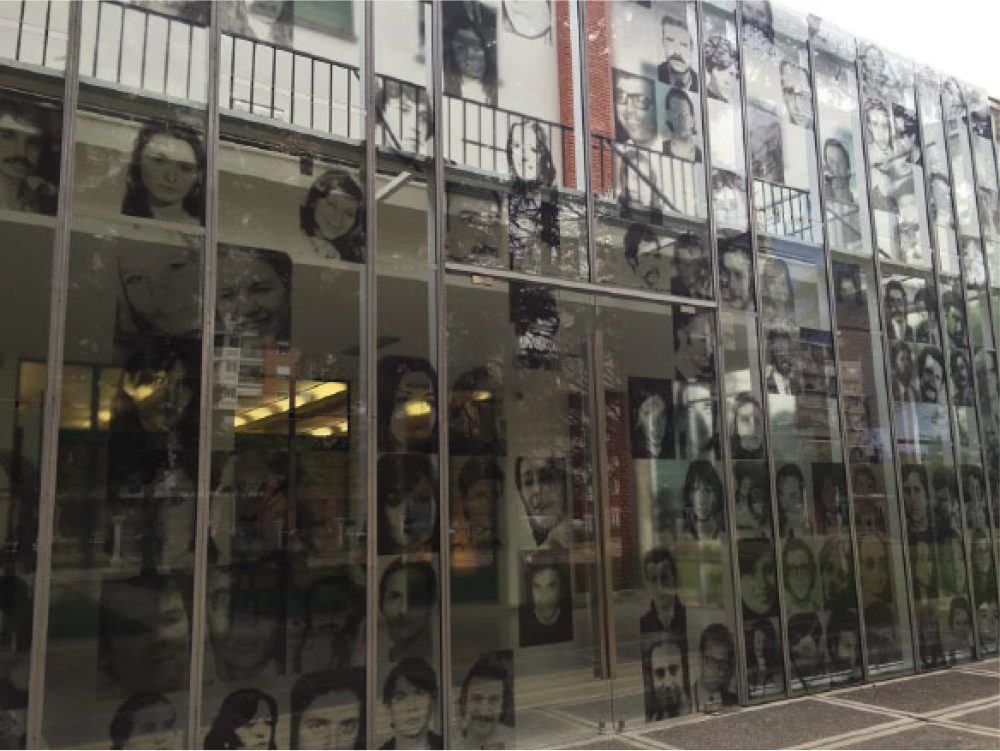
Entrance to the Officers’ Club, ex-ESMA.

Video installation in the Officers’ Club, ex-ESMA.
After this historical presentation, visitors pass by the kitchen and dining area, which in August 2015 were being converted into a live-streaming space where visitors would be able to watch the ongoing trials and sentencing of perpetrators of crimes against humanity. Broadcast footage of the testimonies of victims, perpetrators, and civilians plays a significant role throughout the Officers’ Club, from a wall in one of the prisoner’s cells to a tiny vintage television screen seen only as a reflection in a window. The content of the testimony is usually relevant to the space in which it is projected. For example, on one wall of ESMA director Chamorro’s dining room, the testimony of Andrea Marcela Krichmar (one of his daughter’s friends) runs on a loop. Krichmar describes coming over to play as a child and seeing, through the back window of Chamorro’s quarters, a young woman being dragged at gunpoint out of a Ford Falcon and brought into the building.
A large wing of the Officers’ Club consists of a room referred to as El Dorado in which prisoners’ information was recorded and filed, their real identification documents being destroyed and replaced with false ones. This bureaucratic work was one of the many types of slave labor performed by prisoners. According to the 1979 collective testimony of Alicia Milia, Ana María Martí, and Sara Solarz de Osatinsky in front of the French National Assembly, “On the premises of El Dorado was a folder in which all prisoners who passed through the ESMA were registered. It consisted of the prisoner ’s name, case number, date of abduction, and final destination. . . . The circulation list was restricted to intelligence officers and auxiliary intelligence. 8 This testimony, which appears in large print on one of the walls in El Dorado, is one of many uses of victims’ court testimony in the building. Another wall addresses the systematic destruction of evidence: “In one of the offices there was a paper shredder used to destroy documents that could compromise the oppressors. The detainees were required to input information onto a flashcard, remembering that, after receiving documents with new data, they should destroy all previous records. They called this machine the ‘Crocodile.’” The testimonies and information inscribed on the walls of El Dorado enact a “rhetoric of documentation” (Andermann, 2012) designed to highlight the ongoing efforts to excavate hidden knowledge and rupture the military’s pact of silence.
The impression that the walls of the Officers’ Club speak the truth reaches its peak at the very end of the tour. Visitors enter a large white salon whose only contents are several empty picture frames propped against the walls. They are invited to sit or stand in the middle of the room as window shades lower, blocking the light from the windows. Suddenly, each picture frame is filled with the portrait of a military perpetrator as he appeared during the dictatorship, either in an official military photo (in uniform) or in plain clothes. Next to each portrait, projected onto the shades, are the name, aliases, rank, and career history of each perpetrator. In a flash, the images of the men are replaced by images of them, as old men, standing trial for crimes against humanity, and the projected information changes to the current status of their trials and, when appropriate, sentences. The last part of the installation commences with a black screen and the projection of one word in very large white letters: “Condemned.” What follows amounts to an extensive visual archive of successful prosecutions of military perpetrators of crimes against humanity. This final high-tech presentation and the use of audio-visual materials in general throughout the Officers’ Club contributes to the sense that ongoing forensic work, testimonies, grassroots activism, and prosecutions of crimes against humanity are building a new archive to replace the ones that disappeared into the void of military secrecy.
One exits the ex-ESMA not through a typical museum giftshop filled with T-shirts and memorabilia for sale but through a security-monitored gate, a reminder that this space of memory is an ongoing battleground rather than a place for reconciliation or commodification. On my visit in August 2015 I picked up a modest flyer at the literature table in front of the security desk that read: “If you were a government employee between 1976 and 1983, perhaps you saw things you wish you hadn’t seen. If you wish to tell your truth, call the Commission for the Reconstruction of Our Identity. . . . The military junta is no longer your employer. Silence is not obligatory.”
The Garage Olimpo Project
Ex-Olimpo, located in the Floresta neighborhood of Buenos Aires, is a museum of memory that can be viewed as a case study in the struggle for the ownership of the memory of the community surrounding the museum. Although the political scene has changed, it is important to keep in mind that when efforts to reclaim Garage Olimpo for the purpose of transforming it into a living memory museum began in 1995, along with many museum projects and public spaces of memory in Argentina it fell victim to a “lack of political will, [and] the lack of an active policy for memory” (Jelin and Kaufman, 2000: 98). The ex-Olimpo project, while much smaller in scale than the ex-ESMA, went through a similar journey. But unlike the ex-ESMA, the ex-Olimpo site was not officially inaugurated by the municipal or federal government (Guglielmucci, 2013: 242). Its creation represents the end of a battle of sorts between these two branches of government and a victory for grassroots and community organizations.
In 1995 plans were presented in the Congress to turn the administration of the Olimpo (then the property of the federal police) over to the city council of Buenos Aires for the creation of the Never Again Museum of Memory. A resolution approving the plans was passed in 1996. That same year, just before the twentieth anniversary of the military coup, activist groups introduced a proposal to inaugurate the museum symbolically in defiance of the Menem administration’s rejection of the plans. The leftist Front for a Solidary Country announced that it would paint a mural on its outside walls to mark the museum’s symbolic inauguration. Federal Police Chief Adrián Pelacchi threatened to resign if the walls were painted. Although the 300 or so supporters of the museum were met with riot police, they managed to paint on the sidewalk the words “Never Again Museum of Memory.” 9 In 2004 President Néstor Kirchner, working with the governor of Buenos Aires, Aníbal Ibarra, approved the Olimpo as an official site of historical memory, and in 2005 the site was finally handed over by the federal police. At this point a group of individuals and organizations called the Ex-Olimpo Work and Consensus Roundtable—survivors, neighbors, relatives of the disappeared, representatives of the municipal government, and members of several human rights organizations—formed to make plans for the memory site. 10
Murals play a prominent role at this museum, lining the outside walls and some inside walls as well. They have become a symbol of the supporters’ victory over the federal police and other institutional efforts to block the creation of the museum. One of the earliest murals, painted in 2005 on an outside wall when the ex-Olimpo was still under the control of the federal police, depicted a U.S. flag with a skull and crossbones across it, the Grim Reaper, a cadaver-like policeman, Carlos Menem, and Che Guevara. The images in this mural, which was painted at midnight amidst a verbal confrontation between the neighborhood artists and the guards, were designed to represent connections between U.S. imperialism and dictatorship (Dosch, 2007: 25). The mural features the words “The Flag Is Ours” and “They Tortured Here” (Dosch, 2007: 27). A more contemporary mural points to a 2011 controversy involving the owner of the newspaper Clarín, Ernestina Herrera de Noble, and her alleged illegal adoption of two children of parents who disappeared during the dictatorship. The children refused to be DNA-tested, adding to the public’s suspicion that they might be children of the disappeared. The mural depicts a comic stork in a military cap saluting Herrera, with two cardboard boxes, each containing a baby, by his side. The background of this mural appears to be papered with Clarín and La Nación newspapers, and Herrera is wearing an apron made of a front page with headlines announcing the “new government” (Figure 3). The children are also depicted as young adults holding an imposing pair of scissors and attempting to cut larger-than-life strands of DNA that hover above them in the air. The ex-Olimpo space is, in more ways than one, in dialogue with ongoing community efforts to reunite children who were stolen with their biological relatives and recent courtroom victories in the prosecutions of former military personnel involved in these child abduction rings. Other murals depict a range of political organizations, revolutionaries, and activists from the Mothers of Plaza de Mayo to Che Guevara and a variety of contemporary artists’ murals about peace, indigenous communities, and political struggle.
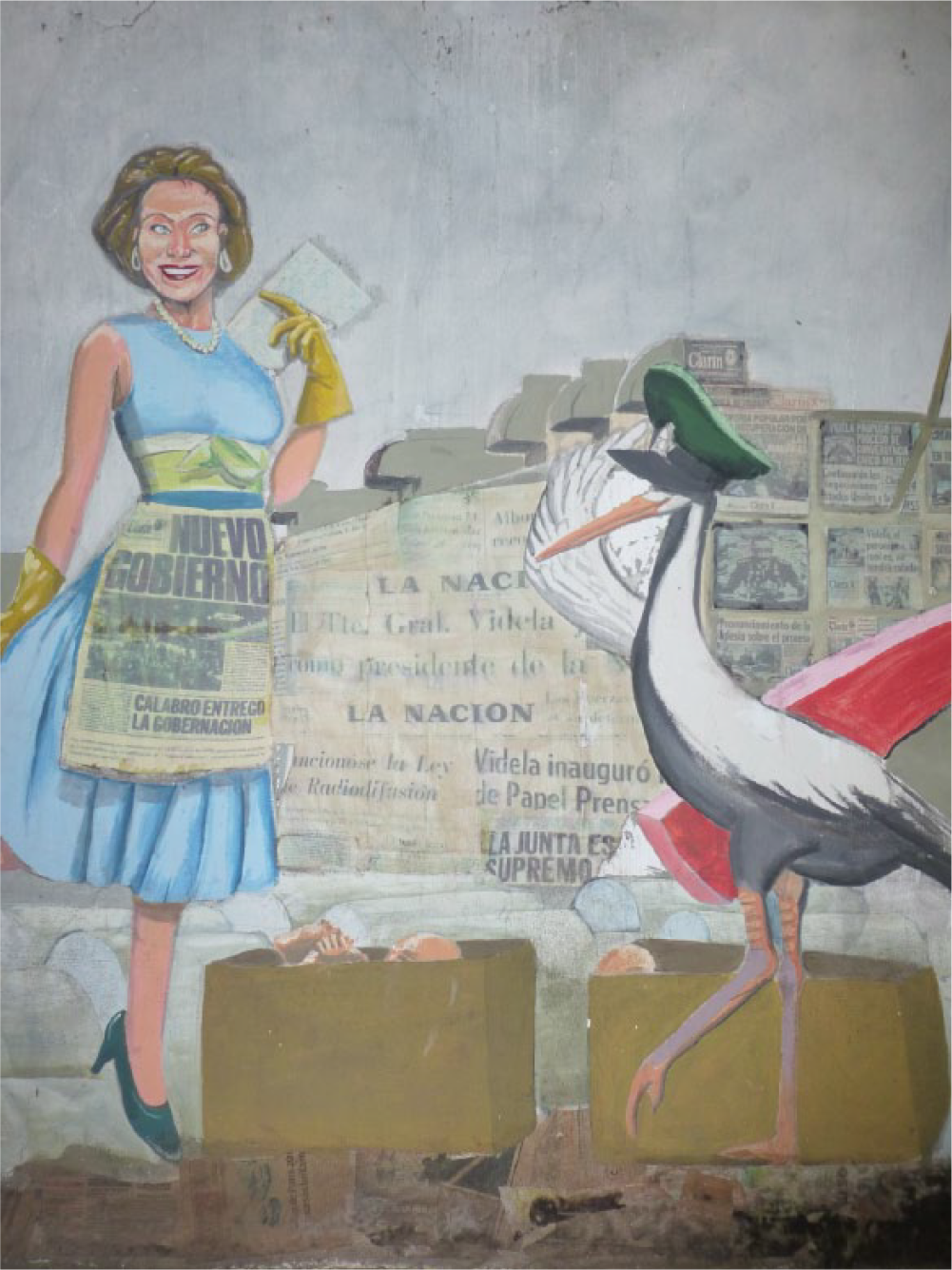
Mural, ex-Olimpo.
Some of the rooms used for detention and torture were directly adjacent to a sidewalk. In the main torture room, the military had installed a sign that read “Welcome to the Olympus of the Gods: The Centurions.” The site houses a few small spaces for community gatherings; for example, there is a room where local students can be tutored, a youth arts organization’s office, and the offices of the political organization Solidarity Resistance. The memory museum includes a repository for goods confiscated from detainees immediately after their capture. The thick-walled rooms in which torture took place are left largely as they were. Some of the holding cells were destroyed, but one gets a sense of their tiny size from markers on the ground. One of the unique features of this museum is the room dedicated to reconstructing the identities of the victims of forced disappearance. One wall of the room is lined with windows whose panes feature transparent black-and-white photos of detainees like those held up by the Mothers of Plaza de Mayo. The space houses several photo and memorabilia albums donated by family members of the disappeared. Visitors are invited to read letters and poems written by the detainees, see pictures of them, and gain a more intimate understanding of their lives (Figure 4). This room, well-lit and lined with floor pillows on which visitors can sit, stands in sharp contrast to the small, dark detention cells with their windows painted over.
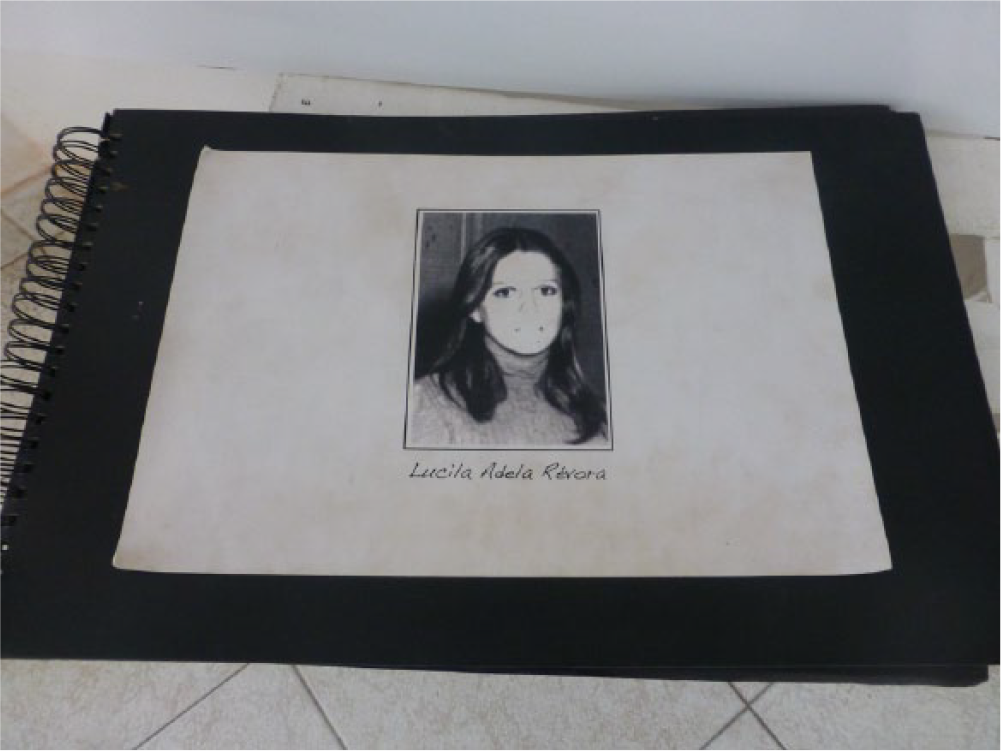
Memory album of Lucila Adela Révora, ex-Olimpo.
I first toured the ex-Olimpo site in 2007 with members of the International Genocide Studies Congress. The scholar of political genocide Daniel Feierstein was our guide, and he stressed that the struggle for memory projects and museums to exist demonstrates how difficult achieving truthful, transparent representations of traumatic memory can be and how threatening this process is. During the tour, a Chilean man came in and asked to speak to the manager. It turned out that the ex-Olimpo was the last place his wife had been seen alive. He was given a private walk through the space, and we were told that visits of this nature happen from time to time. Thus, a large part of the work of memory spaces in clandestine centers of detention, torture, and extermination is simply to persist, to refuse to crumble under the weight of a global trade network that seeks to erase and replace, to provide a collection of remembrances that instead of providing closure point to an “unresolved remainder’ (Avelar, 1999), to educate, and to display the ongoing process of accountability.
Conclusion
In April 1983, shortly after the election of Raúl Alfonsín, General Bignone issued a final report on the military’s “war against subversion and terrorism.” This document, which called for national reconciliation, attempted to dismiss the thousands of people the military had tortured and disappeared in concentration camps by characterizing them as exiles, people living in the country under false identities, and individuals thought to be dead, “regardless of the ability to determine the date, place, or cause of death, nor the burial site of the remains” (Feitlowitz, 2011 [1998]: 14). General Roberto Viola called them “absent forever.” The military claimed to have won the battle against subversion and excused its own “excesses” in the process (Salvi, 2015). In 1984 the National Commission on the Disappeared issued a report documenting the disappearance of 8,960 people and setting the stage for President Alfonsín to call for the trial of nine former commanders on numerous charges including torture, homicide, robbery, falsification of documents, child stealing, forced labor, and kidnapping. All nine were convicted, but the prospect of more court cases in the face of the military’s defiance resulted in Alfonsín’s declaration of the Due Obedience Law (23.049), which excused lower-ranking military personnel on the grounds that they were simply following orders. In a move that further enraged human rights organizations, in the name of stabilizing democracy Alfonsín issued the “Full Stop” laws, which set an end date of February 23, 1987, for prosecutions of military personnel for crimes committed during the dictatorship. In 1990 President Menem, who had included the “politics of memory” in his political platform (Perelli, 1994), pardoned the military personnel convicted during Alfonsín’s tenure and Mario Firmenich, the leader of the Montoneros, in the name of national reconciliation.
The military’s final report admitted “genuine Christian pain over any errors that might have been committed in the fulfillment of its assigned mission” (Feitlowitz, 2011 [1998]: 14) and denied unequivocally the use of secret detention facilities. While the report attempted to bring a preemptive end to the discussion, the Mothers and Grandmothers of Plaza de Mayo, H.I.J.O.S., the human rights groups, state legislators, and community organizations repeatedly rejected that effort. 11 The ex-ESMA complex and the ex-Olimpo site draw upon a politics of truth in visuality, forensic evidence, and testimony, and thus propose “different, and to an extent antagonistic, economies of remembrance and forgetting” (Andermann, 2007: 88).
According to Feitlowitz (2011 [1998]), Druliolle (2011), Memoria Abierta, and other sources, between 500 and 600 concentration camps and secret detention centers have been discovered through the efforts of ordinary people. 12 Over 100 of the approximately 500 missing children of disppeared parents have been recovered by a biological grandparent or had their true identities revealed to them. The “active political struggle not only over the meaning of what took place in the past but over memory itself” that Jelin (2003: xviii) describes has inspired an archive of memory at the grassroots and the official level, and this has resulted in a citywide network of projects and museums in Buenos Aires. Museums of memory created out of former clandestine centers of detention, torture, and extermination and micro-memory projects throughout the city function, alongside the pursuit of justice and human rights in the courts, as an invitation to interested viewers and a challenge to less sympathetic sectors of society to interact with the materials and spaces of disappearance and torture. 13 These days one is likely to come across a memorial flagstone (baldosa) marking the place where a disappeared person once lived, was last seen, or was abducted while walking down any street in Argentina (Figure 5). Family members, friends, and members of human rights organizations take part in the installation of the stones as a way of keeping the memory of their disappeared loved one alive and in view. 14
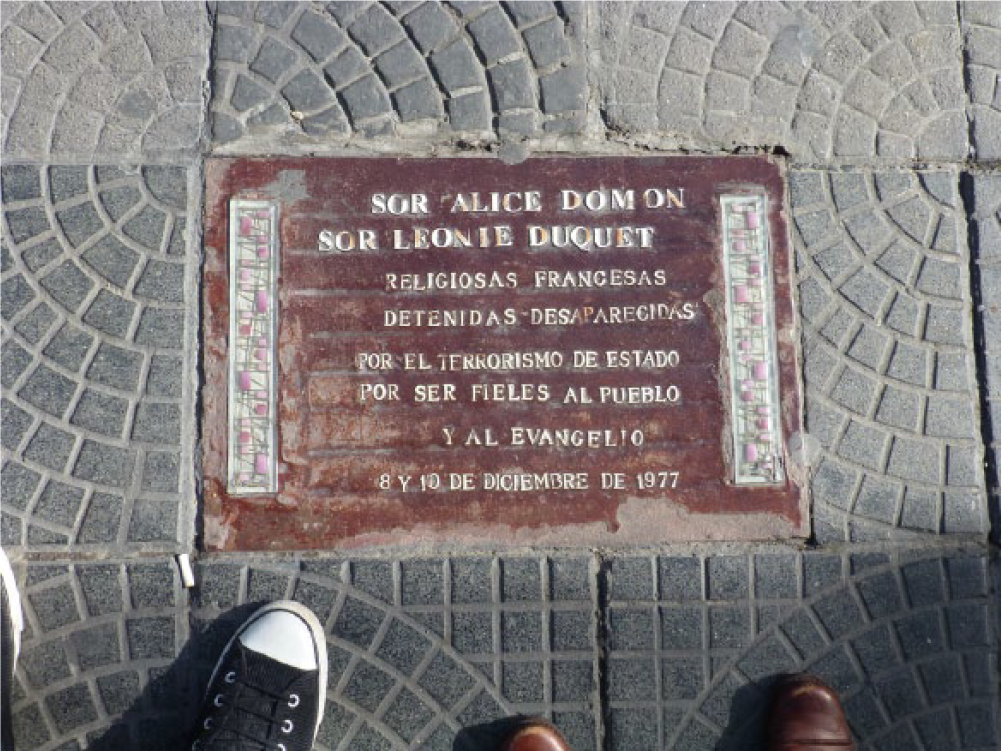
Memorial flagstone in the Palermo neighborhood of Buenos Aires.
Ksenija Bilbija and Leigh Payne (2011) suggest that these types of memory projects can be understood as part of a Latin American “memory market,” but they concede that the benefits derived from increased public knowledge about past injustices, justice and deterrence movements, and progress toward human rights goals outweigh any financial profit that might be derived from memory.Museums and spaces of memory created in former clandestine centers of detention, torture, and extermination have become symbols of state terrorism and in certain cases sources of evidence against members of the military (Druliolle, 2011: 19). While there is a great deal of support for memory projects among human rights organizations, there are also critiques from varied perspectives. Hebe de Bonafini’s faction of the Mothers of Plaza de Mayo, for example, has rejected projects such as the Memory Park, with its wall of the names of the disappeared, on the ground that affirming the death of their children means renunciation of political action. The articles collected by Lessa and Druliolle (2011) however, argue that, rather than serving as a final resting place for memory, these projects reflect a challenge to the fear generated by dictatorship, a reforging of social bonds, an incorporation of future generations into sociopolitical life, and a notion of memory in general as progressive.
Other sectors of society equate the idea of moving forward toward closure and democratic progress with letting go of the uglier aspects of the past, arguing that “remembering past misfortunes has to be prohibited to make way for a national peace process” (Salvi, 2015: 46). The Complete Memory organizations seek to replace the now familiar figures of the repressors and the disappeared with new narratives of military victims of “terrorism” and subversive violence in order to pit human rights groups’ demands for justice against the notion of social peace. Certain prominent social critics have accused politicians who make alliances with human rights organizations and/or work toward funding memory projects of attempting to brand themselves as the sole defenders of human rights and social justice (Guglielmucci, 2013: 239). A recent article in La Nación entitled “The Government Begins Plans to De-Kirchnerize the ex-ESMA” describes President Mauricio Macri’s efforts to decouple the space from the Kirchner presidencies by making changes that will help to situate him within the human rights camp. Macri has invited new organizations (UNICEF, the United Nations, and the National Institute of Indigenous Affairs) to set up offices at the ex-ESMA in what seems to be a move away from its focus on Argentina and Operation Condor. The rhetorical effects of such moves by a president who supported amnesty for generals on trial and an agenda of forgetting the past back in 2009, when he was mayor of Buenos Aires, remain to be seen (Feitlowitz, 2011 [1998]: 300).
However one looks at it, the past is currently framed, understood, and remembered as an ongoing battle against its own oblivion in Argentina, a battle that is evolving in many cultural spaces in the country, from the memorial flagstones that pepper city sidewalks to the pageant-like atmospheres outside the courthouses during some of the ongoing trials and sentencing of war criminals (Kaiser, 2005; 2015). The ex-ESMA and ex-Olimpo sites, both of which remain free and open to the public, highlight a sense of collective responsibility to participate in the conservation of shared memories, to house and display the ongoing emergence of new knowledge about the dictatorship (Kaiser, 2015), and to counter the hegemonic political discourse in Latin America that would like to curb or stop altogether “fixation on the past” (Avelar, 1999: 3).
Footnotes
Notes
Kristi M. Wilson is a coordinating editor of Latin American Perspectives and an associate professor of rhetoric and humanities at Soka University of America. She is the coeditor of (with Laura E. Ruberto) Italian Neorealism and Global Cinema (2007), (with Tomás F. Crowder-Taraborrelli) Film and Genocide (2011), and (with Antonio Traverso) Political Documentary Cinema in Latin America (2014).