



Abstract
Since the early 1990s, Chilean democratic governments after Augusto Pinochet’s dictatorship have made an effort to allocate publicly subsidized housing to the lower classes. Nevertheless, the dominance of market principles in urban policies has contributed to the formation of highly segregated neighborhoods and the gentrification of peripheral neighborhoods. As a result, Chilean public opinion is witnessing the rearticulation of what in the mid-twentieth century was known as the pobladores movement—social mobilizations demanding housing solutions for the poor. In the old working-class municipality of Peñalolén, severe gentrification since the late 1980s has triggered the appearance of autonomous grassroots organizations such as the Movimiento de Pobladores en Lucha (MPL). The movement has been able to fight social and spatial injustice in Santiago through a subversive appropriation of state policies. Its experience reveals the potentialities of such mobilizations for democratizing cities under a neoliberal regime.
Desde principios de los noventa, los gobiernos democráticos chilenos que siguieron a la dictadura de Augusto Pinochet han intentado proveer vivienda social subsidiada a las clases populares. Sin embargo, el predominio de principios de libre mercado en las políticas urbanas ha contribuido a la formación de barrios altamente segregados y a la gentrificación (o “aburguesamiento”) de los vecindarios periféricos. Por consiguiente, la opinión pública chilena está presenciando la rearticulación de lo que a mediados del siglo 20 se conoció como el movimiento de pobladores —movilizaciones sociales que demandaban soluciones habitacionales para los pobres. En el otrora municipio popular de Peñalolén, la importante gentrificación que se ha venido desarrollando desde finales de los 80 ha redundado en la aparición de organizaciones de base autónomas como el Movimiento de Pobladores en Lucha (MPL). Este movimiento ha sido capaz de combatir la injusticia social y espacial en Santiago mediante una apropiación subversiva de políticas estatales, experiencia que revela el potencial de dichas movilizaciones para la democratización de las ciudades bajo un régimen neoliberal.
Urban movements for housing have a long tradition in the so-called Global South. Massive migrations from the countryside and the incapacity of the state to provide social services and infrastructure to migrant populations have contributed to the proliferation of protests claiming the right to housing in developing countries. Like many other Latin American metropolises, Santiago, Chile, underwent a significant demographic and geographical expansion in the mid-twentieth century, resulting in what the historian Armando de Ramón (2007) calls “the city of the masses.” However, this demographic and geographic increase was not accompanied by housing solutions. The housing deficit in Chile reached 488,574 units in 1960, when more than 30 percent of families lived in households deemed “irregular” (lacking the minimum sanitary standards) (CIDU, 1972). This made possible the rise of the pobladores (urban poor residents) movement of the mid-twentieth century, a social mobilization carried out mostly by squatters claiming the right to housing by illegally taking over property in the city.
In Chilean political history, illegal land occupations were especially common during a period of social polarization (1960–1973) in which political parties began to think of them as a legitimate strategy for obtaining housing. Nevertheless, when the socialist Salvador Allende was overthrown by Augusto Pinochet’s dictatorship (1973–1990), the pobladores movement was drastically affected both by the regime’s repressive actions and by new urban policies inspired by neoliberal principles. These measures included the deregulation of the urban land market, forced relocations of organized squatter settlements from the city center to the periphery, and a new, neoliberal policy of social housing in which the whole process of home construction was placed in private hands, with the state providing subsidies only for the lowest-income groups.
Since the restoration of democracy in 1990, subsidy-based housing policies have dramatically reduced the quantitative housing deficit (Hidalgo, 2004). In 2009, 61 percent of households in the first quintile (the poorest 20 percent) were homeowners (Ministerio de Desarrollo Social, 2009). This policy has, however, been strongly criticized because of the poor quality of the housing units and the deficient urban infrastructure and services of the areas where they tend to be constructed. As several scholars have shown (e.g., Hidalgo, 2004; Rodríguez and Sugranyes, 2005), the significant allocation of publicly subsidized housing has not improved the living conditions of low-income families. The dominance of market principles in housing policies has fostered the formation of highly segregated neighborhoods along the city’s margins (Ducci, 1997), and the deregulation of urban land markets has contributed to the severe gentrification of working-class districts (Sabatini et al., 2010), foreclosing access to social housing in these areas.
It is in this context that this paper explores how contemporary pobladores movements are engaging in political practices to fight gentrification—actions that express a deeper criticism of neoliberal housing policies that, in spite of effectively providing the poor with housing through market mechanisms, tend to expel them from well-equipped neighborhoods. My examination is based on a case study of Peñalolén, a peripheral municipality that, initially made up of mid-twentieth-century squatter settlements, has been the site of important real estate investment since the late 1980s. This study focuses on the Movimiento de Pobladores en Lucha (MPL), an autonomous (independent of traditional political parties) grassroots organization demanding housing solutions for the poor. It examines the MPL’s narratives and practices with regard to Peñalolén’s gentrification and the “right to stay” in the district as expressions of emerging urban conflict in Santiago. The data are drawn from 10 in-depth interviews conducted between May and July 2011 and from notes taken during meetings and public demonstrations. 1 They reveal that the MPL’s demands for the right to stay must be understood as part of a broader claim for the right to the city—a concept that, in the context of advanced neoliberalization of housing policies, suggests both a reconfiguration of the old “right to housing” and a new approach in which homeownership is just one of the many components of what the MPL calls la vida digna (the dignified life). In contrast to works examining housing protests that generate a rights-based discourse through the material building of neighborhoods (e.g., Das, 2011; Fawaz, 2009; Holston, 1991; 2008), 2 this paper deals with activists who are mostly allegados—residents of relatives’ overcrowded houses. Accordingly, the case analyzed here problematizes two main issues: (1) to what extent the provision of subsidized housing aimed at promoting homeownership among the urban poor is sufficient for improving their living conditions and (2) how, in this context, contemporary social movements for housing recreate political and discursive strategies for claiming social rights, considering that newer generations of pobladores are no longer conducting their protests from illegal land occupations.
I begin by describing the pobladores movement and go on to discuss the gentrification that has triggered the reemergence of social protests for housing. Finally, I suggest that MPL’s narratives about the right to the city and the dignified life reflect its conception of the city as a space for sociopolitical intervention and of themselves as city makers.
Sociological and Political Accounts of Pobladores
Since the mid-twentieth century, sociological and political inquiries have examined the pobladores movement with particular attention to its social composition and the political scope of its struggles. With reference to the former, in the late 1960s and early 1970s there was passionate debate over the empirical validity of the “theory of marginality” proposed by the Centro para el Desarrollo Económico y Social de America Latina (DESAL, 1969). For these scholars, Latin American squatters, as structurally marginalized city dwellers belonging to the lumpenproletariat, were essentially unable to change their living conditions through political mobilization (see Cortés, 2013). Jorge Giusti’s (1973) account of Chilean pobladores and Janice Perlman’s (1976) study of Rio de Janeiro favelas presented important criticisms of this approach. Both writers emphasized that pobladores and favelados were not marginal but integrated into society in a way that was detrimental to their interests—enmeshed in a system of asymmetrical social, political, cultural, and economic relations that helped the ruling classes reproduce conditions of exploitation and domination. In Chile, one of the analytical consequences of these critiques of the theory of marginality was the treatment of the pobladores movement as a radical political movement bringing together a variety of subjects from the lower classes, a sociological reality not restricted to the existence of the so-called marginals (e.g., Castells, 1973; 1983; Espinoza, 1998; Garcés, 2002; Giusti, 1973). In Espinoza’s (1998) view, the category “poblador” may include both the traditional working class (attending to the system of economic exploitation) and a broader notion of “people” (pueblo) or “community” (derived from ideas of social exclusion), and therefore neither exploitation nor exclusion fully explains the poblador’s experience.
As for the political scope of the pobladores’ struggle, an important theoretical dispute arose in the mid-twentieth century concerning the political significance of housing mobilization in relation to other working-class movements. Among leftist intellectuals and politicians the issue was basically how revolutionary—in the Marxist sense—the pobladores could be, given the class heterogeneity of the people living in squatter settlements and the influence of national-populist projects on vast segments of the urban poor. In this regard, Castells (1973) raised some questions about the structural conditions of a movement stemming from a secondary contradiction of capitalism—one that resulted from claims oriented less toward production than toward collective consumption and services. However, as some scholars have stressed (Castells, 1983; Garcés, 2002), since the early 1950s the social impact of pobladores’ demonstrations called for a political opening among Chilean leftist parties that had traditionally focused on labor movements.
In that context, the massive illegal occupations had various sociopolitical meanings, being expressions of multiple goals. In Espinoza’s (1998: 75) opinion, in the 1950s land seizures were conceived of as a “gesture” through which activists sought to be recognized as citizens capable of taking part in institutional negotiations for social rights. This stage was dominated by narratives based on claims for which political participation was not a goal but a means. Nevertheless, squatter settlements began to acquire a political, even revolutionary meaning as left-wing parties construed them as a radical strategy for social transformation. For this reason, Manuel Castells (1983) argues that the Chilean pobladores movement is unique in that, for the first time in the history of Latin America, leftist organizations realized the significance of city dwellers in increasing the democratization that ended in the election of Salvador Allende as president of Chile in 1970. In Allende’s “Chilean road to socialism” the central interest of the state apparatus was to integrate pobladores’ claims into a political project led by the government. Therefore, in contrast to those of the initial period, their demands were directed not against the state but by the state (Espinoza, 1998). In this new political context, Castells (1983: 179) says, the Chilean experience must be highlighted precisely because it probes “the potential and the limits of squatters’ participation in a revolution” and the political autonomy an urban social movement requires for success.
Peripheral Gentrification and Displacement in Peñalolén
With a population of 244,903 people (Municipalidad de Peñalolén, 2010), Peñalolén is a telling case of the conflicts provoked by the arrival of real estate developments in a popular area with a long tradition of social movements for housing. Located in the southeast of Santiago, the municipality of Peñalolén was formally created in 1984 as a result of reforms aimed in part at creating socially homogeneous comunas (municipalities). As Sabatini (2000) explains, the subdivision of the 17 comunas into the 34 new ones was explicitly implemented to reorganize the patterns of class segregation in Santiago that had been subverted prior to the military coup.
Historically, Peñalolén arose from the urban mobilizations of the 1960s with the construction by their residents of poblaciones (poor neighborhoods) such as La Faena and Lo Hermida, places of political engagement that were targeted sites of violence and repression under Pinochet’s regime. In the 1980s the impact of the neoliberal urban reforms on Peñalolén was twofold. On the one hand, on account of the new subsidized housing policy, the municipality received a large number of former residents of squatter settlements in richer districts that were evacuated by the military regime as part of its “modernizing” agenda. On the other hand, taking advantage of the low price of urban land and the bucolic, semirural landscape offered by a district sited at the base of the foothills of the Andes, in the late 1980s real estate developers began to carry out massive private investments. Ever since, Peñalolén has undergone an “aggressive invasion and colonization” of lower-class areas by the real estate market (Sabatini and Salcedo, 2007) in the form of residential projects (gated communities) and commercial ones (shopping malls, supermarkets), a sort of peripheral gentrification that seems to be common in Latin American metropolises (Janoschka, Sequera, and Salinas, 2014). As a consequence, the percentage distribution of elite families—the richest 7 percent, called “ABC1” groups in Chilean public policy terms—increased from 3.6 percent in 1992 to approximately 10 percent in 2002 (Sabatini et al., 2010). The increase in land prices related to the influx of wealthy neighbors—a rise of 525 percent between 1990 and 2004 (Municipalidad de Peñalolén, 2010)—has dramatically reduced the capacity of the state to provide subsidies to develop social housing. For that reason, the problem of allegamiento (sharing of homes by two or more families) continues to be critical; some 2,700 houses were in such circumstances in 2010.
In contrast to other Latin American examples of gentrification on the urban margins (e.g., Irazábal, 2006; Svampa, 2001), Peñalolén has seen the massive distribution of subsidized public housing, and nearly 80 percent of the population are homeowners (Municipalidad de Peñalolén, 2010). The fact that home ownership is widespread among low-income groups obliges us to rethink how the process of gentrifying displacement comes about. We may argue that, since the poor are homeowners, it will be difficult to expel them from their neighborhoods or they will at least be able to negotiate the sale of their homes and obtain some material benefits. This is the kind of argument that some Chilean planners (Sabatini et al., 2010) have made in problematizing the distinctiveness of Santiago’s gentrification. However, these planners’ model, although revealing about large-scale demographic reconfigurations in the Santiago metropolitan area, fails to account for the intense political conflict that arises from the impossibility of carrying out social housing projects in gentrifying districts.
The ideas of gentrification and displacement are in fact central to understanding the demands of Peñalolén’s pobladores. I propose to adopt a critical perspective on gentrification in Santiago through a more dynamic understanding of displacement. As Tom Slater points out (2006; 2010), early criticism of gentrification has been replaced by accounts that use concepts such as “regeneration,” “revitalization,” “renewal,” or “renaissance,” overlooking the social costs of urban change by defending the “positive effects” of social mixing. In declaring the existence of a so-called positive gentrification—one that is supposed to provide jobs, services, and new equipment to deprived neighborhoods—these approaches dismiss the displacements involved (Slater, 2010). In this regard, Peter Marcuse’s (1985: 205) work offers a useful framework for capturing “the full range of housing-related involuntary residential dislocation.”
Marcuse outlines a variety of forms of displacement. The first is the kind that “occurs when any household is forced to move from its residence by conditions that affect the dwelling or its immediate surroundings” (Grier and Grier, 1978, quoted by Marcuse, 1985: 205). This is “direct last-resident displacement,” which “[may be, on the one hand, physical] when landlords cut off heat in a building, forcing material changes in housing units [or, on the other, economic] when the landlord raises the rent beyond the occupants’ ability to pay.” Three additional forms are “chain displacement,” which includes earlier occupants of a housing unit who may also have been displaced because of physical or economic changes; “exclusionary displacement,” in which gentrification makes occupancy impossible or unaffordable for households that would otherwise have been able to move into that place; and “pressure of displacement,” which is operating when “a family sees the neighborhood around it changing dramatically, when their friends are leaving the neighborhood, when the stores they patronize are liquidating and new stores for other clientele are taking place” (207). These phenomena make the area “less and less livable” and displacement “a matter of time.” Marcuse leads us to look at displacement as a dynamic process functioning at different temporal scales.
From the data collected it is evident that pobladores’ narratives on housing and the right to the city cannot be understood without paying attention to Peñalolén’s gentrification. Although most of the older working-class residents are in fact homeowners, over the past 20 years new generations of pobladores have had to deal with the increase of land values (see also Inzulza and Galleguillos, 2014). For this reason, the right to stay claimed by these generations arises directly from what Marcuse calls “exclusionary displacement,” a housing affordability problem for those who, having being born and raised in Peñalolén, want to continue living there as they start families and seek to get their own homes. Displacement as a mobilizing motive is emphasized by the MPL’s activists, who argue that in Peñalolén they “are no longer provoked by force, as in the dictatorship, but by the action of the market” (Guzmán et al., 2009: 12). This is the context in which Peñalolén’s grassroots organizations propose their political struggle for the right to the city. Nevertheless, in a city whose life is made up of social fractures, boundaries, inequalities, and nostalgia for earlier ways of life when notions like public space and social integration were more significant (Márquez and Pérez, 2008), such a political project entails a reconceptualization of the poblador as a particular kind of working-class agent.
The Movimiento de Pobladores en Lucha
In Peñalolén the existence of both gentrification and a long tradition of urban protest has generated deep conflict. Chilean public opinion witnessed the reappearance of the pobladores movement precisely in this area when in June of 1992, at the very outset of the democratic period, around 800 families occupied a 14-hectare piece of land, forming the settlement Esperanza Andina. Seven years later, in July of 1999, 1,900 families took over a 16-hectare plot, giving rise to the famous Peñalolén occupation, the last massive land seizure in Santiago. In both cases the squatters were allegados demanding the right to stay in Peñalolén. The success of both actions—eventually, most of the families involved obtained houses in the district—came to demonstrate how vigorous the pobladores movement was in its pursuit of social justice.
In the early 2000s, other organizations began demanding housing solutions in the district. Up until 2006 there were two of them, Lucha y Vivienda (Struggle and Housing) and Allegados en Lucha (Allegados in Struggle). After more than three years of ineffective negotiations with local and state institutions, they made the decision to seize plots in Peñalolén. Although they were quickly evicted, the occupation sparked the emergence of the MPL (Figure 1). As Guillermo, one of the founding members, explained (interview, June 8, 2011), “[In 2006] we decided to occupy some plots but we were evicted, so a lot of people got frustrated with that. It was like a ‘military defeat’ but a political triumph because some of us decided to found the MPL.” The idea of “military defeat but political triumph” was widespread among MPL’s activists as a way of describing how they redefined their role as social actors. Accordingly, they also came to question the usual way of obtaining state housing—the allegados committees, state-designated, bureaucratic housing committees through which prospective homeowners applied for state subsidies. In Özler’s (2012) opinion, democratic governments have strategically used committees of this kind to incorporate the poor into the state bureaucracy by enrolling them in governmental programs. In doing so, the Chilean state has somehow avoided the irruption of massive protests for housing that was observed decades ago.
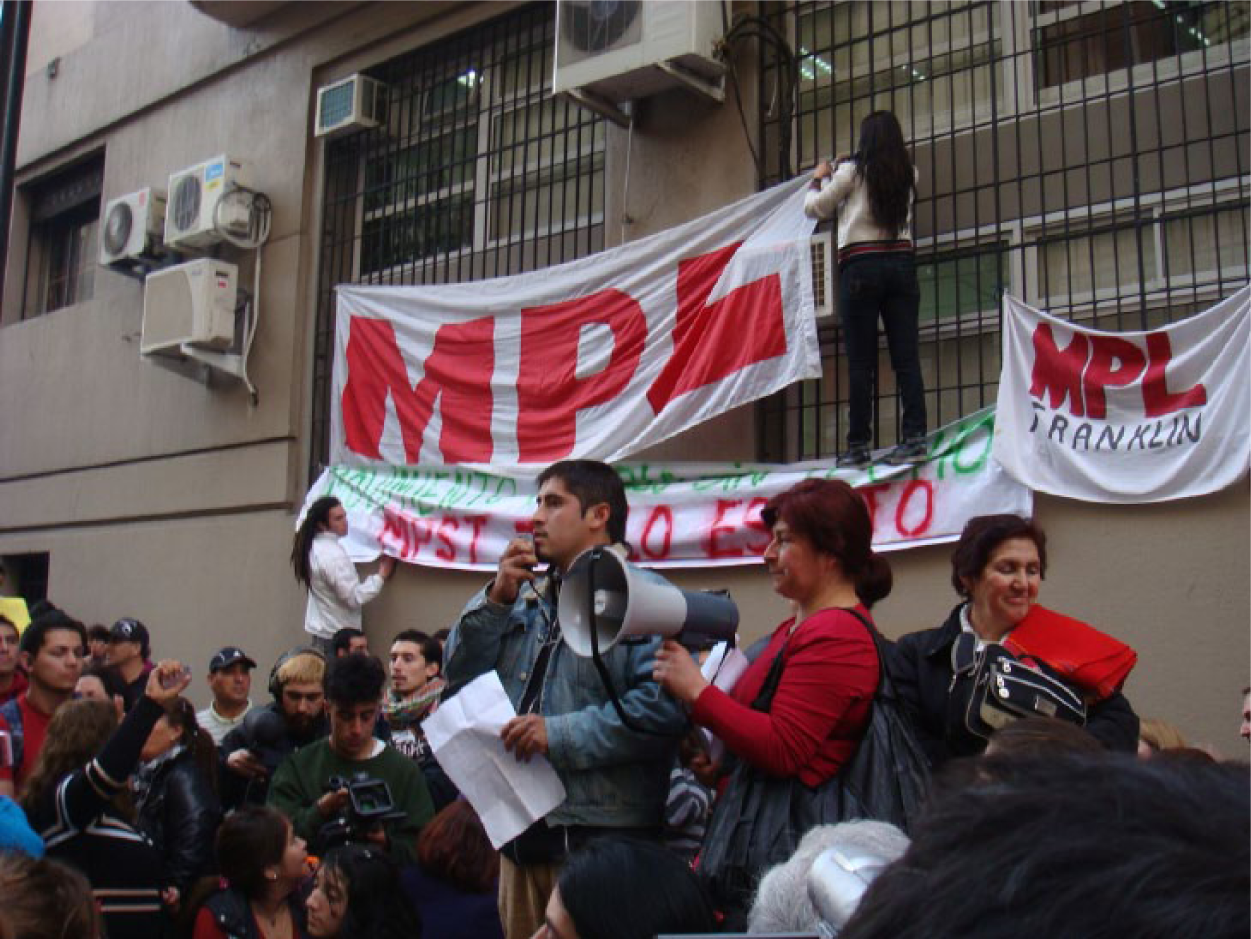
The MPL at a protest in front of the Ministry of Housing and Urbanism, June 2011.
The demobilizing role of allegados committees is one of the aspects that the MPL has to deal with when attempting to put forward a radical political agenda. Although, in general terms, these committees and emerging radical political movements like the MPL have different approaches to the housing problem and different goals—the former to become homeowners and the latter to fight neoliberalism—the relationship between them is unavoidable. This is because, in a period of advanced neoliberalism and generalized depoliticization, the only possible way to propose a new understanding of the housing crisis at the local level is by taking over these bureaucratic structures. Thus, for the MPL what is at stake is less the dismantling of these committees than the resignification of their role in the dissemination of a novel perspective on housing that considers it an initial stage in a broader struggle for social justice. “People come here [to the MPL headquarters] asking, ‘Are you giving houses?’ and we say, ‘No, we don’t give houses to anyone. Here we struggle for housing as long as you get involved in our political program of social transformation’ (Henri, interview, May 30, 2011)
For the MPL’s leaders, housing is not an end in itself but a means to articulate a deeper anti-capitalist narrative. This point is critical to having a full picture of how radical housing movements operate, because their leaders know that for most applicants for social housing the struggle ends once they become homeowners. In that sense, the political and ideological practices of the MPL’s leaders are directed not only toward the building of housing projects but also toward the maintenance of political activity in communities that tend to demobilize after achieving their primary goal, la casa propia (a house of one’s own). The statement just quoted therefore suggests a particular view of the housing problem as well as an expansion of contemporary pobladores’ mobilizations. As claimed in a book published recently by the organization (MPL, 2011), we are witnessing a “new” pobladores’ protest, one that, although sharing the class interests of those of the past, is struggling under new political conditions.
Historical continuity between the “old” and the “new” pobladores movement is explicitly assumed by the Movimiento de Pobladores en Lucha (Guzmán et al., 2009; MPL, 2011) as a way of emphasizing the role played by housing activists in broader processes of social change. In doing so it makes use of the notion of the poblador as referring not to just any poor inhabitant but to an actor constituted through particular political, social, and spatial practices: “Pobladores study, work. . . . [‘Pobladores’] is a generic concept applied to those who construct their organization, their lives, their resistance and formation processes in a territorial segment that is called la población [poor neighborhood]” (Lautaro, interview, May 25, 2011). The relations between past and contemporary pobladores’ protests are based, then, on the recognition of the poblador in his/her performative dimension—the affirmation of an identity that emerges from an array of social and spatial practices in the fight for social housing. The importance of space in the constitution of subjects has been examined by cultural geographers concerned with the performative character of human actions. Using notions like “act of spacing” (Crouch, 2003) or “touch and praesentia” (intimate involvement) (Hetherington, 2003), these researchers explain that in the making of place, which entails the execution of embodied performative practices, space cannot be thought of as an external, objective materiality totally detached from the social. Space is not a receptacle of social practices (acts of representation, signification, etc.) but the instance through which subjectivation takes place.
As I have said, the rise of the pobladores was closely bound up with a specific spatial practice carried out between the mid-1950s and the early 1970s—the self-help construction by residents of homes and neighborhoods (autoconstrucción) and the consequent structuring of a specific mode of subjectivation among the urban poor. In his work on Brazilian metropolises, Holston (1991: 451) suggests that practices of self-help construction or, in his words, “autoconstruction” involve a variety of activities that share two main attributes: first, that of a particular social production of space in which “the need to build a house represents the builder’s relation to a set of conditions that we might call peripheral urbanization; and second, that of home building as the figure or measure of an imagined future quite different from those conditions.” The experience of autoconstruction, Holston (1991) proposes, engenders political actions about residence and aesthetic judgments about houses through which the working classes develop new kinds of social agency: “The first dwellers had to deal with trash, wild hills . . . and had to struggle to get electricity, transportation. . . . Pobladores practically urbanized the Lo Hermida neighborhood” (Lautaro, interview, May 25, 2011).
My informants’ assessment of self-help construction is interesting for two reasons. First, in contrast to what happened some decades ago, home construction is no longer the dominant force in the development of the urban outskirts; indeed, less than the 1 percent of the country’s population lives currently as squatters in shantytowns (MINVU, 2011). Secondly, most of the MPL’s members, who are in their thirties and forties, did not participate in the land takeovers of the 1960s and 1970s and have built their subjectivities as allegados in formalized working-class neighborhoods. Self-help construction and living in squatter settlements, then, are conceived of as part of a glorious past in which pobladores were able to transform not only the city but also the role of the urban poor in society. “My grandfather, a communist militant who was one of the first squatters in La Faena, was assassinated by members of Patria y Libertad [an extreme right-wing organization]. All of my family has been involved in politics, and I remember having attended many marches against Pinochet when I was a child” (Guillermo, interview, June 8, 2011).
Over the past 50 years pobladores have taken on an important function in the process of democratization both as a force of social change prior to 1973 and as active resisters during the dictatorship. The MPL’s militants point to this history of struggle in an effort to reactivate the political facet of their movement and thus counteract what Paley (2001) describes as a period of demobilization stemming from the intersection of political democracy and economic neoliberalism since 1990. This background is also deeply connected to neighborhood memories and family relations, given that direct relatives of today’s leaders struggled either for housing or against repression. The process of house building—socially imagined through family narratives rather than personally experienced—operates as a linking element for younger pobladores in that it brings together individual biographies into an idea of collectivity. On the basis of this shared history, narratives about self-help construction and the significance of pobladores in the history of Peñalolén are central to the demand for the right to stay in the district.
The Right to the City and Dignified Life: Reconceptualizing City Making
The MPL has emerged as an autonomous political instrument to subvert the dominant order of real estate established through neoliberal reforms. As Nena explained (interview, June 15, 2011), “We [the militants of the MPL] define the organization as one against segregation because we didn’t want to go to the ultra-periphery [to get a house], since the rich use tools like a master plan to exclude and expel the poor from the city.” This point is significant, since, as Castells (1983) says, one of the most important problems of the old pobladores movement was that left-wing parties instrumentalized squatter organizations to develop their agendas at the local level. In contrast, according to my interviewees the MPL is independent of major political parties, and this gives it more room to deploy a radical strategy against gentrification. Its members have constructed a right-to-the- city discourse for fighting the ruling groups’ appropriation of the surplus value that pobladores have generated. For them, the right to the city means the right to stay, reappropriate, and be part of a space they consider their own. The main struggle they are engaged in is restoring Peñalolén to those who constructed it.
The right to the city was initially proposed theoretically by Henri Lefebvre (1996) in his endeavor to generate a Marxist approach capable of, on the one hand, critically analyzing the urbanization of society and, on the other, reflecting on a new framework of social relations. Thus, Lefebvre’s “right to the city” must be understood as part of his inquiries about the advent of an urban society, a process in which the urban—“a mental and social form, that of simultaneity, of gathering, of convergence, of encounter” (Lefebvre, 1996: 131)—comes to replace industrialization as the content and meaning of social relations. To explain the relationship between the contradictory logics interacting in urban society, Lefebvre uses two Marxist categories, use value and exchange value, to generate a framework based on two assumptions, the first of which is that the city and urban reality—that is, the material base and urban life—have historically been related to use value. The city, he suggests, can be construed as an oeuvre, as a work of art created and appropriated by its producers. The generalization of commodities led to the breakdown of the city as an oeuvre (use value) and produced the city as a market relationship (exchange value). Lefebvre’s “right to the city” therefore has to do with the reestablishment of the city as an oeuvre.
As a revolutionary understanding of urban society, for the French philosopher the right to the city involves the right to appropriation (the right to use, to live in, and to represent urban space) and the right to participation (the right to exert a control over the decision-making process in the social production of space [Lefebvre, 1991]). Lefebvre understands social change as the result of a particular kind of social experience, inhabitance, structured by class segregation. In this manner, everydayness (and thus residence) acquires a political and generative character in being the instance in which class domination reveals itself. 3 The fundamental argument of Lefebvre’s politics of inhabitance is, therefore, the idea that, in an urbanized society, oppressed and exploited groups will be able to question their living conditions through the acknowledgment of the political nature of everyday life, which, in turn, will allow them to address a transformative agenda composed of right-to-the-city claims.
The anthropologist James Holston (2008) follows Lefebvre in stressing the sociological and political relevance of everydayness in his ethnography of housing mobilizations in São Paulo’s peripheral areas. In his opinion, the set of actions performed by working-class inhabitants—the self-help building of homes and neighborhoods, the struggle to obtain title to residential property, and the search for recognition as city makers—have generated a new urban citizenship based on the creation of an alternative public sphere of civic participation. This “insurgent citizenship,” as he calls it, has two key characteristics: the primary criterion of membership is not nationality but residence, and residents claim resources as a matter of rights to the city. A suggestive aspect of Holston’s work is his use of the concept of “contributor rights” (Holston, 2008: 260) to describe the way urban inhabitants legitimate their demands on the basis of their contributions to the city itself, be it in terms of self-help house building or resistance to eviction. “[All of] this surplus value, this wealth [that Peñalolén has right now] demonstrates that it’s a myth that the poor impoverish a territory, because [rather] what they do is to generate value. And this is the capital in dispute that will finally be appropriated by real estate developers, the banks, and the state” (Lautaro, interview, May 25, 2011).
Similar to those studied by Holston, the subjects of my research conceive of the right to the city in terms of the recognition of productive social practices acting on the city’s development. What is notable here, however, is that their formulation of their right to the city is totally detached from the actual making of homes and neighborhoods. In the context of the state’s massive distribution of subsidized housing, it seems to me that contemporary pobladores, who consider themselves less squatters than allegados, understand city making in a broader sense. They construe it as the practical contribution that pobladores have made to the city over the past six decades not as individuals endeavoring to become homeowners but as working-class agents who have been able to enhance the social and political significance of the urban poor by taking a leading part in democratization. As a consequence, pobladores think of the right to the city in the Lefebvrian sense of the term—as associated not only with the right to appropriation and participation but also with the radical change of capitalist social relations.
Along with the right to the city, the MPL addresses another concept, the dignified life, which is understood as the “political horizon” of the organization (Guzmán et al., 2009: 4). Following Nicolás Angelcos (2012), I argue that the dignified life operates as an empty signifier given that, rather than defining normatively any sort of utopian or idealistic society, it refers to a kind of life in which biographical projects can be fully realized. It seems to me that such an achievement entails the subjective recognition of each poblador as a part of a broader community constituted through an ongoing effort for better living conditions, which in the case I studied depends significantly on inhabiting a place that pobladores have built over the past six decades. The struggle against gentrification and the right to stay in the district are therefore interpreted as a matter of dignity for those who have made the city.
According to the MPL’s activists, the demand for the dignified life arises in a context in which the provision of housing solutions has ideologically modified the critical dimension of urban social mobilizations. When the struggle for housing is oriented solely toward homeownership and neglects other important factors involved in the poor’s everydayness (health care, education, job opportunities, etc.), the relations of domination and social injustice may be maintained and even deepened. For my informants, being a homeowner has paradoxically become a source of social exclusion among the poor. On account of this, I am inclined to think that, for pobladores, the right to the city is a sort of umbrella concept covering various social rights. Don Mitchell (2003), analyzing how marginalized groups are able to both produce and appropriate public spaces by claiming specific rights, points to two important considerations: the need to examine the right to the city in relation to a set of minimum social rights and, as a corollary, the need for discussion of rights (in the plural) to the city (an opinion also held by Marcuse, 2009). 4
As pobladores repeatedly told me, the housing struggle must go beyond the demand for homeownership. For them, owning a house is only “the starting point in a long and permanent struggle” (Guzmán et al., 2009: 11). Phrases like “Our dream is larger than the house of one’s own” and “Moving toward the dignified life”)—both written on banners I observed during my fieldwork—reveal a particular understanding of housing mobilizations articulated through the notions of right to the city and life with dignity, a struggle that, achieved “in everyday life” (MPL, 2011: 31), recognizes “the different dimensions of living and inhabiting a territory: housing, health care, education, labor, our identity” (Guzmán et al., 2009: 11).
Self-Managed Social Housing: Comunidad Las Araucarias
The notion of “dignified life” verbalizes the set of urban and social contexts needed for the working classes to realize fully their individual life projects. It is not a final stage at which they are supposed to arrive but an everyday construction that begins by recognizing their struggle as one structured by the right to the city—a concept through which they can demand a number of social rights such as housing, health care, education, and work. The idea that being moved to peripheral ghettos is the only possible way to get a house is therefore something that the MPL has decided to overcome through popular mobilization, political engagement, and various novel strategies for confronting the housing deficit. As Daniela (interview, June 20, 2011) explained, The development of the MPL has to do directly with that situation [gentrification]; it has to do directly with how you walk around Lo Hermida or Peñalolén Alto [two working-class areas of the municipality] and people say, “I’m not participating in any committee [of allegados] because there is no land available in Peñalolén . . . because in the municipality I was told that there was no land available to build social housing.” So you start from that point telling them, “Sr., there is actually land available in Peñalolén.” . . . So this is how the MPL’s discourse about the defense of our comuna begins.
One of these strategies is the construction of what my informants called self-managed social housing (vivienda social autogestionada) in Peñalolén, an exceptional idea arising from an insightful and subversive appropriation of state policies. The New Housing Policy of 2006 introduced two private agencies mediating the relationship between the state and working-class families: the Entidades de Gestión Inmobiliaria (Entities of Real Estate Management—EGIS) and the Prestadores de Servicios de Asistencia Técnica (Providers of Technical Assistance Services—PSAT). Once people in need of housing obtained state subsidies, these agencies (which might be municipalities, foundations, cooperatives, consulting companies, construction firms, etc.) were in charge of the whole process of home building—identifying the plots where future housing units would be located, dealing with construction companies and state institutions, and supervising the design and construction of the units. For this they received money from the state as part of the subsidy for the construction of housing projects. According to the MPL, the appearance of these intermediaries is another expression of the “privatization” of public policy (MPL, 2011: 37), since housing management is now located not at the local, neighborhood level but in an external institution. In addition, as many informants told me, those organizations function on market principles, making profits by reducing the production costs of social housing projects; thus the very existence of these intermediaries is grounded in the construction of poor-quality housing units.
Nevertheless, taking advantage of the new housing policy, in 2007 the MPL decided to turn into EGIS and PSAT and to create two grassroots nonprofit organizations “where the whole production process [of social housing] rests on organized workers and pobladores and where the benefits are distributed on the basis of the movement’s necessities rather than on the basis of rates of capital accumulation” (MPL, 2011: 37). Here the participation as active militants of young professionals from outside the poblaciones was critical. Although the MPL was founded by pobladores, it is currently a sociopolitical organization that works for pobladores, for the right to the city and the dignified life, whatever the class composition of its militants. The MPL has been able to implement five social housing projects in Peñalolén, the first of which was inaugurated in December of 2012. This neighborhood, Comunidad Las Araucarias, is composed of 120 apartment units built on a 6,000-square-meter plot (Figure 2). This development demonstrates that the new strategies carried out by the MPL entail not only an enhancement of living standards for many working-class families but also a reconfiguration of pobladores’ social and political agency.

Comunidad Las Araucarias, the self-managed housing project in Peñalolén developed by the MPL, June 2011.
Final Comments
Peñalolén’s gentrification and the exclusionary displacement that it brings about has played a fundamental role in the development of contemporary discourses for urban justice in Santiago. The narratives that new generations of pobladores have formulated are grounded in the identification of certain conditions—policies inspired by market principles—that, while providing housing solutions, expel the poor to the extreme periphery and condemn them to endless poverty. The case discussed here is appealing in that the recognition of pobladores as a transformative force is predicated not upon the massive and organized land invasions that characterized the old movements for housing but rather on a shrewd employment of state policies. In this regard, the construction of Comunidad Las Araucarias, the first self-managed housing project in Chile under a neoliberal regime, may be observed by other pobladores—above all in places that have undergone gentrification—as a powerful way of getting high-quality houses. In addition, it works to reconceptualize the idea of city making—now detached from autoconstruction—and allows them not only to resignify their position as producers of space but also to legitimize their demand for the right to the city.
The building of Comunidad Las Araucarias opens up several discussions concerning the relationship between social movements and the state, mainly related to the autonomy of the former with respect to the latter. Although it seems evident that any urban movement for housing must direct its practical and discursive actions toward the state, for MPL’s militants the right-to-the-city struggle is by no means limited to state institutions. State policies may be appropriated to secure housing solutions for the poor without abandoning the revolutionary perspective of the MPL’s politics. From the activists’ standpoint, what makes any right-to-the-city mobilization distinctive is the fact that, instead of relying on professional politicians, working-class inhabitants themselves are imagined as productive, transformative collective subjects. Here lies one of the main differences of this grassroots organization from the ones that made up the “old” pobladores movement of the 1960s and early 1970s: its independence of traditional political parties, which used to construe poblaciones as local branches from which to deploy their political agendas rather than as communities endowed with political autonomy.
This work, as well as that of others conducted in large metropolises (e.g., Holston, 2008; Purcell, 2003), demonstrates what Lefebvre formulated theoretically five decades ago: that urban life itself makes possible the formation of a kind of politics that, composed of demands for rights to the city, revitalizes the political dimension of the city. The reestablishment of the city as a primary political community is powerfully expressed when the MPL’s militants deem pobladores as the foremost city makers, entitled to the city because of the part they have played over the past six decades in both Chilean political history and Santiago’s urban development. In recognizing the social, political, and urban contribution of pobladores, the MPL’s demand for the right to the city functions as a concept that allows activists to take their struggle for the dignified life beyond Peñalolén. The slogan “A tomarse Peñalolén para conquistar la ciudad” (We must take over Peñalolén to conquer the city [Guzmán et al., 2009]) speaks precisely to the idea that, regardless of where pobladores live, a more just and democratic city is required, one in which the poor can take advantage of, use, and define the destiny of a space that they have made throughout history, one in which the market is not the driving force of the urban development and one whose inhabitants are neither displacers nor displaced.
The development of Comunidad Las Araucarias permits us to raise another important issue associated with the two opposed modes of understanding of housing struggles that I observed in fieldwork: on the one hand, the interest of the MPL’s leaders in putting forward a broader anti-neoliberal discourse and, on the other, the social bases’ desire to become homeowners rather than part of a radical political movement. It is too soon to tell whether Comunidad Las Araucarias will display the decline of political activity that tends to characterize former housing protesters who are now homeowners, and an analysis of this phenomenon will be required to assess the real success of the MPL in the promotion of an anti-neoliberal agenda among working-class families. A critical evaluation of the potentialities and limitations of contemporary housing struggles in a larger process of social transformation is crucial for Chilean politics, where the demand for a deeper level of democracy is being powerfully addressed.
Footnotes
Notes
Miguel Pérez is a professor in the Department of Anthropology at the Universidad Alberto Hurtado (Chile). He thanks the Center for Social Conflict and Cohesion Studies (CONICYT/FONDAP/15130009) for its support during the writing of this paper and the militants of the Movimiento de Pobladores en Lucha for allowing him to study their inspiring struggle. He also thanks the reviewers for their comments.