



Abstract
Peru’s posttransition democracy presents a paradox: presidents have remained unpopular despite presiding over a period in which democratic institutions strengthened and the economy grew rapidly. O’Donnell’s work on delegative democracy suggests that the Peruvian paradox results from weak vertical accountability. Since Peru’s return to democracy, parties and civil society have been too weak to hold elected leaders accountable. Furthermore, presidents have faced opposition to reform from entrenched neoliberal technocrats. With no one holding them accountable and little capacity to govern, presidents have chosen to delegate decision-making authority to technocrats. Even when leaders have won office on reformist platforms, continuity has prevailed, and citizens have lost trust in their elected leaders. The origins of the Peruvian paradox and weak vertical accountability can be traced to the destruction of the institutional and organizational foundations of democracy in the 1990s under Alberto Fujimori’s authoritarian regime.
La democracia pos-transición en Perú presenta una paradoja: los presidentes siguen siendo impopulares a pesar de presidir un período en el que las instituciones democráticas se fortalecieron y la economía creció rápidamente. El trabajo de O’Donnell sobre la demo-cracia delegativa sugiere que la paradoja peruana resulta de una débil rendición de cuentas vertical. Desde el retorno de Perú a la democracia, los partidos y la sociedad civil han sido demasiado débiles para responsabilizar a los líderes electos. Además, los presidentes han enfrentado la oposición a la reforma de tecnócratas neoliberales atrincherados. Sin que nadie los responsabilice y con poca capacidad para gobernar, los presidentes han optado por delegar la autoridad en la toma de decisiones a los tecnócratas. Incluso cuando los líderes han sido eligidos en plataformas reformistas, la continuidad ha prevalecido y los ciudadanos han perdido la confianza en sus líderes electos. Los orígenes de la paradoja peruana y la débil rendición de cuentas vertical se remonta a la destrucción de los cimientos institucionales y organizativos de la democracia en la década de 1990 bajo el régimen autoritario de Alberto Fujimori.
Since President Alberto Fujimori’s competitive authoritarian regime collapsed in 2000, Peru has enjoyed an unprecedented period of economic growth, increasing state presence, and stable democracy. Despite this auspicious context, the governments of Alejandro Toledo (2001–2006), Alan García (2006–2011), Ollanta Humala (2011–2016), and Pedro Pablo Kuczynski (2016–2018) have endured intense public dissatisfaction. Approval ratings for presidents, parties, Congress, and the democratic regime itself have often fallen below 20 percent. What explains this “Peruvian paradox” (Levitsky, 2014)? Why do Peruvians despise their politicians despite Peru’s strong performance in recent years?
We propose that Guillermo O’Donnell’s (1994) work on delegative democracy helps to explain the persistent unpopularity of Peruvian politicians. Delegative democracies “rest on the premise that whoever wins election to the presidency is thereby entitled to govern as he or she sees fit, constrained only by the hard facts of existing power relations and by a constitutionally limited term of office” (O’Donnell, 1994: 59). These regimes are weakly institutionalized democracies. Political actors respect the fundamental democratic institutions of free elections and general protection for political rights, but these regimes do not promote accountability. In institutionalized democracies, two sets of actors hold elected leaders accountable. Agents of “horizontal accountability” including ombudsmen, prosecutors, judges, and legislatures have the legal authority to monitor officials and sanction them for abuses of power. At the same time, voters, civil society organizations, and political parties provide “vertical accountability.” These actors can use elections and lobbying to push politicians to be responsive to society’s preferences. Delegative democracies combine electoral vertical accountability with a feeble horizontal counterpart. The absence of checks and balances breaks the representative link between public demands and policy making. While free and fair, elections become mechanisms for selecting a supreme authority to whom voters delegate decision-making power.
Peru’s democracy features a different form of delegation. Rather than voters’ delegating to politicians, Peruvian politicians delegate to unelected technocrats, particularly on economic matters. The result resembles delegative democracy: a regime with democratic institutions but without a representative link between the public and policy makers. However, we diagnose the cause as a lack of vertical rather than horizontal accountability. While elections empower Peruvians to choose their leaders, weak parties and civil society limit the public’s ability to hold governments accountable. Furthermore, without the support of mobilized sectors of society and experienced parties, presidents find themselves alone in their efforts to implement their campaign promises. The path of least resistance becomes capitulating to rather than challenging the entrenched technocrats who have controlled policy making since the 1990s. Thus, presidents who win office promising reform rapidly become protectors of the status quo. While policy stability has encouraged headline economic growth, it leaves the public frustrated with political leaders who refuse to lead.
In the following three sections we describe how this arrangement developed and the forces that maintain it. The first section lays out the Peruvian paradox in further detail. The second section describes its origins in the 1990s, when then-President Alberto Fujimori encouraged the collapse of Peru’s party system, waged a violent conflict against the Shining Path insurgency that weakened civil society, and implemented drastic pro-market economic reforms by empowering neoliberal technocrats in the state. These actions demobilized agents of vertical and horizontal accountability. The third section shows that vertical accountability did not reemerge after Fujimori’s fall. By tracing the course of Peru’s four most recent elected presidents, we highlight how each succumbed to the logic of delegation. The pattern, we argue, endures because without political parties or organized civil society presidents lack the tools and incentives to accept the risks of pursuing reform.
Seventeen Years of the Peruvian Paradox
Since returning to democracy in 2001, Peru has been home to Latin America’s most unpopular politicians. Aggregate measures of public opinion from Latinobarómetro surveys between 2001 and 2017 show an average presidential approval rating of 26.7 percent and similar low levels of trust in Congress (16.5 percent), the courts (16.7 percent), and political parties (13.6 percent). The corresponding averages for the rest of Latin America are 47.8, 27.2, 29.2, and 19.2 percent, respectively, and Peru ranks last in the region on all four indicators. Low public approval has been a feature of all four democratic presidential administrations. Toledo’s approval rating bottomed out at 8 percent (IPSOS, 2006), García’s at 19 percent (IPSOS, 2008 and 2011), and Humala’s at 13 percent (IPSOS, 2016). When Kuczynski resigned the presidency, his rating had fallen as low as 18 percent (IPSOS, 2018). Once out of office, presidents become no more popular; attempting to return to the presidency in 2016, 1 García took less than 6 percent and Toledo just 1 percent. Legislators fare little better; more than 70 percent of the members of Congress in 2011 were serving in the chamber for the first time (Mainwaring, 2018). Political parties hold little mass appeal. Only Brazil averaged a lower proportion of the public that feels close to a political party.
The public’s attitudes toward politicians are puzzling because of Peru’s strong institutional and economic performance. After President Fujimori dismantled Peru’s democratic institutions in the 1990s, Peru’s contemporary political leaders restored and respected them. The judiciary, the legislature, and other traditional institutions of constitutional liberalism are strong and independent. While presidents retain preeminent formal powers as in other Latin American democracies, they have accepted constraints on their authority from Congress, the Constitutional Tribunal, and even supranational bodies like the Inter-American Court of Human Rights (Vergara and Watanabe, 2016). Congress was especially active under President Kuczynski. With opposition forces in charge, the legislature blocked executive initiatives, censured ministers, and attempted to remove the president from office. Obstruction was so extensive that Kuzcynski implored Congress to “let us work, don’t create intrigue, and don’t sack ministers every two weeks” (RPP Noticias, 2017a). Peru does not lack meaningful checks and balances on the exercise of power. Furthermore, in contrast to the uneven playing field that existed under Fujimori, observers such as the European Union and the Carter Center have declared elections since 2001 to be free and fair. Open competition for access to power is perhaps the essential feature of democracy (Mazzuca, 2010). In institutional terms, Peru is clearly a democracy. Not only did Peru’s democratic leaders navigate “the extraordinary uncertainty of the transition” (O’Donnell and Schmitter, 1986: 3) but they have preserved democracy for over 17 years, the longest democratic period in Peru’s history.
Democracy has coincided with an economic boom. Between 2001 and 2016, data from the UN’s Economic Commission for Latin America and the Caribbean (ECLAC) show that the real gross domestic product (GDP) more than doubled, increasing from US$86 billion to US$193 billion at 2010 prices. GDP per capita doubled, from just over US$3,000 to US$6,000, during the same period, averaging 4.2 percent growth per year (ECLAC, 2017). The only Latin American country to grow faster during this period was Panama. According to the Central Bank of Peru (BCRP, 2017), inflation averaged 3 percent per year between the beginning of 2001 and the end of 2017. Social indicators collected by ECLAC also improved. The poverty rate fell from 54.7 percent in 2001 to 22.7 percent in 2014 and extreme poverty from 24 percent to 4.3 percent. Economic inequality decreased, with the Gini index declining 16 percent, from 0.525 to 0.439, during the same period. Health indicators improved markedly. Between 2001 and 2016, infant mortality fell from over 27 deaths per 1,000 live births to fewer than 12. Peru now has the fifth-lowest infant mortality rate in Latin America, having improved six places since 2001. Life expectancy at birth has risen by more than three years over the past decade and a half.
A booming economy strengthened Peru’s state. Social programs received new infusions of resources. For example, the Peruvian conditional cash transfer program Juntos (Together) expanded from a few thousand beneficiaries in 2005 to three-quarters of a million a decade later (Figure 1). According to ECLAC (2017), spending on social programs doubled, from US$282 per person in 2001 to US$599 in 2015. The increase was particularly notable for spending on health (from US$51 per person to US$129) and education (US$92 to $204). While spending remains low relative to Latin America as a whole, it is comparable to levels in neighboring Bolivia and Ecuador, where leftist governments are widely seen as having increased social programs. The scope of Peru’s state also increased. One example is the expansion of the country’s paved road network, which grew from 8,500 kilometers in 2000 to almost 20,000 kilometers in 2016 (Figure 2). Another indicator is the size of the Peruvian police force. The number of police increased from approximately 90,000 in 2003 (UNODC, 2007) to almost 125,000 in 2016 (RPP Notícias, 2017b). While the state’s performance is lacking in many areas, it has clearly improved during Peru’s democratic era.
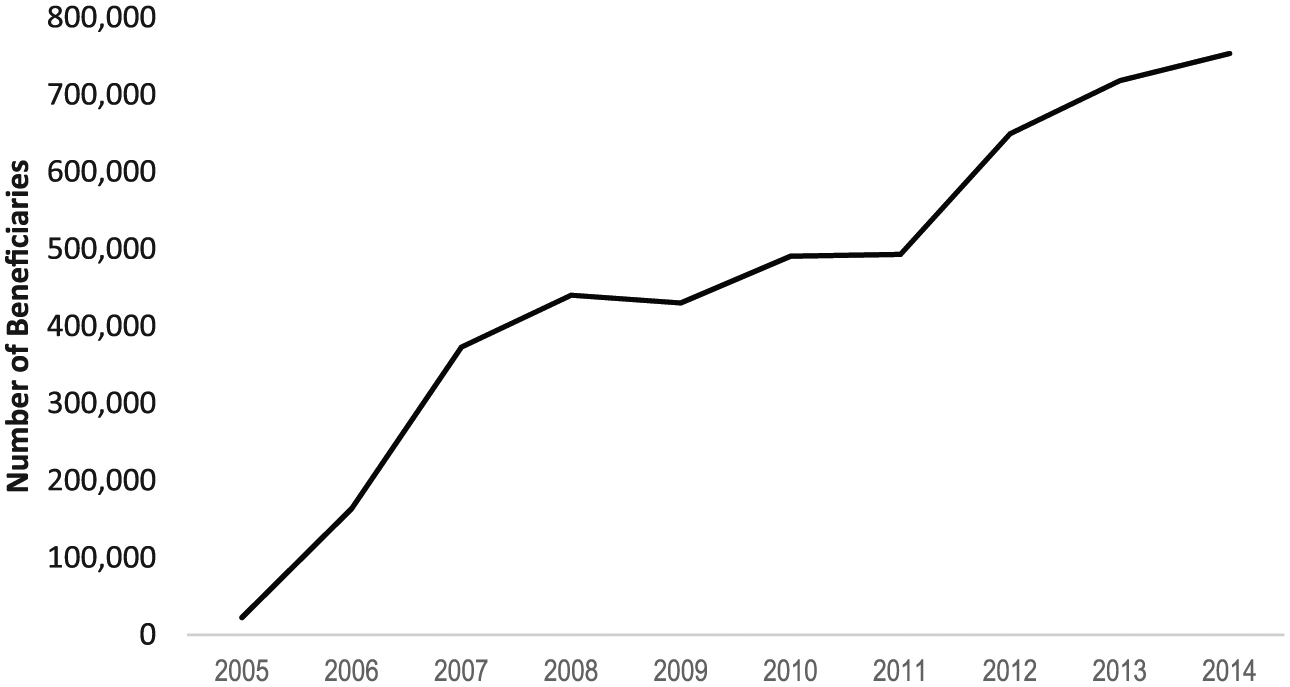
Expansion of households in Juntos program, 2005–2014 (Sánchez and Rodríguez, 2016).
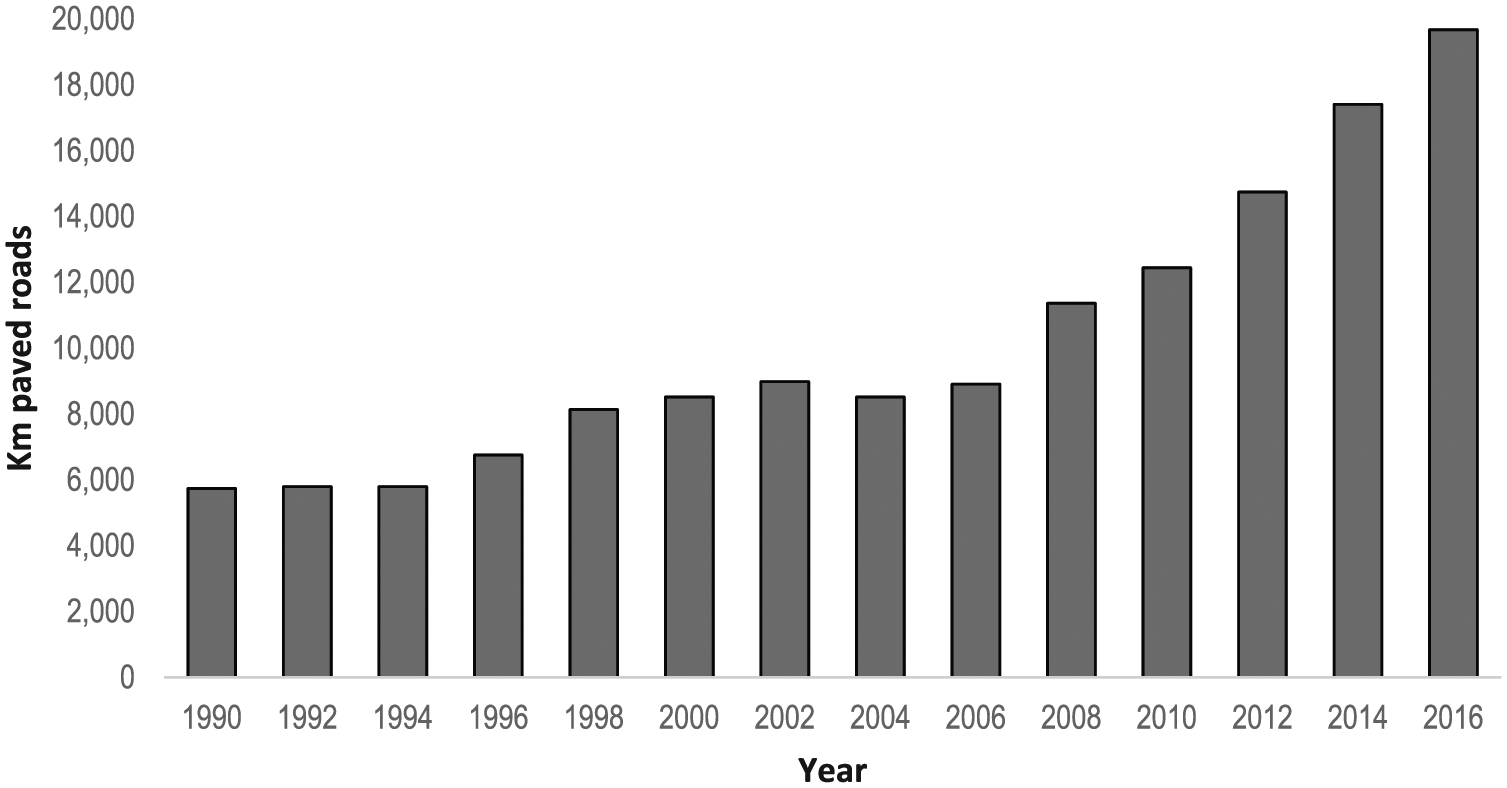
Peruvian national highway system, 1990–2016 (Ministerio de Transportes y Comunicaciones, 2018).
In summary, Peru’s politicians are exceptionally unpopular, but their popularity does not reflect poor performance. In the words of Cynthia McClintock (2006: 96), the post-Fujimori era has been “the first time in its history [when] Peru simultaneously enjoyed economic growth, political peace, and one-person-one-vote democracy.” Few Peruvians, however, approved of their performance. We argue that performance has failed to generate popularity because of a lack of vertical accountability. Political leaders have not been accountable to the public for programs that they offer to voters, running on promises to reform the status quo but protecting it once in office. Each of Peru’s four most recent presidents has followed this pattern. The unresponsiveness of Peruvian politicians to the public’s desires undermines citizens’ trust in their leaders.
The Fujimorato
For scholars working on a range of issues in Peruvian politics, the early 1990s constituted a “critical juncture” (Roberts, 2014). The forces driving change across the entire region during this period were particularly intense in Peru, where they had produced a full-blown crisis by the late 1980s (Vergara and Encinas, 2018). The Peruvian economy was in shambles. Industrial output collapsed, particularly in important sectors like manufacturing and construction (BCRP, 1995). Incomes fell by 50 percent between 1985 and 1990 (BCRP, 1990), and per capita GDP fell to levels not seen since the 1960s. Much of the middle class slid into poverty. Inflation spiraled out of control, peaking at 7,640 percent in 1990. At the same time, brutal armed conflict between the Peruvian state and the Shining Path insurgency engulfed much of the country, leaving around 69,000 Peruvians dead and at least half a million displaced (CVR, 2003). Peru’s political leaders during the 1980s failed to address these crises, becoming consumed in their own internal machinations while growing distant from the sectors of society that they claimed to represent (Tanaka, 1998). The combined failures of the economy, the state, and the political leadership led to the election of the outsider Fujimori to the presidency in 1990 and two years later to Fujimori’s self-coup, which shuttered Congress and suspended the constitution. From his dominant position in the political system, he proceeded to undermine both horizontal and vertical accountability in his project to build a competitive authoritarian regime (Levitsky and Way, 2010).
A large literature has documented how Fujimori sought to limit horizontal accountability (Conaghan, 2005; Levitsky and Loxton, 2012). As did executives in delegative democracies, Fujimori saw agents of horizontal accountability as “nuisances to the president’s will” (O’Donnell, 1994: 60). He reportedly “couldn’t stand the idea of inviting the President of the Senate to lunch in the Presidential Palace every time he wanted to pass a law” (McClintock, 1996: 65). Although international pressure prevented him from permanently closing down Congress and the courts, he reconstituted these bodies on his terms. His control over nominations to the judiciary and regulatory agencies allowed him to pack them with loyalists, while his coattails in the 1995 general elections ensured that his supporters controlled a majority of seats in Congress. During his second term (1995–2000) he governed largely by decree, and Congress failed to monitor the executive, debate laws, or produce any relevant legislation (Degregori and Meléndez, 2007). Far from constraining the president, Congress and the courts helped him to break the law. Most infamously, Congress passed an unconstitutional “Law of Authentic Interpretation” to exempt the president from term limits so that he could run for a third term in 2000. The courts accepted these dubious laws. With the judiciary and the legislature under his control, Fujimori faced almost no horizontal accountability after 1992.
At the same time, he undermined vertical accountability in three ways. First, he actively attacked its institutional foundation: free and fair elections. Through his intelligence chief, Vladimiro Montesinos, he bought off or bullied much of the Peruvian press. Montesinos’s connections with Peru’s intelligence agencies and military allowed him to employ these services in the president’s reelection campaigns (Levitsky and Loxton, 2012: 174–177). Meanwhile, he turned the “Ministry of the Presidency” into a massive clientelistic machine that controlled 20 percent of the national budget and targeted spending on social programs to boost support for the president before elections (Graham and Kane, 1998; Schady, 2000). The president’s personal control over the oversight agencies responsible for monitoring his behavior further tilted the playing field. Opposition candidates had no channels to protest the blatant abuse of state power. Nor was the president subject to the law. When the opposition appealed to the judicial and electoral authorities to block Fujimori from running for a third term in 2000, the government moved to pack more supporters into these bodies, ensuring a favorable outcome. Electoral competition under Fujimori was too unfair to be democratic.
Fujimori also attacked the organizational bases of vertical accountability. Active, organized, and continual public participation in politics beyond simply casting votes is critical to making democratically elected leaders responsive to society’s demands (Campbell, 2004; Putnam, 1993; Skocpol, 2004). By aggregating the efforts, resources, and expertise of many individuals, organized actors such as political parties, unions, neighborhood associations, and fraternal societies can exert greater political influence than those same individuals acting alone. Their greater capacity allows interest groups to monitor politicians between elections, informally sanction those who fail to meet their demands, and thereby link state and society. Organized civil society suffered during Fujimori’s presidency. Fujimori pushed Peru’s already weak parties into collapse. Coming after continual rhetorical attacks from the president (Levitsky and Loxton, 2012: 170), the 1992 self-coup left Peru’s parties out of office, publicly humiliated, and, in some cases, with their leadership in exile. Having neglected to build an organization of his own, Fujimori also had a strong demonstration effect—the recognition that parties were unnecessary for electoral success—and this led politicians to abandon them (Levitsky and Cameron, 2003). Consequently, the parties that had won more than 90 percent of the votes in the 1985 general elections captured less than 5 percent 10 years later. At the same time, both the state and the Shining Path actively directed violence at civil society, which struggled to survive. The continuing context of crisis and their respective weakening led parties and civil society to move apart (Cameron, 1994; Grompone, 1991), further reducing their ability to hold political leaders accountable. In these ways, the vehicles of representation almost vanished during the years of the internal conflict. To quote Hobbes’s description of a world without social contracts, civil society became a “disbanded multitude,” unable to exert influence in politics.
Finally, Fujimori’s economic policy reshaped society, the state, and policy making in ways that limited vertical accountability. Soon after taking office he implemented a drastic neoliberal shock program that undermined the legal basis for important collective actors such as unions and peasant cooperatives. It also shrank the state’s scope and responsibilities, thereby reducing the incentives for interest groups to organize for making claims on the state. The way these reforms were implemented affected vertical accountability as much as their substance. Acting like the president of a delegative democracy, Fujimori aligned himself with apolitical technocrats. In exchange for insulation from political influence and control over economic policy making, these technocrats provided Fujimori the political program that he lacked and the expertise to implement it. Together, Fujimori and his experts became the “alpha and omega of power” (O’Donnell, 1994: 60), particularly after the self-coup undermined the influence of other actors and the success of the shock program gave this team public legitimacy (Dargent, 2015). Just as Fujimori sought to consolidate his hold on the presidency, technocrats embedded themselves in the state. They gained control of crucial institutions such as the Ministry of the Economy and Finance, the Central Bank, and the national tax authority. From these positions, they restructured the economy along neoliberal lines with little input from society. Their specialized knowledge, combined with the success of their policies at taming inflation and restarting economic growth, gave them power. How could Fujimori or any other politician remove them from their posts if doing so might plunge the economy back into crisis? Safe from the threat of termination, technocrats would gain the upper hand against politicians once Peru returned to democracy.
Peruvians may have elected Fujimori democratically, but they did not have democratic channels to hold him accountable or remove him from office. The same crisis conditions that brought Fujimori to power allowed him to transform Peru’s politics, economy, and society on terms that favored his continued rule. Horizontal accountability died at the hands of an isolated but popular caudillo who saw any restriction on his power or organized opposition as a nuisance. In Fujimori’s view, the president’s immediate will overrode campaign promises, institutions, and opponents. The agents and institutions of vertical accountability also stopped being “really important decisional points in the flow of influence, power, and policy” (O’Donnell, 1994: 67). Elections served little more purpose than to legitimize a president to whom society had, intentionally or not, delegated decision making. The more Fujimori succeeded at resolving Peru’s crises, the more the society delegated; the more it delegated, the more it weakened; the more it weakened, the more difficult it became to restore the representative link whose absence had contributed to the crises in the first place. As Mainwaring (2006) noted, a caudillo, even if extremely popular, is a symptom of rather than a solution to problems of representation. The combination of such an anti-institutionalist caudillo and deep neoliberal reforms left an indelible mark on Peruvian politics (Roberts, 2014). Put another way, the crisis of representation Peru faced in the early 1990s was not merely self-reinforcing but self-intensifying.
Peru After Fujimori: Facing Weak Vertical Accountability
Fujimori’s government collapsed in late 2000 because of escalating public protests and a widening bribery scandal that made its corrupt, authoritarian nature impossible to ignore. Although subsequent governments, particularly the transitional administration of Valentín Paniagua, restored Peru’s democratic institutions, meaningful vertical accountability has not reemerged. We argue that it is the continuing weakness of vertical accountability that drives Peruvians’ deep dissatisfaction with politics. Peru’s democratic machinery has consistently failed to achieve one of its main goals: linking the public to the exercise of power. Without organizations with the interest and capacity to participate in politics, such representation is impossible. The premise that democratic decision making is done on “people’s terms” (Pettit, 2012) remains a chimera.
In the following pages, we trace the weakness of vertical accountability across the four elected governments of the post-Fujimori era. The crucial piece of evidence here is that while presidents have won office by promising to pursue reform, they have subsequently embraced the status quo. Presidents have not been held accountable for implementing their campaign promises. In some cases, presidents had promised economic changes (Garcia and Humala), in others the defense of institutions and democracy and the battle against corruption (Kuczynski), but they all broke these promises. Having shown the weakness of vertical accountability, we trace two legacies of Fujimori’s regime that have inhibited the development of responsive government. The first is continued control by technocrats of important areas of policy making regardless of who occupies the presidential palace. The second is the persistent weakness of civil society, particularly political parties. The absence of strong political parties supporting and at times pushing presidents to pursue policy change combined with the opposition of entrenched technocrats to reforming the status quo creates incentives for presidents not to pursue their campaign agendas. The logical course of action for them is to break their promises and delegate authority to technocrats. These legacies of the Fujimori era sever the representative link between state and society that democratic politicians ideally provide and thereby generate the high levels of dissatisfaction with politicians that Peruvians have expressed over the past decade and a half.
Valentín Paniagua (2000–2001)
Before examining the elected governments of Peru’s democratic era, it is important to understand how certain elements of Fujimori’s regime survived the transition to democracy. Peru’s initial redemocratization under Valentín Paniagua’s caretaker administration was largely successful. Peru moved decidedly toward an institutionalized representative democracy that, in O’Donnell’s (1994: 61) words, embraced “the existence and enforcement of a careful distinction between the public and private interests of officeholders.” Paniagua’s government restored fair elections, rule of law, respect for the constitution, and clean government, but it did not and arguably could not avoid several elements of Fujimori’s legacy. The transitional administration recognized the need for economic stability to avoid the slide into chaos that other Andean countries suffered in the wake of their own interrupted presidencies. Paniagua’s government consequently chose to maintain Fujimori’s free-market policies (Dargent, 2015), separating the neoliberal economic model from the populist, authoritarian political project used to implement it. In addition, Paniagua allowed key technocrats from the 1990s to keep their posts in the Ministry of the Economy and Finance (Vergara and Encinas, 2016) and other “islands of efficiency” (Dargent, 2015) even while he removed Fujimori loyalists from the judiciary, the electoral authorities, and other oversight bodies. While the transitional administration had the option to alter Fujimori’s economic legacy, it could not undo the damage inflicted on the political parties. Party building is difficult, time-consuming, and challenging to encourage through top-down policy (Levitsky, Loxton, and Van Dyck, 2016). Thus, while the transitional government restored the institutions of democracy, it left in place elements of Fujimori’s regime that would later impede the development of meaningful vertical accountability.
Alejandro Toledo (2001–2006)
Alejandro Toledo adhered to the pattern of governance Paniagua had established: respect for democratic institutions, a hands-off approach to economic policy grounded in continuity, and decision making with little input from the public. Toledo won the presidency promising to fight corruption and pursue decentralizing reforms to promote greater popular control over government. Such a platform resonated with Peruvians who had witnessed the pervasive corruption of the Fujimori years. Toledo’s humble background and indigenous features—rare among Peru’s political class—also generated enthusiasm among voters. He missed no opportunity to play up his symbolic appeal. He selected a chacana (a traditional Inca tool) as his party’s political symbol and, after winning the presidency, organized a fatuous swearing-in ceremony at Machu Picchu with indigenous leaders. Voters responded positively to Toledo’s platform and image. In the first round of the 2001 presidential election, he won 36.5 percent of the vote and 23 of Peru’s 25 regions before easily defeating Alan García in the runoff. To the public, especially indigenous and mestizo Peruvians, the first elected president of the post-Fujimori era stood for democratization and the hope of economic and social progress.
Toledo largely failed to implement the policies or provide the symbolic representation he promised. Vertical accountability failed for several reasons. First, Toledo entered office without prior experience in navigating the institutional complexities of politics or an organized party to guide him. This precarious political situation led him to appoint internationally respected, highly competent technocrats to key ministries in his cabinet. For example, he named the former World Bank vice president Roberto Dañino as his first prime minister and later gave the post to Pedro Pablo Kuczynski, previously his finance minister. With technocrats in charge, policy followed neoliberal principles while the president and Congress did little of note. Although maintaining macroeconomic stability encouraged growth, delegating authority to a cosmopolitan limeño technocracy distanced Toledo from his electoral base. These advisers’ small-state, free-market orientation meant that social policy changed slowly. Abandoning both his policy program and his supporters contributed to his abysmally low levels of approval, which slid below 20 percent after his first year and never recovered.
Toledo and his Perú Posible (Possible Peru—PP) party had largely vanished from politics by the end of his government. PP did not contest regional elections in 2005. In general elections a year later, it did not run a presidential candidate and won only 2 seats in Congress compared with 45 in 2001. Its effective disappearance from the political scene was final proof that PP was a vehicle not of representation but of Toledo’s presidential ambitions. Rather than investing in party building, he governed by allying himself with technocrats who had stronger links to the international policy community than to the Peruvian public. In delegating authority to these unelected experts, he sapped his own presidency of its vitality.
Alan García (2006–2011)
These dynamics persisted under Alan García, who returned to the presidential palace after a disastrous first term in the late 1980s. Two factors made García’s return noteworthy. First, he belonged to the Alianza Popular Revolucionaria Americana (American Revolutionary Popular Alliance—APRA), perhaps Peru’s only political party. A strong showing for one of the members of Peru’s former party system raised hopes that parties were reviving. Second, he returned to office after voters had delivered a clear rebuke to the status quo. Only 20 percent had supported Lourdes Flores, a conservative politician who positioned herself as the candidate who would preserve it. With Flores taking third place in the first round of balloting, the runoff featured a choice between García and the left-wing populist Ollanta Humala, who modeled himself on Hugo Chávez. While García positioned himself as a moderate alternative to Humala, both claimed to oppose neoliberalism, particularly labor market liberalization and free-trade agreements, and criticized the constitution that had been drawn up during Fujimori’s government.
However, García made an about-face once in office. He became a champion of the neoliberal economic model, signing several free-trade agreements, deregulating the labor market, and pursuing a highly conservative agenda (Drinot, 2014). Given his affiliation with APRA, García was expected to install party cadres to run the state. However, he had never trusted APRA’s technical cadres and filled his government’s key economic policy-making positions with independent experts or businessmen (Vergara, 2010). In ceding power to technocrats, García followed the same logic as Toledo. Policy reform would have challenged an economic model that produced rapid growth (reaching 9 percent in 2008) and enjoyed support from the national media, business elites, and technocrats. Even moderate change would have required political fights with entrenched interests that García was far from certain to win. Furthermore, there was little public pressure for change. While the public registered its dissatisfaction with the status quo in elections and opinion polls, it did not mobilize for political change as had the public in neighboring Bolivia and Ecuador. Instead, society acquiesced to continuity, allowing García to continue delegating to unelected officials. Unsurprisingly, the results of his presidency mirrored Toledo’s. The economy grew at full speed, but Garcia’s approval rating spent much of his term in the 20 percent range (IPSOS, 2008; 2011).
García proved no more responsive to the public than Toledo. His policies were much more conservative than what Peruvians had voted for, and the principal policy makers continued to be unelected experts. The gap between citizens and policy became wider. Not by coincidence, social conflicts over mining projects peaked, with several leading to the deaths of protesters and police (Arellano, 2013). García’s election also did not produce the hoped-for revival of either APRA or the party system. Despite its historical strength, APRA was to be little more than an electoral label for García. In 2010 it won only 2 of Peru’s 25 regional presidencies. A year later it did not field a presidential candidate in the 2011 general elections and won only 4 seats in Congress. As with Toledo and PP, Garcia and APRA failed to represent the public in policy making.
Ollanta Humala (2011–2016)
The 2011 presidential election culminated in what Mario Vargas Llosa called a choice “between AIDS and terminal cancer” (quoted in Levitsky, 2011: 85). The runoff again featured two political outsiders: Alberto Fujimori’s daughter Keiko and Ollanta Humala. Given the Peruvian elite’s ambivalence toward the Fujimoris and Humala’s efforts to recast himself as a moderate leftist, the latter managed to win where he had lost in 2006. Once in office, Humala faced extreme pressure from Peru’s business and political establishment to prove his commitment to the free market and did so by selecting García’s deputy economy minister, Luis Miguel Castilla, to head the Ministry of the Economy and Finance and the respected orthodox economist Julio Velarde to run the Central Bank. Humala’s lack of political experience and his party’s disorganized, disloyal legislative bench created further impediments to implementing his center-left platform. His promise of a “great transformation” became a joke among Peruvians, who noted that Humala’s only transformation was his own. Disappointed with his apparent lack of political will, the leftist advisers who had supported his campaign left the government after only a few months. Key ministerial posts remained under the control of technocrats Humala had inherited from previous administrations. Having embraced neoliberalism while governing with the same cast of unelected technocrats that had ruled the country for years, he saw his popularity decay. Delegation to technocrats produced fewer benefits for Humala than for previous administrations as falling commodity prices slowed economic growth and denied him the legitimacy of a strong performance.
Humala found himself in much the same position as his predecessors by the end of his term. After its candidates failed to gain any traction with voters, his Partido Nacionalista Peruano (Peruvian Nationalist Party—PNP) withdrew from the 2016 general elections. Today Humala and his wife, Nadine Heredia, are accused of corruption and have even spent a few months in jail. The collective shrug from the Peruvian public over Humala’s imprisonment demonstrated just how isolated the president had become from other politicians, interest groups, and voters.
Pedro Pablo Kuczynski (2016–2018)
In 2016 Peruvians elected a president who openly supported the status quo. A banker with connections to the United States and a technocrat who had served in Toledo’s government, Pedro Pablo Kuczynski embodied the neoliberal model. However, his victory did not mean that Peruvians had embraced the status quo. After election officials barred two more appealing outsiders from the race, PPK (as Peruvians know him) won the presidency as the default alternative to Keiko Fujimori, who won the first round of balloting by a clear margin. Upon winning a spot in the runoff election against Keiko, he crafted a campaign emphasizing the corruption and authoritarianism of Fujimorismo, contrasting it with its anticorruption and democratic credentials (Dargent and Muñoz, 2016). He received grudging support from actors across the political spectrum who feared that Keiko would lead Peru back into authoritarianism. This support pushed him to a narrow victory. Between neoliberal continuity and the possibility of democratic backsliding, a slim majority of Peruvians chose the former.
Kuczynski’s flawed presidency followed those of his predecessors. His campaign discourse about fortifying politics, democracy, and institutions vanished, to be replaced with tired ideas about economic growth, big infrastructure, and modernity. Unsurprisingly, his cabinets were full of technocrats and businessmen. Orthodox measures at the Ministry of the Economy and Finance to cut the deficit compounded the negative effects on economic growth of falling commodity prices. This combination of déjà-vu decisions gave way to déjà-vu consequences: the president saw his popularity plummet and was finally impeached. Out of office, his party will almost certainly vanish. The cycle of Peruvian politics seems to be unresponsiveness of presidents followed by their lonely failure.
Summary
After Fujimori’s regime collapsed in 2000, Peru restored the basic institutions of a well-functioning democracy but not the representative link between policy making and public preferences. Presidents without roots have seen little risk in betraying their campaign priorities. Politicians’ lack of accountability for the programs that they offer to voters undermines their popular support. Voters like neither liars nor passive leaders. Given that Peru’s presidents have often been both, Peruvians unsurprisingly hold them in low esteem. Further evidence for the link between weak accountability and low popularity comes from the trajectories of each president’s approval rating. Approval ratings over time for the three presidents who completed their terms follow similar patterns in which presidents enter office with favorable ratings that decline over the first half of their terms (Figure 3). The public remains disappointed in its leaders for failing to follow through on their campaign promises or respond to the desire for change that voters have expressed.
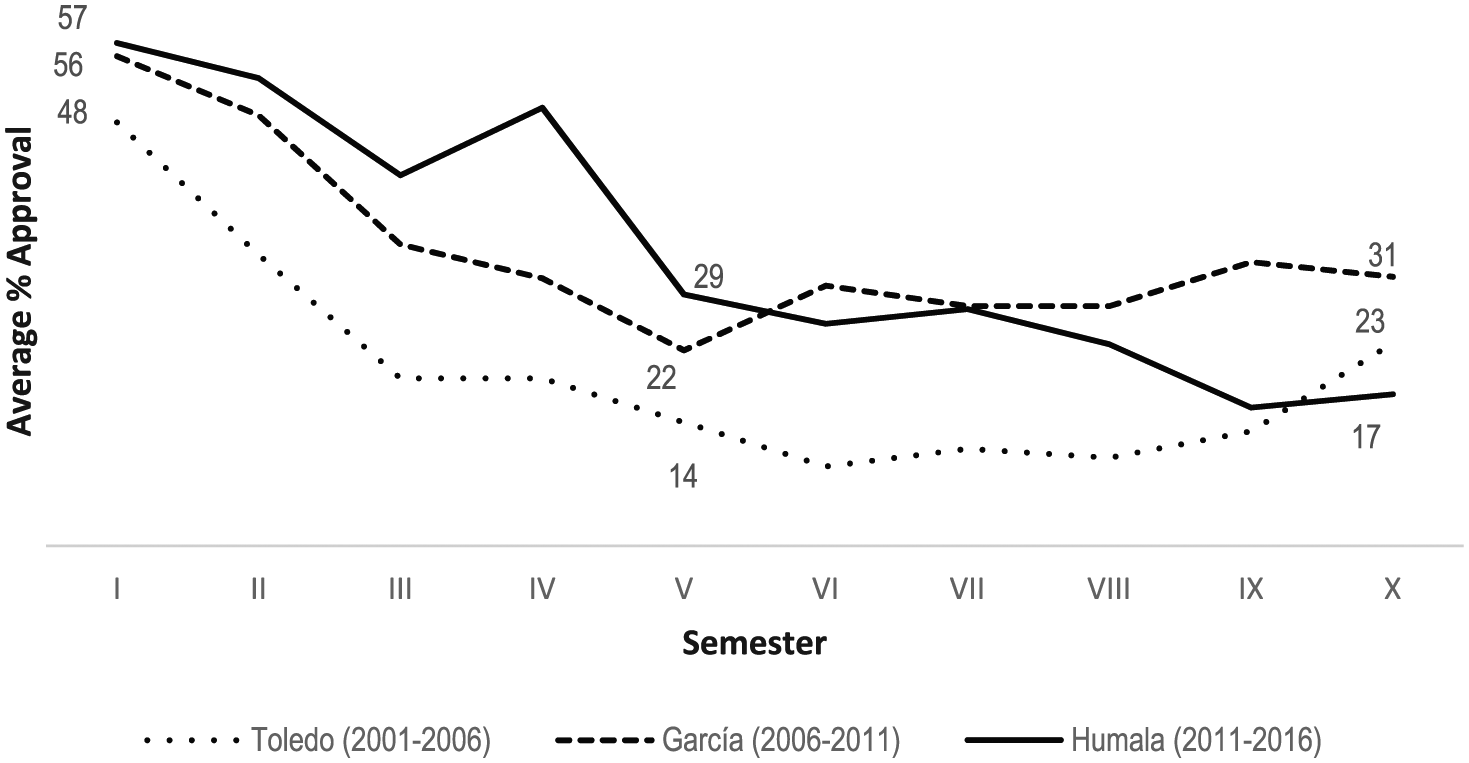
Presidential approval ratings, 2001–2016 (authors’ calculations based on IPSOS (2006; 2008; 2011; 2016).
The preceding section also suggests some causes of Peru’s weak vertical accountability. One is the weakness of Peruvian parties. Except perhaps for APRA and Fujimorismo, Peruvian parties are empty labels that do not command disciplined or much presence outside Lima. As Levitsky and Zavaleta (2016) have argued, Peru’s politicians have learned to play politics without political parties. The absence of strong parties and politicians’ adaptation to these circumstances reduces vertical accountability in several ways. First, politicians without parties are isolated from society. Parties provide citizens and interest groups an everyday presence in politics. The constant pressure from below that they produce incentivizes politicians to take on politically risky battles to implement new policies. Without such pressure, Peru’s politicians have little reason to challenge entrenched technocrats, the business sector, and the media by championing reform of the neoliberal model. Instead, they leave the country “on auto-pilot,” a phrase Peruvians often use to describe their governments. Thus elections and fresh faces in power bring nothing more than “alternation without alternatives” (Vergara, 2012). Second, the absence of parties leaves politicians ill-equipped to govern. Without parties, politicians often win election as political novices who lack the critical knowledge and skills of governing that previous experience in office provides. Furthermore, Peruvian politicians lack the technical support, dependable legislative allies, and electoral organization that strong parties supply. Even when politicians want to pursue new policies, they often lack the capacity to do so. Finally, the absence of parties is self-reinforcing. Without parties, politicians are ineffective, and citizens become discouraged. Such citizens are poor building material for parties. While Peru’s experience has shown that democracy is neither unthinkable nor unworkable without parties, it suggests that it is likely unpopular.
The power of technocrats also impedes vertical accountability. Their experience and expertise give them considerable leverage against weak amateur politicians (Dargent, 2015), and they have increasingly taken control of the government. For example, recent finance ministers have generally been technocrats. Between 2000 and 2012 every finance minister had been educated abroad, and all but one had worked for an international organization (Dargent, 2015). In line with Vergara and Encinas (2016), the percentage of technocratic ministers in Peruvian cabinets has grown steadily through the 2000s. Technocrats made up 49 percent of Toledo’s ministers, 63 percent of García’s, 75 percent of Humala’s, and 70 percent of Kuczynski’s, and the proportions of “political” ministers have correspondingly fallen. The fact that technocrats dominated the cabinets of presidents elected from the left, right, and center demonstrates that these experts, supported by media and business elites, have gained the upper hand against all politicians. The delegation of authority over key areas of policy making from elected politicians to unelected experts creates obvious problems for vertical accountability.
Finally, a weak civil society is unable to act as an alternative agent of accountability. More than 20 years after the internal armed conflict destroyed much of its organizational capital, civil society remains feeble. Less than 5 percent of Peruvians are unionized, and less than 20 percent even sympathize with a political party, according to the 2014 Latin American Public Opinion Project survey (LAPOP, 2015). Organized civil society’s limited footprint and lack of coordination limits its capacity to convert popular discontent into pressure on political leaders. For example, whereas in Bolivia and Ecuador civil society helped to scale up local issues into national protests that altered the trajectory of politics, in Peru the weakness of civil society has meant that local protests remain local (Meléndez, 2012). Similarly, a weak civil society cannot serve as the basis for party building as it has for the Movimiento al Socialismo (Movement toward Socialism) in Bolivia.
With weak parties, a demobilized civil society, and entrenched technocrats, politicians lack the tools, incentives, and opportunities to pursue new policies. They see little choice but to delegate authority to the technocrats. Consequently, the nexus of power in Peruvian democracy lies not between society and politicians but rather firmly in the hands of unelected, isolated experts. Consequently, while surveys like Latinobarómetro and LAPOP find that Peruvians support the institutions of democracy at similar levels to most Latin Americans, they deeply distrust the politicians who operate within these institutions. Our analysis echoes an observation Jeremy Waldron recently made while reviewing the work of Habermas: “In a democracy, laws are supposed to have legitimacy because the people to whom they are addressed are also their authors.” Even if mediated by other structures and actors, “all of this is done in our name. . . . These procedures are us, making laws for ourselves” (Waldron, 2015: 70). If the ultimate point of democracy is to give citizens final say over the laws they must obey, then Peruvians have reason to be upset with politicians who replace their judgments with those of unelected, unaccountable technocrats.
Conclusion
Robert Dahl (1971: 1) famously said that the key element defining a democracy is a situation of “continued responsiveness.” In modern democracies, representation is the main mechanism for making government responsive to the public’s preferences. Yet recent analyses of democracy have followed Guillermo O’Donnell in focusing on problems of horizontal accountability rather than the link between policy makers and society. This focus is largely due to the recurrence of presidents like Alberto Fujimori who win power democratically but undermine the checks on their power, pushing democratic regimes into authoritarianism. Political scientists have devoted more attention to horizontal accountability than to problems of representation and accountability to society. However, as Enrique Peruzzotti (2013; 2015) and Luna and Vergara (2016) have pointed out, broken links between political regimes and citizens can be equally damaging to democracy.
The Peruvian case demonstrates the truth of this statement. The institutions of liberal democracy reemerged after the collapse of Fujimori’s authoritarian regime. Since 2001, presidents have coexisted alongside the judiciary and Congress without undermining them. However, meaningful vertical accountability has not developed in this institutional framework. Its absence lies at the root of the problems of legitimacy that plague contemporary Peruvian democracy. Without responsiveness, Peru’s politicians and institutions have failed to generate public trust. Without roots, presidents have little to gain from pursuing new policies and little to lose if they do not. The lack of strong political parties, the limited ability of civil society to channel public discontent, and the continuing power of unelected technocrats have impeded the regeneration of vertical accountability. As O’Donnell (2010: 197) wrote a decade after publishing his work on delegative democracy, citizens can succumb to alienation—forgetting both that they have created institutions and that these institutions exist to serve them.
This situation generates a serious legitimacy problem for Peruvian democracy. Without a strong civil society to channel their grievances, Peruvians have become silent witnesses in a political system that is supposed to give them voice. How long this equilibrium will last as the economy slows and whatever minimal legitimacy technocratic management has produced evaporates is unclear. Will this situation lead disenchanted middle classes and rural social movements angered by resource extraction to link up behind another Fujimori-like populist who uses a crisis to undermine Peru’s democratic institutions? Could such a moment disrupt these institutional dynamics, creating incentives for politicians to build links to society and exert greater control over policy making? Or, despite a slowing economy and disenchantment, might continuity prevail? No one should be surprised if the latter occurs. Peru’s politicians seem to have learned a lesson Machiavelli taught centuries ago: “There is nothing more difficult to take in hand, more perilous to conduct, or more uncertain in its success than to take the lead in the introduction of a new order of things.”
Footnotes
Notes
Alberto Vergara is an assistant professor at Peru’s Universidad del Pacífico, and Aaron Watanabe is a Ph.D. student in the Department of Government at Harvard University.