



Abstract
In its 12 years in government, Brazil’s Partido dos Trabalhadores (Workers’ Party—PT) promoted inclusion through the labor market and through consumption with an increase in labor flexibility. Despite an increase in employment and incomes, the increase in the heterogeneity of the labor market and in flexibilization has resulted in a deepening of the insecurity and vulnerability of workers in line with the new trends that contemporary capitalism imposes on labor. These trends are being deepened in the postimpeachment situation.
Em 12 anos de governo o PT promoveu um importante movimento de inclusão pelo mercado de trabalho e pelo consumo com avanço da flexibilidade laboral. Apesar do crescimento do emprego e da renda, o alargamento da heterogeneidade do mercado de trabalho e o avanço da flexibilização resultaram no aprofundamento da condição de insegurança e vulnerabilidade dos trabalhadores em linha com as novas tendências que o capitalismo contemporâneo impõe ao trabalho. Essas tendências estão sendo aprofundadas no cenário pós-impeachment.
The bias of the economic policies they adopted and their impacts on the generation of employment and income, the character of their social policy, and the composition of the bourgeois fractions that made up the governments of the Partido dos Trabalhadores (Workers’ Party—PT) have provoked intense debate in Brazilian society, both academic and political, over the degree of departure of this experience from the neoliberal paradigm. Under these governments, this discussion was constituted as an attempt to dispute the directions of the economic policy to be adopted. Today it is aimed at politically disputing the significance of the PT legacy and explaining the abrupt interruption of the second government of President Dilma Rousseff. It also continues to be fundamental to highlighting the reasons for the subsequent and rapid adoption of a strongly austerity-based agenda.
This debate is composed of various attempts to characterize the PT governments. Among them is the approach of Boito Jr. (2012), for whom the Lula and Dilma governments were neodevelopmentalist, supported by the ruling bourgeoisie and the working classes in order to apply the developmentalism possible within neoliberalism. Bielschowsky (2012) locates the Lula governments on the social developmentalist spectrum, since the expansion of the mass consumption market through the redistribution of income and the increase of public investment and social expenditures made the “social” the structuring axis of economic policy. According to Bresser-Pereira (2011; 2014), the Dilma governments could be considered new developmentalist for their attempt to stimulate private investment and change macroeconomic prices (exchange-rate depreciation and interest-rate reduction) with the aim of strengthening the market and making the country more competitive on the international stage. Filgueiras (2014) argues that the Lula and Dilma governments revealed traces of continuity with the Fernando Henrique Cardoso administration in their trade and financial opening and their passive and regressive incorporation into the international division of labor, thus following a liberal-peripheral model. Finally, Martuscelli (2014) argues that the PT governments represented only a reformed neoliberalism that served the interests of subordinate fractions of the ruling bloc (the grande bourgeoisie) while making concessions to the popular sectors. Ranging from theses in the field of developmentalism to formulations on the arrangements and variations of neoliberal policies, these approaches reveal the hybridism of the PT governments and the differences between the Lula and Dilma periods. In these models the center of debate is the economic arena, with political disputes between the various fractions of capital dominating government decision making. The range of nomenclatures they present makes it difficult to examine the impact on the labor market and labor relations of the economic and social policies adopted in connection with the more general challenges present in the periphery of contemporary capitalism.
Emphasizing the labor aspects of the debate, this article analyzes how the transformations in the labor market and labor relations during the PT governments between 2003 and 2014 relate to the economic, political, and ideological characteristics prevailing since the 1980s. The hypothesis is that in 12 years of government the PT promoted a model of inclusion through the labor market and consumption with an increase in labor flexibility whose guidelines are linked to the characteristics of contemporary capitalism. In the next section we examine the challenges presented by financial capitalism under neoliberal hegemony, relating them to the historical aspects of national capitalist formation and the consequent structural problems of the Brazilian labor market. In the following one we show that economic growth through a mass consumer market reduced unemployment and generated formal jobs without overcoming the structural problems of the Brazilian labor market. In the third section we point out that the improvement in several labor indicators was accompanied by an increase in the flexibility of labor relations in the context of the absence of structural changes in the economy and an increasingly heterogeneous labor market.
Labor Trends in Contemporary Capitalism: Challenges to the Periphery
The developmentalist period (1930–1980) in Brazil was informed by a relational perspective 1 based on the effort to catch up with the productive structure of the central countries. This perspective was based on the idea that industrialization would allow the underdeveloped countries to reach the level of economic and social development of the central ones. At the same time, public regulation of labor would become part of a virtuous process of homogenization of the jobs generated, reflecting the reduction of social inequalities and the lifestyles of workers. Although national industry has managed to consolidate the installation of technologically more advanced sectors and variations in the social structure have provided upward social mobility (Mello and Novais, 2009), a fluid regime of labor relations has become established. Despite the extraordinary increase in salaried work between 1940 and 1980 and the existence of a model of labor relations regulated by law, 2 this regime is marked by a large structural surplus of labor power, instability in employment, low wages, a wide range of remuneration, and extreme informality, heterogeneity, and turnover. In this disorganized labor market (Silva, 1991), the freedom of employers to establish the conditions of the use, hiring, and remuneration of labor gives the Brazilian labor market a flexible character that, together with the aforementioned characteristics, leads to predatory competition among workers (Baltar and Proni, 1996; Barbosa de Oliveira, 1998; Krein, 2013).
These historical characteristics intersect with the new trends imposed on labor by contemporary capitalism. Since the 1970s, changes in the mode of capital accumulation under the hegemony of financial globalization have limited the possibilities for economic development and the structuring and regulation of the labor market in the Latin American periphery. Thus an understanding of the development of the labor market and labor relations under the PT governments includes the historical characteristics of a peripheral capitalist country that has failed to structure its labor market and the consequences of a subordinate incorporation into financial globalization, including the adoption of neoliberal ideology and orthodox economic policies that contribute to the flexibilization of labor relations and the reduction of social protection of employees.
The political construction of a global financial system changed the model of corporate competition associated with a rigidly hierarchical bureaucratic organizational structure. According to Belluzzo (2013), the financialization of capital accumulation allowed a new stage of centralization of property through an increase in mergers and acquisitions and the outsourcing of functions considered nonessential to the core business of a company. In addition, in the process of valuing securities independent of productive capital, financial accumulation became a source of profit for companies to the detriment of effective demand. Thus, the capacity for long-term productive investment emerged only in the face of a severe reduction of current costs, among them labor costs, accentuating the tendency toward precarization of the positions that remained and weakening the unions. This trend points to a scenario of difficulties for the achievement of full employment and for the survival of social and economic rights, which are considered an obstacle to the operation of the laws of competition and to the creation of protected occupations not only in peripheral countries but also in countries that had already experienced successful capitalist development (Belluzzo and Galípolo, 2017; ILO, 2015; Kalleberg, 2011; Rodgers, 1989).
The production of goods and services on an international scale impacted the distribution of production and had consequences for national labor markets. Asia became a producer of cheap manufactures, forming a large manufacturing area that pulsated around China and becoming a major importer of raw materials. Brazil and Latin America were practically excluded from the restructuring of global value chains. In Brazil, flows of financial capital predominated. In the productive sphere, the country participated only marginally in global value chains; national industry’s main characteristic was the increase in the participation of sectors that depended heavily on natural resources and a loss of importance of segments of greater technological intensity (Arend, 2014; Belluzzo, 2013; Carneiro, 2017). With regard to employment, this entailed the reduction of the proportion of jobs in manufacturing with the shift of jobs from large industrial enterprises to smaller establishments and the increase in the proportion of jobs in commerce and support services and in social activities such as education, health, welfare, and social assistance (Baltar and Krein, 2013).
The consequences of a logic of accumulation dominated by financial capital with more internationalized production of goods and services also included the relaxation of labor relations and the reduction of social protection (Baltar and Krein, 2013: 289): Financial globalization and the internationalization of the production of goods and services are at the heart of contemporary transformations in capitalism. The organization of production changed, with a trend toward decentralization and flexibility of work. The political framework created by the predominance of neoliberalism not only promoted these changes but also helped to broaden the unfavorable impact on the public regulation of labor, which, instead of shaping the changes to limit the precariousness of employment relations, reinforced these effects, supporting the freedom of action of employers in adapting to the competitive environment.
Changes in the pattern of use, hiring, and remuneration of the workforce were also linked, as pointed out by Belluzzo (2013), to changes in the organization of companies associated with the spread of outsourcing and subcontracting, with their consequences for characteristics demanded of workers such as polyvalence and permanent training. For Boltanski and Chiapello (2009: 239) this was a transition from the 1970s that marked the building of a new spirit of capitalism based on the pursuit of collaboration among wage earners for the achievement of capitalist profit not by “the collective and political integration of workers into the social order through a form of the spirit of capitalism that linked economic and technological progress to a vision of social justice” but by the “development of a self-realization project that link[ed] the cult of individual performance and exaltation of mobility with reticular conceptions of the social bond.”
The pressure on labor regulation systems was not only in the business sphere but also in that of the state. According to Dardot and Laval (2016), while under Keynesianism these interventions followed the principles of solidarity with the creation of a network of social protection, in neoliberalism they made up a new order that aimed to extend the incorporation of the market into social life through public policies that protected and supported the development of capitalist enterprises. The intervention of the state thus had a contrary meaning to that of the previous period: “It is not a question of limiting the market by an act of correction or compensation by the state but one of developing and purifying the competitive market with a carefully adjusted legal framework” (Dardot and Laval, 2016: 69). For these writers this legal framework in the labor sphere involved changes in social legislation to the detriment of social protection and in favor of employers, whose general orientation was toward the dismantling of systems that protected wage earners against cyclical variations in economic activity and their replacement with new forms of flexibility. The promotion of flexibility was in this sense a mechanism for promoting competition.
The general trends of this economic order, however, had national specificities, since, as Silver (2005) points out, the differentiation of geographical areas of capital also determined the periodic oscillation of capitalism between phases that tended toward the “commodification” and others that tended toward the “decommodification” of work (see Polanyi, 2000). The “constant dispute not only over the definition of the ‘rights’ of the working class but also over the type and number of workers with access to these rights” was determined by spatial strategies with regard to who would enjoy the rights and who would be left out (Silver, 2005: 36).
The structural barriers to economic development in the periphery had an impact on the quantity, quality, and standard of regulation of the jobs generated in Brazil. Viewed from the outside, the marginal inclusion of the country in global production chains confirmed its subordinate role in capital accumulation and the valuation of financial wealth. Viewed from the inside, the “position of resisting passive incorporation into globalization . . . was overcome by the position that exalted the effects of a sudden and indiscriminate opening to intensify competition and promote efficiency in the use of existing resources” (Baltar and Krein, 2013: 274). The consequence of this pattern for employment was the spread of low-wage, high-turnover, and low-skill occupations, especially since the 1990s, in a labor market that was already very disorganized and flexible. Thus, while the 1990s were not the beginning of the precariousness and flexibilization of labor relations in the country, they did intensify the deterioration of jobs (Krein, 2013) that in any case were never considered good and regulated (Cardoso, 2013; Guimarães and Paugam, 2016). It is not that working conditions in Brazil have not improved throughout the process of capitalist development but rather that industrialization has not guaranteed formal jobs with a broad pattern of protection in a flexible labor market and that shifting between formal and informal positions is intense. Disputes over labor regulation and the rights attached to it today are the more pronounced in countries of late-capitalist development and unstructured labor markets such as that of Brazil. Since the characteristics of contemporary capitalism are largely unfavorable to labor, the periphery poses an additional challenge in that it has not experienced either public regulation of labor or a broad system of social protection. With this in mind we ask whether the dynamics of economic growth with job creation and income experienced by the country in the 2000s were running against the more general tendencies of contemporary capitalism. The focus is on the possibilities for structuring and regulating the labor market of a country such as Brazil, which has its historical problems and is confronting the unfavorable tendencies for labor of contemporary capitalism. It is from this point of view that we seek to understand the contradictions of the model of economic growth through the promotion of mass consumption.
The Impacts of the Model of Growth through Consumption
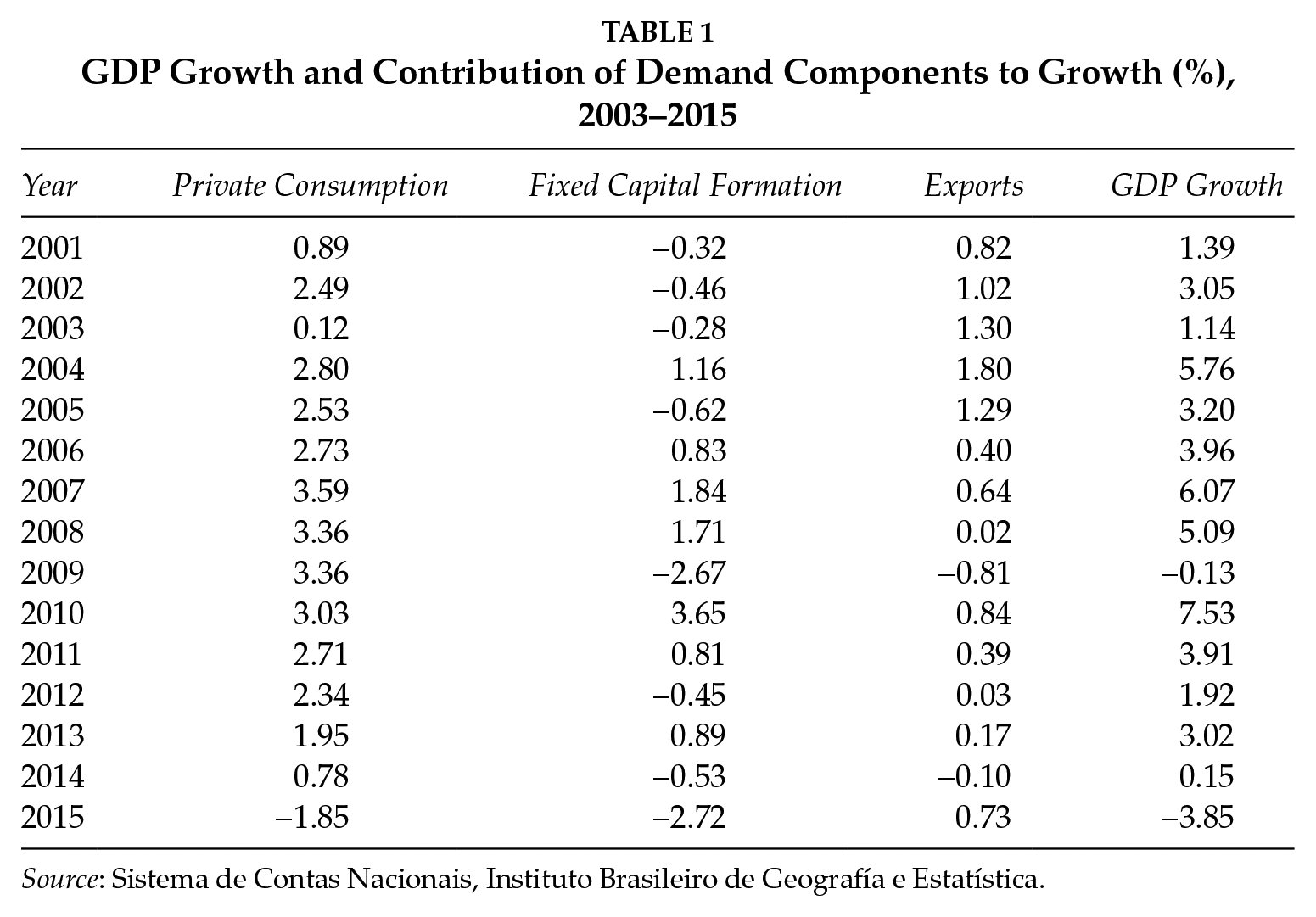
The years in which the PT held the presidency were marked by increased economic growth achieved mainly by the promotion of the internal market with the expansion of the “mass consumer society” (Medeiros, 2015). This trajectory was initially driven by a favorable export cycle and the adoption, especially since 2006, of policies for increasing income and boosting credit and consumption with consequences for investment and employment growth. This cycle began to be reversed with the change of focus of economic policy and the expansion of fiscal adjustment as of 2011 and despite attempts to reduce financial gains and incentives for private investment. The expansion of the domestic market was at the core of the growth strategy of the period, since after the commodities boom a series of consumption-promoting policies enabled the economy to grow. Consumption was the variable that contributed most to GDP growth between 2003 and 2014 (Table 1). The broad distribution of durable and semidurable consumer goods present throughout the cycle was due, as Medeiros (2015) points out, to the increase in the minimum wage and formal wage employment, the expansion of credit, and the appreciation of the exchange rate.
GDP Growth and Contribution of Demand Components to Growth (%), 2003–2015
Source: Sistema de Contas Nacionais, Instituto Brasileiro de Geografía e Estatística.
The increase in consumption and the expectation of continuity in the elements that favored it stimulated investment induced by current demand (Sarti and Hiratuka, 2011), but investment supported directly by state action and based mainly on increased investment in infrastructure showed only modest growth (Carneiro, 2017). Only in 2010 did the contribution of investment to GDP growth exceed that of consumption. This reduction of the role of investment in economic growth was linked to the asymmetric way in which the country had become part of the global value chains and economic policy options of the period, since the “solvency conditions of a developing country depend as much on the economic order . . . as on macroeconomic and industrial policies” (Medeiros, 2015: 146). One reflection of the marginal position of the country in the more internationalized production of goods and services and the consequent development of a national productive structure that was specialized and low-technology was the limited effect on investment of the increase in consumption (Carneiro, 2017); part of the demand for machinery, equipment, and intermediate inputs created by the expansion of consumption ended up leaking abroad, resulting in increased imports (Baltar, 2014; Sarti and Hiratuka, 2017). Regarding the governmental options, “there was little or no progress in Brazilian industrial policy,” a fundamental condition for repairing the leakage from the expansion of the domestic market (Medeiros, 2015: 165). The extensive growth of industry without progress in the high-technology sectors and activities and without an industrial policy aimed at increasing industrial exports resulted in the maintenance of the supply structure. The result of this growth model, based on an increase in domestic consumption and the maintenance of the macroeconomic tripod (based on the upward revision of inflation rates, an increase in the basic interest rate, the primary-surplus target, and the maintenance of a floating exchange rate), was the absence of structural change in the economy. Although consumption continued to grow until 2014, industrial output remained stagnant from 2001 to 2013 and declined sharply thereafter (Sarti and Hiratuka, 2017).
Following this dynamic, the growth trajectory of the Brazilian economy had its best moment between 2004 and 2008, when the average economic growth rate was 4.8 percent. After the effects of the international crisis hit the country, the maintenance of consumption levels was achieved through a set of measures taken to prevent the slowdown in economic growth. 3 As a result, in 2009 the economy declined by only 0.1 percent, recovering rapidly to 7.5 percent in 2010. Starting in the following year, the effects of the slowdown resulting from the international crisis and the exhaustion of the consumption cycle due to the deceleration of the improvement of the income distribution and the increasing indebtedness of households called for a new direction. In 2012 the government’s intention was to implement a ”new economic matrix“ based on stimulating private investment, but this did not produce the expected results 4 despite the depreciation of the exchange rate, the reduction of interest rates, the tax exemptions provided, and concessions to increase the role of the private sector in the area of infrastructure. As a result, the GDP growth rate reached 3 percent in 2013, mainly because of the performance of consumption, and in 2014 stood at 0.1 percent. Between 2011 and 2014, the average growth rate of the economy was only 2.2 percent.
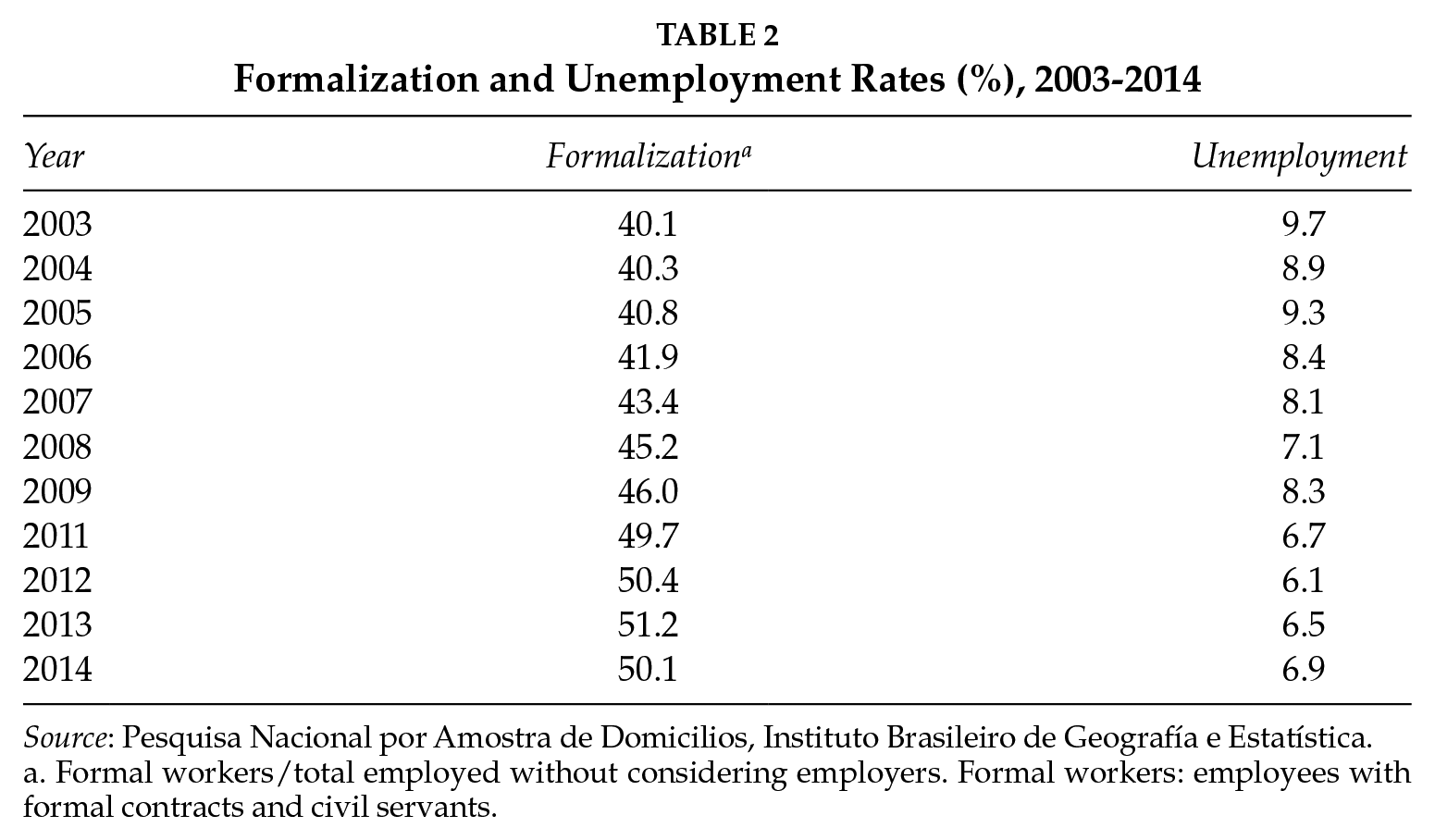
The higher level of economic growth between 2003 and 2014 had positive effects on the labor market, with a consistent drop in the unemployment rate (Table 2). At the same time, there was a deepening of the process of formalization, with a decrease in employment without a formal contract and in unpaid employment and self-employment. Low unemployment rates, even after the international crisis and at a time when the economy was slowing down, are fundamentally related to the decline of the growth rate of the economically active population expressed mainly in the decrease in participation of the under-25 age-group in the labor market. At the same time, formalization was mainly linked, as Krein et al. (2018) have shown, to policies aimed at the formalization of sectors with low access to social security (the self-employed and micro and small businesses) and the strengthening of the public institutions responsible for the enforcement of rights.
Formalization and Unemployment Rates (%), 2003-2014
Source: Pesquisa Nacional por Amostra de Domicilios, Instituto Brasileiro de Geografía e Estatística.
Formal workers/total employed without considering employers. Formal workers: employees with formal contracts and civil servants.
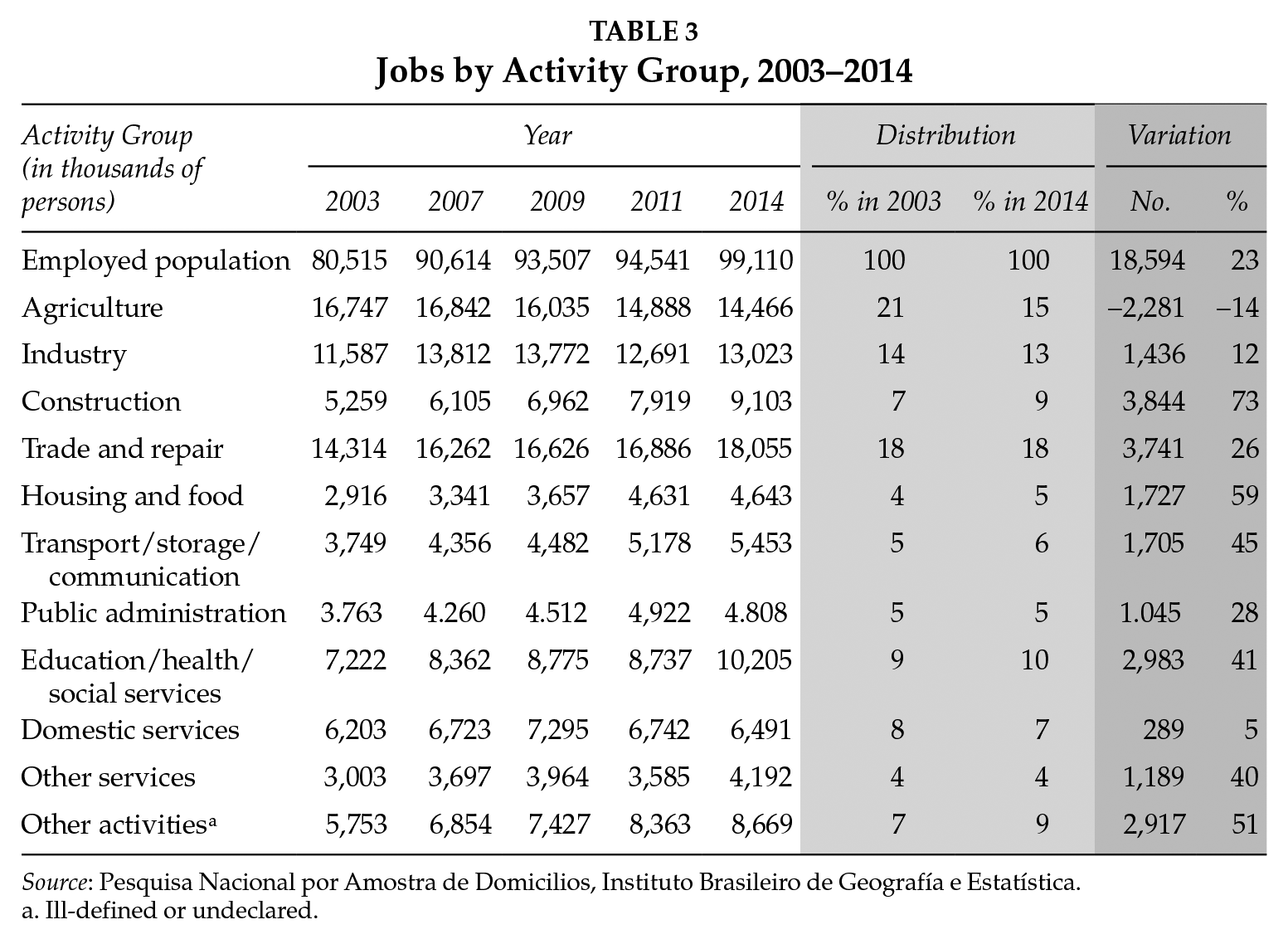
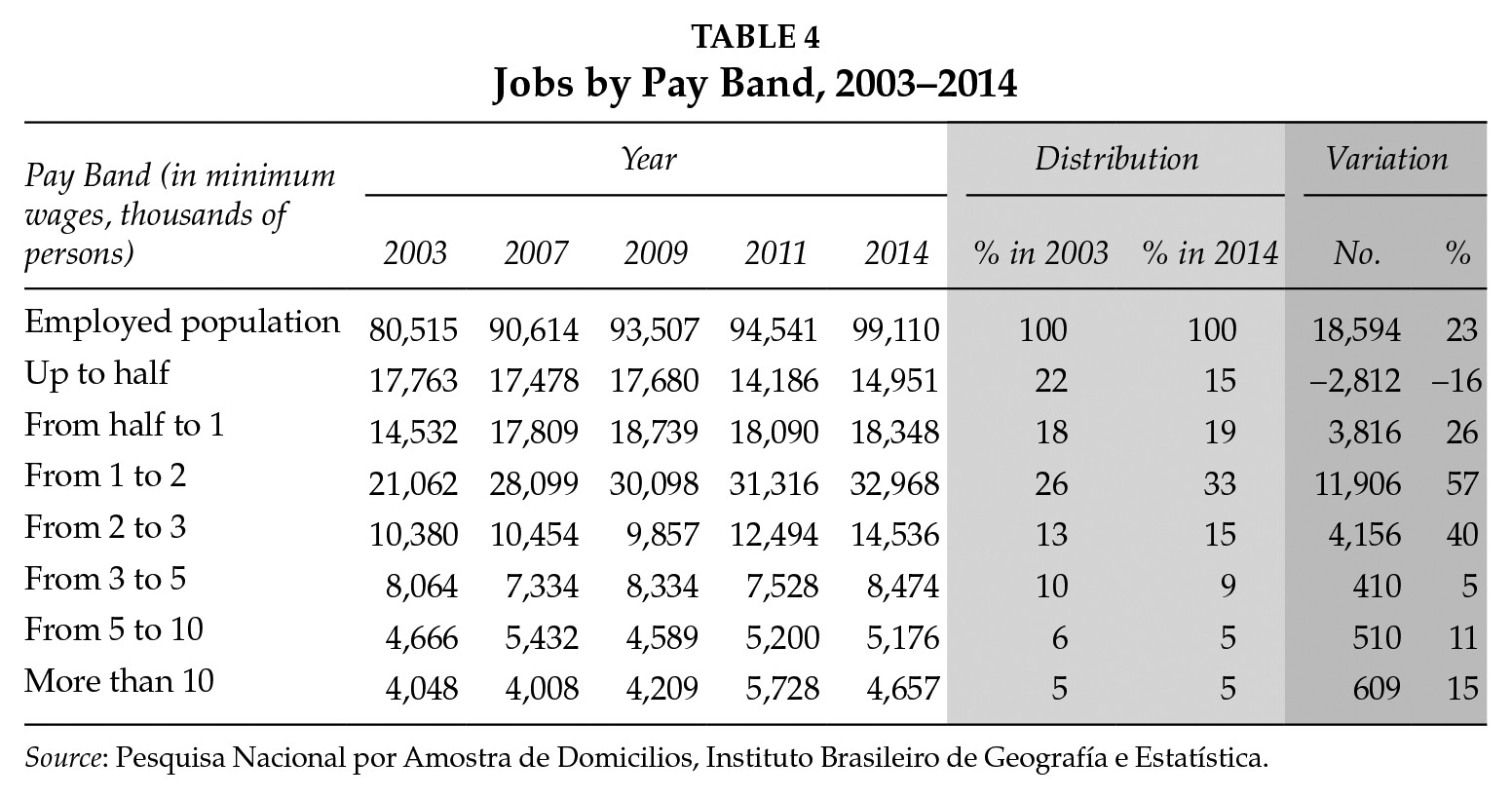
Another impact of this growth dynamic is that, although there was a generalized increase in employment in all sectors except agriculture and in all pay ranges except half a minimum wage, it was the sectors linked to consumption and encouraged by government action that generated most of the jobs. The activity groups with the greatest dynamism in terms of new jobs were those promoted by income and credit facilitation for the poorest—housing, food, transport, commerce, storage, and communication (Table 3). For example, the construction sector, which had the highest employment growth, benefited from the increase in real estate credit and the My House, My Life program. These sectors of activity are precisely the ones with the most low-wage jobs (Baltar, Souen, and Campos, 2017). This explains why jobs increased sharply in low-paid activities (Table 4). At the same time, the increase in these jobs was accompanied by the valorization of the minimum wage, triggering a significant reduction in income inequality. 5 This reduction was also caused by the increase (although to a lesser extent) in middle-income jobs (between two and three minimum wages), which also reflected the wage gains negotiated through collective bargaining. Typically, in these cases, employment generation in education, health, and social services benefited from the implementation of policies inscribed in the Constitution of 1988 and regulated and prioritized in the public budgets of the recent period.
Jobs by Activity Group, 2003–2014
Source: Pesquisa Nacional por Amostra de Domicilios, Instituto Brasileiro de Geografía e Estatística.
Ill-defined or undeclared.
Jobs by Pay Band, 2003–2014
Source: Pesquisa Nacional por Amostra de Domicilios, Instituto Brasileiro de Geografía e Estat�stica.
The experience of manufacturing, in which employment growth was modest and began to decline in absolute numbers from 2008 on, reveals the relationship between the marginal incorporation of the country into global value chains and the difficulty of promoting structural changes in the economy. However, in terms of wages manufacturing contains half of the formal jobs, with an average wage of 1.9 minimum wages, taking 2013 as a reference (Baltar, Souen, and Campos, 2017). This shows that the deindustrialization of the past three decades (Sarti and Hiratuka, 2017) has had an impact not only on the number of jobs generated in manufacturing but also on the low level of remuneration of these jobs.
Finally, the reduction in income inequality was corroborated by the generation of relatively high-paid jobs without formal contracts and self-employment (Baltar, Souen, and Campos, 2017). Thus, on the one hand, the increase mainly in low- and intermediate-wage jobs reflects the growth of the economy and the process of formalization, triggering a reduction of income equality, but, on the other hand, this reduction is also a reflection of the substitution of formal jobs for self-employment and independent contracting in relatively high-paid activities in an effort to conceal the employment relationship and avoid labor costs.
Thus, the growth dynamics driven by the expansion of the domestic market created generalized growth in employment and income. Using Braga’s (2012) expression, this period saw the introduction of a “wage citizenship” characterized by the involvement of an increasing number of workers in social security with the increase in the formalization of jobs and policies encouraging the inclusion in social security of self-employed and domestic workers. However, despite this progress, the number still excluded is very significant, and the structural characteristics of the labor market have changed very little. The absence of structural change under this growth model therefore has two aspects: despite its ability to generate jobs in an economy with a vast internal market, the structural characteristics of labor have not changed, and public regulation is an important condition structuring the labor market and expanding the social protection of wage earners.
The Increase in Labor Flexibility
The increasing pressure of contemporary capitalism on national systems of labor relations went uninterrupted in the 2000s. In the Brazilian case, even given greater formalization, the tendency to make labor relations more flexible was expressed in the heterogeneity of the labor market and the persistence of precarious conditions in many occupations (Guimarães and Paugam, 2016). While formal employment relations guarantee access to social rights, they cannot be understood as synonymous with quality jobs. Despite advances in labor market indicators, flexibilization continued to advance both in collective bargaining and in labor legislation but at a slower pace than in the 1990s (Krein, 2013). By “flexibilization” we mean the increasing freedom of companies to determine the conditions of the use, hiring, and remuneration of work according to their needs, leaving the workers in a condition of increasing insecurity in that their contracts are subject to oscillations of the level of activity (Baltar and Krein, 2013). The legislative measures adopted overlapped with the existing legal framework but did not supplant the Consolidation of Labor Laws, the norm regulating labor law in Brazil. They fell far short of what was wanted by the business sectors, which sought to restrict the possibility of state and union interference in labor regulation—a goal achieved with the labor reform adopted in 2017. 6 In addition, while the measures introduced tended toward labor flexibilization, in some respects they expanded social protection (Krein and Biavaschi, 2015). 7
The flexibilization of the 2000s was expressed in three central aspects of the employment relation: forms of hiring, remuneration, and working hours. With regard to the forms of hiring, there was an increase in subcontracting or outsourcing, “the form of labor contracting that has best conformed to the neoliberal format imposed on labor markets, giving companies a series of benefits, such as the flexibility of managing labor power at a reduced economic and political cost” (Filgueiras and Cavalcanti, 2015: 1). A method developed by the Interunion Department of Statistics and Socioeconomic Studies (DIEESE, 2017) based on data from the Annual Report on Social Information shows that between 2007 and 2014 the total number of formal links in these activities increased from 8.5 to 12.5 million. In 2014, typically outsourced activities accounted for a quarter of total formal employment. On average, these workers received 25 percent in wages, worked three hours a week more than those directly employed, and held more precarious jobs (DIEESE and CUT, 2014). These employment contracts also had twice the turnover rate 8 of typical contracting and a higher percentage of work-related accidents (DIEESE, 2017). Outsourcing shows that formalization and precariousness can be parallel phenomena. At the same time, there was an increase in disguised employment relations 9 expressed in internships and the hiring of independent contractors and individual microentrepreneurs. According to Krein (2013), internships sharply increased between 1995 and 2005. Law 11,788, restricting internships, was passed in 2008, but even so a million students remained in this condition. 10 It is difficult to estimate the increase in hiring of independent contractors, but it is reflected in the number of companies without employees, which went from approximately 3,600,000 in 2003 to 4,300,000 in 2013.
In the case of individual microentrepreneurs the impact was more significant. 11 Alongside the Simple and Super Simple tax forms 12 created in 2007, the individual-microentrepreneur category both generated formalization and stimulated hiring in disguise. According to data presented by Krein et al. (2018), after the law was passed the number of individual microentrepreneurs formalized jumped from 44,000 in December 2009 to 5.5 million in December 2015. The number of formal ties of companies filing the Simple form increased from 7,167,000 in 2007 to 11,372,000 in 2014. In addition, the rate of increase of formalization by the simplified tax form and individual-microentrepreneur status in 2009–2014 (80 percent) was much higher than that of the workforce as a whole (including the self-employed, domestic, and unpaid) plus formalized employers or owners in the public and private sectors (20 percent). These data reinforce the thesis that formalization did not guarantee the generation of quality jobs, since it took place in small enterprises, which had the worst working conditions. The initial purpose of the individual-microentrepreneur category was to ensure access to social security and credit for self-employed workers, but it ended up opening a formal space for the replacement of employment contracts with service delivery contracts—which, since the wage relationship persisted, constituted fraud. 13 In addition, the creation of the category placed entrepreneurship at the level of “job and income generation policy” (Castro, 2013: 46), and therefore it must be analyzed in terms of flexible working relationships. In this respect it both creates the possibility of replacing formal employment and /or formalizing labor with a lower level of rights and allows workers to transcend the passive status of wage earner and to view their jobs as business activities (Dardot and Laval, 2016).
The other expression of flexibility in forms of hiring was the indefinite contract, since the employer was free to withdraw it without justification, simply paying a fine if the contract period had not expired. This helps explain why atypical forms of contracting increased less than indefinite contracts (Krein and Castro, 2015).
The second aspect in which the flexibilization of labor relations was reflected was the increasing trend toward variable remuneration. Krein and Teixeira (2014) show that advances in collective bargaining in the 2000s focused on salary adjustments and profit-sharing programs for companies in the private sector that were more economically structured and had unions. Perossi (2017), researching wages of factory workers in 217 large and medium-sized companies, has shown that 9 percent of annual compensation was variable and 20 percent was indirect (benefits). In the automotive sector, the variable part amounted to 16 percent of total annual remuneration. Thus, while, as we have seen, the valorization of the minimum wage and the readjustment of categories above inflation allowed an increase in the purchasing power of wages, the flexibility of remuneration was associated with profit-sharing programs and indirect wages (benefits). Among the effects of this flexible form of remuneration was its nonwage nature—the fact that there were no social security charges on it (which negatively affected the public fund, especially social security financing) and it excluded labor rights such as vacations, retirement, the thirteenth salary, and weekly paid time off. Another effect was that it encouraged the decentralization of collective bargaining by company and tended to reduce solidarity among workers. As Dardot and Laval (2016) mention, as the company’s expectations of profit begin to stimulate workers, a kind of “flexible coercion” takes shape, causing internalization by wage earners of the constraints of financial profitability and the norms of productive efficiency and individual performance.
The third aspect in which flexibilization of labor relations was apparent was the flexibilization of the workday (Dal Rosso, 2008; DIEESE, 2009), despite the decline of the number of people working more than 44 hours per week in the 2000s (Krein and Biavaschi, 2015). To the traditional means of making the workday more flexible (overtime, shift work, night work, group holidays) were added new forms such as the modulation of the annual work period, the liberalization of work on Sundays, a variety of arrangements tailored to each economic segment, and part-time work (Gibb, 2017). The dismantling of the workday was stimulated by legislative changes (hour banking, liberalization of work on Sundays), 14 regulations specific to certain categories, 15 and partial contracts) and the negotiation, generally endorsed by the judiciary, of a multiplicity of shifts and scales of work, adjusting the workday to the needs of each economic segment, company, or even area within a company. It is worth noting the extension of the workday in connection with shifts in which the workweek was extended from 33 to 40 hours (DIEESE, 2014). As Gibb (2017) shows, the emergence of fragmented and special workdays in different economic sectors and even different jobs also occurred, and technological progress has enabled mechanisms of control of the workday such as the home office (Gibb, 2017). Thus the workday was tended to adjust the distribution of hours worked according to the interests of companies through the introduction of new modes of labor control (Rao, 2013).
The valorization of variable remuneration, the flexibilization of the workday, and the promotion of disguised employment (with emphasis on outsourcing and the stimulation of entrepreneurship) indicate that formal employment is not necessarily secure, stable, and well-paid employment. Increasing flexibility means, on the contrary, that companies can manage the workforce according to their needs and with lower costs. The growth of employment in historically unstructured sectors with low wages and low capacity for collective organization also corroborates the persistence of precariousness in times of the formalization of employment, showing that the two can walk side by side. The increase in flexibilization combined with the creation of an increasingly heterogeneous and segmented labor market indicates that risk in the labor market is no longer suppressed by the existence of a formal employment relationship. Insecure and unstable forms of employment, even formal ones, serve to increase “cultural tolerance for uncertainty” (Streeck, 2013) and naturalize the market as a locus of the pursuit of social welfare, placing the handling of the risks of their existence in workers’ own hands (Dardot and Laval, 2016).
Final Considerations
The preceding analysis of the degree of distance of the PT governments from neoliberalism and developmentalism has been conducted in relation to the constraints of the current phase of capital accumulation and the consequences for labor of late-capitalist development. In the current situation, in which a radical right is gaining strength in the country, this critique is necessary for the construction of a field of resistance to the dismantling of rights that is taking place. The tendency toward flexibilization and reduction of social protection that has prevailed in the central countries in the past four decades is expressed in a particular way in each country according to the specificities of the historically constructed system of labor relations. In the case of Brazil, which has not been able to structure its labor market or create a comprehensive system of social protection, the effects of this logic were apparent as early as the 1990s, when the country chose passive participation in financial globalization. The countermovement under the PT governments was the continuation of flexibilization (although at a slower pace) alongside of an increase in employment and income. This countermovement was related to the decision to promote inclusion through the labor market and consumption, a process that did not alter the economic structure, overcome the labor market’s historical problems, or alter the course of labor flexibilization. Although the legislative changes did not deconstruct the labor code, the dynamics of the labor market and the correlation of forces in the relation between labor and capital resulted in the deepening of the insecurity and vulnerability of workers.
During the PT governments, the dynamics of flexibilization expanded in the central elements of the employment relationship, creating pressure to change the legal framework. Starting in 2013, when the economic and political crisis intensified, this labor agenda gained greater visibility and the pressure to revise the labor code was exacerbated. This process culminated in a deep and substantive labor reform that legalized the existing flexibilization and enabled new options for capital to manage the workforce according to its needs. It substantively changed labor law and weakened both the public institutions responsible for enforcing the law and union organizing and action. Thus the flexibilization of labor relations began in the 1990s, persisted under the PT governments, and deepened profoundly with the passage of the labor reform in 2017 under the government of President Michel Temer. The PT governments represented a moment of increase in the heterogeneity of the labor market and the flexibilization of labor relations. In line with the tendencies of contemporary capitalism, these are traits that seek to reverse the historically acquired rights of solidarity between groups and place workers in a situation of constant risk and insecurity, mobilizing the individual capacity of workers to survive this reality.
Footnotes
Notes
Ana Paula Fregnani Colombi is a professor at the University of Espírito Santo and a researcher at the Brazilian Center for Studies in Trade Unionism and Labor Economics of the University of Campinas. José Dari Krein is a researcher at the same center and a professor at the University of Campinas. Luis Fierro is a translator living in the Miami area.