



Abstract
Brazil’s social structure and associated distributive policies during the PT governments did not depart from neoliberalism but rather implemented a poverty-reducing variant of it. Through minimum-wage hikes, conditional cash transfers, legislation driving financial innovation, and the subsidizing of privately provided for-profit services, state power was used to include individuals in ever-expanding formal circuits of commodity production and consumption. Deprivation in multiple dimensions was indeed reduced through these policies, but in the process social mobility came to mean exiting poverty, getting a formal low-skilled job, and accessing credit at lower interest rates to pay for state-subsidized private health and education.
A estrutura social do Brasil e as políticas distributivas associadas a ela durante os governos do PT não se afastaram do neoliberalismo, mas sim implementaram uma variante de neoliberalismo redutora da pobreza. Por meio de aumentos do salário mínimo, transferências condicionais de renda, legislação que impulsionava a inovação financeira e o subsídio para serviços privados prestados com fins lucrativos, o poder do Estado foi usado para incluir indivíduos em crescentes circuitos formais de produção e consumo de mercadorias. A privação em múltiplas dimensões foi realmente reduzida por meio dessas políticas, mas neste processo a mobilidade social passou a significar sair da pobreza, conseguir um emprego formal pouco qualificado e obter crédito a taxas de juros mais baixas para pagar pela saúde e educação privadas subsidiadas pelo Estado.
Brazil underwent a period of growth and redistribution during the largest part of the Partido dos Trabalhadores (Workers’ Party—PT) administrations (2003–2016), which allowed for the inclusion of large sections of the population in the market as consumers. Between 2003 and 2013, per capita income grew about 56 percent, the extreme poverty headcount decreased from 12.7 percent to 4.9 percent of the population, and the Gini index of household per capita income fell from 0.58 to 0.53. 1 Several other pieces of information report the same phenomenon, indicating that it was not a statistical fluke but a wide-ranging process of raising the monetary income of the bottom of the social pyramid. In this vein, poverty declined from 33.9 percent to 13.9 percent of the population, whereas the Palma ratio (the ratio between share of income appropriated by the top 10 percent and that of the bottom 40 percent) fell from 5.2 to 3.8. Meanwhile, the gross domestic product (GDP) grew on average by 3.8 percent per year, including a rapid rebound from the world economic crisis of 2008, compared with 2.5 percent during the 1990s.
This process of growth and redistribution was part of a larger Latin American trend that, importantly, swam against the current of global developments. Between 2002 and 2013, extreme poverty in the region 2 declined from 13.0 percent to 5.4 percent of the population, whereas the median Gini coefficient declined from about 0.53 to about 0.48 (World Bank, 2017b). Inequality in most countries of the world, in contrast, had been on the rise since at least the late 1980s. According to Lakner and Milanovic (2016), almost all regions of the world experienced continually rising income inequality between 1988 and 2008, including an 8 percent increase of the Gini coefficient for “mature economies” and a 9 percent hike for Sub-Saharan Africa. 3
This markedly different trajectory of Latin American countries with regard to the rest of the world raises the question whether a break with neoliberalism occurred during the 2000s. There are two dimensions to this question. The first regards the durability of this different trajectory—its long-term feasibility. A short-term deviation from the dynamics of neoliberalism does not constitute an anti-neoliberal alternative, however much certain social indicators might improve during such a spell. Associated with this, the second dimension regards whether Latin American countries were able to explore fortuitously favorable conditions during a period of time to manoeuver within the confines of neoliberalism, or whether, on the other hand, the pattern of accumulation was changed at a deeper level. It is only by transforming the bases of neoliberalism with the goal of establishing sufficiently coherent foundations for different economic and social dynamics, rather than finding wiggle room under particular conditions, that a substantive rupture obtains.
This article addresses the question of whether Brazil broke with neoliberalism during the PT administrations, exploring it through the country’s social structure and associated distributive policies. The focus throughout is on how and to what extent the main policies related to the distribution of income, the labor market, and the provision of key services transformed the country’s social structure. More specifically, this article explores whether the PT governments, from the point of view of their impact on Brazil’s social structure, can be seen as a form of “mature” (Fine and Saad-Filho, 2017), “roll-out” (Peck and Tickell, 2002), or “roll-forward” (Jessop, 2002) neoliberalism. These three terms are used interchangeably to indicate a second—logical if sometimes also temporal—phase of neoliberalism characterized by the development of specifically neoliberal forms of participation of state power in social and economic reproduction, as opposed to the roll-back of forms that obtains during the transition to neoliberalism. 4 For the purposes at hand, this means the development of policies that actively spur the commodification of social reproduction. This stands in contrast both to the first phase of neoliberalism, characterized by state power dismantling previous systems of social provisioning, and to non-neoliberal capitalist state forms in which state power supports the circuit of capital by de-commodifying key aspects of social reproduction. Thus, mature neoliberalism simultaneously reasserts that social reproduction is increasingly mediated by the market, since noncommodified forms of provisioning are forestalled, and that some measure of social inclusion will obtain through policies that facilitate the entry of individuals as producers and consumers of commodified goods and services (as opposed to their simple exclusion from such processes).
The main argument presented is that the PT governments did not depart from neoliberalism but rather implemented a poverty-reducing variant of mature neoliberalism. It was poverty-reducing not only in light of the positive social outcomes indicated above but because the latter were the result of key policy decisions and their implications. Centrally, rising minimum wages, conditional cash transfers, and greater pension coverage aimed at reducing poverty and were effective in doing so. As knock-on effects, faster growth led to lower unemployment and labor formalization, also with a positive impact across the lower segments of the income distribution. In spite of these gains for low-income households, the PT governments were nevertheless still a variety of neoliberalism in that the horizon of change was limited to including individuals as consumers in privatized and commodified systems of provision. No clear option was made in favor of public health, education, or housing; instead, sizable subsidies and diverse stimuli were offered that made the private sector the leading provider of the latter. In other words, the government actively sought to commodify access to key services. Furthermore, this was underpinned by a state-sponsored process of financial inclusion, a dimension of commodification in its own right, which led to growing indebtedness for the population. As a result, individuals and households were further subjected to market imperatives in order to reproduce themselves.
The article is structured as follows. After this introduction, the second section presents the main changes to the distribution of income from a class perspective, highlighting the formalization of low-skilled labor and the stability of top capitalist income. The third section explores the drivers of these changes, showing how key policies reduced poverty. The fourth section shows that the labor market improvements were incapable of driving a substantially different pattern of accumulation. This focuses on the precarious nature of the jobs created, concentrated as they were in low-productivity, low-wage services sectors. The fifth section looks at changes in the pattern of consumption, indicating the concerted efforts to commodify the provision of health, education, and housing, supported by rising household indebtedness. The sixth section concludes.
Changes to the BRAZILIAN Class Structure
There were substantial policy-driven income gains for the lower sections of the income distribution in Brazil during the PT administrations. This section details these gains throughout the Brazilian social structure, approached through a typology of seven class positions. This typology is based on command over capital (and conversely the need to sell one’s labor power), command over scarce skills, and protection by the prevailing labor laws (i.e., the formality or informality of the employment relation): 5 Those not in active employment are classified as unemployed/inactive or pensioners, as appropriate. Based on this, households can be classified into one of the following seven categories (detailed classification procedures are available upon request).
Large employers: those who employ more than 10 workers. This is the most privileged position, based on profiting from large amounts of labor, and consequently the one most concentrated at the top of the income distribution. Even if the data used severely underreport their income, as household surveys are known to do, large employers can nevertheless be found at the very top of the distribution.
Small employers: employers of 10 or fewer workers. This is an intermediate position based on commanding a smaller amount of labor. In practice, small employers mostly receive mixed income, combining their own work as supervisors or managers and profiting from the labor of others.
Professional workers: employees or self-employed workers in high-skilled occupations. They are also in an intermediate position, since they still have to sell their labor power but can do so under relatively advantageous conditions given their command over scarce skills. Professional workers and to a lesser extent small employers are the middle class in Brazilian society.
Low-skilled formal workers: formal employees or self-employed workers who contribute to social security in low-skilled occupations. Members of this group have to sell their labor power for a living without the bargaining power that scarce skills offer but are covered by basic labor laws and social protection. Although there is considerable fluidity between formal and informal positions, given that individuals frequently shift between them, the key distinguishing element is that formal workers are paid at least the minimum wage.
Low-skilled informal workers: informal employees or self-employed workers who do not contribute to social security in low-skilled occupations. These are the most precarious workers, as they do not command scarce skills and are not even covered by the prevailing labor legislation. Together with their formal counterparts, they are the backbone of the Brazilian social structure, accounting for about 80 percent of the population and contributing with most of the labor-power sold.
The unemployed or inactive: people looking for jobs but unable to find them during the reference period and people outside the labor market. This is the most destitute group, incapable of entering into paid employment and relying, when available, on social security and cash transfers.
Pensioners: former workers who receive private or state pensions.
Table 1 shows the size and the relative per capita income of these seven class positions at the beginning of the PT administrations (2003–2005) and toward the end of their successful phase (2011–2013). The information presented is based on data from the National Household Sample Survey (Pesquisa Nacional por Amostra de Domicílios—PNAD). 2013 is taken as the final year of the analysis because it is the last moment when the growth and redistribution process was arguably still in place. After this year, GDP growth declined to less than 1 percent per year in 2014 and was in steep decline until then-president Dilma Rousseff was impeached in 2016 (IBGE, 2016). Therefore, the analysis is restricted to the successful growth and redistribution phase.
Composition and Relative Income of the Brazilian Class Structure, 2003–2005 and 2011–2013
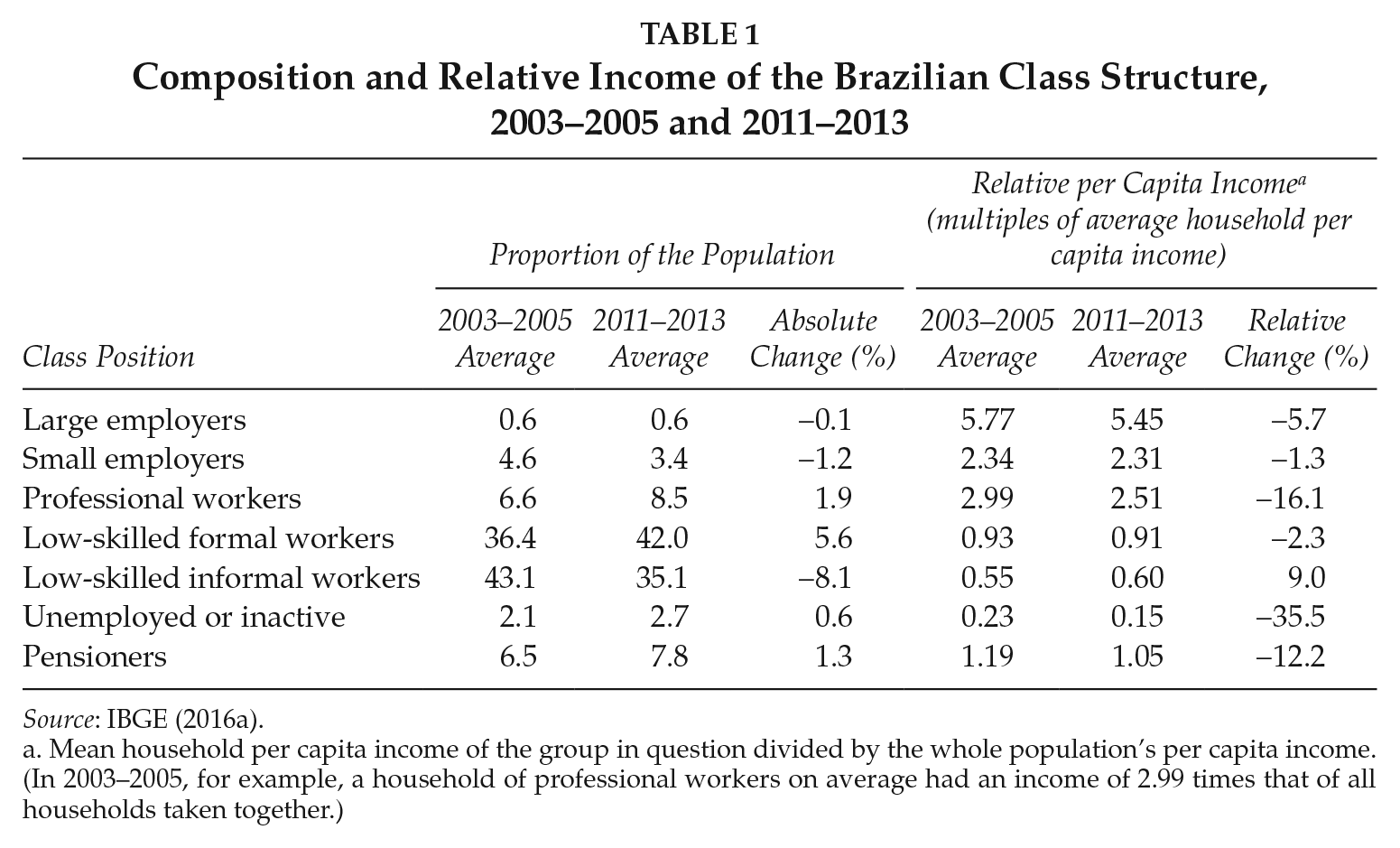
Source: IBGE (2016a).
Mean household per capita income of the group in question divided by the whole population’s per capita income. (In 2003–2005, for example, a household of professional workers on average had an income of 2.99 times that of all households taken together.)
Table 1 shows both distributive changes and continuities, with high levels of inequality prevailing throughout. At the end of the growth and redistribution phase, more than a third of households were in the vulnerable situation of low-skilled informal workers, with an income about 40 percent less than the average. Professional workers had increased by 1.9 percentage points, nearly 30 percent, but combined with small employers this amounted to a middle class only slightly more than 10 percent of the population. These positions, although not plentiful, were considerably privileged: their relative income was about two and half times the average. Naturally, this was a far cry from the top layer of large employers, who at 0.6 percent of the population displayed a mostly constant relative income of about five and a half times the average. 6
While stark inequalities and vulnerability continued to prevail, there were nevertheless two sizable changes over the decade analyzed. First and foremost, the formalization of low-skilled labor guaranteed a higher income and access to basic labor rights for about 8 percent more households. Formal workers became more numerous than their informal counterparts, an important process in that their income was about a third higher. Second, the relative income of professional workers decreased by about 16 percent, reducing the privilege of this group. This can be equated to a fall in the social ladder for the traditional middle class, the only position that really lost in relative terms. 7
These results, pointing to a redistribution of income among workers while preserving the position of capitalists, are reinforced by recent studies using tax data (Gobetti and Orair, 2016; Medeiros and Castro, 2018). 8 Two key results are relevant for present purposes. First, the decrease of inequality may have been much less than that measured by the National Household Sample Survey. Although there is uncertainty surrounding these estimates, Morgan (2017) calculates that the top 1 percent in Brazil appropriated a somewhat stable share of national income throughout the 2000s, about 27 percent. Second, capital was the main factor behind the rise at the top, as income derived from it (profits, interest, dividends) accounted for an increasing share of top incomes. In sum, the highest-income households in Brazil managed to maintain their position through control over capital.
Overall, the data point to a limited distribution among different categories of workers without affecting the position of capital. The distribution still left major vulnerabilities in the social structure, particularly as regards the sizable proportion of informal workers. The only large group to have lost in relative terms was professional workers, to the benefit of low-skilled informal ones. Furthermore, the income of employers, large and small, was basically stable over the whole period. Therefore, the Brazilian social structure was not transformed in a way that consistently empowered workers or eliminated key sources of vulnerability. At the same time, what did take place was a certain inclusion of low-skilled workers in formal labor markets, the maintenance of the position of capitalists at the very top, and a decrease of middle-class privilege.
The Drivers of Redistribution
The drivers of the processes presented above can be explained with the help of Figures 1 and 2, which show the contribution of different sources of income along the distribution of income. Both figures order households by their per capita income on the X-axis, from lowest to highest, and display on the Y-axis the average composition of income for that percentile of the distribution. Figure 1 refers to the beginning of the PT administrations (2003), whereas Figure 2 presents the same information for 2013. Eight income sources are accounted for, six of which are associated with the revenues of the class positions presented above. The other two sources are social security benefits, in particular the conditional cash transfer program Programa Bolsa Família (Family Allowance Program), 9 and a small remainder category for all other forms of income.
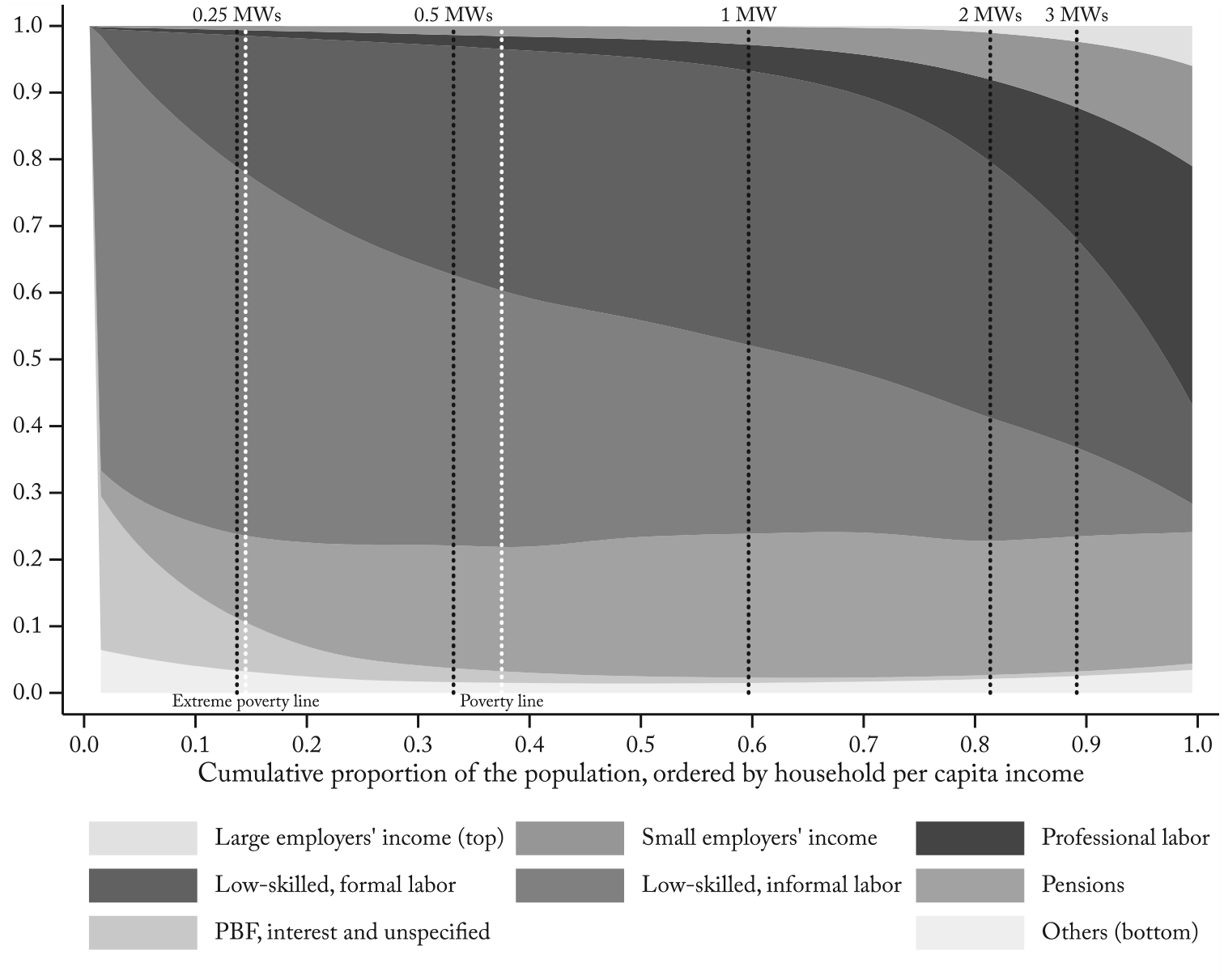
Contribution of different sources of income along the household per capita income distribution in Brazil, 2003, and (extreme) poverty incidence (prepared by the author based on data from IBGE, 2016a). MW, minimum wage. Large employers’ income is the income reported by employers with more than 10 employees; small employers’ income is the income reported by employers with 10 or less employees; professional labor income is the income of workers in occupations that require higher education; low-skilled, formal (informal) labor income is the income of workers in occupations that do not require higher education and are in formal (informal) working arrangements; pensions are state and private pension income; PBF, interest, and unspecified, is the income from government benefits, savings accounts, and other unspecified sources (see n. 9); and others is the income from all other sources (such as rent and donations). The (extreme) poverty line corresponds to a household per capita income of ($1.90) $4.00 per day, converted according to the World Bank’s estimate of the constant 2011 purchasing-power-parity exchange rate. Lowess smoothing is applied to the curves.
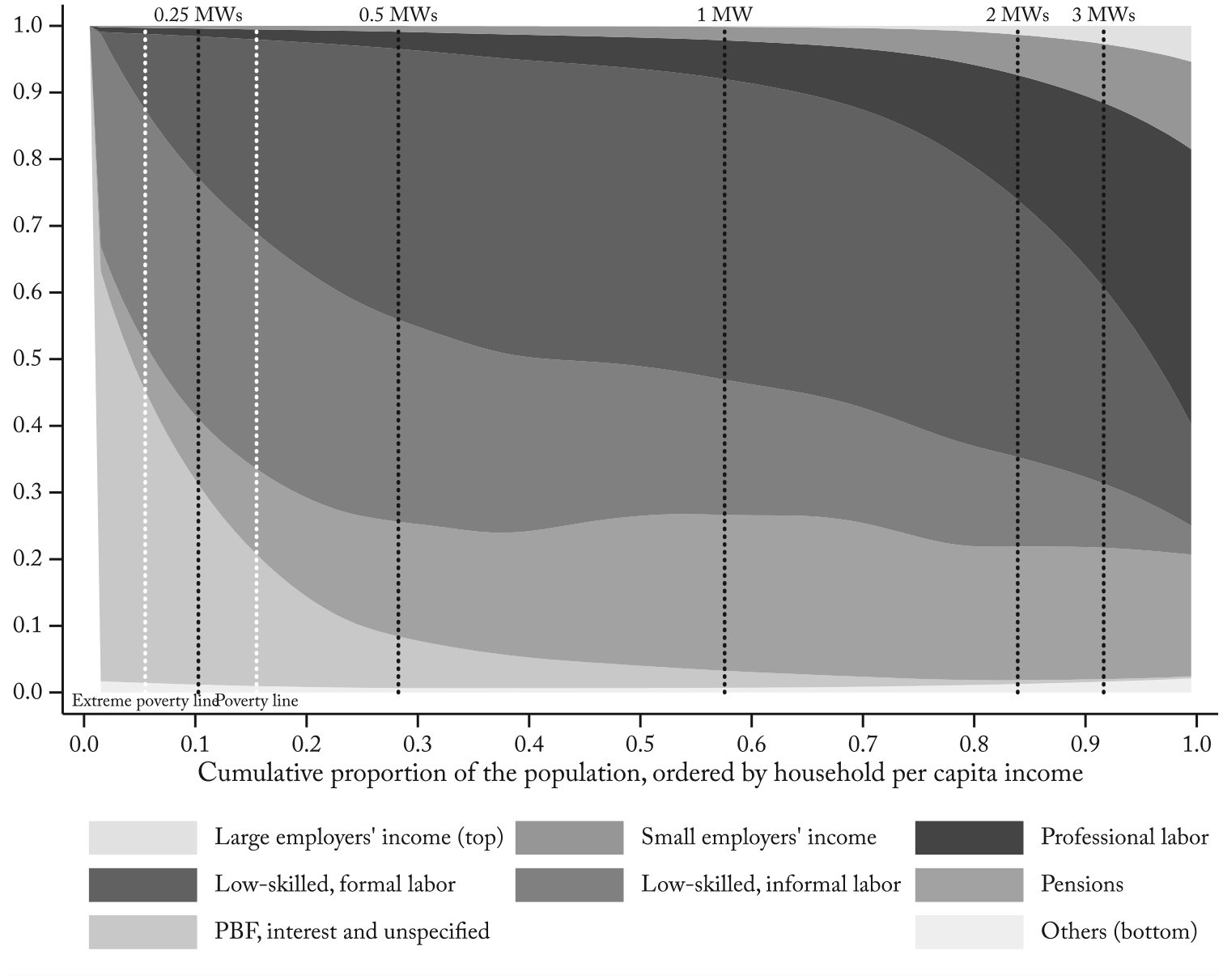
Contribution of different sources of income along the household per capita income distribution in Brazil, 2013, and (extreme) poverty incidence (prepared by the author based on data from IBGE, 2016a). Notes as for Figure 1.
Figure 1 shows that in 2003 government benefits (excluding pensions) accounted for a very small proportion of the income of all households. To a very large extent, most households relied on low-skilled informal labor. For the bottom 40 percent of households, the latter was the main source of income, above which it was superseded by low-skilled formal wages. Professional occupations in turn began to be relevant really only for the top 10 percent of households, at a per capita income of approximately three minimum wages. Finally, pensions were relevant throughout most of the distribution, which highlights both the wide spread in pension benefits—from one minimum wage for most former workers to the salaries of top civil servants 10 —and their centrality to household finances throughout Brazil.
The position in the distribution of fractions and multiples of the minimum wage is particularly telling about the structure of inequality in Brazil. 11 A per capita income of one minimum wage would already have put a household among the top 40 percent (which, as seen below, did not change much), revealing striking levels of inequality. Importantly, about a third of the population had an income below half a minimum wage (representative of households with two low-skilled workers and two school-age children) because of the high levels of informality associated with incomes below one minimum wage. Moreover, such households would be below the international poverty line, which is a very low standard indeed, meaning that the minimum wage was incapable of sustaining the basic needs of a person and a dependent. Even more striking, a per capita income of a quarter of the minimum wage (representative of a four-person household with one low-skilled formal worker) was below the extreme poverty line. Given the latter’s definition as the minimum income necessary to buy a sufficient amount of food, it is not too far off the mark to say that the 2003 minimum wage was a starvation wage for a family of four.
The major changes that occurred during the decade were in the bottom half of the distribution, particularly rising Bolsa Família transfers and low-skilled labor formalization. Whereas benefits were a small portion of household income in 2003, 10 years later they were the major source for the bottom 10 percent and were relevant for all of the lowest quartile. 12 The big change for the second quartile was labor formalization, with low-skilled formal wages becoming the most important form of income for this quarter of the population. The proportion of pensions did not increase substantially for any percentile, meaning that they grew at approximately the same level throughout the whole distribution. Hence, given the overall decrease of inequality, pensions were a contributing factor in this. The top half was much more stable, however, highlighting that distributional gains were concentrated in the bottom half.
Two of the main distributive processes discussed above—labor formalization and rising minimum wages—can be seen in the position of the minimum wage in the distribution. The minimum wage rose in real terms by about 70 percent (deflated by the National Consumer Price Index) between 2003 and 2013, while, as indicated above, the proportion of low-skilled formal workers’ households increased by 8 percentage points. The combination of these two processes multiplied their individual effects as more workers began to receive at least the minimum wage (through formalization) and their income was increased further by rising real minimum wages. Rising minimum wages also affected informal workers being paid close to the minimum wage, through what is known as the “lighthouse effect,” as well as employees whose wages were indexed to (low) multiples of the minimum wage and thus got readjusted (see Maurizio and Vázquez, 2016). Furthermore, a set of social benefits and low-value public pensions was indexed to the minimum wage, increasing the latter’s impact on the economy (Orair and Gobetti, 2010).
Labor formalization and rising minimum wages thus decreased the percentage of the population receiving less than certain fractions of the minimum wage and raised their real income. There was a substantial drop of 5 percentage points in the population with a per capita income below half a minimum wage, whose rising value shifted in relation to the poverty lines. In a process of qualitative import, one minimum wage became capable of putting a worker and a dependent considerably above the poverty line in 2013. The latter is a very low standard, unrepresentative of the level above which individuals are not deprived of key goods, but rising above it does mean that individuals can enter the market as consumers for more than very basic necessities. In other words, rising minimum wages alongside labor formalization made large sections of the population consumers of a much broader and more sophisticated array of goods as they escaped the lowest levels of destitution.
At this point it should be noted that raising the minimum wage, if not accompanied by growing noncompliance with the relevant legislation, might seem antithetical to neoliberal policy-making, as it implies a broad increase in the value of (simple) labor-power. However, while the rise of the minimum wage was substantial under the PT governments, which does nuance their characterization as neoliberal, looking at it from a longer-term perspective shows that the minimum wage did not reach historically high levels. In fact, in 2013 it was some 15 percent below the average real minimum wage of the 1955–1964 period and just 20 percent above the 1982 value. 13 What the PT did in terms of the minimum wage, therefore, was to reverse the direst aspects of the 1980s debt crisis and neoliberalism without moving beyond it.
In sum, the Brazilian social structure under the PT governments saw a change between categories of workers, while the position of capital was much more stable. Low-skilled workers gained the most, while professional workers as a group lost in relative and, in some cases, even in absolute terms. The drivers behind this were conditional cash transfers, rising minimum wages, labor formalization, and greater pension coverage. These processes had a large impact on the bottom half of the distribution but were ineffective in changing top incomes. Schematically, conditional cash transfers affected the very bottom, formalization the first quartile, and rising minimum wages and pensions the second and to some extent the third quartile. Together these measures reduced poverty substantially and, through the relative stability that formal employment offered, inserted millions of individuals into the market as consumers of a broader swath of goods and services.
Limitations of the Gains in the Labor Market
The labor market improvements were limited in that, while there were indeed gains from the formalization of low-skilled labor, the formal jobs created were of low quality. In particular, the sectors that increased their employment the most were low-paid, low-productivity services, especially sales and construction, leading to a growing concentration of posts paying between one and three minimum wages. Although this was an improvement compared with the preceding period, it did not amount to a transformation of the productive and social structure capable of either challenging the ingrained inequalities of the Brazilian economy or driving a development process. In other words, instead of breaking with neoliberalism it only maneuvered within it.
Data from the IBGE’s (2016b) national accounts show that, between 2003 and 2013, construction and sales alone accounted for a third of net jobs created. Combined with transportation and storage, lodging and personal services, and for-profit health and education, this value reaches about 60 percent. These sectors share three characteristics that make them incapable of being the motors of an inclusive, high-wage process of development. They are all low-paid (with average wages about 30 percent below the national average) and low-productivity (with value added per worker also about 30 percent below average), and they are services for personal consumption, which implies limited linkages with the rest of the productive structure and few opportunities for dynamic productivity gains. The employment they created may have improved the living conditions of workers, but they were incapable of driving a different pattern of accumulation with long-term perspectives of rapid growth and social inclusion. 14
An effect of this shift of employment toward sectors with low dynamism was to increase the number of low-paid occupations. Between 2003 and 2013, the proportion of paid employees receiving between one and three minimum wages increased by 10 percentage points (IBGE, 2016a). On the lower end, this is explained by labor formalization, with which the proportion of workers getting less than a minimum wage fell by some 4 percentage points. 15 There was, however, a curtailing of the other end, as the number of jobs paying more than three minimum wages decreased by 6 percentage points, about 1 million jobs. In this it is important to notice that three key sectors whose employment-share grew by 5 percentage points—construction, wholesale and retail trade, and food and lodging—had very few high-paying jobs (13 percent of jobs in the sectors paid more than three minimum wages, compared with 20 percent for the economy as a whole in 2003). In other words, with the rise of low-paid, low-productivity sectors, fewer good jobs were created. 16
Two further processes negatively impacted the quality of the jobs created during the PT governments: outsourcing and high churning rates. The Interunion Department of Statistics and Socioeconomic Studies estimates that approximately 26 percent of formal workers were outsourced in 2014, up from 24 percent in 2007 (DIEESE, 2017). Outsourced workers have lower wages, fewer benefits, less stable jobs, and face a harder task to organize themselves in trade unions, even when they are formal employees (Antunes and Druck, 2013). Representatively, in 2013, formal employees in outsourcing-intensive sectors had average wages a quarter below those in other sectors (excluding agriculture) and half the average job tenure (DIEESE and CUT, 2014: 14). Likewise, the labor market churning rate for formal private employees 17 was not only extremely high in 2013, with 44 dismissals for every 100 outstanding jobs, but higher than in 2003, when there were 41 (DIEESE, 2016). Formal jobs may have been created, but they were precarious and unstable, further blurring the distinction between formal and informal jobs that began with neoliberalism.
Consumption Patterns
Conditional cash transfers, labor formalization, and higher minimum wages raised income above near-subsistence levels while also partially integrating workers into formal circuits of commodity production, with the flipside of enabling access to a range of more sophisticated goods. This happened not mainly through public provision, however, but through growing circuits for the private supply of commodified goods and services. In particular, through several state subsidies and growing indebtedness these workers became consumers of private health, education, and housing. The PT’s policies also acted on the consumption side to enlarge the circuit of capital and incorporate into it growing masses of workers-as-consumers. In other words, the government policies had interconnecting effects that spurred the commodification of social reproduction.
The Commodification of Health Services
The provision of health services in Brazil occurs through the public and private spheres, but with public subsidies for the latter. The country has a universal health care system, free at the point of access, that is modeled after the British National Health Service, but it has been chronically underfunded (Mendes and Weiller, 2015). At the same time, there are four main channels through which public money subsidizes the private, commodified provision of health care: personal income tax exemptions for health expenditures, tax exemptions for companies’ expenditures on health services for employees (which usually means offering health insurance at subsidized prices), tax exemptions for medicine and its inputs, and tax exemptions for charitable hospitals (Ocké-Reis and Gama, 2016).
During the period analyzed, the PT governments did not reverse this two-pronged approach in which an underfunded public system coexisted with a subsidized private one. Ocké-Reis and Gama (2016) estimate that health-related tax exemptions amounted to about R$25 billion in 2013, with a real increase of about 70 percent since 2003. These exemptions were, moreover, a constant share of the Health Ministry budget, just under a third. Instead of strengthening the provision of public health care, therefore, what the PT’s policies did was to offer subsidies to allow formal workers to opt out of the public system. Consequently, out-of-pocket expenditures on health was the item that increased the most in household budgets between 2002 and 2009 (Medeiros, 2015; Posenato Garcia et al., 2015), while the profits of private health insurance providers nearly tripled in real terms between 2003 and 2011 (Ocké-Reis, 2014). Thus, the commodification of health services continued hand-in-hand with its public counterpart, underpinned by rising demand for private health care (through higher income) and public support (through fiscal incentives) for its commodified, for-profit provision.
The Commodification of Education
A similar situation obtained with education, where a public and free system extending from child care to postgraduate degrees, but with a severe shortage of vacancies, coexists with a subsidized private system. With regard to higher education, the private sector had for decades enrolled the majority of students (Chaves and Amaral, 2016). In order to enable the private sector to be the main provider of higher education, however, different subsidies were in place. Three main mechanisms are relevant in this regard: personal income tax exemptions for expenditures on education, the University for All program, which offers full- or half-tuition-fees waivers for low-income students in private institutions (via tax exemptions for the institutions in which they are enrolled), and the federal, subsidized Student Financing Fund.
The policies of the PT governments for higher education focused on expanding the for-profit, commodified segment of the private sector, albeit tempered by a simultaneous increase of funding for the public sector (Carvalho, 2014). Tellingly, while enrollment in public institutions of higher education increased by two-thirds between 2003 and 2014—a massive expansion by any account—their proportion of total higher-education enrollment fell from 31 percent to 25 percent (Chaves and Amaral, 2016). Another important initiative, one whose impact extends far beyond the scope of this article, was the introduction of racial and income-based quotas for students in higher education institutions since 2012, which, although it did not reverse the broad privatizing trend, mitigated the stratified access to higher education in Brazil (see Lehmann, 2018).
Subsidies to private institutions and loans to student-consumers allowed for this increased dominance of the private sector in the provision of higher education. In 2015 some R$15 billion went to the Student Financing Fund and around R$1 billion to University for All (Chaves and Amaral, 2016), both of which directly or indirectly guaranteed the solvency of providing higher education as a commodity. Overall, it is estimated that in 2014 over R$30 billion of public money went to the private education sector at its different levels (Rezende Pinto, 2016). One of the effects of this process was that Kroton, a Brazilian company founded in 1966, became the largest private education company in the world in 2014, reporting US$2.5 billion in revenue and a net income of US$0.64 billion in 2016. 18 Access to higher education thus expanded tremendously during the period, including efforts to reduce its racialized and class-based segregation, under the aegis of expanding commodification.
The Commodification of Housing
In the provision of housing, the PT governments likewise shifted toward state-subsidized commodification. In the 1980s and 1990s, Brazil’s housing policies were dismantled, leading to two decades with no substantial public investment in social housing but rather a series of small-scale, market-enabling initiatives that sought to assert the primacy of private provision and financing for the sector (Valença and Bonates, 2010). After this transition to neoliberalism, the government launched the program My House, My Life in 2009. Differently from the previous model, the program directed vast public resources to stimulating the market-provision of housing for low- and middle-income households, attempting to mitigate deprivation by promoting commodification (Sengupta, 2019).
My House, My Life was indeed capable of expanding the housing stock and homeownership, simultaneously creating profitable income streams for private companies and increasing household indebtedness. It involved the state, private construction companies, and the state-owned bank Caixa Econômica Federal, with different arrangements depending on the income levels of the consumers. 19 The lowest-income consumers received a discount of up to 90 percent on the value of the housing unit, which the state paid directly to the construction companies, whereas other groups were offered subsidized credit. In all cases, the remaining value of the properties was to be paid through a mortgage provided by Caixa Econômica Federal. Official data indicate that about 2 million housing units were delivered by 2014 at a cost of R$88 billion in subsidies and the generation of debt obligations of R$131 billion. 20
Differently from health and education, access to which increased under the PT administration, the overall effects on housing were more ambiguous. The estimated housing shortage in the country fluctuated around 6 million units from 2009 until 2014, largely because of a sharp rise in the number of households paying excessive rent (low-income households paying over 30 percent of their monthly income as rent) (Viana et al., 2019: 292). Rising rents were in turn caused by the overheated real estate market, rife with speculation, that resulted from the commodified approach of housing policy (Maricato, 2013; Rolnik et al., 2015). The housing policy of the PT governments thus included certain low-income households as consumers, subjected others to excessive rent in a speculative real estate market, and created profit streams in the expanding state-subsidized circuits of production and consumption of housing as a commodity.
Financial Underpinnings of the Commodification of Social Reproduction
The commodification of social reproduction was underpinned and accelerated by the incorporation of lower-income groups into formal financial circuits, in itself a dimension of commodification, which, furthermore, carried chains of debt. Data from the Findex database (World Bank, 2017a) show that from 2011 (the earliest available year) until 2014 several indicators of financial inclusion increased in Brazil: the ownership of an account with a financial institution increased from 56 to 68 percent of the population, debit card ownership rose from 41 to 59 percent, and credit card ownership rose from 29 to 32 percent. For the lowest-earning 40 percent of the population, these changes were respectively from 38 to 57 percent, from 24 to 42 percent, and from 15 to 20 percent, indicating faster relative and absolute rises for lower-income groups. Indebtedness followed, although the available data are not disaggregated by income level: between 2005 and 2014, the ratio of household indebtedness to yearly income grew from 18 percent to 46 percent, while the proportion of income used to pay interest and principal on loans increased from 16 to 22 percent (BCB, 2017). 21
The connections between growing indebtedness and the commodification of education (student loans) and housing (subsidized mortgages) have been presented above, but one final key policy must be discussed: the financial innovation of crédito consignado (payroll loans) (on the connection between conditional cash transfers and financialization, see Lavinas, 2017). Instituted through specific legislation in 2003, this form of personal credit is characterized by the deduction of debt repayments directly from (formal employment) wages or state pensions. 22 This is in effect a sort of insurance for the lender, which in the case of state pensioners and civil servants is offered by the government. This greatly reduces the risks of default and allows for comparatively lower interest rates for the borrowers, its main attraction.
What is important about payroll loans is how they fit in with the overall pattern of accumulation, given their strict association with formal employment and pensions—both of which, as shown above, increased substantially. With this, acceding to formal employment came with the added benefit of access to credit at better rates. The increase in the number of payroll loans was thus an endogenous result of the pattern of accumulation, accelerating growth as a central element of the overall macroeconomic scenario (Oliveira and Wolf, 2016). Consequently, payroll loans were the fastest-growing modality of personal credit, jumping from a nominal stock of R$10 billion to R$220 billion between January 2004 and December 2013, whereas non-payroll loans went from R$20 billion to R$98 billion (BCB, 2017).
In sum, the PT governments operated at different junctures to stimulate the commodification of key services, underpinned by the extension of subsidized financing. From legislative innovations to subsidies and tax exemptions, various stimuli enabled the private sector to take the leading role in provisioning. On the one hand, this alleviated deprivation across several dimensions, such as by extending higher education to broader swaths of the population and reducing financial exclusion. This side of the equation allows the characterization of the PT governments as poverty-reducing. They were a mature variety of neoliberalism, however, in that multidimensional deprivation was reduced by furthering the state-sponsored commodification of these dimensions. In the process, public money increasingly became the guarantor of financial rents and of the profits of firms in different sectors. The policies of the PT acted therefore not only to increase the income of those at the bottom (and the very top) of the ladder but also to guarantee that, as these individuals improved their conditions, they could consume goods and services provided by private companies under highly lucrative conditions.
Final Remarks
This article has analyzed changes in the distribution of income and in the provision of key services in Brazil, particularly health, education, and housing, to argue that the PT governments constituted a poverty-reducing variety of neoliberalism. State power was used to include individuals in ever-expanding formal circuits of commodity production and consumption as the government provided income to the poorest, drove wage gains in the labor market, passed legislation to allow for financial innovations, and subsidized the provision of privately provided services. Deprivation in multiple dimensions was thus reduced, but through further commodification of social reproduction and deepening chains of debt. This was broadly in line with mature neoliberalism, in which state power is directed not toward dissembling previous patterns of accumulation and modes of societalization, as happens during the transition to neoliberalism, but rather toward establishing a specifically neoliberal state and its particular forms of social and economic policy. The upshot was that social mobility did occur, but it came to mean exiting poverty, getting a formal low-skilled job, and obtaining credit at lower interest rates to pay for state-subsidized private health, education, and housing.
Although it is beyond the scope of this article to offer an in-depth explanation of why the PT governments implemented a poverty-reducing variety of neoliberalism, it is worth pointing out its place in the party’s broader strategy for social change. Whether seen as centered on the combination of gradual reforms and a conservative pact (Singer, 2012) or as a government for the internal bourgeoisie but supported by formal and informal workers (Boito Jr. and Galvão, 2012), there is widespread agreement that large domestic capitalists and those at the bottom of the social ladder (unequally) shared in the gains under the PT governments. Fundamentally, the PT adopted a strategy whose legitimacy was anchored in guaranteeing growth and income redistribution, predicated on these goals being reachable without social confrontation (Loureiro and Saad-Filho, 2019). Catering to the bottom and the very top through pragmatism and class conciliation was the expression, at the level of political strategies, of poverty-reducing neoliberalism—an attempt to use state power to maneuver within the dominant pattern of accumulation by reducing deprivation through the expanded commodification of social reproduction. Consequently, this strategy for reducing deprivation was viable only insofar as the conditions for class-conciliatory politics were present.
Ultimately, the intellectual purchase of deeming the PT governments neoliberal is to indicate the limits of what they represented and what could be achieved through them. If the characterization is correct, it means that the party’s project under Lula and Dilma was not an alternative to neoliberalism, potentially efficacious over a long period of time and capable of, at different levels, implementing a durable new pattern of accumulation, altering deep structures of social inequality and stratification, prioritizing the decommodification of social reproduction, and so on. Instead, the PT’s project represented a comparatively more inclusive variety of neoliberalism that was only viable under particular and restrictive circumstances. With the closing of this window of opportunity, progressive politics in Brazil has to look beyond the strategy that the PT implemented to confront the enduring forms of neoliberalism and successfully promote social justice.
Footnotes
Notes
Pedro Mendes Loureiro is a lecturer in the Centre of Latin American Studies and Department of Politics and International Studies, University of Cambridge. He thanks the several friends and colleagues who helped him develop his arguments, in particular Alfredo Saad-Filho, Ana Paula Colombi, Juan Grigera, and the other participants in the seminar “The Nature of the PT Governments,” and Aiko Ikemura Amaral, Angus McNelly, and the members of the Latin Americanist discussion group. This research has benefited from a grant from CAPES (BEX 0840/14-9).