



Abstract
In March 2008, the passage of a law to amend grain export taxes in Argentina led to a clash between rural organizations and the national administration. Given its characteristics and political consequences, this clash was one of the most significant events of the Kirchnerist administrations and one of the most outstanding agrarian conflicts in Argentine history. An analysis of it in the context of Argentina’s specific pattern of capital accumulation, in which land appropriation by the industrial sector is significant in explaining valorization capacity, shows how economic determinations affected the political actions of the pertinent social subjects and how the conflict was resolved in favor of the rural bloc.
En marzo de 2008, la aprobación de una ley para modificar los impuestos a la exportación de granos en Argentina condujo a un enfrentamiento entre las organizaciones rurales y la administración nacional. Dadas sus características y consecuencias políticas, este choque fue uno de los más significativos durante las administraciones kirchneristas y uno de los conflictos agrarios más destacados de la historia argentina. Un análisis del mismo en el contexto del patrón específico de acumulación de capital en la Argentina, en el que la apropiación de la renta de la tierra por parte del sector industrial ayuda a explicar la capacidad de valorización, da cuenta de cómo los factores económicos afectaron las acciones políticas de sujetos sociales pertinentes y cómo fue que se resolvió el conflicto a favor del bloque rural.
Recent years have seen an apparent end to Latin America’s so-called left turn (Svampa, 2015). The 2015 presidential election in Argentina, won by a neoliberal alliance led by Mauricio Macri, put an end to 12 years of Kirchnerist administration. (While Néstor Kirchner won the 2003 election, Cristina Fernández de Kirchner did the same two consecutive times, in 2007 and 2011.) Leanings aside, the new government partially maintained one of the most repudiated policies in the field of agricultural production: export taxes on agricultural commodities. This is a particularly problematic issue: a decade ago, an attempt to change this tax scheme triggered a significant political confrontation that I intend to address here.
The 2008 conflict was one of the most significant clashes in Argentine agrarian history. Its immediate trigger was Resolution 125, a law that established a fluctuating tax on exports of the most produced grains: soy, maize, sunflower, and wheat. This law was immediately decried by a social bloc led by the four main agrarian organizations and resulted in an on-and-off conflict that lasted for more than three months and presented many distinctive features. Among them, road blockages should be highlighted: they led to periods of food shortage in the nation’s main urban areas and offered striking images of trucks overturning perishable products (milk, in particular) on roadsides. It should also be noted that, while the agrarian associations led the rural bloc, they did not fully control the protesters. Indeed, another singular aspect of the conflict was the presence of a large sector of individuals (later known as “self-convened”) who acted autonomously, either because they did not belong to any association or because they did not respond to them. Likewise, the organization of multitudinous political acts by both blocs shows the social significance of the conflict, which involved large sections of society. Finally, the conflict was a turning point for Kirchnerism, which up to that point had managed to govern uncontested. For the first time, the government was facing a strong political opposition, so much so that was it was forced to revoke Resolution 125 and present it before Congress, where it suffered one of its first significant defeats. Indeed, the bill was eventually defeated by a single vote, and this was cast by none other than the vice president himself.
In this paper I focus on the political actions of those who led the two opposing social blocs: the capitalists and agrarian landlords who make up the rural associations and the national state. Specifically, I address the defeat of the government-led coalition in terms of the fundamental guidelines of Marx’s Critique of Political Economy presented in Capital (1992 [1867]). I also examine the way in which the most concentrated fraction of the landlord class, which is normally divided into organizations that have historically encountered many difficulties in joining forces, were able to come together and summon the power required to block the law. This is of particular importance in that the appropriation of different fractions of ground rent by the most concentrated capitals of the industrial sector is, as we shall see, one of the most outstanding features of the Argentine process of capital accumulation.
Therefore, in the first two sections of this paper, I address capital as the immediate concrete subject of social production and consumption and move on to the social subjects in the confrontation—the rural organizations and the national government. In the next sections, I analyze the content of the political action carried out by these subjects, as well as the power and limitations of their actions. I employ here a broad understanding of “political action” as action oriented toward the political field in order to influence the decisions of government actors (Beltrán, 2012). In this regard, it was precisely an attempt at passing a federal economic regulation that gave rise to the conflict.
Methodology and Sources
This analysis rests on three main types of sources. In the first place, I reconstruct some of the most relevant aspects of the conflict by making use of documents and communiqués issued by the agrarian associations and reproduced by various media, as well as articles published in national newspapers. In particular, Clarín and La Nación regularly deal with topics related to agrarian production (even dedicating specific sections to this); to a lesser extent, other national newspapers are also referred to here.
A third type of source are the economic calculations regarding the magnitude and distribution of ground rent in Argentina. In particular, I employ data published by Iñigo Carrera (2007b), who has developed a method for estimating the amount and appropriators of agrarian rent flowing into the Argentine economy by using information collected from different sources. This calculation estimates the profit rate of capitals in the industrial sector, and, by using it as a reference for agrarian capitals, the magnitude of the extraordinary profits in the agrarian sector that take the form of ground rent can also be estimated.
Capital as an Immediate Concrete Subject for the Reproduction of Social Life
As Marx (1992) [1867] states in Capital, the capitalist organization of social production and consumption does not take the form of direct relationships between people; on the contrary, they participate in this process as free individuals. Their social relationship lies instead in the products of social labor as the capacity of these products to relate directly to each other in the process of exchange, therefore putting their owners into an indirect relation. In other words, social labor privately undertaken is represented as value—the commodities’ attribute of exchangeability. Individuals’ free consciousness and will is thus subject to a historically specific determination: serving as a personification of their commodity. From the viewpoint of their participation in social labor, therefore, the consciousness and will of individuals count only to the extent that they personify the powers of their commodities. And such power presents itself to them as alien precisely because it is incarnated in the commodities. Thus, as Iñigo Carrera (2006; 2007a) states, the free consciousness and will of commodity producers is the concrete form in which their alienated consciousness and will exist.
Because social labor is privately carried out, the unity of the organization of the production process and social consumption is automatically established as an attribute not of people but of social labor itself. This attribute confronts its producers as a power they cannot control and consists of the objectified capacity to set social labor in motion for the sole immediate purpose of expanding this very capacity. In other words, it confronts them as capital, which becomes the subject of its own movement and is therefore determined as the immediate concrete subject of social production and consumption (Iñigo Carrera, 2013 [2003]: 12–27). This means that commodities are actually the product of labor alienated in capital, carried out by doubly free wage laborers, and, therefore, that individuals’ free consciousness and will are alienated not simply in commodities but in capital. Capitalists and workers are forced to put their consciousness and will at the service of the objectified social relationships they personify: capital and labor power (Iñigo Carrera, 2013 [2003]).
In agrarian production there is also a third social subject, whose existence is determined by a means of production that capital cannot reproduce at will: land. Landlords, individuals who hold titles to land portions that present differential conditions for the production of commodities such as agrarian products, minerals, and energy, can claim a portion of the social product, namely, ground rent, in exchange for the mere temporary transfer of their property’s use. Thus, landownership is the social relation that this class personifies (Marx, 1993 [1894]).
As Marx points out, there are different types of ground rent. 1 The differential ground rent of agrarian land is the prevailing one in Argentina (Iñigo Carrera, 2007b). It is based on a monopoly of the differential natural conditions: as the social need for agrarian commodities expands, it becomes necessary to invest capital in lands that were, until then, not used for production because of the presence of less favorable natural conditions. This results in a decrease in agrarian labor productivity and a rise in the individual price of production, which becomes the new commercial price. As a consequence, capitals invested in the better lands obtain extraordinary profits. (The same mechanism operates when labor productivity declines as a result of the investment of more capital in lands already in production.) Competition for the appropriation of this profit, however, causes it to pass into the hands of the landowner class.
Of course, as Barker (2013) points out, the analysis of the social classes undertaken by Marx in Capital implies a high level of abstraction, since classes cannot act as individual entities. In fact, their members are divided by particular interests and tend to act in a fragmented way when facing the need to carry out a concrete political action. In this regard, Barker states, “‘class issues,’ meaning problems arising from capitalism’s underlying character, do, certainly, confront political actors, but how these actors respond is ‘mediated’ by a host of concrete particulars” (47).
In the case at hand, the Pampean fraction of the Argentine landlord class is represented by organizations that are not usually able to coordinate joint actions. Hence, the question of what made it possible for them to act collectively in the 2008 conflict arises. However, their action went beyond coordinating a political action: they not only acted together but also had enough power to block a law that was of crucial importance to the government. A second question, therefore, is how were they able to do that.
The Social Subjects of the Confrontation
Let us now move to the social subjects at stake in the conflict. As Sartelli (2008) points out, the two blocs were made up of multiple actors. While the “rural” side, led by the four national agrarian associations, included sectors of the church and opposition parties as well as small fractions of the working class alongside small capitalists, a much more significant portion of the working class (represented not only by the newly elected government voters but also by the most important unions) and industrial capital, such as the Unión Industrial Argentina (Argentine Industrial Union) and the Asociación de Bancos Privados de Capital Argentino (Association of Private Banks of Argentine Capital), among others, were on the government’s side. Some governors and mayors also took the side of the Kirchnerist government, as did some Peronist parties and organizations. The leaders of each bloc, however, were two specific social subjects: on the one side, the national state, namely, the general representative of the unit of the national capital accumulation process, which was commanded by the Kirchnerist government, and, on the other side, the agrarian associations that led the rural bloc.
The Agrarian Organizations: Social Base and Political Trajectory
Despite the recent emergence of a multiplicity of rural associations in Argentina, the political representation of many social subjects linked to the production of agrarian exportable commodities is still controlled by the oldest organizations, founded between 1866 and 1956: the Sociedad Rural Argentina (Argentine Rural Society—SRA), the Federación Agraria Argentina (Argentine Agrarian Federation—FAA), the Confederaciones Rurales Argentinas (Argentine Rural Confederations—CRA), and the Confederación Intercooperativa Agropecuaria (Inter-Cooperative Agricultural—CONINAGRO). While they were able to coordinate their actions during the 2008 conflict, the historical bonds among them did not always allow for this type of action.
Indeed, during the first half of the past century, the FAA, which assembled small agricultural capitalists (mostly tenant farmers in the Pampas region), clashed with the landlord class on numerous occasions (Bonaudo and Godoy, 1985). The latter was initially represented by the SRA, which was historically made up of the owners of big portions of land, located mainly in the Pampas, and focused on livestock production. Despite the fact that its members were both capitalists and landlords, it can be seen as mainly representing the landlord class (de Palomino, 1988). 2 In the 1930s, some of these social subjects split from the SRA to form the CRA (Giberti, 1986). For its part, CONINAGRO mainly represents a mass of small agrarian capitalists grouped into cooperatives.
In short, the original structure of political interest representation in the sector opposed small agricultural capitalists and independent producers, both tenants, to stockbreeder capitalists-landlords. However, the complex transformations undergone by the region since the mid-twentieth century transformed this scenario. Between the 1940s and 1960s, a fraction of the small tenants, the FAA’s characteristic social base, became owner of small portions of land (Makler, 2007), thus becoming also landlords. At the same time, the traditional leasing system was abandoned in 1968 and replaced by a more flexible one. These facts diluted the FAA’s antagonistic relationship with the SRA and the CRA and expanded the possibilities for joint actions. During the following decades, some of the FAA members went bankrupt but managed to maintain landownership and remained affiliated (Lissin, 2010; Pérez Trento, 2015).
To sum up, these associations represent different types of landlords and agrarian capitalists in the Pampas. However, it should also be noted that the degree of representativeness that can be ascribed to the agrarian organizations is difficult to estimate. By the early 1990s, the SRA had approximately 9,000 members, the FAA and CRA about 100,000 each, and cooperatives affiliated with CONINAGRO more than 450,000. However, some of these members operated in regions other than the Pampas, and many of them were affiliated with more than one organization (Lattuada, 1992). Additionally, these associations usually do not immediately evict members who stop paying their dues, and even when they do their member lists are not immediately updated. Furthermore, unaffiliated individuals usually participate in their demonstrations and mobilizations.
The difficulty of tracing landownership evolution in Argentina must also be pointed out. The main statistical source, the National Agricultural Census, does not collect information regarding the size of agrarian land property (or of invested capital). This is particularly relevant given that one of the dominant conceptions in the specialized literature is the existence of a powerful landlord class that possesses huge tracts of land. As a corollary, this conception claims that landlords can decisively influence the course of the national economy. In contrast, it has been argued that this hypothesis has serious methodological problems and that, if anything, it ends up demonstrating the opposite: that landownership is, in fact, highly fragmented (for both arguments, see Caligaris and Pérez Trento, 2018). If this is the case, the question regarding what conditions are needed for the most concentrated fraction of the landowner class to join forces and take political action becomes even more important.
Social Structure and Capital Accumulation in the Agricultural Branch
Let us now summarize some of the recent trends of the social structure of agrarian production. This structure, particularly in the Pampas, went through an intense transformation throughout the 1990s. In general, the most notorious feature of this period was a marked acceleration in the concentration and centralization of agrarian capital, which resulted in the bankruptcy of the smaller capitals and an increase in the average size of capital. These phenomena had already been observed in previous decades. A comparison of the National Agrarian Census of 1969 with that of 1988 shows that, in the interior of the Pampas, almost half of the units under 100 hectares (247 acres) disappeared, reducing their total to some 85,000 farms, while their average size increased from 278 to 379 hectares (from 687 to 936 acres). This trend was exacerbated throughout the 1990s, as the 2002 Agrarian Census shows: another 50,000 farms, this time of under 500 hectares (1,235 acres), disappeared during this period, and, partially as a consequence, their average size increased to 510 hectares (1,264 acres).
Thus, a large number of agrarian capitalists was swept from production. Some of them, however, remained in this branch either because they still owned machinery, thus increasing the ranks of agricultural contractors, or because they retained landownership, thus becoming pure landlords (Gras, 2010). Here we must note that some agrarian landlords and capitalists reside in urban areas, particularly in the larger cities. It has been stated that these individuals largely constituted the social base for the protests that took place in Buenos Aires (Sartelli, 2008).
Capital Accumulation in Argentina
As mentioned above, the main actor of the other social bloc was the general political representative of the Argentine process of capital accumulation: the natioinal state. Let us now move to the character of this process.
As Iñigo Carrera (2006; 2007b; 2013 [2003]) points out, one of the most noticeable features of capital accumulation in Argentina is the coexistence of a huge number of small capitals of domestic origin with fragments of the world’s most concentrated industrial capitals. However, while the latter operate in other countries on a scale large enough to compete in the world market, in Argentina they only produce for the tiny scale of the domestic market, and if they export they can generally do so only by obtaining some kind of compensation, for example, through special promotion regimes. This scale restriction means that they have markedly less-than-normal labor productivity and should therefore achieve an equally low profit rate; nevertheless, their presence indicates that this rate is at least equivalent to the normal one.
These capitals have historically benefited from different sources of compensation, such as the purchase of labor power below its value (especially since the mid-1970s); the recovery of means of production that became obsolete to produce for the global market but are used in Argentina as if they were at the state-of-the-art of technical development; tax evasion; the appropriation of a portion of the profits that small capitals lose in the circulation process; and the appropriation of a portion of the mass of social wealth that flows into the country in the form of ground rent via the export of agrarian commodities. This latter form of compensation is key with regard to the specificity of the national capital accumulation process and its political forms.
As the general political representative of the national process of capital accumulation, the national state implements the various economic mechanisms that result in the appropriation of ground rent by industrial capitals. Among these mechanisms, export taxes on agrarian commodities and currency overvaluation stand out. The first collects a portion of the price of agrarian commodities that is made up of ground rent 3 and is later redirected to its final appropriators via policies such as production subsidies, lending of public funds at a negative real interest rate, and the generation of purchasing capacity for the commodities produced by the aforementioned capitals. The second does so in an indirect manner, by holding a portion of ground rent of exported commodities in currency exchange mediation that is later appropriated by industrial capitals, for which the import of means becomes cheapened. At the same time, both mechanisms lower the value of the labor power purchased by these capitals without affecting the material conditions under which it is reproduced. They do so as a result of the competition among agrarian capitals to sell their commodities, which means that even those that are sold in the domestic market circulate below the price of production, thus reducing the price of the commodities produced with them that are consumed by the workers.
The implementation of the mechanisms that allow industrial capitals to appropriate a fraction of ground rent may have as a consequence, as we shall see later, that the landlords (politically represented by the agrarian associations) rise up against such policies. However, the specificity of the Argentine process of capital accumulation still allows them to reproduce as such. As Adam Smith early acknowledged, these are individuals who want to harvest where they have never sown: territorial property allows them to consume part of the social product without having an active role in its production. Therefore, despite the loss of a portion of ground rent to the capitalist class, the specificity of capital accumulation in Argentina entails the reproduction of the landlord class. Of course, this does not mean that they will not confront the economic policies under which such appropriation takes place: from their perspective, this entails the plundering of a mass of social wealth that they consider their own (e.g., see Pérez Trento, 2017).
As we will see, however, they are not always able to identify the mechanisms of ground rent appropriation. One of the most significant aspects of the analysis presented here is the contrast of the political actions carried away by the agrarian associations under neoliberal and progressive (that is, center-left) governments: while said mechanisms were present under both governments, landlords did not act in the same manner.
The Political Action of the National Government
Let us now address the action carried out by the Kirchnerist administration, which led to the 2008 conflict. By 2003, the national capital accumulation process reentered one of its cyclical expansion phases, initially sustained by the wage contraction that followed the currency devaluation. This precarious foundation was almost immediately paired with the ground rent flow entering the national economy, largely as a result of the recovery of agricultural prices (particularly for soybeans), which had begun to fall in the mid-1990s. 4 With an undervalued currency, however, the channeling of ground rent toward industrial capitals could only take place via economic policies in which state intervention becomes immediately visible. Thus, along with the reinstatement of export taxes, policies such as maximum prices for agrarian commodities, subsidized prices on public services, loans at negative real interest rates, and the expansion of public spending also reappeared. And these, in turn, became the foundations for the consolidation of the political form under which expansive phases take place: a progressive government (Caligaris, 2016; Grinberg and Starosta, 2014; Iñigo Carrera, 2005; Kornblihtt, Seiffer, and Mussi 2016).
As the scale of capital accumulation grows, however, the mass of ground rent required by industrial capitals to sustain their valorization also increases. And at some point, faced with a relatively stagnant mass of ground rent, the national capital accumulation process eventually ends up crashing into its very limit, entering a phase of contraction or stagnation.
But this took a long time to happen in the expansive phase opened in the 2000s. After matching the peaks attained during the previous decade, grain prices continued increasing rapidly, thus expanding the flow of ground rent into the economy. And acting as the general political representative of the unity of the Argentine process of capital accumulation, the national state attempted to channel the greatest possible amount of this flow to the industrial capitals.
The Néstor Kirchner administration increased export taxes twice in 2007, but the magnitude of ground rent flowing toward the national economy kept rising. Resolution 125, enacted only four months after Cristina Fernández became president, was destined to become the definitive mechanism of ground rent via taxation: it established a system in which tax rates would vary with prices. However, the political action taken by the rural bloc summoned enough power to prevent it.
The Political Action of the Agrarian Associations
Let us now address the export taxes, which triggered the conflict. This tax can normally be sustained only if it falls on a fraction of ground rent. Therefore, it affects landlords (Iñigo Carrera, 2007b). 5 This means that the political action of the agrarian organizations was carried out mainly in defense of the members of this class. In other words, and as mentioned earlier, by acting in this way landlords were merely personifying land property. In doing so, they had to confront the national state, which acts on behalf of the total social capital operating in Argentine territory.
Needless to say, this was not the first time agrarian organizations confronted the state with regard to ground rent appropriation. And, indeed, because of the specificity of capital accumulation in Argentina, constant confrontation is to be expected. However, the degree of confrontation varies substantially depending on the economic policies under which ground rent appropriation is carried out. Two recent periods can be contrasted in this regard: on the one hand, the 1991–2001 decade, when the Convertibility Act set an exchange rate involving an overvaluation of the Argentine peso close to 100 percent; on the other hand, the 2002–2008 period, in which the currency rose from an undervaluation of about 30 percent to near parity by 2006, after which it continued to rise relatively slowly until 2008.
Let us now take a look at the evolution of ground rent flowing into the national sphere, which is shown in Figure 1. During the Convertibility period, there was a relative stability in the amount of ground rent flowing to the Argentine economy. After the 2002 devaluation, when this amount contracted to less than half, a quick recovery begun, which by 2007 reached the largest amount of ground rent in history.
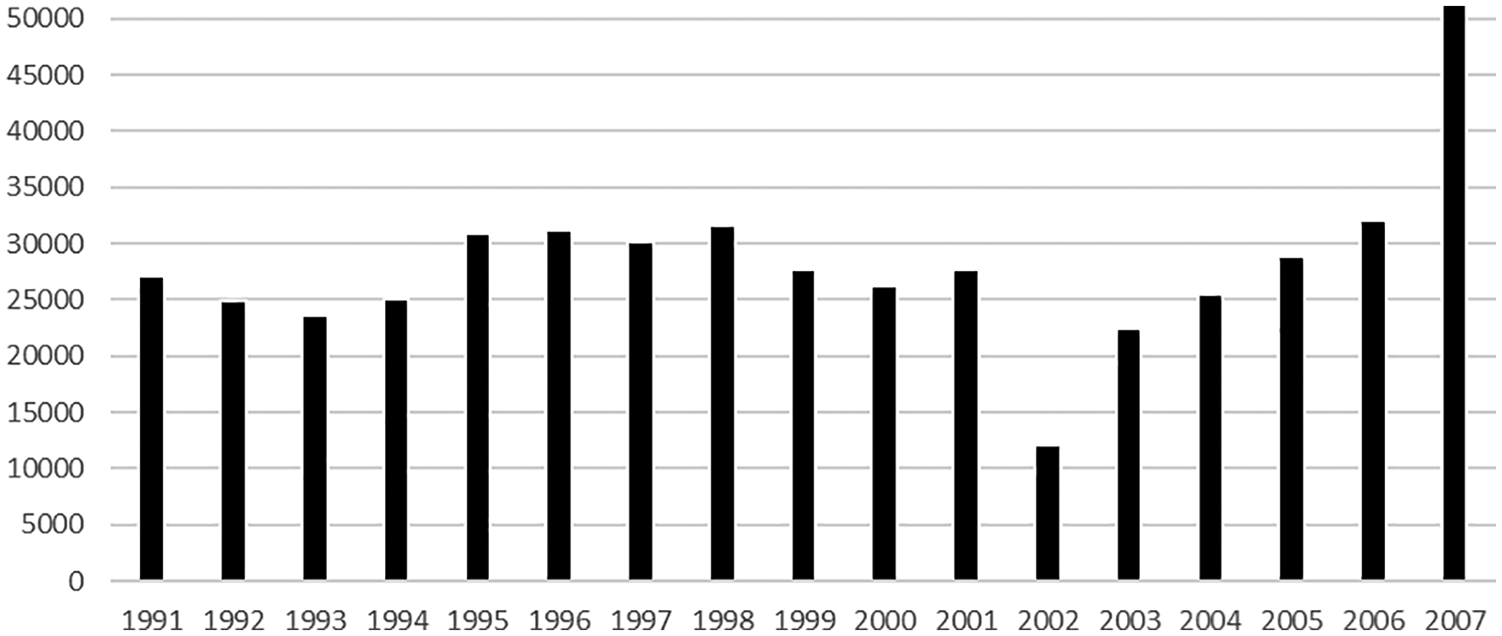
Ground rent (millions of pesos) for agrarian land in 2004 purchasing power (data from Iñigo Carrera, 2008).
Let us now look at the appropriators of this mass of social wealth. Figure 2 shows the fraction of ground rent kept by the landlord class. The proportion of ground rent appropriated by landlords during the Convertibility period averaged 20 percent. This low rate was sharply reversed after the 2002 devaluation, when landlords managed to appropriate not only all of the ground rent but also an extra mass of social wealth (represented in the graph by an appropriation rate exceeding 100 percent), the origin of which we will explore later. From this year on, and with ground rent increasing, its appropriation by landlords sharply exceeded the rate of the previous period even though it declined somewhat: between 2003 and 2006 it averaged 75 percent, more than triple the average of the previous decade, while by 2007 it had decreased to 56 percent, still more than double than the previous average.

Percentage of ground rent appropriated by landlords, 1991–2007 (data from Iñigo Carrera, 2008).
It was in this context that, on March 11, 2008, the government announced the implementation of Resolution 125, triggering the conflict. One may wonder why similar clashes did not take place during the Convertibility period, when the ratio of ground rent kept by landlords was significantly lower. It so happens that, when the appropriation of ground rent takes place via currency overvaluation and therefore does not pass through the state hands, 6 landlords encounter difficulties in confronting it: instead of a tax that specifically affects agrarian production, appropriation takes place through a variable that affects all economic actors; moreover, currency overvaluation is not always self-evident, and its measurement can always be subject to debate. The situation was even trickier in the 1990s, because overvaluation was sustained by the Convertibility Act, a key issue in the program of neoliberal economic reforms implemented by the government. This program was supported supported by the SRA, which believed it was going to unleash the potential of the Argentine economy. Thus, in contrast to the situation in other historical periods (such as the one following the 2002 devaluation), the dispute over ground rent appropriation failed to function as a unifying element for joint action. While during the 1990s some agrarian organizations confronted the government with particular vigor, was not subject to discussion until the crisis begun to take place. Although the FAA, which spearheaded protests during that time, did not seek to terminate Convertibility until the end of the decade, the SRA strongly supported it, stating that it had not only stabilized the economy but also prevented the national administrations from issuing currency. Thus, the dispute over the appropriation of ground rent was virtually absent as an issue in the agrarian conflicts during these years (Pérez Trento, 2015; 2017).
This scenario began to reverse in the post-Convertibility period. Despite the fact that Eduardo Duhalde’s government reinstated export taxes in 2002, the proportion of ground rent kept by landlords increased significantly in the 2002–2007 period. The devaluation that took place in that year resulted in a significant undervaluation of the currency, which meant that landlords were to appropriate not only the totality of ground rent but also an extra mass of social wealth that escaped the already half-empty pockets of the working class through the increase in the cost of the basic food basket. Therefore, even after the reappearance of export taxes, not only did the mass of surplus value kept by landowners increase from an average of 20 percent of ground rent to 100 percent but an extra portion of social wealth, a fraction of wages, was also appropriated by them in 2002 (Iñigo Carrera, 2005). Despite this, the agrarian organizations, including the SRA, immediately protested against the export taxes, although failing to form a strong coalition as they would in 2008.
In sum, when ground rent appropriation by industrial capitals takes place mainly through overvaluation, as was the case during the 1990s, the landlord class hardly confronts that economic policy, and the opposite occurs when appropriation is carried out via economic policies specifically directed toward agrarian commodities. As we shall see, the agrarian associations that acted in representation of landlords repeatedly faced export taxes (among other policies) in the 2002–2007 period, even when they were keeping a larger portion of ground rent in relation to the previous years. And not only that: they were strong enough to force the government to revoke Resolution 125 and, later, to prevent the passage of the bill in Congress. Let us now see why.
“Confiscation” and Freedom: The Limits on the Appropriation of Ground Rent Through Export Taxes
The agrarian lockout (which was actually an interruption of the domestic circulation of certain commodities) was the climactic action undertaken by the rural organizations against the interventionist aspects of the Kirchnerist agrarian policy. Government intervention in the meat and grain markets (which included both price fixing and a temporary ban on exports, among other measures equally repudiated by agrarian associations) from 2005 was met with two strikes in 2006, the first faced by Kirchnerism. While the first one was carried out exclusively by the CRA, the second one was joined not only by the SRA but also by the FAA, which had been close to the government until that point. Although these actions did not have the impact or the power of the 2008 strike, they can be seen as a first step toward the agrarian coalition.
Meanwhile, the price of grains had entered a prolonged rising phase, and the government had increased taxes twice in 2007. The agrarian organizations repudiated these increases, albeit without engaging yet in active protests. The confrontation was triggered only in the following year, with the failed enactment of Resolution 125. Less than 24 hours after the official announcement, the agrarian associations called for a commercial strike that would initially last for two days and was organized under the so-called Comisión de Enlace (Linking Commission—CE; see Sanz Cerbino, 2014). Despite the fact that no one could have anticipated it, a 129-day commercial strike that made history had just begun.
What explains the power of this action, which was the Kirchnerist government’s first significant political defeat and, moreover, managed to link “the countryside” with a small fraction of the urban working class? The answer lies, once again, in the form assumed by the ground rent appropriation mechanism, export taxes. As we have seen, Resolution 125 was a fluctuating tax scheme imposed on agricultural commodities. In March prices, the taxes on soybeans and sunflower seeds would have increased to 44.1 percent and 39.1 percent respectively; in addition, the fluctuating nature of the system could have increased them even more, to as much as 50 percent.
Such numbers allowed landlords to present their case in a simple way: the tax was unacceptable both because of its magnitude and because it affected a particular branch of production. The classic argument of “discrimination against the countryside,” usually raised against export taxes, was then bound to another commonplace that was first put forward by the president of one of the CRA federations the day after the announcement of the passage of the resolution: the idea that the tax was actually a “confiscation” (Clarín, 2008a). The legal basis for this argument was a ruling by the Supreme Court that established that any tax above 33 percent was confiscatory and therefore unconstitutional (see, for example, the constitutionalist lawyer Daniel Sabsay’s assertions in Clarín, 2008b).
Thus, the idea that “the countryside” (or, in any case, the no less abstract “producers”) was being harmed by the insatiable voracity of a government seeking to expand its tax collection capacity even via confiscatory means quickly gained in popularity. Similar statements were made by the presidents of the agrarian associations (Página/12, 2008c, 2009), as well as issued in the CE communiqués (Comisión de Enlace, 2008a, 2008b). Various opposition political parties also repeated this argument (El Santafesino, 2008; Infobae, 2008; Página/12, 2008b), as did some of the media (see, for example, La Nación, 2008a, 2008b). Moreover, precisely because of this alleged confiscatory nature, a small group of capitalists appealed the law, although this request was denied (Página/12, 2008a).
The conflict quickly intensified, especially after the strengthening of the agrarian bloc. Certainly, the creation of such an alliance was partly due to political opportunities. It happens that, until the conflict was unleashed, the Kirchnerist government had managed not only to close the political legitimacy crisis that followed the economic collapse of year 2001 but also to rule fairly unobstructed and consolidate its political hegemony: in 2007, Cristina Fernández was elected with 45 percent of the vote and more than 22 points ahead of her closest rival. In this scenario, the agrarian organizations were able to overcome the quarrels of opposition parties, which were acting separately, and form a coalition with the most important ones. Indeed, one of the most notable political consequences of the conflict was the strengthening of the opposition, which achieved significant victories in the 2009 legislative elections (Castro García, Cornelli, and Palmisano, 2011; Varesi, 2016).
However, the failure of the government to enact Resolution 125 and then to pass the bill in Congress cannot be explained just by the forming of this coalition. On the contrary, the question about the source of its power to prevent the passage of the bill still remains. In this regard, the idea that the taxes were beyond tolerable and an act of “confiscation” played a key role.
The appropriation of ground rent by industrial capitals does not in itself affect the reproduction of agrarian capital; in fact, ground rent could be entirely taken from landlords, affecting only the existence of that social class. However, the abolition of the landlord class would need to go further to include the abolition of the capitalist class, because it would entail the liquidation of private property. Of course, the Kirchnerist government was not to perform such a task; its role was merely to represent a phase of rapid economic expansion sustained by the diversion of an increasing flow of ground rent toward industrial capitals. Therefore, by attempting to increase ground rent appropriation via a traditional mechanism for funneling funds toward other sectors, the national government was doing nothing more than reproducing the specificity of capital accumulation in Argentina. However, the tax scheme appeared to go beyond that.
As long as the taxes remained within the limits considered legitimate, landlords reiterated their usual complaints, but they did not have the strength to prevent the appropriation. By exceeding these limits, the taxes appeared to clash with the legal system, in particular affecting the principle of fiscal equity and the ban on confiscation. Therefore, the very foundations of capitalism seemed to be at stake in the 2008 conflict: a tax close to 50 percent could only be seen as a breach of private property and freedom of trade. As a consequence, the failed tax scheme allowed for a generic protest of “discrimination against the countryside” to turn into what seemed to be a fight over something much more alarming: an illegitimate confiscation and, therefore, a violation of individual freedoms and private property—an argument that garnered considerable support.
Effects of the Expansion of Ground Rent Appropriated by Landlords
The impossibility of exceeding a certain limit on the appropriation of ground rent via taxation largely explains the outcome of the conflict. However, there are some other aspects to consider in order to explain why the agrarian associations held enough strength to prevent the passage of the bill.
First, a series of good harvests at rising prices tends to strengthen the landlord class by allowing it to accumulate enough social wealth to halt commodities trade for a relatively long period. This was not always enough. By the mid-1940s, another period when the amount of ground rent sharply expanded, the freezing of leases and the suspension of evictions in an inflationary economy left the landlords with no chance to raise lease rates or sell their lands, facing the only alternative of lending ground rent as loan capital. However, because of the negative real interest rate, a fraction of that mass of social wealth flowed toward the main loan borrowers, industrial capitalists (Iñigo Carrera, 2007b). Today, in contrast, landlords can prevent that from happening in two ways, both of which took place: on the one hand, by investing ground rent as real estate capital (therefore turning into urban landlords as well) and, on the other, by employing a new storage technology known as silobolsa, which enables them to store grains at low cost and for a relatively long period of time without their suffering a deterioration of their use value. Thus, after garnering enough support, agrarian landlords were literally able to sit on their small mounds of wealth and wait for the resolution of the conflict.
The transformation of the leasing system had the same effect. While the old one forced landlords to lease their lands for long periods of time, it is now usual to lease lands for a one-year period. Therefore, nothing prevents landlords from adjusting lease rates in accordance with movements in grain prices. And this is what, in fact, they have done in recent years (Bisang, 2007).
Conclusions
Let us now go over some of the conclusions. The 2008 conflict was characterized here as a new episode in the long series of clashes between landlords and the national state over the appropriation of ground rent. As noted above, these social subjects respectively personify landownership and the unity of the Argentine process of capital accumulation. And while the channeling of portions of ground rent to the most concentrated capitals of the industrial sector is characteristic of this process, the concrete policies under which this happens do not always allow landlords to face (or even to acknowledge) them. With an undervalued currency, export taxes became the most powerful mechanism of ground rent appropriation, alongside various forms of agrarian market intervention, especially price controls and a ban on exports. Such mechanisms, however, are perceived by landlords as “discriminatory” policies, and after a certain point export taxes appear “confiscatory.” This was the source of the landlords’ power to prevent the passage of the bill: as I have said, the magnitude of the tax clashed with the very foundations of capitalist production, laying bare the limits of the appropriation of ground rent via this mechanism. Besides, landlords engaged in the conflict after years of keeping much of the ground rent for themselves. Therefore, they garnered enough strength to defeat the national state, at least in that battle. Moreover, they managed to gain allies among a small fraction of the working class that, horrified by this “plundering” of private property, joined their cause.
This dynamic partly explains why such clashes took place under the Kirchnerist administration. As noted, the abrupt expansion of the amount of ground rent that flowed toward the Argentine economy led not only to the reinstatement of a series of appropriation mechanisms but also to an attempt to increase export taxes alongside the growth of ground rent. At the same time, this appropriation had its counterpart in the reappearance of policies such as the expansion of public spending, social assistance, and public service subsidies, thus strengthening the government’s progressive character. The immediate visibility of these economic processes allowed the agrarian associations to coordinate political action in defense of the landlords, as opposed to what happened under the neoliberal governments of the previous decade, when ground rent appropriation took place mainly through currency overvaluation. Thus, although they were only able to keep a significantly lower proportion of ground rent, the dispute over its appropriation was not a key issue in agrarian conflicts, and the associations failed to coordinate a strong collective action. 7 When ground rent appropriation is mediated by more visible mechanisms, landlords immediately reject them and may attempt to terminate them, and occasionally their reaction is powerful enough to prevent an increase of the magnitude of the appropriation, as was the case in 2008.
However, their victory was a Pyrrhic one. By that year, the national currency had already reached parity with the U.S. dollar and was slowly beginning to overvaluate. But after the failure to pass Bill 125, this process accelerated exponentially via a sustained issuance of currency in excess of circulation needs. Just five years later, overvaluation was already around 70 percent (Grinberg and Starosta, 2014), not far from the rate reached during the Convertibility period. This, in addition to export taxes that remained at around 35 percent, resulted in an increase in the appropriation of ground rent. With the advent of a new neoliberal government in December 2015, ground rent appropriation declined only slightly, since taxes on grains were eliminated (except for soybeans, which accounted for the highest export value), although this only lasted a brief period. 8
As a final remark, it must be stated that these historically present forms of ground rent appropriation have a specific effect on the Argentine process of capital accumulation. They limit the intensive and extensive investment of agrarian capital by excluding those capitals that are not capable of yielding enough ground rent so that the appropriation mechanisms do not affect their normal profit rate. This prevents the development of the productive forces of social labor applied to agrarian production by excluding capitals that could implement a lower labor productivity but still achieve an individual price of production lower than the commercial price. And these capitals are, precisely, the ones that are compelled to keep developing the productive forces because they are located at the technological frontier (Iñigo Carrera, 2007b). Thus, even being a national space of capital accumulation where the only normal-sized capitals (those concentrated enough to reach the productivity of labor that determines the value of commodities) are those applied to the production of agrarian commodities, 9 Argentina cannot participate in the development of productive forces in this branch. This only emphasizes the issue of overcoming the specificity of this national process of capital accumulation.
Footnotes
Notes
Nicolás Pérez Trento is a postdoctoral fellow of the Consejo Nacional de Investigaciones Científicas y Tecnológicas and an assistant professor in the Facultad de Ciencias Sociales of the Universidad de Buenos Aires. Mariana Ortega-Breña is a freelance translator based in Mexico City.