



Abstract
Now that the global development of economies is knowledge-based, there is increasing pressure on peripheral and semiperipheral countries, technologically and economically trapped by their dependency on the advanced economies. In this context, the education, science, and technology policies of the Citizens’ Revolution in Ecuador (2007–2017) must be considered the product of political emergencies and urgent social needs such as the need to halt the continual increase in inequality, poverty, and institutional instability. The knowledge economy has created a contradictory relationship between cognitive dependency and social development. The Citizens’ Revolution government attempted to resist and challenge knowledge rent, opposing appropriation and pillage by transnational companies while pursuing a public system of higher education in science and technology with increasing participation in human capital flows and access for historically excluded groups. Whereas these policies have had an impact in terms of access, democratization, and poverty reduction, they have had the perverse effect of reinforcing the power of the national elites, reproducing Ecuador’s inequalities and historic injustices.
Ahora que el desarrollo global de las economías se basa en el conocimiento, aumenta la presión sobre los países periféricos y semiperiféricos, los cuales se encuentran tecnológica y económicamente atrapados a raíz de su dependencia de las economías avanzadas. En este contexto, las políticas de educación, ciencia y tecnología de la Revolución Ciudadana en el Ecuador (2007–2017) deben ser consideradas como el producto de emergencias políticas y necesidades sociales urgentes, incluyendo la necesidad de frenar el continuo aumento de la desigualdad, la pobreza y la inestabilidad institucional. La economía del conocimiento ha creado una relación contradictoria entre la dependencia cognitiva y el desarrollo social. El gobierno de la Revolución Ciudadana intentó resistir y desafiar la renta del conocimiento, oponiéndose a la apropiación y el saqueo por parte de las empresas transnacionales mientras buscaba establecer un sistema público de educación superior en ciencia y tecnología con una creciente participación en los flujos de capital humano y el acceso de grupos históricamente excluidos. Si bien estas políticas han tenido un impacto en términos de acceso, democratización y reducción de la pobreza, también han tenido el efecto perverso de reforzar el poder de las élites nacionales, reproduciendo las desigualdades e injusticias históricas del Ecuador.
Keywords
Over the past 20 years, with plans for the knowledge economy reaching a global level, we have suffered the effects of the conservative revolution theorized by Hayek (1937; 1945) with regard to the transformation of state supply, financing, and regulation. The dispute over the public and the private must be read historically as an ideological struggle, with theories of the minimal state being adopted just as the role of states in international economic regulations has increased. Luciano Gallino (2012) identifies these processes as a neoliberal offensive that began with the attack on the social welfare state policies led by Augusto Pinochet in the late 1970s and by Ronald Reagan and Margaret Thatcher during the 1980s. According to Epstein (2005), three concrete historical processes mark the dominant forms of the current world economy—neoliberalism, globalization, and the financialization of the economy. The relationship among these three processes is the reason for both the destruction of social welfare systems and the restructuring of societies according to new financial and commercial capital regulations, with dislocation of production and an attack on labor on a global scale (ILO, 2014). This restructuring entails political reforms to the systems of education, science, and technology, which have become fundamental to capital appreciation by adopting specific categories of human and social capital (Burt, 1997; Vandenbussche, Aghion, and Meghir, 2006). The adoption of these categories has required measurement and control of knowledge and human capital flows (through input monitoring systems such as tests, standards, and selectivities—and constants—with credit systems) and enabled their financial valuation (Guthrie, 2001). The relation between capital and knowledge—what Vercellone (2006) calls “cognitive capitalism”—serves financial valorization in that the segment of capital measured by the proportion of workers in high-intensity knowledge and technology activities and is increasingly the key variable in the increase of competitiveness and inequality among nations. In Latin America since the 1990s, the progress of agendas on knowledge-based economies has coincided with the increasing financialization of the economy, restoring and/or radicalizing the dependency of peripheral and semiperipheral countries. States have contracted debts and “financial risks” (derived from dependency stemming from knowledge commodities) that, rather than relying solely on the sectors of high technology and innovation, research, and development, affect all human activities. We refer to this historical process in terms of cumulative advantages (Marini and Millán, 1994: 58–59): A more detailed analysis shows us, nonetheless, that the developed countries retain two victories in their hands. The first is . . . the technological monopoly that exacerbates the dependent condition of other countries. The second is the control exercised in the transfer of industrial activities, in both technological capacity and investment, to the more backward countries This control acts in two ways: primarily transferring industries that are less knowledge-intensive to the more backward nations and spreading out the commodity production stages among different countries. By doing so, they prevent the rise of nationally integrated economies.
Valorization of capital and living labor at the international level is therefore reproduced through existing and new divisions. In this process—in spite of the fact that the dominant discourse on privatization of universities is combined with the premises of the minimal state (Jessop, Fairclough, and Wodak, 2008)—systems of higher education, science, and technology still depend mainly on national government investment (OECD, 2016). States, especially those of the Global North, maintain strategic power in the systemic organization of collective intelligence, even more so than in the “Fordist” past, in both protection of intellectual property rights (to control or benefit monopolizations) and regulation of training schools, universities, and research centers. They invest, for example, in the entrepreneurship and employability of students, who thus become active subjects of academic capitalism (Mars, Slaughter, and Rhoades, 2008). They have been transformed into stockholders and entrepreneurs of the cognitive capital of their citizenries (Mazzucato, 2014), breaking with the myth of deregulation and, in particular, adopting new forms of regulation. Several investigations (Apple, 2003; Duckett, 2006; Eisinger, 1988; Etzkowitz, Webster, and Healey, 1998) have analyzed the transformations in the role of states in the process of knowledge valorization and the development of industry with high value-added. Block (2008), for example, responding to the dominant free-market ideology, underlines that the U.S. government, over the past 30 years, has radically increased funding to the scientific and technological sectors, public and private. Consequently, we decided to study the implementation of the knowledge society in Ecuador as the state policy of a Global South nation that has decided to intervene in the valorization and reproduction of cognitive capital. To do so, we focused on political mechanisms (development policies and cognitive regulations) and new socioeconomic features (poverty and social inequality). This approach is a response to the need to reflect on the problem of dependency in terms of (1) the regulation of knowledge commodities (dependency in intellectual property systems, for example), (2) regulation of the flows of knowledge and human capital, and (3) the contradictions between public policies of access to and the democratization of education and the persistence of social inequalities.
Financialization of the Economy and the Power of Knowledge Rent
Policies to consolidate the knowledge economy have guaranteed a regulatory framework in line with principles of accumulation whereby the risk increasingly moves to the public sector and the private sector receives the benefits. The exploitation of wealth is not solely a matter of the classic parameters of production but involves mechanisms for guaranteeing financial benefits such as legal protection for intellectual property (Sell, 2003). These are new forms of rent in capitalist societies increasingly characterized by the production of knowledge commodities (Teixeira and Rotta, 2009). Directly guaranteed by states while not entirely depending on them and on financial activities, they represent legal processes that cause knowledge commodities to be appraised in a unique way. They serve financial valorization because they create a fetishism in which exchange value increases as social use decreases through commodification and the manufacture of scarcity. They become political weapons in the control and continuous valorization of capital in the process of capital accumulation. The growth of the knowledge economy shows us that the participation of institutional investors in the stock market has radically influenced the global and local governance of knowledge, while institutional shareholders and private operators (the rentier class) register agreements and conflicts in interests and objectives. This helps us to situate knowledge rents as important mechanisms of the international division of knowledge, labor, and wealth—determinants of new forms of dependency not only in political but in economic and social terms. In 2016 the Ecuadorian government enacted a law challenging the political meaning of knowledge rent as a weapon of social struggle (protected by the state) against appropriation by transnationals. The goals of the 2016 law on the social economy of knowledge, creativity, and innovation (Código Ingenios, 2016) represent social principles upon which to calculate income guarantees. Clearly, this law does not sidestep the monetization of knowledge commodities but provides for their valuation in terms of their social functions—in other words, as a guarantee of future social revenue. Rents are not exclusively money capital but also cultural capital (multidiversities, multinationalisms, and multilingualisms), social capital, and relational capital (the intangibles based on belonging to groups, relationships, and networks of influence and collaboration [Bourdieu, 2005]). In this case, the law constitutes a political attempt by a state in the Global South to make the income of the social base less miserly (a struggle against inequality) and to limit the power of the contemporary capitalist economies of the updated national rentier class (Epstein and Power, 2003).
State Intervention in the Geopolitical Context of Knowledge Economies
With the implementation of the agendas on the knowledge economy and the knowledge society, the contradiction between development and dependency is intensified. The example of the higher education systems of the Organisation for Economic Co-operation and Development (OECD) countries shows that, despite the recent wave of education reforms, state funding continues to be the prevailing form of organization and production of knowledge (OECD, 2016). The stiff competition launched by the United States, the European Union, China, and Australia in the global market of the knowledge economy reveals the contradictions in the internationalization of higher education in Latin America (Robertson and Keeling, 2008). Maldonado-Maldonado (2009), for example, points to the real difficulties faced by higher education institutions in responding to and positioning themselves in the global market while also intervening against social inequalities. The spread of higher education led to an impressive rise in enrollment rates in the region, from 17 percent in 1991 to 21 percent in 2000, registering 40 percent in 2010 (Ferreyra et al., 2017). In 2013 there were almost 20 million higher education students enrolled in Latin America and the Caribbean. In 2005, in the midst of this robust expansion, Ecuador was doing less for science and technology than Brazil, Argentina, Colombia, or Chile. This is a meaningful point of departure for framing the policies for implementation of the knowledge economy in Ecuador within the remarkable political and economic transformation of the state and the social fabric, with old and new forms of dependency, development, resistance, and priorities. The starting point is to recognize the efforts of a government with a clearly primary economy based on exports to build the strategic sectors of the state that operate at the national and international levels in granting licenses, regulating foreign direct investment, regulating technology transfer, and limiting the international accumulation of financial capital.
Muñoz Jaramillo (2014) seems to ignore this assessment in attributing the education, science, and technology policies of the Citizens’ Revolution solely to the increase in labor productivity generated by foreign investment. Under this “Fordist” politico-economic hypothesis, the country’s public contribution (investment, access, and increase in academic quality) to education, science, and technology receives a substantially negative rating. Two consequences emerge from this assertion. First, the political-economic relations that Ecuador maintains in the hegemonic processes of global cognitive capital are not acknowledged, as if the country had magically found itself in an “other,” substantially autonomous world-system. Second, more serious, an erroneous image of reality is reinforced, as if the Ecuadorian university model had historically once been an ideal model for the country’s development or equitable postdevelopment. Despite these considerations, there is no question that the Organic Higher Education Law of 2010 ushered in a phase of implementation and defense of the public nature of the country’s universities. It called into question the neoclassic growth models that assigned a limited role to state intervention in investment. In a country that had more private universities than public ones, the adoption of several regulatory measures by the government was vitally important for regulating both the financing and the quality of and access to institutions of higher education. Criticisms of the law stem from this regulatory design—from resistance to deprivatization (Kwiek, 2017) and to quality measurement (Lucas, 2014). This public intervention was rapidly labeled as an attempt to do away with university autonomy (Muñoz Jaramillo, 2014: 220) because some of the privileges of the university elites were being threatened. On this point we should consider that in the 1990s university autonomy in Ecuador was noted for the narrow private, stratified, and authoritarian interests of the criollo intellectual class that maintained a monopoly and exclusivity not only in the management but also in the control of higher education, without any form of effective state regulation, and that the negligible quality of higher education before 2007 was the result of these class alliances, which have historically generated and reproduced extreme dependency in strategic sectors of the country’s development and social welfare. The higher education model promoted by the Ecuadorian government featured strong public action to intervene in Ecuador’s strategic and technological repositioning in the regional geopolitical scene. The 2010 law was enacted precisely in this framework of institutional strengthening, grounded in the principles of equality of access, free of charge, as a means of reducing socioeconomic inequalities.
Education as a Constitutional Right: Democratization of Access and Poverty Reduction
The public policies implemented since 2010 are part of a broader, crosscutting legislative framework through the constitutional recognition of life-long learning as a right. With the 2006 referendum on educational policies, a 10-year education plan (2006–2015) was adopted that has gradually led to the state’s recovery of the school system and some radical changes with regard to basic general education in Ecuador. In 2012 universal education was achieved, with a net rate of 95.4 percent, up from 91.2 percent in 2006, and the net high school graduation rate increased from 47.9 percent to 62.1 percent in the same period (Cevallos and Bramwell, 2015).
The government of Ecuador intervened politically by regulating—and promoting—flows of capital and people in open confrontation with World Bank proposals of an ideal world in which knowledge citizens circulated without restrictions (World Bank, 2005a; 2005b), consistent with the principle of liberalization of the global human capital market. Latin America has exhibited an exponential increase in skilled (including highly skilled) emigration. While in 1990 there were 1.9 million such emigrants, in 2007 there were 4.9 million, 19 percent of the total for the OECD countries (Docquier et al., 2008). This figure is significant if considering that in 2010 19.42 percent of the emigrants had university educations (Ramirez, 2010: 239). Whole systems, such as that of health care, are affected by the fact that qualified medical personnel and technicians have emigrated to more promising places. The dependency of “Western” (and transnational) economies with respect to foreign specialists and scientists (Blitz, 2010) forces us to update dependency theory (Beigel, 2016; 2013). Moreover, the development of the knowledge economy has led to the promotion of enclave economies (Gallagher and Zarsky, 2007) that generate abundant benefits for transnationals through a scientific and technological workforce from the Global South by capitalizing high returns through the transfer of technologies and the concentration of patents (OIM, 2016). In this context we can frame the strategies of the 2009–2013 National Well-Being Development Plan, which for the first time created the concrete objective of limiting the “brain drain” (controlling and intervening in the flows) and promoted the return of skilled Ecuadorians (SENPLADES, 2009: 111). Public policies have been launched to attract and retain skilled professionals with the goal of strengthening the education, technology, and health care sectors. Some 20,000 scholarships have been granted to pursue higher education programs abroad since 2011. According to 2017 records, 99.7 percent of these students have returned to Ecuador, primarily because of renewed demand for highly skilled labor by universities as a result of quality assessment and the increasing generation of higher education programs. In 2015, for example, third- and fourth-level national degrees doubled with respect to 2005, increasing from 51,059 to 102, 047 and from 9,977 to 19,228, respectively. Secondly, policies were implemented to attract skilled professionals, among them the Prometeo competitive scholarship program (OIM, 2017). In 2013 there were 573 researchers linked to universities and research centers, of whom 12.6 percent were returning Ecuadorians (Pedone and Alfaro, 2015).
It is not coincidental that in 2015 the National Secretariat of Higher Education, Science, Technology, and Innovation (SENESCYT, 2017) recorded 24,190 foreign higher education degrees, 14.2 percent of the country’s total. Although we do not have a systematic study on the rate of return, we do know that since 2010 Ecuador has responded to the general Latin American “brain drain” through a 48.5 percent increase in foreign degrees in relation to 2014. In this political-economic framework, with the adoption of the 2010 higher education law the Ecuadorian government has sought to transform society and its productive and environmental structure through a significant commitment to education, science, and technology. The results have been relevant. In 2015 Ecuador became the country in the region with the most investment, with 2 percent of its annual gross domestic product in relation to the OECD average of 1.7 percent (Argentina 1.2 percent, Colombia 1.1 percent, Brazil 1 percent, Chile 0.9 percent, Paraguay 0.8 percent, Peru 0.4 percent). In terms of teaching quality, specialization of the teacher corps and a modification of the national division of labor through a wage adjustment (the average salary has almost doubled since 2008) has been pursued. A report on the achievements of the Citizens’ Revolution in higher education, science, technology, and innovation (SENESCYT, 2014) describes some of the outcomes of the higher education policies. With regard to gender equality, while in 2006 the gross enrollment rate of women in higher education was 30.7 percent, in 2014 it was 37.4 percent. In March 2014, 46.69 percent of new income went to women, and in March 2015 the figure was 51.82 percent. Access to higher education was in line with the social equity policies implemented since 2008 (Figure 1).
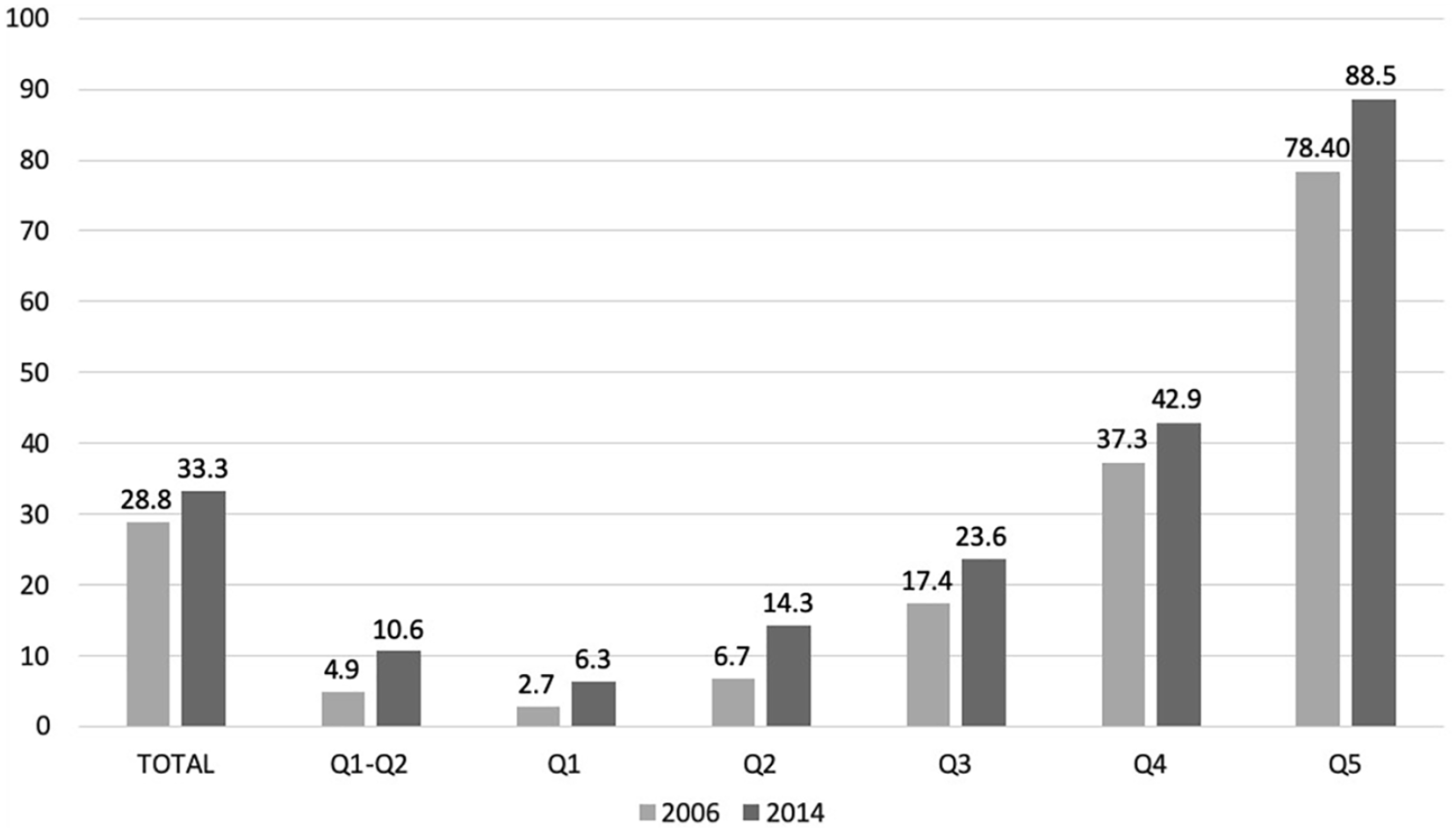
Percentage of total enrollment in higher education by quintile, 2006 and 2014 (SENESCYT, 2014).
Notably, through the higher education policies an increase in access for the most impoverished social classes has been produced, ranging from 4.9 percent in 2006 to 10.6 percent in 2014 as opposed to the reduction of access by 15 percent recorded between 1998 and 2006 (SENESCYT, 2014). Lastly, between 2007 and 2012 the rate of nonenrollment in the higher education system due to economic limitations was reduced to 20 percent, significantly affecting the net tendency toward poverty reduction registered in the country (the Gini coefficient dropped from 0.63 in 2003 to 0.46 in 2016) (Figure 2).
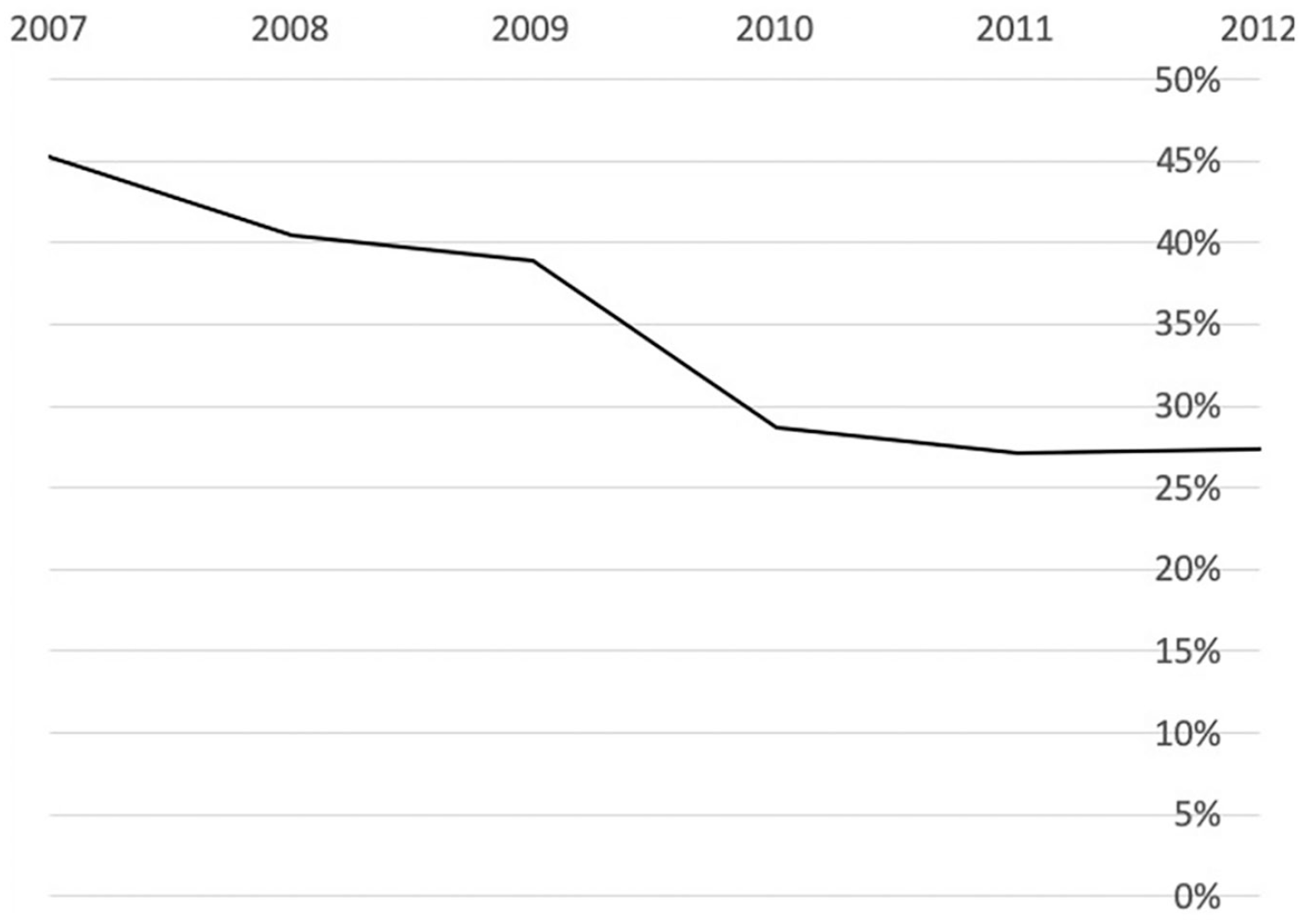
Percentage of nonenrollment in higher education due to economic limitations (INEC, 2012).
Democratization and Elitization of the Higher Education System
With the increasing development of plans for the knowledge economy, the Latin American geopolitical context has been penetrated by various nonstate local and global multilateral actors involved in the creation of cross-border markets in higher education: international agencies of student recruitment, institutions and private education providers, agencies concerned with quality control, and, above all, new forms of credit/debit available for new types of investment (Robertson and Komljenovic, 2016: 598). To halt this tendency, between 2000 and 2017 the Ecuadorian government opted for an unusual strategy of deprivatization, significantly expanding its regulatory power over private institutions and actors for the purpose of guaranteeing free and democratic access (defending the public nature of higher education) by institutionalizing a national system of higher education, science, and technology. In 2004, 38 universities (9 cofinanced and 29 self-financed) were private and 29 were public. In practice there was no quality control, since it was not obligatory or prescriptive. Private universities for elites such as the Universidad San Francisco de Quito were accredited by international agencies, creating an exclusive market of degrees for the country’s urban upper class (UNESCO-IESALC, 2004). In 2017 the degree of institutionalization of the national system of higher education was very different, with some 60 universities compulsorily ranked and accredited by one national quality agency, the Council on Evaluation, Accreditation, and Quality Assurance of Higher Education. The majority (33) of universities were public, 19 self-funded and 8 cofinanced (SENESCYT, 2018). However, despite the democratization of access to the national higher education system and its impact on poverty reduction, some critical questions remain unanswered. Solely in terms of the liberal inclusion/exclusion logic of abstract humanism (Herrera Flores, 2005), we run the risk of naturalizing poverty—denying that it is the product of relations of exploitation (Roig, 2008: 85–88). Exploitation itself, which in Ecuador has historically had colonial features, is transformed into something natural because of the society’s economic ethos. Furthermore, individualizing and simplifying the conceptual field around poverty obscures the conflictive notions formulated about it by economic and social processes.
If, in contrast, we focus on the inclusion/inequality relation, we can critically challenge the development of the knowledge economy. The achievements in terms of inclusion and democratization (reduction of absolute inequalities) have not eliminated relative national inequalities in terms of class, race, gender, and territory. On the contrary, these seem to have been restored through a specific civil and intellectual society—the urban upper class—that has reproduced itself as a dominant class. Because of the renewed role of the national universities, the strategies of the intellectual and political elites of urban areas have continued to dominate in the context of a substantial growth of the national higher education market. A recent study (Véliz Briones et al., 2021) has shown that the formula adopted by the government (2013–2018) for redistributing public resources among higher education institutions failed to take into account their shortcomings (in quality and administrative and financial efficiency) and historical injustices (in terms of the colonial and racial division of the nation between urban and rural areas). Consequently, the variables utilized (budget, allotments, executed budget, efficiency in budget execution, research budget, number of publications, number of students, ethnicities, among others) ultimately served as mechanisms for producing cumulative advantages that benefited the elite national universities. The same cumulative advantages can be seen, for example, in the processes of awarding of scholarships at the national level (Jiménez, 2016), which in the end provided more financing to the same elite universities. These institutions have obtained enormous differences in salaries for their instructors compared with those of instructors with the same rank and accreditation in the rest of the country’s universities. The salaries of senior instructors at these centers were often as much as 15 to 20 times the national minimum wage (US$375 in 2017). These types of institutions operate as major catalysts of elitist values, in educational and cultural terms, indicating status, reproducing dominance, and directly intervening in the processes of differentiation by class, race, and territory.
Conclusions: The Return of Neoliberalism and Threats to the National System of Higher Education
The international division of knowledge responds not to any philanthropic or egalitarian structure, as the ideologues of the knowledge society suggest (Thompson and Harley, 2012), but rather to the financial logic of outreach (inclusion) and differentiation (division) of knowledge commodities. Countries are subject to ranking in terms of various domains. Because of the internationalization and promotion of higher education systems, they depend on financial regulations to consolidate a system of research and innovation linked to technological change. In this framework, the education, science, and technology policies of the Citizens’ Revolution sought to increase the value of intangible assets such as cultural, social, and relational capital (cognitive dependency), which have never been considered as separate from material resources (productive dependency). They have been priorities in the political-economic strategy of the Ecuadorian government, which has aimed to substitute monopolar dependency for multipolar relations (to increase the capacity for political action with respect to economic ties). Enormous differences in this process persist among the regions of the Global North, which, with the advance of the knowledge economy, have consolidated the dominant positions achieved during “Fordist” times, and the peripheral regions generally subordinated by these countries. For this reason, this diversification-of-dependency model acknowledges that for most peripheral countries (particularly small export-dependent countries like Ecuador) neither delinking nor the achievement of true autonomy is feasible (Gamso, 2016: 120). The changes in the system achieved—in terms of its public nature, democratization of access, and impact on poverty reduction—resulted in recent decades in a specific international juncture that has allowed for a certain degree of political-economic autonomy. Diversifying the sources of dependency was largely possible because of the wave of progressive governments (normally acknowledged as twenty-first-century socialism) that have attempted projects of subcontinental integration and cooperation (South-South). Because of this type of limited autonomy, between 2007 and 2017 we witnessed a radical reduction of absolute inequality in Ecuador. Nevertheless, in terms of relative inequalities (class, race, territory) the elite national universities have been strengthened and the urban upper class reproduced as the dominant class. It is no coincidence, therefore, that these same elites, through the alliance between the administration of Lenin Moreno and the ultraliberal right-wing parties, have carried out an attack in the past triennial (2017–2020) on the public policies in education, science, and technology developed in the previous decade under the classic neoliberal principles of the minimal state. A grim inflection point was the return of the International Monetary Fund to Ecuador, eliminating any pretense of politico-economic autonomy, boycotting any process of multipolar dependency, and dismantling regional-level integrationist agendas (UNASUR, MERCOSUR, and CELAC). The letter of intent with the IMF forecasts exponential cuts and the dismissal of up to 140,000 employees in the health and education sectors (Weisbrot and Arauz, 2019). The IMF diktat for the national elites is to reverse the process of deprivatization and institutionalization and rapidly proceed to reprivatization to take advantage of the destruction of the national system of free higher education. Thus, the public health system budget was reduced by 36 percent between 2017 and 2020 while the higher education system budget dropped by 30 percent. The alarming genocide and humanitarian crisis the country experienced during the COVID-19 emergency in 2020 was partly caused by this destruction of the social state and the stifling austerity program. Moreover, in May 2020, at the height of the health crisis, in order to meet the IMF debt payment of US$324 million, the higher education budget was reduced by another 10 percent, definitively opening the door to national and global multilateral private actors. The socioeconomic consequences in terms of increased inequality have been devastating to the social fabric. In fact, in the 2017–2020 triennial poverty rates rose. According to the National Institute of Statistics and Census (INEC, 2020), multidimensional poverty was 38.1 percent, with increases of almost 4 points over 2017. Concerns related to cognitive justice and conflicts over the knowledge economy today are politically strategic and socially urgent—strategic because of their disputes over property (accumulation of knowledge/regulation, patents) and justice in the exploitation (differentiation-dissemination/production) of knowledge and urgent because of the importance of the struggle for a social state and against inequalities and social injustice in Ecuador and Latin America.
Footnotes
Francesco Maniglio is a professor at the Universidad Técnica de Manabí, coordinator of the university’s Master’s program in social science, and director of the Critical Studies for Social Justice research group. He is professor of education, science, technology, and labor in the Doctoral program in sociology at the Universidade de Brasilia and adjunct researcher in the trAndeS postgraduate program in sustainable development and social inequalities in the Andean Region of the Pontificia Universidad Católica de Lima and Freie Universität Berlin. Vicente Barragán is a professor of political science at the Universidad Pablo de Olavide and a specialist in participatory social research methodologies. He is the coordinator of the university’s Master’s program in human rights, interculturality, and development. His research focuses on human rights, democracy, participation, communication, and public policy. Victoria Furio is a conference interpreter and translator located in Yonkers, NY.