




Abstract
Over the past two decades, the sociology of education has addressed the reproduction of inequalities created by for-profit universities in several countries. Despite their contributions, these analyses do not always consider the role of and strategies employed by educational entrepreneurs in social processes. In contrast with approaches that understand the university business as a mere reflection of neoliberal institutionality and those that celebrate profit as the vital element in the renewal of higher education in Latin America an analysis inspired by the literature on social movements and examination of business strategies, institutions, and negotiations in the commodification of Peruvian higher education provides an account of the transformations in the structure of opportunities, resources, and framing processes developed by entrepreneurs during two moments: 1992–2000 and 2001–2012.
En las últimas dos décadas, la sociología de la educación ha abordado la reproducción de las desigualdades generada en varios países por las universidades con fines de lucro. Independientemente de sus aportes, estos análisis no siempre consideran el papel y las estrategias de los emprendedores educativos en los procesos sociales. A diferencia de los enfoques que entienden la empresa universitaria como un mero reflejo de la institucionalidad neoliberal, al igual que aquellos que celebran el lucro como el elemento vital en la renovación de la educación superior en América Latina, un análisis basado en la literatura sobre movimientos sociales de las estrategias empresariales, instituciones, y negociaciones en la mercantilización de la educación superior peruana da cuenta de las transformaciones en la estructura de oportunidades, recursos y procesos delimitantes desarrollados por los empresarios durante dos periodos, 1992–2000 y 2001–2012.
Understanding higher education dynamics is a crucial step toward improving access to this right. In the case of Peru, what has been emphasized is the negative results of university commodification over the past two decades, particularly concerning educational quality (Yamada et al., 2013; Cuenca and Reátegui, 2016). However, knowledge regarding these effects has not been matched by studies on the organizational dynamics that precede them. Studies addressing the reproduction of inequalities have not examined the actors in this process in detail; there is a tendency to address the university sector as a business but to ignore the educational entrepreneurs that drive that business. This has prevented us from noticing the particularities of commodification in different contexts. The Peruvian case, for example, contrasts with the Chilean one. In the latter case, despite not being legal, commercial practices have brought terrible results for students (Basso, 2016). Peru also differs from Brazil, where private educational conglomerates have emerged in a public university system that has not weakened much (Sguissardi, 2008).
To analyze these specificities, it is necessary to break with two views. The first one has understood the corporate university as a mere reflection of neoliberal institutionality (Navarrete, 2017). We need to stop assuming that economic action is a mechanical product of the selfish nature of the entrepreneur or state neglect (Manky, 2020). Second, it is essential to move beyond views that celebrate profit as a factor that renewed higher education, abandoning the fantasy of the heroic entrepreneur typical of many management studies (see Ibarra-Colado, 2006). This article suggests an alternative: to take a cohesive look at business strategies, institutions, and negotiations by undertaking a sociology of business action that allows us to evaluate its role in the commodification of education. As have other actors seeking to change the social game rules radically, entrepreneurs have to mobilize resources to ensure that both society and the state acknowledge their legitimacy and accept the desirability of their wager.
To demonstrate the advantages of our approach, our paper compares two moments in the commodification of Peruvian higher education that have traditionally been read as part of the same liberalization process: 1992–2000 and 2001–2012. Previous studies have underscored the continuity of the commodification process in the neoliberal period, suggesting that it began with the legalization of for-profit higher education in 1996 (Lynch, 2004; Burga, 2008). A detailed analysis allows us to build on these valuable works to address a process that began at least four years earlier and has been transformed over time. After presenting a model for understanding the commodification of the university from a sociological perspective on organizations, the article explains the methodology and results of our research. It then discusses the implications of our work for future studies of change in education systems.
Analytical Framework
The scope for business action during liberalization is often understood from one of two poles. On the one hand, critical studies see it as the consequence of state neglect due to internal crises and international pressures. This is the predominant outlook in discussions regarding labor (Tostes and Villavicencio, 2012) or environmental deregulation (Durand, 2016). On the other hand, studies in administrative sciences see it as the product of innovative decisions made by economic actors. This narrative emphasizes a market revolution that, thanks to business creativity, would benefit consumers exhausted by the ineffectiveness of public services (de Althaus, 2007). Paradoxically, while the first view ignores the initial capacities inherent to business agency, it concludes that the educational enterprise has become a real and seemingly invincible power. The second assumes a vast capacity for innovation as a rule while warning that the slightest state intervention would ruin entrepreneurs.
Although these views shed light on crucial aspects of state policy and business creativity, they simplify the links between institutions and organizations, ignoring the interactive processes of social change (Scott and Davis, 2015). A complementary approach examines the construction of new institutions through the action of multiple agents in an organizational field (Hargrave and Van de Ven, 2006: 868). Economic sociology suggests that it is through the dynamics between institutions and organizations that processes of change and continuity in the market can be understood (Fligstein, 1996).
From this perspective, we assume not that existing companies are the most efficient but that every market involves political processes that reduce the scope of action for certain actors in favor of others. The market is seen as a field with relatively stable rules composed of actors trying, via different strategies, to attain better positions (Bourdieu and Wacquant, 1992; Fligstein, 2002). As an expression of a conflicting relationship between classes, the state regulates its activities via formal and informal rules resulting from the ability of different groups to affect its operation (Vaughan, 2008).
This stance has been adopted by studies that address, for example, how unions and business guilds face neoliberal reforms more or less successfully depending on the available resources and the strategies they develop (Cook, 2007; Manky, 2014). However, less has been said about those who drive commodification processes in state-dominated sectors or nonprofit organizations. As Arce (2001) states in his seminal work on Peruvian pension reform, the literature on economic liberalization has emphasized the collective action of "losers" (for example, unions or, in the case of education, teachers and students affected by rules that reduce their agency) while ignoring the winners and the strategies they employ in different contexts (see also Schamis, 1999).
We propose, then, that the evolution of the educational market can be read in a novel way from this perspective. Instead of discussing neoliberalism in the abstract, we must approach this in a processual manner, detailing periods of growth as entrepreneurs develop different strategies to increase their power. In the Peruvian case, the first thing to note is that private universities have grown at varying paces over time (Table 1).
Peruvian Universities Created by Period and Type, 1960–2012

Source: SUNEDU (2013).
It was not during Alberto Fujimori’s (1990–2000) dictatorial government that for-profit universities grew the most. In fact, between the adoption in 1996 of the Legislative Decree 882, which allowed for-profit education, and 2000, only 9 universities were created. In contrast, between 2010 and 2012 (when a new law forbade the creation of new universities), 24 sprang up. The emergence and growth of these universities were more a product of the economic and political strategies employed by those who profited from education than a mere reflection of legislative changes.
In addition, the level of educational quality offered by these universities seems to vary depending on the contextual moment of their creation. Concerning the previous discussion, we suggest that we must be sensitive to changes in the character of the educational entrepreneur. Following Durand’s (2017) reflections on Peruvian entrepreneurs, we can say that, along with the more traditional group of the 1990s, actors from the popular sectors consolidated during the 2000s and developed ways to increase their power. Symptomatically, the ten universities that, by July 2019, had lost their licenses and been forced to close were founded in the 2002–2012 period. They had failed to comply with some of the essential quality conditions required by the Peruvian state under the 2014 University Law, among them having qualified full-time faculty and clear lines of research (Mora, 2015).
To examine the strategies of the entrepreneurs who create these universities and, in doing so, transform the field of education, 1 we draw on research that has used the social movement literature as a tool to better understand the strategies of economic actors (Hargrave and Van de Ven, 2006; King and Pearce, 2010). Entrepreneurs develop individual and collective strategies that allow them to increase their profits in specific contexts. Paraphrasing Fligstein (2002), we assume that market development depends not just on technical advantages in providing a service but on the ability of those advocating for it to impose or legitimize them with the state authorities and consumers. Economic practices reflect the interests of the best-organized social classes, who have links that enable them to exert pressure on those who hold power in the state. Thus, markets change as organizations that subvert the previous order appear.
In Peru, this order was marked by the predominance of public and private nonprofit universities, and this is why we employ social movements as a metaphor to understand entrepreneurial action. It is also by analyzing strategies that consolidate new rules of the game that we can address the recent clashes between the Peruvian state and these actors as the former has attempted to regulate the latter during the past five years (Mora, 2015; see also Manky and Dolores, 2021).
The three elements emphasized by the McAdam, Tarrow, and Tilly (2001) political process model help understand the world of business (Hargrave and Van de Ven, 2006). First, for collective action to be possible, we need a political system that gives space to its claims. Institutional structures (such as legislation) and informal relations, as well as alliances between elites, are crucial to this process, allowing those who promote change to perceive it as possible (Koopmans and Duyvendak, 1995; Campbell, 2005). This has been one of the most oft-addressed issues by the literature on liberalization in Latin America. When it comes to Peru, Durand (2017) has shown that some business groups obtained more or less advantageous positions depending on their ability to make good use of the political environment. Research on business groups has emphasized the capacity of already constituted sectors, such as industrialists and exporters, to impose laws that work in their favor (Cotler, 2000; Vásquez, 2000). The limitation is that, given the objects of study (industrial or financial sectors), it can be assumed that the signs of possible commodification are clear, as is the ability of these groups to identify interests and develop proposals. This is not the case for new markets such as education, where several challenger companies have had to negotiate the expected type of policy and where the content of informal networks remains to be analyzed.
Secondly, the theory of social movements states that actors must mobilize resources to obtain victories (McCarthy and Zald, 1977). The fields of economics and administration often emphasize access to financial resources. However, resources in a broader sense are also required: leaders capable of guiding the organization with the relevant technical and social knowledge (Ganz, 2000), networks that provide information on allies and the actions of rival groups (Sabel, 1993), and workers capable of generating value (Goergen et al., 2012). In this regard, the literature in Latin America has tended to focus on the use of business guilds to gain advantages in different markets (Schneider, 2004; Dossi and Lissin, 2011; Alvarez, 2015). Paradoxically, the emphasis on these organizations goes against what we know about the weakness of these guilds in several countries of the region, where strategies are handled individually by firms (Durand, 2017). Moreover, in Peru’s case, the university business did not start from scratch the day after a law allowing education for profit was passed in 1996, and it should be noted that not all actors were on an equal footing to compete with established universities. Understanding the new universities’ resources without assuming that they were a strong guild from the outset is key to understanding their dynamics over time.
Finally, a social movement requires convincing its potential members and allies of the benefits of its action (Benford and Snow, 2000). Similarly, entrepreneurs need to generate interpretative frameworks regarding the effectiveness of their organizations. The literature on institutional entrepreneurialism states that to bring about market changes, it is crucial to establish credible and engaging discourses on the new practices (Hardy and Maguire, 2008). This is not just about creating a cheaper offer but about presenting products that have legitimacy concerning the state (which legalizes certain practices and goods) and potential consumers (Rao, 2008). This factor has been addressed in studies on the role of think tanks as producers of common meanings that allow for the maintenance of the neoliberal system (Weller and Singleton, 2006; Alvear, Mato, and Maldonado, 2007). Less has been said about companies and how they seek to change the rules of the game. In the case of higher education, previous studies have established facts such as the importance to both young people and their parents of obtaining a university diploma (Seclén, 2014; López, 2018). However, this demand-driven perspective does not say much about the creation of interpretative frameworks that, promoted by the business actor, define the situation and convince different groups of the need for reform.
In short, this article proposes that analyzing the politics of entrepreneurial action is key to understanding the dynamics of the commodification of public goods and, more generally, of neoliberal flexibility. Instead of assuming that entrepreneurial action is an automatic response to a favorable environment, we try to reconstruct the process through which entrepreneurs make use of political opportunities, mobilize resources, and position symbols. To exemplify the advantages of this framework, we focus on the Peruvian case and the strategies that entrepreneurs have employed to establish their power in the educational market at different times.
Design and Methodology
The Peruvian higher education market has been characterized by radical reforms aimed at creating for-profit organizations and by their results, linked to low-quality education (Benavides et al., 2015). The first has been traditionally explained as a consequence of state neglect associated with the neoliberal rationale imposed during the Fujimori dictatorship. Here we try to present the advantages of an approach focused on organizational aspects, which complements structural or legalistic approaches that have explained commodification by concentrating on the 1996 law in favor of for-profit education (Espinoza and González, 1998).
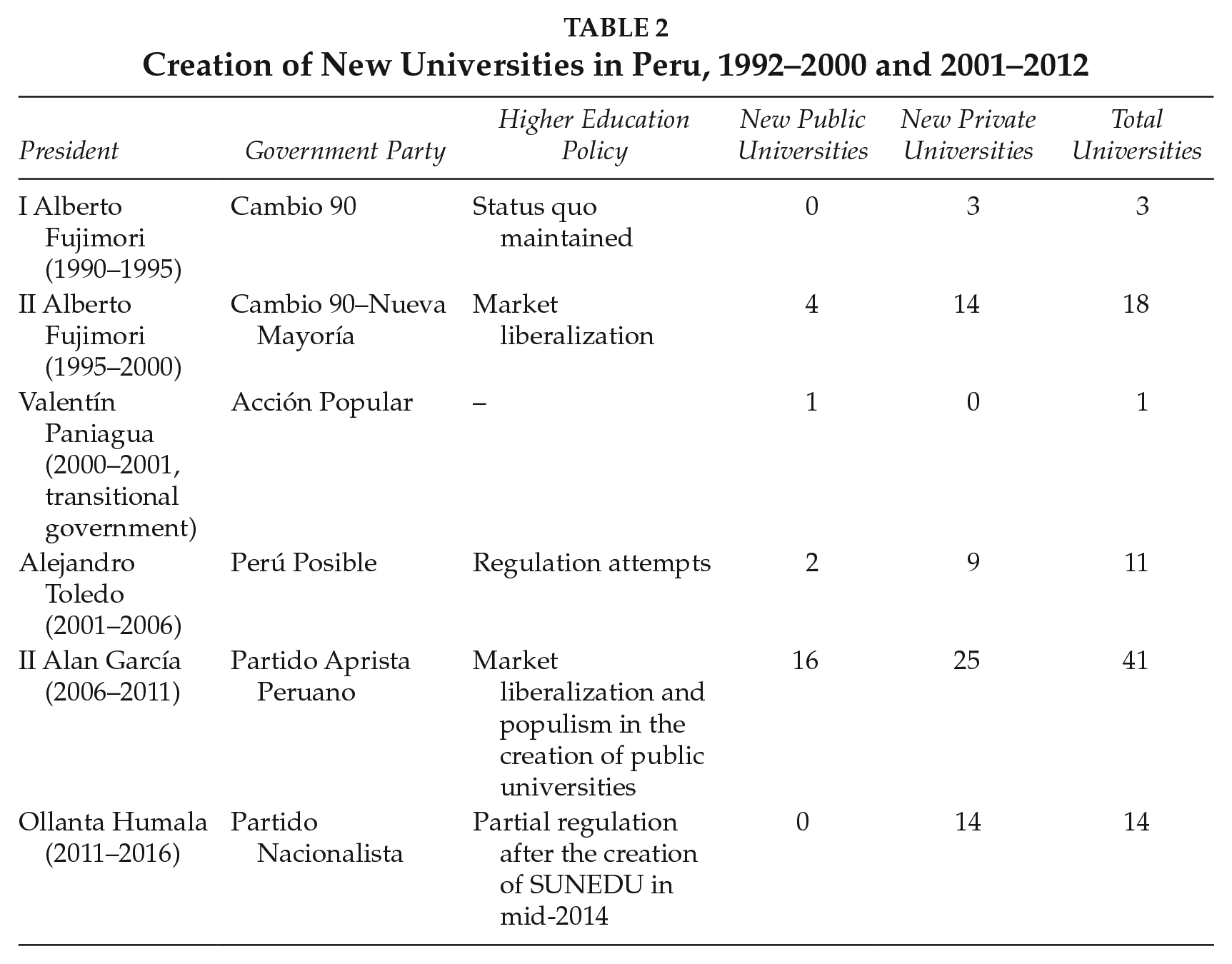
To do this, our article contrasts two periods. The first began in 1992, the year of the auto-coup carried out by Alberto Fujimori, and ended with his resignation as president in 2000. It was then that private universities first became more numerous than public ones and profit in higher education was legalized. The second period began in 2001 and lasted until 2012, when the creation of new universities was banned as part of the debate over the creation of a new university law that marked the beginning of the partial regulation of university institutions. This period spanned three democratic governments and was characterized by the rapid emergence of new universities. In macroeconomic terms, there have been no major differences between governments since 1990 (Jiménez, 2017). At the same time, although there have been no substantial changes in higher education policy from one term to another (Mora, 2015), there are certain differences between periods (Table 2). Since we could not find studies focused on the differences between these two periods, an analysis that explored both became not only analytically but empirically relevant.
Creation of New Universities in Peru, 1992–2000 and 2001–2012
We employed two sources to collect information. First, we undertook a news review across national newspapers in pursuit of detailed information on the strategies and discourses developed by education entrepreneurs. Specifically, we systematized higher-education-related news published between 1992 and 2012 in the newspaper El Comercio 2 and analyzed the minutes of the congressional education committee for the same period. Secondly, we interviewed key players, particularly those who appeared in the reviewed news, including founding partners and rectors of private universities created at the time and those who participated in public and private universities created before 1992.
Results
Opportunity Structure
Previous work has pointed out that, in a context of economic crisis and pressure from multilateral agencies such as the World Bank, Alberto Fujimori’s government opted for the commodification of higher education (Aljovín and Germaná, 2002; Burga, 2008). The role played by Legislative Decree 882, which made for-profit universities legal, has traditionally been emphasized. This reading, however, ignores essential details. The following pages review the political structures that allowed new universities to appear, showing why it is necessary to complement the usual narrative.
When Alberto Fujimori won the 1990 election, he did not have a plan regarding the kind of reforms he would implement. In fact, his previous experience as rector of a public university and president of the Asamblea Nacional de Rectores del Perú (National Assembly of Rectors—ANR), an autonomous body representing the interests of all universities in the country, made the liberalization of the higher education market challenging to imagine (see Manky and Dolores, 2021). The background to the reforms can be found in the workings of the Congress of the Republic after the April 5, 1992, auto-coup. It was under the direction of Rafael Rey, chairman of the education committee and member of Renovación Nacional, a right-wing party, that, in May 1993, a debate on the new constitution of universities began. Specifically, it was suggested that these be created through promoter entities rather than dependent on political debates in Congress, a possibility that opened up new opportunities for economic operators.
In July 1993, the ANR reported the existence of unregistered universities in cities like Pucallpa and Huancayo (El Comercio, July 25, 1993). In the face of public complaints, their promoters excused themselves by arguing that they were only following guidelines discussed in Congress regarding the creation of universities. Over the next two years, the ANR reported the emergence of unregistered universities on several occasions (El Comercio, March 6, 1995). The early education entrepreneurs appeared before any official regulation and took advantage of the lack of clarity during the drafting of the new constitution.
At the same time, the entrepreneurs best-positioned economically and politically sought the quick approval of their university projects before the constitution was implemented. Between January and September 1993, the Congressional education committee received 9 project submissions from private universities. Three were approved at the end of that same year: the Universidad Peruana de Ciencias Aplicadas, the Universidad Privada del Norte and the Universidad Particular de Ciencias y Tecnología. These were the last private universities approved by decree, three years before for-profit education was legalized in the country. Many entrepreneurs attempted this same strategy during 1994 even though the rules of the game had changed and Congress was no longer center stage in university creation. By July of that year, 23 private university project requests were reported (El Comercio, July 18, 1994).
The contrast between a large number of attempts and the fact that none succeeded attests both to entrepreneurial interest even before the practice was legal and to the state’s refusal to grant them complete autonomy. This scenario began to stabilize in early 1995 when, because of pressure from the rectors’ association, the Consejo Nacional para la Autorización de Universidades (National Council for the Authorization of Universities—CONAFU) was created. This was an ANR-dependent body responsible for evaluating, authorizing, or repealing university projects. Before it was designed, 49 projects had already been submitted to Congress (El Comercio, January 27, 1995). While this issue has not been sufficiently addressed in previous discussions (Burga, 2008; Germaná, 2018), it is surely relevant. It is also vital that all of this occurred before the 1996 decree. Entrepreneurs were already interested in making profits, however informally, via higher education. 3
Of the more than 89 projects submitted by Congress to the CONAFU up to 2000, only 13 were approved. The environment in which new private universities appeared was complex because of the strength of the ANR, which was dominated by public and private nonprofit universities (Manky and Dolores, 2021). In fact, in May 1996, Manuel Zevallos, the former rector of a public university, stated that "universities were created by a law of Congress, with very simple, improvised or insufficiently supported projects and, often, following political criteria. . . . Technical arguments are now prevalent and failure to adjust means there is no authorization" (El Comercio, April 31, 1996).
The collisions between a relatively strong CONAFU and the extensive attempts to register new private universities created tensions between entrepreneurs and the ANR. This happened with the Universidad Alas Peruanas, a for-profit university that is a paradigmatic example of the post-2000 trend. That year the university sued the ANR through the Constitutional Court for permission to operate. This led to a series of public debates between the two organizations with regard to the university’s legality: the university managed to ensure its operation through a constitutional protection action issued by Percy Escobar, a judge linked to late Fujimorism (El Comercio, April 29, 2001). Although this judge was later removed from office, his ruling allowed the university to continue operating despite its low quality.
In addition to judicialization, from 2000 on CONAFU changed in both content and dynamics. As the former rector of a public university participating in this body pointed out, with the increase in the number of private universities in the ANR the balance tilted in their favor. Although there was no legal change, CONAFU expanded its approval criteria, given the increase in members willing to facilitate the entry of new players into the market. Because of the unmet demand (number of students unable to gain access to public universities), the rectors of the ANR did not see this increase in supply as problematic. Between 2006 and 2010, the creation of 26 private universities, 23 of them (about 90 percent) for-profit, was approved. As Casas (2012: 80) points out, quoting the rector of a for-profit university, "CONAFU is a useless institution, which was corrupted by all those who applied for university creation authorization. . . . If an institution did not contribute its quota or offer perks, it did not get the approval."
It is worth noting that critical voices could be found in the legislative branch in the post-Fujimori context. By the end of the 2004–2005 legislative period, the annual balance sheet of the education committee reported that, of 103 pending bills, 66 were for a new university law. In August 2004, Congressman Raza Urbina of the Partido Aprista Peruano indicated that the ANR was a sort of ineffective, inefficient, and unpunctual rectors’ guild. The next few years saw a critical assessment of the ANR’s work, including planned suspensions of Decree 882, which allowed for profit in education (El Comercio, April 18, 2008). By 2009 it was clear even to the pro-profit sectors that the system had its limits. On September 22, 2009, Congressman Galarreta of Renovación Nacional declared that the Prosecutor’s Office was closing the files on complaints against universities because the prosecutors and judges were professors in those institutions (see also Mora, 2015: 134). These criticisms did not, however, result in changes to the opportunity structure in which education entrepreneurs operated. This would only happen with the enactment of the 2014 university law, which increased entry standards for the education market and replaced CONAFU and the ANR with the Superintendencia Nacional de Educación Superior (National Superintendency of University Higher Education—SUNEDU), an autonomous body attached to the Ministry of Education.
In short, education entrepreneurs had different channels of access to their market. At first there was an opening from within Congress, and some universities took advantage of this. After Decree 882 and the creation of CONAFU opened the way for for-profit universities, the rules established were relatively strict, but as the new universities got a say in the ANR admission criteria became less so. Alongside these changes, education entrepreneurs changed the resources they relied on (linked to judicialization and access to direct networks in the commission itself) and their framing.
Resource Mobilization
The new entrepreneurs had to mobilize different resources to settle their positions regarding public and private nonprofit universities. The importance of this effort lies in the strength of these organizations: Alberto Fujimori was a former rector of the Universidad Nacional Agraria La Molina, and the president of the ANR, César Paredes Canto, was rector of the Universidad Nacional de Cajamarca and the vice-president-elect in 1995. In addition, the minister of education, Pedro Villena, had been rector of the Universidad de San Cristóbal de Huamanga, and the congresspersons Juan Cardoso, Edith Mellado, and Rafael Urrelo had been rectors of the Universidad Nacional Pedro Ruiz Gallo in Lambayeque, the Universidad Nacional del Centro del Perú, and the Universidad Nacional Agraria de la Selva, respectively.
These were all public universities with representatives positioned advantageously in the executive and the legislature. In this context, three resources appear to have been crucial for entrepreneurs to impose a new rationale in higher education. The first of these was university management experts. As noted above, only a handful of organizations got CONAFU’s approval. The requirements it initially demanded made it crucial to know the education sector, its potential profit margins, and the best management strategies. For example, the main shareholder of the Universidad San Ignacio de Loyola, Raúl Diez Canseco, had run a preuniversity academy since the late 1960s and in 1983 had opened an institute specializing in computer science and administration. By 1991 he also had a school. This gave him experience in hiring teachers, class management, and educational marketing. His school and institute alumni were a seedbed of potential students who knew about his work. Similarly, in the case of the Universidad Privada San Juan Bautista, the above-mentioned Rafael Urrelo headed the project. A number of managers of public and private universities also saw the opportunity to do business during this first period. The dynamic was even repeated with former members of private nonprofit universities such as Luis Bustamante, the former rector of the Universidad del Pacífico, who founded and became rector of the Universidad Peruana de Ciencias Aplicadas in 1995.
Second, mobilizing contacts to support the projects before Congress (initially) and CONAFU was critical. Like social movements requiring agents to provide information, networks, and influencers among political elites, the most successful business projects were those that could employ such networks. In the case of the Universidad Peruana de Ciencias Aplicadas, although it did not have political support from the government (one of its founders had been president of the Movimiento Libertad that competed against Fujimori in 1990), it did have help from economic groups. When its construction began, the ceremony was attended by key figures such as Susana de la Puente Wiese, an essential figure in Peru’s financial sector. Similarly, the Universidad San Ignacio de Loyola had Carlos Boloña as a founding partner; he had been Fujimori’s minister of the economy until 1993. Not surprisingly, given these connections to the government (Boloña took on a ministerial post again in 2000), the inauguration of campus construction was attended by politicians such as Jaime Yoshiyama, president of the official faction of Congress, and the former chairman of the Congress’s education committee, Rafael Rey.
The third type of resource mobilized by the new entrepreneurs was human capital capable of providing the necessary stability for functioning universities. In contrast to the privatization of social security or the mining industry, educational enterprises required intensive work from a type of laborer that did not abound in Peru. Hiring lecturers from public universities was vital. Rectors of public universities such as Javier Sota Nadal of the Universidad Nacional de Ingeniería indicated, in the mid-1990s, that there was an "imperfect market. . . . The UNI, a public university, provides professors to all the private ones that recruit them by paying them five times as much" (El Comercio, March 17, 1994). Universities such as the Universidad Cesar Vallejo and the Universidad Privada del Norte, located in Trujillo, started an aggressive recruitment campaign at the Universidad Nacional de Trujillo. In Lima, several professors from the Universidad Nacional Federico Villareal went to the Universidad Privada San Juan Bautista. During this process, it was essential to use networks involving authorities who, once they decided to create or support the creation of a university, would assemble trustworthy young professors for the new project.
Over the next decade, economic resources would become increasingly important. As Casas (2012: 87) points out, by 2010, there were 21 administrative procedures to achieve the opening of a university, which "reducing the economic cost as much as possible, [would] involve approximately 250,000 new soles in financial investment." Although he draws attention to the investment amount, when we consider the quality of the universities created during that period (10 of them, all for-profit, have now closed) 4 it becomes clear that that investment is being undertaken to meet bureaucratic requirements and increase CONAFU funds rather than to secure the projects’ infrastructure or human capital.
In parallel with this process, this period saw the birth of educational conglomerates financed and led by powerful economic groups. For instance, the Universidad Peruana de Ciencias Aplicadas and the Universidad Privada del Norte became part of Laureate International Universities (the only transnational conglomerate operating in the country) in 2004 and 2007 and by 2018 were among the five largest Peruvian universities (SUNEDU, 2018). Cesar Acuña, founder of the Universidad César Vallejo, also created the Universidad Señor de Sipán and the Universidad Autónoma del Perú, consolidating, by 2015, an educational consortium with some 100,000 students. Alongside this, consolidated economic groups such as Intercorp (which invests in banking, food, and services) acquired universities such as the Universidad Tecnológica del Perú and the Universidad Tecnológica de Chiclayo in the past decade.
The use of political capital also changed. While, previously, the pressure was exercised informally through friendship networks and close social class bonds, consolidated networks began to develop business projects from within Congress and the judiciary starting in 2000. In the 2011 legislature, some congressmen were also educational entrepreneurs, among them Richard Acuña (Universidad César Vallejo), José Elías (Universidad San Juan Bautista), and José Luna (Universidad Telesup). Peru went from having congress members who had been rectors of public universities in the 1990s to having congress members who represented the interests of their private companies. At this stage, resource mobilization began to occur more explicitly as the owners of education businesses defended their interests in Congress (see Barrenechea, 2014).
Judicialization was another recurring appeal from 2000 on, a strategy pioneered by the aforementioned Universidad Alas Peruanas process. In February 2008, questioned by Congress, CONAFU President Rafael Castañeda indicated that several universities were operating on the basis of multiple interpretations of the law, opening subsidiaries across the country. In addition to the subsidiaries approved by the ANR and those approved by CONAFU, there were some approved by the judiciary (see, for example, El Comercio, December 29, 2009, on the payment for a judge’s trips by a private university). Alongside this mobilization of resources in Congress, private universities "carried out co-optation operations by delivering honorary Ph.Ds or hiring professors" from among the judiciary (Mora, 2015: 132). Judicial complaints served as a constant counterweight to CONAFU’s actions and increased from approximately 100 in 2001–2002 to almost 350 in 2005–2006: "University operation via judicial resolution is a practice often employed to avoid the administrative procedures required by CONAFU" (Casas, 2012: 61).
In short, education entrepreneurs increasingly modified their use of resources depending on the context. At the outset, there was a preponderance of entrepreneurs with consolidated capital and access to informal political networks. These resources lost relevance in the 2000s, when practices focused on the mobilization of economic capital and the use of direct political networks in Congress and the judiciary emerged.
Framing the New University
Finally, structuring a new market required the generation and popularization of new rules that legitimized its operation. Previous studies in the region have drawn attention to the pressure exercised by institutions such as the World Bank and the International Monetary Fund in Latin America (e.g., López Segrera, 2008). Although these were key actors, it is essential to note the exis-tence of local discourses that sought to provide legitimacy for new universities.
In 1993, Lima-based businessmen published articles stressing the need to liberalize higher education. That year, Alfredo Miró-Quesada Howard, a founding partner of the Universidad Peruana de Ciencias Aplicadas, stated that it was "urgent to allow the creation of new universities with quality-driven projects. This possibility will generate competition, improve quality, and force cost reductions" (El Comercio, September 15, 1993). What is striking about this and other statements is that they emphasized not profit but the inferiority of an existing governance model. It is a reading based on the crisis experienced by traditional universities that, according to their detractors, had to be replaced by a new model.
This effort contrasts the modern with the traditional, emphasizing the need to think about universities without employing "colonial specifications, or those from the beginning of the republic" (El Comercio, September 15, 1993). Several years later, in 1996, the criticism was explicit: "Our university institutionality goes back . . . to the Middle Ages and . . . to the revolts of Córdova and Puebla. . . . The speed of the present and the complexity of political and economic relations requires another university paradigm" (El Comercio, July 17, 1996). This discourse presents entrepreneurs as selfless actors concerned about the future of society. From their perspective this is not only an economic but also a political issue. It proffers a new type of professional, one more focused on the business sphere than on traditionally liberal jobs (Degregori and Avila, 2000). Along these lines, the educational specialist León Trahtemberg stated that educating thousands of engineers, economists, or accountants would be a waste "unless they are educated with a business mind-set that allows them to set up their own companies" (El Comercio, April 8, 1994).
The approach was disseminated across the social body by the new universities. In January 1994, the Instituto San Ignacio de Loyola offered studies in marketing, finance, and computer science under the slogan "Modernizing Peru." In April of that same year, just months after its operation was approved, the Universidad Peruana de Ciencias Aplicadas advertised "A New Dawn" in national higher education, emphasizing the need to modernize students’ training. This defense of a new form of education went beyond the new universities. On October 22, 1993, the future founder of the Universidad San Ignacio de Loyola (USIL), Carlos Boloña, signed, through his Instituto de Economía de Libre Mercado, an agreement with the Universidad Nacional de San Cristóbal de Huamanga that sought to develop research projects, training, and university extension under a commercial rationale (El Comercio, March 22, 1993).
The other side of this discourse was the commitment to a nonpoliticized education. Alfredo Miró-Quesada Howard indicated that the new university system should train not "studious professionals but [professionals] with communication and risk-taking skills." Moreover, the latter kind of professional was contraposed to those who show "hazardous antisocial behaviors" linked to left-wing groups. The new university system offered, well before 1996 and regardless of state proposals, an education without politically engaged students. This discourse legitimized a new kind of university government, one that left all control to the educational entrepreneurs, in contrast to the ideal of a cogovernment by students and faculty, a legacy of the Córdoba reforms (Múnera Ruiz, 2011). As Miró-Quesada summarized, "if everyone aspires to govern, university life becomes a silent race toward political power" (El Comercio, September 22, 1995). Profit was a key motivator, but at first its quest was framed in terms of a new university model that sought to benefit society as a whole.
The contrast between this and the approach of education entrepreneurs from 2000 on is striking in two ways. On the one hand, the latter period emphasized the need for mass education. This was linked to the idea of offering low fees even if this affected educational quality. Seclén (2014: 142) has analyzed the discourse employed by the Universidad César Vallejo, which in its television spots and brochures portrays an acknowledged "situation of inferiority . . . that can be transcended [by obtaining a college degree]." According to this view, the university would play this role: democratize consumption, not access to citizenship. López (2018: 87) concludes something similar after being told by the highest authority in a for-profit university that it "opens the doors to people who have probably never had the chance to study without leaving their locality, without having to forgo their traditions, without having to believe that only in the capital is there a future. We promote that future for the new generations in our city."
On the other hand, the quality-focused discourse was replaced by one that defended university businesses by arguing that this amounted to a defense of the economic model itself. For example, the congressional education committee promoted Law 28564 (enacted July 1, 2005), which sought to override the ANR’s ability to grant permission to establish subsidiaries outside of the original region of creation. Amid the debate, Rafael Rey stated that "the problem of scams enacted by many universities . . . is not solved by cutting off the freedoms of other very prestigious universities that could enormously benefit the citizens of Lima or other provinces." Another congressman, Valdez Meléndez of the officialist party Perú Posible, was more explicit when he stated that Legislative Decree 882 "was born to boost private investment in the field of education. . . . Today, however, we intend to alter the contractual status arising from it."
A paradigmatic case of this discursive transformation is the Universidad Alas Peruanas. Given numerous complaints regarding unauthorized subsidiaries, Congress summoned its rector several times. On December 1, 2009, the chairman of the education committee reported that, for the third time, the rector of the Universidad Alas Peruanas had failed to comply, arguing that his institution was privately held and autonomous and therefore was not required to provide the requested information. Over time, this closed defense of the model, unable to justify failing quality, would lead to the emergence and strengthening of sectors interested in the kind of university law approved in 2014 (Mora, 2015).
In short, at first, having no clear spaces for action in CONAFU and the ANR, education entrepreneurs developed noninstrumental frameworks that appealed to a greater good: quality and modernization. This changed in the 2000s, when, under CONAFU control and the enactment of Legislative Decree 882, the target moved to the creation of more institutions to meet broad demand, and this was discursively presented alongside a defense of free-market rules.
Conclusions
This article has argued that we must stop assuming that economic action is mechanical or a by-product of whatever the state ceases to do or entrepreneurial ambition. While there is a trend toward the commodification of education on a global scale (Rhoades and Slaughter, 1997), this does not take place in a vacuum, and it is not the same in all countries: negotiations between entrepreneurs and the state, available resources, and the type of framing developed are crucial for understanding the kind of education system that emerges. This perspective enriches our view of the commodification of education in Latin America, which has generally been studied via comparing different laws or civil society’s responses (Rama, 2012). Understanding how entrepreneurs take advantage of specific opportunities and the negotiations they engage in allows us to understand specific processes and their consequences.
In this regard, the idea that Peru is an exemplary case of the university business arising from a legislative decree needs to be readdressed. For-profit projects in the university sector occurred before this practice was legalized. This challenges the idea that the advent of neoliberalism was driven exclusively by international actors or Fujimori’s authoritarianism. We must analyze domestic actors and how they mobilize to impose a perspective that favors them. Drawing on insights from the literature on social movements, we have sought to understand the structure of opportunities in which economic action takes place and the resources and framing processes developed by new entrepreneurs.
This look provides a better view of the links between the institutional arena and organizational dynamics. Looking at the source of resources mobilized by entrepreneurs explains the cultures of research or politics in the new organizations. For example, future research could study how the dynamics of universities created by professors with a strong research culture differ from those whose founders’ only previous experience was managing preuniversity education centers. Similarly, the framing developed since the 1990s appears to have produced depoliticized university students not only because of post-Fujimori Peruvian political culture (Burt, 2007) but also because the organizations where they study are not open to political discussions (López, 2018). It is striking that this seems to occur even when one of the fundamental pillars of the for-profit university—the lack of any student or faculty participation in the organization’s government—has gone unquestioned even by the student guilds.
Our approach can identify variations within the educational field, something that future studies should more clearly identify. Previous research usually assumes that only for-profit organizations have been created since Decree 882. That is not the case. Some post-Fujimori universities opted for a traditional model, while others created and institutionalized in the 1960s decided to bet on profit. Others formally not engaged in profit making maintain practices that bring them closer to for-profit universities than to research-based ones. Understanding how these organizations negotiate their identity and develop framing is crucial.
This article suggests that education entrepreneurs’ strategies are based on political disputes framed by class positions that differ and change over time and aim to transform the education market as a sociopolitical structure. These findings allow us to better account for what happened regarding the state’s ability to drive educational improvement. When the SUNEDU was created, replacing the ANR as the university regulatory body, the framing developed by entrepreneurs was very similar to those of the 2001–2012 period, a defense of university autonomy and the free market. It is possible that in contrast to the discourse used in the 1992–2000 period, this type of framing was not effective enough to ensure entrepreneurs’ dominance in the educational market. After the refusal to license several low-quality, low-cost private universities in the past three years, entrepreneurs began to criticize SUNEDU’s evaluation procedures—the number of days for evaluation, differential treatment for public universities, the profiles of evaluators, and so on. 5
Instead of genuinely critiquing educational reform or producing a discourse that convinced their current or potential students, education entrepreneurs opted for a legalistic discourse. In this process, we also notice a division of education entrepreneurs in terms of their access to economic and symbolic capital. Future research should delve into this apparent break between the operative rationales of some for-profit universities and whether they may be able to resist reform.
Footnotes
Notes
Omar Manky is an assistant professor at the Universidad del Pacífico, Lima, Peru, and Juan Dolores is a research assistant at that university. They thank the editors and peer reviewers who made it possible for them to improve this article. They are also grateful to the Research Vice-Rectorate of the Universidad del Pacífico, which funded the presentation of the study at international conferences where they received valuable feedback. Mariana Ortega-Breña is a freelance translator based in Mexico City.