




Abstract
The results of a qualitative study of cross-border social practices of Mexican women engaged in small-scale trade on Mexico’s northern and southern borders reveal that, although their social practices are a response to an instrumental rationality and imply a certain economic autonomy, they develop on the basis of agency and social networks that enable reproduction of reciprocal relations and family livelihood strategies as types of informal labor, giving rise to a form of globalization from below.
Los resultados de un estudio cualitativo de las prácticas sociales transfronterizas de las mujeres mexicanas dedicadas al comercio a pequeña escala en las fronteras norte y sur de México revelan que, si bien sus prácticas sociales son en respuesta a una racionalidad instrumental e implican una cierta autonomía económica, dichas prácticas se desarrollan sobre la base de la agencia, así como redes sociales que permiten la reproducción de las relaciones recíprocas y estrategias de subsistencia familiar como tipos de trabajo informal. Todo ello da lugar a una forma de globalización desde abajo.
In this article we present the results of a study of the social practices of Mexican merchant women in cross-border regions of Tijuana (Baja California) and San Diego (California), on the northern border, and Comitán (Chiapas) and La Mesilla (Guatemala), on the southern border. Exploring the ways in which these women meet their daily economic needs in regional contexts marked by asymmetrical geopolitical boundaries and others that are cultural and the way they participate in cross-border dynamics, we proposed to identify what these social practices meant for survival in and from the border—how agency develops that leverages the comparative advantages on the border’s two sides.
We situated this study in the discussion about women as cross-border actors in commercial exchanges, participants in what Alba, Lins, and Mathews (2015) have called “globalization from below.” According to this concept, globalization, understood as a set of processes that leads to material and symbolic flows across the world’s borders, is brought about both by hegemonic agents (linked to capital investments and merchandise trade) and by others and by small-scale transnational flows of persons and goods in legally ambiguous contexts. 1 It has to do with family livelihood strategies or social mobility resources that take advantage of the material and symbolic elements of the border region in terms of a popular (nonhegemonic) logic that enables the creation of social reciprocity and community networks aimed at meeting economic needs—features of the economic structure of countries such as Mexico, where self-employment has remained important (Pacheco, 2004). The participation of women in globalization from below has been documented in studies of women in retail business at the borders between Spain and Morocco (Fuentes, 2017) and between Peru and Chile (Dilla and Álvarez, 2018).
Fuentes’s work addresses the role of “porter” women in the economies of many Moroccan families. Women transport and sell merchandise from Ceuta, a Spanish city on the Tingitana Peninsula of northern Morocco. Their small-scale trade is made possible by the business regulations existing between Morocco and Spain and has benefited families for more than 30 years. However, the working and living conditions of these women are marked by precarity and the lack of family and social recognition. The cities of Arica (Chile) and Tacna (Peru) described by Dilla and Álvarez form a cross-border region with an intense flow of people and goods. Peruvian women engage mostly in the sale of secondhand clothes in the city of Arica. Bringing in the merchandise surreptitiously in what is called “the ant trade,” they normally procure it from wholesalers, maintaining a peculiar relation to global economic flows.
In the case of Mexico, Silva (2007: 80) notes that the social media approach is widely used in studying trade on public thoroughfares, considered “the most visible face of the so-called informal sector.” Social practices—in their cross-border mode—function on a diverse and complex base of relations and social strategies related to the “construction and maintenance of a set of social networks” but stimulated in a different way by the management of the country’s southern and northern borders.
With these referents and against the backdrop of studies of social networks, we proposed to use social practices theory to show women’s lifeworlds and their contribution to the formation of the transborder territory, deploying practical knowledge that allowed them to take advantage of the asymmetries inherent to these borders and the benefits of informality, even at the South-South and South-North geopolitical level. We were interested in studying two groups of Mexican women who had built their economic lives in these contrasting border settings, allowing for a deeper understanding of these transborder contexts.
Since our study was concerned with an economic activity characterized by informality, we adopted the approach of the International Labor Conference (ILC, 2015: 2), which conceptualizes the informal economy as “all economic activity (not illicit) carried out by workers and economic units not sufficiently covered by formal systems or not covered at all.” Functionally, the Economic Census of Mexico defines the informal sector of the economy as establishments operated by one person or with five or fewer employees that are not contributing to social security, do not keep accounting records, and are not part of a company (INEGI, 2019b). Both definitions are consistent with the characteristics of the commercial activities carried out by the women in our study groups.
The following presentation has four sections. In the first, we develop the theoretical-methodological framework used to create debate on the research from the vantage point of social practices. In the second we describe the national and local contexts of the two borders, with special attention to the contrasts in economic structures and the importance of informal trade and the participation of women in this economic activity. In the third we systematize the results using the analytical elements proposed by social practices theory. Lastly, we discuss the principal findings in terms of the objective of demonstrating the role of women in the shaping of the border regions analyzed.
Social Practices in the Study of a Cross-Border Region
The theoretical referent for our study comes from Ariztía (2017), who discusses social practices theory as an approach to understanding social worlds. His basic assertion is that it is in social practices that individual and collective actions, structure, and agency converge. The theory’s sociological components appear first in the works of Bourdieu and Giddens, but whereas for these writers there are many other components, in social practices theory the practices in question play a central role in the configuration of the social world (Ariztía, 2017: 223). The theory also draws on Garfinkel’s ethno-methodology and situated knowledge and Wittgenstein’s pragmatism in its close observation of situations on the microsocial level to locate social practices as “unit[s] of comprehension and creation of the social world” (Ariztía, 2017: 223).
Ariztía (2017: 224) defines social practices as “ways of doing and/or saying which arise from the temporal-space interrelation of three elements: expertise, meaning, and materialities.” These three elements actively converge, and each is essential. Expertise is the practical knowledge and abilities (know-how) that make the realization of a practice possible. Meaning is the broad set of teleo-affective aspects, assessments, and cultural repertoires upon which the significance of and need for a practice for those who carry it out are established. Materialities are the tools, infrastructure, and resources involved in the realization of a practice. Materialities are particularly important in actively influencing the configuration of social practices. The focus of observation may shift from individual motivations and actions and/or influences and structural conditioners to the origin, transformation, and disappearance of a set of social practices. In this study the set of social practices we considered was border crossing for small-scale trade, and it was sustained by the construction and maintenance of social networks at the levels that Granovetter (1983) identifies—strong (relatives, friends, neighbors) and weak (leaders, politicians and merchants)—and benefited from the deregulated system at the borders in economic realms such as informal trade.
To obtain information on the border-crossing practices of merchant women residing in Tijuana and Comitán we utilized semistructured interviews, which allowed face-to-face encounters with the subjects of study (Flick, 2004). To examine the three elements of social practices theory, we asked about the knowledge and skills deployed in cross-border trade, the significance and assessments of their commercial activity and the border crossings, and the material conditions that enabled or hindered their daily border crossings.
The Tijuana Fieldwork
The fieldwork in Tijuana was conducted through chain referral or “snowball” sampling (Hernández, Fernández, and Baptista, 2014). Initial prospecting was done among acquaintances who might have relatives or friends involved in the business. We identified the unit of analysis as women merchants whose products were purchased in the United States and sold in Tijuana, mainly in mobile market stalls in various neighborhoods of the city. Between October and December 2018, eight women were interviewed, six of them in one of the city’s three markets (Playas de Tijuana, Soler, and Los Herrera). In addition, we visited other mobile markets and the ports of entry at San Ysidro and El Chaparral, which in addition to automobile traffic have pedestrian crossings where people can be seen carrying bundles of merchandise. In San Diego we identified some sales outlets for discarded goods as well as garage sales.
The Fieldwork in Comitán
The fieldwork in Comitán involved women expressly chosen for their participation in the recently created transborder trade system—street vending of clothing, groceries, tools, and toys on the outskirts of the town’s main market. These were merchants, all identified through networks of persons we knew from participation in other research projects, who were permanent residents of the study area and had been trading in merchandise in the same commercial space for a number of years. Interviews were conducted in December and January 2019 with four women who practiced transborder trade, supplying themselves in the major market of La Mesilla in the municipality of La Democracia. We also interviewed the people in charge of the market, other merchants from Comitán, consumers, and carriers.
Local Contexts on Mexico’s Northern and Southern Borders
Contemporary Border Construction in the North and South of Mexico
The border regions studied contrasted in terms of the degree of asymmetry between the neighboring national states, and the Mexico–United States border was different from the Mexico-Guatemala border. One theory of this difference is related to changes in the types of flows that each permits. In the past 20 years there has been a tendency to attempt to reduce the crossing of people from south to north while at the same time opening to economic and cultural transactions (Velasco and Contreras, 2014: 39).
Since the 2001 attack on the Twin Towers in New York and the creation of the Department of Homeland Security in 2002, the U.S. border with Mexico has undergone accelerated reinforcement, supported by security mechanisms using new technologies (digital visas and registry of biometric data, among others), that has made it increasingly restrictive. In spite of this, economic exchange has not lost momentum. According to data from Mexico’s Secretaría de Relaciones Exteriores (2018), in 2018 1 million border crossings per day were registered, 452,000 in vehicles and 30,000 in cargo trucks, through the 60 ports of entry on the Mexico–United States border, with an economic benefit of about US$1 billion daily. In contrast, cross-border mobility between Mexico and Guatemala has not been marked by binational relations: its dynamics correspond more to the routine order between mirror communities and family groups. However, what happens here affects relations with the United States, Guatemala, Belize, and the rest of Central America, as is apparent in the caravans of migrants heading for the United States in late 2019. In fact, the Mexico-Guatemala border has historically been a paradise for the transit of people, subject to various formal and informal controls that were sometimes stronger on the local than on the transnational level. In fact, one of the traditional magnets on the Mexican side has been work, a little-noted aspect in this country’s experience of international labor (García, 2013). We noted greater emphasis on closing borders in northern Mexico, especially in terms of resources invested in devices for the strict control of flows (such as the wall), than in the South, where the border is much more porous and the level of flows is less, consistent with the less asymmetry between the nation-states in that region in degree of modernization and population
The contrast between the two borders is also evident in their economic structures (Table 1). The secondary sector is larger in Baja California than in Chiapas, where primary-sector activities bear more relative weight in terms of the population employed because of the amount of internal consumption in the campesino economy, farming, and coffee and sugar agri-business (García, 2016). Population processes differ—Baja California is urban and Chiapas mostly rural, San Diego a densely populated metropolis and Huehuetenango more dispersed and rural, with an economy in which coffee, sugarcane, tobacco, chilis, yucca, annatto, and fruits are grown.
Economic Structure of Baja California and Chiapas, 2018–2019
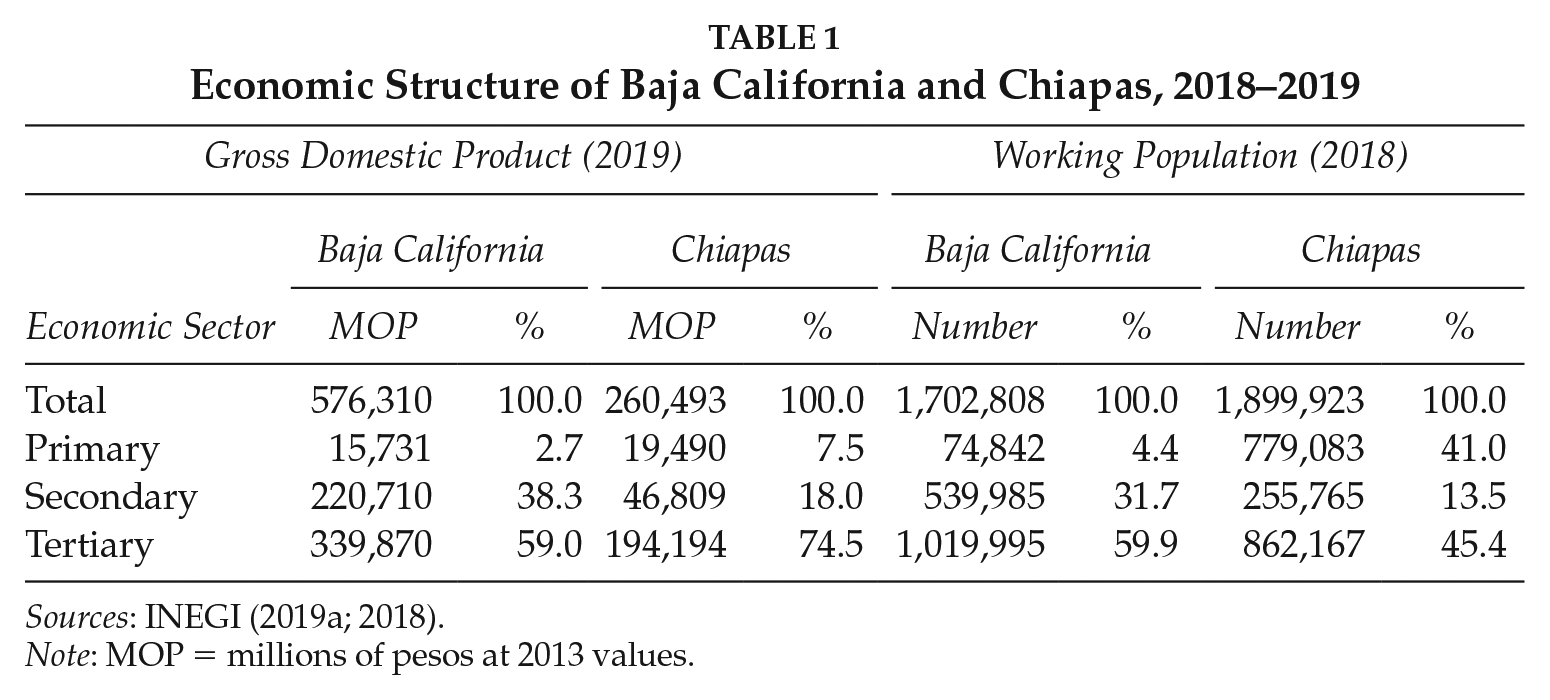
Note: MOP = millions of pesos at 2013 values.
Another contrast between the two borders is the institutional framework—heavier in the North, as is seen in the need for papers to cross. At this border a tourist visa in addition to a passport is required, and obtaining one is subject to a close examination of the applicant’s profile by the U.S. authorities.
On the sociocultural level, both borders have been built through historical processes of separation of peoples with common roots. However, at the northern border the contrasts are sharper, since one country is of Hispanic origin and the other largely Anglo-Saxon, although around Tijuana the use of Spanish or Spanglish is common. In Chiapas as well as in the municipality of La Democracia, in Guatemala, Spanish is also spoken, and Mayan communities live in both countries. Beyond language differences, the U.S. cultural matrix represents a symbolic universe that requires specific expertise, causing tension for those who cross the border daily. The situation is different at the southern border, where there are shared codes and less tension. Likewise, the influence of the cross-border dynamics extends beyond the immediate space of the neighboring state of Chiapas to the rest of southern and central Mexico, especially through trading practices. In Chiapas and in Tabasco and Quintana Roo there are free zones, enclaves engaged in the sale of clothing and other consumer goods.
What these activities signify for the family economies of hundreds of women, especially female heads of households, single mothers, widows, and housewives, is the subject of an extensive literature, from the pioneering studies on indigenous female mobility to the cities by Arizpe (1975) and later by Oehmichen (2005) in Mexico City to those of Velasco (1995) in Tijuana and others on the sociology of labor on gender and informality (Chant and Pedwell, 2008).
Informal Trade in Local Economies
There is considerable informal activity in Mexico, and as a result waged work has not played a dominant role in the labor market. At the same time, there are significant contrasts among regions. In 2018 the percentage of informal commercial establishments in Tijuana was below the national average, while in Comitán it was slightly above it (Table 2). With respect to work in informal trade, the smaller percentage of employees in both municipalities is notable, given that the formal sector is made up of larger and better-paying establishments. This trend is more evident in Tijuana than in Comitán, where 16.19 percent and 40.83 percent, respectively, of persons engaged in business are in informal trade. Nevertheless, the average number of persons working in informal businesses is smaller in Comitán, where they are almost all individual enterprises. The percentage of participation of relatives and unpaid workers is 72.25 percent in Tijuana and 83.1 percent, similar to the national average, in Comitán. Informal trade at both borders and in the rest of the country is mostly family businesses.
Formal and Informal Establishments Engaged in Trade Sector Activity in Mexico and Municipalities Studied, 2018
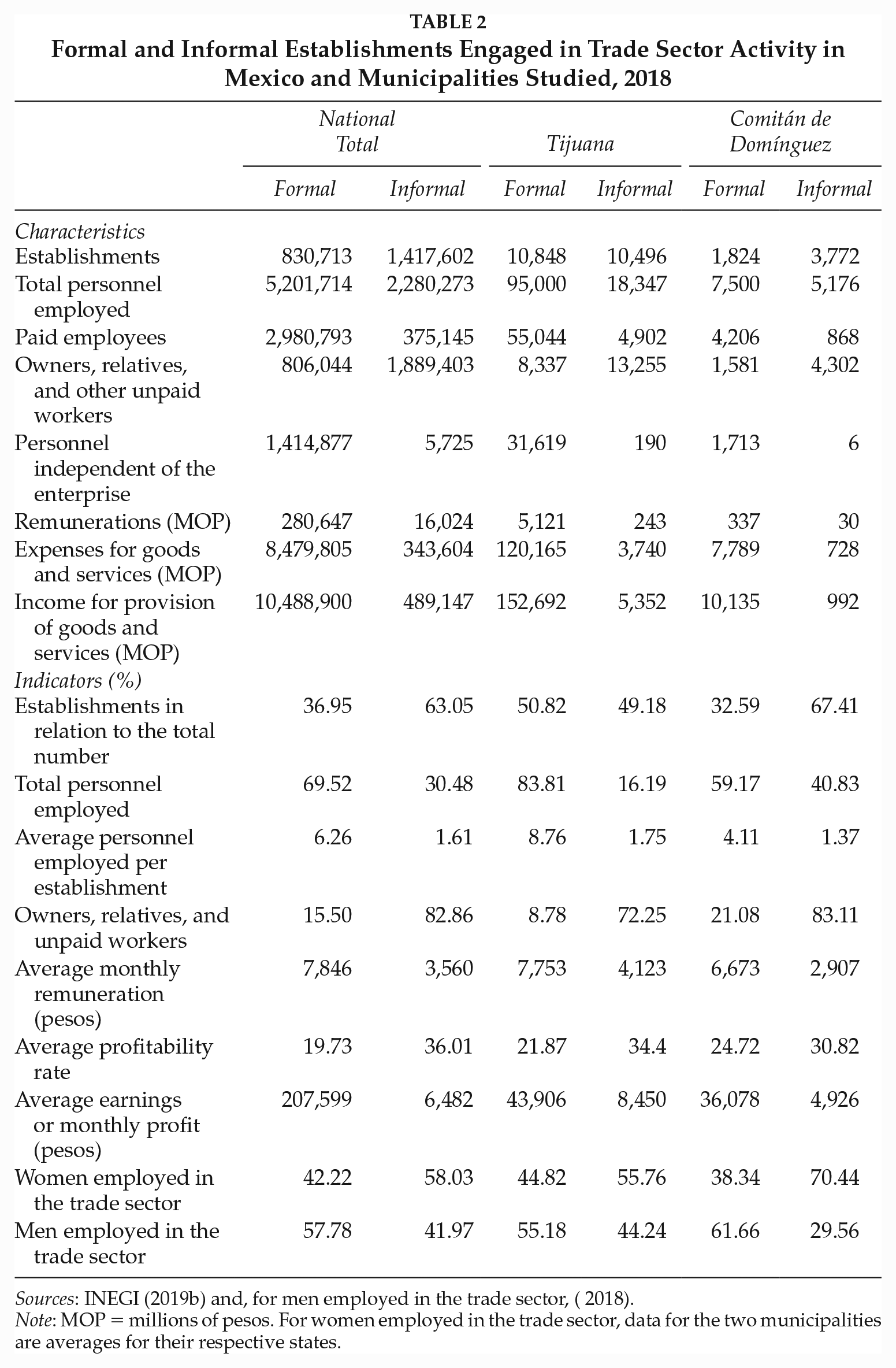
Sources: INEGI (2019b) and, for men employed in the trade sector, ( 2018).
Note: MOP = millions of pesos. For women employed in the trade sector, data for the two municipalities are averages for their respective states.
With regard to income, the informal establishments were more precarious: average monthly wages were almost half those of formal establishments both nationally and in the municipalities studied. In Tijuana wages might reach 4,123 pesos, surpassing the national average (3,560), while in Comitán they were 2,907 pesos. While in Tijuana average monthly earnings for informal businesses were 8,450 pesos (about US$420), in Comitán they were 40 percent less, 4,926 pesos (about US$250).
Informal activities were an important source of employment for women. Although information is not available on the municipal level, the government data provide an idea of the extent of feminization of informal trade at both borders: 55.76 percent in Baja California and 70.44 percent in Chiapas.
Cross-Border Social Practices
Expertise
On the southern border, interviewees’ narratives about their business practices referred to business-related family experiences that were a resource for women who had no male support because of abandonment or widowhood. Another theme was female entrepreneurship undertaken not only out of economic necessity but also out of a desire “to do something on one’s own.” Intuitively, the women considered what type of merchandise they could sell to avoid competition, and their choices were strategic in business terms: clothing for women or youth, women’s undergarments, clothes for adult men, and linens (sheets, towels, tablecloths, curtains). Learning came from relatives and close friends—a strong social network. Previous business practices in their families or social networks helped to foster their initiatives. They built their own economic strategies for buying and selling, taking a fresh look each day at how to meet the demands of their clientele, often tied to arrangements with wholesale vendors. For example, on an outing with Doña Petra we spent a considerable amount of time looking for a rosewood-colored blouse that a customer had requested. The merchant thought about her client, how she dressed, what kind of clothing she usually bought, even her religious affiliation: “I’m looking for something you can wear to church, not a party.” We searched in several stores and visited two shops that sold only blouses. She ended up buying three blouses of the same color: “That way she can choose the one she likes.”
This group of women and the merchants of the local system have no networking organization that links them to the cross-border market except for relationships created through buying on credit or the exchange of unsold merchandise. The union is used only to establish operational agreements: location of stalls on public streets, fees paid to use a neighbor’s space to set up a booth, and the transport system, which is mostly private and operates with scheduled times for travel to and from Guatemala.
On the northern border, interviewees recounted various reasons for engaging in their activity, among them having come from a merchant family and needing to combine income creation with family responsibilities. The products they sold and where they were obtained varied. They bought and sold primarily secondhand clothing and remnants but also toys, lingerie, household goods, and other items. The merchandise came largely from retail stores, supermarket remainders, auctions, swap meets, flea markets, and, increasingly frequently, garage sales. In some cases, the interviewees had shifted between various types of products and places for obtaining them.
Meaning
Our readings of the narratives compiled in the field showed that those interviewed assigned a meaning to this work related to the possibility of earning a living through informal trade and that, in contrast to waged labor, small-scale transborder trade committed all members of the family group to its reproduction. Moreover, while we can designate this activity as due to necessity, business at this scale presents an important territorial anchorage in that the women interviewed referred to the engagement of preceding generations in this activity. Considering their “ant trade” freelancing, they underlined the value of flexibility in their daily work, a certain freedom of action, and contact with lots of people. They valued the task of searching for, selecting, and purchasing products, calling it “pleasurable.” They also mentioned the negative aspects, such as being exposed to the elements, income irregularity due to ups and downs in sales, dealing with people who haggled, and having to rise before dawn.
These women achieved a certain economic independence and a different relationship with their partners. Although they spoke of having their partners’ support, this mainly had to do with help setting up their booths, arriving early to get a good sales spot, and having company on the crossing. Domestic activities fell primarily on the women, who in combining their economic activity with housework ended up working the equivalent of a double day. Furthermore, although for our interviewees being a merchant was sustained by social networks, there could still be inequalities or gender violence in everyday life. This was observed in the interviews on three occasions: in one the husband sometimes intervened, in another the son was vigilant, and in a third a relative approached during the interview, prompting a request to turn off the tape recorder, since sharing “personal issues” with strangers was frowned upon. These situations allowed us to see how gender roles created tension and pressured the women in their undertakings. However, the interviewees said that their work activity was empowering with regard to contact with public life and the realization of personal projects that generated income.
On the southern border we noticed that through their sales the women obtained a supplement to the family income, government subsidies, and international transfers. The big days for their businesses were connected to paydays for social programs such as the revenues from regional agricultural harvests. The area survives on loans, since the purchase of goods and services is obtained through credit against the harvest. In this context, informal merchants pursued strategies to ensure an income. The logic of the regional economic system gave them confidence in the commercial gambles and networking strategies upon which they sustained credit arrangements with private and reliable clients throughout the year. With this strategy woven through networks, they calculated their independence and autonomy in their private connections and their “formal” presence in the informal trade structure. This mechanism included economic commitments through their public ties, such as guaranteeing the acquisition of merchandise in the border market through commercial loyalty using their savings. They avoided at all costs entering the credit economy that kept the local system alive with the revenue guaranteed at harvest times.
Materialities
A significant element that appeared in the interviews and one that linked expertise with materialities was the inclusion of new digital technologies. Only one of the women interviewed reported not knowing how to use these technologies. The others had gradually begun to use computers, smart phones, and other digital devices in tasks such as the search for purchasing points in the United States or traffic conditions at the border crossing, Web searches, contact with clients, and online purchases. In transborder trade these technologies are tools in everyday use and have meant acquiring new skills. Material changes influence everyday business activities, resulting in adaptations and additions, and the use of technology has required significant efforts that are not always fully internalized. Some interviewees noted difficulties in shifting to digital technologies.
The complexity of the daily flow of people between Tijuana and San Diego 2 requires control mechanisms to reduce what the government considers risks or threats (Muria and Chávez, 2011: 356). One of these is a binary classification of buyers versus workers that is deployed daily to identify and treat differently people who might be a threat through illegal work and people who might contribute to the local economy through consumption (Muria and Chávez, 2001: 356–358). This differentiation becomes a negotiating mechanism for those who cross regularly from Mexico to the United States, since crossing as a buyer may mean greater opportunities for access. Reselling secondhand products from the United States in Mexico places cross-border merchants in a liminal zone as subjects of control. Their crossings are as much for employment as for consumption, blurring the binary classification used to limit South-to-North crossings and thus making it possible for the women to conduct their business in a favorable setting. Trading secondhand goods on Mexico’s northern border and regularly crossing into the United States must be examined not only in the light of the restrictions and possibilities for border controls but also considering the loopholes and ambiguities in which the crossing takes place.
The women in the Tijuana interviews were union members and also registered with the municipality as merchants, both of which involved the payment of fees. This was significant in that it placed them in a more complex organizational context—a more extensive, weak social network. Union membership involved obligations and benefits, while mobile markets were used as collective work spaces. The regular payment of dues was required to have a space in the market and in some cases security and/or trash collection. Among the union members it was common to pay a collective fee as insurance for funeral costs and/or support for relatives in the event of a death.
Selling in mobile markets involves the use of public space—the streets where they are installed. These markets are located in different neighborhoods of the city throughout the week, with some booths moving with the market while others are set up one or two days of the week. Booths were constructed of pipes, tarps, tables, and blankets, and some were personalized with arrangements of merchandise. Setting up the booth and taking it down became routine and demanded a significant physical effort. Although some women did it alone, most usually asked for help.
In most cases the interviewees’ business activity was part of a family project, conducted not on an individual basis but jointly with one’s partner or spouse either as the family’s main economic support or as a financial supplement. Two exceptions were the childless woman who was separated and the woman whose trading activity was a complement to her main source of income. This allowed us to reflect on one of our initial assumptions in this work, which was that the female merchant was an individual actor, and coincides with the results of other studies describing trade on public thoroughfares as part of family livelihood strategies for coping with labor precarization (Gómez, 2007).
The majority of the interviewees worked between four and six days a week selling in mobile markets and crossing into the United States to replenish their supplies of merchandise. They spoke of full days of work, since it was necessary to arrive at the market very early in the morning to obtain a good spot and then stay till mid-afternoon, when they had to prepare for the next day. On the days designated for crossing, the work day could begin at dawn to avoid a long wait in line. In addition to the time needed to cross the border, inspection by the U.S. border agents and returning to Mexico with merchandise could mean problems at the border (fines or confiscation of merchandise). Although fear of the border crossing was an important consideration among the women interviewed, the problems they mentioned were delays due to an inspection, being scolded by an agent, and being confronted for attempting to cross with more merchandise than was permitted. This indicates that border crossings take place with a certain ease because the women are seen more as buyers than persons wanting to work in the United States—placing them in the group that is not considered a threat. The women normally used their own vehicles to cross and make the rounds to the various purchase points, although the transport of packages and bales by mail was also possible at moderate prices.
Southern Mexico is marked by corruption and discretionary migration and customs actions, and these merchants avoid the checkpoint by simply skirting the entrances to the municipality of Frontera Comalapa. Abuse by the authorities at the checkpoint or the border sometimes required this. Extortion and the payment of fees were customary, and the women usually “paid” with merchandise selected by the Mexican border agents. Within the trading system, women had their individual cross-border itineraries in a transportation network that used particular locations for the purchase of stolen fuel. Conditions imposed by the border agents were inherent in the transborder practices, and an entire system of irregular transit of people and merchandise was built upon them.
Comitán was characterized by its contribution to the primary sector and the demand for men and women to work in the fresh fruit and vegetables niches and sugarcane cutting. International remittances were an economic supplement in the area. The market was dominated by formal and informal merchants, the latter offering backyard products such as fresh eggs, hens, herbs and seeds, fruit, and prepared food such as atoles, breads, and coffee.
From Guatemala, Mexico might be seen as “the North” in terms of the volume of merchandise formally or informally exchanged between the two countries, and the balance sheet has historically favored it (de la Mora, 2020; Ruiz and Martínez, 2015). Nevertheless, in some wholesale trading of Asian products sold in Guatemala, it is the Mexican side that benefits from the business opportunities, bolstering the economies of the women and their families who have become entrepreneurs through their own initiative.
Conclusions
As an economic activity these practices, although they respond to an instrumental rationality by taking advantage of the opportunities in border regions, are created through agency that allows for the reproduction of reciprocal relations and family livelihood strategies as forms of informal work that defies registry and norms and operates with flexible arrangements on a local scale. These types of jobs have been part of less developed societies, and this has created debates about their nature, whether they are noncapitalist or one of the many forms of the capitalist subsumption of labor (Mingione, 1998; Reygadas, 2011; Mezzadra, 2012). As Alba, Lins, and Mathews (2015) point out, although these activities challenge the legal form of goods crossing, they complement the family economy and are often the family’s only support, thus reproducing globalization locally. The agency displayed by the women is in an ambiguous zone in the sense that Gauthier (2015) points to in analyzing the “ant trade” between El Paso in the United States and Ciudad Juárez in Mexico. The ambiguity arises from its involving activities that are both formal and informal, legal and illegal. In addition, we encounter the border region’s own ambiguity, in which flexible and multireferenced identities develop.
Small-scale trading as a cross-border practice requires expertise and materialities that constitute lifeworlds reproduced in different contexts in varied forms and intensities. The reproduction of these lifeworlds exhibits a certain specificity due to the feminine presence in these activities, since the meaning attached to this practice is related to the pursuit of autonomy. Nevertheless, this inclination is limited by multiple factors, among them the precarity of these activities. And although we observe certain negotiations in couples, the work overload for women is maintained and the social depreciation of their work translates into the impossibility of their improving their living conditions and gaining access to their rights. Likewise, situations of greater vulnerability associated with the combination of gender and other systems of social differentiation, such as ethnicity and social class, are formed in a division that is also spatial, between “rural” and “urban.” Moreover, a variety of possible scenarios is maintained by the dynamic social networks of a world that is changing and disrupted by new technological resources, border control policies, and rural-urban transitions. Social networks confront these women with an open system that combines the formal and the informal without managing to make progress on or to transcend inequalities, although it does avoid expanding the gaps defined by gender.
While we have identified general aspects that run through both border contexts, we found differences in the practices of transborder trade between the groups of women interviewed in the dimensions of expertise and materialities. In terms of expertise, among the women in Tijuana, a more extensive use of cell phones and the new technologies in general stands out. With regard to materialities, we were struck by the use of private cars at the northern border to cross and make the rounds around San Diego—an indication of the differences in precarity of the areas studied and in the extent of urbanization. The southern border was less urbanized and more precarious; trading was sustained by selling on credit and the use of installment payments, subject to the fluctuations of the regional and local economies. Finally, in the North interactions were fed more by weak social networks. The differences between the regions studied reflect the particularities of the demographic contexts, the contrast between rural and urban, and the different degrees of development of the local economies: while the South is primarily agricultural, in the North the maquiladora industry defines the economic and urban structure.
Social practices theory has allowed us to conduct a comparative study that calls attention to the differences in transborder dynamics in South-South and South-North geopolitical contexts. We have noted the different expertise in crossing borders and profiting from the instrumental advantages of the two regions, which impacts the everyday practices of the local economies. Regarding the women and their agency, we observed the Northerners operating in a more complex urban space while the Southerners maintained long-standing transborder ties and lived in a rural setting open to social change.
The feminization of small-scale informal trade is as much a response to the participation of the women as to the precarious conditions displayed. It has to do with the expression of gender inequality prevalent in these contexts, although possibly with greater intensity and in different ways on the southern border because of the preponderance of traditional ways of living. This background of learning as entrepreneurs is strengthened by their own social networks, in which we note the economic (survival-enterprise), political (agency), and sociocultural (empowerment) aspects of private (strong networks) and public (weak networks) spaces.
Footnotes
Notes
Marlene Celia Solís Pérez, Félix Acosta Díaz, and Gerardo Ordóñez Barba are professors and researchers at Mexico’s El Colegio de la Frontera Norte, and Martha García Ortega is a profesor and researcher at El Colegio de la Frontera Sur. Their research specialties are variously gender and labor (Solís), labor mobility, immigrant communities, and migrant farm workers (García), family processes, poverty measurement, and social policy (Acosta), and welfare systems (Ordóñez). The work done for this article was part of the project “Región transfronterizas México-Guatemala: Dimensión regional y bases para su desarrollo integral,” funded by FORDECYT through the FORDECYT/08SE/2017/09/21-05 agreement. Victoria Furio is a translator and conference interpreter located in Yonkers, NY.