




Abstract
The traditional relationship between the Brazilian state and indigenous peoples is based on the state’s “protection.” Under the ultraconservative Bolsonaro government, the state has been taken over by elites with rural and extractive capital who plan on exploiting the Amazon rain forest at any cost and see indigenous peoples as an obstacle to their goal. The military also has a noteworthy position in this offensive, which strikes at the heart of what are considered human rights. The legislative and judiciary branches continue to confront this ambiguous policy, which is accompanied by laws, statutes, national agreements, and international conventions that lack clarity and precision. If Bolsonaro were to be reelected it might mean the extinction of surviving indigenous ethnicities.
A relação tradicional entre o Estado brasileiro e os povos originários é baseada na “tutela” do Estado. O governo ultraconservador de Bolsonaro reflete a captura do Estado pelas elites do capital agrário e extrativista que pretendem dispor da floresta amazônica a qualquer custo, considerando os povos originários como obstáculo à sua agenda. Os militares têm posição de destaque nesta ofensiva que afronta as noções elementares de direitos humanos. Ora, os poderes Legislativo e Judiciário lidam com essa política de maneira ambígua, acompanhando leis, estatutos e convenções nacionais e internacionais de forma pouco precisa e pouco clara. Se Bolsonaro for reeleito, isso poderá acelerar a extinção das etnias indígenas sobreviventes.
One of the main tenets of President Jair Bolsonaro’s electoral campaign was a radical change in the Brazilian government’s policy toward indigenous peoples. Now it is part of a neoconservative ideology supported by a large part of Brazilian society. With the backing of ruralists, the military, and evangelicals, Bolsonaro has put in place racist, ethnocentric, and anti-indigenous policies that threaten the very survival of indigenous peoples. He is the head of a state that has declared war against indigenous rights. This radical break with past policies supports the interests of farmers, loggers, and miners who see existing groups as a nuisance that must be eliminated.
A complex institutional arrangement has been established to curtail the powers of nongovernmental organizations (NGOs) and social movements. The Government Secretariat, which has the task of maintaining a dialogue and interaction with civil society organizations, has become an institution that supervises, coordinates, and monitors the activities of international bodies and NGOs. The role of these organizations in defending indigenous groups has long been denounced by the military as a threat to national sovereignty, and the same has occurred with various public agencies that are tasked with defending the environment. Government directives have a military orientation because of the number of military officers chosen to fill important positions in the state apparatus.
Soon after assuming the presidency, Bolsonaro signed Provisional Measure 870, 1 which transferred power from the Fundação Nacional do Índio (National Indian Foundation—FUNAI), the institution responsible for enforcing Brazilian policies toward indigenous peoples, to the Instituto Nacional de Colonização (National Institute for Land Settlement and Agrarian Reform—INCRA), a body subordinate to the Ministry of Agriculture that is charged with demarcating indigenous lands. The measure weakened FUNAI’s ability to fulfill its primary goal, which was overseeing the demarcation process for indigenous lands.
This initiative was challenged in court, and in August 2019 the plenum of the Supreme Court terminated the provisional measure, citing Article 231 of the 1988 Constitution and International Labor Organization (ILO) Convention 169, of which Brazil is a signatory. Article 6 of the Convention requires that the government “consult the peoples concerned, through appropriate procedures and in particular through their representative institutions, whenever consideration is being given to legislative or administrative measures which may affect them directly,” and Article 14 recognizes “the rights of ownership and possession of the peoples concerned over the lands which they traditionally occupy” (ILO, 1989).
The obsession of the current government with imposing a ruralist agenda on Brazilian policy with regard to indigenous peoples and the haste with which it did so generated a climate of political instability. The three branches of the Republic (executive, legislative, and judiciary) are the setting for disputes on a wide range of issues that end up judicializing politics and, in some cases, politicizing the judicial system. Many of these issues fall beyond the jurisdiction of the congressional courts and cabinet and therefore go to the Supreme Court and overload its docket. The rural sector connected with agribusiness is intent on halting the demarcation of indigenous lands. 2 According to FUNAI, 440 demarcation processes have so far been completed. These areas make up 12.6 percent of Brazil’s territory, mainly in the Amazon, and are subject to strict environmental and social protection laws backed by international treaties and agreements.
Policies with regard to indigenous peoples are strategic actions taken by nation-states to impose their will on the way the cultures of these peoples are identified. Generally, their form and content are the product of demands made by indigenous peoples. Despite Brazilian legislation’s having been updated since redemocratization (the product of years of struggle by indigenous movements), the institutions that enforce policies with regard to indigenous peoples have imposed on them a regime known as “monitored autonomy.” The 1988 Constitution led to many important changes in these policies, among which was the full recognition of indigenous autonomy. This autonomy applied to indigenous social and political organizations, their cultures, and their ways of life. However, there were contradictions in it. The assimilationist and integrationist standard that dated to the colonial period had been continued by the Estado Novo (1937–1945) and the military dictatorship (1964–1985) and even survived the democratic advances of recent years.
The government’s indigenous policy is officially based on the idea of an interethnic relationship that rejects the notion of forced integration on the pretext of “national communion.” This relationship goes beyond the concept of a nation in which indigenous peoples must play the role of pacified “noble savage” in an unequal relationship with people who are not indigenous. Even the state claims to reject this ethnocentric view. Brazilian society envisions an exclusionary world that ignores the complexities of being human (Krenak, 2001).
The struggles of indigenous peoples influence the way in which they are governed rather than the way in which the state is organized. There is hardly talk of struggles for social emancipation. Instead, in the best-case scenario of political liberalism, the state is limited to creating conditions that resolve issues such as access to clean water, electric energy, or social benefits. It tends to play down the link between the fight for indigenous rights and its social and historical dimensions. The pursuit of immediate comfort in the context of a dominant social model is presented by liberal modernity as the only possible direction for state policy. Even with the rise of more leftist governments such as those of the period when the Partido dos Trabalhadores (Workers’ Party—PT) dominated the presidency, little happened with regard to resolving the lingering issues associated with the way the state treats indigenous groups. Jair Bolsonaro’s government represents a step in the wrong direction because it officially opposes the indigenous movement and its campaign for indigenous rights. The new way in which institutions are organized affects the ability of executive bodies to formulate policies with regard to indigenous peoples, and it reflects the wishes of the miners, farmers, fraudsters, and military officers who support this arrangement.
What differentiates the Bolsonaro government from its predecessors is its openly anti-indigenous orientation. In 2017, when Bolsonaro visited the state of Mato Grosso do Sul, he stated his opposition to the demarcation of new indigenous lands in Brazil: “There will not be another square centimeter demarcated.” In making his position against the indigenous movement very clear, he was applauded by the most reactionary elements of Brazilian society. On various occasions, especially during a speech he gave at an event celebrating the inauguration of the Conselho da Amazônia (Amazonian Council), he denounced what he considered a “demarcation industry for indigenous lands” and alleged that the demarcation process was tied to corruption (Murukawa and Walendorff, 2020). Bolsonaro is a vigorous supporter of mineral exploration and agriculture on indigenous lands (through demarcation or occupying them through traditional means) without taking into account that the law requires that any activity in these areas be socially and environmentally sustainable.
As the recently elected president, he began to make racist comments and promised to “treat indigenous peoples as Brazilians” and to “provide means by which the Indians can be integrated into Brazilian society.” Ignoring the constitution and the international treaties that Brazil had signed, he held firm on his promise to allow the leasing of indigenous lands for the purpose of expanding agribusiness (Folha de São Paulo, December 1, 2018). The president is a firm believer in an evolutionary ideology for Brazilian society and holds that being indigenous is a temporary condition between barbarism and civilization. This perception is a relic of a colonialist ideology that continues to influence Latin American societies and remains active in many institutions. The perception of an indigenous person as a second-class citizen was formally abandoned with the 1988 Constitution and ILO Convention 169. In practice, the idea persists that indigenous peoples are incapable of evolving without “de-Indianizing” or, rather, submitting to the norms of the dominant civilization. As Manuela Carneiro da Cunha (2012: 60) argues, this perception assigns to the laws of nature something that is essentially the product of politics. This “consolation” works for everyone except its victims.
Colonialism and Self-Determination
Pablo Gonzalez Casanova (1965: 27) argues that political boundaries directly or indirectly influence the formulation and use of sociological categories such as colonialism. Certain categories have emerged to address the internal problems of imagined nations and their demands for demarcation of their boundaries. Because this process has failed to acknowledge the interconnections of indigenous peoples, the possibility arises that these categories may also be used to explain international problems and vice versa. The concept of “colonialism” is an international phenomenon that explains the asymmetrical relationships between peoples and nations. According to Gonzalez Casanova, colonialism and the colonial structure as ideas promoted notions of domination and submission between groups in national projects as well as internationally, and indigenous peoples were among the most affected by power relations imposed by capitalist development.
Aníbal Quijano (2010) came up with the concept of “the coloniality of power” to classify and systematize the sociopolitical effects of colonialism. This concept allows a new understanding of colonial power structures as structures that did not disappear with the achievement of independence or national sovereignty but were constantly being reconstructed and redefined within the modern state. The notion of coloniality makes it impossible to discuss the modern without considering race and ethnicity. Modernity is intrinsically linked to the colonial experience. Colonialism is fundamental to the creation of a global capitalist system. Structures relating to power and subordination directed by mechanisms of the world system are reproduced in the construction of nation-states.
Boaventura de Sousa Santos (2004) argues that colonialism was among the greatest watershed moments in Western history and was seen as a civilizing mission. This argument is captured by Quijano, who sees the colonialism model as hegemonic since the conquest of the Americas. Ideas such as race, work, space, and the people are articulated through the need to obtain capital for the benefit of white Europeans. Colonialism is manifest not in the inclusion of non-Europeans in the process of modernization but in their exploitation to meet the demands of capital and produce the benefits expected by the upper classes presenting themselves as models for progress and civilization. The idea of the coloniality of power refers to the persistence of a colonial logic after the end of colonialism. The survival of a colonial mentality worldwide is seen in the exploitation by global capital of poor workers in the Global South who are considered racially and ethnically inferior to those from the North who led the capitalist expansion. States are forced to adopt public policies formulated by multilateral organizations such as the International Monetary Fund (IMF) and the World Bank in order to satisfy those with political and economic hegemony.
According to Grosfoguel (2008: 224), “Peripheral zones remain in a colonial situation, even though they are no longer under a colonial regime.” He argues that the old idea that societies evolve according to a one-dimensional historical pattern that begins with precapitalist modes of production and ends with a capitalist system should be abandoned. Rather, everyone is imbedded in a world capitalist system that articulates different forms of work in accordance with a racial classification of the world population that determines “the social geography of capitalism” (Quijano, 2000: 208).
Quijano (2000: 234–235) argues that the idea of “a national social interest” relates to the existence of a national society dominated by a national bourgeoisie that controls the nation-state. A power structure is configured along these lines. He contends that the coloniality of self, knowledge, and power is characterized by an antihistoricity that ignores past occurrences of violence and tutelage. It underestimates the impact of civil and Eurocentric processes on the national space in an effort to legitimize the power disparity that these conflicts represent. In fact, social policies disregard ideas (such as culture, history, and territory) in order to impose demands that, in general, damage the groups that should be their beneficiaries.
The struggle of indigenous peoples has become more noticeable in the past 30 years. Once the nation-state became a universal entity and model for political development, indigenous demands for land, resources, rights, and self-governance became challenges to the hegemonic system imposed on them. Through the use of new modes of communication and cultural exchange, the political consciousness of indigenous peoples has increased both in the developed countries and in the periphery. Activists have perfected the use of legal tools in the international and domestic realm to defend indigenous populations.
The right of indigenous peoples to determine their own lives has been incorporated into various documents that led to the United Nations Declaration on the Rights of Indigenous Peoples in 2007 3 and were mostly established in the first article of the United Nations Charter: “All peoples have the right to self-determination. By virtue of that right they freely determine their political status and freely pursue their economic, social and cultural development.” The concept of self-determination is one of the most misunderstood and obscure concepts in Brazilian society and the one most prone to rejection and sabotage by the state. Article 3 of the UN Declaration reads as follows: “Indigenous peoples have the right to self-determination. By virtue of that right they freely determine their political status and freely pursue their economic, social, and cultural development.” Article 4 of ILO Convention 169 says, “Indigenous peoples, in exercising their right to self-determination, have the right to autonomy or self-government in matters relating to their internal and local affairs, as well as ways and means for financing their autonomous functions.” The idea of self-determination and the legal precedents that established it have been used by indigenous peoples throughout the world. The fight for separate rights has meant the replacement of monolithic state structures with other structures that are more open and oriented toward cultural plurality.
The concept has also been used as a form of resistance to coloniality, as it has in the struggle surrounding the demarcation of indigenous lands and in the opposition to the construction of large infrastructure projects such as hydroelectric plants and businesses in indigenous areas. The fight to empower minority ethnic groups requires that state actors and others recognize the demands of indigenous activists and the consequent need for conflict resolution despite the claims of political elites that these groups threaten national unity and sovereignty. Colonial domination demanded the elimination of spaces inhabited by indigenous peoples and imposed a kind of working subordination that elevated the interests of elites and forced indigenous peoples to conform to policies that were detrimental to their interests. Sometimes this subordinate relationship was associated with organizational and decision-making autonomy for indigenous communities. Instead of recognizing indigenous autonomy, the state opted for a deliberate denial of cultural and indigenous heterogeneity. In doing so it rejected Caio Prado Júnior’s idea of an ongoing historical process of transition from a colony to a nation that remains heavily constrained by the colonial past. Cultural diversity persists by taking refuge in organizational forms that are more or less isolated or different from the national project. The old colony has continued to foster destructive behavior relating to indigenous expressions of identity. The fight has continued for judicial-constitutional recognition of indigenous autonomy in Brazil, and as a result some state institutions have been able to preserve the principle of self-determination to a certain extent.
State Tutelage of Indigenous Peoples
Brazilian policies with regard to indigenous peoples were originally organized according to positivist principles. Positivism was the guiding ideology of the military after the Proclamation of the Republic in 1889 and remained influential into the first decades of the new regime. The Serviço de Proteção ao Índio (Indian Protection Service—SPI), eventually the Serviço de Proteção ao Índio e Localização de Trabalhadores Nacionais (Service for the Protection of Indians and the Placement of National Workers—SPILTN)—was founded in 1910, and its goal was to fulfill the government’s responsibilities with regard to two groups in Brazilian society that could not be more alien and distant from one another: indigenous peoples and so-called national workers (Freire, 2007). The objective was to “nationalize” the Indians (or “forest dwellers”) and transform them into peasants—to integrate them into the local economy and what was called the “national community.” This was an expression that was frequently used by intellectuals who, before World War I, argued with each other about the political significance of nationality and the legitimacy of the state (see Neto and Martins, 2006). Foremost in the minds of policy makers was preventing indigenous peoples from living near the border or becoming isolated, the fear being that they might become rebellious and ally themselves with neighboring nation-states. In the 1930s the SPI was incorporated into the Special Department for Borders of the Ministry of War, which was headed by Marshal Cândido Rondon (Lima, 1992: 164–165), who claimed to be an expert in Brazil’s rural interior. Over time, it fell under the purview of other ministries: the Ministry of Agriculture, Industry, and Commerce and the Ministry of the Interior. For these various institutions, indigenous peoples had to become part of the national community in formation. Considerable resources were spent on the integration of indigenous peoples into the capitalist system, which represented in practice their extinction as indigenous peoples.
The state developed various strategies for creating national workers, among them a generic classification of designated indigenous peoples as members of either the urban or the rural working class. The proletarianization of indigenous peoples was part of a project that sought to create an “imagined community.” This idea establishes the notion of a collective “we” despite the intentions, inequalities, and hierarchies that lie behind its creation. The 1916 Civil Code recognized the “relative inability” of indigenous peoples to engage in the practices of civil life and the consequent need to subject them to a tutelary regime. A series of special laws and regulations was based on the degree to which indigenous peoples could become part of Brazilian “civilization” (Cordeiro, 1999: 5).
This trend was reinforced after the 1930 Revolution and even more so after the inauguration of the Estado Novo in 1937. This dictatorship, presided over by Getúlio Vargas and backed by the military, used every brutal and sophisticated resource at its disposal to build a Brazilian nation. Waves of Northeasterners, so-called rubber soldiers, were sent to the Amazon to take over control of the region. The colonization of the Amazon was even described using military terminology. The outbreak of World War II brought what was called “military patriotism,” the idea that it was the sacred duty of all Brazilians to support the regime’s dictatorial policies. The driving force behind Brazil’s official indigenous policy reappeared with a vengeance with the military dictatorship in 1964. Among the principles of the national security doctrine of the War College was the binomial “development and security” (Dreifuss, 2006). Fully believing that they were the saviors of the nation, military officers removed by force any obstacle that stood in their way.
After the creation of FUNAI in 1967 and the passage of Law 6,001/73 (also known as the Indian Statute), the state established a more sophisticated relationship with indigenous peoples while preserving the old colonial mentality. Promulgated by sworn integrationists who lived by the mantra adopted by the dictators and generals of the time, “Integrar para não entregar” (Integrate rather than hand over), the statute was based on the principle established by the 1916 Brazilian Civil Code that Indians were “relatively incapable” and should be protected by the state. It contained clauses that promoted discrimination, assimilation, and expropriation based on the idea of the indigenous person’s “transitoriness.” Indigenous peoples were denied the right to own property and could be removed for reasons of national security or the conduct of public works projects or mining by state-owned companies or to allow the leasing of indigenous lands.
The 1988 Constitution abandoned the idea of assimilation and guaranteed the physical and cultural preservation of ethnic minorities. It also ratified ILO Convention 169. Articles 231 and 232 identified indigenous peoples as parties that could initiate legal action in defense of their rights and interests. This major innovation was based on applying the concept of self-determination to indigenous communities. Certain rights were granted them, among them autonomy with regard to their cultural organization and free, prior, and informed consent on issues that interfered directly or indirectly with their way of life. The goal was “interaction” rather than “integration.” Although the constitution made important changes in the legal system, the fundamental rights of indigenous peoples continue to be constantly violated, especially with regard to the preservation of their territories and social, agricultural, health, and welfare policies. The view of indigenous peoples as incapable of defending or expressing themselves remains strong in all three branches of government, and institutions continue to recognize FUNAI’s tutelage. The legal and constitutional recognition of the autonomy of indigenous peoples in Brazil did not put an end to the old notion of the Indian’s being caught in a transitory state between barbarism and civilization. Instead, the assimilationist indigenous policies that dominated for decades were replaced by policies that sought to “de-Indianize” Brazilian society. Ethnocide was practiced either intentionally or unintentionally by the state for decades in the name of progress and economic development (Stavenhagen, 2010).
This colonialist vision survives in indigenous policy and is decisive in the way the state’s tutelary policies with regard to indigenous peoples are formulated. Even FUNAI, on its website, officially recognizes a transitory status for indigenous peoples: “Despite the establishment in the 1988 Federal Constitution of a new paradigm on the rights of indigenous peoples in Brazil, putting an end to the tutelary and integrationist perspective remains a work in progress.” According to Viveiros de Castro (1983: 235), While formally being a symmetrical guarantee at the heart of an asymmetrical relationship between Indians and Whites, the idea of tutelage has been invented by the government as a way to exercise its power over indigenous peoples despite its claim to protect indigenous peoples in our society—silence them, take away their power, reduce their territories, and stunt their movements.
Colonialism became a framework in which the ideological and cultural domination of Western modernity could be legitimized. The “rule of law” guarantees the privileges of certain groups. Indigenous peoples continue to occupy a space of ontological and political “exteriority” within the nation, and social programs and public policies are imposed on them without opposition. In fact, initiatives designed to help indigenous peoples obtain social benefits reproduce prejudices and reinforce the idea that indigenous peoples need to be protected. Perhaps the initiative that does the most to spread these preconceptions is the policy relating to access to welfare benefits. The National Social Security Institute specifies that indigenous policyholders must be approved by FUNAI and must demonstrate their rural status individually or within a family economy regime. For an organization in the public sector to require approval from FUNAI goes against Brazilian law. The constitution does not say anything about tutelage but instead focuses on the recognition of cultural differences and different modes of social organization. By demanding approval from FUNAI for access to social programs, the state not only illustrates its disregard for the self-determination of these peoples but also reproduces a colonial mentality.
A similar situation exists in the education system. In order to prove their identity and benefit from the quotas assigned to them in Brazilian universities, many indigenous students have to make long trips to FUNAI to ask for official recognition of a certificate stating that they are under its care (in other words, a certificate recognizing another certificate). This authority is formally exercised in the absence of constitutional norms, defending an idea on paper but doing the opposite in reality.
Indigenous tutelage is an expression of power that the Bolivian sociologist Luís Tapia calls the “monocultural state.” Although he focuses on the Bolivian context, Tapia (2002, quoted by Walsh, 2009: 69) ends up describing the state structures that exist in Latin America as follows: The state, laws, government institutions, the regime governing politics and organizations are accountable only to culture, [in particular,] the culture that belongs to the society that conquered the continent. Soon afterward, under more modern guises, a subordinated integration was established. In this way, structurally and constitutionally speaking, it is a racist state even though it is not publicly seen as such.
The Governments before Bolsonaro
The persistence of a tutelary, assimilationist, and integrationist model for indigenous peoples does not necessarily mean that every government behaves in the same way. There are characteristics that they have in common, but their relationships with indigenous peoples differ. There were social advances during the 13 years of the PT governments, among them income distribution programs, access to education at all levels of society, and job creation. Social programs such as Fome Zero (Zero Hunger) and the Bolsa Família (Family Allowance or Family Stipend) reduced the number of families that lived below the poverty line and had a substantial impact on the lives of indigenous peoples. Nonetheless, these social programs were characterized by discrepancies relating to certain ethnic traits and by the idea that their social inclusion was limited and temporary. Despite this weakness, the PT governments created and reestablished various committees that focused on national public policies, national conferences, and participatory processes, and indigenous representatives took part in these committees, especially the national committee for indigenous policy and the local and district committees and national conference on indigenous health. Despite these advances, however, development and progress continued to be viewed from an ethnocentric perspective. The main concern of the indigenous movement, the demarcation of indigenous lands, has suffered increasing setbacks over time (Figure 1).
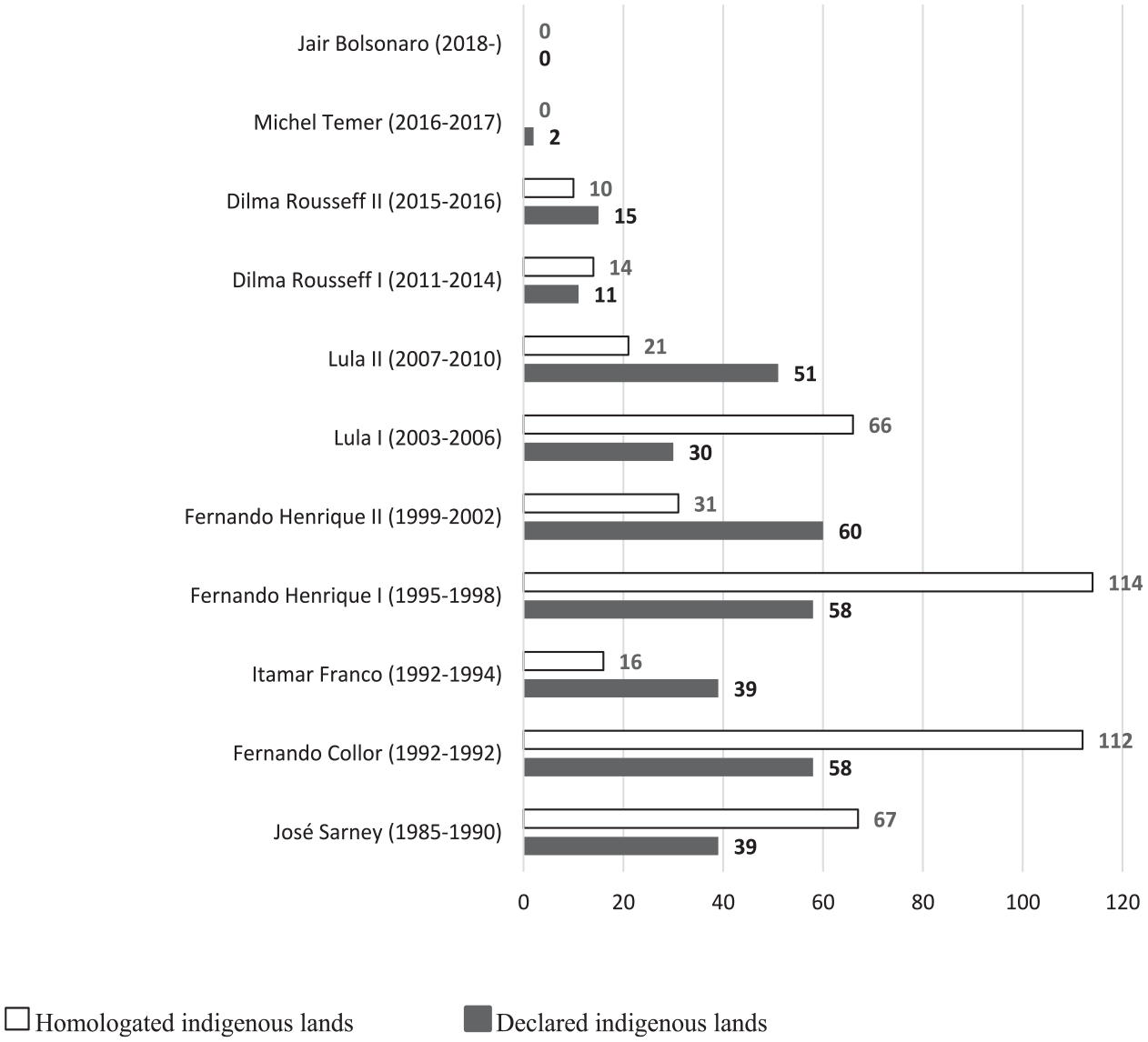
Indigenous lands demarcated since 1988 (adapted and updated from the Instituto Socioambiental [https://www.socioambiental.org/pt-br/noticias-socioambientais/com-pior-desempenho-em-demarcacoes-desde-1985-temer-tem-quatro-terras-indigenas-para-homologar (accessed January 19, 2020)]).
It was José Sarney's conservative government and those with a neoliberal orientation such as those of Fernando Collor de Mello and Fernando Henrique Cardoso that did the most to demarcate indigenous lands. Since Lula’s second term, agribusiness elites have become a political force, and they gained even more influence after Dilma Rousseff was deposed in a parliamentary coup in 2016. The congressional proceedings on the issues of concern to the Frente Parlamentar Agropecuária (Congressional Agrarian Front—FPA) reveal the expansion of the anti-indigenous offensive in recent years (Figure 2).
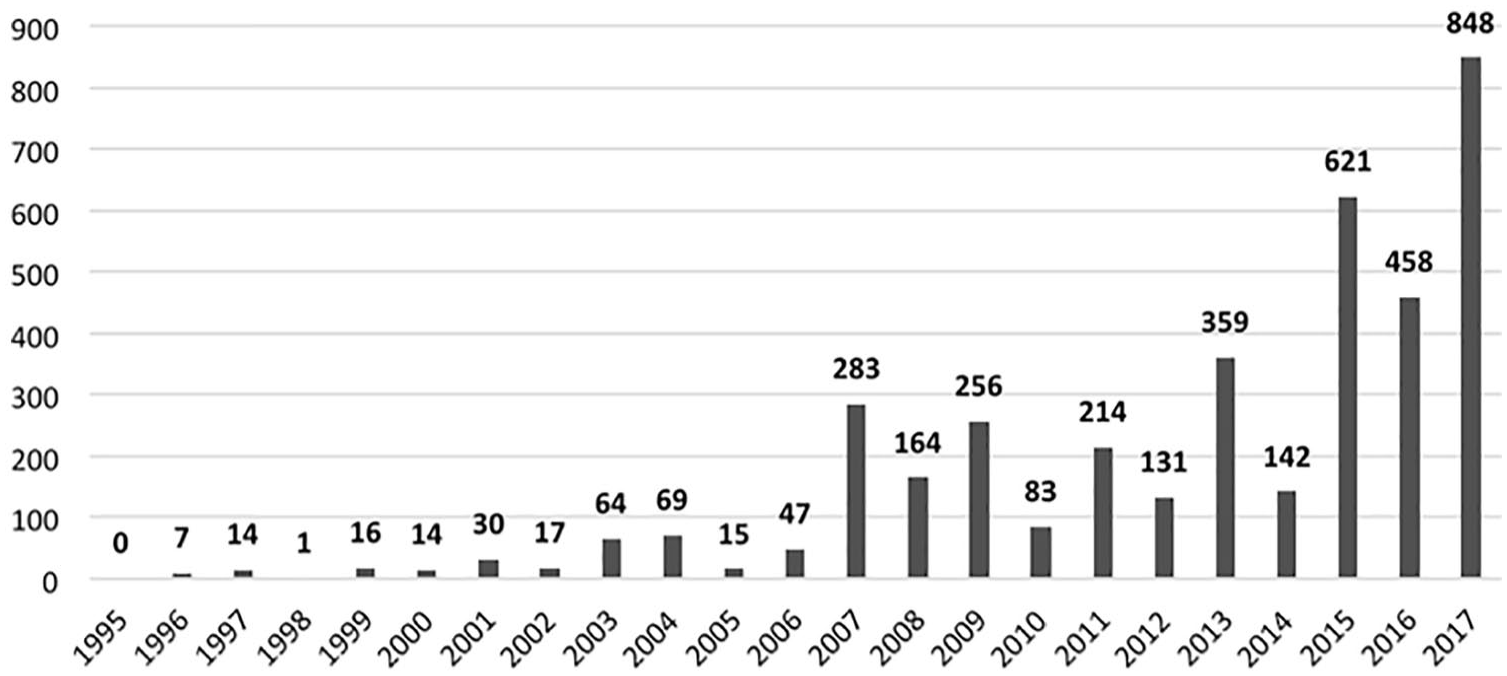
Anti-indigenous bills in Congress, 1995–2017 (data from Câmara dos Deputados, Conselho Indigenista Missionário, and FUNAI [https://outraspalavras.net/outrasmidias/congresso-os-numeros-da-grande-ofensiva-anti-indigena/ (accessed July 28, 2018)]).
The neoexpansionist agenda and the “productivity pact” of the PT governments represented a setback for the demarcation of indigenous lands. The Lula and Dilma governments were heavily criticized by the operators of large hydroelectric plants such as Belo Monte in Rio Xingu and the Tapajós Complex in Pará that are part of the Growth Acceleration Program. Despite the promising results of PT social programs in the fight against poverty, larger structural issues remained unresolved, such as ensuring territorial access in an environment of ecological and cultural sustainability. Political accords in the congressional setting during the PT governments also indicated a growing number of lobbyists working for agribusiness, a sector of the Brazilian economy that greatly benefited from PT policies.
The Anti-Indigenous Trend in Brazilian Government
Jair Bolsonaro’s election in 2018 was a victory for a reactionary force in Brazilian politics that already had considerable influence in Congress. Formulated with the backing of major opponents to indigenous rights such as the FPA and supported by agribusiness, the political agenda of the current government seeks to hamper indigenous policies in several areas (such as education, social welfare, and ethnic development) with a special focus on curtailing the designation of indigenous lands. Bolsonaro’s congressional record is full of racist remarks and attacks on indigenous peoples. In 2004, during a session of the Chamber of Deputies, he called indigenous people “smelly, uneducated, and people who do not speak our [Portuguese] language.” In 2008, in front of the entire chamber, he called on the indigenous leader Jecinaldo Barbosa to “eat grass outside and remember where you came from.” During his political campaign, Bolsonaro stated on various occasions that Brazil has a “demarcation industry” set up by FUNAI and the NGOs. During an interview he said, “If it were up to me, there would be no more demarcations of indigenous lands” (Resende, 2018). He frequently described indigenous peoples as groups with “an inferior background” and even compared them to zoo animals.
The institutional stance of Bolsonaro is not an isolated occurrence but a neocolonialist project aimed at dismantling Brazilian indigenous policies. This project is supported by three groups that have tremendous influence in Brazilian society—the ruralists, the military, and the evangelicals. The ruralists are interested in promoting the expansion of agribusiness on indigenous lands. The military continues to express concern about a supposed risk to national sovereignty if indigenous groups remain autonomous. The more radical evangelical churches are seeking to extend their sphere of influence through missionary activities. The confluence of these different agendas manifests itself in the fight for deregulation in the demarcation of indigenous lands, which also has an impact on policies relating to access to and exploitation of indigenous lands.
The FPA is the largest political force organized by Congress, with 257 deputies (of a total of 513) and 32 senators (of a total of 81) (Congresso em Foco UOL, 2019). The recent arrival of the ruralists as a political force has its roots in an ideological dispute between agribusiness and other modes of production (Schneider, 2010: 516–517). The FPA has taken a firm stance against the demarcation of indigenous lands, arguing that it means less space for agribusiness to expand and pointing out that 14 percent of Brazil’s national territory is owned by ethnic groups that represent less than 0.5 percent of the population (FUNAI, 2017). Furthermore, it condemns the legal uncertainty created in cases where demarcations are not clearly defined. In May 2018, the then-federal deputy and presidential candidate Jair Bolsonaro promised, on his way to an exhibition of agricultural technology in Brasília, to allow and encourage landowners to be armed: “If it were up to me, every farmer would have a gun on his property.” He also said that to leave farmers unarmed was “foolish and irresponsible” and would mean leaving them “at the mercy of the Movimento dos Trabalhadores Sem Terra [Landless Workers’ Movement—MST] and other types of bandits.”
Jair Bolsonaro’s government is apparently acting in concert with the large rural producers, but it has disrupted agricultural exports in some respects. A few hours after becoming president, Bolsonaro signed Provisional Measure 870, an administrative reform that transferred control of FUNAI to the Ministry of Women, Family, and Human Rights, whose head was the evangelical pastor Damares Alves. The ministry did not plan on annulling previous demarcations of indigenous lands but, rather, allied itself with missionary organizations that sought to evangelize indigenous peoples at any cost. However, under pressure from the indigenous movement, progressive sectors of the population, and members of Congress, FUNAI was returned to the Ministry of Justice and Public Security. The dismantling of indigenous policies also included the adoption of a provisional measure transferring FUNAI’s power to demarcate indigenous lands to INCRA, but the Supreme Court reversed it. The reissuing of the measure was judged by Justice Luis Roberto Barroso as “an unacceptable affront to the supreme authority of the Federal Constitution” and “an inadmissible and dangerous transgression of the fundamental principle of separation of powers stated in Article 2 of the Federal Constitution” (STF, 2019).
Besides the attacks on policies demarcating indigenous lands, pressure was exerted by ruralist groups and others to reverse the status of areas whose control had already been legally established. This effort was led by sectors linked to mining companies, which want to weaken the laws regulating environmental and ethnic protection. Their main goal is to mine the subsoil of indigenous lands in areas that are also environmentally protected. Indigenous lands are owned and used by indigenous peoples, but they are also the property of the federal government.
The FPA is also fighting environmental protection and sustainable agricultural practices on indigenous lands. Using a proposed constitutional amendment that would change certain provisions of the 1988 Constitution, rural lobbyists, in league with Bolsonaro, sought permission for nonindigenous Brazilians to mine on indigenous lands. This measure plans on returning Brazil to an integrationist and assimilationist model and is incompatible with ILO Convention 169. In February 2020, Bolsonaro said, “Indians are the same as us in that they are human beings and have a heart.” He said this with the intention of sending to Congress a proposal to permit mining on indigenous lands, but he was doing nothing less than questioning the humanity of indigenous peoples, a process that dates back to Brazil’s colonial past (Folha de São Paulo, January 23, 2020). The presidency of FUNAI was turned over to a representative of the Federal Police, whose various regional departments are controlled by military officers. Control of technical and strategic sectors such as the Department of Isolated Indians and Recent Contact was given to a fundamentalist evangelical missionary. These officials brought indigenous policy in line with the agendas of evangelical and ruralist lobbyists.
Bolsonaro’s public attacks on indigenous peoples took place in a context in which grilagem (falsification of property documents for the illegal possession of lands), timber theft, mining, and invasions of indigenous lands were increasing dramatically. 4 The scale of the disputes for control of these areas is very worrisome. These disputes have led to the largest number of indigenous leaders’ dying in conflicts in the countryside in 11 years, according to the Catholic Comissão Pastoral da Terra (Pastoral Land Commission—CPT). In 2019, seven indigenous leaders were assassinated, compared with two in 2018 (Figure 3).
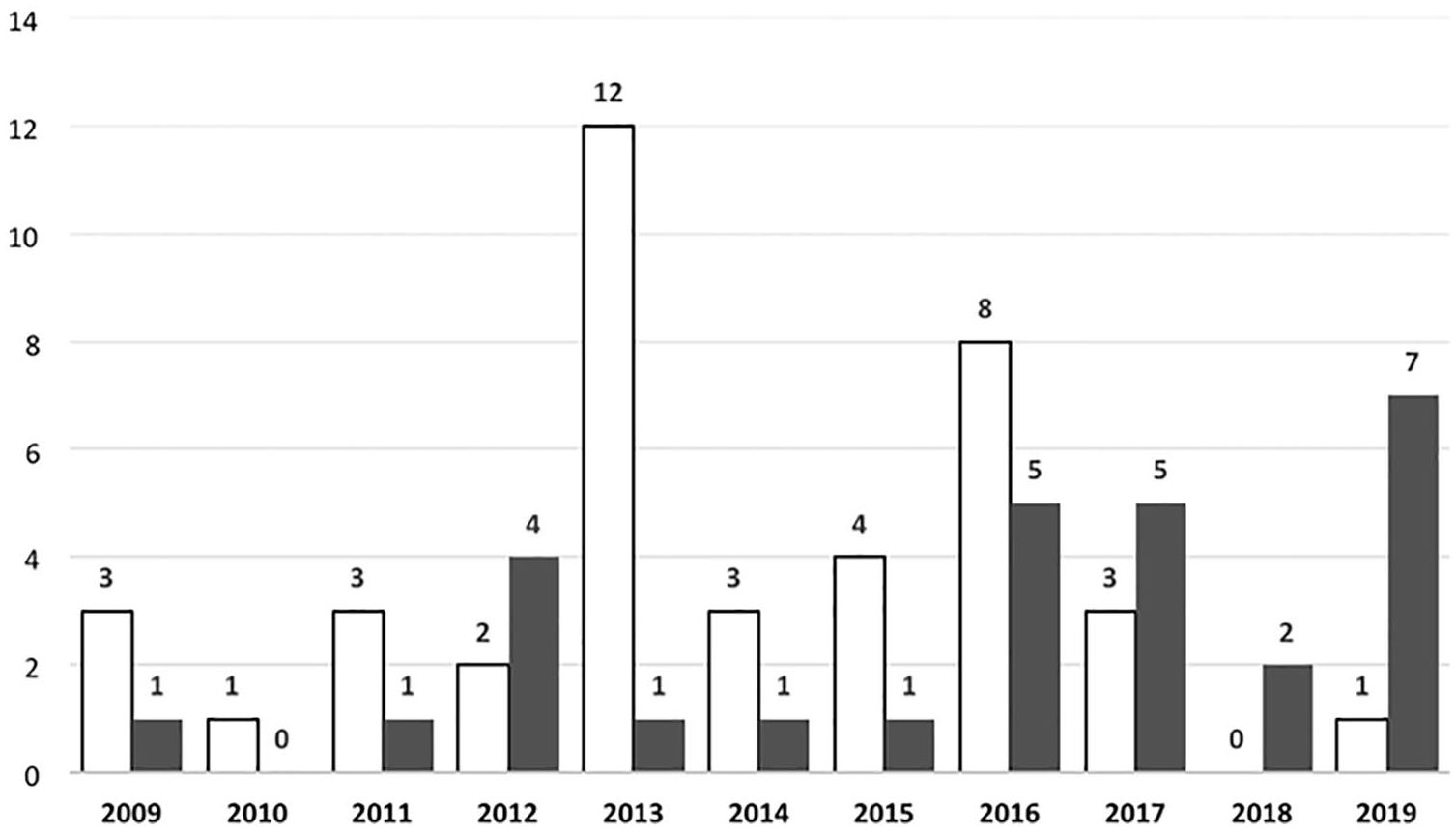
Assassinations of indigenous people (white bars) and leaders (black bars), 2009–2019 (data from Centro de Documentação Dom Tomás Balduino and Comissão Pastoral da Terra, 2020).
According to a 2019 survey done by the Conselho Indigenista Missionário (Indigenous Council of Missionaries—CIMI) (2020), “[It has come] to our attention that within the first nine months of 2019, there were 160 cases of invasion on 153 indigenous lands located in 19 states and throughout 2018 there were 111 [similar] cases on 76 indigenous lands in 13 states.” The indigenous peoples themselves were the first to launch protests after Bolsonaro’s inauguration. The Articulação dos Povos Indígenas do Brasil (Liaison for Indigenous Peoples in Brazil—APIB) made headway at UN headquarters and in the Organization of American States (OAS) with the goal of condemning the violence and violations committed by the current government. The indigenous leader Dinaman Tuxá of the APIB summarized the situation: “Our prospects are the worst they have ever been. Now that FUNAI is under the control of the Ministry of Justice again, we will continue to find ourselves the target of a policy of extermination. . . . There is a deliberate attempt to weaken and suffocate FUNAI. As things stand, FUNAI does not meet the minimum requirements for functioning properly” (UOL, 2019).
The recent weakening of environmental defense organizations such as the Instituto Brasileiro do Meio Ambiente e dos Recursos Naturais Renováveis (Brazilian Institute for the Environment and Renewable Natural Resources—IBAMA), the Instituto Chico Mendes de Conservação da Biodiversidade (Chico Mendes Organization for the Preservation of Biodiversity—ICMBio), and FUNAI reveals an agenda that seeks to open these territories so that they can be exploited for their natural resources. The recent reissuing of Provisional Measure 910, which allows property speculators, trespassers, and miners to own property on public lands, gives the green light to others who would repeat these criminal practices.
In the wake of the COVID-19 pandemic, the health system is unable to promote policies that mitigate COVID’s spread even though indigenous peoples are among the most vulnerable to the pandemic’s effects.
Conclusion
The demands of the indigenous movement for more democracy have resulted in institutional gains, the recognition of their political equality, and the constitutionalization of their social rights. The 1988 Constitution was a watershed moment for the fight for indigenous rights. The principle of self-determination (written into the constitution and reaffirmed in ILO Convention 169) became an important source of legal support for the indigenous movement. Even with the onset of redemocratization, indigenous peoples fought for a different standard in the relationship between the state and Brazilian society in which the former would become more reflective of the diversity present in the latter. Furthermore, they fought so that indigenous peoples could shape and influence state actions and participate in the formulation of public policies.
Although the constitution signified a fundamental rupture that included all of Brazilian society (with popular participation at every political level), the governments elected did not implement any real changes regarding the relationship between the state and society. The primary demands of indigenous peoples (especially the demarcation of their lands) were answered only in specific instances dependent on the circumstances of the time. Situated in a context that saw a slight improvement during the 13 years of the PT governments, the Brazilian political system frustrated the advance of indigenous rights in Brazil.
The desire for indigenous lands because of the mineral resources they contain is the main motivation for the offensive against the 305 different ethnicities that are recognized by the Brazilian government. The collusion of public officials with private interests (led by those who represent the interests of agribusiness and landowners) is evident in the way this bloc has spread its tentacles to occupy important positions in many institutions. The emergence of statements and policies against indigenous peoples is the result.
The current government’s stance against indigenous peoples has two fundamental aspects. The first is a confusion of the government with the state in which the current group in power seeks to circumvent republican values and impose a form of government based on personal relationships that keeps Bolsonaro in power. The second is a worldview based on ethnocentric dichotomies, the main one in this case being “civilized” vs. “primitive.” It is a tragic situation not only for indigenous peoples but also for Brazilian society, since demarcated lands represent close to 14 percent of the national territory and, coincidentally, are the most environmentally protected in all of Brazil (FUNAI, 2017). Protecting these lands is not only essential for preserving an ecological balance but also important for agribusiness.
An ethnocentrism that supports arguments for reducing indigenous territories and for the cultural and physical extinction of indigenous peoples is also based on an idea that indigenous peoples are incapable of modernizing. This idea is not new. It has played a pivotal role in Brazilian history and continues to influence Brazilian society. Bolsonaro’s government is the product of a colonialist and ethnocentric perspective in the guise of neoliberalism. This perspective continues to wield tremendous influence, even on progressive governments. Bolsonaro’s government is very different from its predecessors because of the radical way in which it applies exclusionary policies. The anti-indigenous bloc wants to exploit indigenous resources, take away indigenous rights, and exploit indigenous peoples for its own political and economic benefit. Bolsonaro is an ally of this bloc who is more than willing to break the law and impose his will by force in order to appease it. The president is making progress toward his goal of exterminating indigenous peoples.
Footnotes
Notes
Manuel Domingos Neto is a retired professor from the Universidade Federal de Ceará and the Universidade Federal Fluminense and a former president of the Associação Brasileira de Estudos de Defesa and the Conselho Nacional de Desenvolvimento Científico e Tecnológico. Luís Gustavo Guerreiro Moreira has Ph.D. in public policy from the Universidade Estadual de Ceará and is an indigenist at the Fundação Nacional do Índio, a researcher at the Observatório das Nacionalidades, and the editor of Tensões Mundiais. Nick Ortiz is a writer, researcher, linguist, and translator with experience in translation relating to Latin American history and politics.