



Abstract
During the 2015 post-electoral conflict in the municipality of Oxchuc, Chiapas, came the demand for the election of municipal authorities through its own internal regulatory system. After going through several phases, proponents of change in electoral proceedings obtained legal recognition for Indigenous self-government. This achievement led to an interlude in the long history of political conflict and social change in the municipality. In this article we examine the contemporary history, processes, and recent political developments in the municipality of Oxchuc, which led to institutional recognition of this municipality’s self-government.
During the second half of 2015, in the region most densely populated by Indigenous communities of the Altos de Chiapas (Chiapas Highlands), large groups mobilized to protest the results of the elections for new town councilors. In this region, most notably in the municipality of Oxchuc, a pattern of protest emerged that ranged from contesting electoral results to establishing a new system of local government.
This new system of government achieved institutional recognition based on Indigenous peoples’ right to self-determination, which in the case analyzed here includes recognition by the state of their regulatory systems and cultural specificities, the protection of collective political rights, and the restoration of political power to an Indigenous majority. In this light, we believe that the people of Oxchuc attained a de jure decolonization under the umbrella of recognition of Indigenous institutions, as conceptualized in Indigenous rights in international law. 1 However, if the recognition of Indigenous institutions, as we will explain, involves challenging colonialist state structures, it also entails the establishment of a multicultural political hegemony which reinvigorates the legitimacy of the state, repositioning it as the primary and ultimate source of democratic governability (González, 2010; Burguete Cal y Mayor, 2010). From this standpoint, in the case we will analyze, it was not by chance that both the claimants and state institutions (state Congress, state government, and electoral institutions) found in the right to self-determination the mechanism for resolving the governability problem in the municipality, thereby conferring upon the de jure autonomous regime a political value which it lacked.
In this article we examine the contemporary social and political history of the municipality of Oxchuc, which is marked by an intricate relationship of conflicts in which internal and external actors have participated. We identify the social change processes that were influential, since at least the 1940s, in energizing the local society. We will pay special attention to analyzing the political projects advanced by various social actors, which established guidelines for the building and reshaping of social and political identities.
We are primarily interested in two questions: How has the field of political opposition in Oxchuc been developed from the 1940s to date by various social actors? How has the demand for recognition of differentiated rights been shaped in recent years, culminating in the official recognition of municipal political self-determination (self-government)? To answer these questions, we first center the discussion around the Indigenous movement in Latin America, with an emphasis on the Mexican process. We refer to the demands and declarations on Indigenous political autonomies, and we examine the overall context of Indigenous mobilization in order to then refer to the demands for Indigenous self-determination and autonomies in Mexico. We will then situate the more significant social and political projects in the contemporary history of the municipality of Oxchuc, which offer guidelines for analyzing recent political processes within which the demand for self-government is central. We conclude with an analysis in which we wish to situate recent social and political changes in the Oxchuc municipality, showing the challenges and contradictions of self-government.
From Indigenous Emergence To Indigenous Self- Government
In the late 1990s, several particularly strong Indigenous organizations emerged throughout the world that placed the recognition of differentiated rights at the center of their demands. In these demands, either for inclusion or expansion of rights, these organizations discussed the relationship of Indigenous peoples (often erroneously considered minorities) with the prevailing national culture. They made visible—and the object of public rebuttal—the alleged concurrence and oneness of peoples, ethnicities, and nations. They debated the public sphere and, in this regard, the predominant politics. During this period in Latin America many classist-trade union organizations vanished or were transformed to include environmentalist or cooperative demands, or began self-recognition processes that resulted in them being strengthened through explicitly ethnic demands (Bengoa, 2000).
The formation of these organizations and their political stances, characterized as an ethnic rebirth or Indigenous emergence (Kuper, 2003; Bengoa, 2000) has been a long process related to the political agendas of the ethnic organizations themselves, with policy designs aimed at the recognition of political and cultural rights channeled from governmental bodies and from supranational and nongovernmental organizations on a global, regional, and local scale (Burguete Cal y Mayor, 2010). In what follows, we will summarize some of these processes with respect to Latin America, focusing on the case of Mexico, to contribute elements for understanding the case analyzed here.
Before that, it is important to underscore two issues that the region’s ethnic organizations have in common. The first is that out of their demands for the right to ethnic differentiation, they questioned the relationship of nation-states to their citizens. That is, they are challenging the liberal premise of citizen equality (simple or absolute equality) upon which the 19th century Latin American nation-states were founded; a philosophical and political substratum of modern democratic states. The second issue is that over the last decade, ethnic organizations have advanced their demands for differentiated rights towards obtaining political and territorial autonomy (at differing levels), becoming, in a preconceived manner or not, struggles for decolonization (Burguete Cal y Mayor, 2010) and adding a post-colonial feature to the process of democratization of Latin America (Gledhill, 2000). Nevertheless, as demonstrated by Central America (Hale, 2002) and in the case analyzed here, these struggles flow between revitalizing the legitimacy of the nation-states (and with it colonialist practices in a new framework of political relations), and limiting the very processes of decolonization and empowerment of Indigenous peoples when the state grants and embraces Indigenous demands (González, 2010). 2
The processes of building nation-states in Latin America had as a common substratum political liberalism, which upholds the equality of its citizens as one of its major premises. Despite their historical, social, and cultural diversity (of class, ethnicity, and religion) from their foundations, nation-states in Latin America did not make distinctions in political-institutional terms. On the contrary, in their processes of change and economic and political modernization, the ruling classes believed it was necessary to integrate into the national society the subjects and collectivities considered marginal or in the minority (Indigenous peoples are considered as such in our region) through institutional programs for the betterment of the population’s material conditions, education, and health, including miscegenation campaigns and “religious defanatization;” or through political integration projects introducing the system of municipal government or sectoral political grouping initiatives linked to state powers (campesino and worker organizations and unions).
The policies of integration of Indigenous peoples reached a point of exhaustion between the 1960s and 1970s, and were strongly criticized in Latin America by the very members of society subjected to integrationist public policies: numerous Indigenous professionals and academics (mainly professional anthropologists) who had been acting as officials in charge of the design and implementation of Indigenist policies of national governments. In Mexico, for example, in the period referenced, they moved from integrationist Indigenist policy to participatory Indigenist policy or participatory Indigenism that envisioned involving members of those Indigenous societies in the implementation of said programs (Medina, 2007), but without substantially changing the developmentalist, modernizing, and “whitening” perspective of the population that had defined the previous policy.
That same period in Mexico saw widespread political upheaval (the 1968 student movement, urban and rural guerrillas, and institutional changes in formal policy such as the 1975 political reform) in which social movements, primarily dissident campesino movements, stood out by disclosing the rifts in the Mexican government’s supposedly hegemonic corporate system, and the economic crisis suffocating rural areas, increasing poverty rates, and marginalization. Under these conditions campesino movements focused on demanding basic social and civil rights of the Mexican state such as access to land, healthcare, and education. They also sought real political participation, which, given the country’s governability situation, translated into dismantling the cacique-controlled local governments. Although the ranks of campesino organizations were made up of Indigenous communities and groups, cultural demands were absent, largely due to the priority given to the above demands, but also because the cultural difference, on the one hand, was addressed with a certain preponderance by official Indigenist policy. On the other hand, the political imagery of the left that was close to the campesino movements was dominated by Marxist approaches to class struggle that saw these emerging organizations, which began to make demands for cultural recognition, as defenders of a mediocre and folkloric ethnicism (García, 1991).
In this period of Mexico, the first actions that emphasized ethnicity had corporative organizational objectives. The organization of literate Indigenous persons who attended training or boarding schools during the administration of General Lázaro Cárdenas (1934-1940) were in this category, seeking to enter the national government structure as the Alianza Nacional de Profesionistas Bilingües A.C. (National Alliance of Bilingual Professionals, ANPIBAC), an organization that lodged one of the first Indigenous affirmative actions as a demand on the government’s public agenda: recognition of bilingual education in Mexico’s school curriculum.
Other initiatives were those promoted by the Instituto Nacional Indigenista (National Indigenist Institute, INI), the entity in charge of official Indigenist policy, the Confederación Nacional Campesina (National Campesino Confederation, CNC), and the Secretaría de la Reforma Agraria (Secretariat of Agrarian Reform, SRA), which attempted to “consolidate a corporate political organization of Indigenous people in the framework of the Partido Revolucionario Institucional [Institutional Revolutionary Party, PRI], a goal that was never reached” (Warman, 2003: 266).
It was in the 1980s that the demands and self-identification of campesino organizations began to take on a more Indianist nature, a political identification linked to ethnicity. Among the earliest organizing experiments demanding cultural recognition, as well as political recognition, was the Conference of Independent Indigenous Organizations of Mexico, Central America, and the Caribbean in Cheranástico, Michoacán, in 1981 (Solís, 2012). At that time, as the title of the conference indicates, coordination between organizations had begun in Mexico and Latin America that gradually moved from demanding civil and social rights, and fighting against racial discrimination, towards their affirmation in the public arena as political subjects.
The 1990s marked the rise of the ethnic movement on a global level. In Latin America, the confluence of the accumulated experience of Indigenous mobilization of past decades, along with the impetus of the Indigenous rights agenda by supranational bodies (mainly the United Nations), the transitions towards democracy, and the process of economic restructuring that established neoliberalism in the region, brought about a cycle of institutional recognition of the ethnic and cultural diversity of nation-states. With the ratification of International Labour Organization (ILO) Convention 169, the signatory countries committed to carrying out constitutional reforms to establish the state’s pluricultural or multiethnic nature as national law (Assies, 1999).
Mexico signed Convention 169 in 1991, producing a significant impetus of activism by Indigenous peoples. Within a few years, the irruption of the Ejército Zapatista de Liberación Nacional (Zapatista National Liberation Army, EZLN) in 1994 provided new vigor and greater visibility to the country’s Indian movements along a different political path. Not initially inclined towards the cultural rights agenda in its original proposals, the EZLN adopted them, resulting in a strategic alliance of mutual reinforcement (Pérez, 2007).
We will not dwell here on the details of the process of mobilization of Indigenous peoples and the formal and constitutional treatment of their rights in the period following the EZLN uprising. 3 For the purposes of this article, we note that as a result of the dialogue for peace between the EZLN and the federal government, the San Andrés Accords on Indigenous rights and culture were signed in 1996, which established not only the differing conceptions of these rights among the major actors in dispute, but also the path ahead for their implementation. These accords were finalized in the COCOPA Law (Comisión de Concordia y Pacificación or Commission for Agreement and Pacification), which in 2001 led to the reform of Article 2 of the Mexican Constitution, recognizing the right of Indigenous peoples to self-determination. Nevertheless, it is important to note that a significant number of Indigenous peoples and organizations that mobilized around the demands for recognition of cultural rights found this legislative reform to be limited. Today, many politically active Indigenous peoples switch between exercising de facto or formalizing de jure what they consider the right to self-determination, self-governance, or autonomy. 4 This is taking place in new contexts of power, negotiation of ethnic and political identities, and internal conflicts (factional, partisan politics, etc.), as we will see in the case analyzed here.
The Community Context
Oxchuc is an Indigenous municipality nestled in the mountain ranges of the Chiapas Highlands in southern Mexico. It is a municipality inhabited primarily by Tzeltals, one of the Native groups, successors of the Mayan culture that existed between what is today southeast Mexico and part of Central America.
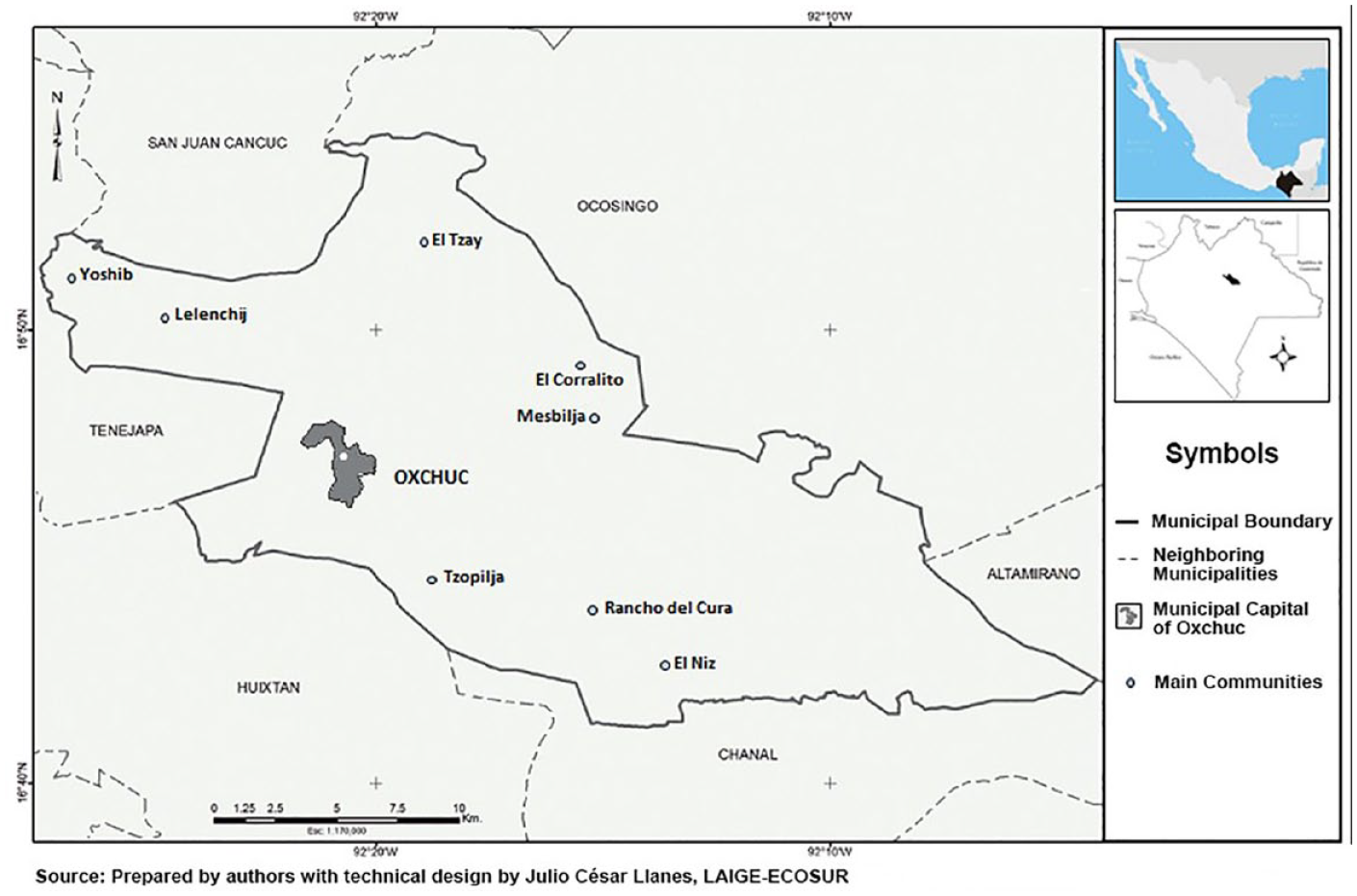
Map of Mexico, Chiapas, and the municipality of Oxchuc.
In the context of post-revolutionary nationalism (1910-1940), Oxchuc was one of a few communities that was selected – and became a space for intervention – for the implementation of various cultural integration policies. 5 The first state action along these lines was its recognition of Oxchuc as a free municipality in 1936. As a result, the constitutional municipal government was established: a form of local government that would soon achieve acceptance and local adoption, though not without controversy. In addition, other actions had diverse impacts in areas targeted for programs: educational, health, religious and political projects. 6
Specifically, from the 1940s, the so-called political-religious system underwent significant transformations due to government action and the proselytism of Protestant religious denominations. From being a local government entity sustained by coercive and consensual activities among the population (with a predominance of religious figures in positions of power and administration of justice) it transitioned, in a relatively short span of time (1940-1970), to a government with civilian predominance integrated into the nation-state’s corporatism.
During this changeover, two projects proved to be of great significance in socio-political relations: official Indigenism and Protestant pastors. The first, encompassed in the nation-state’s modernization project during the presidency of General Lázaro Cárdenas (1934-1940), was directed from the Office of Indigenous Affairs that later became the National Indigenist Institute (INI). The second, with federal government approval, was promoted by the Instituto Lingüistico de Verano (Summer Language Institute, ILV), a project that introduced Protestant religious conversion in addition to elementary schools in Indigenous municipalities in the Chiapas Highlands. Both projects trained and empowered leadership in the municipality as promotors of education and of Protestantism, forming an educated sector which would gain prominence in subsequent years, and changing the structure of social and political relations (Rus and Wasserstrom, 1979; Rus, 1995). In this process, they directed the secularization of the local government and the legitimation of the new political structures linked to the Municipal Council. The municipality as a form of political and territorial organization would become a legitimate playing field for steering the social transformations 7 (Villa Rojas, 1990; Cruz Gómez, 2017; Pérez Sánchez, 2020).
Anthropological studies of the 1940s in the region (Slocum, 1956; Villa Rojas, 1990; Siverts, 1969) reported that the strongholds of the mestizo population, who primarily lived in the biggest Indigenous towns, coexisted between tension and harmony with the Indigenous population. The relationship of the mestizo population’s dominance over the Indigenous population was evident in various arenas, especially in the economic and political realms, and in the control of the centers of power, that is, the municipal capitals. However, these power relations would be modified starting in the mid-20th century through national development projects. The control of trade, and more specifically the mestizo monopoly of liquor in municipalities such as Oxchuc, was the principal source of supremacy over the Indigenous population. Relations of exploitation, submission, and dominance were built on this business structure. This was one of the first fields of struggle to which the emerging Indigenous leaderships committed themselves, trained by the state and the Protestant church, unleashing ethnic conflicts: Indigenous peoples versus mestizos (Bautista, 2002).
In the political-religious realm, there was a ruling structure in the 1940s that Siverts (1969) called tribal government, which was composed primarily of pulsadores (pulsers) and brujos mayores (traditional healers) who were the supreme leaders in the civil-religious hierarchy, responsible for maintaining order in the community through practices of spiritual and religious submission. In addition, there was the civil authority, that is, the cabildo (town council), an extension of the state in the community. Political power in the town council was primarily controlled by a mestizo agent who acted as a secretary in the municipal structure. Due to the agent’s ability to read and write, as well as their knowledge of the state bureaucratic system, they functioned as a facilitator and liaison between the political powers of the region and those of the council (Villa Rojas, 1990).
The recognition of Oxchuc in 1936 as a free municipality 8 led to the founding of its constitutional municipal government, which was considered the sole legal authority for the entire population. This change of political regime altered the system of local government, and the emerging Indigenous leadership began to have an ever more important role in the structure of civil authority, ceding to the religious structure a space for representation based on acknowledgement of community and values of respect and honor.
With the Oxchuc municipality’s inclusion in the federal government system, it had to conform to the nation-state’s structure and that of its state party, the Partido Nacional Revolucionario (Revolutionary National Party, predecessor to the current Partido Revolucionario Institucional, PRI). From then on, official and institutional policy in the municipality was processed through the political party. Here it is important to note local compliance with corporative partisan national policy practices. 9 In early 1960s Oxchuc, the election for municipal president was held by a show of hands with the approval of the major players in the religious hierarchy. In the years that followed, new authorities in the municipal office would alternate between bilingual promoters trained by official Indigenism, leaders close to official Catholicism, and campesinos, all within the framework of partisan interests of the PRI (Cruz Gómez, 2017: 205).
By the 1970s, the system of civil religious government, which Alfonso Villa Rojas (1990) had found to be frankly deficient since 1940, lost power in the life of local people, with the municipal government structure taking hold. In that same decade, a new group of Indigenous youth trained as bilingual teachers began to form as a group with trade union interests in the Sindicato Nacional de Trabajadores de la Educación (National Education Workers Union, SNTE). Controlled by the state, the anti-democratic actions of this union resulted in a large part of Indigenous educators, particularly in the south of the country, creating, as a counterweight within the SNTE itself, the Coordinadora Nacional de los Trabajadores de la Educación (National Coordination of Educational Workers, CNTE) in 1979. 10 To top it off, the CNTE became an alternative union affiliation, with a strong political discourse focused on the democratization of the union. The democratizing CNTE project arose in a context of political, social, and cultural struggles, where left ideology was gaining strength in the face of a repressive and authoritarian state.
Between the 1970s and 1980s, the agrarian and campesino movements in the southern Mexico found an ally in the dissident teachers’ movement. Together they strengthened the leftist parties, which in view of the dwindling paths for clandestine struggle, largely viewed the party system as a means to channel their own banners for democratization of a country that the state had mired in a political farce. 11
Well into the 1980s, in some Indigenous towns in the Chiapas Highlands, the struggle for political control began to redefine itself through the presence of parties opposed to the PRI. Although not very prominently, leftist parties that began to operate as counterweights to the hegemonic and traditional PRI in Indigenous communities joined the Partido Acción Nacional (National Action Party, PAN), a “traditional” opposition party in Mexico. At that time, the educators’ sector was clearly divided into two camps. On one side was the SNTE tied and subordinated to the federal government and its state party. On the other was the trade union fraction assembled in the CNTE, allied with political and left sector clusters that had worked in coalition in the 1988 federal presidential race. The following year they began forming the Partido de la Revolución Democrática (Democratic Revolution Party, PRD).
In Oxchuc, this trend manifested itself in a fierce conflict between the “vanguards,” a teachers’ political cluster linked to the SNTE and the PRI, and the “democrats” made up largely of the bilingual teachers endorsing the CNTE. The point in contention: the municipal presidency, a space of power from which the bilingual teachers, called democratic, had been displaced after having held it throughout the 1980s. The dispute was not lacking in violence and fatalities. It was defined, in contrast to the conflict that occurred in the 1950s against the mestizos, by its interunion, interethnic, and interparty nature. It also signified a transition towards a new phase of factional organizing: the defeated bilingual teachers split from the PRI and, in alliance with campesino groups, formed one of the local political associations with major influence in the municipality for decades: the Asociación Civil Tres Nudos (Three Knots Civil Association). It allied with the emerging PRD and influential campesino organizations in the region: the Organización Campesina Emiliano Zapata (Emiliano Zapata Campesino Organization, OCEZ) and the independent Asociación Rural de Interés Colectivo (Independent Rural Association of Collective Interest, ARIC-independiente) (Cruz Gómez, 2017: 236-239).
It is necessary to situate these changes in the political and social reshaping of the municipality of Oxchuc in the framework of two interrelated facts. One of these has to do with the reform of Article 115 of the Constitution, aimed at the decentralization of the municipal government in Mexico. The second refers to the deep economic crisis of the 1980s. According to Jan Rus (2012), to mitigate the effects of the crisis in Indigenous communities in Chiapas, the strategy of the local political elites was to resort to social control by delivering money. This strategy was translated into public policy. In the case of Chiapas, it was institutionalized under the name Convenio de Confianza Municipal (Municipal Confidence Agreement, CODECOM), 12 a program comprised of state and municipal public funds to promote works and productive projects in the communities. This strategy was framed in the aforementioned reform of Article 115, which endowed the municipality with greater political and administrative responsibilities while at the same time financing it with public resources, along with salaries for municipal government staff.
This was a process of decentralization in the country that gave local governments a margin for operations in the handling of its municipal treasury and receipt of federal and state resources, although with a tendency to reinforce political subordination to state powers. The significance of this pecuniary shift in local areas is shown by recent data on the millions in public financing available to municipalities such as Oxchuc. In 2021, this municipality received 261,194,488 million Mexican pesos (USD 12,885,766.55) for the Fondo de Aportaciones para la Infraestructura Social Municipal (Fund for Contributions to Municipal Social Infrastructure, FISM) and the Fondo de Aportaciones para el Fortalecimiento de los Municipios (Fund for Contributions to the Strengthening of the Municipalities, FORTAMUN). 13 This does not take into account other sources of income for the municipality.
Thus, political power underwent an important qualitative transformation. In the municipality of Oxchuc, governance and belonging to the municipal structure shifted from being a burden to those who were in office, to a means of accessing political and economic power, something truly significant in historically impoverished areas.
Lastly, to complete this contextual framework, it is important to point out that in the 1990s, Oxchuc maintained very robust political activity in the region connected to processes of sectoral, partisan, and dissident groups. Communities belonging to the municipality were active in the ranks of the EZLN in 1994; from this experience they learned to create novel forms of building political subjectivities and consequently, political participation. Despite the confrontations and intense repression that Zapatista-supporting communities in Oxchuc suffered, EZLN forms of action, identity, and political speeches took hold and became part of future types of action.
These developments prefigure recent political conflicts in the municipality, conflicts that are rekindled in the demands for Indigenous collective rights. In these new situations of dispute and confrontation, “renewed” forms of understanding politics and democracy are emerging with a tenor of demanding rights for the self-determination of Indigenous peoples and communities.
Municipal Self-Government In Oxchuc, Its Emergence And Recognition
In Oxchuc, as in other municipalities of the Chiapas Highlands (Chenalhó and Chamula), a bitter conflict occurred in 2015. The election results for new members of the municipal government were disputed and questioned. Participants in the conflict from differing political parties charged that the officially recognized winners had engaged in various irregularities and crimes to obtain the posts. The post-electoral dispute developed in various manners in the different municipalities, with even fatal outcomes in some of them (Solís, 2017; Jacorzinski, 2019). What they had in common was that in certain phases, without even coinciding in arguments and discourse, they were demanding community self-government. For Oxchuc, arriving at the demand for community self-government meant going through several phases of organization, struggles, and discursive logic in a relatively short period of time.
The conflict in Oxchuc began as a disagreement with the voting results of the local electoral process in 2015. In parallel with demonstrations repudiating the electoral results that handed victory to María Gloria Sánchez Gómez, mayoral candidate for the Partido Verde Ecologista de México (Green Ecologist Party of Mexico, PVEM), the dissenters filed an electoral nullification suit with the appropriate legal bodies (TEECH-JNE-M-010-2015). 14 The plaintiffs, representatives from all the political parties opposed to the winner, joined together in what they called the Movimiento Pacifista de Organizaciones Independientes del Pueblo de Oxchuc (Peaceful Movement of Independent Organizations of the Oxchuc People, MPOIPO) and stated in their suit that a “state election” had occurred, referring to the fact that the outgoing mayor, Norberto Santiz López, had utilized state power through public resources and the municipal office to force the vote and benefit his wife: María Gloria Sánchez Gómez, who had divorced the president in advance. This measure skirted the legal restrictions prohibiting a candidate from having a conjugal relationship, concubinage, blood relation, or kinship with the current holder of the office. This tactic was previously used by the same couple when Santiz López was replaced in the municipal office (2002-2004) by his spouse Sánchez Gómez for the 2005-2007 three-year term. 15
Along with the above, plaintiffs also denounced irregularities in vote tallies, the disappearance of official count records from polling places, and inconsistencies between votes cast and votes recorded (TEECH-JNE-M-010-2015). The Tribunal Electoral del Estado de Chiapas (Electoral Court of the State of Chiapas, TEECH) found the grievances presented to be unfounded, thereby confirming the election of María Gloria Sánchez Gómez.
The battle in the courts represented only one strategy in the political conflict. Another was that of demonstrations in the streets, which gradually reached greater levels of tension and violence, involving an ever-increasing number of political actors. Both were carried out in parallel to specific phases of the conflict.
The camps were defined: opponents of the municipal president-elect (which consisted of political party leaders in the municipality, previous education and campesino leadership, and some community representatives) and sympathizers of the municipal president-elect (primarily fellow party members). The dispute intensified, with violent clashes resulting in deaths, injuries, and the burning of properties of both camps, including the municipal hall building. The scene in the town became warlike due to the extent of the violence, forcing interventions, at times, by the federal army and state police to maintain public order. An initial phase of confrontations ended with control of the municipality by the opposition, self-imposed exile of some MPOIPO leaders, and the banishment of the municipal president, who, by order of the state Congress, was removed from office after she requested a leave of absence. This action was considered a victory for the dissidents due to the pressure exerted on the state Congress and government. The municipal president, in her own court battles, alleged harm to her political-electoral rights, alluding to gender-based political violence (Cosh, 2022), and found favor in the courts (SUP-JDC-1690-2016-INC2), 16 but her lack of political protection by local forces made her position in the municipality unsustainable.
In the process of organizing the protest, those who were discontent after the consolidation of the MPOIPO came together in the Movimiento Social Pacifista (Pacifist Social Movement, MSP), an initiative with features of citizen participation that was distanced from initial partisan interests. It was led by representatives of the community, neighborhoods, and school committees who were not in agreement with the acts of violence and their impacts on their daily lives. It was the MSP that secured a dialogue with the state government, although not free of tensions and confrontations. The most critical moment came after MSP representatives were apprehended in a meeting with government representatives and accused of rioting, while police raided the municipalities to dismantle a protest by members of the MSP, which led to new acts of violence and the capture of police who served as hostages to be exchanged for community representatives that had been apprehended. With this measuring of forces, the MSP came out strengthened and more emphatically lodged the demand for the municipal president’s removal and the establishment of a municipal council, 17 which they declared, for the first time, would be carried out through community “practices and customs.” This maneuver enjoyed broad recognition and legitimacy in the communities, transitioning to a broader and more sustained form of civic organization called the Comisión Permanente por la Paz y Justicia de Oxchuc (Permanent Commission for Peace and Justice in Oxchuc, CPPJO).
Added to the animosity and violence of the conflict was the complexity and, at some points, political inexperience of the institutions involved. Participation by the state Congress of Chiapas contributed to polarizing the positions of the opposing groups and factions.
The state Congress was a stakeholder in the conflict by institutional mandate, since it is responsible for guaranteeing conditions of governability in the municipalities, which clearly did not exist in Oxchuc. The indefinite leave of absence presented in February 2016 by the president-elect was a political solution to the governability crisis, which hurriedly and for purposes of appeasement provided the state Congress with the administrative power to consider it a resignation. In adherence to Article 159 of the Organic Municipal Law, the Congress installed, by means of an assembly, a municipal council composed of community representatives, naming leaders of the recently formed CPPJO as president and council members. Nevertheless, this process suffered a legal setback stemming from the suit filed by the president in protection of her political-electoral rights. The Tribunal Electoral del Poder Judicial de la Federación (Superior Chamber of the Electoral Court of the Judicial Branch of the Federation-TEPJF) decided in her favor, ordering the state Congress to reinstate María Gloria Sánchez Gómez to her post as president along with three other council members (SUP-JDC-1690/2016).
The outcome of the above was: 1) the continued existence of two municipal councils for nearly two years (2016-2018), each with differing social and legal legitimacy; and 2) a continued struggle disputed through control of public resources (and with that, control of the political clienteles of each camp) and violent clashes. The largest of these confrontations occurred in January 2018, resulting in deaths, destruction of property, arrests, and hostage-taking. This event marked the definitive removal of María Gloria Sánchez Gómez from the municipal presidency, having been accused and charged with acts of violence and bloodshed in the municipality of Oxchuc.
Once the municipal president was dismissed, the state Congress proceeded to appoint a municipal council in February 2018, repeating the 2016 electoral process: in an assembly and by a show-of-hands vote (a concession by the Congress to the dissidents while the procedure had not yet been legally established). Those who were members of the 2016 council were ratified by this act, although it had continued to operate without legal recognition. The 2018 council would function temporarily until the election of a new municipal council, and until a community-level resolution over where the electoral process would be conducted through a contest of electoral parties or according to “practices and customs.”
From here a new phase in this entire political process began. The positions of power among the factions were redefined, along with the projects they promoted. The municipal ex-president and her colleagues saw their political position diminished, while those assembled in the CPPJO gained traction, which also presented them with a series of challenges. The first was the sustainability of the group itself and, with that, its design and identity. Implementing the CPPJO proposals in a new internal and external context also constituted a challenge. We noted that internally the CPPJO was transformed from heading up a parallel government to an official government, which entailed translating into political practice what it had condemned in its discourse: eliminating political bad habits. This was not an easy task in a place where in recent history the exercise of government had been based on deals and perks for groups. Externally, they were singularly focused on the electoral process for a new state governor and the federal presidency, with Morena as the predominant electoral preference and some internal currents favoring the recognition of Indigenous peoples right to self-determination.
Since 2016, in the framework of the establishment of the first municipal council, the political players demanding the removal of the president-elect identified as part of their strategies of struggle: new political figures, a change in the form of electing municipal authorities, and a change in the structure of government. The very creation of the council, despite being a concept recognized in municipal law, signified progress along to the extent that it resembled a form of collective representation, presumably distanced from political parties.
Along with the running battles between the quarreling groups, they sought to place and legitimize their demands in the courts and with governmental agencies. In this regard, the demand for self-determination or community self-government advanced by the CPPJO proceeded as follows: in November 2016, the CPPJO presented a request to the Institute of Elections and Citizen Participation of the State of Chiapas (IEPC) to elect their municipal authorities according to their own normative systems. In response, the IEPC argued that said request was inadmissible, as no legal framework existed in the entity to conduct an election under the terms requested. Not satisfied with that response, the CPPJO filed a suit before the TEPJF for the protection of electoral political rights. The TEPJF referred this demand to the pertinent body in Chiapas, the TEECH, the same body that, in a judgment rendered in June 2017, determined that it was appropriate to carry out a study to confirm or not the existence of normative systems specific to the municipality of Oxchuc and then conduct a consultation with regard to the procedure for the election of authorities (Chiapas, 2019).
The agency responsible for executing the study and judgment was the Instituto Nacional de Antropología e Historia (National Institute of Anthropology and History, INAH). The conclusion from that anthropological study confirmed: “the historical existence of internal normative systems for electing municipal authorities” (Chiapas, 2019). 18 In accordance with that verdict and complying with the TEECH resolution, the IEPC issued an agreement from its general counsel declaring the undertaking of a consultation among the inhabitants of Oxchuc appropriate in order to know their wishes regarding the system for electing their authorities: either by a system of political parties of by “practices and customs.”
The consultation process, held between October 2018 and January 2019, was handled in technical and legal terms by the IEPC. Once the process and procedures were agreed upon with the plaintiffs for community self-determination, consultative assemblies were held in each community of the municipality, culminating with the Plenary Assembly on Results on January 5, 2019, to announce the following results: 59.17 percent of the participants chose the internal normative system (“practices and customs”), 38.39 percent chose the political party option, and the remaining 2.45 percent corresponded to consultation assemblies that were not carried out (Cruz and Long, 2020: 120). Given the above, and by institutional recognition, Oxchuc became the first municipality in Chiapas authorized to elect their authorities through their internal normative system, in accordance with principles of self-determination and Indigenous autonomy.
Lastly, along with creating contentious public protests (demonstrations and roadblocks) and the fight in the courts, the members of the CPPJO built and strengthened alliances with communities, associations, and groups alienated by their proposals and cries for rights to self-government, which strengthened their political agenda. They promoted and participated in the Second Encounter for the Self-Determination of the Indigenous Peoples of Mexico, held in Oxchuc in July 2018 and featuring invited allies like Adelfo Regino, María Luisa Albores, and Jesús Ramírez, who would assume high level roles in the elected federal Morena (Movimiento de Regenaración Nacional, Movement for National Regeneration) government. The members of the CPPJO also participated in the Forum for Self-Determination and Defense of the Territory held in Ejido Bachajón, in the municipality of Chilón, in August of that same year.
Conclusions
The processes of Indigenous autonomy in Mexico have taken various paths, both de jure as well as de facto. In the context of the neozapatista uprising in Chiapas in 1994, the demand for Indigenous rights received a strong impetus resulting in a movement that over time took different directions. The maximum expression of this movement was the National Indigenous Congress (CNI). The development of this autonomous movement arose out of the political process spearheaded by the EZLN, first and foremost vindicating rights to territory and autonomy. It took root and was appropriated in various ways at the community level in several regions of Mexico, primarily in areas which had long been engaged in struggles to dismantle cacique-controlled domains. During the last decade, Indigenous autonomy was considered an important strategy for contending with the decomposition of life and community structures affected by private violence, caused by criminal groups in various regions of Mexico. Experiences in Michoacán, in the municipality of Cherán, and several communities in Guerrero, are examples of the positive value that Indigenous autonomy represents for reestablishing conditions of communal harmony that are essential in a context of violence, harassment, and territorial control by groups of organized crime.
The recognition of the self-government in Oxchuc, as we have described, has been linked to factional political disputes. It became a strategy of one of the groups in the struggle to reconfigure the arena of conflict, take political power away from one of the contending parties, and establish another with greater legitimacy, in this case the CPPJO movement. In terms of the socio-political history of the municipality, it signified a new phase of conflict that led to reshaping internal relations without altering the substantive quality of the society itself.
Once constitutional recognition of the self-government in Oxchuc was achieved, the next task was to organize the electoral process for new municipal authorities. In this new process, the entity responsible for technical and legal accompaniment was the IEPC. In April 2019, a new municipal council was elected in Oxchuc on the basis of collective accords in assemblies and on collectively agreed upon procedures that took various criteria into consideration: eligibility, backgrounds, gender parity, length of time in the position, and the design of the municipal council itself. 19
The change in power did not signify major shifts, as those newly elected were already from the same CPPJO core group of leaders. It did, however, reveal internal strife and displeasure among CPPJO supporters regarding the leaders’ performance in government as municipal council members (2016, 2018). Nor did the change in the system for electing authorities end political conflicts as the managers of local and state politics had hoped. The latest and most noteworthy of these conflicts occurred in December 2021 on the occasion of a municipal council election.
Per its proponents, elections according to internal normative systems sought to salvage some of the basic principles of community life and make political activity a public good. However, the December 2021 election was once again bloody because two of the primary contenders declared themselves winners. Confrontations were revived and the situation reached a point of irresolution, with the state Congress once again intervening to appoint a new municipal council. Constitutionally-recognized self-government is on hold, and a period of great uncertainty has been created in light of a display of firepower by those not satisfied with the results. Unfortunately, this display of force in Oxchuc is part of an emerging manifestation of criminal organizations that are hired as private armies to confront rival groups. In the December 15, 2021, election in Oxchuc, after the split in the general assembly, a heavily armed commando take over occurred in the main square in favor of one of the contenders. This armed display has been seen in other Mayan Indigenous municipalities in the region, including Pantelho, Chamula, Huixtán, and Altamirano. These events reveal the level of degradation and violence on the local level and the fragility of the local government structures, while also exhibiting the limitations and contradictions of the de jure processes of Indigenous self-government.
Footnotes
Notes
Jesús Solís Cruz is a Researcher and Full Time Professor at the Higher Education Center of Mexico and Central America, Universidad de Ciencias y Artes, Chiapas. Manuel Cosh Pale is a Postdoctoral Fellow at the Center for Advanced Research and Studies in Social Anthropology (CIEAS-Sureste).