



Abstract
Gendered stereotypes in the US military context often result in the creation of barriers for women. Constant confrontation with these barriers may negatively impact a servicewoman’s career. The author argues that gendered stereotypes in the US Marine Corps (USMC) have the potential to undermine a female Marine’s performance, and sometimes the performance of others around her. Through the application of ethnographic content analysis to thirty-five in-depth interviews (seventeen female and eighteen male Marines), this article investigates the possible consequences of gendered stereotypes in the USMC. Four themes regarding the origination, socialization, and reinforcement of gender-role stereotypes in the USMC emerge through the interview process. Findings suggest gender-role stereotypes influence (1) the perceived abilities of female Marines, (2) the initial socialization of Marines, (3) camaraderie and opportunities for female Marine mentorship, and (4) a culture of double standards. The aforementioned themes are compared to findings in the literature and implications for camaraderie, shared sense of mission, and leadership are discussed.
Introduction
The experience of American servicewomen is an important consideration in light of current US conflicts. War fighting in Afghanistan and Iraq has changed the way the military engages the enemy and women have become the proverbial “tip of the spear,” where cultural sensitivities are taken into consideration. Congress and military personnel continue to debate what role women should play in combat rather than discussing their known performance. Women perform superbly, but gender stereotypes persist and highlight contradictions between policy and reality. 1
The participation of women in war has become more dynamic over the last decade, with American servicewomen rarely engaging in combat prior to 2001. 2 Afghanistan and Iraq have become the battleground where women can prove their competency, but law prohibits women from joining any combat Military Occupational Specialty (MOS). Women have demonstrated their leadership skills—specifically, they can lead male troops into combat but cannot serve alongside them in battle. They also patrol streets, dispose of explosive ordnance, drive trucks into dangerous areas, and have proven indispensable by interacting with Afghan and Iraqi women (e.g., US Marine Corps [USMC] Lionesses). Women are in combat, but officially they are labeled “attached” to a combat unit.
The inclusion of servicewomen in war today is undeniable. The USMC has recently sent full-time “female engagement teams” out with infantry patrols in Afghanistan to try to gain the trust of Afghan women who are culturally off limits to American men. Thirty-nine female Marines volunteered for the job and were assigned to visit Pashtun women in their homes for tea and information gathering. 3 While no women have been killed during these missions, many of them have seen good friends die. 4 For instance, based on her experience, Corporal Anica Coate said she would not volunteer for the female engagement team again since she believed “she was too much of a girl to deal with these guys getting killed.” 5 Corporal Coate felt prepared for the job, but unprepared for the death associated with it. To distinguish herself from the emotionally tough, she used the feminine term “girl” to emphasize the dichotomy. Meanwhile, male Marines who have seen female engagement teams are reported to be confused and unsure of their purpose, and infantrymen are resentful of the attention female Marines receive from commanders and the media. Interestingly, female Marines like Corporal Coate cite gender-role stereotypes (e.g., emotional women) to differentiate themselves from male Marines. The confusion of male Marines may arise from a belief that women and warriors are mutually exclusive categories and the resentment these men report may be tied to the contradictory behavior of the US military—that is, women actively participate in combat despite the fact that military doctrine excludes women from that participation.
Given the contrast between the USMC as a male-dominated institution and the increased opportunities for women to participate in combat, it is important to understand the experience of female Marines confronting stereotypes in an institution resistant to change. 6 As such, the purpose of the present study is to conduct a qualitative content analysis of thirty-five male and female Marine interviews to examine whether gender stereotyping of female Marines exists, and if so, the possible effects they may experience as a result.
This project focuses on the USMC, a service that is widely known to be “overwhelmingly male and designed for combat.” 7 In 2011, women made up 6.8 percent of active-duty Marines, numbering 13,677 of the 201,157 total Marines. 8 The minority status of female Marines is strikingly apparent: the USMC is the smallest of the US services and arguably has the richest culture. Indeed, Marines are “formalist, insular, elitist, with a deep anchor in their own history and mythology” and take pride at placing responsibility at the lowest levels of the organization. 9 The USMC edict that “Every Marine Is a Rifleman” illustrates the importance of low-ranking status. The very essence of the USMC is predicated on the basics of war fighting and the strong imagery that the edict provides illustrates a tension between femininity and warfare, where women are not perceived as warriors in the deepest sense.
Literature Review
The literature on performance effects of negative stereotyping is rich and related to both race and gender. These findings are most prevalent within the Stereotype Threat (ST) literature. ST “occurs when an individual is in a position to confirm a negative stereotype that disparages the performance ability of members of their own social group.” 10 The theory of ST, pioneered by Claude Steele, provides a powerful account of how contextually dependent stereotypes can contribute to the underperformance of individuals for whom those stereotypes are relevant. 11 Empirical support demonstrates that ST can affect members of many stereotyped social groups and has explained female academic underperformance relative to men, 12 African American academic underperformance relative to Caucasian students, 13 the underperformance of Caucasian men compared to Asian American men on math tests, 14 and the academic underperformance of Hispanic students where analytical ability was measured. 15 Beyond academic domains, ST is described as negatively affecting homosexual men in child care domains, 16 Caucasian male athletes with respect to natural athletic ability, 17 women in negotiation, 18 and women with respect to their driving skills. 19 Overall, the literature demonstrates that negative stereotypes have the power to undermine performance for various social groups and contexts.
Gender stereotypes are often launched at women in leadership positions and can be detrimental to their career success. Women in the twenty-first century are thought to confront a labyrinth (rather than the glass ceiling theory prevalent in the 1990s) that includes various obstacles they must negotiate in leadership positions. Factors related to this labyrinth are stereotypes and schemas, group dynamics, role expectations, and power and status differentials. 20 The labyrinth is common for women in both civilian and military settings.
For instance, Eagly and Carli state that gendered expectations for leadership are biased such that male leaders are associated with masculine traits (e.g., dominance) and female leaders are associated with communal qualities (e.g., compassion).
21
Men are thought to embody the “command and control” leadership style, while women typically assume more of a “facilitative and collaborative” style.
22
In order to successfully overcome obstacles in the labyrinth, women must: …demonstrate both agentic and communal skills as well as create social capital. They often must combine assertive agency with the communal qualities of kindness, niceness, and helpfulness. The skill of creating social capital is derived from interacting with colleagues and establishing positive relationships. Women must participate in networking with both women and men. Mentoring is the final requirement for developing social capital. A mentoring relationship can offer encouragement, acceptance, and friendship, which are key to achieving corporate success.
23
Both forms of leadership are important, and many scholars agree that having a variety of styles to draw from will help any individual become a better leader; however, women are expected (more than men) to lead without being too weak or too aggressive. 24 This unique position applies to women in the US Armed Forces. Specifically, gender-role bias is often demonstrated in the evaluations of men and women where military leadership is concerned.
Boyce and Herd investigate the extent to which students in the US Air Force Academy (USAFA) apply gender stereotypes to military leadership positions. 25 A ninety-two-item attribute inventory was used to assess how USAFA male students would rate three groups: women, men, and successful leaders. The study produced several findings: (1) perceptions by men that women and leaders have few similarities, (2) recognition by women of similarities common among women and leaders, (3) more experience with female leadership did not change the masculine stereotype of successful leaders held by male participants, and (4) men, regardless of their level of performance, associated a masculine stereotype with effective military leaders.
Morgan investigates possible differences in perceived male and female leadership at the US Military Academy (USMA). The purpose of his study was to “identify the characteristics of the determined female minority at the [USMA] that distinguishes them as group from their male counterparts.” 26 Morgan finds that male cadets are more likely to have less confidence in the leadership abilities of their female counterparts. After cadets rated their peers on twelve dimensions, female cadets were rated lower on five of these: (1) influencing others, (2) personal ethics, (3) supervising, (4) planning and organizing, and (5) developing subordinates. Duty motivation, however, was the only statistically significant category where female cadets were rated higher than their male counterparts. Similarly, Looney, Robinson-Kurpius, and Lucart look at perceptions of leadership by asking US Naval Academy midshipmen to rate officers for a possible promotion based on a written Fitness Report. 27 The researchers hoped, by manipulating the sex of the assessed officer, to better understand how military leadership is evaluated in the academy context. The Fitness Reports differed only in name—that is, midshipmen either evaluated Lieutenant Alice Reynolds or Lieutenant Arthur Reynolds. The authors found that “female leaders were automatically ascribed emotional characteristics,” which reinforces the fact that stereotypes continue to be considered when making assessments in the military context. 28 Midshipmen also completed the Attitudes Toward Women scale and the Male Role Norms scale. Survey analysis suggests that male and female midshipmen who possess more stereotypically masculine traits are viewed as equals, but those considered to have stereotypically feminine traits (e.g., friendliness, understanding, sensitivity) are deemed weak. One must note that the aforementioned findings may be more illustrative of youth’s attitudes toward military leadership since this study employs students yet to serve in the military. However, these findings may be telling of societal preconceptions of leadership in the military context.
Drake examines the level of ambivalence toward women in the military held by US Armed Forces officers, academy cadets, and Reserve Officers’ Training Corps students in order to develop “a more organizationally grounded analysis of masculine culture.” 29 The Triangle Institute for Security Studies survey is employed to examine issues like “masculine culture,” “discrimination,” and “harassment,” where respondents rated how strongly they agreed that the “military should remain basically masculine” and how individuals would feel if their commander was female. 30 Findings reveal that men generally place more value on masculine culture, hold prejudicial attitudes toward women, and believe the military has overreached in response to sexual harassment issues. Moreover, a high correlation exists between historically masculine cultures (e.g., USMC) and the need to preserve that culture. Rosen, Knudson, and Fancher’s study on Army units supports Drakes findings that men generally place high value on masculine culture, but only when they are part of a predominantly male unit. Rosen and his colleagues show that units were less likely to identify with a historically masculine culture if women made up a significant portion of that unit. 31 Said another way, there will likely be less ambivalence toward women in cases where women are not tokens of a group. 32 Taken together, both studies suggest that ambivalence or negative feelings toward women is structural. Highly integrated units allow for increased male–female interaction, which leads to greater acceptance by their peers. The perceived distribution of men and women within a unit may be powerful enough to sustain or break the military’s masculine culture.
The reviewed literature illustrates that negative stereotypes can be powerful enough to undermine performance in various contexts and may influence the perceived abilities of certain individuals. For the military context, I examine two questions: (1) whether there are differences between USMC male and female conceptions of the female Marine, and (2) whether those differences negatively impact the experience and performance of female Marines. 33 If female Marines are perceived as different by their male counterparts, they will have fundamentally different experiences. I speculate about how gendered stereotypes can be damaging to women’s USMC careers and I also propose specific recommendations to ameliorate this possible damage.
Method
The data were collected in the field between June 2008 and January 2009. Thirty-five active-duty Marines participated in a formal interview surveying their unique USMC experience. Of the thirty-five Marine participants, thirteen are officers and twenty-two are enlisted Marines. While women currently make up 6.8 percent of the USMC, 49 percent of the interviewees were female. Table 1 (female participants) and Table 2 (male participants) show the diversity of the participants represented in the sample. The tables include randomly assigned subject numbers, rank and grade, years of service, MOS description, and the stateside location of all participants. Unreported information is represented by the abbreviation “NA.”
Female Participants.
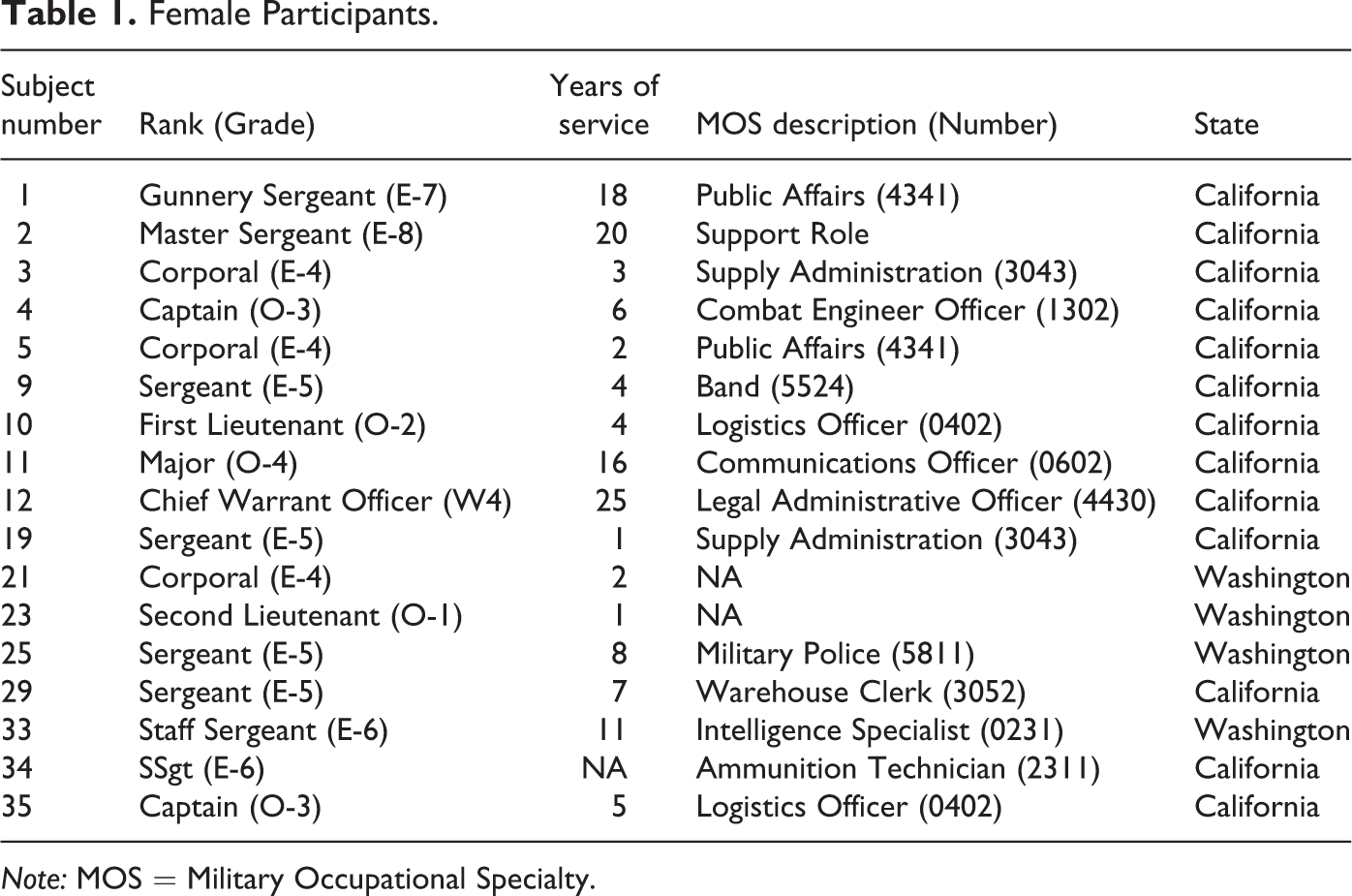
Note: MOS = Military Occupational Specialty.
Male Participants.

Note: MOS = Military Occupational Specialty.
I visited two stateside USMC bases in California and five recruiting stations in Washington to collect interviews. 34 Because building rapport with Marines is crucial for a candid interview, a randomized sample was impossible. Marines would not participate in an interview unless a fellow Marine referred the interviewer to them and they trusted that their identity would remain anonymous. The results are drawn from a snowball sample; that is, the first Marine interviewed identified another Marine that would participate in the project, who would later identify another candidate, and so on. In order to mitigate bias, I oversampled females and selected interviewees based on attributes absent from the sample.
Qualitative data were collected through structured in-depth interviews. All interviews were conducted and transcribed between April and December 2009. A list of open-ended interview questions was prepared before any interviews were conducted. Although a core set of interviewing questions was asked consistently, some questions were added or omitted depending on the Marine’s rank, MOS, education, or background (e.g., prior enlisted officer). Table 3 lists questions used for participating Marines.
In-Depth Interview Questions.

The average length of an interview was forty minutes. The shortest interview was twenty minutes and the longest interview was two hours. Four participants (all male) abstained from answering several (predetermined or probing) questions that made them feel uncomfortable. 35 All participants were asked before the interview if it could be recorded. In cases where they consented to being recorded, the interview was later transcribed and a copy was distributed to interviewees that requested it. All participants were assigned subject numbers to ensure anonymity.
Every interview (N = 35) was coded according to categories and themes that became apparent throughout the interview process. 36 While many responses to questions were coded in a presence/absence fashion, categories were often identified in initial interviews, and then those categories were tested and revised in later interviews. Coding ranged from demographic information and information pertinent to the USMC (e.g., combat MOS), to references made regarding stereotypical images of the female Marine (e.g., dyke, easy, or bitch), as well as the frequency of positive and negative female Marine anecdotes. 37 Appendix A lists the themes and categories coded for in each interview. The unit of analysis for this study is the participant’s interview (N = 35). The recording unit of analysis ranges from single words to entire paragraphs. Intracoder and intercoder reliability were calculated at .95 and .88, respectively. 38 These measures ensure, at a minimum, that separate interview coding agreed 88 percent of the time.
I choose to apply ethnographic content analysis to the small sample of interviews. This approach “does not avoid quantification but encourages content analysis accounts to emerge from reading of texts.” 39 Meaningful statistical analysis cannot be applied to a sample of thirty-five interviews; however, I quantified dimensions of the interviews to make sure the emerging patterns were real. Tables of frequencies and basic descriptors present loose quantitative analysis that guides the qualitative discussion. Ethnographic content analysis elevates the narrative and thick description. Since this is the comparative advantage of the project, I present a qualitative analysis that fleshes out the quantitative findings.
Results and Discussion
Themes regarding the origination, socialization, and reinforcement of gendered stereotypes in the USMC emerge through the interview process. Four significant themes include (1) how stereotypes influence the perceived abilities of female Marines, (2) how stereotypes influence the initial socialization of Marines, (3) how stereotypes influence camaraderie and opportunities for female Marine mentorship, and (4) how stereotypes solidify a culture of double standards. Overall, each theme suggests that male and female Marines perceived themselves as different. Those differences, in turn, generally illustrate that the indiscriminate application of traditional gender-role stereotypes have the potential to disrupt a servicewoman’s performance in fundamental ways. Rather than focusing on the absolute differences between men and women on any given measure, I report general patterns generated from the analysis of thirty-five interviews.
Influence of Gender Stereotypes on the Perceived Abilities of Female Marines
Gender is a significant element used to understand at least three dimensions of advantage in the military. 40 First, the organizational structure of the military is based on the dimensions of power and opportunity (division by hierarchical rank) and occupational structure (gendered division of labor). Female exclusion from any combat MOS precludes them from serving in the most elite jobs, and therefore, there are distinct gender representation patterns in various military sectors. Second, the military is a numerically male-dominated institution, where men almost exclusively fill MOS’s that are related to the core functions of the military. Having jobs that are closely related to war fighting often confers more prestige, more rewards, and possibilities for faster rank advancement. Finally, “hegemonic definitions of the military conflate with hegemonic masculine culture and ideology, even if such construction is subject to historical change.” 41 It follows, then, that the military is an enduring source of normative conceptions of gender. 42 However, the reinforcement of gender-role expectations could be societally driven rather than institutionally driven. Societies proscribe socially constructed gender-role expectations for behavior, and what is appropriate for men and women is learned early in life and are reinforced by various social settings (e.g., the military). 43 The military undoubtedly inherits some of these notions from society. I argue, though, that the military is not a passive recipient of social conditioning. The military creates gender-role stereotypes around their activities, and the institution is an active producer of text and materials that reflect gender-role stereotypes. Not all braches of the US Armed Forces hold identical sentiments, but the reinforcement of gender-role stereotypes in the USMC context is evident through a close reading of the interviews.
Male respondents expressed that what motivates men to join the USMC does not motivate women. A male captain stated that it’s natural for him to “want to fight, [and] want to kill;” the “warrior-protector is in all males,” but did not think it was in women.
44
Furthermore, he claims that “the male warrior mentality is set up to accomplish what the Marine Corps’ congressionally mandated missions are—to be a force in readiness. That is compatible with who [he is] at a base level . . . [but] a female asked to behave that way will not necessarily be acting true to her nature.” In the mind of this captain, the behavior of men and women are fundamentally different. He candidly states: I look at male Marines as simple creatures like myself . . .There are two things that motivate men: they want to kick some ass and get some ass. And that’s all that motivates them and they join the Marines to have opportunities for both—to get out of their small town . . .and be able to make money so they can show up the chicks in town. That’s just what motivates them. To be again perfectly blunt, in my mind to understand males, and which helps me understand even myself, is we operate on a cycle: hungry, horny, and sleepy. You know, when I’m tired don’t mess with me and when I’m hungry the same thing. And when I’m fed and I’ve slept, there’s only one thing on my mind. Now, that’s an oversimplification, but you’ll find when you use it you really understand both males in general and my Marines. That’s not the same with females, [I have to wonder] why [they are] here? But, with the males [it] makes perfect sense to me.
45
According to this depiction, men and women are simply wired differently, which results in disparate desires and responsibilities. Several male Marines mention they feel an added duty to defend female Marines while deployed because of their “protector” status. A master sergeant recalled feeling that he had “double duty” while deployed: It’s sort of the Marine Corps’ doing, if you will. And and a lot of us come from small towns and [have] hometown values about protecting your sister, your mother and all this kinda stuff. You’re the guy. You’re supposed to be, [the protector] . . .I do believe that we are double protecting, if you will—[doing my duty as a Marine and protecting the woman next to me].
46
A male lieutenant colonel echoes this sentiment: …males are typically protective of the female and [this feeling results from] part of that macho image . . . of being the protector of country, family, [and], corps . . . I think most male Marines would feel ultimately responsible or more responsible for that female [than a male in the case of death] . . . That’s [a] personal [belief] obviously.
47
The master sergeant’s need to protect female Marines around him assumes that women cannot protect themselves. The lieutenant colonel, alternatively, articulates an added anxiety and responsibility if his female counterpart were to be killed in action alongside him. Placing women in a “protected people” category may also be a subconscious strategy to distance himself from feminine identities. His identity as a man cannot be called into question if he is fulfilling the “protector” gender-role stereotype. These interviews, then, confirm the work of Arkin and Dobrofski, where highlighting some identities works to reinforce military masculinities. 48 The belief that men are the sole guardians of women could have a real impact on the lives of deployed Marines. Taken to the extreme, where female Marines are seen as a distraction in combat, the anxiety that rises from the added duty in combat could put their own lives and the lives of others in danger.
Interestingly, female officers agreed with their male counterparts to the extent that they understood a real difference between male and female Marines. Though they did not express ideas of gender being incompatible with the USMC mission, they did express the notion that the male and female motivations to act stem from different sources. While both men and women experience similar emotions, capitalizing on that emotion to affect an end is different. A female major discusses the hypothetical difference between convincing men and women to participate in combat: …it’s good [that] women and men are different. We’re different physically [and] we’re also different emotionally. And what I mean by that is that the man has the same ability to tap into the same emotions that a woman does . . . A guy can feel pain, a guy can feel hurt, a guy can feel all those things. Women do as well. But we think emotionally . . . I’ve said this before to other Marines because they [didn’t] get it. I said, look, we tell a guy to take the hill in combat, everybody’s on the hill [yelling] “argh, argh, argh! We’re gonna take the hill. After ‘em!” You know, it’s that natural instinctive emotion that a man [has to] take the hill. [He believes] we can get the hill, [w]e kill ‘em, we beat ‘em, and all that other stuff. You tell a woman to go take the hill and a woman [says], “why do we need to go take that hill?” She thinks about it differently than a guy. A guy’s motivation is different than a woman’s motivation. You get a woman to believe in taking that hill, she will be on that hill and she’ll die on that hill before she gives up the hill. We’re emotionally different. A guy will attack the hill for a different emotion than a woman will [attack] . . . Once she believes in the cause, she’ll die for the cause. It’s just a matter of tapping into those [different] emotions and . . . strengths.
49
This major notes that women can fight just as hard as male Marines—the rub is tapping into those emotions that elicit a reaction. For men, it is “adrenaline rushing” and for women, it is “processing the situation.” The end goal (i.e., the fight) is the same, but the process getting to the fight is different. Visualized this way, women remain different but not in a way that makes them incapable of embodying the warrior spirit as some male Marines might claim. Overall, it seems that male Marines largely acknowledge that this difference is at best confusing and, at worst, distracting. Women, on the other hand, feel that men and women are similar but acknowledge that accessing specific attributes (e.g., emotion) to achieve a desired outcome is different. Seeing one another as different may have ramifications for unit cohesion and working effectively together outside of the wire.
Influence of Stereotypes on Initial Marine Socialization
One of the most interesting patterns that emerge from the interviews is the way in which female Marines describe their personal image of the female Marine. “Easy,” “bitch,” and “dyke” are the most common adjectives used by female Marines to describe their same-sex peers. This finding is documented in Table 4. In many cases, female interviewees phrased their responses identically. After recognizing this unexpected trend, I pushed the sixth participant to explain where she first heard the typology. Without hesitation, the corporal stated that she was explicitly told in boot camp that there are three female typologies: [Drill instructors] tell us . . . you’re [either] a bitch, a slut, or a dyke. It’s one or other so [if you’re a bitch] . . . you’re mean and nobody likes you . . . and usually these are the female Marines that do well in the Marine Corps. There’s ones that sleep around and [they get labeled the slut]. And then there’s . . . dyke[s] who are basically like the men. They tell you which one you wanna be and . . . you wanna be the bitch.
50
Frequency of Reported Stereotypes of Female Marines.
Note: The most common stereotypes presented in interviews are listed as column titles. The final column represents those who did not provide a response because they deemed their response to be inappropriate. The most common responses for male and female Marines are italicized. Participants may have provided only one stereotype or provided up to nine in a given interview.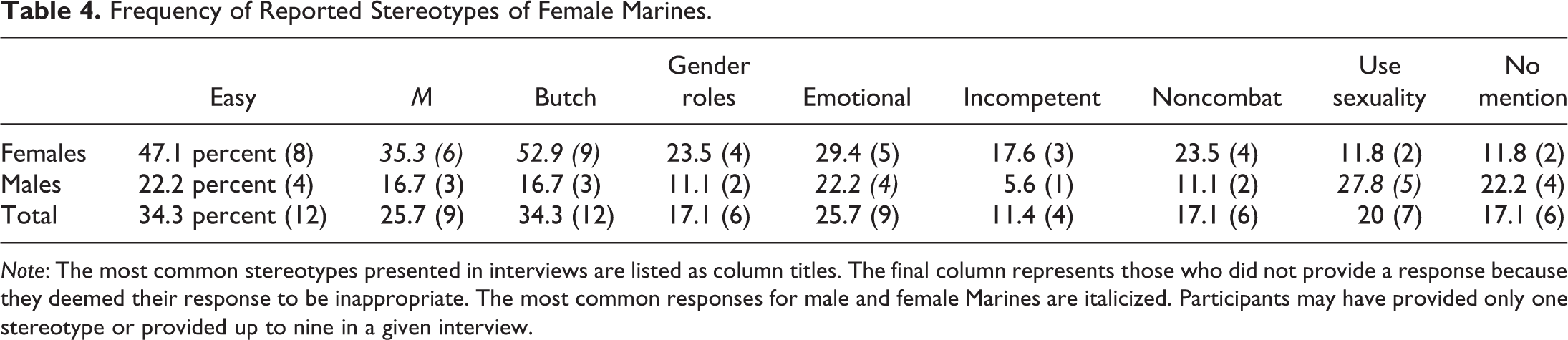
This typology is described to female recruits by superiors “offline,” or outside a formal setting. Of the female officers interviewed, prior enlisted officers noted having been told this. One female officer noted having heard the same conversation at Officers Candidate School. This indicates that female enlisted recruits and officer candidates hear the same warning despite having different initial experiences. When asked if the female officer was ever “taught” about issues female officers confront in the USMC, she stated: I remember at one point our senior sergeant instructor pulled us all in and she [said] . . . ‘ladies, I’m gonna level with you . . . in the Marine Corps as a woman you are one of three things. You’re either a dyke, a bitch, or a ho. And she said you just need to make up your mind which one it’s gonna be because that’s what you’re gonna be cast as.’ And I felt like . . . that’s very limiting, but if that’s the perception then that’s what you’ve gotta live with . . . acknowledging that it’s out there and accepting it [allowed me to say], “okay, it’s out there, ignore it, and then move on…
51
The literature notes that variable archetypes of servicewomen exist, but archetypes depicted in the literature are different from those described by women interviewed here. Though scholars have noted several female archetypes, two are most applicable: women as (1) sexual objects and (2) protected people. Emphasizing the abuse of women as sex objects is thought to eradicate doubts about the gender identity of the serviceman employing the stereotype. 52 The use of sexual violence in war creates women as targets to be psychologically destroyed by the enemy. While I make no claim that our military engages in this behavior as a tactic of war, women have been the objects of sexual violence in other parts of the world and within our military. 53 Enloe notes a “significant increase of sexual assaults perpetrated by American male soldiers against American women soldiers.” 54
The “protected woman” archetype highlights women’s roles as nurturing mothers and men’s roles as strong warriors. Though this category appeared in the last section and was discussed by only male Marines, female Marines did not identify this archetype as applicable to themselves. These archetypes may explain the “othering” of women in different parts of the world, but the female Marines interviewed here see negative categories relevant to personality (e.g., mannish, sexually coercive) as having damaging repercussions for their USMC careers. Regardless of category, each archetype communicates that the very presence of women is disruptive. 55
Tellingly, before ever interacting with a male Marine (USMC basic training is sex-segregated), female recruits learn that they will be stereotyped. A defining recruit experience is the realization that as servicewomen they have additional obstacles to overcome in order to be accepted by their male counterparts. While their high ranking and respected instructors do not ignore the realities of their being female Marines, it is significant that women are advised to choose what is a negative persona. Yet, female Marines are still more likely than their male counterparts to depict fellow female Marines in positive ways. For example, subjects 2, 10, and 12 described female Marines as “hard charging,” “squared away,” and “strong,” respectively.
The sample of women in this study generally claim that while Drill Instructors (DI) influence the recruit’s view of the “female Marine,” they generally do not believe that DIs have a hand in actively perpetuating stereotypes of the female Marine. When asked if DIs actively spread stereotypes, a female corporal said: [Our senior Drill Instructors just] talked to us about some of their experiences being a female Marine, being compared to the males, and what it’s like [in the fleet] with male Marines . . . .because it’s different [after boot camp]. [For example], they [said] females tend to run slower. And, so they told us how to get past that. They said, “just keep working, don’t let them get to your mind. If they get to your mind, that’s what’s gonna tear you apart.”
56
In this excerpt, the senior DI brings up a gender stereotype about female Marines, but no attention is paid to the stereotype itself. The focus is on how to overcome the criticism and to psychologically remain strong in spite of it. This curious contradiction—that DIs influence but do not actively perpetuate stereotypes—may arise from female Marines excusing DIs for having to tell it like it is. To say someone is perpetuating stereotypes is to place blame. Rather than placing blame, they appreciate the DI’s warnings because it may help them survive in the fleet. This appreciation, I believe, is reflected in the previous interview excerpt 57 where that first lieutenant acknowledges that the realities of the USMC culture allowed her to ignore the negative stereotypes. Overall, these female Marines are less inclined to claim that the USMC culture perpetuates stereotypical images of women (as compared to male Marines). Because DIs are the immediate teachers and exemplars of USMC culture, it seems that “perpetuating stereotypes” and “influencing Marines” are one and the same. That said, more women than men make a distinction between the two. Also, while few female Marines provided answers regarding what they believe is responsible for perpetuating stereotypes, those who did respond claimed that the ignorance of fellow Marines generally, and the bad behavior of some females Marines particularly, perpetuate negative stereotypes. Table 5 demonstrates this finding.
Frequency of Reported Sources That Perpetuate Stereotypes Relevant to Female Marines.
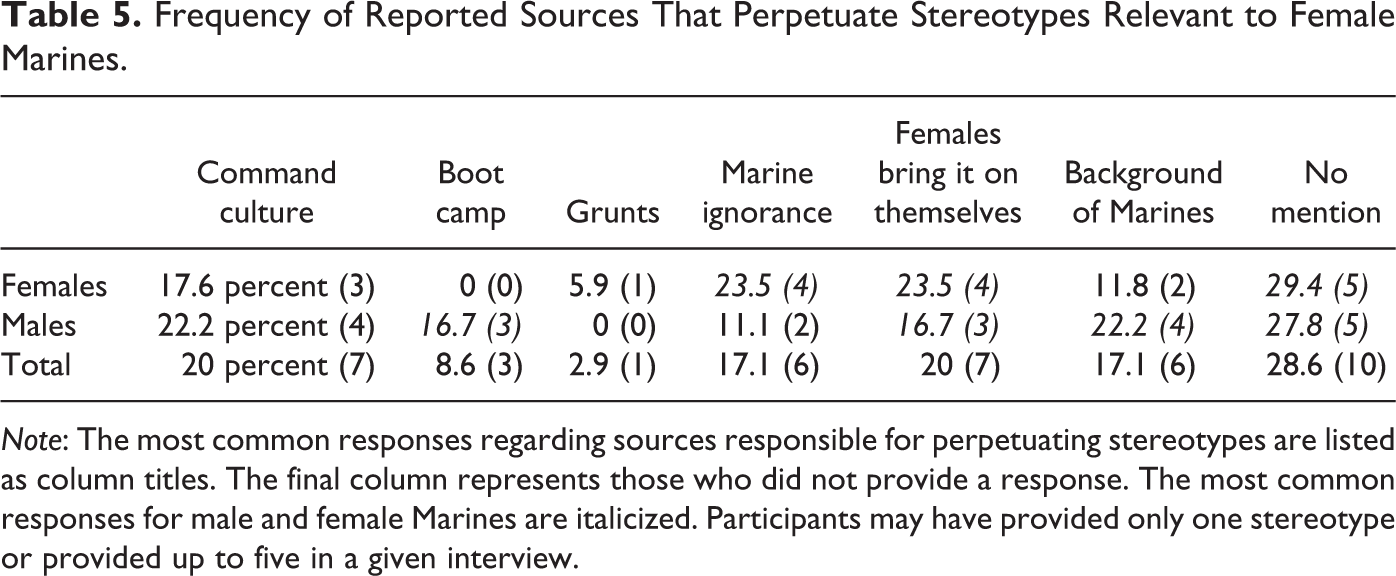
Note: The most common responses regarding sources responsible for perpetuating stereotypes are listed as column titles. The final column represents those who did not provide a response. The most common responses for male and female Marines are italicized. Participants may have provided only one stereotype or provided up to five in a given interview.
Conversely, when males are asked to describe their image of the female Marine, the most common responses are “easy,” “emotional,” and “sexually coercive” (Table 4). Men in the sample claimed that female Marines use their sexuality to their advantage more than their male counterparts. Male recruits also are reportedly influenced by their DIs early on in their USMC career. Several participants reported hearing that women are dangerous and have the power to end a male Marine’s career. According to a male captain, all recruits are warned about women at some point during boot camp. He recalled the first time he heard it: I was told by another [Marine] . . . when I was dating [a female Marine] to get away from them, they’re trouble . . . You date one, they make an accusation, facts not mattering—you’re done. Your career is over.
57
A staff sergeant echoed this statement and added “what a male Marine might think of as harmless, a female Marine could misconstrue and get the male Marine in trouble.” 58 In yet another instance, a male sergeant claimed that “boot camp DIs go out of their way to make you scared to deal with females because of the repercussions.” 59 Relatedly, several female Marines indicated they were aware that male Marines hear these warnings.
This pattern is noteworthy because such behavior is detrimental to community building. If men are taught that women are not part of the team, it is unlikely that male and female Marines will be able to work cooperatively together while stateside or deployed. If female Marines, on the other hand, anticipate being marginalized before even joining the fleet, women could be handicapped in profound ways—that is, they may have a deflated sense of self, limited understanding of how to be a successful female Marine, and a sense that they will truly never be members of the gun club.
Influence of Stereotypes on Female Marine Camaraderie and Mentorship
An overwhelming majority of female Marines recalled between one and three negative anecdotes about their female peers based on their USMC experience. An anecdote is defined here as an unsolicited narrative of an incident they found relevant to a point they wanted to make (biographical in nature). Almost every female Marine (with the exception of two) brought up the issue of camaraderie among women in the USMC. Though several thought camaraderie was apparent, most women reported that no real sense of camaraderie exists among females. 60 Sisterhood does not exist as brotherhood does for males. I speculate that women do not feel a sense of sisterhood because they are often competing against one another. This competition is not sexual, but professional; that is, a female Marine wants to be seen as a more competent Marine than the woman standing next to her. Men arguably do not feel the pressure of this kind of competition to the extent that women do around their female peers. This may be due to the fact that women are tokens and the most visible minority in the USMC.
One female corporal noted a lack of camaraderie starting in boot camp. She recalled her experience at Parris Island as evidence that her platoon did not feel the same type of cohesiveness as her male counterparts did. Every moment “was a competition where [females] were vying for the ‘top dog’ position . . . or to be the toughest recruit. There was never any sense that we were friends.”
61
When asked if a sergeant experienced camaraderie with other women in her four years as a Marine, she expressed that there is more competition than camaraderie among females. She stated that competition was a function of having so few females around. She said: There’s competition. I don’t even think it’s over finding a mate or anything sexual like that . . . First of all you don’t want to be the piece of shit female, and second, even if you’re not a piece of shit, you don’t want to be the low man on the totem pole.
62
A second lieutenant voiced the same issue: Because as 6% of an organization, every single female Marine is a representative of all female Marines. So you’re charged with a little bit [more] . . . you perceive greater responsibility because you have to be perfect. [If you’re not perfect], you’re screwing over the rest of the females coming before you. From then on, [when] you see a really jacked up female Marine, you get really pissed off . . . and that reflects badly on you.
63
These recollections demonstrate the idea that females generally try to disassociate themselves from other female Marines. Women have to over-perform just to be considered equal to their male counterparts. The pressure to constantly overperform is stressful enough for the targeted Marine, but this stress is often felt simultaneously with other stressors related to the military context (e.g., confronting unwanted sexual advances, masculine features of the institution, etc.). 64 Compounded stress in this form is specific to the female Marine experience.
While female enlisted personnel and officers expressed a lack of camaraderie or sisterhood, most female officers noted there is little to no mentorship for female officers specifically, or female Marines generally. A female chief warrant officer responded this way when asked if she experienced any mentorship in her twenty-five-year career: I don’t know that there is [any mentorship for female Marines]. When I first transitioned from the enlisted side to the officer side, I didn’t have any mentorship. I think part of that was because I was a single female. When you’ve had the scandals with the male officers mistreating the females at conferences, everyone kinda panics. They say “Oh you know, I can’t do this with women,” so I didn’t get any mentorship. All my male counterparts were taken under the wings of senior male officers. They were mentored but I haven’t had any.
65
This woman recognized that male Marines can serve as role models and mentors for female Marines. However, many male Marines are reluctant to take on this role because they might be accused of giving special attention to a female Marine. 66 Also, a female captain 67 and a female major 68 reported that there are so few females in leadership roles that it’s very rare to have senior females able to mentor. These female Marines reinforce Michele Putko’s contention that low visibility is disparaging since “seeing few females ‘at the top’ has a dramatic effect on the entire female [Army] officer population.” 69
The lack of camaraderie as a pattern is of concern because females often see other females as competition rather than as members of a supportive network. For female Marines, there is no “safe zone.” Whereas men have other men to confide in, and visualize brotherhood to be a large part of the Marine Corps experience, women are individuals tied to no such idea. Several women mentioned sisterhood, but felt the notion of a sisterhood could not compete with that of a brotherhood. When asked if women experienced sisterhood to the extent that men felt the bonds of brotherhood, a female sergeant said that “. . . women tend to be territorial or have jealousies . . . and [she didn’t] think [they] come together like [they] should, to hold it down for one another.” 70 A young female corporal noted the same female behavior and said there was effort in creating female camaraderie at boot camp, but it “wasn’t [felt] by the whole platoon. It [was just] a few of ‘em.” 71 A first lieutenant went as far as to say that naïve young Marines (freshly graduated from high school) have compromised their integrity because they so “desperately want to be a part of this brotherhood.” 72 If female Marines do not feel a sense of community and there are no mentors in place to reinforce the notion that the community wants them to flourish, female Marines might cut their careers short. Michele Putko certainly worries about this issue. She asks, “why should female officers desire to serve . . . where there seems to be reduced opportunities for advancement and where they cannot be part of the mainstream?” 73 Yet, in an era where volunteers are critical to fill the ranks of any military service, any loss could put mission success at risk.
Stereotypes and the Reinforcement of Double Standards
As compared to enlisted Marines, officers are more likely to suggest that equality between men and women is practiced in the USMC. Despite this officer-enlisted disparity, every female officer described at least one double standard she had confronted personally or seen another female confront. Leadership double standards are a primary frustration for women in the USMC and their application can negatively impact women. 74 The following three examples come from women of different rank, and all examples comment on a woman’s approach to leadership.
A female captain, active in the USMC for approximately six years, noted that there is a fine line between being considered emotional and tough. She recalled: …As a woman you have to be careful because if you raise your voice you get labeled as emotional. When I was going through the basics school [as] a platoon commander . . . there [were] times I had to lock on marines. [I] would not scream and yell, but I [was] very firm . . . If I raised my voice they would say, “oh, she’s getting emotional.” But if another guy raises his voice, he’s putting Marines in their place.
75
As noted in the introduction, if civilian female leaders do not balance their approach between “too weak” and “too aggressive,” they are seen as less effective. The aforementioned excerpt clearly reinforces Sanchez-Hucles and Davis’s findings. This issue could potentially make leading a platoon more difficult, particularly if a female Marine’s approach to her platoon is not taken seriously by her subordinates or peers. In terms of other leadership issues, a master sergeant recalled a moment when her leadership style was called into question: …There was a male Marine that was the same rank as I was that worked in the same office and at that time I was having a lot of male and female marines coming to me just [to] talk about military issues. They wanted some counseling or someone to talk to. This same male Marine would have people come and talk to him as well. Well, when they came to talk to him it was considered counseling. When they were coming to talk to me, it was considered socializing and I did way too much socializing . . . So, I was actually [reprimanded] for being too social.
76
Her professionalism was called into question because her behavior was recognized as fulfilling a feminine gender role. However, since “socializing” is not considered a male attribute, her counterpart received no reprimand. Had this issue been documented in writing (e.g., nonjudicial punishment), it could have affected her professionally by endangering her future promotions. Additionally, one could imagine the repercussions for Marines under her supervision. If she deprived her subordinates of the attention they deserve because she worried that her peers would judge or reprimand her, she would be doing a disservice to her Marines. This type of monitoring does not allow women to be mentors in the deepest sense because they are constantly censoring themselves. As a consequence, a woman’s ability to effectively lead Marines could be severely limited. Self-surveillance may be one mechanism for perpetuating gendered stereotypes.
Finally, a first lieutenant described a double standard that a fellow female officer confronted. She explained that her friend, a first lieutenant, was preparing her platoon (special operations, support role) for an exercise in Southeast Asia. While debriefing her platoon on the exercise, she was informed that her platoon would be led by a male first lieutenant once in country. She recalled her friend’s explanation of the situation and her own reaction: They’re gonna give my platoon to some other lieutenant in-country because the locals don’t believe in female officers, or the female camp is really far away or something like that, some bullshit thing that could’ve been resolved at the command level had somebody tried . . . I know how I would’ve felt if I’d trained my Marines, prepped them, and then told somebody else was gonna lead them. Oh, no! I don’t think so. That was really hard on her and it’s taken her almost nine months for her to be acknowledged and accepted . . . The fact that they would let someone else take her platoon just blows my mind. It would never happen to a guy, ever.
77
This account highlights several problems female officers face exclusively. First, having a platoon pulled from her command is debilitating and could be considered career ending. Second, the officer described had a difficult time rebounding from issues out of her control, which may lead her to question whether her superiors accept her as a full member of the officer corps. Finally, this behavior can pose insurmountable problems for her platoon—that is, confidence in their leader will be irreparably damaged and a trusting relationship between the new officer and Marines will not exist. Such actions are bound to negatively affect unit cohesion, morale, and the effectiveness of the unit as a fighting force. At bottom, questioning the ability of a leader based on gender may compromise the USMC’s ability to successfully complete missions.
All four themes borne from the interview analysis speak to the power of USMC gender-role stereotypes. Gender is continually and actively negotiated by men and women, and is always measured and related to “both their physical embodiment and social structures within which they live.” 78 Because gender is relational, masculinities are always constructed in opposition to femininities. This could lead one to conclude that women and military careers are mutually exclusive. This becomes clear when interviewees claim that some behavior is “natural” to women, that women fit cleanly into three distinct archetypes that explain their behavior within the USMC, and that some leadership styles are incompatible with the military context. These concerns have implications for camaraderie, shared sense of mission, unit cohesion, and successful leadership.
Conclusion
The roles and opportunities available to servicewomen have expanded since the late 1980s. Despite this, equal rights legislation in the US military context is steeped in contradiction and confusion. In 1988, the Combat Exclusion Policy was codified into the “Risk Rule,” which standardized procedures that excluded women from serving in combat roles. 79 Three years later, Congresswoman Pat Schroeder presented a measure to the House Armed Services Committee that would allow Navy and Air Force servicewomen to fly combat missions. The measure passed and the Defense Authorization Acts of 1992 and 1993 provided women with this opportunity. 80 The following year, the Risk Rule was repealed in response to the changing nature of warfare—that is, asymmetric war had eradicated the notion of “front lines.” The 1990s represented a period where opportunities for women to serve their country expanded greatly.
In 2005, Congressman Duncan Hunter introduced a bill “requiring the Army to restrict women from the front lines ‘. . . in Heavy Infantry Brigade Combat teams and equivalent elements of Stryker Brigades, a total of 21,925 spaces currently open to female soldiers would be closed.’” 81 In response, General Richard Cody, Army Vice Chief of Staff, noted that the asymmetry of war continually put servicewomen in harm’s way and that passage of the amendment would send the wrong message to soldiers currently fighting. Hunter reluctantly withdrew the bill and at the end of 2005, “Congress passed compromise legislation that required the [Department of Defense] to notify [Congress] within 30 days if women were being assigned or collocated with ground troops on the front lines.” 82 Most recently, in February 2012, the Pentagon announced plans to open more combat positions to US servicewomen. Some 14,000 positions will open for women, but “about one-fifth of active duty military positions, including the infantry, combat tank units, and Special Operation Commando units, will remain off limits.” 83
This brief discussion of equal rights legislation illustrates that women have made clear advances, but the current terminology used to describe their involvement in war as either “attached,” “assigned,” or “collocated” obscures their true service roles in combat. This language persists in part because of the ways in which gender roles are constructed in the military context.
The discussion of gendered stereotypes and their relevance to women in the US Armed Forces continue to be important, especially as their role in the military continues to expand. Since women are considered a growing minority in the military, the institutional changes that accompany greater proportional representation will require scholars to look at how the changing military negotiates what it means to be a serviceman or a servicewoman. 84 The strength of such a project lies in the insights to be gained about how gender-role stereotypes have the potential to undermine the success of female Marines as they move through different stages of their careers and development.
Two primary questions were examined for this project: (1) whether male and female Marines perceive one another as different and (2) whether those differences are detrimental to the experience and performance of female Marines generally. Four themes emerge from the interview analysis that provides answers to these questions. The themes suggest gender-role stereotypes’ influence: (1) the perception of female Marines’ abilities, (2) the initial socialization of Marines, (3) the camaraderie and mentorship female Marines do or, as the case may be, do not experience, and (4) a culture rich in leadership double standards. The perception of women’s abilities and initial Marine socialization illustrate that stereotypes inform how women are perceived by their counterparts and how they conduct themselves in various situations. Being constrained by gender stereotypes negatively impacts the dynamic between male and female Marines. The interview analysis reinforces this idea consistently. Moreover, female Marines report feeling less camaraderie and have fewer mentorship opportunities compared to their male counterparts, and regularly confront double standards due to the application of gender stereotypes. In leadership positions, these experiences can negatively impact not only the subject, but also her subordinates.
Gender-role stereotypes applied to women highlight feminine characteristics in opposition to masculine characteristics. Stereotypes that depict women as overly emotional, using sexuality rather than professionalism to affect an end, and evoking “facilitative” feminine leadership styles seem incommensurate with the USMC’s masculine identity. While there are different masculinities within the US Armed Forces, there is a military masculinity that constructs the “military man” as unemotional, brave, psychologically fit, and ready for action. Some men might not see that description as applicable to themselves, but they recognize it as an ideal and are complicit in reaping the rewards of the militarized masculine ideal since they do not challenge the model. 85 The hegemonic warrior model, then, might be partly responsible for the constant appeal to gender stereotypes of women even in the face of superb performance by servicewomen. The constant reference to military masculinity, I speculate, has enormous implications for servicewomen broadly, and female Marines specifically.
The constant appeal to gender-role stereotypes may have especially troubling implications for servicewomen with regard to camaraderie, shared sense of mission, and leadership. First, if stereotypes are evoked to illustrate that men and women are uniquely different and have different experiences, camaraderie more inclusive than brotherhood will not exist for women. Even if brotherhood is an imagined community, women may still feel like outsiders with no access to it. This could lead to a sense of alienation which ultimately has negative affects on performance and feelings of self-worth. Second, servicewomen may become frustrated if there is no sense of shared mission. Evinced by these interviews, some male Marines perceive their responsibilities as doubled because they have to fight the enemy while protecting the women they fight alongside. However, Marines are trained to engage in mutual protection—specifically, they will protect their team members and are confident their team members will protect them. Losing confidence in this expectation can lead to the degradation of unit cohesion and increased anxiety. Finally, women in leadership roles are important in the military context, but they continually encounter resistance to their leadership style thanks to gender stereotypes and expectations. If this is the case, and fewer servicewomen fill these positions, some may wonder whether the military context is one that allows the careers of servicewomen to grow and thrive. As the United States becomes involved in different kinds of conflict, having diversity in leadership styles may well prove critical to mission success.
Despite an interviewed sample that is not representative of the entire USMC population, the results obtained corroborate previously reported analysis. 86 They point to the USMC having two options: (1) prohibit women’s participation in the USMC or (2) create an environment that unites rather than divides. The first option is, of course, not an option—the US Armed Forces needs women to fill its ranks, and, based on their superb performance, nothing could justify prohibiting women from serving their country. The second option, then, must be embraced. Though the propagation of gender-role stereotypes by society is a constant, the content of those stereotypes is subject to change. The USMC could lead this change by creating an inclusive culture through two methods. First, the teachers of USMC culture (e.g., DIs) must eliminate the informal discussion about traditional gender-role stereotypes. DIs should, alternatively, convey a narrative of “sibling-hood” rather than “brotherhood.” Second, female Marines must move away from their token status and become more visible, creating a sense of normality. Studies show that as female numbers grow in a given context, women are perceived by their peers to be better and more competent leaders. 87 The visibility of female Marines could be the one step that affects the most change. Specifically, more women could mean that female Marines see their participation as a significant contribution appreciated by their peers and less as a competition with other female Marines. Furthermore, they would see the USMC environment as one where their advancement is not only possible, but also desirable and needed. With more female Marines come more opportunities for mentorship and leadership, leading to a normalizing, snowballing effect.
Servicewomen are considered a necessity in today’s US military. John A. Nagl, former President for the Center of a New American Security, believes that “we literally could not have fought [in Afghanistan and Iraq] without women.” 88 With necessity also comes opportunity. As the USMC confronts new types of missions, female Marines must recognize themselves as playing an integral part in our nation’s security. 89 Male Marines must also recognize that female counterparts are critical and will remain critical components of mission success.
Footnotes
Appendix A
Acknowledgments
Thank you to the United States Marine Corps and the many Marines that participated in this project. I d also like to thank Rose McDermott and M. Kent Jennings for their invaluable guidance with regards to this research. To Patricia Shields, two anonymous reviewers, Nancy Wilson, and Astrid Virding, thank you for your helpful comments and editorial suggestions.
Declaration of Conflicting Interests
The author declared no potential conflicts of interest with respect to the research, authorship, and/or publication of this article.
Funding
The author received no financial support for the research, authorship, and/or publication of this article.