



Abstract
This article gives an overview of how civilian control of the military in Slovenia is implemented in practice. It utilizes the perspective of the controlled entity itself, that is, the Slovenian Armed Forces. The findings show the type and characteristics of civilian control in Slovenia and how they hinder military effectiveness. As one of the European transition countries to have concluded the democratization of its civil–military relations, civilian control over Slovenia’s Armed Forces is now in place; however, the control mechanisms have had several debilitating effects on the country’s armed forces—the democratization of civil–military relations has been achieved at the partial expense of military effectiveness. Because of this experience, the Slovenian case could serve as an example of how successful democratization of civil–military relations can sometimes produce negative outcomes, or collateral damage, for the military, especially when the employers of the control mechanisms are not aware of the effects that the exercise of their control might have on the military’s ability to execute core missions. Methodologically, this article brings an approach for analyzing interrelations between civilian control and military effectiveness.
Introduction
The democratization of civil–military relations was one of the most important aspects of transforming the political systems of the former Yugoslavia and Eastern Bloc states. The process started in the late 1980s and is ongoing. Regarding the transition countries, the implementation of democratic values into civil–military relations is believed to have been completed. 1 Civilian control over the armed forces and separation of the military from politics is no longer an issue, but the effective management of defense and security sectors remains important. 2 The democratization of civil–military relations in Slovenia has been successful; 3 however, some indications show that the implementation of civilian control could jeopardize the military’s fulfillment of obligations having an impact on its performance. 4 In this respect, Slovenia could serve as an example of some negative consequences of the democratization of control, particularly when civilians forget to account for the military’s needs in establishing itself as an effective force for pursuing its constitutional and legal roles.
In presenting the results of a case study of civilian control over the Slovenian Armed Forces, this article provides insight into civil–military relations from the perspective of the controlled itself, that is, the military. The general hypothesis is that unresolved problems in the first-generation civil–military relations, as well as deviations within the second, require from the military a constant reappraisal of its performance, leading to a risk of reduced legitimacy, credibility, and the ability to execute its core mission.
By the analysis of constitutional, legal, and other normative foundations that defined the implementation of institutionalized civilian control, an answer that determined whether the first-generation problematic in Slovenia has been resolved. This case study uses extensive document analysis to identify the characteristics of civilian control in practice, as well as how they relate to military effectiveness. 5 The leading questions were whether the military gets from civilians what is expected, and whether it enjoys professional autonomy, as well as how the use of control mechanisms impacts military effectiveness.
Samuel Huntington’s theory of objective civilian control over the armed forces is used as a conceptual framework. Although the theory has been critiqued by many authors, 6 the message is still relevant: objective control supports the military profession, its effectiveness, and provides for professional autonomy as a prerequisite. The existence of institutions with clearly defined roles and responsibilities that are well understood and executed is a precondition for objective civilian control over armed forces.
Civilian Control and Military Autonomy
Civilian control is the center of gravity in civil–military relations. The main task for civil authorities in this respect is maintaining civil superiority over the military and the development of stable civil–military relations within society. Control is dependent on the methods civilian authorities use to implement control mechanisms. They then try to balance the requirement for military subordination to civilians with the requirement for a strong and effective military capable of providing security for the country. It is also dependent on the way both actors in civil–military relations execute their own responsibilities and fulfill their own roles. In general, civilians look on control from the perspective of military subordination and political neutrality; the military, on the other hand, looks on it from the perspective of effective mission execution and freedom of action. The paradox “strong enough to do anything asked and subordinate enough to do only what is authorized” 7 is the possible reason for deviations in civil–military relations and the reasons for the different views of how successful civilian control is.
For control to be objective, it is important that civil authorities recognize and accept professional military competence and professional autonomy, abstaining from political intervention. Military effectiveness is fostered by political neutrality and the professional autonomy of the armed forces. 8 Civilian respect of military competences and professional autonomy has a direct impact on the military’s behavior and its effectiveness. It defines how the military perceive objectivity and “fairness” of civilian control. Although the military and civilian spheres overlap, professional autonomy can be considered “a limited zone” for the civilians. Neglecting its importance leads to deviations in civil–military relations and can reduce military effectiveness. James Burk, for example, argues a crisis in civil–military relations occurs whenever military or civilians act outside the bounds of their professional competences, abandoning their responsibilities and duties in an attempt to influence or, in extreme cases, decide what happens outside their domains, for example, the military influencing government policy or civilians determining military strategy and tactics. 9 Dale Hespring writes, there is always a conflict in civil–military relations when “political authorities constantly try to limit the military's autonomy, while the armed forces attempt to circumvent efforts by civilian authorities to interfere in internal military matters.” 10 Rebecca Shiff recognizes a form of subjective control “where civilian elites deny the military its independence to the point of threatening national security.” 11 From the civilian perspective, there is the constant dilemma of how much autonomy the military can enjoy while not violating the principles of democratic civilian control, as well as what control mechanism to use without interfering or jeopardizing the execution of the military mission, as Michael Quinlan points out, how to maximize the protective value provided to society by the armed forces while minimizing the “coercive risk” to the society, which might arise. 12
There are different opinions about the “right” level of professional autonomy. Douglas Bland, for example, suggests that “the military should be allowed a degree of ‘rightful’ and vested authority over such matters as military doctrine, discipline, operational planning, internal organization, promotion below general and flag grade, and the tactical direction of units in operations.” 13 Michael Desch disagrees and supports civilian responsibility for the military doctrine because it gives civilians the tools for exercising civilian control, and it can serve as a focal point of civil–military agreement on different issues (e.g., the use of the military in an international environment). 14 In searching for an answer to the required level of military autonomy, one should avoid the judgment of different perspectives and focus on the question of whether it provides for military effectiveness, credibility, and legitimacy. It is hard to recognize the professionalism of a military that does not enjoy autonomy within a purely military domain and is not accountable for military matters (e.g., for issuing combat or training manuals).
Civilian Control and Military Effectiveness
There is no generally accepted view on the interrelation between civilian control and military effectiveness. However, there is one concurrent theme: the implementation of civilian control is not only intended for the establishment of mechanisms that provide for the obedience and subordination of the military to civil authorities but also to ensure the military provides the security that justifies its existence. Although “the quantity” of security which is “produced” by civilian control is not possible to measure directly, an interrelation between the security provided and the military’s effectiveness can serve as a basic approach. The assumption is that a more effective military provides a higher degree of security. When the military is recognized as effective, it can also depend on public support that confirms and fosters its legitimacy. 15
That the implementation of civilian control can negatively affect the military is a foregone conclusion. Indeed, an analysis of various authors on the negative aspects of civilian control shows that political interference with the military (e.g., micromanagement, politicization, and civilianization) is one of their main grievances. Huntington claims that efforts to establish stronger civilian control over the military can ruin the military’s abilities to operate as an effective combat force. 16 Thomas Bruneau talks about the possibility of extreme levels of civilian control having an impact on military effectiveness, and in such situations a cost–benefit analysis of civilian control is needed. 17 The need for developing a new civil–military relations theory was called for by Peter Feaver, who writes that civilian control can affect a military’s ability to perform its core role and defend or support national interests. 18 Ernest Gilman and Herold Detlef use several case studies to emphasize the need for protecting the military from civilians. 19 Suzanne Nielsen joins the discussion and points out that the relation between civilian control and military effectiveness should be a legitimate and central tenet of the subject of civil–military relations. 20
There is also no generally agreed upon definition on military effectiveness. Lawrence Korb asserts “effective militaries are those that achieve the objectives assigned to them or are victorious in war. 21 Allan Millett, Williamson Murray, and Kenneth Watman write that a victory is not a characteristic of an organization but a result of the activities of that organization. Moreover, a proportionality of the costs involved need to be taken into account when assessing effectiveness. 22 With regard to their findings that military activities are executed on a political, strategic, operational, and tactical level, Suzanne Nielsen thinks the measuring of a military’s effectiveness needs to be in a similar vein. 23 Anne Clunan describes military effectiveness as the ability of an armed force to execute its roles as defined by civilian authorities in relation to defense efficiency, and achieving military effectiveness at a reasonably economic, social, and political cost should be a concern for the defense sector. She also emphasizes the influence of standards used by multinational organizations that the country belongs to on military capabilities and effectiveness. 24 For Risa Brooks, military effectiveness can be measured by evaluating a military’s success in four key areas: (1) the integration of military activities at different levels, (2) its responsiveness (in relation to internal limitations and the external environment), (3) military skills (motivation and competence), and (4) the quality of hardware (armament and equipment). 25 According to Thomas Bruneau and Cris Matei, a military’s effectiveness is directly related to its ability for mission execution. However, they state that the measurement of effectiveness can be difficult to achieve in certain areas, particularly when the evidence of effectiveness is found in situations where the military has not deployed. To obtain a measurement of effectiveness, they suggest an evaluation of three requirements: (1) the existence of strategies, doctrines, and plans; (2) the existence of structures and processes required to develop strategies, doctrines, and plans; and (3) the allocation of recourses that provide for equipping, training, and other necessities for implementing assigned roles and missions. 26
Analyzing How Civilian Control Impacts on Military Effectiveness
The theory that an effective military is a military that wins wars was of little consequence in the context of the study. Following the study aim, a definition of what constitutes an effective military was developed. It is a military that understands its role and mission and is capable of transforming political guidance into effective military action and responses. It is also able to effectively use allocated recourses in developing military capabilities and is trained and ready to defend the country or respond to different situations. Furthermore, it is capable of conducting combat and other operations within the expected or assigned time frame and with available resources, as well as successfully achieving military goals with minimum losses.
A structural analysis was developed to enable a determination of the quality of civilian control and for acquiring an answer to how it affects the Slovenian Armed Forces (see Figure 1). This type of analysis offers one possible approach in studying interrelations between civilian control and military effectiveness. The analysis focused on institutionalized civilian control and considered the roles and responsibilities of both civilian authorities and the military. The first assigns missions and tasks, issues guidance for military operations and development, allocates resources, and implements other control mechanisms. The military executes its missions and tasks, demonstrates its ability for translating political guidance into operations, tends to effectively use available resources, and maintains preparedness to defend the country or respond to different situations that require military action. Civilian authorities establish conditions for military effectiveness and the military, using those conditions in the best way, establishes effective combat force. In general, the better are the conditions and the more effective are the implementation of civilian roles and responsibilities, the higher are the probability of military effectiveness. However, effective civilian control does not guarantee military effectiveness. It is a military job to establish this.
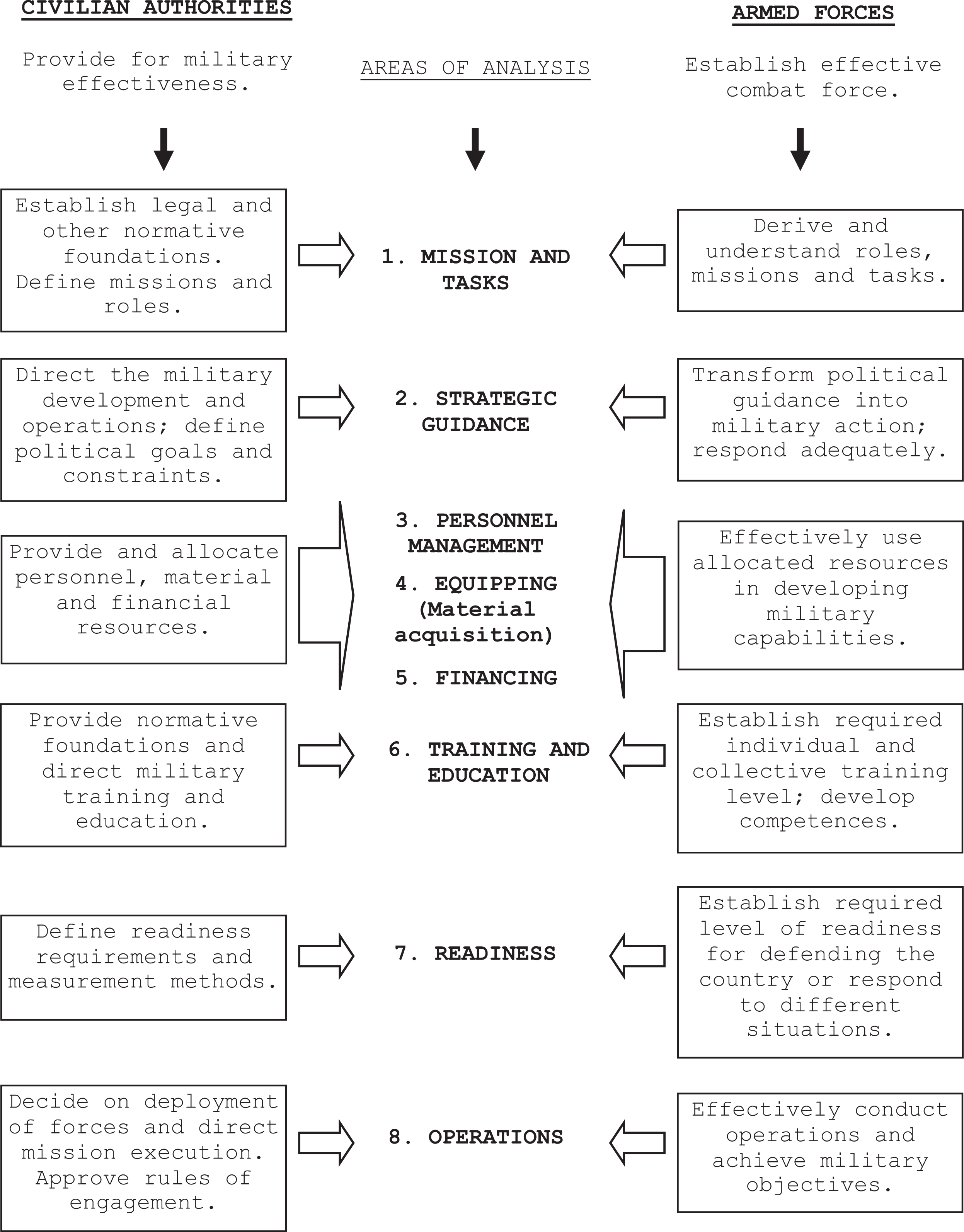
Structural analysis of Slovenian Civil–Military Relations.
Effects of Civilian Control on the Slovenian Armed Forces
The document analysis confirmed that in the Republic of Slovenia, the subordination of the armed forces has been established in accordance with democratic standards. Civilian authorities provide legal foundations and set the formal role of the armed forces within society, decide on peace and war, decide on the use of military force, define national security and defense goals and strategies, and define boundaries between military and civilian spheres. They allocate resources and provide guidance for military development and operations, define the strength and organization of the armed forces, define the defense doctrine and standards for military education and training, and provide conditions for professional development. All the conditions for objective civilian control over the armed forces exist. An analysis of the implementation of civilian control in practice, however, shows that some deficiencies could have negative impacts on the armed forces.
From the perspective of missions and tasks, determining the role of the president as the Commander-in-Chief is problematic. The president has no legal authority to exercise command functions in Slovenia. The main role for exercising control over the defense sector is vested in parliament. Direct control over the military is shared by the government, which decides on the deployment of military force, and the minister, who directs the operations and development of the armed forces. This can have two repercussions. The first is the inference that the head of the armed forces is little other than a “mascot,” which directly undermines the fundamental notion of what it is to serve one’s country. The second lies in the hypothetical scenario of a president attempting to issue orders and unit commanders allying themselves with different civilian bodies.
The document analysis of this case study revealed late or absent political decisions and guidance for the deployment of troops are problematic for the military and can negatively affect the quality of pre-deployment preparations and mission execution. 27 Furthermore, the implementation of Slovenian civilian control has been deficient with regard to two key military roles. First, the armed forces have not always been given guidance to adequately prepare for the support of the national emergency and disaster relief system. 28 As a direct consequence, they are not able to effectively execute some tasks that can result in a loss of credibility and trust across society. Second, there remains an absence of clarity with regard to the defense legislation in the area of using the armed forces for domestic counterterrorist operations or combat operations beyond the national borders. 29 Legal dilemmas can produce hesitation (late response), indecisiveness, or the resistance of the military.
Political guidance is one of the control mechanisms that provide the basis for military development and operations. However, although it is comprehensive, it is inconsistently applied and leads to ambiguity with regard to the interpretation of the guidance to follow. For example, the incoherence between the Defense Strategy adopted in 2001 and the Military Doctrine adopted in 2006. The strategy is obsolete and does not recognize Slovenia as a member of North Atlantic Treaty Organization (NATO) and the European Union (EU). The doctrine put the Slovenian Armed Forces into the context of the command and control of the allied forces, while the strategy talks only about national interests for joining the Alliance. 30
The personnel management of the Slovenian Armed Forces follows the political guidance, plans, and regulations adopted by civilian authorities. It is an area where control mechanisms are directly implemented and where an irregular pattern of enforcement and an implementation of intrusive control mechanisms can be found. For example, the Chief of Defense’s (CHOD) 31 responsibility is to recommend all officers’ promotions to the minister. The government issued the requirement that all CHOD’s recommendations should be reviewed by the Human Resources Management Board appointed by the minister. The board decides with a majority of votes, and the CHOD’s vote counts only 1/8 of the total. Besides which, although not required by law, there is a precedent that before taking the promotion list to the Board, the Intelligence and Security Service issues an opinion as to which of the officers is not suitable for promotion. These control mechanisms and an ignorance of military advice (when for example the Minister strengthens the defense administration by utilizing military human resources or decorate military personnel without the CHOD’s knowledge and consent) undermines the CHOD’s legal authority and reduces the credibility of the office.
Material acquisition is an area where strict civilian control exists and where the most obvious elements of micromanagement and interference of one political level overlap with another. The institutions responsible for implementing civilian control, due to either enthusiasm or the lack of understanding of others’ responsibilities, sometimes issue guidance that should be issued by others, or they go into too much detail. It is a situation for possible conflicts between the legislative and executive branches (when for example the parliament decides on the type and number of military equipment limiting the freedom of action of the government and the minister). Furthermore, the obstruction created through implementing civilian control of one political institution from the other, as well as the low level of political dialogue, are also evident in the Defense Committee and the Ministry of Defense. 32
For the military, it is particularly damaging when politics impacts the development of military advice. Document analysis of the procurement of cargo aircraft, the reconnaissance vehicle, and the armored vehicle demonstrated that the minister sometimes follows professional military advice, sometimes sets additional requirements or constraints, and sometimes ignores it or even terminates the procurement process. All situations are legal and legitimate actions from the civilian authority in exercising control. They are problematic for the military only when the military upon political requests alters or adapts its professional advice in order to meet those requests. It is a dilemma for the military whether to reject altering the professional advice and take the risk of contradicting the civilian authority, or to obey and risk a possible loss of the credibility for providing good professional advice. Furthermore, the result has an impact on the public’s confidence in their military’s professionalism and credibility. When military advice is overruled or adjusted by politicians, combat capabilities suffer. 33
The implementation of various control mechanisms within the financial area shows the intent of civilian authorities to exercise detailed control over the military budget. In determining the finances down to battalion level, the government with the Mid-term Defense Program interferes with the responsibilities of the minister and the CHOD. It limits the autonomy of commanders who have no freedom of action in allocating their own budgets according to operational and other needs in implementing their missions. 34 The analysis of military expenditures in 2008 and financial mechanisms showed the CHOD has no control over approximately 5 percent of his own budget, since the military finances are used also for financing organizations outside the Slovenian Armed Forces.
Some examples of micromanagement and the use of military resources to finance civilian projects, as well as the transfer of military finances to other government agencies were observed—all of which lead to an opaque and irregular record of defense spending. For example, the military budget for the Fiscal Year 2008 was reduced by 11 percent. Forty-eight-million Euros were transferred to other ministries and agencies, or allocated to the government’s reserve founds. The analysis of financial transfers documents showed that on the list of receivers was an organization legally not eligible for using defense resources. An example of nontransparent and irregular use of the military’s finances is also the procurement of new equipment for the foreign military, which is not anticipated by the defense legislation. These manifestations of the use of control mechanisms result in the Slovenian Armed Forces having to live within an environment of financial instability, which requires constant adaptation of military goals and can negatively affect the development of capabilities and readiness.
Military training and education is an area where the Slovenian Armed Forces enjoy professional autonomy in the sense of planning and execution. However, it is also an area where the CHOD has no power over the authorities which are inherently a part of and inseparable from the military. The CHOD has no authority to issue tactical and technical manuals and training programs. Critical for the professional development and the military career system is the fact that the defense legislation enables untrained personnel to reach command assignments or other positions in military staffs; this practice directly affects military effectiveness and calls into question the professionalism of the military.
Civilian authorities define readiness status of forces and request feedback on how the military is fulfilling their requirements. The readiness evaluation system, approved by the minister, enables civilian authorities and the public to acquire credible information on the status of military readiness with regard to military’s ability to execute its mission. Readiness reports are used as a control mechanism. 35
With regard to military operations, it can be concluded that the Slovenian Armed Forces are afforded the required legal foundations and political guidance to conduct operations in the following situations: (1) combat operations in the case of a military threat to national security, (2) stability operations in peace operations and other crisis response or humanitarian operations, and (3) support operations in the case of natural and other disasters. There is doubt sometimes within the armed forces about the reasons for deployment in cases where the political guidance has been poorly defined. 36
Operational or tactical guidance issued by civilian authorities can be found to have jeopardized the execution of military tasks. These are situations, for example, when the government defines the detailed composition of troops to be deployed. This kind of political guidance narrows the options for adapting unit composition according to military’s needs. Such interference limits the CHOD’s and commanders’ ability to act autonomously within their own domain. Furthermore, forms of civilian delegation of tasks that avoid the military’s chain of command have also been identified, for example, when the minister requires military advice from staff officers without the CHOD’s knowledge. The summary of the findings and outcomes, based on document analysis, of civilian control and the impacts on the Slovenian Armed Forces are shown in Table 1.
Findings and Outcomes of Civilian Control in Slovenia.

Source. See Note 5 for description of methodology used to construct this table.
Effects of Civilianization on the Slovenian Armed Forces
When assessing the influence of civilian control on the armed forces, the civilianization of defense administration needs to be taken into consideration. The civilianization of the defense sector has been an integral part of the democratization of civilian control over the military in Slovenia. Unlike other postcommunist countries in Europe, there was no need for restructuring and demilitarizing the defense sector as it did not exist. It was a process of establishing a new independent and democratic state with new defense institutions. Following democratic models, the Ministry of Defense was established with a prevailing civilian presence, and the situation continues to this day.
The document analysis showed the balancing of the civilian–military structure has not been successful. Although the ratio is not prescribed, it is hard to agree on adequate civilian–military structure when 12 percent of officers in the total structure as it was by the end of 2009. This was recognized by the minister, who ordered a strategic review of the defense sector. The review emphasized “it is important to establish a more effective defense administration which will through a more balanced structure foster implementation of strategic and operational goals of the defense sector, and enhance the military capabilities and disaster relief and protection capabilities, and provide for more efficient work and use of human, material and financial resources.”
The practice of “false” civilianization was identified, particularly in areas where career officers have been assigned to civilian duties or transferred back and forth between leading civilian and military positions. Appointing senior officers to senior civilian positions can be considered a kind of “remilitarization” of the defense sector. This practice is not only problematic from the perspective of democratic civil–military relations but also opens doors for the possible politicization of the military. It represents interference in developing democratic civilian control and it questions the understanding of the civilianization of the defense sector. Although former senior officers might perform very professionally in civilian positions, one cannot exclude the risk of their being “politically contaminated.” They bring military thinking and habits into a “civilian environment.” There is a risk that those “fake civilians” tend to provide military advice to the minister, which is usually expected from the highest military authority.
Conclusion
In general, civil–military relations in Slovenia follow standards and traditions similar to other democratic societies. The legal foundation for civilian control defines the relations, authorities, and responsibilities between civilian and military authorities, and establishes conditions for objective control. Objective control is characterized by the total subordination of the military to civilian authorities, effective implementation of civilian control, the development of military professionalism, and the political neutrality of the armed forces. However, as a result of possible inexperience or fear inherited from the former communist regime, the document analysis reveals that the eagerness with which effective civilian control was implemented has resulted in the deficient and exaggerated use of some control mechanisms, and consequently the armed forces have sustained collateral damage. A deficient normative apparatus, which prevents the military from enjoying more professional autonomy and sets unbalanced roles for the civilian authorities in charge of executing control, shows that the first generation problematic has not yet been resolved. The second generation is characterized by forms of subjectivity and deficiencies in exercising civilian control.
The implementation of civilian control does not foster military effectiveness. It can have negative impacts on the military decision-making process and can produce a late or inadequate military response. It can reduce military capabilities, affect the quality of preparations before deployments, and raise the risk of mission failure. The control measures limit the CHOD’s and commanders’ freedom of action in executing their missions and using their own resources. The outcomes of civilian control can be a slower tempo of professional development, the reduction in the CHOD’s credibility, lower combat effectiveness, and possibly lower public legitimacy of the military. The implementation of civilian control also brings the risk of the politicization of the military.
There is a need for the political awareness that civilian control is not intended for the sole purpose of subordinating the armed forces but also for fostering military effectiveness. “Controllers” should not ignore the consequences that control mechanisms have had on the country’s armed forces. The careless implementation of mechanisms when readiness or credibility or professional autonomy are affected can produce frustrations for military leadership. A military which recognizes it is incapable of fulfilling its mission tends to resist control and involve itself politically, which leads to conflicts between military and civilian leaders. Implementation of civilian control, even after it effectively subordinates the military, may sometimes lead to deteriorating civil–military relations.
Footnotes
Declaration of Conflicting Interests
The author declared no conflicts of interest with respect to the research, authorship, and/or publication of this article.
Funding
The author received no financial support for the research, authorship, and/or publication of this article.