




Abstract
This article examines the basis of military leadership preferences toward war termination, and thus the basis of the associated civil–military divide, within the context of protracted small war. The conventional wisdom posits military leadership preferences as a near-constant in favor of persistence and thus expects a dominant pattern of military obstructionism. However, such a pattern does not hold empirically across the population of small wars. This gap between expectation and evidence derives at least in part from the limits of the bureaucratic–organizational model, focused on the military’s desire for resources, autonomy, and influence, that underlies the conventional wisdom. In contrast, this article suggests an alternative model privileging the demands of institutional legitimacy. The legitimacy motive as conceptualized here is particularly salient to the small war context. It accordingly provides a foundation for better understanding variation in military leadership preferences toward war termination and thus variation in the direction and intensity of the civil–military divide.
Introduction
This article examines the basis of military leadership preferences toward war termination, and thus the basis of the associated civil–military divide, within the context of protracted small war. 1 The conventional wisdom regarding military leadership and war termination, traceable to Morton Halperin’s 1970 study “War Termination as a Problem in Civil-Military Relations,” posits military leadership preferences as a near-constant in favor of persistence and therefore expects a dominant pattern of military obstructionism. 2 War termination decision making accordingly represents a locus of civil–military tension, as political leadership seeking a way out of a conflict is countered by military leadership refusing to accept any outcome short of victory. A recent study, however, finds that this pattern does not hold consistently within the context of protracted small war. 3 War termination decision making still serves as a significant source of civil–military tension within this context. But one is just as likely, if not more likely, to observe a shift by military leadership to a preference of withdrawal prior to any similar shift by political leadership. And in such cases, military leadership plays a facilitating, as opposed to an obstructionist, role in the war termination process.
The following study attempts to address this gap between the small war evidence and the conventional wisdom regarding military leadership and war termination. It suggests that the gap derives at least in part from the shortcomings of the bureaucratic–organizational model of the military—focused on the military’s desire for resources, organizational autonomy, and bureaucratic influence—that underlies the conventional wisdom. This bureaucratic–organizational view of the military, prevailing within international relations and security studies scholarship at least since the mid-1980s, may be adequate for assessing military leadership preferences in some scenarios but is overly limiting in most. In particular, it fails to account for variation in military leadership preferences toward war termination and thus the variation in the direction and intensity of the associated civil–military divide.
Borrowing from the work of Dutch sociologist Jacques van Doorn and more broadly from neoinstitutionalism, this article suggests the value of an alternative model privileging the demands of institutional legitimacy as an analytically distinct and hierarchically superior basis of military leadership preferences. Institutional legitimacy as conceptualized here is certainly not the only motive at play in determining military leadership preferences toward war termination. As Lindemann and Martin suggest, “Military preferences are always contingent to a wide range of conditions.” 4 At a minimum, however, the emphasis on institutional legitimacy is useful in that it suggests greater variation than expected under the bureaucratic–organizational model. But the significance of the legitimacy motive likely goes further than merely adding another source of variation to the mix given that it is particularly salient to protracted small war. Thus, while military leadership preferences always hinge upon a wide range of factors, an emphasis on institutional legitimacy is critical to understanding these preferences within the domain of interest.
The basic argument here is that the experience of protracted small war imposes unique demands upon the military’s institutional legitimacy and that military leadership preferences of persistence versus withdrawal are determined in large part by the collective desire to preserve or enhance this legitimacy. Further, the legitimacy motive can spur a wide range of military leadership preferences and thus wide variation in the direction and intensity of the civil–military divide. While such a claim may not be satisfying in a positivist sense, it aligns well with Jon Elster’s suggestion that a single cause or antecedent condition can simultaneously trigger diametrically opposed effects within similar subjects, or even within a single subject, such that the “net effect is impossible to predict from theory alone.” 5
The remainder of the article proceeds in four parts. The first outlines the prevailing view on military leadership and war termination to include a brief discussion of the bureaucratic–organizational model of the military that underlies this view. The second introduces what is termed the professional–institutional model, centered on the legitimacy motive, as a supplement or alternative. The third part relates this alternative to military leadership preferences and behaviors within the context of protracted small war. And the final part illustrates the potential value of the professional–institutional model by looking briefly at military leadership preferences of persistence versus withdrawal concomitant to three cases of small war termination. The first case of France in Algeria exhibits a pattern of civil–military divergence that fits the conventional wisdom. It serves as an example of military obstructionism par excellence. The latter two cases of Israel in Lebanon and Portugal in the African Territories reveal a distinctly different pattern, with military leadership facilitating the war termination process in opposition to political leadership. The key is that the legitimacy motive helps explain military leadership preferences with each type of case.
Armed Bureaucrats: The Prevailing View of the Military and War Termination 6
Scholars have long problematized the characterization of the professional military as a loyal and obedient servant, unquestioning of its civilian political masters. 7 Feaver, for example, describes civil–military relations as a “game of strategic interaction.” Specifically, the military “may not share identical preferences with the civilians on all policy questions and so may seek to manipulate the relationship so as to prevail in policy disputes.” 8 Across the relevant literature, there is also a high level of consensus as to what motivates military leadership and thus what creates the potential for divergence from political leadership. Most studies at least assume that corporate interests—generalized in terms of the military’s desire to maximize resources, organizational autonomy, and bureaucratic influence—play the dominant role. As Perlmutter suggests, corporate interest may not represent the only cause but still provides “the most significant explanation for military interventionism and for the political strains existing between the civilian and the military.” 9
This focus on corporate interest as the primary cause of “political strains” is linked to a bureaucratic–organizational model of the military. As background, Graham Allison, Morton Halperin, and Francis Rourke collectively introduced the “bureaucratic political paradigm” or “bureaucratic perspective” to the study of foreign policy in the early 1970s. 10 This paradigm was then adopted wholesale and applied to the military by a number of prominent international relations and security studies scholars over the subsequent two decades. Seeking to explain a range of international and foreign policy outcomes, these scholars argued that the military establishment, far from being unique, is best understood as equivalent to other bureaucratic organizations and as “perhaps the most ‘organized’ of organizations.” 11 Van Evera, for, example, contends that the key to understanding military leadership behavior, to include efforts to obstruct war termination, “is to recognize that militaries promote and defend themselves like other bureaucracies . . . Militaries infuse society with organizationally self-serving myths to convince society to grant them the size, wealth, autonomy . . . which all bureaucracies seek.” 12
Applied explicitly to the military, the bureaucratic–organizational perspective not only compels the analytic focus on corporate interest but also provides the underpinnings for the conventional wisdom regarding military leadership and war termination. Halperin remains one of the few scholars to have examined the topic in any depth. His central argument is that pressure to end a war short of victory will almost always come from civilian political leadership. Most military leaders, driven by budgetary concerns and interservice competition, maintain a strong preference of persistence. Political leadership thus needs the support of the general staff to overrule other military leaders. Fortunately for political leadership, general staff officers tend to be “characterized by loyalty to political leaders and sensitivity to their domestic political as well as foreign policy,” and thus these officers should “be able to remove the blinders on the interests of the services to which they belong.” 13
It is important to recognize that Halperin’s reasoning, while exhibiting a degree of nuance, points clearly to an obstructionist view of the military. Again, it is political leadership that initiates war termination. If left to its own devices, military leadership will oppose such a move absent military victory. Any shift by military leadership to a preference of withdrawal comes after the shift by political leadership and after the “least military” of military leadership has adopted the civilian perspective.
Also of note, Halperin’s assertion that pressure to end a war will usually come from political leadership is treated as a starting assumption. Although providing evidence of this in a handful of cases, he provides no a priori reason why it should be true. Halperin does explain that political leaders view the question of war termination largely through the lens of domestic political constraints, suggesting that they will “be concerned with the impact which various kinds of war termination conditions will have on the postwar politics of their country” and particularly “with the impact of war termination conditions on elections.” 14 But there is no indication as to when such concerns will lead to moves to end a war or why political leadership preferences will shift prior to military leadership preferences. The only way to effectively read this, then, is that domestic political pressures and constraints will cause political leadership preferences to vary meaningfully while military leadership preferences remain relatively fixed.
Further, it is clear that this argument, in turn, is built explicitly upon an underlying bureaucratic–organizational perspective of the military. In terms of motive, Halperin focuses primarily on the bureaucratic battles between the military and other governmental agencies, as well as among the different military services, for resources and influence. As rationale for a military leadership preference of persistence, he explains, “Services are concerned about their budgets, both their absolute budgets and their relative budgets compared to the other services . . . This cannot help but influence their attitude toward war termination issues.” Further, “The arguments that the services are willing to put forward will be influenced by their judgment of how these will affect postwar struggles over defense budgets.” This competition for resources and influence often plays out in efforts to protect and expand mission areas or bureaucratic turf. Halperin continues, There is in all major military establishments now a competition between the services for roles and missions which are in the margin between services. This means that services will desire to protect the missions which they have and in some cases expand them, and they are concerned about how behavior during a war and also the process of war termination affect future assignments of roles and missions.
15
Since Halperin, a handful of scholars have noted an important role for the military variable in the domestic politics of war termination; but none has provided more than token analysis, and none has deviated meaningfully from Halperin’s basic argument. 16 From even these few existing analyses, there emerges a conventional wisdom regarding military leadership and war termination. This can be summarized with four key points. First, military leadership consistently exhibits a strong preference of persistence. Second, any movement toward withdrawal short of victory will initially come from political leadership as opposed to military leadership. Third, any subsequent shift by military leadership to a preference of withdrawal will come about as a result of political leadership pressure and/or the adoption of the civilian perspective by military leadership. Finally, and as the only exception to the first three points, military leadership will shift to a preference of withdrawal prior to political leadership when, in extreme circumstances, political leadership’s war policy threatens the ruin of the state and its organs. The commonly cited case here is Germany at the end of World War II. Iklé elaborates, “There could have been no more hawkish position than that of Hitler himself. He was determined to see the fighting continue to the last soldier and was willing—indeed during his last days eager—that Germany be destroyed in the process.” Accordingly, it was the “doves” in the military “who had to resort to insubordination to end the fighting and avoid further destruction.” 17
Although largely accepted without question, the theoretical perspective outlined above remains underdeveloped, with advocates of the “military obstructionist” view citing the same handful of cases over and over again as evidence (i.e., France in Algeria). And from an analytical perspective, the near constancy of the military variable inherently reduces its causal significance. Of further concern, from an empirical perspective, there are a number of cases that appear to run counter to the conventional wisdom.
The staying power of the conventional wisdom regarding military leadership and war termination, despite such theoretical and empirical shortcomings, stems in part from the fact that the underlying bureaucratic–organizational model of the military has, itself, gone largely unchallenged outside of the niche field of military sociology. The bureaucratic–organizational model does appear to offer significant purchase when it comes to questions of peacetime preferences and peacetime decision making. However, it has proven less useful for understanding the wartime context. 18 In particular, it does not appear adequate for capturing the wide range of military leadership preferences toward war termination within the context of protracted small war.
An Alternative Model of Military Leadership Motives
The concept of institutional legitimacy provides the basis for an alternative model of military leadership motives applicable to the problem of war termination. What can be termed the professional–institutional model takes corporate interest into account but also considers institutional legitimacy as an analytically distinct, and hierarchically superior, source of military leadership preferences. Further, the alternative model is explicitly relevant to the small war context and thus, at a minimum, serves as a useful supplement for understanding military leadership preferences of persistence versus withdrawal.
This approach derives from a neoinstitutionalist view of the organizational actor as being embedded within a broader social environment and, even if exercising a high degree of organizational autonomy, as being deeply affected by this environment. 19 Because of this “embeddedness,” neoinstitutionalist theory rejects the claim that organizational dynamics can be assessed solely in terms of bureaucratic, technological, or material imperatives. Instead, as Suchman notes, one must also take into account “cultural norms, symbols, beliefs and rituals.” And “at the core of this intellectual transformation lies the concept of legitimacy” framed in terms of “a generalized perception or assumption that the actions of an entity are desirable, proper, or appropriate within some socially constructed system of norms, values, beliefs, and definitions.” 20 While not applicable to all organizational actors to the same extent, the preferences of some actors in some contexts are influenced heavily by the legitimacy motive, with specific behaviors of these actors aimed at gaining, maintaining, or defending institutional legitimacy. 21 Accordingly, the concept of institutional legitimacy serves as “an anchor-point of a vastly expanded theoretical apparatus addressing the normative and cognitive forces that constrain, construct, and empower organizational actors.” 22
Although relatively obscure, the work of Dutch sociologist Jacques van Doorn is useful here in that it emphasizes institutional legitimacy as applied specifically to the professional military establishment. Van Doorn recognizes that the military exhibits traits and maintains interests similar to those of other organizations within the governmental bureaucracy. Nonetheless, the military represents “an excellent and possibly unique” example of the integration of bureaucratic organization and professional institution. Where the organization is occupied simply with relations between ends and means, the profession is aimed at the solution of problems that are highly relevant to the central values of society. 23 Even among the latter, the function of the military profession “is so exceptional” that the military “differs sharply from other institutions which ensure the continuity of society.” 24
Such distinction stems from the centrality of violence in defining the purpose and identity of the professional military establishment. This point on the centrality of violence, while perhaps an obvious one, is not effectively taken into account by most academic conceptions of the military: A study of military problems is, in the final analysis, a study of violence; military action is nothing else than the exertion of violence. In the social sciences this fact is rather frequently overlooked. Studies on military affairs are rarely concerned with actual violence. Sociologists have discussed the military profession and military organization, the relations between army, politics and society, but have often ignored the simple fact that it is impossible to separate these phenomena from the key function of the armed forces.
25
As applied to the military, Van Doorn frames institutional legitimacy in terms of effectiveness, appropriateness, and recognition. On the latter element, he explains, “There are invariably two parties, one claiming legitimacy . . . and the other accepting this right and showing its readiness to accord recognition to the other’s legitimate claims.” 28 These claims, in turn, are evaluated in terms of effectiveness and appropriateness. The professional military establishment, as part of a wider social system, must not only demonstrate the necessary functional capacity but must also be seen as consistent with the “generalized values of the superordinate system.” 29 Or, as Burk explains, the military’s legitimacy derives not only from its perceived effectiveness and relevance but also from its “moral integration” with society, or the degree to which the military accords with the normative expectations of the political community. 30 Of course, the recognition of such is rarely a formalized or explicit process. Instead, recognition is best thought of in terms of the “public confidence and esteem,” or “public support and political trust” shown to the military. 31 Forster similarly describes what the military conceives as the “obligation on society to value and respect the armed forces” for what they do “on behalf of the nation.” 32
Building upon the concepts outlined above, this article takes institutional legitimacy as applied to the military to mean the degree to which the professional military establishment is recognized by the relevant political community as meeting applicable standards of effectiveness and appropriateness. The implication here is that military preferences and behaviors are motivated by the demands of institutional legitimacy. In other words, the military as a collective actor cares about, and will take steps to bolster and/or preserve, its institutional legitimacy. None of this means that more traditional corporate interest lacks relevance, as the professional–institutional model continues to take corporate interest into account. However, institutional legitimacy represents not only an analytically distinct, but also a hierarchically superior, basis of military leadership preferences. 33 At least in theory, then, as long as institutional legitimacy is secure, military leadership preferences should align with the demands of corporate interest to include the push for resources, autonomy, and bureaucratic influence. However, if military leadership perceives this legitimacy to be at risk, the basis of its preferences will shift accordingly.
Assuming civilian control and no more than a marginal internal policing role for the military, the institutional legitimacy of the military is rarely at stake during times of internal and external stability. It follows that in peacetime, the corporate interests of the military, similar to those “which all bureaucracies seek,” will come to the fore. These interests will continue to provide motive in times of war but are also likely to be subsumed, obscured, or at least balanced by other factors. Within the context of total or near-total war, the exigencies of national and institutional survival should dominate. But there is a sizable middle ground. It is within this domain, to include the context of protracted small war, that the impetus of institutional legitimacy plays a more pronounced role in shaping military leadership preferences. This is not to imply that the legitimacy motive is absent from contexts other than small war but only that the demands upon the military’s legitimacy are generally less acute. 34 See Figure 1.
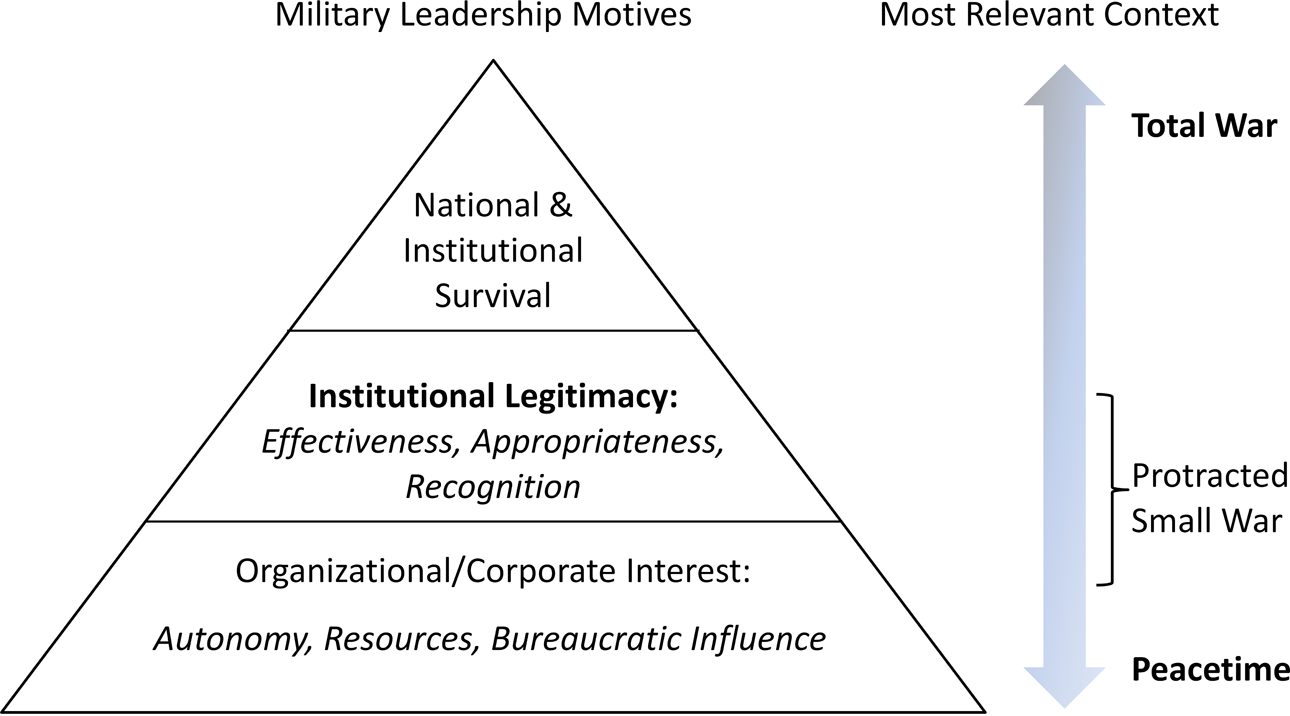
The professional–institutional model of military leadership motives.
Institutional Legitimacy and Military Leadership Preferences of Persistence versus Withdrawal
The following section considers briefly how the legitimacy motive outlined in general terms above translates to military leadership preferences and behaviors in the context of protracted small war. It is important to note that there is no attempt here to predict when military leadership preferences will shift or diverge from political leadership preferences. Instead, the intent is merely to argue that the legitimacy motive serves as an important basis for military leadership preferences of persistence versus withdrawal and impels variation in these preferences and associated behaviors beyond that anticipated with the bureaucratic–organizational model.
There is little question that military leadership is inclined toward persistence or toward staying the course until achieving victory. For the powerful state, failure in small war rarely resembles traditional military defeat. Instead, failure is more often manifested as a political decision to withdraw prior to the securing of state aims and despite maintaining the option to persist. However, even capitulation of this kind cannot but affect perceptions of military effectiveness, one of the pillars of institutional legitimacy. Accordingly, Schwab points to “the essential and critical need of every military to achieve victory.” Citing the US military in Vietnam as an example, he elaborates, “The JCS could not conceive of fighting a war to lose . . . The loss of Indochina, after the commitment of large US forces, was anathema to the professional armed forces. It challenged the legitimacy of their profession.” 35
But there are also scenarios under which the legitimacy motive is better served by an outcome of withdrawal. Taken as a whole, the characteristics of ideal-type small war present a unique challenge to the military’s institutional legitimacy, and the experience of small war is prone to foster a “legitimacy crisis within the armed forces.” 36 This stems in part from requirements to assume nontraditional roles inconsistent with idealized standards of effectiveness and also to employ means that elicit societal critique and weaken military claims to appropriateness. On the latter, battle lines associated with small war are typically ill defined, and the fighting takes on unconventional, and often particularly brutal, forms as the army of the powerful state faces an adversary that practices “violent acts regarded as illegitimate.” 37 According to Van Doorn, the military feels compelled to counter this violence with similar measures, as the push to succeed leads the professional soldier “to use force against civilians, to torture prisoners and to deploy organized terror methods, courses of action which expose him to public criticism.” 38
The fact that such means do not yield immediate and measurable results only exacerbates the problem. Any progress made with counterinsurgency or antiguerilla operations typical of small war can be frustratingly slow despite the marked asymmetry of resources and military power. Further, traditional measures of operational progress and success do not always apply. This necessarily opens the door to critique of “what may appear to be inefficiency and unnecessary military setbacks.” 39 And societal perceptions of military effectiveness and appropriateness are inherently intertwined. Van Doorn explains, “If a counter-insurgency war is fought with little success the volume of criticism swells and becomes increasingly concentrated on the methods used. Accusations on the home front that the troops are committing atrocities are connected in part with those troops’ inability to end the conflict.” 40
More generally, protracted small war often fosters dissent within the powerful state. Mack, for example, describes “conflicts in the metropolis—both with the political elite and in the wider society—which the (small) war by its very nature will inevitably tend to generate (original emphasis).”
41
Such domestic conflict may translate to overt protest against the war effort and against the military’s conduct of the war. However, public indifference or abandonment, although less obvious than overt protest, also serves as a form of societal critique. Small war, by definition, never requires a total commitment of resources and national effort by the powerful state. Small wars can thus go on for years and receive very little attention in the metropole. Or the public may experience war weariness and grow disinterested or otherwise decide to ignore the conflict despite the ongoing sacrifices of the military, thus leading to the phenomenon of the “forgotten war.” Cohen effectively summarizes the potential effects: These circumstances do not only corrode the possibility of appropriate political-military coordination. At a deeper level . . . they also create deep psychological and cultural rifts between the entire military establishment and the society whose interests it is morally and legally bound to defend and promote. Conscious that they no longer enjoy the public and political backing that they feel they have a right to expect, soldiers accuse civil society as a whole of desertion and pusillanimity. For its part, civilian society suspects the military of adopting and promoting a set of values from which many citizens feel increasingly divorced.
42
On the latter, Ashforth and Gibbs suggest that the organizational actor can respond to threats to its legitimacy through either symbolic or substantive legitimation measures. 44 This distinction translates well to military leadership behaviors in response to the experience of protracted small war. Assuming a status quo preference of persistence, a shift by military leadership to a preference of withdrawal, and subsequent efforts to promote this preference, would constitute substantive management, a legitimation approach which “involves real, material change in organizational goals.” 45 Conversely, the military could maintain a preference of persistence but exercise symbolic management in an effort to preserve or defend its institutional legitimacy. As a contrast to substantive management, Ashforth and Gibbs explain, “Rather than actually change its ways, the organization might simply portray—or symbolically manage—them so as to appear consistent with social values and expectations. Symbolic management, in short, transforms the meaning of acts.” 46
Within the context of protracted small war, military leadership exercises symbolic legitimation in a number of ways. At one extreme, this may include a strategy of “denial and concealment” in order to “suppress information regarding activities or outcomes likely to undermine legitimacy.” 47 Alternatively, military leadership can work to shape the interpretation of information related to the war through various forms of cost framing. 48 Other symbolic measures include efforts by military leadership to shift blame for questionable conduct of the war or for unfavorable war outcomes. In the case of the United States in Vietnam, it appears that military leadership attempted to hedge its preference of persistence through such efforts. 49
More generally, symbolic legitimation may accompany, or may be employed in lieu of, specific substantive measures. And as a tentative rule of thumb, the military driven to defend its institutional legitimacy will employ symbolic measures first and then turn, if at all, to substantive measures only after the former is deemed insufficient. Accordingly, any shift by military leadership to a preference of withdrawal as a form of substantive legitimation will likely be a drawn-out affair. But this in no way implies that such a shift will come about only after a similar move by political leadership. One should thus be able to observe meaningful variation in the direction and intensity of the civil–military divide associated with war termination decision making across cases and over time within cases of small war.
Empirical Observations: Imputing the Legitimacy Motive after the Fact
Again, the assertion here is that within the context of protracted small war, the demands of institutional legitimacy can motivate a wide range of military leadership preferences and behaviors associated with war termination decision making. Theoretically, this allows for a great deal of variation traceable to the legitimacy motive. However, it also complicates any effort to predict when preferences will shift or to provide stable ex ante indicators. Also, a shift in military leadership preferences based on the legitimacy motive may be triggered by a single big event or several smaller but cumulative demands. It is for such reasons that in most studies of institutional legitimacy unrelated to the military or the small war problem, “legitimacy motives for organizational actions have tended to be imputed after the fact.” 50
That being said, the remainder of the article examines briefly three cases of protracted small war to include France in Algeria (1954–62), Israel in Lebanon (1982–85), and Portugal in the African territories (1961–75). While this empirical overview certainly does not suffice for causal inference, it is still useful for illustrating the potential relevance of the professional–institutional model for assessing military leadership preferences of persistence versus withdrawal. In none of these cases can one find specific references to the legitimacy motive per se. Instead, one can more readily identify deep concerns among military leadership related to the proxies of honor, prestige, and image, all of which are germane to the matter of societal recognition. Further, there is ample evidence of the mechanisms of idealized mission orientation, credit and blame attribution, and institutional memory of failure at work in shaping military leadership preferences of persistence versus withdrawal. Each of these mechanisms is linked theoretically to the legitimacy motive. 51
France in Algeria (1954–62)
There is little question with the case of France in Algeria that military leadership preferences diverged from those of political leadership in the direction of persistence and that this made war termination more problematic. At the same time, however, one cannot readily attribute the direction and intensity of this divergence to traditional bureaucratic–organizational incentives. In other words, the pattern of military obstructionism here aligns well with the conventional wisdom, but the bureaucratic–organizational model of the military underlying the conventional wisdom lacks purchase for explaining this pattern.
The Algerian War began mere months after France’s humiliating withdrawal from Indochina with many veterans of Indochina moving directly to North Africa. In reference to Algeria, Kelly explains, “For the French Army reeling from Indochina, it was the war that, even against the will of God or man, could not be lost.” 52 The civil–military divide became evident in the spring of 1958 after the newly formed government under Prime Minister Pflimlin made known its plans for negotiations with the insurgent FLN and eventual Algerian self-determination as a basis for ending the war. This did not sit well with military leadership. As Ambler notes, “By 1958, once the army had been allowed to step into a civilian power vacuum in Algeria, once military honor, prestige, and self-esteem had been heavily invested in the defense of French Algeria, it was probably too late for any government of the Fourth Republic to abandon French Algeria without serious obstruction from the army.” 53
This obstructionism, to include at least the tacit threat of military coup, resulted in the dissolution of the government and fall of the Fourth Republic. With the blessing of the army, Charles de Gaulle assumed the reins of power but then hinted at his own plans for Algerian self-determination in September 1959. This sparked a new wave of protest from military leadership and led to the military-backed “Barricades Week” insurrection in Algiers. De Gaulle survived this episode but was reportedly “astonished” by the level of backlash from military leadership and subsequently came to realize “that peace in Algeria would only come about through peace with the army.” 54
De Gaulle then backed off from any plans to rapidly withdraw from the war and spent the next year and a half working assiduously to “convert the army to his views on the need for change in Algeria.” 55 De Gaulle may have underestimated the depth of military leadership’s preference of persistence, but he was quite savvy as to what motivated this preference. And the approach he took to narrowing the civil–military divide is telling. Beginning with the tourneé des popotes in March 1960, De Gaulle traveled extensively throughout Algeria and Europe meeting with and attempting to “propagandize” the French officer corps. 56 His message had little to do with resource maximization, organizational autonomy, or bureaucratic influence. Instead, De Gaulle focused his efforts on two main themes, each explicitly tied, from a theoretical perspective, to the legitimacy motive.
First, De Gaulle sought to alter military leadership preferences through reorienting the army’s idealized mission or idealized standard of effectiveness. Appealing to national grandeur and the “honor of French arms,” he preached to a captive, but at first skeptical, audience that “A great nation must have great missions . . . a nation summoned to a leading role in the world stage must have military missions global in their inclusiveness.” 57 France was destined to once again be a world power, and withdrawal from Algeria was necessary in order to assume this role. Thus, according to De Gaulle, the army would “not continue indefinitely to be in effect a garrison army in colonial territory” but, instead, “higher things were in store for it one day.” 58 In particular, De Gaulle sought to shift the focus of the army from its doctrine of guerre révolutionnaire and affiliated “crusade” in Algeria to a new idealized mission orientation centered on the defense of Europe and founded on the nuclear deterrent of France’s nascent force de frappe. 59
Second, De Gaulle sought to convince the French army that its sacrifices and successes in Algeria would be recognized in full and that, conversely, the army would not in any way be blamed for the loss of Algeria. De Gaulle recognized the power of the institutional memory of failure, with its implications for the legitimacy motive, and worked to dissociate an outcome of withdrawal in Algeria from the memory of defeat in Indochina. On a number of occasions leading up to French withdrawal, he publicly praised French military successes in Algeria and vowed that the loss of Algeria would not be assessed by the French nation as a military failure. And when meeting with French military officers, he proclaimed, with whatever the implication, that “There will be no Dien Bien Phu in Algeria.” 60 In a sense, here, De Gaulle was interjecting his own form of symbolic legitimation upon the military by altering the meaning of withdrawal. By mid 1961, it was evident that the bulk of military leadership had been swayed by De Gaulle’s efforts and was acceptant, if not in favor, of an outcome of withdrawal. Although a few extremists remained within the officer corps, after this point “there was no further obstacle to formal negotiations with the FLN.” 61
Israel in Lebanon (1982–85)
The case of Israel in Lebanon exhibits a distinctly different pattern in terms of the divergence of political and military leadership preferences. Here, military leadership shifted unambiguously to a preference of withdrawal while the Likud government maintained its preference of persistence until losing power toward the end of 1984. This divergence was made clear to the public by early 1984 with the release of a high-level military report recommending withdrawal. Also, in a January 1984 interview, a government spokesperson stated that, on the question of an Israeli pullout, the Cabinet “had not shifted its position” and then acknowledged, however, that “the military might have other ideas.” 62 The political opposition seized upon the opportunity to blast the government for refusing “to effect a withdrawal for reasons of prestige and internal power struggles despite, or even against, the best professional advice of the IDF”; and this divergence became a point of emphasis in the subsequent electoral campaign. 63 Finally, throughout the highly contested debate of early 1985 that led to the end of the war, a unified military leadership unequivocally sided with the political advocates of withdrawal.
Of course, military leadership did not start out with a preference of withdrawal. As Merom notes of the case, “The army and its officers were conceptually predisposed to side with the government, and had considerable institutional and personal interest in convincing the public that the war was justified and successful . . . Obviously a failed war threatened to taint the army’s image and put an end to the promotion and careers of some of the senior officers.” 64 Military leadership recognized that an outcome of withdrawal would be viewed as military failure. And there was no clear strategic impetus for this course of action. Yaniv argues, “The withdrawal, at least on the face of it, made no immediately apparent sense . . . it ran contrary to the common logic of response to the nation’s security dilemma.” 65
In terms of more traditional organizational concerns, civilian opponents of the war cited a number of negative effects upon the armed forces. 66 But according to military leadership, things were not that bad. While noting some organizational issues, senior military officials generally argued that “the critics exaggerate the negative impact of the Lebanese experience on the Army” and that “none of the damage is irreparable.” 67 Along these lines, military leadership was primarily concerned that the ongoing conflict interfered with routine training and also disrupted reserve call-up schedules. Viewing the conflict in a more positive light, Major General Einan suggested in 1985 that “There were some gains from the war for the Army . . . New weapon systems were tested under combat conditions, and large numbers of troops received indispensable operational experience.” 68 It is thus difficult to locate any compelling strategic or bureaucratic–organizational incentives driving military leadership to a preference of withdrawal. Nonetheless, well before political leadership preferences had changed, military leadership “resolved its own internal controversy over whether to retreat and had become committed to a withdrawal as soon as possible” 69
A turning point for the military as a collective came in early 1983 with the aftermath of the Sabra and Shatilla incident. To understand the impact of Sabra and Shatilla on the military, it is necessary to first look back to the fallout of the 1973 Yom Kippur War. Despite a final outcome of Israeli military victory in this previous conflict, initial intelligence failures and the early success of Egyptian forces resulted in a postwar atmosphere of national despondency and anger as well as a push to assess accountability and assign blame. 70 The Agranat Commission was subsequently formed to investigate the circumstances that had led to the war and its early setbacks. While civilian leadership was cleared of responsibility, the highest ranks of the army and intelligence service were found culpable of negligence. Essentially, the Israel Defense Forces (IDF) was to blame, a conclusion that led to a great deal of resentment and bitterness throughout military leadership. 71
After news of the Shabra and Shatilla massacre broke, Defense Minister Sharon effectively disappeared from public view, leaving the IDF chief of staff and other military spokesmen to answer a deluge of questions. Among the IDF’s top leadership, “this was interpreted as an attempt by Sharon to divert responsibility for the tragic affair to the IDF.” 72 When Sharon did intervene in an attempt to head off a formal inquiry, he argued that any effort to investigate the massacres would result in blame being directed toward the IDF. This caused further uproar within the military establishment which viewed the move, ostensibly aimed at protecting the IDF, as “little more than a cynical attempt to shift the probing public spotlight away from their (political leadership) own responsibility and failings.” 73 Thus, in late 1982 as the government moved again toward an investigatory commission, “every officer in the senior command remembered that in the aftermath of the 1973 Yom Kippur War, the Defense Minister came clean out of the final report . . . whereas the army and its officers were thoroughly tainted.” 74
The findings of the Kahan Commission, released in February 1983, appeared to justify such concerns. The report found that no IDF personnel played a direct role in the massacre. Further, IDF personnel did not have any specific prior knowledge that the massacre would take place and did not learn of the incident until after the fact, when it was too late to intervene. 75 Despite the lack of any direct culpability, the Kahan Commission still issued a scathing indictment of a number of senior military leaders. And this was in light of the testimony of senior military leaders that they had explicitly advised political leadership of the general dangers of employing the Phalangists in Palestinian refugee camps. 76
Overall, this episode “sent a chill through the IDF’s professional officer corps” and produced “an unprecedented outpouring of resentment by some of the army’s highest ranking officers.” 77 More importantly, there emerged a marked shift in the collective mind-set of military leadership toward the war. Based on a number of interviews with military leaders of the time, one scholar elaborates, “Senior officers of the IDF had developed frustrations at an early stage in the war. However, until the massacre . . . they restricted themselves to anonymous leaks at most . . . The massacre changed everything. Officers immediately grasped its political significance. They instantly realized that the massacre threatened to tarnish their and the army’s image.” 78
As noted above, this realization was exacerbated by both the memory of 1973 and the view, whether justified or not, that political leadership was once again looking to shift blame to the IDF. Major General Drori, one of the senior officers named in the Kahan Commission report, summarized the resultant perspective of military leadership in commenting, “Damn, nobody will remember this war but for the worse.” 79 The implication was that any further operational advances would offer little gain in terms of recognition of effectiveness. On the other hand, with the IDF a likely scapegoat for further setbacks or further manifestations of a “dirty” war, the downside remained significant in terms of diminished perceptions of appropriateness. 80
Given the demands of institutional legitimacy, there was a strong potential for a shift in military leadership preferences under such conditions. In fact, military leadership did begin to diverge from political leadership shortly thereafter. This was largely hidden from public view until early 1984, but over the interim, the apparent consensus between political and military leadership became little more than a facade. 81 And there were some leaks prior to early 1984. Israeli journalist Eitan Haber observes, “What kind of war was it? One during which generals of the IDF were whispering into our ears that the war was unnecessary.” 82
Portugal in the African Territories (1961–75)
War termination in the case of Portugal in the African territories exhibits a civil–military pattern similar to that seen with Israel in Lebanon. By 1964, Portugal was embroiled in three separate small wars across Africa. In 1974, after more than a decade of fighting, senior military leadership shocked both political leadership and the public by releasing a document that effectively called for Portuguese withdrawal. 83 Political leadership held fast to its preference of persistence and demanded that military leadership publicly back the government’s war policy. Not only did this demand go unheeded but also political leadership was soon disposed by military coup. The military conspirators had little desire to seize political power but instead sought to rapidly extricate Portugal from the small wars in Africa. Once this outcome was assured, the military handed over power to a new civilian government. As justification for the coup, one Portuguese officer explains, “Since Goa, the Armed Forces have been the scapegoat for all that was wrong in Portugal, including the impossible military situation in Africa and the lowering of living standards at home because of failure in Africa . . . We could see that the African policy would lead to another Goa, the disgrace of the Army, especially for the officer corps.” 84
The reference here to Goa is telling. In 1961, shortly after hostilities erupted in Portugal’s overseas territory of Angola, India demanded that Portugal cede its Goa enclave in South Asia, threatening the use of force if necessary. Prime Minister Salazar refused and, on the eve of the Indian attack, ordered his military commander General Vassalo e Silva to fight to the last man. Facing a heavily mechanized Indian army of 30,000 supported by modern attack aircraft, however, the Portuguese force of 3,000 lightly armed troops surrendered after a mere skirmish. Political leadership framed the military outcome as a national disgrace. After a drawn-out and highly publicized process, Silva and most of the other officers involved were dismissed from the army and charged with cowardice. The episode created an “emotional shock” within the military establishment where it was widely perceived that the regime was trying to “shift blame for the loss of Portuguese India to the military.” 85
This was not forgotten as Portugal became increasingly involved in three separate small wars in Africa. Cann elaborates, “The military at large was resentful at the unjust punishment and at making soldiers the scapegoats for civilian mistakes. The armed forces carried into the African campaigns this ominous message that the government was prepared to manipulate and sacrifice them in hopeless missions and to court-martial virtually all survivors.”
86
As the wars dragged on, Goa emerged as dominant theme among military dissenters. Along these lines, the Armed Forces Movement manifesto issued shortly before the coup states, Beginning with the fall of India, and above all in the manner in which the wars in Africa were prolonged, the armed forces discovered, not without fear on the part of many soldiers who saw things clearly for the first time, the true separation from the nation. The armed forces are, therefore, humiliated, discredited, and presented to the country as if they were those mainly responsible for the disaster.
87
Conclusion
Across the population of protracted small wars fought since 1945, there are a number of cases in which military leadership obstructed political leadership’s war termination efforts. But the cases of Israel in Lebanon and Portugal in the African territories are by no means outliers or anomalies. Again, as a recent study of small wars has shown, military obstructionism in the war termination process is not the dominant pattern. One is just as likely, if not more likely, to observe a shift by military leadership to a preference of withdrawal prior to any similar shift by political leadership and thus have military leadership play a facilitating role in the war termination process. With this latter type of case, a significant civil–military divide may still emerge but in a distinctly different direction.
The conventional wisdom regarding military leadership and war termination, largely unquestioned for the past four decades, does not account for such variation. As discussed above, this gap stems at least in part from the limits of the underlying bureaucratic-organizational model of the military that similarly has gone largely unchallenged. Introducing institutional legitimacy as an analytically distinct and hierarchically superior basis of military leadership preferences toward war termination appears to be of value for better understanding the range of these preferences, and thus variation in the direction and intensity of the civil–military divide.
Although presented here in brief, anecdotal form, the three cases discussed above are still useful for illustrating this value. The case of France in Algeria is most oft-cited by scholars espousing the conventional view of the military and war termination. Accordingly, this case is particularly beneficial for weighing the relative explanatory value of the professional–institutional model. The latter two cases are also important in that they exhibit a distinctly different pattern of civil–military divergence and are not accounted for by the conventional wisdom. Further, because these two are most different across the relevant population of cases in terms of regime-type and civil–military structure, findings that are similarly consistent with the professional–institutional model increase confidence in the portability of the model across the remainder of the population. Military preferences in each of the three cases, despite wide variation in the direction of the civil–military divide, appear to have been shaped by factors and mechanisms consistent with the legitimacy motive.
Of course, it is always a challenge to attribute preferences to a collective actor. It is even more problematic to specify the precise motives behind these preferences. And the above study remains a tentative one. Nonetheless, an analytic focus on institutional legitimacy, framed here in terms of effectiveness, appropriateness, and recognition, does seem to provide insight into military leadership preferences of persistence versus withdrawal within the context of protracted small war. At a minimum, such a focus provides a useful supplement to the prevailing bureaucratic-organizational model.
As noted upfront, the aim of this article was to examine and better understand the basis of military leadership preferences toward war termination, particularly within the context of protracted small war. Getting this small piece of the puzzle correct may be of interest to some in its own right. But such an exercise has greater theoretical relevance. The associated convergence or divergence between political and military leadership can alter fundamentally the domestic politics of war termination. Yet as Maoz and Siverson recently observe in a survey of existing scholarship, it is precisely this aspect of the domestic politics of war termination that remains one of the most theoretically undeveloped and thus “one of the unexplained lacunas of the politics of war.” 90
Footnotes
Declaration of Conflicting Interests
The author declared no potential conflicts of interest with respect to the research, authorship, and/or publication of this article.
Funding
The author received no financial support for the research, authorship, and/or publication of this article.