



Abstract
Given various challenges to national security in democracies, such as terrorism and political violence, a growing need for reconceptualization of the term “resilience” emerges. The interface between national security and resilience is rooted in individuals’ perceptions and attitudes toward institutions and leadership. Therefore, in this article, we suggest that political–psychological features form the basis of citizens’ perceived definitions of national resilience. By comparing national resilience definitions composed by citizens of two democratic countries facing national threats of war and terrorism, the United States and Israel, we found that perceived threats, optimism, and public attitudes such as patriotism and trust in governmental institutions, are the most frequent components of the perceived national resilience. On the basis of these results, a reconceptualization of the term “national resilience” is presented. This can lead to validation of how resilience is measured and provide grounds for further examination of this concept in other democratic countries.
Introduction
For the West, the potential impact of traumatic stress on political institutions and the general population was demonstrated on September 11, 2001, when the United States experienced devastating attacks in New York City and at the Pentagon. However, the destructiveness of terrorism worldwide has yet to obliterate people’s motivation to survive and to thrive. Individuals, as well as communities, are characterized by the ability to overcome adversity, often referred to as resilience. 1 This article questions the nature of resilience at the national level, and how it is perceived within democracies. The high frequency and severity of terror attacks on civilians around the world have led scholars and decision makers to examine the ability of democratic societies to cope with these threats. 2 While a quarter of a century ago discussions were conducted on the presence or absence of external threats, and the development of territorial defenses 3 within national security boundaries, scholars have recently begun to focus on the political–psychological aspects 4 that affect perceptions of national security. We therefore suggest that national resilience is actually an overlooked element of society’s ability to enhance national security, and cannot be limited to military, economic, or clinical–psychological aspects; rather the concept should be expanded to include political–psychological components as well. In democratic societies, psychological–political aspects such as trust in the government and the public institutions, as well as patriotism and out-group threat perceptions play an important role in political participation and gaining social capital 5 which in turn, lead to higher levels of resilience. 6 Thus, the aim of this article is to bridge the macro-level conceptualization of “national resilience” and micro-level perceptions of individuals. By exploring and comparing how citizens of two terror-experienced democracies, the United States and Israel, define their perceived national resilience, we can suggest a definition of national resilience which yields a valid measurement of this concept. Similarities in these perceptions can lead to a cross-cultural definition of national resilience applicable to other democracies. To this end, we first present a comprehensive review of the definitions of the concept “resilience” at both the individual and the national levels. Second, we describe our exploratory–comparative analysis which examines the perceptions and self-definitions of national resilience among Americans and Israelis. Finally, we discuss our results and suggest theoretical and practical implications as well as acknowledge limitations of the current research.
The Concept of Resilience
Real-world traumatic circumstances relevant to the study of national resilience range from exposure to natural disasters such as forest fires, earthquakes, or hurricanes to war and terrorist attacks. The disastrous events of September 11, 2001, coupled with a chronic threat of terrorism and the expansion of the threat of war (e.g., threats from North Korea and Iraq) have challenged Americans’ sense of national resilience, threat perceptions, and invulnerability perhaps forever. Increasingly, exposure to terrorist attacks is understood as a collective trauma. 7 This demonstrates the importance of the term “resilience” not only in psychological literature but also in contemporary political discourse. 8
Resilience is the consequence of successful individual adjustment and the ability to function efficiently following traumatic events. 9 Defining it as the ability to regain internal balance, or stable functioning following trauma, adversity, or failure, psychologists consider resilience as a series of functions aimed at helping individuals overcome adversities, 10 through a positive trajectory of adjustment after a disturbance or stress, 11 which constitutes a “successful adaptation, positive functioning or competence . . . despite high-risk status, chronic stress, or following prolonged or severe trauma.” 12 In other words, following exposure to a traumatic event, resilient individuals bounce back quickly or do not develop psychological distress at all. 13
Following the above definitions, we suggest that resilience is not only the outcome of an appropriate adjustment to adversity but also a process occurring while facing an ongoing threat or after experiencing a stressful and unusual event. In this article, we argue that a consideration and examination of such a process should include national-level features of the affected population’s perceptions of social–psychological aspects that will lead to the population’s ability to mitigate the consequences of such adversity.
Toward Conceptualizing and Measuring National Resilience
Studies analyzing resilience in national terms are few and far between. The concept of national resilience has emerged in the literature upon acknowledgment that a nation’s power cannot be evaluated solely by military capacity, but also by political–psychological aspects. 14 As at the individual level described above, resilience at the national level also deals with the process of adjusting to and absorbing the adversity or change dictated by an external threat.
Friedland suggests that at the national level, resilience is the ability of a society to withstand adversities and crises in diverse realms by implementing changes and adaptations without harming the society’s core values and institutions. 15 However, the national level of resilience can be viewed in two different ways. On one hand, national resilience expresses society’s ability to withstand adversity with its values and institutions intact. 16 On the other hand, such resilience might be reflected in readjusting and adapting in new and innovative ways, such as behavioral adaptations that help “close the gap” between the current strain and the community’s needs and abilities. 17 Furthermore, at the national level, beyond new behavioral patterns emerging as a reaction to a threat, political and social attitudes and perceptions have also been found to determine a nation's ability to withstand situations of crisis and ongoing conflicts. 18 Such measurable dimensions are patriotism, optimism, social integration, and political trust. 19 These four dimensions represent a practical measurement of national resilience that is drawn from a social capital perspective. Society’s capacity to adapt to adversities is bounded within the “social acceptability of the options for adaptation.” 20 Thus, unanimity or at least broad agreement regarding national policy toward security is important in evaluating the population’s capacity to absorb unexpected or ongoing adversity. In other words, we suggest that national resilience should be measured according to political–psychological attitudes such as strength of democracy and trust in leadership, rather than rely solely on behavioral and mental dimensions of individuals in society.
National Resilience’s Psychological–Political Background: Research Strategy
This article goes beyond the common conceptualization of resilience by employing an analysis of individuals’ perceptions of national level constructs. Relying on, and yet departing from the above definitions, our working definition of “national resilience” is the ability of a society or population to withstand adversities and crises in diverse realms by implementing changes and adaptations without harming the society's core values and institutions. We suggest that the psychological–political measureable key elements of patriotism, optimism, trust, and threat perceptions demonstrate the society’s ability to endure those adversities, by allowing the needed adaptation to the new situation on one hand, while keeping the core values, on the other.
The United States and Israel are two Western democracies which have been experiencing threat of terrorism for decades. Such threats have also perceptional and behavioral consequences, 21 which we suggest, increase democratic societies’ ability of resilience. Perceived threats are important as people perceive a situation as threatening when it endangers their physical or psychological well-being. 22 Exposure or proximity to terrorism not only traumatizes societies, 23 but interpretations of terror attacks change the way people perceive the world, particularly threats to their country. 24 Individuals who display psychological resilience (i.e., bounce back quickly or do not develop distress at all) following traumatic events, however, tend to perceive the world as meaningful, predictable, and controllable. 25 Accordingly, studies in Israel 26 and in South Africa 27 have shown that individuals who experience major psychological distress in response to traumatic events tend to see the world as more threatening, unpredictable, and dangerous than those who have not been exposed to them. 28 Individual interpretation of the reality, 29 and of the level of threat in particular encapsulated in the event, is crucial for understanding the effects of such collective events. Thus, in democracies, national security and national resilience reciprocate, and psychological–political perceptions play an important role in absorbing and “bouncing back” from external threats. In our case, the basis for comparison between the United States and Israel lies in the public’s perceived external threats. As will be discussed later in this article, both Americans and Israelis perceive terrorism as a major personal and national threat. As we suggest, these threats lay in the basis of the nation’s resilience, which serves as a coping mechanism.
Direct derivatives of threat perceptions are personal attitudes (such as optimism) and political attitudes (such as patriotism and trust in governmental institutes). These outcomes serve as coping mechanisms 30 at the individual level and at national level as it might affect the country’s leaders and policy makers’ national security decisions. At the individual level, optimistic attitudes might indicate on the population’s ability to adapt to the changing security conditions and cope with threats (or perceive them as less threatening). Optimistic attitudes reflect taking hopeful views and involve anticipation and searching for new ideas and solutions, through complex processes of creativity and flexibility. 31 In the context of constant terror threat and exposure to terror, optimism is examined here as the individual’s “social-cognitive attitudes to the state of the world,” 32 and as individuals do not have any direct control on the security situation, optimists will better adapt to the threatening conditions, and show more resilience.
Furthermore, political attitudes have also an effect on the community and nation’s ability to cope with threat and endure adversities. For example, when evaluating the reaction to a potential terror attack or initiating an operation against terrorists, public perceptions should be taken into consideration, as they enable decision makers to estimate the population’s ability to endure a new round of violence. Such public perception is trust in the government. Aftermath 9/11 political trust, which refers to the faith people have in their government and their subjective level of support of the political system, 33 has doubled itself. 34 This trust has lead to public support in military actions in Iraq and Afghanistan. 35 In addition, the exposure to terror has led to higher levels of patriotism among Americans. 36 Such high levels of patriotism and “love of the country” among citizens reflect the willingness to make sacrifices for the country, such as living under rocket attacks, as in the Israeli case, 37 and show support of military responses to terror, as in the American case. These psychopolitical consequences of exposure to terror allow citizens of democratic societies to adapt to new threatening situations. Such adaptation, behavioral and cognitive, stands in the basis of resilience.
In this study, therefore, we have two main goals: (a) explore how citizens of democratic countries perceive their national resilience and (b) reconceptualize the term “national resilience” according to the terminology used by the respondents, namely, their usage of psychological–political expressions. To examine our proposed definition of national resilience, and achieve the study’s goals, we compared subjective interpretations of national resilience among Americans and Israelis. The United States and Israel are Western democracies, immigrant societies, and popular targets for religious fundamentalist terrorist attacks. Although these two nations differ significantly in their resources, religion, language, ethnicity, and political institutions, they share significant terror experiences. Israelis were exposed to extreme ongoing acts of terrorism causing 1,115 fatalities during the Al-Aqsa Intifada (2000–2005, data were collected during 2004). Americans experienced the September 11 events which did not constitute ongoing terrorism, but a single tragic day’s events. However, extensive research shows that the effect of exposure to terrorism is similar whether ongoing as in the Israeli case, 38 or a onetime extensive event as in the American case. 39
Method
Sample
To study what national resilience means in a democracy, we examined perceptions of national resilience among Israeli and US students employing qualitative research methods. Participants were recruited from universities in both countries. Approval to conduct research involving human subjects was sought and granted. Using open-ended questions allowed us to establish the conceptual definition of national resilience for both samples. The US sample consisted of eighty-six respondents and contained nearly an equal number of women (53.5 percent) and men (46.5 percent). Most of the participants were White (75.3 percent), others were Asian Americans (9.4 percent), Hispanics (8.2 percent), and African Americans (1.2 percent). Most (66 percent) respondents defined themselves as secular, while 33 percent were religious. Sixty-four percent of the American students stated that their parents' income was above average, 19.8 percent reported average incomes, and 16.3 percent less than average income. Three-fifths (61.6 percent) defined their political leanings as leftist, and the remainders were either center (22.1 percent) or rightist (16.3 percent).
The Israeli sample consisted of seventy-two respondents. The sample contained an equal number of women (50 percent) and men (50 percent). Most (73.6 percent) of the respondents defined themselves as secular, and 26.4 percent were religious. Fifty percent of the Israeli students stated that their parents’ income was above average, 18.1 percent reported average incomes, and 22.2 percent less than average income. While these characteristics may differ from those of the general population, they are expected among student populations. Most participants (41.7 percent) defined their political leanings as leftist, and the remainders were either center (30.6 percent) or rightist (20.8 percent).
Measures and Content Analysis Procedure
Each questionnaire included two open-ended questions: 1. “What is national resilience?” and 2. “What are the three major threats facing our country?”
To analyze the first question and establish the prototype of national resilience perceptions, two separate language experts first translated all Hebrew texts into English, with a third translator employed in case of disagreement. Next, both translated Hebrew and English completed lists were compiled into a single file of 2,488 English words which we ran through Wordstat, a text analysis specifically designed to study textual information. Once we ran the built-in exclusion list (stop list) used to remove words with little semantic value, such as pronouns, conjunctions, and so on, we asked our two translators to go over the remaining words and exclude all words that carried no meaning for the subject at hand (i.e., “I believe that,” “important,” “key”), leaving us with a total of 938 words, or 438 unique words.
Using Wordstat’s Keywords-In-Context function (KWIC), we searched each word to ensure that its intended meaning was correctly coded. 40 We collapsed all remaining words that derive from the same word stem into one (terror, terrorist, terrorists, terrorism, and suicide bombers were all coded as terrorism). Following a rather liberal threshold, we further excluded word stems that appeared less than three times, such as respect or loyalty. Finally, to balance our uneven samples (i.e., 1,304 words in the translated Israeli sample and 1,184 in the American), we applied weights to equalize them and avoid sample size bias. The same procedure was used to analyze the second question, asking respondents to state the three current major threats their country was facing.
Findings
The basis for comparison between the United States and Israel in their national resilience perception lies in two factors: first, both countries are Western democracies, and second, they are both exposed to constant terror threats. This significant external threat has a major effect on both countries’ political and psychological perceptions and attitudes. Such perceptions play an important role as a coping mechanism, which enables an adequate adjustment to the stressful reality.
Perceived Threats
Examining threats facing the two countries, our final list consists of 331 threats, which our coders aggregated into 23 distinguishable categories. Intercoder reliability was again satisfactory (Cohen’s κ = .855). Table 1 shows that the threat of terrorism is relevant and vivid for both countries. Unexpectedly, Americans feel twice as threatened (67.31 percent) by terrorism as Israelis (32.69 percent). It seems that threats, and the ability to overcome them, are consequences of our perceptions. 41 In the face of ongoing conflict, forced to endure both daily terrorism and hostile neighbors, Israelis have become somewhat accustomed to these recurring threats and have learned to function while demonstrating a process of adaptation. 42 Americans, who do not face these threats on a daily basis, are probably haunted by the gruesome memories of 9/11 and still live through that experience. 43
Frequencies of Perceived Threat Categories by Country.
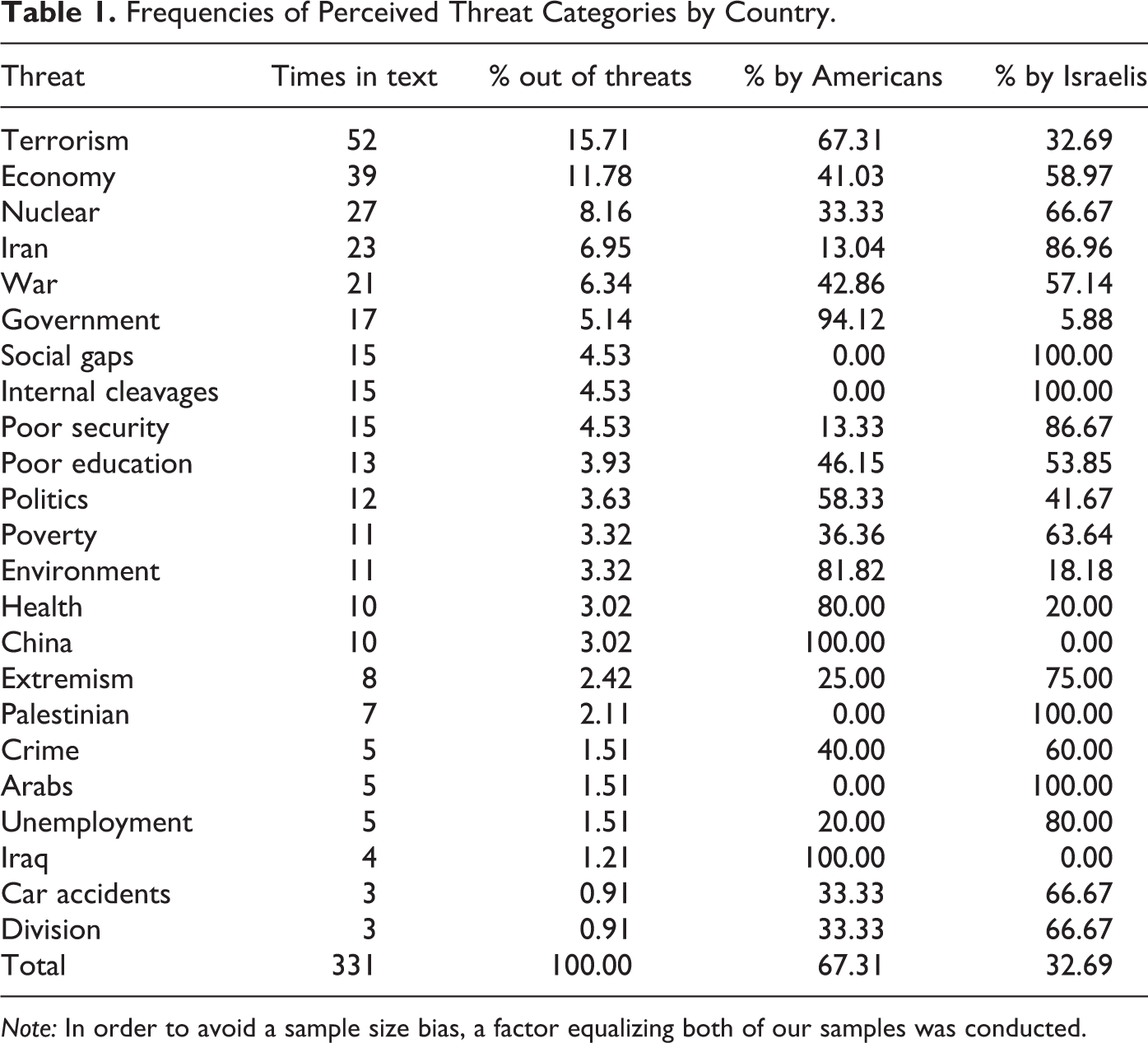
Note: In order to avoid a sample size bias, a factor equalizing both of our samples was conducted.
Furthermore, for Israelis, external threats are salient and significant. “Nuclear,” “Iran,” and “war” are frequent in Israelis’ threat lists; this has presumably made Israelis more militant. One candidate, when identifying specific threats in their definitions, was Iran, perhaps in response to the radical rhetoric of President Ahmadinejad in recent years. Threats by Iranian leaders, as well as Iran’s attempts to obtain weapons of mass destruction, were reported as more stressful for Israelis (86.96 percent) than for Americans (13.04 percent). Israelis also tended to associate weapons of mass destruction (WMD) particularly with Iran (the word combination appeared fourteen times) whereas Americans worried about WMD regardless of which country had them.
The state of the economy also shaped perceptions of national resilience. Considering the shift from the model of a socialist welfare state toward a capitalist welfare state, Israelis were concerned with widening income gaps, increasing poverty, and rising unemployment. Americans, however, have always lived in a free market economy and are familiar with and more accustomed to its positives and negatives.
“National Resilience” Definitions by Americans and Israelis
In studying the meaning of national resilience, we ended up with thirty-seven keywords or tokens. To examine representations in individuals' responses to a designed survey, 44 we extracted from these tokens thematic clusters to analyze variation in people’s comprehension and interpretations of national resilience and its components. Two separate coders were asked to divide these thirty-seven tokens into six thematic clusters: “coping abilities” (words in this category: overcome, intact), “domestic issues” (citizen, nation), “threats” (attacks, enemies, terrorism), “origin of threats” (external/internal threats), “security” (military, defend), and “patriotism” (unity, love). Intercoder agreement was quite high (Cohen’s κ = .841). In cases of disagreement, a third coder was used to rule between the two coders. Among these six clusters, one can find the four psychopolitical resilience dimensions: “coping abilities” include optimistic perceptions and assessment of the nation’s coping abilities, “domestic issues” cover the area of trust in governmental institutions, and “patriotism” and “threat” refer to unity and enemies, respectively. This finding reasserts the importance of incorporating psychological–political attitudes when evaluating perceptions of national resilience.
Figure 1 shows the results of the content analysis of the respondents' definitions of national resilience. Israelis (20.9 percent) were more likely to use militaristic language (e.g., security, defend, army, war) as a key component, while Americans (6.5 percent) were less likely to do so. This finding can also relate to and derive from Israelis’ external threats described in the previous section. The continuous external threats to Israel have led to an actual existential threat and therefore, in their perception of resilience as a coping mechanism, one can find militaristic language. Further, Israelis also tended to employ more emotional–patriotic phrases such as feelings of love for their country, volunteering, and unity (9.4 percent vs. 2.9 percent, respectively). For example, interestingly, one respondent defined national resilience as the “ability to maintain stability and unity in an era of political changes, such as elections, despite disagreements, due to a feeling of obligation and responsibility.” Another respondent simply defined national resilience as the “ability to remain steadfast when dealing with problems in different areas: terrorism, poverty and corruption.”
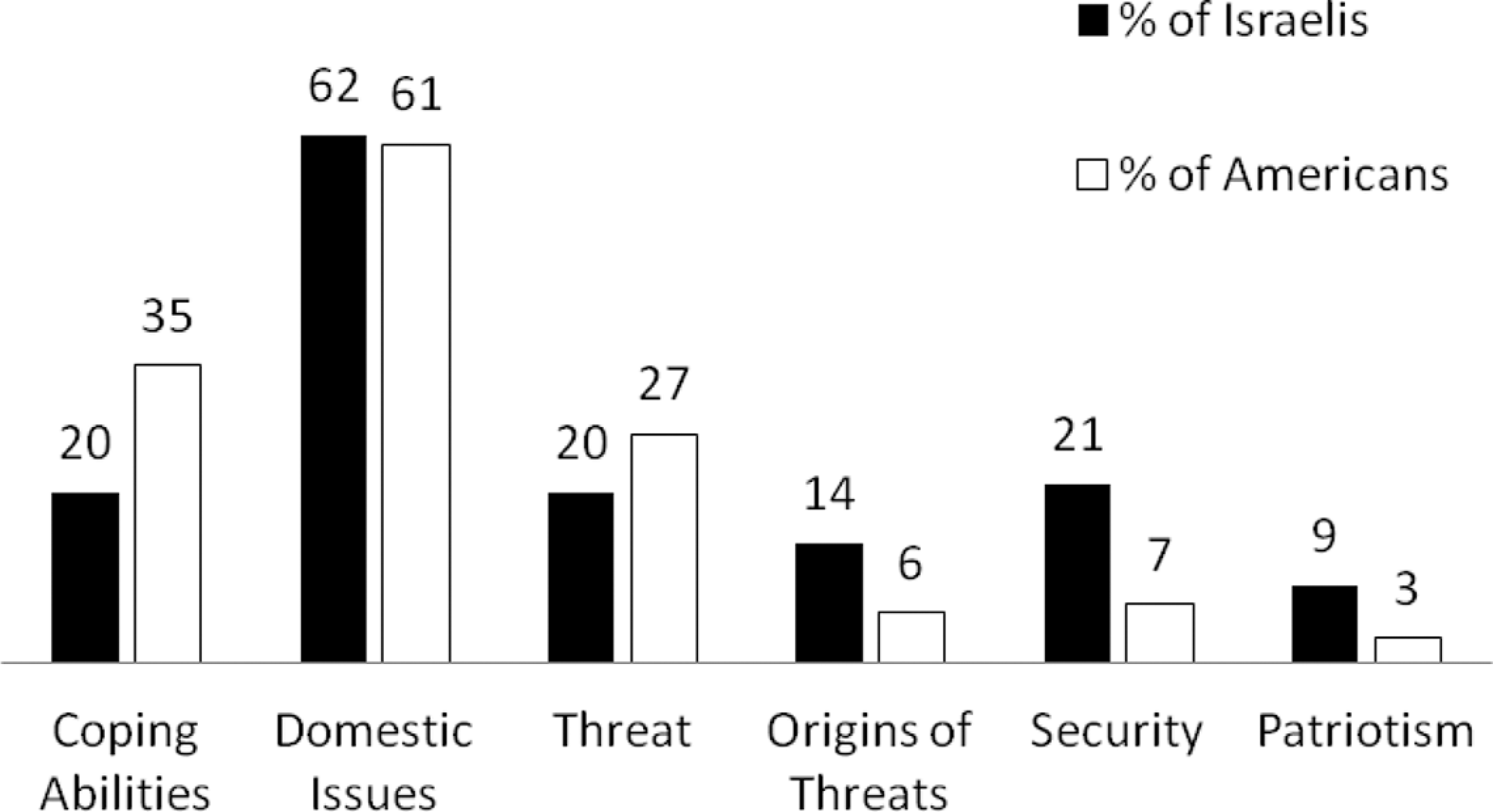
Themes emerging from national resilience definitions by country.
Comparing Americans and Israelis across the six themes (Figure 1) reveals that Americans score higher on coping ability and threats, whereas Israelis score higher on origins of threats, security, domestic issues, and patriotism. These trends are also reflected in the formal language used by the Americans when defining national resilience in contrast to the informal language and threat-oriented definitions given by the Israelis.
Considering the definitions provided by the American respondents, we may summarize their conception of national resilience in a more abstract manner, as the nation's ability to overcome its problems and threats, and remain united while facing those threats. Israelis, for whom threats (e.g., existential survival and internal cleavages) are more vivid, went into more detail. Thus, their definition can be summarized as the nation’s ability to overcome its external and internal threats and problems, be they political, social, or economic, while society remains united, patriotic and imbued with a volunteering spirit.
As expected, both Americans and Israelis definitions included psychological–political components. Trust in the nation’s institutions—as “domestic issues,” patriotism, threats, and optimism—as coping abilities—were components that appeared in the respondents’ definitions. While small variations between these two definitions of national resilience can be attributed to cultural and political differences, the core of the definition is cross-cultural. Put another way, these minor differences in definitions are likely to hold for other countries while the central concept of national resilience is likely to apply to other nations as well. This understanding allows for a working definition of national resilience as the nation's ability to cope successfully with its adversities (whether terrorism, corruption or poverty), while keeping its social fabric intact. To avoid self-bias, a further validation of our working definition was tested by three independent referees—Israeli doctoral students not associated with this research. Referees were provided with the above definition of national resilience along with a table of our 158 respondents’ definitions and were then asked to match the working definition to the 158 individual definitions on a scale of 1 to 5 (when 1 signified not matching at all and 5 denoted matching to a great extent). While matching, judges were instructed to focus on the overall meaning of the definitions, rather than on their wording. The result of this test was a rating of 4.2 for our working definition across both countries.
Discussion and Conclusions
What does national resilience mean in a democracy? Several definitions of “national resilience” include economic, military, and political aspects in this term’s definition. While these aspects consist of macro-level perspective, we suggest integrating micro-level factors, namely, psychological–political perceptions, into the definition of this term. Such an examination adds the important component of civic participation—a core element in democracies. 45
Results of the content analysis lead to a meaningful and critical conclusion. For both Israelis and Americans, the presence of major threats and the stability of a society’s political institutions are important components of national resilience. Different cultural and political climates can explain minor variances between the two countries; yet, the definition remains the same. As a comparative study, the evidence suggests common ground that makes it possible to apply this concept of national resilience to other democracies.
National resilience is a dynamic rather than a static and contextual term. By presenting a dynamic resilience definition, this study posits that by measuring threats and public attitudes such as patriotism, trust, and optimism, it is possible to evaluate the abilities of democratic societies to endure crises and recover from them. Terrorism was the most frequently occurring word used by our respondents as a threat currently facing their country. Thus, it seems that the diverse plausible impacts of terrorism should be accounted for in future studies of national resilience. 46 However, although terrorism was the most common threat to appear, policy makers should not mistakenly assume that terrorism is the sole threat to the democratic world. For instance, our analysis reveals that a poor economy was considered second only to terrorism, followed by poor governmental performance and corruption.
Some methodological and conceptual issues merit comment. Although the cross-sectional design limits assignment of causality, considering the urgent need for cross-cultural studies on national resilience in democracies, the study’s design may be regarded as an advantage. Another issue is the use of a student sample. However, other studies on political attitudes and perceptions have found hardly any differences between results based on student samples and on general population samples. 47 Further, university students are the nation’s potential for future decision maker and policy makers, allowing their perceptions, as students, to be of meaningful in the near future. However, one must keep in mind that those attaining higher education are of specific social and political background (e.g., having left wing views).
Conceptualization of national resilience is influenced by various contexts and covariates. Only a limited number of studies have examined the psychological impact of exposure to terrorism, 48 while others have investigated terrorism’s political consequences. 49 However, even fewer studies 50 have addressed the relationships between psychological consequences of personal exposure to terrorism—which is more pervasive than would at first seem—and political consequences. Although the approach put forward here has led to a study that focuses neither on personal exposure or proximity to terrorist attacks and wars nor on psychological distress, we acknowledge the confounding roles of traumatic exposure and related psychological distress in the investigation of national resilience among Americans and Israelis. Our main goal, however, was to conceptualize national resilience. In line with Lazarus and Folkman's 51 approach, we believe that the role of exposure and related psychological distress in activating threat perceptions is significant.
Notwithstanding its limitations, this study makes important contributions in several areas. It contributes to the body of knowledge concerning attempts to cope with the threat of terrorism in democratic countries. It joins the growing trend of shifting from a pathologically oriented view toward a slightly more constructive one: the role of individuals and societies in understanding and enduring the impact of terrorism. The definition for “national resilience” presented in this study can form the basis for improved measures of resilience from the individual level to the communal.
Ultimately, the study combines theory and practice. Defining the psychological–political factors of national resilience enables decision makers to understand the ways society is affected in times of adversity. Importantly, these can clarify the different factors that may contribute to strengthening a society's national resilience. Given the current global threats, our research shows that gaining citizens’ support and trust in government policy, a key element in obtaining national resilience, will have a vital and even critical effect on the ability of the state to endure nonroutine situations. We believe it is valuable, even essential, to expand perspectives on national resilience beyond macro-level security considerations and micro-level psychological considerations. This can be achieved by broadening national resilience’s indicators so that they encompass its complexity, while uncovering additional facets of this elusive concept. We hope further research will continue this course of action.
Footnotes
Declaration of Conflicting Interests
The authors declared no potential conflicts of interest with respect to the research, authorship, and/or publication of this article.
Funding
The authors received no financial support for the research, authorship, and/or publication of this article.