




Abstract
Armed forces form the lifeblood of any nation, and morale of its officers is the key to effective defense of the country’s borders. Yet, most militaries, and so does Indian, suffer from a relatively high rate of churn of officers that has adverse effects. Turnover is detrimental to any organization, and it is particularly undesirable for armed forces, as it affects unit cohesion and operational preparedness, thus proving to be chronic problem that demands attention. With this aim, we investigate the factors that are instrumental in influencing the propensity of military officers to leave. A survey of 476 Indian military officers, followed by a rigorous empirical analysis, revealed the pay, promotion, and job satisfaction to be the prime perpetrators for the intention of military officers to leave. Our work is a step in the direction of stemming the attrition and improving the retention of officers in the Indian military.
Keywords
Introduction
Retention of qualified military personnel is a major area of concern for most of the countries. Given its peculiar geographical–political environment, the problem assumes a great importance for India especially with respect to officers. Indian military is short of a staggering 14,264 officers 1 —about 24 percent of the sanctioned strength. 2 The shortages, which are mainly in the ranks of lieutenant colonel (or equivalents) and below, 3 have begun to adversely affect the cutting-edge junior leadership of the armed forces, especially of the army, which has heavy operational commitments in border management, counterinsurgency, and internal security—all of which are driven by junior leaders, making it increasingly difficult to recruit and retain the right kind of officers. 4 As noted by numerous studies, turnover intentions reflect a state of “psychological withdrawal” that in time may turn into actual turnover. Research has related this tendency of service members to quit to a wide variety of factors like individual and job characteristics, quality of life perceptions, work attitudes, prevailing state of employment, 5 family factors, 6 and attraction of alternate employment. 7 Civil and military studies have further accentuated this propensity to leave the military to factors like perceived pay, promotion opportunities, 8 and job satisfaction. 9
Pay is defined as a fixed amount of money or compensation paid to an employee by an employer in return for the work performed. 10 Extant literature suggests that pay satisfaction could be influenced by three factors: (i) economic benefits received on the job, (ii) extent to which earnings are regarded as fair or deserved, and (iii) noneconomic job satisfactions. 11 Promotion is the advancement of an employee’s rank or position in an organizational hierarchy system, which brings in higher responsibilities and corresponding monetary rewards. In military, promotion means higher rank and relates to individual achievement, increased pay, and greater prestige in the organization. 12
Job satisfaction is a global feeling about the job or as a related constellation of attitudes about its various aspects or facets. 13 Variations in job satisfaction may be explained by the Herzberg’s “two-factor theory” which states that satisfaction and dissatisfaction are driven by different factors—motivation and hygiene factors. There are certain factors in the workplace that cause job satisfaction with a separate set causing dissatisfaction, causing job satisfaction and job dissatisfaction to exist independently of each other. 14 The motivators give positive satisfaction arising from intrinsic aspects of the job such as recognition, achievement, or personal growth. Hygiene factors do not give positive satisfaction, though dissatisfaction results from their absence. These include the aspects of the working environment such as pay and the organizational policies. 15,16 Thus, satisfaction and dissatisfaction are not on a continuum, rather are independent phenomena. For attaining the desired level of satisfaction, both the factors are required to be addressed independently.
While there is sufficient theoretical support to assume that pay and promotion influence job satisfaction as well as turnover intention, the exact causal relationship is not without debate. Williams et al. 17 noted that variables like pay influence only satisfaction directly, which in turn may lead to propensity to quit. However, Spector 18 and Judge et al. 19 suggested that the pay level is only marginally related to satisfaction. A similar divergence in inferences is noted in the relationship of pay/promotion with turnover intentions. Janowitz 20 doubts whether the military, as a profession, can solve its personnel problems on the basis of incentive pay scales. This is supported by the work of Kim, 21 which indicates that for public sector employees in California, availability of higher wages with competitors plays no role on their decisions to leave their organization. Heilmann et al. 22 also provide some evidence that advancement expectations do not significantly influence the intention to quit. However, in contrast, Griffeth and Hom 23 noted that pay dissatisfaction predisposes an employee to quit.
Propensity to quit may emerge from yet another context. Most of the infantry units of the Indian military are traditionally based on the region/ethnicity/caste of “persons below officer rank” 24 like Bihar, Gurkha, or Sikh regiment. Such affiliations/relationships may be argued to influence the service members’ retention intentions when deployed in counterinsurgency operations against their “own people.” In colonial era, Khalidi 25 notes, the strategy for such situations was to use trans-community deployment, that is, to use some force alien to the region. For example, predominantly Sikh regiments (based on troops from north India) could be deployed in northeastern India, while Gurkha regiments could be deployed in Punjab (north India). As the present policy of the military on such deployments is not available in public domain, the research tends to rely on media reports 26 which neither indicate continuation of the colonial deployment strategy nor any serious impact on retention of the service members on this account; more so in case of commissioned officers, who most of the times, are from a social background, different from that of their troops.
Clearly, there is not only a lack of clarity over interrelationships among these constructs but also how they affect propensity of military personnel to quit, a severe problem plaguing the Indian military. Drawing on theory and past research, our research aims to propose an empirically validated model explaining intention to leave along with empirical evidence to factors at play through supporting hypotheses in the context of Indian military officers. Hypotheses, which relate each of the antecedents to the relevant consequent constructs like job satisfaction and intention to quit, not only present a framework in the form of constructs unique to military literature but also should be able to provide guidance to decision makers about ways to stem the problem of outflow of officers, which is so very important for the operational preparedness of the military. The present work undertakes development of ten such hypotheses in the form of a conceptual model, which are then empirically validated through survey research, followed by structural equation modeling–based path analysis. The development of the conceptual model backed by literature is presented next. This is followed by methodology of collecting and analyzing data for empirical validation of the model. We, then, discuss the results of the analysis followed by discussion, limitations of this work, and future directions.
Conceptual Model
Military Pay and Intention to Leave
There exist empirical and theoretical evidences concerning the role of compensation in turnover process. Compensation for participation in military is important as it influences the decision to remain in the organization.
27
Military members compare their pay with income for comparable positions in the civilian sector. When military pay is significantly lower than civilian opportunities, retention is decreased.
28
Compensation affects and reflects status/lifestyle. Perceived lower wages may therefore give rise to quit tendencies and a desire to move for greener pastures. This thus leads to the following hypothesis:
Promotion Prospects and Intention to Leave
Another factor, which very significantly guides the decisions of junior army officers to quit active force, is perceived promotion prospects.
29
Higher rank implies higher status, and greater prestige in the organization, making it one of the strongest motivating factors in any organization.
30
Career progression pyramid in the military is too sharp to even accommodate all the positively evaluated and deserving officers. As an organizational constraint, therefore, only a small fraction of the officers can hope to reach the ranks of colonel and above.
31
Munasinghe
32
indicated that the employees are less inclined to leave positions that have a high degree of wage growth. This is consistent with the work of Harrington,
33
who noted that air force workers were more likely to leave if they were dissatisfied with their promotion opportunities. Research thus suggests that promotions can serve as an important mechanism for employers to keep their workers happy and reduce turnover.
34
We therefore suggest the following hypothesis:
Job Satisfaction and Intention to Leave
The idea of desirability of movement has become commonly associated with the concept of job satisfaction which is an established indicator of organizational functioning.
35
March and Simon
36
provide the earliest source for employee turnover theory that individuals will participate in an organization so long as the benefits of participation are consistent with the rewards (level of satisfaction). It was found that higher job satisfaction was associated with lower turnover rates,
37
suggesting that increasing job satisfaction among other measures is potentially a good strategy for reducing turnover intentions. Notwithstanding this, not everyone who is satisfied intends to stay, and not everyone who is dissatisfied intends to leave.
38
The relationship has been suggested to also vary with the prevailing employment rates—a low relation during times of high unemployment and high during the times of low unemployment.
39
The predictability of turnover was further noted to decrease with time, especially in military samples.
40
We therefore hypothesize the following:
Antecedents of Job Satisfaction
Research suggests a number of factors impacting job satisfaction, which can be broadly grouped under two heads—work environment and family concerns. In the first category, factors like person–organization fit, job autonomy, perceived organization support, and recreational means have been established as salient satisfiers. Under family concerns, there is considerable emphasis on family-centric factors like family involvement and family support. Research on life satisfaction has indicated that satisfaction of military personnel with the environment for families is a dominant predictor of overall satisfaction for married military members. 41 We next discuss the individual effects of each of these antecedents on job satisfaction.
Person–Organization Fit and Job Satisfaction
The degree of confluence between a person and the organization is expressed as their person–organization fit. 42 This is defined as the compatibility between people and organizations that occurs when at least one entity provides what the other needs, when they share similar characteristics or both. 43 A good fit has been found to result in a number of mutual benefits such as improved satisfaction. 44 Schneider’s 45 attraction–selection–attrition theory 46 states that people pursue careers with organizations whose values match their own and that organizations select candidates whom they believe share common attributes with those of the organization. 47
There is an abundance of research supporting the existence of relationships between job satisfaction and person–organization fit. 48 The theory also relates the misfit to turnover, implying that the individuals with poor fit after organizational entry will inevitably leave it, either by choice or by force. 49 Chatman 50 found fit to be particularly important in organizations with strong cultures whose norms are clearly defined, such as the US navy environment.
In view of above, we hypothesize the following:
Job Autonomy and Job Satisfaction
Job autonomy refers to the degree to which the job provides freedom, independence, and discretion to the individual in scheduling the work, and in determining the procedures to be used in carrying it out. 51 In its most general form, job autonomy influences employees’ perceptions of their authority to initiate, perform, and complete tasks. 52 Job autonomy is related with a sense of achievement and comes with the responsibilities of decision making, adding to the professional growth of an officer. 53 Autonomy has also been widely considered as positively associated with worker performance, which is likely to decline with a reduction in autonomy. 54
Restrictions of various kinds are an inherent feature of military functioning. While this is inescapable from the organizational perspective, many officers feel that the moment they joined the military they lost all freedom assured by the constitution of India, with little or no room for individual initiative or imaginativeness. This, for some, gives rise to irritation and dissatisfaction on individual considerations.
In view of the above, we hypothesize the following:
Family’s Satisfaction with Military Life and Job Satisfaction
Family’s satisfaction toward military life, in simple terms, implies the general attitude of the entire family toward military as a career. Service in military involves more than just an occupational choice; it is the selection of a lifestyle that permeates almost every aspect of a person’s life. 55 The combinations of demands that military places on its soldiers and their families is unique, extremely intense, 56 and unimaginable in most civilian occupations. 57 This includes frequent relocations, prolonged separations, long work hours, isolation from civil society, and risks of injury or death. 58 On the other hand, few civilian employers offer their employees the encompassing range of economic and social benefits that tie their employees as well as members of their families to the organization. 59 This unique combination of occupational demands and supports describes military as a total institution, 60 and impacts the overall environment for the families in military and their satisfaction with the military way of life.
Segal 61 posited that the recruitment, morale, and retention of military personnel are affected by the family members’ attitudes toward military lifestyle. Heilmann et al. 62 noted that the family’s satisfaction with military life affected retention decisions. These findings were consistent with the past research which empirically established that the more satisfaction members have with the environment for families, the greater will be their overall satisfaction with military as a way of life. 63
In view of the above, we suggest the following hypothesis:
Family Involvement and Job Satisfaction
Family involvement is the perceived level of personal involvement of an employee in his family responsibilities. It implies increased allocation of time and effort to family and home activities such as child care and family or household activities. 64 Stated simply, it means “family first.” Given the centrality of family, it is logical to expect both, work to family and family to work interferences in such cases. Frone et al. 65 noted the family involvement to be significantly related to family interfering with work. However, the levels of such interference were found to be low due to higher levels of emotional and instrumental support to family involvement from family. 66 Family involvement is expected to have a positive relationship with family social support because workers who enjoy high levels of family involvement are likely to devote more time and energy to family, and thereby increase the family’s opportunity and motivation to provide support. Emotional and instrumental support from family is therefore hypothesized to be positively associated with life satisfaction. 67 Higher levels of family involvement therefore were associated with higher levels of emotional sustenance from family members, which, in turn, had a positive relationship with life satisfaction and thus to job satisfaction.
We thus hypothesize the following:
Recreational Means and Job Satisfaction
Recreational activities like sports, adventure, and social interactions, have always been promoted in the military.
68
The facilities, generally meant for the service members, are extended most liberally to the families as well. Social gatherings, an integral part of military life, are organized at the slightest pretext. The benefits of these practices go far beyond those of the physical fitness and overall wellness of a service member and his family. These are traditionally seen as great stress busters, contributors to something that binds and improves the cohesiveness of the military fraternity, and significantly improves the quality of life in an environment of heavy work commitments. This in turn enhances the commitment of servicemen/servicewomen and their families to the military. In Dowden’s
69
“quality of life” model, leisure and recreation are among its critical domains. The availability of adequate leisure time and leisure time activities in a military station therefore impacts the satisfaction of service member with the military way of life.
70
Balancing work and nonwork domains thus implies positive perceptions concerning these “quality of life” domains. This contributes to job satisfaction and commitment
71
and may in turn influence employee retention.
72
In view of this discussion, we hypothesize the following:
Perceived Support and Job Satisfaction
Perceived organizational support can be defined as employees’ global beliefs concerning the extent to which the organization values their contributions and cares about their well-being. 73 Eisenberger et al. 74 argued that the employee–organization connection was a social exchange relationship in which the organization offered employees benefits and social rewards in exchange for loyalty and work effort. 75 Based on the norm of reciprocity, 76 when employees perceive that the organization supports them, they would reciprocate with positive attitudes, favorable work behaviors, 77 and heightened performance. 78
The military has a role that is fraught with risk to life and limbs. Its members are trained and groomed to give their best toward the mission’s accomplishment even if it involves the supreme sacrifice for the nation. In return, going by the tenets of exchange theory, 79 they expect support from the state in discharging their work and nonwork responsibilities. The support is characterized as emotional (the extent they go out of their way to help and are willing to attend to the personal problems) and instrumental (make things easier and could be relied upon). Thus, while at personal level, the support may mean showing of respect, trust, and appreciation of his work, at professional level it implies the necessary wherewithal needed for the facilitation of the mission. 80
From the perspective of government’s support, there is a feeling among the officers that the prestige of military career is on the decline, 81 as the neglect of the military by the former is on the rise. Within the military, however, support of all forms is ingrained into the military DNA, and the officers traditionally perceive the military as a fairly cohesive organization.
The morale and discipline of the armed forces are boosted when they know that they are being treated fairly by the powers that be,
82
and this directly affects their satisfaction level. All round support—emotional as well as instrumental, to an officer, both in work and nonwork issues, reinforces his faith in the importance of his work. As support increases, the motivation and satisfaction for the state also increases. The abovementioned discussion leads to the following two hypotheses:
Compiling all the above-proposed hypotheses, a conceptual model is given in Figure 1.
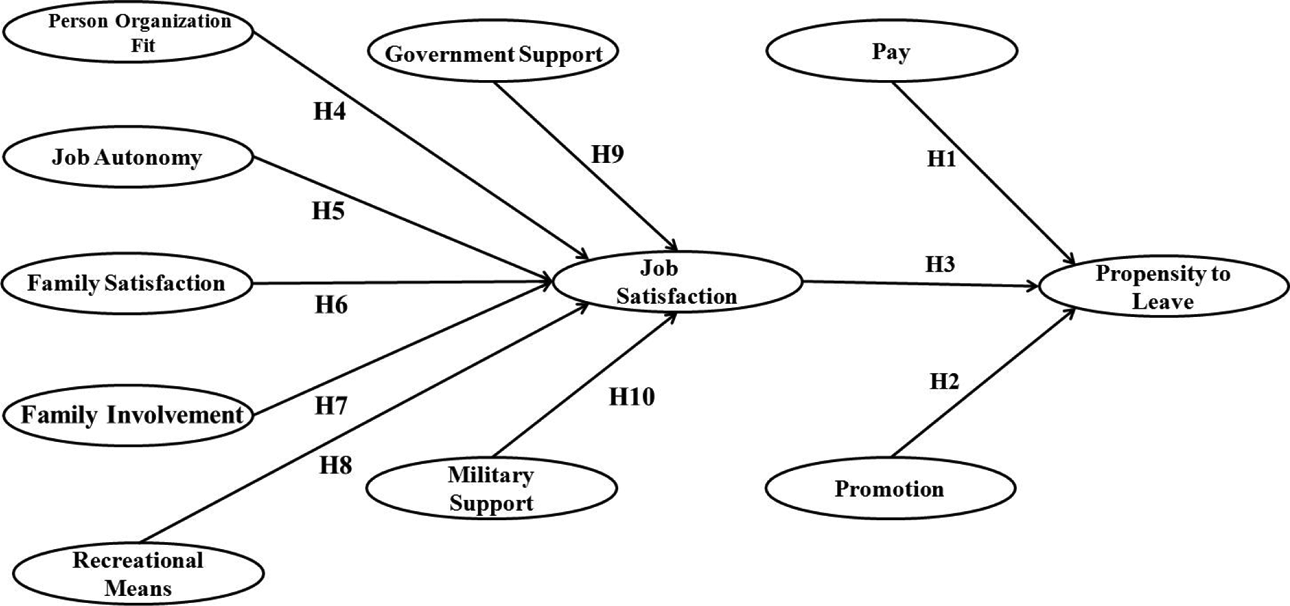
Conceptual model.
Methodology
Research Design
Based on literature survey and interaction with experts and officers, a draft questionnaire was prepared. This was tested on a group of officers who were undergoing a course in management at the Indian Institute of Management, Lucknow (India). They were encouraged to identify and report any ambiguity or discrepancy in the questions. Forty-three officers responded in full; some double-barreled, ambiguous, and repetitive questions were pointed out, which were dropped from the final questionnaire.
Sample and Instrument
Data collection for this research was undertaken using a cross-sectional survey of military officers attending the “General Management Programme” at the premier management institutes of India to include the Indian Institutes of Management (IIM) at Lucknow, Indore, and Ahmedabad since 2011. Each course, designed exclusively for the military officers who, for whatever reason, were at the verge of leaving the military, comprised of about forty to sixty officers from the army, air force, and navy. The course is open to complete range of retiring/recently retired officers as a welfare/resettlement measure from the government. They may be young short-service officers with five/ten years of service, or women officers with similar service spans, or could be medically boarded out officers (irrespective of length of service), or those who took premature release, and includes those who have completed full service or have also completed one/two reemployment terms. The officers on such courses were, again, a mixed lot—from combat to support/logistics services, with totally diverse academic backgrounds—from plain undergraduate to postgraduate/doctorates. The ranks varied from major through brigadiers, and their equivalents in navy and air force. Thus, even though, a formal sample selection process could not be followed due to ground realities/sensitivities attached with the defense officers, the courses at Indian Institutes of Management (IIMs), presented a fairly representative sample of Indian military.
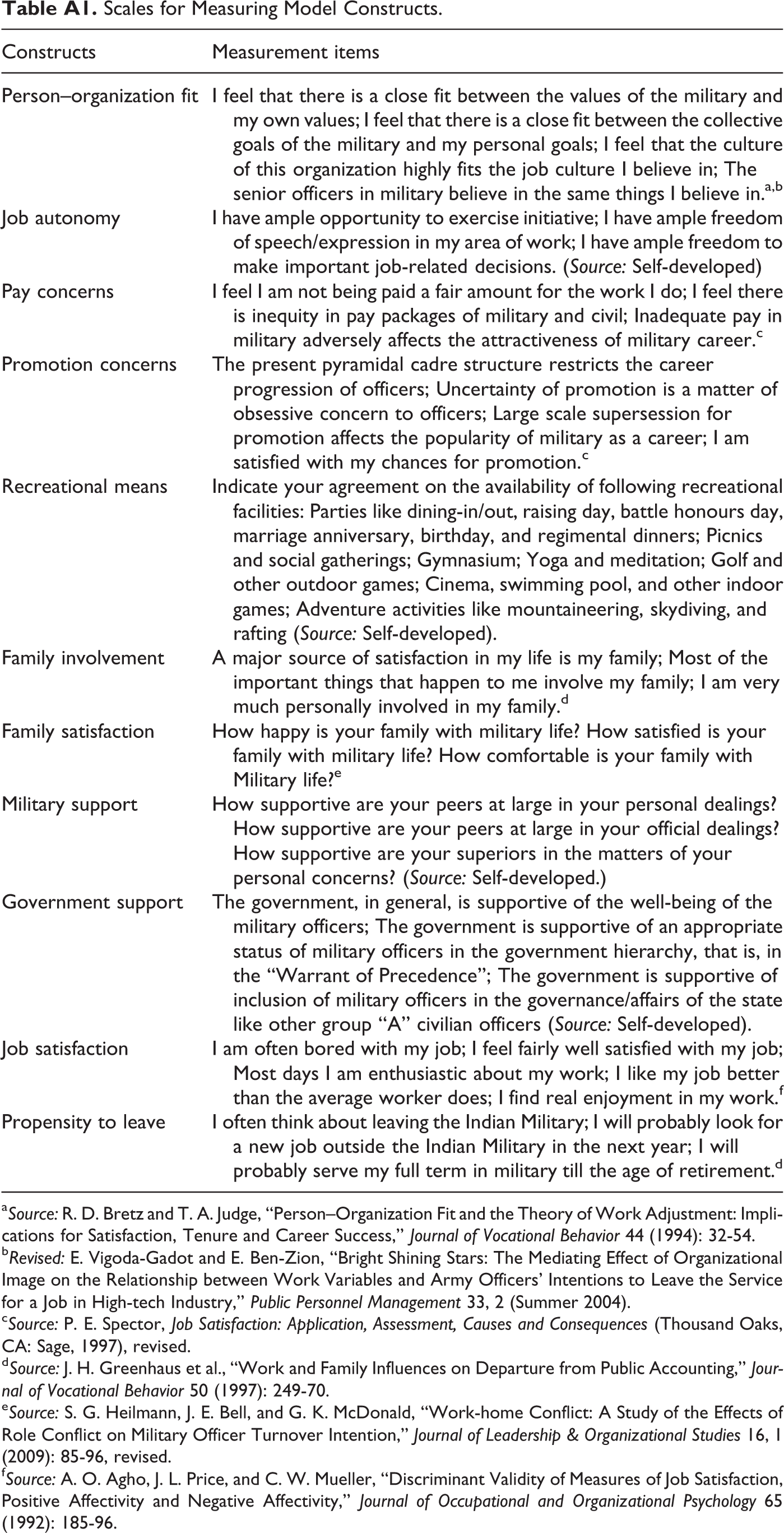
The final instrument included forty items to specifically measure the stated hypotheses. Scales consisting of multiple items were used to measure each construct. As much as feasible, standard scales that have been used in earlier management studies were used. Most of the scales were modified and adjusted to the needs of the study for the quality empirical research. All constructs were measured through multiple-item scales (minimum three) on a five-point Likert-type response format. The appendix summarizes the items used for measuring the relevant variables in the model.
Data Collection
Data collection was completed in both electronic and physical (paper and pen) modes. As far as possible, officers were provided with a printed questionnaire to fill. In other cases, the questionnaire was uploaded on the Internet, and the officers were requested to respond. The questionnaire included a cover letter, survey instructions, and the items. The cover letter appealed for response and assured its confidentiality.
A total of 213 and 263 valid responses were obtained in electronic and physical form, respectively. In both the cases, repeated appeals were made through classroom interactions/e-mails to solicit response as many officers were very apprehensive about the whole exercise. The responses came slowly, in small lots, after each reminding exercise and included some partly filled/untouched ones. A total of 476 valid responses (sample size) were thus collected. The sample characteristics are summarized in Table 1.
Sample Characteristics.

Note: IAF = Indian air force; IN = Indian navy.
The sample comprised predominantly of mid-level officers, who bear the brunt of battlefield hardships. Most of them had sufficient length of service, a family, and were either at the verge of quitting or just retired officers. Although going by the ratio of officers in the three services, air force and navy were underrepresented in the sample (41 and 72 percent of proportionate figures, respectively) yet given the defense-related limitations of the subject, the numbers were taken as adequate.
Results
Summary of observations like “mean” and SD are given in Table 2. Construct validity (convergent and discriminant) of ten factors was checked by carrying out confirmatory factor analysis while reliability was tested using Cronbach’s α. The findings are given in Table 2.
Summary of Observations and Results of Construct Validity Analysis.

aThe “range” of all variables varied from 1 to 5 but for the “Recreational means,” which is a composite variable with eight items. The responses across these eight items varied widely with respondents and therefore the “range” in this case was found to be as 1.375–4.875.
The value of Cronbach’s α for all the factors is above .7, which shows satisfactory internal consistency of scales. All the items were found to be loading well above .5, showing good convergent validity. To test discriminant validity, the correlation coefficients between any pair of constructs were observed. These were found to be significantly below unity, establishing the discriminant validity of the measures. The goodness-of-fit measures for the sample were found to be as follows: χ2 = 2,254.40 (476), χ2/df = 2.013, comparative fit index (CFI) = 0.944, incremental fit index (IFI) = 0.945, and root mean square residual (RMR) = 0.053. Although χ2 value was significant, RMR value for the model was acceptable, and the other indices were more than the cutoff criterion of 0.90 which indicated a good fit.
After getting satisfactory measurement model, the hypothesized model given in Figure 1 was tested for fit using path analysis. The results are shown in Figure 2. The insignificant paths are shown in broken lines and the path coefficients of significant relationships are depicted in adjacent boxes. Fit measures of the path analytic model obtained were RMR = 0.029, gross fit index (GFI) = 0.982, normed fit index (NFI) = 0.957, IFI = 0.964, and CFI = 0.963, which show a satisfactory fit.
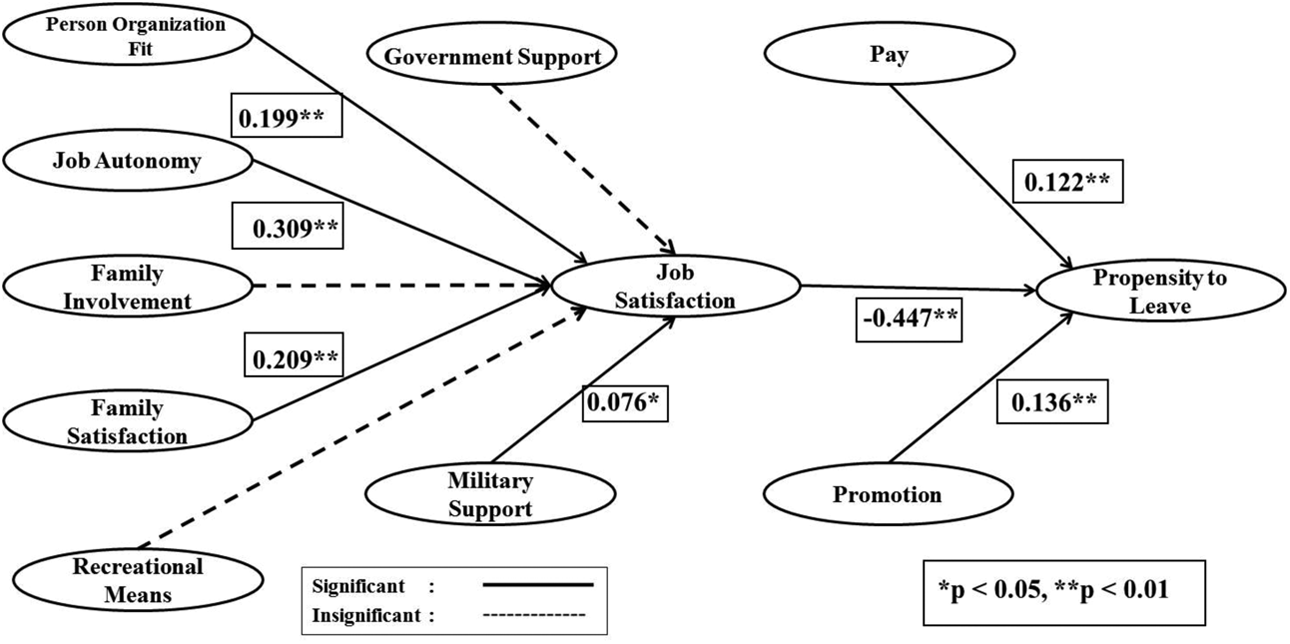
Path analysis.
From the path diagram, it is clear that the higher pay and promotion concerns lead to a higher intention to leave with β values of .122 and .136, respectively. Job satisfaction is also found to have a strong negative effect on intention to leave with a significant path coefficient of −.447. Finally, in terms of antecedents of job satisfaction, person–organization fit, job autonomy, family satisfaction, and military support were found relevant with significant β values of .199, .309, .209, and .076, respectively.
Discussion
Current study has addressed some of the vital predictors of turnover intention of Indian military officers. Job satisfaction, a prime antecedent, has been found to be strongly related with the intention to leave. This is consistent with the results of the US Active Duty Survey (1999) and the web-based surveys (Status of Forces Surveys of Active-Duty Members) conducted in July 2002 and March 2003 which suggest considerably high correlations between satisfaction with military life and willingness to stay on active duty. 83 Also in a British army leavers’ survey, 79.1 percent of respondents said that the decision to leave was related entirely, or in part, to job satisfaction. 84
Pay and promotion have also been found to be significantly related to turnover intentions. This is in line with the findings of US Active Duty Survey (1999), 85 in which 38 percent of respondents said that the basic pay will be the main reason to leave the military. An unprecedented number of requests for release from service, from the Indian military officers not satisfied with the award of sixth Central Pay Commission in 2007, also underscore the finding. 86 Since promotion is associated with higher status and higher wages, the impact of both the pay and promotion on intention to leave is significant. This is also in line with the findings of Ramdass, 87 which noted that the US aviation officers who attain higher ranks are more likely to remain in the organization.
Extant research has also tested the relationship of hypothesized job satisfiers with job satisfaction. Job autonomy has emerged to be a strong contributor of job satisfaction showing the importance, an officer attaches today, to autonomy at workplace. Family satisfaction and job satisfaction relationship has also been found to be significant, and is in line with the existing research. 88 Military is a challenging and demanding organization. Unless the person–organization fit is good for this kind of work, the job will appear to be very stressful, and may lead to severe dissatisfaction. The significance of this relationship has once again been reaffirmed by the result of the study. In organizational support, military support is found to be significantly related to turnover intentions, though to a moderate extent. However, the relationship of government support with turnover intentions has been found to be insignificant. This can possibly be explained by the fact that bulk of the respondents, the mid-level officers, deal mostly with their immediate higher headquarters within the military and may not have much to do with the civil–military dealings which are normally held at a little higher level. Their exposure thus, with the civil government, may not be adequate to render a worthwhile picture and therefore may be explored in future work.
Managerial Implications
Officers today have more occupational choices than before. They may tend to crossover to the civil sector, as the research has highlighted, if not satisfied with their military job. The military therefore should address various factors contributing to turnover intentions more closely in order to improve the retention of its service members.
The results of the study may be viewed in the perspective of “Two Factor Theory.” 89 While pay and promotion aspirations of service members may be kept in focus as hygiene factors of the theory, enhanced attention to significant job satisfiers like autonomy, person–organization fit, family satisfaction, and military support may be dealt with as motivators, the other factors of the theory responsible for positively impacting satisfaction.
Limitations and Directions for Future Research
One limitation of our work relates to the dearth of literature in context of the Indian military in public domain, possibly due to security-related restrictions in the military. The present work, therefore, to a large extent, is based on research done outside of India. While a great proportion of such findings do apply to Indian settings as well, there may be a certain amount of variation in outcomes due to cultural, geographical, and other differences. It is felt that the study could have captured these distinctive features much better if prior indigenous effort could also be amalgamated with the present work, which future researchers should focus on.
A second limitation pertains to the inaccessibility of serving officers for data collection. The prevailing security culture does not seem to encourage or facilitate such deliberations in the civilian domain, even if scholarly in nature. As the perceptions of an officer may vary with his age, arm/branch, length of service, and operational sector profile, it was desirable to capture these variations for more realistic outcomes. However, for the aforesaid limitations, it was not feasible to meet such exacting requirements, and therefore the research need was fulfilled, to some extent, by having interaction with a restricted lot of officers from different service brackets and from different branches of the military. As these were the officers who were already thinking of leaving and were on a resettlement course at the IIMs, the generalization of results of the study to entire Indian military officers tends to get limited to that extent. A better and more exact sample framer is thus suggested for future studies on similar topics.
A third limitation lies in the sweeping conclusions drawn for all branches of the Indian military. The three services have much in common and are viewed as one entity—the Indian military. However, despite the similarities, the functional environment for the three branches is quite different, and one study for all three may tend to be little generic. Separate studies on the turnover in the army, air force, or navy therefore may be taken up, focusing on the peculiarity of the particular service.
Conclusion
This study provides a novel effort to empirically establish those factors that cause servicemen and servicewomen to leave the Indian military prematurely. Being an early effort, this study raises more questions than answers. All the issues discussed in this article need to be addressed to answer the questions more effectively. The outcomes so obtained may help the Indian military mitigate the problem of attrition and help attain a higher level of operational preparedness.
Footnotes
Appendix
Scales for Measuring Model Constructs.
| Constructs | Measurement items |
|---|---|
| Person–organization fit | I feel that there is a close fit between the values of the military and my own values; I feel that there is a close fit between the collective goals of the military and my personal goals; I feel that the culture of this organization highly fits the job culture I believe in; The senior officers in military believe in the same things I believe in.a,b |
| Job autonomy | I have ample opportunity to exercise initiative; I have ample freedom of speech/expression in my area of work; I have ample freedom to make important job-related decisions. (Source: Self-developed) |
| Pay concerns | I feel I am not being paid a fair amount for the work I do; I feel there is inequity in pay packages of military and civil; Inadequate pay in military adversely affects the attractiveness of military career.c |
| Promotion concerns | The present pyramidal cadre structure restricts the career progression of officers; Uncertainty of promotion is a matter of obsessive concern to officers; Large scale supersession for promotion affects the popularity of military as a career; I am satisfied with my chances for promotion.c |
| Recreational means | Indicate your agreement on the availability of following recreational facilities: Parties like dining-in/out, raising day, battle honours day, marriage anniversary, birthday, and regimental dinners; Picnics and social gatherings; Gymnasium; Yoga and meditation; Golf and other outdoor games; Cinema, swimming pool, and other indoor games; Adventure activities like mountaineering, skydiving, and rafting (Source: Self-developed). |
| Family involvement | A major source of satisfaction in my life is my family; Most of the important things that happen to me involve my family; I am very much personally involved in my family.d |
| Family satisfaction | How happy is your family with military life? How satisfied is your family with military life? How comfortable is your family with Military life?e |
| Military support | How supportive are your peers at large in your personal dealings? How supportive are your peers at large in your official dealings? How supportive are your superiors in the matters of your personal concerns? (Source: Self-developed.) |
| Government support | The government, in general, is supportive of the well-being of the military officers; The government is supportive of an appropriate status of military officers in the government hierarchy, that is, in the “Warrant of Precedence”; The government is supportive of inclusion of military officers in the governance/affairs of the state like other group “A” civilian officers (Source: Self-developed). |
| Job satisfaction | I am often bored with my job; I feel fairly well satisfied with my job; Most days I am enthusiastic about my work; I like my job better than the average worker does; I find real enjoyment in my work.f |
| Propensity to leave | I often think about leaving the Indian Military; I will probably look for a new job outside the Indian Military in the next year; I will probably serve my full term in military till the age of retirement.d |
a Source: R. D. Bretz and T. A. Judge, “Person–Organization Fit and the Theory of Work Adjustment: Implications for Satisfaction, Tenure and Career Success,” Journal of Vocational Behavior 44 (1994): 32-54.
b Revised: E. Vigoda-Gadot and E. Ben-Zion, “Bright Shining Stars: The Mediating Effect of Organizational Image on the Relationship between Work Variables and Army Officers’ Intentions to Leave the Service for a Job in High-tech Industry,” Public Personnel Management 33, 2 (Summer 2004).
c Source: P. E. Spector, Job Satisfaction: Application, Assessment, Causes and Consequences (Thousand Oaks, CA: Sage, 1997), revised.
d Source: J. H. Greenhaus et al., “Work and Family Influences on Departure from Public Accounting,” Journal of Vocational Behavior 50 (1997): 249-70.
e Source: S. G. Heilmann, J. E. Bell, and G. K. McDonald, “Work-home Conflict: A Study of the Effects of Role Conflict on Military Officer Turnover Intention,” Journal of Leadership & Organizational Studies 16, 1 (2009): 85-96, revised.
f Source: A. O. Agho, J. L. Price, and C. W. Mueller, “Discriminant Validity of Measures of Job Satisfaction, Positive Affectivity and Negative Affectivity,” Journal of Occupational and Organizational Psychology 65 (1992): 185-96.
Declaration of Conflicting Interests
The authors declared no potential conflicts of interest with respect to the research, authorship, and/or publication of this article.
Funding
The authors received no financial support for the research, authorship, and/or publication of this article.