



Abstract
Political actors have assumed that economic sanctions hinder a nation’s stability by reducing its economic growth, though history has shown otherwise. One potential explanation for this phenomenon is that any decline in a growth is offset by the economic benefit they receive from a response of increased militarization. Using a defense-driven model, we test this explanation with data Iranian from 1959 to 2007. The findings show that economic sanctions have limited the development of Iran, but the influence of an increasing defense sector offsets the sanctions, suggesting sanctions may be ineffective due to the substitution effect from defense expenditures.
Economic sanctions are a coercive tool used to induce a change in the policies of a targeted government and are often favored by nations and international organizations as a means of influencing behavior without resorting to military conflict. Although the use of sanctions can be traced at least so far as the Megarian decree of Athens in 435 B.C. (Kaempfer & Lowenberg, 2007), a broader application of economic sanctions has been witnessed since the establishment of the League of Nations. As noted by Hufbauer, Schott, and Elliot (1990), there have been at least 115 instances of sanctions between the establishment of the League of Nations in 1914 and 1990. Following the collapse of the Soviet Union and the growing costs of militarized intervention (both financially and politically) over the past 20 years, sanctions have become an increasingly preferred alternative for both the United States and the United Nations (Elliot & Hufbauer, 1999; Lacy & Niou, 2004).
Despite the prevalence of sanctions as a tool in international disputes, a debate has begun to arise regarding the utility of sanctions as a means of resolve. According to Hufbauer et al. (1990), sanctions are successful only 34% of the time. Reexamining the findings, Pape (1997) argues that many of the sanction successes previously found were incorrectly classified, instead concluding effectiveness in only 5% of instances when viewed under strict definitions of success. Similar findings have also been reiterated by Morgan (1997) and Elliot (1999). While the literature has directed significant attention toward the issue of sanction effectiveness, it has failed to provide significant theoretical and empirical evidence on why and how sanctions fail.
Understanding effectiveness is crucial to the success of U.S. foreign policy. For three decades, the United States has engaged in a policy aimed at limiting the economic development of the Islamic Republic of Iran by restricting oil exports and access to foreign investments (Clawson, 1998; Falasiri, 2010). First imposed in 1979 after the Islamic Revolution, it was hoped that sanctions would reduce the power of the supreme leader and the U.S.-backed Shah would be reinstalled. Viewing the sanctions as outside involvement in its internal affairs, however, Iran secured long-term stability through the appointment of its second supreme leader and by entering a period of postrevolution militarization (Clawson, 1998). Under the control of the Islamic Revolutionary Guards, the Iranian defense sector has been vastly expanded, producing an array of advanced weaponry, including tanks, submarines, fighter planes, and long-range missiles.
The approach used in this study differs in an important respect from the previous work on the effectiveness of economic sanctions. Instead of assuming a two-sector economy of private and government sectors, a nation’s economy includes a third sector, a defense sector, which also contributes to growth in gross domestic product (GDP; see Biswas & Ram, 1986; McDonald & Eger, 2010; Mintz & Huang, 1990). While sanctions target the private and government sectors, this study shows that the cost brought by sanctions may be offset by a substitution effect of an increase in the defense sector. Historically, when a nation undergoes extended unrest, such as economic sanctions, it responds by a period of defense buildup (Klare, 1972). The conventional wisdom behind the militarization is that when sanctions fail the audience costs to the sender is too great to avoid a military intervention (Lektzian & Sprecher, 2007). Although the original intent of sanctions may be to place pressure on an economy and government, due to the relationship between defense expenditures and economic growth in the defense–growth relationship, the resulting impact from the militarization is a boost to the GDP. Sanctions can then be rendered ineffective if the boost provided by the defense effect is larger than the cost imposed by the sanctions. In exploring the failure of sanctions, this study develops an augmented Solow model and empirically tests the model for the effects of economic sanctions and defense expenditures on the economic performance of the Islamic Republic of Iran between fiscal year 1959 and 2007. 1
To accomplish the above goal, the remainder of this article is structured as follows. The first section provides the relevant background, focusing on the theoretical connection between economic sanctions and increased militarization and then between increased militarization and economic growth. The second section establishes a defense-centered economic growth model for analysis and the methodological approach used to address the issue at hand. The empirical results of the study and a discussion on sanctioning experience of Iran are presented in the third section. The fourth section concludes.
Sanctions, Militarization, and Economic Growth
As previously discussed, economic sanctions are designed as a restriction on a nation’s private economy (Elliot & Hufbauer, 1999; Fearon, 1997). There are, however, potential factors that could mitigate, or offset, the adverse effects of sanctions. The theory of offsetting is that sanctioned governments choose to respond to economic sanctions not by giving in but rather by finding some alternative means of supporting the economy. The argument presented here is that the offsetting factor is the militarization of the sanctioned economy. This foundation is built upon two propositions: First, governments choosing not to succumb to a sanction militarize in anticipation of and preparation for future conflict. Second, the defense expenditures that result from the militarization can have a positive effect on economic performance.
Response to Sanctions
As a coercive tool, the design of sanctions is simple: By limiting international interaction and hindering economic progress, a sanctioned government will undergo the desired change. Literature on sanctions has often been split between those who view sanctions as an alternative to military conflict (Hoffmann, 1967; Morgan & Schwebach, 1997; Sleden, 1999) and those who view them as a complement to future military involvement (Askari, Forrer, Teegen, & Yang, 2003; Oudraat, 2000; Peterson & Drury, 2011). Morgan and Schwebach (1997) posit that “sanctions should reduce the likelihood that the disputants will resort to force to settle their differences” (p. 35). Drezner (1998, 1999), however, views sanctions as a tool of last resort, with senders imposing sanctions when future military involvement is seen as inevitable.
Previous studies on sanction effectiveness have described sanctions as a signal from the sender to the target nation (Schwebach, 2000). In order to maximize the likelihood of success, sanctions must be viewed as credible and that the sender must be willing to enter into armed conflict upon noncompliance (Bienen & Gilpin, 1979; Renwick, 1981). One way of increasing credibility is by sending a signal that generates an audience cost that leaders of the sanctioning nation are not inclined to absorb if they were unwilling to carry out threats of intervention (Lektzian & Sprecher, 2007). As the audience costs increases, so do the political costs associated with backing down, tying the hands of leadership to a military response (Fearon, 1997). By accepting the possibility of incurring the cost, the sanctioner is able to distinguish itself from others who might be unwilling to follow through militarily (Schwebach, 2000). Clark and Reed (2005) conclude that “the positive correlation between the use of force and sanctions equations indicates that unobserved variables increase the chances policy makers implement both sanctions and force” (p. 620).
Furthermore, the signal generated by a sanction may be one of last resort. According to Drezner (1998), sanctioning nations are likely to utilize sanctions as an alternative when future conflict is expected. Similar sentiments are echoed by Peterson and Drury (2011) who found that sanction “senders—particularly democratic senders—are actually more likely to use military force against the targets of their sanctions” (p. 580). Witnessing the costs to the leadership of the sanctioner, the rational acting government that has no interest in succumbing is expected to prepare for what it understands to be an inevitable conflict. That is, governments that wish to remain in power must be able to demonstrate that they are not vulnerable to external pressures. In response, the sanctioned government will maximize its military capabilities either to a point that it surpasses that of the sanctioning nation or to the point to which it has utilized all available resources.
Militarization can also be perceived as national security or protection of the culture and society from outside interference (R. Smith, 1995). Adam Smith (1994) notes that two of the duties of a nation are “that of protecting the society from the violence and invasion of other independent societies … that of protecting, as far as possible, every member of society from the injustice or oppression of every member of it” (p. 747). As Coleman and Brice (1962) point out, the military can be “a modernizing and stabilizing source of organizational strength in society, a last stand-by reserve which could be called in, or could take over, to prevent subversion of a total collapse of the political order” (p. 359). Understanding that the role and responsibility of the military is to be a safeguarding establishment during times of social struggle and economic crisis (Lowy & Sader, 1985), Dunne, Smith, and Willenbockel (2005) posit that an increase in militarization occurs to provide security for individuals and property from an external threat and to ensure successful market operation.
While economic sanctions intend to restrict or change a certain aspect of a nation, if that aspect is one that the government feels is part of their culture or social beliefs, then increased militarization may occur to protect against the outside influence. That is, a growing military would provide a buffer between the outside world and the nation, allowing its inhabitants to choose the lifestyle and government it views as most appropriate. Supporting this approach, a variety of studies have concluded that increased militarization often occurs in Third World states as a protection against social unrest (Klare, 1972; Luckham, 1994). Given the use of economic sanctions as a means of forcing a specified change in a state, it can be expected that militarization occurs to protect and maintain the society from the outside influence.
Evidence of a militarization response to sanctions can be seen in the work of J. S. Smith and Tuttle (2008), whose investigation into the behavior of defense spending concludes that spending has historically increased during times of crisis and uncertainty, and McDonald and Eger (2010) who concluded that the defense sector in the post-Soviet countries served as a stabilizing force during uncertain times. Further evidence of a militarization response can be seen in the recent histories of Iran and North Korea. For instance, North Korea threatened military response to the United Nations Security Council should it proceed in sanctioning the country for the sinking of South Korea’s Cheonan Navy ship in the spring of 2010 (MacFarquhar, 2010). Falasiri (2010) reports that the continued confrontation between the United States and Iran only served to strengthen Ahmadinejab’s regime and increased the national interest in military expansion.
Defense Expenditures and Economic Growth
Of greater importance than the militarization response to sanctions is the effect that the increase has on economic performance. The extant literature is largely in agreement that the defense expenditures can influence economic performance (Benoit, 1973; Mintz & Huang, 1990; Russett, 1969). Historically, defense expenditures were thought to restrict economic growth by crowding out government spending from more productive areas (Heo & Eger, 2005; McDonald, 2013). More recently, scholars have looked at defense expenditures as compliments to economic performance. 2 McDonald and Eger (2010), for example, have suggested that defense programs can provide stability during times of governmental and social uncertainty. Aizenman and Glick (2006) and Dunne et al. (2005) explain the difference in influence as a product of the purpose or project to which the expenditures are allocated. That is, defense expenditures incurred as a response to or in expectation of external conflict produce a positive impact, while a negative or insignificant impact is the resultant of defense expenditures incurred under any other circumstances (Sevastianova, 2009).
A positive effect for expenditures incurred in response to external threats, such as economic sanctions, is expected for two reasons. First, an expectation for a positive impact stems from how the defense expenditures were financed. To finance any government program, initial investments are required, which can only be financed by issuing new money, creating new taxes, or increasing the budget deficit (McDonald & Eger, 2010; McDonald & Miller, 2010). Historically, defense expenditures incurred due to external conflict have historically been funded by deficit financing, whereas expenditures incurred during peacetime have traditionally been financed through increased taxation (Russett, 1969). Following a Keynesian school of thought, Carroll (2006) argues that different modes of financing produce different economic impacts, with defense expenditures funded through taxation restricting growth and expenditures funded through deficit financing producing a positive externality on the economy. As noted by Carroll (2006) and Heo and Bohte (2012), deficit financed defense expenditures would also allow government spending to stimulate aggregate demand throughout the economy without the crowding-out effect on investment that increased taxation would produce. The cause of this positive impact is associated with reductions in unemployment by increased hiring in the defense sector. The literature has long shown that defense expenditures can improve growth through a series of positive externalities (Dunne, Smith, & Willenbockel, 2005; Sandler & Hartley, 1995), including an increase in aggregate demand and purchasing power and improved labor conditions. Other externalities include technological development, human capital formation through educational training, and a security spillover.
Second, the new institutional economic literature reminds us that the security of the citizenry and their property from external threat are central to the incentive to invest and to the effective operation of markets (North, 1990). According to new institutional economics, a primary role of government and governmental institutions is to reduce uncertainty and allow for market exchanges to occur. Given that economic sanctions are designed to create instability in the sanctioned state, transaction costs, or the cost of conducting market exchanges, would be high. As noted by North (1990) and Williamson (1981), when transaction costs are high, the likelihood of economic growth is reduced as resources are moved from new investment possibilities and allocated toward preexisting projects. For example, funds may be allocated toward infrastructure repair instead on new energy development. A strengthened military not only serves as a protective mechanism from outside influence but also serves as a stability force on market exchange (Mearsheimer 1994/1995). Driven by security needs rather than rent seeking, it reduces transaction costs by ensuring a degree of stability during uncertain times (Sevastianova, 2009). McDonald and Eger (2010) point toward the countries of the former Soviet Union as evidence of a defense sector, providing market stability in nondeveloped countries.
Although studies on the relationship between economic growth and defense expenditures have presented mixed results in the past, the literature has been fairly consistent in its effects when investigating the relationship during times of peaked crisis or war. Aizenman and Glick (2006) studied the impact of defense expenditures and threat for 90 countries between 1989 and 1998. Although their study showed that defense expenditures restricted economic growth under normal circumstances, it also showed that expenditures incurred as a result of threat would likely increase growth. Similar results were found in J. S. Smith and Tuttle’s (2008) study of defense expenditures in the United States. Further distinguishing between threat and war, Sevastianova’s (2009) cross-section study of 90 countries found that there is no straightforward relationship between war and economic well-being, rather the relationship can only be determined on a case-by-case basis.
Modeling Economic Growth
To test for the failure of economic sanctions due to militarization, we rely upon a neoclassical production function, which is a commonly used method in the study of government spending and economic growth (Jones, 1990; Romer, 1990). Based on the work of Solow (1956) and Swan (1956), this approach uses a supply-side description of changes to aggregate output, which, in turn, explains growth as a function of labor and capital. The growth equation of the Solow model is derived by linearizing the transition path of per-capita output around the steady state. Although a simple explanation of economic growth, the strength of the approach is its ability to provide a realistic description of economic performance (Mankiw, Romer, & Weil, 1992). Of further interest is the ability to extend the model to account various fluctuations and impacts while maintaining the rich theoretical tradition that the Solow model holds. Dunne et al. (2005) extended the standard Solow model to account for the effect of militarization. Not only can the model be extended to incorporate the association of economic sanctions, its use as the preferred explanation for the defense–growth relationship in Iran was demonstrated by McDonald (2012).
Following the neoclassical tradition, the augmented Solow model begins with a neoclassical production function that features labor-augmenting technological change demonstrated as:

Here, the notation is standard. Economic output is represented by the notation Y, physical capital as K, labor as L, and technological progress as A. Both labor and technology are assumed to grow exogenously at the respective rates of n and g, which may be expressed as:


Influencing technological growth is the defense sector, d, whose share of GDP grows at the rate γ. According to this specification, a permanent change in the defense share will not affect the long-run, steady-state growth, but it can potentially produce a permanent level effect on per-capita income along the steady-state’s growth path. It can also affect the transitory growth rates as it moves toward the new steady-state equilibrium.
In accordance with the classical assumptions of the Solow model, a constant rate of savings, s, is invested. Also witnessed are the growth rates of the labor force, n, technological progress, g, and a constant rate of capital depreciation, δ. Capital accumulation can be described as:


where y is normalized as output per laborer, y = Y/AL, and k is normalized as the capital stock per laborer, k = K/AL. After linearly adjusting around the steady state and approximating the transition dynamic of output per laborer, the following equation is produced (see Dunne et al., 2005, for a full derivation of the model:

Noting that within steady state y evolves according to:

γ comes to represent the elasticity of income with respect to the long-run defense research and development expenditure share of GDP.
Given the nature of the research question at hand, and the unusual political environment of Iran, we make two augments to the model. Following the sanctions literature, which delineates typologies of sanctions based on severity (Hufbauer, Schott, & Elliot, 1990; Wood, 2008), three variables are added to account for shifts in economic growth due to the presence of economic sanctions of increasing severity. This is represented with the variable S, where the superscripts s, m, and l denote the degree of the sanction as mild, moderate, or severe, respectively. The sanction variables are lagged to reflect the heterogeneity of their intended economic and political effect on Iran (see Wood, 2008). A final variable, R, captures the changes in Iran’s political regime. The final effect of defense expenditures on economic growth within the augmented growth model is expressed as:

Data
Data from the Islamic Republic of Iran were collected for the years 1959–2007. These data are outlaid in fiscal years (March 20–March 19) and are expressed in 2010 constant dollars. Data on GDP, defense expenditures, and gross domestic private investment (GDPI) are obtained from the Central Bank of the Islamic Republic of Iran. Exchange rates and population data are from the International Monetary Fund’s International Financial Statistics database. Descriptive statistics are presented in Table 1.
Descriptive Statistics.
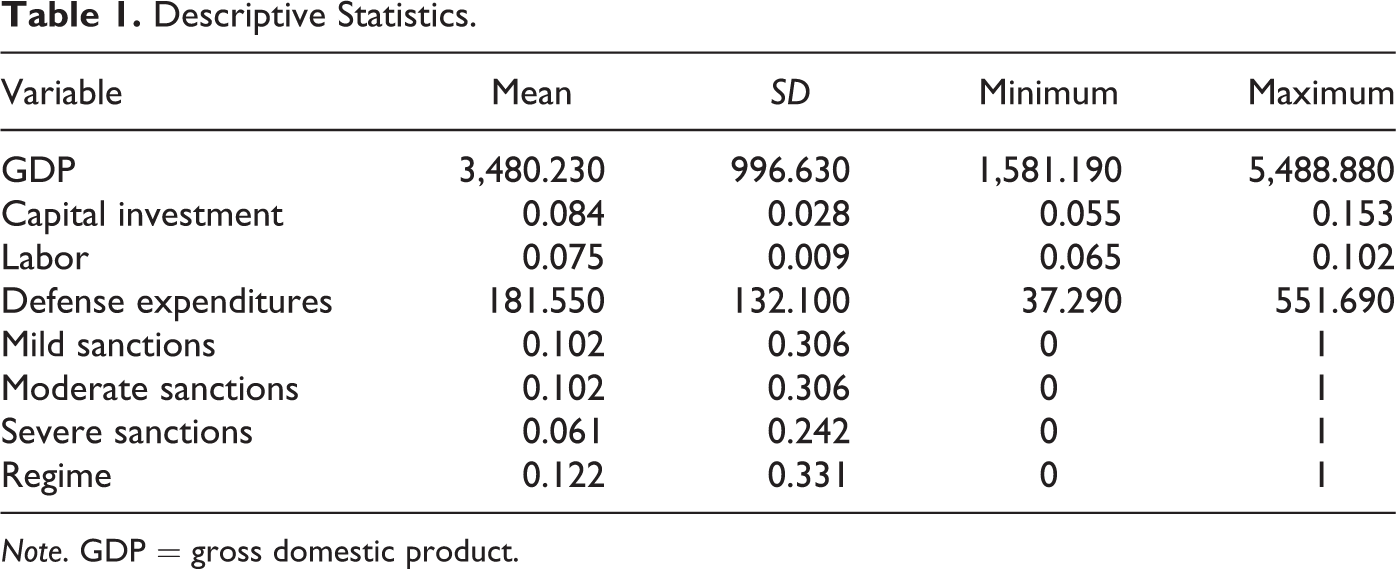
Note. GDP = gross domestic product.
Using the above data sources, the empirical measures employed for the analysis are as follows: We measure s as the GDPI share of GDP. The variables y and d are per-capita GDP and defense expenditures, respectively. The economic growth model used here also includes a measure of growth in the Iranian labor force, n. Consistent and reliable numbers on the labor force, however, are unavailable. To compensate, we follow the approach established by Ram (1986) and continued by Alexander (1990), Mintz and Stevenson (1995), and M. Ward, Penubarti, Cohen, and Lofdahl (1995) and use the growth rate of the population as a proxy. This approach suggests that the rate of participation in the labor force will show little variation in the short run, thus justifying the use of the population growth rate (Lebovic & Ishaq, 1987). Finally, we follow the previous literature on augmented Solow models and fix the summation of g and δ at 0.05, assuming that any reasonable change in this assumption will have minimal effect on the estimate (see Mankiw et al., 1992).
Each of the variables that account for economic sanctions are coded as dummy variables based on Wood’s (2008) severity scale. For each variable, a “1” is given when a sanction at that degree is in place and a “0” is assigned otherwise. For this coding, a mild sanction is defined as one that targets specific individuals or firms in Iran or restricts foreign aid to the country. A moderate sanction is one that influences the net imports or exports and a severe sanction is a complete embargo or abnegation of trade flow. Information on the economic sanctions placed on Iran are from the U.S. Department of Treasury and The Center for Arms Control and Non-Proliferation.
Data for changes in the political regime are derived from the Center for Systemic Peace’s Polity IV Annual Time Series. Periods which face a change in the political regime are controlled for via a binary variable, with a score of “1” reflecting a change and a score of “0” otherwise. In particular, this controls for the 1979 Revolution, the 1997 reform election of Mohammad Khatami, and turnover in 2004 to a conservative legislative parliament.
Method
Before turning to the results of the empirical analysis, several methodological issues must be addressed. To show that the presence of economic sanctions produces a militarization response, we rely upon Toda and Yamamoto’s (1995) variation of the Granger causality test. This variation allows for the use of a bivariate variable in determining the causal influence; that is, the presence or absence of economic sanctions. To estimate the above model and explain variation in the economic growth of Iran, this article employs an ordinary least squares approach. Considering that the study is a time series, there are several issues of estimation that must also be addressed. First is the determination of the appropriate lag for the variables included in the model. According to Gujarati (1988), a distributed lag allows for the capturing of dynamic effects by including changes in variables over time. Since the specification of the growth model contains distributed laws, and there is no a priori information on the lag structure, an objective criterion is needed to determine the proper number of lags. This is accomplished using a standard information criterion (SIC) as suggested by Schwarz (1978) and Geweke and Meese (1981). According to Mintz and Huang (1990), “[t]his criterion involves a statistic that incorporates a measure of the precision of the estimate and a measure of the parsimony of the statistical model” (p. 748). Based on the result of the SIC diagnostic, a lag structure of t − 2 is found appropriate.
The second issue to be addressed is the potential presence of autocorrelation within the results. To test for the presence of autocorrelation, we use the Durbin–Watson (D-W) statistic. The D-W statistic indicates that there is no autocorrelation problem within the augmented Solow model (D-W = 1.9694).
For the potential causality problem between economic growth and defense expenditures, we employ a Granger causality test. A Granger causality test is a method of detecting the direction of causality (cause and effect), where there is a temporal lead–lag relationship between two variables. The results indicate that there is no statistically significant effect of economic growth on defense expenditures. An overview of the results of the test is provided in Table 2.
Granger Causality Test.
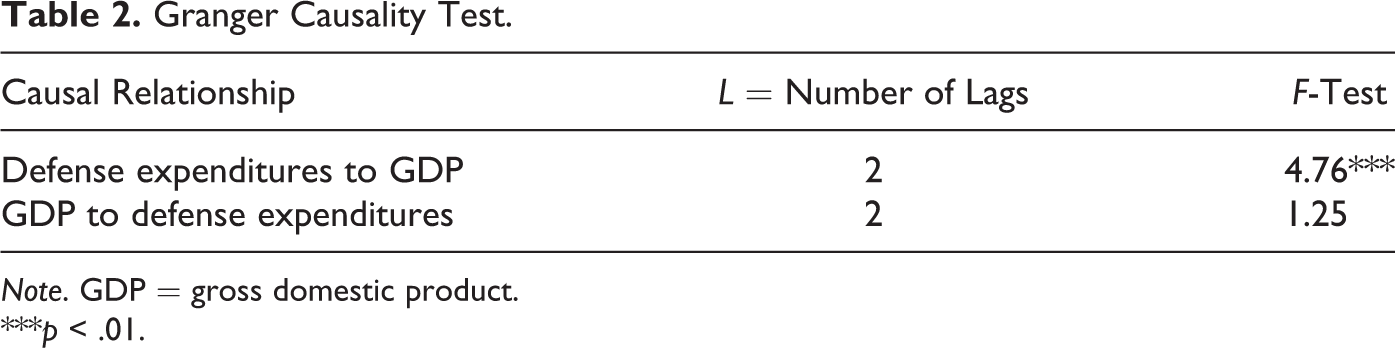
Note. GDP = gross domestic product.
***p < .01.
Results and Discussion
The results estimating the causal influence between economic sanctions and defense expenditures are presented in Table 3. The results of the Granger causality analysis show that the presence of economic sanctions on Iran produced a militarization response, as seen in their defense expenditures. The results of estimating the defense-driven economic growth model are presented in Table 4. Overall, the model of economic growth in the Islamic Republic of Iran performed exceptionally well. Despite the eccentricities present in the economic behavior of Iran, the model was able to explain more than 97% of variation in the economy’s performance (R 2 = .97).
Granger Causality Test.

*p < .10. ***p < .01.
Impact of Sanctions and Militarization on the Iranian Economy.
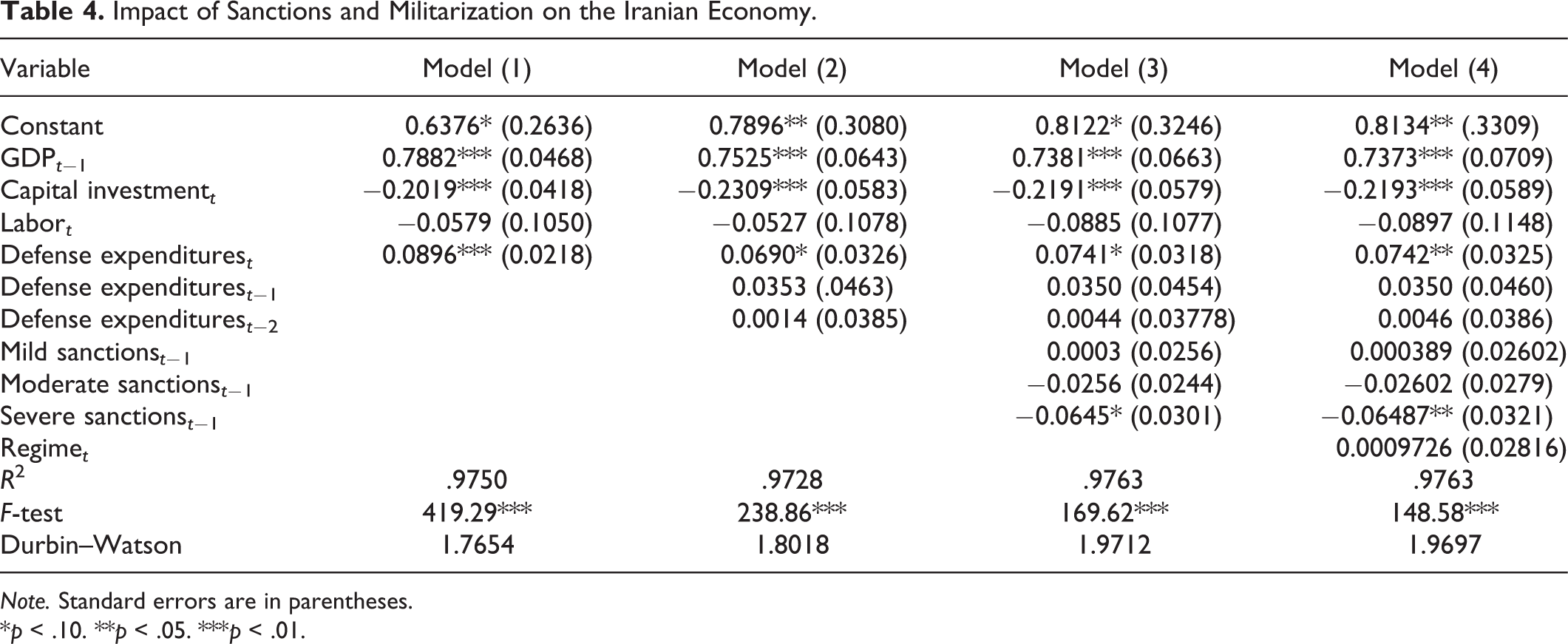
Note. Standard errors are in parentheses.
*p < .10. **p < .05. ***p < .01.
In addition to the overall explanation of economic behavior, the results also provide important information on the hypothesized offsetting of sanctions. In order for the cost imposed by economic sanctions to be offset by militarization, the analysis must show a negative effect associated with the presence of sanctions and a positive effect of equal or greater magnitude associated with defense expenditures. Beginning with the cost of sanctions, there is no statistically significant effect observed with the presence of mild or moderate economic sanctions, although a significant and negative effect is observed for severe sanctions. A decline in economic growth can be expected for years in which Iran is subjected to severe economic sanctions at a rate of 6.49%. Consistent with the design of the economic sanctions, the findings lead to the conclusion that the most severe sanctions placed by the United States on Iran were effective in terms of limiting overall economic growth and could be considered successful in that area.
Regarding the effects of militarization, a significant and positive coefficient on defense expenditures suggests that the Iranian defense sector generates positive spillovers onto the economy. Based on the coefficients, the militarization of Iran helps promote economic growth in the short term and continues to do so in the following 2 years. Interpreting the size of the effects, a 1% increase in defense expenditures is expected to produce an increase in economic growth by 0.07% in the current year. Over the duration of influence, however, the additional 1% of defense expenditures leads to a total increase in economic growth by almost 0.11%. This finding is consistent with Sevastianova (2009), McDonald (2012), and McDonald and Eger (2010), all of whom argued that defense expenditures can produce a stabilizing effect on an economy.
In support of the offsetting of economic sanctions by militarization, the results of the analysis are both significant and in the directions necessary. Although sanctions do have a limiting effect on growth, their cost can be offset by the size of the positive effect of Iran’s defense sector. That is, the negative cost of 0.06 can be negated with a 0.87% or greater increase in defense expenditures, as determined by the ratio of severe sanction to defense effects. To determine if the offsetting took place, we look toward the historical trends in the data. Prior to economic sanctions, the mean expenditure on defense was 7,713.3 billion Iranian rials (approximately US$4.4 billion). 3 After 1979, the mean expenditures rose to 12,747 billion rials (approximately US$7.3 billion), an increase of about 65.2%. Although some of the increase can be attributed to the Iran–Iraq war (fought from 1980 to 1988), the largest increase occurred after President Clinton’s embargo on the country in 1995.
Turning to the other control variables, the previous year’s national income has a significant and positive effect on economic growth. This finding suggests that there is some momentum in the Iranian economy as it moves toward its steady state. The measures of capital investment (ln s) and labor (represented as ln[g+ n+ δ]), however, have a significant and negative impact. These findings suggest that a 1% increase in savings will reduce economic growth by 0.22%, and a 1% increase in labor will produce a reduction of 0.09%. Lastly, the control for changes in the political regime showed no statistically significant impact on economic growth in Iran.
The Iranian Experience
In 1978, a revolution began in Iran that centered on internal control of the government rather than external direction (S. R. Ward, 2009). Following Mohammad Reza Pahlavi’s collapse of power, Iran was subjected to economic sanctions by the United States on November 14, 1979 (Office of Foreign Assets Control, 2011). The sanctions were intended to restrict the economic behavior of the target government and its respective economy. In the 32 years since, the sanctions have been revisited, revised, and expanded 6 times, most recently with the Comprehensive Iran Sanctions, Accountability, and Divestment Act of 2010. For the United States, the sanctions have been a tool to encourage the reinstatement of the Shah and to encourage pro-American government activity. Iran’s response, however, has been one of independence, adopting a policy of military deterrence rather than governmental submission. As a result, using severe economic sanctions as a policy instrument have failed to trigger Iranian demilitarization. As demonstrated in this article, this has actually led to the phenomenon of increasing militarization as an offsetting of the intended adverse economic and political consequences of sanctions sought by the United States.
Iran’s decision on how to respond to economic sanctions is highly related to its history and culture. The 15th largest country in terms of GDP and 18th in terms of area, Iran has a history rich with political and social unrest that dates back to 2800 B.C. (S. R. Ward, 2009). Even within the 58 years of its modern history, Iran has experienced multiple coup d’états, assassinations, and rebellions, many of which has been tied to the United States. In 1951, Mohammad Mosaddegh was elected prime minister of Iran by a parliamentary vote. Although Mosaddegh was popular among the population, his nationalistic ideology was viewed by the United States as anti-American and anti-British (Kinzer, 2003). To gain support in the region, the United States provided weapons and supplies to Pahlavi who was out of favor with the population. The support culminated with the authorization of Operation Ajax by President Eisenhower and the 1953 Iranian coup d’état (known in Iran as the 28 Mordad coup). Prior to the overthrow, the government structure had been a constitutional monarchy, but after the coup, the government became increasingly autocratic and militaristic, adding pressure to the existing disfavor.
The revolution that began in 1978 brought an end to autocratic rule and established a new, Islamic republic the following year. Following the establishment of the new government, the United States placed economic sanctions. Internally, the involvement of the United States in Iranian affairs was seen as hostile. Hesitant to accept a strong military and unable to initiate a successful conflict with the United States, a policy of deterrence was adopted. This policy was threefold: (1) expand the size of the military force, (2) expand the production of military armaments, and (3) engage in a guerilla style of warfare. The goal was to disincentive military action against Iran and its interests by raising the costs to the aggressor.
Examples of the militarization response by Iran can be seen as early as 1979. Anticipating U.S. military activity in the country, Ayatollah Ruhollah Khomeini increased the conscription period to 18 months and called for an expansion of the army to 285,000 men in 1979 (S. R. Ward, 2009). By 2011, the armed forces total 523,000 active duty personnel and another 350,000 reservists (International Institute for Strategic Studies, 2011), representing an increase of 83.5%. According to S. R. Ward (2009), most growth in the size of the armed forces occurred after the completion of the Iran–Iraq war and coincided with renewed interest in the region by the United States.
Other examples of a militarization response can be seen in Iran’s production of military armaments. Under Pahlavi, Iran’s military industry was limited to the assembly of foreign weapons. When economic sanctions restricted access to foreign weapons, Iran turned inward to produce its own line of weaponry capable of supplying the armed forces during battle. By the mid-1990s, Iran was capable of producing 80% of its ammunition needs (S. R. Ward, 2009). Production has also been expanded to include long-range missiles, submarines, and unmanned aerial vehicles (International Institute for Strategic Studies, 2011). Although not capable of maintaining an all-out war, the production of these specialized armaments serves to disincentive foreign involvement in Iran by ensuring retaliatory strike capability against targets friendly to the aggressor.
Conclusion
With the refusal of Iran to end its uranium-enrichment program in 2008 and continuing concerns about the country’s nuclear program, the United States has revisited its use of economic sanctions. For nearly three decades, U.S. foreign policy has focused on forcing the rogue regime to conform to U.S. interests by use of nonmilitarized tools. Yet, as history has shown, economic sanctions have failed to topple Iran’s current government. In conjunction with the Iranian experience, the results of a number of international sanctions in recent years have raised questions over their usefulness as a foreign policy instrument. The vast literature on economic sanctions within the political science and economic traditions has generally concluded that sanctions do not work (Doxey, 1971, 1972; Galtung, 1967; Hoffmann, 1967; Morgan & Schwebach, 1997; Renwick, 1981), largely arguing that sanctions exist only for domestic political reasons of the sender. Although past studies have provided many reasons as to why sanctions fail (see Hufbauer et al., 1990), one reason that has not been discussed is the dueling impact of the defense–growth relationship. Sanctions might restrict the economic performance of a target nation, but the cost of these limitations can be outweighed by an economic boost received from the resulting militarization.
To investigate the economic implications of sanction on highly militarized economies, we developed a defense-driven economic growth model based on the extant literature and empirically tested it with Iranian data from fiscal years 1959 to 2007. Although the effectiveness of sanctions and the impact of defense expenditures on economic growth have both been tested in a number of studies, there has been a gap in the literature on understanding the economic impact of the target nation’s military response. Therefore, the contribution to the literature is through the theoretical advancement and rigorous empirical investigation of economic sanctions through direct channels. Using an augmented Solow model of capital, labor, and technology, we test for the impact of economic sanctions while accounting for impacts due to changes in defense expenditures.
The analysis reveals that the most severe economic sanctions have a negative effect on performance, with the presence of sanctions producing a negative shift in economic growth by about 6.5%. The empirical analysis also shows, however, that defense expenditures have a positive, long-term effect. A 1% increase in expenditures is expected to increase economic growth by 7.42%. These findings confirm the belief that the sanctions imposed by the United States upon Iran have been largely unsuccessful and further confirm the findings of Elliot and Hufbauer (1999), Hufbauer et al. (1990), and Pape (1997) regarding the ineffectiveness of sanctions.
The political climate between the United States and Iran has begun to change. In 2015, a nuclear agreement was reached between the two countries that resulted in the lifting of some sanctions by the Obama administration. However, it is not yet known to what extent sanctions, as compared to other influences such as the decline in price of crude oil, played a role in the willingness of Iran to reach the nuclear agreement. With certainty this question will be addressed in the research for quite some time. In the meantime, this study is not without implication for the use of sanctions against other governments. Although this study has focused on Iran, the Iranian experience is not all that different from that of other sanctioned governments. For example, both Cuba and North Korea have exhibited growth in their militaries, since sanctions were imposed. Without a more targeted approach which carefully analyzes the effect of the type of sanction implemented relative to the sanctioned nation’s reliance on militarization, sanctions are unlikely to succeed as intended.
Footnotes
Declaration of Conflicting Interests
The authors declared no potential conflicts of interest with respect to the research, authorship, and/or publication of this article.
Funding
The authors received no financial support for the research, authorship, and/or publication of this article.

Notes
References
Supplementary Material
Please find the following supplemental material available below.
For Open Access articles published under a Creative Commons License, all supplemental material carries the same license as the article it is associated with.
For non-Open Access articles published, all supplemental material carries a non-exclusive license, and permission requests for re-use of supplemental material or any part of supplemental material shall be sent directly to the copyright owner as specified in the copyright notice associated with the article.
