



Abstract
This article examines the relationship between advisors and linguists in the contemporary military advising mission and applies an emergent postmodern military culture theoretical framework. This project’s multimethod collected data from Iraq, documents, and interviews. The study reveals an intriguing and nuanced story about the deployment of advisors and linguists in the advising mission. This article defines the military advising mission including the major actors. The article then introduces the postmodern military culture theoretical framework and method. The findings report many themes including linguist selection and hiring processes, the importance of advisor–linguist relationships, the relevance of linguists’ backgrounds, linguists as full advisory team members, and the building blocks of successful advising sessions. Effective advisors work with linguists to deploy a Swiss Army knife of cultural tools including peacekeeper diplomat, warrior, subject matter expert, innovator, and others to accomplish the mission, which divulge broader changes indicative of an emergent postmodern military and culture.
Keywords
Introduction
Since 9/11, millions of U.S. and coalition military service members deployed to Iraq and Afghanistan, and they frequently worked with linguists to communicate with various foreign people. Myriad operations required soldiers to employ and draw on the skills of linguists, including working and talking with foreign military troops, police officers, government officials, and indigenous members of the population. One mission that definitively required the use of linguists constituted the military advising mission, in which military advisor teams provided foreign counterparts (security forces) consultation, professional advice, and recommendations. The vast majority of U.S. advisors required linguists to communicate and build rapport with their foreign counterparts and to avoid miscommunications and misunderstandings—which helped soldiers and linguists to stay alive in combat and accomplish their mission. This article examines the relationship between advisors and linguists in the contemporary military advising mission from the advisor’s viewpoint and applies an emergent postmodern military culture theoretical framework. This article draws on a study of the U.S. military advising mission to report findings about how military advisors build relationships and work effectively with linguists, which constitutes a critically important aspect of the military advising mission. This article represents a direct complement to a previous Armed Forces & Society piece that discusses the importance of advisors building relationships with foreign counterparts (Hajjar, 2014b), 1 and it also builds on former Armed Forces & Society publications about emergent postmodern military culture (Hajjar, 2014a) and cross-cultural competence (Hajjar, 2010). This piece defines the military advising mission, forwards the postmodern military culture theoretical framework, explains the method, discusses several findings about advisors and linguists, explicates theoretical implications, and concludes.
What Is the Military Advising Mission?
The essence of the military advising mission constitutes military members providing consultation, advice, mentorship, coaching, and other related activities to foreign counterparts to enhance their capabilities and professionalism. Advising missions range from large-scale operations during combat conditions, such as in Iraq and Afghanistan after 9/11, to much smaller peacetime advisory efforts in numerous locations worldwide. Although advising is not a new role for the U.S. military (particularly for the Special Forces; Ramsey, 2006; Stoker, 2008), the employment of many thousands of mainstream advisors in Iraq and Afghanistan represented a monumental adaptation in the conventional armed forces—even though history reveals many of these changes entailed the mainstream military relearning how to advise successfully (Hajjar, 2014c). Advising relationships can take the form of different kinds of structures, but at their core, they involve three principal actors (see Figure 1—the Military Advising Triad). The first actor constitutes the foreign security force member in the advising relationship who bears the title of counterpart. Counterparts receive suggestions, tutelage, information, resources, and associated support from the advisor. The second actor is the military advisor who provides the counterpart with tutorship, teaching, advice, recommendations, and other forms of assistance intended to develop the counterpart’s competence and performance. 2 A third actor plays a vital yet sometimes subdued role in the advising relationship, and this person bears the title of linguist. 3 The linguist, employed by the U.S. military, possesses sufficient cross-cultural competence and language skills (e.g., English and the counterpart’s language) to facilitate effective communication and relationship building between the advisor and the counterpart (Hajjar, 2010). An advisor and linguist work together to provide assistance, suggestions, and consultation to increase the foreign counterpart’s proficiency and professionalism. This piece devotes substantial attention to the advisor–linguist relationship from an advisor’s viewpoint and discusses how this relationship impacts the military advising mission.
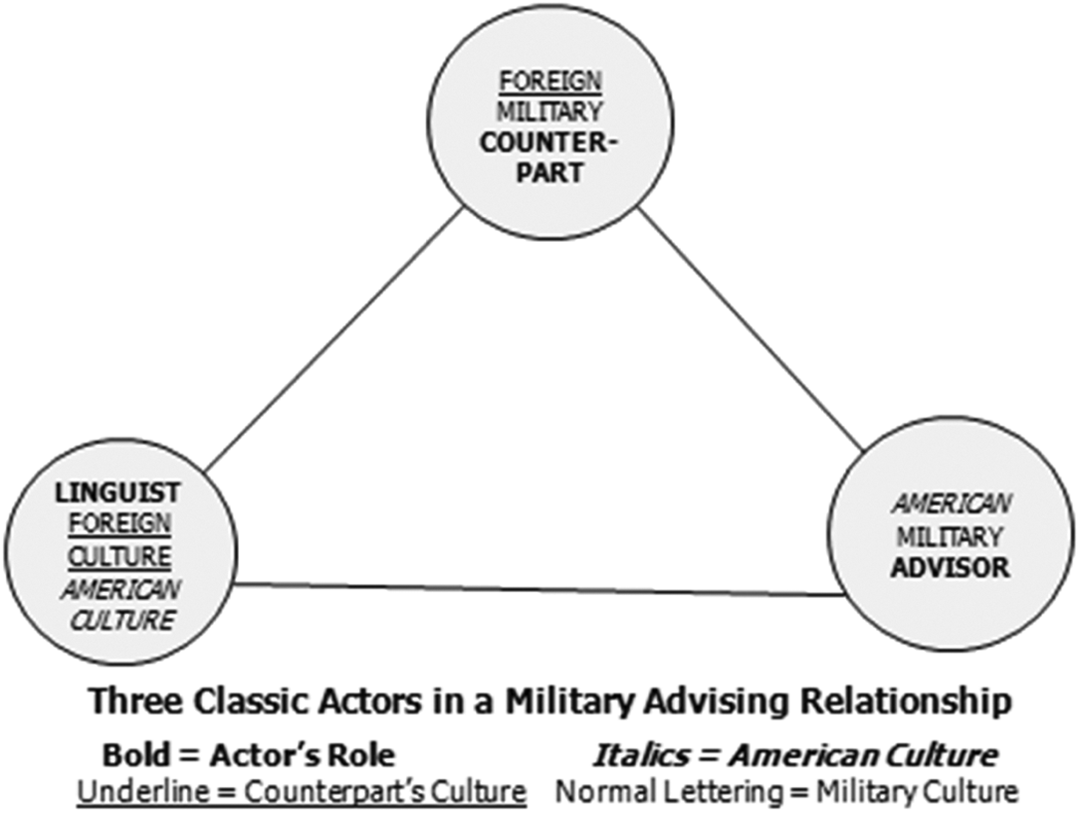
The military advising triad: One example of an advising relationship. The bolded lettering in the spheres indicates the roles played by the different actors in the triad. The underlined letters indicate that linguists typically share the national or regional culture of the counterpart. The italicized letters indicate that advisors and some linguists share U.S. culture (although some local national linguists do not share U.S. culture). The normal lettering indicates the shared military culture between counterparts and advisors, albeit there are important differences in their national and military cultures.
Who Are Linguists?
To further amplify the linguist role, this section answers some relevant questions about linguists, including: Who are linguists? How does the U.S. military categorize its linguists? What kinds of people typically fill linguist positions? What tasks comprise the work of linguists?
To begin to answer these questions, we begin with a passage from current U.S. military doctrine. LINGUIST SUPPORT CATEGORIES: When possible, interpreters [linguists] should be U.S. military personnel or category II or III linguists. [Linguists] fall into three categories.
This study concentrates mainly on Category 1 and Category 2 civilian contractor linguists. Although a small number of active duty military linguists exist—the “09L” military occupational specialty—my study did not collect data about them, with the exception of some field notes and ethnographic observations from Iraq in 2009–2010 where my unit had one Arabic 09L U.S. Army linguist. The interview data mainly talk about Category 1 linguists, meaning the advisors that I interviewed typically worked with local national linguists in Iraq or Afghanistan, albeit there were a few exceptions. The survey data I collected in Iraq in 2010 when I served in an advising unit concentrate exclusively on Category 2 linguists. The Category 2 linguists in my unit in Iraq were born and raised in Arabic-speaking countries (including Iraq, Lebanon, Egypt, and Morocco) who immigrated to the United States sometime between their late teenage years through their 30s, and then became U.S. citizens. These linguists acquired at least a secret-level security clearance, and some of them possessed bachelor’s or advanced degrees and other specializations (e.g., computer programmers; engineers). Thus, this article’s findings stem from a balance of cases of Category 1 and Category 2 linguists.
This passage comes from a monograph for advisors, and it forwards a linguist ideal type. The perfect interpreter is impossible to find. Who is an ideal interpreter? It would be someone who can accurately and quickly translate nuanced meaning, be thoroughly versed in both countries’ history, literature, culture, and politics, as well as in the technical subjects under discussion, and yet not allow his personality to shade the interpretation. This paragon does not exist. In the real world, the interpreter is more likely a local citizen who left his country decades in the past and has only returned on a contract, or someone whose parents are from the country in question and who learned the language from his family while growing up in America, or a local citizen who studied English in school. None of these is likely to be a formally trained interpreter, and, at best, the advisor will be provided translation which will only be approximately correct. Facts, figures, and details will often be mistranslated, and nuances of meaning may be totally lost. If the interpreter is from a different religious or ethnic group than the official [counterpart], there may be mistrust and bias on both sides. If the interpreter is seen as having abandoned his native country for a better life in America, there may be resentment against him. At worst, the interpreter will have such heavy emotional baggage, prejudice, or personal political motivation that conversations will be twisted in a way not intended by either advisor or official [counterpart], leading to distrust and mission failure. All of this adds immeasurably to the advisor’s burden. Dealing with interpreters is a skill which a surprisingly large number of … advisors [soldiers] completely lack, but not having this skill is like not knowing how to fire your weapon. (Metrinko, 2008, p. 41–42)
Second, the passage depicts an ideal type for a linguist; the nonexistent linguist “paragon” would perfectly perform multiple complex tasks. These data illustrate the finding that linguists require skills and cross-cultural competence that extend beyond adequate linguistic expertise. Linguists require culture-specific competence (e.g., relevant knowledge, skills, attitudes, and open-mindedness about U.S. and foreign cultures), and ideally possess relevant military subject matter expertise (Hajjar, 2010). Since perfect linguists do not exist “in the real world,” advisors must realize that even when working with the best linguists, some information will get lost in translation; thus, taking painstaking efforts to minimize this eventuality also presents an important task.
Furthermore, this passage discusses the impact of linguists serving on civilian business “contracts.” Some linguists’ contractual occupational and for-profit orientations may contrast with the more balanced professional, institutional, and occupational motives of their military advisor supervisors and soldier teammates (Kelty & Segal, 2007; Moskos & Wood, 1988). Finally, the account supports the theme that advisors need to create smooth relationships between linguists and counterparts and must consider that linguists’ and counterparts’ ethnicity, dialect, sex, age, religion, political ideology, education, flexibility, and other factors will influence the counterpart–linguist relationship, which in turn impacts the quality of the advisor–counterpart relationship. This section reviewed the different categories of linguists, their sources of employment (mainly contracts), linguists’ cultural backgrounds, and details about the linguist role, all of which contribute to an understanding of military linguists.
An Overarching Framework for Emergent Postmodern Military Culture
This article applies a previously established theoretical framework revealing the emergence of a postmodern military and organizational culture (see Figure 2; Hajjar, 2014a). This framework reveals that contemporary military culture possesses tremendous complexity, fragmentation, contradiction and harmony, traditional and current features, and multiple overlapping spheres of influence including professional and bureaucratic (Sookermany, 2012), institutional and occupational (Moskos & Wood, 1988), warrior and peacekeeper–diplomat (Perez, 2012), leadership and followership, multirole versatility, cross-cultural competence, power and influence, diplomacy, ambassadorship, and other cultural tools (Swidler, 2001). This article further builds and amplifies the case for an emergent postmodern military and culture, and the findings section will explain how advisor–linguist teams illuminate and enrich different cultural spheres within this design during the conduct of the military advising mission. The contemporary advising mission presents an ideal case to examine, given the substantial role of linguists and advisors in the mission.
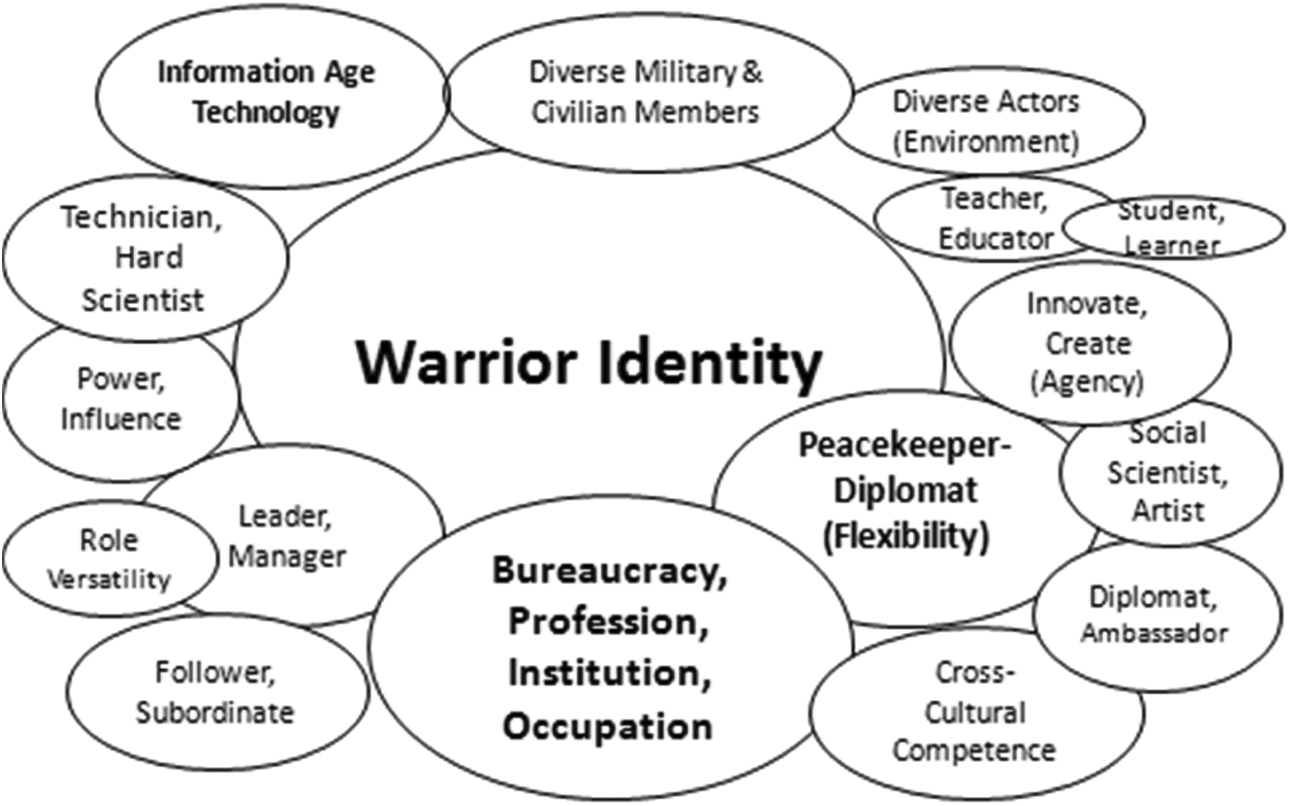
Postmodern military culture.
Findings From the Overall Study: The Swiss Army Knife of Advisory Skills
This section summarizes the overall project’s major findings and sets the stage for a main concentration on the importance of military advisor–linguist relationships. An informant uses the metaphor of a “Swiss Army knife,” which serves as a fitting symbol for the cultural toolkit deployed by contemporary advisors to conduct their mission. Switzerland’s reputation for neutrality and peace makes the combination of the word “Swiss” (peacekeeper-diplomat) with the words “Army knife” (warrior) extremely suitable for this article’s conceptual design and argument. A sledgehammer would symbolize the military’s historic combat warrior identity, which evolved to include smaller hammers, scalpels, other kinds of knife blades, and new tools needed for different kinds of combat missions of varying intensities. The contemporary Swiss Army knife also includes emerging peacekeeper-diplomat, information age technology, soft and hard leader skills, expertise, and other tools required to perform a full spectrum of noncombat and combat operations. Advisors and linguists draw from their Swiss Army knives to traverse numerous complexities, balancing acts, dangers, and ambiguities that characterize the advising tightrope.
Although this article primarily discusses the study’s finding about the invaluable role of advisor–linguist partnerships in the advising mission, a brief synopsis of the project’s other major findings provides a necessary broader context. One main finding includes the significance of advisors effectively building relationships with foreign counterparts. Two other larger intertwined findings disclosed advising as an unconventional and second-tier mission, given the task’s unusual in-depth cross-cultural requirements and the mission’s lower status compared to traditional command roles and combat functions. As the mainstream military adapted to conduct the unconventional advising mission in Iraq and Afghanistan after 9/11, many advisors practiced tremendous creativity and agency by stretching boundaries (and in turn causing ripples of cultural change) in the conventional military to spend sufficient time with, operate alongside, and at times live on counterpart bases. Another major finding constitutes the ambiguities and challenges linked to defining advisory success, including the folly of solely trying to employ precise objective measures of success. Subjective measures for advisory achievements manifested, such as facilitating counterpart autonomy and establishing enduring advisor–counterpart relationships and friendships (Sookermany, 2012). 4 Finally, an amalgamation of other patterns emerged, including the role of information age technology, the importance of relevant subject matter expertise, providing various “goodies” (e.g., equipment, shared intelligence, etc.) to counterparts, considerations for deploying woman advisors, and the need to successfully interact with various actors in the advising environment.
Method
Given that a fuller explanation of the method appears in a previous Armed Forces & Society article about the contemporary advising mission, this section will provide a summary and add some details that pertain to this specific paper (Hajjar, 2014b). 5 This study stems from a multimethod comprised of three major subparts: (1) data collected in Iraq, particularly a survey (N = 23 subjects, including 16 advisors and 7 linguists); (2) an in-depth analysis of global advising documents (N = 20) including journal articles, monographs, military doctrine, and book chapters; and (3) in-depth semistructured interviews (N = 11 informants, including 10 advisors and 1 linguist). The initial analysis of the Iraq data yielded initial categories, conceptual clusters, and trends, which expanded in complexity during the reiterative analytical processes that occurred throughout the project. Although triangulation of the results from these three distinct data sources strengthened the findings’ validity, generalizability typically does not constitute the main purpose of qualitative studies including this one (Autesserre, 2014). Rather, this study sought to make relevant exploratory claims and assertions about military advisors and linguists primarily within a post-9/11 context in Afghanistan and Iraq, but it also provides some insights bearing historical and regional variation. Further, although the study captures germane insights directly from linguists, its main source constitutes military advisors; thus, the findings provide an advisor-centric vantage into the world of advisor–linguist relationships, and how military advisors and linguists perform the advising mission.
Effectively Working With Military Linguists: Vital Intercultural Intermediaries
This article examines the relationship between advisors and linguists in the contemporary military advising mission from the advisor’s viewpoint and applies an emergent postmodern military theoretical framework. Since a very small handful of advisors either speak their counterpart’s language or work with counterparts who speak English fluently, this study reveals that the overwhelming majority of advisors utilize linguists. Advisors require a repertoire of cultural tools to effectively lead and build rapport with their linguist teammates, and linguists require a variety of special cross-cultural skills to bond with advisors and help build bridges that connect advisor–linguist teams to counterparts. Myriad conditions, including the phase of a campaign, diverse backgrounds of the actors involved in advising sessions, different places and organizations, the military subject matter of a given advising session, military member and civilian contractor cultural orientations, and other circumstances influence advisors to draw on warrior, peacekeeper-diplomat, leader, creativity, and other tools from their Swiss Army knives to work well with linguists. This findings section reports numerous interrelated patterns regarding advisor–linguist relationships and interactions in the advising mission, including advisors selecting and hiring linguists, the importance of advisors building strong relationships with linguists, the relevance of linguists’ cultural backgrounds and language skills, linguists as full advisory team members (but not in a lead role), and the building blocks of successful advising sessions. The following subsections draw on the most vivid and representative data from the study to explain how linguists fill the role of vital intercultural intermediaries in the mission, and how advisors work effectively with linguists as a prerequisite to building relationships with counterparts to ultimately succeed in the advising mission.
Selecting and Hiring Linguists: Personal and Systematized Processes
The study shows that different conditions determine how advisors select and hire linguists. In mature campaigns, such as the latter phases of Iraq and Afghanistan, advisors typically enter units that already have linguists. In immature campaigns, some advisors reported handpicking linguist candidates “off the street.” The findings reveal advisors draw on warrior, peacekeeper-diplomat, military–civilian, creativity, and other tools from their Swiss Army knives, as they select and hire suitable linguists.
The following case involves a National Guard officer, Peter, who reflects on working with linguists in his three Afghanistan military advisor experiences that spanned from 2003 to 2010. The first person you need to build trust with is your linguist. He’s your primary guy. If he’s not someone you can trust then you need to get rid of him and
When I asked Peter about whether he harbored security concerns when he handpicked linguists off the street, not necessarily knowing if these linguist candidates secretly supported enemy groups, he responded with the following thoughts. I think
The Importance of Building Strong Advisor–Linguist Relationships
The following military advisors reflect on their experiences with linguists, and they provide some vivid examples of the overarching finding that strong advisor–linguist relationships benefit the mission. Building a relationship with your interpreter is equally as important, if not more important than the relationships you’re gonna generate with your advisee [counterpart]. I’ll use a hockey analogy because I’m Canadian. The more you play with your line mates, you know you can blindly pass the puck off into the corner and your teammate will be there to get it because you’ve developed a relationship where you know that’s where he’s going to be. Magically it all happens. That’s how professionals play. They play based on instinct and reaction, not set drills. (Cade, interview, 2012; Age 42, Canadian advisor with five advising tours including three in Afghanistan)
The Relevance of Linguists’ Cultural Backgrounds, Language Skills, and Dialects
This section discusses how linguists’ cultural backgrounds, language skills, dialects, and potential biases impact the advising mission. The findings indicate that advisors need to carefully assess these linguist factors to set the conditions for advisory success. The data explored in this subsection provide examples of this overall finding. In the first case, Don, an advisor and advisory team leader in Afghanistan provides numerous germane insights regarding the importance of linguists.
An Iraqi-descent linguist who spent 5 years in Iraq as a linguist wrote this response to a survey about some problems he observed when non-Iraqi linguists worked with Iraqi counterparts.
Linguists as Full Advisory Team Members (But Not in the Lead Role)
This section explores the balancing act of working with linguists, whereby advisors seek to draw on linguists’ talents as “full team members” (a subject’s words) while preventing linguists from overstepping their bounds, role, and authority. Accomplishing the balancing act of working well with linguists and making them feel like well-respected and full team members who in turn bring forth substantial motivation toward the mission, but yet not letting linguists dominate or wield too much influence during advising sessions or back at the office sometimes presents a tricky, challenging, and sophisticated task that contemporary military advisors must negotiate.
The following data provide different angles and explanations regarding the delicate task of effectively bonding with, leading, and working with linguists, which vividly highlight this finding. Ricky [a linguist] was acting very weird … and he was As translators [linguists]: we should also be considered advisors. (Habeeb, 2010 [unpublished survey data]; Age 66, Iraqi-descent linguist in Iraq, data from 2010 survey in Iraq) Insist that your interpreters translate exactly what you mean. Do not allow them to add anything extra or usurp your authority to [avoid]
Michelle reported her linguist, Ricky, also “actually thought he was an advisor.” Michelle reported that Ricky’s strong “ego” and “obstinate attitude were about to get him fired.” Due to Ricky’s attitude where he tried to push with too much influence to become the boss in advising sessions, Michelle felt compelled to take “draconian” actions and occasionally “hand” the linguist his “arse.” Michelle, a career U.S. Air Force officer, might have experienced excessive assertiveness and stubbornness from her linguist because she replaced a higher ranking male U.S. military officer; her male linguist of Middle-Eastern descent might have had trouble adjusting to working for a woman boss of slightly lower rank (one rank lower). Another relevant condition that may have contributed to Michelle’s case includes the possibility that her linguist experienced some burnout, given that linguist had spent several years in Iraq away from his family. Thus, an examination of Michelle’s specific conditions yields relevant insights about the need for advisors to quickly ascertain sufficient situational awareness, and apply appropriate cultural tools to rectify any unprofessional or out-of-bounds conduct by linguists. In Michelle’s case, we can deduce she used leadership tools to reestablish boundaries, roles, and a proper relationship with her linguist. The short U.S. military doctrinal passage (the last narrative in the data set above) supports Michelle’s account when it states advisors should avoid “complications about who is really in charge” between linguists and advisors.
Based on the study, Bill’s comments best capture the essence of how an advisor effectively traverses the balancing act of building a solid relationship with a linguist. Advisors who succeed in helping their linguists feel like full team members (but not in charge) receive the benefits of the linguist’s talents and insights. The linguists “will catch things/body language” and other relevant “things you will have no idea occurred” during engagements with counterparts. Unlike advisors, linguists “have a natural feel for the conversation they are translating,” and while advisors might “fixate on words,” linguists comprehend the bigger picture meanings or the “gist of the conversation.” Bill’s concept of building a feeling of “full team membership” in his linguists motivates them to draw on all of their talents to achieve the mission.
This section explains how U.S. advisors deploy numerous cultural tools from their Swiss Army knives to build productive relationships with their linguists and to inspire a full team member (but not in charge) spirit in their linguist teammates. When some linguists overstep their bounds (e.g., dominating advising sessions; not following advisors’ guidance) and do not respond to softer diplomatic requests for behavior changes, advisors apply harder command tools to redirect linguists. The study reveals that advisors’ peacekeeper-diplomat tools, including culture-specific competence, diplomacy, flexibility, learning, mentoring, following, and creativity, as well as applicable cross-cultural leadership tools, enable U.S. advisors to effectively motivate linguists and maintain the right balance in the relationship with their linguist brothers (and sisters) who serve as key cultural bridges in the mission. The finding further amplifies the need for contemporary advisors to take a more subjective, personalized, individualized, and nuanced approach toward working with linguist colleagues, which bears a postmodern aura that differs from the rigidity, objectivity, and formality linked to organizational relationships of the modern era (Morgan, 2003; Sookermany, 2012). Furthermore, as advisors learn these skills based on their situated experiences, they learn by doing the mission and many benefit from working in communities of practice (e.g., specific advisory teams and units around the globe; Sookermany, 2011).
The Building Blocks of Successful Advising Sessions
This section reports advisor–linguist dynamics that constitute the building blocks to effective advising sessions. This includes preparatory actions and how to navigate actual meetings with counterparts. In the first passage, a linguist talks about how advisors’ military subject matter expertise, linguists’ cross-cultural communication skills, and rehearsals coalesce to benefit the mission. They’re [counterparts] extremely impressed with [subject matter expertise]. If you show them that you know your stuff, that is significant. If you show in any way that you’re incompetent, then that would [negatively] impact the situation. Now being an expert, they [advisors] have to communicate successfully [with counterparts]. If you have the translator whose going to translate what you do,
In the next passage, Martin discusses how he prepared for advising sessions with linguists, which made the engagements more productive, despite their fluid nature. Prior to any meetings with my counterpart I would always pull my ‘terp aside and say, ‘this is what I want to talk about today.’
The following illuminating case discusses the mechanics of how advisors and linguists work well together during meetings with foreign counterparts, drawn principally from an advisor’s vantage. Common mistakes [in meetings with counterparts] are to subject the interpreter to
Conclusion
In conclusion, this article examined the relationship between advisors and linguists in the contemporary military advising mission from the advisor’s viewpoint and applied an emergent postmodern military culture theoretical framework to enhance understanding of that relationship. The findings reveal that effectively working with linguists presents an essential task for advisors, and many supporting subthemes emerged in the study. Since a very small handful of U.S. advisors either speak their counterpart’s language or work with counterparts who speak English fluently, the study finds that an overwhelming majority of contemporary advisors utilize linguists. Myriad conditions, including the phase of a campaign, different cultural backgrounds of the actors involved in advising relationships, different regions and organizations, the applicable military topic, military–civilian cultural orientations, advisors’ personal preferences, and other factors influence how advisors form relationships and work with linguists. Advisors draw on a repertoire of cultural tools to effectively select, assess, lead, bond with, teach, mentor, and deploy linguists as full advisory team members. Advisors draw on cultural tools to cross the civilian–military and U.S.-foreign cultural divides between linguists and advisors to bond with their new brothers and then travel across the cultural bridges that linguists build to connect with foreign counterparts. An interrogation of the data explain how linguists serve as vital intercultural intermediaries between advisors and counterparts in the contemporary advising mission, and linguists also play essential roles in other military missions in which soldiers must successfully communicate with foreign partners and people.
Theoretical Implications
The findings from this study reinforce previous arguments for the emergence of a postmodern military and culture (Figure 2), and a contemporary military advisory toolkit (see Figure 3) (Hajjar, 2014a, 2014b). This particular study adds to this series of articles by enriching the case for an emergent postmodern military and culture by discussing findings about advisor–linguist relationships, which illuminate unique and applicable qualities of the contemporary advising mission. Current combat advisors serve as lethal warriors and also peacekeeper-diplomats who evince cultural and interpersonal savvy. Military advisors build nuanced and personalized relationships with linguists as a prerequisite to establishing rapport with foreign counterparts and advancing the mission. Instead of rigidly conforming to the orderly, objective, formal, hierarchical (senior-subordinate), and generic features that commonly characterize relationships in the modern and late modern military, current advisor–linguist relationships reveal substantial ambiguity, subjectivity, informality, flatness, tensions and contradictions, and more custom-made interactions and relations indicative of a postmodern military. Spontaneity, creativity, individualized decision-making (sometimes in contradiction to stated doctrine or regulations), and situated, contextualized on the job learning often occurring in communities of practice (such as units comprised of advisors and linguists) permeate this study’s core findings and support the argument for a nascent postmodern U.S. military and culture. Beyond the case of military advising, the growing set of contemporary military missions (e.g., a range of peace-oriented operations, infrastructure building, humanitarian assistance and disaster relief, etc.) often requiring the effective employment of linguists and sophisticated cross-cultural orientations produce changes in the organization’s culture, which moves the United States and other advanced military’s modernist cultures toward emergent postmodern military culture and form (Sookermany, 2012). 7
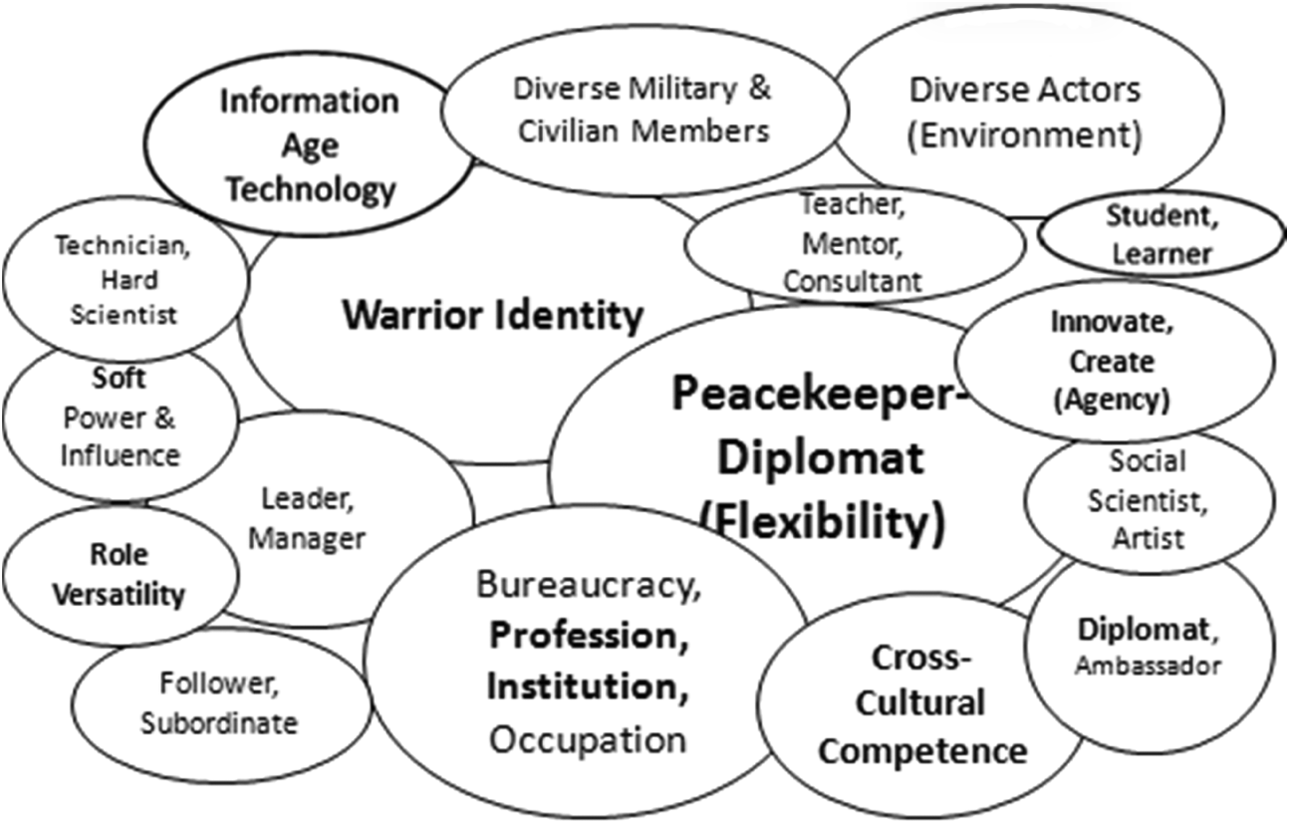
Military advisors’ cultural toolkit.
Future Research
This section forwards recommendations for future research about contemporary military advisors and linguists. Military advisors’ viewpoints in the advising mission in the post-9/11 campaigns in Iraq and Afghanistan clearly take center stage in this study’s findings; thus, future research should seek to more deeply explore linguists’ vantages and their employment in different missions around the world to learn more about the nuances of the linguists’ role in various contexts. These fresh perspectives would corroborate or contradict and expand the findings reported in this article about the role of military linguists, and how soldiers and linguists interact to accomplish various tasks. Further, studies of active duty military linguists (e.g., 09L in the U.S. Army) would also provide useful insights. A systematic examination of international armed forces’ lessons learned about linguists would also constitute worthwhile research. These proposals for future studies would not only enhance our understanding of contemporary military linguists but would also sharpen comprehension of the nascent postmodern military and its culture.
Footnotes
Acknowledgments
The author thanks the blind reviewers and editorial staff for their beneficial reviews and feedback, which enhanced this article.
Declaration of Conflicting Interests
The author declared no potential conflicts of interest with respect to the research, authorship, and/or publication of this article.
Funding
The author received no financial support for the research, authorship, and/or publication of this article.

Notes
References
Supplementary Material
Please find the following supplemental material available below.
For Open Access articles published under a Creative Commons License, all supplemental material carries the same license as the article it is associated with.
For non-Open Access articles published, all supplemental material carries a non-exclusive license, and permission requests for re-use of supplemental material or any part of supplemental material shall be sent directly to the copyright owner as specified in the copyright notice associated with the article.
