



Abstract
Hard power, the unorthodox foreign policy mechanism, has emerged recently as a complex agency that uses military power to regulate diplomatic relations between military and civilian actors. Although national governments use hard power rather frequently to influence foreign public opinions, the field’s scholarship tends to downplay the role of military instruments in the development of public diplomacy. Almost all armed forces contribute to various public diplomacy efforts by applying basic tools, including humanitarian-relief operations and construction works, and international military education and training programs. This article analyzes these tools in the context of soft power and public diplomacy and demonstrates the impact of military power on public diplomacy. It also reconstructs the effective time frames of public diplomacy works of the military by introducing a novel pattern to understanding these works.
Keywords
In September 2004, the disastrous tsunami and earthquake in Indonesia received an immediate humanitarian response from the United States. Under Operation Unified Assistance, the hospital ship U.S. Naval Ship (USNS) Mercy rushed to the area to help the victims. Surveys on the incident demonstrate that the relief efforts of the United States, orchestrated by U.S. military, increased the Indonesian public’s support of American engagement in the region. U.S. aid also sparked a lively public debate about whether the military’s role in disaster aid gave it the same status as a public diplomacy agency in foreign policy (Wike, 2012).
This short anecdote and its reflections in terms of (positive) public opinion above present the importance of the public diplomacy efforts in military affairs. Although various operations targeted “military aid,” national armies have mostly failed to optimize their full potential or comply with the principal of the “center of mass,” a military term that describes the direction of all available forces onto a particular zone in order to breach through the enemy line (Echevarria, 2003). The concept of “defence diplomacy,” as United States and its allies previously applied to improving relations with Russia and China, seems to have shifted to what I call, the concept of “military public diplomacy” (Cottey & Forster, 2013, pp. 8–15). 1 This article seeks to explain whether or not “a well-run military can or cannot be a source of prestige,” by exploring the military’s influence on public diplomatic affairs in the areas of humanitarian relief missions, military staff training programs, and direct contributions to foreign establishments and people (Nye, 2011). This focus affords a deeper understanding of public diplomacy work in relationship with military affairs in foreign policy. It also helps to characterize the extent to which military power has influenced the field of public diplomacy and determine the effective periods of the military’s public diplomacy works. Public diplomacy is concerned with affecting the ideas, decisions, and preferences of the policy makers of other countries. We can thus comprehensively define public diplomacy in the following way: In addition to a government’s traditional diplomatic channels within the international environment, public opinion can be influenced in target communities and among decision makers, by using individuals, groups, and companies to facilitate the executive country’s national interests. In other words, a country’s government should supervise the domain of public diplomacy such that its public diplomatic activities function as a form of soft power. According to Nye, soft power “is the ability to get what you want through attraction rather than coercion or payments. When you can get others to do what you want, you do not have to spend as much on incentives to move them in your direction.” Unquestionably, the definition of the two terms, public diplomacy and Nye’s soft power, are different; whereas soft power excludes official guidance and supervision in communication with other communities, public diplomacy considers them viable. So the totality of efforts in encountering the targeted community without government backing is soft power, not public diplomacy. Nye also defines hard power as “the ability to coerce [which] grows out of a country’s military and economic might.” As military power is the essential tool for hard power, how does the military (not) participate in public diplomacy and to what extent does it constitute elements of public diplomacy? (Nye, 2004)
Related to the question above, another question arises: To what degree can the military’s power influence foreign public opinion? Although the armed forces have effectively executed public diplomacy efforts, these efforts were in service to very specific goals and were not integrated into broader diplomatic discussions or efforts. One example is the U.S. Navy’s relief to Italy in December 1908, immediately following an earthquake that cost the lives of 200,000, including the U.S. Consul and his wife (Oldham, 1909, p. 185). In January 1909, U.S. ships Connecticut, Culgoa, Yankton, Celtic, Illinois, and Scorpion sailed to Italy on a humanitarian mission. Italy’s King Victor Emmanuel personally accepted Real Admiral Charles Stillman Sperry and expressed his appreciation of the endeavor. The governor of Naples, Marquis del Carretto, sent the secretary of the Navy a special letter of gratitude for U.S. humanitarian assistance as well, emphasizing that this assistance funneled an air of public optimism to Italy (Reckner, 1988, pp. 147–148). A decade later, in 1922, the United Kingdom established the Imperial Defense College in London to train senior military officers from its colonies and to promote relations with these officers, thus ensuring the survival of British domination overseas. France also followed suit by launching similar programs with Ecole Supérieur de Guerre (Cottey & Forster, 2013, p. 6).
Such examples embody earlier cases of noncoercive use of military resources in foreign policy. The field’s existing literature brands these goodwill missions as “Operations Other Than War” (Chong, 2015, p. 234). 2 From the perspective of public diplomacy, however, this description seems rather limited. To begin, military public diplomacy as a relatively new scholarly paradigm envelops a wide range of palliative aid services to more complicated activities such as the U.S. Armed Forces’ involvement in the disaster relief efforts after earthquake disaster in the vicinity of the nuclear reactor in Daiichi, Japan (Holt, Campbell, & Nikitin, 2012, p. 12). 3 This is a “force projection,” a kind of operation different from combat missions, including disaster relief (Engstrom, 2013, p. 40). Likewise, exchange programs, training, medical, and nearly all humanitarian aid to foreign audiences fall into the category of public diplomacy efforts in military affairs. As an official entity, then, the military is a hard power asset in the pursuit of soft purposes. In Practicing Public Diplomacy, Yale Richmond cites another example of public diplomacy from divided Germany following the Second World War. During this time, Soviet aggression and invasion into East Germany alarmed the public in West Germany and caused the United States to fly the B-29 bombers repeatedly over West Germany as an effective method of deterrence against the Soviet offensive. This action also instilled confidence and a sense of security among the West Germans (Richmond, 2008, p. 18). The military powers did not, however, seem to factor the effect of public diplomacy into their missions. To emphasize the significance of public diplomacy in modern military warfare, Edward Kurjack has wondered with regard to the U.S. invasion of Iraq, “Why were there no appropriate Arabic quotations from the Koran stenciled on the American tanks?” (Kilbane, 2009, p. 190)
The Military as an Instrument in Public Diplomacy
Military forces, hierarchical and sophisticated by nature, function as the major public diplomatic agency. In the 2008 report, Stockholm International Peace Research Institute introduced six factors that are vital for completing military rescue missions during times of natural disasters: “timeliness, appropriateness, efficiency, absorptive capacity, coordination, and costs.” This list should include the internal communications capability of the rescuing unit as an additional factor. This capability prevents the use of the unit’s alternative tool of communication, combat equipment, and proves especially helpful in resolving issues related to miscommunication and power outage in the disaster-stricken areas. This article analyzes a representative number of public diplomatic actions involving the military. It evaluates specific cases to explain the ways in which military operations made positive contributions to a state’s image abroad. It underscores the significance of reconsidering the role of military instruments in public diplomacy by way of looking at the three categories of humanitarian assistance and disaster relief (HADR): missions, military staff training programs, and territorial support (Wiharta, Ahmad, Haine, Löfgren, & Randall, 2008). 4
Most capable countries undertake military public diplomacy activities. For instance, the armed forces of East Asian countries (China, Japan, South Korea, Australia, Singapore, and even Taiwan) performed humanitarian missions (Engstrom, 2013; Li, 2015). In particular, the Chinese Military (People’s Liberation Army [PLA]) has attempted to extend its global influence and engage in humanitarian operations in Africa, South Asia, Central America, and the Caribbean. The PLA Navy’s hospital ship, “Peace Ark,” has visited various countries in these regions and, since 2010, offered humanitarian and medical assistance under the title “Harmonious Mission” (Benson, 2013). 5 United Kingdom’s African Peacekeeping Training Support Program and France’s Renforcement des Capacités Africaines de Maintien de la Paix also provided public diplomacy facilities to various African countries (Cottey & Forster, 2013, pp. 59–60). Along with these military forces, this article draws its cases from U.S. military forces because these cases are richer and reported in greater detail.
HADR Missions
Foreign humanitarian assistance aims to directly relieve, or reduce, human suffering, disease, hunger, and privation (Joint Publication 3-29, 2014). It encompasses any state responses to critical humanitarian issues and, of the various means of implementing the importance of hard power assets as a foreign policy instrument, HADR missions are the most striking (Capie, 2015, pp. 312–323). Indeed, military organizations are being used for HADR missions especially after devastating natural disasters such as earthquakes and tsunamis as a tool of public diplomacy. Of course, in the aftermath of natural disasters, all the humanitarian aid activities are valuable, but military organizations are more capable of supporting large-scale humanitarian relief efforts than other institutions due to their excellent coordination capacity, mobility, manpower, and equipment. Thanks to highly visible equipment and vehicles, military organizations further create a sort of “demonstration effect” (Capie, 2015, p. 325). For instance, one U.S. Navy ship is described thus, “Abraham Lincoln aircraft carrier ship, besides its enormous size, has the capacity of producing daily 100,000 gallons of drinkable water” (Wells & Hauss, 2007, p. 486). Moreover, it has quite a large number of crew members relative to the total number of Foreign Service officers in the State Department. As far as numbers are concerned, the U.S. Navy employs more construction engineers and workers than those in the U.S. Agency for International Development (Gvosdev & Reveron, 2010, p. 31).
Military responses to natural disasters have become increasingly important since the beginning of the 21st century. Over the course of a decade, military organizations have been successfully used as public diplomacy instruments by governments during natural disasters. Since 1995, the United States has engaged in about 40 humanitarian assistance relief operations (Moroney, Pezard, Miller, Engstrom, & Doll, 2013), including the earthquake and tsunami in Indonesia (2004), Cyclone Nargis in Burma (2008), Padang Earthquake in Indonesia (2009), monsoon floods in Pakistan (2010), the earthquake and tsunami in Japan (2011), and Typhoon Haiyan in Philippines (2013) to name a few. Perhaps the most striking example of this aid was after the twin earthquake and tsunami disasters struck Southeast Asia on December 26, 2004. This catastrophe mostly affected the countries of Indonesia, Sri Lanka, India’s southeast coast, Thailand, and Maldives. In a matter of minutes, according to the United Nations, 169,752 people lost their lives and 127,294 people went missing; millions of people lost their homes and jobs. Help came to the affected countries from all around the world, but the largest donor was the United States. The U.S. Navy was at the epicenter of this comprehensive aid program. This humanitarian relief mission, named Operation Unified Assistance, involved 16,000 U.S. military personnel, 26 ships (including one hospital ship, “USNS Mercy”), 58 helicopters, and 43 fixed wing aircrafts. Additionally, 10 million pounds of food and supplies and over 400,000 gallons of fresh water were delivered to the affected areas, and approximately 2,500 patients were treated (Elleman, 2007; see also American National Red Cross, 2009; CNN, 2005).
Initially, because of U.S. military action in Afghanistan and Iraq, some of the local people had negative feelings about U.S. military aid efforts in the region. For example, one man in Indonesia who had survived the tsunami said, he appreciated the help from abroad but worried that the United States might try to influence the country’s religion. Another man said that he did not agree with American moral values and for this reason they should not stay long in Indonesia. Eventually, however, attitude changed in Indonesia, the most populous Muslim country in the world. Not long after the humanitarian-relief efforts one Indonesian religious leader said, “We are very close friends with the military, and they have been assisting our efforts to help the Acehnese people by bringing us on their airplanes. I expect they will be here for a very long time.” In a public speech after the 2004 HADR mission, the Prime Minister of Singapore, Lee Hsien Loong, emphasized the importance of U.S. support, saying “the U.S. should make the most of this soft power to win over hearts and minds, and inspire and shape developments in Asia and beyond” (Loong, 2007). The then U.S. Pacific Commander, Admiral William J. Fallon, agreed with Loong and concluded that the DoD-led humanitarian operations after the 2004 Indian Ocean tsunami reinforced a positive image and perception of the United States in the region (Forster, 2015, p. 4). In an interview, George W. Bush acknowledged the weakness of public diplomacy efforts compared to those who were trying to vilify the United States all around the world. But in the wake of military humanitarian mission, people understood the United States and its moral values as one of compassion (Demick, 2005; Guerin, 2005; Paddock, 2005; Walters, 2005). Thanks in part to favorable local public opinion, the United States also supported Indonesian Military Forces related to the HADR operations, organizing about 500 joint exercises with Indonesia in 2014 (Martin, 2015a, p. 65).
Pew Research Center (PRC) conducted a survey in 2005 to measure the variation in Indonesian public attitude following the rescue efforts. According to this survey, 79% of the Indonesians said the aid provided by the United States (military) had improved their impression of America. This reflected a 23% spike in positive opinion, as shown in Figure 1. Another poll conducted in Indonesia by Terror Free Tomorrow in 2006 displayed a decline of 35% in the percentage of unfavorable views of the United States in the year following the humanitarian aid (McCawley, 2006; Wike, 2012).
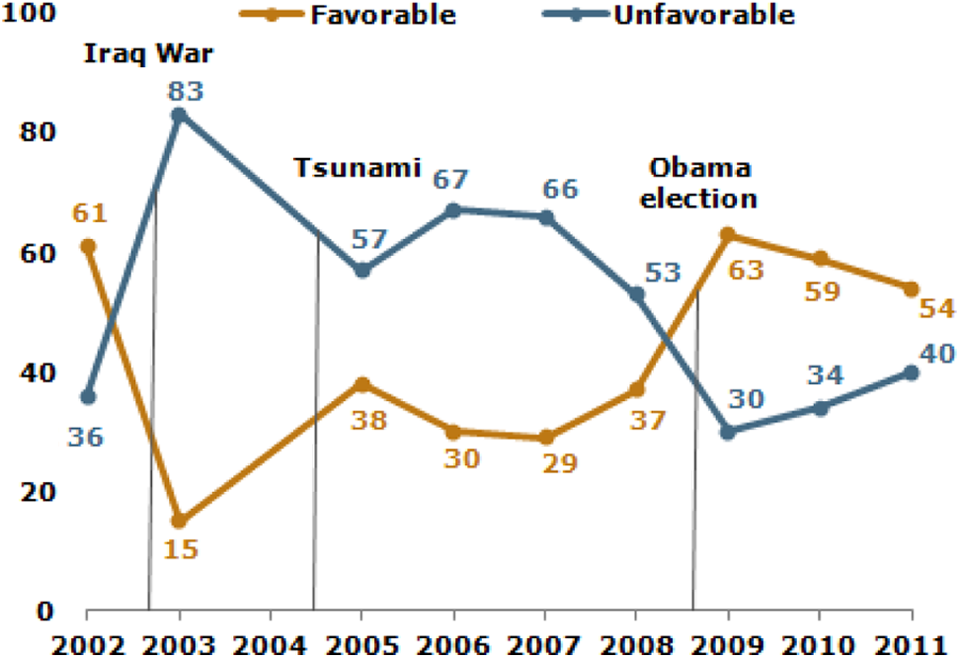
Views of United States in Indonesia (PRC).
This military aid provided to Indonesia not only improved the United States’ image in the eyes of Indonesians. The same PRC Polls also revealed substantial increases in the neighboring countries, namely, India and Pakistan. Likewise, the Woodrow Wilson International Center’s Asia Program Special Report clearly indicated that U.S. favorability among Pakistanis doubled from 23% to 46% in May 2005 (Kohut, Doherty, & Wike, 2006, p. 1). 6
Another notable example of U.S. military assistance during natural disasters is the 2011 Japan earthquake. On March 11, the 9.0-magnitude quake shook Japan and then a tsunami followed, registering 15,188 deaths and 8,742 missing (Feickert & Chanlett-Avery, 2011, p. 1). The U.S. forces, then stationed nearby, reacted immediately to the disaster by carrying out “Operation Tomodachi” in collaboration with the Japan Self-Defense Forces from March 12 to May 4, 2011. The U.S. troops participated in this humanitarian-relief mission by providing 24,000 personnel, 189 aircraft, and 24 navy vessels (National Bureau of Asian Research, 2014, p. 14). Compared to other cases, this HADR operation proved to be extremely complicated because of the damage to the Daiichi nuclear power plant. In fact, Vice Admiral Scott Buskirk stated that “it was the most complex HADR mission ever conducted” (Buskirk, 2011). As public in Japan learned about HADR support from U.S. troops, they began to feel a sense of gratitude toward American soldiers. Toshimi Kitazawa, Japan’s Minister of Defense at the time, said on April 4, 2011, while aboard the U. S. Ship Ronald Reagan, “we have never appreciated the value and the significance of our alliance with the U.S. as much as we do today.” His opinion signified a shift in the minds of the Japanese public. Only 2 years prior, the new Democratic Party of Japan government had questioned the U.S.–Japan alliance and, instead, suggested a regional, Japan–Asian alliance. The HADR mission had a profound impact on Japanese political and social perceptions, ultimately reversing the national attitude toward the United States (Bradford, 2013, p. 32; see also Hayashi, 2011). Even the Japanese media spoke of the United States in favorable terms. The Japan Times, for instance, expressed warm feelings and deep gratitude of the Japanese public on the first anniversary of the disaster with the headline, “Operation Tomodachi a Huge Success, But Was it a One-Off?” ( Johnston, 2012, March 3) According to the PRC, public opinions also showed an increase in public opinion of the United States since 2008, but the aid provided in 2011 seemed to contribute to this being larger than it would have been otherwise, as shown in Figure 2 (Fackler, 2011; see also Wike, 2012).
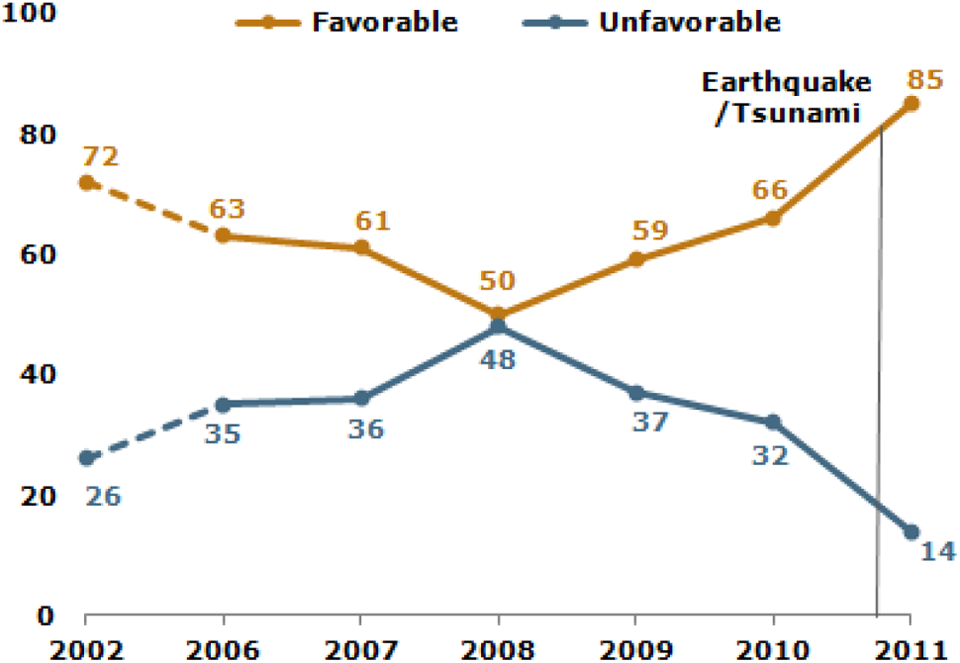
Views of United States in Japan (PRC).
Based on the U.S. experience, the success of the HADR missions reveals that, when military power orchestrates such operations, it can strongly impact foreign populations and serve as a means of public diplomacy. By emulating the U.S. model, in fact, many regional powers including China and Japan have created their own version of this tool in search of more effective public diplomacy.
Military Staff Training Programs
The second tool or category of military public diplomacy is personnel training programs, which consist of language learning and other military knowledge based theoretical and practical courses, given to foreign military staff. These officers, selected by their respective countries through a rigorous process, enroll in the program. The program provides them with an informed understanding and appreciation of the host country’s democratic principles, social norms, and military values. Along with their coursework, the officers who graduate from the program use these credentials to assume eminent positions in their country. In the U.S. case, most of these courses have been implemented under the International Military Education and Training Program (IMET). In short, IMET is a grant program designed for international military personnel. The IMET program, directed by the Bureau of Political–Military Affairs under the U.S. Department of State, seeks to provide national security and to improve defense capabilities. This program likewise aims for its alumni to not only gain the requisite skills but also to acquire perspectives consistent with U.S. interests (Hanauer et al., 2014, p. 115). Specifically, IMET helps to organize better relationships and to develop military capabilities with other countries, and it assists in the promotion of human rights (Fitch, 1981, pp. 65–66). A reporter for the Research and Development Organization National Defense Research Institute explains the benefits of the IMET program: Although international military education and training is a very small program with a very small budget, it has an impact beyond its size and is not easily quantified in terms of dollars and cents, the success of IMET lies in the prestige and quality of U.S. training that motivate foreign countries to send their best and brightest military students to courses in the United States. The United States has the opportunity to expose friendly and allied nations’ future leaders to the U.S. system and culture, thus generating mutual understanding and durable working relationships. (Taw, 1994)
The IMET program has a substantial impact on the relations of the United States with allied and friendly countries, compared to its moderate budget (DoS Congressional Budget Justification, 2015).
7
This claim is supported by the statistics: between the years of 1985 and 2004, the National Defense University Fellows Program has trained 471 international officers, of whom 25 have gone on to become heads of state, ambassadors, ministers of defense, chiefs of their services, or senior participants in U.N. peacekeeping efforts. (Bloomfield, 2004, p. 7)
The basic problem at this point has been systematically measuring the outcomes of IMET-based education processes. In order to better track all alumni rather than just those who have achieved positions of prominence, depending on IMET’s importance, the State Department and Department of Defense have tried to measure the impact of IMET program via surveys (Hanauer et al., 2014, p. 115). Although results of surveys are not open to the public, the desire and intention for measuring emphasize significance of IMET program.
Another functional aspect of military training programs is the “sponsorship” application for the visiting international military officers and their families. 8 These personnel, meticulously selected among the best officers, can be prominent figures in the decision-making mechanisms of their countries someday. Hence, in our case, the United States can easily find the opportunity to positively influence the world’s future military leaders’ thorough training programs. 9 The structure of sponsorship application generally builds on three sponsors: barracks sponsor, community sponsor, and seminar sponsor. The role of the barracks sponsor is to assist the fellow and his family during their stay in barracks, the seminar sponsor (classmate of the fellow, usually married) assists the fellow in class activities, and the community sponsor (usually a husband and wife from the civilian community) is supposed to assist the fellow and his family in getting familiar with the social life of the United States (U.S. Army War College, 2015).
By and large, these sponsor families are responsible for the leisure time activities of foreign officers. For instance, they often invite the visiting military personnel to their homes; take them sightseeing; and take them to sporting events such as football, baseball, and basketball games. These kind of volunteer sponsorship activities pave the way for conducting better public diplomacy. Those military staff not only get the opportunity to see the United States but also to witness its liberal and democratic culture. When these officers return to their home countries, they serve as volunteer U.S. ambassadors in terms of advocating for freedoms and other cultural values (Personal communications, March 11, 2014, April 25, 2014, September 17, 2015, and October 6, 2015). 10
The last instrument of the military staff training program is the International Fellows Hall of Fame ceremonies. In the case of the U.S. military, some foreign military officers have been invited to the United States by U.S. military authorities after being promoted or appointed to higher governmental or multinational positions. The main objective of this program is “to provide a prestigious and visible means of honoring international fellow graduates” (International Fellows Hall of Fame Memorandum, No. 351-2). Keeping track of the graduates, especially the ones who hold the key positions in their nation’s bureaucratic system, is crucial for this instrument. Therefore, the honoring hall of fame ceremonies, among all the instruments available, serve as a supplementary tool of military public diplomacy.
Military staff training programs generally contain in-person interactions, the processes of which increase the “speed of trust” among military personnel (Bradford, 2013, p. 25). And, when coupled with other democratic and social norms, the reciprocated trust holds the potentials to create strikingly successful public diplomacy endeavors.
Territorial Support
The third tool of military assistance as part of public diplomacy is territorial military support. Territorial support consists of military aid and support programs other than the humanitarian relief assistance such as the construction of hospitals, building health-care centers, maintenance of public properties, and health monitoring programs.
Undoubtedly, military power is capable of creating engineer works. Maintenance of bridges, roads, schools, and hospitals is among the capabilities of the military might. Building structures and digging wells can be accomplished easily with military equipment and personnel for the best interest of the community. United States Africa Command (USAFRICOM), which was established in 2007 to protect and seek the interests of the United States in Africa via military command (Brown, 2013), is an example of successful public diplomacy. For instance, in 2015, a rehabilitation center was built with the total cost of US$ 639,700 by AFRICOM engineers for children suffering from malnutrition in Nkwanta South in the Volta Region of Ghana (Aldrige, 2013; Ghana News Agency, 2015). In 2013, 176th Engineer Company of the U.S. Army Corps of Engineers completed the project of building a high school named Preah Ang Duong in Cambodia. The cost of the school was US$700,000, and it was the largest humanitarian assistance project in this country (Milligan, 2014, p. 173). The same engineer unit supported schools by building school houses in Thailand under the name of Exercises Cobra Gold (Martin, 2015b, p. 60). Health screening and veterinarian capabilities of the U.S. military are also remarkable. In 2008, U.S. Army veterinarians examined some 17,000 animals in Ethiopian villages, inoculating the animals against diseases (Dean, 2008). In addition to that, some Army doctors from AFRICOM joined Djibouti Army doctors to conduct clinics for civilian patients (Quellette, 2013). In similar vein, Mongolia agreed on an exchange program between the U.S. Army Nurse Corps and Mongolian Armed Forces medical nursing professionals from 2010 to 2013. While in the program, nurses exchanged information in military nursing practices and learned ways of partnership between the U.S. and Mongolian armies (Martin, 2014, p. 66). These are just a few examples of how military forces can directly contribute to public diplomacy efforts by carrying out supportive works for foreign publics. Beyond the locals who receive this help, positive publicity can come from photos of soldiers performing this work, being published in the local media to attract public attention. In this way, the admiration and respect of foreign publics could be gained.
Time Perspectives
Public diplomacy must be administered from a central unit in order to accomplish tangible results in a targeted community. This central unit, such as the U.S. Information Agency, undertakes the responsibilities related to conceptualizing and executing public diplomatic activities. It is possible to analyze the degree to which the duration of a public diplomacy operation affects the results of the activity. Our analysis examines several cases and finds that the public diplomacy efforts of the military forces can be divided into two types of activity: shorter and longer terms. When engaged in humanitarian relief efforts and territorial support, military organizations tend to complete their mission as a shorter term activity within 2 years. They undertake longer term activities for over 2 years, however, when training military personnel.
As part of public diplomacy policy, humanitarian missions resort to the use of force in dealing with natural disasters such as earthquake and tsunami. These missions operate on temporary basis and, typically, register minimal long-term impact on the views of the foreign public. In the representative case mentioned before, documented by PRC, the U.S. Navy’s assistance to Indonesians, in response to the 2004 earthquake and tsunami in the region, positively affected the perceptions and opinion of the United States in Indonesia. This increment of positive views, however, came to a gradual halt in the following 2 years. In particular, the PRC polls demonstrate that the favorable opinion in Indonesia recorded a 23% increase, thanks to the naval assistance, and 9% decrease after 2 years. Those kinds of humanitarian relief operations not only influence the target community, they cause ripple effects over the neighboring countries as well, namely, China, India, and Pakistan. However, positive opinion is effective in a limited time period and goes into a decline in the influenced countries within 2 years as seen in Figure 3 (Kohut & Wike, 2008, p. 21).
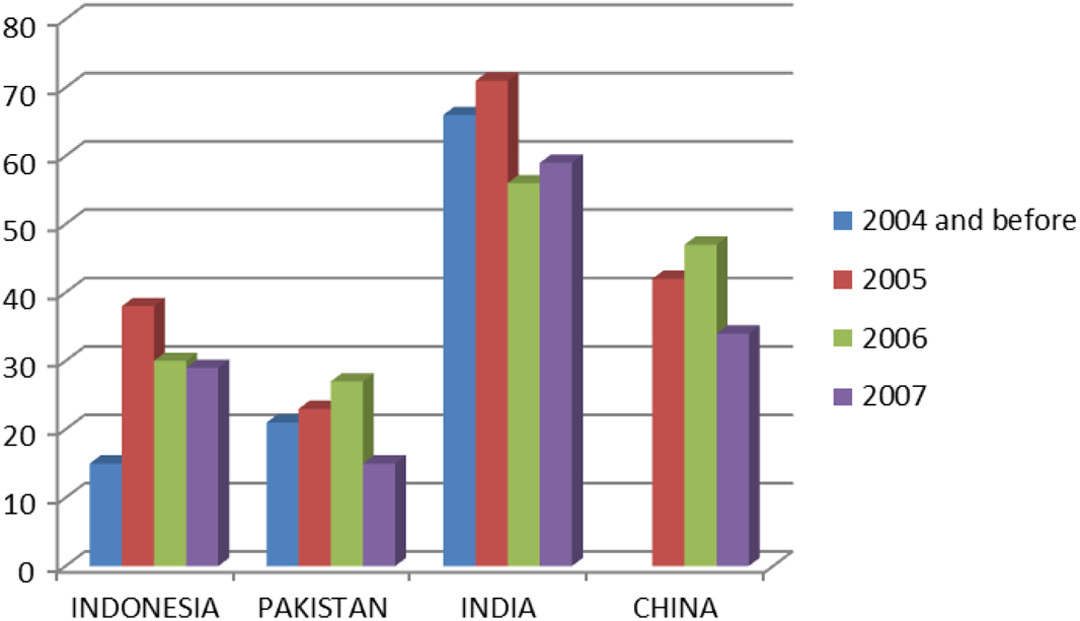
Favorable public views of the United States (PRC).
Territorial support, another military instrument capable of serving as a means of public diplomacy, addresses a range of services, including hospital construction, health-care centers, the maintenance of public property such as bridges, roads, and schools, and health and veterinarian monitoring programs. USAFRICOM has provided African countries with such support, mentioned in detail above. Due to their shorter impact, these kinds of activities can be included in the category of shorter term activities.
Whereas the impact of humanitarian missions expires within 2 years, that of longer term activities extends over a longer period of time. As a longer term activity, the training of foreign military personnel can create long-lasting emotional bonds between the parties, the trainee, and the training country and its staff. The U.S. Ministry of Defense has offered such training to foreign officers through the IMET Program. The Defense Security Cooperation Agency has so far monitored and tracked the IMET graduates rather inefficiently, making it difficult to determine the extent to which the graduates followed suit. Charles Larson suggests that, in the absence of detailed information from the source, past experiences of graduate students can help to evaluate the impact of IMET programs. Recently in 2014, for instance, the Pakistani Lieutenant General and the 2008 U.S. Army War College graduate, Rizwan Akhtar, became the Director-General of the Interservices Intelligence, a critically important position in the Pakistani Army (Boone, 2014). While in the college, his research project focused on how and why the U.S. hostility to the Pakistan region would and should diminish (Akhtar, 2008). In Thailand, as well, another graduate, Major General Chamlong Srimuang, played a pivotal role during the 1992 democratization process and served as the Deputy Prime Minister between 1994 and 1995. The 2006 graduate, Field Marshal Abdelfattah al-Sisi, played even more striking role in shaping the political course of his country, Egypt. (Al-Sisi, 2006). Last but not least examples include the former graduates of U.S. Naval War College, President of Lebanon from 1998 to 2007, Émile Lahoud (Priest, 1998), and the new chief of the Royal Malaysian Navy, Admiral Dato’ Seri Panglima Ahmad Kamarulzaman (Malaysia Navy, 2015). Such examples demonstrate that, indeed, the impact of the officer education program extends beyond 2 years as well registering longer term public diplomatic activities (U.S. Government Accountability Office, 2011, pp. 17–18). 11
Conclusion
In the era, we live in interactions with foreign publics are becoming increasingly important for governments. In connection with this reality, public diplomacy, as a foreign policy technique, started to play a significant role in world politics together with traditional diplomatic channels. So, military power, the core element of the hard power, is coming to the fore as a tool of public diplomacy to affect and attract public opinion. Although it has been used over the past several decades, its value as a tool for diplomacy has been rediscovered in recent decades. During any government’s public diplomacy efforts, military organizations, due to their extraordinary visibility and capability, can be effectively used for humanitarian relief missions; military staff training programs; and territorial support, including construction and maintenance works and health and veterinarian monitoring programs. By using the capacity of military sources, the ultimate goal of the states is to turn potential adversaries into partners and to influence domestic transitions in positive directions (Cottey & Forster, 2013, p. 70). Military might, which could be the source of a negative image of a country, can in fact be an instrument to ameliorate a country’s negative reputation. Consequently, the military functions not only as the fundamental pillar of hard power, it also serves as an excellent public diplomacy tool by forcing common good.
Footnotes
Declaration of Conflicting Interests
The author declared no potential conflicts of interest with respect to the research, authorship, and/or publication of this article.
Funding
The author received no financial support for the research, authorship, and/or publication of this article.