




Abstract
There are numerous studies on the success of various leadership styles that refer to the link between styles and levels of performance and other relevant organizational parameters. Data from a recent survey in a multinational headquarters (HQs) replicate previous findings on leadership style concerning the preferences of the subordinates for more participation in decision-making. Although multinational HQs are in many ways unique organizations that could present unique leadership challenges, too, the findings using traditional models of leadership show how similarly, compared to civilian companies and public administrations, leadership styles are perceived and evaluated by subordinates. Apart from that, the survey data indicate that leadership style—quite different from what was expected—has no significant effect on “organizational commitment” and “mission clarity.” The reasons for that result are discussed against the backdrop of the peculiarities of the organization under investigation.
The major share of leadership research is devoted to particularly examining the degree to which the led are involved in decision-making processes (Bass, 1990; Neuberger, 1994). It does not matter at first what the decisions are about—for instance, business routines, staffing, the future strategic approach to the market, or decisions typical in military settings. The answer to the question what style of leadership is the “right” one is of particular relevance to the military in comparison with other organizations and can even be of vital importance because the lives of the led depend on the decisions a military leader takes in an emergency. It is not least for this reason that leadership is an essential element of the military.
The top training establishment of the German Armed Forces (GAF), for instance, is called the Führungsakademie (Leadership and Staff College) and the organizational culture of the GAF is basically a leadership culture—Innere Führung. Participation in the decision-making process is a central element of the GAF’s leadership philosophy, Innere Führung (leadership development and civic education), too. The Joint Service Regulation (Zentrale Dienstvorschrift [ZDV]) on Innere Führung unequivocally requires this of the military leader: “I lead fairly. I make use of the abilities and skills of my soldiers and involve them in my decision-making whenever possible” (ZDV A-2600/1, p. 27). The extent to which subordinates should be involved in the decision-making process is at least stated clearly in the rules and regulations: Military leaders of the GAF should go by the participative leadership style. It is therefore well worth taking a critical look at the alleged features of leadership styles in the military.
Leadership and leadership styles have been prominent research topics in military sociology and military psychology till today. Recent studies examined the contribution of personal values in predicting the motivation to lead (Clemmons III & Fields, 2011), explored the relationship between coping and transactional and transformational leadership styles (Alarcon, Lyons, Schlessman, & Barelka, 2012), and identified how cultural politics influence efforts to portray “leadership” in a military setting (Hutchinson, 2013). This article presents and discusses the results of empirical leadership research done in a specific type of organization, the multinational military headquarters (HQs). It begins with a short overview of the research on (nonmilitary) leadership style and an account of the state of research in multinational military organizations. Previous studies in this field of military sociology provide working hypotheses on the preference of leadership styles among the led and on the factors that determine this preference structure (antecedents). Subsequently, the consequences of leadership styles on two selected organizational parameters, that is, affective commitment (AC) and mission clarity (MC), are examined. An organizational survey at the Supreme Headquarters Allied Powers Europe (SHAPE), North Atlantic Treaty Organization’s (NATO) military HQs in Belgium, provides the data basis for testing hypotheses.
Some years ago, military sociologists introduced the thesis of a movement of the western armed forces to a “postmodern military” in reaction of the end of the Cold War (Moskos, 2000; for critics, see Booth, Kestnbaum, & Segal, 2001). The postmodern military is—besides other factors—characterized by an “increasing interpenetrability of civilian and military spheres” and an “internationalization of military forces” in bi- and multinational divisions, force, and command structures (Moskos, Williams, & Segal, 2000, p. 2). To some extent, one could attribute these characteristics to SHAPE right from its foundation in the year 1951. SHAPE staff always was put together with civilian and military workforce from NATO’s members. Examining leadership styles in a unique organization like SHAPE is charming because this organization, to some extent, had showed characteristics of the postmodern military decades before the concept of a postmodern military was born.
Research on Leadership Styles
The Ohio-state leadership studies conducted in the United States in the 1940s provided the foundations for the ongoing research on leadership styles. Leadership style can be understood as a permanent pattern of behavior attached to certain ethical standards or personality-related criteria. The distinction between an employee-driven leadership style (consideration) and a task-driven style (initiating structure) pointed the way ahead for further research: Consideration is the degree to which a leader shows concern and respect for followers, looks out for their welfare, and expresses appreciation and support […]. Initiating structure is the degree to which a leader defines and organizes his role and the roles of followers, is oriented toward goal attainment, and establishes well-defined patterns and channels of communication. (Judge, Piccolo, & Ilies, 2004, p. 36)
One-dimensional leadership style concepts have prevailed to the present day in another branch of research that is referred here: Literature on leadership considers the degree of participation in decision-making processes in a continuum from directive to participative leadership styles (Bass, 1990, pp. 436–471; Tannenbaum & Schmidt, 1958). There is controversy over whether employees should be involved in the decision-making of a superior and, if so, to what extent. There is also controversy over the question of whether the leadership style depends or should depend more on personality traits, individual dispositions, and values of the leader or rather on situational factors like the consequences of the decisions made for the led and the level of information of the superior. The known model developed by Vroom and Yetton (1973) considers a large number of situational variables and produces a sophisticated decision tree that identifies which leadership style along the continuum should be applied under what conditions in order to achieve decisions that are not only socially acceptable but also efficient and effective from the point of view of the organization. Although such “decision logic in decision-making” would probably not be very feasible in leadership practice, particularly in the military field, it clearly indicates that no simple answer can be given to the issue of the comparative advantages of a leadership style without consideration being given to the overall conditions.
It has proved useful for empirical studies of leadership styles to break up the continuum into a discrete typology of four leadership styles: the authoritarian, paternalistic, participative, and democratic styles (Hagen, 2006; Santero & Navarro, 2006). A leader who makes decisions quickly, communicates them to his employees clearly and without further ado, and expects the instructions to be carried out loyally and without criticism is said to have an authoritarian leadership style. A leader who usually makes decisions alone but tries to explain the rationale behind them and answers questions asked by subordinates is said to be paternalistic. Participation in decision-making begins when employees are consulted, and pros and cons are weighed up jointly before the leader makes the final decision. The democratic leadership style fundamentally requires a discussion to be held with the team in which arguments are put forward and the majority opinion is binding for the making of the decision. In the fourth leadership style, the superior plays the role of a facilitator.
It is important to point out that the fundamental assumption in research on leadership style is that leaders cultivate a certain (individual) leadership style which the led perceive as a more or less distinct and consistent mode of behavior. That is to say, the led can attribute their leader a certain average leadership style, and this style will always be updated in specific situations that involve interaction. The results obtained by researchers who have looked into the question of which style employees prefer vary and situational factors play quite a significant role. The doyen of leadership research, Bernhard M. Bass, states in his overview of the research on the leadership style continuum: “Generally, participative leadership will be favored over directive leadership” (1990, pp. 441–442).
There are numerous studies on the success of various leadership styles that refer to the link between styles and levels of performance, like the effectiveness and efficiency of the organization and other relevant organizational parameters. The participative leadership style seems to have comparative advantages with regard to job satisfaction and productivity. Although Neuberger (1994, p. 142) states in a nonexhaustive overview that 8 of the 12 considered studies indicate that there is a positive correlation between the participative style and job satisfaction (3 studies show that there is no effect and 1 study indicates that the effect is negative) and 10 of the 17 considered studies indicate that there is a positive correlation with productivity (4 studies show that there is no effect and 3 that there is a negative one), this style seems to have a certain superiority, though the mixed results at least suggest that situational factors are of importance.
Leadership Research in Multinational Military Organizations
As a response to the end of the Cold War and the changes in the mission situation, multinationality has become an increasingly important structural principle of military organizations. This is also reflected in several empirical studies on the topic over the past 20 years. Studies conducted at the former Bundeswehr Institute of Social Sciences (SOWI), Germany, until 2012 define military multinationality as “…permanent and coordinated cooperation between military personnel from at least three nations in common structures across various hierarchical levels that were previously organized nationally […]” (Gareis, 2016, p. 171). 1 The author distinguishes between “horizontal cooperation” and “vertical integration.” The former encompasses links between adjacent force contingents; in this case, multinationality primarily takes place at the strategic and operational levels. In contrast, vertical integration is characterized by a multinational mixture of command echelons up to the execution level. 2
The SOWI and cooperating research institutions have conducted studies on vertical integration and HQs of NATO and European Union (EU) missions in the 2000s. In addition to a wide range of questions on enhanced military cooperation between the participating nations from the military and defense policy angle and from the point of view of organizational culture, the researchers were interested in the topic of leadership. The leadership style continuum and the typology of four were used in a questionnaire study on the Multinational Headquarters South-East (MNHQ/SE), the HQs of the EU’s ALTHEA mission in Bosnia–Herzegovina (Santero & Navarro, 2006), and in a study on the HQs of the 1st German/Netherlands Corps (HQ 1 (GE/NL) Corps) in Germany (Hagen, 2006). Special attention is drawn to the following empirical findings on the antecedents of leadership styles:
The majority of the personnel at the two HQs studied preferred the participative leadership style. At MNHQ/SE, 42% favor this style (Santero & Navarro, 2006, p. 165), and at HQ 1 (GE/NL) Corps, 57% favor this style (Hagen, 2006, p. 76). The preference patterns for leadership styles differ between the nations, that is to say, national cultures are apparently reflected in the leadership culture. Italian, French, Spanish, and German military personnel served at MNHQ/SE. For instance, 53% of the German personnel prefer the participative leadership style, while only 45% of the French do so (Santero & Navarro, 2006, p. 168).
3
The preferred leadership style is dependent on the military hierarchy: The higher the rank, the greater the preference for the participative and democratic leadership styles. At MNHQ/SE, for instance, 71% of the senior officers preferred the participative style but only 50% of the Noncommissioned Officers (NCOs; Santero & Navarro, 2006, p. 167). The leadership style that soldiers see their direct superior practicing does not necessarily correspond with the leadership style they would prefer. At the HQ 1 (GE/NL) Corps, 62% of the Dutch personnel prefer the participative style, whereas only 39% see their direct superiors practicing this style (Hagen, 2006, p. 76). For quite a few interviewees, there is a gap between what they would prefer to see and what they actually see.
The state of research can be summarized as follows: Leadership styles vary according to personal preferences and social and cultural situations. No in-depth study has yet been conducted on the consequences they have in the context of multinational military organizations. SHAPE study 4 can be utilized to close the research gap to some extent. The study is part of an ongoing process of optimizing the organizational structure and procedures at the HQs, and its research focus was on organizational diagnosis, not primarily on leadership style. Nevertheless, the secondary analysis of the available data and variables allows examining some interesting questions in this field: Previous studies did not address the issue of whether leadership styles have an influence on AC and MC, both variables that are of key importance for the military in particular.
Hypotheses
Considering the state of research and the identified gaps, two research issues can be delineated: One issue treats the preferences for leadership styles among the subordinates, the other treats effects of leadership style on relevant organizational parameters. The first research issue’s ambition is descriptive, the second is explanatory. The descriptive working hypotheses against the backdrop of the empirical findings at MNHQ/SE and at HQ 1 (GE/NL) Corps are:
A two-stage approach is needed to answer the explanatory research questions. First, I will have a look on the effect of the participative style on AC and MC: Does the all-encompassing application of the participative leadership style—if it appears to be the ideal style in the eyes of the led—lead to greater AC to the organization and greater MC? Regardless of the high preference of the subordinates for participation—and the obviously high preference for this style among leadership researchers—I will secondly examine whether leadership styles have an effect on AC and MC at all. Given the fact that a considerable number of the led prefer the other three styles, that is to say, the authoritarian, the paternalist, and the democratic styles, a distinction is made between cases where the actual and the desired styles coincide and cases where they do not. The two groups, that is, coherent and incoherent cases, then form a separate independent variable. This allows the effects of this variable on the two chosen organization parameters to then be examined.
Previous research on the effects of leadership style focused, as mentioned above, on organizational parameters like efficiency and productivity. Three main reasons can be quoted for the decision to have a closer look at AC and MC but not on other relevant organizational parameters like, for instance, creativity, innovation, or teamwork. First, research possibilities are restricted because this work is a secondary analysis of existing data with a limited scope of independent variables. Second, although AC and MC have often been investigated by scholars in the field of military psychology (Gade, Tiggle, & Schumm, 2003; Meyer, Kam, Goldenberg, & Bremner, 2013), the variables have not yet been brought directly in connection with leadership styles. Looking at the nexus between the superior–subordinate interaction processes and the construction of commitment to a military organization and its level of ambition will improve the understanding of the functioning military as a social system. And third, commitment and MC are of crucial importance in military organizations in practical regard. Allen (2003) gives an overview of the all in all positive consequences of commitment in military settings, for instance, the effects on personnel retention: “Strongly committed employees are significantly less likely than those with weaker commitment to express an intent to leave the military” (p. 244).
The concept of organizational commitment has often found an echo in military psychology and military sociology. Recourse is often taken to the Three Component Model of Allen and Meyer (1990), according to which a distinction can be made between AC, that is, the emotional attachment of an employee and identification with the organization; continuance commitment (CC), that is, the awareness of the cost of leaving the organization; and normative commitment, that is, a sense of obligation toward the organization: “Employees with strong AC remain because they want to, those with strong continuance commitment because they need to, and those with strong normative commitment because they feel they ought to do so” (p. 3; emphasis in the original). The present questionnaire study focuses on AC, which is highly relevant for the military in particular. Studies examining the effects of these three types of commitment in comparison and in combination usually indicate that AC especially has positive effects from the point of view of the organization: “Whenever possible, it is desirable to foster affective commitment” (Meyer & Herscovitch, 2001, p. 323). 6 It is plausible to assume that active involvement in decision-making and the satisfaction of a need for psychological coherence that results from the conformity between the actual situation regarding the leadership behavior of superiors and the desired situation also manifest themselves in a positive attitude and the attachment associated with AC.
In addition to leadership style and sociodemographic variables, (a) job satisfaction and (b) organizational fairness are variables that are included in the multivariate analyses conducted here. Psychological studies explain the emergence of AC in addition to other influencing factors with satisfaction at work—Meyer, Kam, Goldenberg, and Bremner (2013, p. 387) doing so most recently for the military sector. The construct of organizational fairness indicates the degree to which employees evaluate their current employer as a fair employer, that is, the degree to which a fair relationship between the individual and the organization is perceived (Goldenberg, Andres, & Resteigne, 2016, who did so recently for the military sector). Tremblay (2010, p. 516) ascertained a high correlation (.54) of fairness perceptions and unit commitment in his study within the Canadian Armed Forces. An exchange relationship that is perceived as fair should therefore improve AC in the case of SHAPE, too.
Especially in the military sector, it is crucial that members of a unit or HQs are well informed about the purpose of the organization and have a clear understanding of its mission and objectives. This circumstance is referred to here as “MC”: This variable measures the extent to which a service member or civilian employee is ultimately able to appreciate the purpose of the organization they work for. It is plausible to assume that this appreciation is also influenced by superiors and their leadership style.
It is further assumed that particularly in organizations like SHAPE, where the assignments are temporary assignments for most of the military personnel and certainly a new experience in the careers of many, MC should depend on two variables in addition to leadership style: (a) The “preparation for an office/assignment” measures how well a staff member feels prepared for a post and whether he or she has the impression of having received sufficient adequate training in advance. (b) There is a great need for coordination between divisions, branches, and the interests of the participating nations at the NATO military HQs. The “quality of meetings” (target orientation, structuredness, possibility for participants to bring in aspects of their own) that are conducted each day at various levels and on various platforms are very important for staff work. In most cases, these meetings have the purpose to share information between departments and branches and to work out solutions for specific issues or problems. Participants represent the functional competence from different organizational units, for instance, the resources directorate or the strategic planning branch, and bring in their professional inputs. The meetings are organized and led by an officer or civilian member of the branch who was tasked to be in charge of a specific issue or problem. It is rather the exception than the rule that the leader of the meeting is simultaneously the direct supervisor of those officers and employees who attend the meeting or participate in a temporal task force or project.
As a result of these deliberations, I formulate four hypotheses concerning AC and MC:
Object of Study
SHAPE is the HQs of the Allied Command Operations (ACO), one of NATO’s two strategic commands, the other being the Allied Command Transformation in Norfolk, VA. Since 1967, it has been based at Casteau, north of the Belgian town of Mons (Bergen). ACO is commanded by the Supreme Allied Commander Europe, who is responsible for all the military operations of the Alliance. The HQs was set up in 1951, 2 years after the founding of NATO, and can be assigned to the “horizontal cooperation” category (see above). SHAPE is superior to other multinational NATO HQs and primarily exercises strategic-level command and control of operations and missions. Approximately 800 primarily military personnel from all 28 NATO member states and from Partnership for Peace states work at the international staff of SHAPE.
One characteristic of SHAPE is the high fluctuation among its military personnel (they are usually assigned to it for 3 years), another is the relatively longtime civilian personnel remain in office and therefore fulfill the function of an “organizational memory.” The uniqueness of SHAPE and the motivation to study leadership styles in this HQs is not its multinational character in the sense of interacting—and perhaps sometimes colliding—national military and leadership cultures, but its strategic level and a working culture depending much on information sharing and consensus building among different national and functional responsibilities.
Method and Measurements
A complete survey was conducted from October 15 to November 14, 2014, online on a SharePoint platform. The response was a gratifying 44% (N = 796, n = 353). The questionnaire in the English language consisted of 35 questions, some of which were made up of several items and four open questions. Table 1 shows the basic data of the participants in the survey. The average tenure or duration of assignment is 2 years and 8 months, the specific figures being 8 years and 7 months for the civilian personnel and 1 year and 5 months for the military personnel.
Demography.

Note. Data basis: Supreme Headquarters Allied Powers Europe (SHAPE): 2014 internal survey. Figures given in percentage.
The variables necessary to test the hypotheses were operationalized as follows:
Leadership style: The survey used the scenario technique, by which the participants were given four types of leaders and asked to state separately what type they would prefer and what type of direct superior they actually had: “Superior 1: Is, in general, quick in decision-making and communicates the decisions clearly and plainly to the employees. Expects them to carry out the decisions loyally and without trouble. Superior 2: Is, in general, quick in decision-making, but tries to explain them first of all to his/her employees before continuing. Gives the reasons for the decisions and answers any questions. Superior 3: Consults, in general, his/her employees before taking a decision. Listens to their advice, weights pros and cons, and then announces the decision. Expects everyone—even those who were of a different opinion—to carry out the decision loyally. Superior 4: In general, organizes a meeting with all employees first before taking a decision. Explains the problem to the group and encourages discussion. Accepts the opinion of the majority as the decision.” The corresponding type designations (1 = authoritarian, 2 = paternalistic, 3 = participative, and 4 = democratic) were not mentioned in the questionnaire. The wording was taken from Hagen, Moelker, and Soeters (2006, p. 172).
AC: AC was measured in 4 items on a 5-level Likert-type scale (completely disagree to completely agree) on the basis of the instrument of Gade, Tiggle, and Schumm (2003, pp. 193–194). Example item: “I feel like ‘part of the family’ at SHAPE.” Index parameters: [0; 1], M = 0.63, SD = 0.21, α = .89.
MC: The newly developed variable was measured in 4 items in a 5-level Likert-type scale (completely disagree to completely agree). Example item: “It is clear to me what we are trying to achieve at SHAPE.” Index parameters: [0; 1], M = 0.79, SD = 0.18, α = .91.
Job satisfaction: The question was: “All in all, how much are you satisfied with your job at SHAPE?” A 5-level Likert-type scale was utilized (completely unsatisfied to completely satisfied). Parameters: [0; 1], M = 0.76, SD = 0.22.
Organizational fairness: The newly developed variable was measured in 5 items on a 7-level Likert-type scale (completely disagree to completely agree). Example item: “In general, I can count on this organization to be fair.” Index parameters: [0; 1], M = 0.75, SD = 0.17, α = .82.
Preparation for office/assignment: The newly developed variable was measured in 2 items on a 5-level Likert-type scale (completely disagree to completely agree). Example item: “I received appropriate training to accomplish my tasks and responsibilities at SHAPE.” Index parameters: [0; 1], M = 0.64, SD = 0.25, α = .74.
Quality of the meetings: The newly developed variable was measured in 4 items on a 5-level Likert-type scale (completely disagree to completely agree). Example item: “When a meeting is finished, everybody has a clear notion what will be the next steps.” Index parameters: [0; 1], M = 0.58, SD = 0.19, α = .82.
Results
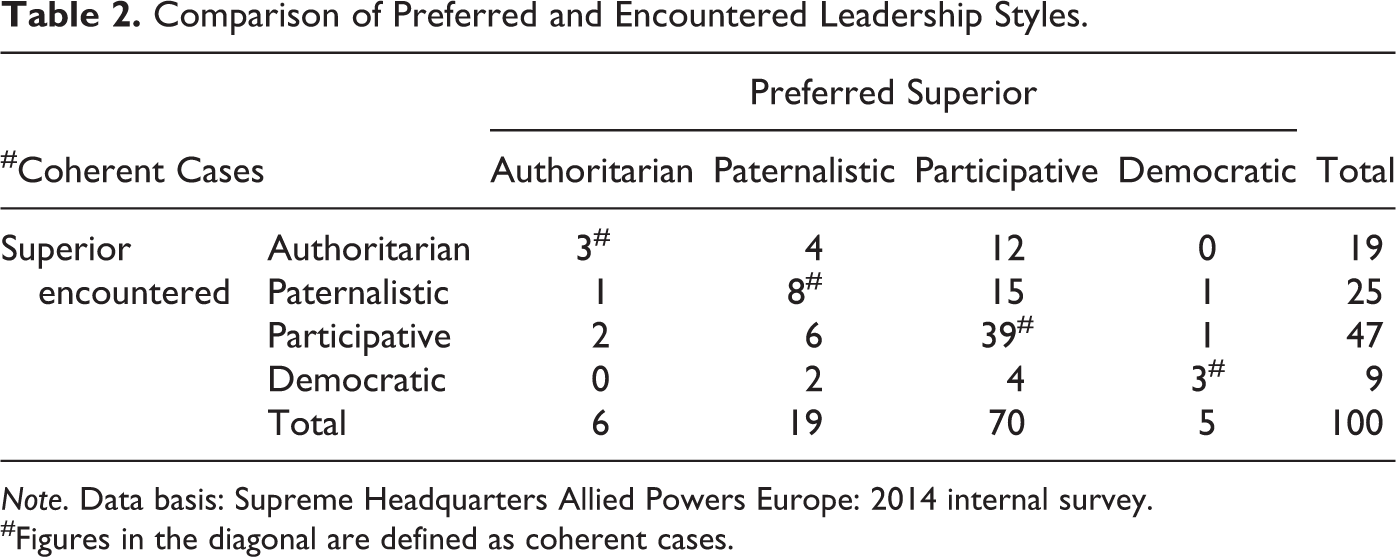
Table 2 indicates that with 70%, the participative leadership style receives the highest approval at SHAPE; this is a higher degree of approval than that found for the two multinational HQs in the previous studies, that is, MNHQ/SE and HQ 1 (GE/NL). Hypothesis 1 is thus confirmed. In addition, bivariate analyses (χ 2 tests) showed that the leadership style that the personnel preferred depended neither on gender, age, status, and, as far as military personnel were concerned, membership of a specific service nor on whether or not the interviewees themselves had command responsibility. The 40% of the HQ personnel who by their own account define themselves as leaders (Table 1) on average prefer the same leadership style as those who are led by them.
Comparison of Preferred and Encountered Leadership Styles.
Note. Data basis: Supreme Headquarters Allied Powers Europe: 2014 internal survey.
#Figures in the diagonal are defined as coherent cases.
For a bare majority of 53% of the HQ personnel, the leadership style they see practiced by their direct superior matches the leadership style they themselves prefer (Table 2). If incoherence is seen at the individual level (47%), a clear tendency toward more participation can be noted: A share of the altogether 27% of the interviewees who consider that they are led in a paternalistic (15%) or authoritarian manner (12%) would prefer their direct superiors to practice the participative style. Hypothesis 2 is thus also confirmed.
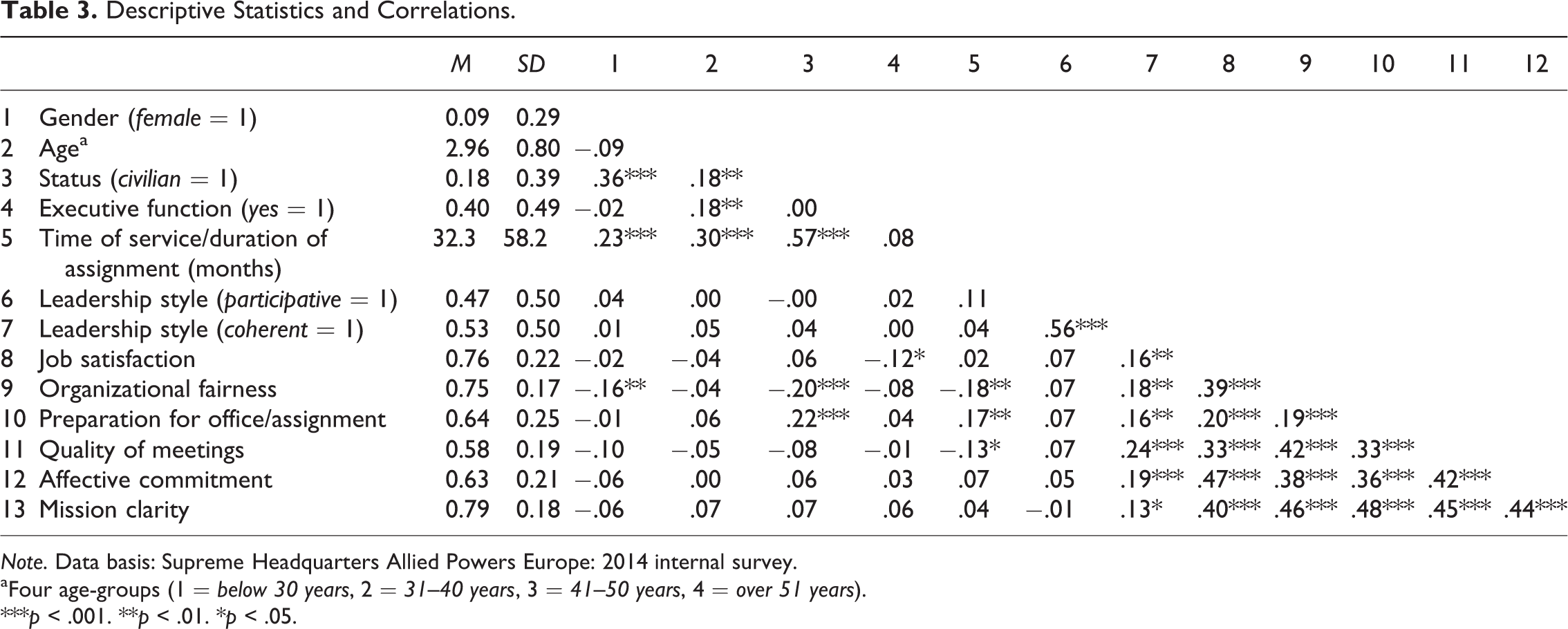
Bivariate correlations of all independent and the two dependent variables regarded for the explanatory analysis can be extracted from Table 3. Already on the bivariate level, the data indicate no significant correlation between participative leadership on the one hand and AC and MC on the other. Therefore, Hypotheses 3 and 4 are not confirmed. However, the correlations between a coherency in leadership style and AC (.19***), respectively, MC (.13*) give good cause for the assumption of Hypotheses 5 and 6.
Descriptive Statistics and Correlations.
Note. Data basis: Supreme Headquarters Allied Powers Europe: 2014 internal survey.
aFour age-groups (1 = below 30 years, 2 = 31–40 years, 3 = 41–50 years, 4 = over 51 years).
***p < .001. **p < .01. *p < .05.
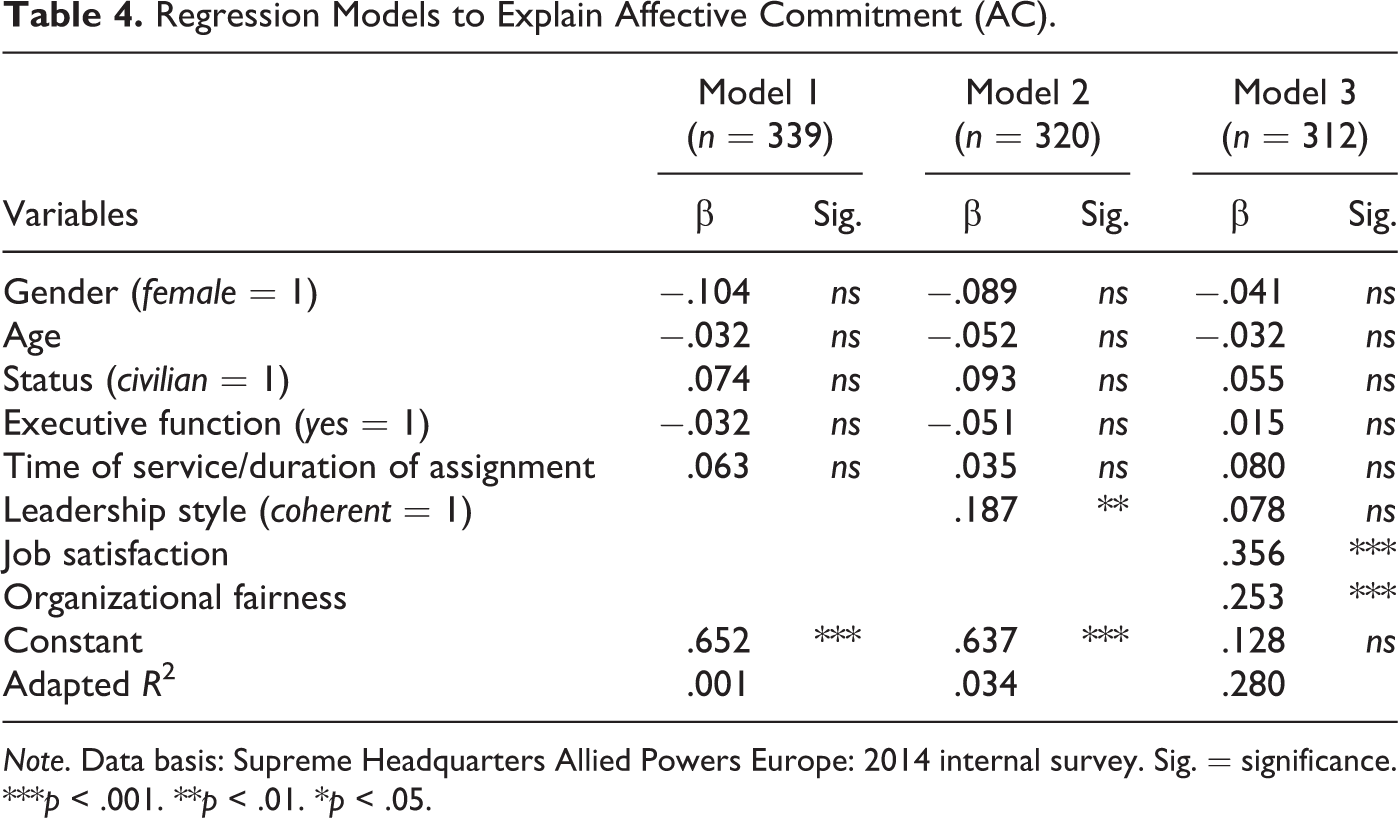
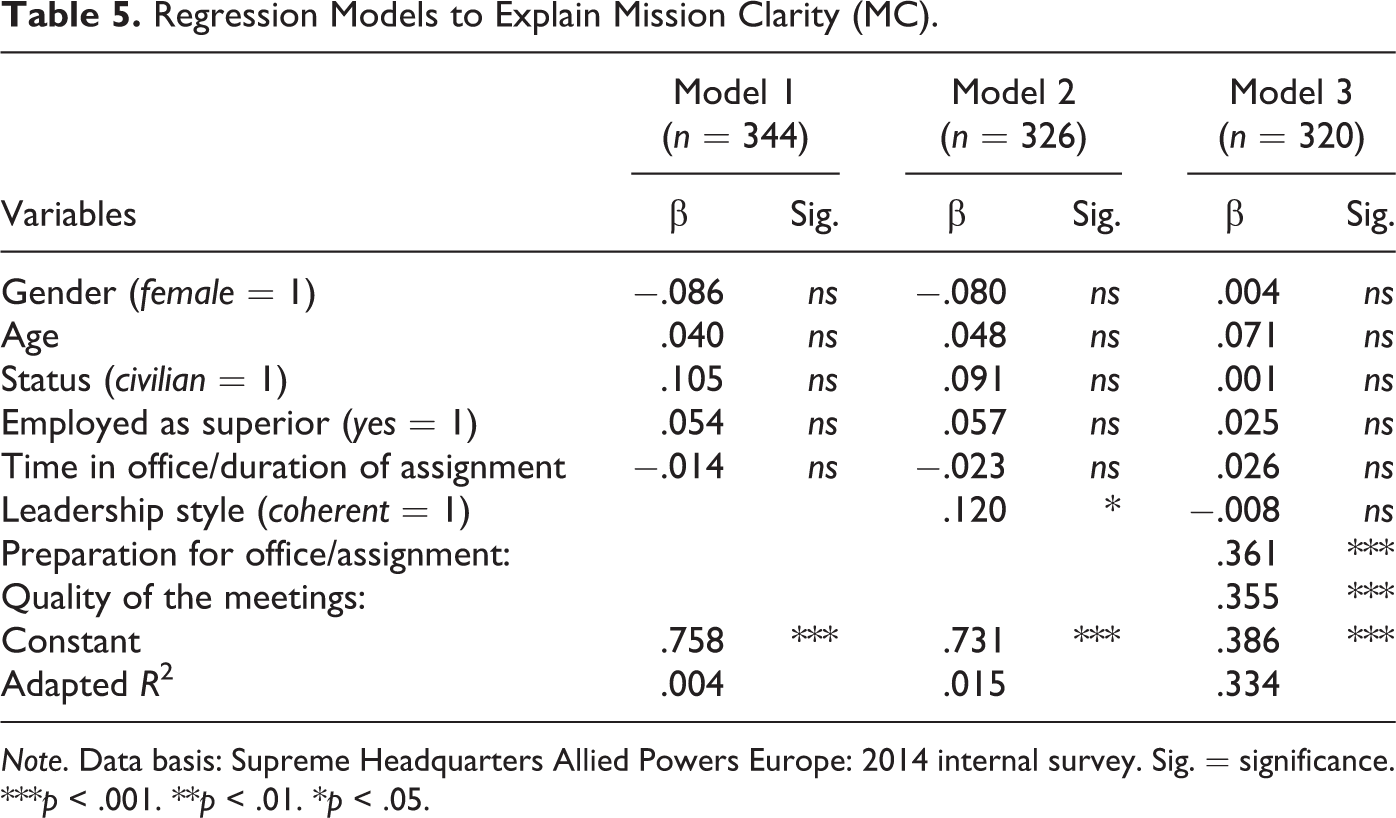
Multivariate linear regression models are calculated to verify Hypotheses 5 and 6 (Tables 4 and 5). A basic model (Type 1 models) involves only demographic variables. As can be seen already in Table 3, both AC and MC are irrespective of gender, age, whether the person is military or civilian, whether or not the person is in executive function, and irrespective of time in office or duration of assignment to date. The effects of coherence in leadership style are tested in extended models (Type 2 and 3 models).
Regression Models to Explain Affective Commitment (AC).
Note. Data basis: Supreme Headquarters Allied Powers Europe: 2014 internal survey. Sig. = significance.
***p < .001. **p < .01. *p < .05.
Regression Models to Explain Mission Clarity (MC).
Note. Data basis: Supreme Headquarters Allied Powers Europe: 2014 internal survey. Sig. = significance.
***p < .001. **p < .01. *p < .05.
The effect of the consideration of coherence in leadership style on AC and MC is low, so Type 2 models are not suitable to explain AC and MC. The quality of the models increases significantly if the variables “job satisfaction” and “organizational fairness” are included in the case of AC and “preparation for an office/assignment” and “quality of the meetings” in the case of MC (Type 3 models). Factors that are more important for AC than the leadership style are those like general job satisfaction and the perception of SHAPE as a fair organization.
MC strongly depends on the degree to which the sending member states offer their personnel not only adequate preparation 7 and courses prior to the assumption of their NATO offices or assignments but also how well information events and workplace briefings are conducted for “new arrivals” at SHAPE. The quality of the meetings also has a strong impact on the everyday appreciation of the work there. From the organization point of view, meetings and leadership processes are to a certain degree functional equivalents of the coordination of activities, as both help problems to be defined and solved, responsibilities to be distributed, and ultimately decisions to be made in everyday work. The survey results indicate that the former are obviously more important in this organization than the latter in this respect.
Summary and Discussion
The SHAPE study replicated some results of earlier studies on military multinational organizations: The majority of the led prefer the participative leadership style, and in the case of some of the interviewees—almost half of them at SHAPE—the leadership style they prefer and the reality they encounter do not coincide. Contrary to the assumptions made, a nonparticipative leadership style or incoherence in leadership style does not have a negative impact on AC and MC.
The examined military HQs of NATO is not a typical form of organization. It is an institution at the top of the currently largest military alliance in the world. It is a place where primarily senior officers from the 28 member nations work in a multinational and multicultural context. In accordance with the state of research on other forms of organization, the principle that superiors do not involve the civilian and military personnel entrusted to them in decision-making processes to such a degree as they should in the subordinates’ point of view also holds true for SHAPE. Nevertheless, the study indicates that—at least for this special type of organization—the leadership style and maybe leadership in general are obviously not of such great importance as one would assume for military organizations. In an organizational culture that is based on coordination and consensus between 28 nations, like that of SHAPE, the microrelation between the leaders and led certainly does not entirely take a back seat but is only of minor significance in the everyday decision-making processes in and between the divisions and branches. In contrast, meetings are of great importance in comparison. Leadership in postmodern organizations in general and in the postmodern military, one could argue, is dispersed when complexity reigns, which seems to be the case to some extent at SHAPE today and might have been the case since its establishment in 1951.
The result that leadership styles do not contribute to establishing commitment to the organization and a clear notion of the organizations overall mission must be qualified in at least two respects—and these are the limits to which the results of the SHAPE study can be generalized. First, modern leadership involves more than just answering the doubtlessly important question of participation in decision-making. The principle applying to leadership processes especially in a multinational military environment is that …the broad array of skills required for effective leadership in multinational military contexts is more complex and demanding than the leadership competencies required in national culturally homogeneous military forces and will present unique challenges in the contemporary global context. (Febbraro, 2008, p. 55)
A comparison of the three cases considered (MNHQ/SE, HQ 1 [GE/NL], and SHAPE) suggests that the participative style is preferred at HQs that are more political and strategic in character (as at SHAPE), while there are relatively more advocates of the paternalist and authoritarian leadership styles at HQs like that of the ALTHEA mission, that is to say, those in theaters and those required to deal directly with operational-level military tasks. Putting this into a military sociology context, it can be said that cold organizations that conduct bureaucratic routine duty activities can afford a higher degree of participation in decision-making, while hot organizations that deal closely with operational activities, even combat activities maybe, prefer a more classic scheme of order and obedience. This statement should be regarded as a provisional finding, however, and needs to be validated in studies at other HQs because of its far-reaching implications. Another aspect regarding the HQs compared in this study is that they have different rank structures (primarily senior officers serve at SHAPE, while more NCOs and rank-and-file personnel served at MNHQ/SE). Since the preference of leadership style depends on rank, this could have caused the effect. This suggests that there is a need for further research. In order to be able to answer these kinds of questions, it is necessary to repeatedly point out that the military can benefit from business management and organizational research (Kern & Richter, 2014; Waard & Soeters, 2007).
Footnotes
Declaration of Conflicting Interests
The author declared no potential conflicts of interest with respect to the research, authorship, and/or publication of this article.
Funding
The author received no financial support for the research, authorship, and/or publication of this article.