




Abstract
After the end of the Cold War, many European countries cut back so heavily on defense expenditure that they lost their capacity to defend themselves. This resulted in greater need for improved cooperation and interoperability among member states’ armed forces. One important attempt to improve the understanding and interoperability among the European Union (EU) nation’s armed forces was taken in 2008 by the creation of the European Initiative for exchange of young officers aimed to make the officer education in Europe more transparent and convergent with each other. This article presents a proposal for a generic pedagogic model for an academically professional officer education that can improve understanding and interoperability among the EU nation’s armed forces. The model helps to facilitate a process of professionalization of the military profession with an officer education that can meet the requirements of higher education systems as well as the demands of the military profession.
Keywords
The end of the cold war created a new security situation in Europe where European countries saw no immediate threats to their own borders, which created a drive for them to cut back heavily on defense expenditure and man power. These cutbacks led to most individual European Union (EU) member states’ armed forces becoming so small that they lost their capacity to defend themselves in the event of war. At the same time, most EU member states also abolished their conscription systems and went over to professional armed forces, with the intention that officers should return to the civilian labor market after a career in the armed forces. These two fundamental changes in the armed forces were well understood among EU member states, and the way chosen to overcome them has been a process of increased cooperation and improved interoperability among member states’ armed forces under the name of Europeanization. Europeanization is based on the European Common Security and Defence Policy (Libel, 2016) and refers to the integration and institutionalization of rules and practice at the EU level and their influence on national policy-making processes. The consequences of Europeanization for armed forces were not only a greater need for better interoperability among EU member states’ armed forces (Merlingen, 2013) but also for much better understanding and increased interoperability of military officer education systems. This striving for convergence and understanding should also include the United States because many international operations come under the umbrella of North Atlantic Treaty Organization (NATO) and the United States. This situation has resulted in major reforms of officer education systems in the EU (Libel, 2016: Paile, 2010), with the aim of becoming more convergent with other nations’ officer educations system as well as educating officers for a return to a civilian career.
A Reformed Basic Officer Education System in Europe
The need for increased understanding and interoperability between the EU member states’ officer education systems resulted in the 2008 “European Initiative for exchange of young officers,” which was launched under the French EU presidency, and the Initiative was given to the secretariat of the European Security and Defence College (ESDC; Paile, 2010). The way for EU nations to find increased cooperation and understanding of other nations’ officer education systems was to voluntarily join the Initiative for exchange of young officers. This meant that they had to implement and adapt to some of the cornerstones of the Erasmus programme and Bologna process such as (1) easily understandable and comparable degree systems; (2) implementation of the European Credit Transfer and Accumulation System (ECTS), which is the standard for comparing the achievement and performance of students in higher education across the EU and other collaborating European countries; (3) promoting mobility among students, teachers, and researchers; (4) promoting quality assurance, and (5) promoting a European dimension in higher education (Paile, 2010). Adaptation to the higher education system, and the Erasmus and Bologna processes, became the innovative solution to not only the objective of making individual EU nation’s officer education more convergent with other each other but also to creating officer education with academic status that gave officers more civilian flexible career possibilities and the opportunity to participate in the European Lifelong Learning Programme (Paile, 2010).
The adaption to Erasmus and Bologna processes is a milestone in the development of officer education because it opened the pathway for officer education to become part of civilian higher academic education systems worldwide, which opens up great opportunities for officers’ future civilian careers. The price for becoming part of the worldwide higher education system was to adapt to its regulations and policies regarding the content and quality of higher education. This meant that officer education had to be transformed from traditional nonacademic vocational training, based on practice-based knowledge and proven experience, to professional vocational education based on academic knowledge, research, and critical thinking. Military education refers to an academic tradition of research-based knowledge, critical analysis, abstract reasoning, and comfort with ambiguity and uncertainty, while military training refers to well-defined static knowledge and skills to conduct specific tasks. One way of putting it is that training is for dealing with certainty, whereas education is for dealing with uncertainty (Johnson-Freese, 2012; Mukherjee, 2017). This solution was an accessible way of dealing with what Van Creveld (1990) described as the tension in traditional military education, such as the tensions between theory and practice, training and education, military and nonmilitary issues, and a way to make these tensions obsolete because an officer needs both education and training. The adaption to higher education systems made it possible for officer education systems to find a new balance between military training and academic education. This balance could produce officers with both sound military and civilian knowledge, skills, and the right competence for the complex contemporary security and operational environment (Evans, 2007), as well as facilitating the transfer of officers from a military career to a civilian career.
The aim of the article
The aim of this article is to present a proposal for a generic pedagogic model for creating academically based, professional vocational officer education. The model proposed has a functional balance between theory and practice, and education and training, which has the potential to meet both the requirements of the military profession, and the standards of higher education, with their requirements for academic quality. The pedagogic model is generic in that it can be used in all officer education programs at military academies and universities. Basic entry officer programs and programs at a higher level, such as command and staff courses, follow the same path of academic progress as regular universities with bachelor and master degrees. The balance of education and training will be affected, that is, there is more education at higher levels and more training at the entry level. The pedagogic model might also help to develop a model for curriculum work, which enhance possibilities to compare curricula, and promote opportunities for mobility among students, teachers, and researchers at officer education institutions.
Before presenting the generic model, there will be a brief overview of officer education in Europe based on the report from the European Initiative for exchange of young officers in 2010.
European Military Higher Education
In 2009, to evaluate the progress of the European Initiative for exchange of young officers, the ESDC conducted a study of the 27 member states’ officer training systems and presented the results in 2010 in “The European Military Higher Education Stocktaking Report” (Paile, 2010). They found that one main characteristic of officer education systems is that they usually contain both purely academic aspects and more professional vocational aspects based on practice-based knowledge and proven experience, but there are no common international standards for curricula, skills, or competences that officers should achieve from their officer education. In some nations, one aspect of the curriculum could be approached in a purely academic way, while in another nation, the same aspect was approached in a vocational and practical way. There is no common European idea about how officer education should be organized, or what practical skills or theoretical competencies the cadet should have accomplished when graduating as an officer. The report’s findings revealed that each nation’s officer education is based on national and regional traditions, rather than a common internationally recognized body of proven experiences and academic knowledge based on research, which distinguishes it from genuine professions, such as medicine and law, which have a sound academic base to their professional education.
Structural models for officer education
When designing an officer education that is accepted by both the military establishment, with its requirement for practical training, and academic institutions, with their quality regulations, one key issue is to create a functional structure for the officer education system. EU member states have chosen different models to meet this challenge and in his report, Paile (2010) found five types of model for officer education.
The first model is the organic separation model where there is a clear separation between vocational elements and academic elements. This is the case, for example, in Germany, where cadets complete their military education at a military school before they enter the University of the Bundeswehr or vice versa. Similarly, in the United Kingdom, Royal Navy cadets must have graduated from a civilian university before they can enter the Royal Naval College. The second was the alternation of vocational and academic aspects of education, as in Belgium and the Netherlands, for example, where they have periods of either vocational or academic education at the military school, but not both at the same time. A third model is a mixed system, with a mix of organic separation and alternation. Examples are the Swedish and Czech systems where cadets have academic education at the Defence University and periods of vocational education at armed forces branch schools. A fourth model, used in Finland and Estonia, is the parallel conduct of vocational and academic education, where both academic and vocational courses take place at the same time at the same place. The fifth and final model in the report was a mixed system of parallel and organically separated education, only found in the UK’s Army and Air Force, where there is both vocational education at military schools and academic education at civilian universities at the same time. The existence of these five structural models creates obstacles for student mobility and the full implementation of the exchange idea in the Erasmus program because there is no common internal organization of the various elements in the different nations’ officer education systems.
Practice-Based and Research-Based Knowledge
The generic pedagogic model presented in this article is inspired by a concept for the integration of research-based and practice-based knowledge (Ellström & Nilsen (2014).
Practice-based knowledge
Practice-based knowledge is related to and represents experience-proven knowledge and skills characterized by finding solutions to specific problems and hands-on use in a concrete, context-specific everyday situation, usually tacit knowledge expressed in action, difficult to share, unique, personal, and difficult to access. Practice-based knowledge is focused on learning know-how (Ryle, 1949/2009) in a specific context or for a specific position and has its roots in the workplace and the traditional master–apprentice system, which has also been the common traditional pedagogic method for military officer education not too long ago. The merits of practice-based knowledge are that it is useful for improving existing routines and work in the short term, it is very concrete in form, and it is quite easy to evaluate its effects. The weaknesses, on the other hand, are that it is very context-specific, it is conservative in nature and can obstruct improvement and creative thinking, and it is best suited for supporting what Argyris (1982, 1999) and Argyris and Schön (1978) call single-loop learning, because it is characterized by improving existing routines, work, and capabilities, rather than reframing a situation, developing new capabilities, or solving ambiguous problems.
Research-based knowledge
Research-based knowledge is related to theory, research, and academic knowledge and is characterized by improving understanding of problems; relevance and applicability to a wider sphere than the specific situation; explicit codified knowledge primarily expressed in text; ease of sharing; public availability in books, journals, and reports; and it must often pass rigorous quality control through a peer review system. Research-based knowledge has its roots in academia and universities and is a result of scientific research methods and critical reflection. The merits of research-based knowledge are that it is not context- or position-specific; it is focused on principles rather than specific applications; it has a tradition of questioning old truths, an open attitude to new knowledge and solutions, and supports what Argyris (1982, 1999) and Argyris and Schön (1978) call double-loop learning, which refers to reframing a situation, developing new capabilities, or solving ambiguous problems. The weaknesses of research-based knowledge are that it is not very concrete and does not prepare people for specific contexts or situations, which can be very frustrating not only for students but also for employers. It is difficult to evaluate its effects in the short term.
The distinction between practice-based and research-based knowledge should simply be perceived as an analytic tool at either end of a continuum of knowledge types, and the challenge in officer education is to find a fruitful and functional balance between them. The concepts of practice-based and research-based knowledge are related to adaptive learning and creative learning.
Adaptive and Creative Learning
Adaptive learning is about learning well-known, routinized, rule-based, or habitual practice-based knowledge for handling recurrent daily problems and demands (Ellström, 2001, 2005). It is a process of learning, and socialization of institutional rules, in a specific context, what to do and how to do it (Abell, 1995; Scott, 1995), which can be manifested in written or verbal instructions, manuals, guidelines, and in tacit knowledge (Polanyi, 1967; Ryle, 1949/2009). Adaptive learning is efficient when learning what is already known and when the aim is simply to make people do things a certain way, with high levels of quality in performance, homogeneity, certainty, and stability. The weaknesses of adaptive learning are that it is conservative and it follows traditions, which can hamper the need to learn or understand new problems, situations, and challenges. Adaptive learning is closely related to single-loop learning (Argyris, 1982, 1999; Argyris & Schön, 1978) and can work well when making minor changes and reforms in a specific context, but it is lacking when trying to find new solutions and develop practice-based knowledge; then there is a need for creative learning.
In contrast to adaptive learning, creative learning is associated with more radical changes, the revision or development of routines, rules, organizations, goals, products, that is, what Argyris (1982, 1999) and Argyris and Schön (1978) call double-loop learning. Creative learning promotes exploration, variation and diversity, taking risks, trying to “think outside the box,” and breaking institutional rules. The basis of creative learning is reflection, which is the process of transforming facts, actions, and everyday experience into learning and understanding (Schön, 1991). According to Dewey (1933/2008), the mechanism of reflection is a process of exposé and scrutinizes our beliefs, behavior, actions, and responses to everyday problems and situations. Reflection is a process of inner dialogue that integrates old and newly discovered knowledge into new knowledge, which can open individuals up to new experiences, ideas, mental models, mind-sets, and new behavior and actions (Boud, Keogh, & Walker, 1985). Mezirow (1991) describes it as a process that leads to new interpretations and understanding involving a change or transformation of an individual’s meaning schemes and perspective. There are different types and levels of reflection and Moon (1999) put forward five stages of reflection, where the first three are related to single-loop, adaptive learning and the last two are related to double-loop, creative learning. The first level, “noticing,” refers to the acquisition of sensory data. The second level, “making sense,” refers to seeking coherency in the material that is perceived. The third level “making meaning” is when new knowledge is related and added to old knowledge. The fourth level “working with meaning” is thinking things over deeply until they generate meaning, which is the basis for deeper learning (Biggs & Tang, 2011; Ramsden, 2003), and the fifth level, “transformative learning” (Mezirow, 1991), is a radical change in understanding, a new way of understanding.
Practice-Based and Research-Based Knowledge in a Professional Officer Education
In an officer education context, practice-based knowledge and adaptive learning have always been the norm and the traditional way of learning. However, the transformation of the officer education system to meet university standards has challenged this traditional norm because the promotion of research-based knowledge and creative learning forms the core of academic logic. Traditional officer education has focused on learning to solve current problems, situations, and tasks; while academic education focuses more on learning for the future and for problems, situations, and tasks, we know little or nothing about yet. One critical but very important part of creating modern and functional professional officer education is the integration of practice-based knowledge (training) with research-based knowledge (education) in a way that enhances both adaptive and creative learning and that creates a deeper understanding of what is learnt than would-be possible with just one of the two knowledge types. This means that the research-based knowledge must be theories and academic knowledge that are relevant for the practice-based knowledge. If this is the case, it will not only improve both the understanding and the skills to use what is learnt, that is, single-loop learning but also enhance reflection and critical thinking that can enhance double-loop learning (Argyris, 1982, 1999). This is the essence of the integration of practice-based and research-based knowledge. Two mistakes when trying to transform traditional vocational education into professional education, with an academic basis, can occur when the balance between practice-based and research-based knowledge is poorly designed. Firstly, there can be too much academic knowledge at the expense of practice-based knowledge, and secondly, there is no genuine integration between the two types of knowledge. This happens when the research-based knowledge is too general and has little or no application in the practice-based knowledge. The main function of research-based knowledge in professional academic education should be to support the understanding, the critical thinking and development of the professional practice-based knowledge, and practical behaviors and actions. It is important to understand the different logics of these two types of knowledge and how they might affect students. Practice-based knowledge with adaptive learning has a logic of production, while research-based knowledge with creative learning has a logic of critical thinking development.
A Generic Pedagogic Model for Professional Officer Education
The application of the concepts of research-based and practice-based knowledge, and the concepts of adaptive and creative learning, into concrete curricula and a model for leadership education resulted in the development of a generic pedagogic model for officer education containing seven variables (see Figure 1).
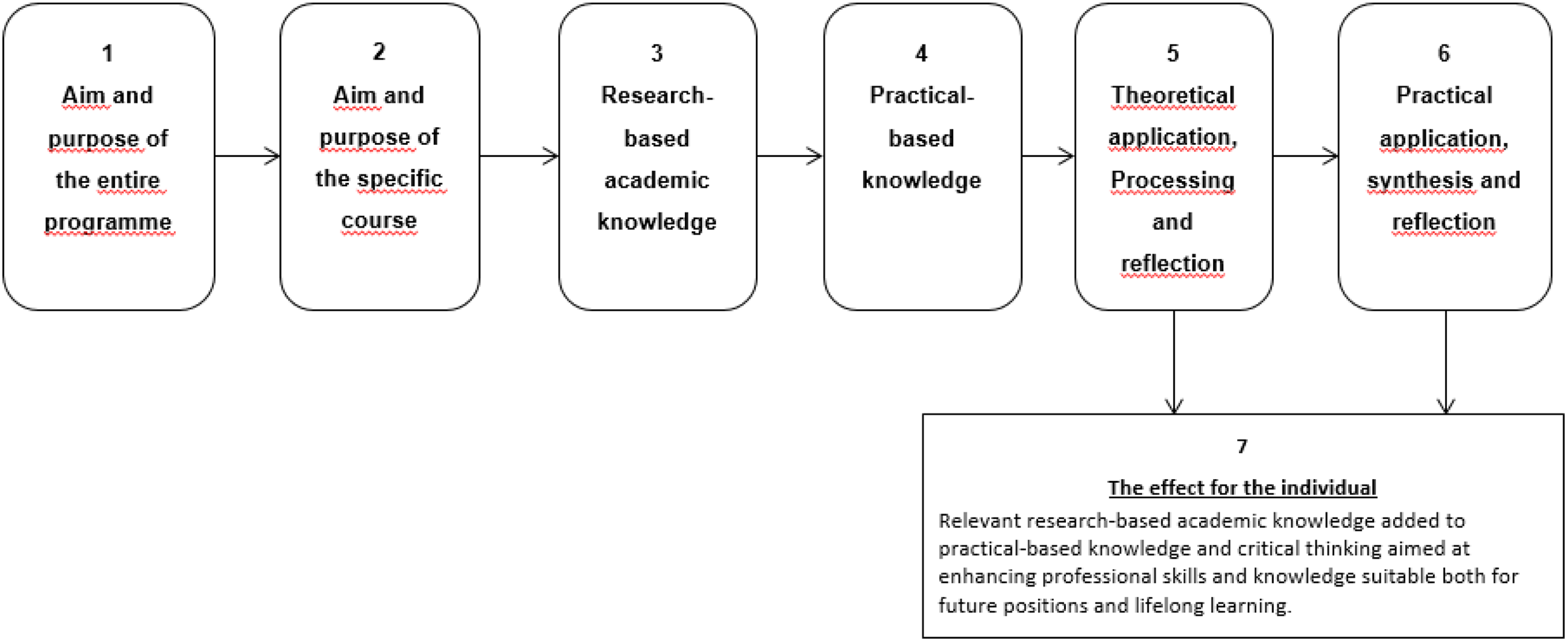
A generic pedagogic model for officer education.
The aim and purpose of the entire officer program
The aim and purpose of any officer program might appear quite unproblematic, but, as seen in Paile’s (2010) overview of officer education in Europe, it is not very clear, and European states lack a common idea about how to design officer education. This means that there could be a problem in creating a coherent, relevant curriculum with distinct, clear aims and purposes for the entire program, which can be assessed and compared in line with the quality requirements in higher education systems. As Paile (2010) points out, there will always be some national context-specific requirements for each nation’s officer education. However, for national programs to become more convergent with each other, and with the Bologna goals of implementation of ECTS and promoting quality assurance, there must also be some ideas on a common concept of curriculum content, and what core competencies all officers should have achieved when they graduate. For example, the aim of the command and staff program at the Swedish Defence University (SEDU) is to educate student officers, so they have the competence to be staff officers or commanders in national and international staffs. This means that all courses in the program should contribute to this aim.
Aim and specific purpose of each specific course
The aim and specific purpose of each specific course must be derived from the aim and purpose of the entire program and must be clear, distinct, and possible to evaluate. In professional officer education, the aims must always have a clear relevance for the development of the officer’s professional knowledge and skills. In some cases, this has been problematic for many European officer education programs since the transformation to more academic education (Paile, 2010). The increased general academic profile of officer education has resulted in it losing part of its professional character. This can lead to officer education becoming more general academic education rather than professional vocational officer education. If it is not possible to identify at least some professional relevance in the aims of a specific course, there might be good reasons to change the course content. Furthermore, when deciding the aims and purpose of each course in the program, it is important to have a clear idea of what is to be achieved during the course, how to achieve it, and how to assess the outcome—or, as described by Biggs and Tang (2011) and Ramsden (2003), a constructive alignment, which includes sound principles for devising objectives, curriculum content, teaching and learning activities, and assessment tasks that directly address the intended learning outcomes. In the leadership program of the command and staff course at the SEDU, one course is on leadership and team learning. The aim of the course is to increase the officer’s leadership skills to facilitate learning and learning activities in a military staff, an aim which is derived directly from the aim of the entire program.
Research-based academic knowledge
To become an accredited institution in the higher education system, it is necessary to develop curricula and courses based on solid research-based academic knowledge. The research and academic knowledge can come from the fields of psychology, social psychology, sociology, organizational theory, military sociology, and pedagogy. In these academic fields, there is a lot of research and knowledge that is highly relevant in developing an officer’s professional knowledge and skills. Furthermore, many studies in psychology, social psychology, sociology, organizational theory, and pedagogy have actually been carried out in a military context, and in military sociology, all studies are related to the military, which ensures the professional relevance of the research-based knowledge.
The teachers of the research-based knowledge can be civilian university lecturers and professors or officers with a doctor of philosophy (PhD). At least some of them should do research in the field they teach because this promotes a constructive loop of research, development, and education. The intention here is to build up a substantial body of civilian academics and officers with PhD degrees to create a productive mix of civilian and military academics and, not least, build up a sound body of research important for the development of the officer profession. The literature should generally be academic books and peer-reviewed articles from academic journals. This not only ensures a high standard of academic literature but also that students are made aware of and updated on current research. This is important because it familiarizes officers with the academic world and journals that publish research on topics most relevant for the officer profession. They might also be inspired to do some research themselves. Without this knowledge of the literature, officers find it very difficult to grasp what research-based knowledge actually is, how it is produced, and how professional knowledge can enhance their own and other officers’ professional knowledge. In the leadership and team learning course, the teachers have PhD-level education, and the literature consists of peer-reviewed articles and books related to team learning and leadership in general and military contexts.
Practice-based knowledge
Practice-based knowledge is essential to demonstrate how theories and academic knowledge can be applied in real-life situations related to the officer profession. It is in the meeting between research-based and practice-based knowledge that professional knowledge can grow, be understood, and developed. The mix of research-based and practice-based knowledge is the key to relating research-based knowledge to professional knowledge, and it can also compensate for the students’ lack of personal professional experience. If there are no practical illustrations and applications of the research-based academic knowledge, it can be too abstract for students to fully understand. This could make it impossible for them to get into what Vygotsky (1986) calls the proximal zone, which is the knowledge zone where it is possible for students to learn with the help of someone else who knows more than they do. If the content and topic being taught is too alien, complex, or abstract, in relation to the students’ experience, it falls outside their proximal zone and learning ability. It is then difficult to achieve holistic and deep learning; at best there could just be atomistic and surface learning, if any learning at all.
Generally, the teachers on these courses (as is the case for the leadership and team learning course at the command and staff course) should be officers or other professionals with sound practical personal experience of what the theories and research-based knowledge are about. This is also a good way to give students an opportunity to meet experienced professionals.
Theoretical application, processing, and reflection is the assessment of what students have actually learnt about the theories from research-based academic knowledge and practice-based knowledge. The choice of examination or assessment tasks is extremely important because it will have a considerable effect on the students’ perception of the aim of the course and where it is important for them to focus their learning. If examinations focus on too many details in a way that lacks coherence and is untestable for the students, the result will be atomistic and surface learning (Biggs & Tang, 2011; Ramsden, 2003). The students will strive to learn by heart and not really try to gain a deeper understanding of the principles and the essence of the topic, that is, a holistic deep-learning approach The examinations must be a coherent part of the constructive alignment where intended learning outcomes are related to teaching and learning activities, which are examined and assessed with relevant tasks based on the course content. The students must get the possibility to reflect on, analyze, and describe a professional situation that needs to be dealt with in a professional manner.
They should then present how they would work with the task and suggest what can be done to develop or complete the task, relating their findings to what they have learnt about practice-based and research-based professional knowledge. This kind of examination is also partly inspired by a problem-based learning method (Hmelo-Silver, 2004), where students have to cooperate to analyze and identify a problem, find the knowledge that can help to solve the problem, and finally, suggest some solutions based on that knowledge. This need for cooperation among the students in the examination task is an important part of the pedagogic model because it enhances opportunities for the students to learn from each other. In this case, the learning is a fundamentally collective process, which aims to improve the knowledge and skills of both individual students and the group. To make this happen, there is a need for a pedagogic method that makes it possible to tap the potential for many minds to be more intelligent than one (Senge, 2006). According to Senge, this is a genuine dialogue, which, unlike discussion, is when no one strives to win; everyone is a winner. In dialogue, the students explore complex issues from many points of view and gain insights that could not be achieved individually.
The intention of this pedagogic method is to create an effective, productive balance of adaptive learning and creative learning where students have to use what they have learnt, related to a relevant professional context, and where they also use creative learning, critical thinking, and reflection to create new professional knowledge. This ability to apply professional knowledge, gained through adaptive learning, in a professional context and to create new professional knowledge by reflection on one’s own actions and creative learning constitutes what Donald Schön (1991) calls “the reflective practitioner.” This is the essence of both the individual professional competence and shared professional competence needed to build up and develop the collective body of professional knowledge. This ability is what constitutes learning for the future and for the unknown, which is one of the important aims of higher education. In the team learning and leadership course, the theoretical application occurs when each student officer, based on theoretical and practical knowledge, and their own knowledge and experience, has to write a paper about how they, as a commander in a military staff, will promote good learning. They also have to present their answers in a seminar.
Practical application, synthesis, and reflection
Practical application, synthesis, and reflection occurs when students use and apply relevant theoretical knowledge in practical professional situations, which they will do on various kinds of military exercises during officer education programs, from a lower tactical level (squad/platoon) up to the operational level (formation), depending on the officer program. This is the output of the research-based and practice-based knowledge actually acquired by individual students. It is what each student has managed to synthesize and transform into practical professional competencies, skills, actions, and behaviors. Here, it will be obvious if the student has gained deeper, holistic knowledge, which can be transformed into real action and behaviors, rather than just atomistic, surface knowledge (Biggs & Tang, 2011; Ramsden, 2003). What students can actually do in action and practice shows the professional knowledge, skills, and behaviors they have actually learnt. In both theoretical and practical applications, the main aim is to use research-based and practice-based knowledge from the course and apply it in a professional context, where the essential aim is to learn rather than control. The aim is to develop functional professional knowledge, instead of just declarative university knowledge, which requires the student to execute, apply, and prioritize (Leinhardt, McCarthy Young, & Merriman, 1995). The practical application in the leadership and team learning course involves participation, as staff members and commanders, in the annual international Combined Joint Staff Exercises, with about 450 student officers from about 15 countries. Here they have to put into practice what they have presented in theory in their seminar papers. This gives them a very good opportunity to test their ideas and explore what kind of leadership best facilitates good team learning.
The effect for the individual
The effect for individual officers will vary, even if they have done exactly the same courses in the officer program. This is because they are all individuals, different people with different backgrounds, skills, interests, motivation, and so on. A useful pedagogic method to help students scrutinize their own progress and development, during their entire officer education, is to give them a “book of progress.” In this book, they reflect on and write down what they have learnt in respective courses and how this learning has affected them as officers and commanders, their perception of leadership, attitudes, and other issues related to the development of their professional knowledge, competencies, and skills. The main purpose of this “book of progress” is to get them used to reflecting on and being aware of how the education affects them. It also gives them a very concrete example of a simple but very effective method for documenting their reflections, which is important in helping them to train themselves to develop their professional skills and competence and to become good “reflective practitioners” (Schön, 1991). This is the final step in the leadership and team learning course. Here, they have to evaluate, reflect, and draw some conclusions and lessons learned from their own and others’ performance during the staff exercise. Reflection is one of the core competences in higher education and the basis of developing both professional competence and lifelong learning. This is what each individual will actually take with them to develop their own professional development.
Discussion
The aim of this article is to present a proposal for a generic pedagogic model for an academically professional officer education that can meet both the requirements of higher education systems and the demands of the military profession.
However, as shown above, officer education in European countries is heterogeneous and very diverse. Some have a clear separation between vocational elements and academic elements; others have periods of either vocational or academic education at military schools or parallel vocational and academic education. These different structures for officer education are a challenge, but not an impossible challenge, for implementing the model presented. The main obstacle probably arises in the organic separation model, if there is little or no formal institutional structures and processes between the military academy/university and the civilian university for the planning of programs, courses, and curricula. The separation model in the United Kingdom and Denmark is particularly problematic because these student officers have to graduate from a civilian university with a civilian degree. In that model, it will be almost impossible to implement the pedagogic model as long as the academic part is solely under the authority of the civilian university with no formalized and institutionalized structures and processes for planning programs, courses, and curricula with the military academies/universities. In the models where the academic education is under the authority of the military (e.g., Finland) or both the military and civilian authority (e.g., Sweden), the implementation will be much easier.
All these differences in officer education have their roots in each nation’s local and regional history, traditions, and needs, and some of these local and regional traditions and needs will remain. However, the fact that most nations need help from other nation’s armed forces to defend themselves and participate in international operations, often under the umbrella of NATO and the United States, requires some kind of convergence, harmonization, and transparency of officer competence and officer education to achieve interoperability and be effective.
To summarize, the main arguments for and benefits of implementation of the generic pedagogic model are that the generic model that can be used in all officer education from the basic entry officer program up to higher levels, such as command and staff courses. It will be an effective tool in transforming officer education from traditional nonacademic vocational training based on practice-based knowledge and proven experience to professional vocational education based on academic knowledge, research, and critical thinking. The progression in the programs follows the same academic progress as regular universities with bachelor and master’s degrees. The model also affects the balance of education and training, that is, there is more education at higher levels and more training at the entry level. It can enhance the possibility of comparing curriculum and promote opportunities for mobility among students, teachers, researchers, and officers, which will increase understanding and cooperation between different nations’ armed forces and officer education. Nevertheless, the main argument could be that adaption and transformation to become part of higher education system mean that the military profession must start a process of professionalization by building up their own body of professional research-based knowledge. This means that there must be research into military practice, which continuously contributes to developing and improving officer education, and the common body of professional knowledge, in a systematic and constructive loop of research and development, in the same way as traditional professions, for example, medicine and law. If military academies and universities around the world become part of higher education systems, they can build sound officer education based on sound research-based and practice-based knowledge, which will be both highly functional for the profession’s needs and the requirements of higher education. Furthermore, they will become part of the worldwide higher education quality assurance system for research and education; they will join research communities for sharing and discussing research results, methods, and, not least, establishing research networks and possibilities for cooperation and exchanges of teachers and students.
The generic pedagogic model presented in this article should be perceived as a serious proposal for the development of a common model for the planning and execution of officer education in Europe and other countries, which can meet both military professional needs and the requirements of higher education. The generic pedagogic model could also be useful in resolving the classical clashes in professional officer education, such as the tensions between theory and practice, training and education, military and nonmilitary issues. The generic pedagogic model presented should not be seen as the final version, it should rather be perceived as a first version that should be continuously revised and developed. The intention of this article is to invite scholars and professionals to join in constructive and fruitful discussion and dialogue to further develop the pedagogic model presented.
Footnotes
Declaration of Conflicting Interests
The author declared no potential conflicts of interest with respect to the research, authorship, and/or publication of this article.
Funding
The author received no financial support for the research, authorship, and/or publication of this article.