




Abstract
Existing literature connects military service to regional characteristics and family traditions, creating real distinctions between those who serve and those who do not. We engage this discussion by examining military service as a function of personality. In the second portion, we examine military service as predisposed by genetics. Our findings indicate there is a significant heritability component of serving in the military. We find a significant genetic correlation between personality traits associated with progressive political ambition and military service, suggesting that military service represents a different form of political participation to which individuals are genetically predisposed. We discuss the long-term implications of our findings for policy makers and recruiters.
But I fear they do not know us; I fear they do not comprehend the full weight of the burden we carry or the price we pay when we return from battle…a people uninformed about what they are asking the military to endure is a people inevitably unable to fully grasp the scope of the responsibilities our Constitution levies upon them.
If some people are more likely to serve in the military, it can have policy implications. For example, citizens who have sacrificed less tend to be more inclined to the use of military force and less likely to hold elected officials responsible for failing to withdraw from costly military engagements (Feaver & Gelpi, 2011; Jennings & Markus, 1977; Kriner & Shen, 2016). Likewise, prior military service, especially exposure to combat, shapes elected officials’ willingness to use military force to achieve political goals (Horowitz & Stam, 2014; Lupton, 2017).
There is some evidence that military service is not random, and instead is linked to regions, such as the south, and is conditional on family traditions (Bailey, 2009; Johnson & Kaplan, 1991; Kane, 2005; U.S. Department of Defense & Readiness, 2017; Watkins & Sherk, 2008). Some people join the military because they have a strong sense of loyalty to the country and a desire for public service (Moskos, 1977), others join for financial reasons or because they want to have new experiences (Griffith & Perry, 1993). Recently, scholars have noted the relationship between military service and personality traits. People who score higher in some personality traits were more likely to choose military over other forms of public service in Germany (Jackson, Thoemmes, Jonkmann, Lüdtke, & Trautwein, 2012). Not only are personality traits remarkably stable throughout the life course, they are also genetically heritable (Jang, Livesley, & Vemon, 1996; Specht, Egloff, & Schmukle, 2011; Vukasović & Bratko, 2015). Advances in political psychology demonstrate that certain personality traits strongly influence the types of political activities in which one participates (Mondak, 2010).
Those high in extraversion are more interested in the breadth of activities than the depth. In groups, they tend to assert themselves, dominate conversation, and enjoy interacting with others. Extraverts have numerous friendships, enterprising vocational interests, and activities and have high interest in politics (McCrae & Costa, 2008). They also have a strong sense of political efficacy (Mondak & Halperin, 2008) and are more likely to be interested in running for elected office (Dynes, Hassell, & Miles, 2018). Emotionally stable individuals are less likely to view ordinary situations as threatening and are less likely to have long-term negative reactions to everyday experiences. They often have a greater interest in politics, but they also tend not to have a large social network and are less comfortable trying to persuade people to support a particular candidate (Gerber et al., 2011). Emotionally stable individuals are less likely to be interested in running for elected office (Dynes et al., 2018).
Perhaps then, the reason that the United States has such a rich history of people serving in the military choosing to seek higher office is that both are motivated by a similar set of genetically heritable personality traits. If so, the recent dearth of elected officials who have served in the military is caused, not by a change in the genetic makeup of the U.S. citizenry but by changing societal arrangements that make military service and/or political service seem less attractive today than they were in the past. The military actively seeks candidates who are emotionally stable and conscientious, but people who score above average in these traits are not politically ambitious. If changes in the political environment cause people who score high in traits the military identifies as desirable to opt out of seeking elective office, people with a military background will be less represented in elected bodies.
We take the first step in beginning this investigation by assessing differences between citizens who serve in the military compared to those who do not. First, we examine military service as predicted by stable personality characteristics in a national survey. Second, we use a twin study to assess the direction of the causal arrow. To establish that personality traits are a motivating force behind the decision to serve in the military, we examine the extent to which the same genes that predispose individuals to developing certain personality traits also predispose them to choosing military service.
Why People Join the Military
Social scientists have long noted that some people are more community orientated and more predisposed to public service, perhaps most notable in elements of regional political culture observed in the United States (Jackman & Miller, 1996; Sharkansky, 1969). However, a willingness to commit years of one’s life to military service is quite different from one’s willingness to attend a city council meeting, volunteer at a food pantry, or vote in most elections. And even as observers lament a general decline in civic participation and social capital (Putnam, 2001), with moderate optimism for the future (Sander & Putnam, 2010), the tradition of military service appears strong in some areas of the country and in some families.
We seek to understand the inclination, if any, toward military service. Are there demographic, attitudinal, personality, or biological components that predispose some toward military service? Existing research provides some guidance. For example, some use a market analogy to describe the forces that motivate people to join the military. Government demand for soldiers is one side of the equation, but the other side is the willingness of people to join. Moskos (1977) noted that when the U.S. military moved to an all-volunteer force in 1973, it also shifted from an institutional organization (one validated by norms) to an occupational (one legitimated by the marketplace). In practice, this resulted in dramatic increases in pay, benefits, and tax advantages for people who opted into military service (Moskos, 1977). This made military service a more attractive option for talented individuals.
Meanwhile, Griffith and Perry (1993) identify four factors that motivate people to enlist in the military: a desire to experience the military, personal development, pay and benefits, and career development. Of these, the desire to experience the military had the strongest predictive power, whereas desire for career development was only a strong motivator for racial minorities (Griffith & Perry, 1993). Despite occupational incentives, some enlistees continue to be motivated to join the military because they are committed to serving their country (Griffith, 2008), and they remain in military service because they develop a group identity with their fellow service members (Griffith, 2009). Thus, market forces may dissuade some from enlisting, but those with strong institutional motivations will still be enticed to serve in the military.
Adjusting for meeting service qualifications, evidence suggests that young men in the United States are more likely to join the military if they come from a lower socioeconomic status household, are African American, have lower high-school grades, come from nontraditional households, or come from rural areas (Elder, Wang, Spence, Adkins, & Brown, 2010). 1 In addition, men are more likely to join the military if they have friends in the military, are not socially well-connected, or have a history of aggression (see Bachman, Segal, Freedman-Doan, & O’malley, 2000; Bachman, Sigelman, & Diamond, 1987; Eighmey, 2006; Johnson & Kaplan, 1991; Kilburn & Klerman, 1990; Kleykamp, 2006; Segal & Segal, 2004), with some exceptions women are similar (Lundquist, 2008). Contextual effects have little influence on the likelihood of military service (Elder et al., 2010), but Kleykamp (2006) did find that proximity to a military base increases the likelihood of military service. In addition, the demographic characteristics associated with military service have tended to vary over time (MacLean & Elder, 2007), especially in the context of war versus peace (Kleykamp, 2006).
Personality and Military Service
Some research suggests that personality traits are associated with civic duty and military service. A stronger sense of civic duty is correlated with particular personality traits, and those traits are also associated with particular genetic factors (Weinschenk & Dawes, 2017). In their longitudinal study of German youth, Jackson, Thoemmes, Jonkmann, Lüdtke, and Trautwein (2012) found that individuals who score lower in agreeableness, neuroticism, and openness to experience are more likely to opt for military service after high school. They also find that military training did not change participants’ personality scores. And we do know that personality traits show remarkable stability over the course of one’s adult life (Specht et al., 2011) and are genetically heritable (Jang et al., 1996; Vukasović & Bratko, 2015). For these reasons, we explore the possibility that some personality traits might predispose individuals toward military service.
Students of personality often use the lexical approach to identify five facets of individual personality. These five factors are neither an exhaustive nor exclusive list of aspects of human personality. Rather, the Big Five are broad domains into which various subsidiary personality traits can be organized. After briefly explaining each trait below and its relationship to political behaviors, we develop a framework for understanding why personality influences the decision to join the armed forces.
Those high in extraversion are more interested in the breadth of activities than depth. In groups, they tend to assert themselves and dominate conversation. Extraverts enjoy interacting with others and are energetic. Extraverts have numerous friendships, enterprising vocational interests, numerous club and athletic activities, and have high interest in politics (Mondak, 2010; Weinschenk & Dawes, 2017). Extraverts are likely to be attracted to military service because it presents an opportunity to experience elements of life that one could not experience in any other way.
People who are high in openness to experience tend to be intellectually curious; more sensitive to beauty; and enjoy art, emotion, adventure, and unusual ideas. Open individuals crave variety and change (Mondak, 2010; Weinschenk & Dawes, 2017), and while military service might allow people to see the world, there is no guarantee that one gets to travel when or where they want to, which leaves unclear expectations for openness. Agreeableness captures concern for social harmony. Those high in this trait tend to work well in teams, trust other people, show kindness to others, and a willingness to compromise. Those high in agreeableness are less likely to seek elected office because seeking and holding office is conflictual (Dynes et al., 2018). Military service also increases the probability of encountering conflict, which might motivate agreeable individuals to avoid it.
Conscientious people are social, aim for achievement, and strive to fulfill their duties; they enjoy planning for the future and prefer to think carefully about their decision-making (DeYoung, Quilty, & Peterson, 2007; Ozer & Benet-Martinez, 2006). Our expectations for conscientiousness are mixed because although conscientious people have a strong sense of purpose and high levels of aspiration, they are less likely to participate in politics (Mondak, 2010).
Finally, emotional stability is more often characterized by its opposite (neuroticism). Those with high levels of emotional stability are less likely to experience negative emotions such as anger, anxiety, or depression (Mondak, 2010), a pattern that suggests that emotionally stable individuals would have greater interest in military service.
The preceding discussion leads us to outline the following expectations for the relationship between personality and service in the armed forces.
Genetics, Predispositions, and Agency
What do geneticists mean when they say that a trait is genetically heritable, does this imply a lack of agency? We will use the genetic heritability of height to illustrate. Human height has a strong genetic component. Between 89% and 93% of the variation in height is explained by genetic factors, with the remainder explained by an individual’s unique environment (Silventoinen et al., 2003). The fact that unique environment accounts for a relatively small proportion of the average variation in height by human populations does not mean that individual decisions have no influence on how tall one becomes. For example, malnourished individuals tend not to achieve their optimal height (Walker et al., 2007). Rather, this means that each individual’s genetic makeup predisposes them to a certain range of height, but the actual height any given individual attains depends on lifestyle choices and the environment in which they live.
Thus, studies of genetic heritability are less about coming to deterministic conclusions about individual behavior than they are about parsing the role of family socialization from the role of biological factors. In many households, military service runs in the family. One veteran reported that seven generations of his family served in the U.S. military (2014). It is possible that this family socializes military service through family discussions, home decor, and family traditions. It is also possible that members of this family who have served in the military share genetic predispositions that motivate them to opt for military service over other forms of public service.
Studies on the genetic heritability of political traits and attitudes are instructive. The dominant explanation for the marked family resemblance in political attitudes has been that they result from social learning, the social background, or the social environment (Campbell, Converse, Miller, & Stokes, 1960; Converse, 1964; Jennings & Niemi, 1968; Jennings, Stoker, & Bowers, 2009; Niemi & Jennings, 1991). Utilizing longitudinal survey data, Niemi and Jennings (1991) report a strong correlation between the party identification of the respondent’s parents and the respondent’s own party identification and political ideology decades later (also see Jennings et al., 2009). Parents with consistent political values tend to pass those on to their children and people show remarkable attitude consistency throughout adulthood.
In contrast, recent work suggests that both attitude stability and parent/child attitude correspondence are likely due to shared parent/child genetic material, not just familial socialization. According to this view, people choose reproductive mates who share similar social, political, and religious perspectives. Some evidence suggests that people select mates who are more similar to themselves attitudinally than they are physically (Alford, Hatemi, Hibbing, Martin, & Eaves, 2011; Klofstad, McDermott, & Hatemi, 2013; McDermott, Tingley, & Hatemi, 2014).
Hatemi and colleagues’ (2009) analysis of longitudinal data collected on twins throughout childhood and adolescence shows that parents strongly influence their child’s political attitudes up until adulthood, but after about age 20, the influence significantly declines. From this point on, genetic influences account for nearly half of the variation in political ideology. By age 50, the environment in which a respondent was raised does not explain any of the variation in political ideology—it is strictly influenced by personal experiences and genetic components. This suggests that parental transmission of political attitudes occurs via genetic rather than social pathways.
In addition, genes influence the way that people respond to their everyday world. Genes exert their influence on political views in the background influencing attitude structures rather than particular attitude items (Hatemi, Eaves, & McDermott, 2012, p. 362). To a greater or lesser degree, we can control how we deal with these predispositions. However, the manifestation of genetic heritability in political views, ideologies, or behaviors is a function of our environment and how we respond. For example, Hatemi (2013) explored how life events—like losing a job—interact with genes to influence support for economic policies. The results suggest that life events have a strong influence on short-term support for economic policies and that genes account for a substantial proportion of individual differences. Situational triggers influence policy attitudes and genes influence individual sensitivity to the event (Hatemi, 2013).
To be clear, our suggestion that individuals are genetically predisposed to military service says nothing about whether individuals choose military service. On the contrary, we argue that military service is a choice, but one’s unique experience with the world has a stronger influence on that choice than the home environment in which they are raised. The distinction is important because understanding what motivates certain behaviors helps policy makers prescribe appropriate solutions to promote or deter specific behaviors. If they assume that family socialization is the cause of the choice to serve in the military, policy makers will target recruitment efforts in U.S. families. However, if they understand that military service is guided by genetic predispositions that motivate specific responses to societal conditions, policy makers will focus their priorities on the institutions that motivate military service.
Genes, Personality, and Military Service
We are also interested in determining the direction of the causal arrow. Personality traits are genetically heritable and show considerable stability over the life span, but recent research suggests that experience in the military might cause small changes in personality traits. Jackson et al. (2012) find that people who serve in the military are less agreeable after six years than those who chose something other than military service.
Another possibility is that people who have served in the armed forces score higher in certain personality traits because the military screens on these traits. 2 Current guidelines list personality inadequacy among the medical conditions that could disqualify someone from military service (Stanley, 2011), and military recruiters actively seek out people who possess abilities associated with certain personality traits (Barrick & Mount, 2009).
We think it is plausible that a correlation between personality traits and military service could be caused by genetic predispositions. For example, there is no reason a priori to assume that the influence of extraversion on the choice to serve in the military is limited to a single point in time. Rather, it could be that the same genetic pathways that predispose someone to develop an extraverted personality also predispose them to choosing military service as adults, which leads to our final hypothesis.
Data and Method
Our analysis consists of two studies, one is a national poll conducted in 2016 and the other is a twin study. Study 1 employs individual-level data on demographics and attitudes, while Study 2 makes use of demographic, biological, and personality measures.
Study 1
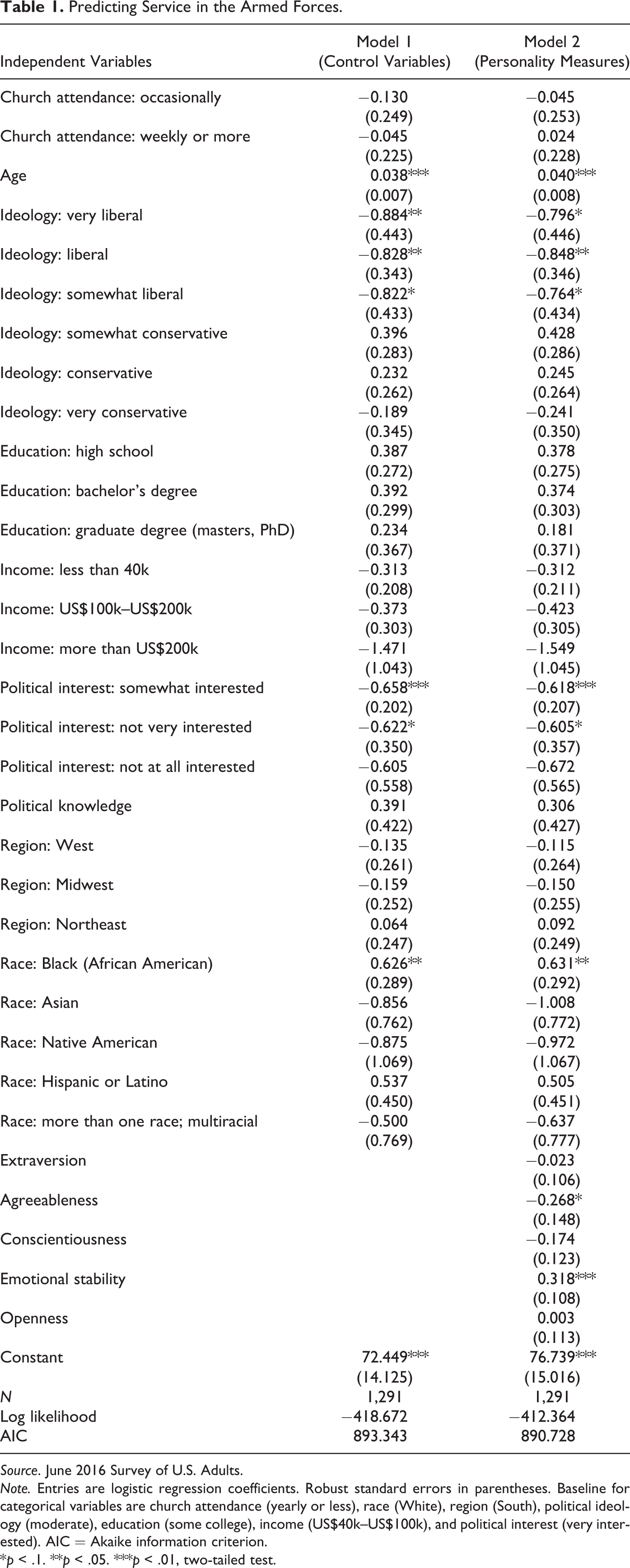
Clear Voice Research recruited a sample of 1,290 American adults to participate in a national online survey from June 18–28, 2016, for the authors. The demographic characteristics of these participants closely resemble that of the U.S. population (see Online Appendix). In the survey, we asked respondents to complete the short 11-item Big Five Personality Inventory (Rammstedt & John, 2007). We also included a list of life events that people might experience. Following Ryff et al. (2012), we asked respondents to indicate which (if any) of the items in the list they had experienced in their lives. The list included items such as declaring bankruptcy, being unemployed, experiencing combat, and entering the armed forces. About 12% of respondents (155 individuals) reported that they have entered the armed forces at some point in their lives. We dichotomized responses to this question and estimated a logistic regression model predicting an affirmative response. The results are displayed in Table 1.
Predicting Service in the Armed Forces.
Source. June 2016 Survey of U.S. Adults.
Note. Entries are logistic regression coefficients. Robust standard errors in parentheses. Baseline for categorical variables are church attendance (yearly or less), race (White), region (South), political ideology (moderate), education (some college), income (US$40k–US$100k), and political interest (very interested). AIC = Akaike information criterion.
*p < .1. **p < .05. ***p < .01, two-tailed test.
The first column in Table 1 includes only the standard demographic characteristics to predict serving in the armed forces, while the model results in the second column add personality measures as predictors. These results are largely consistent with previous work on the subject. African Americans are significantly more likely to have served in the armed forces than Whites, and liberals are significantly less likely than moderates or conservatives to have served in the military. We also note that those who are very interested in politics are less likely to have served in the military than those who are “somewhat” or “not very” interested in politics. Not surprisingly, age is significantly associated with serving in the armed forces; older respondents, having lived through more international conflicts, are more likely to have served.
We find no support for our hypothesized association between extraversion and military service in this national sample (Hypothesis 1). Consistent with our expectations, we find moderate support for a negative association between agreeableness and military service (Hypothesis 3) and we find a significant positive association between emotional stability and military service (Hypothesis 2).
Two findings have important implications for military service in the United States. First, there is a strong, significant relationship between emotional stability and military service. Compared to those low in this trait, people high in emotional stability are less likely to experience negative emotions like anger, anxiety, or depression. Our results suggest that people who have or are serving in the armed forces have a stronger command of their emotions. This is consistent with our expectations, but the direction of the causal arrow is uncertain. Perhaps emotional stability is associated with military service because the military selects on this trait.
Second, political interest is negatively associated with military service. We think this is important because political interest is associated with political efficacy, political engagement, voting, and political knowledge (Rosenstone & Hansen, 1993). In short, those who are interested in politics pay attention to politics and get involved in the political system. It is entirely possible that some people are genetically predisposed to defending American political values through military service and excluding themselves from the processes through which they make their views heard by elected representatives. We explore this possibility in our second study.
Study 2: A Genetic Component?
We use a twin study to examine the extent to which serving in the armed forces is associated with genetic and environmental factors. Twin studies compare the phenotypes of monozygotic (MZ) twins who share 100% of their genetic material to dizygotic (DZ) twins who share, on average, 50% of their genetic material. This approach emphasizes the concordance between MZ twins relative to that of the DZ twins. If we assume that these different sets of twins share comparable environments, we can estimate the variance that results from common environment (C) and separate that from the variance due to genetic factors (A) and unique individual experiences (E). This approach has been used by behavioral geneticists since the early 1920s, and the findings based on these methods have been supported as statistical tools have become more precise (Visscher et al., 2006).
Subjects were drawn from the MacArthur Foundation Survey or Midlife Development in the United States (MIDUS; Brim et al., 2011; Ryff et al., 2012). In 1995–1996, the MacArthur Midlife Research Network carried out a national survey of over 7,000 Americans aged 25–74. The purpose of the study was to investigate the role of behavioral, psychological, and social factors in understanding age-related differences in physical and mental health. With support from the National Institute on Aging, a longitudinal follow-up of the original MIDUS samples was conducted in 2004–2006. MIDUS II respondents were aged 35–86. Zygosity was ascertained using DNA microsatellite markers extracted from buccal swab samples. The study sample comprised 240 MZ pairs (mean age = 44.0 years, SD = 11.9), 357 DZ same-sex pairs (mean age = 45.2 years, SD = 12.5), and 240 opposite-sex DZ pairs (mean age = 45.9 years, SD = 12.0).
The first project in MIDUS II sent a self-administered questionnaire to the test subjects. One series of questions concerns experiences in life with the following prompt, “The following questions are about experiences you may have had at any time.” The options are identical to those we included on the national survey in Study 1. One of the items asks whether the respondent entered the armed forces. Conceivably this could be voluntary or involuntary entrance into the armed forces, but for the purposes of this study, it is not relevant. If subjects are selected into the armed forces through a random lottery, there is no reason to expect genes to influence random selection into the military and each of those respondents will not confound the study.
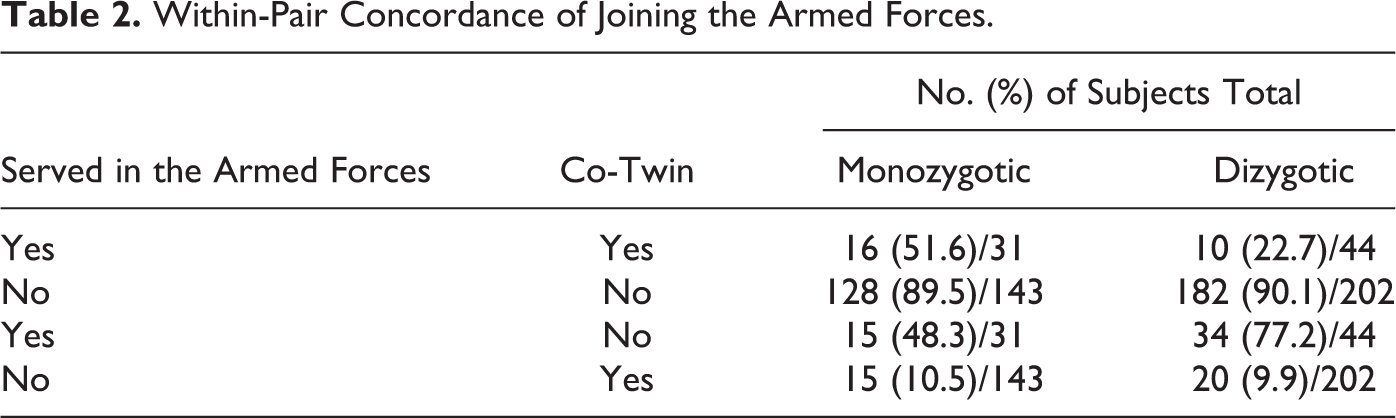
When data on MZ and DZ twin pairs are available, we can estimate a correlation liability for each type of twin. However, we can also go further by fitting a model that explains these MZ and DZ correlations. We decompose the liability correlation into additive genetic components (A), shared environment components (C), and components attributed to the individual’s unique experiences (E), as we do for continuous traits with correlations determined by the path model. We follow best practices and modify the analytical techniques for our dichotomous trait (serving in the armed forces = 1; Falconer, 1965; Rijsdijk & Sham, 2002). Table 1 displays the twin pair concordances for service in the armed forces.
Table 2 shows that roughly 51% of the MZ twins who served in the armed forces had twin pairs who also served in the armed forces. By contrast, only 22.7% of the DZ twins who enrolled in the armed forces have twins who also served. Broadly, MZ and DZ twin pairs have approximately the same rate of not enrolling in the armed forces as each other. The proportion of variance explained by additive genetic (A), common environmental (C), and unique environmental (E) components is estimated with a two-group threshold model (explained previously). In addition, we fit models with no additive genetic component (CE) and no common environment component (AE) and compare model fit to determine the best model.
Within-Pair Concordance of Joining the Armed Forces.
In the fully saturated (ACE) model, the estimated contribution of shared environment (C) is zero. All of the fit statistics suggest that ACE model performs well. By contrast, the fit statistics for the CE model (Table 3) suggest poor model fit. The comparative fit index is well below .95 and the root mean square error of approximation is larger than .05. Since the fully saturated model estimated C to be zero, it is not surprising that the AE model has the best fit statistics. This suggests that the home environment siblings were raised in has virtually no effect on entering the armed forces, and unique environment (E) and additive genetic effects (A) explain virtually all the variation in military service, with a high degree of genetic heritability for military service (64.2%). These findings suggest that the reason we see familial similarity in service in the armed forces is due to shared genetic material. Social learning in the home environment has very little influence on whether one enters the armed forces (Hypothesis 4).
Full Univariate Models.
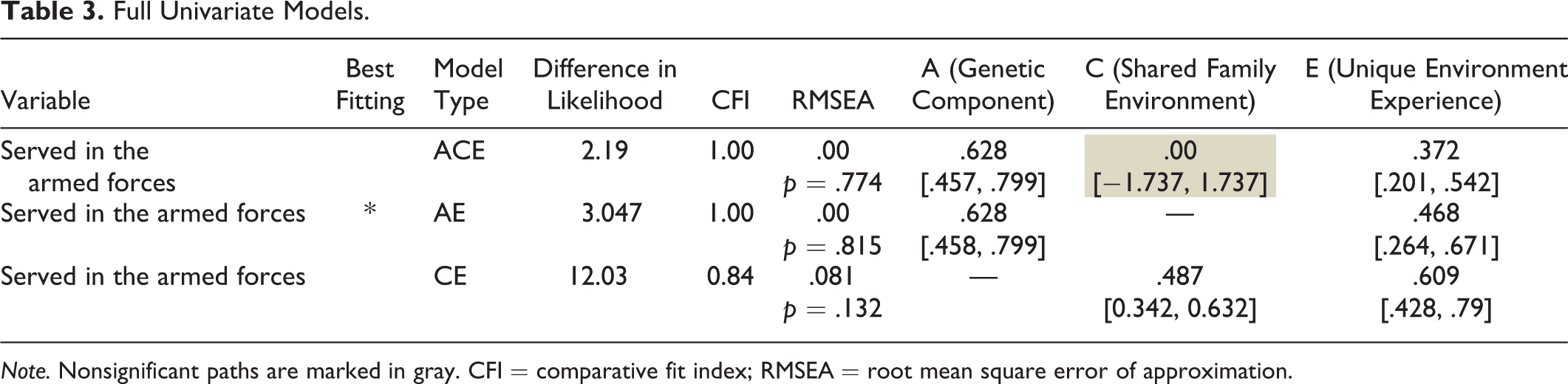
Note. Nonsignificant paths are marked in gray. CFI = comparative fit index; RMSEA = root mean square error of approximation.
Bivariate Relationships
Given the statistical association between some personality traits and military service, and the strong genetic heritability of the Big Five traits (Jang et al., 1996; Vukasović & Bratko, 2015), we examine a possible genetic correlation between personality and military service.
Table 4 displays the genetic correlation between the Big Five personality traits and serving in the armed forces. Of all the personality traits, the strongest bivariate genetic correlation is found between emotional stability and military service. Unique environment does not explain any of the covariation between the two. In fact, 12.8% of the genetic material predisposing someone to be emotionally stable also predisposes them to serve in the armed forces. Furthermore, unique life experiences do not account for any of the covariation between emotional stability and military service. Those who serve or have served in the armed forces have a genetic predisposition toward having less emotional responses to everyday situations—a trait that is invaluable for military service.
Genetic Correlation of Big Five Personality Items and Joining the Armed Forces.
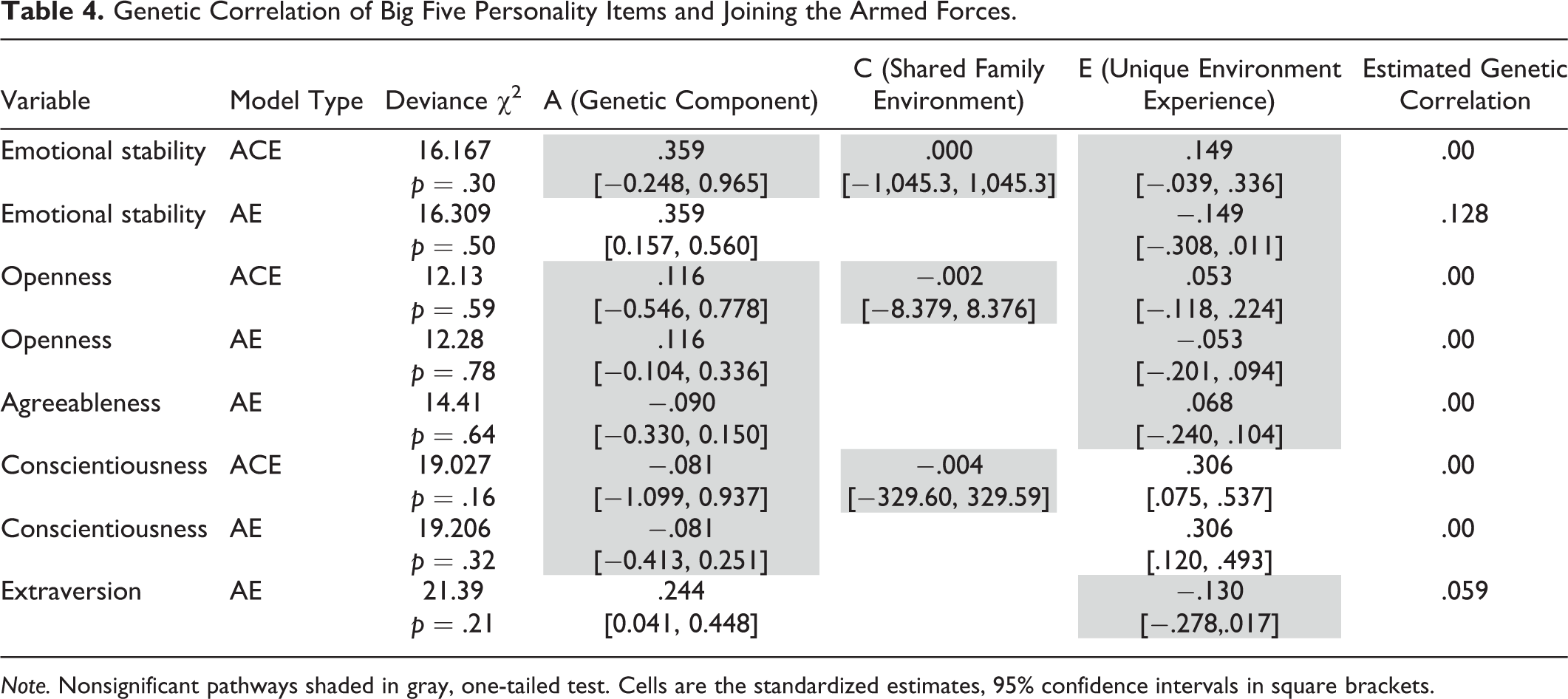
Note. Nonsignificant pathways shaded in gray, one-tailed test. Cells are the standardized estimates, 95% confidence intervals in square brackets.
We find a mild association between extraversion and military service. Our findings show that 5.9% of the genes that are associated with extraversion are also associated with military service. Likely, the genetic aspects of extraversion related to being a member of clubs and organized athletic teams are those who are associated with military service, but we cannot make a definitive statement.
In our first study, we found a significant, negative association between agreeableness and military service. We interpreted this to mean that people who are more agreeable are less likely to have experienced military service. Our analyses in the second study show that this relationship is not genetic. That is, the genetic pathways predisposing someone to agreeableness are different than those predisposing someone to military service.
Discussion
Taken together, the results presented in this section broaden our understanding of why people choose to join the military. In our survey of the U.S. population, we find some evidence consistent with popular conceptions of those who serve in the military; political conservatism, age, and race are all associated with service in the armed forces. Furthermore, the association between some stable psychological traits and military service suggests that some people may have genetic predispositions that make service in the armed forces more attractive to them than it would be to others.
We demonstrate that service in the armed forces is highly genetically heritable. The genes one inherits at birth explain over 39% of the variation in why some people serve in the armed forces and others do not. Although this does not mean that people are “born” to serve or not to serve in the military, it allows further exploration into genetically heritable psychological traits that might also predispose people to service in the military. Many of these traits do not share common genetic pathways with the decision to serve in the military, but some are noteworthy. The same genes that predispose people to emotional stability also predispose them to military service. Likewise, the genes predisposing someone to extraversion also predispose them to serve in the armed forces.
In all, these findings support a view of those who serve in the military as social, outgoing, emotionally stable individuals. At present, extraverts are more likely to be politically ambitious, while emotionally stable and agreeable individuals are less likely to be interested in running for elective office (Dynes et al., 2018). One reason that the United States has such a rich history of people serving in the military choosing to seek higher office is that the two are motivated by one set of genetically heritable personality traits. Since running for political office often requires a strong social network (which emotionally stable people often lack), this may be the modern institutional feature of U.S. elections that persuade emotionally stable individuals to serve their country in the military rather than through elective office. If so, the recent dearth of elected officials who have served in the military is caused, not by a change in the genetic makeup of the U.S. citizenry but by changing societal arrangements that make military service and/or political service seem less attractive today than they were in the past.
Conclusion
We hope this study initiates additional research exploring the recent decline in the percentage of elected officials who have prior military experience. We hesitate to make too strong an assertion based on this single study; our twin study limits our ability to control for other factors that we know are associated with military service. Some people in that sample served in the armed forces because they were conscripted, while others were not. Some joined the armed forces out of economic necessity, while others did not. We acknowledge that controlling for these factors is not possible with our data. At the same time, the pattern of findings presented in this article is compelling. First, in the analysis of a national survey of American adults, we find a positive relationship between emotional stability and military service, which differs from studies of personality and political participation. Consistent with studies of political ambition and participation, we find a negative relationship between agreeableness and military service.
This led us to our second study in which we explored the possibility that some people might be genetically predisposed to select some forms of public service over others. Of course, people serve in the military for a myriad of reasons that we do not explore in this study. Even so, it is possible that the same genetic materials that predispose someone to developing an extraverted, agreeable, or emotionally stable personality also predispose them to military service (Griffith & Perry, 1993).
Although the genetic correlations from our twin study do not explain very much of the genetic pathways that motivate people to join the armed forces, our findings go a long way in helping to understand the divide between those who serve in the military, elected officials, and the broader public. We now know a lot more about how those who serve in the armed forces differ from the general public. We can say that some people are genetically predisposed toward military service. We do not interpret this to mean that people have no agency in the matter. Rather, the evidence presented here suggests that the genetic makeup of some individuals leads them to a worldview that lends itself toward the forms of participation one can achieve through military service and away from other types of political participation.
Supplemental Material
Supplemental Material, military_service_civil-military_divide_(appendix_AFS) - Personality and Genetic Associations With Military Service
Supplemental Material, military_service_civil-military_divide_(appendix_AFS) for Personality and Genetic Associations With Military Service by Matthew R. Miles and Donald P. Haider-Markel in Armed Forces & Society
Footnotes
Authors’ Note
An earlier version of this article was presented at the Annual Meeting of the American Political Science Association, 2016, Philadelphia, PA.
Acknowledgment
The authors would like to thank Casey Klofstad and Chris Ojeda for their helpful comments.
Declaration of Conflicting Interests
The authors declared no potential conflicts of interest with respect to the research, authorship, and/or publication of this article.
Funding
The authors received no financial support for the research, authorship, and/or publication of this article.

Supplemental Material
Supplemental material for this article is available online.
Notes
References
Supplementary Material
Please find the following supplemental material available below.
For Open Access articles published under a Creative Commons License, all supplemental material carries the same license as the article it is associated with.
For non-Open Access articles published, all supplemental material carries a non-exclusive license, and permission requests for re-use of supplemental material or any part of supplemental material shall be sent directly to the copyright owner as specified in the copyright notice associated with the article.
