



Abstract
Why would politicians recruit soldiers for military coups d’état? The civil–military relations literature assumes politicians aspire to supremacy over the military; enabling praetorianism would risk their future rule. While civil–military relations widely recognizes the empirical fact of civilian participation in military takeovers, no study specifies or theorizes the topic. This essay examines the conditions in which politicians recruit soldiers to seize power by investigating the understudied processes of military takeovers. Using British Foreign Office documents, Arabic language memoirs, and Polity data, I find that civilian statesmen in Iraq (1936) and Syria (1951) could not tolerate their civilian rivals’ incumbency but were unable to challenge them peacefully, so they recruited like-minded officers for coups. This suggests that while politicians do not necessarily want the army in the chambers, they sometimes favor praetorianism to the continued rule of their civilian opponents.
Why would civilian politicians recruit soldiers for military coups d’état? The concept of civilian control in civil–military relations (CMR) implies parliamentarians have a preference for limited military influence in political affairs; they should not want to share power with officers. This essay is about the understudied processes of coups, specifically the puzzle of civilian-recruited coups. While politicians do not necessarily want the army in the chambers, they sometimes prefer praetorianism to the rule of their civilian rivals.
Using British Foreign Office (FO) documents, Arabic language memoirs and manifestos, and Polity data, this essay finds that Iraqi and Syrian politicians were too polarized to countenance their civilian opponents’ incumbency but unable to compete freely and fairly in elections, so they recruited soldiers for coups. In 1936, Iraqi politician Hikmat Suleyman and his Ahali movement encouraged General Bakr al-Sidqi to replace Yasin al-Hashimi and hand the government to Suleyman. Syrian politician Akram al-Hawrani helped Colonel Adib al-Shishakli unseat Ma’aruf Dawalibi in 1951.
Based on these cases, this article discusses three implications for research on military politics. First, we cannot fully understand coups if we focus too heavily on ambitious officers. Second, politician-recruited coups enable praetorianism because it alters soldiers’ perceptions of their opportunity to intervene. 1 Third, civilian political bodies cannot form a united front in order to reduce the military’s influence over political affairs if certain politicians benefit from the army’s continued interference. The article concludes by raising three additional questions for future research.
Coup Dynamics in the Arab World
Researchers devoted many volumes to Middle East militaries during the region’s wave of postwar coups (e.g., Haddad, 1971; Khadduri, 1953; Perlmutter, 1970; Petran, 1972; Torrey, 1964), but public and academic attention to Arab armies ebbed (Assaf & Barak, 2010; Jumbert & Kårtveit, 2014) with some well-known exceptions (e.g., Bellin, 2004; Cook, 2007; Picard, 1990; Quinlivan, 1999). Arab militaries’ influence during the 2011 rebellions rejuvenated their study (e.g., Abul-Magd & Grawert, 2016; Albrecht, 2014; Albrecht & Bishara, 2011; Bellin, 2012; Droz-Vincent, 2011, 2013; Gause, 2011; Lutterbeck, 2013; Makara, 2013; Pion-Berlin, Esparza, & Grisham, 2014). This article speaks to two areas of research that have found fresh breath: Arab armies’ intervention into and extrication from political life (Jumbert & Kårtveit, 2014). By using postcolonial cases, the study seriously takes the call to go “beyond the sudden fall of autocratic leaders” (Jumbert & Kårtveit, 2014, p. 1).
Civilian Politicians and Military Coups
Researchers have devoted little attention to coup dynamics, the processes of military takeovers (Singh, 2014), such as coup recruitment (Ferguson, 1987; Luttwak, 1979). In particular, the types and levels of civilian involvement in coups are undertheorized. While the field of CMR widely recognizes the empirical fact of civilian involvement in military takeovers, no study methodically examines the topic or discriminates officer-recruited versus civilian-recruited coups.
Researchers have so far offered only nebulous descriptions of civilian involvement in coups. Janowitz (1964/1977) claimed “organized factions” execute coups in the developing world (p. 49). Finer (1962) ambiguously drew a connection between politicians and officers in Iraq (1936–1941), which …[R]esembled a game of ‘change your partners’—a loose group of politicians rent by rivalries confronted a loose group of ambitious officers. From time to time a clique of politicians would link hands with a clique of officers and thereby get themselves installed in office. Then another clique from each side would momentarily combine to oust the first combination; and so forth. (emphasis added, p. 80)
Most closely resembling this essay’s subject, Ferguson (1987) included in his four “models of conspiracy” a “combined civil-military plot involving the most senior military officers and elements of the government or opposition parties…” (p. 113), or what Adel Beshara calls a “fusionist coup” (2005, p. 8). Luttwak’s (1979) “cookbook” likewise distinguished a putsch, which is “carried out by a faction within the army,” from a coup d’état, which “can also be executed by civilians using some army units…” (emphasis added, Luttwak, 1979, p. 9). The remainder of Luttwak’s Coup d’État discusses civilians only in reference to the pacification of resistance, for example, the period of “accommodation and conciliation” (p. 57). Civilian resistance has received its own separate attention (Luttwak, 1979; Roberts, 1975; Singh, 2014).
Researchers have systematically studied mass civilian support for military takeovers (Casper & Tyson, 2014; Powell, 2012; Seligson & Carrion, 2002; Svolik, 2012), and elites' involvement is recognized implicitly or explicitly in most definitions of coups (e.g., Casper & Tyson, 2014; Derpanopoulos, Frantz, Geddes, & Wright, 2017; Powell & Thyne, 2016). Several data sets include cases of civilian involvement in military takeovers. 2 Powell and Thyne’s (2011) definition states, “the military or other elites within the state apparatus unseat the sitting executive using unconstitutional means” (p. 252). Svolik’s (2009) definition claims that governments can be removed by “other government members or members of the military or the security forces…” (p. 478). Most definitions are broad enough to include civilian involvement in nonmilitary coups (e.g., intraparty coups), such as revolutionary politician Laurent Kabila’s removal of Mobutu Sese Seko (Derpanopoulos et al., 2017).
The puzzle: Civilians should want a quartered army
The CMR literature generally assumes the desirability of separate civil–military spheres with civilian supremacy over officers (Feaver, 1996, 1999; Finer, 1962; Huntington, 1957, 1968). We should not expect civilians to recruit soldiers for coups d’état because enabling praetorianism risks politicians’ future rule for at least two reasons.
First, politicians need officers to take power, but how can they prevent their armed partisans from turning on them? This question places Feaver’s (1996) “civil–military problematique” at the substate level. The first civilian-backed coup will help ambitious soldiers identify potential co-conspirators and teach them how to seize the parliament or executive. Second, coups mobilize the modern state’s armed forces, with the accoutrements of state capacity (e.g., tanks, aircraft, training). If the army occupies the capital, politicians will not be able to fight back with a party militia. Party militants lose when confronted by the public army, like the Brownshirts’ (Sturmabteilung) experience in Munich (Luttwak, 1979).
These are not merely theoretical concerns. The Syrian Army learned “how to unseat governments” from Colonel Husni al-Za’im’s coup in 1949, “but had not yet acquired the self-confidence and political skill to enable it to take its place in the political arena,” wrote Patrick Seale. “It was not long to be so modest” (1965/1986, p. 76). After Syrian politician Akram al-Hawrani helped three colonels seize power in March, August, and December 1949, all three turned on him. Not surprisingly, after involvement in several coups radical politician Michel Aflaq and his civilian Baathist allies were “aptly…driven out of power and banished from Syria in the aftermath of a military coup in 1966” (Ajami, 1981/1992, p. xiv).
Civilian Recruitment for Coups d’état: Theory and Study Design
Politicians recruit soldiers for coups when polarization is high and electoral competition is low. High polarization is necessary but insufficient to explain civilian-recruited coups. In highly democratic but polarized systems, politicians can still remove their opponents in free and fair elections. In highly autocratic systems, polarization might be present, but its potential manifestations are repressed. When polarization raises the stakes of inaction where electoral competition is also present, but insufficiently free and fair to seriously challenge incumbents, civilian statesmen are more likely to recruit soldiers for coups. Figure 1 represents these pathways.

The pathways toward civilian recruitment for coups d’état.
Polarization refers to a situation in which changes to elites’ relationship to the state and economy threaten the “very existence of an elite” (Waldner, 1999, p. 29). In the Middle East’s polarized postcolonial party systems—where economic power and political power went hand in hand—rivals were intolerant of one another’s rule and sometimes their very existence. Opposing divisions of the political elite promoted beliefs and took actions that threatened one another’s capacity to “reproduce” their “elite status” or “compete for economic surplus over the long-term” (Angrist, 2006, pp. 16, 124). Postcolonial Syria and Iraq were polarized over borders, regime type, foreign policy, land distribution, and religion’s role in the state—all questions which threatened the existence of one or another section of the political elite (Angrist, 2006; Khadduri, 1951, 1953; Petran, 1972; Seale, 1965/1986; Tarbush, 1982; Torrey, 1964; Tripp, 2007).
An illustration from Syria clarifies this point. Radical politicians Michel Aflaq and Akram al-Hawrani, who were both involved in Damascus’ postwar coups, explicitly threatened conservative elites’ grip on power. 3 As the Baath Party’s ideologue, Aflaq advocated an “overturning” (inqilab, the Arabic word for coup) of the traditional order (Aflaq, 1950). 4 The Baath was the “Party of the Upheaval (Hizb al-Inqilab)” (Aflaq, 1949). Hawrani (2000) avidly supported the peasantry and expressed bitter antipathy toward landowners (Parker, 2015). Landlord and onetime Prime Minister Husni al-Barazi remarked of Hawrani, “if he could have drunk our blood and eaten our flesh he would have done so” (as cited in Seale, 1965/1986, p. 40). Hawrani’s (2000) memoirs reproach the postwar regime for dismantling the constitution and restricting freedoms (pp. 560–577).
High electoral competition refers to situations in which “elected officials are chosen in frequent and fairly conducted elections in which coercion is comparatively uncommon” (Schmitter & Karl, 1991, p. 106). This “procedural” component of democratic regimes, according to the authors of the Polity IV project, requires the “guarantee of civil liberties to all citizens in their daily lives and in acts of political participation” (Marshall, Gurr, & Jaggers, 2017, p. 14). Citizens should be allowed to vote, run for office, freely express themselves, access information outside the political establishment’s scope of provision, and “form relatively independent associations or organizations” such as parties (Dahl, 1982, p. 11; see also, e.g., Schmitter & Karl, 1991, p. 106). Elections are not free and fair if, as in postwar Syria, voters and poll workers are kidnapped from polling places or incumbents’ kata’ib (scribes) cast ballots for illiterate constituents (Torrey, 1964, pp. 98, 353). POLITY scores—including an alternative measure of democratic regime type, XPOLITY, which removes the endogenous indicators of factionalism and violence from Polity IV’s index (Vreeland, 2008)—compliment the qualitative discussion of electoral politics in Syria and Iraq (below).
Electoral competition is a nominal variable with three ideal–typical categories: none (autocratic), high (democratic), low (hybrid regime). 5 Democracies peacefully signal dissent to those who govern, thereby decreasing the motivation and popular support for political violence. Coups will more likely originate within officer cliques in autocracies, where surveillance, repression, and bans on assembly curtail politicians’ involvement in conspiracy, wherein soldiers’ units are preorganized associations. Baathist officers formed a “Military Committee” in Cairo to plot secession from the United Arab Republic (UAR) but kept their secret from Baath civilians because the UAR was a police state (Petran, 1972, p. 146). In hybrid regimes, politicians compete in unfair elections, but they can still meet, recruit, and conspire with relative ease. Syrian Baathists Aflaq, Hawrani, and Salah al-Din al-Bitar remained in exile until Colonel Adib al-Shishakli’s dictatorship liberalized slightly in 1954, at which time they orchestrated a coup (Kaylani, 1972).
Two theoretical mechanisms link low electoral competition to civilian recruitment for coups. First, unfair elections can directly exclude the opposition from power. When Baathist Salah al-Din al-Bitar lost in an election that was skewed toward conservatives in December 1961, his subsequent “exclusion from power…played no small part in the decision of the Aflak-Bitar Ba’th to…choose the road of conspiracy” (Petran, 1972, p. 153). Second, indirectly, even if a few revisionists overcome electoral manipulation, they will still lack parliamentary allies. Akram al-Hawrani’s leftism won him a seat in feudalistic Hama, but he relied on army threats in the chambers because his coradicals struggled at the polls. Hawrani (2000, pp. 765–769) cited the Quwatli regime’s manipulation of elections as one motivation for Col. Husni al-Za’im’s coup, in which the former was involved. 6
The outcome variable is civilian recruitment for military intervention. Civilian recruitment is when politicians (a) approach soldiers and/or (b) actively encourage, plot, or incite military conspirators for coups. Military intervention is “the use, actual or threatened, of force by members of the military, either alone or with civilian actors, in an attempt to change the executive leadership of the state” (emphasis added, Taylor, 2003, p. 7). The Syrian and Iraqi cases were chosen because of their high values on these study variables—a case selection procedure that contributes to theory development (George & Bennett, 2005, pp. 181–182; Van Evera, 1997, pp. 47–48). Although selecting on the outcome is taboo (e.g., Geddes, 1990), it is permitted if cases are “sufficiently data rich to permit process tracing” (Van Evera, 1997, p. 47). The cases are constructed with British FO documents, Arabic language participant testimony, and secondary accounts.
The study builds theory using within-case analysis of two coup-prone states by combining “congruence procedures” with “process tracing” for a “plausibility probe,” as opposed to a hard empirical test (Bennett & Elman, 2007, pp. 183–185; Eckstein, 1975, pp. 108–113; George & Bennett, 2005, pp. 181–182; Møller, 2017, p. 2344). Future studies could extend the theory to additional cases in order to assess its generalizability.
October 29, 1936—Iraq’s First Coup
Iraqi politician Hikmat Suleyman and the Jama’at al-Ahali (people’s group)—established in 1931 by mostly young foreign-educated Iraqis—wanted to upend their country’s traditional order and “transform Iraq into a modern, democratic state, by means of far-ranging change in Iraqi society” (Eppel, 2004, p. 41). The traditional elite frustrated their efforts by manipulating elections, so the radicals seized power by recruiting a disgruntled former Ottoman military officer named General Bakr al-Sidqi. In Suleyman’s words, “There was nothing left for us except the Army…so we resorted to the Army” (emphasis added, as cited in Tarbush, 1982, p. 121).
On Thursday, October 29, 1936, military planes disrupted an otherwise quiet morning in Baghdad when they began flying low over the city to drop what Britain’s Ambassador to Iraq, Archibald Clark Kerr, referred to as a “manifesto” (Kerr, 1936a, p. 197), which covered the capital’s walls and was signed by General Sidqi, “chief of the National Reformist Force” (Vernier, 1966, p. 151). The document urged “King Ghazi, in the name of the army, to dismiss [Yasin al-Hashimi’s] Cabinet and to set up a new Administration under Hikmat Sulaiman” (Kerr, 1936a, p. 197). Suleyman was the sole candidate who the General mentioned in his ultimatum (Suweidi, 2010, pp. 239–240).
Chief of Staff Taha al-Hashimi, PM Yasin al-Hashimi’s brother, wrote that General Sidqi became partial toward Suleyman during the military’s operations against Iraq’s Assyrians and that Sidqi continued to visit Suleyman throughout Iraq’s Euphrates campaign (Hashimi, 1967, p. 137). It must have been during these meetings that the General listened “sympathetically to Hikmat Sulaiman’s plans for the toppling of Yasin al-Hashimi’s government” (my emphasis, Tripp, 2007, p. 86). While members of Ahali took part in the operation (Talfah, 1976, p. 14) by distributing leaflets in Baghdad (Tripp, 2007), Suleyman’s role was more involved.
Before PM Hashimi officially tendered his resignation, he summoned Suleyman to the palace to assess his intentions; he would resign only if Suleyman’s goal was the betterment of Iraq. Upon this request, Hashimi and King Ghazi were surprised to find Suleyman already waiting in the building to deliver to Ghazi a letter—from Sidqi and the commander of the other wayward brigade, General Abdul Latif Nuri—which stated the air force would bomb Baghdad in 3 hr unless Ghazi acquiesced. Hashimi stalled so long that right before noon, the air force shelled Baghdad. Shortly after the PM resigned, King Ghazi issued a royal Iradah offering Hikmat Suleyman the opportunity to form a cabinet. Sidqi entered the capital without resistance and was at Serai, government headquarters, with Suleyman by 7 p.m. (Kerr, 1936a, pp. 197–198)
Polarization and Electoral Competition
High polarization and low electoral competition explain Hikmat Suleyman’s recruitment of General Bakr al-Sidqi. Modernization and urbanization pitted Iraq’s (mostly Sunni) notables, capital holders, and landowners against an emerging professional class of elite bureaucrats known as the effendiyya (Angrist, 2006; Eppel, 2004, pp. 4–5, 22). The traditional elite was caught between defending the status quo and balancing the interests of the emerging middle class, from which it needed political support, and “whose distresses required a change in the status quo” (Eppel, 2004, p. 39).
To preserve their status, Iraq’s traditional elite made two interrelated moves. First, they exploited their economic and political privileges to integrate a group of Shi’a into the ranks of the ruling class. The Ottoman Land Law of 1958 created a class of landed rural Shi’a notables by enclosing tribal territory, allowing tribal chiefs to seize territory, and transform tribesmen into fellahin. Iraq’s traditional elite used the 1932 Land Settlement Law and the 1933 Law Governing the Rights and Duties of the Cultivators to dole out land and further entrench the power of Shi’a tribal notables (Eppel, 2004, pp. 4–5, 22). The conservatives, second, appealed to the effendiyya, who they needed to run the state’s bureaucracy, with Arab and Iraqi nationalism—which avoided antagonizing their Shi’a coalition partners—to strengthen Baghdad against the centrifugal tendencies of rural tribalism. Without vertically integrating the lower classes into the ruling structure, however, this twin strategy did not resolve the incompatible “interests of the political elite and the upper class…and the interests of the effendiyya…to modernize, industrialize, democratize, and change the political regime” (Eppel, 2004, p. 26).
The personalities of the effendiyya confirm these tensions. British Ambassador Archibald Clark Kerr referred to Hikmat Suleyman as a “Voltairian Republican” for his antiestablishmentarianism and claimed there was “a noticeably red tinge” of the platform of the Popular Reform League, which buttressed Suleyman’s postcoup government and contributed “to the discord of incompatible ideals which seem to inspire” its ministers (my emphasis, Kerr, 1936d, p. 204). Populists like Kamel Chaderchi, Hussein Jamil, Communist-leaning Abd al-Qadr Ismael al-Bustani, Abd al-Fattah Ibrahim (who led a “clique” of Marxists), Muhammad Salih al-Qazzaz (an active leader of the workers movement), and Khalil Kana, all “supported social reforms, gave a high priority to development and modernization, and even favored moderate, limited agrarian reform, including the distribution of some state lands to the fellahin” (Eppel, 2004, pp. 41–42; see also Kerr, 1936d, p. 204; Talfah, 1976, pp. 14–15).
Despite these tensions, the British and King Faisal I had guaranteed stability until Britain vacated Iraq (1932) and King Faisal I’s death (1933; Suweidi, 2010, p. 237; Talfah, 1976, p. 17). Without a strong monarchy to balance competing elites, “the political system lumbered along in conformity with traditional practices,” but among the modernizers, “some sought the support of the military and were ready to hand over authority” to officers while “others…began to advocate a radical change in the form of government (my emphasis, Khadduri, 1969, p. 68).
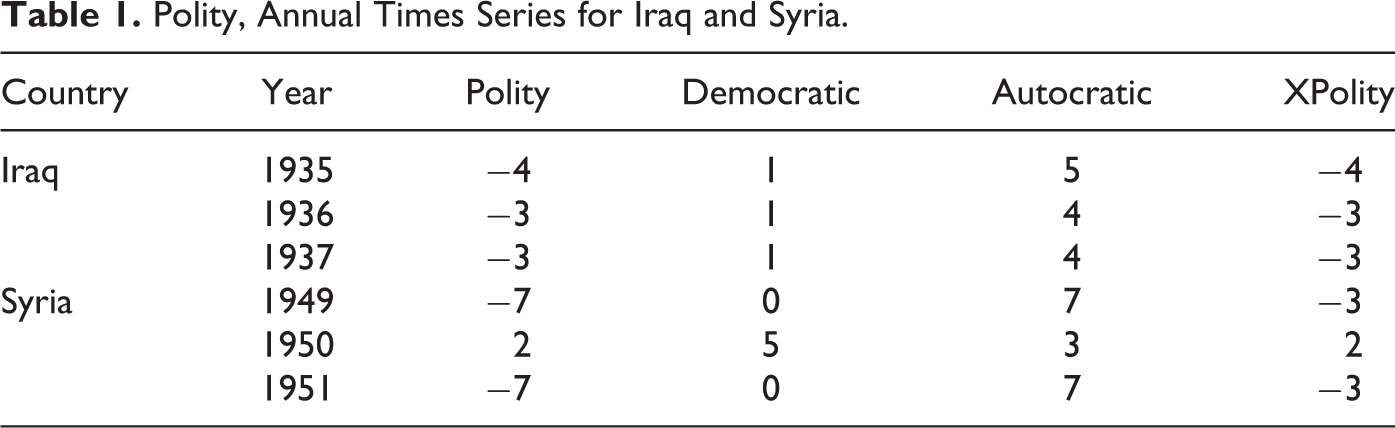
Unimpressed by tradition, the effendiyya used its overrepresentation in the printing houses to intensify its war against Iraq’s conservatives, but due to Iraq’s electoral system, they were “incapable of reaching the foci of power and control within the state” (Eppel, 2004, p. 26). The Jama’at al-Ahali’s meetings expressed frustration with the voting system (Tripp, 2007). Two of Ahali’s founders, Abd al-Fattah Ibrahim and Mohammad Hadid, thought democratic reform more than socialism was a panacea for Iraq’s ills (Amin, 1980, pp. 121–122). Iraq’s POLITY/XPOLITY scores—on a scale from most autocratic (−10) to most democratic (10)—were −4 and −3 in 1935 and 1936, respectively, with a regime case score of −4 for 1924–1936 (see Tables 1 and 2). Suleyman cited this as a reason they “resorted” to conspiracy (Tarbush, 1982, p. 121).
Polity, Annual Times Series for Iraq and Syria.
Polity IV, Polity-Case Format for Iraq and Syria.

Iraq’s conservative elites, who based their rule on narrow patron–client networks, watched with fear as challengers built European-style parties based on ideological appeal (Angrist, 2006, p. 126; Kedourie, 2016, pp. 28–58). They countered with indirect, two-stage elections with literacy and property requirements (Angrist, 2006, p. 126). Iraqi politician Khairallah Talfah (1976) claimed ministerial posts were “guarded jealously by a group of politicians who shared a common fate with Great Britain” (p. 17) and that parliamentary councils were “bricks in the hands of the rulers” to control Iraq’s national movement while the Majlis manipulated elections (p. 15). In a typical contest, according to former politician Tawfiq Suweidi (2010), the King and the Minister of Interior (with British influence) consented to a group of candidates, kept the list secret until election day, and then used the election’s “managers,” to help their nominees prevail (p. 103).
Akram al-Hawrani and Colonel Adib al-Shishakli
Syrian populist Akram al-Hawrani opposed the prospect of a Damascus–Baghdad merger—the most polarizing issue of the early 1950s. Despite winning his seat in left-leaning Hama, Hawrani lacked radical allies in parliament to help him block conservatives from pursuing union because the latter dominated the unfair elections to the Constituent Assembly in 1949. When Hawrani’s use of military threats in the chambers failed to break the resolve of the pro-Hashemite People’s Party (PP) and its leader Ma’aruf Dawalibi, the radical enlisted Colonel Shishakli to oust and jail prounion politicians.
As the prospect of Hashemite reign over Damascus spun Syria into crisis, several attempts to put together a government failed because parliamentarians refused to join unless a civilian held the defense portfolio, which controlled the politically potent gendarmerie (Dawalibi & Abu Saleh, 2005, pp. 135–137; Montagu-Pollock, 1951b, para. 2; Torrey, 1964, p. 200). 7 Eventually, President Hashem al-Atasi tapped the leader of the largely prounion, conservative PP, Ma’aruf Dawalibi, to form a cabinet (now his second attempt). Ostensibly, Dawalibi satisfied his coparliamentarians by buckling under their pressure to “pledge” a cabinet with reduced army influence. He then took the defense post for himself, that is, he took control over the gendarmerie.
The most common view is Shishakli’s coup intended to preserve army influence (Montagu-Pollock, 1951b; Moubayed, 2012, p. 94; Petran, 1972, p. 102), but Dawalibi’s mistake was stacking the cabinet (70%) with members of his PP, which proponents of Syrian–Iraqi union dominated (Torrey, 1964, p. 200). Dawalibi’s earlier attempt to form a government failed because—as he told a colleague of British Ambassador Sir William Montagu-Pollock—he was the army’s candidate and therefore his fellow deputies distrusted him (Montagu-Pollock, 1951b, para. 1). In his memoirs, Dawalibi claims he did not want to provoke the army (Dawalibi & Abu Saleh, 2005, pp. 135–137) probably because he favored territorial nationalism over Hashemite monarchy, a view he shared with top officers but not with his own party (Montagu-Pollock, 1951b, para. 2; Seale, 1965/1986, p. 114). Dawalibi’s standing with the army explains why his colleagues pressured him to form an anti-army cabinet and why he took the defense post: His associates would not accept Colonel Fawzi Selu, but the army would not tolerate an anti-army Defense Minister (Dawalibi & Abu Saleh, 2005, pp. 135–137; Montagu-Pollock, 1951b, para. 1). Finally, Shishakli warned PM Dawalibi that his cabinet list—not only his choice for Defense Minister—was unacceptable (Seale, 1965/1986, p. 115).
The evidence suggests Shishakli ousted Dawalibi because he appointed a prounion administration. On November 28, 1951, within 12 hr of announcing the government (Torrey, 1964, p. 200), Shishakli ordered the arrest of Dawalibi, his cabinet, his party’s secretary general, Nazim al-Qudsi, and “a number of Hashemite sympathizers” (Seale, 1965/1986, p. 115). Anti-unionists Hawrani, his Socialist Party, and the Syrian Social Nationalist Party (Parti Populaire Syrien) were behind the coup (Kaylani, 1972; Moubayed, 2006, p. 247; Seale, 1965/1986, p. 115; Torrey, 1964, p. 163). This explains why Shishakli arrested proponents of union—not only PP members—and why his postcoup pronouncements blamed Dawalibi for conspiring to undermine Syrian independence (Montagu-Pollock, 1951a, para. 1; Seale, 1965/1986, p. 115).
Polarization and Electoral Competition
High polarization and low electoral competition led radical politician Akram al-Hawrani to help Colonel Adib al-Shishakli assume power. As Syrian statesmen debated a new constitution in 1949, they argued over the state’s religion and land redistribution, but external affairs raised fury (Khadduri, 1951, p. 159; Torrey, 1964, pp. 172–176). Foreign policy overlapped with class, with conservatives favoring closer ties to the West. Ma’aruf Dawalibi’s PP favored the union because the Aleppo merchant class—whose interests aligned with Mosul and Baghdad more than Damascus—supported the party. Hawrani drew his support from Hama’s and Aleppo’s peasantry. When in December 1949 the PP used its majority in the Constituent Assembly to add a prounion provision to the constitution, Hawrani—who lacked allies in the chambers—visited Major Amin Abu Assaf and Captain Fadlallah Abu Mansour to tell them they “alone are responsible for saving the country and putting an end to this decay” (Abu Mansour, 1959, pp. 95–96; Seale, 1965/1986, p. 85). They propelled Shishakli to power on December 18.
In September 1951, the Americans and Saudis exacerbated tensions over Syrian–Iraqi union because of a “peasant crisis,” which manifested in violence as fellah agitated over working conditions. Hawrani availed himself of the situation by convening a peasant’s congress in Aleppo. Washington viewed this move through Cold War goggles and foolishly pressured Damascus to join a Western-backed defense pact with Baghdad (Petran, 1972, pp. 100–102). Anxiety entered Syrian statesmen’s speeches, intensifying anti-Western and anti-union sentiment (Torrey, 1964, pp. 196–197).
This case supports the study’s second of two mechanisms that link electoral competition to civilian-recruited coups. As in 1949, Hawrani had few parliamentary allies to fight his rivals’ overtures toward Baghdad because the electoral system unfairly favored conservatives (Chaitani, 2007, p. 148; Khadduri, 1951, p. 151). Between 1950 and 1951, electoral competition in Damascus was low. At the time of the coup, Syria’s POLITY and XPOLITY scores were both +2 for polity-case and annual time series (see Tables 1 and 2). Hawrani instigated the coup between two periods (1949 and 1951) of greater authoritarianism, with POLITY and XPOLITY scores of −7 and −3, respectively. After his 1949 coup, Hawrani was so isolated in parliament that he had to use his relationship with Shishakli and Selu to threaten opponents in the chambers and veto attempts to subvert his will (Moubayed, 2006, p. 247; 2012, p. 92; Torrey, 1964, p. 168).
The elections to the Constituent Assembly in 1949 were not free or fair. As a leftist in Hama—a district marked by peasant–landlord conflict—Hawrani was able to win a seat, but his coradicals struggled at the polls. Michel Aflaq was sure that, “Rushdi al-Kikhia at the Ministry of Interior…rigged the November elections.…Hawrani only won in Hama with the help of his officer friends (as cited in Seale, 1965/1986, p. 79). Despite his victory, Hawrani complained that the gendarmerie tried to sway voters and elevate its preferred candidates. The Interior Ministry received complaints that dead people had voted in Aleppo and Deir Ezzor and that, in Daraa, “supporters of one candidate drugged the coffee of the election committee and then stuffed the ballot boxes after the officials had fallen asleep” (Torrey, 1964, pp. 152–153).
The radicals gained 12 seats: the Baath won 3, the Islamic Socialist Front won 4, and the Syrian Social Nationalist Party (Parti Populaire Syrien) and Hawrani’s Arab Socialists won a combined 5. By contrast, Ma’ruf Dawalibi’s PP won 51 of the 114 seats, while Independents (including conservative members of the National Party, which boycotted the contest) won 40. Counting Independents that were aligned with the PP, the latter could boast 63 of the 114 seats—an overwhelming majority (Chaitani, 2007, p. 144; Montagu-Pollock, 1951b, para. 3). After Hawrani and Shishakli’s December 1949 coup d’état, the PP lost its cabinet majority but remained dominant in the assembly (Seale, 1965/1986, p. 91).
Prior to the 1949 election, Hawrani had supported the Assembly’s continuation as a parliament, but later pushed for fresh elections to a new body (Torrey, 1964, pp. 181–182), likely because his army allies failed to produce favorable election returns. The PP ignored Hawrani’s protestations and voted on September 5, 1950, for the new constitution and to transform itself into a legislature in lieu of new elections. Subsequently, during Khaled al-’Azm’s premiership, Hawrani was “reluctant to face a trial of strength in parliament which he knew he could not win” (Seale, 1965/1986, p. 94). When Dawalibi gave control of the cabinet to the PP, Hawrani simply relied on Colonel Shishakli.
Implications and Future Research
These cases have three implications for the study of military politics. First, military interventions cannot be fully understood without studying who recruits whom. Attention to the 1936 coup in Iraq has centered exclusively on General Bakr al-Sidqi, despite Hikmat Suleyman’s prominent role. Halpern (1962) argued that the army’s middle-class identity led Sidqi to oust Hashimi. Heller (1977) cited divisions between Sharifian officers (loyal to Sharif Hussein’s World War II Arab Revolt) and ex-Ottoman officers. Sorby (2011) claims Sidqi wished to emulate Turkey’s Kemal Atatürk. Vernier (1966) did not even mention Suleyman in his version of events.
Researchers have conceptualized Syria since 1949 as “a theater for ambitious army men” (my emphasis, Perlmutter, 1969a, p. 827), but rather than personal interest, Shishakli shared with Hawrani opposition to union with Baghdad, for fear it would “destroy the army and restore the [Hashemite] monarchy” (Seale, 1965/1986, p. 115). After Shishakli seized power, he hid in the shadows. Former PM Hasan al-Hakim said: …[E]ven at this stage, Shishakli…seemed extremely reluctant to become President, preferring to remain in the background….. My own view of [Shishakli] is that he was not ambitious to become President as many people believed: the situation and the office were in a sense forced upon him. Had he wanted to provoke a crisis he could have done so much earlier. (my emphasis, as cited in Seale, 1965/1986, p. 116)
Second, this essay confirms research on public support for coups (e.g., Casper & Tyson, 2014; Powell, 2012; Seligson & Carrion, 2002). 9 Coups are the product of motive and opportunity (Finer, 1962; Powell, 2012; Taylor, 2003). “Plotters who are disposed to attempt a coup,” Powell (2012) writes, “will evaluate their ability to carry out the effort before acting” (p. 1021). British Ambassador Kerr (1936b) wrote that Sidqi could not have entered Baghdad successfully “unless he had been sure of the support of such men as Hikmat Sulaiman…who could carry with them a large volume of public opinion” (my emphasis, p. 202). Suleyman altered Sidqi’s opportunity structure regardless of the latter’s desire to promote his own career (Kerr, 1936b, p. 202).
Third, civilians cannot reduce military interference if some politicians benefit from it. Studies of army extrication that emphasize the military’s desire to stay out of politics imply that politicians must cunningly outmaneuver officers (e.g., by providing military hardware, foregoing prosecution, purging disloyal officers, paying the armed forces better, and redefining the army’s gamut; Barany, 2012; Huntington, 1991, pp. 231–253), while accounts that highlight civilians’ unwillingness to confront the army suggest politicians lack gall—as some have claimed of Akram al-Hawrani (e.g., Torrey, 1964). Cunning politicians can also use the army to cow their rivals with army threats. Hawrani collapsed several cabinets because “No government could stand in the face of Hawrani’s threat since he was the army’s spokesman” (emphasis added, Torrey, 1964, p. 168).
Finally, this essay leaves readers with three questions for future research. First, what makes militaries more or less susceptible to coup-recruitment? One answer might be rapidly expanding armies, which preceded civilian recruitment in both Syria and Iraq (Heller, 1977; Parker, 2015). Growing armies create opportunities for civilian ideologues to place their partisans in the military academies. Other factors could mitigate the effects of military growth, such as state mechanisms (e.g., spying, advanced vetting) that prevent the enlistment of soldiers in coup conspiracies.
Second, what level of risk do politicians take when facilitating coups? Politicians intend to hold power after seizing it, but this strategy seems to routinely backfire, as Hawrani’s and Suleyman’s coups both did. Colonel Shishakli exiled Hawrani in 1952 (Kaylani, 1972). When politician and former soldier Ja’afar al-Askari met Bakr Sidqi’s units outside Baghdad to dissuade them from marching on the city, Sidqi promptly ordered Askari’s murder and desert burial. Upon hearing of Askari’s death, Suleyman wished to exit the government, but Sidqi forced him to form a cabinet (Kerr, 1936c, p. 204).
Third, does facilitating praetorianism violate a “civil–military taboo”? Syrian and Iraqi politicians and officers hinted at a norm against army intervention. The Baathists, for instance, “did not like military regimes but could not but applaud the eclipse of the traditional conservative parties” (Seale, 1965/1986, p. 116). “I have never been comfortable,” wrote Iraqi Chief of Staff Taha al-Hashimi, “with the army’s involvement in politics…” (1967, p. 138). Hashimi could not fathom the Iraqi Army’s involvement in such a “shameful” act (1967, p. 138). Iraqi politician Tawfiq Suweidi (2010, p. 238) and Brigadier Khairallah Talfah (1976) also expressed discomfort with the precedent General Sidqi set in 1936.
Conclusion
High polarization and low electoral competition led civilian politicians to recruit soldiers for coups. Politicians in postcolonial Syria and Iraq desired social, economic, and political change, but their opponents limited their reach by manipulating elections. In 1936, Iraqi statesman Hikmat Suleyman recruited disgruntled General Bakr al-Sidqi to transfer power from Prime Minister Yasin al-Hashimi’s government to Suleyman and his reform-oriented Ahali group. Lacking allies in the Syrian parliament, radical nationalist Akram al-Hawrani assisted his army partisan, Colonel Adib al-Shishakli, to oust PM Ma’aruf Dawalibi in December 1951, when the latter appointed a cabinet dominated by the pro-Hashemite PP, which favored a Damascus–Baghdad merger.
Footnotes
Author’s Note
Drew Holland Kinney is a PhD candidate in Political Science at the Maxwell School of Citizenship and Public Affairs, Syracuse University. This article is a chapter of his doctoral dissertation, “Politicians at Arms.”
Acknowledgments
I wish to thank Mehrzad Boroujerdi, Seth Jolly, Brian Taylor, Osamah Khalil, Yüksel Sezgin, Wesley Renfro, Whitney Bailie, John Harman, Massimo Ramaioli, Amy Kallander, Colin Elman, Prakhar Sharma, Lindsay Burt, Pedram Maghsoud-Nia, Nneka Eke, G. David Arceneaux, and Sefa Seçen, for comments on earlier versions of this research. Thanks to Yasar Qatarneh, Tamer Khorma, Nidal Abu Mariah, Ghaith Jann, Jad D. Bou Abdo, and Badr al-Madi for research assistance in Amman and Beirut. Special thanks to Syracuse University’s Institute of National Security and Counterterrorism, in particular Keli Perrin and Roxanne Tupper. I would like to thank two anonymous reviewers for their feedback and the Armed Forces & Society staff for their hard work. Nevertheless, the faults of this work are my responsibility. Finally, without Candy Brooks nothing is possible.
Declaration of Conflicting Interests
The author declared no potential conflicts of interest with respect to the research, authorship, and/or publication of this article.
Funding
The author disclosed receipt of the following financial support for the research, authorship, and/or publication of this article: This research was supported in part by a grant from Syracuse University’s Institute for National Security Studies’ (INSCT) 2016 Andrew Berlin Family National Security Research Fellowship and a grant from the 2015 Roscoe Martin Fund.
