



Abstract
Motivation is a key factor for the military institution to accomplish its goals. Extant academic research, however, has generally focused on the combat motivation and the motivation to serve has been understudied. This study examines the motivation to serve and its predictors among Turkish military officers and NCOs. The aim of the current study is 2-fold: (1) to test the effectiveness of measures proposed by previous studies in Turkish Armed Forces and (2) to build on the existing body of knowledge by showing the impacts of perceived fairness and satisfaction with social benefits. Survey data, which were conducted only 2 months before the coup attempt in Turkey on July 15, 2016, were used to assess the motivation. Findings revealed that institutional and moral commitments, organizational responsiveness, perceived fairness, and satisfaction with social benefits were positive significant determinants of motivation to serve, while occupational commitment had a negative relationship with it.
The scientific knowledge regarding the definition of “motivation” encompasses many different definitions, classifications, and principles that are specific to a particular discipline. In military studies, there is a broad spectrum of thought regarding the importance of motivation, but, indisputably, motivation is essential for individuals and the military institution alike to accomplish both their peacetime and wartime goals. The concept of motivation is generally classified into two groups including motivation to serve and combat motivation. Extant research on motivation—that have generally been conducted in the U.S. context—has generally focused on combat motivation and motivation to fight, which is not surprising given the involvement of the U.S. military in numerous military operations in the last decade. The concept of motivation to serve—which is more related to willingness to serve in the military during peacetime, on the other hand—has been less frequently studied by previous research. This study addresses the issue of motivation to serve and its predictors among Turkish military officers (TMO) and non-commissioned officers (NCOs). It contributes to the existing body of knowledge on military sociology—in general—and motivation to serve—in particular from several aspects. Also, much of the literature on motivation to serve is on the enlistment decision or the initial motivation. However, this study focuses on motivation among the currently serving personnel.
At present, there is no single, comprehensible, and systematic theory of motivation to serve. There is only a nonintegrated set of studies that have developed largely in isolation from one another, sometimes but not always disjointed by disciplinary boundaries. Some of these studies revealed that commitment to the military organization was one of the most important predictors of motivation to serve in the military (Griffith, 2008; Moskos & Wood, 1988; Segal, 1986; Woodruff, Kelty, & Segal, 2006). In particular, they have highlighted some different forms of commitment, including the institutional, occupational, and moral commitment, all of which have been shown to produce different consequences with respect to motivation to serve. Along with the studies emphasizing the importance of different forms of commitment, other studies found the organizational responsiveness—which refers to soldiers’ perception of reliability of leaders and responsiveness of the institution to their personal and professional needs—as another factor associated with the motivation to serve (Ben-Dor, Pedahzur, & Hasisi, 2002; Waar, Bindl, Parker, & Inceoglu, 2014). Thus, extant research has generally focused on different forms of commitment and organizational responsiveness as potential predictors of motivation to serve. A majority of these studies, however, have been conducted to military organizations of what Caforio (2006) calls the first-level countries including the United States and some European countries. One goal of the current study is to examine the motivation to serve and its predictors in the military in a different context, namely, Turkish Armed Forces (TAF). By this way, this article explicates and integrates the findings of the previous studies of motivation to serve and tests the effectiveness of existing measures proposed by these studies in a non-Western and understudied military organization.
Aside from testing the effectiveness of existing measures in a different context, the current study also builds on the greater body of scientific knowledge in the field of motivation to serve by introducing two new variables—including the perceived fairness and satisfaction with social benefits—that may potentially influence motivation to serve in military units—in general—and in TAF—in particular. While these variables have never been incorporated into motivation to serve studies, findings of research focusing on these factors in different contexts imply that they may positively affect motivation to serve among soldiers (Caglayandereli, Arslan, & Unal, 2016; Öztürk & Teber, 2006; Unsaldi & Dabagci, 2012). Finally, the survey data that we utilize in this article were collected 2 months before the failed coup attempt that took place in Turkey on July 15, 2016. The findings of this study are therefore invaluable as they demonstrate the motivational atmosphere among Turkish military personnel before the coup attempt. While the discussion of the coup attempt, controversies surrounding it, and its predictors and consequences is not among the goals pursued in this article, findings of this article may provide important implications for those who are interested in these issues.
Background
Conceptual Framework
The concepts of morale, motivation, and esprit de corps have at times been grouped in military literature, though their meanings are quite different. While the morale is more related to the “mental and emotional condition of a group to accomplish the task,” motivation is defined as “the willingness to show high-level performance to reach organizational goals” (Latham & Pinder, 2005, p. 486). Webster’s definition of “esprit de corps” is “the common spirit existing in the members of a group” (Esprit de corps, 2005). Some scholars have stressed the difficulty in accurately defining, analyzing, and measuring these concepts (Cofer & Appley, 1964; Hackman and Oldham, 1980). Fennell (2014) described the different perspectives of military practitioners and academics who have searched for an appropriate framework for these concepts, an effort possibly stemming from the commonalities among the various goals of the armed forces. He posited that the term, military morale, has not been properly defined and it has been poorly understood. Accordingly, he defined morale as a “willingness to act in a manner required by an authority or institution” (p. 823). Other scholars have defined esprit de corps and motivation with the same terms: the willingness to act (Latham & Pinder, 2005). Therefore, to provide a clear understanding of motivation to serve, in this study, it is conceptualized as the “willingness to act.” Additionally, research on esprit de corps and morale have been included in the literature review if the work defined either term as the “willingness to act.”
Theoretical Framework
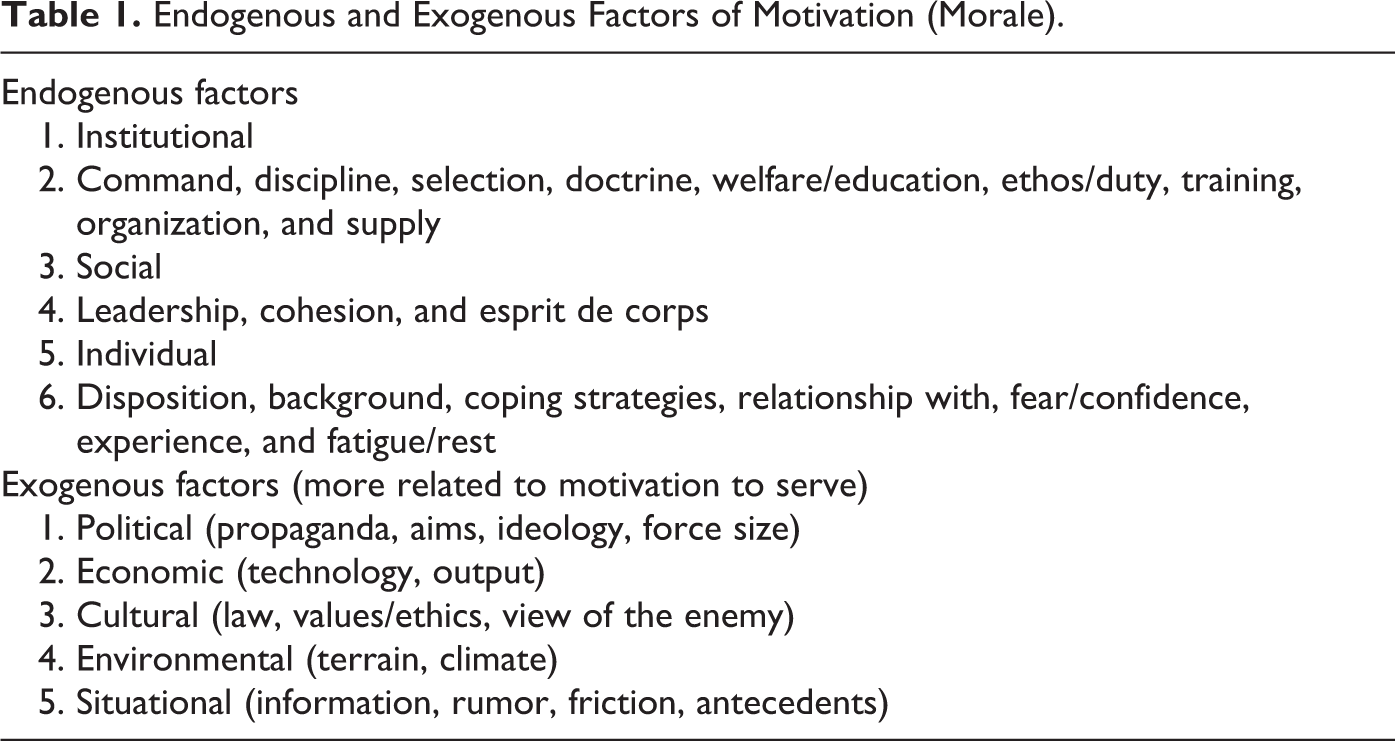
At present, there is no single, coherent theory of motivation to serve. There are only a fragmented set of theories that have developed largely in isolation from one another, sometimes but not always segmented by disciplinary boundaries. Newsome (2003) divided intrinsic motivation theories into the categories of national service, volunteerism, will, warrior spirit, militarism, nationalism, ethnicity, religiosity, morality, social ideology, and political ideology. He suggested that theories of extrinsic motivation including the combat motivation were developed more rigorously and in a more empirically supportable way compared to theories of intrinsic motivation including the motivation to serve (Newsome, 2003). Also, Fennell (2014) conducted an in-depth literature review and explained the factors affecting motivation (in his research, this was described as morale); he categorized these into two groups (see Table 1) and argued that there was a mutual interaction between them. These general endogenous and exogenous factors provide a nearly comprehensive list of factors addressed in the military motivation literature.
Endogenous and Exogenous Factors of Motivation (Morale).
Review of the Literature on Predictors of Motivation to Serve
Moskos’s (1976) occupational and institutional model has generally shaped the measurement methods of predictors in motivation studies (Taylor, Clerkin, Ngaruiya, & Velez, 2015). Scholars following Moskos’s (1976) model have employed commitment and institutional responsiveness as measures of motivation to serve. In particular, they have pointed out some different types of commitment, including institutional, occupational, and moral (Griffith, 2008; Moskos & Wood, 1988; Segal, 1986; Woodruff et al., 2006).
Institutional commitment refers to an emotional condition in which an individual is group-oriented, deeply committed to the organization itself, willing to make sacrifices, and motivated by intangible rewards such as honor and respect (Burland & Lundquist, 2013; Griffith, 2008; Moskos, 1977). According to Griffith (2008), soldiers who were committed to the military as an “institution” were more likely to continue their careers in the military, show a willingness to perform duties, and prioritize the service to country over material rewards. Additionally, Woodruff, Kelty, and Segal (2006) found that soldiers who had reported greater tendencies of being enlisted before the service were more likely to develop institutional commitment and plan to stay in the military. The second form of commitment highlighted by previous studies is occupational commitment, which refers to a condition in which individuals are motivated by tangible and realistic rewards such as money, time, and promotions (Battistelli, 1997; Eighmey, 2006; Griffith, 2008; Moskos, 1977). Woodruff et al. (2006) found that soldiers who had lower tendencies to join the military before their service were generally influenced by occupational and material aspects of the military service. Although to a lesser extent, previous studies also emphasized the importance of moral commitment, which is a condition in which individuals feel obligated to remunerate for the efforts exerted by the institution on their behalf. Thus, they consider leaving the institution as a type of betrayal and are motivated to stay. In other words, individuals become morally or ethically committed or loyal to the institution (Bremner & Goldenberg, 2015; Wakin, 2000). In the light of these studies, we expect to find that “Hypothesis 1: Institutional and moral commitment to the army will be positively associated, and occupational commitment will be negatively associated with motivation to serve.”
According to Griffith (2008), soldiers who are committed to the military as an “occupation” and motivated by the material advantages of it are less likely to remain in the service for a long time and to report to serve the country. This proposition has also shaped the general understanding of the commitment in the TAF. Turkish military practitioners generally prefer those who care less for monetary rewards, and they search for candidates who are more likely to be motivated by unrealistic, abstract, and goal-oriented motivators. Their recruitment strategies are mainly based on the view that a person who is highly motivated by occupational commitment will likely prefer a better civilian job than the military counterpart. Thus, the military institution attempts to lessen the adverse effects of the competitiveness of the job market by seeking out institutionally motivated people instead of those driven by realistic rewards such as high salaries and other benefits.
Along with the studies focusing on Moskos’s I–O model and highlighting the effects of different forms of commitment on motivation to serve, other studies also reported the organizational responsiveness as another factor associated with the motivation to serve (Ben-Dor et al., 2002; Waar et al., 2014). Organizational responsiveness refers to the soldiers’ perceptions regarding the reliability of officers and the institution’s responsiveness to their personal and professional needs. Griffith (2002) suggested that responsiveness as well as respect and consideration—as examples of positive leadership behaviors—can increase a soldier’s mental well-being, gratification, self-worth, self-esteem, and the identification with the leader, unit, and the military organization. Perry, Griffith, and White (1991) argued that the attrition mighty is affected by such factors as an attachment to the unit, reliance, confidence in officers, and the perception of unit commanders as helpful, all of which have also been shown to affect levels of motivation to serve. Based on the findings of previous research (Griffith, 2002; Lebel, 2008), our second hypothesis proposes that “Hypothesis 2: The army’s responsiveness to personnel will be positively associated with motivation to serve.”
Apart from commitment and organizational responsiveness, there may be some other factors that can potentially affect motivation to serve among soldiers. Perceived fairness—as one of these factors—has not been evaluated as a separate factor associated with motivation to serve, but some studies have listed fairness and the law as cultural factors that affect individuals’ motivation (Fennell, 2014). Perceived fairness refers to what personnel thinks about equal treatment at the institution. Turkish sociological studies on hierarchical institutions, specifically on the Armed Forces, have found that perceptions of fairness, adherence to the law, and equality all increase the motivation of personnel (Caglayandereli et al., 2016; Öztürk & Teber, 2006). Also, Kunter’s (2014) study revealed that personnel had listed fairness as the third most important leadership characteristic. Although there is only a limited number of studies on perceived fairness and motivation to serve, findings of these studies may imply that perceived fairness in the military institution—especially in the Turkish context—may have a potential to affect the level of motivation to serve among military personnel. Thus, we expect to find that “Hypothesis 3: Satisfaction with fairness in the army will be positively associated with motivation to serve” (Caglayandereli et al., 2016; Fennell, 2014).
Satisfaction with social benefits is another factor that, to the best of our knowledge, has not been investigated in studies of motivation to serve. It refers to the satisfaction with the privileges provided by the Armed Forces. Some studies on the TAF have shown that the Armed Forces offer particular social benefits to members via reserved areas, commissaries, holiday resorts, military hospitals, mess halls, and transportation opportunities (Unsaldi & Dabagci, 2012). Also, the Armed Forces Trust and Mutual Fund (OYAK) is a rare funding organization that is different from those runs by other modern armies; it provides unique privileges to its member cadres. For example, OYAK’s retirement benefits were at least 3 times greater than those offered to civilian counterparts (Ulusoy, 2016, p. 14). While satisfaction with the social benefits has not been incorporated into the motivation to serve literature before, we believe that having particular privileges as part of the membership to the military institution—as is the case with the TAF personnel—might lead to higher levels of motivation to serve among the personnel. For this reason, our final hypothesis suggests that “Hypothesis 4: Satisfaction with the social benefits provided by the army will be positively associated with motivation to serve.”
To sum up, previous studies have mainly focused on different forms of commitment and organizational responsiveness as potential predictors of motivation to serve in military units. They found that occupational commitment was negatively associated with motivation to serve, while institutional and moral commitment was associated with higher levels of motivation to serve (Battistelli, 1997; Bremner & Goldenberg, 2015; Eighmey, 2006; Griffith, 2008; Moskos, 1977; Wakin, 2000; Woodruff et al., 2006). Organizational responsiveness was also reported to positively affect motivation to serve among military personnel (Ben-Dor et al., 2002; Waar et al., 2014). In addition to these factors that have been examined by extant research, the current study introduces two more variables that may potentially influence motivation to serve in military units—in general—and in TAF—in particular, that are perceived fairness and satisfaction with social benefits. While these variables have never been incorporated into motivation to serve studies, findings of research focusing on these factors in different contexts imply that they may positively affect motivation to serve among soldiers (Caglayandereli et al., 2016; Öztürk & Teber, 2006; Unsaldi & Dabagci, 2012).
Unique Characterization of TAF
Since Turkey has serious security concerns because of its geopolitical region and historical debate, it controls North Atlantic Treaty Organization’s (NATO) second-largest army. This army offers both professional and compulsory service positions. Young men who enlist in response to mandatory recruitment serve 6–12 months and generally take part in low-risk activities. Professional soldiers are military officers (commissioned and noncommissioned), specialists, and contracted privates. TAF has been in combat with the Kurdistan Workers' Party (PKK) terrorist organization for nearly 35 years, and it has carried out numerous military operations mainly in the southeastern part of the country and sometimes through cross-border operations in Iraq and Syria. The issue of motivation to serve in the Turkish military, therefore, is of vital importance, given the needed recruitment numbers and the availability and readiness of personnel for counterterrorism operations. Thus, it is important to reveal factors that might potentially influence the level of motivation to serve in the TAF. To the best of our knowledge, this study is the first academic research that examines the extent and predictors of motivation to serve in the TAF.
Method
Data and Sampling
Data were derived from the Institutional Belonging Survey (IBS), which queried active-duty military officers and NCOs in the Turkish Army. Surveys were conducted during 1 month in May 2016. Military personnel who were surveyed were randomly selected out of all commissioned and noncommissioned military officers in the Turkish Land Forces by extracting from personnel files through the assignment of random registration numbers. Survey questionnaires were distributed and responses collected via an intranet network called KaraNet, a private network accessible only to Turkish Land Forces’ staff. Personnel was informed of the study’s purpose and that participation was voluntary and represented a minimal risk. They were also guaranteed anonymity and assured that their responses would be recorded without individual identifiers; results would be reported only as grouped data.
Of the 5,000 military personnel randomly selected for the survey, 4,060 of them completed surveys and returned their responses (an 81.2% response rate). Males comprised about 99% of the final sample. More than 90% of respondents had some college or a higher educational degree. Also, 35% of respondents were commissioned and 65% were reported as noncommissioned officers. The distribution of respondents’ self-reported incomes was found to be relatively consistent with the initial expectations. Sociodemographic, rank, and unit distributions of the sample were similar to those of all military officers and NCOs in the Turkish Land Forces. From this point of view, it can be determined that the sample sufficiently represented the target population.
KaraNet Network and Data Collection Procedures
As it was mentioned, we collected the data via an internal network called KaraNet. KaraNet is a high-security intranet network with fiber-optic infrastructure, which has no connection to the Internet. It is a network in which officers and noncommissioned officers can log in from the computers that are registered in the system by using their username and passwords, where they can follow their benefits and receive feedbacks. It is possible to enter the system from the units that are delegated all over the country varying from independent military units such as platoons and companies to the Land Forces Command’s headquarter. The control center of the system is at MEBS (communications, electronics, and information systems) Command, which is a branch of Turkish Land Forces located in Ankara, Turkey.
It is possible to collect data and replicate this study by using the KaraNet network with the permission of the Turkish Land Forces Command and the coordination of the Land Forces Command Sociological and Psychological Research Branch Office. The survey we utilized in this study was conducted to a random sample of officers and noncommissioned officers in the Turkish Land Forces by following the guidelines stated above. Survey questionnaires were sent to the personnel confidentially and collected again voluntarily. Data collected were stored without any visible individual identifiers to guarantee anonymity and confidentiality.
Survey Questionnaire
The survey questionnaire consisted of 76 items. The first 17 were questions regarding respondents’ sociodemographic characteristics such as age, gender, income, and educational attainment and military-specific information such as rank, service year, unit location, and branch. The remaining items asked respondents to rate various unit aspects such as quality of unit administration, responsiveness, training, leadership, and interpersonal relationships, as well as individual characteristics such as job performance, motivation to serve, commitment, and satisfaction with the institution’s norms. The questionnaire also included items that were intended to measure their intention to remain in military service under different conditions. The questionnaire concluded by asking respondents to report their satisfaction with the social benefits provided by the institution. Items were taken from questionnaires used in previous studies of retention, motivation, institutional belonging, and related areas and administered to soldiers (some notable examples; Ben-Dor et al., 2008; Griffith, 2008). Survey items were closed-ended phrases to which soldiers responded on a 5-point Likert-type scale ranging from strongly disagree (coded as 1) to strongly agree (coded as 5).
Measures
Dependent variable
This study focused on the motivation to serve of military officers and NCOs during peacetime. Consistent with the measurement techniques employed in the extant research (Ben-Dor & Pedahzur, 2006; Griffith, 2008; Woodruff et al., 2006), the dependent variable, “motivation to serve” was measured based on how much respondents agreed with the following statements: (1) I know that I will be appreciated when I do a good job, (2) I feel intimate with the people with whom I work, (3) I feel much satisfaction during my service, (4) I can use all of my abilities in my job, (5) I think that I have a good job, (6) I outrightly perform any actions above and beyond the call of duty, (7) I benefit from new techniques to be able to perform my duties better, (8) I bring practical solutions to deal with problems, (9) I bring creative ideas to the job environment, (10) When there is a problem, I just ignore it (reverse item), and (11) I will be so happy if I can go on with this job in the remaining part of my career. Responses to each statement ranged from strongly disagree = 1 to strongly agree = 5. To avoid possible bias, 1 of the 11 items was presented as a negative statement that was later reverse-coded. The scores were summed and divided by the number of reports to keep the original scale ranging from 1 to 5. The Cronbach’s α for these items was .86, indicating that the items featured high internal consistency.
Independent variables
Commitment
Consistent with previous research (Griffith, 2008; Moskos & Wood, 1988; Segal, 1986; Woodruff et al., 2006), to reveal the analytical capability of commitment, the current study included three forms of commitment.
Institutional commitment: This refers to an individual who is group-oriented and motivated by intangible rewards (Griffith, 2008; Moskos, 1977). In this study, institutional commitment was computed via the following statements: (1) I don’t feel emotionally attached to this institution (reverse-coded item), (2) I consider institutional problems to be my problems, (3) I don’t feel like a part of the family in this institution (reverse-coded item), and (4) this institution holds a special place in my heart. Response categories for each statement ranged from strongly disagree = 1 to strongly agree = 5. The scores were summed and divided by the number of statements to keep the original scale ranging from 1 to 5. The Cronbach’s α for these items was .75, indicating that the items featured acceptable internal consistency.
Occupational commitment: This is exhibited by individuals who are self-oriented and motivated by tangible rewards (Battistelli, 1997; Griffith, 2008; Moskos, 1977). In this study, occupational commitment was measured by the following statements: (1) I stay in this institution due to reasons beyond my control, (2) I cannot bear the consequences of leaving this institution, (3) If I leave the institution now, my life will be upside down, (4) I stay in this institution because I have no other options, and (5) I stay in this institution because I cannot find another job if I leave. Response categories for each statement ranged from strongly disagree = 1 to strongly agree = 5. The scores of respondents were summed and divided by the number of statements to keep the original scale ranging from 1 to 5. The Cronbach’s α for these items was .76, which indicated that the items featured acceptable internal consistency.
Moral commitment: This refers to a condition in which individuals feel obligated to remunerate for the efforts exerted by the institution. Thus, the individuals become morally or ethically committed or loyal to the institution (Bremner & Goldenberg, 2015; Wakin, 2000). In the current study, moral commitment was measured based on how much respondents agreed that the following statements applied to them: (1) I don’t feel any ethical obligation to continue working in this institution (reverse-coded item), (2) even though it is advantageous to me, leaving this institution now is not proper behavior, (3) I would feel guilty if I left the institution now, (4) this institution deserves my loyalty, (5) I feel obliged to this institution, and (6) I cannot leave this institution now because I feel responsible for other people with whom I work. Response categories for each statement ranged from strongly disagree = 1 to strongly agree = 5. The scores were summed and divided by the number of statements to keep the original scale ranging from 1 to 5. The Cronbach’s α for these items was .85, which indicated that the items featured strong internal consistency.
Organizational responsiveness
The extant research has found the responsiveness of the military organization to the personal needs of soldiers to be strongly associated with motivation to serve (Ben Dor et al., 2002; Waar et al., 2014). In this study, organizational responsiveness was computed by the responses given for the following statements: (1) My superiors give their all to understand me with regard to personal and occupational issues, (2) my superiors embrace their personnel, (3) my superiors support their subordinates even in the hardest times, (4) my superiors do not allocate time to develop their personnel (reverse-coded item), (5) my superiors motivate their subordinates and solidify their will to succeed, (6) my superiors trust their subordinates and hand over their authority to them sometimes, and (7) my superiors serve as a model for their subordinates. Response categories for each statement ranged from strongly disagree = 1 to strongly agree = 5. The scores were summed and divided by the number of statements to keep the original scale ranging from 1 to 5. The Cronbach’s α for these items was .95, which indicated that the items featured a solid internal consistency.
Perceived fairness
The Turkish sociological studies on hierarchical institutions, specifically on the Armed Forces, have found perceived fairness to increase motivation (Caglayandereli et al., 2016; Kunter, 2014; Öztürk & Teber, 2006). In the current study, perceived fairness was measured based on how much respondents agreed with the following items: (1) In this institution, personnel who do a good job are generally appreciated, (2) personal rights are sufficiently protected by this institution, (3) in this institution, the right to legal remedies is protected, (4) I think that this institution does not treat me fairly (reverse-coded item), (5) in this institution, personnel are trusted, (6) in this institution, individuals’ complaints are determined fairly, (7) in this institution, personnel who work hard are held in high esteem, (8) in this institution, personnel’s suggestions are not taken into consideration (reverse-coded item), and (9) in this institution, personnel are treated fairly. Response categories for each statement ranged from strongly disagree = 1 to strongly agree = 5. The scores were summed and divided by the number of statements to keep the original scale ranging from 1 to 5. The Cronbach’s α for these items was .92, which indicated that the items featured a firm internal consistency.
Social benefits
Some studies have presented that TAF provide particular social benefits to its members (Ulusoy, 2016; Unsaldi & Dabagci, 2012). In this study, personnel’s satisfaction with the social benefits provided by the military was measured based on how much respondents agreed with the following statements: (1) I’m satisfied with the social facilities such as officers’ clubs (mess halls) and local educational camps (holiday resorts), (2) I believe that membership in OYAK is very beneficial, (3) I’m not satisfied with the housing opportunities (reverse-coded item), (4) I think that the retirement system is very good for this institution, and (5) I cannot benefit sufficiently from health care services (reverse-coded item). Response categories for each statement ranged from strongly disagree = 1 to strongly agree = 5. The scores were summed and divided by the number of statements to keep the original scale ranging from 1 to 5. The Cronbach’s α for these items was .75, which indicated that the items featured an acceptable internal consistency.
Military background variables
The current study controlled for survey respondents’ military-specific characteristics in an attempt to observe the relationships among the dependent and independent variables when these variables were controlled. Respondents’ ranks were measured by an open-ended question asking them to report this information. Responses were then coded, such that the highest score indicated the highest rank, ranging from 1 = sergeant (E-5) to 7 = colonel (O-6). Respondents’ unit type was measured as 1 = military headquarters and educational institutions and 2 = military units. Respondents’ service years were measured based on a question asking how long they had worked for the military. The highest score indicated the highest number of service years.
Sociodemographic variables
Along with the military background variables, the current study also controlled for some sociodemographic factors that might affect the relationship between motivation and other variables. Marital status was coded as a dichotomous variable, by “1 = single and 2 = married. Previous studies demonstrated that having children was one of the important factors leading to higher levels of motivation (Bourg & Segal, 1999; Segal, Segal, Bachman, Freedman-Doan, & O’Malley, 1998). In this study, respondents’ number of children was measured by a question asking their number of children. Response categories ranged from 0 = no children” to 6 = 6 or more children.
Analytic Strategy
Since the dependent variable was normally distributed, an ordinary least squares (OLS) regression estimation was employed to assess the hypotheses. In total, two OLS regression models were evaluated. In Model 1, only independent variables (i.e., commitment, organizational responsiveness, perceived fairness, and social benefits) were included to delineate the relationships between motivation and the variables as it is expressed in the following equation:

In Equation 1, b 0 represents the random intercept value, while b 1, b 2, b 3, b 4, b 5, and b 6 represent the unstandardized coefficients of the institutional commitment (X 1), moral commitment (X 2), occupational commitment (X 3), responsiveness (X 4), fairness (X 5), and social benefits (X 6), respectively, which indicates the unique effects of these variables on the value of motivation to serve (Y (Motivation)). The epsilon (ε) represents the random error, which is uncorrelated with the independent variables and has a constant variance and zero population mean.
In Model 2, military background and sociodemographic variables were added to the analysis as controls to elucidate the differences in the relationships among the dependent and independent variables when the control variables were held constant. The regression equation for Model 2 is as follows:

As Equation 2 demonstrate, in Model 2, rank (X 7), unit type (X 8), service years (X 9), marital status (X 10), and number of children (X 11) were incorporated into the analysis as control variables. Impacts of these variables on the value of motivation to serve (Y (Motivation)) are represented by the terms, b 7, b 8, b 9, b 10, and b 11, respectively. As it is the case with Equation 1, the epsilon (ε) represents the random error, which is uncorrelated with the independent variables and has a constant variance and zero population mean. As was stated earlier, we established four hypotheses proposing that (1) institutional and moral commitment to the army will be positively associated and occupational commitment will be negatively associated with motivation to serve, (2) the army’s responsiveness to personnel will be positively associated with motivation to serve, (3) satisfaction with fairness in the army will be positively associated with motivation to serve, and (4) satisfaction with the social benefits provided by the army will be positively associated with motivation to serve. Linking our hypotheses to the equations above, we expected to find the coefficients, b 1, b 2, b 3, b 4, b 5, and b 6 to be significantly associated with motivation to serve (p < .01). Except for the coefficient of occupational commitment (b 3), all other coefficients were proposed to have positive values, suggesting positive relationships with motivation to serve.
Results
Descriptive Statistics
Table 2 presents the descriptive statistics of the variables analyzed for the current study. Starting with the dependent variable, the average score for motivation among military officers and NCOs was approximately 3.72 with a standard deviation of 0.65, suggesting that the level of motivation to serve among TMO and NCOs was higher than the midpoint on a 5-point Likert-type scale. As stated above, the commitment was measured by three different categories: institutional, moral, and occupational. The descriptive statistics showed that the average score for institutional commitment was approximately 3.66, while it was 3.46 for moral commitment and 2.54 for occupational commitment on 5-point Likert-type scale; indicating that the most prevalent type of commitment among the military officers and NCOs was institutional commitment. The average score for organizational responsiveness was about 3.00 with a standard deviation of 0.82, showing that the level of perceived organizational responsiveness among TMO and NCOs was at the midpoint on a 5-point scale. The descriptive statistics also revealed that the average rating for the perceived fairness of the military was about 2.86, with a standard deviation of 0.93, that the mean number was below the midpoint on a 5-point scale. Finally, the descriptive analyses showed that the average score for the social benefit was 3.12 with a standard deviation of .78, which was higher than the midpoint on a 5-point scale.
Descriptive Statistics.
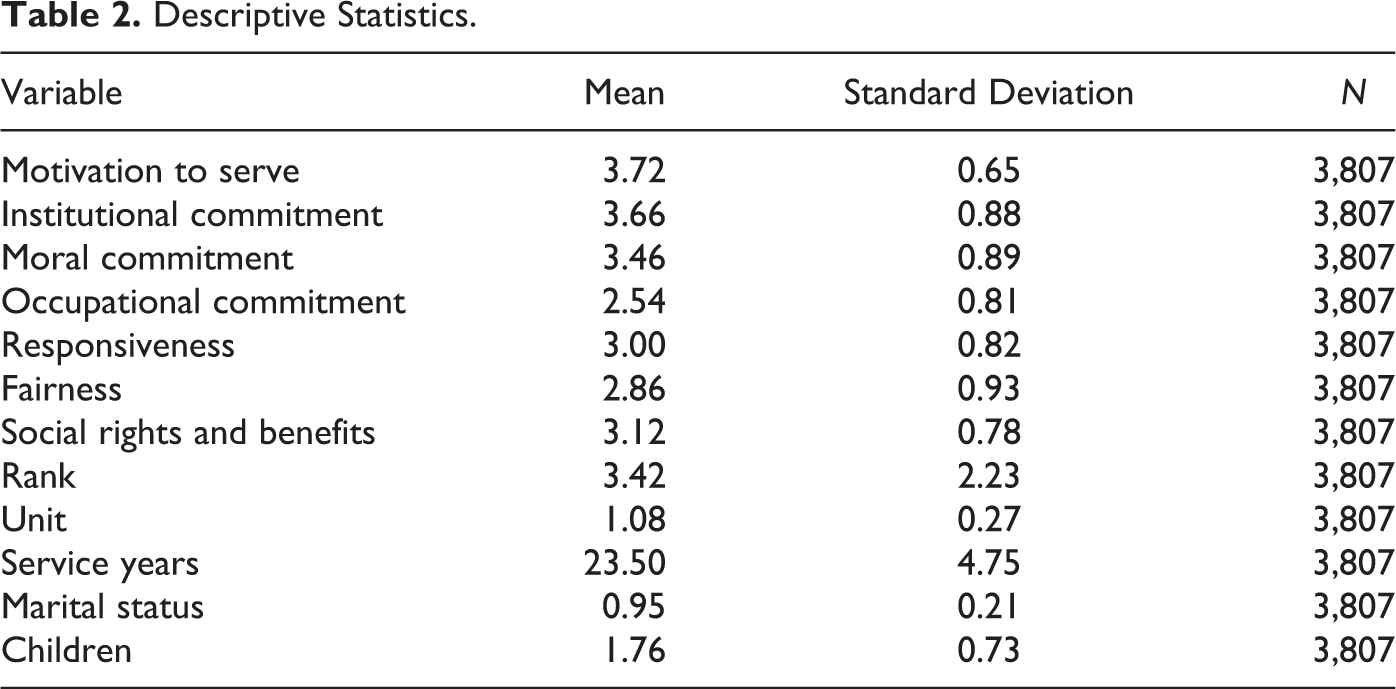
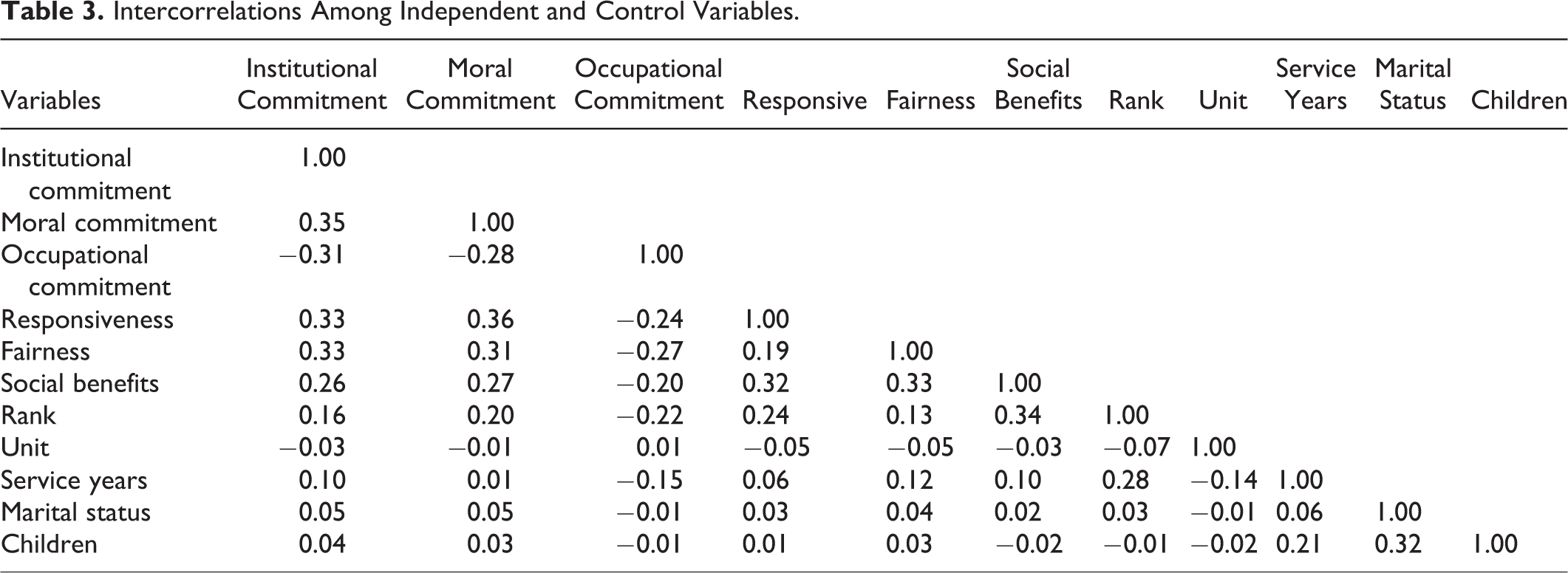
The descriptive statistics for the military background variables highlighted that the average number of service years was 23.50 and most of the respondents held the ranks of sergeant major, first lieutenant, or captain (E-9 to O-3). About 92% of the sample worked in military units while about 8% of the respondents worked in military headquarters and educational institutions. In addition to the military background variables, the descriptive analyses for the sociodemographic variables revealed that about 95% of the sample was married. The average score for number of children was about 1.76 with a standard deviation of 0.73, which suggests that the number of children for the majority of the respondents, on average, ranged from 1 to 3. Lastly, as it was presented in Table 3, the analysis of intercorrelations between predictor variables demonstrates that the highest level of correlation was found between moral commitment and responsiveness, which was about .36. The correlations between all other variables were lower than .36. This indicates that the multicollinearity should not be considered a problem for the current study.
Intercorrelations Among Independent and Control Variables.
OLS Results
Table 4 presents the OLS regression results showing the associations between motivation to serve and the other variables. As was stated above, two different models were created for this analysis. In both models, about 66% of the variance in the dependent variable, motivation to serve, was explained by the independent variables, which indicated that both models fitted the data well (see R 2 values). In Model 1, only the independent variables were entered into the analysis and their relationship to motivation was analyzed. The results of Model 1 indicate that all types of commitment were significantly associated with the motivation to serve. While the direction of the associations was positive for institutional (B = .13, p < .001) and moral (B = .17, p < .001) commitment, occupational commitment had a negative relationship with motivation (B = −.07, p < .001). Along with commitment and in support of initial expectations, organizational responsiveness (B = .28, p < .001), perceived fairness (B = .09, p < .001), and satisfaction with social benefits (B = .02, p < .05) were all significantly and positively associated with motivation to serve.
Predictors of Motivation to Serve Among TMO and NCOs.
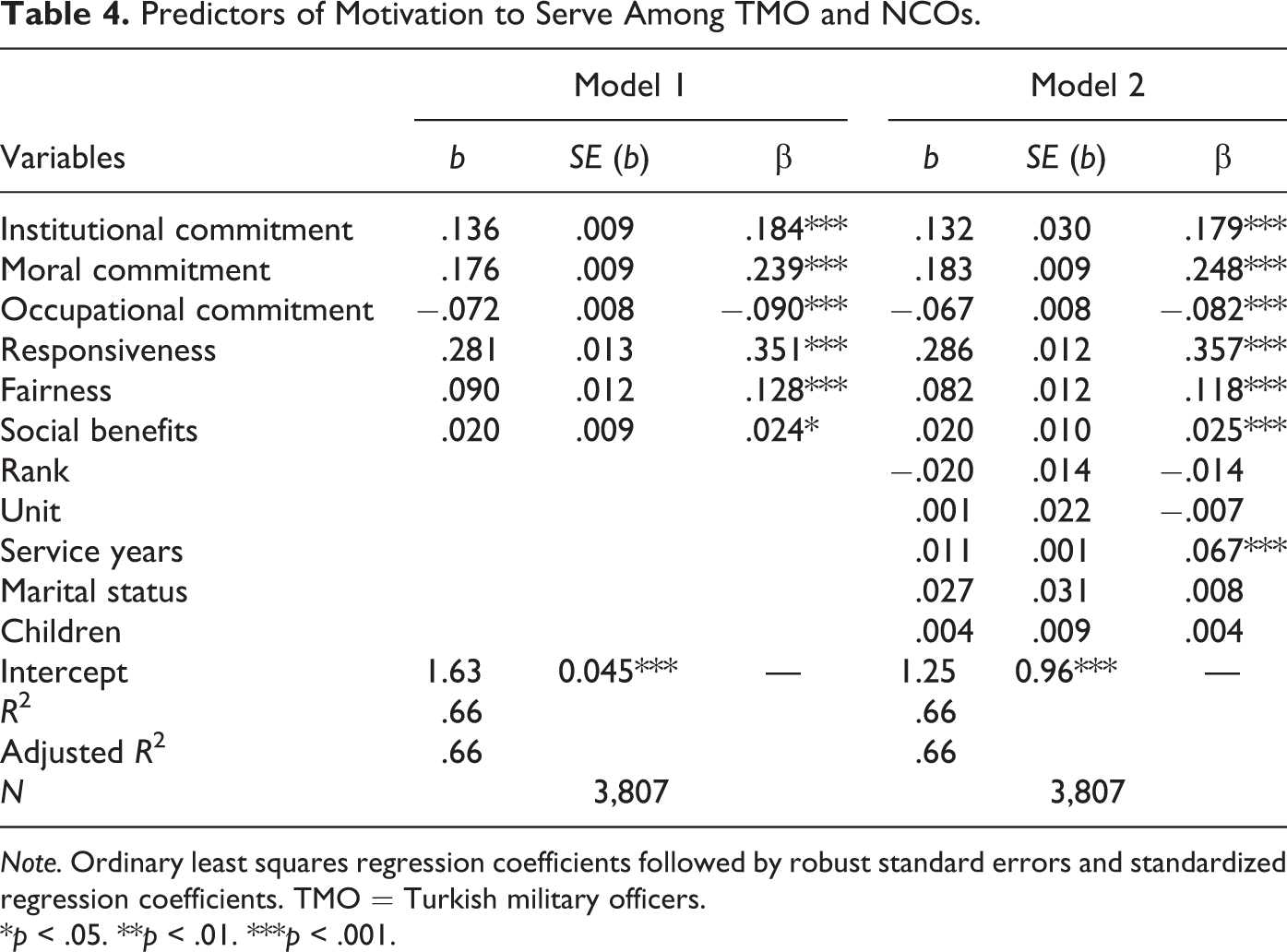
Note. Ordinary least squares regression coefficients followed by robust standard errors and standardized regression coefficients. TMO = Turkish military officers.
*p < .05. **p < .01. ***p < .001.
In Model 2, military background and sociodemographic controls were added to the analysis, which did not change the percentage of the variance in the dependent variable explained by independent variables. Holding the other variables constant, the results indicate that all types of commitment were significantly associated with the motivation to serve. Specifically, institutional (B = .13, p < .001) and moral (B = .18, p < .001) commitment were positively associated with motivation to serve. Occupational commitment, on the other hand, was negatively associated with motivation to serve (B = −.06, p < .001). The results regarding the effects of commitment on motivation to serve confirmed our first hypothesis, which proposed that institutional and moral commitment to the military would be positively associated and occupational commitment would be negatively associated with motivation to serve (Bremner & Goldenberg, 2015; Griffith, 2008; Moskos, 1977).
Along with commitment, organizational responsiveness (B = .28, p < .001) was positively associated with motivation to serve, which was a finding supporting the second hypothesis that the army’s responsiveness to personnel would be positively associated with motivation to serve (Griffith, 2002; Lebel, 2008). The third hypothesis of the study suggested that satisfaction with fairness in the military would be positively associated with motivation to serve (Caglayandereli et al., 2016; Fennell, 2014). Supporting this hypothesis, findings revealed that perceived fairness (B = .08, p < .001) was significantly and positively associated with motivation to serve. Finally, the fourth hypothesis of the study proposed that satisfaction with the social benefits provided by the military would be positively associated with motivation to serve. Findings supported the hypothesis by revealing that satisfaction with social benefits was positively and significantly associated with motivation to serve, if all else was kept equal (B = .02, p < .05). The contribution of social benefits to the variance in the dependent variable, however, was too little given the large sample size. Every 1-point increase in the level of satisfaction with social benefits resulted in only 0.02-point increase in the level of motivation to serve on a scale ranging from 1 to 5. With respect to the relative contribution of each scale to the variance in the dependent variable, the standardized coefficients (β) reveal that organizational responsiveness was the most important variable (β = .357), followed by moral commitment (β = .248), institutional commitment (β = .179), perceived fairness (β = .118), occupational commitment (β = −.082), and social benefits (β = .025). Regarding the military background variables, service year was significantly and positively associated with motivation to serve (B = .01, p < .001), while the others (i.e., rank, unit type, and status) showed no significant relationship. Analysis of the sociodemographic variables (i.e., marital status and number of children) also showed no meaningful relationship to motivation to serve.
Discussion and Conclusion
This study examined motivation to serve among a sample of currently serving military officers and NCOs in TAF. One of its primary goals was to test the effectiveness of measures proposed by previous studies in explaining the motivation to serve in a different context—namely, TAF. According to Caforio (2006), military sociological studies were generally conducted in the first-level countries including the United States and some European countries. Findings of the current study demonstrated that the predictors of motivation to serve derived from previous studies that have been conducted on Caforio’s first-level countries could also be valid for a TAF-specific measurement of motivation to serve. More specifically, based on the findings of previous research, we developed the first two hypotheses, proposing that (1) the institutional and moral commitment to the military would be positively associated and occupational commitment would be negatively associated with motivation to serve (Bremner & Goldenberg, 2015; Griffith, 2008; Moskos, 1977) and (2) the military’s responsiveness to personnel would be positively associated with motivation to serve (Griffith, 2002; Lebel, 2008). We found that organizational responsiveness, institutional commitment, and moral commitment had significant and positive relationships with motivation to serve. Occupational commitment, on the other hand, had a significant and negative association with motivation to serve. Griffith (2008) suggested that soldiers who were committed to the military as an “occupation” and motivated by the material advantages of it were less likely to remain in the service for a long time and to report to serve the country. The same idea was also presented in multiple studies (i.e., Eighmey, 2006; Moskos, 1977; Woodruff et al., 2006). Thus, findings of this study concerning institutional, moral, and occupational commitment and organizational responsiveness were in parallel with previous studies and supported our first two hypotheses.
The second goal of the current study was to build on the existing body of knowledge by revealing the impacts of perceived fairness and satisfaction with social benefits on motivation to serve among military personnel, which represented the first attempt to incorporate these variables into the literature on motivation to serve. While these variables have not been separately examined as potential predictors of motivation to serve before, findings of some studies may imply that perceived fairness and satisfaction with social benefits in the military institution—especially in the Turkish context—may have a potential to positively affect the level of motivation to serve among military personnel (Caglayandereli et al., 2016; Kunter, 2014; Öztürk & Teber, 2006). From this point of view, our third and fourth hypotheses proposed that (3) perceived fairness in the army would be positively associated with motivation to serve and (4) satisfaction with the social benefits provided by the army would be positively associated with motivation to serve. Findings revealed that both perceived fairness and social benefits derived from the unique characterization of the TAF had significant and positive relationships with motivation to serve, which confirmed our third and fourth hypotheses.
The current study may enhance the general understanding of motivation to serve in the military and contribute to the relevant literature in several ways. First, Turkey, as a member of NATO, has a predominantly Western military education system, though its institutions have been changed dramatically after the coup attempt on July 15, 2016. TAF also has a long military history, culture, traditions, and characteristics that proceed with the influence of the West, and thus the TAF is not, strictly speaking, a regular Western army. From this point of view, by examining the issue of motivation to serve in the Turkish context, results of the current study support and reinforce the findings of previous studies in respect to influences of different forms of commitment and organizational responsiveness on motivation to serve in the military. Second, this study introduced new variables including perceived fairness and satisfaction with social benefits to the literature of motivation to serve and revealed that both variables were positive significant predictors of motivation to serve. These findings may provide important implications for future research that will be conducted in other countries’ military organizations. Third, prior research on motivation to serve has generally lacked sizable active-duty samples and access to units beyond infantry. This study provided a substantial body of active-duty data and covered some different units. Finally, this study had utilized the IBS, which was conducted to TMO and NCOs only 2 months before the coup attempt that took place on July 15, 2016, in Turkey. Thus, its findings are invaluable in terms of showing the motivational atmosphere among military officers and NCOs just before the coup attempt.
Aside from the crucial contributions of the current study, it is important to note some limitations. The first concern was the generalizability of the results. Since this study was limited to the context of TMO and NCOs, the results cannot be generalized to military institutions of other countries or conscripts of the TAF. Despite the generalizability issue, however, this study still represents an important attempt as its results might have implications for the effectiveness of existing measures and the feasibility of utilizing perceived fairness and satisfaction with social benefits in explaining the motivation to serve. In addition to the generalizability issue, this study lacks certain demographic variables when compared to similar studies conducted in other countries. Race and ethnicity, for instance, were not included in the analysis. This is because there were not strict lines distinguishing one ethnic group from others in the Turkish Army, meaning that identifying different ethnicities was very difficult. Likewise, since about 99% of the sample was male, gender was also not included in the analyses to prevent potential biases. Finally, some of the coefficients that were found to be statistically significant (e.g., social benefits and service years) were relatively small in value, and they might be significant largely due to the large sample size of the study.
Given the results of this study, further research is needed to develop its findings. First, as was stated earlier, this study was not able to measure racial/ethnic differences regarding the motivation to serve. Future research should address this issue since the motivational predictors of Kurdish military personnel in TAF serving in predominantly Kurdish areas may be different from those of other personnel. Second, though the survey included female military officers and NCOs, they were insufficient in number; their representation was less than 1%. Future research should encourage women to participate or conduct a separate study solely for female army personnel. Finally, replicating this study in other countries’ military organizations would be of great importance to reinforce the findings of this study with regard to the feasibility of utilizing our new variables (i.e., fairness and social benefits) in explaining the motivation to serve in the military.
Footnotes
Declaration of Conflicting Interests
The authors declared no potential conflicts of interest with respect to the research, authorship, and/or publication of this article.
Funding
The authors received no financial support for the research, authorship, and/or publication of this article.
